


Showing posts with label War On Protest. Show all posts
Showing posts with label War On Protest. Show all posts
Tuesday, February 04, 2014
No More Peaceful!
This is an Egyptian song, in Arabic only, declaring that there will be no more peaceful protests with criminals and murderers (the illegal and unelected regime that was installed by Egypt's military).


Tuesday, June 04, 2013
Is Turkey In Turmoil?
Courtesy Of Al-Jazeera
It started as a protest over a park, but plans to redevelop a public open space in Istanbul have sparked wider civil unrest. Tens of thousands have joined nationwide protests, directed at the government.
Dozens of demonstrations have taken place in 48 cities across the country, rights groups have accused police of being excessively heavy-handed.
They say two people have been killed and more than a thousand injured - although this has not been confirmed. Turkey's Prime minister Recep Tayyip Erdogan has admitted that mistakes were made.
But he is also accusing opponents of using Friday's initial protest over the park to stir up wider unrest.
"They are talking about a shopping centre, what we are referring to is not a usual shopping centre, you can't build it there, there hasn't been a decision for this centre, maybe we will build a city museum there or a venue for different activities. Have you got any documents about what will be built there? No, but they bring people to protest anyway," said Erdogan.
Prime Minister Recep Tayyip Erdogan,was elected prime minister in 2003, as leader of the Justice and Development Party, known as the AK party, which has its roots in political Islam.
Throughout much of the next decade he steered the country through a period of strong economic growth. And he also improved Turkey's international stature - both regionally and globally.
Erdogan's AK party was elected to a third term in 2011. But in recent years government has faced growing accusations of authoritarian rule and so-called 'islamisation' - critics cite concern over the intimidation of journalists; laws restricting alcohol; and banning kissing in public.
And hints that Erdogan may be looking to change the constitution to allow him to run for another term have strengthened that perception.
So will these protests tarnish Turkey's image as a model for the melding of Islam and democracy?
To discuss this, Inside Story, with presenter Jane Dutton, is joined by guests: Mustafa Akyol, a columnist for the leading Turkish newspaper Hurriyet Daily News; Fadi Hakura, an associate fellow at Chatham House, and a Turkey specialist; and Cengiz Temil, one of the protesters.
"Erdogan is a democratically-elected leader .... However, he has been too defiant, too threatening to the people who do not support him … and in the past few months especially by his new regulations on limitation of alcohol use ... by naming a bridge after a controversial Ottoman sultan, he just flamed the culture war that is in this country. So he is legitimate there ... but he is not acting very liberal, and not very participatory. I think he should take a lesson from this incident and move on, and to try to listen to those who don't agree with him … he should be able to build consensus ... "
- Mustafa Akyol, a columnist for Hurriyet Daily News
Saturday, December 22, 2012
Predicting The Future Through Online Data Mining

The information to predict whether tomorrow it will rain is limited by the number of weather sites available, but sites that might refer to upcoming anti-American demonstrations in the Middle East are infinitely more numerous [AFP]
Recorded Future predicts When and Where A Demonstration Will Occur After Mining From The Web All The Related Activities.
By Santiago Zabala,
Martin Heidegger's greatest concerns when it came to technological innovations was the formation of existential conditions where, as he said, the "lack of emergency is the only emergency". In this condition human beings would be completely "uprooted" from the earth, that is, "framed" ("Ge-stell") by a technological power they are no longer able to control.
As it turns out, the software company Recorded Future (which has recently been praised by Wired, the MIT Technology Review and other media outlets, after the CIA and Google invested millions in their services) seems to be offering its clients something similar: a world where emergencies, that is, future events, can be calculated in advance. But how does this start-up actually function, and why are the German philosopher’s concerns relevant to its services?
Recorded Future is based in Gothenburg and has offices in London, Boston, Arlington and New York. A team of 20 computer scientists, statisticians and experts in linguistics "calculate" the future. While Yahoo, Google and Bing use links to connect and rank different web pages, Recorded Future goes further by scouring (in real time) thousands of available information sources such as blogs, websites and Twitter comments in order to find "invisible links", that is, relationships among actions, people and institutions that refer to related events in the future.
| "Recorded Future is based in Gothenburg and has offices in London, Boston, Arlington and New York. A team of 20 computer scientists, statisticians and experts in linguistics 'calculate' the future." |
After mining from the web all the related people ("Bashar al-Assad"), places ("Syria") and activities ("military interventions") that refer to a possible demonstration, Recorded Future uses algorithms to predict when and where a demonstration will occur.
An example of a predicted demonstration is available in a video on the company website which illustrates how its powerful engines monitor these protests not only in the Middle East, but also in South America and North Africa. The fact that Google and the CIA have already invested millions in this company is an indication that it will be used to conserve certain interest against others as the example above indicates.
The different fee levels for the customers of Recorded Future are probably related to the quality and quantity of information they wish to purchase, making this, and similar companies, at the service of the wealthiest and most powerful.
From a philosophical point of view, the most interesting feature of all this is not that these demonstrations can be predicted, but rather how technology has finally uprooted and dislodged man from the world, that is, has given human existence to a power beyond human control. The secured, comfortable and calculated environment that allowed the creation of society has now become so functional and rationalised that we cannot help but become victims by existing in it.
This existential dilemma does not arise from the fact that it’s finally possible to organise all the things the web already knows about the future, which could certainly become useful to prevent diseases or famine, but rather that a private company now means to know everything, that is, all human projects.
We have entered an age where only those framed within the approved interests of Recorded Future clients will be able to live freely, that is, without being predicted. But how free is an existence that is completely revealed to the modern "lack of emergencies"?As Heidegger explained, emergencies do not arise when something doesn't function correctly, but rather when "everything functions … and propels everything more and more toward further functioning". It's within this logic that as soon as something critical to the interests of those who can afford it fails to function, Recorded Future will alert its customers, who will then take the appropriate measures to conserve the previous condition.
In sum, Heidegger's concerns over a world lacking "emergencies" more than 50 years ago was meant to point out how technologies such as that employed by Recorded Future (and similar companies) aim to avoid the future, that is, to change the world.
Via: "Al-Jazeera"
Via: "Al-Jazeera"
Friday, August 17, 2012
Suppressing Protest

Human Rights Violations In The U.S. Response To Occupy Wall Street
A group of legal experts have published a report detailing "abusive and unlawful protest regulation and policing practices" by New York police in response to Occupy Wall Street protests.
The report, Suppressing Protest: Human Rights Violations in the U.S. Response to Occupy Wall Street, examines treatment of protestors and journalists by local, state, and federal authorities from September 2011 through July 2012.
The eight-month investigation – carried out by law clinics at NYU, Fordham, Harvard and Stanford – documents instances in which authorities acted in ways that "suppress and chill protest rights" and violate international obligations to respect free assembly and expression.
These include excessive or unnecessary use of force, massive and continuous over-policing, obstruction of press freedoms and legal monitoring, constant surveillance, accountability and transparency failures, unjustified restrictions on peaceful assembly and arbitrary rule enforcement.
The first appendix of the 132-page report lists 130 incidents of excessive or unnecessary physical force by police in New York City.
A few examples (with video links):
September 24, 2011: A protester was being surrounded and held by three officers... One of the officers then pushed him to the ground... officers then proceeded to handcuff and arrest the protester.
October 5: An officer took at least three two-handed overarm swings at protesters. Some of the protesters are holding cameras, and at least one protester had his hands in the air as if signaling the officer to stop.
November 17: An officer threw another protester to the ground who was standing between police and their target... The video then shows another officer appearing to strike the apprehended protester several times with downward jabbing motions of his baton.
January 1, 2012: An officer lifted a metal barricade with both hands, causing it to move up in the direction of a protester’s face. The video appears to show that the protester was struck in the face by the top bar of the barricade.
March 17: An officer [at 4:11] grabbed a protester out of the arms of another officer... Approximately six other officers then surrounded the protester, grabbed at his head and arms, ripped the mask off his face and pushed him to the ground.
The authors call for the city to establish an inspector general to oversee the police department, a review of the city’s response to the protests and the creation of new guidelines for policing them, and the prosecution of officers found to have broken laws.
If the NYPD fails to respond to these suggestions, the group said, it will ask the Department of Justice to investigate their complaints.
Further detailed studies from the Protest and Assembly Rights Project will be published in the coming months about police response in Boston, Charlotte, Oakland, and San Francisco.
Via: "Business Insider"
The Report: "About The Protest and Assembly Rights Project"
Wednesday, August 08, 2012
US Policing: Institutionalising Brutality
Extreme police tactics are not a new phenomenon in the US. But in the age of social media, police violence, such as the shooting of unarmed people and the use of pepper spray and taser guns, are being documented for the world to see.
Occupy protesters throughout the country felt the full force of police tactics - many were subject to violent arrest.
Perhaps the most controversial example was at the University of California, Davis (UC Davis) where peaceful protesters were pepper sprayed last November.
It is more than 20 years since a recording of police violence sparked riots in Los Angeles. The beating of Rodney King was caught on video and the footage shocked the world.
But two decades later how much has changed?
On Saturday, police in the Californian city of Anaheim shot and killed Manuel Diaz, an unarmed man who they said was running from them, hitting him in the leg and the back of the head.
On Saturday, police in the Californian city of Anaheim shot and killed Manuel Diaz, an unarmed man who they said was running from them, hitting him in the leg and the back of the head.
Police said he and another young man shot dead the following day were both gang members. But local residents say the Latino men were victims of racial profiling and an overly aggressive police force.
The community reacted furiously and on Tuesday night, when protesters attempted to attend a city council meeting, they were barred from entering city hall by police who said the meeting room was full.
The community reacted furiously and on Tuesday night, when protesters attempted to attend a city council meeting, they were barred from entering city hall by police who said the meeting room was full.
The clashes between protesters and police have now gone on for several days and nights. In one incident, police fired rubber bullets at near point blank range and police dogs attacked protesters. Mobile phone footage of the incident went viral, attracting nationwide attention.
Anaheim's mayor says federal officials have agreed to investigate the shootings. But the city, where there have been six fatal police shootings this year, is now being compared to a powder keg.
So is policing in the US becoming increasingly militarised?
"I've lived in this community my whole life and it's sad when you have to be scared for your kids to go outside."
Louisa Sanchez, a protester
Monday, August 06, 2012
America's Descent Into Darkness
Slouching Towards Nuremberg
MORRIS BERMAN writes,
Strange things are happening in the United States these days, and every day seems to bring additional scary news. The similarity to the erosion of civil liberties in Germany during the 1930s is a bit too close for comfort. Many will regard this statement as hyperbole, and, to some extent, it is. But let’s take a close look at what is going on before we dismiss the comparison out of hand.
MORRIS BERMAN writes,
Strange things are happening in the United States these days, and every day seems to bring additional scary news. The similarity to the erosion of civil liberties in Germany during the 1930s is a bit too close for comfort. Many will regard this statement as hyperbole, and, to some extent, it is. But let’s take a close look at what is going on before we dismiss the comparison out of hand.
In terms of the historical record for Germany, legal discrimination against Jews certainly existed before the Nuremberg Laws of 1935, and grew steadily over time. There was always a feeling in the Jewish community—most of whom regarded themselves as Germans, after all—that “OK, that’s the worst of it.” Hence, the decision to stay. Then came the next set of restrictions, and again the response: “This is as far as it will go.” It was like the classic experiment of turning up the heat on frogs placed in warm water. Gradually, they get boiled to death, because the increase of heat is incremental. It was only toward the end of the thirties that the choice began to look like: jump or die. Finally, it became simply, die.
In 1933, the Law for the Restoration of the Professional Civil Service banned “non-Aryans” from the civil service.
In 1935, the Nuremberg Laws deprived Jews of German citizenship and prohibited marriage between Jews and “Aryans.” They also prohibited sexual intercourse between Jews and “Aryans,” and the employment of “Aryan” females under forty-five years of age as domestic workers in Jewish households. In addition, Jews could not work as lawyers, doctors, or journalists; could not use state hospitals; and could not be educated by the state past the age of fourteen. They could not enter public parks, libraries, or beaches, and could not receive winnings from the national lottery.
In 1938, Jews with first names that were not characteristically Jewish had to adopt the middle name Sara (if female) or David (if male). Passports of German Jews were stamped with a “J”.
In 1939, Jews living in German-occupied Poland had to wear the yellow star. This was extended to all Jews living within Nazi-controlled areas in 1941.
By way of comparison, one thing that makes me particularly nervous is what has been called the “conspiracy of silence.” Almost nobody spoke up in Germany as this process was unfolding, and the American public has been similarly silent about the events documented below. Indeed, I would venture to say that 98% of the American public (maybe more) is unaware of events such as these, or of the passage of repressive legislation, and that they wouldn’t care even if they did know about it. (“Hey, I ain’t no Ay-rab!”) The classic quote that has come down to us is from Martin Niemoeller, a German pastor and theologian who wound up in the Sachsenhausen and Dachau concentration camps (he was liberated by the Allies in 1945). It goes something like this:
“First they came for the communists, but I didn’t speak out because I wasn’t a communist. Then they came for the trade unionists, but I didn’t speak out because I wasn’t a trade unionist. Then they came for the Jews, but I didn’t speak out because I wasn’t a Jew. Then they came for me, but by that time there was no one left to speak out.”
The signs of a gradual slide towards Nuremberg, and concomitant citizen apathy, are very much present in the current political milieu. Let’s have a look at what has been going on in the decade since 9/11. I’m going to discuss the following topics:
I. The creation of a political climate in which the police are out of control, arbitrarily free to intimidate anyone for virtually anything
II. The persecution of whistleblowers, protesters, and dissenters
III. The dramatic expansion of the surveillance of American citizens on the part of the National Security Agency (NSA)
IV. The corruption of the judicial system by means of show trials of Muslim activists
V. The construction of political detention centers, also known as Communication Management Units (CMU’s)
VI. The shredding of the Bill of Rights by means of the National Defense Authorization Act
VII. Future scenarios: The “disappearing” of intellectual critics of the U.S. government?
I. The creation of a political climate in which the police are out of control, arbitrarily free to intimidate anyone for virtually anything
The evidence for this is perforce anecdotal, but events such as the ones discussed below are getting to be so common that we have to keep in mind that when you have accumulated enough anecdotes, the result is called “data.”
-In June 2011 the sheriff of Nelson County, North Dakota, called in a Predator B drone from the local Air Force base to capture three men who had stolen some cows. Once the unmanned aircraft located the suspects, police rushed in to make the first known arrests of U.S. citizens with the help of a Predator spy drone. It turns out that predator drones are frequently used for domestic investigations all over the U.S.—by the FBI, the Drug Enforcement Administration, and by state and local law enforcement officials.
-In July 2011 police in a small town in Georgia shut down a lemonade stand being run by three girls, ages 10-14, who were trying to save up for a trip to a local water park. The police said that they didn’t know what was in the lemonade; and in addition, that the girls needed a business license, a peddler’s permit, and a food permit in order to run the stand. The permits, by the way, cost $50 a day.
-In January 2012 the library system of Charlton, Massachusetts, called the police to collect some overdue books charged to Hailey Benoit—a five-year-old girl.
-Also in January 2012, a young couple was arrested in Baltimore for asking a police woman directions to highway I-95. They spent the night in jail.
-In April 2012 the Supreme Court ruled that jail authorities may strip search people arrested for minor offenses before they are jailed while awaiting a hearing. Individuals have been strip searched for offenses such as biking with an inaudible bell, walking a dog without a leash, and driving with a noisy muffler. The sexual humiliation involved in these searches, writes Naomi Wolf, is clearly a way of keeping the masses in line, politically docile. How long, she asks, before saying anything controversial online or on the phone (see Item III, below) will result in the “guilty” party facing arrest and sexual humiliation? I think we need to pause a moment before we summarily dismiss this as paranoia.
II. The persecution of whistleblowers, protesters, and dissenters
This has been going on throughout the past decade, first under President Bush, and then more aggressively under President Obama. According to the New Yorker, “the Obama Administration has pursued leak prosecutions with a surprising relentlessness.” To which the New York Times added: “In 17 months in office, President Obama has already outdone every previous president in pursuing leak prosecutions.” In the famous case of Bradley Manning, who revealed government documents to  Wikileaks, Mr. Obama publicly declared him guilty before he went to trial or was convicted of a crime. The overall result is that the government has basically criminalized public servants who speak out to expose waste or corruption or unethical behavior. Whistleblowing and dissent have, in themselves, become criminal activities.
Wikileaks, Mr. Obama publicly declared him guilty before he went to trial or was convicted of a crime. The overall result is that the government has basically criminalized public servants who speak out to expose waste or corruption or unethical behavior. Whistleblowing and dissent have, in themselves, become criminal activities.
-Since 2006 the filmmaker Laura Poitras, who made a documentary about the U.S. occupation of Iraq, has been detained and questioned at airports more than forty times. Government agents confiscate her computer and notebooks without a warrant. She is hardly an isolated case. With no oversight or legal framework for its activities, the Department of Homeland Security routinely singles out individuals who are suspected of no crimes, detains them at the airport when they return to the U.S. from an international trip, and then seizes their laptops, cameras, cellphones, notebooks, and credit card receipts.
-William Binney, an intelligence official who worked for the NSA for nearly forty years, resigned in October 2001 when massive domestic spying became the norm. Binney and several other NSA officials reported their concerns about this to Congress and the Department of Defense. In 2006, he exposed the NSA practice of installing secret monitoring rooms in major U.S. telecommunications facilities. Finally, in 2007, a dozen FBI agents charged into his house with guns drawn, pointed their weapons at his head, and interrogated him at length. Three other ex-NSA employees were raided the same day.
- You can now go to jail in the United States simply for speaking. In July 2011, environmental activist Tim DeChristopher was sentenced to two years in prison for his repeated declaration that environmental protection required civil—i.e., nonviolent—disobedience. One wonders if the same judge, Dee Benson, would have also put Rosa Parks and Mahatma Gandhi in jail, had he been around during their lifetimes.
-In March 2012 the president signed H.R. 347, the so-called trespass bill, into law, which allows the government to jail anyone protesting near someone with Secret Service protection for up to ten years. This makes it quite easy for the government to criminalize protest per se, because the exclusion zones defined by the law have no clear boundaries. In fact, they can be as large as the law wants them to be; which means that the free speech zone is a moving target.
III. The dramatic expansion of the surveillance of American citizens on the part of the National Security Agency (NSA)
-On 19 July 2010 the Washington Post reported that 854,000 people work for the National Security Agency in thirty-three building complexes amounting to 17 million square feet of space, in the DC Metro and suburban area. Every day, collection systems at the NSA intercept and store 1.7 billion emails and phone calls of American citizens, in what amounts to a vast domestic spy system. Writing in the New Yorker on 23 May 2011, Jane Mayer reported that the NSA has three times the budget of the CIA, and has the capacity to download, every six hours, electronic communications equivalent to the entire contents of the Library of Congress. They also developed a program called Thin Thread that enables computers to scan the material for key words, and they collect the billing records and the dialed phone numbers of everyone in the country. In violation of communications laws, ATT, Verizon, and BellSouth have opened their electronic records to the government. At the height of its insanity, the Stasi in East Germany was spying on 1 out of 7 citizens. The U.S. is now spying on 7 out of 7.
-To make the surveillance of American citizens even more comprehensive (assuming that is even possible), the NSA is currently building the biggest-ever data complex in Bluffdale, Utah, as part of a secret surveillance program code-named “Stellar Wind.” The center, scheduled for completion in 2013, will be twice as large as the U.S. Capitol, and contain 100,000 square feet of computer space, at a cost of $2 billion. In addition, the NSA has established listening posts throughout the country as part of this operation. All in all, there are now 1,271 government agencies and 1,931 private companies that work on programs related to counterterrorism and homeland security in about 10,000 locations across the U.S. The goal is to store and review the e-mails, phone calls, online shopping lists, and virtually every bit of information about every single American. Everything you do, from traveling to buying groceries, will be displayed on a graph. William Binney (see above, Item II) has stated that we are about two millimeters away “from a turnkey totalitarian state.”
IV. The corruption of the judicial system by means of show trials of Muslim activists
This was discussed at length by Chris Hedges on truthdig, 16 April 2012. That very week, Tarek Mehanna, a U.S. citizen, was sentenced to 17½ years in prison. He was convicted of conspiring to kill American soldiers in Iraq and giving material support to al-Qaeda. No proof of these charges was provided. What seems to have been the more relevant issue is that Mehanna had spoken out against U.S. foreign policy, and had refused to become a government informant.
These types of trials have been going on since 9/11. In them, federal lawyers are allowed to prosecute people on “evidence” that the defendants are not allowed to see. Stephen Downs, a lawyer who has defended Muslim activists since 2006, has documented the phony charges used to label these people as terrorists and then put them behind bars, typically for long stretches of time. He told Hedges: “People who have committed no crime are taken into custody, isolated without adequate recourse to legal advice, railroaded with fake or contrived charges, and ‘disappeared’ into prisons designed to isolate them.” Basically, they are condemned before they have committed a crime, in a process that Downs calls “pre-emptive prosecution.”
Downs discovered all this in 2006, when Yassin Aref, the imam of a mosque in Albany, New York, was entrapped in a government sting operation. What then happened, he told Hedges, was that the government “put together a case that was just one lie piled on top of another lie, and when you pointed it out to them they didn’t care. They didn’t refute it. They knew it was a lie….But the facts are irrelevant. The government has decided to target these people.” Essentially, he went on, the government lawyers “must know they’re prosecuting people before a crime has been committed based on what they think the defendant might do in the future.” These are, in other words, kangaroo courts.
The bottom line, of course, is that if you destroy the judicial system, then finally nobody is safe. The government could wind up railroading anyone they don’t like, and I very much doubt that this possibility is far-fetched. First they came for the Muslims…
V. The construction of political detention centers, also known as Communication Management Units (CMU’s)
Where do the suspected Muslim terrorists go? It turns out that the government is using secret prison facilities to house inmates accused of non-violent activities, i.e. of allegedly being tied to terrorist groups. As it turns out, these are not just Muslim groups; the CMU’s are also being used to house environmental activists. The first CMU was built in 2006 in Terre Haute, Indiana; in 2008 a second facility was constructed in Marion, Illinois. Restrictions on contact with the outside world are quite severe—for example, having all phone calls monitored and limited to fifteen minutes per week. Among the so-called terrorists housed in these units are the following:
-Rafil Dhafir, an Iraqi-born oncologist from Syracuse, New York, who created a charity called Help the Needy to provide food and medicine to the people of Iraq who had been suffering from U.S. economic sanctions. He was sentenced to twenty-two years in prison for violating those sanctions. (I cite some of these in Dark Ages America; they include a ban on the importation of medicine and toilet paper.)
-Daniel McGowan, an environmental activist who committed two acts of arson to protest logging in the Pacific Northwest, was sentenced to seven years. He was not convicted of any terrorist crime or being affiliated with any terrorist group, although the government claimed that he was a member of the Earth Liberation Front, which they regard as a domestic terrorist organization. One thing that did not help was his public visibility, both through media appearances and his website.
-Andrew Stepanian, recently released—the first prisoner ever to be released from a CMU. He spent three years in jail, which included six and a half months at the Marion facility, for trying to shut down an animal testing laboratory. He was then put under house arrest in New York. In fact, he was not accused of any violent crime or property destruction.
What distinguishes the CMU’s from other jails is that they are political prisons. All of the defendants are incarcerated there for what appear to be ideological reasons. Meanwhile, the definition of “terrorist” continues to grow (see below, Item VI); it won’t necessarily stop with Muslims or environmental rights activists. Significantly, the word “ecoterrorism” was coined by corporations in the early 1980s. The CMU’s even contain antiwar tax protesters. In general, the legal wall separating “terrorist” from “dissident” is starting to break down, if, indeed, it hasn’t already.
VI. The shredding of the Bill of Rights by means of the National Defense Authorization Act
The NDAA, also known as the “indefinite detention bill,” was signed into law by President Obama on 31 December 2011. It has no temporal or geographic limitations, and can be used by Mr. Obama or any future president to military detain U.S. citizens. As in pre-Magna Carta days, you can simply be swept up and put away forever—disappeared—with no explanation of why, no right to call a lawyer or anybody else, and no right to a trial. You can actually be tortured to death, if the government decides it is in the national interest. The NDAA is probably the greatest rollback of civil liberties in the history of the United States. Under the Act, literally anyone can be described as a “belligerent,” or as they are now called, “covered person.” The president claimed that he signed the bill only to provide funding for American troops, and that he had been reluctant to sign it because it included American citizens. This b.s. was subsequently exposed by one of the bill’s sponsors, Senator Carl Levin, who revealed that it was Mr. Obama himself who insisted that the indefinite detention clause include U.S. citizens. Meanwhile, the White House had been conducting a misinformation campaign to secure this incredible dictatorial power while portraying the president as some type of reluctant absolute ruler. It is also important to note that there was virtually no coverage of this issue on the part of the mainstream media. In effect, as Naomi Wolf has written, the U.S. “is sleepwalking into become a police state.” The New American website posted the following comment on the new law:
“The universe of potential ‘covered persons’ includes every citizen of the United States of America. Any American could one day find himself or herself branded a ‘belligerent’ and thus subject to the complete confiscation of his or her constitutional civil liberties and nearly never-ending incarceration in a military prison.”
You don’t have to be convicted of terrorism to be rounded up, under this new law; you only have to be suspected of terrorist activity. And as Senator Rand Paul pointed out prior to the passage of the bill, the Department of Justice now has a list of “identifying characteristics” of terrorists that includes having one or more fingers missing from your hands; having more than seven days’ worth of food in your house; and having a loaded weapon on your property—which describes half the households in the United States. In effect, with the NDAA, if the government, for any reason, doesn’t like you—for example, if you are simply a critic of the U.S., nothing more—they can brand you a terrorist and put you away forever, with literally no one knowing what happened to you.
Note also that even before the passage of this law, the president had the legal right, even though it violates the Geneva accords, to designate anyone on the planet an enemy, and have him or her assassinated. Thus on 30 September 2011, Mr. Obama had two American citizens, Anwar al-Awlaki and Samir Khan, assassinated because of suspected—i.e. not proven—al-Qaeda membership and terrorist activity. Two weeks later, the CIA killed al-Awlaki’s sixteen-year-old son. The real problem in these cases is not whether these people were actually guilty of terrorism; it’s that the Constitution says that no matter how heinous the crime, every American citizen has a right to his or her day in court. If I remember correctly, it does not say that the president has the right to rub them out without a trial.
(Just as an aside, there are, in general, more people under “correctional supervision” in America than there were in the Russian gulag under Stalin, at its height. Writing in the New Yorker on 30 January 2012, Adam Gopnik declared: “Mass incarceration on a scale almost unexampled in human history is a fundamental fact of our country today.”)
VII. Future scenarios: The “disappearing” of intellectual critics of the U.S. government?
This leads me to my final point. The distinctive characteristic of American democracy, from 1776, was the protection of the individual and the preservation of individual rights. That no longer exists. Anyone is a potential terrorist now; anyone can be persecuted, prosecuted, and in effect, destroyed. Democracy is only possible if dissent is not only permitted, but also respected. This too is finished. What does this mean for someone such as myself?, is something I lay awake nights thinking about. I have published three books, and half a collection of essays, showing where we have gone wrong, predicting our eventual collapse—indeed, this repression is part of that collapse—and arguing that the U.S. no longer has a moral compass; that it is spiritually bankrupt. I run a blog that is anything but polite: it says the U.S. is finished; that it is essentially a corporate plutocracy, run by a gangster elite; that the American people are basically morons, with little more than fried rice in their heads; and that anyone with half a brain and the means to do so should emigrate before it’s too late. I’m not really a threat to the U.S. government, largely because I am not a political activist and because it’s not likely that more than 74 people out of 311 million regularly read my blog (it’s probably more like 24, in fact). But as the definition of terrorism widens in this country, what is to prevent the creation of a category known as “intellectual terrorism” from arising, and putting folks like myself in that category? What is to prevent the government from calling such activity a clear and present danger to national security? As must be obvious by now, the government can do anything it wants to; as in Nazi Germany, we now have a government of men, not of laws. Indeed, the “laws” are little more than a pretext for whatever the government wishes to do.
Is the following scenario completely paranoid? Five or ten years down the line, as I fly into the DFW Airport en route to giving a lecture somewhere, or simply visiting friends, I am suddenly surrounded by government agents, whisked off to a holding cell, and eventually sent to Guantanamo. Nobody knows what happened to me, and I’m not allowed to phone anyone—not my lawyer, not a friend, and certainly not Chris Hedges, who is probably being tortured in the adjoining cell. Two points to remember here, historically speaking:
-When a country puts laws such as torture or indefinite detention or arbitrary assassination on the books, sooner or later it will use these legal instruments. They won’t just lie dormant, in other words. As in the case of technology, once the mechanisms are there, the temptation to employ them simply becomes too great to resist. That is what is happening today.
-In a world that is politically construed along Manichaean lines—which, as I have argued elsewhere, America has been doing since Day 1—the first line of attack is against the enemy outside. It doesn’t matter if we are talking about Protestants or Catholics or al-Qaeda operatives or infidels of any kind, the first order of business is to go to war with them. But as the British anthropologist Mary Douglas shows in her book Purity and Danger, or Norman Cohn demonstrates in The Pursuit of the Millennium, if the war goes on long enough, inevitably the enemy is also seen to be a fifth column, i.e. within the walls of the body politic itself. They become Huguenots or Marrano Jews or heretics of whatever stripe, and as in the case of Goya’s famous painting, Saturn Devouring His Son, the country begins to eat itself alive. Everybody becomes an enemy; no one is safe any longer. And so I believe that I, and you, really do have reason to worry.
Somewhere along the line, God stopped blessing America. We are not marching to Pretoria; rather, we are slouching towards Nuremberg. To quote Edward R. Murrow, Good Night, and Good Luck.
Morris Berman’s latest book is Why America Failed.
©Morris Berman, 2012
Via: "CounterPunch"
Saturday, April 07, 2012
The Growing Surveillance State
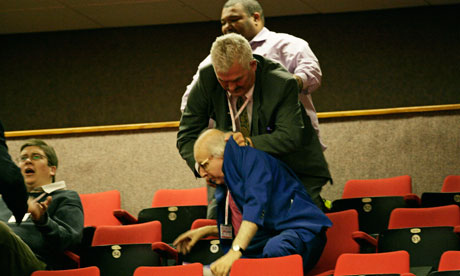
'The Terrorism Act was introduced by Tony Blair with the promise that it would be used only in the gravest of cases. Less than five years later it was used to bar an elderly man [Walter Wolfgang, pictured above] from the Labour party conference for heckling.' Photograph: Dan Chung for the Guardian
Growing Under A Coalition That Pledged To Reverse It
Proposals for real-time monitoring of email and social media show the government has caved in to the security services.
By James Ball
Monday 2 April 2012 11.15 EDT
Courtesy Of "The Guardian"
If the government were to suggest monitoring every building that each person in the UK visits, and making a note of every conversation they had, the policy would be seen as electoral suicide. Assurances that the actual content of conversations wouldn't be recorded would be unlikely to help.
It's a telling sign of how many real-world freedoms have been sacrificed online, then, that a government that just two years ago pledged to"reverse the rise of the surveillance state" feels able to propose real-time monitoring of all email and social media communications.
The information stored would include the sender and recipient of an email, the time it was sent, and details of the computer it was sent from. This would build a profile of who contacts whom, with what frequency, and from where.
The government says such measures are essential to counter organised crime and terrorism, citing that 95% of organised crime investigations and "every" major counter-terrorism investigation use communications data. However, this statistic does not show if such information was essential or even useful to these investigations – merely that investigators chose to get hold of communications records on almost every occasion, usually via warrant or use of the Regulation of Investigatory Powers Act (Ripa).
This kind of surveillance is nothing new: it's been gradually expanding in the UK over the past decade, from measures that make it easier to obtain permission to monitor communications, to requiring internet service providers to store information on email communications to all their users. Under Ripa, state employees as junior as Royal Mail officersare allowed to "ping" mobile phones for location information on the basis of a simple, unrecorded, verbal request.
Information about each email sent – the data that would be covered by the new proposals – already has to be stored by providers for at least a year under UK law. The change would make it accessible to intelligence services in real time, presumably to allow for patterns or unusual activity to be spotted.
Such efforts sound impressive, but whether adding to the huge pile of data at the disposal of the UK's intelligence agencies will make us safer is questionable. Trawling big data for suspicious activity is the 21st-century version of finding needles in a haystack. Terrorists are thankfully very rare relative to the size of the population. As such, attempts to identify suspicious patterns of activity may generate many "false positives": examples of innocent behaviour that also raise flags.
Adding a vast swath of unfocused surveillance data to the pile – more than a trillion emails a year are sent from the UK – increases the size of the haystack many times over, while the number of needles stays unchanged. Our security services may drown themselves in data. Worse still, some users can hide their traffic, and avoid email entirely, by use of encryption or anonymising technology.
It's not as if the innocent have nothing to fear; time and again data from official government databases has been lost, stolen, or mishandled. Only last week Channel 4 News uncovered details of data on the police national database being accessed or altered by criminal gangs. Hundreds of civil servants have been found to have committed "gross misconduct" when handling jobseekers' data – and inquiries into the extent to which media organisations "blagged" records from public databases are ongoing.
Even these concerns are minor relative to the broader "mission creep" of new police and intelligence powers. The Terrorism Act was introduced by Tony Blair with the promise that it would be used only in the gravest of cases. Less than five years later it was used to bar an elderly man from the Labour party conference for heckling.
Such has been the path with surveillance. First, it was simply a matter of allowing legislation so that email and social media information could be collected with a warrant. Then powers were added to make sure such information is stored on everyone, in case it is needed later. Now the case is made that: given the information is collected anyway, why not use it in real time?
Given that the contents of these emails can be collected from Google, Yahoo, MSN and others with a warrant, it is not hard to imagine the state going still further.
It is the role of the security services to lobby for any power that can make their difficult task any easier. Such lobbying is legitimate and, in all probability, inevitable. It is equally the role of a democratic government to question, or refuse, such measures when they encroach on the private lives of millions. This is a responsibility the Labour government abdicated for more than a decade. With the coalition's sudden conversion to the pro-surveillance cause, civil libertarians have gone from notionally having the support of two of the big three parties to none.
Far from being reversed, the journey towards a surveillance state – begun under Labour – continues as before.
Sunday, March 04, 2012
We Are All Terrorists Now
“See Something Say Something” Campaign Could Allow People to Label ANY AMERICAN a Suspected “Terrorist” … Just Like in Nazi Germany or Stasi East Germany
Posted on February 12, 2012
List of Actions or Beliefs Which May Get You Labeled a Terrorist Grows Daily
Every American could – literally – be labeled a suspected terrorist under current governmental criteria.
Specifically, the following actions may get a U.S. citizen labeled as a suspected terrorist today:
- Questioning war (even though war reduces our national security; and see this)
- Criticizing the government’s targeting of innocent civilians with drones (although killing innocent civilians with drones is one of the main things which increases terrorism. And see this)
- Stocking up on more than 7 days of food (even though all Mormons are taught to stockpile food, and most Hawaiians store up on extra food)
Subscribe to:
Posts (Atom)
