Showing posts with label Boomerang. Show all posts

Saturday, November 10, 2012

Stuxnet Goes Out Of Control


Chevron Infected By Anti-Iranian Virus, Others Could Be Next

America’s cyberwar is already seeing collateral damage, and it’s hitting the country’s own billion-dollar companies. Oil giants Chevron say the Stuxnet computer virus made by the US to target Iran infected their systems as well.

California-based Chevron, a Fortune 500 company that’s among the biggest corporations in the world, admits this week that they discovered the Stuxnet worm on their systems back in 2010. Up until now, Chevron managed to make their finding a well-kept secret, and their disclosure published by the Wall Street Journal on Thursday marks the first time a US company has come clean about being infected by the virus intended for Iran’s nuclear enrichment program. Mark Koelmel of the company’s earth sciences department says that they are likely to not be the last, though.
“We’re finding it in our systems and so are other companies,” says Koelmel. “So now we have to deal with this.”
“I don’t think the US government even realized how far it had spread,” Koelmel adds.
Discovered in 2010, the Stuxnet worm was reported with all but certainty to be the creation of the United States, perhaps with the assistance of Israel, to set back Iran’s nuclear enrichment program as a preemptive measure against an eventual war. Only as recently as this June, however, American officials with direct knowledge of the worm went public with Uncle Sam’s involvement.
In a June 2012 article published by The New York Times, government agents with direct knowledge of Stuxnet claimed that first President George W. Bush, then Barack Obama, oversaw the deployment of the worm as part of a well-crafted cyberassault on Iran. Coupled with another malicious program named Flame and perhaps many more, Stuxnet was waged against Iran as part of an initiative given the codename “Olympic Games.” Rather than solely stealing intelligence through use of computer coding, the endeavor was believed to be the first cyberattack that intended to cause actual hard damage.
“Previous cyberattacks had effects limited to other computers,” Michael Hayden, the former chief of the CIA, explained to the Times earlier this year. “This is the first attack of a major nature in which a cyberattack was used to effect physical destruction.”
After the Times published their expose in June, Senator Dianne Feinstein, chairwoman of Intelligence Committee, called for an investigation to track down how the media was first made aware of America’s involvement in Olympic Games.
When Feinstein spoke to DC’s The Hill newspaper, she said, "the leak about the attack on Iran's nuclear program could 'to some extent' provide justification for copycat attacks against the United States." 
Speaking of the accidental impact Stuxnet could soon have in the US, Chevron’s Koelmel tells the Journal, "I think the downside of what they did is going to be far worse than what they actually accomplished.”

Wednesday, June 20, 2012

The Ultimate No-Fly List

By Peter Van Buren and Tom Engelhardt,
June 13, 2012
Courtesy Of "Anti-War"


Last week, touching down in India on his way to Afghanistan, Secretary of Defense Leon Panetta described reality as you seldom hear it in the confines of Washington and, while he was at it, put his stamp of approval on a new global doctrine for the United States. Panetta is, of course, the man who, as director of the CIA, once calledits drone air campaign in the Pakistani borderlands “the only game in town.” (At the time, as now, it was a classified, “covert” set of airstrikes that were a secret to no one in Washington, Islamabad, or anywhere else on Earth.)
In India, expressing his frustration over U.S. relations with Pakistan, he spoke the “W-word” aloud for the first time. “We are,” he told his Indian hosts, “fighting a war in the FATA [the Pakistani tribal areas].” How true. Washington has indeed long been involved in a complex, confusing, escalating, and undoubtedly self-defeating partial war with Pakistan, never until now officially called by that name, even as the intensity of the drone air campaign in that country’s borderlands continues to ratchet up. So give Panetta credit for rare bluntness.
In India, he said something else previously unspoken, acknowledging a breathtaking new reality: “We have made it very clear that we are going to continue to defend ourselves. This is about our sovereignty as well.” In other words, he claimed that, while the sovereignty of other countries might be eternally violable, U.S. sovereignty extends inviolably over Pakistani territory. This is, in fact, the concept that underpinsthe use of drones there and elsewhere. When it comes to its presidential version of war-making, only the U.S. has a claim to global sovereignty, against which the more traditional concept of national sovereignty doesn’t stand a chance.
In Washington, a controversy has now broken out over what are clearly administration leaks about our drone wars in Pakistan, Yemen, and Somalia, and ournew cyberwar against Iran. It’s clear enough that, in its urge to run a Republican-proof election campaign on the image of a tough-guy president, those in the Oval Office, themselves fierce anti-leakers in other circumstances, didn’t know when to stop leaking information they considered advantageous to the president and so badly overplayed their hand. Now, as prosecutors from the Justice Department (one with apedigree that should leave the administration shaking in its combat boots) are being appointed to look into the leaks, all bets should be off in the capital. Hold onto your hats, tell your journalist friends that, as the investigations begin, they are the ones likely to find themselves in the hottest water, and expect almost anything in the coming months.
One thing won’t happen, though. You’re not going to get tons more Panetta-style realism. It’s clear that all of Washington’s players, however intensely they might argue with one another, will be pulling together to shut down those leaks and any others heading our way. We at TomDispatch are convinced, on the other hand, that its time to open the faucets, turn those drips into a steady stream, and let the American people know just what is being done, what wars (even when not called wars) are being fought in their name, what new weapons are being released into the world with their imprimatur (if not their knowledge).
It’s with some pride, then, that TomDispatch turns to its whistleblower-in-residence, State Department official Peter Van Buren, author of We Meant Well: How I Helped Lose the Battle for the Hearts and Minds of the Iraqi People, to offer his take on what this controversy really means for us all and just how it looks to someone who has been on the other end of the Obama administration’s fierce crackdown on governmental truth-tellers, rather than image-padders. (To catch Timothy MacBain’s latest Tomcast audio interview in which Van Buren discusses how Washington has changed when it comes to both leaking and stifling information, click here or download it to your iPodhere.) Tom

How Obama’s Targeted Killings, Leaks, and The Everything-Is-Classified State Have Fused 

by Peter Van Buren
White is black and down is up. Leaks that favor the president are shoveled out regardless of national security, while national security is twisted to pummel leaks that do not favor him. Watching their boss, bureaucrats act on their own, freelancing the punishment of whistleblowers, knowing their retaliatory actions will be condoned. The United States rains Hellfire missiles down on its enemies, with the president alone sitting in judgment of who will live and who will die by his hand.
The issue of whether the White House leaked information to support the president’s reelection while crushing whistleblower leaks it disfavors shouldn’t be seen as just another O’Reilly vs. Maddow sporting event. What lies at the nexus of Obama’s targeted drone killings, his self-serving leaks, and his aggressive prosecution of whistleblowers is a president who believes himself above the law, and seems convinced that he alone has a preternatural ability to determine right from wrong.
If the President Does It, It’s Legal?
In May 2011 the Pentagon declared that another country’s cyber-attacks — computer sabotage, against the U.S. — could be considered an “act of war.” Then, one morning in 2012 readers of the New York Times woke up to headlines announcing that the Stuxnet worm had been dispatched into Iran’s nuclear facilities to shut down its computer-controlled centrifuges (essential to nuclear fuel processing) by order of President Obama and executed by the U.S. and Israel. The info had been leaked to the paper by anonymous “high-ranking officials.” In other words, the speculation about Stuxnet was at an end. It was an act of war ordered by the president alone.
Similarly, after years of now-you-see-it-now-you-don’t stories about drone attacks across the Greater Middle East launched “presumably” by the U.S., the Times (again) carried a remarkable story not only confirming the drone killings — a technology that had morphed into a policy — but noting that Obama himself was the Great Bombardier. He had, the newspaper reported, designated himself the final decision-maker on an eyes-only “kill list” of human beings the United States wanted to destroy. It was, in short, the ultimate no-fly list. Clearly, this, too, had previously been classified top-secret material, and yet its disclosure was attributed directly to White House sources.
Now, everyone is upset about the leaks. It’s already a real Red vs. Blue donnybrook in an election year. Senate Democrats blasted the cyberattack-on-Iran leaks and warned that the disclosure of Obama’s order could put the country at risk of a retaliatory strike. Republican Old Man and former presidential candidate Sen. John McCaincharged Obama with violating national security, saying the leaks are “an attempt to further the president’s political ambitions for the sake of his re-election at the expense of our national security.” He called for an investigation. The FBI, no doubt thrilled to be caught in the middle of all this, dutifully opened a leak investigation, and senators on both sides of the aisle are planning an inquiry of their own.
The high-level leaks on Stuxnet and the kill list, which have finally created such a fuss, actually follow no less self-serving leaked details from last year’s bin Laden raid in Pakistan. A flurry of White House officials vied with each other then to expose ever more examples of Obama’s commander-in-chief role in the operation, to the point where Seal Team 6 seemed almost irrelevant in the face of the president’s personal actions. There were also “high five” congratulatory leaks over the latest failed underwear bomber from Yemen.
On the Other Side of the Mirror
The Obama administration has been cruelly and unusually punishing in its use of the 1917 Espionage Act to stomp on governmental leakers, truth-tellers, and whistleblowers whose disclosures do not support the president’s political ambitions. AsThomas Drake, himself a victim of Obama’s crusade against whistleblowers, told me, “This makes a mockery of the entire classification system, where political gain is now incentive for leaking and whistleblowing is incentive for prosecution.”
The Obama administration has charged more people (six) under the Espionage Act for the alleged mishandling of classified information than all past presidencies combined. (Prior to Obama, there were only three such cases in American history, one beingDaniel Ellsberg, of Nixon-era Pentagon Papers fame.) The most recent Espionage Act case is that of former CIA officer John Kiriakou, charged for allegedly disclosing classified information to journalists about the horrors of waterboarding. Meanwhile, his evil twin, former CIA officer Jose Rodriguez, has a best-selling book out bragging about the success of waterboarding and his own hand in the dirty work.
Obama’s zeal in silencing leaks that don’t make him look like a superhero extends beyond the deployment of the Espionage Act into a complex legal tangle of retaliatory practices, life-destroying threats, on-the-job harassment, and firings. Lots of firings.
Upside Down Is Right Side Up
In ever-more polarized Washington, the story of Obama’s self-serving leaks is quickly devolving into a Democratic/Republican, he-said/she-said contest — and it’s only bound to spiral downward from there until the story is reduced to nothing but partisan bickering over who can get the most advantage from those leaks.
But don’t think that’s all that’s at stake in Washington. In the ever-skittish federal bureaucracy, among the millions of men and women who actually are the government, the message has been much more specific, and it’s no political football game. Even more frightened and edgy than usual in the post-9/11 era, bureaucrats take their cues from the top. So expect more leaks that empower the Obama Superman myth and more retaliatory, freelance acts of harassment against genuine whistleblowers. After all, it’s all been sanctioned.
Having once been one of those frightened bureaucrats at the State Department, I now must include myself among the victims of the freelancing attacks on whistleblowers. The Department of State is in the process of firing me, seeking to make me the first person to suffer any sanction over the WikiLeaks disclosures. It’s been a backdoor way of retaliating for my book, We Meant Well: How I Helped Lose the Battle for the Hearts and Minds of the Iraqi People, which was an honest account of State’s waste and mismanagement in the “reconstruction” of Iraq.
Unlike Bradley Manning, on trial under the Espionage Act for allegedly dumping a quarter million classified documents onto the Internet, my fireable offense was linking to just one of them at my blog. Just a link, mind you, not a leak. The document, still unconfirmed as authentic by the State Department even as they seek to force me out over it, is on the web and available to anyone with a mouse, from Kabul to Tehran to Des Moines.
That document was discussed in several newspaper articles before — and after — I “disclosed” it with my link. It was a document that admittedly did make the U.S. government look dumb, and that was evidently reason enough for the State Department to suspend my security clearance and seek to fire me, even after the Department of Justice declined to prosecute. Go ahead and click on a link yourself and commit what State now considers a crime.
This is the sort of thing that happens when reality is suspended in Washington, when the drones take flight, the worms turn, and the president decides that he, and he alone, is the man.
What Happens When Everything Is Classified?
What happens when the very definitions that control life in government become so topsy-turvy that 1984 starts looking more like a handbook than a novel?
I lived in Taiwan when that island was still under martial law. Things that everyone could see, like demonstrations, never appeared in the press. It was illegal to photograph public buildings or bridges, even when you could buy postcards nearby of some of the same structures. And that was a way of life, just not one you’d want.
If that strikes you as familiar in America today, it should. When everything is classified — according to the Information Security Oversight Office, in 2011 American officials classified more than 92,000,000 documents — any attempt to report on anything threatens to become a crime; unless, of course, the White House decides to leak to you in return for a soft story about a heroic war president.
For everyone else working to create Jefferson’s informed citizenry, it works very differently, even at the paper that carried the administration’s happy leaks. Timesreporter Jim Risen is now the subject of subpoenas by the Obama administration demanding he name his sources as part of the Espionage Act case against former CIA officer Jeffrey Sterling. Risen was a journalist doing his job, and he raises this perfectly reasonable, but increasingly outmoded question: “Can you have a democracy without aggressive investigative journalism? I don’t believe you can, and that’s why I’m fighting.” Meanwhile, the government calls him the only witness to a leaker’s crime.
One thing at stake in the case is the requirement that journalists aggressively pursue information important to the public, even when that means heading into classified territory. If almost everything of importance (and much that isn’t) is classified, then journalism as we know it may become… well, illegal.
Sometimes in present-day Washington there’s simply too much irony for comfort: the story that got Risen in trouble was about an earlier CIA attempt to sabotage Iran’s nuclear program, a plot which failed where Stuxnet sort of succeeded.
The End
James Spione, an Academy Award–nominated director who is currently working on a documentary about whistleblowers in the age of Obama, summed things up to me recently this way: 
Beneath the partisan grandstanding, I think what is most troubling about this situation is the sense that the law is being selectively applied. On the one hand, we have the Justice Department twisting the Espionage Act into knots in an attempt to crack down on leaks from “little guys” like Thomas Drake and John Kiriakou, while at the same time an extraordinarily detailed window into covert drone policy magically appears in the Times.
Here is the simple reality of our moment: the president has definitively declared himself (and his advisers and those who carry out his orders) above the law, both statutory and moral. It is now for him and him alone to decide who will live and who will die under the drones, for him to reward media outlets with inside information or smack journalists who disturb him and his colleagues with subpoenas, and worst of all, to decide all by himself what is right and what is wrong.
The image Obama holds of himself, and the one his people have been aggressively promoting recently is of a righteous killer, ready to bloody his hands to smite “terrorists” and whistleblowers equally. If that sounds Biblical, it should. If it sounds full of unnerving pride, it should as well. If this is where a nation of laws ends up, you should be afraid.
Peter Van Buren, a 24-year veteran Foreign Service Officer at the State Department, spent a year in Iraq as Team Leader for two State Department Provincial Reconstruction Teams. Now in Washington and a TomDispatch regular, he writes about Iraq, the Middle East, and U.S. diplomacy at his blog, We Meant Well. Since his book, We Meant Well: How I Helped Lose the Battle for the Hearts and Minds of the Iraqi People (The American Empire Project, Metropolitan Books), was published in 2011, the Department of State has begun termination proceedings against him, after reassigning him to a make-work position and stripping him of his security clearance and diplomatic credentials. To listen to Timothy MacBain’s latest Tomcast audio interview in which Van Buren discusses how Washington has changed when it comes to both leaking and stifling information, click here or download it to your iPod here.
[Disclaimer: The views here are solely those of the author, expressed in his capacity as a private citizen.]
Follow TomDispatch on Twitter @TomDispatch, join us on Facebook, and check out the latest TD book, Terminator Planet: The First History of Drone Warfare, 2001-2050.
Copyright 2012 Peter Van Buren
This article originally appeared at TomDispatch.com. To stay on top of important articles like these, sign up to receive the latest updates from TomDispatch.com.

Game Of Drones

June 11, 2012 -- 8:00 PM
Courtesy Of "The Washington Examiner"


Last week, in its report on the 2013 Defense Authorization bill, the Senate Armed Services Committee called for allowing drones to operate "freely and routinely" in U.S. airspace.
"Large numbers of [UAVs] now deployed overseas may be returned to the United States as the conflict in Afghanistan and operations elsewhere wind down in coming years," the Committee Report read.
Drones "have clearly demonstrated their immense value to DOD military capabilities in the global war on terrorism," and they're increasingly "contributing to missions of agencies and departments within the United States. ... The pace of development must be accelerated," the report concluded.
Technology forged for gathering battlefield intelligence and waging war against terrorists is coming home -- and the powers that be seem pretty blithe about it.
"It's great!" Virginia Gov. Bob McDonnell said on WTOP's "Ask the Governor" program last month: "That's why we use [UAVs] on the battlefield .... If you're keeping police officers safe, making it more productive and saving money... it's absolutely the right thing to do."
"Drones are a legitimate form of law enforcement," Rep. Peter King, R-N.Y., told CNN's Candy Crowley Sunday: "You don't have an expectation of privacy if you're in the open."
True enough: as Stanford Law's Ryan Calo notes, under current law, "citizens do not enjoy a reasonable expectation of privacy in public, nor even on the portions of their property visible from a public vantage."
That's a problem. Drone technology dramatically enhances the government's ability to monitor citizens in public places and on their own property -- and privacy law hasn't kept pace with technological change.
Law enforcement agencies already have access to some 146 commercial drones -- and that may be just the beginning as drones get smaller and more capable.
Defense contractor AeroVironment is perfecting the "Nano Hummingbird," a drone that weighs less than an AA battery and is capable of alighting on a window ledge to record video.
The "Gorgon Stare" system, under development by the Air Force, features a drone-mounted, Argus-eyed camera array designed for full-spectrum surveillance.
"Gorgon Stare will be looking at a whole city, so there will be no way for the adversary to know what we're looking at, and we can see everything," an Air Force officer bragged to the Washington Post. "The Department of Homeland Security is exploring the technology's potential, an industry official said."
Creepy? Sure. But the dystopian fears these metal sentinels provoke might force us to get serious about new legal protections. Privacy violations in the form of massive data mining and the like "tend to be hard to visualize," Stanford's Professor Calo observes. The specter of domestic drones "could be just the visceral jolt society needs to drag privacy law into the 21st century."
Indeed, Americans are becoming increasingly unsettled by this sort of military "mission creep." In February, a Rasmussen poll found voters opposed to the use of drones for domestic surveillance, 52 to 30.
Some legislators are taking note. Last week, Rep. Austin Scott, R-Ga., introduced a bill to restrict domestic use of drones. His "Preserving Freedom From Unwarranted Surveillance Act" leaves space for legitimate public safety uses of UAVs in "exigent circumstances" like hostage situations or missing person hunts. But it provides that "a person or entity acting under the authority of the United States shall not use a drone to gather evidence or other information except to the extent authorized in a warrant."
That's a start -- but we'll need continual vigilance to ensure that technologies developed for foreign wars aren't turned into tools of domestic social control. As James Madison warned at the Constitutional Convention, "The means of defense against foreign danger have always been the instruments of tyranny at home."
Examiner Columnist Gene Healy is a vice president at the Cato Institute and the author of "The Cult of the Presidency

Tuesday, June 19, 2012

Mutually Assured Cyber-Destruction

Obama's Virus Wars: By Officially Sanctioned Leaks, The US Brags Of Its Cyber Warfare Alliance With Israel Against Iran. Is This Wise Or Safe Policy?

By Richard Silverstein and Muhammad Sahimi
Friday 8 June 2012 08.30 EDT
Courtesy Of "The Guardian"


Recent revelations about Flame, the most sophisticated cyber-worm ever created, and David Sanger's White House-authorized leak of classified information confirming US-Israeli collaboration in creating the Stuxnet and Duqu viruses, raise the question of how committed the US is to a negotiated resolution of the nuclear impasse with Iran.
A former senior Israeli government minister has told us that, just as Sanger confirmed Stuxnet was created in partnership with the IDF's Unit 8200 cyber warfare unit, Flame was created by similar figures in Israel. Stuxnet's main purpose was to sabotage Iran's uranium enrichment program. A Flame variant appears to have wiped out the hard drives of specific Iranian officials and damaged the National Iranian Oil Company's computer network last month, forcing some oil terminals to go offline.
Flame has even broader goals and capabilities. It targets specific computers and surveils the entire system, takes screenshots of instant messaging (IM) activity, and can turn on a microphone to monitor audio activity as well. Computers in a number of Arab countries deemed hostile to Israel (mostly Iran, but also Egypt, Jordan, Palestine and Russia) have been infected.
Our source also confirms that Flame is the first cyber weapon used by Israeli intelligence to target its own citizens also. For example, Haaretz reports (Hebrew) on the gargantuan power struggle between the former IDF chief of staff Gaby Ashkenazi and Defense Minister Ehud Barak, which involved charges of spying, counter-spying and forged memos investigated by the security services. Our Israeli source tells us that the Shin Bet installed Flame on the computer of Barak's chief of staff after Ashkenazi complained the former was spying on him.
Sanger, meanwhile, writes that the Obama administration saw cyber warfare as an inexpensive, non-lethal method of covert war against Iran that would keep Israel on a leash, preventing it from attacking Iran militarily. The US president judged a military strike as being a worse evil than computer sabotage.
But there are major problems with cyber warfare as a tool of national policy. First, if the US really does want to reduce Iran's perceived nuclear threat through negotiations, covert acts of sabotage only hinder such diplomatic efforts. The fiercely nationalist Iranians will not take kindly to such acts, particularly in light of cyber warfare being part of a broader and sometimes lethal campaign widely attributed to the Mossad of Israeland Iranian dissident forces, which has also included the assassination of key Iranian nuclear scientists. Given that oil is vital to Iran's economy, might not that nation consider the type of strategic sabotage described above as an act of war?
Can we imagine how the US would react if a competing power engaged in such acts of terror against us? In fact, we don't need to: the Wall Street Journal reported a year ago that the Pentagon determined that computer sabotage may constitute an "act of war" against the United States, to which we might respond militarily. So, in effect, we are doing to Iran precisely what we've said we might attack another country for doing to us.
Second, if negotiations fail, as they had until their recent revival, then the US would be left with a bunch of sanctions and computer worms as a substitute for an articulate strategy toward Iran. If war is to be avoided, how do sanctions and cyber-attacks represent a substantive policy? As the Iraq experience taught us, failed sanctions may be merely a prelude to military operations.
There is a great danger of counterterror tactics and strategy, which includes cyber warfare, becoming a policy in and of itself. We've seen the use of drones to attack Islamist militants in Pakistan, Yemen and elsewhere become so common that there appears to be no other current strategy to engage these countries. Our relations with them are becoming embroiled in the controversy over drone attacks and their invasion of territorial sovereignty, crowding out any other, more constructive form of engagement.
Obama faces the same problem regarding his counterterror strategy and relations with the Arab world as outlined in Scott Shane's New York Times investigative piece, which exposed the terror kill list personally vetted and approved by the president. Instead of having a genuine policy toward the Arab world, Obama seems to have an effective drone counterterror tactic that efficiently kills reputed Islamist terrorists in numerous Arab countries (along with several hundred innocent bystanders).
There's yet another troubling element of the Stuxnet story reported by Sanger. As Gawker pointed out, the White House has not denied that it authorized the leak of classified materials that the New York Times reporter used for his story. This means the Obama administration wantsAmericans and Israelis to hear about its cyber warfare successes. Barack Obama clearly wants to burnish his national security credentials and Stuxnet allows him to do that.
The most critical long-term danger posed by cyber warfare, however, is "as ye sow so shall ye reap". In other words, now we've done it to the Iranians. But they are quick learners and shrewd. After containing the sophisticated computer worms, they will modify them for use in their own cyber warfare. What will stop Iran from doing it to us? Our cyber security experts have told us that no matter how "hard" a target we are, this country is so dependent on computer technology that there will be millions of weaknesses to exploit. A determined enemy will find a way to exploit them. If the enemy is skilled enough, the damage could be catastrophic.
What defense can we then mount as we face such a tragedy, when it is we who, in effect, have unleashed this weapon upon the world? If a building, bridge, power plant or airliner fails through such sabotage, can we truly say we are innocent victims?
Sanger's Mutually Assured Cyberdestruction makes it quite clear that the Obama administration has not plumbed the profound moral and strategic implications of the US embrace of cyber warfare against Iran and other enemies:
"'They approached the Iran issue very, very pragmatically,' one official involved in the discussions over Olympic Games [US cyber warfare program] told me. No one, he said, 'wanted to engage, at least not yet, in the much deeper, broader debate about the criteria for when we use these kinds of weapons and what message it sends to the rest of the world'."
When will we be ready to pursue this debate? After hundreds have been killed by a US nuclear plant explosion, or after one of our viruses runs rampant and poisons the water supply of a major Iranian city (to use but two of many possible examples)?
Again, once we've used this weapon on our enemies, we've opened a Pandora's Box – which others will seek to exploit also. Are we so certain that our use of the cyber weapons has been and will continue to be just, pure and morally defensible, compared to those who follow us who may or may not have our compunctions?
We should ask another question: how much benefit has the use of cyber sabotage brought us? A thousand centrifuges in Natanz (20% of Iran's inventory) destroyed. A nuclear program delayed by a few months, possibly a year. Is the potential short and long-term impact on the world worth such limited gains? Personally, we believe the national security considerations that approved the use of these cyber weapons were exceedingly short-term. We planted seeds and could reap the whirlwind.

Sunday, June 10, 2012

Sleepwalking Into The Drone Age, Unaware Of The Consequences

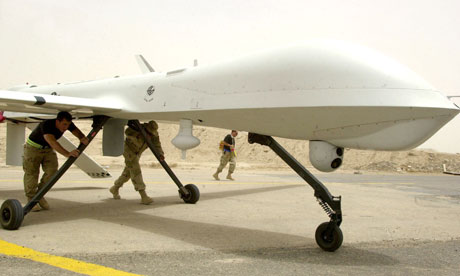
Crew Moves Predator At Tallil
Innocent civilians are being killed by US Predator drones in Waziristan despite claims by the CIA that this is not the case. Photograph: US Air Force/Getty Images

Obama's Policy Of Killing 'Militants' In Pakistan May Go Down Well In The US, But It Is Provoking An Extremist Backlash Abroad

By Clive Stafford Smith
Saturday 2 June 2012 13.55 ED
Courtesy Of "The Guardian"


Last October I was at a jirga in Islamabad where 80 people from Waziristan had assembled to talk about the US Predator drones that buzz around overhead, periodically delivering death by Hellfire missile. A jirga is the traditional forum for discussing and resolving disputes, part parliament, part court of law. The turbaned tribal elders were joined by their young sons on a rare foray out of their region to meet outsiders and discuss the killing. The isolation of the Waziris is almost total – no western journalist has been to Miranshah for several years.
At our meeting I spoke as the representative westerner. I reported the CIA claim that not one single innocent civilian had been killed in over a year. I did not need to understand Pashtu to translate the snorts of derision when this claim was translated.
During the day I shook the hand of a 16-year-old kid from Waziristan named Tariq Aziz. One of his cousins had died in a missile strike, and he wanted to know what he could do to bring the truth to the west. At the Reprieve charity, we have a transparency project: importing cameras to the region to try to export the truth back out. Tariq wanted to take part, but I thought him too young.
Then, three days later, the CIA announced that it had eliminated "four militants". In truth there were only two victims: Tariq had been driving his 12-year-old cousin to their aunt's house when the Hellfire missile killed them both. This came just 24 hours after the CIA boasted of eliminating six other "militants" – actually, four chromite workers driving home from work. In both cases a local informant apparently tagged the car with a GPS monitor and lied to earn his fee.
Last week officials in the Obama administration talked to the New York Times about the "Secret Kill List" drawn up for drone assassinations. Democratic strategists in an election year calculate that the article will prove a vote-winner, dispelling any notion that Barack Obama is soft on terror. The administration voices wanted to leave the impression of an involved and committed president who reads Thomas Aquinas's theory of the "just war" in between personally vetting the kill list.
Mitt Romney dubbed Obama "Dr Strangelove" back in 2007. It may have been a rare, perceptive insight. A decision by the smartest man in the room is only as good as the information that he receives, and no matter how accurate the shiny new missile, if it's aimed at the wrong person it will hit the wrong target.
It is easy to understand how the CIA slaughtered Tariq and many other innocent victims. Those who press the Hellfire buttons are 8,000 miles away in Nevada and are dependent on local "intelligence". Just as with Guantánamo Bay, the CIA is paying bounties to those who will identify "terrorists". Five thousand dollars is an enormous sum for a Waziri informant, translating to perhaps £250,000 in London terms. The informant has a calculation to make: is it safer to place a GPS tag on the car of a truly dangerous terrorist, or to call down death on a Nobody (with the beginnings of a beard), reporting that he is a militant? Too many "militants" are just young men with stubble. At least 174 have been children.
The New York Times reports that Obama first embraced a policy of taking no prisoners in order to avoid the embarrassing sore of Guantánamo. Then he accepted a method for assessing casualties that "counts all military-age males in a strike zone as combatants" unless there is explicit posthumous proof of their innocence – because they are probably "up to no good".
While Obama's policies may go down a treat in the US, they are fomenting radicalism abroad, the very policy not only undermining our way of life but provoking an extremist hydra with many more heads.
Some sane voices penetrate the gloom. Starting last summer, Cameron Munter, Obama's ambassador to Islamabad, was required to give a thumbs up or down assessment of each drone attack on Pakistani turf, as if he were an emperor in the Colosseum. "He didn't realise his main job was to kill people," said a colleague. Munter is quitting his job early this month because his diplomatic mission has been rendered impossible.
The dearth of US domestic criticism is astounding. The last time a president indulged in an illegal bombing campaign in the sovereign territory of allies (Richard Nixon in 1969, in Cambodia and Laos), the policy nearly got included in the articles of impeachment. We should remember that history, as the Vietnamese capitalised on the backlash, helping to impose the genocidal Khmer Rouge on Cambodia, and a single-party regime that endures 40 years later in Laos.
Ultimately, Mitt Romney faces a dilemma: what must a Republican candidate do to outflank the extremism of his Democratic opponent? The rest of us must be concerned as well: we are sleepwalking into the Drone Age, and few people are debating the dire consequences.
Clive Stafford Smith is director of the charity Reprieve, which has a project intended to provoke debate on drones.

Saturday, June 09, 2012

Risks Of Boomerangs A Reality In World Of Cyberwar

By RICHARD LARDNER
Associated Press
Posted: Jun 02, 2012 7:40 AM EDT
Updated: Jun 02, 2012 7:50 AM EDT
Courtesy Of "NBC29"

WASHINGTON (AP) - The Obama administration is warning American businesses about an unusually potent computer virus that infected Iran's oil industry even as suspicions persist that the United States is responsible for secretly creating and unleashing cyberweapons against foreign countries.

The government's dual roles of alerting U.S. companies about these threats and producing powerful software weapons and eavesdropping tools underscore the risks of an unintended, online boomerang.

Unlike a bullet or missile fired at an enemy, a cyberweapon that spreads across the Internet may circle back accidentally to infect computers it was never supposed to target. It's one of the unusual challenges facing the programmers who build such weapons, and presidents who must decide when to launch them.

The Homeland Security Department's warning about the new virus, known as "Flame," assured U.S. companies that no infections had been discovered so far inside the U.S. It described Flame as an espionage tool that was sophisticated in design, using encryption and other techniques to help break into computers and move through corporate or private networks. The virus can eavesdrop on data traffic, take screenshots and record audio and keystrokes. The department said the origin is a mystery.

The White House has declined to discuss the virus.

But suspicions about the U.S. government's role in the use of cyberweapons were heightened by a report in Friday's New York Times. Based on anonymous sources, it said President Barack Obama secretly had ordered the use of another sophisticated cyberweapon, known as Stuxnet, to attack the computer systems that run Iran's main nuclear enrichment facilities. The order was an extension of a sabotage program that the Times said began during the Bush administration.

Private security researchers long have suspected that the U.S. and Israeli governments were responsible for Stuxnet. But the newspaper's detailed description of conversations in the Oval Office among Obama, the vice president and the CIA director about the U.S. government's responsibility for Stuxnet is the most direct evidence of this to date. U.S. officials rarely discuss the use of cyberweapons outside of classified settings.

Stuxnet is believed to have been released as early as 2009. It was discovered in June 2010 by a Belarusian antivirus researcher analyzing a customer's infected computer in Iran. It targeted electronic program controllers built by Siemens AG of Germany that were installed in Iran. The U.S. government also circulated warnings to American businesses about Stuxnet after it was detected.

The White House said Friday it would not discuss whether the U.S. was responsible for the Stuxnet attacks on Iran.

"I'm not able to comment on any of the specifics or details," White House spokesman Josh Earnest said. "That information is classified for a reason, and it is kept secret. It is intended not to be publicized because publicizing it would pose a threat to our national security."

Cyberweapons are uncharted territory because the U.S. laws are ambiguous about their use, and questions about their effectiveness and reliability are mostly unresolved. Attackers online can disguise their origins or even impersonate an innocent bystander organization, making it difficult to identify actual targets when responding to attacks.

Viruses and malicious software, known as malware, rely on vulnerabilities in commercial software and hardware products. But it is hard to design a single payload that always will succeed because the target may have fixed a software vulnerability or placed computers behind a firewall.

On the Internet, where being connected is a virtue, an attack intended for one target can spread unexpectedly. Whether a cyberweapon can boomerang depends on its state of the art, according to computer security experts. On that point, there are deep divisions over Flame.

Russian digital security provider Kaspersky Lab, which first identified the virus, said Flame's complexity and functionality "exceed those of all other cybermenaces known to date." There is no doubt, the company said, that a government sponsored the research that developed it. Yet Flame's author remains unknown because there is no information in the code of the virus that would link it to a particular country.

Other experts said it wasn't as fearsome.

Much of the code used to build the virus is old and available on the Internet, said Becky Bace, chief strategist at the Center for Forensics, Information Technology and Security at the University of South Alabama. Flame could have been developed by a small team of smart people who are motivated and have financial backing, she said, making it just as likely a criminal enterprise or a group working as surrogates could have been responsible.

"Here's the wake-up call as far as cyber is concerned: You don't have to be a nation-state to have what it would take to put together a threat of this particular level of sophistication," said Bace, who spent 12 years at the National Security Agency working on intrusion detection and network security. "There's no secret sauce here."

Stuxnet was far more complex.

Still, Stuxnet could not have worked without detailed intelligence about Iran's nuclear program that was obtained through conventional spycraft, said Mikko Hypponen, chief research officer at F-Secure, a digital security company in Helsinki, Finland. The countries with the motivation and the means to gather that data are the United States and Israel, he said.

"This is at the level of complexity that very few organizations in the world would even attempt," said Hypponen, who has studied Stuxnet and Flame. "Basically you have to have moles. Most of what they needed to pull this off was most likely collected with what we would characterize as traditional intelligence work."

The more intricately designed a cyberweapon is, the less likely it will boomerang. Stuxnet spread well beyond the Iranian computer networks it was intended to hit. But the collateral damage was minimal because the virus was developed to go after very specific targets.

"When some of these super sophisticated things spread, it's bad but it may not have the same impact because the virus itself is so complex," said Jacob Olcott, a senior cybersecurity expert at Good Harbor Consulting. "It's designed to only have its impact when it finds certain conditions."

Israel is a world leader in cybertechnology and senior Israeli officials did little to deflect suspicion about that country's involvement in cyberweapons. "Whoever sees the Iranian threat as a significant threat is likely to take various steps, including these, to hobble it," said Vice Premier Moshe Yaalon, a former military chief and minister of strategic affairs.

A senior defense official involved in Israel's cyberwarfare program said Friday that, "Israel is investing heavily in units that deal with cyberwarfare both for defense and offense." He would not elaborate. The official spoke on condition of anonymity because he is not allowed to speak with the media.

Isaac Ben-Israel, an adviser to Israeli Prime Minister Benjamin Netanyahu on cybersecurity issues, declined Friday to say whether Israel was involved with Stuxnet.

It could take years to know who is responsible, which is what is so unsettling about attacks in cyberspace. "We are very good as an industry at figuring out what a piece of malware does," said Dave Marcus, director of advanced research and threat intelligence at digital security giant McAfee. "But we are less accurate when it comes to saying what group is responsible for it, or it came from this country or that organization."

___

Associated Press writers Anne Gearan in Washington and Ian Deitch in Jerusalem contributed to this report.