Showing posts with label Drug Cartels. Show all posts

Saturday, October 25, 2014

Mexican Drug Cartels Are Worse Than ISIL


Western Obsession With The Islamic State Is Fueled More By Bigotry Than Any Genuine Assessment Of Risk Or Atrocities

The horrific rampage of the Islamic State of Iraq and the Levant (ISIL) has captured the world’s attention. Many Western commentators have characterized ISIL’s crimes as unique, no longer practiced anywhere else in the civilized world. They argue that the group’s barbarism is intrinsically Islamic, a product of the aggressive and archaic worldview that dominates the Muslim world. The ignorance of these claims is stunning.
While there are other organized groups whose depravity and threat to the United States far surpasses that of ISIL, none has engendered the same kind of collective indignation and hysteria. This raises a question: Are Americans primarily concerned with ISIL’s atrocities or with the fact that Muslims are committing these crimes?
For example, even as the U.S. media and policymakers radically inflate ISIL’s threat to the Middle East and United States, most Americans appear to be unaware of the scale of the atrocities committed by Mexican drug cartels and the threat they pose to the United States.

Cartels versus ISIL

A recent United Nations report estimated nearly 9,000 civilians have been killed and 17,386 wounded in Iraq in 2014, more than half since ISIL fighters seized large parts on northern Iraq in June. It is likely that the group is responsible another several thousand deaths in Syria. To be sure, these numbers are staggering. 
But in 2013 drug cartels murdered more than 16,000 people in Mexico alone, and another 60,000 from 2006 to 2012 — a rate of more than one killing every half hour for the last seven years. What is worse, these are estimates from the Mexican government, which is known to deflate the actual death toll by about 50 percent.
Statistics alone do not convey the depravity and threat of the cartels. 
They carry out hundreds of beheadings every year. In addition to decapitations, the cartels are known to dismember and otherwise mutilate the corpses of their victims — displaying piles of bodies prominently in towns to terrorize the public into compliance. They routinely target women and children to further intimidate communities. Like ISIL, the cartels use social media to post graphic images of their atrocious crimes.
The narcos also recruit child soldiers, molding boys as young as 11 into assassins or sending them on suicide missions during armed confrontations with Mexico’s army. They kidnap tens of thousands of children every year to use as drug mules or prostitutes or to simply kill and harvest their organs for sale on the black market. Those who dare to call for reforms often end up dead. 


In September, with the apparent assistance of local police, cartels kidnapped and massacred 43 students at a teaching college near the Mexican town ofIguala in response to student protests. A search in the area for the students has uncovered a number of mass graves containing mutilated bodies burned almost beyond recognition, but none of the remains have been confirmed to be of the students.
While the Islamic militants have killed a handful of journalists, the cartels murdered as many as 57 since 2006 for reporting on cartel crimes or exposing government complicity with the criminals. Many of Mexico’s media have been effectively silenced by intimidation or bribes. 
These censorship activities extend beyond professional media, with narcos tracking down and murdering ordinary citizens who criticize them on the Internet, leaving their naked and disemboweled corpses hanging in public squares. 
Yet American intellectuals such as Sam Harris appear to be more outraged when Muslims protest or issue threats in response to blasphemous or anti-Muslim hate speech than when cartels murder dozens of journalists and systematically co-opt an entire country’s media.
Similarly, Westerners across various political spectrums were outraged when ISIL seized 1,500 Yazidi women, committing sexual violence against the captives and using them as slaves. Here again, the cartels’ capture and trafficking of women dwarfs ISIL’s crimes. Narcos hold tens of thousands of Mexican citizens as slaves for their various enterprises and systematically use rape as a weapon of war.
U.S. media have especially hyped ISIL’s violence against Americans. This summer ISIL beheaded two Americans and has warned about executing a third; additionally, one U.S. Marine has died in efforts to combat the group. By contrast, the cartels killed 293 Americans in Mexico from 2007 to 2010 and have repeatedly attacked U.S. consulates in Mexico. While ISIL’s beheadings are no doubt outrageous, the cartels tortured, dismembered and then cooked one of the Americans they captured — possibly eating him or feeding him to dogs.
The US government cannot formulate an effective response to the narcos’ severe threats because the American public is far too busy disparaging Islam while the US military kills Arabs and Muslims abroad. 
The cartels’ atrocities are not restricted to the Mexican side of the border. From 2006 to 2010 as many as 5,700 Americans were killed in the U.S. by cartel-fueled drug violence. By contrast, 2,937 people were killed in the Sept. 11, 2001, attacks. Over the last decade, some 2,349 Americans were killed in Afghanistan, and 4,487 Americans died in Iraq. In four years the cartels have managed to cause the deaths of more Americans than during 9/11 or either of those wars.
Barack Obama’s administration claims ISIL poses a severe threat to U.S. interests and national security. However, the militants were primarily concerned with seizing and holding territory in Iraq and Syria until the U.S. began targeting them. Even now, while they have called for lone wolves to carry out attacks on targets in the United States, so far those arrested in connection to ISIL have been trying to go and fight abroad rather than plotting domestic attacks. To the extent ISIL wants to kill Americans, its primary tactic has been to try to lure U.S. troops to its turf by publicly executing citizens they already hold hostage
In fact, several U.S. intelligence officials have asserted that ISIL poses no credible threat to the United States homeland. 
However, the same cannot be said of the cartels.
Narcos have infiltrated at least 3,000 U.S. cities and are recruiting many Americans, including U.S. troops and law enforcement officers, to their organizations. They have an increasingly sophisticated and robust foundation in the U.S., with Mexican cartels now controlling more than 80 percent of the illicit drug trade in the United States and their top agents deployed to virtually every major metropolitan area. There are no realistic assessments indicating that ISIL could achieve a similar level of penetration in the United States.

Explaining The Dissonance

It is clear that the anti-ISIL campaign is not driven by the group’s relative threat to the United States or the scale or inhumane nature of their atrocities. If these were the primary considerations, the public would be far more terrified of and outraged by the narcos. Perhaps the U.S. would be mobilizing 50 nations to purge Mexico’s Sinaloa cartel rather than shielding it from prosecutionhelping it polish off its rivals or even move drugs into the United States.
Some may argue that despite the asymmetries, the cartels are less of a threat than ISIL because ISIL is unified around an ideology, which is antithetical to the prevailing international order, while the cartels are concerned primarily with money. This is not true.
A good deal of the cartels’ violence is perpetrated ritualistically as part of their religion, which is centered, quite literally, on the worship of death. The narcosbuild and support churches all across Mexico to perpetuate their eschatology. One of the cartels, the Knights Templar (whose name evokes religious warfare), even boasts about its leader’s death and resurrection. When cartel members are killed, they are buried in lavish mausoleums, regarded as martyrs and commemorated in popular songs glorifying their exploits in all their brutality. Many of their members view the “martyrs” as heroes who diedresisting an international order that exploits Latin America and fighting the feckless governments that enable it. The cartels see their role as compensating for state failures in governance. The narco gospel, which derives fromCatholicism, is swiftly making inroads in the United States and Central America. In short, the cartels’ ideological disposition is no less pronounced than ISIL’s, if not worse.
Unfortunately, the U.S. government cannot formulate an effective response to these much more severe threats because the American public is far too busy disparaging Islam while the U.S. military kills Arabs and Muslims abroad. One thing is certain: America’s obsession with ISIL is fueled by Islamophobia rather than any empirical realities
Musa al-Gharbi is an instructor in the Department of Government and Public Service at the University of Arizona, and an affiliate of the Southwest Initiative for the Study of Middle East Conflicts (SISMEC).


Monday, January 07, 2013

Peruvian Cocaine


Artists: Immortal Technique, Pumpkinhead, Diabolic, Tonedeff, Poison Pen, Loucipher, C-Rayz Walz.

Actors: Al Pacino, Johnny Depp, Wesley Snipes, Mario Van Peebles, Ice-T  and others.

Movies: ScarFace, Blow, New Jack City and others.

(Intro: from the film "Scarface"):
Host: I've heard whispers about the financial support 
your government receives from the drug industry. 

G
uest: Well, the irony of this, of course, is that 
this money, which is in the billions, is coming from 
your country. You see, you are the major purchaser of 
our national product, which is of course cocaine. 

Host: On one hand, you're saying the United States 
government is spending millions of dollars to 
eliminate the flow of drugs onto our streets. At the 
same time, we are doing business with the very same 
government that is flooding our streets with cocaine. 

Guest: Mmm-hmm, si, si. Let me show you a few other 
characters that are involved in this tragic comedy. 

(Two Men Speaking Spanish):

1st guy: Oye ustedes ahi, ustedes trabajando, sigue trabajando carajo
2nd guy: Oye luis cuando van a terminar?
1st guy: Ahorita
2nd guy: Pero que se apuren los burros, ahorita viene el camion apura dile
1st guy: Ahorita van a venir para recoger los productos, apurate!


(Immortal Technique - Worker):

I'm on the border of Bolivia, working for pennies 
Treated like a slave, the coca fields have to be ready 
The spirit of my people is starving, broken and sweaty 
Dreaming about revolution (REVOLUTION!) looking at my machete 
But the workload is too heavy to rise up in arms 
And if I ran away, I know they'd probably murder my moms 
So I pray to Jesucristo when I go to the mission 
Process the cocaine, paced and play my position 

(Pumpkinhead - Cocaine Field Boss):

Ok, listen while I'm out there, just give me my product 
Before we chop off ya hands for worker's misconduct 
I got the power to shoot a copper, and not get charged 
And it would be sad to see your family in front of a firing squad 
So to feed your kids, I need these bricks 
40 tons in total, let me test it, indeed I (*sniff*) 
Shit, this is good, pass me a tissue 
And don't worry about them, I paid off the officials 

(Diabolic - Peruvian Leader):

Yo, it don't come as a challenge, I'm the son of some of the foulest 
Elected by my people...the only one on the ballot 
Born and bred to consult with feds, I laugh at fate 
And assassinate my predecessor to have his place 
In a third-world fascist state, lock the nation 
With 90% of the wealth in 10% of the population 
The Central Intelligence Agency takes weight faithfully 
The finest type of China white and cocaine you'll see 

(Tonedeff - American Drug Distributor):

Honey I'm home, nevermind why our bank account's suddenly grown 
It's funny, we're so out of this debt from this money we owe 
Woulda ya...mind if I told you I had two governments overthrown 
To keep our son enrolled in a private school, and to keep ya tummy swollen 
C'mon, our fuckin' home was built on the foundation of bloody throats 
The hungry stolen of they souls, of course this country's runnin' coke 
I took a stunted oath to hush the one's who know 
But CIA conducts the flow of these young hustlers who lust for dough 

(Poison Pen - Drug Dealer):

I don't work in the hood (Hit my connect) 
Plus what's really good, they supply for the hood 
These dudes fucking crack me up, scrutinize like we inferior 
Petrified when we meet in my area (calm down) 
My dude's'll shoot until I say so, got the loot? 
Give me the YAY YAY like Ice Cube, so don't play with my yayo
We won't stop for you bastards 
Must choose (?), chop it and bag it 

(Loucipher - Undercover Police Officer):

Taking pictures and tapping phones 
Debating snitches and cracking codes 
Past a couple, blast the fo', 
Want any hustler stacking dough with probably crack or blow 
And my overtime is where your taxes go 
I gain your trust 
Get you to hand weight to us because we paid up front 
On the low with cameras taping ya 
Getting pop away? The prison sentence is going to 
Make the officer leave with two ki's out the evidence room 

(C-Rayz Walz - Prison Inmate):

Out the evidence room (*Said with Loucipher*) 
Went my fame, truck, boat or plane, they watching you 
You think you got work? They copping too 
We control blocks, they lock countries 
Ya own companies, we had nice cars and sneaker money 
Now there's players out there, talking 'bout the holding 
With bugs in they house like they down South with windows open 
Your dough ain't long, you wrong, you take shorts and soon 
Feds will be up in your mouth...like forks and spoons 
So enjoy the rush, live plush off Coke bread 
Soon you'll be in a cell with me, like Jenny Lopez 
In school, I was a bully, now life is fully a joke 
I keep a flow on a boat for Peruvian Coke 
Players do favors for governors and tax makers 
Fat Quakers smoke crack and sex acts with bad mayors 
The walls got ears, you big mouths probably scared 
Not prepared to do years like Javier 

(Immortal Technique Speaking):

The story just told is an example of the path that 
drugs take on their way to every neighborhood, in 
every state in this country. It's a lot deeper than 
the niggas on your block. So when they point the 
finger at you, brother men, this is what you've got to tell them: 

(Wesley Snipes - from "New Jack City"):

I'm not guilty. YOU'RE the one that's guilty. The 
lawmakers, the politicians, the Colombian drug lords, 
all you who lobby against making drugs legal. Just 
like you did with alcohol during the prohibition. 
You're the one who's guilty. I mean, c'mon, let's kick 
the ballistics here: Ain't no Uzi's made in Harlem. 
Not one of us in here owns a poppy field. This thing 
is bigger than (Immortal Technique). This is big 
business. This is the American way.

Sunday, December 23, 2012

Justice Isn't Blind, It's Biased


"The decision to not prosecute in this instance belies everything that the government has ever done with regard to drug prosecutions everywhere.  I mean, when you think about the way they behave toward ordinary people who get caught up in drug cases, where they seize all your property and they use absolutely the maximum sentences they can possibly avail themselves of, and in this case they catch a bank that launders billions of dollars for Colombian and Mexican drug cartels … for years on end, and they can’t find something to charge these people with?"

"If the law doesn’t apply equally to everybody, then you don’t really have a system of law.  And so you have a built-in defense for everybody in every drug case forever.  I mean, if you get caught with a stem of marijuana, how do you not stand up and say, ‘You’re going to send me to jail for this where a guy who laundered a billion dollars for a bunch of murderers gets nothing?’"

---

Matt writes:

I had the pleasure of appearing on Eliot Spitzer's Viewpoint last night to talk about the hideous Eric Holder Lanny Breuer HSBC settlement, in which the government elected not to push criminal prosecutions against bank officers who admitted to laundering billions of dollars in drug money. Spitzer was the first guy I thought of when I saw the softball settlement, so it was cool to hear the prosecutorial take on the deal. When I came home after the show, my wife laughed. "It's like you guys were fighting over who was more pissed off.

Thursday, October 04, 2012

America’s Secret Deal With Mexican Drug Cartels

Tom Burghardt reports the following in "Dissident Voice",


In a story which should have made front page headlines, Narco News investigative journalist Bill Conroy revealed that:
A high-ranking Sinaloa narco-trafficking organization member’s claim that US officials have struck a deal with the leadership of the Mexican ‘cartel’ appears to be corroborated in large part by the statements of a Mexican diplomat in email correspondence made public recently by the nonprofit media group WikiLeaks.
A series of some five million emails, The Global Intelligence Files, were obtained by the secret-spilling organization as a result of last year’s hack by Anonymous of the Texas-based “global intelligence” firm Stratfor.
Bad tradecraft aside, the Stratfor dump offers readers insight into a shadowy world where information is sold to the highest bidder through a “a global network of informants who are paid via Swiss banks accounts and pre-paid credit cards. Stratfor has a mix of covert and overt informants, which includes government employees, embassy staff and journalists around the world.”
One of those informants was a Mexican intelligence officer with the Centro de Investigación y Seguridad Nacional, or CISEN, Mexico’s equivalent to the CIA. Dubbed “MX1″ by Stratfor, he operates under diplomatic cover at the Mexican consulate in Phoenix, Arizona after a similar posting at the consulate in El Paso, Texas.
His cover was blown by the intelligence grifters when they identified him in their correspondence as Fernando de la Mora, described by Stratfor as “being molded to be the Mexican ‘tip of the spear’ in the U.S.”
In an earlier Narco News story, Conroy revealed that “US soldiers are operating inside Mexico as part of the drug war and the Mexican government provided critical intelligence to US agents in the now-discredited Fast and Furious gun-running operation,” the Mexican diplomat claimed in email correspondence.
Those emails disclosed “details of a secret meeting between US and Mexican officials held in 2010 at Fort Bliss, a US Army installation located near El Paso, Texas. The meeting was part of an effort to create better communications between US undercover operatives in Mexico and the Mexican federal police, the Mexican diplomat reveals.”
“However,” Conroy wrote, “the diplomat expresses concern that the Fort Bliss meeting was infiltrated by the ‘cartels,’ whom he contends have ‘penetrated both US and Mexican law enforcement’.”
Such misgivings are thoroughly justified given the fact, as Antifascist Callingreported last spring, that the Mexican government had arrested three high-ranking Army generals over their links to narcotrafficking organizations.
In Conroy’s latest piece the journalist disclosed that the “Mexican diplomat’s assessment of the US and Mexican strategy in the war on drugs, as revealed by the email trail, paints a picture of a ‘simulated war’ in which the Mexican and US governments are willing to show favor to a dominant narco-trafficking organization in order to minimize the violence and business disruption in the major drug plazas, or markets.”
A “simulated war”? Where have we heard that before? Like the bogus “War on Terror” which arms and unleashes throat-slitting terrorists from the CIA’s favorite all-purpose zombie army of “Islamist extremists,” Al Qaeda, similarly, America’s fraudulent “War on Drugs” has been a splendid means of managingthe global drug trade in the interest of securing geopolitical advantage over their rivals.
That major financial powerhouses in Europe and the U.S. (can you say Bank of America, Barclays, Citigroup, Credit Suisse, HSBC, ING and Wachovia) have been accused of reaping the lions’ share of profits derived from the grim trade, now a veritable Narco-Industrial Complex, the public continues to be regaled with tales that this ersatz war is being “won.”
While the Mexican body count continues to rise (nearly 120,000 dead since 2006 according to the latest estimates published by the Instituto Nacional de Estadística y Geografía, or INEGI, as reported by the Paris daily Le Monde in a recent editorial) the United States is escalating its not-so-covert military involvement in Mexico and putting proverbial boots on the ground as part of the $1.6 billion U.S.-financed Mérida Initiative.
But have such “initiatives” (in actuality, taxpayer-funded boondoggles forgiant military contractors), turned the corner in the drug war? Not if estimates published by the United Nations are accurate.
According to the 2011 World Drug Report, published by the United Nations Office on Drugs and Crime (UNODC):
US authorities have estimated for the last couple of years that some 90% of the cocaine consumed in North America comes from Colombia, supplemented by some cocaine from Peru and limited amounts from the Plurinational State of Bolivia. For the year 2009, results of the US Cocaine Signature Program, based on an analysis of approximately 3,000 cocaine HCl samples, revealed that 95.5% originated in Colombia (down from 99% in 2002) and 1.7% in Peru; for the rest (2.8%), the origin could not be determined. The trafficking of cocaine into the United States is nowadays largely controlled by various Mexican drug cartels, while until the mid-1990s, large Colombian cartels dominated these operations.
Despite more than $8 billion lavished on programs such as Plan Colombia, and despite evidence that leading Colombian politicians, including former President Álvaro Uribe and his entourage, had documented links to major drug trafficking organizations that go back decades, the myth persists that pouring money into the drug war sinkhole will somehow turn the tide.
But drug seizures by U.S. agencies only partially tell the tale.
As UNODC Executive Director Yury Fedotov pointed out in the introduction to the agency’s 2011 report, Estimating Illicit Financial Flows Resulting from Drug Trafficking and Other Transnational Crimes, “all criminal proceeds are likely to have amounted to some 3.6 per cent of GDP (2.3-5.5 per cent) or around US$2.1 trillion in 2009.”
UNODC analysts disclosed that illicit money flows related to “transnational organized crime, represent the equivalent of some 1.5 percent of global GDP, 70 percent of which would have been available for laundering through the financial system. The largest income for transnational organized crime seems to come from illicit drugs, accounting for a fifth of all crime proceeds.”
“If only flows related to drug trafficking and other transnational organized crime activities were considered,” UNODC asserted, “related proceeds would have been equivalent to around US$650 billion per year in the first decade of the new millennium, equivalent to 1.5% of global GDP or US$870 billion in 2009 assuming that the proportions remained unchanged. The funds available for laundering through the financial system would have been equivalent to some 1% of global GDP or US$580 billion in 2009.”
“The results,” according to UNODC, “also suggest that the ‘interception rate’ for anti-money-laundering efforts at the global level remains low. Globally, it appears that much less than 1% (probably around 0.2%) of the proceeds of crime laundered via the financial system are seized and frozen.”
Commenting on the nexus between global drug mafias and our capitalist overlords, former UNODC director Antonio Maria Costa told The Observer in 2009, “that the proceeds of organised crime were ‘the only liquid investment capital’ available to some banks on the brink of collapse last year. He said that a majority of the $352bn (£216bn) of drugs profits was absorbed into the economic system as a result.”
Would there be an incentive then, for U.S. officials to dismantle a global business that benefits their real constituents, the blood-sucking gangsters at the apex of the capitalist financial pyramid? Hardly.
Nor would there be any incentive for American drug warriors to target organizations that inflate the balance sheets of the big banks. Wouldn’t they be more likely then, given the enormous flows of illicit cash flooding the system, to negotiate an “arrangement” with the biggest players, particularly the Sinaloa Cartel run by fugitive billionaire Joaquín “El Chapo” Guzmán?
In fact, as Narco News disclosed last December, a “quid-pro-quo arrangement is precisely what indicted narco-trafficker Jesus Vicente Zambada Niebla, who is slated to stand trial in Chicago this fall, alleges was agreed to by the US government and the leaders of the Sinaloa ‘Cartel’–the dominant narco-trafficking organization in Mexico. The US government, however, denies that any such arrangement exists.”
Narco News reported that according to “Zambada Niebla, he and the rest of the Sinaloa leadership, through the US informant Loya Castro, negotiated an immunity deal with the US government in which they were guaranteed protection from prosecution in exchange for providing US law enforcers and intelligence agencies with information that could be used to compromise rival Mexican cartels and their operations.”
In court pleadings, Zambada Niebla’s attorneys argued that:
The United States government considered the arrangements with the Sinaloa Cartel an acceptable price to pay, because the principal objective was the destruction and dismantling of rival cartels by using the assistance of the Sinaloa Cartel–without regard for the fact that tons of illicit drugs continued to be smuggled into Chicago and other parts of the United States and consumption continued virtually unabated.
Those assertions seem to be borne out by emails released by WikiLeaks. Conroy disclosed: “In a Stratfor email dated April 19, 2010, MX1 lays out the Mexican government’s negotiating, or ‘signaling,’ strategy with respect to the major narco-trafficking organizations as follows:
The Mexican strategy is not to negotiate directly.
In any event, “negotiations” would take place as follows:
Assuming a non-disputed plaza [a major drug market, such as Ciudad Juarez]:
• [If] they [a big narco-trafficking group] bring [in] some drugs, transport some drugs, [and] they are discrete, they don’t bother anyone, [then] no one gets hurt;
• [And the] government turns the other way.
• [If] they [the narco-traffickers] kill someone or do something violent, [then the] government responds by taking down [the] drug network or making arrests.
(Now, assuming a disputed plaza:)
• [A narco-trafficking] group comes [into a plaza], [then the] government waits to see how dominant cartel responds.
• If [the] dominant cartel fights them [the new narco-trafficking group], [then the] government takes them down.
• If [the] dominant cartel is allied [with the new group], no problem.
• If [a new] group comes in and start[s] committing violence, they get taken down: first by the government letting the dominant cartel do their thing, then [by] punishing both cartels.
“MX1,” Narco News revealed, “then goes on to describe what he interprets as the US strategy in negotiating with the major narco-trafficking players in Ciudad Juarez–a major Mexican narco-trafficking ‘plaza’ located across the border from El Paso, Texas:”
… This is how “negotiations” take place with cartels, through signals. There are no meetings, etc. …
So, the MX [Mexican] strategy is not to negotiate. However, I think the US [recently] sent a signal that could be construed as follows:
“To the VCF [the Vicente Carrillo Fuentes] and Sinaloa cartels: Thank you for providing our market with drugs over the years. We are now concerned about your perpetration of violence, and would like to see you stop that. In this regard, please know that Sinaloa is bigger and better than [the] VCF. Also note that CDJ [Juarez] is very important to us, as is the whole border. In this light, please talk amongst yourselves and lets all get back to business. Again, we recognize that Sinaloa is bigger and better, so either VCF gets in line or we will mess you up.”
I don’t know what the US strategy is, but I can tell you that if the message was understood by Sinaloa and VCF as I described above, the Mexican government would not be opposed at all.
In sum, I have a gut feeling that the US agencies tried to send a signal telling the cartels to negotiate themselves. They unilaterally declared a winner [the Sinaloa Cartel], and this is unprecedented, and deserves analysis. If there was no strategy behind this, and it was simply a leaked report, then I will be interested to see how it plays out in the coming months.
Keep in mind that this “analysis” is from a senior CISEN officer describing U.S. “strategy” for managing, not putting a stop to the flood of narcotics crossing the border.
“In a separate Stratfor email dated April 15, 2010,” Conroy wrote, “MX1′s views on the US strategy with respect to the drug organizations in Juarez, essentially favoring the Sinaloa ‘Cartel,’ is referenced yet again:”
We believe that when the US made an announcement that was corroborated by several federal spokespersons simultaneously (that Sinaloa controlled CDJ [Juarez]), it was a message that the DEA wanted to send to Sinaloa. The message was that the US recognized Sinaloa’s dominance in the area [Juarez], although it was not absolute. It was meant to be read by the cartels as a sort of ultimatum: negotiate and put your house in order once and for all.
One dissenting analyst thinks that the message is the opposite, telling Sinaloa to take what it had and to leave what remains of VCF. Regardless, the reports are saying that the US message to the cartels was to negotiate and stop the violence. It says that the US has never before pronounced that a cartel controls a particular plaza, so it is an unusual event.
“Unusual” perhaps, but not surprising given the secret state’s documented history of close collaboration with major drug trafficking networks that serve as unofficial, though highly-effective instruments, for advancing U.S. imperial strategies.
In a recent piece published by Global Research, analyst Peter Dale Scott observed that America’s two “self-generating wars” on “terror” and “drugs” have “in effect become one.”
“By launching a War on Drugs in Colombia and Mexico,” Scott wrote, “America has contributed to a parastate of organized terror in Colombia (the so-called AUC, United Self-Defense Forces of Colombia) and an even bloodier reign of terror in Mexico (with 50,000 killed in the last six years).”
And by “launching a War on Terror in Afghanistan in 2001, America has contributed to a doubling of opium production there, making Afghanistan now the source of 90 percent of the world’s heroin and most of the world’s hashish.”
“Americans should be aware of the overall pattern that drug production repeatedly rises where America intervenes militarily–Southeast Asia in the 1950s and 60s, Colombia and Afghanistan since then,” Scott noted. “(Opium cultivation also increased in Iraq after the 2003 US invasion.) And the opposite is also true: where America ceases to intervene militarily, notably in Southeast Asia since the 1970s, drug production declines.”
“Both of America’s self-generating wars are lucrative to the private interests that lobby for their continuance,” Scott averred. “At the same time, both of these self-generating wars contribute to increasing insecurity and destabilization in America and in the world.”
In this light, Narco News revelations make perfect sense. As the global financial crisis deepens, brought on in no small part by the massive frauds perpetrated by leading capitalist institutions, they have inflated their balance sheets with a veritable tsunami of hot cash generated by the Narco-Industrial Complex.
In turn, the American secret state, working to recapitalize financial markets beset by a seemingly insolvable liquidity crisis resulting from massive bank frauds, turn a blind eye as these same institutions become major centers of organized crime, monopoly enterprises which could not survive without the trillions of dollars of illicit funds parked in offshore accounts.

Wednesday, August 08, 2012

Global Banks Are The Financial Services Of Drug Cartels

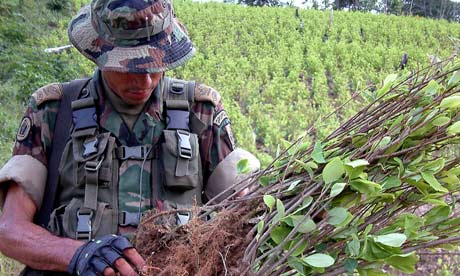
Colombian soldier on coca plantation
A Colombian soldier inspects the harvest of a 50-acre coca plantation: fines for laundering drugs money may seem huge, but banks pay them out of petty cash. Photograph: Efrain Patino/AP

As HSBC executives apologise to the US Senate for laundering drugs money, the fact is that nothing changes

By Ed Vulliamy
Saturday 21 July 2012 13.01 BST
Courtesy Of "The Guardian"

"Steal a little," wrote Bob Dylan, "they throw you in jail; steal a lot and they make you a king." These days, he might recraft the line to read: deal a little dope, they throw you in jail; launder the narco billions, they'll make you apologise to the US Senate.

Two months ago in Washington DC, a poor black man called Edward Dorsey Sr was convicted of peddling 5.5 grams of crack cocaine. Because he was charged before a recent relative amelioration in sentencing, he was given a mandatory 10 years in jail.
Last week, managers from Britain's biggest bank, HSBC, lined up before the Senate's permanent sub-committee on investigations – just across the Potomac river from the scene of Dorsey's crime – to be asked questions such as: "It took three or four years to close a suspicious account. Is there any way that should be allowed to happen?"
The "suspicious account" was that of a "casa de cambio", a currency exchange house operated in Mexico on behalf of the largest criminal syndicate in the world and one of the most savage, the Sinaloa drug-trafficking cartel. The dealings had been flagged up to HSBC bosses by an anti-money laundering officer, but to no avail – the dirty business continued. "No, senator," came the reply from a bespectacled Brit called Paul Thurston, chief executive, retail banking and wealth management, HSBC Holdings plc.
The same casa de cambio, called Puebla, was known to be under investigation in another case involving the Wachovia bank during the time HSBC was entertaining its money. US authorities had seized $11m from Wachovia's Miami office, on the way to securing the biggest settlement in banking history with Wachovia in March 2010, detailed in this newspaper last year.
Wachovia was fined $50m and made to surrender $110m in proven drug profits, but was shown to have inadequately monitored a staggering $376bn through the casa de cambio over four years, of which $10bn was in cash. The whistleblower in the case, an Englishman working as an anti-money laundering officer in the bank's London office, Martin Woods, was disciplined for trying to alert his superiors, and won a settlement after bringing a claim for unfair dismissal.
No one from Wachovia went to jail – and, said Woods at the time of the settlement: "These are the proceeds of murder and misery in Mexico, and of drugs sold around the world. But no one goes to jail. What does the settlement do to fight the cartels? Nothing. It encourages the cartels and anyone who wants to make money by laundering their blood dollars."
HSBC has been found to have handled $7bn in narco cash, "and this is the starter for 10", Woods now says. "We'll get the full picture over time. But what's the sanction on these banks? What's their risk? The cartels should renegotiate their charges with the banks. They're being priced for a risk element that isn't there."
Wachovia was not the first, neither will HSBC be the last. Six years ago, a subsidiary of Barclays – Barclays Private Bank – was exposed as having been used to launder drug money from Colombia through five accounts linked to the infamous Medellín cartel. By an ironic twist, Barclays continued to entertain the funds after British police had become involved after a tip-off, from HSBC.
And the issue is wider than drug-money. It is about where banks, law enforcement officers and the regulators – and politics and society generally – want to draw the line between the criminal and supposed "legal" economies, if there is one.
Take the top-drawer bank to the elite and Her Majesty the Queen, Coutts, part of the bailed-out Royal Bank of Scotland. On 23 March, the UK Financial Services Authority issued a final notice to Coutts, fixing a penalty of £8.75m for breach of its money-laundering code.
The FSA reviewed 103 "high-risk customer files" and "identified deficiencies in 73 files", showing "failure to conduct appropriate ongoing monitoring" over three years. In two cases, private bankers involved had "failed to identify serious criminal allegations against those customers". Rory Tapner, chief executive of the wealth division of RBS said that "since concerns were first identified by the FSA, Coutts & Co has enhanced its client relationship management process". The refrain was the same from HSBC last week, and every other bank after every other shameful revelation: we went awry, but we've fixed it.
Wouldn't it be interesting, though, to know Coutts's private view of Wachovia's case – or, at least of people such as Woods who do root out criminal laundering?
As it happens, through a rare glimpse, we do. Last year, the Wachovia whistleblower was offered a job at Coutts. But the bank suddenly withdrew its job offer. An internal email sent by the interviewer to a director of Coutts's wealth management programme explained the bank had "a very generic reason for our decision, citing the fact that we had become aware of an incident at Wachovia, one of Martin Woods's previous employers, and that Coutts was keen to avoid any risk of reputational damage that might relate to the incident".
The thought occurs to Woods, who is taking legal action against Coutts for mistreatment of a whistleblower, that he was too tenacious at Wachovia. Coutts declined to comment.
No one at Coutts was called to account for the FSA's alarming findings. No one was sanctioned under criminal law last month when the ING bank was fined $619m for illegally moving billions of dollars into the US banking system, in breach of sanctions – as HSBC has done with money from North Korea and Iran. Neither were they in 2009, when Lloyds TSB – 43% owned by the British taxpayer – was fined $350m for whitewashing Iranian money into the US. The fines seem huge to us, but banks pay them from petty cash.
If there is a prosecution, it is always "deferred", as with Wachovia, and a Californian bank called Sigue used by HSBC to receive the Mexican drug money. Be good for a year, and we'll forget about it. Since when did the likes of Edward Dorsey of Washington enjoy that kind of leniency?
A foremost trainer of anti-money laundering officers in the US is Robert Mazur, who infiltrated the Medellín cartel during the prosecution and collapse of the BCCI bank in 1991, and who tells the Observer that "the only thing that will make the banks properly vigilant to what is happening is when they hear the rattle of handcuffs in the boardroom".
It remains to be seen whether HSBC's barons will, like Wachovia's, avoid Dorsey's fate.
"People don't like to ask how close the banker's finger is to the trigger of the killer's gun," says Woods.
But in this newspaper – when we revealed the original "cease and desist" order against HSBC – the former head of the UN Office on Drugs and Crime, Antonio Maria Costa, posited that four pillars of the international banking system are: drug-money laundering, sanctions busting, tax evasion and arms trafficking.
The response of politicians is to cower from any serious legal assault on this reality, for the simple reasons that the money is too big (plus consultancies to be had after leaving office). The British government recruits a former chairman of HSBC as trade secretary just as the drug-laundering scandal breaks.
Herein, along with Dylan's dictum, lies the problem. We don't think of those banking barons as the financial services wing of the Sinaloa cartel.
The stark truth is that the cartels' best friends are those people in pin-stripes who, after a rap on the knuckles, return to their golf in Connecticut and drinks parties in Holland Park.
The notion of any dichotomy between the global criminal economy and the "legal" one is fantasy. Worse, it is a lie. They are seamless, mutually interdependent – one and the same.