Showing posts with label No Justice-No Peace. Show all posts

Tuesday, March 25, 2014

Egypt: More Than 500 Sentenced To Death In ‘Grotesque’ Ruling


Today’s mass death sentences handed down by an Egyptian court are a grotesque example of the shortcomings and the selective nature of Egypt's justice system, Amnesty International said.  

According to state media reports, in a single hearing this morning, the Minya Criminal Court sentenced 529 supporters of former President Mohamed Morsi to be executed for their alleged role in violence following his ousting in July last year.  

“This is injustice writ large and these death sentences must be quashed. Imposing death sentences of this magnitude in a single case makes Egypt surpass most other countries’ use of capital punishment in a year,” said Hassiba Hadj Sahraoui, Deputy Middle East and North Africa Programme Director at Amnesty International. 

"This is the largest single batch of simultaneous death sentences we’ve seen in recent years, not just in Egypt but anywhere in the world.  

“Egypt's courts are quick to punish Mohamed Morsi's supporters but ignore gross human rights violations by the security forces. While thousands of Morsi's supporters languish in jail, there has not been an adequate investigation into the deaths of hundreds of protesters. Just one police officer is facing a prison sentence, for the deaths of 37 detainees. 

“Without an independent and impartial process that can deliver truth and justice for all, many will question whether Egypt's criminal justice system has indeed anything to do with justice. In any event, recourse to the death penalty is inherently unjust, and the Egyptian authorities should impose a moratorium on executions, with a view to abolishing it.”  

Egypt’s authorities do not release figures on death sentences and executions, despite repeated requests over the years by Amnesty International. The organization knows that Egyptian courts handed down at least 109 death sentences in 2013, after at least 91 death sentences in 2012, and at least 123 in 2011. The last known execution was carried out in October 2011, when one man was hanged for the killing of six Coptic Christians and a Muslim police guard in a drive-by shooting in January 2010.


Sunday, December 23, 2012

Justice Isn't Blind, It's Biased


"The decision to not prosecute in this instance belies everything that the government has ever done with regard to drug prosecutions everywhere.  I mean, when you think about the way they behave toward ordinary people who get caught up in drug cases, where they seize all your property and they use absolutely the maximum sentences they can possibly avail themselves of, and in this case they catch a bank that launders billions of dollars for Colombian and Mexican drug cartels … for years on end, and they can’t find something to charge these people with?"

"If the law doesn’t apply equally to everybody, then you don’t really have a system of law.  And so you have a built-in defense for everybody in every drug case forever.  I mean, if you get caught with a stem of marijuana, how do you not stand up and say, ‘You’re going to send me to jail for this where a guy who laundered a billion dollars for a bunch of murderers gets nothing?’"

---

Matt writes:

I had the pleasure of appearing on Eliot Spitzer's Viewpoint last night to talk about the hideous Eric Holder Lanny Breuer HSBC settlement, in which the government elected not to push criminal prosecutions against bank officers who admitted to laundering billions of dollars in drug money. Spitzer was the first guy I thought of when I saw the softball settlement, so it was cool to hear the prosecutorial take on the deal. When I came home after the show, my wife laughed. "It's like you guys were fighting over who was more pissed off.

Thursday, June 07, 2012

What Happens When They Get Drones?

JUN 1 2012, 10:10 AM ET
Courtesy Of "The Atlantic"

David Ignatius' gripping novels are quickly emerging as the spy industry's narcotic for smart, complex intelligence yarns to read on long flights.  His made-for-movies stories seem to be a hybridized LeCarre with a twist of Michael Crichton as he reveals tectonic fault lines between an overly self-confident, reckless America and a fragmented, in spots radicalized, almost always misunderstood Islamic world.

His latest novel, 
Bloodmoney: A Novel of Espionage, has recently appeared in paperback and should be required reading for wannabe strategists who want a glimpse of how messy and convulsive the future is probably going to be.  America will remain a big, important power into the foreseeable future, but a myriad of new players pushing back on U.S. institutions and interests heighten the complexity and danger for a declining superpower holding tightly to anachronistic global arrangements.

Ignatius, long-time national security columnist for the 
Washington Post and author as well of the novel-turned-movie Body of Lies, makes an important policy point via fiction that 'the other guys' -- in this case, vengeance-driven Pakistanis who have legitimate grievances against a drone-lobbing America -- will one day have the technology and systems sophistication to to turn the West's military and economic assets against it.

Bloodmoney
 probably should have been called Blowback: The Costs and Consequences of American Empire, but that title was already taken by the late Chalmers Johnson who wrote a pre-9/11 treatise arguing that American hubris, its global sprawl of US military bases, and influence-machinery around the world were going to trigger push-back, or blowback as it were, from states no longer wanting to play by U.S. rules in a post-Cold War World -- eventually leading to a cataclysmic event.

One of the cases Johnson starts with in the book was the 
1993 murder of CIA employees at a stoplight near the entrance to the Central Intelligence Agency by an aggrieved Pakistani man, Aimal Qazi, who was upset about American policy towards Palestinians. When the terror strikes by al Qaeda hit Washington, New York, and rural Pennsylvania on September 11, 2001, Johnson'sBlowback became the most difficult in-print but out of stock book to get. The publisher could not keep the fast-selling, prescient books on the shelves. 
111010_drone_reuters_328.jpgIgnatius' novel starts out on a similar track to this real world event, opening with a US clandestine drone wiping out an innocent family -- mother and father, siblings, and nieces and nephews -- of an unusually smart tribal youth from South Waziristan, Pakistan.  The youth, Omar, was the West's dream kid -- moving via educational opportunity from the backward, tribal pool of an ignorant, terrorist-generating culture, to modernity -- becoming a globally-aware, traveled, and in the Western sense, rational person. (drone photo credit: Reuters) 

Ignatius' Omar is a mathematical wunderkind who not only escaped the geographic gravitational forces of his Pashtun tribe but became an academic consulting to the world's spy agencies who wanted to know more about the world he came from.  This fictional fabrication again tracks closely with real life. 

Like some others from Pakistan and Afghanistan who have quietly and deeply buried their grievances with the West -- perhaps because of religion, or the loss of loved ones due to the military operations of the U.S. and its allies -- and bided their time until they were in important military and intelligence operations only to eventually explode killing their duped allies, Omar is committed to achieving a 'calibrated revenge' against those who killed his family. 

I won't reveal more of the plot, but I want to raise a few of the themes and nods that Ignatius weaves into this smart page-turner.

First of all, the West may be deceiving itself that education and roads, modernity writ large, will be a quick fix correcting ancient behavioral norms and codes written deeply into the DNA of tribal groups -- in this case Pashtun tribes but certainly not limited to them.

Ignatius' protagonist killer in the book is a professor possessed by deep impulses to avenge his family's murder. Ignatius' portrait of Omar defies easy typecasting as he sits between primitive and turbo-charged modern worlds; interestingly, Ignatius positions him at the end of the novel to be the one most ready to see a way back to 'balance', or a deal that would end the killing and restore calm.
cia.jpgNone of the other personalities in the book -- not the head of Pakistan's ISI, or the operatives of an off-the-books intelligence operation, or the spymasters running the CIA -- could understand that Omar could choose to stop his successful campaign and might strike an arrangement.  Ignatius is telling us that American policymakers still don't understand what could be achieved with the Taliban -- that it's not just a tug of war between a Pashtun uber allesformula or obliterating them.

Secondly, Ignatius has subtly taken sides in the novel, and surprisingly it's with the victimized Pakistani.  Omar, driven by understandable outrage, hit above his weight and achieved an intellectual and technical sophistication besting his adversaries.  The Americans in the novel arrogantly thought it would be impossible for anyone from relatively primitive circumstances in tribal zones in Pakistan  to develop the capacity to challenge the U.S. and Western allies in the way Omar did.  Ignatius reminds the reader that technology and innovation are globally accessible today and that neither the US nor any power have a monopoly on technological or economic innovation. 

In other words, Ignatius warns that weapons technology -- and complex financial instruments and structures -- will not remain the sole preserve of the U.S. and its allies.  What we throw at them may come back and be deployed against us. 

The pattern and link analysis that the Department of Treasury, National Security Agency, CIA, FBI, and other parts of the intelligence industrial complex have used with great effect to target terrorists and influence the behavior of thuggish officials in problematic nations, like Iran, North Korea, and Syria, could conceivably be acquired by our rivals.

While the US is today preparing to further expand its drone force and as of late arm Italian drones,Iran is now trying to develop its own drones.  So too it seems China and Russia.

The question that President Obama, who has admitted direct, routenized involvement in creating the drone 'kill list', should ponder is what will happen as the barriers to entry on drone technology fall enough so that an adversary's drones can be deployed against U.S. and allied forces and interests.

The key message behind David Ignatius's interesting book is that day is probably coming sooner than most think. 

Tuesday, May 01, 2012

Prayer Before Birth

Posted by "CavalierZee"

I am not yet born; O hear me.
Let not the bloodsucking bat or the rat or the stoat or the
club-footed ghoul come near me.


I am not yet born, console me.
I fear that the human race may with tall walls wall me,
with strong drugs dope me, with wise lies lure me,
on black racks rack me, in blood-baths roll me.


I am not yet born; provide me
With water to dandle me, grass to grow for me, trees to talk
to me, sky to sing to me, birds and a white light
in the back of my mind to guide me.


I am not yet born; forgive me
For the sins that in me the world shall commit, my words
when they speak me, my thoughts when they think me,
my treason engendered by traitors beyond me,
my life when they murder by means of my
hands, my death when they live me.


I am not yet born; rehearse me
In the parts I must play and the cues I must take when
old men lecture me, bureaucrats hector me, mountains
frown at me, lovers laugh at me, the white
waves call me to folly and the desert calls
me to doom and the beggar refuses
my gift and my children curse me.


I am not yet born; O hear me,
Let not the man who is beast or who thinks he is God
come near me.


I am not yet born; O fill me
With strength against those who would freeze my
humanity, would dragoon me into a lethal automaton,
would make me a cog in a machine, a thing with
one face, a thing, and against all those
who would dissipate my entirety, would
blow me like thistledown hither and
thither or hither and thither
like water held in the
hands would spill me.


Let them not make me a stone and let them not spill me.
Otherwise kill me.

[By Louis MacNeice]

Saturday, March 03, 2012

Detroit Hosted A Terror Trial – and Survived

Hinkle: Underwear Bomber Proves Obama Was Right 

By: A. BARTON HINKLE 
Published: February 21, 2012 
Courtesy Of "The Richmond Times Dispatch"


Something remarkable didn't happen last week: Nobody blew up Detroit.
This is a stunning development. It is stunning because Detroit is the city where, on Thursday, a federal judge sentenced Umar Farouk Abdulmutallab to life behind bars.
Abdulmutallab is the infamous Underwear Bomber — the man who tried to blow up Northwest Airlines Flight 253 on Christmas Day in 2009 in a suicide mission for al-Qaida. Four months ago he pleaded guilty to the charges. In civilian court, in Detroit.
Which, last time anyone checked, is still standing.
This is not what was supposed to happen, if you will recall. Three years ago, a lot of people — Republicans and conservatives, mostly — were pulling their hair out in (pardon the term) sheer terror at the very thought of trying terrorist suspects in civilian court.
The Obama administration had proposed doing just that with the detainees being held at the military facility at Guantanamo Bay, Cuba. It was going to put 9/11 mastermind Khalid Sheikh Mohammad on trial in New York. Other terrorist suspects would be tried in Washington. Pending trial, some of them were to have been held in custody here in Virginia.
Conservatives went berserk. Virginia Reps. Eric Cantor, Frank Wolf and Randy Forbes strenuously opposed the idea. As this newspaper reported at the time, "The Republicans raised fears that the presence of detainees could make domestic jails targets of international terrorists and create local security risks in cases of escape. The lawmakers also were concerned that terrorists would try to recruit gang members."
Forbes introduced legislation to block federal funds for any transfer of prisoners from Guanatanamo stateside. Bob McDonnell, then running for governor, issued a press release supporting the measure. The United States District Courthouse in Alexandria, he noted, "is located in the city, only 190 feet from a new Westin Hotel, and close to apartment buildings, shops and restaurants. The U.S. Patent and Trademark Office, with 7,000 employees, is only a block away." The clear implication: Their lives would be in danger.
Former Bush administration Attorney General Michael Mukasey agreed that any terrorist suspect's mere "presence would generate serious security concerns for any person or place associated with their prosecution or confinement."
Ditto columnist Charles Krauthammer, who fretted that "any such trial will be a security nightmare and a terror threat to New York." What better propaganda, he asked, "than blowing up the entire courtroom, making KSM a martyr and making the judge, jury and spectators into fresh victims?"
Not only that: Granting KSM a civilian trial offered him "the greatest propaganda platform imaginable — a civilian trial in the media capital of the world — from which to proclaim the glory of jihad and the criminality of infidel America." In other words, it would be a grand recruitment opportunity for al-Qaida.
Many Americans shared such concerns. According to one 2009 poll, "nearly two out of every three respondents — 61 percent — said they think it is likely that New York City will experience a terrorist attack, either before, during, or immediately after the terrorist trials."
The pressure proved too great. On the same day Obama announced his bid for re-election, his administration caved on civilian trials for the prisoners at Gitmo, who would get military tribunals instead.
Abdulmutallab's sentencing makes the frenzied panic of three years ago look rather silly. Swarthy Middle Eastern commandos did not spring Abdulmutallab in a daring nighttime raid. He did not tunnel his way out of jail with a plastic spoon, or incinerate Grosse Pointe with a homemade nuke. He made a few remarks in court, but referring to his undies as a "blessed weapon" and his life sentence as a "victory" does not seem to have inspired legions of imitators.
Abdulmutallab will spend the rest of his days rotting in an isolation cell at a supermax prison in Colorado. But he won't be entirely alone: The Alcatraz of the Rockies is home to Richard Reid, the shoe bomber; Ted Kaczynski, the Unabomber; Ramzi Yousef, who helped bomb the World Trade Center in 1993; and Terry Nichols, who helped Timothy McVeigh bomb the Murrah Federal Building in Oklahoma City. It also holds Ali Salah al-Marri, an al-Qaida sleeper agent, and Jose Padilla, the dirty bomber.
All those terrorists were tried in civilian court without incident, too. Ramzi Yousef was tried in New York. Most of those just named were tried and sentenced well before the Obama administration announced plans to close Guantanamo. Unlike his conservative critics, the president demonstrated some faith in the ability and dedication of the nation's courts, security guards, prison staff and counterterrorist operatives.
And his critics? All they demonstrated is that pandering to public fear to score cheap political points can make you look like a fool.

Monday, January 23, 2012

Guantanamo’s System Of Injustice

In this June 27, 2006 file photo US military guards walk within Camp Delta military-run prison, at the Guantanamo Bay US Naval Base, Cuba
Camp Delta, the military-run prison, at the Guantanamo Naval Base in Cuba  (Credit: AP)


The First Trial Of An Accused Terrorist Exposes The Flaws Of "Reformed" Military Commissions 

BY LAURA PITTER 
THURSDAY, JAN 19, 2012 1:14 PM EASTERN STANDARD TIME 
Courtesy Of "Salon Magazine"

Brig. Gen. Mark Martins, chief prosecutor for the Office of Military Commissions, has lately appeared at bar association conferences promoting “reformed military commissions” at Guantanamo. Speaking to the New York City bar association on January 11, Martins said the military commissions were “comparable to federal courts in their incorporation of all of the fundamental guarantees of a fair and just trial demanded by our values.” Indeed, a new masthead on the military commission website, put up after Martins took over, reads: “Fairness, Transparency, Justice.”
Yet this week, behind thick bulletproof glass in a secure hangar-like courtroom at Guantanamo, I saw vast differences between the two systems. One notices first the physical – the few observers permitted to visit the isolated island base reach the courthouse through a maze of walkways secured by high dark-mesh fences, guards and double barbed wire on both sides. Instead of sitting in the courtroom, observers sit in an adjoining room, behind glass, and hear voices on 40-second delay to allow court security officers to cut off the audio should any classified information be uttered. In the dock this week was Abd al-Rahim al-Nashiri, a Saudi of Yemeni descent accused of planning and participating in the bombing of the destroyer, the USS Cole, on October 12, 2000. The attack killed 17 US servicemen and injured many more. With US service members killed a federal court clearly would have jurisdiction over the case, so the government must have some other reason for choosing a military commission.
Nashiri’s is the first death penalty case to move forward in the military commissions. The fact that it is just being heard now, nine years after he was apprehended, demonstrates one of the starkest differences between the military commissions and federal courts – the absence of any real right to a speedy trial.  This type of delay would never occur in federal court and greatly prejudices both sides, as memories fade and witnesses disappear.
Further, nearly every substantive issue litigated in Guantanamo this week would never have arisen in civilian court. For example, the defense asked the judge to order the military to stop reading mail marked attorney-client privileged. In a federal prison, while mail might be inspected for physical contraband, a warden wouldn’t read clearly marked legal mail to determine if it was truly a privileged communication.
The defense also sought permission from the judge alone to request funds for expert witnesses, a routine motion in federal court. But in the military commissions, the defense normally shares its request with the prosecution, potentially revealing its case theory and litigation strategy. Observers and reporters dozed during the hours of debate about whether defense email could be encrypted –- a seemingly dry issue until one realizes that request was being made because the Defense Department has been reading all the defense attorneys’ email.
The defense has still not received roughly 70,000 pages of documents deemed relevant and material to the defense. Much of the evidence in the case is classified. After his capture, Nashiri was held in a secret CIA “black site” for four years, and waterboarded — a form of mock execution by inducing near suffocation long considered torture under US and international law. He was also threatened with a gun and, later, with a revving power drill near his head while he was hooded but otherwise naked. Details of his torture, while available in the public domain, are largely treated as classified.
The classified nature of the evidence means the defense only gets summaries of parts the prosecution deems relevant and that the judge approves. A request by the defense to challenge the accuracy of the summaries was denied. But civilian judges recognize that the parties should be able to challenge summaries, and may do so with a motion to reconsider.
Despite the volume of documents, the prosecution pressed for trial to begin on March 3. That type of timeline is unheard of in federal court, especially in a death penalty case. The federal court case against 9/11 conspirator Zacarias Moussaoui took more than four years.   Richard Kammen, one of Nashiri’s defense attorneys, called the prosecution’s proposed schedule “a time line for secret justice, for expedient justice, for under-resourced defense justice, and for justice that is fundamentally unfair.” He asked for ten months to two years depending upon whether he gets the resources and access to documents he needs. Ultimately the judge did not fix a trial date but gave the defense only two months to read all the documents and file any motions to challenge their adequacy.
Even in the presentation of evidence, the military commissions have vastly different rules of evidence. Statements from the accused obtained by torture are prohibited. But evidence derived from other types of coercion may be admitted. In federal court, any evidence derived from coercion would be barred, absent a showing that it would have been discovered in another lawful way. Also, unlike in federal court or the US courts martial system, multiple levels of hearsay are admissible (like a memo reporting on a conversation), denying a defendant any genuine right to confront witnesses against him.
Given the stark differences on display this week, it was startling to hear Martins say after the proceedings that military commissions “like federal court and courts martial” provide a fair system of justice. The US does not need to use this fundamentally flawed military commission system. As Martins himself admits, and the Obama administration has acknowledged, detainees can be prosecuted in either system for virtually the same offenses.
Whether one agrees with the use of military commissions or not, Martins and the Obama administration should at least be honest about the differences: as demonstrated by the proceedings this week, fundamental procedural protections afforded defendants in federal courts simply do not exist in military commissions. And without comparable fairness and transparency, the promise of justice remains a big question mark.
Laura Pitter is counterterrorism advisor in Human Rights Watch’s US Program. More Laura Pitter


Sunday, February 13, 2011

A Truth More Powerful Than An Army


The power of domination depends on our essential isolation from one another - our cynical separateness, our underdeveloped or perhaps completely decommissioned capacity for empathy. Alone with ourselves, we have no choice but to fear the power of a brutal and strutting sociopath.

By Robert C. Koehler
February 11, 2011
Courtesy Of "IslamiCity's iViews"


It was just a routine murder.

Last June, police accosted a young man at an Internet cafŽ in the city of Alexandria. He had just filmed their drug deal, or he simply refused to show them his ID. Whatever the provocation - accounts vary - they slammed his head against the table, dragged him outside as he screamed, beat him viciously for 20 minutes. That was that. You can pick up the body later.

In a thug society, power is as power does. And in Egypt, power flowed from the top - from, indeed, beyond the top. It flowed from the superpower that had been a cornucopia of military aid, nearly $2 billion a year, to President Hosni Mubarak for the last 30 years. In return, Mubarak had to be a useful friend to that superpower: open his prisons for secret torture operations, acquiesce to Israel's blockade of Gaza and, of course, keep the oil flowing from Saudi Arabia. Otherwise, his only obligation was to stay in power, and he did so with a simple and basic brutality. Do what we say or we'll kill you.

This is the game of geopolitics. It's played by governments, by the enormously powerful. It's a game of strategies and "interests," which are seldom spoken of explicitly because they're raw and generally smell bad. We - the bulk of ordinary humanity, preoccupied with our own lives, doing the best we can - have, or are supposed to have, only a limited role to play in this game.

We're soldiers and low-level order followers or, in the privileged and relatively secure West, mostly spectators. We get to read with awe about the great decisions of the powerful, who are busy making history while we pay our taxes, agree, disagree, vote, refrain from voting, distract ourselves and shake our heads occasionally with wonder and tepid sympathy as the bombs fall in distant places.

"Ooh, that's gotta hurt!" a colleague said to me, for instance, on the morning of March 20, 2003, as we gaped at an overhead television set in our office as the shock-and-awe bombing of Baghdad begin.

Yeah, imagine how that must feel . . .

This is the thing. The power of domination depends on our essential isolation from one another - our cynical separateness, our underdeveloped or perhaps completely decommissioned capacity for empathy. Alone with ourselves, we have no choice but to fear the power of a brutal and strutting sociopath. We have no choice but to learn a lesson with each routine murder committed in the name of order, and be careful, stay hidden.

But something happened in the wake of the murder last June of Khaled Said that has rocked the whole planet and caused the powerful to drop their jaws (John McCain called it a virus). An uninvited player - the ordinary person, you, me, or at least our Egyptian and Tunisian counterpart - has interrupted the game of geopolitics and started changing the rules.


It began, as the world now knows, with a Facebook page called "We Are All Khaled Said." Let me say that a little louder: WE ARE ALL KHALED SAID. This is not the same as saying, "Ooh, that's gotta hurt." This isn't an observation. It's a truth more powerful than an army.

Eventually some 400,000 people joined the Facebook page, which included not only a picture of the smiling young man but also a picture of his shattered face after the beating. Suddenly this routine murder lay open before the nation, a wound and shocking symbol of the Mubarak regime. No one should ever be treated this way.

The outrage festered for half a year. Then in December, a Tunisian street vendor named Mohamed Bouazizi committed suicide by self-immolation after being humiliated by a police officer. This tragic act not only sparked a people's revolt in Tunisia, which drove President Ben Ali from power, but also reignited the outrage in neighboring Egypt. Hundreds of thousands of people marched in Cairo and other Egyptian cities, demanding an end to the Mubarak regime and making his American benefactors squirm.

"Even if a government has a monopoly of military force and even if a government has the support of the world's one remaining superpower," Steven Zunes wrote this week on Huffington Post, "it is still ultimately powerless if the people refuse to recognize its authority."

This is the truth we kept forgetting. It's the foundation of democracy, but it's far too inconvenient to be taken seriously. Among the myriad interests of the powerful, circumventing or suppressing it is usually near the top. And this truth doesn't summon itself easily. As Tom Engelhardt recently pointed out, it happened 20 years ago in Eastern Europe and brought about the collapse of the Soviet Union; what's happening today in the Middle East may signal that a similar fate awaits the American empire.

I mourn the death of a young man, and the millions more - damaged, uprooted, murdered - he has come to represent. I don't know how far the flame will spread in the Middle East, or what will follow. I only know this: I am Khaled Said.

© 2011 TRIBUNE MEDIA SERVICES, INC.

Robert Koehler is an award-winning, Chicago-based journalist, contributor to One World, Many Peaces and nationally syndicated writer. His new book, Courage Grows Strong at the Wound (Xenos Press) is now available. Contact him at koehlercw [AT] gmail.com or visit his website at commonwonders.com

© 2011 TRIBUNE MEDIA SERVICES, INC.

Monday, February 07, 2011

Egyptian Voices Reflect Diversity


More than a million people have filled the area in and around Cairo's Tahrir Square [AFP]


Al Jazeera Meets The Vanguards Of The Pro-Democracy Protests That Have Flooded Cairo's Tahrir Square For 12 Days.

Al Jazeera Online Producer
Last Modified: 06 Feb 2011 21:30 GMT
Courtesy Of "Al-Jazeera"

CAIRO, EGYPT - Behind a barricaded front door across the street from the famed Egyptian Museum, through a tight, fluorescent-lit hallway crammed with a makeshift kitchen, bed and debris meant to obstruct intruders, up a winding, outdoor metal staircase with a view over a darkened back street, we find Mohammed, a smiling, skinny 23-year-old with a buzzed head and a scarf around his neck.

Mohammed and the group of mostly young men he commands on this 10th-floor rooftop exposed to the damp Cairo night are the vanguards of the pro-democracy protests that have flooded Tahrir Square for 12 days. They are the occupiers of this apartment building and its defenders against assault by supporters of Egypt’s president, Hosni Mubarak.

They're a diverse crowd. Mohammed idolises Gamal Abdel Nasser, the socialist and nationalist hero of modern Egyptian politics, but elsewhere on the rooftop we find Sohail, the son of a wealthy businessman who professes no religious ideology but admires the Muslim Brotherhood’s organisational skills.

Mohammed has admitted us to their rooftop ramparts not because he is particularly fond of our company, though we all get along well, but because he no longer trusts the Egyptian media to report fairly on the story of Tahrir Square and the hundreds of thousands of protesters there who are eager to change their country’s ossified political and social system.

There on the roof, ducking behind a large satellite dish when the ever-present military helicopter circles nearby, Mohammed and Sohail offer us a nuanced look at who is protesting, what motivates them, and how a group of untrained 20-somethings came together to fend off a co-ordinated, determined attempt – likely backed by elements within the government – to crush them beneath a hail of rocks, Molotov cocktails and gunfire.

Against The Thugs

The combat between anti-government protesters and Mubarak supporters around the museum on Wednesday night and Thursday morning was intense and bloody, involving thousands on either side. An Al Jazeera online producer at the barricades during the fighting witnessed two protesters being treated for critical gunshot wounds and several others who were hit by rocks or petrol bombs.

Citizen video obtained by Al Jazeera has also shown anti-government protesters apparently being hit by live gunfire after being targeted by a green laser.

After 12 hours of overnight combat, the protesters in the square managed to advance their wall of shields – metal barricades scavenged from a nearby construction site – around 200 metres from where the fighting began, and they eventually overwhelmed and defeated the outnumbered Mubarak supporters.


Mohammed and his group of around 15 men, like others that night, fought their way hand-to-hand into the apartment building they now occupy. They did so in the face of a determined opponent that was resupplied throughout the night by cars that arrived bearing more petrol bombs.

In the midst of battle, the protesters realised they needed someone to act as a leader. The nominees included those who had showed the most calm during tough situations and those who displayed the best tactical sense.

"Battle naturally creates leaders," Mohammed said.

One man, curiously, nominated himself. Most of the others nominated Mohammed. After it was clear that Mohammed would win, the man grabbed a metal pipe and tried to attack, declaring that he was actually a member of the state security forces. The protesters quickly subdued him and dragged him off to a makeshift prison that had been established at a metro station in the centre of the square.

Like other groups, Mohammed's crew started wearing badges – handwritten pieces of tape – stating their role and unit. Realising these could be forged, they switched to a simple password system to grant entry to the building, one that changes every 12 hours.

The rooftop leaders in the area, including Mohammed, communicate with ground-level leaders and others by mobile phone, tracking the movements of any approaching baltageya, or "thugs".

Dozens of soldiers armed with automatic assault rifles and wearing flak jackets and ballistic helmets stand outside, keeping watch over the square and guarding the museum, but they take no action against the parallel civilian authority right next door.

The army did ask the man who owns the occupied building, as well as three others nearby, to boot the squatting protesters out, but the protesters refused, and the army has yet to act. The owner of the top-floor apartment, which Mohammed’s group found unlocked and have been using, told the young men they were free to make themselves at home as long as they didn't ruin the place.

On the rooftop, piles of rocks await any baltageya assault. Atop a nearby building we visited earlier, another squad of protesters has wrapped rocks in petrol-soaked rags that they will ignite and use to swing and hurl the projectiles a greater distance. A stockpile of the Molotov cocktails, as they are known, left behind by retreating Mubarak supporters lies nearby.

A Marriage Of Authority and Money

Mohammed and Sohail, his 20-year-old comrade, told us a refrain about the Mubarak supporters that we had heard repeated many times in the square: If they really cared, why aren't they still here? Why aren't they mounting continued protests in their own square?

Indeed, aside from the police identification cards found on some of the captured Mubarak supporters, the one thing that most indicated government collusion in the violent attacks on Tahrir Square was the co-ordination with which the Mubarak crowd came and went. Often on Wednesday and Thursday, lines of male spectators would appear on the overpass above the museum barricades at odd hours – including after dark – and watch the museum barricades ominously until eventually other men behind them would begin launching rocks.

Mohammed said he had seen people at the Sayyida Zeinab metro station, south of Tahrir Square, handing out 350 Egyptian pounds per person to encourage Mubarak supporters to mass near the square. These are the same "thugs," Sohail said, who the government unleashes on election days to overrun polling stations, guarantee access for the ruling National Democratic Party (NDP), and intimidate opposition voters.

It was the government's blatant robbing of the most recent parliamentary election, held in November and December, that pushed everyone over the edge, he said. The NDP essentially won more than 90 per cent of parliament, wiping out all but one seat for the Muslim Brotherhood, the banned but semi-tolerated movement that had previously held around a fifth of the People's Assembly.

"The president has managed to keep power through the marriage of money and authority," Mohammed told us.

Even before the call went out for mass protests to begin on January 25, "we could feel the effects of corruption that the country suffers from," Mohammed said. "From unemployment to corruption to rigged elections. I can feel it myself, I am unemployed, I have a business degree, but I cannot find an appropriate job. We can feel it in our daily lives, in everyday dealings, nobody can get anything done in any government institution without paying, without bribery."

Sohail – whose father owns a business where he can find a job and who studies at a private university for the comparatively high cost of around 10,000 pounds ($1,700) per semester – told us his aim was to "bring down the president".

Both he and Mohammed said that a lack of dignity was the protesters' essential grievance, and one that had succeeded in attracting people from all walks of life.

"[The government] degrades us so badly, the police used to degrade the people so much, that's why when people took to the streets on January 28" – the violent Friday following the major street protests – "they just wanted revenge, nothing more," he said.

Mohammed said that the demands of the youth were not "classist," and that corruption and repression weigh on all layers of society.

"As I said, we are prepared to live on the bare minimum, as long as we feel like we have our dignity, that we are walking down the streets with our dignity," Mohammed said. "Not like when a policeman sees me in the street and decides to make life difficult for me, asking me about my ID, and even if I have my ID and am obeying the law, I don't have a weapon or hashish or drugs or anything, just for the sake of it he will stop me and make me pay to pass. And if you don't pay, he will make up a charge and throw you in prison, this is how things work here."

The West's Fears

In the first days of the Egyptian street protests, the Mubarak government quickly blamed the unrest on the Muslim Brotherhood, even though the group had stated in the days before January 25 that it would not participate.

It wasn't a new tactic: The Egyptian leadership is fond of invoking Western fears of an "Islamist takeover", especially since September 11, to rally support for its repressive tactics, including the continued enforcement of emergency national security laws that have been in place since the 1981 assassination of Anwar Sadat, Mubarak’s predecessor.

Though the government is now negotiating with the Brotherhood and other opposition groups to play out a transition as long as it can, it continues to smear the protesters in the hopes of limiting their popular support. On Friday, in a one-room shop near the northern barricades , an army officer chatting with the owner told Al Jazeera that some of the protesters were "terrorists" and that they had been infiltrated by agents from other countries, including Iran.

Mohammed said that he and his comrades were well aware of the information campaign being waged against them.

"People in their homes who are sympathetic with us will no longer be," he said. "They will think we are agents of foreign countries who are trying to affect the stability of our nation."

If the disagreements on the rooftop are any indication, the protest movement does contain a diverse ideological array.

While Sohail admires the Muslim Brotherhood's organisation and discipline, Mohammed blames the group for plotting to assassinate Nasser and says they try to hide their aspirations for political power.

The Brotherhood uses religious slogans to brainwash the youth, Mohammed told us. They're fine allies now, but he doesn't want to see them lead.

Some protesters give the Brotherhood credit for being the square's most stalwart defenders, the ones who rarely leave and show the most bravery on the front lines. At night, much of the debate around the campfires and many of the speeches over the loudspeakers concern religion.

But Sohail wasn't worried.

"If the president leaves, I don't care about my political party, everyone will unite," he told us.

Mohammed shared a similar view of the movement's solidarity.

"There are old men, there are people over 40, there are those younger than 20, there are women. The people who are here represent a state of monopolisation throughout the whole nation," he said.

"Everyone suffers, there isn't one person who doesn't suffer. Everyone down there is suffering, everyone at home is suffering, even the people who come to oppose us, those who support the president, they suffer as well, but they've been paid."

Down below, next to the museum, the army had formed a cordon to prevent most of the protesters from nearing the outermost layer of barricades, where the worst fighting took place. Only the sidewalk to the side was open for foot traffic.

It was clear the government was attempting to return a sense of normalcy to the city; businesses and banks were set to open on Sunday, and the army was intent on clearing away all signs of discord but for the crowd in the square. Men in fluorescent vests even went about clearing debris and trash from the streets where protesters had died just nights before.

But as high-ranking opposition figures negotiate a transition with Mubarak’s right-hand man, former intelligence chief and newly appointed vice-president Omar Suleiman, Mohammed, Sohail, and the men on the rooftops remain dug in, hoping for a complete overhaul.

After the thugs' attack on Wednesday, they won't accept negotiation with Mubarak.

"He’s hiding a dagger behind his back," Mohammed said.

Asmaa Mahfouz's Video Helped Spark Egypt's Revolution


This vlog was recorded on January 18th by Asmaa Mahfouz, the girl who helped start it all. She had shared it on her Facebook, and it had gone viral. It was so powerful and so popular, that it drove Egyptians by the thousands into Tahrir Square, and drove the Egyptian government to block Facebook.

Translated by Iyad El-Baghdadi, subbed by Ammara Alavi. Find me here:
www.el-baghdadi.com
www.facebook.com/iyad.elbaghdadi
www.twitter.com/iyad_elbaghdadi

Sunday, February 06, 2011

Hail To The Conquering Heroes Of Tahrir Square


GammaStardust Says: "Credits for this clip go to no one else but the Egyptians who are fighting bravely for their freedom all over Egypt. Their struggle, their death toll, their blood, their determination are all Humanity's! Ultimately, my own also.

Events of 2nd February turned dire in Egypt, and the utter inhumanity this falling pharaoh (and his masters) are bringing the World urges me and everyone to get out of the sideline.

I am unable to pray but I join to all of those who do the sustained conviction that all peoples in the world will have a "Liberation Square" true to its name!

PS: If you're wondering what's the noise screen all about... is to show yourself and that your own ideas DO stand out in all the manipulation(noise) this global power is imposing on you. That is, if you endured some of the seconds it lasted."


Song: "Uprising"
Group: "Muse"
Songwriters: "Bellamy, Matthew"

The paranoia is in bloom, the PR
Transmissions will resume, they'll try to
Push drugs, keep us all dumb down and hope that
We will never see the truth around, so come on


Another promise, another scene, another
Package not to keep us trapped in greed with all the
Green belts wrapped around our minds and endless
Red tape to keep the truth confined, so come on


They will not force us
And they will stop degrading us
And they will not control us
We will be victorious, so come on


Interchanging mind control, come let the
Revolution take its toll, if you could
Flick a switch and open your third eye, you'd see that
We should never be afraid to die, so come on


Rise up and take the power back, it's time that
The fat cats had a heart attack, you know that
Their time is coming to an end, we have to
Unify and watch our flag ascend, so come on


They will not force us
They will stop degrading us
They will not control us
We will be victorious, so come on


Hey, hey, hey, hey
Hey, hey, hey, hey
Hey, hey, hey, hey


They will not force us
They will stop degrading us
They will not control us
We will be victorious, so come on


Hey, hey, hey, hey

The Wounded March Victorious In Cairo Square


By THE ASSOCIATED PRESS
Published: February 4, 2011
Courtesy Of "The New York Times"


CAIRO (AP) — Men with freshly bandaged heads marched through Tahrir Square on Friday, the wounded, victorious veterans of two days of street battles against supporters of President Hosni Mubarak.
A child made a victory sign with a bandaged hand and stared blankly into the distance. The men chanted for those killed battling for a few city blocks with showers of rocks and sheet metal shields on Wednesday and Thursday.
"Oh martyrs on the door of heaven!" they shouted. "Oh martyrs, rest. We'll continue the struggle!"
As the afternoon faded, the crowd of around 100,000 walked slowly around the square. A young man handed out cookies with quiet purpose, as if he was fueling his comrades for more fighting.
Suddenly, a clanging echoed across the square. Young men banged lengths of iron rebar against a metal fence and hundreds rushed out of the square and into a street heading east toward downtown.
Hundreds of Mubarak supporters in nearby Talat Harb Square were moving down the street toward Tahrir Square.
"Whenever they start approaching, we start giving that alert," said Karim, a 28-year-old engineer who spoke in English and declined to give his last name for fear of government retaliation.
Everywhere, the roadway was broken up into fist-sized chunks of asphalt — and the two sides showered each other with volleys until a mass of bloodied fighters swarmed back into Tahrir, or Liberation, Square with a captured pro-government man in their midst.
"They don't hit them, they don't beat them up," said Bahaa Kialani, a 35-year-old employee of a public relations company.
The crowd moved over to a tank guarding the northern approach to the square, where demonstrators said they were handing him over to the army.
Health Minister Ahmed Sameh Farid said 28 protesters suffered mostly minor wounds Friday and three more people died from injuries sustained in clashes in the square on Wednesday and Thursday, driving up the death toll from those two days to 11. The Tahrir clashes brought the number of deaths since protests began Jan. 25 to 109 people.
Officials have said about 900 people had been wounded in the two days of fighting around Tahrir.
Mohammed Awash, a 25-year-old computer science teacher, wore a plastic construction helmet tied to his head with a scarf.
"We'll be destroyed if we don't fight so hard," he said. "We made the lion angry. If we give up now, it's going to come back fiercer than it was before."
Across the square, people threw trash down the steps of the Sadat Metro station, where it piled up against metal gates that had been pulled shut, chained and barred with a timber from a construction site to make a jail for pro-Mubarak fighters captured in the rock battles.
Demonstrators said those captives had been taken away by the army too.
The military presence was heavy around the square. A lieutenant speaking flawless American English checked IDs at the first checkpoint on the west side of the Kasr el-Nil bridge. Across the bridge, soldiers with black riot helmets, bulletproof vests and Kalashnikovs with folding stocks stood behind razor-wire while hundreds of people filed through a narrow gantlet formed by dozens more soldiers.
Battered pieces of sheet metal that had been used to haul rocks and shield fighters from rains of stones lay abandoned on the ground.
Serious-looking young men in civilian clothes checked IDs and bags, separating women and men for quick pat downs.
Yet another civilian checkpoint, and the crowd dispersed into Tahrir Square.
A group of young bloggers gathered in an area under an ornate lamppost that protesters have come to call "upper-class corner."
Four words were spray-painted on the green metal gates of the shuttered Egyptrav tour company nearby. In English, it read "Facebook" and "Twitter." In Arabic, "Youth" and "Al-Jazeera."
Attorneys Ahmad Fathi, 47, and Osama el-Feyana, 43, strolled through the square together.
"The hairs on my arm are standing on end. I have goose bumps," Fathi said. "As lawyers we were always told we could say whatever we want but there was never any freedom. I owe a lot to the youths. They were able to move that barrier of fear and allow us to come here today."
The square was filled with members of Egypt's struggling middle-class, men who said they were educated as engineers and teachers but found themselves unable to support their families, or even find an apartment and get married. There was a heavy presence of men with the long beards and shaved upper lips of Salafis — ultra-conservatives preaching a return to the ways of early Muslims.
One was Gharib Ibrahim, a 35-year-old painter with worn shoes and a kaffiyeh wrapped around his head.
He said he had come to help turn Egypt into a country where he could have rights including "the ability to find a good job, the ability to get an apartment without having to know somebody who knows somebody."
Another was Alaa Mohammed, a 40-year-old religious studies teacher who showed the scars on his wrist from where, he said, security forces had hung him by a rope when he was jailed from 1994-2006 for what he said were political activities.
"They were just jailing Islamists," he said.
Sometimes, he said, electrodes were attached to his ears to deliver electric shocks.
"I challenge anyone to bear the torture of having electricity pulsed into your ears," he said. "Only Allah saved me."
___
Diaa Hadid contributed to this report.

Saturday, February 05, 2011

North Africa & The Global Political Awakening


Are We Witnessing The Start Of A Global Revolution

By Andrew Gavin Marshall
January 27, 2011
Courtesy Of "Global Research"


For the first time in human history almost all of humanity is politically activated, politically conscious and politically interactive... The resulting global political activism is generating a surge in the quest for personal dignity, cultural respect and economic opportunity in a world painfully scarred by memories of centuries-long alien colonial or imperial domination... The worldwide yearning for human dignity is the central challenge inherent in the phenomenon of global political awakening... That awakening is socially massive and politically radicalizing... The nearly universal access to radio, television and increasingly the Internet is creating a community of shared perceptions and envy that can be galvanized and channeled by demagogic political or religious passions. These energies transcend sovereign borders and pose a challenge both to existing states as well as to the existing global hierarchy, on top of which America still perches...

The youth of the Third World are particularly restless and resentful. The demographic revolution they embody is thus a political time-bomb, as well... Their potential revolutionary spearhead is likely to emerge from among the scores of millions of students concentrated in the often intellectually dubious "tertiary level" educational institutions of developing countries. Depending on the definition of the tertiary educational level, there are currently worldwide between 80 and 130 million "college" students. Typically originating from the socially insecure lower middle class and inflamed by a sense of social outrage, these millions of students are revolutionaries-in-waiting, already semi-mobilized in large congregations, connected by the Internet and pre-positioned for a replay on a larger scale of what transpired years earlier in Mexico City or in Tiananmen Square. Their physical energy and emotional frustration is just waiting to be triggered by a cause, or a faith, or a hatred...

[The] major world powers, new and old, also face a novel reality: while the lethality of their military might is greater than ever, their capacity to impose control over the politically awakened masses of the world is at a historic low. To put it bluntly: in earlier times, it was easier to control one million people than to physically kill one million people; today, it is infinitely easier to kill one million people than to control one million people.[1]

- Zbigniew Brzezinski
Former U.S. National Security Advisor
Co-Founder of the Trilateral Commission
Member, Board of Trustees, Center for Strategic and International Studies


An uprising in Tunisia led to the overthrow of the country’s 23-year long dictatorship of President Ben Ali. A new ‘transitional’ government was formed, but the protests continued demanding a totally new government without the relics of the previous tyranny. Protests in Algeria have continued for weeks, as rage mounts against rising food prices, corruption and state oppression. Protests in Jordan forced the King to call on the military to surround cities with tanks and set up checkpoints. Tens of thousands of protesters marched on Cairo demanding an end to the 30-year dictatorship of Hosni Mubarak. Thousands of activists, opposition leaders and students rallied in the capitol of Yemen against the corrupt dictatorship of President Saleh, in power since 1978. Saleh has been, with U.S. military assistance, attempting to crush a rebel movement in the north and a massive secessionist movement growing in the south, called the “Southern Movement.” Protests in Bolivia against rising food prices forced the populist government of Evo Morales to backtrack on plans to cut subsidies. Chile erupted in protests as demonstrators railed against rising fuel prices. Anti-government demonstrations broke out in Albania, resulting in the deaths of several protesters.

It seems as if the world is entering the beginnings of a new revolutionary era: the era of the ‘Global Political Awakening.’ While this ‘awakening’ is materializing in different regions, different nations and under different circumstances, it is being largely influenced by global conditions. The global domination by the major Western powers, principally the United States, over the past 65 years, and more broadly, centuries, is reaching a turning point. The people of the world are restless, resentful, and enraged. Change, it seems, is in the air. As the above quotes from Brzezinski indicate, this development on the world scene is the most radical and potentially dangerous threat to global power structures and empire. It is not a threat simply to the nations in which the protests arise or seek change, but perhaps to a greater degree, it is a threat to the imperial Western powers, international institutions, multinational corporations and banks that prop up, arm, support and profit from these oppressive regimes around the world. Thus, America and the West are faced with a monumental strategic challenge: what can be done to stem the Global Political Awakening? Zbigniew Brzezinski is one of the chief architects of American foreign policy, and arguably one of the intellectual pioneers of the system of globalization. Thus, his warnings about the 'Global Political Awakening' are directly in reference to its nature as a threat to the prevailing global hierarchy. As such, we must view the 'Awakening' as the greatest hope for humanity. Certainly, there will be mainy failures, problems, and regressions; but the 'Awakening' has begun, it is underway, and it cannot be so easily co-opted or controlled as many might assume.

The reflex action of the imperial powers is to further arm and support the oppressive regimes, as well as the potential to organize a destabilization through covert operations or open warfare (as is being done in Yemen). The alterantive is to undertake a strategy of "democratization" in which Western NGOs, aid agencies and civil society organizations establish strong contacts and relationships with the domestic civil society in these regions and nations. The objective of this strategy is to organize, fund and help direct the domestic civil society to produce a democratic system made in the image of the West, and thus maintain continuity in the international hierarchy. Essentially, the project of "democratization" implies creating the outward visible constructs of a democratic state (multi-party elections, active civil society, "independent" media, etc) and yet maintain continuity in subservience to the World Bank, IMF, multinational corporations and Western powers. 

It appears that both of these strategies are being simultaneously imposed in the Arab world: enforcing and supporting state oppression and building ties with civil society organizations. The problem for the West, however, is that they have not had the ability to yet establish strong and dependent ties with civil society groups in much of the region, as ironically, the oppressive regimes they propped up were and are unsurprisingly resistant to such measures. In this sense, we must not cast aside these protests and uprisings as being instigated by the West, but rather that they emerged organically, and the West is subsequently attempting to co-opt and control the emerging movements.

Part 1 of this essay focuses on the emergence of these protest movements and uprisings, placing it in the context of the Global Political Awakening. Part 2 will examine the West's strategy of "democratic imperialism" as a method of co-opting the 'Awakening' and installing "friendly" governments.
 
The Tunisian Spark

A July 2009 diplomatic cable from America’s Embassy in Tunisia reported that, “many Tunisians are frustrated by the lack of political freedom and angered by First Family corruption, high unemployment and regional inequities. Extremism poses a continuing threat,” and that, “the risks to the regime’s long-term stability are increasing.”[2]

On Friday, 14 January 2011, the U.S.-supported 23-year long dictatorship of Tunisian president Ben Ali ended. For several weeks prior to this, the Tunisian people had risen in protest against rising food prices, stoked on by an immense and growing dissatisfaction with the political repression, and prodded by the WikiLeaks cables confirming the popular Tunisian perception of gross corruption on the part of the ruling family. The spark, it seems, was when a 26-year old unemployed youth set himself on fire in protest on December 17.

With the wave of protests sparked by the death of the 26-year old who set himself on fire on December 17, the government of Tunisia responded by cracking down on the protesters. Estimates vary, but roughly 100 people were killed in the clashes. Half of Tunisia’s 10 million people are under the age of 25, meaning that they have never known a life in Tunisia outside of living under this one dictator. Since Independence from the French empire in 1956, Tunisia has had only two leaders: Habib Bourguiba and Ben Ali.[3] The Tunisian people were rising up against a great many things: an oppressive dictatorship which has employed extensive information and internet censorship, rising food prices and inflation, a corrupt ruling family, lack of jobs for the educated youth, and a general sense and experience of exploitation, subjugation and disrespect for human dignity.

Following the ouster of Ben Ali, Prime Minister Mohamed Ghannouchi assumed presidential power and declared a “transitional government.” Yet, this just spurred more protests demanding his resignation and the resignation of the entire government. Significantly, the trade union movement had a large mobilizing role in the protests, with a lawyers union being particularly active during the initial protests.[4]
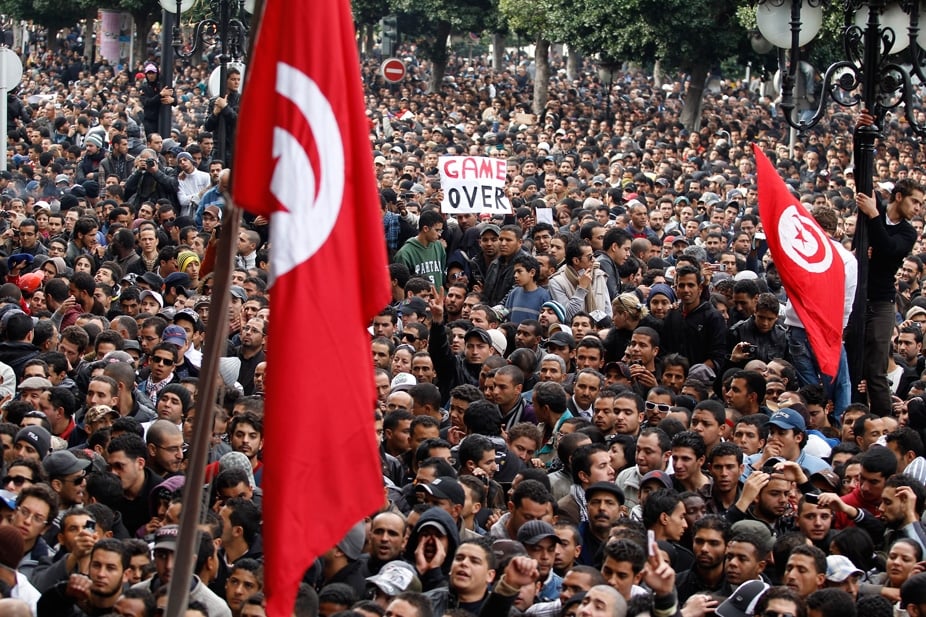

Protests in Tunisia
 

Social media and the Internet did play a large part in mobilizing people within Tunisia for the uprising, but it was ultimately the result of direct protests and action which led to the resignation of Ben Ali. Thus, referring to Tunisia as a “Twitter Revolution” is disingenuous.

Twitter, WikiLeaks, Facebook, Youtube, forums and blogs did have a part to play. They reflect the ability “to collectively transform the Arab information environment and shatter the ability of authoritarian regimes to control the flow of information, images, ideas and opinions.”[5] [Editors Note: The US based foundation Freedom House was involved in promoting and training some Middle East North Africa Facebook and Twitter bloggers  (See also Freedom House), M. C.].
We must also keep in mind that social media has not only become an important source of mobilization of activism and information at the grassroots level, but it has also become an effective means for governments and various power structures to seek to manipulate the flow of information. This was evident in the 2009 protests in Iran, where social media became an important avenue through which the Western nations were able to advance their strategy of supporting the so-called 'Green Revolution' in destabilizing the Iranian government. Thus, social media has presented a new form of power, neither black nor white, in which it can be used to either advance the process of the 'Awakening' or control its direction.
 
Whereas America was publicly denouncing Iran for blocking (or attempting to block) social media in the summer of 2009, during the first several weeks of Tunisian protests (which were largely being ignored by Western media), America and the West were silent about censorship.[6] Steven Cook, writing for the elite U.S. think tank, the Council on Foreign Relations, commented on the lack of attention being paid to the Tunisian protests in the early weeks of resistance prior to the resignation of Ben Ali. He explained that while many assume that the Arab “strongmen” regimes will simply maintain power as they always have, this could be mistaken. He stated that, “it may not be the last days of Ben Ali or Mubarak or any other Middle Eastern strongman, but there is clearly something going on in the region.” However, it was the end of Ben Ali, and indeed, “there is clearly something going on in the region.”[7]

France’s President Sarkozy has even had to admit that, “he had underestimated the anger of the Tunisian people and the protest movement that ousted President Zine al-Abidine Ben Ali.” During the first few weeks of protests in Tunisia, several French government officials were publicly supporting the dictatorship, with the French Foreign Minister saying that France would lend its police “knowhow” to help Ben Ali in maintaining order.[8]

Days before the ouster of Ben Ali, Hillary Clinton gave an interview in which she explained how America was worried “about the unrest and the instability,” and that, “we are not taking sides, but we are saying we hope that there can be a peaceful resolution. And I hope that the Tunisian Government can bring that about.” Clinton further lamented, “One of my biggest concerns in this entire region are the many young people without economic opportunities in their home countries.”[9] Her concern, of course, does not spur from any humanitarian considerations, but rather from inherent imperial considerations: it is simply harder to control a region of the world erupting in activism, uprisings and revolution.

The Spark Lights a Flame

Tunisia has raised the bar for the people across the Arab world to demand justice, democracy, accountability, economic stability, and freedom. Just as Tunisia’s protests were in full-swing, Algeria was experiencing mass protests, rising up largely as a result of the increasing international food prices, but also in reaction to many of the concerns of the Tunisian protesters, such as democratic accountability, corruption and freedom. A former Algerian diplomat told Al-Jazeera in early January that, “It is a revolt, and probably a revolution, of an oppressed people who have, for 50 years, been waiting for housing, employment, and a proper and decent life in a very rich country.”[10]

In mid-January, similar protests erupted in Jordan, as thousands took to the streets to protest against rising food prices and unemployment, chanting anti-government slogans. Jordan’s King Abdullah II had “set up a special task force in his palace that included military and intelligence officials to try to prevent the unrest from escalating further,” which had tanks surrounding major cities, with barriers and checkpoints established.[11]

In Yemen, the poorest nation in the Arab world, engulfed in a U.S. sponsored war against its own people, ruled by a dictator who has been in power since 1978, thousands of people protested against the government, demanding the dictator Ali Abdullah Saleh to step down. In the capitol city of Sanaa, thousands of students, activists and opposition groups chanted slogans such as, “Get out get out, Ali. Join your friend Ben Ali.”[12] Yemen has been experiencing much turmoil in recent years, with a rebel movement in the North fighting against the government, formed in 2004; as well as a massive secessionist movement in the south, called the “Southern Movement,” fighting for liberation since 2007. As the Financial Times explained:

Many Yemen observers consider the anger and secessionist sentiment now erupting in the south to be a greater threat to the country’s stability than its better publicised struggle with al-Qaeda, and the deteriorating economy is making the tension worse.

Unemployment, particularly among the young, is soaring. Even the government statistics office in Aden puts it at nearly 40 per cent among men aged 20 to 24.[13]
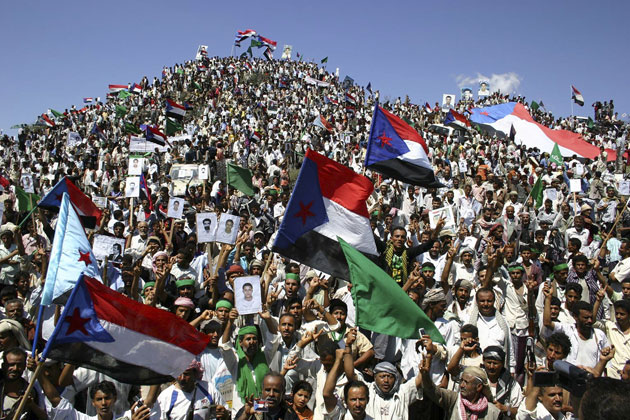
 

Protest of the Southern Movement in Yemen

On January 21, tens of thousands of protesters took to the streets in Albania, mobilized by the socialist opposition, ending with violent clashes between the police and protesters, leading to the deaths of three demonstrators. The protests have been sporadic in Albania since the widely contested 2009 elections, but took on new levels inspired by Tunisia.[14]

Israeli Vice Prime Minister Silvan Shalom stressed concern over the revolutionary sentiments within the Arab world, saying that, “I fear that we now stand before a new and very critical phase in the Arab world.” He fears Tunisia would “set a precedent that could be repeated in other countries, possibly affecting directly the stability of our system.”[15] Israel’s leadership fears democracy in the Arab world, as they have a security alliance with the major Arab nations, who, along with Israel itself, are American proxy states in the region. Israel maintains civil – if not quiet – relationships with the Arab monarchs and dictators. While the Arab states publicly criticize Israel, behind closed doors they are forced to quietly accept Israel’s militarism and war-mongering, lest they stand up against the superpower, America. Yet, public opinion in the Arab world is extremely anti-Israel, anti-American and pro-Iran.

In July of 2010, the results of a major international poll were released regarding public opinion in the Arab world, polling from Egypt, Saudi Arabia, Morocco, Jordan, Lebanon and the United Arab Emirates. Among some of the notable findings: while Obama was well received upon entering the Presidency, with 51% expressing optimism about U.S. policy in the region in the Spring of 2009, by Summer 2010, 16% were expressing optimism. In 2009, 29% of those polled said a nuclear-armed Iran would be positive for the region; in 2010, that spiked to 57%, reflecting a very different stance from that of their governments.[16]

While America, Israel and the leaders of the Arab nations claim that Iran is the greatest threat to peace and stability in the Middle East, the Arab people do not agree. In an open question asking which two countries pose the greatest threat to the region, 88% responded with Israel, 77% with America, and 10% with Iran.[17]

At the Arab economic summit shortly following the ousting of Ben Ali in Tunisia, who was for the first time absent from the meetings, the Tunisian uprising hung heavy in the air. Arab League leader Amr Moussa said in his opening remarks at the summit, “The Tunisian revolution is not far from us,” and that, “the Arab citizen entered an unprecedented state of anger and frustration,” noting that "the Arab soul is broken by poverty, unemployment and general recession.” The significance of this ‘threat’ to the Arab leaders cannot be understated. Out of roughly 352 million Arabs, 190 million are under the age of 24, with nearly three-quarters of them unemployed. Often, “the education these young people receive doesn't do them any good because there are no jobs in the fields they trained for.”[18]

There was even an article in the Israeli intellectual newspaper, Ha’aretz, which posited that, “Israel may be on the eve of revolution.” Explaining, the author wrote that:

Israeli civil society organizations have amassed considerable power over the years; not only the so-called leftist organizations, but ones dealing with issues like poverty, workers' rights and violence against women and children. All of them were created in order to fill the gaps left by the state, which for its part was all too happy to continue walking away from problems that someone else was there to take on. The neglect is so great that Israel's third sector - NGOs, charities and volunteer organizations - is among the biggest in the world. As such, it has quite a bit of power.[19]

Now the Israeli Knesset and cabinet want that power back; yet, posits the author, they “have chosen to ignore the reasons these groups became powerful,” namely:

The source of their power is the vacuum, the criminal policies of Israel's governments over the last 40 years. The source of their power is a government that is evading its duties to care for all of its citizens and to end the occupation, and a Knesset that supports the government instead of putting it in its place.[20]

The Israeli Knesset opened investigations into the funding of Israeli human rights organizations in a political maneuver against them. However, as one article in Ha’aretz by an Israeli professor explained, these groups actually – inadvertently – play a role in “entrenching the occupation.” As the author explained:

Even if the leftist groups' intention is to ensure upholding Palestinian rights, though, the unintentional result of their activity is preserving the occupation. Moderating and restraining the army's activity gives it a more human and legal facade. Reducing the pressure of international organizations, alongside moderating the Palestinian population's resistance potential, enable the army to continue to maintain this control model over a prolonged period of time.[21]

Thus, if the Israeli Knesset succeeds in getting rid of these powerful NGOs, they sow the seeds for the pressure valve in the occupied territories to be removed. The potential for massive internal protests within Israel from the left, as well as the possibility of another Intifada – uprising – in the occupied territories themselves would seem dramatically increased. Israel and the West have expressed how much distaste they hold for democracy in the region. When Gaza held a democratic election in 2006 and elected Hamas, which was viewed as the ‘wrong’ choice by Israel and America, Israel imposed a ruthless blockade of Gaza. Richard Falk, the former United Nations High Commissioner for Human Rights Inquiry Commission for the Palestinian territories, wrote an article for Al Jazeera in which he explained that the blockade:

unlawfully restricted to subsistence levels, or below, the flow of food, medicine, and fuel. This blockade continues to this day, leaving the entire Gazan population locked within the world's largest open-air prison, and victimized by one of the cruelest forms of belligerent occupation in the history of warfare.[22]

The situation in the occupied territories is made increasingly tense with the recent leaking of the “Palestinian Papers,” which consist of two decades of secret Israeli-Palestinian accords, revealing the weak negotiating position of the Palestinian Authority. The documents consist largely of major concessions the Palestinian Authority was willing to make “on the issues of the right of return of Palestinian refugees, territorial concessions, and the recognition of Israel.” Among the leaks, Palestinian negotiators secretly agreed to concede nearly all of East Jerusalem to Israel. Further, Palestinian President Mahmoud Abbas (favoured by Israel and America over Hamas), was personally informed by a senior Israeli official the night before Operation Cast Lead, the December 2008 and January 2009 Israeli assault on Gaza, resulting in the deaths of over 1,000 Palestinians: “Israeli and Palestinian officials reportedly discussed targeted assassinations of Hamas and Islamic Jihad activists in Gaza.”[23]

Hamas has subsequently called on Palestinian refugees to protest over the concessions regarding the ‘right of return’ for refugees, of which the negotiators conceded to allowing only 100,000 of 5 million to return to Israel.[24] A former U.S. Ambassador to Israel and Egypt lamented that, “The concern will be that this might cause further problems in moving forward.”[25] However, while being blamed for possibly preventing the “peace process” from moving forward, what the papers reveal is that the “peace process” itself is a joke. The Palestinian Authority’s power is derivative of the power Israel allows it to have, and was propped up as a method of dealing with an internal Palestinian elite, thus doing what all colonial powers have done. The papers, then, reveal how the so-called Palestinian ‘Authority’ does not truly speak or work for the interests of the Palestinian people. And while this certainly will divide the PA from Hamas, they were already deeply divided as it was. Certainly, this will pose problems for the “peace process,” but that’s assuming it is a ‘peaceful’ process in the first part.

Is Egypt on the Edge of Revolution?

Unrest is even spreading to Egypt, personal playground of U.S.-supported and armed dictator, Hosni Mubarak, in power since 1981. Egypt is the main U.S. ally in North Africa, and has for centuries been one of the most important imperial jewels first for the Ottomans, then the British, and later for the Americans. With a population of 80 million, 60% of which are under the age of 30, who make up 90% of Egypt’s unemployed, the conditions are ripe for a repeat in Egypt of what happened in Tunisia.[26]

On January 25, 2011, Egypt experienced its “day of wrath,” in which tens of thousands of protesters took to the streets to protest against rising food prices, corruption, and the oppression of living under a 30-year dictatorship. The demonstrations were organized through the use of social media such as Twitter and Facebook. When the protests emerged, the government closed access to these social media sites, just as the Tunisian government did in the early days of the protests that led to the collapse of the dictatorship. As one commentator wrote in the Guardian:

Egypt is not Tunisia. It’s much bigger. Eighty million people, compared with 10 million. Geographically, politically, strategically, it's in a different league – the Arab world's natural leader and its most populous nation. But many of the grievances on the street are the same. Tunis and Cairo differ only in size. If Egypt explodes, the explosion will be much bigger, too.[27]

In Egypt, “an ad hoc coalition of students, unemployed youths, industrial workers, intellectuals, football fans and women, connected by social media such as Twitter and Facebook, instigated a series of fast-moving, rapidly shifting demos across half a dozen or more Egyptian cities.” The police responded with violence, and three protesters were killed. With tens of thousands of protesters taking to the streets, Egypt saw the largest protests in decades, if not under the entire 30-year reign of President Mubarak. Is Egypt on the verge of revolution? It seems too soon to tell. Egypt, it must be remembered, is the second major recipient of U.S. military assistance in the world (following Israel), and thus, its police state and military apparatus are far more advanced and secure than Tunisia’s. Clearly, however, something is stirring. As Hilary Clinton said on the night of the protests, “Our assessment is that the Egyptian government is stable and is looking for ways to respond to the legitimate needs and interests of the Egyptian people.”[28] In other words: “We continue to support tyranny and dictatorship over democracy and liberation.” So what else is new?
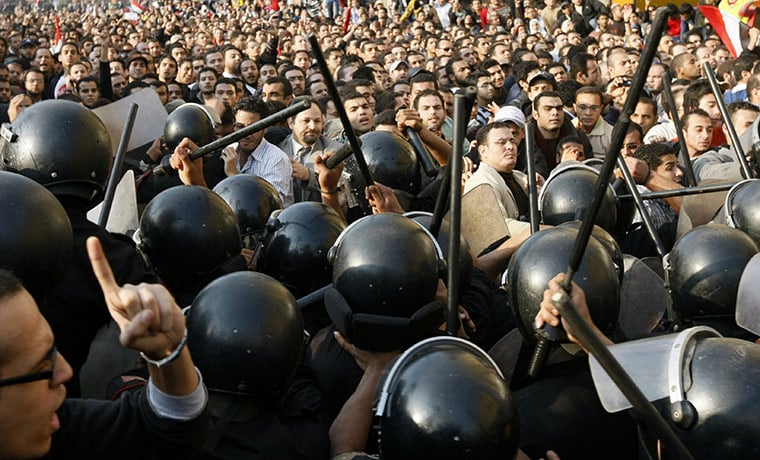
 
Egyptian Protest, 25 January 2011

According to some estimates, as many as 50,000 protesters turned out in Cairo, Alexandria, Suez and other Egyptian cities.[29] The protests were met with the usual brutality: beating protesters, firing tear gas and using water cannons to attempt to disperse the protesters. As images and videos started emerging out of Egypt, “television footage showed demonstrators chasing police down side streets. One protester climbed into a fire engine and drove it away.”[30] Late on the night of the protests, rumours and unconfirmed reports were spreading that the first lady of Egypt, Suzanne Mubarak, may have fled Egypt to London, following on the heels of rumours that Mubarak’s son, and presumed successor, had also fled to London.[31]

Are We Headed for a Global Revolution?

During the first phase of the global economic crisis in December of 2008, the IMF warned governments of the prospect of “violent unrest on the streets.” The head of the IMF warned that, “violent protests could break out in countries worldwide if the financial system was not restructured to benefit everyone rather than a small elite.”[32]

In January of 2009, Obama’s then-Director of National Intelligence Dennis Blair, told the Senate Intelligence Committee that the greatest threat to the National Security of the U.S. was not terrorism, but the global economic crisis:

I’d like to begin with the global economic crisis, because it already looms as the most serious one in decades, if not in centuries ... Economic crises increase the risk of regime-threatening instability if they are prolonged for a one- or two-year period... And instability can loosen the fragile hold that many developing countries have on law and order, which can spill out in dangerous ways into the international community.[33]

In 2007, a British Defence Ministry report was released assessing global trends in the world over the next 30 years. In assessing “Global Inequality”, the report stated that over the next 30 years:

[T]he gap between rich and poor will probably increase and absolute poverty will remain a global challenge... Disparities in wealth and advantage will therefore become more obvious, with their associated grievances and resentments, even among the growing numbers of people who are likely to be materially more prosperous than their parents and grandparents.  Absolute poverty and comparative disadvantage will fuel perceptions of injustice among those whose expectations are not met, increasing tension and instability, both within and between societies and resulting in expressions of violence such as disorder, criminality, terrorism and insurgency. They may also lead to the resurgence of not only anti-capitalist ideologies, possibly linked to religious, anarchist or nihilist movements, but also to populism and the revival of Marxism.[34]

Further, the report warned of the dangers to the established powers of a revolution emerging from the disgruntled middle classes:

The middle classes could become a revolutionary class, taking the role envisaged for the proletariat by Marx.  The globalization of labour markets and reducing levels of national welfare provision and employment could reduce peoples’ attachment to particular states.  The growing gap between themselves and a small number of highly visible super-rich individuals might fuel disillusion with meritocracy, while the growing urban under-classes are likely to pose an increasing threat to social order and stability, as the burden of acquired debt and the failure of pension provision begins to bite.  Faced by these twin challenges, the world’s middle-classes might unite, using access to knowledge, resources and skills to shape transnational processes in their own class interest.[35]

We have now reached the point where the global economic crisis has continued beyond the two-year mark. The social repercussions are starting to be felt – globally – as a result of the crisis and the coordinated responses to it. Since the global economic crisis hit the ‘Third World’ the hardest, the social and political ramifications will be felt there first. In the context of the current record-breaking hikes in the cost of food, food riots will spread around the world as they did in 2007 and 2008, just prior to the outbreak of the economic crisis. This time, however, things are much worse economically, much more desperate socially, and much more oppressive politically.

This rising discontent will spread from the developing world to the comfort of our own homes in the West. Once the harsh realization sets in that the economy is not in ‘recovery,’ but rather in a Depression, and once our governments in the West continue on their path of closing down the democratic façade and continue dismantling rights and freedoms, increasing surveillance and ‘control,’ while pushing increasingly militaristic and war-mongering foreign policies around the world (mostly in an effort to quell or crush the global awakening being experienced around the world), we in the West will come to realize that ‘We are all Tunisians.’

In 1967, Martin Luther King, Jr., said in his famous speech “Beyond Vietnam”:

I am convinced that if we are to get on the right side of the world revolution, we as a nation must undergo a radical revolution of values. We must rapidly begin the shift from a "thing-oriented" society to a "person-oriented" society. When machines and computers, profit motives and property rights are considered more important than people, the giant triplets of racism, materialism, and militarism are incapable of being conquered.[36]

This was Part 1 of "North Africa and the Global Political Awakening," focusing on the emergence of the protest movements primarily in North Africa and the Arab world, but placing it in the context of a wider 'Global Awakening.'
Part 2 will focus on the West's reaction to the 'Awakening' in this region; namely, the two-pronged strategy of supporting oppressive regimes while promoting "democratization" in a grand new project of "democratic imperialism."

Andrew Gavin Marshall is a Research Associate with the Centre for Research on Globalization (CRG).  He is co-editor, with Michel Chossudovsky, of the recent book, "The Global Economic Crisis: The Great Depression of the XXI Century," available to order at Globalresearch.ca. He is currently working on a forthcoming book on 'Global Government'.


Notes

[1]        Zbigniew Brzezinski, The Global Political Awakening. The New York Times: December 16, 2008:http://www.nytimes.com/2008/12/16/opinion/16iht-YEbrzezinski.1.18730411.html; “Major Foreign Policy Challenges for the Next US President,” International Affairs, 85: 1, (2009); The Dilemma of the Last Sovereign. The American Interest Magazine, Autumn 2005:http://www.the-american-interest.com/article.cfm?piece=56; The Choice: Global Domination or Global Leadership. Speech at the Carnegie Council: March 25, 2004: http://www.cceia.org/resources/transcripts/4424.html; America’s Geopolitical Dilemmas. Speech at the Canadian International Council and Montreal Council on Foreign Relations: April 23, 2010:http://www.onlinecic.org/resourcece/multimedia/americasgeopoliticaldilemmas
[2]        Embassy Tunis, TROUBLED TUNISIA:  WHAT SHOULD WE DO?, WikiLeaks Cables, 17 July 2009:http://www.wikileaks.ch/cable/2009/07/09TUNIS492.html
[3]        Mona Eltahawy, Tunisia's Jasmine Revolution, The Washington Post, 15 January 2011: http://www.washingtonpost.com/wp-dyn/content/article/2011/01/14/AR2011011405084.html
[4]        Eileen Byrne, Protesters make the case for peaceful change, The Financial Times, 15 January 2011:http://www.ft.com/cms/s/0/82293e38-20ae-11e0-a877-00144feab49a.html#axzz1C08RDtxu
[5]        Marc Lynch, Tunisia and the New Arab Media Space, Foreign Policy, 15 January 2011:http://lynch.foreignpolicy.com/posts/2011/01/15/tunisia_and_the_new_arab_media_space
[6]        Jillian York, Activist crackdown: Tunisia vs Iran, Al-Jazeera, 9 January 2011:http://english.aljazeera.net/indepth/opinion/2011/01/20111981222719974.html
[7]        Steven Cook, The Last Days of Ben Ali? The Council on Foreign Relations, 6 January 2011:http://blogs.cfr.org/cook/2011/01/06/the-last-days-of-ben-ali/
[8]        Angelique Chrisafis, Sarkozy admits France made mistakes over Tunisia, The Guardian, 24 January 2011:http://www.guardian.co.uk/world/2011/jan/24/nicolas-sarkozy-tunisia-protests
[9]        Hillary Rodham Clinton, Interview With Taher Barake of Al Arabiya, U.S. Department of State, 11 January 2011:http://www.state.gov/secretary/rm/2011/01/154295.htm
[10]      Algeria set for crisis talks, Al-Jazeera, 8 January 2011: http://aljazeera.co.uk/news/africa/2011/01/2011187476735721.html
[11]      Alexandra Sandels, JORDAN: Thousands of demonstrators protest food prices, denounce government, Los Angeles Times Blog, 15 January 2011: http://latimesblogs.latimes.com/babylonbeyond/2011/01/jordan-protests-food-prices-muslim-brotherhood-tunisia-strike-thousands-government.html
[12]      AP, Thousands demand ouster of Yemen's president, Associated Press, 22 January 2011:http://www.google.com/hostednews/ap/article/ALeqM5g3b2emEy39Bn52Z_haypKxNPGMSw?docId=d324160638a74e84b874baeada16bb4c
[13]      Abigail Fielding-Smith, North-south divide strains Yemen union, The Financial Times, 12 January 2011:http://www.ft.com/cms/s/0/c7c59322-1e80-11e0-87d2-00144feab49a.html#axzz1C08RDtxu
[14]      EurActiv, 'Jasmine' revolt wave reaches Albania, 24 January 2011: http://www.euractiv.com/en/enlargement/jasmine-revolt-wave-reaches-albania-news-501529
[15]      Clemens Höges, Bernhard Zand and Helene Zuber, Arab Rulers Fear Spread of Democracy Fever, Der Spiegel, 25 January 2011:http://www.spiegel.de/international/world/0,1518,741545,00.html
[16]      Shibley Telhami, Results of Arab Opinion Survey Conducted June 29-July 20, 2010, 5 August 2010:http://www.brookings.edu/reports/2010/0805_arab_opinion_poll_telhami.aspx
[17]      Shibley Telhami, A shift in Arab views of Iran, Los Angeles Times, 14 August 2010:http://articles.latimes.com/2010/aug/14/opinion/la-oe-telhami-arab-opinions-20100814
[18]      Clemens Höges, Bernhard Zand and Helene Zuber, Arab Rulers Fear Spread of Democracy Fever, Der Spiegel, 25 January 2011:http://www.spiegel.de/international/world/0,1518,741545,00.html
[19]      Merav Michaeli, Israel may be on the eve of revolution, Ha’aretz, 17 January 2011: http://www.haaretz.com/print-edition/opinion/israel-may-be-on-the-eve-of-revolution-1.337445
[20]      Ibid.
[21]      Yagil Levy, Israeli NGOs are entrenching the occupation, Ha’aretz, 11 January 2011: http://www.haaretz.com/print-edition/opinion/israeli-ngos-are-entrenching-the-occupation-1.336331?localLinksEnabled=false
[22]      Richard Falk, Ben Ali Tunisia was model US client, Al-Jazeera, 25 January 2011:http://english.aljazeera.net/indepth/opinion/2011/01/201112314530411972.html
[23]      Jack Khoury and Haaretz Service, Two decades of secret Israeli-Palestinian accords leaked to media worldwide, Ha’arets, 23 January 2011: http://www.haaretz.com/news/diplomacy-defense/two-decades-of-secret-israeli-palestinian-accords-leaked-to-media-worldwide-1.338768
[24]      Haaretz Service and The Associated Press, Hamas urges Palestinian refugees to protest over concessions on right of return, Ha’aretz, 25 January 2011: http://www.haaretz.com/news/diplomacy-defense/hamas-urges-palestinian-refugees-to-protest-over-concessions-on-right-of-return-1.339120
[25]      Alan Greenblatt, Palestinian Papers May Be Blow To Peace Process, NPR, 24 January 2011:http://www.npr.org/2011/01/24/133181412/palestinian-papers-may-cause-blow-to-peace-process?ps=cprs
[26]      Johannes Stern, Egyptian regime fears mass protests, World Socialist Web Site, 15 January 2011:http://www.wsws.org/articles/2011/jan2011/egyp-j15.shtml
[27]      Simon Tisdall, Egypt protests are breaking new ground, The Guardian, 25 January 2011:http://www.guardian.co.uk/commentisfree/2011/jan/25/egypt-protests
[28]      Ibid.
[29]      MATT BRADLEY, Rioters Jolt Egyptian Regime, The Wall Street Journal, 26 January 2011:http://online.wsj.com/article/SB10001424052748704698004576104112320465414.html
[30]      Catrina Stewart, Violence on the streets of Cairo as unrest grows, The Independent, 26 January 2011:http://www.independent.co.uk/news/world/middle-east/violence-on-the-streets-of-cairo-as-unrest-grows-2194484.html
[31]      IBT, Suzanne Mubarak of Egypt has fled to Heathrow airport in London: unconfirmed reports, International Business Times, 25 January 2011: http://www.ibtimes.com/articles/104960/20110125/suzanne-mubarak-of-egypt-has-fled-to-heathrow-airport-in-london-unconfirmed-reports.htm
[32]      Angela Balakrishnan, IMF chief issues stark warning on economic crisis. The Guardian: December 18, 2008:http://www.guardian.co.uk/business/2008/dec/16/imf-financial-crisis
[33]      Stephen C. Webster, US intel chief: Economic crisis a greater threat than terrorism. Raw Story: February 13, 2009:http://rawstory.com/news/2008/US_intel_chief_Economic_crisis_greater_0213.html
[34]      DCDC, The DCDC Global Strategic Trends Programme, 2007-2036, 3rd ed. The Ministry of Defence, January 2007: page 3
[35]      Ibid, page 81.
[36]      Rev. Martin Luther King, Beyond Vietnam: A Time to Break Silence. Speech delivered by Dr. Martin Luther King, Jr., on April 4, 1967, at a meeting of Clergy and Laity Concerned at Riverside Church in New York City: http://www.hartford-hwp.com/archives/45a/058.html

Andrew Gavin Marshall is a frequent contributor to Global Research.  

Global Research Articles by Andrew Gavin Marshall