Showing posts with label Truth To Power. Show all posts

Tuesday, January 21, 2014

Truth: The Enemy Of The State


The political establishment has implicitly embraced the mindset of Hitler’s Propaganda Minister, Dr. Joseph Goebbels:

The lie can be maintained only for such time as the State
can shield the people from the political, economic and/or
military consequences of the lie. It thus becomes vitally
important for the State to use all of its powers to
repress dissent, for the truth is the mortal enemy of the
lie, and thus by extension the truth becomes the greatest
enemy of the State.

This is why the state is so threatened by such modern technologies as the Internet, as well as by the “whistleblowers” who insist on exposing the state’s embarrassing truths to the general public.

Our institutionalized world is increasingly hostile to any utterances of truth that would be upsetting to the status quo. 

The mainstream media and most of academia long ago gave themselves over to propagandizing on behalf of defending and/or enhancing the coercive power structure of the state. When war policies are under discussion, retired Army generals or officials from “think-tanks” funded by the national defense industry, are trotted out to “debate” such non-issues as how many troops to send in, who to attack, etc., etc., all to maintain the pretense of having a “fully-informed” public. 

But when was the last time you saw a Robert Higgs, Noam Chomsky, Lew Rockwell, Amy Goodman, Justin Raimondo, Angela Keaton, Karen Kwiatkowski, Chris Hedges, or other critic of the war system allowed to raise the kinds of questions that are not supposed to be asked in this best of all possible worlds?  

[Butler Shaffer]

Friday, July 13, 2012

The Santa-ization of MLK's Radical Legacy

“The nation is sick. Trouble is in the land; confusion all around.”
– Martin Luther King’s final speech, I've Been to the Mountaintop

Yet, for all of King’s talk of getting along – the stuff he’s known for now -- he was not at all about just going along with a system he saw as evil; he wasn’t about politely working within a system designed by and for those who profit from human suffering. And for that reason he was hated by the elites, labeled a communist by the likes of FBI Director J. Edgar Hoover and a potential security threat by good liberals like Robert Kennedy.
Rather than shy away from controversy, however, King embraced his status as a pariah for progressive change, coming out as an enemy of the American warfare state.
Speaking at a church in New York City in April 1967, King criticized American military intervention in Vietnam, proclaiming that he could no longer stand idly be as his government – headed by a pro-war Democrat – reigned hell upon the poor overseas. Though he had for years focused on preaching a message of peace as an answer to America’s domestic problems, “I knew that I could never again raise my voice against the violence of the oppressed in the ghettos without having first spoken clearly to the greatest purveyor of violence in the world today – my own government.” King decided he couldn’t keep quiet as millions of human beings being murdered in Vietnam, even if it meant speaking out against a president who had signed the Civil Rights Act. For the sake of those at home watching their government employ violence to solve its perceived problems, and thinking that perhaps violence could be the solution to problems of their own, and “for the sake of the hundreds of thousands trembling under our violence, I cannot be silent.”
Almost a year to the day later, King was silenced for good by an assassin’s bullet.
Martin Luther King Jr. was an American radical, a man who stood up to the ruling class on behalf of the impoverished, both at home and abroad. Unable to confront the moral force of his message, the powerful have instead chosen to ignore it, appropriating his image and stripping him of his radicalness. In Washington the whitewashing of King’s legacy is plain for all to see, the made in China monument constructed in his honor as white as most members of Congress.
But like other radicals, King’s image has been appropriated by the powerful, his inconvenient radicalism ignored, his message dumbed down to a few lines that would feel at home on a Hallmark card. According to the official history, King is something of a jolly American Santa Claus who, like, just wanted everyone to get along, man. George W. Bush and Barack Obama alike have claimed him as an inspiration, reducing him to the status of an honorary Founding Father, a guy who believed “all men are created equal,” in the words of The Decider, one who had faith in the “beliefs articulated in our founding documents.”
What our powerful elites leave out: That today, America doesn’t have an equivalent popular voice against state-sanctioned terror. Our preachers condemn sex and drugs, but can’t be bothered to say nary a bad word about incinerating women and children with Hellfire missiles. Our 21st century spiritual leaders hawk phones but couldn’t care less about peace, consumerism filling the void left by our society’s atrophied moral conscience.
That void cannot remain. A nation without a conscience, a nation that abides state-sanctioned murder from Yemen to Pakistan to Honduras so long as a new iPad is released every 9 months or so, is a nation without a soul. Instead of waiting around for a savior, though, we as a people need to acknowledge our collective power to shape the future for the better, our ability to create a world where militarism and corporate greed are supplanted by mutual aid and a commitment to community. The elites may have all the guns and money, but we have the numbers.
"For a time I was depressed,” Helen Keller, another American whose radicalism has been forgotten (she was a socialist, an antiwar marcher and a founder of the ACLU), remarkedwhen speaking of her own awakening to the institutionalized injustice around her. “But little by little my confidence came back and I realized that the wonder is not that conditions are so bad, but that society has advanced so far in spite of them. And now I am in the fight to change things.”
Are you?

Saturday, March 10, 2012

The Crime Of Truth

Obama's Persecution Of The Peacemaker 

THURSDAY, 08 MARCH 2012 00:50 
Courtesy Of "Chris Floyd"


If any one person can be said to have ended the direct involvement of the United States military in Iraq, it is not the man whose champions claim this deed as one of his glorious accomplishments: Barack Obama. As we all know (and 99 percent of us have forgotten), Obama fought doggedly to extend the murderous occupation of Iraq into the indefinite future.

No, if you had to choose one person whose actions were the most instrumental in ending the overt phase of the war, it would not the commander-in-chief of the most powerful war machine in world history, but a lowly foot-soldier -- mocked, shackled, tortured, defenseless: Bradley Manning
William Blum points this out in his latest "Anti-Empire Report," as he recaps the impact of the revelations made by Manning and Wikileaks. He begins by noting a painful irony: Manning's own defense team is playing down the heroic nature of this act and instead insisting that such a "sexually troubled" young man should never have been sent to the homophobic environment of the American occupation force in the first place. He was under too much stress, acting irrationally, they say, and thus should not be held accountable for his actions. As Blum notes, this defense -- though doubtless well-intentioned, a desperate bid to keep Obama's massive war machine from crushing Manning completely under its wheels -- partakes of the same deceitful twisting of reality that has characterized the entire war crime from the beginning. Blum:
It's unfortunate and disturbing that Bradley Manning's attorneys have chosen to consistently base his legal defense upon the premise that personal problems and shortcomings are what motivated the young man to turn over hundreds of thousands of classified government files to Wikileaks. They should not be presenting him that way any more than Bradley should be tried as a criminal or traitor. He should be hailed as a national hero. Yes, even when the lawyers are talking to the military mind. May as well try to penetrate that mind and find the freest and best person living there. Bradley also wears a military uniform.

Here are Manning's own words from an online chat: "If you had free reign over classified networks ... and you saw incredible things, awful things ... things that belonged in the public domain, and not on some server stored in a dark room in Washington DC ... what would you do? ... God knows what happens now. Hopefully worldwide discussion, debates, and reforms. ... I want people to see the truth ... because without information, you cannot make informed decisions as a public."

Is the world to believe that these are the words of a disturbed and irrational person? Do not the Nuremberg Tribunal and the Geneva Conventions speak of a higher duty than blind loyalty to one's government, a duty to report the war crimes of that government?
Every scrap of evidence presented about Manning's alleged crimes makes it clear that he was acting from rational, well-considered motives, based on the highest ideals. Indeed, wasn't Manning simply following the words of Jesus Christ -- words carved in stone, with the most bitter irony, in the entranceway of the original headquarters of the CIA: "And ye shall know the truth and the truth shall make you free."

In any case, as Blum points out, the effects of Manning's actions were far-reaching:
It was after seeing American war crimes such as those depicted in the video "Collateral Murder" and documented in the "Iraq War Logs," made public by Manning and Wikileaks, that the Iraqis refused to exempt US forces from prosecution for future crimes. The video depicts an American helicopter indiscriminately murdering several non-combatants in addition to two Reuters journalists, and the wounding of two little children, while the helicopter pilots cheer the attacks in a Baghdad suburb like it was the Army-Navy game in Philadelphia.

The insistence of the Iraqi government on legal jurisdiction over American soldiers for violations of Iraqi law — something the United States rarely, if ever, accepts in any of the many countries where its military is stationed — forced the Obama administration to pull the remaining American troops from the country.

If Manning had committed war crimes in Iraq instead of exposing them, he would be a free man today ...
But he is not a free man, of course. It is very likely that he will never be free again. He will spend the rest of his life in a federal prison for the unforgiveable crime of telling the truth to people who don't want to hear it.

NOTE: A tribute to Bradley and his fellow truth-tellers can be found here: The Good Corporal: To the Exposers of Power and the Troublers of Dreams.

Saturday, November 12, 2011

The Radical Power Of Just Showing Up


Occupy Wall Street is "a refusal ... to conform to an imposed script of appropriate citizen behaviour" [GALLO/GETTY]


The Arab Spring and Occupy Wall Street Movements Show That Simply Standing Together Can Achieve Real Results.

By Jillian Schwedler
Last Modified: 25 Oct 2011 11:15
Courtesy Of "Al-Jazeera"


The Arab Spring initiated a jarring series of events in 2011 that illustrate the radical political possibilities of just being present. When the regime won't listen, when being heard as an individual isn't really a viable option, simply standing together and being seen can be profoundly political and empowering.

But will just "being there" really bring significant change?

Revolutions never happen overnight. They result from accumulations of dozens, even hundreds of moments, often stretching over a period of years, that make possible the ruptures that emerge when vast numbers of people begin to imagine, and then to demand, an alternative to their living conditions. We have been seeing these moments over the past year, first in the Middle East but then spreading to England, Brazil, Spain, Great Britain, the United States, and elsewhere. In this sense, we are experiencing a revolutionary moment in which the popular perception of what is possible has indisputably shifted in a way unseen on a global scale since 1968.

This moment is revolutionary, even though revolutions are not imminent everywhere. People around the globe are simultaneously imagining alternatives to the conditions under which they live, and they recognise such movements taking place elsewhere and feel a connection, a kinship, with other who are taking to the streets and reclaiming public spaces. For some, the imagined future entails a fundamental change in the structures of government; for others, it entails an alternative to the economic status quo. But for all of them, often for the first time in generations, an alternative future feels possible and tangible rather than fantastical.

Revolutionary Road

Revolutionary moments don't always foster revolutions, of course. Political revolutions are only possible when the repressive security apparatuses that defend the regime - the army, the police, and other agencies of force - become divided. When armies divide, when some leaders and their troops defect, that is when a revolution becomes possible. But even this does not mean that a revolution will be successful. It can lead to a regime change, even a rapid or peaceful one, but more often it can lead to a bloody, protracted civil war. But for many of the citizens - albeit not for all of them - sustained bloodshed is preferable because it keeps alive the hope that an alternative future is finally within grasp. Witnessing people choose these bloody moments of possibility over the (sometimes bloody) status quo has a dramatic impact. If they can do it-when the obstacles they have successfully overcome were far more daunting than the ones we face - why are we acquiescing to the repressive conditions that limit the possibilities of our own lives?

Follow Al Jazeera's ongoing coverage
Although many hope to dismiss its potential, Occupy Wall Street represents just such a revolutionary moment. It is a politics of refusal because of its strong and sustained rejection of a system that dismisses the economic struggles of most of the people on the globe. It is a refusal to feel helpless and powerless in the face of economic policies that favour banks and corporations at the expense of flesh and blood. That refusal has been manifest in the retaking of public spaces, an outpouring of people into places where their frustrations and grievances become visible. Merely standing together in public can be a radical political act because governments around the world seek to control how public spaces are used, preserving them for certain kinds of loyal and conforming citizens. "Undesirables” - the homeless, the punks, skateboarders, graffiti artists, groups of young men, and of course protesters who question the prevailing political and economic policies - must all be cleared from those spaces, sometimes at high costs. Who is welcome? Nuclear families, particularly if they are spending money.

And our public spaces are being stolen from us in other ways: many of them have been silently privatised, so that pedestrian commercial malls appear to be public spaces but are not. If you buy a pumpkin latte, you are welcome to relax at a table or bench. If you cannot, or do not spend money to consume, you are loitering, trouble, out of place.

Occupy Wall Street represents a refusal of these and other exclusions, a refusal to conform to an imposed script of appropriate citizen behaviour at appropriate times. Perhaps most ironically, the protesters in Zuccotti Park have been able to remain there in part because it is a private space open to public access 24 hours a day. Its owner - despite considerable pressure - has not (yet) acted to have them removed. Public parks in NYC close at dusk.

Occupy Wall Street represents a revolutionary moment in another way: by refusing the notion that democratic politics has been reduced to standing in a voting queue every four years. Facebook and other social media have been important in connecting citizens, in allowing individuals to learn about and to explore alternative political visions, to discover social movements, and sometimes even to mobilise. But when politics is reduced to voting and to "liking" a page, democracy is impoverished. Even in the United States, the Republican Party, the Democratic Party, corporations, and other key institutions of the American political regime want us to participate only in this limited fashion. It is not disruptive of their agendas, and it dramatically limits our ability to shape the public political discourse. Be good citizens. Behave. Go spend $4 on a latte; you can vote again next year.

One of the criticisms of Occupy Wall Street has been that it does not have a clear agenda. I have two comments on this. First, so what? We don't yet know what kind of movement this will be, and all major movements begin with a sorting through of various claims and priorities. The labour movement in the United States was divided early on between advocates for craft workers and advocates for unskilled workers, but the movement sorted that out over time. This is how major movements evolve, and Occupy Wall Street is in its very early stages.

But second, I think it is a strength of the movement to not have a single, united agenda beyond "We are the 99 per cent”. In fact, this is precisely what is so unsettling to those in power, whether in the government or the parties or the CEOs of major corporations: the politics of being present and refusing to go away isn't about a single agenda that can be engaged, critiqued, mocked, or rejected. It's hard to characterise the crowds as radical anarchists (though parts of the media continue to perpetuate this fiction) when marines turn out to join the protest wearing their uniforms. When middle-aged unemployed women drive for hours to be a part of this crowd, instead of sending out yet another futile job application. When even parts of the 1 per cent - people who live in relative comfort but whose retirement accounts are evaporating - are making their way to public spaces around the United States to stand in solidarity with others. Those in power can ignore the powerful presence of such diverse and motivated crowds only at their peril.

'Occupy Everywhere'

In this sense, global occupations, from Tahrir, to Placa de Catalunya, to Wall Street, are revolutionary moments.

Citizens are stepping into public spaces, empowered by a sense of being a part of something different, and demanding, insisting, that they be acknowledged. These are not only radical political moments but also a politics of refusal. They are democratic moments, as well as profoundly human moments: when people stand together to face down a variety of institutions that crush the possibilities of our futures - politically, socially, and economically. This is a politics of just being there that insists - to borrow from the ACT UP movement of the 1980s that had a major impact on how we view AIDS - "We are here, and we are not going anywhere”.

Will Occupy Wall Street matter? Can this insistence that democratic participation not be reduced to voting queues and e-petitions help create an alternate future? I am reminded of a joke about Hosni Mubarak in the days before he was forced from office. The joke goes: One of Mubarak's advisors said to him,"Mr President, I think you should prepare a farewell letter to your people." To which he replied, "Why, where are they going?”

Mubarak was tone-deaf. He did not hear the voices of the Egyptian people, nor did he understand their politics of refusal as thousands, and then millions, took to the streets and refused to go away. The most powerful and immediate effect of Occupy Wall Street may also be profound: the movement could change the terms of the public discourse in the United States. The numbers of protesters will surely dwindle as the winter sets in, and critics will relish characterising the movement as a failure. But if the numbers begin to swell again in the spring, and should they continue through the election year - with growing crowds of citizens demanding to be recognised together despite having their individual grievances - Occupy Wall Street could extend the revolutionary moment that began in the Middle East. US politicians would be forced to listen seriously to their voices or else appear as tone deaf as Mubarak was.

Occupy Wall Street is unsettling and disarming to those who hold economic power precisely because it is about making our government more democratic, creating an economic system that is more fair to its citizens and more responsive to the needs of people, and not to the needs of corporations. I noted that revolutionary moments turn into revolutions only when the repressive forces maintaining the regime begin to divide. The 1 per cent can be split - and perhaps already is becoming divided. When it does, this revolutionary moment may turn revolutionary. An alternative future on a global scale is possible, and it may have never been more within reach. And even if gains are not imminent, people of every generation grasp the idea that they ought to have a direct say in the conditions that shape their lives. Indeed, they are now insisting on it. Nothing is more revolutionary.

Jillian Schwedler is Associate Professor of Political Science at the University of Massachusetts, Amherst, and author of Faith in 'Moderation: Islamist Parties in Jordan and Yemen' (Cambridge 2006).

Friday, November 11, 2011

"Gimme Some Truth"

By "John Lennon"

The song and images are exclusively property of John Ono Lennon and Yoko Ono Lennon and WMG.

Edit by "Giacomo A. Iacolenna"


I'm sick and tired of hearing things
From uptight, short-sighted, narrow-minded hypocrites
All I want is the truth
Just gimme some truth

I've had enough of reading things
By neurotic, psychotic, pig-headed politicians
All I want is the truth
Just gimme some truth

No short-haired, yellow-bellied, son of Tricky Dicky
Is gonna mother hubbard soft soap me
With just a pocketful of hope
Money for dope
Money for rope

I'm sick to death of seeing things
From tight-lipped, condescending, mama's little chauvinists
All I want is the truth
Just gimme some truth now

I've had enough of watching scenes
Of schizophrenic, ego-centric, paranoiac, prima-donnas
All I want is the truth now
Just gimme some truth

No short-haired, yellow-bellied, son of Tricky Dicky
Is gonna mother hubbard soft soap me
With just a pocketful of hope
It's money for dope
Money for rope

Ah, I'm sick to death of hearing things
from uptight, short-sighted, narrow-minded hypocrites
All I want is the truth now
Just gimme some truth now

I've had enough of reading things
by neurotic, psychotic, pig-headed politicians
All I want is the truth now
Just gimme some truth now

All I want is the truth now
Just gimme some truth now
All I want is the truth
Just gimme some truth
All I want is the truth
Just gimme some truth

Friday, October 14, 2011

9/11 Is the Litmus Test

Heretic Productions
By "Les Visible"


There is one thing that defines everyone over the course of these early years of this new century. That thing is the 9/11 attack. Everyone in government and every field of endeavor the world over is defined by their position on this event. It is not necessary to know the truth. It is only necessary to know the extent of the lies in order to define any leader in any position anywhere in the world. By what they have said and by what they have not said, one can accurately judge who is an enemy of the people’s of the world. One can accurately determine who is a tool of the psychopaths or one of them.


Think about what you allow yourself to know. Think about what you pass by; ignore, deny and defend ...that defines you. It defines the degree of your personal courage, your relationship to the truth, your values, your principles and what you will pass on to your children and everyone you meet. It tells you in that place where your conscience must once have lived whether you are a hypocrite and a fool or whether something greater still lives within you.


Nineteen men pass through airport security. Eleven of them are stopped and questioned but then allowed to board. Several large passenger planes wind up hijacked and flown at high speed into enormous buildings. None of these men had shown previous capacity to accomplish this feat. These men were armed with box cutters. No jet fighters were scrambled to intercept these planes, although the authorities in charge of such actions knew immediately what was happening. Airport traffic controllers were ordered to destroy all recorded evidence of the event. Some of them physically broke the CD’s and scattered the pieces into different trash containers at the airports.


Within hours, three of the biggest buildings in the city, buildings designed to absorb the impact of the very planes which hit them, all crumbled into their own footprints at the speed of freefall. It was said that the fire, which burned below the melting point of steel, caused this to happen. No fire in history had previously accomplished such a thing, not once. Previous fires had burned hotter and longer, yet no building fell. Now, three have fallen in one day. Months later the wreckage burned white hot beneath the surface and clear cuts in support beams were photographed.


A passport from one of the hijackers appears on a city street undamaged. Cars are discovered at airports with flight training videos and Korans. Apparently the men who were deeply religious enough to give their lives to attack these buildings thought nothing of leaving their sacred texts behind. Some weeks later, seven of the alleged hijackers are found to be alive in their native countries.


Some days earlier some of these men were observed drinking and having lap dances in a Florida bar. This sort of behavior is not normal for such men as these. Around the same time, the ringleader of these men and some associates were observed by the FBI boarding a gambling boat belonging to Jack Abramoff. These men were tracked to Las Vegas and watched by the FBI, yet they passed through the airport security checkpoints. Even though eleven of them were stopped and questioned they still boarded.


On the day of the event several men were observed videotaping the attack as it happened. They were seen to be dancing and celebrating as well. The police stopped and arrested them. They were found to be Mossad agents. Some time later they were quietly released and returned to their home country with no reasons given. The men videotaping and celebrating had to have known about the attack in advance in order to have been in a position to film it. Members of the Bin Laden family; the man accused of masterminding the attack, were immediately flown out of the country. Bin Laden denied any connection to this attack. Direct evidence of this exists and no evidence of his admitting his involvement exists. All of this is fabrication and hearsay. No one can present such information other than one fabricated video that was proven false by the world’s leading forensic experts in Switzerland. Many insist it is true but no one has such evidence. Go look. Bring it to me.


As a result of this event, major wars have been launched. Over a million people have died with nearly another 5 million displaced. An investigation was launched into the event against the wishes of the president and vice president and rubber stamped with pre-drawn conclusions even though the evidence did not support these conclusions. The wreckage was gathered together and shipped overseas. No one was allowed to investigate it.


In every event... in New York City... in a Pennsylvania field... at The Pentagon... all of the evidence is contradictory. The amount of evidence on every level that directly refutes what we have been told fills thousands of pages. Meanwhile, the administration and the congress belligerently oppose any inquiry into the matter. People in government who have questioned the official story have been fired from their jobs or driven from office by the very party they are a member of. University professors are fired for discussing it. Independent investigators are met with scenes like THIS. Major web sites composed of experts in their fields, HERE and HERE are ignored and censured.


Casual investigation of who benefited and who engineered actions of global impact based on official 9/11 findings ALL lead to the same parties. It is incontrovertibly true that one organization, PNAC, called for an attack on American soil in order to facilitate what followed. Members of this organization held key positions in and around the present administration.


Therefore... therefore... here is what you must know, given that the official story is patently absurd. Anyone... anyone who promotes the official story; who accepts the official story, who oppresses those who doubt the official story, who does not question the official story, is involved or too stupid to pat their head and chew gum at the same time. Any presidential candidate who does not dispute the official story is a traitor to their nation and a tool of those who accomplished the attack.


It all comes down to 9/11. Everything that has happened has happened based on a lie. Everyone in government; in the media, in entertainment, in organized religion, in the public eye and in the public who accepts and promotes the official story is either a traitor or a tool. Everyone who does not stand forth and speak truth to power is a coward, a liar and complicit in mass murder. Everyone- everywhere can be measured according to this litmus test.


I have included here only a very small portion of the damning evidence that runs counter to the official lies. The preponderance of evidence that refute the official lies is overwhelming.


Measure everyone by their position and their comments or lack of comments concerning this signal event. Measure everything they say in relation to their position on this event. For those of you who know that this is all a lie, I ask you not to go to work on March 19th in protest of this event and all of the events that have followed. I ask the residents of every nation on Earth to take this day off from your usual duties and stand down in protest of the terrible lies and events that cloud our existence and circumscribe our freedoms. Send a message. Stop the machine. See your power and in seeing it, expand it.


Hear me people. We know who you are and we know who we are. We see you lie and we see you murder. We see. You are going down. It may not be today and it may not be tomorrow but you are going down. And you... all of you who know and who abet and serve the empire of darkness; all of you who have sold your honor and integrity for a place at the table, for the opportunity to run your mouths about banal tripe and be a hearty-fellow-well-met among the psychopaths, who lurk like jackals among the lions, who are complicit in this evil... you will be shamed beyond endurance for having been such a whore and a fool for table scraps at the cost of your humanity.


March 19th. Stand down. Next time make it a week and then a month and then as long as it takes.


Have I got it Right? ...Talking 9/11 Blues

Sunday, October 09, 2011

Wednesday, September 21, 2011

Tony Bennett "We Caused The 9/11 Attack"

gty tony bennett jp 110908 wblog Tony Bennett on 9/11 Attacks: They Flew the Plane in, But We Caused It

Tony Bennett On 9/11 Attacks

By Brian Canova
Sep 19, 2011 10:17pm
Courtesy Of "ABC News"

video platformvideo managementvideo solutionsvideo player

...Beginning with his service in World War II, Bennett said that his experiences as a teenager in combat forever changed his position on war.

“I’m anti-war,” he said. “It’s the lowest form of human behavior.”

Drafted by the U.S. Army in November 1944, Bennett served as an infantryman in Europe, moving across France, and later into Germany.

“The Germans were frightened. We were frightened. Nobody wanted to kill anybody when we were on the line, but the weapons were so strong that it overcame us and everybody else.”

Bennett credited the Army with allowing him to study singing under the GI Bill. He also admitted that his two years of service gave him enough time to witness the horrors of war.

“The first time I saw a dead German, that’s when I became a pacifist,” he said.

He told Stern that he was left forever shaken by the sight of death.

“It was a nightmare that’s permanent,” he said. “I just said, ‘This is not life. This is not life.’”

Bennett, 65 years after leaving his military life behind, ... developed definite opinions about other wars involving the United States.

“To start a war in Iraq was a tremendous, tremendous mistake internationally,” he said.

Stern then asked Bennett about how America should deal with terrorists, specifically those responsible for the 2001 attack on the World Trade Center.

“But who are the terrorists? Are we the terrorists or are they the terrorists? Two wrongs don’t make a right,” Bennett said.

In a soft-spoken voice, the singer disagreed with Stern’s premise that 9/11 terrorists’ actions led to U.S. military involvement in Iraq and Afghanistan.

“They flew the plane in, but we caused it,” Bennett responded. “Because we were bombing them and they told us to stop.”

Following seconds of silence, Stern said that his guest was “making some good points.”

Before leaving, Bennett recalled an evening in 2005 when he was honored at the Kennedy Center. Meeting President George W. Bush at the event, the singer said that the commander-in-chief shared his opinion about the Iraq War.

“He told me personally that night that, he said, ‘I think I made a mistake,’” Bennett said.

Bennett believed that the president made this revelation because “he had a special liking to me.”

Saturday, April 23, 2011

American Radical

The Trials Of Jewish-American Political Scientist Norman Finkelstein.

Last Modified: 12 Apr 2011 13:12
Courtesy Of "Al-Jazeera"


"Every single member of my family on both sides was exterminated. Both of my parents were in the Warsaw Ghetto uprising. And it is precisely and exactly because of the lessons my parents taught me and my two siblings that I will not be silent when Israel commits its crimes against the Palestinians."

Norman Finkelstein


American Radical is the probing, definitive documentary about Jewish-American political scientist Norman Finkelstein.

A devoted son of holocaust survivors, an ardent critic of Israel and US Middle East policy, Finkelstein has been steadfast at the centre of many intractable controversies, including his denial of tenure at DePaul University.
"You don't know who Norman Finkelstein is. He's poison, he's a disgusting self-hating Jew."

Leon Wieseltier, literary editor, The New Republic

Called a lunatic and self-hating Jew by some and an inspirational street-fighting revolutionary by others, Finkelstein is a deeply polarising figure.

"Norman is a very careful scholar. And he feels very passionately about the Holocaust. His parents are both survivors of extermination camps and he was deeply involved in their lives and the tragedies and so on. [He] knows everything about the Holocaust. And when he sees somebody using it, exploiting it, demeaning the memory of the victims for personal gain, he doesn't like it. I can understand that."

Noam Chomsky, friend and professor of linguistics, MIT

From Beirut to Kyoto, the filmmakers follow Finkelstein around the world as he attempts to negotiate a voice among both supporters and critics.

"If he were not a Jew - that is, I don't think he is a Jew. As someone once put it 'he's only Jewish on his parents side". If he were not a Jewish person or a person of Jewish heritage with a name like Finkelstein, nobody would have any doubt that he was an anti-Semite."

Alan Dershowitz, author 'The Case for Israel'

Filmmakers: David Ridgen and Nicolas Rossier

The documentary was recently voted fifth best political documentary of all time by www.screenjunkies.com

Wednesday, July 21, 2010

The Price Of Truth In Anglo-America

By Rami G. Khouri
The Daily Star (Lebanon)
Thursday, Jul 15, 2010
Courtesy Of "Axis Of Logic"


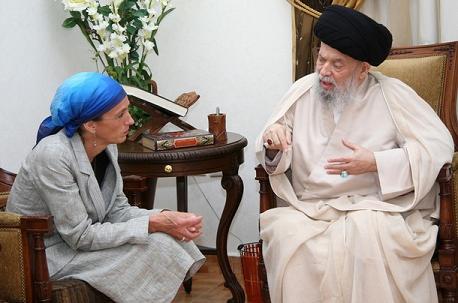
Editor's comment: As is the case with France and their ban on the burqa, the real issue in this sad tale for Britain is the loss of their national sovereignty to the Zionist establishment in the UK and Israel. The global issue is Israel's aggression and press for war on its neighbors through European foreign policy. Ambassador Frances Guy was forced to apologize for her honesty and for doing her job as an ambassador. (photos added to original article by Axis of Logic)
- Les Blough, Editor


Lebanon's Sayyed Mohamad Hussein Fadlallah and Frances Guy,
British Ambassador to Lebanon in a cordial meeting in Beirut, June, 2008

Two fascinating yet troubling incidents took place in the past week related to American and British public figures – a British ambassador and an American journalist – who had their fingers burned for acknowledging the deep respect that the late Sayyed Mohammad Hussein Fadlallah, the Lebanese Shiite Muslim religious figure, enjoyed throughout Lebanon and the Islamic world.


The British ambassador to Lebanon, Frances Guy, said Sunday she regretted “any offense” caused by a blog post two days earlier in which she had praised Fadlallah for being a man of spiritual and intellectual depth. She had written that, “When you visited him you could be sure of a real debate, a respectful argument and you knew you would leave his presence feeling a better person.” 


That gesture reflected both the best of her own character as a decent human being and her professionalism as a diplomat whose job is to know the society where she is posted, with all its nuances. The convergence of those two qualities, it seems, may have been too much for the British government. The Foreign Office quickly removed her original comments, saying that she had expressed her personal views that clashed with official policy. It also noted, “While we welcomed his progressive views on women’s rights and interfaith dialogue, we also had profound disagreements – especially over his statements advocating attacks on Israel.”

Guy’s latest blog Sunday included her expression of regret for offending anyone. She explained correctly that the original blog, “was my personal attempt to offer some reflections of a figure who while controversial was also highly influential in Lebanon’s history and who offered spiritual guidance to many Muslims in need.”


Fadlallah’s death also created problems for Lebanese-born Octavia Nasr, senior editor with CNN television and a long-time analyst of the Arab world for that company. She was fired last week after sending out a personal tweet praising Fadlallah as “one of Hizbullah’s giants I respect a lot.”


After losing her job for expressing a personal opinion that also happened to be an honest one (if slightly inaccurate, as he was not formally a Hizbullah man), Nasr later said of her original statement via Twitter that, “it was an error of judgment for me to write such a simplistic comment and I’m sorry because it conveyed that I supported Fadlallah’s life’s work. That’s not the case at all.”


What do we learn from these incidents? Two main issues come to mind. The first is about the true commitment of the United States and the United Kingdom to the principles of freedom of speech and press. If knowledgeable people like Guy and Nasr get punished, humiliated or merely slapped on the wrist for making sincere personal statements about important public issues, then why should anyone take seriously the American and British governments and their armies that come to our region regularly to promote democracy and freedom of speech and press? Do the US and UK governments want us to act as free men and women, except when the issue touches Israeli sensitivities?


The second is about nuanced analysis and assessment of Arab societies and leaders, including in this case a man like Fadlallah who elicited enormous respect but also angered many in Israel and the West for supporting military resistance to the Israeli occupation of south Lebanon. Instead of seeing him in black and white only, it is more sensible to acknowledge his many prevalent humanistic qualities while also disagreeing with aspects of his worldview – as the two ladies hinted at in their subsequent statements. But, again, this seems forbidden when the matter includes active opposition to Israeli policies.
We see here once again the failure of the prevailing Israeli-driven Anglo-American view that anyone who opposes or actively fights Israel is discounted and boycotted as a terrorist.


No other aspect of one’s life, values or actions can be examined or acknowledged; we exist only insofar as we acquiesce to Israeli demands.


This is not only an enormous tragedy and waste in terms of perpetuating the destruction caused by the Arab-Israeli conflict; it is also a massive dagger in the heart of Anglo-American-Israeli rhetoric about their respect for democracy, and their desire to promote personal and political freedoms in our region. Every time a US or British government official speaks to us about facing truth and reality, we will recall these two minor incidents and ask them when they plan to break free from the hysteria, hypocrisy and political blackmail that still define so many aspects of Anglo-American-Israeli relations. We in the Middle East are used to this sort of racist intellectual terrorism; American and British citizens who occasionally dare to speak accurately about the Mideast and its people are still learning about the full price of the truth when Israeli interests are in the room.

Saturday, May 22, 2010

Silenced For Speaking The Truth About Guantanamo

Unfair Trials

By Robert Fisk
Saturday, 15 May 2010
Courtesy Of "The Independent"

I began my column last week with the words "We know all about Guantanamo". I was wrong. Courtesy of the Toronto press – until a few days ago, when half of them were censored out of the drumhead courts martial that pass for "justice" in this execrable place – I have been learning a lot more.

Because the case involves a Canadian citizen – and because the Canadian government is doing sod-all for its passport-carrying prisoner – it hasn't been getting a lot of publicity on this side of the Atlantic. It should.

Omar Khadr was 15 when he allegedly – the word "'allegedly" is going to have to be used for ever, since this is not a fair trial – shot and killed a US Special Forces soldier in eastern Afghanistan in July 2002. Last week, a former US serviceman called Damien Corsetti, nicknamed "The Monster" at the Bagram jailhouse where torture and murder were widespread, agreed via a video link to the Guantanamo "court" that Khadr was trussed up in a cage "in one of the worst places on earth". "We could do basically anything to scare the prisoners," Corsetti announced.

Beating was forbidden, "The Monster" acknowledged, but prisoners could be threatened with "nightmarish scenarios" like rendition to Egypt or Israel where, according to Canada's Globe and Mail, "they would disappear". Which tells you a lot about Israel. Or what the Americans think of Israel. Quite a lot about Egypt, too, come to think of it.

I should add that Mr Khadr, who is now 23, was gravely wounded when he was brought to Bagram. As Mr Corsetti said, "He was a 15-year old kid with three holes in his body, a bunch of shrapnel in his face." The lads at Bagram – the guards and interrogators, that is – dubbed him "Buckshot Bob". Clever, huh?

Mr Corsetti, I should also add, was kind to Mr Khadr. He was earlier acquitted of charges of detainee abuse – not involving Khadr – and now says he is a disabled veteran being treated for "post-traumatic stress disorder". In other words, quite a find for Khadr's defence lawyers. Not for the Canadian government, however, which asked the Obama administration to suppress the fact that in 2003 and 2004, Khadr had given information to officials of the Ottawa department of foreign affairs and to agents of the Canadian Security and Intelligence Service (CSIS, for those who care).

The Canadian Supreme Court (for which I care a lot, because it appears to be fair) has already ruled that the conditions of Khadr's imprisonment at Guantanamo when interrogated by CSIS "constituted a clear violation of Canada's international human rights obligations".

Another American interrogator at Bagram, a sergeant, it turned out at the Guantanamo hearings, had questioned Khadr about his role in the Taliban. This interrogator, named Joshua Claus, was later convicted of detainee abuse – though not against Khadr. Claus also pleaded guilty to assaulting an innocent Afghan taxi driver named Dilawar who died in custody at Bagram.

We know Claus's identity because he gave press interviews to, among others, The Toronto Star, in 2008, when he claimed that his former employers were "trying to imply I'm beating or torturing everybody I ever talked to". Claus said, "Omar was pretty much my first big case. With Omar, I spent a lot of time trying to understand who he was and what I could say to him or do for him, whether it be to bring him extra food or get a letter out to his family." There was a lot more stuff at these hearings, admission of a "fear up" and "fear down" technique, for example – "fear up" apparently involved the threat of rape "by four big black guys".

In other words, another horrible, obscene story from Guantanamo. But wait. We can't have this kind of publicity show in the Canadian press, can we? Not least when Khadr's own government will do nothing for him. So get this. The Pentagon has announced that more than half of the Canadian press – including The Globe and Mail and the Star – will no longer be able to report the Guantanamo "proceedings" because they named Mr Claus as one of the interrogators – even though Mr Claus had himself given interviews to the press two years ago. But he wasn't named at Guantanamo. Get it?

Information already in the public domain is no longer in the public domain when it isn't mentioned at a drumhead trial in Cuba. (Yes, let's just remember that Guantanamo is actually in bloody Cuba!) The Pentagon didn't even call the reporters concerned – they used email, of course, because there might have been an argument, mightn't there?

Fairness in court? Not that we are going to find out. Khadr's father was an al-Qa'ida official. His life was almost certainly saved by US medics – there are some good guys in these wars – but he was most definitely tortured; and Canada (here I quote the Globe and Mail's excellent editorial) "in a sneaky and illegal fashion, participated in the abuse. It turned the fruits of its own interrogations of Mr Khadr to the prosecution, at a time when the military commissions had no explicit bar against evidence obtained coercively".

Too bad we won't have to hear much more about this trial, not in Canada, at least. The Star and The Globe and Mail have since made no reference to Claus's identity. Not surprising, I suppose. But remember, you read it here.

More from Robert Fisk

Thursday, November 05, 2009

Legitimate For The Oppressed To Take Up Arms

By Arundhati Roy
Source: Al Jazeera
Posted November 03, 2009
Courtesy of "Information Clearing House"

We meet Arundhati Roy, the Indian writer and activist. For years she has been known as one of the world's most vocal advocates of freedom and social justice. She has earned the wrath of her fellow countrymen for her vehement criticism of India's nuclear weapons.

Roy is against the development of nuclear weapons without regard to the lives of the poor, and the refusal to grant Kashmir independence. She has called the US-led war in Afghanistan "another act of terror against the people of the world" and considers US-style capitalism to be the cause of much of the world's instability.


Part 2


Tuesday, August 11, 2009

Read Between The Lines

The Radical Works Which Can Make Sense Of These Extraordinary Times

By John Pilger,
August 08, 2009
Courtesy Of Anti-War News

These are extraordinary times. Flag-wrapped coffins of 18-year-old soldiers killed in a failed, illegal and vengeful invasion are paraded along a Wiltshire high street. Victory in Afghanistan is at hand, says the satirical Gordon Brown. On the BBC’s Newsnight, the heroic Afghan MP Malalai Joya, tries, in her limited English, to tell the British public that her people are being blown to bits in their name: 140 villagers, mostly children, in her own Farah Province. No parade for them. No names and faces for them. The suppression of the suffering of Britain’s and America’s colonial victims is an article of media faith, a tradition so ingrained that it requires no instructions.

The difference today is that a majority of the British people are not fooled. The cheerleading newsreaders can say "Britain’s resolve is being put to the test" as if the Luftwaffe is back on the horizon, but their own polls (BBC/ITN) show that popular disgust with the wars in both Afghanistan and Iraq is strongest in the very communities where adolescents are recruited to fight them. The problem with the British public, says a retired army major on Channel 4 News, is that they need "to be trained and educated." Indeed they do, wrote Bertolt Brecht in The Solution, explaining that the people . . .

Had forfeited the confidence of the government
And could win it back only
By redoubled efforts. Would it not be easier
In that case for the government
To dissolve the people
And elect another?

In their modern classic Manufacturing Consent: the Political Economy of the Mass Media, Edward S. Herman and Noam Chomsky describe how war propaganda in free societies is "filtered" by media organizations, not as conscious "crude intervention, but by the selection of right-thinking personnel and by the editors’ and working journalists’ internalization of [elite] priorities and definitions of newsworthiness." In the wake of the US invasion of Vietnam, in which at least three million people were killed and their once-bountiful land ruined and poisoned, planners of future bloodfests invented the "Vietnam syndrome," which they identified perversely as a "crisis of democracy." The "crisis" was that the "general population threatened to participate in the political system, challenging established privilege and power." Afghanistan and Iraq now have their syndromes.

With this in mind, I respectfully urge readers to put aside the holiday reading lists in the newspaper review pages, with their clubbable hauteur, and read, or read again, books as fine as Manufacturing Consent, which help make sense of extraordinary times. As Herman and Chomsky decode principally the American media, an ideal companion is Newspeak in the 21st Century, by David Edwards and David Cromwell (published next month by Pluto). The founders and editors of the outstanding website medialens.org present a fluent dissection of Britain’s liberal media, employing the kind of rigor that shames those who proclaim their impartiality and independence from vested power. Read also A Century of Spin by David Miller and William Dinan, who describe the rise of an "invisible government" invented by Sigmund Freud’s nephew Edward Bernays. "Propaganda," said Bernays, "got to be a bad word because of the Germans, so what I did was to try and find some other words." The other words were "public relations," which now consumes much of journalism.

The latest achievement of PR is the "Obama phenomenon." In Barack Obama and the Future of American Politics (published in the US by Paradigm), Paul Street peels away the mask in perhaps the only book that tells the truth about the 44th president of the United States. Not enough laughs? Pack Joseph Heller’s Catch-22, still unmatched in its demolition of the idiocies and lies of the killers who promote wars. Try this:

"Anyone," says Dr "Doc" Daneeka, "who wants to get out of combat isn’t really crazy, so I can’t ground him."
Yossarian: "OK, let me get this straight.
In order to be grounded, I’ve got to be crazy. And I must be crazy to keep flying. But if I ask to be grounded, that means I’m not crazy anymore, and I have to keep flying."
Dr "Doc" Daneeka: "You got it . . ."

Kurt Vonnegut’s equally black and brave and hilarious Slaughterhouse Five is my other favorite war book.

"How’s the patient? [the colonel] asked.
“Dead to the world."
“But not actually dead."
“No."
“How nice — to feel nothing, and still get full credit for being alive."

Faber recently published Harold Pinter’s Various Voices: 60 Years of Prose, Poetry, Politics (1948-2008). It is a gem from Pinter on everything from Shakespeare, night cricket and Arthur Miller’s socks to murderous great power:

It never happened. Nothing ever happened. Even while it was happening it wasn’t happening. It didn’t matter. It was of no interest. The crimes of the United States have been systematic, constant, vicious, remorseless . . . while masquerading as a force for universal good. It’s a brilliant, even witty, highly successful act of hypnosis.

If you have not already read it, The Heart Is a Lonely Hunter by Carson McCullers is a rare treat: a view of humanity so precisely, beautifully, honorably, yet almost incidentally expressed. In the "bantering inconsequence" (F Scott Fitzgerald) of effete modern fiction, no one touches McCullers or, for that matter, Pete Dexter, whose Paris Trout is the great unsung book of the American South, or Richard Ford, whose Rock Springs is a masterly collection, among his others, on the mysteries between men and women. And don’t forget Albert Camus’s The Outsider, about a man who will not pretend: a parable for today. Happy holidays.

Read more by John Pilger

Monday, August 10, 2009

We The People...The Insurgency


Fight The Coming World Government

By Adrian Salbuchi
August 5, 2009
Courtesy Of
Global Research

Salbuchi begins a series of videos with some specific ideas, proposals and suggestions regarding what each of us CAN DO to fight the coming World Government, irrespective of where you are, what your work is, and what your resources - large or small - may be.

All Journeys begin with the First Step. For us, that First Step is to become AWARE that the One-Worldlers promoting WORLD GOVERNMENT are the Enemies of all of us: the Enemies of Mankind.
As such they must be fought, neutralized and overcome...


*


Adrian Salbuchi is a frequent contributor to Global Research.

Global Research Articles by Adrian Salbuchi

Thursday, August 06, 2009

The Limits Of Power

An Interview With Andrew Bacevich

By Aaron Leonard
August 3, 2009
Courtesy Of The History News Network

Mr. Leonard is a freelance journalist specializing in controversial political commentary. His columns and interviews span the gamut from geopolitics to economics to religion. His column, “Is That Right?” can be found in New York University's Washington Square News: www.aaronleonard.net.

In 2008 Boston University historian Andrew Bacevich released, The Limits of Power: The End of American Exceptionalism. In the book he pulls no punches--presenting a stark assessment of the U.S. in the post-Cold War world. He questions the sustainability of the current U.S. economic model, challenges long-standing assumptions about America's historical place in the world, and speaks bluntly about the consequences of the failed “war on terror.” The following interview was conducted via telephone.

The opening chapter of your book is titled “The Crisis of Profligacy.” You frame the chapter in part by using a point from U.S. historian, Frederick Jackson Turner, that “Not the constitution, but free land and an abundance of natural resources,” made American democracy possible. You also highlight the fact that, “By the end of WW2 the country possessed nearly two-thirds of the world’s gold reserves and more than half of its entire manufacturing capacity.” The chapter presents a picture of a very wealthy country with avaricious tastes. Why does your book start this way?

My interpretation of our culture is one that suggests it is deeply unhealthy. It’s unhealthy because of the way too many Americans have come to define freedom in terms of consumption and individual autonomy. I think that expresses itself in the economic arena in the insistence of having more, more, more...without paying due attention to who’s going to pay the bills, what are the consequences for future generations.

You make a very stark statement early on that, “Baghdad was not Berlin in 1945; it was Warsaw circa 1939.” Could you elaborate on what you mean?

I think the architects of the Global War on Terror, did not think the war on terror was going to end in Baghdad. They thought that the war on terror was a way station, a preliminary objective and that having achieved success in Baghdad they expected they would be able to go on to liberate, or pacify, or dominate--depending on what term you want to use--the rest of the greater Middle East. So it was the start of something they imagined would be much bigger. However, because they didn’t achieve the success in Iraq that they imagined, the grander project was nipped in the bud.

There’s a lot of well stated anger in your book. As I read this I began thinking these past eight years, the Bush years, have seen a stark erosion of confidence and sense of legitimacy by many, including the intelligentsia in this country. Do you think that true? And if so what do see as the implications?

I think there’s been an erosion of confidence in our basic institutions because of a variety of things. One of those is the mishandling of the Iraq war. The perception that exists in some quarters, not all, is that lies were told about the purpose of the war. There are also the scandals that have occurred in places like Abu Ghraib and the larger issue of torture. I think compounding all that is the economic crisis and the fact that the economic crisis, to some degree at least, appears to have been propelled by recklessness and dishonesty in the the basic financial institutions of the country. I think some number of Americans find themselves in a situation today where they basically have to question, ‘Who can we trust?’ and their answer is, not anybody.

You talk about Bush as thinking that history “has a visible direction.” You also cite Obama making statements about putting, “hands on the arc of history.” In contrast you say pretty unambiguously that “History’s purpose remains inscrutable.” Could you talk about that?

I think there’s a very long tradition in our country, that is really part of this idea of American Exceptionalism, based on the notion that history does have an arc and to one degree or another the United States has a responsibility to move history along that arc, to get history to where it is supposed to go. In our political discourse, history is supposed to go toward freedom for all mankind. Freedom in this sense is assumed to be the American way of life; that our values, our notion of what it means to be free, our political system, are intended to prevail everywhere. This is such a staple of the way our politicians talk we almost don’t even hear it any longer.

My own sense is that is all a bunch of malarkey. That the truth, to look at the actual events of history, is to suggest that it has no pattern. It has no direction, it has no purpose that we are able to discern and frankly, get used to it, that’s the way it is going to be.

You make a searing criticism of the U.S. military establishment - -and single out Gen. Tommy Franks particularly. At one point you say, "A great army accomplishes its assigned mission. Since George W. Bush inaugurated his global war on terror, the armed forces of the United States have failed to meet that standard." How did you arrive at such a startling conclusion?

I don’t think it is startling. We have been involved in Afghanistan for almost eight years now and nobody thinks it’s being won. Some people think its winnable, but many people do not. That’s hardly a manifestation of “Mission Accomplished.”

In Iraq you might say the picture is somewhat more ambiguous, but certainly the mission that was assigned to the U.S. Armed Forces was not to get involved in a war that was going to go on for as long as that war has gone on, for six years now. The mission was to overthrow the regime and bring order to Iraq. That is not what happened. That is not an attack on all the soldiers who have gone over to these to places, and done the very best that they can. I simply think we need to be realistic, and recognize what the outcome has been. The outcome in neither place has been a victory.

You say in the afterward of the paperback edition that, “A world that once indulged America’s profligacy is no longer willing to do so...we don’t have the money and we don’t have the troops -- we can’t make the world indulge our profligacy.” Isn’t that ominous for the future of the U.S.?

The notion back in the 1990s was that we were the world’s sole superpower. We were the indispensable nation. To overstate it a little bit, ‘we could call the shots.’ That was wrong in the 1990s and it is even ‘wronger’ today.

The implications are that we need to be more modest in acknowledging that the world is complex. That humanity is not headed in the direction that all people are going to live their lives the way we live our lives. Recognize that our power is quite limited. We have power. We have more than other countries, but it's not sufficient to fulfill the ambitions of American statesmen. We should husband our power. We should try and cope as best we can with the complexities of the world. We should abandon any notion that utopia is just around the corner, if we’ll just try a little bit harder to make it into a reality.

About Andrew Bacevich

Andrew J. Bacevich is Professor of International Relations and History at Boston University. A graduate of the U. S. Military Academy, he received his Ph. D. in American Diplomatic History from Princeton University. Before joining the faculty of Boston University in 1998, he taught at West Point and at Johns Hopkins University.

Dr. Bacevich is the author of The Limits of Power: American Exceptionalism (2008). His previous books include American Empire: The Realities and Consequences of U. S. Diplomacy (2002), The Imperial Tense: Problems and Prospects of American Empire (2003) (editor), The New American Militarism: How Americans Are Seduced by War (2005), and The Long War: A New History of US National Security Policy since World War II (2007) (editor). His essays and reviews have appeared in a wide variety of scholarly and general interest publications including The Wilson Quarterly, The National Interest, Foreign Affairs, Foreign Policy, The Nation, The American Conservative, and The New Republic. His op-eds have appeared in the New York Times, Washington Post, Wall Street Journal, Financial Times, Boston Globe, Los Angeles Times, and USA Today, among other newspapers.

In 2004, Dr. Bacevich was a Berlin Prize Fellow at the American Academy in Berlin. He has also been a fellow of the Paul H. Nitze School of Advanced International Studies at Johns Hopkins University, the John F. Kennedy School of Government at Harvard University, and the Council on Foreign Relations in New York.

Saturday, February 14, 2009

Questioning Authority: The Milgram Experiments

Questioning Authority: A Rethinking Of The Infamous Milgram Experiments
A famous 1970s experiment was recently replicated, revealing what it takes for us to question and resist those in positions of authority.
By Liliana Segura,
Posted February 12, 2009.
Courtesy Of AlterNet

Between 1963 and 1974, Dr. Stanley Milgram conducted a series of experiments that would become one of the most famous social psychology studies of the 20th century. His focus was how average people respond to authority, and what he revealed stunned and disturbed people the world over.

Under the pretense of an experiment on "learning" and "memory," Milgram placed test subjects in a lab rigged with fake gadgetry, where a man in a lab coat instructed them to administer electrical shocks to a fellow test subject (actually an actor) seated in another room in "a kind of miniature electric chair."

Participants were told they were the "teachers" in the scenario and given a list of questions with which to quiz their counterparts (the "learners"). If the respondent answered incorrectly to a question, he got an electric shock as punishment.

The shocks were light at first -- 15 volts -- and became stronger incrementally, until they reached 450 volts -- a level labeled "Danger: Severe Shock." The actors were never actually electrocuted, but they pretended they were. They groaned, shouted, and, as the current became stronger, begged for relief. Meanwhile, the man in the lab coat coolly told the test subjects to keep going.

To people's horror, Milgram discovered that a solid majority of his subjects -- roughly two-thirds -- were willing to administer the highest levels of shock to their counterparts. This was as true among the first set of his test subjects (Yale undergrads), to subsequent "ordinary" participants as described by Milgram ("professionals, white-collar workers, unemployed persons and industrial workers"), to test subjects abroad, from Munich to South Africa. It was also as true for women as it was for men (although female subjects reported a higher degree of anxiety afterward).

For people who learned of the study, this became devastating proof, not only of human beings' slavish compliance in the face of authority, but of our willingness to do horrible things to other people. The study has been used to explain everything from Nazi Germany to the torture at Abu Ghraib.

But what if Milgram's obedience studies tell us something else, something just as essential, not about our obedience to authority, but what it takes for people to resist it? Now, for the first time in decades, a psychologist has replicated Milgram's famous study (with some critical changes).

The bad news: His results are statistically identical to Milgram's. The good news: Contrary to popular perception, the lesson it teaches us is not that human beings are a breed of latent torturers. "Actually," says Dr. Jerry Burger, the psychologist who led the exercise, "what I think is that the real lesson of the demonstration is quite the opposite."

Replicating Milgram: 'I Can't Tell You Why I Listened to Him and Kept Going'

Burger works at Santa Clara University in Santa Clara, Calif. Like many in his field, he has long been interested in Milgram.

"Everybody who works in my area has his or her own ideas about why Milgram's participants did what they did," he says. And many have ideas about what they would change if they did the study themselves. "I have kind of had ideas like that forever … but it's pretty much been considered to be out of bounds for research. I think we all kind of assumed no one was every going to be able to do this study again."

Indeed, Milgram's obedience study was deeply controversial in its time. His deceptive methodology would later be criticized as unethical, and stiffer regulations concerning the psychological well-being of participants in such studies would follow. Thus, despite its enduring role in the popular imagination -- and relevance to the events of the day -- Milgram's study would remain firmly entrenched in its time and place.

Then, in 2004, the Abu Ghraib scandal broke. In the analysis that followed, many pointed to Milgram's findings as a way to understand what could have led otherwise-average soldiers to act so cruelly. At ABC News, producers decided they wanted to do an investigative report on this question.

"I think what they had in mind at first was some sort of journalistic stunt," Burger recalls "… to set up the Milgram study themselves." But ABC was advised not undertake such a project lightly. "Someone told them, 'If you want to do some sort of exploration of obedience, you need to talk to someone who works in the field,' " says Burger. "Somehow my name surfaced in this conversation."

When ABC called him, "I told them, 'No you can't replicate Milgram,' but I thought it was great that they wanted to explore these questions. … I was not interested in helping them put on some kind of stunt (but), it was something that I always wanted to do. And if ABC would foot the bill …"

It took months to set up the project -- recruiting and vetting participants, getting insurance, consulting lawyers, etc. When it came to conduct the experiment, Burger had implemented significant changes to Milgram's original study. One crucial adjustment had been to establish a threshold that did not exist under Milgram. Burger calls it the "150-volt solution."

"You can't put people through what Milgram did," says Burger. Revisiting descriptions of his subjects, he says, "you see that people were suffering tremendously." They believed they were torturing people, that people were "presumably even dying on the other side of the wall."

Thus, based on Milgram's original data, which showed that the majority of the participants who administered 150-volt shocks to their subjects were willing to go all the way to the highest levels, Burger decided that he would stop participants at the 150-volt mark, "the point of no return."

When the ABC special aired in January 2007, it took a predictably sensationalist approach. "A Touch of Evil" was the title, and foreboding music provided a dark backdrop.

The segment showed men and women of various ages, ethnicities and professions doing the same thing -- administering what they believed were electric shocks to a person in another room.

Often the participants would be startled by the shouts behind the wall, turning to look to the man in the lab coat with nervous expressions. But at his behest, they continued, even amid protests from the actor. ("Get me out of here, I told you I had heart trouble. My heart's starting to bother me now.")

In the end, 70 percent of the subjects reached the 150-volt mark -- a statistic basically identical to Milgram's. Unlike in Milgram's experiment, however, Burger told his subjects immediately after their time was up that the whole thing had been staged.

"I can't tell you why I listened to him and kept going," one participant told his ABC interviewer. "I should have just said no."

In the media and the blogosphere, the response to Burger's study has played into the notion that Milgram's findings, as true now as they were a generation ago, point to some intrinsic capacity for evil in human beings. It was more or less summed up by one blog's headline, which Burger noted, chuckling: "This Just In: We Still Suck."

'Under the Right Circumstances, People Will Act In Surprising and Unsettling Ways'

Although Milgram's research is understood mainly through the lens of "obedience," Burger believes that authority is actually not the definitive factor in the situation.

Just as important, if not more so, are the combination of factors that make up the scenario and which make subjects so dependent on authority. For example, despite being shown the "learner" strapped in before the experiment begins, participants are operating on relatively little information.

"They want to be a good participator, they don't know, 'should I stop, should I not,' " says Burger, "… Except there's a person in the room that's an expert, who knows all about the study, the equipment, etc … and he's acting like, well, this is nothing unusual … If the only information you have is telling you that this is the right thing to do -- of course you do it."

Participants are also absolved of any real sense of personal responsibility. "I was doing my job," is a common refrain. Burger notes, "when people don't feel responsible, that can lead to some very unsettling behaviors." And then, there's the high pressure created by the limited window of time participants have to choose whether to shock their "learner."

"Imagine if Milgram had allowed those people to take 30 minutes and think about it," says Burger. "They don't have time, and the experimenter doesn't allow them time. In fact, if the person pauses, the experimenter steps in and says, 'Please continue.' "

But perhaps the most important enabling factor is the fact that the volts go up in little by little.

"Milgram set this up so that people responded in small increments," says Burger. "They didn't start with 150 volts, they started with 15 and worked their way up … That is a very powerful way to change attitudes and behaviors." Most people, after all, don't start with extreme behaviors right off the bat.

"People didn't start by drinking Jim Jones' poison Kool-Aid," Burger says. "They probably started by donating money, or going to a meeting … you probably see that in most examples where you're scratching you head and saying, 'How can they do that?' "

In Burger's opinion, the significance of Milgram's findings are widely misunderstood. "The point is not 'look how bad people are.' … What we fail to recognize is the power of the situation and [that] under the right circumstances, people will act in surprising and sometimes unsettling ways."

Indeed, what these factors demonstrate is not how easily people will harm another person, but how quickly people will cede their own authority to another person when they feel isolated, pressured and powerless. The more controlled an environment, the more vulnerable a person is.

What Does It Take to Resist Authority?

Long before his most famous experiment, Stanley Milgram was interested in phenomena showing that people placed in the right situation will often do the wrong thing.

Writing in The Nation magazine in 1964 about a case in which a New York woman named Kitty Genovese was killed within earshot of 38 neighbors, none of whom intervened, Milgram wrote, "We are all certain that we would have done better." But, he argued, it is a mistake to "infer ethical values from the actual behavior of people in concrete situations."

"…We must ask, did the witnesses remain passive because they thought it was the right thing to do, or did they refrain from action despite what they thought or felt they should do? We cannot take it for granted that people always do what they consider right. It would be more fruitful to inquire why, in general and in this particular case, there is so marked a discrepancy between values and behavior."

One lens through which to understand this is politics, a profession notorious for its moral corrosiveness. In his book, Conservatives Without Conscience, John Dean, Richard Nixon's White House counsel, wrote about the Milgram experiment to explore how members of the Bush administration could be so complicit in the immoral policies of the so-called war on terror.

In a 2006 interview with Thom Hartmann, Dean explained:

"I looked at this because I was trying to understand, how do people who work at the CIA and know that they're part of a system that is torturing people in the Eastern European secret prisons -- and they're supporting that system, they're providing information or bringing it out of it -- how they do that every day?
"How do the people who work at NSA who were turning that huge electronic apparatus of surveillance on their neighbors and their friends, where's their conscience?
"And then I realized that this is a perfect example of the Milgram experiment at work. They're under authority figures. What they are doing is, they're haven't lost their conscience -- they have given their conscience to another agent, and so they feel very comfortable in doing it."

If Milgram's experiment showed a sort of moral death by a thousand cuts, the decisions, compromises and rationalizations that politicians make on a daily basis from their Washington offices that seem otherwise unfathomable indeed seem easier to explain, if not justifiable. After all, unlike the participants in Milgram's original study, who were paid $5 for their time (and notoriety), politicians in the White House or on Capitol Hill build their careers on decisions that can destroy human beings. Whether in Iraq or at Guantanamo, the suffering on the other side of those walls is real.

But Milgram has much to teach us, too, about what it takes to resist powerful governments and their destructive policies. It's not easy, and the stakes can be high.

Writing about war resisters in The Nation in 1970, Milgram noted, "Americans who are unwilling to kill for their country are thrown into jail. And our generation learns, as every generation has, that society rewards and punishes its members not in the degree to which each fulfills the dictates of individual conscience but in the degree to which the actions are perceived by authority to serve the needs of the larger social system. It has always been so."

But while Milgram so effectively demonstrated the challenge of defying authority, he also showed that subjects were far more likely to do it when they saw other people doing it. He wrote in The Perils of Obedience, "The rebellious action of others severely undermines authority."

"In one variation, three teachers (two actors and a real subject) administered a test and shocks. When the two actors disobeyed the experimenter and refused to go beyond a certain shock level, 36 of 40 subjects joined their disobedient peers and refused as well."

Put in a political context, this is perhaps the most important lesson Milgram has to teach us. The best hope people have of resisting an oppressive system is to validate their experiences alongside other people. There is no more basic antidote to authoritarianism than support, solidarity and community.

Milgram wrote, "When an individual wishes to stand in opposition to authority, he does best to find support for his position from others in his group. The mutual support provided by men for each other is the strongest bulwark we have against the excesses of authority."

See more stories tagged with: abu ghraib, jim jones, abc news, stanley milgram, dr. jerry burger, the nation magazine