Showing posts with label Radicals. Show all posts

Monday, October 22, 2012

US Military: ‘Social Network’ Use Is A Sign Of Radicalism

By Spencer Ackerman,

... according to the U.S. military. You’ve recently changed your “choices in entertainment.” You have “peculiar discussions.” You “complain about bias,” you’re “socially withdrawn” and you’re frustrated with “mainstream ideologies.” Your “Risk Factors for Radicalization” include “Social Networks” and “Youth.”

These are some other signs that one of your co-workers has become a terrorist, according to the U.S. military. He “shows a sudden shift from radical to ‘normal’ behavior to conceal radical behavior.” He “inquires about weapons of mass effects.” He “stores or collects mass weapons or hazardous materials.”
That was the assessment of a terrorism advisory organization inside the U.S. Army called the Asymmetric Warfare Group in 2011, acquired by Danger Room. Its concern about the warning signs of internal radicalization reflects how urgent the Army considers that threat after Maj. Nidal Malik Hasan shot and killed 13 people at Ford Hood in 2009. But its “indicators” of radicalization are vague enough to include both benign behaviors that lots of people safely exhibit and, on the other end of the spectrum, signs that someone is so obviously a terrorist they shouldn’t need to be pointed out. It’s hard to tell if the group is being politically correct or euphemistic.
American behavior is easier for Americans to understand, but the Asymmetric Warfare Group’s list of red flags from American troops is also problematic outside context. Someone who “takes suspicious or unreported travel (inside or outside the United States)” could be linking up with a terrorist group. Or he could be hooking up with a lover, or a going on a road trip with friends, or anything else. Yet that’s an example of “Actions conducted by the subject that would indicate violent or terroristic planning activities that warrant investigation.” The unreported aspect of the travel might be its most blatantly problematic feature.
Similarly, some of the “Risk Factors for Radicalization” identified here apply equally to Normal Soldier and Ticking Time Bomb. Among them: “Youth,” which might be a difficult thing to mitigate against, unless the military wants to take former Pentagon official Rosa Brooks’ unorthodox recruitment advice. “Social Networks” is another, and it’s probably alarmingly coterminous with Youth. Still others: “Emotional Vulnerability,” “Personal Connection to a Grievance” and “Conflict at Work or at Home.”

Friday, July 13, 2012

The Santa-ization of MLK's Radical Legacy

“The nation is sick. Trouble is in the land; confusion all around.”
– Martin Luther King’s final speech, I've Been to the Mountaintop

Yet, for all of King’s talk of getting along – the stuff he’s known for now -- he was not at all about just going along with a system he saw as evil; he wasn’t about politely working within a system designed by and for those who profit from human suffering. And for that reason he was hated by the elites, labeled a communist by the likes of FBI Director J. Edgar Hoover and a potential security threat by good liberals like Robert Kennedy.
Rather than shy away from controversy, however, King embraced his status as a pariah for progressive change, coming out as an enemy of the American warfare state.
Speaking at a church in New York City in April 1967, King criticized American military intervention in Vietnam, proclaiming that he could no longer stand idly be as his government – headed by a pro-war Democrat – reigned hell upon the poor overseas. Though he had for years focused on preaching a message of peace as an answer to America’s domestic problems, “I knew that I could never again raise my voice against the violence of the oppressed in the ghettos without having first spoken clearly to the greatest purveyor of violence in the world today – my own government.” King decided he couldn’t keep quiet as millions of human beings being murdered in Vietnam, even if it meant speaking out against a president who had signed the Civil Rights Act. For the sake of those at home watching their government employ violence to solve its perceived problems, and thinking that perhaps violence could be the solution to problems of their own, and “for the sake of the hundreds of thousands trembling under our violence, I cannot be silent.”
Almost a year to the day later, King was silenced for good by an assassin’s bullet.
Martin Luther King Jr. was an American radical, a man who stood up to the ruling class on behalf of the impoverished, both at home and abroad. Unable to confront the moral force of his message, the powerful have instead chosen to ignore it, appropriating his image and stripping him of his radicalness. In Washington the whitewashing of King’s legacy is plain for all to see, the made in China monument constructed in his honor as white as most members of Congress.
But like other radicals, King’s image has been appropriated by the powerful, his inconvenient radicalism ignored, his message dumbed down to a few lines that would feel at home on a Hallmark card. According to the official history, King is something of a jolly American Santa Claus who, like, just wanted everyone to get along, man. George W. Bush and Barack Obama alike have claimed him as an inspiration, reducing him to the status of an honorary Founding Father, a guy who believed “all men are created equal,” in the words of The Decider, one who had faith in the “beliefs articulated in our founding documents.”
What our powerful elites leave out: That today, America doesn’t have an equivalent popular voice against state-sanctioned terror. Our preachers condemn sex and drugs, but can’t be bothered to say nary a bad word about incinerating women and children with Hellfire missiles. Our 21st century spiritual leaders hawk phones but couldn’t care less about peace, consumerism filling the void left by our society’s atrophied moral conscience.
That void cannot remain. A nation without a conscience, a nation that abides state-sanctioned murder from Yemen to Pakistan to Honduras so long as a new iPad is released every 9 months or so, is a nation without a soul. Instead of waiting around for a savior, though, we as a people need to acknowledge our collective power to shape the future for the better, our ability to create a world where militarism and corporate greed are supplanted by mutual aid and a commitment to community. The elites may have all the guns and money, but we have the numbers.
"For a time I was depressed,” Helen Keller, another American whose radicalism has been forgotten (she was a socialist, an antiwar marcher and a founder of the ACLU), remarkedwhen speaking of her own awakening to the institutionalized injustice around her. “But little by little my confidence came back and I realized that the wonder is not that conditions are so bad, but that society has advanced so far in spite of them. And now I am in the fight to change things.”
Are you?

Wednesday, June 27, 2012

The Family’s Ugandan Project

Post by "CavalierZee"


In Uganda, a legislative effort has been launched to execute homosexuals. When asked to speak against it, Rick Warren suddenly becomes highly evasive. Now, Harper’scontributing editor Jeff Sharlet reveals that the figures behind this initiative have close ties to the Family–the shadowy Christianist organization that runs the C Street home now closely linked to three sex scandals involving prominent Republican congressmen.


Additional Info:


Part-1


Part-2

Wednesday, May 23, 2012

Beware of Tea Party Extremists

Sen. Richard Lugar's Parting Words: Lugar said they could not possibly govern for the good of the nation if they held fast to their draconian, uncompromising beliefs.

By Steven Rosenfeld
Posted at May 8, 2012, 9:00 pm
Courtesy Of "Alter Net"

Indiana's Sen. Richard Lugar, who lost in the Republican Primary to Tea Party darling Richard Mourdock, issued a lengthy written statement on Tuesday night that chastised extremists in his party--such as his opponent--who Lugar said could not possibly govern for the good of the nation if they held fast to their draconian, uncompromising beliefs.
Instead, Lugar, who was among one of the last moderate Republican Senators who prided themselves on working with Democrats and Republicans alike, issued a statement that said that the Republican Party would not survive if its U.S. senators could not compromise on issues such as climate change, tax increases, immigration reform or vote for a Democratic president's Supreme Court nominees.
Here's the Lugar statement in it entirety:
Prepared Statement of Senator Richard G. Lugar on the Concluded Indiana Senate Primary - May 8, 2012
"I would like to comment on the Senate race just concluded and the direction of American politics and the Republican Party. I would reiterate from my earlier statement that I have no regrets about choosing to run for office. My health is excellent, I believe that I have been a very effective Senator for Hoosiers and for the country, and I know that the next six years would have been a time of great achievement. Further, I believed that vital national priorities, including job creation, deficit reduction, energy security, agriculture reform, and the Nunn-Lugar program, would benefit from my continued service as a Senator. These goals were worth the risk of an electoral defeat and the costs of a hard campaign.
"Analysts will speculate about whether our campaign strategies were wise. Much of this will be based on conjecture by pundits who don’t fully appreciate the choices we had to make based on resource limits, polling data, and other factors. They also will speculate whether we were guilty of overconfidence.
"The truth is that the headwinds in this race were abundantly apparent long beforeRichard Mourdock announced his candidacy. One does not highlight such headwinds publically when one is waging a campaign. But I knew that I would face an extremely strong anti-incumbent mood following a recession. I knew that my work with then-Senator Barack Obama would be used against me, even if our relationship were overhyped. I also knew from the races in 2010 that I was a likely target of Club for Growth, FreedomWorks and other Super Pacs dedicated to defeating at least one Republican as a purification exercise to enhance their influence over other Republican legislators.
"We undertook this campaign soberly and we worked very hard in 2010, 2011, and 2012 to overcome these challenges. There never was a moment when my campaign took anything for granted. This is why we put so much effort into our get out the vote operations.
"Ultimately, the re-election of an incumbent to Congress usually comes down to whether voters agree with the positions the incumbent has taken. I knew that I had cast recent votes that would be unpopular with some Republicans and that would be targeted by outside groups.
"These included my votes for the TARP program, for government support of the auto industry, for the START Treaty, and for the confirmations of Justices Sotomayor and Kagan. I also advanced several propositions that were considered heretical by some, including the thought that Congressional earmarks saved no money and turned spending power over to unelected bureaucrats and that the country should explore options for immigration reform.
"It was apparent that these positions would be attacked in a Republican primary. But I believe that they were the right votes for the country, and I stand by them without regrets, as I have throughout the campaign.
"From time to time during the last two years I heard from well-meaning individuals who suggested that I ought to consider running as an independent. My response was always the same: I am a Republican now and always have been. I have no desire to run as anything else. All my life, I have believed in the Republican principles of small government, low taxes, a strong national defense, free enterprise, and trade expansion. According to Congressional Quarterly vote studies, I supported President Reagan more often than any other Senator. I want to see a Republican elected President, and I want to see a Republican majority in the Congress. I hope my opponent wins in November to help give my friend Mitch McConnell a majority.
"If Mr. Mourdock is elected, I want him to be a good Senator. But that will require him to revise his stated goal of bringing more partisanship to Washington. He and I share many positions, but his embrace of an unrelenting partisan mindset is irreconcilable with my philosophy of governance and my experience of what brings results for Hoosiers in the Senate. In effect, what he has promised in this campaign is reflexive votes for a rejectionist orthodoxy and rigid opposition to the actions and proposals of the other party. His answer to the inevitable roadblocks he will encounter in Congress is merely to campaign for more Republicans who embrace the same partisan outlook. He has pledged his support to groups whose prime mission is to cleanse the Republican party of those who stray from orthodoxy as they see it.
"This is not conducive to problem solving and governance. And he will find that unless he modifies his approach, he will achieve little as a legislator. Worse, he will help delay solutions that are totally beyond the capacity of partisan majorities to achieve. The most consequential of these is stabilizing and reversing the Federal debt in an era when millions of baby boomers are retiring. There is little likelihood that either party will be able to impose their favored budget solutions on the other without some degree of compromise.
"Unfortunately, we have an increasing number of legislators in both parties who have adopted an unrelenting partisan viewpoint. This shows up in countless vote studies that find diminishing intersections between Democrat and Republican positions. Partisans at both ends of the political spectrum are dominating the political debate in our country. And partisan groups, including outside groups that spent millions against me in this race, are determined to see that this continues. They have worked to make it as difficult as possible for a legislator of either party to hold independent views or engage in constructive compromise. If that attitude prevails in American politics, our government will remain mired in the dysfunction we have witnessed during the last several years.
And I believe that if this attitude expands in the Republican Party, we will be relegated to minority status. Parties don’t succeed for long if they stop appealing to voters who may disagree with them on some issues.
"Legislators should have an ideological grounding and strong beliefs identifiable to their constituents. I believe I have offered that throughout my career. But ideology cannot be a substitute for a determination to think for yourself, for a willingness to study an issue objectively, and for the fortitude to sometimes disagree with your party or even your constituents. Like Edmund Burke, I believe leaders owe the people they represent their best judgment.
"Too often bipartisanship is equated with centrism or deal cutting. Bipartisanship is not the opposite of principle. One can be very conservative or very liberal and still have a bipartisan mindset. Such a mindset acknowledges that the other party is also patriotic and may have some good ideas. It acknowledges that national unity is important, and that aggressive partisanship deepens cynicism, sharpens political vendettas, and depletes the national reserve of good will that is critical to our survival in hard times. Certainly this was understood by President Reagan, who worked with Democrats frequently and showed flexibility that would be ridiculed today – from assenting to tax increases in the 1983 Social Security fix, to compromising on landmark tax reform legislation in 1986, to advancing arms control agreements in his second term.
"I don’t remember a time when so many topics have become politically unmentionable in one party or the other. Republicans cannot admit to any nuance in policy on climate change. Republican members are now expected to take pledges against any tax increases. For two consecutive Presidential nomination cycles, GOP candidates competed with one another to express the most strident anti-immigration view, even at the risk of alienating a huge voting bloc. Similarly, most Democrats are constrained when talking about such issues as entitlement cuts, tort reform, and trade agreements. Our political system is losing its ability to even explore alternatives. If fealty to these pledges continues to expand, legislators may pledge their way into irrelevance. Voters will be electing a slate of inflexible positions rather than a leader.
"I hope that as a nation we aspire to more than that. I hope we will demand judgment from our leaders. I continue to believe that Hoosiers value constructive leadership. I would not have run for office if I did not believe that.
"As someone who has seen much in the politics of our country and our state, I am able to take the long view. I have not lost my enthusiasm for the role played by the United States Senate. Nor has my belief in conservative principles been diminished. I expect great things from my party and my country. I hope all who participated in this election share in this optimism."

Thursday, April 12, 2012

French Right Focuses On 'Radical' Muslims


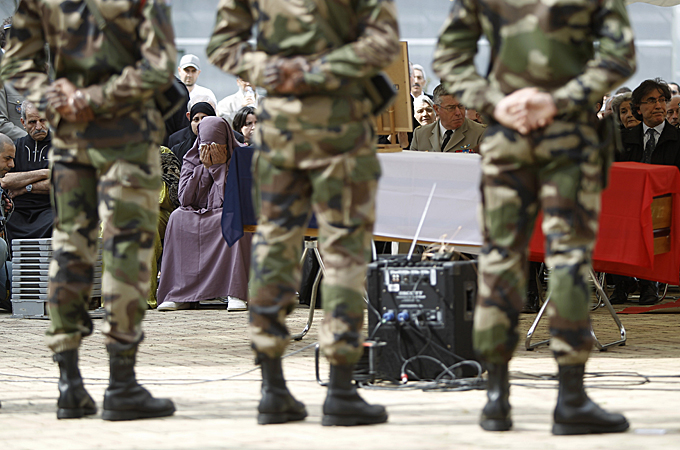
The military funeral for Mohamed Legouad, a Muslim paratrooper murdered by Merah, at a mosque in Lyon [AP]


Critics Accuse Le Pen and Sarkozy Of Using The Toulouse Tragedy To Gain Electoral Favour.

By Yasmine Ryan
Last Modified: 06 Apr 2012 07:29
Courtesy Of "Al-Jazeera"


For France's far-right Marine Le Pen, the tragic bloodshed in Toulouse has simply proven what her party has been saying for years about French identity.

Since the shootings, Nicolas Sarkozy, the current president, has likewise chosen to focus his re-election campaign on "security" against the perceived threat of "radical Islam".

With France's presidential elections set for April 22 and May 6, some commentators are condemning the right-wing candidates for attempting to use the case of Mohamed Merah, the alleged gunman who killed seven people, to misrepresent complex issues such as religion, immigration and integration.
 
'Zero Tolerance'

Speaking before a crowd of 1,500 supporters on the outskirts of the town of Nantes on March 25, three days after police killed the alleged gunman, Le Pen gave the most violent speech of her campaign to date.
Merah was "Magrebin", she affirmed, spitting out the term to emphasize his North African ancestry - his parents were Algerian immigrants - to a crowd that stomped its feet and roared with approval.

"How many Mohamed Merahs arrive in France every day, in the boats and planes full of immigrants?" she asked, paying little heed to the fact that the alleged gunman was born and raised in France.

"How did he manage to get French nationality?" she said, her voice husky and incredulous.

The biggest threat to 21st centuary France was what she called "Islamoleftism", a word she has coined to describe what she considers an unhealthy alliance between "Islamist fanatics" and the French Left.
Far-right presidential candidate Marine Le Pen questioned how Merah, born and raised in France, had obtained French nationality [AP]
Sarkozy, she said, has allowed his government to be "corrupted" by the "culture of perpetual apology".

If she were president, she promised to have the French secret services eavesdrop on all "radical" French mosques. Muslims who travelled to Afghanistan would be immediately deported to their country of origin if possible, or, in the case of French citizens, forced to wear an electronic ankle bracelet.

"We will act with zero tolerance," she said.

Although Le Pen views Merah as "Algerian", the Algerians see him as French. Despite initially authorising a request for his body to be buried in the country of his father, the Algerian government changed course after the proposal drew outrage amongst the Algerian public, Le Mondereported (French).

Hunting The 'Monster'

Not to be outdone, Sarkozy has also responded to the shootings in Montauban and Toulouse by spearheading the most extensive crackdown on "Muslim fundamentalists" France has seen since 1993.

The president spearheaded raids last Friday, in which 17 suspected "radical Islamists" were arrested.

There were 10 more arrests on Wednesday. Sarkozy has vowed that this is only the beginning.

At the same time, his government has refused to allow the heads of France domestic and overseas intelligence agencies to appear before a Senate committee to respond to questions over possible intelligence failures in the way they handled Merah's case.

François Hollande, the Socialist candidate who has been leading the polls for most of the campaign, has argued that the government should reflect on the circumstances that may have allowed Merah to carry out three successful attacks.

"What is important is to evaluate the [existing] laws and how they were applied. Then, if changes are needed, this will happen after the elections," Hollande said last week, Le Monde reported

François Bayrou, the presidential candidate for centrist Democratic Movement, has repeatedly called for the debate to focus on the social causes behind the shootings, rather than demonising a segment of the French population.

"[Politicians are] pointing fingers at people because of their ancestry to incite passions, and they are doing it because in the fire, there are votes to be had," he said.
"How many Mohamed Merahs arrive in France every day, in the boats and planes full of immigrants?"
- Marine Le Pen
Jean-Luc Mélenchon, the candidate for the Left Party, and Eva Joly, the candidate for the Green Party, have each also condemned the "discriminatory discourse" which they say is coming from Sarkozy's government in response to the shootings.

Responding to such criticisms, Sarkozy said Merah was a "monster" and that searching for any social factors that may have been factors in the shootings was "an unpardonable moral error".

"Blaming society, pointing the finger at France, its policies, its institutions, it's disgraceful," he said.

Like Le Pen, Sarkozy has confused the issues. With his comments on the "Muslim appearance" of the soldiers, he drew a strong response from the father of Abel Chennouf, a Catholic paratrooper of Berber ethnicity who was one of those killed.

"I ask the president of the Republic to think about what he is saying," Albert Chennouf told BFMTV. "The family of Abel wishes, in respect of all religions, that his be respected as well… in the armed services there are only brothers in arms."

Unknown Soldiers

Elyamine Settoul, a political sociologist at Sciences Po, argued that by fixating on the story of Merah, a disturbed and socially isolated individual, politicians are ignoring the many stories of the children of immigrants who do play a positive role in French society, and who embrace its institutions and values.

"What is sad about the state of the current debate is that, instead of speaking about the real evolutions taking place, we're obsessing over a news story that doesn't reflect the reality of French society," he said.

"I think these are political strategies to make the population feel more insecure."

Beginning on March 11, Merah carried out three attacks. He killed three elite soldiers of North African ancestry and injured a fourth, a Catholic of West Indian origin. His final attack killed three Jewish schoolchildren and a rabbi.

The evidence suggests he targeted the paratroopers as a way of condemning the many French Muslims who are fighting in Afghanistan.
"We'll never hear the minister talking about the Muslim soldiers who've died for France."
- Elyamine Settoul, a political sociologist
Prior to taking this violent path, Merah had himself twice tried to join the army. A repeat offender who had been arrested many times in his teenage years, the army refused to accept him.

In trying to find his way through the military, Settoul said, Merah was not unlike many French teenagers born to immigrants or the grandchildren of immigrants.

"I think he tried to get into the army because, today you have many young people who are struggling with academic failure and discrimination who can find a sort of family in the army, emotional and professional relationships," he said.
On his alternative route, it was another French institution that helped mould Merah's identity - prison. It was there that he discovered his peculiar interpretation of Islam. 

By 2010 and 2011, he was making trips to Pakistan and Afghanistan, allegedly reaching out to al-Qaeda.

Since France ended compulsory military service in 1996, the military needed to attract recruits and found a readily available pool in the disenfranchised suburban youth.

"They recruit everyone without distinction, there is no discrimination," he said, noting the difference with French police, which have a much more negative relationship with second- and third-generation French citizens.

Paradoxically, only upon their deaths did the French public learn about the likes of Imad Ibn Ziaten, 30, Abel Chennouf, 25, and Mohamed Legouad, 23.

And many more like them, whether of North African descent, Muslim, or both, have died whilst on mission in Afghanistan with little official acknowledgement.

"We'll never hear the minister talking about the Muslim soldiers who've died for France," Settoul said, estimating that around a dozen of the 82 French soldiers who have died since the mission began there in 2001.

Even now, however, Merah is the one dominating the political conservation.

Saturday, March 17, 2012

Guaranteeing A Radical Conservative Future For America


Photo Credit: A.M. Stan

The Republican presidential campaign is not just about the presidential race. It is about using conservative language to strengthen conservative values in the brains of voters. 

By George Lakoff 
March 12, 2012 
Courtesy Of "Alter-Net"

The Santorum Strategy is not just about Santorum. It is about pounding the most radical conservative ideas into the public mind by constant repetition during the Republican presidential campaign, whether by Santorum himself, by Gingrich or Ron Paul, by an intimidated Romney, or by the Republican House majority. The Republican presidential campaign is about a lot  more than the campaign for the presidency. It is about guaranteeing a radical conservative future for America.
I am old enough to remember how liberals (me included) made fun of Ronald Reagan as a not-too-bright mediocre actor who could not possibly be elected president. I remember liberals making fun of George W.Bush as so ignorant and ill-spoken that Americans couldn't possibly take him seriously. Both turned out to be clever politicians who changed America much for the worse. And among the things they and their fellow conservatives managed to do was change public discourse, and with it, change how a great many Americans thought.
The Republican presidential campaign has to be seen in this light.
Liberals tend to underestimate the importance of public discourse and its effect on the brains of our citizens. All thought is physical. You think with your brain. You have no alternative. Brain circuitry strengthens with repeated activation. And language, far from being neutral, activates complex brain circuitry that is rooted in conservative and liberal moral systems. Conservative language, even when argued against, activates and strengthens conservative brain circuitry. This is extremely important for so-called "independents," who actually have both conservative and liberal moral systems in their brains and can shift back and forth. The more they hear conservative language over the next eight months, the more their conservative brain circuitry will be strengthened.
This point is being missed by Democrats and by the media, and yet it is the most vital issue for our future in what is now being discussed. No matter who gets the Republican nomination for president, the Santorum Strategy will have succeeded unless Democrats dramatically change their communication strategy as soon as possible. Even if President Obama is re-elected, he will have very little power if the Republicans keep the House, and a great deal less if they take the Senate. And if they keep and take more state houses and local offices around the country, there will be less and less possibility of a liberal future.
The Republican presidential campaign is not just about the presidential race. It is about using conservative language to strengthen conservative values in the brains of voters -- in campaigns at all levels from Congress to school boards. Part of the Republican strategy is to get liberals to argue against them, repeating conservative language. There is a reason I wrote a book called Don't Think of an Elephant!  When you negate conservative language, you activate conservative ideas and, hence, automatically and unconsciously strengthen the brain circuitry that characterizes conservative values.
As I was writing the paragraphs above, the mail came. In it was material from Public Citizen (an organization I admire) promoting single-payer health care (which I agree with) by arguing against right-wing lies about it. In big, bold type the lies were listed: Single-payer is socialized medicine. Single-payer will lead to rationing, like in Canada. Costs will skyrocket under single-payer. And so on. After each one, came the negative: Wrong. And then in small, unbolded type, the laundry lists of policy truths. Public Citizen was unconsciously promoting the conservative lies by repeating them in boldface and then negating them.
The same naiveté about messaging, public discourse, and effects on brains is now showing up in liberal discussions of the Republican presidential race. Many Democrats are reacting either with glee ("their field is so ridiculously weak and wacky." -- Maureen Dowd), with outrage (their deficit-reduction proposals would actually raise the deficit -- Paul Krugman), or with incredulity ("Why we're debating a woman's access to birth control is beyond me." -- Debbie Wasserman Schultz). Hendrik Hertzberg dismissed the ultra-conservatives as "a kick line of clowns, knaves, and zealots." Joe Nocera wrote that he hopes Santorum would be the Republican candidate, claiming that he is so far to the right that he would be "crushed" -- an "epic defeat," "shock therapy" that would bring back moderate Republicans. Democrats even voted for Santorum in the Michigan primary on the grounds that he would be the weaker candidate and that it would be to the Democrats' advantage if the Republican race dragged on for a long time.
I mention these liberals by name because they are all people I admire and largely agree with. I hope that they are right. And I hope that the liberal discourse of glee, scorn, outrage, incredulity, and support for the most radical conservative will actually win the day for Democrats at all levels. But, frankly, I have my doubts. I think Democrats need much better positive messaging, expressing and repeating liberal moral values -- not just policies-- uniformly across the party. That is not happening.
One of the reasons that it is not happening is that there is a failure to understand the difference between policy and morality, that morality beats policy, and that moral discourse is absolutely necessary. This is a major reason why the Democrats lost the House in 2010. Consider how conservatives got a majority of Americans to be against the Obama health care plan. The president had polled the provisions, and each had strong public support: No preconditions, no caps, no loss of coverage if you get sick, ability to keep your college-age child on your policy, and so on. These are policy details, and they matter. The conservatives never argued against any of them. Instead, they re-framed; they made a moral case against "Obamacare." Their moral principles were freedom and life, and they had language to go with them. Freedom: "government takeover." Life: "death panels." Republicans at all levels repeated them over and over, and convinced millions of people who were for the policy provisions of the Obama plan to be against the plan as a whole. They changed the public discourse, changed the brains of the electorate -- especially the "independents" -- and won in 2010.
The radical conservative discourse of the Republican presidential race has the same purpose, and conservative Republicans are luring Democrats into making the same mistakes. Santorum, the purest radical conservative, is the best example. From the perspective of conservative moral values, he is making sense and arguing logically, making his moral values clear and coming across as straightforward and authentic, as Reagan did.
The Moral Value Systems
The basic moral values in the progressive moral system are empathy and responsibility, both for oneself and others. This leads to a view of government as having certain moral obligations: providing protection and empowerment for everyone equally. This requires a vibrant commitment to the public -- public infrastructure (roads, buildings, sewers), public education, public health, and so on. No private business can prosper at all without such public provisions. The private depends on the public.
These values follow from certain ideal progressive family values, as projected to larger institutions. The progressive family has parents of equal authority. Their central moral role requires empathy with each other and their children, it requires self-responsibility, and responsibility for the well-being of other family members. This means open communication, transparency about family rules, shared decision-making, and need-based fairness.
This is an idealized view. Because our first acquaintance with being governed is in our families, we come to understand ideal versions of governing institutions (e.g., churches, schools, teams, and nations) in terms of idealizations of families.
The idealized conservative family is structured around a strict father who is the natural leader of the family, who is assumed to know right from wrong, whose authority is absolute and unchallengeable, who is masculine, makes decisions about reproduction, and who sets the rules - in short, the Decider. Children must be taught right from wrong through strict discipline, which is required to be moral. This maps onto the nation. To be prosperous in a free market, one must be fiscally disciplined. If you are not prosperous, you must not be disciplined, and if you are not disciplined, you cannot be moral, and so you deserve your poverty.
When this idealized family model is projected onto various governing institutions, we get conservative versions of them: conservative religion with a strict father God; a view of the market as Decider with no external authority over the market from government, unions, or the courts; and strictness in other institutions, like education, prisons, businesses, sports teams, romantic relationships, and the world community. Control over reproduction ought to be in the hands of male authorities.
For conservatives, democracy is about liberty, individual responsibility and self-reliance -- the freedom to seek one's own self-interest with minimal or no commitment to the interests of others. This implies a minimal public and a maximal private.
We can now see why the Santorum Strategy is so concerned with family values. Strict father family values are the model for radical conservative values. Conservative populism -- in which poor conservatives vote against their financial interests -- depends on those poor conservatives having strict father family values, defining themselves in terms of those values, and voting on the basis of those values, thus selecting strict fathers as their political leaders.
The repetition of language expressing those values leads to more and more working people becoming political and accepting those values in their politics. As long as the Democrats have no positive moral messaging of their own, repeated over and over, the Santorum Strategy will go unchallenged and conservative populism will expand. Moreover, repeating the Santorum language by mocking it or arguing against it using that language will only help radical conservatives in propagating their views.
Democrats are concentrating on the presidential race, hoping that if Obama wins, as it looks like he will, all will be fine. They are missing the bigger picture. The Democratic strategy of getting the independent women's vote for Obama is not sufficient, because independent women may still vote for their local conservative leaders as the strict fathers they want to see in office.
Democrats have been gleeful about the Santorum birth control strategy, taken up by conservatives in the House as a moral position that if you want to use birth control, you should pay for it yourself. Democrats see this as irrational Republican self-destruction, assuming that it will help all Democrats to frame it as a "war against women." I hope they are right, but I have doubts.
This is anything but an irrational position for radically conservative Republicans. Quite the contrary. It fits conservative moral logic -- the logic used by conservative populists, male for sure and for many women as well. In some respects it embodies the most powerful aspects of conservative moral logic, strengthening conservative moral logic in the minds not only of conservatives, but also of independents who have both conservative and progressive world views and swing between them.
Here's how that logic goes.
  • The strict father determines what happens in the family, including reproduction. Thus reproduction is the province of male authority.
  • The strict father does not condone moral weakness and self-indulgence without moral consequences. Sex without reproductive consequences is thus seen as immoral.
  • If the nation supports birth control for unmarried women, then the nation supports immoral behavior.
  • The conservative stress on individual responsibility means that you and no one else should have to pay for your birth control -- not your employer, your HMO, or the taxpayers.
  • Having to pay for your birth control also has a metaphorical religious value -- paying for your sins.
  • This is a classical slippery slope narrative. If no one else should have to pay for your birth control, the next step is that no one else should have to pay for any of your health care.
  • And the step after that is that no one else should be forced to pay for anyone else. This is, everything should be privatized -- no public education, safety nets, parks, or any public institutions or services.
That is what makes conservative moral logic into such a powerful instrument. And conservative and independent women can be pragmatic about the birth control details, while accepting the moral logic as a whole.
Incidentally, Rush Limbaugh's "slut" and "prostitute" remarks, while even more extreme than Santorum, make sense to conservatives in terms of the same conservative moral logic. Limbaugh apologized for those two words, but not for the logic behind them. Even after the apology for the two words, the logic lingers.
All moral logic in politics, whether progressive or conservative, is based on metaphorical thought processes, applying family moral values to political moral values. Republicans understand this and Santorum carries it out masterfully for the benefit of all conservative Republican office seekers at all levels, today and in the future.
The Santorum Strategy does not end with this election. It is part of a permanent campaign that has been going on since the Gingrich revolution of 1994, and will continue into the indefinite future.
Democrats tend to be literalists, assuming that the presidential campaign is only about the presidential campaign and that birth control is only about birth control. In 2010, they thought that health policy was only about health policy, even as conservatives were metaphorically making it about freedom ("government takeover") and life ("death panels").
It is vital that Democrats not make that mistake again. 
George Lakoff is the author of Don't Think of an Elephant: Know Your Values and Frame the Debate' (Chelsea Green). He is Professor of Linguistics at the University of California at Berkeley and a Senior Fellow of the Rockridge Institute.

Thursday, December 08, 2011

Republican Plan To Establish Christian Theocracy & Nullify Courts

124002711
Rick Santorum, Newt Gingrich, and Michele Bachmann

Photograph by Robyn Beck/AFP/Getty Images.


Rule Of Lord 

By William Saletan 
Posted Monday, Nov. 21, 2011, at 9:54 AM ET 
Courtesy Of "The Slate Group"


Is the United States sliding toward theocracy? That’s what Republican presidential candidates have told us for more than a year. Radical Islam, they’ve argued, is on the verge of taking over our country through Sharia law. But this weekend, at an Iowa forum sparsely covered by the press, the candidates made clear that they don’t mind theocracy—in fact, they’d like to impose it—as long as it’s Christian.

You can find video of Saturday’s “Thanksgiving Family Forum” on the Web sites of two organizations that sponsored it: CitizenLink and the Family Leader. Here are highlights of the candidates’ remarks.
1. Religious Americans must fight back against nonbelievers. To quote Herman Cain:

What we are seeing is a wider gap between people of faith and people of nonfaith. … Those of us that are people of faith and strong faith have allowed the nonfaith element to intimidate us into not fighting back. I believe we’ve been too passive. We have maybepushed back, but as people of faith, we have not fought back.
2. The religious values we must fight for are Judeo-Christian. Rick Perry warned:
Somebody’s values are going to decide what the Congress votes on or what the president of the United States is going to deal with. And the question is: Whose values? And let me tell you, it needs to be our values—values and virtues that this country was based upon in Judeo-Christian founding fathers.
3. Our laws and our national identity are Judeo-Christian. Michele Bachmann explained:
American exceptionalism is grounded on the Judeo-Christian ethic, which is really based upon the 10 Commandments. The 10 Commandments were the foundation for our law. That’s what Blackstone said—the English jurist—and our founders looked to Blackstone for the foundation of our law. That’s our law.
4. No religion but Christianity will suffice. Perry declared, “In every person’s heart, in every person’s soul, there is a hole that can only be filled by the Lord Jesus Christ.”
5. God created our government. Bachmann told the audience:
I have a biblical worldview. And I think, going back to the Declaration of Independence, the fact that it’s God who created us—if He created us, He created government. And the government is on His shoulders, as the book of Isaiah says.
6. U.S. law should follow God’s law. As Rick Santorum put it:
Unlike Islam, where the higher law and the civil law are the same, in our case, we have civil laws. But our civil laws have to comport with the higher law. … As long as abortion is legal—at least according to the Supreme Court—legal in this country, we will never have rest, because that law does not comport with God’s law.
7. Anything that’s immoral by religious standards should be outlawed. Santorum again:
God gave us rights, but He also gave us laws upon which to exercise those rights, and that’s what you ought to do. And, by the way, the law should comport—the laws of this country should comport with that moral vision. Why? Because the law is a teacher. If something is illegal in this country because it is immoral and it is wrong and it is harmful to society, saying that it is illegal and putting a law in place teaches. It’s not just—laws cannot be neutral. There is no neutral, Ron. There is only moral and immoral. And the law has to reflect what is right and good and just for our society.
8. The federal government should impose this morality on the states. Santorum once more:
The idea that the only things that the states are prevented from doing are only things specifically established in the Constitution is wrong. Our country is based on a moral enterprise. Gay marriage is wrong. As Abraham Lincoln said, the states do not have the right to do wrong. … As a president, I will get involved, because the states do not have the right to undermine the basic, fundamental values that hold this country together.
9. Congress should erase the judiciary’s power to review moral laws. Newt Gingrich suggested:
I am intrigued with something which Robby George at Princeton has come up with, which is an interpretation of the 14th Amendment, in which it says that Congress shall define personhood. That’s very clearly in the 14th Amendment. And part of what I would like to explore is whether or not you could get the Congress to pass a law which simply says: Personhood begins at conception. And therefore—and you could, in the same law, block the court and just say, ‘This will not be subject to review,’ which we have precedent for. You would therefore not have to have a constitutional amendment, because the Congress would have exercised its authority under the 14th Amendment to define life, and to therefore undo all of Roe vs. Wade, for the entire country, in one legislative action.
Gingrich said the same strategy could secure the Defense of Marriage Act, which bars federal recognition of same-sex marriages and protects the right of states to disregard same-sex marriages performed in other states. In his words, “You could repass DOMA and make it not appealable to the court, period.”
10. Courts that get in the way should be abolished. Gingrich again:
The simplest first step which I would take is to propose—and I hope this will be a significant part of the campaign next year—I have proposed to abolish the court of Judge Biery in San Antonio, who on June 1 issued an order that said, not only could students not pray at their graduation, they couldn’t use the word benediction, the could not say the word prayer, they could not say the word God, they could not ask people to stand for a moment of silence, they couldn’t use the word invocation, and if he broke any of those, he would put their superintendent in jail. I regard that as such a ruthless anti-American statement that he should not be on the court, and I would move to literally abolish his court, so that he could go back to private practice, as a signal to the courts.
Biery’s order was an overreach. In fact, it was overturned two days later by an appeals court. But he’s only the first target of the anti-judicial purge. The next words after Gingrich’s threat came from Santorum, who said: “I agree with a lot of what has just been said here. I would go farther—one step farther, Newt. I would abolish the entire Ninth Circuit.”
11. The purge of judges should be based on public opinion. Gingrich once more:
Part of the purpose of singling out Judge Biery and eliminating his job is to communicate the standard that the two elected branches have the power and the authority to educate the judiciary when it deviates too far from the American people. And I think you would probably take that approach.
12. Freedom means obeying morality. Santorum concluded, “Our founders understood liberty is not what you want to do, but what you ought to do. That’s what liberty really is about.”
There was one voice of dissent among the candidates. Ron Paul, the libertarian congressman from Texas, argued that people should be allowed to make bad decisions, that freedom of choice in religious matters should extend to atheists, and that powers not reserved to the federal government should be left to the states. But in a field of candidates bent on legislating Christian morality and purging uncooperative judges, Paul stood alone. Protecting America is too important to let the Constitution get in the way.