Showing posts with label Inquisition. Show all posts

Saturday, March 09, 2013

Targeted Bannings


Murtaza Hussain reports the following:

A "Trend" Has Been Identified That Shows That The Overwhelming Majority Of Those On The No-Fly List Are Muslims [AP]

On January 2, 2005, Rahinah Ibrahim, a PhD student in Construction Management and Engineering at Stanford University, arrived at San Francisco International Airport to board a scheduled international flight en route to Malaysia. Ibrahim was slated to attend a Stanford-sponsored conference in the country to present findings from her doctoral research; a trip she was taking despite being wheelchair-bound due to complications from a recent hysterectomy.

However instead of boarding her flight, Ibrahim found herself in handcuffs - detained by the San Francisco Police Department before being searched and locked in a holding cell by TSA agents without explanation as to the reason for her arrest. After being interrogated for several hours by the FBI it was revealed that she had been placed - for reasons not revealed to her - on a No-Fly list which prevented her from routinely boarding her flight. Despite this Ibrahim was cleared by the agents of being a security risk, assured there would be no future problems, and allowed to board a flight for Malaysia the following day.

However upon attempting to return to the United States after her trip, Ibrahim found herself again detained and prevented from boarding her flight by local authorities who had received instructions from the US Consulate that she was to be barred from returning home.

It has now been eight years and Ibrahim has still not been allowed to return to the United States, banished based on secret evidence which she is unable to view let alone contest and trapped in a Kafkaesque legal limbo which has made her an effective exile from the country.

As shocking as Ibrahim's situation is, it is not unique; over the past decade there have been countless documented cases of individuals who have suddenly found themselves permanently stranded abroad after being banned from the United States despite holding legal residency and/or citizenship in the country.
The Stream
Blacklisted from the skies

In April 2012, a 43-year old American citizen and US Air Force veteran named Saadiq Long was banned from boarding a flight to Oklahoma to visit his mother whose health had been deteriorating due to congestive heart failure. Long, who had grown up in Oklahoma but moved to Qatar for work, was told by officials from the Department of Homeland Security (DHS) that he had been placed on a No-Fly List which would exclude him from the country of his birth but was refused access to even the most basic details as to the reason for his placement on this list. Outcry over Long's case from American civil rights organisations eventually led to him being allowed to visit his mother - but the worrying precedent set by the arbitrariness of his de facto banishment has had an impact on countless others.

In the past year alone, the number of individuals placed by the Obama administration on the federal No-Fly list has doubled to over 10,000, with at least 500 being holders of American citizenship. A further 400,000 individuals of indeterminate citizenship are on a separate "watchlist" which flags them as being "reasonably suspicious" and potentially subject to exclusion. The names of those on these lists are not disclosed and neither is the reasoning or evidence as to why any particular individual may be flagged. The American Civil Liberties Union has represented many Americans who believe have been on the No-Fly list and have been banned from travelling for work or to visit family for reasons unknown to them. In the words of ACLU attorney Ben Wizner:
People who are protected by the Constitution have a right to fundamental due process. If the United States government is going to maintain a watch list and prevent people from flying, there has to be some way for people to confront the evidence against them and rebut it.
Targeted Bannings

An identified trend has seen Muslims and those who claim ethnic descent from majority-Muslim countries being overwhelmingly targeted for seemingly inexplicable placement on these lists. Steve Washburn, a Muslim convert as well as a US military veteran was told by officials at Dublin International Airport that he was on a "terrorist watch list" and would not be allowed on his flight home to New Mexico or on any other future flights which would take him to the United States. Even high profile individuals such as Gilbert Chagoury, a multimillionaire businessman with close ties to former President Bill Clinton, have seen themselves effectively banned from travel by their unexplained and indisputable placement on the No-Fly list. After being detained and interrogated by agents for several hours and questioned about his views and purported ties to terrorists he would say:
I cannot accept being labelled a terrorist when I am known all over the world as a person who loves peace. It really hurts.
Gadeir Abbas, a lawyer with the Council on American-Islamic Relations (CAIR) says that calls from Muslim-Americans stranded abroad after being banned from boarding flights home have become a regular occurrence. "The amount of people who experience tragic, life-altering travel delays is significant," said Abbas.

In numerous cases individuals have claimed to be banned from travelling after refusing to become informants against their own community. Ibrahim "Abe" Mashal, was told by FBI agents that his name would be removed from the No-Fly list if he would agree to go undercover and spy on other Muslims, while Mohammed Tanvir was coerced with threats and blackmail to become an informant spying on the South Asian community in New York. After refusing, Tanvir was placed on the No-Fly list, an act which his lawyer said was direct retaliation for his refusal to inform.

There is a recognised and genuine need to prevent known terrorists and those legitimately suspected of involvement with terrorism from travelling freely to the United States and elsewhere. However in practice it seems as though the ability to place individuals on No-Fly lists and other types of restrictive surveillance has been abused to harass and pressure innocent individuals, with specific emphasis upon Muslims.

In the case of Rahinah Ibrahim a federal judge in San Francisco recently blasted the government's usage of secret evidence against her, citing their "persistent and stubborn refusal" to follow applicable laws and attempts to undermine "the traditional system of fair play where both sides have notice of the arguments and evidence being used against them".

This system increasingly appears to be inapplicable to Muslim-Americans and those who claim descent from Muslim countries, for whom a parallel legal system exists which leaves them at the mercy of secret evidence and subject to effective exile from the United States through legal prohibition them flying home. The subversion of the US justice system towards this end has been a legacy of the past decades erosion of civil liberties and has continued with even greater vigor under the Obama administration.

As articulated by ACLU attorney Nusrat Choudhury, "It doesn't make anyone safer for innocent people not to be allowed to fly." Effectively granting government the ability to opaquely subject citizens to de facto banishment while abroad protects no one, but rather represents a troubling and potentially consequential deterioration of constitutionally protected rights in the post-9/11 era.

Thursday, January 31, 2013

Anti-Muslim Violence Increases

 
"I pushed a Muslim off the train tracks because I hate Hindus and Muslims… Ever since 2001 when they put down the Twin Towers, I've been beating them up."
Muslim-Americans, as well as HindusSikhs and others who purportedly "look Muslim" have been humiliated,assaulted and in many cases murdered by individuals often galvanised to violence by politicians and media figures who have enthusiastically engaged in public hatemongering against the Muslim community in the country. 


Anti-Muslim Violence Increases 

The 9/11 attacks precipitated a surge in hate crimes, but even as the events themselves recede further into history, the level of hatred and violence directed at Muslim communities is paradoxically increasing. Within the past month, in New York alone, police have suspected racial hatred as being the motive behind several crimes.  
 'Hate crime' on cards for Iraqi woman killed in US

This includes a string of murders specifically targetingMiddle Eastern storekeepers in Brooklyn, the last of whom, a 78-year old Iranian immigrant named Rahmatollah Vahidipour, was shot to death while closing his boutique and whose lifeless body was then dragged to a backroom and covered over with merchandise from his store. 

Within the same week as Vahidipour's murder another Muslim man was viciously beaten by two men who preceded their attack by asking him whether he was "a Hindu or a Muslim", while another man was stabbed several times outside of a mosque in a random attack by an assailant who screamed "I'm going to kill you Muslim", while repeatedly plunging a knife into his victims' body. 

Far from being aberrations, these incidents are in line with national statistics which show anti-Muslim violence in America nearing record highs, a trend which comes in tandem with highly public campaigns against mosque construction as well as fear-mongering by politicians and media figures regarding alleged plots by Muslim-Americans to override the constitution and impose Islamic law on the country.

The US election cycle also saw Muslims used as convenient targets for politicians seeking office, with one example being incumbent Illinois House of Representatives Republican Joe Walsh who told a cheering crowd at a campaign rally that "Muslims are here trying to kill Americans everyday", before making a baseless and highly incendiary claim that radical Islam had "infiltrated" the Chicago suburbs and that Muslims there were planning an attack that would "make 9/11 look like child's play".

While working the crowd into hysterics was a convenient campaign strategy for Walsh, just days later the Muslim community experienced the consequences of his rhetoric. A man opened fire on an Illinois mosque while it was packed with hundreds of congregants for Ramadan. The next day, another mosque was hit with an acid bombthrown at a window while worshippers had gathered for night services.

Despite these attacks against Illinois Muslims in the wake of his statements, Walsh steadfastly refused to apologise for his rhetoric demonising the Muslim-Americans and instead doubled-down on his blanket accusations against them, a reflection of the mainstream acceptability of anti-Muslim rhetoric by political figures in the US today.

Indeed the use of Muslims as a punching bag by opportunistic politicians seeking a minority group to scapegoat has become a regular feature of American political life which shows no signs of abating, despite the "trickle-down" effect by which this bigotry is now manifesting itself in real violence against innocent Muslim-Americans on a regular basis.

Behind this hatemongering lies a deep cynicism, as leading anti-Muslim politicians such as Newt Gingrich who have warned of "stealth jihad" and other nefarious plots by Muslims in America were within recent years helping facilitateSharia-compliant finance programmes in the country and who maintained notably cordial relations with prominent Muslim leaders.

Political Hatemongering

With Muslim-bashing becoming politically fashionable in recent years, politicians such as Gingrich have markedly changed their tune and it has been to the detriment of Muslim-Americans, as well as to the general level of social cohesion and tolerance in the country. 

In addition to political hatemongering, the past several years have seen a highly organised and well-funded group of anti-Muslim activists who have been sponsoring campaigns targeting Muslims across the country.
Leading figures in this movement such as Pamela Geller and Robert Spencer have led a crusade to vilify Muslims throughout the country and to exclude them from public life through campaigns of smears and hate-mongering which have cast Muslim-Americans as an insidious fifth column within the country.

Their views have gotten considerable popular attention, and thanks to a documented network of funders and media associates they have managed to bring their message to people across the United States.

In the past few months, a major controversy erupted when Geller's anti-Muslim organisation sponsored the placement of Islamophobic advertisements at major subway stations in New York as well as in other cities across the country.

Some advertisements depicted pictures of the 9/11 attacks with verses from the Quran superimposed, while others called Muslims "savages" and implored people to "fight Jihad". While the campaign has been challenged by many liberal commentators, including one infamous incident in which Egyptian-American activist Mona Eltahawy was arrested for attempting to cover a sign with pink spray paint, they continue to run across the country and to spread a message of indiscriminate, vitriolic hatred towards Muslim-Americans in a manner unlikely to be tolerated were it to pertain to any other minority group.

While correlation does not necessarily imply causation, the question must be asked - what effect do advertisements such as these have on the psyches' of people such as Erika Menendez? Was Sunando Sen, a law-abiding, hardworking immigrant who had given his life to achieving the American dream and who was pushed to his death by a woman who "hated Muslims" a direct victim of this campaign of bigotry? That he lost his life on the same subway system which for months has played host to hateful, incendiary advertisements such as Geller's is a tragic irony but is in many ways the natural result of a national culture of anti-Muslim bigotry that has become mainstream in both politics and popular culture.

The sad, inescapable truth is that Sen will likely not be the last victim of the accelerating phenomena of violence against Muslims in the United States - the only question today is how far into the darkness America must travel before it decides to take a stand against it.

Via: "Al-Jazeera"

Monday, January 07, 2013

Spain’s Forgotten Muslims – The Expulsion Of The Moriscos


One of the truly tragic events in Islamic history is the loss of al-Andalus, or Muslim Spain. For centuries, the Iberian Peninsula was a Muslim land with Muslim rulers and a Muslim population. At its height, Iberia had over 5 million Muslims, a majority of the land’s people. Muslim rulers built an advanced civilization based on faith and knowledge. In the 900s, the capital of Muslim Spain, Cordoba, had paved roads, hospitals, and street lights throughout the city. At the time, Christian Europe’s largest library had only 600 books, while Cordoba’s calligraphers were producing 6000 books per year.  The society was a peaceful mixture of European and African cultures, represented by Muslims, Jews, and Christians living in harmony side by side.
This almost utopian society did not last forever. As the so-called Reconquista, or Reconquest, of Spain by Catholic monarchs progressed through the 11th to the 15th centuries, Spain’s Muslims became a marginalized group. In 1492, when the last Muslim state of Iberia, Granada, fell, Spain’s Muslims faced a new reality: genocide.

Occupation

After the fall of Granada in 1492, most Muslims expected it to be a small setback. They thought Muslim armies from Africa would soon come to redeem the loss of Granada and re-establish a Muslim state. The new Spanish monarchs, Ferdinand and Isabella, had other plans, however.
They made their religious intentions clear early on. In March 1492, Spain’s monarchs signed an edict that effectively forced every last Jew out of the country. Hundreds of thousands of Jews were forced out, with the Ottoman Empire accepting many of them. Sultan Bayezid II of the Ottoman Empire sent his entire navy to Spain to pick them up and bring them to Istanbul, in order to avoid the mass killing that awaited them in Spain.
The Spanish policy towards the Muslims was not much different. In 1492, there were about 500,000 Muslims throughout Spain. The Catholic Church made it a priority to convert them all to Christianity now that they did not have the protection of a Muslim state.
The first attempts to convert Muslims to Christianity was through bribery. Converts were showered with gifts, money, and land. This approach proved to be unsuccessful, as most of these “converts” quickly returned to Islam after getting such gifts.

Rebellion

When it became clear in the closing years of the 1400s, that the Muslims of Spain were more attached to their beliefs than to wealth, Spain’s rulers took a new approach. In 1499, Francisco Jimenez de Cisernos, a cardinal in the Catholic Church was sent to southern Spain to “speed up” the conversion process. His approach was to harass the Muslims until they converted. All manuscripts written in Arabic were burned (except for medical ones). Muslims who refused to convert were arbitrarily sent to prison. They were tortured and had their property confiscated in an attempt to convince them to convert. This was all part of Cisernos’ policy that “if the infidels [Muslims] couldn’t be attracted to the road of salvation, they had to be dragged to it.”
His oppression and harassment soon had unintended consequences for Spain’s Christian kings. Spain’s Muslims, in order to resist the oppression began an open rebellion. Granada’s Muslims especially openly protested in the streets and threatened to overthrow the oppressive Catholic rule and replace it with a new Muslim state. Spain’s king and queen quickly intervened along with Cisernos. They gave Granada’s rebels a choice – conversion or death. Almost all of Granada’s citizens chose to convert on the outside, but secretly kept Islam as their true religion.
In 1502, King Ferdinand and Queen Isabella officially made Islam illegal throughout Spain
In the countryside, the Muslim towns throughout Granada rose in revolt. They took refuge in the rocky Alpujarras Mountains in Southern Spain, making it difficult for the Christian authorities to root them out. The rebels had no clear plan nor one central leader. They were united in their belief in Islam and resistance to Christian rule.
Since almost all of the population of Granada was Muslim, the rebellion took a defensive form. Christian soldiers regularly attacked Muslim towns in an attempt to force its residents into conversion. The Muslim rebels, not as well equipped or trained as the Christian soldiers, were not always able to rebel the attacks. Massacres and forced conversions of villages were common.
By 1502, the rebellion had petered out and Queen Isabella officially declared an end to toleration for any and all Muslims in Spain. Thus, all Muslims had to officially convert to Christianity, leave Spain, or die. Many did in fact flee to North Africa or fight to the death. However, most officially converted to Christianity, while still keeping their true beliefs hidden.

In Hiding

Spain’s Muslim population went underground in 1502. They had to hide their faith and actions from the Spanish authorities to avoid being killed. These “converted” Muslims were known as Moriscos by the Spanish, and they were intently watched.
Spanish government officials placed strict restrictions on the Moriscos to try to make sure they were not still secretly practicing Islam, which many were of course doing. Moriscos had to leave the doors to their homes open on Thursday nights and Friday mornings, so soldiers can pass by and look in to make sure they were not bathing, as Muslims are supposed to do before the congregational prayer of Friday. Any Muslim caught reading the Quran, or making wudu (ablution) could be immediately killed. For this reason, they were forced to find ways to practice their religion in secret, constantly in fear of being found.
Even under such difficult circumstances, the Moriscos retained their beliefs for decades. While the community activities of Islam such as congregational prayer, alms giving, and pilgrimage to Makkah were restricted, they were able to continue to practice in secret.

Final Expulsion

Despite the best efforts of the Moriscos to conceal their practice of Islam, the Christian kings suspected them of continued adherence to Islam. In 1609, over 100 years after the Muslims went into hiding, King Phillip of Spain signed an edict expelling all Moriscos from Spain. They were given only 3 days to completely pack up and board ships destined for North Africa or the Ottoman Empire.
During this time, they were constantly harassed by Christians, who would loot their belongings and kidnap Muslim children to raise as Christians. Some Moriscos were even killed for sport on their way to the coast by soldiers and regular people. Even when they got to the ships that would take them to their new lands, they were harassed. They were insultingly expected to pay their own fare in their exile. Also, many of the sailors raped, killed, and stole from the Moriscos they were carrying on their ships. This example religious intolerance can effectively be classified as a genocide and terrorism. The Spanish government made very clear their desire to harass and make life miserable for Spain’s Muslims as they were on their way out.
In this environment, however, the Moriscos were finally able to be open about their practice of Islam again. For the first time in over 100 years, Muslims prayed openly in Spain. The adhan (call to prayer) rang in the mountains and plains of Spain once again, as its Muslims were on their way out of their homeland.
Spain’s Muslims were given 3 days to leave their homes and board ships destined for foreign lands in 1609.
Most of the Moriscos wished they could stay in Spain. It had been their homeland for centuries and they did not know how to live in any other land. Even after their exile, many tried to sneak back into Spain and come back to their former homes. These efforts were almost always failures.
By 1614 every last Morisco was gone, and Islam disappeared from the Iberian Peninsula. Going from over 500,000 people to zero in 100 years can only be described as a genocide. Indeed, the Portuguese Dominican monk, Damian Fonseca, referred to the expulsion as an “agreeable Holocaust”. The effects on Spain were grave. Its economy suffered greatly, as a large part of the labor force was gone, and tax revenues dropped. In North Africa, Muslim rulers attempted to provide for the hundreds of thousands of refugees, but in many cases, were unable to do much to help them.  The Moriscos of North Africa spent centuries trying to assimilate into society, but still kept their unique Andalusian identity.
To this day, neighborhoods in major North African cities boast of their Morisco identities and keep alive the memory of Muslim Spain’s glorious past. They remind us of the illustrious history of the Iberian Peninsula, as well the tragic story of their expulsion from their homes in the one of the greatest genocides Europe has ever seen.
Bibliography:
Carr, Matthew. Blood and Faith: The Purging of Muslim Spain. New York: The New Press, 2009. Print.
Ochsenwald, W., & Fisher, S. (2003). The Middle East: A History. (6th ed.). New York: McGraw-Hill.

Monday, December 24, 2012

Our History Of Religious Intolerance Must Come To An End


By Rev. Gary R. Hall, Amb. Thomas R. Pickering and Imam Feisal Abdul Rauf:

Although religious freedom is enshrined in the Bill of Rights, religious intolerance still exists in this country. Thanksgiving reminds us that the Pilgrims came to America to escape religious persecution. But the Puritans did not welcome other religions into their colony. All through American history, most religions arriving on our shores have had to fight suspicion and intolerance.

Look at Catholic and Jewish Americans. They faced widespread discrimination and demands that the doors to America be closed to them. Even so, some anti-Semitism and anti-Catholic sentiment persists, but both communities are thriving today. Now it's Muslim Americans who grapple with persistent challenges to their loyalty as Americans.

Since 9/11, bias toward American Muslims has been fueled by fear of terrorism and ignorance about Islam as a religion and tradition. Well-funded individuals and groups fan this intolerance by spreading distortions and sowing distrust. They aim to exclude Muslims from American civic life.

Lost in all of this are the contributions Muslims have made, from our intellectual life to military service and -- more importantly -- the loyalty and support that America's 7 million Muslims have shown since 9/11 to help build and defend the United States.

This discrimination cannot go uncontested. As people of faith, we have a responsibility to embrace America's commitment to freedom of religion by counteracting this growing intolerance not just with talk, but with action.

At a recent gathering of religious scholars and leaders convened by Washington National Cathedral and the Center for the Study of the Presidency & Congress, our aim was an honest understanding of how Muslims have been caricatured and marginalized since 9/11. We grasped the need to expand an interfaith outreach to Muslim organizations to help them counter these challenges. 

A Pew Research poll reported that nearly four in 10 Americans have an unfavorable opinion of Islam, and an equal number link Islam with acts of violence. With such shocking religious illiteracy about Islam in our society, it's no small wonder that intolerance thrives.

What should be done?

First, we need to recover civic discourse. When a pastor burns a Quran, for instance, or anti-Muslim slogans appear in subway ads, we need to reject such actions as a failure to recognize the full humanity of our fellow-citizens -- an assertion that some people do not belong in the same way that "we" do.

But we cannot just react to incivility. We must engage audiences with real human stories out of the Muslim community; stories that stress our shared humanity and the role of Muslims in building our rich and diverse society.

We must act together through interfaith cooperation, especially with our young people, through organizations such as the Interfaith Youth Core that teaches a new generation how to come together and challenge the world. The Interfaith Alliance champions religious freedom while fighting extremism. Productions by BoomGen Studios highlight stories of interfaith cooperation in film and online media.

The religious rights of American Muslims are threatened every time anyone seeks to limit how Muslims participate in our society. Such limits contradict the religious imperative to work for social justice and provide all of God's creatures with the chance to grow and flourish as members of the community. We commit ourselves to honoring through word and deed the contribution of American Muslims. We also commit ourselves to work for justice because we believe justice is essential to create a more peaceful and equitable society.

The American Muslim identity has been forged within the same challenges that face all Americans: the need to belong and contribute to society as a whole while nurturing our own values of justice and acceptance. If we listen closely on Thanksgiving Day, we will hear so many Muslim-Americans giving thanks to God for the opportunity to live in America and practice Islam perhaps more freely than they did in their home countries.

We have a moral duty -- as both people of faith and Americans -- to take a stand for religious liberty and to make space for the Muslim-American identity to grow and prosper. Indeed, we will fail the guiding principles of this nation if we do not.

The Very Reverend Gary R. Hall is dean of Washington National Cathedral. Ambassador Thomas R. Pickering is chair of the Center for the Study of the Presidency & Congress. Imam Feisal Abdul Rauf is chairman of the Cordoba Initiative and author of Moving the Mountain.

Via: "The Huffington Post"

Thursday, November 29, 2012

Informant: NYPD Paid Me To 'Bait' Muslims


A paid informant for the New York Police Department's intelligence unit was under orders to "bait" Muslims into saying inflammatory things as he lived a double life, snapping pictures inside mosques and collecting the names of innocent people attending study groups on Islam, he told The Associated Press.

Shamiur Rahman, a 19-year-old American of Bangladeshi descent who has now denounced his work as an informant, said police told him to embrace a strategy called "create and capture." He said it involved creating a conversation about jihad or terrorism, then capturing the response to send to the NYPD. For his work, he earned as much as $1,000 a month and goodwill from the police after a string of minor marijuana arrests.

"We need you to pretend to be one of them," Rahman recalled the police telling him. "It's street theater."

Rahman said he now believes his work as an informant against Muslims in New York was "detrimental to the Constitution." After he disclosed to friends details about his work for the police - and after he told the police that he had been contacted by the AP - he stopped receiving text messages from his NYPD handler, "Steve," and his handler's NYPD phone number was disconnected.
Rahman's account shows how the NYPD unleashed informants on Muslim neighborhoods, often without specific targets or criminal leads. 

The AP corroborated Rahman's account through arrest records and weeks of text messages between Rahman and his police handler. The AP also reviewed the photos Rahman sent to police. Friends confirmed Rahman was at certain events when he said he was there, and former NYPD officials, while not personally familiar with Rahman, said the tactics he described were used by informants.
Informants like Rahman are a central component of the NYPD's wide-ranging programs to monitor life in Muslim neighborhoods since the 2001 terrorist attacks. Police officers have eavesdropped inside Muslim businesses, trained video cameras on mosques and collected license plates of worshippers. Informants who trawl the mosques - known informally as "mosque crawlers" - tell police what the imam says at sermons and provide police lists of attendees, even when there's no evidence they committed a crime.
The programs were built with unprecedented help from the CIA.
Police recruited Rahman in late January, after his third arrest on misdemeanor drug charges, which Rahman believed would lead to serious legal consequences. An NYPD plainclothes officer approached him in a Queens jail and asked whether he wanted to turn his life around.

The next month, Rahman said, he was on the NYPD's payroll.

In an Oct. 15 interview with the AP, however, Rahman said he received little training and spied on "everything and anyone." He took pictures inside the many mosques he visited and eavesdropped on imams. By his own measure, he said he was very good at his job and his handler never once told him he was collecting too much, no matter whom he was spying on.

One of his earliest assignments was to spy on a lecture at the Muslim Student Association at John Jay College of Criminal Justice in Manhattan. The speaker was Ali Abdul Karim, the head of security at the Masjid At-Taqwa mosque in Brooklyn. The NYPD had been concerned about Karim for years and already had infiltrated the mosque, according to NYPD documents obtained by the AP.

Rahman also was instructed to monitor the student group itself, though he wasn't told to target anyone specifically. His NYPD handler, Steve, told him to take pictures of people at the events, determine who belonged to the student association and identify its leadership.

On Feb. 23, Rahman attended the event with Karim and listened, ready to catch what he called a "speaker's gaffe." The NYPD was interested in buzz words such as "jihad" and "revolution," he said. Any radical rhetoric, the NYPD told him, needed to be reported.

John Jay president Jeremy Travis said Tuesday that police had not told the school about the surveillance. He did not say whether he believed the tactic was appropriate.

"As an academic institution, we are committed to the free expression of ideas and to creating a safe learning environment for all of our students," he said in a written statement. "We are working closely with our Muslim students to affirm their rights and to reassure them that we support their organization and freedom to assemble."

Talha Shahbaz, then the vice president of the student group, met Rahman at the event. As Karim was finishing his talk on Malcolm X's legacy, Rahman told Shahbaz that he wanted to know more about the student group. They had briefly attended the same high school in Queens.

Rahman said he wanted to turn his life around and stop using drugs, and said he believed Islam could provide a purpose in life. In the following days, Rahman friended him on Facebook and the two exchanged phone numbers. Shahbaz, a Pakistani who came to the U.S. more three years ago, introduced Rahman to other Muslims.

"He was telling us how he loved Islam and it's changing him," said Asad Dandia, who also became friends with Rahman.

Secretly, Rahman was mining his new friends for details about their lives, taking pictures of them when they ate at restaurants and writing down license plates on the orders of the NYPD.

On the NYPD's instructions, he went to more events at John Jay, including when Siraj Wahhaj spoke in May. Wahhaj, 62, is a prominent but controversial New York imam who has attracted the attention of authorities for years. Prosecutors included his name on a 3 ½-page list of people they said "may be alleged as co-conspirators" in the 1993 World Trade Center bombing, though he was never charged. In 2004, the NYPD placed Wahhaj on an internal terrorism watch list and noted: "Political ideology moderately radical and anti-American."

That evening at John Jay, a friend took a photograph of Wahhaj with a grinning Rahman.

Rahman said he kept an eye on the MSA and used Shahbaz and his friends to facilitate traveling to events organized by the Islamic Circle of North America and Muslim American Society. The society's annual convention in Hartford, Conn, draws a large number of Muslims and plenty of attention from the NYPD. According to NYPD documents obtained by the AP, the NYPD sent three informants there in 2008 and was keeping tabs on the group's former president.

Rahman was told to spy on the speakers and collect information. The conference was dubbed "Defending Religious Freedom." Shahbaz paid Rahman's travel expenses.

Rahman, who was born in Queens, said he never witnessed any criminal activity or saw anybody do anything wrong.

He said he sometimes intentionally misinterpreted what people had said. For example, Rahman said he would ask people what they thought about the attack on the U.S. Consulate in Libya, knowing the subject was inflammatory. It was easy to take statements out of context, he said. He said wanted to please his NYPD handler, whom he trusted and liked.
"I was trying to get money," Rahman said. "I was playing the game."
Rahman said police never discussed the activities of the people he was assigned to target for spying. He said police told him once, "We don't think they're doing anything wrong. We just need to be sure."

On some days, Rahman's spent hours and covered miles in his undercover role. On Sept. 16, for example, he made his way in the morning to the Al Farooq Mosque in Brooklyn, snapping photographs of an imam and the sign-up sheet for those attending a regular class on Islamic instruction. He also provided their cell phone numbers to the NYPD. That evening he spied on people at Masjid Al-Ansar, also in Brooklyn.

Text messages on his phone showed that Rahman also took pictures last month of people attending the 27th annual Muslim Day Parade in Manhattan. The parade's grand marshal was New York City Councilman Robert Jackson.

Rahman said he eventually tired of spying on his friends, noting that at times they delivered food to needy Muslim families. He said he once identified another NYPD informant spying on him. He took $200 more from the NYPD and told them he was done as an informant. He said the NYPD offered him more money, which he declined. He told friends on Facebook in early October that he had been a police spy but had quit. He also traded Facebook messages with Shahbaz, admitting he had spied on students at John Jay.
"I was an informant for the NYPD, for a little while, to investigate terrorism," he wrote on Oct. 2. He said he no longer thought it was right. Perhaps he had been hunting terrorists, he said, "but I doubt it."

Shahbaz said he forgave Rahman.

"I hated that I was using people to make money," Rahman said. "I made a mistake."

Via: "The Associated Press"

Saturday, October 20, 2012

Anti-Islamophobia Resources


By Sheila Musaji,

Critical reports on the Islamophobia Industry TAM has a regularly updated collection of Existing Reports, Polls, and Studies on Islam, Muslims & Radicalization.  Here are those relating specifically to the Islamophobia Industry.


— Bureau of International Information Programs report Muslims in America: A statistical portrait

— CAIR (Council on American Islamic Relations) reports: Western Muslim minorities: Integration and disenfranchisementThe status of Muslim civiil rights in the U.S. 2009: Seeking Full Inclusion;  The mosque in America: A national portrait; and CAIR and the University of California, Berkeley’s Center for Race and Gender (CRG) report Same Hate, New Target:  Islamophobia and its impact in the United States

— The Center for American Progress (CAP) reports:  UNDERSTANDING SHARIAH LAW:  Conservatives’ Skewed Interpretation Needs Debunking, by Wajahat Ali and Matthew Duss, andFear Inc.: The roots of the Islamophobia Network in America.  Article about the report, with article collection here  The CAP Fear, Inc. report includes:  Funders - Donors Capital Fund; Richard Mellon Scaife Foundation;  Lynde and Harry Bradley Foundation; Newton and Rochelle Becker Foundation and Newton and Rochelle Becker Charitable Trust;  Russell Berrie Foundation,  Anchorage Charitable Fund and William Rosenwald Family Fund; Fairbrook Foundation.  Misinformation Experts - • Frank Gaffney at the Center for Security Policy;  • David Yerushalmi at the Society of Americans for National Existence;  • Daniel Pipes at the Middle East Forum • Robert Spencer of Jihad Watch and Stop Islamization of America;  • Steven Emerson of the Investigative Project on Terrorism.

— Communique Partners report Western Perception of Islam and Muslims

— Hope Not Hate Campaign report Counter-Jihad’ Movement profiles over 100 individuals who are central to the international anti-Muslim network.

— The Institute for Social Policy and Understanding published A Portion of the People: Islam in a ‘Christian’ America

— MAPOS The Muslim American public opinion survey by Matt A. Barreto, University of Washington and Karam Dana, Harvard University


— New York Civil Liberties Union (NYCLU) White Paper Religious Freedom Under Attack:  The Rise of Anti-Mosque Activities in New York State charts rising anti-Muslim trends.

— People for the American Way (PFAW) report The Right Wing Playbook on Anti-Muslim Extremism


— SPLC reports:  Jihad Against Islam and The Anti-Muslim Inner Circle by Robert Steinback, and list of active anti-Muslim groups by state.  This list includes:  9/11 Christian Center at Ground Zero, Aggressive Christianity, The American Defense League, American Freedom Defense Initiative, Atlas Shrugs, Bare Naked Islam, Casa D’Ice Signs, Christian Action Network, Christian Guardians, Christian Phalange, Citizen Warrior, Concerned American Citizens, Concerned Citizens for the First Amendment, Escaping Islam, Faith Freedom, Insight USA, Islam: the Religion of Peace , and a big stack of dead bodies), Jihad Watch, Political Islam, Radio Jihad, Sharia Awareness Action Network, Silver Bullet Gun Oil, Stop the Islamization of America (SIOA), Sultan Knish a blog by Daniel Greenfield, Tennessee Freedom Coalition, The United West, U.S. Justice Foundation.  The SPLC Anti-Muslim Inner Circle report includes:  Bill French, Center for the Study of Political Islam - Brigitte Gabriel, ACT! for America and American Council for Truth - David Gaubatz, Society of Americans for National Existence (SANE) - Pamela Geller, Stop Islamization of America (SIOA), the American Freedom Defense Initiative (AFDI), Stop the Islamization of Nations (SION) - David Horowitz, Front Page Magazine, David Horowitz Freedom Center - John Joseph Jay, Stop Islamization of America (SIOA), the American Freedom Defense Initiative (AFDI) - Terry Jones, Dove World Outreach Center - Debbie Schlussel - Robert Spencer, Jihad Watch, Stop Islamization of America (SIOA), the American Freedom Defense Initiative (AFDI), Stop the Islamization of Nations (SION) - David Yerushalmi, Society of Americans for National Existence (SANE), Stop the Madrassa.

Via: "The American Muslim"

Sunday, October 14, 2012

What Is Happening To Muslims Will Happen To The Rest Of Us

By Chris Hedges
Courtesy Of "Op-Ed News"


The decision by the European Court of Human Rights  last week to refuse to block the extradition of the radical Muslim cleric Abu Hamza al-Masri and four others to the United States on terrorism charges removes one of the last external checks on our emerging gulag state.

Masri and the four others, all held in British jails, will soon join hundreds of other Muslims tried in Article III federal courts in the United States over the last decade. Fair trials are unlikely. A disturbing pattern of gross infringements on basic civil liberties, put in place in the name of national security, has poisoned our legal system. These infringements include intrusive surveillance, vague material support charges, the use of prolonged pretrial solitary confinement, classified evidence that the accused cannot review, and the use of political activities, normally protected under the First Amendment, to demonstrate mind-set and intent. 

Muslims caught up in the Article III courts are denied the opportunity to confront their accusers and to have their religious and political associations protected, and they rarely find a judge courageous enough to protect their rights. These violations of fundamental civil liberties will not, in the end, be reserved exclusively for Muslims once the corporate state feels under siege. What is happening to them will happen to the rest of us. 

"One of the misapprehensions of the last decade is that the government had to go outside the law to places like Guantanamo or Bagram to abridge the rights of suspects in the name of national security," said Jeanne Theoharis, a professor of political science at Brooklyn College who has been an outspoken critic of the rights abridgement occurring in Article III courts...

"But this is not the case. A similar degradation of rights that has characterized the prison at Guantanamo has also affected the judicial system within the United States. The right to dissent, the right to see the evidence against you, the right to due process, the right to fair and speedy trial, the right to have a judge who will be impartial, the right to fair and not disproportionate punishment, and the right not to be punished before you are convicted have been taken from us in the name of national security. It is not just in special secret prisons that this occurs, but also -- dismayingly -- within the U.S. federal courts."
This is not about the guilt or innocence of Masri, an Egyptian who lost an eye and a hand as a mujahedeen fighting in Central Asia and who has repeatedly called for violence against the United States and allegedly helped orchestrate violence. This is about the right of all accused to a fair defense and humane detention conditions. 

Once Masri arrives on U.S. soil he will receive neither. He will, even before he is tried or convicted, endure prison conditions that replicate the brutality suffered by those in our offshore penal colonies, including the one at Guantanamo Bay. He will enter a world of prolonged and psychologically crippling isolation, made worse by the likely application of so-called special administrative measures. He will spend his days in a tiny cell under constant electronic surveillance. At New York's Metropolitan Correction Center, where Masri and the other men will most likely first be incarcerated, he will never be allowed outdoors. He will be permitted to spend only one hour a day outside his cell, alone in a cage. Masri and the four other suspects could spend years in these conditions before trial. Because of security restrictions, it will take as long as six months for letters from his family to reach him. His lawyers can be prosecuted if they repeat in public what he tells them, especially about the conditions of his incarceration.

And, once he goes on trial, he will be in an Article III court, where national security provisions will almost certainly guarantee his conviction. Once convicted, he and the others are likely to be sent to the federal Administrative Maximum facility (known as ADX), in Florence, Colo., to spend, potentially, a lifetime in solitary confinement. There he will be permitted, at most, an hour a day out of his cell, in a cramped cage nicknamed "the dog run" because it looks like a dog kennel. His meals will be delivered to his cell through a slot. He will not be permitted to work in prison industries or have congregational prayer, an essential tenet of the Muslim faith. 

"Torture is legal in the United States in the form of years of solitary confinement and the use of special administrative measures," Theoharis said when we spoke by phone. "The Obama administration has not only refused to hold Bush officials accountable for torture, but maintains torturous conditions in federal prisons. And the Obama administration willfully misled the European Court about the conditions these prisoners face."

Nearly every state now has a "supermax" prison similar to the federal prison at Florence, which former ADX Warden Robert Hood once called "a clean version of hell." These prisons presage a dystopian world where disobedient citizens are seized, stripped of rights and broken psychologically. Law professor Laura Rovner and Theoharis -- who is an outspoken advocate for her former student Fahad Hashmi, being held in the Florence supermax -- detailed the corrosion of justice within federal courts in an article in the American University Law Review. 

They noted that the distortion within the federal legal system "represents a particular way of seeing the Constitution, of constructing the landscape as a murky terrain of lurking enemies where rights must have substantial limits and the courts must be steadfast against such dangers." The two professors went on to argue that while legal scholars and human rights advocates have examined the dangers of these paradigms in Guantanamo, they have generally failed to acknowledge that "the federal system is similarly infected by such paradigms."

There are currently an estimated 25,000 prisoners imprisoned in supermax facilities. They are disproportionately Muslims and people of color. Many, including Hashmi, Dritan DukaOussama Kassir and Seifullah Chapman, were not found by the courts to be involved in specific terrorist plots but instead were incarcerated under these conditions for their "material support" to terrorism. The prisons are equipped with special housing units for those who do not show a proper deference to authority. These "H-units" hold prisoners under special administration measures, or SAMs. They live in cells of only 75 to 85 square feet. They endure almost complete social isolation and sensory deprivation as well as round-the-clock electronic surveillance. And it is in these units that even the most resilient are psychologically destroyed.

Prolonged isolation, says Craig Haney, a psychologist at the University of California at Santa Cruz who has studied the effects of solitary confinement, eventually induces "appetite and sleep disturbances, anxiety, panic, rage, loss of control, paranoia, hallucinations and self-mutilations" as well as "cognitive dysfunction ... hopelessness, a sense of emotional breakdown ... and suicidal ideation and behavior." Haney found that "many of the negative effects of solitary confinement are analogous to the acute reactions suffered by torture and trauma victims."

Masri, a burly man who once was a bouncer in a nightclub, is accused of 11 terrorism charges, including attempting to set up a terrorism training camp in a remote area of Oregon and involvement in a kidnapping in Yemen in 1999 in which three British tourists were killed. He was based at north London's Finsbury Park mosque, which I visited several times when I was covering al-Qaida for The New York Times. His rhetoric was always incendiary and conspiratorial, assuring him press coverage, which I suspected he coveted. He called the 9/11 attacks a Jewish plot and the Columbia space shuttle explosion "punishment from God." Richard Reid, the hapless shoe bomber, whose past associations I was investigating in London, attended the mosque. Masri was never an important Muslim leader in Britain or abroad. He made headlines mostly because he sought them. He was jailed last year in Britain on charges of soliciting murder and inciting racial hatred. And at that point the U.S. began the process of extradition.

Masri faces the possibility of life imprisonment. He will be extradited with four others, including Khaled al-Fawwaz, a Saudi national; and Adel Abdul Bary, another Egyptian. These two men are accused of having been aides to Osama bin Laden in London and allegedly taking part in the 1998 U.S. embassy bombings in East Africa in which more than 200 people were killed and thousands injured. Babar Ahmad, a British citizen in detention since 2004, will also be extradited. He, along with Talha Ahsan, is accused of using his now-closed website, Azzam.com, to support terrorism. Ahmad has been held in custody in Britain without trial for nearly eight years.

The ruling of the European Court of Human Rights, handed down Sept. 24 after the men requested that the court block their extradition, in essence certifies that U.S. prison standards are compatible with European human rights. This opens the door for any European nation receiving extradition requests from the U.S. to swiftly turn prisoners over to U.S. authorities. The ruling came despite the fact that 26 human rights groups including the ACLU, the Center for Constitutional Rights, and Human Rights First supported the prisoners' contention that they would be housed in inhuman conditions in the United States. The human rights groups predicted that the court's ruling would have "serious implications ... for legitimizing the use of conditions of confinement that violate human rights."

Tuesday, September 11, 2012

NYPD Spying On Muslims Resulted In No Terrorism Leads Or Cases

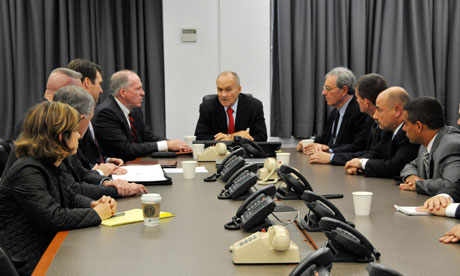
NYPD Ray Kelly terrorism meeting

Police Department Admits Demographics Unit Spied On Muslims For Six Years Without Triggering A Terrorism Investigation


In more than six years of spying on Muslim neighborhoods, eavesdropping on conversations and cataloging mosques, the New York police department's secret demographics unit never generated a lead or triggered a terrorism investigation, the department acknowledged in court testimony unsealed late Monday.
The demographics unit is at the heart of a police spying program, built with help from the CIA, which assembled databases on where Muslims lived, shopped, worked and prayed. Police infiltrated Muslim student groups, put informants in mosques, monitored sermons and cataloged every Muslim in New York who adopted new, Americanized surnames.
Police hoped the demographics unit would serve as an early warning system for terrorism. And if police ever got a tip about, say, an Afghan terrorist in the city, they'd know where he was likely to rent a room, buy groceries and watch sports.
But in a 28 June deposition as part of a longstanding federal civil rights case, assistant chief Thomas Galati said none of the conversations the officers overheard ever led to a case.
"Related to demographics," Galati testified that information that has come in "has not commenced an investigation."
The NYPD is the largest police department in the nation and mayor Michael Bloomberg has held up its counterterrorism tactics as a model for the rest of the country. After the Associated Press began reporting on those tactics last year, supporters argued that the demographics unit was central to keeping the city safe. Galati testified that it was an important tool, but conceded it had not generated any leads.
Galati, the commanding officer of the NYPD intelligence division, offered the first official look at the demographics unit, which the NYPD denied ever existed when it was revealed by the AP last year. He described how police gather information on people even when there is no evidence of wrongdoing, simply because of their ethnicity and native language.
As a rule, Galati said, a business can be labeled a "location of concern" whenever police can expect to find groups of Middle Easterners there.
Galati testified as part of a lawsuit that began in 1971 over NYPD spying on students, civil rights groups and suspected communist sympathizers during the 1950s and 1960s. The lawsuit, known as the Handschu case, resulted in federal guidelines that prohibit the NYPD from collecting information about political speech unless it is related to potential terrorism.
Civil rights lawyers believe the demographics unit violated those rules. Documents obtained by the AP show the unit conducted operations outside its jurisdiction, including in New Jersey. The FBI there said those operations damaged its partnerships with Muslims and jeopardized national security.
Attorney Jethro Eisenstein, who filed the Handschu case more than 40 years ago and questioned Galati during the deposition, said he will go back to court soon to ask that the demographics unit be shut down. It operates today under a new name, the zone assessment unit. It recently stopped operating out of state, Galati said.
"This is a terribly pernicious set of policies," Eisenstein said. "No other group since the Japanese Americans in World War II has been subjected to this kind of widespread public policy."
Dozens of members of Congress have asked the justice department to investigate the NYPD. Attorney general Eric Holder has said he was disturbed by the reports. But John Brennan, President Barack Obama's top counterterrorism adviser, has said he is confident the NYPD's activities are lawful and have kept the city safe.