This is the point from which I could never return,
And if I back down now then forever I burn.
This is the point from which I could never retreat,
Cause If I turn back now there can never be peace.
This is the point from which I will die and succeed,
Living the struggle, I know I'm alive when I bleed.
From now on it can never be the same as before,
Cause the place I'm from doesn't exist anymore
[Immortal Technique]
"Terrorist"
"Terrorist"
Just a Word...
'Terrorist' is just a word, one I wish I'd never heard...
When it's used to vilify, without the need to question why...
Only fools would swift condemn, that which has not befallen them...
Until you know what lies behind, the actions of a tortured mind...
Thank your God for sparing you, the suffering others have lived through...
Where are the cries of just demand, for Arabs driven from their land?...
Blame the victim, turn the cheek, praise the bully, kick the weak!...
Mock the man who truth does speak...
Tinker, tailor, soldier, spy, greed, corruption, torture, lies!...
Blair invasion, sly persuasion, annihilation, massacred nation...
Keep on running, karma's coming!...
Money talks, truth walks, oil spills, greed kills...
Tide is turning, London's burning!...
Bombs will fall and blood will flow, as sure as my own name I know...
Until corrupt dictators go, brutal, rotten, to the core...
Their day has come, they rule no more...
Show me the man who will not fight, to save his child, his home, his right!...
You can call him what you like, you're not in his sorry plight...
Cowards stay and Martyrs go, I know not where, but this I know...
Speak your truth and stand your ground, fight your corner...
When all around, point the finger, purse the lips, pin the label, 'Terrorist'!...
Just a word, but one that sticks, even when the cap don't fit...
But for the grace of God go I, remember that, before you cry...
False accusation, names of shame, at those who may not be to blame,...
Their crime, refused to play the game, of meek acceptance, dumbing down,...
Your life, your choice; Warrior / Clown...
The ACLU, together with the NYCLU and CUNY's CLEAR Project, filed a lawsuittoday challenging the New York Police Department's unconstitutional policy and practice of targeting entire Muslim communities for discriminatory and suspicionless surveillance. The NYPD's vast religious profiling program has cast an unjustified badge of suspicion and stigma on hundreds of thousands of innocent New Yorkers, based on nothing more than their religious faith and practice. We represent civic and religious leaders, two mosques, and a charitable organization, all of whom were swept up in the police department's dragnet surveillance because they are Muslim.
As documented extensively in the NYPD's own records and in Pulitzer prize-winning reporting by the Associated Press, NYPD officers and informants have routinely monitored mosques and businesses frequented by Muslims, including restaurants and bookstores. The department has also sent paid infiltrators into mosques, Muslim student associations, and beyond to take photos, write down license plate numbers, and keep notes on people simply because they are Muslim. Video surveillance cameras have been mounted outside mosques, recording every person who goes to worship. Maps created and maintained by the NYPD show the location of scores of mosques and Muslim businesses across New York's five boroughs. A senior NYPD representative has admitted that these mapping activities have not generated a single lead or resulted in even one terrorism investigation.
The NYPD's discriminatory surveillance is based on a false and unconstitutional premise: that Muslim religious belief and practices are a basis for law enforcement scrutiny. That is a premise rooted in bias and ignorance, not good law enforcement or fact. It is a premise that is both demonstrably wrong—terrorism is not a "Muslim phenomemon"—and deeply unfair to the millions of American Muslims who are a law-abiding, diverse, and integral part of our nation and New York City. The NYPD's surveillance program would be unthinkable if it targeted churches or synagogues, Christian reading rooms or Jewish community centers. The fact that it maps and sends informants into mosques and Muslim-owned businesses is no different. Like all Americans, our Muslim communities are entitled to protection from discriminatory religious profiling and intrusive police surveillance.
The NYPD's religious profiling has profoundly harmed New York's Muslim community. Long before the AP confirmed the vast scope of this program, knowledge and fear of unjustified surveillance permeated the community. Our clients' stories show how deep the damage has been. The NYPD's monitoring of mosques has forced religious leaders to censor what they say to their congregants, for fear that their statements could be taken out of context by police officers or informants, resulting in further unjustified scrutiny, or worse. Some religious leaders have felt the need to regularly record their sermons to defend themselves against potential mischaracterizations. Disruptions resulting from NYPD surveillance have also diverted precious time and resources away from religious education and counseling, both of which are part of mosques' core religious mission. And fear of NYPD surveillance has diminished congregants' attendance at mosques, prompted distrust of newcomers out of concern that they are NYPD informants, and prevented the mosques from fulfilling their mission of serving as religious sanctuaries.
The same fear of NYPD surveillance has also diminished the ability of charities—like one of our clients, Muslims Giving Back—to raise funds to support their efforts. Muslims Giving Back and one of its leaders, our client Asad Dandia, discovered in October 2012 that the group had been infiltrated for months by a paid NYPD informant posing as a friend and enthusiastic participant in the organization's religious mission. Since then, mosques have been reluctant to host or support Muslims Giving Back, for fear of other NYPD informants. This type of chronic mistrust cripples the ability of organizations like Muslims Giving Back to solicit the donations from congregants that sustain their charitable activities. Baseless law enforcement scrutiny has interfered with Muslims Giving Back and Asad's mission of promoting and providing charity to needy New Yorkers in accordance with one of Islam's primary tenets.
This discriminatory profiling and the harms it has caused our clients violate the Fourteenth Amendment's Equal Protection Clause, and the First Amendment right to the free exercise of religion and guarantee of government neutrality toward religion. Our suit asks the court to end the NYPD's Muslim surveillance program and to prevent future surveillance based solely or predominantly on religion in the absence of individualized suspicion of criminal activity. It also seeks to expunge the records of all of our clients created because of the program, and to appoint a monitor to ensure that New York City truly ends all of the unconstitutional practices inherent in its religious surveillance efforts. We hope the court recognizes that suspicionless and discriminatory surveillance based on nothing more than religious identity has no place in New York, or anywhere else.
A paid informant for the New York Police Department's intelligence unit was under orders to "bait" Muslims into saying inflammatory things as he lived a double life, snapping pictures inside mosques and collecting the names of innocent people attending study groups on Islam, he told The Associated Press.
Shamiur Rahman, a 19-year-old American of Bangladeshi descent who has now denounced his work as an informant, said police told him to embrace a strategy called "create and capture." He said it involved creating a conversation about jihad or terrorism, then capturing the response to send to the NYPD. For his work, he earned as much as $1,000 a month and goodwill from the police after a string of minor marijuana arrests.
"We need you to pretend to be one of them," Rahman recalled the police telling him. "It's street theater."
Rahman said he now believes his work as an informant against Muslims in New York was "detrimental to the Constitution." After he disclosed to friends details about his work for the police - and after he told the police that he had been contacted by the AP - he stopped receiving text messages from his NYPD handler, "Steve," and his handler's NYPD phone number was disconnected.
Rahman's account shows how the NYPD unleashed informants on Muslim neighborhoods, often without specific targets or criminal leads.
The AP corroborated Rahman's account through arrest records and weeks of text messages between Rahman and his police handler. The AP also reviewed the photos Rahman sent to police. Friends confirmed Rahman was at certain events when he said he was there, and former NYPD officials, while not personally familiar with Rahman, said the tactics he described were used by informants.
Informants like Rahman are a central component of the NYPD's wide-ranging programs to monitor life in Muslim neighborhoods since the 2001 terrorist attacks. Police officers have eavesdropped inside Muslim businesses, trained video cameras on mosques and collected license plates of worshippers. Informants who trawl the mosques - known informally as "mosque crawlers" - tell police what the imam says at sermons and provide police lists of attendees, even when there's no evidence they committed a crime.
The programs were built with unprecedented help from the CIA.
Police recruited Rahman in late January, after his third arrest on misdemeanor drug charges, which Rahman believed would lead to serious legal consequences. An NYPD plainclothes officer approached him in a Queens jail and asked whether he wanted to turn his life around.
The next month, Rahman said, he was on the NYPD's payroll.
In an Oct. 15 interview with the AP, however, Rahman said he received little training and spied on "everything and anyone." He took pictures inside the many mosques he visited and eavesdropped on imams. By his own measure, he said he was very good at his job and his handler never once told him he was collecting too much, no matter whom he was spying on.
One of his earliest assignments was to spy on a lecture at the Muslim Student Association at John Jay College of Criminal Justice in Manhattan. The speaker was Ali Abdul Karim, the head of security at the Masjid At-Taqwa mosque in Brooklyn. The NYPD had been concerned about Karim for years and already had infiltrated the mosque, according to NYPD documents obtained by the AP.
Rahman also was instructed to monitor the student group itself, though he wasn't told to target anyone specifically. His NYPD handler, Steve, told him to take pictures of people at the events, determine who belonged to the student association and identify its leadership.
On Feb. 23, Rahman attended the event with Karim and listened, ready to catch what he called a "speaker's gaffe." The NYPD was interested in buzz words such as "jihad" and "revolution," he said. Any radical rhetoric, the NYPD told him, needed to be reported.
John Jay president Jeremy Travis said Tuesday that police had not told the school about the surveillance. He did not say whether he believed the tactic was appropriate.
"As an academic institution, we are committed to the free expression of ideas and to creating a safe learning environment for all of our students," he said in a written statement. "We are working closely with our Muslim students to affirm their rights and to reassure them that we support their organization and freedom to assemble."
Talha Shahbaz, then the vice president of the student group, met Rahman at the event. As Karim was finishing his talk on Malcolm X's legacy, Rahman told Shahbaz that he wanted to know more about the student group. They had briefly attended the same high school in Queens.
Rahman said he wanted to turn his life around and stop using drugs, and said he believed Islam could provide a purpose in life. In the following days, Rahman friended him on Facebook and the two exchanged phone numbers. Shahbaz, a Pakistani who came to the U.S. more three years ago, introduced Rahman to other Muslims.
"He was telling us how he loved Islam and it's changing him," said Asad Dandia, who also became friends with Rahman.
Secretly, Rahman was mining his new friends for details about their lives, taking pictures of them when they ate at restaurants and writing down license plates on the orders of the NYPD.
On the NYPD's instructions, he went to more events at John Jay, including when Siraj Wahhaj spoke in May. Wahhaj, 62, is a prominent but controversial New York imam who has attracted the attention of authorities for years. Prosecutors included his name on a 3 ½-page list of people they said "may be alleged as co-conspirators" in the 1993 World Trade Center bombing, though he was never charged. In 2004, the NYPD placed Wahhaj on an internal terrorism watch list and noted: "Political ideology moderately radical and anti-American."
That evening at John Jay, a friend took a photograph of Wahhaj with a grinning Rahman.
Rahman said he kept an eye on the MSA and used Shahbaz and his friends to facilitate traveling to events organized by the Islamic Circle of North America and Muslim American Society. The society's annual convention in Hartford, Conn, draws a large number of Muslims and plenty of attention from the NYPD. According to NYPD documents obtained by the AP, the NYPD sent three informants there in 2008 and was keeping tabs on the group's former president.
Rahman was told to spy on the speakers and collect information. The conference was dubbed "Defending Religious Freedom." Shahbaz paid Rahman's travel expenses.
Rahman, who was born in Queens, said he never witnessed any criminal activity or saw anybody do anything wrong.
He said he sometimes intentionally misinterpreted what people had said. For example, Rahman said he would ask people what they thought about the attack on the U.S. Consulate in Libya, knowing the subject was inflammatory. It was easy to take statements out of context, he said. He said wanted to please his NYPD handler, whom he trusted and liked.
"I was trying to get money," Rahman said. "I was playing the game."
Rahman said police never discussed the activities of the people he was assigned to target for spying. He said police told him once, "We don't think they're doing anything wrong. We just need to be sure."
On some days, Rahman's spent hours and covered miles in his undercover role. On Sept. 16, for example, he made his way in the morning to the Al Farooq Mosque in Brooklyn, snapping photographs of an imam and the sign-up sheet for those attending a regular class on Islamic instruction. He also provided their cell phone numbers to the NYPD. That evening he spied on people at Masjid Al-Ansar, also in Brooklyn.
Text messages on his phone showed that Rahman also took pictures last month of people attending the 27th annual Muslim Day Parade in Manhattan. The parade's grand marshal was New York City Councilman Robert Jackson.
Rahman said he eventually tired of spying on his friends, noting that at times they delivered food to needy Muslim families. He said he once identified another NYPD informant spying on him. He took $200 more from the NYPD and told them he was done as an informant. He said the NYPD offered him more money, which he declined. He told friends on Facebook in early October that he had been a police spy but had quit. He also traded Facebook messages with Shahbaz, admitting he had spied on students at John Jay.
"I was an informant for the NYPD, for a little while, to investigate terrorism," he wrote on Oct. 2. He said he no longer thought it was right. Perhaps he had been hunting terrorists, he said, "but I doubt it."
Shahbaz said he forgave Rahman.
"I hated that I was using people to make money," Rahman said. "I made a mistake."
MATT APUZZO AND ADAM GOLDMAN report the following:
In New Brunswick, N.J., a building superintendent opened the door to apartment No. 1076 one balmy Tuesday and discovered an alarming scene: terrorist literature strewn about the table and computer and surveillance equipment set up in the next room.
The panicked superintendent dialed 911, sending police and the FBI rushing to the building near Rutgers University on the afternoon of June 2, 2009. What they found in that first-floor apartment, however, was not a terrorist hideout but a command center set up by a secret team of New York Police Department intelligence officers.
From that apartment, about an hour outside the department's jurisdiction, the NYPD had been staging undercover operations and conducting surveillance throughout New Jersey. Neither the FBI nor the local police had any idea.
Since the terrorist attacks of Sept. 11, 2001, the NYPD has become one of the country's most aggressive domestic intelligence agencies. A months-long investigation by The Associated Press has revealed that the NYPD operates far outside its borders and targets ethnic communities in ways that would run afoul of civil liberties rules if practiced by the federal government. And it does so with unprecedented help from the CIA in a partnership that has blurred the bright line between foreign and domestic spying.
Neither the city council, which finances the department, nor the federal government, which contributes hundreds of millions of dollars each year, is told exactly what's going on.
The department has dispatched teams of undercover officers, known as "rakers," into minority neighborhoods as part of a human mapping program, according to officials directly involved in the program. They've monitored daily life in bookstores, bars, cafes and nightclubs. Police have also used informants, known as "mosque crawlers," to monitor sermons, even when there's no evidence of wrongdoing. NYPD officials have scrutinized imams and gathered intelligence on cab drivers and food cart vendors, jobs often done by Muslims.
Many of these operations were built with help from the CIA, which is prohibited from spying on Americans but was instrumental in transforming the NYPD's intelligence unit.
A veteran CIA officer, while still on the agency's payroll, was the architect of the NYPD's intelligence programs. The CIA trained a police detective at the Farm, the agency's spy school in Virginia, then returned him to New York, where he put his new espionage skills to work inside the United States.
And just last month, the CIA sent a senior officer to work as a clandestine operative inside police headquarters.
While the expansion of the NYPD's intelligence unit has been well known, many details about its clandestine operations, including the depth of its CIA ties, have not previously been reported.
The NYPD denied that it trolls ethnic neighborhoods and said it only follows leads. In a city that has repeatedly been targeted by terrorists, police make no apologies for pushing the envelope. NYPD intelligence operations have disrupted terrorist plots and put several would-be killers in prison.
"The New York Police Department is doing everything it can to make sure there's not another 9/11 here and that more innocent New Yorkers are not killed by terrorists," NYPD spokesman Paul Browne said. "And we have nothing to apologize for in that regard."
But officials said they've also been careful to keep information about some programs out of court, where a judge might take a different view. The NYPD considers even basic details, such as the intelligence division's organization chart, to be too sensitive to reveal in court.
One of the enduring questions of the past decade is whether being safe requires giving up some liberty and privacy. The focus of that debate has primarily been federal programs like wiretapping and indefinite detention. The question has received less attention in New York, where residents do not know for sure what, if anything, they have given up.
The story of how the NYPD Intelligence Division developed such aggressive programs was pieced together by the AP in interviews with more than 40 current and former New York Police Department and federal officials. Many were directly involved in planning and carrying out these secret operations for the department. Though most said the tactics were appropriate and made the city safer, many insisted on anonymity, because they were not authorized to speak with reporters about security matters.
The story begins with one man.
___
David Cohen arrived at the New York Police Department in January 2002, just weeks after the last fires had been extinguished at the debris field that had been the twin towers. A retired 35-year veteran of the CIA, Cohen became the police department's first civilian intelligence chief.
Cohen had an exceptional career at the CIA, rising to lead both the agency's analytical and operational divisions. He also was an extraordinarily divisive figure, a man whose sharp tongue and supreme confidence in his own abilities gave him a reputation as arrogant. Cohen's tenure as head of CIA operations, the nation's top spy, was so contentious that in 1997, The New York Times editorial page took the unusual step of calling for his ouster.
He had no police experience. He had never defended a city from an attack. But New York wasn't looking for a cop.
"Post-9/11, we needed someone in there who knew how to really gather intelligence," said John Cutter, a retired NYPD official who served as one of Cohen's top uniformed officers.
At the time, the intelligence division was best known for driving dignitaries around the city. Cohen envisioned a unit that would analyze intelligence, run undercover operations and cultivate a network of informants. In short, he wanted New York to have its own version of the CIA.
Cohen shared Commissioner Ray Kelly's belief that 9/11 had proved that the police department could not simply rely on the federal government to prevent terrorism in New York.
"If anything goes on in New York," one former officer recalls Cohen telling his staff in the early days, "it's your fault."
Among Cohen's earliest moves at the NYPD was making a request of his old colleagues at CIA headquarters in Langley, Va. He needed someone to help build this new operation, someone with experience and clout and, most important, someone who had access to the latest intelligence so the NYPD wouldn't have to rely on the FBI to dole out information.
CIA Director George Tenet responded by tapping Larry Sanchez, a respected veteran who had served as a CIA official inside the United Nations. Often, when the CIA places someone on temporary assignment, the other agency picks up the tab. In this case, three former intelligence officials said, Tenet kept Sanchez on the CIA payroll.
When he arrived in New York in March 2002, Sanchez had offices at both the NYPD and the CIA's station in New York, one former official said. Sanchez interviewed police officers for newly defined intelligence jobs. He guided and mentored officers, schooling them in the art of gathering information. He also directed their efforts, another said.
There had never been an arrangement like it, and some senior CIA officials soon began questioning whether Tenet was allowing Sanchez to operate on both sides of the wall that's supposed to keep the CIA out of the domestic intelligence business.
"It should not be a surprise to anyone that, after 9/11, the Central Intelligence Agency stepped up its cooperation with law enforcement on counterterrorism issues or that some of that increased cooperation was in New York, the site of ground zero," CIA spokeswoman Jennifer Youngblood said.
Just as at the CIA, Cohen and Sanchez knew that informants would have to become the backbone of their operation. But with threats coming in from around the globe, they couldn't wait months for the perfect plan.
They came up with a makeshift solution. They dispatched more officers to Pakistani neighborhoods and, according to one former police official directly involved in the effort, instructed them to look for reasons to stop cars: speeding, broken tail lights, running stop signs, whatever. The traffic stop gave police an opportunity to search for outstanding warrants or look for suspicious behavior. An arrest could be the leverage the police needed to persuade someone to become an informant.
For Cohen, the transition from spying to policing didn't come naturally, former colleagues said. When faced with a decision, especially early in his tenure, he'd fall back on his CIA background. Cutter said he and other uniformed officers had to tell Cohen, no, we can't just slip into someone's apartment without a warrant. No, we can't just conduct a search. The rules for policing are different.
While Cohen was being shaped by the police department, his CIA background was remaking the department. But one significant barrier stood in the way of Cohen's vision.
Since 1985, the NYPD had operated under a federal court order limiting the tactics it could use to gather intelligence. During the 1960s and 1970s, the department had used informants and undercover officers to infiltrate anti-war protest groups and other activists without any reason to suspect criminal behavior.
To settle a lawsuit, the department agreed to follow guidelines that required "specific information" of criminal activity before police could monitor political activity.
In September 2002, Cohen told a federal judge that those guidelines made it "virtually impossible" to detect terrorist plots. The FBI was changing its rules to respond to 9/11, and Cohen argued that the NYPD must do so, too.
"In the case of terrorism, to wait for an indication of crime before investigating is to wait far too long," Cohen wrote.
U.S. District Judge Charles S. Haight Jr. agreed, saying the old guidelines "addressed different perils in a different time." He scrapped the old rules and replaced them with more lenient ones.
It was a turning point for the NYPD.
___
With his newfound authority, Cohen created a secret squad that would soon infiltrate Muslim neighborhoods, according to several current and former officials directly involved in the program.
The NYPD carved up the city into more than a dozen zones and assigned undercover officers to monitor them, looking for potential trouble.
At the CIA, one of the biggest obstacles has always been that U.S. intelligence officials are overwhelmingly white, their mannerisms clearly American. The NYPD didn't have that problem, thanks to its diverse pool of officers.
Using census data, the department matched undercover officers to ethnic communities and instructed them to blend in, the officials said. Pakistani-American officers infiltrated Pakistani neighborhoods, Palestinians focused on Palestinian neighborhoods. They hung out in hookah bars and cafes, quietly observing the community around them.
The unit, which has been undisclosed until now, became known inside the department as the Demographic Unit, former police officials said.
"It's not a question of profiling. It's a question of going where the problem could arise," said Mordecai Dzikansky, a retired NYPD intelligence officer who said he was aware of the Demographic Unit. "And thank God we have the capability. We have the language capability and the ethnic officers. That's our hidden weapon."
The officers did not work out of headquarters, officials said. Instead, they passed their intelligence to police handlers who knew their identities.
Cohen said he wanted the squad to "rake the coals, looking for hot spots," former officials recalled. The undercover officers soon became known inside the department as rakers.
A hot spot might be a beauty supply store selling chemicals used for making bombs. Or it might be a hawala, a broker that transfers money around the world with little documentation. Undercover officers might visit an Internet cafe and look at the browsing history on a computer, a former police official involved in the program said. If it revealed visits to radical websites, the cafe might be deemed a hot spot.
Ethnic bookstores, too, were on the list. If a raker noticed a customer looking at radical literature, he might chat up the store owner and see what he could learn. The bookstore, or even the customer, might get further scrutiny. If a restaurant patron applauds a news report about the death of U.S. troops, the patron or the restaurant could be labeled a hot spot.
The goal was to "map the city's human terrain," one law enforcement official said. The program was modeled in part on how Israeli authorities operate in the West Bank, a former police official said.
Mapping crimes has been a successful police strategy nationwide. But mapping robberies and shootings is one thing. Mapping ethnic neighborhoods is different, something that at least brushes against what the federal government considers racial profiling.
Browne, the NYPD spokesman, said the Demographic Unit does not exist. He said the department has a Zone Assessment Unit that looks for locations that could attract terrorists. But he said undercover officers only followed leads, disputing the account of several current and former police and federal officials. They do not just hang out in neighborhoods, he said.
"We will go into a location, whether it's a mosque or a bookstore, if the lead warrants it, and at least establish whether there's something that requires more attention," Browne said.
That conflicts with testimony from an undercover officer in the 2006 trial of Shahawar Matin Siraj, who was convicted of planning an attack on New York's subway system. The officer said he was instructed to live in Brooklyn and act as a "walking camera" for police.
"I was told to act like a civilian _ hang out in the neighborhood, gather information," the Bangladeshi officer testified, under a false name, in what offered the first narrow glimpse at the NYPD's infiltration of ethnic neighborhoods.
Officials said such operations just made sense. Islamic terrorists had attacked the city on 9/11, so police needed people inside the city's Muslim neighborhoods. Officials say it does not conflict with a 2004 city law prohibiting the NYPD from using religion or ethnicity "as the determinative factor for initiating law enforcement action."
"It's not profiling," Cutter said. "It's like, after a shooting, do you go 20 blocks away and interview guys or do you go to the neighborhood where it happened?"
In 2007, the Los Angeles Police Department was criticized for even considering a similar program. The police announced plans to map Islamic neighborhoods to look for pockets of radicalization among the region's roughly 500,000 Muslims. Criticism was swift, and chief William Bratton scrapped the plan.
"A lot of these people came from countries where the police were the terrorists," Bratton said at a news conference, according to the Los Angeles Daily News. "We don't do that here. We do not want to spread fear."
In New York, current and former officials said, the lesson of that controversy was that such programs should be kept secret.
Some in the department, including lawyers, have privately expressed concerns about the raking program and how police use the information, current and former officials said. Part of the concern was that it might appear that police were building dossiers on innocent people, officials said. Another concern was that, if a case went to court, the department could be forced to reveal details about the program, putting the entire operation in jeopardy.
When Cohen made his case in court that he needed broader authority to investigate terrorism, he had promised to abide by the FBI's investigative guidelines. But the FBI is prohibited from using undercover agents unless there's specific evidence of criminal activity, meaning a federal raking program like the one officials described to the AP would violate FBI guidelines.
The NYPD declined to make Cohen available for comment. In an earlier interview with the AP on a variety of topics, Police Commissioner Kelly said the intelligence unit does not infringe on civil rights.
"We're doing what we believe we have to do to protect the city," he said. "We have many, many lawyers in our employ. We see ourselves as very conscious and aware of civil liberties. And we know there's always going to be some tension between the police department and so-called civil liberties groups because of the nature of what we do."
The department clashed with civil rights groups most publicly after Cohen's undercover officers infiltrated anti-war groups before the 2004 Republican National Convention in New York. A lawsuit over that program continues today.
During the convention, when protesters were arrested, police asked a list of questions which, according to court documents, included: "What are your political affiliations?" "Do you do any kind of political work?" and "Do you hate George W. Bush?"
"At the end of the day, it's pure and simple a rogue domestic surveillance operation," said Christopher Dunn, a New York Civil Liberties Union lawyer involved in the convention lawsuit.
___
Undercover agents like the rakers were valuable, but what Cohen and Sanchez wanted most were informants.
The NYPD dedicated an entire squad, the Terrorist Interdiction Unit, to developing and handling informants. Current and former officials said Sanchez was instrumental in teaching them how to develop sources.
For years, detectives used informants known as mosque crawlers to monitor weekly sermons and report what was said, several current and former officials directly involved in the informant program said. If FBI agents were to do that, they would be in violation of the Privacy Act, which prohibits the federal government from collecting intelligence on purely First Amendment activities.
The FBI has generated its own share of controversy for putting informants inside mosques, but unlike the program described to the AP, the FBI requires evidence of a crime before an informant can be used inside a mosque.
Valerie Caproni, the FBI's general counsel, would not discuss the NYPD's programs but said FBI informants can't troll mosques looking for leads. Such operations are reviewed for civil liberties concerns, she said.
"If you're sending an informant into a mosque when there is no evidence of wrongdoing, that's a very high-risk thing to do," Caproni said. "You're running right up against core constitutional rights. You're talking about freedom of religion."
That's why senior FBI officials in New York ordered their own agents not to accept any reports from the NYPD's mosque crawlers, two retired agents said.
It's unclear whether the police department still uses mosque crawlers. Officials said that, as Muslims figured out what was going on, the mosque crawlers became cafe crawlers, fanning out into the city's ethnic hangouts.
"Someone has a great imagination," Browne, the NYPD spokesman, said. "There is no such thing as mosque crawlers."
Following the foiled subway plot, however, the key informant in the case, Osama Eldawoody, said he attended hundreds of prayer services and collected information even on people who showed no signs of radicalization.
NYPD detectives have recruited shopkeepers and nosy neighbors to become "seeded" informants who keep police up to date on the latest happenings in ethnic neighborhoods, one official directly involved in the informant program said.
The department also has a roster of "directed" informants it can tap for assignments. For instance, if a raker identifies a bookstore as a hot spot, police might assign an informant to gather information, long before there's concrete evidence of anything criminal.
To identify possible informants, the department created what became known as the "debriefing program." When someone is arrested who might be useful to the intelligence unit _ whether because he said something suspicious or because he is simply a young Middle Eastern man _ he is singled out for extra questioning. Intelligence officials don't care about the underlying charges; they want to know more about his community and, ideally, they want to put him to work.
Police are in prisons, too, promising better living conditions and help or money on the outside for Muslim prisoners who will work with them.
Early in the intelligence division's transformation, police asked the taxi commission to run a report on all the city's Pakistani cab drivers, looking for those who got licenses fraudulently and might be susceptible to pressure to cooperate, according to former officials who were involved in or briefed on the effort.
That strategy has been rejected in other cities.
Boston police once asked neighboring Cambridge for a list of Somali cab drivers, Cambridge Police Chief Robert Haas said. Haas refused, saying that without a specific reason, the search was inappropriate.
"It really has a chilling effect in terms of the relationship between the local police department and those cultural groups, if they think that's going to take place," Haas said.
The informant division was so important to the NYPD that Cohen persuaded his former colleagues to train a detective, Steve Pinkall, at the CIA's training center at the Farm. Pinkall, who had an intelligence background as a Marine, was given an unusual temporary assignment at CIA headquarters, officials said. He took the field tradecraft course alongside future CIA spies then returned to New York to run investigations.
"We found that helpful, for NYPD personnel to be exposed to the tradecraft," Browne said.
The idea troubled senior FBI officials, who saw it as the NYPD and CIA blurring the lines between police work and spying, in which undercover officers regularly break the laws of foreign governments. The arrangement even made its way to FBI Director Robert Mueller, two former senior FBI officials said, but the training was already under way and Mueller did not press the issue.
___
NYPD's intelligence operations do not stop at the city line, as the undercover operation in New Jersey made clear.
The department has gotten some of its officers deputized as federal marshals, allowing them to work out of state. But often, there's no specific jurisdiction at all. Cohen's undercover squad, the Special Services Unit, operates in places such as New Jersey, Pennsylvania and Massachusetts, officials said. They can't make arrests and, if something goes wrong _ a shooting or a car accident, for instance _ the officers could be personally liable. But the NYPD has decided it's worth the risk, a former police official said.
With Police Commissioner Kelly's backing, Cohen's policy is that any potential threat to New York City is the NYPD's business, regardless of where it occurs, officials said.
That aggressiveness has sometimes put the NYPD at odds with local police departments and, more frequently, with the FBI. The FBI didn't like the rules Cohen played by and said his operations encroached on their responsibilities.
Once, undercover officers were stopped by police in Massachusetts while conducting surveillance on a house, one former New York official recalled. In another instance, the NYPD sparked concern among federal officials by expanding its intelligence-gathering efforts related to the United Nations, where the FBI is in charge, current and former federal officials said.
The AP has agreed not to disclose details of either the FBI or NYPD operations because they involve foreign counterintelligence.
Both Mueller and Kelly have said their agencies have strong working relationships and said reports of rivalry and disagreements are overblown. And the NYPD's out-of-state operations have had success.
A young Egyptian NYPD officer living undercover in New Jersey, for example, was key to building a case against Mohamed Mahmood Alessa and Carlos Eduardo Almonte. The pair was arrested last year at John F. Kennedy Airport en route to Somalia to join the terrorist group al-Shabab. Both pleaded guilty to conspiracy.
Cohen has also sent officers abroad, stationing them in 11 foreign cities. If a bomber blows himself up in Jerusalem, the NYPD rushes to the scene, said Dzikansky, who served in Israel and is the co-author of the forthcoming book "Terrorist Suicide Bombings: Attack Interdiction, Mitigation, and Response."
"I was there to ask the New York question," Dzikansky said. "Why this location? Was there something unique that the bomber had done? Was there any pre-notification. Was there a security lapse?"
All of this intelligence _ from the rakers, the undercovers, the overseas liaisons and the informants _ is passed to a team of analysts hired from some of the nation's most prestigious universities. Analysts have spotted emerging trends and summarized topics such as Hezbollah's activities in New York and the threat of South Asian terrorist groups.
They also have tackled more contentious topics, including drafting an analytical report on every mosque within 100 miles of New York, one former police official said. The report drew on information from mosque crawlers, undercover officers and public information. It mapped hundreds of mosques and discussed the likelihood of them being infiltrated by al-Qaida, Hezbollah and other terrorist groups.
For Cohen, there was only one way to measure success: "They haven't attacked us," he said in a 2005 deposition. He said anything that was bad for terrorists was good for NYPD.
___
Though the CIA is prohibited from collecting intelligence domestically, the wall between domestic and foreign operations became more porous. Intelligence gathered by the NYPD, with CIA officer Sanchez overseeing collection, was often passed to the CIA in informal conversations and through unofficial channels, a former official involved in that process said.
By design, the NYPD was looking more and more like a domestic CIA.
"It's like starting the CIA over in the post-9/11 world," Cohen said in "Protecting the City," a laudatory 2009 book about the NYPD. "What would you do if you could begin it all over again? Hah. This is what you would do."
Sanchez's assignment in New York ended in 2004, but he received permission to take a leave of absence from the agency and become Cohen's deputy, former officials said.
Though Sanchez's assignments were blessed by CIA management, some in the agency's New York station saw the presence of such a senior officer in the city as a turf encroachment. Finally, the New York station chief, Tom Higgins, called headquarters, one former senior intelligence official said. Higgins complained, the official said, that Sanchez was wearing both hats, sometimes acting as a CIA officer, sometimes as an NYPD official.
The CIA finally forced him to choose: Stay with the agency or stay with the NYPD.
Sanchez declined to comment to the AP about the arrangement, but he picked the NYPD. He retired last year and is now a consultant in the Middle East.
Last month, the CIA deepened its NYPD ties even further. It sent one of its most experienced operatives, a former station chief in two Middle Eastern countries, to work out of police headquarters as Cohen's special assistant while on the CIA payroll. Current and former U.S. officials acknowledge it's unusual but said it's the kind of collaboration Americans expect after 9/11.
Officials said revealing the CIA officer's name would jeopardize national security. The arrangement was described as a sabbatical. He is a member of the agency's senior management, but officials said he was sent to the municipal police department to get management experience.
At the NYPD, he works undercover in the senior ranks of the intelligence division. Officials are adamant that he is not involved in actual intelligence-gathering.
___
The NYPD has faced little scrutiny over the past decade as it has taken on broad new intelligence missions, targeted ethnic neighborhoods and partnered with the CIA in extraordinary ways.
The department's primary watchdog, the New York City Council, has not held hearings on the intelligence division's operations and former NYPD officials said council members typically do not ask for details.
"Ray Kelly briefs me privately on certain subjects that should not be discussed in public," said City Councilman Peter Vallone. "We've discussed in person how they investigate certain groups they suspect have terrorist sympathizers or have terrorist suspects."
The city comptroller's office has audited several NYPD components since 9/11 but not the intelligence unit, which had a $62 million budget last year.
The federal government, too, has done little to scrutinize the nation's largest police force, despite the massive federal aid. Homeland Security officials review NYPD grants but not its underlying programs.
A report in January by the Homeland Security inspector general, for instance, found that the NYPD violated state and federal contracting rules between 2006 and 2008 by buying more than $4 million in equipment through a no-bid process. NYPD said public bidding would have revealed sensitive information to terrorists, but police never got approval from state or federal officials to adopt their own rules, the inspector general said.
On Capitol Hill, where FBI tactics have frequently been criticized for their effect on civil liberties, the NYPD faces no such opposition.
In 2007, Sanchez testified before the Senate Homeland Security Committee and was asked how the NYPD spots signs of radicalization. He said the key was viewing innocuous activity, including behavior that might be protected by the First Amendment, as a potential precursor to terrorism.
That triggered no questions from the committee, which Sanchez said had been "briefed in the past on how we do business."
The Justice Department has the authority to investigate civil rights violations. It issued detailed rules in 2003 against racial profiling, including prohibiting agencies from considering race when making traffic stops or assigning patrols.
But those rules apply only to the federal government and contain a murky exemption for terrorism investigations. The Justice Department has not investigated a police department for civil rights violations during a national security investigation.
"One of the hallmarks of the intelligence division over the last 10 years is that, not only has it gotten extremely aggressive and sophisticated, but it's operating completely on its own," said Dunn, the civil liberties lawyer. "There are no checks. There is no oversight."
The NYPD has been mentioned as a model for policing in the post-9/11 era. But it's a model that seems custom-made for New York. No other city has the Big Apple's combination of a low crime rate, a $4.5 billion police budget and a diverse 34,000-person police force. Certainly no other police department has such deep CIA ties.
Perhaps most important, nobody else had 9/11 the way New York did. No other city lost nearly 3,000 people in a single morning. A decade later, police say New Yorkers still expect the department to do whatever it can to prevent another attack. The NYPD has embraced that expectation.
As Sanchez testified on Capitol Hill: "We've been given the public tolerance and the luxury to be very aggressive on this topic."
____
Associated Press writers Tom Hays and Eileen Sullivan in Washington contributed to this report.
In 2002, David Cohen retired from the CIA, where he'd been the agency's operational chief. He took a new job as the NYPD's intelligence chief, and, driven by post-9/11 safety concerns, aggressively remade the division, which until then had little impact.
Cohen took his cues from his former employer, with the blessing of both the NYPD and then-CIA chief George Tenet, according to a blockbuster Associated Press investigation. He hired a deputy, Larry Sanchez, who remained on the CIA's payroll while training officers in intelligence gathering, with a specific focus on surveilling the city's Muslim communities.
At first, Cohen bumped up against the NYPD's rules — officers had to remind him they couldn't just search someone's apartment without a warning. But in 2002, he convinced a federal judge to overturn a ruling preventing police officers to wait for "specific information" indicating a crime when it came to intelligence gathering; it mirrored a change in the FBI's constraints around the same time, a specific response to the heightened concern over terrorism.
Cohen was free to pursue his plan, harnessing the diversity of the NYPD officer pool to infiltrate ethnic communities. He supposedly created a division within the intelligence arm known as the "Demographic Unit," sending Pakistani officers to hang out in Pakistani cafes, bookstores, and mosques, for instance, looking for signs of terrorist involvement. It sounds an awful lot like racial profiling, though the department denies that's the case. "It's not profiling," a spokesman told the AP. "It's like, after a shooting, do you go 20 blocks away and interview guys or do you go to the neighborhood where it happened?"
Still, there were concerns within the department (especially among the lawyers), since Cohen had moved away from his promise to the judge to stick to FBI guidelines, and was operating under something a whole lot closer to the less stringent CIA practices. Supposedly, the department had officers called "mosque crawlers," from whom the FBI refused to accept information, concerned the surveillance violated the law.
Internal documents were shredded as a regular ritual — often a pretty good sign something's not entirely on the up-and-up. Outside critics have called the NYPD's intelligence practices "rogue" in the past, and that was before the full extent of Cohen's program came to light. The NYPD unit isn't confined to the city, either: Officers have been deputized as federal marshalls, and have investigated in New Jersey, Pennsylvania, and even abroad while following cases or fact-finding. Officers have been stationed in 11 cities overseas, in fact.
If a bomber blows himself up in Jerusalem, the NYPD rushes to the scene, said [Mordecai] Dzikansky, who served in Israel and is the co-author of the forthcoming book "Terrorist Suicide Bombings: Attack Interdiction, Mitigation, and Response."
"I was there to ask the New York question," Dzikansky said. "Why this location? Was there something unique that the bomber had done? Was there any pre-notification. Was there a security lapse?"
Perhaps that's a new recruiting slogan for the department: See the world.
Buried deep in the heart of one of New York's outer boroughs, in an area inhabited by junkyards and auto-body shops, is an unmarked redbrick building that stands as an extraordinary symbol of police commissioner Ray Kelly's obsessive commitment to the fight against terrorism. Here, miles from Manhattan, is the headquarters of the NYPD's one-year-old counterterrorism bureau.
When you step through the plain metal door at the side of the building, it is like falling down the rabbit hole—you're transported from a mostly desolate, semi-industrial area in the shadow of an elevated highway into the new, high-tech, post-9/11 world of the New York City Police Department.
The place is so gleaming and futuristic—so unlike the average police precinct, with furniture and equipment circa 1950—that you half expect to see Q come charging out with his latest super-weapon for 007. Headlines race across LED news tickers. There are electronic maps and international-time walls with digital readouts for cities such as Moscow, London, Tel Aviv, Riyadh, Islamabad, Manila, Sydney, Baghdad, and Tokyo.
In what is called the Global Intelligence Room, twelve large flat-screen TVs that hang from ceiling mounts broadcast Al-Jazeera and a variety of other foreign programming received via satellite. The Police Department's newly identified language specialists—who speak, among other tongues, Arabic, Pashto, Urdu, and Fujianese—sit with headphones on, monitoring the broadcasts.
There are racks of high-end audio equipment for listening, taping, and dubbing; computer access to a host of superdatabases; stacks of intelligence reports and briefing books on all the world's known terrorist organizations; and a big bulletin board featuring a grid with the names and phone numbers of key people in other police departments in this country and around the world.
The security area just inside the door is encased not only in bulletproof glass but in ballistic Sheetrock as well. The building has its own backup generator (everyone learned the importance of redundancy on September 11); and the center is staffed 24 hours a day, seven days a week.
Even the 125 cops in the bureau (hand-picked from nearly 900 applicants) look a little sharper. Some are in dark-navy polo shirts that bear the counterterrorism-bureau logo, and others are in suits that seem to be a cut above the usual discount-warehouse version of cop fashion.
Though the counterterrorism bureau is still in its infancy, law-enforcement officials from around the U.S. and overseas regularly come to see it and learn. And it was all put together practically overnight—it opened in February of last year, little more than a month after Ray Kelly was sworn in as police commissioner.
The bureau, along with the NYPD's totally revamped intelligence division, and the high-level hires from Washington—a lieutenant general from the Pentagon and a spymaster from the CIA—is part of Kelly's vision to remake the NYPD into a force that can effectively respond to the world's dangerous new realities.
There are now New York City police officers stationed in London working with New Scotland Yard; in Lyons at the headquarters of Interpol; and in Hamburg, Tel Aviv, and Toronto. There are also two cops on assignment at FBI headquarters in Washington, and New York detectives have traveled to Afghanistan, Egypt, Yemen, Pakistan, and the military's prison at Guantánamo Bay in Cuba to conduct interrogations.
Members of the department's command staff have also attended sessions at the Naval War College in Newport, Rhode Island.
And there are the Hercules Teams, elite, heavily armed, Special Forces–type police units that pop up daily around the city. It can be at the Empire State Building, the Brooklyn Bridge, Times Square, or the stock exchange, wherever the day's intelligence reports suggest they could be needed. These small teams arrive in black Suburbans, sheathed in armor-plated vests and carrying 9-mm. submachine guns—sometimes with air or sea support. Their purpose is to intimidate and to very publicly mount a show of force. Kelly knows that terrorists do a lot of reconnaissance, and the Hercules Teams were designed to disrupt their planning. Like an ADT warning sign in front of a house, they're also intended to send a message that this is not an easy target.
The police commissioner now has what's called an STU (Secured Telephone Unit) on his desk. It is a phone line that enables him to talk to someone in the White House or the Pentagon without fear of being monitored. When a key on the phone is turned, the conversation is electronically encrypted.
Every morning at eight, in the commissioner's conference room on the top floor of police headquarters (another NYPD venue where, by the way, you can watch Al-Jazeera), Kelly is briefed by his two key players in the counterterrorism battle: Lieutenant General Frank Libutti, who runs the department's counterterrorism bureau, and David Cohen, formerly No. 4 at the CIA, who is now in charge of the NYPD's intelligence division.
Job one for the new bureau is threat assessment on landmarks, public and private properties, and the city's infrastructure. The bureau has nine five-man teams, whose members were schooled at the federal law-enforcement training center in Georgia.
These teams could, for example, look at the Brooklyn Bridge, a Con Ed plant, or the offices of New York Magazine. Once an inspection is complete, the team produces a written report that includes detailed security suggestions. Though most of the sites are chosen by the bureau based on risk level, some are done by request. This process has helped the department establish closer ties to the business community.
The counterterrorism bureau also does independent intelligence analysis. The focus is on techniques. If two suicide bombers in a row in Israel are wearing Columbia ski jackets, for example, they'll identify the marker and issue an alert so cops here are aware of this.
"When we got here, there was no counterterrorism doctrine for a city like New York," he says in a faint Boston accent. "There was no playbook, no manual you could turn to and say, 'We should do two of these and a couple of the things in that chapter, and we have now built our counterterrorism program.' The process for us has been to write and implement the playbook simultaneously. And it's like trying to change the tires on a speeding car."
The relationship between the FBI and the NYPD has probably never been more critical than it is right now. The FBI-NYPD Joint Terrorism Task Force is one of the key instruments in the effort to protect the city. The task force was a relatively sleepy backwater run by the FBI but made up of both agents and detectives. One of Kelly's earliest moves was to pump up the number of detectives from 17 to 125, a huge commitment that the FBI matched. Kelly's intensity and his willingness to push the envelope were demonstrated early on when he tried to muscle control of the JTTF away from the FBI. According to sources, Kelly and Libutti sent a two-star police chief named Phil Pulaski over to the JTTF, which is housed at the FBI's New York headquarters.
Pulaski is generally viewed within the NYPD as brilliant—he designed and set up the police lab. However, as one cop put it to me, he also has a "Ph.D. in pissing people off." So he trooped over to the JTTF and told them, after the FBI had been in charge for over twenty years, that he was now the boss. Though you can imagine the reaction by the Feds, Donovan managed to maintain his cool and prevent a truly damaging explosion.
But the response from the two sides when this episode is brought up is perhaps more revealing than the incident itself. "Pulaski had a job to do," says the FBI's Joseph Billy. "He had to integrate a large number of detectives into the task force, and he's a very results-oriented individual. There was some tension, but it all worked out. The FBI is still the lead agency for the JTTF."
The most obvious tests of Kelly's new counterterrorism strategy are large public events. And two months ago, with several hundred thousand people gathered in Times Square for New Year's Eve, the pressure was really on the commissioner and the NYPD. They had executed what Kelly calls their "counterterrorism overlay package." Undercovers were everywhere. Intelligence officers mingled in the crowd. Sharpshooters were on the rooftops. Police boats were on the water, choppers were overhead, and Hercules Teams were ready to move.
Kelly also had the department's Archangel package in place, which includes ESU teams equipped to detect a chemical or biological attack and to respond if one does in fact occur.
The five days leading up to the celebration had been especially difficult. There were intelligence reports detailing serious harbor threats, including information about a possible plan to stage eight separate diversionary acts culminating with a major terrorist attack. All the locations were covered. The water had an eerie, blacker-than-usual look to it because it was mostly empty. No pleasure boats were allowed out.
Police had also been looking for the five men who might have come across the border from Canada using illegal documents. Michael John Hamdani, the Pakistani document forger under arrest in Toronto, told the NYPD detective who interrogated him about the men. This prompted the FBI to instigate and then call off a nationwide manhunt. Hamdani, however, didn't say they were terrorists, just that they were trying to sneak into the U.S. For Kelly, this highlighted what he believes is an ongoing alien-smuggling problem. Cops hit various locations around the city during the day, and several arrests were made.
Kelly also had credible intelligence that something might happen between Christmas and New Year's Day at the stock exchange. All week, Hercules Teams had been flooding the financial district. And then, of course, there was the gathering in Times Square itself.
"We were covering a lot of bases," says Kelly. "But we were addressing all these things appropriately. We all felt we'd done everything we could've reasonably done to make the night a safe one. You can really see the force and the power of the Police Department manifestly displayed on a night like New Year's Eve."
Police Department Admits Demographics Unit Spied On Muslims For Six Years Without Triggering A Terrorism Investigation
In more than six years of spying on Muslim neighborhoods, eavesdropping on conversations and cataloging mosques, the New York police department's secret demographics unit never generated a lead or triggered a terrorism investigation, the department acknowledged in court testimony unsealed late Monday.
The demographics unit is at the heart of a police spying program, built with help from the CIA, which assembled databases on where Muslims lived, shopped, worked and prayed. Police infiltrated Muslim student groups, put informants in mosques, monitored sermons and cataloged every Muslim in New York who adopted new, Americanized surnames.
Police hoped the demographics unit would serve as an early warning system for terrorism. And if police ever got a tip about, say, an Afghan terrorist in the city, they'd know where he was likely to rent a room, buy groceries and watch sports.
But in a 28 June deposition as part of a longstanding federal civil rights case, assistant chief Thomas Galati said none of the conversations the officers overheard ever led to a case.
"Related to demographics," Galati testified that information that has come in "has not commenced an investigation."
The NYPD is the largest police department in the nation and mayor Michael Bloomberg has held up its counterterrorism tactics as a model for the rest of the country. After the Associated Press began reporting on those tactics last year, supporters argued that the demographics unit was central to keeping the city safe. Galati testified that it was an important tool, but conceded it had not generated any leads.
Galati, the commanding officer of the NYPD intelligence division, offered the first official look at the demographics unit, which the NYPD denied ever existed when it was revealed by the AP last year. He described how police gather information on people even when there is no evidence of wrongdoing, simply because of their ethnicity and native language.
As a rule, Galati said, a business can be labeled a "location of concern" whenever police can expect to find groups of Middle Easterners there.
Galati testified as part of a lawsuit that began in 1971 over NYPD spying on students, civil rights groups and suspected communist sympathizers during the 1950s and 1960s. The lawsuit, known as the Handschu case, resulted in federal guidelines that prohibit the NYPD from collecting information about political speech unless it is related to potential terrorism.
Civil rights lawyers believe the demographics unit violated those rules. Documents obtained by the AP show the unit conducted operations outside its jurisdiction, including in New Jersey. The FBI there said those operations damaged its partnerships with Muslims and jeopardized national security.
Attorney Jethro Eisenstein, who filed the Handschu case more than 40 years ago and questioned Galati during the deposition, said he will go back to court soon to ask that the demographics unit be shut down. It operates today under a new name, the zone assessment unit. It recently stopped operating out of state, Galati said.
"This is a terribly pernicious set of policies," Eisenstein said. "No other group since the Japanese Americans in World War II has been subjected to this kind of widespread public policy."
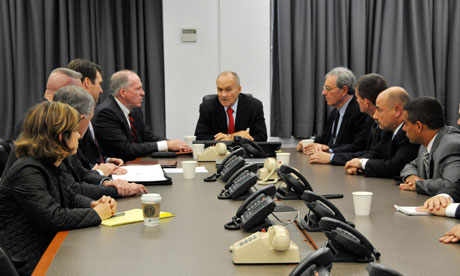
Dozens of members of Congress have asked the justice department to investigate the NYPD. Attorney general Eric Holder has said he was disturbed by the reports. But John Brennan, President Barack Obama's top counterterrorism adviser, has said he is confident the NYPD's activities are lawful and have kept the city safe.
Even if they do dramatically overstate their counterterrorism record, it's no secret that the bigger-than-the-FBI NYPD has extensive counterterrorism operations. These operations often include spying outside NYPD jurisdiction, both nationally and abroad.
According to Al-Monitor, an online newspaper reporting on the Middle East, the NYPD has now officially opened a branch in Israel's Sharon District Police headquarters in Kfar Saba, with former Israeli and veteran NYPD detective, Charlie Ben-Naim. From Al-Monitor:
Ben-Naim was chosen for the mission of opening the NYPD branch in Israel. He is a veteran detective of the NYPD and a former Israeli who went to study in New York, married a local city resident and then joined the local police force. Among the things he has dealt with in the line of duty are the extradition of criminals, the transmitting of intelligence information and assistance in the location of missing persons, both in the United States and in Israel.
So far, Ben-Naim looks to be the sole officer stationed at the so-called branch, which has reportedly been organized in order to stay in close contact with Israeli police.
Officers have been stationed in London, Lyons, Hamburg, Toronto, and Tel Aviv, New York Magazine reports.
Stateside the department has been under intense scrutiny for its surveillance efforts, which many civil liberties advocates say wrongfully target innocent Muslims, without creating any known leads.
The New York Police Department is embracing online surveillance in a wide-eyed way. Representatives from Microsoft and the NYPD announced the launch of their new Domain Awareness System (DAS) at a Lower Manhattan press conference today. Using DAS, police are able to monitor thousands of CCTV cameras around the five boroughs, scan license plates, find out the kind of radiation cars are emitting, and extrapolate info on criminal and terrorism suspects from dozens of criminal databases ... all in near-real time.
New York Police Commissioner Ray Kelly first announced that Microsoft had the NYPD's Domain Awareness System under development at the Aspen Security Forum in July. Microsoft has quietly become one of the world's largest providers of integrated intelligence solutions for police departments and security agencies. Although DAS is officially being touted as an anti-terrorism solution, it will also give the NYPD access to technologies that—depending on the individual's perspectives—veer on science fiction or Big Brother to combat street crime. The City of New York and Microsoft will be licensing DAS out to other cities; according to Mayor Michael Bloomberg, New York City's government will take a 30% cut of any profits. "Citizens do not like higher taxes, so we will (find other revenue outlets)," said Bloomberg. Bloomberg continued that "I hope Microsoft sells a lot of copies of this system, because 30% of the profits will go to us."
According to publicly available documents, the system will collect and archive data from thousands of NYPD- and private-operated CCTV cameras in New York City, integrate license plate readers, and instantly compare data from multiple non-NYPD intelligence databases. Facial recognition technology is not utilized and only public areas will be monitored, officials say. Monitoring will take place 24 hours a day, seven days a week at a specialized location in Lower Manhattan. Video will be held for 30 days and then deleted unless the NYPD chooses to archive it. Metadata and license plate info collected by DAS will be retained for five years, and unspecified “environmental data” will be stored indefinitely.
Cameras are primarily deployed in the Financial District, Midtown Manhattan, and at strategic transportation points like bridges and tunnels. In addition, radiation detectors capable of identifying radiation contamination from chemotherapy, x-rays, medication, industrial uses, and terrorism will also be deployed.
Although NYPD documents indicate that the system is specifically designed for anti-terrorism operations, any incidental data it collects “for a legitimate law enforcement or public safety purpose” by DAS can be utilized by the police department. The NYPD will also share data and video with third parties not limited to law enforcement if either a subpoena or memorandum of understanding exists. The DAS system is headquartered in a lower Manhattan office tower in a command-and-control center staffed around the clock by both New York police and "private stakeholders." When this reporter visited, seats were clearly designated with signs for organizations such as the Federal Reserve, the Bank of New York, Goldman Sachs, Pfizer, and CitiGroup.
The system also allows deep, granular analysis of crime patterns in real time. Information about suspects can also be quickly called up. At a press conference, Microsoft's Jennifer Tisch showed how integrated geographic information systems could display layers of real-time crime analysis for both misdemeanors and felonies. In addition, real-time access to multiple databases belonging to the NYC and other organizations can bring up a massive personal history--including both criminal and public domain information--from any suspect in a matter of seconds.
The NYPD has been at the center of recent controversies involving civil rights and surveillance; in July, a 911 call revealing an NYPD anti-terrorism safe house in New Jersey was released. The safe house in the college town of New Brunswick was monitoring Muslim-American college students; the safe house/apartment's landlord feared the NYPD apartment might have been harboring terrorists.



_img.jpg)

