Showing posts with label Intolerance. Show all posts

Wednesday, July 03, 2013

Islam and Intolerance In America


By T.A. Ridout

My Muslim friends are some of the best people I know. I don't normally think about their religion because no one has made a coherent argument as to why I should care. But when there are spikes of anti-Muslim sentiment in this country, I am reminded of the Islamophobia they deal with every day.
For some, I think the guidance, strength, and peace that Islam provides make them better people. For others, Islam is not a major part of their lives, just like Christianity is not a major part of my life. It doesn't matter though. What matters is that they are fantastic people.
After the bombs went off in Boston, my Palestinian-American friend on the other side of the world took less than three hours to check in on me: "Hi you. Thinking about you and yours a lot today." The salt on my cheeks was fresh when I read her email and finally breathed deeply.
She had already seen on Facebook that my family was safe. I was fortunate. Given the anguish I felt in those brief moments when I thought my father might be... I can't imagine what others are going through. As soon as I confirmed that he had not reached the finish line, I felt a moment of utter helplessness; I didn't know who to check on next. Any number of friends could have been at the finish line, watching or running. I didn't know where to begin. That is when the tears came. That is when my humanity was laid bare.
Nura checked in with me every single day for two weeks, offering compassion, understanding, humor, and love. When I was unsure about whether or not to fly home for the weekend, she convinced me. When I felt despair about humanity, she offered words of comfort and the insight that comes from experiencing the same thing, time and again. She is Muslim.
A few years ago, my Pakistani-American friend and I were sharing our life stories. I commented that her hardships seemed greater than mine, but she cut me off. With the gentle poetry of a peace-loving Californian, she said, "Nah, dude, pain is pain." I've kept that with me ever since. She is Muslim.
Weeks later, I saw the frustration in Sabah's eyes after what was clearly not the first "random search" she had ever experienced. I tried to comfort her, saying that throughout our history Americans have persecuted nearly every group imaginable at one point or another. Despite our failings, American society is still among the most tolerant and accepting on the planet. I told her that it would pass. I'll never forget the dejected look on her face when she asked me, "When?"
I don't normally refer to these friends with the modifiers Pakistani and Palestinian. To me, they are simply American, human. They are but two of many Muslim friends that are as varied as any cross-section of humanity. I can't imagine life without them. Their love, wisdom, and companionship have enriched me as a person.
I know that it is painful and infuriating when demented people kill innocents with bombs and guns, claiming to represent Islam. But stigmatizing Muslims is not going to make us safer. Muslims are not the problem. Extremists are the problem. Intolerant, hateful, violent people are the problem. They can be found in all different colors and creeds. I wish there were an easier way to identify them other than by observing their behavior and hearing their opinions, but there simply is not. By blaming a whole group for the actions of a few deviants, we are part of the problem.
I am drawn to those who are kind, interesting, accepting, and curious. I like people who make me laugh and smile, who bring me comfort and joy. These qualities transcend labels such as white, Ethiopian, Asian, Russian, European, atheist, lesbian, Latino, Jewish, Uzbek, straight, transgendered, handicapped, Uighur, Muslim, asexual, Nepali, black, Ecuadorian, Inuit, Nigerian, gay, Sikh; Persian, Egyptian, Arabian, Christian, Eskimo... I think you get the point. The notion of caring about such things strikes me as a waste of my valuable time.
Intolerance is an illness in human society. It is a parasite that eats away at our ability to grow to our full potential. It destroys prosperity by arbitrarily repressing the ideas and talents of those who do not belong to one group or another. It leads to social alienation, bitterness, and hatred. It hurts people.
I happen to be a straight, white male of Protestant Christian heritage. These attributes still confer privilege upon me in American society, but I don't want it. I want respect and appreciation because I have earned them through my life and works. I want everyone to be afforded this same chance. If we eliminate in groups and out groups from society, our quality of life will increase dramatically. The only in group that matters is "human."
So many problems in the world need our attention. As long as we waste our time and energy agonizing over our differences of background and personal preference, many of them will go unresolved.

Monday, December 24, 2012

Our History Of Religious Intolerance Must Come To An End


By Rev. Gary R. Hall, Amb. Thomas R. Pickering and Imam Feisal Abdul Rauf:

Although religious freedom is enshrined in the Bill of Rights, religious intolerance still exists in this country. Thanksgiving reminds us that the Pilgrims came to America to escape religious persecution. But the Puritans did not welcome other religions into their colony. All through American history, most religions arriving on our shores have had to fight suspicion and intolerance.

Look at Catholic and Jewish Americans. They faced widespread discrimination and demands that the doors to America be closed to them. Even so, some anti-Semitism and anti-Catholic sentiment persists, but both communities are thriving today. Now it's Muslim Americans who grapple with persistent challenges to their loyalty as Americans.

Since 9/11, bias toward American Muslims has been fueled by fear of terrorism and ignorance about Islam as a religion and tradition. Well-funded individuals and groups fan this intolerance by spreading distortions and sowing distrust. They aim to exclude Muslims from American civic life.

Lost in all of this are the contributions Muslims have made, from our intellectual life to military service and -- more importantly -- the loyalty and support that America's 7 million Muslims have shown since 9/11 to help build and defend the United States.

This discrimination cannot go uncontested. As people of faith, we have a responsibility to embrace America's commitment to freedom of religion by counteracting this growing intolerance not just with talk, but with action.

At a recent gathering of religious scholars and leaders convened by Washington National Cathedral and the Center for the Study of the Presidency & Congress, our aim was an honest understanding of how Muslims have been caricatured and marginalized since 9/11. We grasped the need to expand an interfaith outreach to Muslim organizations to help them counter these challenges. 

A Pew Research poll reported that nearly four in 10 Americans have an unfavorable opinion of Islam, and an equal number link Islam with acts of violence. With such shocking religious illiteracy about Islam in our society, it's no small wonder that intolerance thrives.

What should be done?

First, we need to recover civic discourse. When a pastor burns a Quran, for instance, or anti-Muslim slogans appear in subway ads, we need to reject such actions as a failure to recognize the full humanity of our fellow-citizens -- an assertion that some people do not belong in the same way that "we" do.

But we cannot just react to incivility. We must engage audiences with real human stories out of the Muslim community; stories that stress our shared humanity and the role of Muslims in building our rich and diverse society.

We must act together through interfaith cooperation, especially with our young people, through organizations such as the Interfaith Youth Core that teaches a new generation how to come together and challenge the world. The Interfaith Alliance champions religious freedom while fighting extremism. Productions by BoomGen Studios highlight stories of interfaith cooperation in film and online media.

The religious rights of American Muslims are threatened every time anyone seeks to limit how Muslims participate in our society. Such limits contradict the religious imperative to work for social justice and provide all of God's creatures with the chance to grow and flourish as members of the community. We commit ourselves to honoring through word and deed the contribution of American Muslims. We also commit ourselves to work for justice because we believe justice is essential to create a more peaceful and equitable society.

The American Muslim identity has been forged within the same challenges that face all Americans: the need to belong and contribute to society as a whole while nurturing our own values of justice and acceptance. If we listen closely on Thanksgiving Day, we will hear so many Muslim-Americans giving thanks to God for the opportunity to live in America and practice Islam perhaps more freely than they did in their home countries.

We have a moral duty -- as both people of faith and Americans -- to take a stand for religious liberty and to make space for the Muslim-American identity to grow and prosper. Indeed, we will fail the guiding principles of this nation if we do not.

The Very Reverend Gary R. Hall is dean of Washington National Cathedral. Ambassador Thomas R. Pickering is chair of the Center for the Study of the Presidency & Congress. Imam Feisal Abdul Rauf is chairman of the Cordoba Initiative and author of Moving the Mountain.

Via: "The Huffington Post"

Sunday, December 09, 2012

3 Faiths, 1 God: Judaism, Christianity, Islam


Teaser:

This is an excerpt from the ground-breaking documentary, Three Faiths, One God: Judaism, Christianity, Islam which compares similarities and differences in religious beliefs and practices that Islam has with Christianity and Judaism. It also examines how people of goodwill in the Abrahamic faith communities are coming to terms with historical conflicts that impact their lives today, the crisis of the fundamentalist approach to religious pluralism and tearing down barriers to understanding & respect. 

www.threefaithsonegod.com

Thursday, October 04, 2012

The Assault On Coexistence


WHAT is common between the criminal complaint against Rabbi David Goldberg for circumcising Jewish boys in Hof, Germany; the ban on minarets in Switzerland; the continual attempts by some European publications to offend Muslims; the attempt to convict a young Christian in Pakistan for blasphemy she did not commit; an attack on a mosque in Missouri, US; or, most vicious of all, the recent film that injects lies and malice into public discourse through veins nourished by hatred?

By MJ Akbar
Courtesy Of "Dawn"


Each one is not designed to destroy the existence of the ‘other’. Their purpose is to poison coexistence, the fundamental basis of civilised living. Anger is not always illogical, but there is no rationale that can justify each of these instances.
Rabbi Goldberg was not trying to circumcise Christians; he was practising his own faith. To target minarets as a cultural crime in an age of skyscrapers is manifest prejudice, of the sillier sort.
Provocative European publishers are not defending freedom of speech, which is their much-advertised explanation, since nowhere in the democratic world does the right to publish include the leeway to libel or defame, particularly when a lie can lead to public disorder.
The Pakistani child was a victim, not a perpetrator — of fanatics who wanted to punish her and her kin for protecting Christianity in their theocratic environment.
The bilious film about the Prophet of Islam (PBUH)was not made by a filmmaker, but by a bigot determined to provoke a violent reaction that would confirm in many innocent or naïve minds the image of Islam as a fountainhead of violence rather than what the word actually means, which is peace. The barbarians who killed four American diplomats in Libya duly obliged: hatred breeds hatred in an escalating cycle.
Even the most dramatic example of pure, unadulterated terrorism, the destruction of New York’s twin towers on 9/11, was initiated not to destroy America’s existence, which is impossible even within the mindset of a maniac, but to breach an emerging international order founded on mutual respect, and the equality of nations.
The planes that headed towards the White House and Pentagon were not ferrying troops who had been ordered to conquer Washington. Their purpose was to generate fear, hostility and war between the two largest religious communities in the world.
They succeeded, but to an extent far lower than the expectations of terrorist masterminds, and yet far more than the young 21st century could stomach.
The price has been high. The Mumbai terrorist attacks in November 2008 had a dual objective: to warp the India-Pakistan engagement, as fragile as it might have been; and to incite violence in India between Hindus and Muslims. It is satisfying to report that the second wish failed spectacularly because Indians understood that such discord would mean a victory for terrorism.
The most interesting aspect of this worldwide shadow war is that both the self-appointed commanders and their terrorist troops are almost wholly civilian. We are witnessing a rare phenomenon: people outside the power structure, working largely (but not always) on their own, can do more damage to social harmony than powerful regiments led by dictators, presidents or prime ministers.
There are governments, of course, who are tempted to dip their hands in the sewer for political gain; and you can never rule out the unintelligent intelligence agency which believes in a strategy of destabilising civilian populations. But governments have not, exceptions apart, been in the forefront of these battle lines.
Whatever their nature, despotic, democratic or in-between, governments know that fomenting terrorism debilitates the personal and institutional advantages of being in power through blowback damage. Even when legitimate armies are put on the field, governments calibrate the conflict.
When governments fall into the grip of radical ideologues who have left common sense at the club bathhouse, the damage is startling, as was evident during president George Bush’s Iraq war.
The most dangerous of today’s conspiracies are being manufactured in small rooms lost in the labyrinths of a big city by men who will not become internationally infamous unless they succeed. We do not know how many 9/11s or Mumbai attacks have failed, but just the thought is sufficient for a shudder.
Failure is not any hindrance to fanatics. They are now being lured by the siren outreach of a miraculous technology that continues to breed new tools by the day. Prevention is the full-time job of innumerable police forces, while no one has any real clue about what might constitute a cure.
This war has to be fought where it is being incubated, on the street, and in the mind. We cannot afford politicians who seek votes from a sewer. This is a malaise, an infection, a plague, a crisis that demands leaders who maintain the sanity of good doctors in the face of havoc. Violence can begin with a word, and every word must be chosen with care.

Wednesday, July 25, 2012

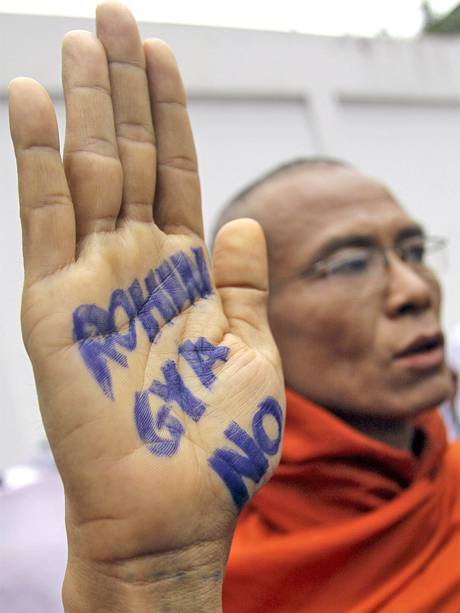
Burma's Monks Call For Muslim Community To Be Shunned


The Buddhists Have Reportedly Tried To Block Humanitarian Aid Getting To Ethnic Group

Monks who played a vital role in Burma's recent struggle for democracy have been accused of fuelling ethnic tensions in the country by calling on people to shun a Muslim community that has suffered decades of abuse.

In a move that has shocked many observers, some monks' organisations have issued pamphlets telling people not to associate with the Rohingya community, and have blocked humanitarian assistance from reaching them. One leaflet described the Rohingya as "cruel by nature" and claimed it had "plans to exterminate" other ethnic groups.

"In recent days, monks have emerged in a leading role to enforce denial of humanitarian assistance to Muslims, in support of policy statements by politicians," said Chris Lewa, director of the Arakan project, a regional NGO. "A member of a humanitarian agency in Sittwe told me that some monks were posted near Muslim displacement camps, checking on and turning away people they suspected would visit for assistance."

The Young Monks' Association of Sittwe and Mrauk Oo Monks' Association have both released statements in recent days urging locals not to associate with the group. Displaced Rohingya have been housed in over-crowded camps away from the Rakhine population – where a health and malnutrition crisis is said to be escalating – as political leaders move to segregate and expel the 800,000-strong minority from Burma. Earlier this month, Thein Sein attempted to hand over the group to the UN refugee agency.

Aid workers report ongoing threats and interference by local nationalist and religious groups.

Monks' leader Ashin Htawara recently encouraged the government to send the group "back to their native land" at an event in London hosted by the anti-Rohingya Burma Democratic Concern. Ko Ko Gyi, a democracy activist with the 88 Generation Students group and a former political prisoner, said: "The Rohingya are not a Burmese ethnic group. The root cause of the violence… comes from across the border." Mark Farmaner, director of Burma Campaign UK, said: "We were shocked to have [Ashin Htawara] propose to us that there should be what amounts to concentration camps for the Rohingya."

Ms Suu Kyi has also been criticised for failing to speak out. Amal de Chickera of the London-based Equal Rights Trust, said: "You have these moral figures, whose voices do matter. It's extremely disappointing and in the end it can be very damaging."

The Rohingya have lived in Burma for centuries, but in 1982, the then military ruler Ne Win stripped them of their citizenship. Thousands fled to Bangladesh where they live in pitiful camps. Foreign media are still denied access to the conflict region, where a state of emergency was declared last month, and ten aid workers were arrested without explanation.

Via: "The Independent"

Sunday, July 22, 2012

A Heroine No More


Suu Kyi and The Rohingya


Like many I watched with joy as Aung San Suu Kyi spent two weeks traveling Europe. Throughout her house detention she won numerous awards including the Nobel Peace Prize, and while in England as well as meeting the likes of the Dalai Lama, she spoke of how her memories when studying in England helped her through her political detention.
Returning to Burma, she was greeted by chanting crowds, a mark of a true political heroine. Yet despite this, her silence on the continued persecution of the Rohingya makes her complicit in their persecution.
The Rohingya are a community of 800,000 living in the Arakan region of Burma. According to the United Nations, they are amongst the most persecuted minorities; and aside from occasional reporting, their plight, particularly in current days, remains poorly reported.
While Suu Kyi, the third child of Aung San - considered the father of modern-day Burma - received a standing ovation at Westminster Hall in London, asking for help to deliver, 'better lives, greater opportunities, to the people of Burma who have been for so long deprived of their rights to their place in the world;' speaking of the Rohingya, she said that she 'didn't know' if they were Burmese citizens.
If as some opine, in her desire to lead the people of Burma, she has adopted this position of uncertainty to appeal to the wider Burmese community - many of whom view the Rohingya as foreigners.  Then I fear, despite her accolades of peace, and her rapturous reception here in Europe, as she now travels freely, she remains, mentally, a prisoner under house arrest.
There can be no worse head of state than one who dismisses and ignores the plight of 800,000 of her countries residents. 
And I fear His Holiness the Dalai Lama's words, when meeting Suu Kyi, "I have real admiration for your courage," no longer reflects the woman I once read of and admired, who in her silence on Rohingya persecution is a heroine no more.

Tuesday, January 17, 2012

Advance Of The Fanatics

Photo Gallery: Battle for the Soul of Israel
Veiled women, radical rabbis and gender segregation: Israel is facing a rise in the influence of ultra-Orthodox Jews. Their efforts to impose a strictly conservative worldview have led to growing tensions with the country's secular society. A resolution to the conflict is vital for Israel's future


By Juliane von Mittelstaedt 
January 13, 2012 
Courtesy Of "Der Spiegel Online" 

The Growing Influence of the Ultra-Orthodox in Israel


Outside is the Judean Wilderness, the Dead Sea shimmers in the distance. Naomi Machfud is sitting inside the self-built house, dreaming about making the world disappear. She wants to cover up her face with a veil, she says, her mouth, her nose and her eyes. A black veil, without even a vision slit, one that swallows every glance and submerges the world in darkness. The veil is the pinnacle of zniut, or modesty, the closest a person can get to God. But, she says with a sigh, "unfortunately I'm not that far yet."

But Machfud, a 30-year-old woman with six children, has already created an insulating layer of material between herself and the outside world. She is wearing a wool robe, an apron, a blouse, three floor-length corduroy skirts, a black skirt and trousers. She has a piece of black wool material wrapped loosely around her head. Underneath it is a tight, black veil, and underneath that is a pale pink veil. Not a single hair is visible. She is wearing a pair of earrings, but she takes them off when she leaves the house.


Machfud is a Jewish woman married to a Jewish man. They live in a settlement in the West Bank, but she dresses as if she lived in Afghanistan. In Israel, the veiled women are referred to as the "Taliban," while they refer to themselves as women of the shawl. Machfud claims that there are thousands of women like her, but it is more likely that they number in the hundreds. They are usually seen in Jerusalem's ultra-orthodox Me'ah She'arim neighborhood, black, shapeless figures, holding the hands of their daughters, who look like miniature versions of their mothers.

One could call these women crazy. Or one could see them as the product of a religious community that is becoming more and more extremist.

Gender Separation In Public

The ultra-religious are gaining power throughout the Middle East, including in Israel, where radical rabbis are expanding their influence. This is especially clear when it comes to women. Ironically, it is in Israel, a country that was already being run by a woman, Golda Meïr, in the 1970s, and where women fly fighter jets, that Jewish fundamentalists are trying to bring about gender separation in public -- in elections, on buses and in the street -- all in the name of a morality that is supposedly agreeable to God. Until now, this trend has been most noticeable in Jerusalem, in Beit Shemesh and in Bnei Brak near Tel Aviv, the country's ultra-orthodox strongholds. But increasingly it is becoming apparent in places where secular Israelis live.

Even a former head of the Mossad, Israel's foreign intelligence agency, is now warning that the ultra-orthodox are a bigger threat to the country than the Iranian nuclear program. US Secretary of State Hillary Clinton said recently that the conditions in Jerusalem remind her of Iran.

The odd coexistence of religion and democracy in the Jewish state was long unproblematic. But now the consequences are becoming clear, the signs of fatigue of an overstressed country, a country that is both a democracy and an occupying power, a high-tech nation in which a portion of the population still lives as if it were the 19th century, and a country that accepts immigrants from around the world, provided they are Jews, while at the same time mercilessly deporting refugees. As such, the settlers are, on the one hand, increasingly exhibiting a Messianic nationalism while, on the other hand, the ultra-orthodox pursue a fundamentalism hostile to the state.

Naomi Machfud says that she feels good in her headscarf and multiple skirts. So good, in fact, that she claims she doesn't even sweat during the summer, at 45 degrees Celsius (113 degrees Fahrenheit). She huddles on a worn sofa and tries to explain how it all began, with her and the veil. It is a story consisting of fragments and allusions, and it begins with a Jewish girl from New York who feels empty and spends her time in the streets, until she goes to Israel at 15 to attend an orthodox seminar. She becomes religious and, encouraged by the rabbis, starts wearing more and more clothing.

'Some Men Don't Like It'

Her rabbi was supposed to explain why exactly women are doing this, but he cancelled the meeting at the last minute. At the moment, it is not advisable to openly support the Taliban women, because a few of the ultra-orthodox have just imposed a new rule on them, which they announce in wall newspapers: "You may not cover yourself in abnormal and peculiar clothing, including veils, especially if your husband is against it."

Machfud smiles a Mona Lisa smile. "Some men don't like it," she says. "Suddenly we're more religious than they are." Therefore she is now trying to explain it all herself, and to support her argument she has placed a tattered book on the table. The title is "World of Purity," a bestseller in the ultra-orthodox community. She flips through images of women from past centuries, most of them Jewish, from Yemen, Morocco and Greece, but also of Amish women and Arab women. They all have one thing in common: 

the large, dark robes they wear, often including a face veil. This is how it was in the past, says Machfud, and it's how it should be again today.

Orthodox Jewish women wear long-sleeved blouses and skirts, and they cover their hair. But this doesn't go far enough for Machfud. She says that she sees too much fashionable clothing, garments that are too tight, too pretty and too indecent. The women, she says, attract looks that should be reserved for the husband. In her view, this leads to sin, and as long as there is sin, the Messiah cannot appear.

"Would you wear a diamond in the market? No, you would hide it at home," adds Revital Shapira, 46, a woman with eight children who is sitting next to Machfud, her body covered in black, floor-length skirts, shawls and headscarves.

Shapira also found religion later than most. She studied literature and only became a Taliban woman after she had given birth to an autistic boy and a girl with heart disease.

'Little House' Crossed With Saudi Arabia

As different as they are -- Machfud soft and pretty, Shapira ideological and contrary -- both women want to live in a world in which women do housework, have children and leave their homes as little as possible. They envision a world without computers and washing machines, with organic food and homemade clothing, a mixture of "Little House on the Prairie" and Saudi Arabia.

"The woman should disappear from public. She should not go out, and she should not speak with strangers on the street," says Shapira. "Unfortunately, the majority of Israelis don't understand this, which is why we are building a parallel system." The two women do not talk to men, and they leave the room when a man comes in. And they are determined to see their daughters follow in their footsteps. "We are building the will in our children to want these things as well," says Machfud.

"For decades, the male leaders of the ultra-orthodox have talked about nothing but modesty," says Hebrew University sociologist Tamar El Or. "No matter what, women are always being lectured on morality, and even the most devout must listen, morning, noon and night, to how they, with their femininity, bring sin to men."


The length of skirts became the gold standard, and each additional layer of material was seen as bringing women a step closer to God. "Some women have started going to excessive lengths. It's like anorexia." According to El Or, this obsession with virtue is also a rebellion against husbands and rabbis, with women now choosing to define their bodies and their faith themselves.

Bruria Keren was a particularly extreme case. In the end she was wearing 27 layers of material. Known in Israel as "Mama Taliban," Keren is one of the leaders of the women of the shawl. Born in a kibbutz and abused by her father, she eventually became religious -- a typical story. As she became more and more obsessed with morality, she beat her children, forced them to pray and cut their hair in punishment, which is why she is now serving a four-year prison sentence.

Witnessing An 'Extremist Trend'

"It started with a coat, and then there were three. Then she added trousers and a skirt on top. In the end there were 10 skirts, 10 coats and gloves," says her son, who chooses not to reveal his name. "Eight years ago, she covered her face with a veil, first outside and then at home, and finally she was even wearing it in the shower. I haven't seen her face since then. She set up a tent in the bathroom, so that even the walls couldn't see her naked." Keren also stopped speaking, only communicating with gestures or writing.

While his mother became more and more chaste, the son was having sex with his sister in the next room. He was 15 and she was 12.

It was a broken life, says the son, who is now 30 and still hardly dares to go out in public. He works as a laborer during the day and, at night, runs to efface his past. He has become one of the fastest runners in Israel.

"If my mother hadn't been religious, she would have been committed to an institution right away," he says. Instead, the ultra-orthodox community protected her and no one intervened. The ultra-orthodox prefer to solve their problems on their own, without the government. "And my mother's followers told me that she was a saint."

Yair Nehorai, the attorney who represented the son in court when he was charged with sexual abuse, has published a book based on his client's story*. Nehorai is not religious, but one of his ancestors was a prominent rabbi, which gives him credibility. He represents almost all of the ultra-orthodox who have problems with the authority of the state. One of his clients was an ultra-orthodox man who recently allegedly berated a female soldier who was sitting with the men in the front of the bus, calling her a "whore." And then there were the Yeshiva students from Beit Shemesh, who made headlines when they spat at female students from a religious girls' school, because their skirts only extended to just below the knee. Nehorai also represented the Sikrikim, self-proclaimed moral police who threw fecal matter at a bookstore until it bowed to their moral dictates.

Few Dare To Publicly Oppose Them

Nehorai has never been as busy as he is today. "There is an extremist trend in the ultra-orthodox community," he says. "These radicals were a very small group in the past, but they are becoming more important." Many orthodox Jews are opposed to the moral terror of the zealots, says Nehorai, but very few dare to publicly oppose them.

Synagogues and religious schools have long been single-sex. But then gender segregation began on buses a few years ago. At first only one bus line was "kosher," but soon the men were sitting in the front and the women in the back on more than 60 routes. The government did nothing, until a women's organization took its case to the Supreme Court. It ruled more than a year ago that the segregated seating arrangement is only permissible if it is voluntary. It is a ruling that reveals the court's unwillingness to take a clear position in the conflict between religious and secular segments of society.

Increasingly, supermarket checkout lines, hospital waiting rooms and wedding celebrations are segregated in orthodox neighborhoods. This is voluntary, and yet it is also the norm. But gender segregation is beginning to spread beyond the neighborhoods where the Haredim, or god-fearing ones, live.

Women have disappeared from advertising posters in Jerusalem. Swimming pools at the university have separate hours for men and women. Burial societies forbid women from giving eulogies. In an award ceremony at the Ministry of Health, the female researchers who were being honored were not permitted to walk onto the stage. The deputy health minister is ultra-orthodox.

There are now campaigns against the so-called Haredization of public life. Women are singing in the streets and refusing to sit at the back of the bus. Several thousand people attended one demonstration against the radicals of Beit Shemesh. Nevertheless, it is unlikely that all of this will reverse the trend.

Festering Since The Country's Establishment

At issue is a culture war that has been festering since the country's establishment, because it is still unclear today what exactly Israel is supposed to be: a theocracy for Jews? Or a democratic sovereign state? The orthodox appear to be on the road to winning this fundamental battle of principles.

Although they are a minority, with only 10 percent of the population, their birth rate is almost three times as high as that of secular Jews. If this remains the case, the Haredim will make up a third of the population in less than 50 years. A quarter of Jewish first-graders are already ultra-orthodox. They also constitute 40 percent of the members of parliament in the coalition government, as well as 40 percent of new army officers and soldiers in combat units. This gives them a disproportionately large amount of influence, which they utilize.

Even in the army, women are now being assigned to units with ultra-orthodox soldiers with decreasing frequency. A few months ago, religious officer candidates left a party where women were singing, saying that this could lead to impure thoughts. An influential rabbi said afterwards that he would rather stand before a firing squad than listen to a woman singing.

Since then, members of parliament, generals and rabbis have addressed the issue of women singing.

Israel's chief rabbi has released an eight-page religious opinion, in which he argues that the army should prohibit women from singing when religious students are listening. A lawmaker from the "Party of Sephardic Torah Guardians," or Shas, proposed that religious soldiers be provided with earplugs in the future.

Shas is led by 91-year-old Rabbi Ovadia Josef, who is known for underscoring his comments with slaps in the face. His son, also a rabbi, seriously believes that women should not be allowed to drive. Far from being an outsider, Josef is one of the most powerful men in Israel, and his party has been part of almost every government in the last two decades, including the current government. Prime ministers bow to him when they ask for his approval of decisions involving war and peace.

Independent Of The Government

In many ways, Israel already resembles Iran more than Europe. It is a country where there is no civil marriage, and where rabbis rule on weddings and divorces. It is also a country where ultra-orthodox schoolchildren learn neither mathematics nor English, where every kindergarten and every military battalion has a rabbi, and where an infrastructure minister wants to place power plants under the supervision of rabbis so that even electricity will be in compliance with religious purity laws.

All of these things have been around for decades, but now orthodox radicals are increasingly occupying key positions, thereby imposing their stamp on the secular majority.

For a long time, the politicians did nothing. They were constantly giving their religious coalition partners more money and housing for their ultra-orthodox clientele. Otherwise, they left the orthodox to their own devices -- and to the extremists.

That's why men like Joelisch Kraus, 38, are now setting the tone. Kraus is one of the Israel haters of Neturei Karta, the ultra-orthodox, anti-Zionist group. He lives in Me'ah She'arim, in the middle of Jerusalem -- and yet he is part of a parallel society from the 19th century. He has never watched television, has no identification card and speaks Yiddish. He only takes buses that are not operated by the government-owned transportation company, Egged. Garbage disposal presented a problem to Kraus, but he has solved it by tossing his garbage into his neighbor's garbage can. All of this makes him independent of the government and the government independent of him. He is slowly undermining the government from within by refusing to participate in society. He believes that this is the way it should be, because, as he says, Jews should not rule the Holy Land until God sends the Messiah.

It is early evening, and Kraus has just returned from Torah lessons. His son jumps into his lap and pulls on his sidelocks. His wife is sweeping the two-room apartment with an enormous broom. They have 13 children. Seven of them sleep in their parents' bed, two on the window seat and the rest on the floor.

Stoning The Buses

What are a woman's duties? He looks puzzled. "Well, she should be at home and do all the things that have to be done, like having children, raising them and doing the laundry. That's their role," Kraus explains with the gentle amiability of a person who commits crimes out of conviction. "That's all."

To keep it this way, Kraus is leading a crusade against the modern age, so that women will not want education and jobs one day and thus throw the world of the ultra-orthodox out of balance. It is no accident that the culture war is being waged now, as more and more religious Jews participate in the military and working life, despite all the rabbis' bans.

Me'ah She'arim today resembles the Gallic village that is defending itself against the Romans, and Joelisch Kraus is Asterix. The Romans are the representatives of the state and the seculars. Kraus and his fellow ultra-orthodox Jews divide up the streets during religious festivals, with one side for women and the other side for men. If they had their way, the same separation would also apply to everyday life. They threw stones at the non-segregated buses passing through Me'ah She'arim until Egged shut down its service in the neighborhood for more than a year. Now the buses are back in operation, but with police escorts.

"The non-religious Jews have long since lost Jerusalem. They may have a secular mayor, but they just imagine that they are in charge." Kraus laughs. He is familiar with the birth statistics and he knows that time is on his side. "We run Jerusalem," he says.


* Yair Nehorai; "Thou Shall Be My Mother, My Grave"; Steimatzky/Chamama Sifrutit; in Hebrew.

Translated from the German from Christopher Sultan

Sunday, March 13, 2011

Unrelenting Attacks On US Muslims

By Riz Khan

"More people died in the United States last year from dog bites, than died from terrorist attacks"

Sheikh Hamza Yusuf examines the congressional hearing on the so-called radicalization of American Muslims.

Monday, March 07, 2011

Islam Does Not Belong In Germany

Hans-Peter Friedrich
 New German Minister  Hans-Peter Friedrich

By Danna Harman
Published 01:53 06.03.11
Latest update 01:53 06.03.11
Courtesy Of "Haaretz NewsPaper"

Just three days into the job, Germany's new interior minister is already causing his government a headache after wading into a highly delicate debate about multiculturalism and claiming Islam was not a key part of the German way of life. "Islam in Germany is not something supported by history at any point," Hans-Peter Friedrich told journalists on his first day as Thomas de Maiziere's replacement on Thursday.
.
.
.
Friedrich's foray into the subject of immigrant religion and multiculturalism is in tune with comments made by other European leaders recently. British Prime Minister David Cameron said last month that multiculturalism has failed in Britain and left young Muslims vulnerable to radicalization, arguing for a more active policy to heal divisions and promote Western values.

Germany is home to Western Europe's second-biggest Islamic population after France. The single biggest minority is Turkish. In contrast to the situation in Britain or France, where simmering racial tensions sometimes explode into violence, German Muslims live relatively peacefully alongside mainstream society, but a lack of integration has long posed a problem.

Opposition member Dieter Wiefelsputz of the Social Democratic Party referred to Friedrich's comments as "rubbish," saying that the minister began his term with "poor judgment."

Intolerance Is Tearing Apart America's Social Fabric

Illustration by Shadi Ghanim

By James Zogby
Last Updated: Mar 6, 2011
Courtesy Of "The National"


Let me state quite directly: Islamophobia and those who promote it are a greater threat to the United States than terrorists like Anwar al Awlaqi.
From his hideout in Yemen, the American-born Mr al Awlaqi can only prey off alienation where it exists. Like some parasites, Mr al Awlaqi cannot create his own prey. He must wait for others to create his opportunities, which until now have been isolated and limited - a disturbed young man here, an increasingly deranged soldier there.
Islamophobia, on the other hand, if left unchecked, may serve to erect barriers to Muslim inclusion in America, thus increasing alienation, especially among young Muslims. Not only would such a situation do grave damage to one of the fundamental cornerstones of America's democracy; it would also rapidly expand the pool of recruits for future radicalisation.
I have often remarked that America is different in concept and reality from our European allies. Third-generation Kurds in Germany, Pakistanis in the UK, or Algerians in France, for example, may succeed and obtain citizenship, but they do not become German, British, or French. Last year, I debated with a German government official on this issue. She kept referring to the "migrants" - a term she used to describe the many generations of Turks living in her country. Similarly, following their last election, a leading British newspaper commented on the "number of immigrants" who won seats without noting that many of those "immigrants" were third-generation citizens.
America has prided itself on being different. Being "American" is not the possession of a single ethnic group, nor does any group define "America". Not only do new immigrants become citizens, they also secure a new identity. More than that, as new groups become American and are transformed, the idea of "America" itself has also changed to embrace these new cultures.
History has demonstrated that, in the end, newcomers have been accepted, incorporated and absorbed into the American mainstream. This defines not only our national experience, but our core narrative as well.
It is because new immigrants have found their place in the American mainstream that the country, during the last century, survived and prospered despite being sorely tested with world wars, economic upheaval and bouts of internal strife. During all this time we had to contend with anti-black, anti-Asian, anti-Catholic, anti-Jewish, anti-immigrant, and anti-Japanese movements.
While such sentiments inevitably die down, they do not always go away. The Islamophobia we are witnessing today is the latest campaign to tear apart the very fabric of America, and we know the groups promoting it. First, there is the well-funded right-wing "cottage industry": groups and individuals with a long history of anti-Arab or anti-Muslim activity. Some of the individuals have been given legitimacy as commentators on "terrorism," "radicalisation" or "national security concerns" despite their obvious bias.
If these "professional bigots" have provided the grist, the mill itself is run by the vast network of right-wing radio, TV and online content who have combined to amplify the anti-Muslim message nationwide.
In just the past two years, we have seen a dramatic upsurge in the activity of these bigots. More ominously, their cause has been embraced by national political leaders and by elements in the Republican Party who appear to have decided in 2010 to use "fear of Islam" as a base-building theme and a wedge issue against Democrats for electoral advantage.
In the past, only obscure or outrageous members of Congress were Islamophobes: North Carolina's Sue Myrick - who expressed nervousness and insecurity because of "who was owning all those 7/11's", or Colorado's Tom Tancredo, who once warned that he "would bomb Mecca".
But after the National Republican Congressional Campaign Committee embraced opposition to Park51 as a campaign theme, it is hard to find a leading Republican who has not railed on some issue involving Islam or Muslims in the US.
This current wave of Islamophobia has played well to the Republican base. The polling numbers are striking and deeply disturbing. Fifty-four percent of Democrats have a favourable attitude towards Muslims, while 34 per cent do not. Only 12 per cent of Republicans hold a favourable view of Muslims, with 85 per cent saying they have unfavourable views. Additionally, 74 per cent of Republicans believe "Islam teaches hate" and 60 per cent believe that "Muslims tend to be religious fanatics".
This issue will not go away soon, and the longer we are plagued by this bigotry, the longer young Muslims will feel that the "promise of America" does not include them, and they will feel like aliens in their own country.
It is this concern that has prompted many inter-faith religious groups and leaders and a diverse coalition of ethnic and civil rights organisations to vigorously oppose Congressman Peter King's hearings that will deal with the radicalisation of American Muslims later this week. They know, from previous statements that Mr King harbours personal hostility towards American Muslims. They also know that what Mr King is doing will only aggravate matters, creating greater fear and concern among young Muslims who have already witnessed too much bigotry and intolerance.
What they should also know is that in the process of targeting a religion in this way and engaging in this most "un-American activity", Mr King and company are, in fact, opening the door for increased alienation and future radicalisation.
 James Zogby is the president of the Arab American Institute

Friday, September 24, 2010

Intolerance At Jerusalem's Museum Of Tolerance

Building On The Dead

By GEORGE BISHARAT
September 9, 2010
Courtesy Of "CounterPunch"

Four decades ago, the state of California purchased land in Carmichael, a suburb of Sacramento, and built Casa de los Gobernadores to replace the aging downtown governor's mansion. Few realized at the time that it was also the site of a Native American burial ground. Successive California governors refused to move there, mostly on pragmatic grounds. But in declining to live over the dead bodies of this state's native inhabitants, those governors, perhaps fortuitously, chose well.

Today, another structure, across the world, is being erected over the dead bodies of a different indigenous people that, nonetheless, has a curious connection to California.

In his first trip abroad after taking office as governor of California in 2004, Arnold Schwarzenegger attended the groundbreaking ceremony of a new Museum of Tolerance in Jerusalem, proclaiming "this building will be a candle to light us." The museum is a project of the Los Angeles-based Simon Wiesenthal Center, supported by the Israeli government. Our governor's presence there, along with other luminaries, bestowed legitimacy upon the project, and the involvement of the Wiesenthal Center also gave it a distinct California cast.

Yet the museum is being constructed on the site of an ancient Muslim cemetery, desecrating the graves of the interred. Archaeologists believe the Mamilla (Faithful of God) Cemetery holds the remains of tens of thousands of Muslim soldiers of Salah ed-Din, the 12th century leader who reconquered Jerusalem from the Crusaders. The cemetery was actively used by prominent Palestinian families through 1948, when West Jerusalem fell to Israeli troops. Hence the site is immensely significant archaeologically, but is also culturally sensitive to Palestinians.

An initial petition by Palestinian families and Islamic groups to the Israeli high court delayed but did not halt museum construction. Speed was the guiding principle of the project, not care for archaeological preservation nor respect for the dead, construction workers recounted to Israel's Haaretz newspaper. The Israeli high court denied a second petition, ignoring evidence that the Israel Antiquities Authority had suppressed the opinion of its own expert in originally permitting the museum's construction.

In fact, chief excavator Gideon Suleimani advised his Antiquities Authority superiors against construction on the site and has since characterized building there as "an archaeological crime." Palestinian families have taken their case to the United Nations, petitioning a variety of bodies there for relief. Represented by the New York-based Center for Constitutional Rights, the families have also dispatched letters to members of the board of the Wiesenthal Center appealing to them to press for a halt to construction.

Israel's support for the museum project despite Palestinian and Muslim sensibilities is emblematic of its intolerant treatment of its own 1.3 million Palestinian citizens as well as of its efforts to erase Palestinian history in Jerusalem and thereby reinforce exclusive Jewish claims to the city. Palestinian residents of Jerusalem face especially acute discrimination in the provision of municipal services and access to land for residential building.

Those residing in East Jerusalem, seized by Israel in 1967, have been required to prove that Jerusalem constitutes their "center of life" and risk the loss of residency rights there. The Israeli human rights organization B'Tselem characterized the set of pressures faced by native non-Jewish residents of Jerusalem as a form of "quiet deportation." Coupled with an aggressive campaign of Jewish settlement, Israeli policies amount to a form of 21 century colonialism.

Schwarzenegger's 2004 visit to Jerusalem was, no doubt, well intentioned. Indeed, he has a commendable record of support for mutual respect among peoples of different faiths and origins. He went, however, not simply as an individual, but as the elected leader of this state.

The governor should now exercise his moral stature and political authority with Israeli politicians and Wiesenthal board members by disavowing support for the Museum of Tolerance in Jerusalem and persuading them to halt construction of this ill-situated building. That is the surest way to maintain his deserved standing as an ambassador of understanding and this state's reputation as a place where equality in human dignity is cherished above all.

George Bisharat is a professor at Hastings College of the Law and writes frequently about law and politics in the Middle East.