


Showing posts with label American Revolution. Show all posts
Showing posts with label American Revolution. Show all posts
Tuesday, September 10, 2013
A Military Coup Against US President Obama
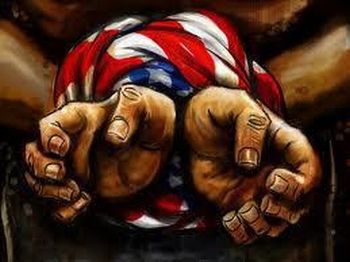
This animation applies the Egyptian military coup model to America, where the Pentagon intervenes to back a fabricated "popular demand" and removes the legal and democratically elected president.
"What do you call this? Yes, a brutal military coup ad a democratic nightmare. Why call it anything different when it takes place in Egypt. Wake up human race. It's time to respect every vote. Support Egypt. Support democracy."


Monday, October 08, 2012
A Second American Civil War In The Future?
“We have problems . . . The federal government is preparing for civil uprising,” he added, “so every time you hear about troop movements, every time you hear about movements of military equipment, the militarization of the police, the buying of the ammunition, all of this is . . . they (DHS) are preparing for a massive uprising.”Hagmann goes on to say that his sources tell him the concerns of the DHS stem from a collapse of the U.S. dollar and the hyperinflation a collapse in the value of the world’s primary reserve currency implies to a nation of 311 million Americans, who, for the significant portion of the population, is armed.
Uprisings in Greece is, indeed, a problem, but an uprising of armed Americans becomes a matter of serious national security, a point addressed in a recent report by the Pentagon and highlighted as a vulnerability and threat to the U.S. during war-game exercises at the Department of Defense last year, according to one of the DoD’s war-game participants, Jim Rickards, author of Currency Wars: The Making of the Next Global Crisis.
Through his sources, Hagmann confirmed Rickards’ ongoing thesis of a fear of a U.S. dollar collapse at the hands of the Chinese (U.S. treasury bond holders of approximately $1 trillion) and, possibly, the Russians (threatening to launch a gold-backed ruble as an attractive alternative to the U.S. dollar) in retaliation for aggressive U.S. foreign policy initiatives against China’s and Russia’s strategic allies Iran and Syria.
“There’s no hyperbole here,” he added, echoing Trends Research Institute’s Founder Gerald Celente’s forecast of last year. Celente expects a collapse of the U.S. dollar and riots in America. Since Celente’s ‘Civil War’ prediction of last year, executive orders NDAA and National Defense Resources Preparedness were signed into law by President Obama, which are both politically damaging actions taken by a sitting president.
And most recently, requests made by the DHS for the procurement of 450 million rounds of hollow-point ammunition only fuels speculation of an upcoming tragic event expected on American soil.These major events, as shocking to the American people as they are, have taken place during an election year.
Escalating preparatory activities by the executive branch and DHS throughout the last decade—from the Patriot Act, to countless executive orders drafted to suspend (or strip) American civil liberties “are just the beginning” of the nightmare to come, Hagmann said.
“What they [DHS] are expecting, and again, this is according to my sources, what they’re expecting is the un-sustainability of the American dollar,” Hagmann said. “And we know for a fact that we can no longer service our debt. There’s going to be a period of hyperinflation . . . the dollar will be worthless . . . The economic collapse will be so severe, people won’t be ready for this.”Text via: "Musicians 4 Freedom"
Saturday, June 23, 2012
War Or Revolution Every 75 Years
It's Time Again?
By Paul Buchheit
June 11, 2012
Courtesy Of "Information Clearing House"

By Paul Buchheit
June 11, 2012
Courtesy Of "Information Clearing House"
When Charles Dickens wrote, "It was the best of times, it was the worst of times" to begin "A Tale of Two Cities," he compared the years of the French Revolution to his own "present period.” Both were wracked with inequality. But he couldn't have known that 75 years later inequality would cause the Great Depression. Or that 75 years after that, in our own present period, extreme inequality would return for a fourth time, to impact a much greater number of people. He probably didn't know that the cycles of history seem to drag the developed world into desperate times about every 75 years, and then seek relief through war or revolution.
It's that time again.
Three cycles (225 years) ago, in the years before the French Revolution, inequality was at one of its highest points ever. While it's estimated that the top 10% of the population took almost half the income, as they do today, the Gini Coefficient was between .52 and .59, higher than the current U.S. figure of .47. The French Revolution began a surge toward equality that lasted well into the 19th century.
Two cycles ago, in Dickens' day of the 1860s, European inequality was again at a nearly intolerable level. It took the second industrial revolution and the U.S. Civil War to start correcting the economic injustices.
One cycle ago was the Great Depression. The New Deal, World War 2, and the laborious process of war recovery put an end to this third period of extreme inequality.
Now, nearly 75 years after we started World War 2 production, we again feel the agony of a wealth gap expanding, like grotesquely stretched muscle, to intolerable limits. If history repeats itself, we will be part of another revolution of long-subjugated people. Indeed, it has already begun, in Europe and Canada and with the Occupy Movement.
The face of plutocracy has changed, but not the consequences. Just before the French Revolution, Paris and London were dismal places for the masses, with islands of unimaginable splendor for aristocrats, who, like the multi-millionaires of today, found it hard to relate to the commoners. Dickens portrayed it well. Exclaimed the Marquis St. Evremonde to a gathering crowd: "It is extraordinary to me that you people cannot take care of yourselves and your children. One or the other of you is forever in the way. How do I know what injury you have done to my horses?" This he said after his carriage had struck and killed a young child.
Today the two cities could be Los Angeles and Chicago, both among the ten most unequal metropolitan areas in the United States. Instead of lords and noblemen, we have CEOs and hedge fund managers. The economic injustices are fashioned in more civilized ways. Insidious ways.
Los Angeles is the biggest city in a state with a $9-16 billion budget deficit. It is facing severe cuts in education, health care, social services, and the court system. College tuition increased 50% in two years. Public schools are down to one counselor for every 800 students.
But California's deficit wouldn't exist if corporations had paid their state taxes. Apple is a prime example of nonpayment. While the company's 10% federal tax rate has been widely publicized, its 2% state payment (rather than the required 9%) is less well known. For state avoidance purposes, they claim residency in Nevada. And despite conducting most of its research and development in the United States, they channel much of their sales through Luxembourg and Ireland and the Caribbean.
What about Chicago? It has the highest sales tax in the country. Illinois cut 2012 education spending by a greater percentage than any other state. The state tax rate was just increased by 66%. Property taxes went up by about $300 per homeowner. Illinois was recently named one of the ten "Most Regressive State Tax Systems," with the third-highest "Taxes on the Poor."
Yet if just 20 large Illinois companies had paid state taxes at the required statutory rate over the past three years, an additional $7.5 billion would have come back to the state, or about half of the state's current deficit.
Just as Los Angeles loses out to technology, Chicago is victimized by finance. The Chicago Mercantile Exchange (CME), with billions of untaxed contracts worth well over a quadrillion dollars, and whose profit margin over the past three years is higher than any of the top 100 companies in the nation, demanded and received an $85 million per year tax break.
"A man grown grey in treachery...who once when it was objected, to some finance scheme of his, 'What will the people do?' - made answer, in the fire of discussion, 'The people may eat grass.'" -- Thomas Carlyle, "The French Revolution," the main source for Dickens' novel.
In our 'civilized' times people aren't being run down by noblemen or forced to eat grass.
The aristocracy has learned a lot about suppressing crowds in 225 years. But they need to fear the growing revolution. They need to fear, as Dickens put it, "the remorseless sea of turbulently swaying shapes, voices of vengeance, and faces hardened in the furnaces of suffering until the touch of pity could make no mark on them."
This this article was first published at Nation Of Change
Wednesday, May 23, 2012
Do We Have The Makings Of A Real Revolution?
Unless the spirit of the last year continues to grow and becomes a major force in the social and political world, the chances for a decent future are not very high.
By Noam Chomsky
May 8, 2012
Courtesy Of "Alter Net"
By Noam Chomsky
May 8, 2012
Courtesy Of "Alter Net"
The Occupy movement has been an extremely exciting development. Unprecedented, in fact. There’s never been anything like it that I can think of. If the bonds and associations it has established can be sustained through a long, dark period ahead -- because victory won’t come quickly -- it could prove a significant moment in American history.
The fact that the Occupy movement is unprecedented is quite appropriate. After all, it’s an unprecedented era and has been so since the 1970s, which marked a major turning point in American history. For centuries, since the country began, it had been a developing society, and not always in very pretty ways. That’s another story, but the general progress was toward wealth, industrialization, development, and hope. There was a pretty constant expectation that it was going to go on like this. That was true even in very dark times.
I’m just old enough to remember the Great Depression. After the first few years, by the mid-1930s -- although the situation was objectively much harsher than it is today -- nevertheless, the spirit was quite different. There was a sense that “we’re gonna get out of it,” even among unemployed people, including a lot of my relatives, a sense that “it will get better.”
There was militant labor union organizing going on, especially from the CIO (Congress of Industrial Organizations). It was getting to the point of sit-down strikes, which are frightening to the business world -- you could see it in the business press at the time -- because a sit-down strike is just a step before taking over the factory and running it yourself. The idea of worker takeovers is something which is, incidentally, very much on the agenda today, and we should keep it in mind. Also New Deal legislation was beginning to come in as a result of popular pressure. Despite the hard times, there was a sense that, somehow, “we’re gonna get out of it.”
It’s quite different now. For many people in the United States, there’s a pervasive sense of hopelessness, sometimes despair. I think it’s quite new in American history. And it has an objective basis.
On the Working Class
In the 1930s, unemployed working people could anticipate that their jobs would come back. If you’re a worker in manufacturing today -- the current level of unemployment there is approximately like the Depression -- and current tendencies persist, those jobs aren’t going to come back.
The change took place in the 1970s. There are a lot of reasons for it. One of the underlying factors, discussed mainly by economic historian Robert Brenner, was the falling rate of profit in manufacturing. There were other factors. It led to major changes in the economy -- a reversal of several hundred years of progress towards industrialization and development that turned into a process of de-industrialization and de-development. Of course, manufacturing production continued overseas very profitably, but it’s no good for the work force.
Along with that came a significant shift of the economy from productive enterprise -- producing things people need or could use -- to financial manipulation. The financialization of the economy really took off at that time.
On Banks
Before the 1970s, banks were banks. They did what banks were supposed to do in a state capitalist economy: they took unused funds from your bank account, for example, and transferred them to some potentially useful purpose like helping a family buy a home or send a kid to college. That changed dramatically in the 1970s. Until then, there had been no financial crises since the Great Depression. The 1950s and 1960s had been a period of enormous growth, the highest in American history, maybe in economic history.
And it was egalitarian. The lowest quintile did about as well as the highest quintile. Lots of people moved into reasonable lifestyles -- what’s called the “middle class” here, the “working class” in other countries -- but it was real. And the 1960s accelerated it. The activism of those years, after a pretty dismal decade, really civilized the country in lots of ways that are permanent.
When the 1970s came along, there were sudden and sharp changes: de-industrialization, the off-shoring of production, and the shift to financial institutions, which grew enormously. I should say that, in the 1950s and 1960s, there was also the development of what several decades later became the high-tech economy: computers, the Internet, the IT Revolution developed substantially in the state sector.
The developments that took place during the 1970s set off a vicious cycle. It led to the concentration of wealth increasingly in the hands of the financial sector. This doesn’t benefit the economy -- it probably harms it and society -- but it did lead to a tremendous concentration of wealth.
On Politics and Money
Concentration of wealth yields concentration of political power. And concentration of political power gives rise to legislation that increases and accelerates the cycle. The legislation, essentially bipartisan, drives new fiscal policies and tax changes, as well as the rules of corporate governance and deregulation. Alongside this began a sharp rise in the costs of elections, which drove the political parties even deeper into the pockets of the corporate sector.
The parties dissolved in many ways. It used to be that if a person in Congress hoped for a position such as a committee chair, he or she got it mainly through seniority and service. Within a couple of years, they started having to put money into the party coffers in order to get ahead, a topic studied mainly by Tom Ferguson. That just drove the whole system even deeper into the pockets of the corporate sector (increasingly the financial sector).
This cycle resulted in a tremendous concentration of wealth, mainly in the top tenth of one percent of the population. Meanwhile, it opened a period of stagnation or even decline for the majority of the population. People got by, but by artificial means such as longer working hours, high rates of borrowing and debt, and reliance on asset inflation like the recent housing bubble. Pretty soon those working hours were much higher in the United States than in other industrial countries like Japan and various places in Europe. So there was a period of stagnation and decline for the majority alongside a period of sharp concentration of wealth. The political system began to dissolve.
There has always been a gap between public policy and public will, but it just grew astronomically. You can see it right now, in fact. Take a look at the big topic in Washington that everyone concentrates on: the deficit. For the public, correctly, the deficit is not regarded as much of an issue. And it isn’t really much of an issue. The issue is joblessness. There’s a deficit commission but no joblessness commission. As far as the deficit is concerned, the public has opinions. Take a look at the polls. The public overwhelmingly supports higher taxes on the wealthy, which have declined sharply in this period of stagnation and decline, and the preservation of limited social benefits.
The outcome of the deficit commission is probably going to be the opposite. The Occupy movements could provide a mass base for trying to avert what amounts to a dagger pointed at the heart of the country.
Plutonomy and the Precariat
For the general population, the 99% in the imagery of the Occupy movement, it’s been pretty harsh -- and it could get worse. This could be a period of irreversible decline. For the 1% and even less -- the .1% -- it’s just fine. They are richer than ever, more powerful than ever, controlling the political system, disregarding the public. And if it can continue, as far as they’re concerned, sure, why not?
Take, for example, Citigroup. For decades, Citigroup has been one of the most corrupt of the major investment banking corporations, repeatedly bailed out by the taxpayer, starting in the early Reagan years and now once again. I won’t run through the corruption, but it’s pretty astonishing.
In 2005, Citigroup came out with a brochure for investors called “Plutonomy: Buying Luxury, Explaining Global Imbalances.” It urged investors to put money into a “plutonomy index.” The brochure says, “The World is dividing into two blocs -- the Plutonomy and the rest.”
Plutonomy refers to the rich, those who buy luxury goods and so on, and that’s where the action is. They claimed that their plutonomy index was way outperforming the stock market. As for the rest, we set them adrift. We don’t really care about them. We don’t really need them. They have to be around to provide a powerful state, which will protect us and bail us out when we get into trouble, but other than that they essentially have no function. These days they’re sometimes called the “precariat” -- people who live a precarious existence at the periphery of society. Only it’s not the periphery anymore. It’s becoming a very substantial part of society in the United States and indeed elsewhere. And this is considered a good thing.
So, for example, Fed Chairman Alan Greenspan, at the time when he was still “Saint Alan” -- hailed by the economics profession as one of the greatest economists of all time (this was before the crash for which he was substantially responsible) -- was testifying to Congress in the Clinton years, and he explained the wonders of the great economy that he was supervising. He said a lot of its success was based substantially on what he called “growing worker insecurity.” If working people are insecure, if they’re part of the precariat, living precarious existences, they’re not going to make demands, they’re not going to try to get better wages, they won’t get improved benefits. We can kick ’em out, if we don’t need ’em. And that’s what’s called a “healthy” economy, technically speaking. And he was highly praised for this, greatly admired.
So the world is now indeed splitting into a plutonomy and a precariat -- in the imagery of the Occupy movement, the 1% and the 99%. Not literal numbers, but the right picture. Now, the plutonomy is where the action is and it could continue like this.
If it does, the historic reversal that began in the 1970s could become irreversible. That’s where we’re heading. And the Occupy movement is the first real, major, popular reaction that could avert this. But it’s going to be necessary to face the fact that it’s a long, hard struggle. You don’t win victories tomorrow. You have to form the structures that will be sustained, that will go on through hard times and can win major victories. And there are a lot of things that can be done.
Toward Worker Takeover
I mentioned before that, in the 1930s, one of the most effective actions was the sit-down strike. And the reason is simple: that’s just a step before the takeover of an industry.
Through the 1970s, as the decline was setting in, there were some important events that took place. In 1977, U.S. Steel decided to close one of its major facilities in Youngstown, Ohio. Instead of just walking away, the workforce and the community decided to get together and buy it from the company, hand it over to the work force, and turn it into a worker-run, worker-managed facility. They didn’t win. But with enough popular support, they could have won. It’s a topic that Gar Alperovitz and Staughton Lynd, the lawyer for the workers and community, have discussed in detail.
It was a partial victory because, even though they lost, it set off other efforts. And now, throughout Ohio, and in other places, there’s a scattering of hundreds, maybe thousands, of sometimes not-so-small worker/community-owned industries that could become worker-managed. And that’s the basis for a real revolution. That’s how it takes place.
In one of the suburbs of Boston, about a year ago, something similar happened. A multinational decided to close down a profitable, functioning facility carrying out some high-tech manufacturing. Evidently, it just wasn’t profitable enough for them. The workforce and the union offered to buy it, take it over, and run it themselves. The multinational decided to close it down instead, probably for reasons of class-consciousness. I don’t think they want things like this to happen. If there had been enough popular support, if there had been something like the Occupy movement that could have gotten involved, they might have succeeded.
And there are other things going on like that. In fact, some of them are major. Not long ago, President Barack Obama took over the auto industry, which was basically owned by the public. And there were a number of things that could have been done. One was what was done: reconstitute it so that it could be handed back to the ownership, or very similar ownership, and continue on its traditional path.
The other possibility was to hand it over to the workforce -- which owned it anyway -- turn it into a worker-owned, worker-managed major industrial system that’s a big part of the economy, and have it produce things that people need. And there’s a lot that we need.
We all know or should know that the United States is extremely backward globally in high-speed transportation, and it’s very serious. It not only affects people’s lives, but the economy. In that regard, here’s a personal story. I happened to be giving talks in France a couple of months ago and had to take a train from Avignon in southern France to Charles De Gaulle Airport in Paris, the same distance as from Washington, DC, to Boston. It took two hours. I don’t know if you’ve ever taken the train from Washington to Boston, but it’s operating at about the same speed it was 60 years ago when my wife and I first took it. It’s a scandal.
It could be done here as it’s been done in Europe. They had the capacity to do it, the skilled work force. It would have taken a little popular support, but it could have made a major change in the economy.
Just to make it more surreal, while this option was being avoided, the Obama administration was sending its transportation secretary to Spain to get contracts for developing high-speed rail for the United States, which could have been done right in the rust belt, which is being closed down. There are no economic reasons why this can’t happen. These are class reasons, and reflect the lack of popular political mobilization. Things like this continue.
Climate Change and Nuclear Weapons
I’ve kept to domestic issues, but there are two dangerous developments in the international arena, which are a kind of shadow that hangs over everything we’ve discussed. There are, for the first time in human history, real threats to the decent survival of the species.
One has been hanging around since 1945. It’s kind of a miracle that we’ve escaped it. That’s the threat of nuclear war and nuclear weapons. Though it isn’t being much discussed, that threat is, in fact, being escalated by the policies of this administration and its allies. And something has to be done about that or we’re in real trouble.
The other, of course, is environmental catastrophe. Practically every country in the world is taking at least halting steps towards trying to do something about it. The United States is also taking steps, mainly to accelerate the threat. It is the only major country that is not only not doing something constructive to protect the environment, it’s not even climbing on the train. In some ways, it’s pulling it backwards.
And this is connected to a huge propaganda system, proudly and openly declared by the business world, to try to convince people that climate change is just a liberal hoax. “Why pay attention to these scientists?”
We’re really regressing back to the dark ages. It’s not a joke. And if that’s happening in the most powerful, richest country in history, then this catastrophe isn’t going to be averted -- and in a generation or two, everything else we’re talking about won’t matter. Something has to be done about it very soon in a dedicated, sustained way.
It’s not going to be easy to proceed. There are going to be barriers, difficulties, hardships, failures. It’s inevitable. But unless the spirit of the last year, here and elsewhere in the country and around the globe, continues to grow and becomes a major force in the social and political world, the chances for a decent future are not very high.
Noam Chomsky is Institute Professor Emeritus in the MIT Department of Linguistics and Philosophy. A TomDispatch regular, he is the author of numerous best-selling political works, most recently, Hopes and Prospects,Making the Future, and Occupy, published by Zuccotti Park Press, from which this speech, given last October, is excerpted and adapted. His web site is www.chomsky.info.
Copyright 2012 Noam Chomsky
Wednesday, April 04, 2012
The Chain Of Obedience
Posted by "Sayf Maslul"
The death squads and concentration camps of history were never staffed by rebels and dissidents. They were were run by those who followed the rules.
The problem isn't the chain of command. The problem is the chain of obedience!
The death squads and concentration camps of history were never staffed by rebels and dissidents. They were were run by those who followed the rules.
The problem isn't the chain of command. The problem is the chain of obedience!
Sunday, January 15, 2012
Saturday, December 31, 2011
Montanans Launch Recall of Senators Who Approved NDAA Military Detention
Merry Christmas, US Senate
By Ralph Lopez
Dec-25-2011 17:57
Courtesy Of "Salem-News"
The issue of federal official recall has never reached the federal courts.
(HELENA) - Moving quickly on Christmas Day after the US Senate voted 86 - 14 to pass the National Defense Authorization Act of 2011 (NDAA) which allows for the indefinite military detention of American citizens without charge or trial, Montanans have announced the launch of recall campaigns against Senators Max Baucus and Jonathan Tester, who voted for the bill.

Montana is one of nine states with provisions that say that the right of recall extends to recalling members of its federal congressional delegation, pursuant to Montana Code 2-16-603, on the grounds of physical or mental lack of fitness, incompetence, violation of oath of office, official misconduct, or conviction of certain felony offenses.
Section 2 of Montana Code 2-16-603 reads:
"(2) A public officer holding an elective office may be recalled by the qualified electors entitled to vote for the elective officer's successor."
The website Ballotpedia.org cites eight other states which allow for the recall of elected federal officials: Arizona, Colorado, Louisiana, Michigan, Nevada, North Dakota, Oregon, and Wisconsin. New Jersey's federal recall law was struck down when a NJ state judge ruled that "the federal Constitution does not allow states the power to recall U.S. senators," despite the fact the Constitution explicitly allows, by not disallowing ("prohibited" in the Tenth Amendment,) the states the power to recall US senators and congressmen:
"The powers not...prohibited...are reserved to the States...or to the people." - Tenth Amendment of the U.S. Constitution.
The issue of federal official recall has never reached the federal courts.
Montana law requires grounds for recall to be stated which show conformity to the allowed grounds for recall. The draft language of the Montana petitions, "reason for recall" reads:
"The Sixth Amendment of the U.S. Constitution guarantees all U.S citizens:
"a speedy and public trial, by an impartial jury of the State and district wherein the crime shall have been committed..."
The National Defense Authorization Act of 2011 (NDAA 2011) permanently abolishes the Sixth Amendment right to a jury trial, "for the duration of hostilities" in the War on Terror, which was defined by President George W. Bush as "task which does not end" to a joint session of Congress on September 20, 2001.
Those who voted Aye on December 15th, 2011, Bill of Rights Day, for NDAA 2011 have attempted to grant powers which cannot be granted, which violate both the spirit and the letter of the Constitution and the Declaration of Independence.
The Montana Recall Act stipulates that officials including US senators can only be recalled for physical or mental lack of fitness, incompetence, violation of the oath of office, official misconduct, or conviction of a felony offense. We the undersigned call for a recall election to be held for Senator Max S. Baucus [and Senator Jonathan Tester] and charge that he has violated his oath of office, to protect and defend the United States Constitution."
Montana residents William Crain and Stewart Rhodes are spearheading the drive. Mr. Crain is an artist. Mr. Rhodes is an attorney, Yale Law School graduate, and the national president of the organization Oath Keepers, who are military and law enforcement officers, both former and active duty, who vow to uphold their Oath to the US Constitution and to disobey illegal orders which constitute attacks on their fellow citizens. Rhodes said:
"These politicians from both parties betrayed our trust, and violated the oath they took to defend the Constitution. It's not about the left or right, it's about our Bill of Rights. Without the Bill of Rights, there is no America. It is the Crown Jewel of our Constitution, and the high-water mark of Western Civilization."
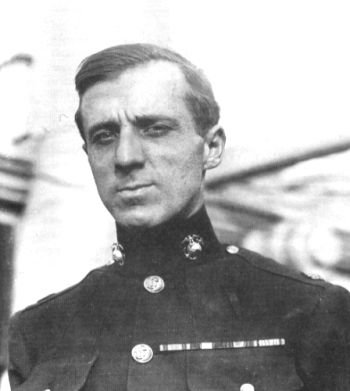
Two Medals of Honor - Marine Gen. Smedley Butler
|
Rhodes noted that:
"Two time Medal of Honor winner Marine General Smedley Butler once said "There are only two things we should fight for. One is the defense of our homes and the other is the Bill of Rights. Time to fight. "
Butler famously ended his career as a Marine General by touring the country with his speech and book denouncing war, "War is a Racket."Butler confessed that he had spent most of his life as a "high class muscle man for Big Business, for Wall Street and the bankers...a racketeer, a gangster for capitalism..."
Eighteen states at present have recall laws, most of which do not apply to federal officials. For these and other states to recall federal officials, state legislatures would have to first pass or amend such laws.
Rising on the House floor to oppose the bill based on the military detention provisions for Americans, Rep. Tom McClintock said before the House vote:
" today, we who have sworn fealty to that Constitution sit to consider a bill that affirms a power contained in no law and that has the full potential to crack the very foundation of American liberty."
Vermont Senator Bernie Sanders said in opposing the final NDAA:
”This bill also contains misguided provisions that in the name of fighting terrorism essentially authorize the indefinite imprisonment of American citizens without charges.”
And in a New York Times op-ed piece by two retired four-star U.S. Marine generals, Charles Krulak and Joseph Hoar, Krulak and Hoar said that "Due process would be a thing of the past."
Montana would be the first recall drive to be launched as a result of the vote for the NDAA military detentions provisions. A number of Facebook pages appeared after the passage of the bill from locations across the country.
References:
Facebook: "Recall Every Congressman Who Voted for the NDAA"
"Recalling Senators and Congressmen"
http://www.uscitizensassociation.com/...
http://www.uscitizensassociation.com/...
"How to Recall US Senators and Congressmen"
http://recallthetraitors.blogspot.com/...
http://recallthetraitors.blogspot.com/...
Special thanks to Daily Kos
Friday, December 30, 2011
Wednesday, December 14, 2011
'Occupy' Protests: Not Tahrir Yet
Demonstrations In The US and Europe Are Important, But Egyptian Style Revolution Is Still An Unlikely Prospect.
By Mark LeVine
Last Modified: 26 Oct 2011 11:17
Courtesy Of "Al-Jazeera"
'Hummus party!'
So texted Synthian Sharp, self-described 'tech dork', singer of the band Exit Ophelia, and General Assembly facilitator for the newly established "Occupy OC" (Orange County) encampment in Irvine, CA at around midnight on day four of the occupation.
I had sent an SMS to Synthian to see how he and the dozen or so die-hard comrades who are at the heart of the local occupation were holding up, given that the City of Irvine was preventing them from sleeping at their camp, forcing them literally to stay awake all night and move around the sidewalk in order to avoid being forced to leave or even arrested.
I was relieved to receive Synthian's upbeat SMS, considering he and his comrades were on their fourth night of sitting on old blankets and beach chairs at one of Irvine's busier intersections. Not quite the level of challenges faced by protesters in Tahrir, Bourgiba Street or The Pearl, to be sure. But it's as close to a revolution as Orange County has witnessed in generations, if ever.
Indeed, the "OC", whose level of wealth and conspicuous consumption made the subject of at least two television series in the past five years, isn't just one of the wealthiest counties in America. It's the Garden of Eden of the West Coast conservativism that swept across the US with the election of Richard Nixon as President in 1968, and has defined the country's political culture ever since.
A Suburban Occupation
It's not just the local political culture that makes Irvine a less than ideal place to stage an occupation. It's also geography and urban planning. Occupy OC is, as of now, the only non-urban "Occupy Wall Street"- inspired occupation in the United States.
And yet, the number of people who came for the first day's rally and march - by some counts well over 1,000 - set a record for an OWS opening, according to activists with the group.
As was to be expected, once the opening weekend turned into the ensuing work week, the number of people on site at any one time dwindled significantly, to as few as a dozen. Despite the fall-off, however, Irvine's leadership is none too keen on having protesters camped at City Hall. And so since day-one, the police have forced the entire encampment to be packed up and removed at 10:00 each night, only allowing it to be reconstructed at 6:00 the next morning.
The City of Irvine won't allow die-hard occupiers to sleep on the edge of the sidewalk, even though it wouldn't violate any municipal ordinances. So to ensure that the Occupy OC Encampment takes root, at least a dozen volunteers have to be willing to stay awake all night, while one particularly noble supporter arrives with his truck every evening at around 9:30 to break the "village" down, only to bring everything back eight hours later to be reconstructed by dead-tired occupiers.
After one week of doing so, the City apparently decided to ratchet up the pressure, so on the morning of the first week's anniversary, workers turned on the lawn sprinklers multiple times after the occupiers had reset the village, soaking computers and other media equipment used to give the public real-time updates of the situation at the village. Despite the damage, a good crowd had gathered by the time of the weekly march, with more families and children than had come any of the previous days.
The Death Of TINA
In the Arab world, protesters have faced down tanks, snipers, helicopters and camels to stake their claim to public space. Fortunately, OWS activists have not faced similar levels of violence. But they have faced down pepper spray, kettling, police commanders with unresolved authority issues towards women, and in Irvine, where well-manicured lawns are something of an obsession despite the naturally dry climate, angry sprinklers. Their ability to continue defying these attempts to repress and expel them will ensure the viability of the OWS movement.
 |
| Follow our continuing coverage |
Indeed, by holding their ground against the various attempts to force their encampments to disband, protesters are helping to chip away at the already frayed hegemony of the neoliberal ideology that has governed America for the last two generations. In so doing, they are offering the rest of the country the inspiration and example of change that President Obama promised to bring, but has so thoroughly failed to deliver upon.
One of the cornerstones of neoliberal ideology, as professed by Thatcher, Reagan and most every Western leader since them is that that "There Is No Alternative" to the neoliberal order; "TINA," as Thatcher used to say. This argument has long been repeated by Western client regimes in Cairo, Tunis, Amman and other Arab capitals, who have survived for decades precisely by convincing their Western patrons and a good share of their own citizens of the same thing.
But a decade after the World Social Forum movement announced that "another world is possible", TINA is finally being revealed to be a lie. The Arab spring gave proof to that, inspiring occupiers across the United States and Europe to imagine another future. In so doing, the OWS protests have helped their fellow citizens break through the wall of fear that has allowed the system to function so well for the last two generations.
Centre Of The Storm
The City of Irvine is one of the stranger towns in the United States. It has little of the feel of a normal urban space, even though its population is over 200,000 and it was recently chosen by CNN as the fourth best American city in which to live. It has been described as a "master planned utopia," but this description only holds true if you think that placeless grids and largely cookie cutter architecture constitute good planning and the best possible way for people to live together.
Irvine is in many ways a perfect avatar of the neoliberal system writ large against which the OWS movement is protesting. There is no city centre, no civic heart, no "old town" to give a nostalgic flavour of a time gone by, and little sense of civic identity. It is, in a word, placeless and without meaningful identity. Yet, once you live here, it's extremely hard to leave a microcosm of the proverbial Hotel California, for the neoliberal age.
And it's surrounded by even wealthier suburbs and some of California's most expensive beach front developments, whose cookie cutter McMansion's, expensive private schools and corporate restaurants create "la bella vita" for the management of many real estate, technology and financial services companies whose corporate headquarters occupy Irvine's self-styled "financial district".
Cities like New York or Los Angeles have long histories of social protest and significant working class and progressive populations. But Irvine's unique history and dynamics make it a far more important test case for the future of the OWS movement. If OWS can take root in here, there's a good chance it will become a powerful force in American politics, and perhaps even compete with the far better financed and far more partisan Tea Party movement.
But if the OWS can't take root in a Democratic city that's home to a major university, with its broadly liberal population of professors and tens of thousands of students directly affected by the disastrous policies of Wall Street, then there's not much chance it will penetrate deeply into far more conservative "middle America" and give the well-financed Tea Party, never mind corporate America, a run for their money.
A Few Good Omens
Despite the precipitous drop in attendance after the opening weekend, Occupy OC has already revealed some positive indicators about the broad appeal of the OWS movement. Much of it has to do with the ingeniously broad appeal ofthe movement's "We are the 99 per cent" slogan. After all, it quite literally includes 99 per cent of the population as potential allies, even in a wealthy town like Irvine.
When drivers of Mercedes, BMWs, Lexuses and even Porsches are slowing down to honk their horns in support of sign-waving protesters, as I've witnessed in three days of periodic sign-holding, it's clear something is changing in Orange County. Even members of the upper middle and wealthy classes are starting to come around to the notion that an economy driven by war and unaccountable financial services and banking sectors is unsustainable, not just for the working and middle classes, but for them as well.
And indeed, the protests here have brought not just progressives, hippies, and union members to the "village". Republicans, religious people and the very denizens of corporate America who should be opposed to any attempt to regulate corporate capitalism have also participated in the daily marches and rallies.
But most surprising are the numbers of long-term unemployed people, many with college and even professional degrees, that you meet at the village. It is downright frightening to meet so many people who look and act like they've just stepped out of a nice corner office in one of Irvine's semi-sky scrapers explain that they haven't had a steady job in several years and are literally at the end of their economic rope, with little hope for anyone to catch them when they completely drain whatever savings they have left.
Americans, in short, are starting to experience what citizens of Tunisia, Egyptians, and the developing world more broadly have had to live with for decades: a government of elites who are enriching themselves and their corporate friends at the expense of citizens. They are literally stealing the country blind, leaving only the shell of a country in the wake of their greed and duplicity, along with a military that has arrogated a huge share of the country's wealth to its domain and a prison system ready to house - for a profit - anyone who threatens the system.
The Rise Of Neoliberalism
To understand the significance of the dynamics surrounding Occupy OC and Occupy Wall Street more broadly, it's necessary first to understand precisely how remarkable and unlikely has been the neoliberal and neoconservative capture of the hearts and minds of middle America during the last three decades. From the New Deal era till through 1970s here, there was a broad social compact between government, labour and business that helped create and sustain the remarkable prosperity of the post-war era.
During this period, the main way that conservative elites - included so-called southern Democrats - won the loyalty of voters was through appeals to racial, ethnic, or religious solidarity. They couldn’t try to create the extremes of wealth and disparities that exist today because the social compact wouldn’t allow it.
The structure of America’s political economy, whose success was tied to maintaining a balance between the interests of business, workers and the state that mediated between them, helped ensure that the country's growing wealth was distributed evenly enough to enable the fabled "American dream" to become a reality.
|

The changes in the world political economy, as well as the computer, communications and transportation revolutions that heralded the age of contemporary globalisation, shifted the balance of power decidedly in the favour of corporations, who have literally bought off government and in so doing, been able to continuously weaken the power and earnings of workers.
Thus real wages have remained stagnant or declined despite the huge growth in America's GDPfor the last three decades (and even today, the regular increase in the number of people earning more than $1m per year), while pensions,healthcare and other benefits have all shrunk during this period. This as corporate profits and executive salaries have soared, producing theone per cent scenario against which the OWS movement is protesting.
A Brilliant Strategy
In order for neoliberalism to succeed, the economic elite had to pull off an incredible trick: to convince millions of Americans - first labelled, in the 1980s, as "Reagan Democrats" - actively support policies that clearly went against their economic interests. At the same time, the policies of conservative and economic elites were geared to expropriating more wealth than ever before, they had to convince the very people whose wealth they were siphoning off that they actually represented their most basic interests and values.
How did they do this? Through a brilliant two-fold strategy. First, they solidified a culture of materialism and hyperconsumption based on the ideology of 'Greed is Good', in which achieving wealth and power and looking out for number one - always resonant with American myth of rugged individualism and self-reliance - became defining markers of American identity and its increasingly bling-obsessed culture.
The corporate elites, from manufacturing to the culture industries, managed to convince most Americans that they both could and should hope to achieve the same wealth as possessed by the super rich. The problem was that the very structure of the neoliberal economy redistributes wealth away from most Americans and towards the top.
The gap between how Americans were being told they should live and how they could afford to live created a huge amount of cognitive dissonance that helped fuel the rise in consumer debt, as tens of millions of Americans used credit card and home equity to live more like the rich whom they were incessantly told they could and should try to be.
But people aren't that easily fooled; soon enough they would start to understand that the economy was shifting in a way that privileged the few at the expense of the rest of the country. How to keep the broad swath of "middle America" from rebelling against a system that was siphoning off a huge share of their wealth to enrich the top tier?
This is where the second half of the strategy comes into view. With one side of their mouths, elites told Americans that maximising wealth and power was the defining culture value in America, even as the neoliberal policies they imposed on the country made doing so increasingly difficult for the large majority of Americans. But out of the other side of their mouths, they told Americans that wealth didn't matter, that religious faith and conservative social values such as being anti-gay and anti-abortion, and patriotism and support for the military, were what defined "real" Americans.
It was this argument that allowed the wealthy in this country to eat their cake and still have it; to foster one ideology that justified the increasing skewing of wealth towards the proverbial "1 per cent" (in reality, it's more like 12 or 13 per cent, but slogans work precisely by intensifying reality for political effect), while at the same time deploying another ideology that said both that wealth didn't matter and that the very people who could help bring the majority of working Americans a better standard of living-the government, unions and other progressive forces-were the greatest danger to the "American way of life."
| Occupy Wall Street activists remain defiant |
Now, however, it appears that people are finally waking up; most important, they are doing so from the grassroots upwards, not from the top down as happened with Obama or the corporate-run Tea Party. If the OWS movement can peel more of the top 10 per cent of population away from the top one per cent, help them understand that their lives and their children's futures will be served better by throwing their lot in with the bottom 90 per cent than the top one per cent, the entire edifice of neoliberalism, which was always a house of cards, could well begin to collapse.
At least in Irvine during Occupy OC's first week, the odds don't seem too bad.
Becoming Egyptians
The rise of a grassroots level of intelligence that is much harder for corporations and politicians to manipulate is a signature achievement of the OWS movement and mirrors the dynamics that produced the Arab Spring. Indeed, Americans are starting to act like their counterparts in the Arab world, finally standing up for themselves because, essentially, no one in power will do so for them. The Irvine civic centre is not yet Tahrir, but sitting on the sidewalk sometime past midnight on day four, eating hummus and pita, strumming a guitar and talking politics with fellow occupiers, there was at least a hint of the tremendous feeling of empowerment and solidarity felt in Tahrir during those heady last 10 days of the February intifada.
With children leading chants during the day, young people at the helm of the organising efforts, older protesters ("fogies" as they're affectionately referred to) bringing experience and patience to the proceedings, and increasing numbers of people with literally nothing else to do with their time realising this is the place to be, Irvine might just be ground zero in the war between the one per cent and the rest of America.
As we watch the American government continue to intervene politically, diplomatically and militarily to prop up or tear down regimes based on their allegiance to the larger neoliberal system, it's clear that in the same way that events in the Arab world have profoundly influenced the emerging protest movement in the US, the outcome of the OWS movement will strongly influence the balance of power in the Arab world as well.
Today, perhaps more than ever before, we really are living in a global village.
Mark LeVine is a professor of history at UC Irvine and senior visiting researcher at the Centre for Middle Eastern Studies at Lund University in Sweden. His most recent books are Heavy Metal Islam (Random House) and Impossible Peace: Israel/Palestine Since 1989 (Zed Books).
Tuesday, December 13, 2011
Americans Get A Shabak Education

Police have beaten non-violent protestors, veterans and even seniors in order to 'gain compliance' [GALLO/GETTY]
The World Enters A New Phase Where The Students Are Slowly Becoming The Teachers, Forcing Bloody Change Says Author.
Submitted By "Sayf Maslul"
By Mark LeVine
Last Modified: 23 Nov 2011 08:35
Courtesy Of "Al-Jazeera"
Irvine, CA - It was a term that has stuck with me since a Palestinian friend in the Ajami neighbourhood of Jaffa first used it in response to one of my more naive questions. "Why don't you all do to protest against the on-going expropriation of land and discrimination against local residents by the Israeli government," I asked him on a typically sunny summer day, as we stood in front of yet another luxury housing development being constructed on formerly Palestinian land.
"Because we've all received a good Shabak education," he answered.
The education in question, was dispensed by the Shabak, or Shin Bet, Israel's state security services, to keep the country's Palestinian population from protesting too vigorously against the policies that have kept them second class citizens despite the official political equality granted to them by the Israeli state.
A Shabak education wasn't quite a mukhabarat education - the much more violent repression meted out to citizens of authoritarian Arab countries like Egypt, or to Palestinians in the Occupied Territories by Israel, and as tragic, by the PA and Hamas as well. But it was enough to keep Israel's Palestinian community in line, most of the time, and was part of a continuum of measures that could always be ramped up to include more intense violence if the state felt threatened by the Palestinian minority (as happened most famously at the outset of the al-Aqsa intifada in 2000).
As long as the violence was within "acceptable" limits, and limited to Palestinians, the Shabak educational system didn't disturb the seemingly democratic character of Israel more broadly. But the problem was that the violence visited upon Palestinian citizens in Israel was deeply related to the violence of the Occupation, and ultimately both began to leak into Israeli society.
In recent years, increasing numbers of Israeli Jews have begun receiving a Shabak education, especially as more and more actively join the struggle for Palestinian rights on both sides of the Green Line. They are tear-gassed, doused with "stinky water", arrested, shot with rubber bullets, and worse. At the political level, the government has sought to delegitimise and even outlaw various means of advocacy by progressive Israelis that used to be protected as evidence of Israel's liberal and democratic credentials.
Not surprisingly, this dynamic is evolving as Israel deepens its entrenchment within the West Bank, a process that is inextricably linked to the growing power of ultra-religious Jews, not merely in the political system, but within the country's military system. The situation has lead even mainstream Israelis to declare that the democratic basis of the Israeli state is under threat as never before - not from Palestinians, but from how Jews are treating each other.
Inevitable Blowback
This is the blowback of the Occupation, something even the "father" of Israel, David Ben Gurion, realised would be the likely outcome of a renewed settlement enterprise after 1967. You simply cannot visit so much violence routinely on other people, and devote so much of the resources of your government to enforcing a regime of violence, and not wind up having the very people the violence was meant to protect become the objects of that violence.
In the wake of September 11, many commentators pointed out that the US finally understood what it felt like to be Israeli. "We're all Israelis now", or so the saying went. What most people didn't consider as the country geared up for what has become by far its longest and most costly war, was that the violence Americans were prepared to unleash against Muslims around the world, and particularly in Iraq and Afghanistan, would sooner or later inevitably return home.
Not in the form of terrorism, which was and remains a very possibility. But more dangerous to the political health of the country, in the form of a state that at all levels is increasingly willing to use violence to quash dissent among its own citizens. You simply cannot spend trillions of dollars invading, occupying, killing and otherwise oppressing - or setting up or supporting governments that oppress on your behalf - other people and not have that violence seep into the internal mechanisms that govern how a society functions.
The first evidence of this trend occurred in the 1960s and 1970s, when the military and counter insurgency weapons, tactics and philosophies developed for Vietnam began to be deployed at home - both in domestic spying as part of the COINTELPRO programmes and through the creation of militarised police units such as SWAT teams, usually staffed by military veterans.
However dangerous to the overall health of American democracy, spying on activists and using military tactics in the ghetto didn't touch the majority of white Americans. The violence directed by the state was able to remain largely hidden from view through the rapid expansion of a prison industrial complex that locks up millions of mostly minority and poor Americans, increasingly for profit, the majority of them for non-violent offences.
The incarceration of African Americans at six times the level of the white fellow citizens has never caused a huge outcry among the majority of (white) Americans. Even the country's first black President has done nothing to address this gross and systematic ongoing racism.
But now, with an economic downturn that is forcing tens of millions of white Americans to understand the economic insecurities with which African Americans and Latinos have long had to live, with privatisation encroaching on every aspect of public life, from schools to prisons, and with an increasingly militarised police culture whose members are literally trained to see people as obstacles to be overcome rather than citizens to be served and protected, the landscape has been prepared for the spread of a Shabak education to the general populace.
All that was needed was the right spark to set more and more citizens into the streets to protest the fundamental order of the neoliberal/conservative system, and the lesson would begin. Occupy Wall Street provided that spark, and in the last two months the increasing number of viral videos of police across the country, on streets and on campuses, beating, pepper spraying, tear-gassing and otherwise assaulting peaceful citizens engaged in the once respected rights of non-violent political speech have shown the country what a Shabak education looks like.
Ugly Scenes With Increasing Regularity
It's not pretty. Eighty-four-year-old grandmothers and rows of college students sprayed with mace from containers, the size of small fire extinguishers by police officers, acting so nonchalantly you might think it was a drill if you didn't hear the screams. Combat veterans shot and beaten to the point of rupturing their internal organs.
Pregnant women tear-gassed, students and faculty assaulted and having guns pointed at them. Police officers talking matter-of-factly, of beating non-violent protesters with batons in order to "gain compliance" with orders to disperse. Mayors of global cities ordering raids that destroy thousands of books, tents and other equipment while hundreds of thousands of homeless sleep without shelter.
And this list doesn't include draconian anti-terror laws such as the Patriot Act, FBI trolling of mosques, infiltration of peace and environmental and animal rights groups and the use of anti-terror laws against them, and the criminalisation of dissent on university campuses. America is slowly descending into the state of emergency under which Egyptians and Palestinians have long lived. We may not have gotten all the way there yet, but like slowly boiling a frog, by the time most Americans figures it out, it will be too late.
This morning, as I chatted on Facebook with Egyptian friends dodging tear gas and bullets in Tahrir, I was receiving a stream of emails describing how students at the University of California Davis, and other campuses, have been pepper-sprayed and otherwise assaulted by campus police. On my own campus, UC Irvine, it turns out that police held SWAT like trainings to prepare to deal with potential student protests over massive tuition hikes being imposed this year.
Whether in Egypt or the United States, the ultimate dynamic is the same. Rather than address fundamental demands of citizens for basic rights, equality and democracy, those in power would rather attack them by whatever means they believe they can get away with. Citizens are not to be served by government, but rather to be shoved aside in order to ensure the system's continued unfettered operation.
Amy Newhall, the Executive Director of the Middle East Studies Association, put it best, explaining that:
"Apparently the students have been inspired by the Arab Spring. I guess the police were inspired by the Syrian nightmare".
Synergy From Below
There is no need to compare campus police in California, or American police more broadly, with the far more brutal Egyptian police and security services. Americans aren't being crushed by APCs and shot by snipers. This is still a Shabak rather than mukhabarat education that Americans are receiving (of course the Iraqis, Afghans and others who are on the wrong end of the US military or CIA are getting much harsher lesson in American values).
But the distance travelled by American democracy to reach this point is far greater than the distance travelled by violent authoritarian regimes attacking their citizens with deadly violence. And when you consider the strong links between the US and Egyptian governments - and of course Israel as well - the larger pattern is clear.
But so are the similarities in the way protesters, whether in Egypt the US or even Israel are responding to the increased level of repression and marginalisation by their governments. OWS protests are witnessing a progressives and Republicans coming together in ways that haven't been seen in decades, as the clear failure of the country's political system is opening spaces for conversations and even solidarities that were very difficult to imagine before. Similarly, in Egypt, secular and religious forces, which have been at odds since Mubarak's ouster last February, are once again fighting on the same side on the streets of Cairo, Alexandria and Suez.
In Israel, despite the attempt to marginalise Palestinian voices and concerns in the "tent movement" this past summer the reality is that Palestinian and Israeli civil society activists began talking and acting together in ways that will profoundly reshape Israeli internal politics in the coming years. Moreover, for the first time, Israelis are taking their cues from Arab societies whom they've long been taught to consider less modern than and fundamentally hostile to them.
At the same time, Palestinians across the Green Line are beginning "Freedom Rides" into Israel to force Israelis to confront the essential Apartheid nature of their rule in the Occupied Territories.
The thing about Shabak or mukhabarat educations is that they can't be sustained indefinitely. At some point, the people graduate, the students become the teachers, and the ruling elites are forced to learn the lesson that if removed, even the veneer of civility from the mechanisms of rule, and leave people feeling utterly betrayed by their government and with little to lose, they will lose their fear and you will lose your grip on power.
It's a long and bloody struggle, but it's clearly entered a new phase, not just in the US, Egypt or Israel/Palestine, but across the Middle East and the world.
A musician friend of mine in Cairo put it this way on his Facebook page after Saturday's violence: "25 January was the demo, now comes the album release". To put it in slightly more scholastic terms, it's a new year and class is now back in session. And if governments from Washington to Cairo, Tel Aviv or Damascus don't pay attention, they and their systems are going to fail out of school, and pass into the dustbin of history.
Mark LeVine is a professor of history at UC Irvine and senior Distinguished Visiting Professor at the Centre for Middle Eastern Studies at Lund University in Sweden. He is the author of Heavy Metal Islam: Rock, Resistance, and the Struggle for the Soul of Islam (Random House, 2008), Impossible Peace: Israel/Palestine Since 1989 (Zed Book, 2009) and co-editor, with Gershon Shafir, of Struggle and Survival in Palestine/Israel (University of California Press, forthcoming).
Follow Mark LeVine on Twitter @culturejamming
Subscribe to:
Posts (Atom)
