Showing posts with label PIPA. Show all posts

Tuesday, October 16, 2012

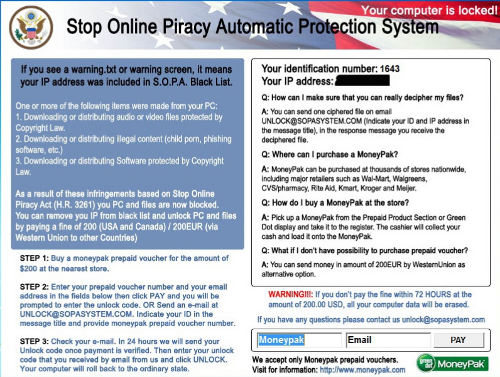
SOPA Is Back! … As A Ransomware Virus

sopa marware

SOPA Ransomware


After historic Internet protests in January the SOPA anti-piracy bill was defeated. However, several reports have pointed to a rather unfortunate SOPA comeback. Not in Congress, but as a nasty cryptovirus that locks up people’s computers and accuses them of distributing copyright infringing files. Infected users can get their data back after a payment of $200 – at least, that’s what the virus makers promise.

This week ‘the bill’ was resurrected by a virus maker, who has been warning users of infected computers that their IP-address is on a blacklist after it was discovered distributing illegal content.


As a result, the SOPA virus holds all files on the host computer ransom.
“Your computer is locked!” the splash screen above warns, adding:
If you see a warning.txt or warning screen, it means your IP address was included in S.O.P.A. Black List. One or more of the following items were made from your PC:
1. Downloading or distributing audio or video files protected by Copyright Law.
2. Downloading or distributing illegal content (child porn, phishing software, etc.)
3. Downloading or distributing Software protected by Copyright Law.
As a result of these infringements based on Stop Online Piracy Act (H.R. 3261) your PC and files are now blocked.
The SOPA virus is so-called ransomware, meaning that it holds computers hostage and only promises to free data after victims hand over cash. In the U.S. and Canada people are instructed to pay with a MoneyPak prepaid voucher, and in other parts of the world they can use Western Union.
Those who don’t pay within three days are in trouble, the virus maker warns.
“WARNING!!!: If you don’t pay the fine within 72 HOURS at the amount of 200 USD, all your computer data will be erased.”
People who are affected should of course ignore all the above. Searching online for “Stop Online Piracy Automatic Protection System Removal”” is a better option, there are plenty of ways to defeat the resurrected SOPA and get your data back.


Tuesday, June 05, 2012

The FBI's Secretive Net-Surveillance Unit


CNET has learned that the FBI has formed a Domestic Communications Assistance Center, which is tasked with developing new electronic surveillance technologies, including intercepting Internet, wireless, and VoIP communications.

By Declan McCullagh
May 22, 2012 11:44 PM PDT
Courtesy Of "C|net"


The FBI has recently formed a secretive surveillance unit with an ambitious goal: to invent technology that will let police more readily eavesdrop on Internet and wireless communications.
The establishment of the Quantico, Va.-based unit, which is also staffed by agents from the U.S. Marshals Service and the Drug Enforcement Agency, is a response to technological developments that FBI officials believe outpace law enforcement's ability to listen in on private communications.
While the FBI has been tight-lipped about the creation of its Domestic Communications Assistance Center, or DCAC -- it declined to respond to requests made two days ago about who's running it, for instance -- CNET has pieced together information about its operations through interviews and a review of internal government documents.
DCAC's mandate is broad, covering everything from trying to intercept and decode Skype conversations to building custom wiretap hardware or analyzing the gigabytes of data that a wireless provider or social network might turn over in response to a court order. It's also designed to serve as a kind of surveillance help desk for state, local, and other federal police.
The center represents the technological component of the bureau's "Going Dark" Internet wiretapping push, which was allocated $54 million by a Senate committee last month. The legal component is no less important: as CNET reported on May 4, the FBI wants Internet companies not to oppose a proposed law that would require social-networks and providers of VoIP, instant messaging, and Web e-mail to build in backdoors for government surveillance.
During an appearance last year on Capitol Hill, then-FBI general counsel Valerie Caproni referredin passing, without elaboration, to "individually tailored" surveillance solutions and "very sophisticated criminals." Caproni said that new laws targeting social networks and voice over Internet Protocol conversations were required because "individually tailored solutions have to be the exception and not the rule."
Caproni was referring to the DCAC's charge of creating customized surveillance technologies aimed at a specific individual or company, according to a person familiar with the FBI's efforts in this area.
An FBI job announcement for the DCAC that had an application deadline of May 2 provides additional details. It asks applicants to list their experience with "electronic surveillance standards" including PacketCable (used in cable modems); QChat (used in push-to-talk mobile phones); and T1.678 (VoIP communications). One required skill for the position, which pays up to $136,771 a year, is evaluating "electronic surveillance solutions" for "emerging" technologies.
"We would expect that capabilities like CIPAV would be an example" of what the DCAC will create, says Steve Bock, president of Colorado-based Subsentio, referring to the FBI'sremotely-installed spyware that it has used to identify extortionists, database-deleting hackers, child molesters, and hitmen.
Bock, whose company helps companies comply with the 1994 Communications Assistance for Law Enforcement Act (CALEA) and has consulted for the Justice Department, says he anticipates "that Internet and wireless will be two key focus areas" for the DCAC. VoIP will be a third, he says.
For its part, the FBI responded to queries this week with a statement about the center, which it also refers to as the National Domestic Communications Assistance Center (even Caproni has used both names interchangeably), saying:
 The NDCAC will have the functionality to leverage the research and development efforts of federal, state, and local law enforcement with respect to electronic surveillance capabilities and facilitate the sharing of technology among law enforcement agencies. Technical personnel from other federal, state, and local law enforcement agencies will be able to obtain advice and guidance if they have difficulty in attempting to implement lawful electronic surveillance court orders.
It is important to point out that the NDCAC will not be responsible for the actual execution of any electronic surveillance court orders and will not have any direct operational or investigative role in investigations. It will provide the technical knowledge and referrals in response to law enforcement's requests for technical assistance.
Here's the full text of the FBI's statement in a Google+ post.
One person familiar with the FBI's procedures told CNET that the DCAC is in the process of being launched but is not yet operational. A public Justice Department document, however, refers to the DCAC as "recently established."
"They're Doing The Best They Can To Avoid Being Transparent"
The FBI has disclosed little information about the DCAC, and what has been previously made public about the center was primarily through budget requests sent to congressional committees. The DCAC doesn't even have a Web page.
"The big question for me is why there isn't more transparency about what's going on?" asksJennifer Lynch, a staff attorney at the Electronic Frontier Foundation, a civil liberties group in San Francisco. "We should know more about the program and what the FBI is doing. Which carriers they're working with -- which carriers they're having problems with. They're doing the best they can to avoid being transparent."
The DCAC concept dates back at least four years. FBI director Robert Mueller was briefed on it in early 2008, internal FBI documents show. In January 2008, Charles Smith, a supervisory special agent and section chief in the FBI's Operational Technology Division, sent e-mail to other division officials asking for proposals for the DCAC's budget.
When it comes to developing new surveillance technologies, Quantico is the U.S. government's equivalent of a Silicon Valley incubator. In addition to housing the FBI's Operational Technological Division, which boasts of developing the "latest and greatest investigative technologies to catch terrorists and criminals" and took the lead in creating the DCAC, it's also home to the FBI's Engineering Research Facility, the DEA's Office of Investigative Technology, and the U.S. Marshals' Technical Operations Group. In 2008, Wired.com reported that the FBI has "direct, high-speed access to a major wireless carrier's systems" through a high-speed DS-3 link to Quantico.
The Senate appropriations committee said in a report last month that, for electronic surveillance capabilities, it authorizes "$54,178,000, which is equal to both the request and the fiscal year 2012 enacted level. These funds will support the Domestic Communications Assistance Center, providing for increased coordination regarding lawful electronic surveillance amongst the law enforcement community and with the communications industry." (It's unclear whether all of those funds will go to the DCAC.)
In trying to convince Congress to spend taxpayers' dollars on the DCAC, the FBI has received help from local law enforcement agencies that like the idea of electronic surveillance aid. A Justice Department funding request for the 2013 fiscal year predicts DCAC will "facilitate the sharing of solutions and know-how among federal, state, and local law enforcement agencies" and will be welcomed by telecommunications companies who "prefer to standardize and centralize electronic surveillance."
A 2010 resolution from the International Association of Chiefs of Police -- a reliable FBI ally on these topics -- requests that "Congress and the White House support the National Domestic Communications Assistance Center Business Plan."
The FBI has also had help from the Drug Enforcement Administration, which last year requested $1.5 million to fund eight additional DCAC positions. DEA administrator Michele Leonhart has said (PDF) the funds will go to "develop these new electronic surveillance capabilities." The DEA did not respond to CNET's request for comment.
An intriguing hint of where the DCAC might collaborate with the National Security Agency appeared in author James Bamford's article in the April issue of Wired magazine. Bamford said, citing an unidentified senior NSA official, that the agency has "made an enormous breakthrough several years ago in its ability to cryptanalyze, or break, unfathomably complex encryption systems" -- an obstacle that law enforcement has encountered in investigations.
Eventually, the FBI may be forced to lift the cloak of secrecy that has surrounded the DCAC's creation. On May 2, a House of Representatives committee directed the bureau to disclose "participation by other agencies and the accomplishments of the center to date" three months after the legislation is enacted.

Wednesday, April 25, 2012

CISPA Is The New SOPA


By Rep. Ron Paul,
April 24, 2012
Courtesy f "Anti-War"


Earlier this year, strong public opposition led by several prominent websites forced congressional leaders to cancel votes on two bills known in Washington as SOPA andPIPA. Both of these bills threatened search engines and websites with possible shutdowns if the Justice Department deemed them insufficiently cooperative with our phony “war on terror,” or if they were merely accused of copyright infringement. Fortunately, the American public flooded Capitol Hill with phone calls and congressional leaders dropped both bills.
But we should never underestimate the federal government’s insatiable desire to control the Internet. Statists of all parties, persuasions, and nationalities hate the free, unbridled flow of information, ideas, and goods via the Internet. They resent the notion that ordinary people can communicate and trade across the world without government filters or approvals. So they continually seek to impose controls, always under the guise of fighting terrorism or protecting “intellectual property” rights.
The latest assault on Internet freedom is the Cyber Intelligence Sharing and Protection Act, or CISPA, which may be considered by Congress this week. CISPA is essentially an Internet monitoring bill that permits both the federal government and private companies to view your private online communications with no judicial oversight — provided, of course, that they do so in the name of “cybersecurity.” The bill is very broadly written and allows the Department of Homeland Security to obtain large swaths of personal information contained in your emails or other online communication. It also allows emails and private information found online to be used for purposes far beyond any reasonable definition of fighting cyberterrorism.
CISPA represents an alarming form of corporatism, as it further intertwines government with companies like Google and Facebook. It permits them to hand over your private communications to government officials without a warrant, circumventing well-established federal laws like the Wiretap Act and the Electronic Communications Privacy Act. It also grants them broad immunity from lawsuits for doing so, leaving you without recourse for invasions of privacy. Simply put, CISPA encourages some of our most successful Internet companies to act as government spies, sowing distrust of social media and chilling communication in one segment of the world economy where America still leads.
Proponents of CISPA may be well-intentioned, but they unquestionably are leading us toward a national-security state rather than a free constitutional republic. Imagine having government-approved employees embedded at Facebook, complete with federal security clearances, serving as conduits for secret information about their American customers. If you believe in privacy and free markets, you should be deeply concerned about the proposed marriage of government intelligence gathering with private, profit-seeking companies. CISPA is Big Brother writ large, putting the resources of private industry to work for the nefarious purpose of spying on the American people.We can only hope the public responds to CISPA as it did to SOPA back in January. I urge you to learn more about the bill by reading a synopsis provided by the Electronic Frontier Foundation. I also urge you to call your federal senators and representatives and urge them to oppose CISPA and similar bills that attack Internet freedom.

Monday, February 13, 2012

How To Deal With The Police

Posted by Guest Blogger "Sayf Maslul" 

 Part-1


Consists of a law professor giving his take on the issue.


 Part-2


Officer George Bruch of the Virginia Beach Police Dept, who is also attending law school, tells you how to interact with cops.

Don't Fall Prey To Tricks, Remain Silent and Ask For A Lawyer.


Sunday, February 12, 2012

30,000 Domestic Drones To Fill Our Skies


FAA Act Would Raise 'Very Serious Privacy Issues' 

By Common Dreams Staff 
Published on Thursday, February 9, 2012 
Courtesy Of "Common Dreams"

A bill has passed in the House and Senate this week that would allow the presence of drones in U.S. civilian airspace. The Federal Aviation Administration (FAA) Reauthorization Act requires the FAA to alleviate many current rules on domestic drone authorization. Drones would now be able to fly in the same airspace as commercial airliners, private planes, and cargo jets. Up to 30,000 drones could be allowed in U.S. airspace by the end of the decade.

The Senate passed the bill on Monday, 75-20 and allots $63.4 billion to the FAA. President Obama is expected to sign it into law.
ACLU, among other civil liberties groups, is expressing grave concern for civilian privacy, as the legislation does not restrict drone surveillance activities by police and federal government agencies.
* * *
ACLU states:
As we explained in our recent report, drone technology is advancing by leaps and bounds, and there is a lot of pent-up demand for them within the law enforcement community. But, domestic deployment of unmanned aircraft for surveillance purposes has largely been blocked so far by the Federal Aviation Administration (FAA), which is rightly concerned about the safety effects of filling our skies with flying robots (which crash significantly more often than manned aircraft).[...]
Unfortunately, nothing in the bill would address the very serious privacy issues raised by drone aircraft. This bill would push the nation willy-nilly toward an era of aerial surveillance without any steps to protect the traditional privacy that Americans have always enjoyed and expected.[...]
We don’t want to wonder, every time we step out our front door, whether some eye in the sky is watching our every move. [...]
Here are details on what the bill would do in terms of drones:
  • Require the FAA to simplify and speed up the process by which it issues permission to government agencies to operate drones. It must do this within 90 days. The FAA has already been working on a set of proposed regulations to loosen the rules around drones, reportedly set for release in the spring of 2012.
  • Require the FAA to allow “a government public safety agency” to operate any drone weighing 4.4 pounds or less as long as certain conditions are met (within line of sight, during the day, below 400 feet in altitude, and only in safe categories of airspace).Nano Hummingbird Surveillance Drone
  • Require the FAA to establish a pilot project within six months to create six test zones for integrating drones “into the national airspace system.”
  • Require the FAA to create a comprehensive plan “to safely accelerate the integration of civil unmanned aircraft systems into the national airspace system.” “Civil” drones means those operated by the private sector; currently it is all but impossible for any non-government entity, except for hobbyists, to get permission to fly drones (for-profit use of drones is banned). Industry groups and their congressional supporters see this as a potential area for growth. Congress specifies that the plan must provide for the integration of drones into the national airspace system “as soon as practicable, but not later than September 30, 2015.” The FAA has nine months to create the plan. The FAA is also required to create a “5-year roadmap for the introduction” of civil drones into the national airspace.
Unfortunately, nothing in the bill would address the very serious privacy issues raised by drone aircraft. This bill would push the nation willy-nilly toward an era of aerial surveillance without any steps to protect the traditional privacy that Americans have always enjoyed and expected.
  • Require the FAA to publish a final rule within 18 months after the comprehensive plan is submitted, “that will allow” civil operation of small (under 55 pounds) drones in the national airspace, and a proposed rule for carrying out the comprehensive plan.
* * *
TPM reports:
The federal government is also facing alawsuit from the Electronic Frontier Foundation, a watchdog group that is asking for the FAA to release records on the almost-300 agencies that have authorization to operate drones domestically. Jennifer Lynch, an attorney with the EFF who brought the case, told TPM that this bill makes their suit even more important. “I think the fact that Congress is pressuring the FAA to expand its UAS program through the FAA Reauthorization Act only reinforces the need for these records,” Lynch said. “It’s important that we learn more about how the federal government and state and local law enforcement agencies are already using UASs before we expand their use further. The privacy concerns posed by the use of drones for domestic surveillance are too great to excuse the FAA’s lack of transparency on this issue.”
* * *
New York Times provides the following video documenting recent drone 'hummingbird' surveillance technology:

Saturday, February 11, 2012

The Copyright Industry: A Century Of Deceit

Businessman crossing fingers behind back

By RICK FALKVINGE 
Courtesy Of "Falkvinge"

It is said that those who don’t study history are doomed to repeat it. In the case of the copyright industry, they have learned that they can get new monopoly benefits and rent-seeker’s benefits every time there is a new technology, if they just complain loudly enough to the legislators.
The past 100 years have seen a vast array of technical advances in broadcasting, multiplication and transmissions of culture, but equally much misguided legislators who sought to preserve the old at expense of the new, just because the old was complaining. First, let’s take a look at what the copyright industry tried to ban and outlaw, or at least receive taxpayer money in compensation for its existence:
It started around 1905, when the self-playing piano was becoming popular. Sellers of note sheet music proclaimed that this would be the end of artistry if they couldn’t make a living off of middlemen between composers and the public, so they called for a ban on the player piano. A famous letter in 1906 claims that both the gramophone and the self-playing piano will be the end of artistry, and indeed, the end of a vivid, songful humanity. People called for its ban, too.
In the 1920s, as broadcast radio started appearing, another copyright industry was demanding its ban because it cut into profits. Record sales fell from $75 million in 1929 to $5 million four years later – a recession many times greater than the record industry’s current troubles. (Speaking of recession, the drop in profits happened to coincide with the Great Depression.) The copyright industry sued radio stations, and collecting societies started collecting part of the station profits under a blanket “licensing” scheme. Laws were proposed that would immunize the new radio medium from the copyright industry, but they did not pass.
In the 1930s, silent movies were phased out by movies with audio tracks. Every theater had previously employed an orchestra that played music to accompany the silent movies, and now, these were out of a job. It is quite conceivable that this is the single worst technology development for professional performers. Their unions demanded guaranteed income for these performers in varying propositions.
In the 1940s, the movie industry complained that the television would be the death of movies, as movie industry profits dropped from $120 million to $31 million in five years. Famous quote: “Why pay to go see a movie when you can see it at home for free?”
In the 1950s, the movie industry complained loudly about cable television, and this time complained how unfair it was that their free content was unable to compete with paid!
In 1972, the copyright industry tried to ban the photocopier. This push was from book publishers and magazine publishers alike. “The day may not be far off when no one need purchase books.”
The 1970s saw the advent of the cassette tape, which is when the copyright industry really went all-out in proclaiming their entitlement. Ads saying “Home taping is killing music!” wereeverywhere. The band Dead Kennedys famously responded by subtly changing the message in adding “…industry profits”, and “We left this side [of their tape] blank, so you can help.”
The 1970s also saw another significant shift, where DJs and loudspeakers started taking the place of live dance music. Unions and the copyright industry went ballistic over this, andsuggested a “disco fee” that would be charged at locations playing disco (recorded) music, to be collected by private organizations under governmental mandate and redistributed to live bands. This produces hearty laughter today, but that laughter stops sharp with the realization that the disco fee was actually introduced, and still exists.
The 1980s is a special chapter with the advent of video cassette recorders. The copyright industry’s famous quote when testifying before the US Congress – where the film lobby’s highest representative Jack Valenti said that “The VCR is to the American film producer and the American public as the Boston strangler is to the woman home alone” – is the stuff of legend today. Still, it bears reminding that the so-called Betamax case went all the way to the Supreme Court, and that the VCR was as near as could be from being killed by the copyright industry: The Betamax team won the case by 5-4 in votes.
Also in the late 1980s, we saw the complete flop of the Digital Audio Tape (DAT). A lot of this can be ascribed to the fact that the copyright industry had been allowed to put its politics into the design: the cassette, although technically superior to the analog Compact Cassette, was so deliberately unusable for copying music that people rejected it flat outright. This is an example of a technology that the copyright industry succeeded in killing, even though I doubt it was intentional: they just got their wishes as to how it should work to not disrupt the status quo.
In 1994, Fraunhofer Institute published a prototype implementation of its digital coding technique that would revolutionize digital audio. It allowed CD-quality audio to take one-tenth of the disk space, which was very valuable in this time, when a typical hard drive would be just a couple of gigabytes. Technically known as MPEG-1 Audio Layer III, it was quickly shortened to “MP3” in everyday speak. The copyright industry screamed again, calling it a technology that only can be used for criminal activity. The first successful MP3 player, the Diamond Rio, saw the light in 1998. It had 32 megabytes of memory. Despite good sales, the copyright industry sued its maker, Diamond Multimedia, into oblivion: while the lawsuit was struck down, the company did not recover from the burden of defending. The monopoly middlemen tried aggressively to have MP3 players banned, but lost.
The century ended with the copyright middlemen pushing through a new law in the United States called the Digital Millennium Copyright Act, which would have killed the Internet and social media by introducing intermediary liability – essentially killing social technologies in their cradle. Only with much effort did the technology industry manage to stave off disaster by introducing so-called “safe harbors” that immunizes the technical companies from liability on the condition that they throw the free speech of the end-users to the wolves on request. The internet and social media survived the copyright industry’s onslaught by a very narrow escape that still left it significantly harmed and slowed.
Right after the turn of the century, the use of Digital Video Recorders was called “stealing” as it allowed for skipping of commercials (as if nobody did that before).
In 2003, the copyright industry tried to have its say in the design of HDTV with a so-called “broadcast flag” that would make it illegal to manufacture devices that could copy movies so flagged. In the USA, the FCC miraculously granted this request, but was struck down in bolts of lightning by courts who said they had way overstepped their mandate.
Finally, in 2006, the broadcasting industry sued (and lost against) the cloud-based DVR, trying to ban it, as with everything else.
What we have here is a century of deceit, and a century revealing the internal culture inherent in the copyright industry. Every time something new appears, the copyright industry has learned to cry and throw tantrums like a spoiled brat, and succeeds practically every time to get legislators to channel taxpayer money their way or restrict competing industries. And every time the copyright industry succeeds in doing so, this behavior is further reinforced.
It is far past due that the copyright industry is stripped of its nobility benefits, every part of its governmental weekly allowance, and gets kicked out of its comfy chair to get a damn job and learn to compete on a free and honest market.

ABOUT THE AUTHOR: RICK FALKVINGE

Rick is the founder of the first Pirate Party and is a political evangelist, traveling around Europe and the world to talk and write about ideas of a sensible information policy. He has a tech entrepreneur background.