This is the point from which I could never return,
And if I back down now then forever I burn.
This is the point from which I could never retreat,
Cause If I turn back now there can never be peace.
This is the point from which I will die and succeed,
Living the struggle, I know I'm alive when I bleed.
From now on it can never be the same as before,
Cause the place I'm from doesn't exist anymore
[Immortal Technique]
"Terrorist"
"Terrorist"
Just a Word...
'Terrorist' is just a word, one I wish I'd never heard...
When it's used to vilify, without the need to question why...
Only fools would swift condemn, that which has not befallen them...
Until you know what lies behind, the actions of a tortured mind...
Thank your God for sparing you, the suffering others have lived through...
Where are the cries of just demand, for Arabs driven from their land?...
Blame the victim, turn the cheek, praise the bully, kick the weak!...
Mock the man who truth does speak...
Tinker, tailor, soldier, spy, greed, corruption, torture, lies!...
Blair invasion, sly persuasion, annihilation, massacred nation...
Keep on running, karma's coming!...
Money talks, truth walks, oil spills, greed kills...
Tide is turning, London's burning!...
Bombs will fall and blood will flow, as sure as my own name I know...
Until corrupt dictators go, brutal, rotten, to the core...
Their day has come, they rule no more...
Show me the man who will not fight, to save his child, his home, his right!...
You can call him what you like, you're not in his sorry plight...
Cowards stay and Martyrs go, I know not where, but this I know...
Speak your truth and stand your ground, fight your corner...
When all around, point the finger, purse the lips, pin the label, 'Terrorist'!...
Just a word, but one that sticks, even when the cap don't fit...
But for the grace of God go I, remember that, before you cry...
False accusation, names of shame, at those who may not be to blame,...
Their crime, refused to play the game, of meek acceptance, dumbing down,...
Your life, your choice; Warrior / Clown...
President Barack Obama speaks during a 'Lawyers for Obama Luncheon' fundraiser, Friday, March, 16, 2012, at the Palmer House Hotel in Chicago. (AP Photo/Pablo Martinez Monsivais) (Credit: AP)
BY GLENN GREENWALD TUESDAY, MAR 20, 2012 6:18 AM EASTERN DAYLIGHT TIME Courtesy Of "Salon Magazine"
(updated below)
(1) A reader reminded me of this yesterday and it’s really quite something: in July, 2009, NBC‘s Chuck Todd went on Morning Joe to defend President Obama’s decision to shield all Bush officials from prosecution for torture, arguing that because Bush got his lawyers to say he could torture, it was legal. I interviewed/debated Todd a couple of days later about those views, but before I did, I wrote a reply to the argument he made on television. When doing so, I tried to think of the most extreme tyrannical and lawless power possible which a President could hypothetically assert, in order to reveal the invalidity of Todd’s reasoning, and this is what I wrote:
I’d like to ask Chuck Todd: if Bush had John Yoo write a memo opining that it was perfectly legal for Bush to deploy hit squads within the U.S. to assassinate American citizens without any due process, would it be wrong to investigate and prosecute that, too, on the ground that everyone had permission slips from a DOJ lawyer and that’s just what lawyers do?
The current President has, of course, obtained his own DOJ permission slip to assassinate American citizens without due process. Since that permission slip is too secret for us to see, we do not know whether the authorized assassination power is confined to foreign soil or extends to the U.S., although once one embraces the Bush-Cheney-Yoo theory that the entire world is a “battlefield,” there is no coherent way to limit those asserted powers to foreign soil. In any event, the real point here is that our government has become so radical and warped that it outstrips one’s ability to create absurd hypothetical powers to test the validity of a principle: before you blink your eyes, you find that your hypothetical has become reality.
(2) Yesterday, the Obama administration — which, in the past six months alone, has killed three American citizens in Yemen: Anwar Awlaki, Samir Khan, and Awlaki’s 16-year-old son Abdulrahman — smashed the limits of all known irony charts:
The only civilized way to kill Americans in Yemen is through the use of drones. Or, put another way: killing Americans in Yemen: that’s our job — not the job of you Terrorists!
(3) After Bradley Manning was arrested on charges that he leaked documents to WikiLeaks, he was held in intense solitary confinement for ten months until political pressure finally forced his transfer to more humane conditions in Fort Leavenworth; the top U.N. torture official last week concluded that Manning’s treatment during those 10 months was “cruel and inhumane.” By stark contrast, Staff Sgt. Robert Bales — the prime suspect in the slaughter of 16 Afghan civilians — is already at Fort Leavenworth and is receiving this treatment:
Bales arrived at Fort Leavenworth last Friday and is being held in an isolated cell. He is “already being integrated into the normal pretrial confinement routine,” prison spokeswoman Rebecca Steed said.
The routine includes recreation, meals and cleaning the area where he is living. Steed said once his meetings with his attorneys are complete later in the week, Bales will resume the normal integration process.
An ABC News article back when Manning was transferred to Fort Leavenworth included these details:
The 150 inmates at the facility — including eight who are awaiting trial — are allowed three hours of recreation a day, she said, and three meals a day in a dining area.
That likely means that there will be some substantial interaction between Bales and Manning. Think about that: if you expose to the world previously unknown evidence of widespread wanton killing of civilians (as Manningallegedlydid), then you will end up in the same place as someone who actually engages in the mass wanton killing of civilians (as Bales allegedly did), except that the one who committed atrocities will receive better treatment than the one who exposed them. That’s a nice reflection of our government’s value system (similar to the way that high government officials who commit egregious crimes are immunized, while those who expose them are aggressively prosecuted). If the chat logs are to be believed, Manning decided to leak those documents because they revealed heinous war crimes that he could no longer in good conscience allow to be concealed, and he will now find himself next to a soldier who is accused of committing heinous war crimes.
(4) I have an Op-Ed in The Guardian on the quick removal of Bales from Afghanistan and the resulting exclusion of Afghans from the investigation into what happened. Today, The New York Timesexplains the serious difficulties this could pose to Bales’ prosecution:
The case could founder in the courtroom on questions of evidence collected under difficult conditions thousands of miles away, . . . .Gathering evidence and securing the cooperation of witnesses can be bedeviling in far-flung places, and contributed to the collapse of the prosecutions against Marines linked to the killings of 24 men, women and children in the Iraqi city of Haditha. Charges were dropped against most of the Marines who were tried in that case.
Perhaps trying him in Afghanistan would have solved those problems. It is true that American soldiers accused of commiting crimes are not legally subject to the Afghan judicial system, but that does not mean that their trials cannot take place in Afghanistan, thus ensuring the inclusion of Afghans in the investigation and the subsequent attempts to bring justice to those who deserve it.
(5) There are a couple of articles that have appeared in the last week or so about the willingness of many Democrats to passively accept or even actively cheer for policies under President Obama that they vehemently condemned (or would have condemned) under President Bush: thisfrom Politico, and this from Tim Carney at The Washington Examiner. Back in June, 2009, New York Times columnist Bob Herbert — once anardent admirer of President Obama — wrote a column lambasting his civil liberties record, and this was the first sentence in Herbert’s column: “Policies that were wrong under George W. Bush are no less wrong because Barack Obama is in the White House.” At the time, I truly did not fathom how that principle — which really should just be an unstated axiom — would not only come to be so controversial but routinely violated and ignored.
(6) In November, 2011, Jonathan Chait wrote an article for New York Magazine castigating liberals as “unreasonable” for failing to revere President Obama as much as Chait does. Today, Chait wrote an article entitled “How Obama Tried to Sell Out Liberalism in 2011” about a new Washington Post piece detailing the President’s attempts last year to massively cut Social Security and other entitlement programs without any new revenue. Chait concludes: “What the story actually shows is that Obama’s disastrous weakness in the summer of 2011 went further toward undermining liberalism than anybody previously knew.” This was the essence of Chait’s accusation back when he was in Obama-hagiography mode: “Liberals are dissatisfied with Obama because liberals, on the whole, are incapable of feeling satisfied with a Democratic president.” The Prime Progressive Pundit Principle: The permissible range of Obama criticism is precisely equal to the amount that I criticize Obama.
Meanwhile, Chait’s primary competitor for supreme Obama media defender, Andrew Sullivan, has spent this week doing what he often does:insisting that President Obama is a TrueConservative, and that the Right is therefore irrational for not adoring him the way that Andrew does. Notably, Andrew is equally fond of attacking liberals who fail to adore the President as much as Andrew does, on the ground that Obama has achieved more progressive goals than any President in decades. In other words, Andrew’s core defense of the President — set forth most comprehensively in his Newsweek cover story declaring the President’s critics on both the right and the left to be basically stupid and crazy – amounts to simultaneously claiming that: (1) conservative critics of Obama are dumb because Obama is a Real Conservative; and (2) liberal critics of the President are dumb because Obama’s presidency is a bonanza of progressive successes. As Guy Saperstein put it: “The fact that these two critiques are internally inconsistent has somehow managed to escape Mr. Sullivan.”
What seems to permit these simultaneously held views is the belief that President Obama’s personal greatness is so vast and profound (perhapsdeserving of Mount Rushmore elevation given the pile of corpses he’s assembled) that he is actually both The Great Conservative President and The Great Liberal President all rolled into one. He deserves the gratitude and admiration of everyone regardless of their agreement with his policies and actions: that’s how fantastic he is as a leader. That said, Andrew really seemed to enjoy the White House state dinner to which he was invited last week, including his “warm chat with the president” and discovering “the impact that the Newsweek Obama cover-story had on Obama donors and staffers,” so that’s good. It’s important and gratifying as a journalist to know that you’ve given something of great value to a politician’s donors and staffers; isn’t that why the Founders insisted on a free press?
(7) I was on Al Jazeera’s Inside Story yesterday debating the material support given to MEK, a designated Terrorist group, by many of Washington’s most well-connected former officials. It was a robust and contentious debate, well worth watching, and I’ll post the video when it’s available. NBC Newsreported last week that more subpoenas have been issued seeking to investigate payments to these officials, now including former Gov. Ed Rendell, ex-FBI Director Louis Freeh, and former chairman of the Joint Chiefs of Staff Gen. Hugh Shelton. The extremely broad “material support” laws are a grave threat to free speech and free association, but nobody of any significance in Washington cared or objected when the ones being imprisoned were powerless, nameless Muslims (indeed, some now receiving payments from MEK were the same ones cheering or even perpetrating those “material support” prosecutions). Perhaps this is what is needed to motivate those with influence to put a stop to these McCarthyite prosecutions. I would draw an analogy to the Drug War: injustices are easy to perpetuate when they primarily affect those who are powerless and marginalized; it’s much more difficult when they apply equally to those with power.
UPDATE: Here’s the aforementioned (contentious though enlightening) Al Jazeera debate on MEK in which I participated yesterday with Patrick Clawson of The Washington Institute for Near East Policy andReza Marashai of the National Iranian American Council:
(I was kidnapped, abducted, falsely imprisoned, tortured, and threatend with further torture, without charge, without trial....Even many soldiers had said to me afterwards, it was "Hell, if you weren't a terrorist when you came in here, by the time you leave I'm sure you would be because of the way we treated you." (Bush:" Let us never tolerate outrageous conspiracy theories concerning the attacks of September the 11th. Malicious lies that attempt to shift the blame away from the terrorists themselves. Away from the guilty")
People are always asking me "YO gemineye, what's your angle? are you a devil or an angle?" and i say "BOTH!" as i continue to blame the Knights Templar and the harsh Protalus. The real reason New York lost their towers.
Don't sit back, or hesitate to react to the impact. Many takin a nap.In fact they would fake an attack to make way for the patriot act.
Some say " hey it ain't safe to say that" but its the same game, different name on the map, as they place blame, and they aim at Iraq. Its a damn shame cause they never claimed the hijack.
Followin the fiddle while with a bound hero. The town hero, responsible for ground zero. Objects in the mirror are closer than they appear, so clear your ear. They hear the sound of fear grow.
Beware the evil, the dragon, and the ego. And the boarders that we are forced to see slow. Persecuted and disputed because of what we know. The strength that control these kings come from below.
Absorb the norm of this dark art double mit. Thinking they can avoid the spark of another mit. Walk right up, take the Ark of the Covenant. The cords have been pulled by the shark and I'm lovin it.
Look hard, and you will find 7, head to the beast behind 9/11. Repped and fillin and even John Lenin, couldn't imagine this mortared day, Armageddon.
We've been ambushed, pushed to the edge. Persecuted because we disputed to know the ledge. Pledge allegiance? Not even if the world stops turning. Never trust a bush unless its burning! We've all been ambushed, pushed to the edge. Persecuted because we disputed to know the ledge. Pledge allegiance? Not even if the world stops turning. Never trust a bush unless its burning!
(their is a chance, for the president of the united states to use this disaster to carry out what his father, a phrase his father used i think only once and hasn't been used since. and that is a new world order.)
From junior to senior, to grandpa Prescot. to the Nazi mouse house at the center at Etkart. lets not forget the messed up mascot. skull and bones walkin up to Ron Paul's rest spot.
These fool goons are not alone in their obsessed plot. These dark gnomes are part of em, so i take my best shot. With a heart of stone as they approve. They never get caught. Because they be going through any details in your emails on your desktop.
Many be grown like Ghandi or mayor Giuliani. Practicing karate with the illuminati. A ton of people savoy whos quick to kill somebody. For the love of mud honey or a little blood money.
I don't find these thugs funny. they sell drugs to bugs bunny. Not that its any of my business that Imo dissin daffy duck's bunny. Just hidin when they laugh at me and what my dread locks study. When they killed tiny children, left many building blocks bloody.
Their squaring in the compass in the almanac. Are you aware that their amongst us and that its all an act? Some in a sizzle now come crawling back. Choked the bohemian groom dressed all in black.
A serpent king worshiping a stone owl. The dragon Ronald Reagan ain't Colin Powell. The description like battle white showing a bowwel. We have to plan to fight and never throw in the towel.
We've been ambushed, pushed to the edge. Persecuted because we disputed to know the ledge. Pledge allegiance? Not even if the world stops turning. Never trust a bush unless its burning! We've all been ambushed, pushed to the edge. Persecuted because we disputed to know the ledge. Pledge allegiance? Not even if the world stops turning. Never trust a bush unless its burning!
(Remember this! your government funded and trained al-queda!)
(Bush:"The supreme courts ruling has said that uh we must conduct ourselves under the common article 3 of the Geneva convention. And that common article 3 sais that you know that their will be no outrages upon human dignity..... uh, is it, its a, it, is it like, its very vague. what does that mean?")
It is often said that only by confronting the past can nations construct a better future. Germany, Spain, Argentina, Chile and South Africa have put themselves through the wringer of historical self-examination. Putin's Russia has yet to. It is, though, easier to point the finger at dark episodes embedded in the past than to apply the same scrutiny to recent history. To be both liberal and democratic is to be axiomatically part of a club that examines itself. Not so, argues Human Rights Watch. Exhibit A? Barack Obama's record in investigating the allegations of detainee abuse authorised by his predecessor, George W Bush.
The wrongdoing of that administration is today broadly, although not universally, acknowledged. Waterboarding has been declared as tortureby the attorney general Eric Holder. Enhanced interrogation techniques are no longer used. The CIA has closed down its programme of secret detention centres. Unidentified planes no longer land at odd hours at Prestwick Airport with unknown human cargoes (although rendition-type questions have been raised about a Somali interrogated aboard a US warship for two months). There are still 171 detainees in Guantánamo Bay, and military commissions still exist, but in general it is fair to say the most egregious practises of the Bush war on terror have ceased. Far from enhancing security, the wisdom in Washington today is that these practises endangered it .
The crimes are there for all to see, but the people who ordered them, sanctioned them and bent the Geneva conventions for them, walk free. Two weeks ago, the search for accountability hit the buffers when Mr Holder announced that a two-year review by a specially appointed prosecutor determined that any further investigation into the mistreatment of nearly 100 detainees was not warranted. Criminal proceedings will be launched only about the deaths of two suspects in CIA custody. This is no surprise as the probe was limited to unauthorised acts, and could not examine authorised acts like waterboarding.
HRW today says that there are solid grounds to investigate George Bush, Dick Cheney, Donald Rumsfeld and George Tenet for authorising torture and war crimes and that the roles of the former national security adviser Condoleezza Rice and former attorney general John Ashcroft should also be examined. Nothing will happen in the US, where the rule of law has been rebooted rather than applied. But this important report could provide grounds for the arrest of suspects abroad under universal jurisdiction. Political inconvenience should not be confused with criminal liability. If it is, justice is for other nations to apply.
Second week of bombing begins; Media visits village hit by missile
By Andrew Buncombe in Washington Monday, 15 October 200 Courtesy Of "The Independent"
After a week of debilitating strikes at targets across Afghanistan, the Taliban repeated an offer to hand over Osama bin Laden, only to be rejected by President Bush.
After a week of debilitating strikes at targets across Afghanistan, the Taliban repeated an offer to hand over Osama bin Laden, only to be rejected by President Bush.
The offer yesterday from Haji Abdul Kabir, the Taliban's deputy prime minister, to surrender Mr bin Laden if America would halt its bombing and provide evidence against the Saudi-born dissident was not new but it suggested the Taliban are increasingly weary of the air strikes, which have crippled much of their military and communications assets.
The move came as the Taliban granted foreign journalists unprecedented access to the interior for the first time. Reporters were escorted to the village of Karam in southern Afghanistan, where the Taliban said up to 200 civilians were killed in an American bombardment last Wednesday.
The reporters saw clear evidence that many civilians had been killed in the attack, though they could not confirm the number of deaths. "I ask America not to kill us," pleaded Hussain Khan, who said he had lost four children in the raid. In the rubble of one house, the remains of an arm stuck out from beneath a pile of bricks. A leg had been uncovered near by.
Another old man said: "We are poor people, don't hit us. We have nothing to do with Osama bin Laden. We are innocent people." Washington has not commented on the bombardment.
Mr Kabir said: "If America were to step back from the current policy, then we could negotiate." Mr bin Laden could be handed over to a third country for trial, he said. "We could discuss which third country."
But as American warplanes entered the second week of the bombing campaign, Washington rejected the Taliban offer out of hand. "When I said no negotiations I meant no negotiations," Mr Bush said. "We know he's guilty. Turn him over. There's no need to discuss innocence or guilt."
Earlier, in comments within a videotaped speech played at a meeting of the American Society of Anaesthesiologists, Mr Bush said his country was experiencing "one of the darkest moments in our history. Let me be clear about this. We will win the war on terrorism, and we will also continue to fight important battles at home."
One home-front battle is the growing unease in America about the outbreak of anthrax infections and the threat from bioterrorism. Another five employees of the Florida tabloid publishers – where one man died of the disease – were confirmed yesterday to have tested positive for exposure to the spores. Two states, New York and Florida, have now reported confirmed incidents of the disease and a third, Nevada, has reported discovery of anthrax spores in the post.
Several of Mr Bush's cabinet members tried to calm fears over anthrax when they appeared on television talk shows, but John Ashcroft, the Attorney General, said there was a chance the outbreaks were linked to Mr bin Laden. "We should consider this potential that it is linked [to Mr bin Laden]," he said. "It is premature at this time to decide whether there is a direct link."
Mr Ashcroft said some of those linked to the attacks on the US may still be at large within America. "I believe that it is very unlikely that all of those individuals associated with or involved with the terrorism events of 11 September and other terrorism events that may have been prepositioned and pre-planned have been apprehended," he said.
There were heightened fears of a biological attack in Britain yesterday when it was reported an unidentified man sprinkled white power in the crypt of Canterbury Cathedral.
In Afghanistan, US planes again struck targets close to the Taliban's front line north of Kabul where they are fighting the Northern Alliance. In a turnaround that could suggest they are under pressure, the Taliban urged their enemies to join the war against America.
Abdullah Abdullah, the Alliance's foreign minister, said his forces were delaying an advance against Kabul until a political arrangement over how to rule Afghanistan after the fall of the Taliban was in place.
Anti-US protests claimed one life in Pakistan when police opened fire on demonstrators trying to storm the air base at Jacobabad, in southern Pakistan, one of two the government has lent to US forces.
In Nigeria, riots triggered by Muslim protests against the air strikes were reported to have claimed at least 200 lives in the town of Kano.
In an exclusive extract from his new book, A History of the World since 9/11, Dominic Streatfeild explains how despite expert warnings, the US let al-Qaida buy an arsenal of deadly weapons – then tried to cover it up
By Dominic Streatfeild Friday 7 January 2011 Courtesy Of "The Guardian"
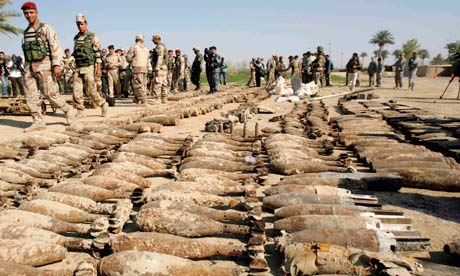
Iraqi soldiers inspect weapons seized in Yusifiyah, 16 Nov 2008. Photograph: Khalid Mohammed/AP
Haki Mohammed and his brothers were shovelling manure on their farm in Yusifiyah in the spring of 2003 when the soldier arrived. Dishevelled and distressed, the man had run a great distance. "Please," he entreated, "are you true Arabs?"
The Iraqis, raised in a culture of obligatory hospitality towards needy strangers, immediately understood the subtext. The man needed help. Even had he not been a soldier (Haki thought he recognised the uniform of a Special Republican Guard), they were honour-bound to offer assistance. "Of course," Haki assured the man. "What is it you need?"
The soldier held out his AK-47. "Take it." He indicated the webbing around his waist, stuffed full of charged magazines. "Take them all. I don't want them. But I need a dishdasha or a robe. Anything that isn't a uniform." Then the soldier started to undress.
The Mohammeds were indeed good Arabs. They fetched a dishdasha and the man slipped it on. Then, without warning, he flung the ammunition and the rifle down and ran off into the desert. Bemused, the Yusifiyans examined his belongings. He wasn't a Republican Guard at all. His uniform, bereft of rank badges, was that of a rarer outfit: Manzaumat al-Amin, the Iraqi military's security and protection agency.
A small, nondescript town of a few thousand souls 25km south-west of Baghdad, Yusifiyah is known for its rich soil, which enables the production of potatoes famous throughout Iraq for their size and flavour. The singer Farouk al-Khatib was born here. But that's about it. For those uninterested in either potatoes or Iraqi popular music, there's little of interest: farms criss-crossed by irrigation ditches, a great deal of sand, and not much else.
Yusifiyah's obscurity, however, together with its convenient location – less than 30 minutes' drive from Baghdad airport – make it perfect for certain purposes: hiding things, for example. Things you'd rather no one ever knew about. Secret things.
Sure enough, 15km to the south lies a big, big secret. The secret dates back to 1977, when the then-president Ahmed Hassan al-Bakr ordered the construction of a vast munitions plant outside the town. Built by the Yugoslavs, the factory was originally to be named after Bakr himself, until Saddam Hussein seized power in 1979. In a fit of patriotic zeal, the fledgling dictator named it after the Iraqi general Qa'qaa ibn Umar, who in the seventh century inflicted a most glorious massacre on the Persian army in the second battle of Qasidiya: Al Qa'qaa.
Weapons inspectors who visited the facility were dumbstruck by the scale of the place. "Huge," comments one senior figure familiar with the site. "The biggest chemical plant I've ever seen." Covering an area of 36 square km, containing 1,100 buildings and employing more than 14,000 staff, the site was essentially a secret, self-sufficient city, 10 times the size of New York's Central Park – in the middle of the desert. It even had its own power station.
Saddam was so pleased with the facility that, when the Iran–Iraq war broke out in 1980, he built a number of other weapons factories nearby. Soon, Nahir Yusifiyah, the sparsely populated crescent-shaped region surrounding the town, was teeming with facilities engaged in the manufacture of free-fall aircraft bombs, small arms, ammunition, scud-missiles, as well as nuclear centrifuge development and bio-warfare experiments: all huge, clandestine weapons sites with their own research staff and agendas.
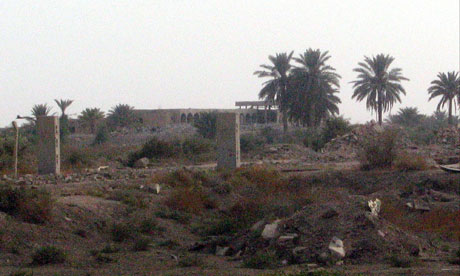
An outside view of the Qa'Qaa complex. Photograph: Anmar Falih/AP
From the outside there was little to indicate what was going on in Qa'qaa. Surrounded by tall earthen walls, all that was visible was a series of chimney stacks producing huge plumes of acrid brown smoke. Employees in the facility were not allowed to speak about it; nobody else was allowed in. To Yusifiyans, however, it was obvious the plant made military equipment of some sort: repeated explosions emanated from within the walls when things went wrong, and from the facility's test ranges when things went right.
At the heart of this big, big secret lay further secrets, some so huge they bordered on the preposterous. In the late 80s, the facility was involved in the construction of the largest rifle in the history of the world: a monstrous weapon with a 150m barrel and the ability to shoot a 600kg projectile into space. The Supergun required 10 tonnes of propellant for each shot – doubtless the reason why research was underway at Qa'qaa, where the explosive material was to be made.
Unfortunately, even this state-of-the-art facility was not up to the task. At the end of the decade, suppliers were sought for a pair of compounds that the facility was unable to synthesise purely: RDX (the basis for a number of explosives, including C4) and PETN (used in small-calibre ammunition and Semtex). The materials, ordered from eastern Europe via Chile, arrived in shipments of hundreds of tonnes.
Then the project stalled. In 1991, following the Iraqi rout in Kuwait, inspectors from the International Atomic Energy Agency (IAEA) gained access to Qa'qaa, where they found 145 tonnes of pure RDX and PETN. On a whim, one enterprising inspector asked technicians whether they had imported any other explosives of note. Qa'qaa staff exchanged glances and shuffled their feet, before leading him to a series of bunkers containing hundreds of drums of an off-white, crystalline powder. About as highly explosive as high explosive gets, High Melt Explosive (HMX) is used to detonate nuclear warheads. Qa'qaa had nearly 200 tonnes of it. The IAEA moved all the explosives to secure bunkers on the south-west corner of the facility, then closed the doors with tamper-proof seals. And there the 341 tonnes sat for more than a decade.
Of course, inhabitants of Yusifiyah and the surrounding towns had no idea about any of this. In Saddam's time, there were many things one didn't inquire about. But that was before the curious incident of the soldier, the rifle and the dishdasha.
Looting By The Truckload
For Haki and his brothers, Operation Iraqi Freedom had started in the early hours of 3 April 2003, when they were woken by the sound of low-flying aircraft. Moments later, the first American artillery shells zipped overhead, eliminating with pinpoint accuracy the Republican Guard checkpoints and roadblocks around Yusifiyah, in effect neutralising all threat of resistance.
By sunrise, American tanks were trundling north up Highway 8 towards Baghdad Airport. Ali, one of Qa'qaa's senior administrators, recalls the invasion well. "The Americans came in on the second or third of April," he says. "There was no fighting. Most of the soldiers and officers just took off their uniforms and ran away."
It took Haki Mohammed next to no time to deduce that the man who showed up on his doorstep had come from the secure compound at Qa'qaa, and an even shorter time to figure that, if the soldiers had left, the site was unguarded. For a quarter of a century, the facility had been off-limits. Here, finally, was an opportunity to find out what had been going on in there.
Haki's neighbours had the same idea. "Lots of people went in," he recalls. "They destroyed the fence and they went in that way . . . There was no army, no guards, nothing." The period between the guards fleeing and the first Yusifiyans breaching the compound was remarkably short. "About an hour," he says. By the afternoon of 3 April, the largest explosives plant in the Middle East was open to all-comers.
A week after the first Yusifiyans breached Qa'qaa's perimeter fence, the US 101st Airborne Division pitched camp just outside the facility. There appears to have been no briefings about the site. The soldiers' attention was elsewhere: the 101st was itching to get to Baghdad. As far as the troops were concerned, they were sitting on their behinds while higher-ups attempted to jump the queue, to manoeuvre their own divisions into the capital for a share of the glorious victory. They were missing the show.
And what a show it was. On 9 April, the day before the 101st arrived at Qa'qaa, US troops had taken the capital, symbolically pulling down the statue of Saddam Hussein in Firdos Square. The image, broadcast around the world, delighted the commander-in-chief back in Washington. "In the images of falling statues," President Bush later announced, "we have witnessed the arrival of a new era."
Unfortunately, by the time the 101st arrived in Baghdad on 11 April, the foundations of the new era were looking distinctly shaky. As the troops settled in to the capital, news began to break that the city was descending into an orgy of lawlessness and looting. Reporters told of mobs roaming the city, stealing everything that wasn't nailed down.
Back in Yusifayah, Haki was unable to contain his curiosity any longer. Many of his neighbours had been into Qa'qaa and had returned with fantastic stories of all the useful bits and pieces lying about. He decided to take a look for himself. On 6 April Haki and his cousins and friends piled into a grey Kia minibus, hung a white flag from the window to placate passing American troops, and made their way to the main gate. Finding it open, they drove in to the compound.
Hundreds of Yusifiyans were roaming around inside. They were gutting the place. Some targets were easier than others. Trucks vanished fairly quickly. The first few were simply hotwired and driven away. When locals realised there was no rush, however, they became more brazen, using the stolen trucks to return and carry away further loot. The next day they came back for more. "Lathes, machine tools, electrical generators," says Haki. "They were even taking the iron posts from the buildings." Qa'qaa was assaulted from all sides. From the north-west came the Yusifiyans; from the north-east, the inhabitants of Mahmudiyah.
Some of Qa'qaa's senior staff lived in an executive employees' compound just west of the town. When the power went out after the Americans passed by, they returned to the complex to fetch an electrical generator. By the time they arrived, two days before the Saddam statue ceremony, Mahmudiyans were operating a market inside the walls, selling and bartering plundered goods. Ali, the site administrator, was flabbergasted at the scale of the operation. "It was astonishing, the way they managed to steal such big pieces of kit. Some of them were using cranes." He shakes his head. "They even took the electrical cables. They dug them up from the ground and took them. The water pipes. Everything."
As yet, however, the looters had not discovered Qa'qaa's real treasure: the vast stockpiles of HMX, PETN and RDX. We know they had not discovered the explosives because of a somewhat fortuitous event. On 18 April, two weeks after the looting began, a pair of American journalists did.
Discovery Of The High Explosives
Over the course of the month that they had been embedded with the 101st Airborne, reporter Dean Staley and cameraman Joe Caffrey had seen more than their fair share of action. Now, however, they were stuck. At the end of the second week in April, the 101st had established their base a mile south-east of Qa'qaa, from which they serviced Black Hawk helicopters and ferried military bigwigs around. A week later, they were still there. With no obvious route to Baghdad, the journalists' chances of an exclusive were growing slimmer by the minute. So when, on the morning of 18 April, a sergeant and a warrant officer offered them the opportunity to tag along on a trip outside the camp, they were all ears.
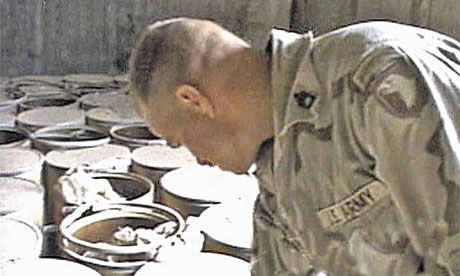
A US soldier inspects barrels of explosives, 2003. Photograph: AP
"It was a sightsee," recalls Caffrey. "Non-sanctioned. They basically decided on a whim, because they weren't assigned to fly that day, to check out the base."
Within a quarter of an hour, they started finding things. Paved roads. Watchtowers. Perimeter fences. And, within them, munitions of every possible shape and size. There were fat bombs, thin bombs, cartoon-style bombs with big fins and, lying in the hot morning sun, bombs that appeared to be leaking corrosive brown material. Some of them were as big as Volkswagens.
Outside one bunker, the soldiers and the journalists stopped. A length of thin steel wire snaked around the lock, the chain and the hinges of the door, secured by a copper disc the size of a coin.
Clearly, the wire wasn't strong enough to keep anyone out. So what was it for? The soldiers wondered aloud whether it wasn't so thin because it was meant not to be seen, that it was a booby trap. In the end, curiosity prevailed. One of them broke the disc apart and the wire fell away. Nothing happened. They walked in.
There were no warheads in this bunker. Only crates of what appeared to be chemicals. And some strange-looking drums. Cautiously, the soldiers opened one. Inside was a clear plastic bag containing coarse powder. Caffrey went in for a look. "It was very flour-like, yellow, bright yellow in colour." Further bunkers also contained the yellow, flour-like substance. In fact, the more the journalists looked, the more they found. Many of the buildings appeared to be filled with it: in one corner there might be 30 crates or boxes, in the other, 60 or 70 barrels. The quantity was staggering. "What is this stuff?" one of the soldiers murmured.
For a moment the soldiers and the journalists had the same idea. Had they accidentally discovered Saddam's WMDs? No one knew. But just in case, Caffrey filmed it all.
While Caffrey, Staley and the soldiers were exploring the bunkers outside Yusifiyah, officials at the IAEA headquarters in Vienna were becoming increasingly concerned. Prior to the invasion the agency had told the Americans of the dangers of allowing the security situation to collapse. Two weeks after the start of the war, Jacques Baute, the head of the Iraq nuclear inspection teams, visited the US mission to advise, again, that the weapons sites needed protection. He specifically mentioned Qa'qaa. Just days before the invasion, he told officials, inspectors had inventoried the facility's HMX, RDX and PETN stores and ensured that the seals were still intact. This kind of materiel, the Frenchman suggested, should be kept out of the hands of looters. There was no reaction.
Privately, IAEA officials wondered whether the Americans really understood what they were doing. Qa'qaa had made the propellant for the Nasser 81 artillery rocket programme, itself at the heart of the administration's case for war. On 3 May, an internal memo at the IAEA warned that, if Qa'qaa was not secured, the result could be "the greatest explosives bonanza in history".
Initially, looters at Qa'qaa had targeted consumer goods such as fridges and air-conditioners. Although munitions had been taken, no one really knew what to do with them. It soon dawned, however, that they might be intrinsically valuable. Weaponry was rapidly emerging as a second currency.
"After the invasion, we started seeing these Arabs, these foreign fighters," recalls Haki, "Palestinians, Egyptians, Libyans." Most Yusifiyans were wary of these new arrivals, but a number of local tribes took them in: "Karagol, Jenabies, Rowissat . . ."
Yusuf, an emerging leader in the insurgency who belongs to one of these tribes, confirms the story. "We allowed the Arabs into our houses and our farms. We welcomed them properly. Some of them even married our daughters." The fact they were Arab strangers was sufficient to ensure hospitality, but these foreigners had extra pull. They were fedayeen. They were al-Qaida.
They also informed the tribes that some of Qa'qaa's contents were considerably more valuable than rocket launchers and pistols. It wasn't long before Yusuf finally stumbled upon Qa'qaa's real treasure. "We found something that we didn't recognise. It was like a powder. It was stored in specific conditions, in special barrels." Yusuf had no idea what it was, but he thought he might as well take some. Only later would he learn that it was pure, crystalline high explosive.
Following the rush to appropriate munitions, Yusifiyans had to figure out where to store their loot. Many hid it in their homes. This soon led to tragedy. Rival groups fired rocket-propelled grenades into each other's houses, knowing they were full of explosives. Accidents also led to fatalities. One of Yusuf's barns blew up.
After a few such incidents, the powder was decanted into flour sacks, then dispersed and loaded into subterranean potato stores. Portable air-conditioning units were installed to keep it cool. By 8 May 2003, when the Pentagon's Exploratory Task Force arrived at Qa'qaa to search for WMDs, all of the PETN, RDX and HMX was gone.
Yusifiyah became a boomtown. Each potato sack of the explosive formula went for $300 (£194) to $500 (£325). "People from Yusifiyah had never seen a dollar bill. They certainly hadn't seen a $100 bill," says Haki. "But when [the Arabs] arrived, everyone was talking about tens of thousands of dollars. We started seeing people holding bundles of wads of dollars."
In this seedy, lottery-win atmosphere, locals rushed to spend their hard currency, throwing lavish weddings, buying cars, trucks and houses. Some used their share of the cash to travel. The sensible ones didn't return.
Meanwhile, bored with waiting for the Americans to establish security and tired of living without electricity, sewerage, clean water and other basic facilities, Iraqis turned in their droves to jihadist organisations, then attacked coalition troops. More violence meant less reconstruction, which led to more dissatisfaction, more anti-American sentiment and more violence. The insurgency became self-fuelling.
Throughout the summer of 2003, the insurgents' bombing campaign increased. In November, with attacks on coalition forces running at more than 1,000 a month, a classified Defence Intelligence Agency report finally stated the obvious: the vast majority of munitions used in the attacks had been pilfered from weapons sites that coalition troops had failed to protect.
In September 2003, a month after the bombing of the UN building in Baghdad (an attack in which munitions from Qa'qaa appear to have been used), Ali, who had worked at Qa'qaa for 14 years, was invited to the Green Zone to confer with the US military. The meeting had been called to discuss how best to get Iraqi industries back on their feet. Ali had other plans.
After the conference, he pulled the senior US general to one side and explained that he had come from Qa'qaa and that it had been severely looted. He then handed the general a dossier containing his senior staff's assessment of the damage. Such was the extent of the looting, the report stated, it had to be assumed that all explosive materiel inside the facility – not just the RDX, PETN and HMX – had gone. The total quantity was staggering.
"We told him that we had lost 40,000 tonnes," Ali recalls. "The gunpowder, anything that burned energetically, could be used as an explosive, so you could consider that part of the missing explosives." If the general was concerned, he concealed it well, especially when Ali informed him that among the looted munitions were 1,000 suicide-bomb belts manufactured at Saddam's orders in February 2003. "There was no reaction. He took the records and didn't say anything."
Political Bombshell
The Iraqi Islamic Army was one of the insurgent groups formed in the wake of the US invasion. Abu Shujaa, one of its founders, sits in an armchair and thinks for a moment. "One of the operations we did was the attack on the al-Amyria police station. This was in October 2003. We received information from our intelligence service that one of the high-profile military generals would be there. We decided to use a car bomb."
Shujaa is a hard man to track down. After a month of negotiations in Baghdad, we found him through intermediaries, and intermediaries of intermediaries. Shortly after our interview, he fled Iraq for Syria.
"We used two cars: Nissan Patrol 4x4s that had previously belonged to the Iraqi Special Services. We used TNT and the explosives taken from the western bunkers of Qa'qaa. They had been removed and hidden in western Baghdad, near Abu Ghraib. In total, we used about 24kg, which we mixed with the formula [powder from Qa'qaa] to make the explosions more effective. The formula was available through the farmers to the west of al-Radhwania and al-Rashid area [Yusifiyah is in this area]. Most of the explosives had been taken and hidden in flour sacks near the railway tracks."
Shujaa's first car detonated outside the police station at 9.45am on 27 October 2003. Passerby Hamid Abbas was killed, along with his daughters Samar (25) and Doniya (16) and his one-year-old granddaughter. "The other car didn't explode," continues Shujaa. "The explosives were a bit moist. They had been stored in a place that was too humid. Although the amount that had been taken from Qa'qaa was very large, we were concerned that we would finish it all if we didn't use it wisely. So after that we decided to mix a little more TNT with the formula, in case it was too humid."
IAEA staff in Vienna were livid about the Americans' failure to contain the explosives. Munitions sites in Iraq had been heavily looted, but the Americans would not allow the IAEA to visit them; it was reliant on secondhand news. When nothing was heard about Qa'qaa, inspectors chased up the interim government directly. What had happened to the sealed RDX, PETN and HMX? Was it safe?
A year later, on 10 October 2004, Jacques Baute, the agency finally received a one-page letter from the Iraqi Planning and Following-up Directorate: "The following materials, which have been included in Annex 3 (item 74) registered under IAEA custody, were lost after 9-4-2003, throughout the theft and looting of the governmental installations due to lack of security." The letter contained a table detailing the "lost" materiel: 5.8 tonnes of PETN, 141.233 tonnes of RDX and 194.741 tonnes of HMX. At last, the truth: 341 tonnes of high explosive were missing.
The letter created consternation. What was the agency supposed to do with it? The American presidential election was three weeks away. If the IAEA went public with the news, it would look as if the agency – supposedly apolitical – was taking a swipe at the Bush administration. If, on the other hand, it sat on its hands, it would be open to charges of sabotaging the campaign of Bush's opponent, John Kerry. Potentially, the letter was a political trap.
IAEA director Mohamed ElBaradei attempted a compromise, contacting the UN security council. The explosives were gone, he told them. There was every chance the news would leak. Perhaps, however, it was possible to keep a lid on it for a while, giving the coalition a chance to try to find some of them before the news broke.
The diplomatic approach came to nothing. On 14 October, the agency received a call from CBS's 60 Minutes in New York. The programme had managed to obtain a copy of the letter. So had the New York Times. Realising the cat was out of the bag, the next day the IAEA officially informed the US-led Multinational Force (MNF) that the explosives were missing. News of the report made it almost immediately to Condoleezza Rice and the president. David Sanger of the Times hastily drafted an article, while travelling with the president on Air Force One in the last days of the election campaign. No date was set for its publication.
Then, suddenly, the story leaked. On Thursday 21 October – 13 days before the presidential election – Chris Nelson, the author of a respected Washington political online report, received an anonymous phone call. A huge quantity of high explosives had gone missing, he was told. They had been stolen. They were being used to attack US troops. Nelson did some checking, discovered the story stood up and posted it on the internet that weekend.
Sanger, still waiting for the editors of the Times to publish his exclusive, discovered that the story was leaking on Sunday. The article went out the next morning: "Huge Cache of Explosives Vanished from Site in Iraq." Shortly after the newspaper hit the streets, Bush's chief political strategist Karl Rove swept into the media area of Air Force One and started shouting at Sanger. "Rove came and screamed at me in front of all the other reporters," he says. "Declared that this had been invented by the Kerry campaign." Apparently, the report had hit a nerve.
It was at this point that the story of the looting of Qa'qaa got really dirty.
Bush Administration Cover-Up
With the presidential election just eight days away, it now became crucial for the White House to neutralise the story. If voters suspected that American GIs were dead because of sheer official incompetence, they might be tempted to vote the wrong way. Evangelistic certainty and moral clarity were one thing; US soldiers dying needlessly in the sand in a faraway country was quite another. Had the explosives been stolen? Why had they not been protected? Had there not been enough troops?
The looting of Qa'qaa raised a whole swathe of issues that the Bush administration was not keen to address. Not this close to an election, anyway. Over the course of the next week, the White House deployed a number of tactics to make it go away. The first tactic was simply to assert the story was untrue. There were different angles of attack. One was that the explosives had not been there in the first place. Various figures were presented to show that the IAEA had got its sums wrong. In conjunction with this argument came a second, more formidable one: that the explosives had been there, but Saddam had moved them prior to the war.
The Pentagon brandished satellite photos of heavy trucks at Qa'qaa the day before the US invasion began. To bolster its case, the Pentagon wheeled out Colonel David Perkins, commander of the troops that took the area in April 2003. According to Perkins, it was "highly improbable" themateriel had been stolen after the invasion. "The enemy sneaks a convoy of 10-tonne trucks in," Perkins asked rhetorically, "and loads them up in the dark of night and infiltrates them in your convoy and moves out? That's kind of a stretch too far."
Donald Rumsfeld agreed. "Picture all of the tractor trailers and forklifts and caterpillars it would take," the secretary of defence told Voice of America. "We had total control of the air. We would have seen anything like that."
Even if the explosives had been there at the time of the invasion, the administration argued, they had probably been destroyed by US troops. Another officer was wheeled out. Austin Pearson of the 24th Ordnance Company had visited the site on 13 April 2003 and removed 250 tonnes of ordnance, including TNT, detonator cord and white phosphorous rounds. The materiel had later been destroyed. There were photographs of the operation, Pentagon spokesman Larry di Rita told journalists, "which we may provide later".
Finally, the administration added another point: even if the materiel had been at Qa'qaa, even if it had been looted, the loss wasn't significant. Iraq had been awash with munitions at the end of the war. Some 402,000 tonnes of armaments had been destroyed. It was estimated that Iraq's total holdings were in the region of 650,000 tonnes. Compared with this vast figure, 341 tonnes was a paltry 0.06%. The New York Times was making a mountain out of a molehill.
On this issue there was a double deception. Qa'qaa's administrators had already informed the US, in writing, that the sum total of munitions looted from their facility was not 341 tonnes but 40,000. On this accounting, the missing explosives constituted more than 6% of all explosives in Iraq, a very great deal more than 0.06%, in fact.
Further statistical manipulation was afoot, too. While the missing materiel from Qa'qaa was pure high explosive, the 402,000 tonnes destroyed by US forces included some very heavy objects that contained no explosives at all. "[The Pentagon] was trying to compare the weight of the guns and stocks and metal and all of that stuff," says a senior weapons-intelligence analyst. "They were counting tanks and guns and bazookas – metal – as opposed to the raw explosive that can be directly used . . . It's an absolutely dishonest comparison."
On Friday 29 October, Osama bin Laden succeeded where the White House's spin doctors had failed. The first videotaped message from the al-Qaida leader for more than a year pushed the looted explosives story out of the public eye. Four days later, Bush won a second term in office.
Torture and Murder
News of Bush's glorious second victory left Yusifiyans cold. Haki and his neighbours had other concerns. Top of the list came the recently arrived Arab strangers. For al-Qaida, Yusifiyah was important not only because it was home to Iraq's largest armaments facilities, but also because it was strategically extremely well positioned. Eventually, the mujahideen fighters settled in the area permanently. For the locals, the situation rapidly became intolerable. Instead of buying explosives, the Arabs simply took them, forcing potato farmers to store the materiel in their underground bunkers, then killing them later. "Those guys started ruling the whole area," says Haki. "They weren't guests any more." In fear of his life, the farmer fled to Baghdad to become a security guard.
In 2004, al-Qaida established a camp inside the Qa'qaa complex itself. "We had a firing range, like a tunnel. It was used to shoot small-calibre bullets," says Ali. "It became a training camp for terrorists."
Anyone entering the facility without permission was killed. Al-Qaida spread horror stories about its activities, intimidating locals into collaborating. An execution room was set up with a makeshift gallows. Yusuf was part of the operation. "We used to kill people in terrible ways, torturing them to give al-Qaida more influence." Mutilations, murders and decapitations were filmed and copies were distributed around Yusifiyah to discourage dissent.
The violence increased. Anyone suspected of attempting to join the Iraqi military or police was executed. Shias were executed. People with Shia names were executed. People who did anything regarded as Shia-like were executed. When Haki's uncle was caught smoking a cigarette, al-Qaida broke all his fingers with a hammer. Then they killed him.
Soon even Yusuf recognised that things had gone awry. "We realised that al-Qaida hadn't come to rescue us. They were killing all kinds of people, saying they were atheists and that they idolised statues," he recalls.
When Haki returned from Baghdad in 2005, he found the main road into town littered with corpses, bound, tortured and shot. "We hadn't seen anything like this before in our lives. It was like a horror film."
By 2005, commentators were dubbing the Yusifiyah region the "Triangle of Death": the most dangerous sector in all Iraq. Palm-tree plantations were rigged with explosives to bring down low-flying helicopters; soldiers were abducted, tortured and murdered. Bombs went off everywhere.
It was, of course, no coincidence that Nahir Yusifiyah was so favoured by insurgents. It was where all the weapons were.