Showing posts with label Slavery. Show all posts

Saturday, December 13, 2014

A Slave's Freedom


Loghman of Sarrakhs cried: "Dear God, behold
Your faithful servant, poor, bewildered, old--
An old slave is permitted to go free;
I've spent my life in patient loyalty,
I'm bent with grief, my black hair's turned to snow;
Grant manumission, Lord, and let me go."


A voice replied: "When you have gained release
from mind and thought, your slavery will cease;
You will be free when these two disappear."


By Farid ud-Din Attar

English version by Afkham Darbandi and Dick Davis
Original Language Persian/Farsi

Saturday, February 22, 2014

The People They Enslaved

group_passing_capital_wcaption2

Schools across the country are adorned with posters of the 44 U.S. presidents and the years they served in office. U.S. history textbooks describe the accomplishments and challenges of the major presidential administrations -- George Washington had the Revolutionary War, Abraham Lincoln the Civil War, Teddy Roosevelt the Spanish-American War, and so on. Children's books put students on a first-name basis with the presidents, engaging readers with stories of their dogs in the Rose Garden or childhood escapades. Washington, D.C.'s Smithsonian Institution welcomes visitors to an exhibit of the first ladies' gowns and White House furnishings.
Nowhere in all this information is there any mention of the fact that more than one in four U.S. presidents were involved in human trafficking and slavery. These presidents bought, sold, and bred enslaved people for profit. Of the 12 presidents who were enslavers, more than half kept people in bondage at the White House. For this reason, there is little doubt that the first person of African descent to enter the White House -- or the presidential homes used in New York (1788-90) and Philadelphia (1790-1800) before construction of the White House was complete -- was an enslaved person.
The White House itself, the home of presidents and quintessential symbol of the U.S. presidency, was built with slave labor, just like most other major building projects had been in the 18th-century United States, including many of our most famous buildings like Philadelphia's Independence Hall, Boston's Faneuil Hall, Thomas Jefferson's Monticello, and James Madison's Montpellier. President Washington initially wanted to hire foreign labor to build the White House, but when he realized how costly it would be to pay people fairly, he resorted to slave labor.
Constructed in part by black slave labor, the home and office of the president of the United States has embodied different principles for different people. For whites, whose social privileges and political rights have been protected by the laws of the land, the White House has symbolized the power of freedom and democracy over monarchy. For blacks, whose history is rooted in slavery and the struggle against white domination, the symbolic power of the White House has shifted along with each president's relation to black citizenship. For many whites and people of color, the White House has symbolized the supremacy of white people both domestically and internationally. U.S. nativists with colonizing and imperialist aspirations understood the symbolism of the White House as a projection of that supremacy on a global scale. This idea is embodied in the building project itself.
Although the White House is symbolically significant, there is a largely hidden and silenced black history of the U.S. presidency. Here are just a few examples.
pres_washington_fieldworkers_v4George Washington's stated antislavery convictions misaligned with his actual political behavior. While professing to abhor slavery and hope for its eventual demise, as president Washington took no real steps in that direction and in fact did everything he could to ensure that not one of the more than 300 people he owned could secure their freedom. During the 10 years of construction of the White House, George Washington spent time in Philadelphia where a law called the Gradual Abolition Act passed in 1780. It stated that any slaves brought into the state were eligible to apply for their freedom if they were there for longer than six months. To get around the law, Washington rotated the people working for him in bondage so that they were there for less than six months each.
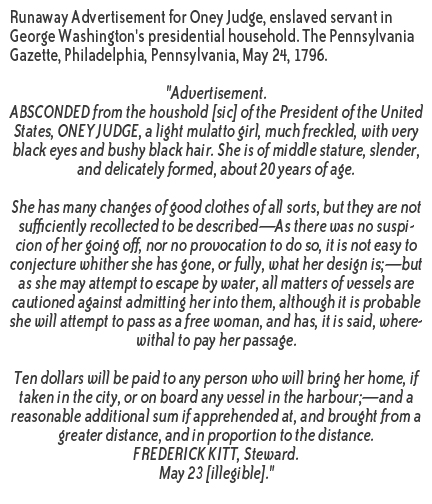
Oney_Judge_Runaway_Ad_wcaption2Despite Washington's reluctance to carry out his stated antislavery predilections, the movement against slavery grew anyway, including within the president's very own household among the men and women he enslaved. One of the presidential slaves was Ona "Oney" Maria Judge. In March 1796 (the year before Washington's second term in office ended), Oney was told that she would be given to Martha Washington's granddaughter as a wedding present. Oney carefully planned her escape and slipped out of the Washingtons' home in Philadelphia while the Washingtons were eating dinner. Oney Judge fled the most powerful man in the United States, defied his attempts to trick her back into slavery, and lived out a better life. After her successful attempt became widely known, she was a celebrity of sorts. Her escape from the Washingtons fascinated journalists, writers, and others, but more important, it was an inspiration to the abolition movement and other African Americans who were being enslaved by whites.
pauljennings_wcaption3By the age of 10, Paul Jennings was enslaved at the White House as a footman for James Madison, the fourth president of the United States. When he got older, Dolley Madison hired out Jennings, keeping every "last red cent" of his earnings. Dolley indicated in her will that she would give Jennings his freedom, but instead sold him before she died. Thankfully, Daniel Webster intervened and purchased his freedom. Soon after, Paul Jennings helped plan one of the most ambitious and daring efforts to liberate enslaved blacks in U.S. history, thePearl Affair. It was not successful, but as with John Brown's raid, the political repercussions lasted for decades and strengthened the abolitionist cause. Paul Jennings went on to become the first person to write a memoir of a firsthand experience working in the White House.
In textbooks and popular history, the White House is figuratively constructed as a repository of democratic aspirations, high principles, and ethical values. For many Americans, it is subversive to criticize the nation's founders, the founding documents, the presidency, the president's house, and other institutions that have come to symbolize the official story of the United States. It may be uncomfortable to give up long-held and even meaningful beliefs that in many ways build both collective and personal identities. However, erasing enslaved African Americans from the White House and the presidency presents a false portrait of our country's history. If young people -- and all the rest of us -- are to understand a fuller, people's history of the United States, they need to recognize that every aspect of early America was built on slavery.

clarence_lusaneDr. Clarence Lusane is the program director for Comparative and Regional Studies at American University. He teaches courses in comparative race relations, modern social movements, comparative politics of the Americas and Europe, and jazz and international relations. He is a national columnist for the Black Voices syndicated news network.bhwhLusane has authored a number of books includingif_we_knew_bannerThe Black History of the White House (City Lights, 2010). This article is part of the Zinn Education Project If We Knew Our History series.

Friday, February 21, 2014

More Than A Quarter Of U.S. Presidents Were Involved In Slavery, Human Trafficking


AMY GOODMAN: As the country marks Presidents’ Day today, we turn to an aspect of U.S. history often missed: the complicity of American presidents with slavery. The first person of African descent to enter the White House was most likely a slave. The nation’s capital, Washington, D.C., once hosted markets where human beings were sold for profit. Slaves built some of the country’s most famous landmarks, including Philadelphia’s Independence Hall, Boston’s Faneuil Hall, James Madison’s Montpelier. Last week, President Obama mentioned the role of slaves in building one specific landmark: Thomas Jefferson’s plantation estate in Charlottesville, Virginia. Obama was touring the home of America’s third president with French leader François Hollande. This is what Obama had to say about Monticello.
PRESIDENT BARACK OBAMA: This house also represents a complicated history of the United States. We just visited downstairs, where we know that slaves helped to build this magnificent structure, and the complex relations that Jefferson, the drafter of the Declaration of Independence, had to slavery. And it’s a reminder for both of us that we are going to continue this fight on behalf of the rights of all peoples, something that I know France has always been committed to and we are committed to, as well.
AMY GOODMAN: President Obama speaking last week during French President François Hollande’s visit to the U.S.
We’re joined now by Clarence Lusane, who has documented the racial history of Washington, D.C., and the presidency. His most recent article is "Missing from Presidents’ Day: The People They Enslaved." Clarence Lusane writes, quote, "more than one in four U.S. presidents were involved in human trafficking and slavery. These presidents bought, sold, and bred enslaved people for profit. Of the 12 presidents who were enslavers, more than half kept people in bondage at the White House," he writes. Clarence Lusane is author of The Black History of the White House, a member of the D.C. Commission on African American Affairs, also professor at American University in Washington, D.C.
Professor Lusane, welcome to Democracy Now! So, talk about this history of slavery and U.S. presidents.
CLARENCE LUSANE: Well, I’m glad that you pointed out that President Obama, when he went to Jefferson’s home, pointed out the slave history there. But it’s also important to note that the most iconic building in the U.S., the one that represents the country to the world, the White House, also was a place where slavery existed. Not only that, it was built by slaves. And none of that has been publicly acknowledged. There is over a million people who visit the White House every year, who go on tours, who come for meetings, and you can go through that building and never have a sense of that important history.
And that’s critical because I think Presidents’ Day should be a period of critical reflection, not some kind of blind celebration, but it should be one where we really try to get a better sense of the country’s history. And part of that history, part of what I think resonates even to this day, is that, significantly, before the Civil War, nearly every U.S. president was a slave owner, which meant that they were compromised on the issue of slavery, and that had repercussions that, you know, redounded through history. So it’s really critical, I think, that we have that acknowledgment, because we grow up, we go to school, we have history classes, and none of that history is told to us.
AMY GOODMAN: So, give us a black history of U.S. presidents, as you call it.
CLARENCE LUSANE: Well, in looking at the White House—and I use that as the prism to try to look at this longer history that basically led up to President Obama—one of the things that we find that’s missing in that history is the voices of people, particularly African Americans, who were enslaved during that long, long, long history. And that was critical because when you think about George Washington, Madison, Monroe, all of the early presidents, who wrote the Declaration of Independence, they wrote the Constitution, they wrote the Articles of Confederation, all of these documents, these founding documents that extol the principles of democracy, liberty, equality, they were living a contradiction. And that contradiction is that every single day of their life, every moment in their life, they were surrounded by people who were enslaved.
Now, fortunately, because of some of the historic records that have been kept, we now know who some of those people were. George Washington, for example, when he was president and his presidency was in Philadelphia, had at least nine individuals with him who were enslaved—Oney Maria Judge, for example, who was a young woman of about 22 who escaped from George Washington. She escaped—this was in 1796, when she found out that Martha Washington was planning to give her away as a wedding gift. And she made contact with the free black population in Philadelphia, was able to escape. Now, this is remarkable because we’re talking about a young woman who basically traveled nowhere by herself, who escapes from the most powerful person on the planet, pretty much, certainly most powerful person in the United States. Her story is important because she lived—she outlived Washington. She lived to be, I believe, in her eighties and lived a life where she learned to read, became active in her community. You also had Hercules, who was Washington’s cook, who also escaped from Washington.
So there are people who we were in and around the White House who had stories to tell that are part of that history that we literally were never taught about for all of the years that, you know, we took schooling and we took classes in history. And so, I thought it was important, and there are others who have written to re-enter into the historic narrative the stories of these individuals, because they really are critical if you really want to understand the politics of George Washington or the politics of Thomas Jefferson or any of the other presidents who held slaves.
AMY GOODMAN: Tell us about Paul Jennings.
CLARENCE LUSANE: Paul Jennings, again, is another fascinating character. He was enslaved to the Madisons, to James and Dolly Madison. He was, in fact, the first individual to actually write about working in the White House. He published a memoir—this was in the late 1860s—that talked about the time when he was in the White House. And he was there in 1814. He was there when the British literally were burning down the city, and was part of the contingent of folks who were attempting to get materials out of the White House and preserve them before the British came. So he really had a fascinating history.
He was supposed to be free when James Madison died, but Dolly Madison basically reneged on the deal. So he—it took him a few years to buy his freedom, which he eventually did. And then he actually came to help Dolly Madison. She fell on hard times. She wasn’t wealthy. She wasn’t a wealthy person, and she wasn’t part of the social elite of Washington. And so, when she fell on hard times and her family and friends abandoned her, Jennings would often bring her food and bring her money and basically would look after her. But what was also important about James Jennings is that he also was—
AMY GOODMAN: Paul Jennings.
CLARENCE LUSANE: Paul Jennings, I’m sorry, is that he was also central to the largest attempt at escaping from slavery that happened in Washington, D.C. This happened in 1848. For a number of reasons, the escape attempt failed, but Jennings was never brought in. He was never seen as being part of it. And it was only literally after his death that it was revealed that he had played a very critical role in that. So, my point is that you had these individuals who were enslaved to presidents, who really had fascinating kinds of stories and fascinating kinds of lives that we should know about, because they really are also a part of the history of the White House and the history of the presidency.
AMY GOODMAN: I want to play a clip from the trailer of the film Lincoln, directed by Steven Spielberg, released last year, about President Abraham Lincoln and the fight to end slavery in the United States. In this clip, you first hear Abraham Lincoln, played by Daniel Day-Lewis, followed by the voices of Thaddeus Stevens, the congressmember from Pennsylvania, and Mary Todd Lincoln, the first lady. Let’s go to that clip.
PRESIDENT ABRAHAM LINCOLN: [played by Daniel Day-Lewis] We’re stepped out upon the world stage now, the fate of human dignity in our hands! Blood’s been spilt to afford us this moment! Now! Now! Now!
THADDEUS STEVENS: [played by Tommy Lee Jones] Abraham Lincoln has asked us to work with him to accomplish the death of slavery.
MARY TODD LINCOLN: [played by Sally Field] No one’s ever been loved so much by the people. Don’t waste that power.
AMY GOODMAN: That was an excerpt of Lincoln. Clarence Lusane, talk about Abraham Lincoln and slavery.
CLARENCE LUSANE: Lincoln was—the Lincoln administration was a turning point in terms of the history of the relationship between African Americans and the White House. It was during Lincoln’s tenure that the first meeting took place between a U.S. president and leaders of the black community. This happened in 1862, I believe. Now, this was critical because up until that point, although African Americans, particularly free African Americans in the North, had been organized and had been raising issues, policy issues, issues around slavery, they simply had no access to the White House or to policymakers. Lincoln, however, opened up some of that space.
And part of what I think moved Lincoln from being not just simply anti-slavery, but ultimately to recognizing that you had to eliminate slavery, that abolition was the only path forward, in part, came because of his discussions with black leaders, not only church leaders, but people like Frederick Douglass, but also—and this is in the film—discussions with Elizabeth Keckley. In the film, she’s the woman who’s often seen with Mary Lincoln. She’s played by Reuben, Gloria Reuben, in the film. And the film is a little bit disingenuous in that you could think that maybe she was a servant, but in fact she was an independent businesswoman who had become basically best friends with Mary Lincoln, but also she spent a great deal of time at the White House having discussions with Abraham Lincoln about race, about slavery, about the future of the country. And again, her story is important to be told because she, again, was part of a contingent of African Americans who thought to influence the presidency and to address issues that needed to be dealt with. And so, the movie Lincoln doesn’t quite take you there to show you that side of the people who influenced Lincoln, but it’s an important part of understanding what happened in the Civil War and how Lincoln actually got to the point where he said the only way out of this situation is that slavery has to end.
AMY GOODMAN: Then that moment, that meeting, August 14th, 1862, Abraham Lincoln does something unprecedented: He meets with a small delegation of black leaders, clergy.
CLARENCE LUSANE: Right. And at that point, Lincoln had already decided to issue the Emancipation Proclamation. There was some debate about which date to issue it on, but he was already moving in a position where he saw the country’s future as a future without slavery. And these leaders that he met with were people who mostly were tied to the black church community, but people who also had ties to abolitionists, to people who were active in the other kinds of issues around the country. So that really was kind of a turning point. And since that point, there has been a considerable amount of effort on the part of African Americans to negotiate and to meet with and to lobby not only in Congress, but the president themself.
AMY GOODMAN: Talk about the buildings, these iconic structures that kids, adults go to in Washington, D.C., to honor this country—the White House, the Capitol. Who built it?
CLARENCE LUSANE: This is really important, because I think there may be some sense, more generally, that Washington owned slaves and Jefferson owned slaves, but I think there’s a general ignorance about the role of people who were enslaved in actually building the nation’s capital. In 1790, after the country was founded, the Congress passed legislation to build a capital. Washington, D.C., did not exist. And so, there was a decision that land that was ceded from Maryland and from Virginia would become the nation’s capital, and it had to be built, and it would take 10 years. This is why Washington spent all of his presidency either in New York or in Pennsylvania. But to build Washington, D.C., you needed labor. And George Washington, who was more or less in charge of the project, initially wanted labor to come from Europe, but it was very, very difficult to get people to come all the way over on these really harsh trips to work in basically a jungle. So they basically relied on enslaved labor, which meant cutting down trees, moving rocks, digging holes—you know, all of the harsh, harsh labor that had to be done literally to clear the area. But it also included skilled labor, people who were carpenters and plasterers. We know for a fact that both at the White House and—the building that became the White House and the U.S. Capitol, there were at least five highly skilled carpenters who worked for years to build those two buildings.
And again, this needs to be acknowledged, because it reflects that ongoing contradiction, what President Obama talked about with President Hollande, of this conflict between the principles of equality and democracy, and the reality of slavery. Now, in the Capitol a few years ago, there were two plaques that were put up to honor or to acknowledge the people who were enslaved that built the Capitol. One is on the House side, and one is on the Senate side in the Rotunda. And in Philadelphia, at the pavilion where the Liberty Bell exists, the new Liberty Bell Pavilion was actually built over the old house where—or the land where George Washington lived when he was president. There is also a plaque there that acknowledges the people who were enslaved to Washington during the time of his presidency. What we do not have yet, and it actually may happen, is something in the White House that will have that kind of acknowledgment.
AMY GOODMAN: Final comment, Clarence Lusane, about what you think we should understand on this Presidents’ Day? And take it all the way—you write about Teddy Roosevelt.
CLARENCE LUSANE: Yeah, I think that the most important thing is to understand that there is a long and rich history of African Americans in the White House long before President Obama. And all of that history tells us a great deal, I think, about the current situation we face, where we continue to see racial disparities and racial discrimination pretty much across the board. The story you did earlier about the shootings in Florida, for example, I think, in part, reflect an unawareness of this history and the degree to which the country still has not acknowledged and reconciled this past. A year ago, I went with students to Rwanda, and we visited a great—a large number of memorials. And it became so clear to me that the degree to which the country acknowledges its past in an honest and straightforward way goes a long way towards healing and reconciliation. It doesn’t necessarily end up with all the justice that needs to be happening, but it certainly is a first step, that acknowledgment and recognition of your history becomes really important.
AMY GOODMAN: Thanks so much for being with us, author of The Black History of the White House . We’ll link to your piece, "Missing from Presidents’ Day: The People They Enslaved" at democracynow.org. Clarence Lusane is also a professor at American University. This is Democracy Now!, democracynow.org, The War and Peace Report. Back in a minute.

Saturday, May 18, 2013

This Is What American History Looks Like


I don’t know why, given where we are with dronefare, but I didn’t expect the man making the announcement about Assata Shakur being the first woman “terrorist” to appear on the FBI’s most wanted list to be black. That was a blow. 
I was reminded of the world of “trackers” we sometimes get glimpses of in history books and old movies on TV. In Australia the tracker who hunts down other aboriginals who have, because of the rape and murder, genocide and enslavement of the indigenous (aboriginal) people, run away into the outback. 
He shows up again in cowboy and Indian films: jogging along in the hot sun, way ahead of the white men on horseback, bending on his knees to get a better look at a bruised leaf or a bent twig, while they curse and spit and complain about how long he’s taking to come up with a clue. And then there were the “trackers” who helped the pattyrollers during our four hundred years of enslavement. When pattyrollers (or patrols) caught run-away slaves in those days they frequently beat them to death. 
I’ve often thought of the black men whose expertise at tracking fugitives helped bring these terrors, humiliations and deaths about. When I was younger I would have been in a rage against them; not understanding the reality of invisible coercion, and mind and spirit control, that I do now. 
Today, only a few years older than Assata Shakur, and marveling at the unenviable state of humanity’s character worldwide, I find I can only pray for all of us. That we should be sinking even below the abysmal standard early “trackers” have set for us: that the US government can now offer two million dollars for the capture of a very small, not young, black woman who was brutally abused, even shot, over three decades ago, as if we don’t need that money to buy people food, clothes, medicine, and decent places to live.
What is most distressing about the times we live in, in my view, is our ever accelerating tolerance for cruelty. Prisoners held indefinitely in orange suits, hooded, chained and on their knees. Like the hunger strikers of Guantanamo, I would certainly prefer death to this. 
People shot and bombed from planes they never see until it is too late to get up from the table or place the baby under the bed. Poor people terrorized daily, driven insane really, from fear. 
People on the streets with no food and no place to sleep. People under bridges everywhere you go, holding out their desperate signs: a recent one held by a very young man, perhaps a veteran, under my local bridge: I Want To Live. 
But nothing seems as cruel to me as this: that our big, muscular, macho country would go after so tiny a woman as Assata who is given sanctuary in a country smaller than many of our states.

Sunday, March 24, 2013

Bandeirantes


Photograph BANDEIRANTES by armando cuéllar on 500px
The bandeirantes (Portuguese pronunciation: [bɐ̃dejˈɾɐ̃tʃis], "followers of the banner") were composed of Indians (slaves and allies), caboclos (people of Indian mixed with white), and whites who were the captains of the Bandeiras. Members of the 16th–18th century South American slave-huntingexpeditions were called bandeiras (Portuguese for "flags"). Though their original purpose was to capture and force amerindians into slavery, the bandeirantes later began to focus their expeditions on finding gold, silver and diamond mines. They ventured into unmapped regions in search of profit and adventure. From 1580–1670 the Bandeirantes focused on slave hunting, then from 1670–1750 they focused on mineral wealth. Through these expeditions, the Bandeirantes also expanded Portuguese America from the small limits of the Tordesilhas Line to roughly the same territory as current Brazil. This expansion discovered mineral wealth that made the fortune of Portugal during the 17th and 18th centuries.
The first Bandeira was in 1628, organized by Antonio Raposo Tavares. This bandeira raided 21 Jesuit villages in the upper Paraná Valley. They captured about 2,500 natives. A bandeira tactic was to set native tribes against each other in order to weaken them, and then to enslave both of them.
As a result of the Bandeiras, the Capitaincy of São Vicente became the basis for the vice-kingdom of Brazil and encompassed current states of Santa Catarina, Paraná, São Paulo, Minas Gerais, Goiás, Tocantins and both Northern and Southern Mato Grosso. With the few outlying Spanish settlements and missions overrun, the defacto control over most of what is now Brazil was recognised by the Treaty of Madrid in 1750.

Despite the fact that the Jesuit missionaries were the chief opponents of the Bandeirantes, priests accompanied the Bandeira for two reasons: 1. to shrivethe dying and the dead, 2. to ease the conscience of the men.

In the beginning, the main focus of the bandeirantes was to enslave natives. They carried this out by disguising themselves as Jesuits, often singing mass to lure the natives out of their settlements. However, more often they relied on surprise attacks. If luring the natives with promises didn’t work, the bandeirantes would surround the settlements, and set them alight in order to force out the natives. The natives would be captured and placed into a large outdoor pen, until there were enough of them enslaved to justify a trip back to the coast, where they would be sold as slaves. It could be weeks or months until this was the case, and so hundreds of captives died of exposure. On the journey to the coast, the captives would be stripped, and tied to a long pole to prevent them from trying to flee the group.

There were over 2.5 million Indigenous peoples in Brazil in 1500. By the middle of the 18th century, the number had dropped to between 1 million and 1.5 million. Many tribes living close to the Atlantic coast intermixed with Portuguese or died of diseases. Others had fled into the interior, and their flight created an ever-greater need for slaves, one that was not entirely satisfied by importing them from Africa. Native slaves sold for about $30–$40, while the imported African slaves sold from $100–$500. The bandeirantes were able to sell many native slaves due to their cheap price, and hence made a large profit.


Info Via: "Wikipedia"
Photo by Armando Cuellar
Sculpture by Victor Brecheret
Location: Just across the Ibirapuera Park, Sao Paulo, Brazil.


Saturday, February 09, 2013

Prophet Muhammad's Views On Slavery


Islam and Slavery:


In Sharia (Islamic law), the topic of Islam and slavery is covered at great length. The legal legislations brought two major changes to the practice of slavery inherited from antiquity, from Ancient Rome, and from the Byzantine Empire, which were to have far-reaching effects. 

The Qur'an considers emancipation of a slave to be a highly meritorious deed, or as a condition of repentance for many sins. The Qur'an and Hadith contain numerous passages supporting this view.  In chapter 2 , verse 177, God says most emphatically:

“ It is not righteous that ye turn your faces towards east or west; but it is righteousness - to believe in God and the Last Day, and the Angels, and the Book, and the Messengers; to spend of your substance, out of love for Him, for you kin, for orphans, for the needy, for the wayfarer, for those who ask, and for the ransom of slaves; to be steadfast in prayer and to practice regular charity, to fulfil the contracts which ye have made and to be firm and patient. Such are the people of truth and God-fearing”.

People Personally Freed By Prophet Muhammad:

Muhammad encouraged manumission of slaves, even if one had to purchase them first. Traditional biographies of Muhammad give many examples where Muhammad's companions, at his direction, freed slaves in abundance. Abul Ala Maududi reports that Muhammad freed as many as 63 slaves. Meer Ismail, a medieval historian, writes in Buloogh al Muram that his household and friends freed 39,237 slaves.

It was a practice and tradition of Muhammad to release from captivity those females who would face the risk of being disgraced or humiliated as a result of being held as captives or slaves, and those who came from respected backgrounds that were known for their philanthropic contributions to the general masses, regardless if their charitable deeds benefited Muslims or non-Muslims.

During the lifetime of Muhammad, the tribe of Tayy that lived to the northeast of the city of Medina, engaged in banditry and highway robbery, and came in conflict with the Muslims of Medina, which led to battles between them that led to the Tayy's defeat, and the subsequent captivity of some of their tribes folk.

Abū Ḥāmed Muḥammad ibn Muḥammad Ghazālī narrated in his Ihya' ulum al-din (Ihya'e Ulumuddin, The Revival of Religious Sciences), that when the daughter of Hatim al-Tai, Safana bint Hatem, was taken as a captive, she came to Muhammad asking for her release, and not to be made a subject of humiliation amongst the various Arab quarters, as her father, Hatim al-Tai, was a person who used to aid the needy, feed the hungry, spread greetings, free slaves, and never refused an assisting request; to which Muhammad replied that these described qualities of her father are those of the believers, and if her father was a Muslim then indeed he would have asked for (Divine) mercy on him. He then asked his companions to release her stating that her father loved the noble-character, and God loves the noble-character. The Prophet said: “Whoever frees a slave, Allah will save all the parts of his body from the Fire, as he has freed the body-parts of the slave.” (Bukhari, vol 3, hadith no. 693)

Female Slaves

  • Safiyya bint Huyayy, according to Islamic accounts she adopted Islam and became a wife of Muhammad. She lived more than a decade after him as a widow and became involved in the first power politics of the early Muslim community and left a large inheritance to her Jewish family.
  • Maria al-Qibtiyya, a Coptic slave given to Muhammad by Muqawqis, a Byzantine official. She gave birth to Ibrahim ibn Muhammad whom Muhammad loved dearly. Some sources indicate that she was freed and became Muhammad's wife.
  • Rayhana, captured after siege of Banu Qurayza.

Male Slaves

  • Zayd ibn Harithah, was freed to become Muhammad's adopted son, until adoption was replaced with guardianship in Islam, upon which Muhammad became his guardian.


Monday, January 02, 2012

An Execrable Ancestor

By Bruce Fein
Published: 8:51 PM 12/28/2011
Updated: 8:48 PM 12/30/2011 
Courtesy Of "The Daily Caller"


The execrable ancestor of the National Defense Authorization Act of 2012 (NDAA) is the Fugitive Slave Act of 1850. Frederick Douglass protested, “Under this [Fugitive Slave] law the oaths of any two villains (the capturer and the claimant) are sufficient to confine a free man to slavery for life.” Under the NDAA, the suspicion of the president is sufficient to confine an American citizen to military detention for life without accusation or trial. The twin laws make for an alarming tale.
The Fugitive Slave Act passed with overwhelming congressional support. Only four members of Congress voted against it. The South clamored for its enactment even though very few slaves ever escaped from their owners.
The act vandalized due process. A claimant was authorized to obtain possession of an alleged fugitive slave by presenting an affidavit asserting ownership to a commissioner appointed by the judicial branch. The alleged slave was prohibited from testifying to discredit the claimant’s enslavement affidavit, which is the equivalent of proscribing a criminal defendant from asserting his innocence. The commissioner received a $10 fee for sustaining an enslavement claim, but only $5 for upholding freedom. During the life of the act, slave claimants prevailed in 322 cases and freedom triumphed in 11.
The NDAA defiles due process more egregiously than did the Fugitive Slave Act. Section 1021 empowers the military to detain for life without trial any American citizen captured in the United States whom the president maintains is “substantially support[ing] … al-Qaeda, the Taliban, or associated forces” engaged in hostilities against “coalition partners” of the United States. None of the key terms in section 1021 are defined to constrain the president’s power to disappear Americans into dungeons at Guantanamo Bay or elsewhere. “Al Qaeda” is undefined. “The Taliban” is undefined. “Associated forces” is undefined. “Coalition partners” is undefined. “Substantially supporting” is undefined. The words can mean whatever the president, like Humpty Dumpty, wants them to mean. “Substantial support” might be said to include any criticism of the United States government for flouting the Constitution in combatting international terrorism.
The president is crowned by the NDAA with untrammeled authority to decide the proof and method for the executive branch to determine whether an American is substantially aiding al-Qaeda, the Taliban, or associated forces against a coalition partner. There is no judicial involvement. In sum, under the NDAA the president may imprison for life any American citizen for an alleged linkage to international terrorism against coalition partners of the United States on his say-so alone — the very definition of tyranny articulated by James Madison, father of the Constitution, in Federalist No. 47.
The NDAA emerged from the Senate and House Armed Services Committees without a single hearing. The Judiciary Committees waived jurisdiction. Only 13 senators voted against the sacrilege to due process. The statute is naked of findings that the awesome power lodged in the president was necessary to cure a deficiency in existing laws. It was enacted more than a decade after the 9/11 abominations, when it was known that no American citizen on American soil who substantially supported al Qaeda had ever eluded prosecution and punishment in the criminal justice system before any American in America had been harmed.
The NDAA, like the Fugitive Slave Act, is tyranny for the sake of tyranny. It is an ugly spot on the Constitution like Lady Macbeth’s “damned spot” for complicity in assassination.
Who in Congress will earn a chapter in Plutarch’s Lives by sponsoring repeal legislation?
Bruce Fein was associate deputy attorney general under President Reagan, 1981-83, and is senior policy advisor to the Ron Paul 2012 Presidential Campaign and author of American Empire Before the Fall.

Friday, December 02, 2011

Ending Slavery The Sharia Way

By Dr. David Liepert 
Muslim Author, Leader, Spokesperson, Host of "The Optimistic Muslim" on webtalkradio.net 
Posted: 11/16/11 03:30 PM ET 
Courtesy Of "The Huffington Post"


Modern day Slavery? Still a problem in the 21st century? Really? Even here in North America?
The truth is there are more slaves in North America today than there were 200 years ago, more slaves around the world today than there have ever been before, and the illegal trafficking of human beings -- the slave trade -- continues unabated, ongoing since the dawn of history.
As you read this, throughout the world, more than 30 million of our fellow human beings are living as the humiliated property of others, human beings who can be bought and sold as commodities like cattle, forced to work as child-soldiers, serfs, servants and sex-trade workers.
But the IMAM -- the International Muslim Abolitionist Movement -- believes that true compliance to Muhammad's example demands that slavery in all its evil forms must come to an end, and that Muslims serious about living their lives as God's servants should be striving to make that happen today.
But aren't religions part of the problem? Most of our faiths have been used to justify slavery in the past, so what's changed? And while we're at it why haven't religions condemned slavery since the very beginning of time?
The answer to all those questions is that slavery once had a purpose, serving as a slightly less evil alternative to death by starvation or execution, the two common ancient consequences to losing a war. That's why instead of condemning it outright, most religions merely regulated and moderated slavery's worst abuses.
However, it is long past time we moved beyond that dark chapter of human history, and long past time for all believers to take more of a stand. Because on this issue we can unquestionably stand together. In fact, slavery's evolving status throughout our world's religions actually confirms the consistent nature of God's progressive revelation, delivered through myriad messengers, speaking at different times to a diverse world.
For instance, Judaism began among those wrongly enslaved, when Joseph's brothers sold him into Egypt. Decades after he had been freed and had brought his family to live alongside him, when Egypt turned against their Hebrew brethren and enslaved them under the Pharaohs, Moses led them out of Egypt to become God's people instead.

So even though slavery had a place in the laws of Judaism and Christianity, God's guiding principle was implicit to the history of the Jews themselves: as the children of slaves, they knew there could be no difference in an individual's ultimate value whether slave or free before God or man.
Centuries later, Christianity's revelation came at a time when that important truth had not yet been given to Israel's Roman overlords. And again, rather than condemning the practice, Christianity merely confirmed Judaism's lesson to a wider audience, and eventually changed the Roman world as well.
But what do you do when you ARE the overlord? That's the piece of the puzzle Islam answers because, throughout human history, our human tendency has been to ignore all of our myriad faith's egalitarian leanings -- something you can find in each if you look for it -- and devalue and humiliate those following different faiths, or even following our own faith in what we think are different ways, whenever we've thought we could get away with it.

So what does the Quran say about slavery? Rather than promoting the taking of slaves, the Quran promoted their freedom and proclaimed their equal status to their masters under God. The Quran declared that slaves had rights and that masters had a responsibility to protect them, and it made freeing a slave worthy of eternal reward.
What did Muhammad say about slavery? That slave and free were brethren, and that female slaves in particular should be protected, respected, educated, and either married or freed outright.

How did the earliest Muslims treat slaves
? Following Muhammad's example they helped, cared for and freed them, listened to, learned from and included them, respecting their contributions to the community of Islam.
Muhammad's immediate household personally freed almost 40,000 slaves alone.
What do Muslim scholars say about slavery? That the natural state of humanity is freedom, and that slavery is an abhorrent aberration. Rather than merely the gradual eradication of slavery, all scholars agree that Muslims should seek to eradicate the discriminatory injustice that is slavery's root cause as well.
So what does al-Shariah -- an Arabic phrase that means "the well trodden path to the waterhole" that has come to mean Islamic law as well -- say about slavery?
Well, it really depends which sharia you're talking about.
Because al-Shariah, the path Muhammad and his companions walked led toward a world without slavery, something every modern day scholar will happily confirm. But after they passed away, later Muslims who saw their slave-count dwindling decided they didn't like it. So they "tweaked" the rules just a little, just enough maintain their access to fresh slaves.
And whenever that happens, whenever Muslims put their own ambitions ahead of true fidelity to the path of Islam -- that leads us to serve God by serving His Creation, albeit in different roles -- and instead misdirect al-Shariah to serve their own dark desires instead, they turn their man-made so-called sharia laws into an abomination.
However, personally, I think the most important lesson al-Shariah teaches us is that the life of faith is a journey, and no matter how far down a path you've gone in the wrong direction, you can change it back into a righteous path just by turning yourself around. 

And quite frankly, it's long past time for Muslims who honestly love Islam, sharia and Muhammad's legacy to fix those abuses and begin to take sharia back for Muhammad's exemplary Islam!
Because the message of the Quran, the Sunnah (the acts and words of Muhammad), Islam's wise scholars and the Salaf (early Islam's first three generations) is clear: Muslims should have ended slavery long ago.
So if you are a Muslim who loves Islam and strives to honor Muhammad's true legacy of justice, peace and freedom for all humankind, then please join the IMAM to say a prayer for freedom for the sake of all humankind on the International Day for the Abolition of Slavery (Friday, Dec. 2), and help us take a step toward ending slavery and oppression and injustice throughout the world today.


Follow Dr. David Liepert on Twitter: www.twitter.com/DrDavidLiepert