Showing posts with label Muslim OutReach. Show all posts

Sunday, June 08, 2014

Islamic Prayers To Be Held At Vatican

For the first time in history, Islamic prayers and readings from the Quran will be heard at the Vatican on Sunday, in a move by Pope Francis to usher in peace between Israelis and Palestinians.
Francis issued the invitation to Israeli President Shimon Peres and Palestinian Authority President Mahmoud Abbas during his visit last week to Jordan, Israel, and the Palestinian Authority.
Abbas, Peres, and Francis will be joined by Jewish, Christian and Islamic religious leaders, a statement released by Peres’s spokesperson said, according to the Times of Israel.
Holy See officials on Friday said the evening prayers would be a “pause in politics” and had no political aim other than to rekindle the desire for Israeli-Palestinian peace at the political and popular level, according to the Associated Press.
And from the Times of Israel
President Shimon Peres will head to the Vatican on Sunday to participate in an interfaith peace prayer event at the invitation of Pope Francis.
Francis issued the invitation to Peres and Palestinian Authority President Mahmoud Abbas during his visit last week to Jordan, Israel, and the Palestinian Authority.
According to a statement released by Peres’s spokesperson, Abbas, Peres, and Francis will be joined by Jewish, Christian and Islamic religious leaders.
The event will feature readings about peace by the clergy from the Tanach, the New Testament and the Quran. Francis will then read religious verses with Peres and Abbas, which the three will have selected for the ceremony.
Israel’s delegation, which the Chief Rabbinate helped to select, will include members of the local Jewish, Druze and Muslim communities.
Vatican Radio) At a press conference in the Vatican on Friday, the head of the Holy See’s press office, Fr Federico Lombardi, and the Franciscan Custos of the Holy Land, Fr Pierbattista Pizzaballa, announced details of a prayer encounter to be held on Sunday with the presidents of Israel and Palestine. Also attending the event will be the spiritual leader of the Orthodox world, Ecumenical Patriarch Bartholomew of Constantinople.
Pope Francis invited Israeli President Shimon Peres and Palestinian President Mahmoud Abbas to the encounter on May 25th during his brief but intense visit to the Holy Land.
“Building peace is difficult, but living without peace is a constant torment.” Those were Pope Francis’ words to the Israeli and Palestinian presidents when he invited them to come to the Vatican to join him in “heartfelt prayer to God for the gift of peace.” Both leaders immediately accepted that invitation and will be arriving in the Vatican around 6.30pm on Sunday evening, accompanied by delegations of about 20 people representing the different faith communities present in both states. Also taking part in the Vatican delegation will be the Orthodox Patriarch who played such a central role in the Pope’s recent pilgrimage to Jerusalem to recall a similar encounter between their predecessors exactly half a century ago.
Following a brief welcome in the Casa Santa Marta where he lives, Pope Francis will accompany the two presidents and the patriarch through the Vatican gardens to a specially prepared venue surrounded by two tall hedges between the Pontifical Academy of Sciences building and a wing of the Vatican museums.
Fr Lombardi explained that each faith community will present a piece of music, then thank God for the gift of creation, ask forgiveness for sins committed and pray for the gift of peace. 

Pope Francis and the two presidents will add their own calls for peace in the region, before exchanging greetings, planting an olive tree as a visible symbol of their desire for an end to the conflict and sharing a moment of private conversation together.

Answering journalists’ questions about the aim of the encounter, Fr Pizzaballa said it is a purely religious event designed to provide space for people to stand back from the conflict and “recreate a desire for change”. While the meeting will not lead to any overnight solutions to the complex problems of the Middle East, Fr Pizzaballa said he hoped it might just reopen a path of dialogue and allow people to dream of a world where peace really is possible.

(From archive of Vatican Radio)

Sunday, December 08, 2013

AIPAC, The Biggest Barrier To Peace


Former British Foreign Secretary Jack Straw said during a debate in the British parliament that: “unlimited” funds available to Jewish organizations and AIPAC in the U.S. are used to control American policy in the Middle East.

The comments reportedly were made last week during the Round Table Global Diplomatic Forum in the British House of Commons.

Former Israeli Knesset Member Einat Wilf was in attendance at the debate and posted Straw’s comments on her Facebook page.

Straw said, according to Wilf, that 

the greatest obstacles to peace between Israel and the Palestinians and her Arab neighbors are the “unlimited” funds available to Jewish organizations and AIPAC in the U.S., as well as Germany’s “obsession” with defending Israel.

Friday, September 27, 2013

JESUS V MUHAMMAD: MISCONCEPTIONS


This a response to the EPIC FAIL of a video by Steven Crowder in his desperate attempt to gain attention. It's always best to ignore such videos, especially since the whole "Islamophobia" thing is getting old now, but in certain instances it's good to clarify where he went wrong in terms of the misconceptions he put forward.
This video deals with the obvious criticisms of Islam and brings light to their reality.

1) The Marriage of Aisha with Muhammad (pbuh)
2) The issue of polygamy and multiple wives in Islam
3) The punishment of adultery in Islam
4) The concept of Jihad and fighting
5) The final words and death of Muhammad (pbuh) the best man to walk this Earth.

We will defend our beloved and noble Prophet Muhammad (pbuh) until our last breath. We are used to this already.

"They want to extinguish the light of Allah with their mouths, but Allah will perfect His light, although the disbelievers dislike it." Quran 61:8

Thursday, September 26, 2013

American's Defend Muslims


This powerful social experiment set out to show us a glimpse of the disturbing discrimination many Muslims sadly face every day in America. I began watching this video thinking I would be left feeling disheartened and angry, but the words the soldier says at 5:05 are so powerful that I wish all people who held prejudice could hear him speak.

Sunday, July 14, 2013

Islam Is A Peaceful Religion


Muslim journalist Mehdi Hasan, political editor of the Huffington Post, warns Anne-Marie Waters that her "astonishing claims" might endanger her future as a Labour Party candidate, but assured her "don't worry, the BNP will take you".

Hasan asks why, if Islam is "responsible for killing," such a tiny percentage of believers actually participate in violence. He asks the audience if they really believe that 1.6 billion people are all "followers, promoters and believers in a religion of violence".

Hasan urges them not to "fuel the arguments of the phobes and bigots and legitimise hate", but to "trust the Muslims that you know and that you hear."

MOTION: THIS HOUSE BELIEVES ISLAM IS A RELIGION OF PEACE:
Yes's: 286
No's: 168
Filmed on 28/02/2013

ABOUT MEDHI HASAN:
MEHDI HASAN is Britain's most prominent Muslim journalist. He recently moved from the New Statesman to become political editor of the Huffington Post. He has appeared on Question Time five times, and is hosting Al Jazeera's 'Head to Head' series at the Oxford Union this term.

ABOUT THE OXFORD UNION SOCIETY: 
The Union is the world's most prestigious debating society, with an unparalleled reputation for bringing international guests and speakers to Oxford. It has been established for 189 years, aiming to promote debate and discussion not just in Oxford University, but across the globe.


FOLLOW Mehdi Hasan on Twitter @https://twitter.com/mehdirhasan
Facebook @ http://fb.me/theoxfordunion
Twitter @ http://www.twitter.com/OxfordUnion
Oxford Union Website @ http://www.oxford-union.org/

Saturday, January 26, 2013

How The Quran and Islam Honors Mary


The Story Of Mary Is One Spoken With Great Reverence In The Quran, For She Is A Woman Like No Other.


There was a devout woman in Palestine who made an appeal to her Lord:
O my Lord! Behold, to You do I vow [the child] that is in my womb, to be devoted to Thy service. Accept it, then, from me: verily, You alone art all-hearing, all-knowing!
She was expecting a male child, and she planned on devoting him to the priesthood, which only males could do. Yet, the boy she expected was actually a girl. Thus, knowing that she couldn't make her a priest, she prayed thus to the Lord:
O my Lord! I have been given birth to a female, and I have named her Mary. And verily, I seek Your protection for her and her offspring against Satan, the accursed.
This story was not taken from the Bible, but rather the 19th chapter of the Quran, which is, in fact, named after her. This may surprise many of my Christian readers, but it should not. Both Christ and his mother are very highly revered in Islam and by Muslims all over the world.
Yet, in the passage about the birth of Mary, which Catholics commemorate on December 8 in the Feast of the Immaculate Conception, there is a key passage that many translators of the Quran have completely missed despite its huge significance. The literal phrase in Arabic is laysal dhakaru kal unthawhich means "the male is not like the female." Many translators have interpreted the verse like this: "But when she had given birth to the child, she said: 'O my Lord! Behold, I have given birth to a female'—while God had been fully aware of what she would give birth to and the male is not like the female..."
Twentieth-century Quran translator Muhammad Asad interpreted it differently, and it is one that I like so much better:
But when she had given birth to the child, she said: "O my Lord! Behold, I have given birth to a female"—while God had been fully aware of what she would give birth to, and [fully aware] that no male child [she might have hoped for] could ever have been like this female...
Let's look at that Quranic quote again: "No male child [she might have hoped for] could ever have been like this female..."
That is the greatness of this woman, Mary, the mother of Jesus Christ. The passage finishes with the Lord lavishing praise upon Mary's mother, the magnificent woman born centuries ago in Palestine:
And thereupon her Lord accepted the girl-child with goodly acceptance, and caused her to grow up in goodly growth... (3:35-37).
No male child she might have hoped for could ever have been like this female, Mary. She was the mother of Christ; bearer of the Word of God, which was communicated unto her. Mary took on a terrifying task: having a son without a father and having to face the utter shock and likely disgust of her community.
She would have to face horrific accusations and terrible maligning of her character. This character was so impeccable, in fact, that her people—as the Quran mentions—nicknamed her "Sister of Aaron"—and not just any old "Aaron," but the brother of Moses himself. It was an enormous test, and it was so difficult that she cried out as Christ was being born:
Oh, would that I had died before this, and had become a thing forgotten, utterly forgotten! (Quran 19:23).
But, she did it with grace, faith and a fortitude that would shame most of the staunchest believers. She was an amazing woman, and I am truly blessed that my faith calls upon me to honor this Mary in the most reverent way possible. In fact, the Quran challenges me to be like Mary:
And [We have propounded yet another parable of God-consciousness in the story of] Mary, the daughter of Imran, who guarded her chastity, whereupon We breathed of Our spirit into that [which was in her womb], and who accepted the truth of her Lord's words—and [thus] of His revelations—and was one of the truly devout (66:12).
The Quran holds up the example of the Virgin Mary as how one should be God-conscious. And, the Quran holds up the example of the Virgin Mary for all believers—male and female—for all time to come. Truly, truly, no male child could ever have been like this female, Mary. I pray that one day I can enter His highest of Gardens and get to see the Holy Virgin, the magnificent mother of my Master Jesus, and enter into her presence and kiss her hand.
Amen, O my Beautiful Lord, Amen.


Tuesday, January 22, 2013

Love Thy Neighbor


By Aviva Shen

Standing in Denver’s main mosque on Christmas Eve, Christian, Muslim and Jewish community leaders launched an ad campaign promoting understanding and tolerance between the religious groups. “Love Thy Neighbor” ads on Denver buses are intended to combat anti-Muslim ads produced by the American Freedom Defense Initiative. The controversial group attracted attention with hateful posters in New York subways and DC metro stations.
The Colorado Muslim Society paid $5,000 for the “Love Thy Neighbor” ads, which focus on love as “a shared concept in the three religions.” Other religious leaders and interfaith groups then publicly embraced the message:
They said the ad they unveiled — at a time on the calendar devoted to love and understanding — is meant to respond to recent national tragedies and to replace anti-Muslim ads placed on buses last month.
“Our country is in the midst of a lot of divisions,” Temple Emanuel Senior Rabbi Joe Black said. “Hatred is only going to further violence and the breakdown of society.”
Denver’s tolerance initiative follows the lead of many faith groups around the countryprotesting the Islamophobic ads. The Denver ads proclaim: “9,757 Deadly Islamic Attacks Since 9/11/01. It’s Not Islamophobia. It’s Islamorealism.” Colorado’s religious leaders also stood together in solidarity after the 9/11 attacks in 2001.
Public renunciation of anti-Muslim bigotry is much needed, as hate crimes against Muslims have held steady at a record high. Meanwhile, anti-Islamic rhetoric has become commonplace in mainstream media.

Saturday, December 29, 2012

What Did The Muslims Do For The Jews?


David J Wasserstein writes,


Islam saved Jewry. This is an unpopular, discomforting claim in the modern world. But it is a historical truth. The argument for it is double. First, in 570 CE, when the Prophet Mohammad was born, the Jews and Judaism were on the way to oblivion. And second, the coming of Islam saved them, providing a new context in which they not only survived, but flourished, laying foundations for subsequent Jewish cultural prosperity - also in Christendom - through the medieval period into the modern world.
By the fourth century, Christianity had become the dominant religion in the Roman empire. One aspect of this success was opposition to rival faiths, including Judaism, along with massive conversion of members of such faiths, sometimes by force, to Christianity. Much of our testimony about Jewish existence in the Roman empire from this time on consists of accounts of conversions.
Great and permanent reductions in numbers through conversion, between the fourth and the seventh centuries, brought with them a gradual but relentless whittling away of the status, rights, social and economic existence, and religious and cultural life of Jews all over the Roman empire.
A long series of enactments deprived Jewish people of their rights as citizens, prevented them from fulfilling their religious obligations, and excluded them from the society of their fellows.
Had Islam not come along, Jewry in the west would have declined to disappearance and Jewry in the east would have become just another oriental cult
This went along with the centuries-long military and political struggle with Persia. As a tiny element in the Christian world, the Jews should not have been affected much by this broad, political issue. Yet it affected them critically, because the Persian empire at this time included Babylon - now Iraq - at the time home to the world's greatest concentration of Jews.
Here also were the greatest centres of Jewish intellectual life. The most important single work of Jewish cultural creativity in over 3,000 years, apart from the Bible itself - the Talmud - came into being in Babylon. The struggle between Persia and Byzantium, in our period, led increasingly to a separation between Jews under Byzantine, Christian rule and Jews under Persian rule.
Beyond all this, the Jews who lived under Christian rule seemed to have lost the knowledge of their own culturally specific languages - Hebrew and Aramaic - and to have taken on the use of Latin or Greek or other non-Jewish, local, languages. This in turn must have meant that they also lost access to the central literary works of Jewish culture - the Torah, Mishnah, poetry, midrash, even liturgy.
The loss of the unifying force represented by language - and of the associated literature - was a major step towards assimilation and disappearance. In these circumstances, with contact with the one place where Jewish cultural life continued to prosper - Babylon - cut off by conflict with Persia, Jewish life in the Christian world of late antiquity was not simply a pale shadow of what it had been three or four centuries earlier. It was doomed.
Had Islam not come along, the conflict with Persia would have continued. The separation between western Judaism, that of Christendom, and Babylonian Judaism, that of Mesopotamia, would have intensified. Jewry in the west would have declined to disappearance in many areas. And Jewry in the east would have become just another oriental cult.
But this was all prevented by the rise of Islam. The Islamic conquests of the seventh century changed the world, and did so with dramatic, wide-ranging and permanent effect for the Jews.
Within a century of the death of Mohammad, in 632, Muslim armies had conquered almost the whole of the world where Jews lived, from Spain eastward across North Africa and the Middle East as far as the eastern frontier of Iran and beyond. Almost all the Jews in the world were now ruled by Islam. This new situation transformed Jewish existence. Their fortunes changed in legal, demographic, social, religious, political, geographical, economic, linguistic and cultural terms - all for the better.
First, things improved politically. Almost everywhere in Christendom where Jews had lived now formed part of the same political space as Babylon - Cordoba and Basra lay in the same political world. The old frontier between the vital centre in Babylonia and the Jews of the Mediterranean basin was swept away, forever.
Political change was partnered by change in the legal status of the Jewish population: although it is not always clear what happened during the Muslim conquests, one thing is certain. The result of the conquests was, by and large, to make the Jews second-class citizens.
This should not be misunderstood: to be a second-class citizen was a far better thing to be than not to be a citizen at all. For most of these Jews, second-class citizenship represented a major advance. In Visigothic Spain, for example, shortly before the Muslim conquest in 711, the Jews had seen their children removed from them and forcibly converted to Christianity and had themselves been enslaved.
In the developing Islamic societies of the classical and medieval periods, being a Jew meant belonging to a category defined under law, enjoying certain rights and protections, alongside various obligations. These rights and protections were not as extensive or as generous as those enjoyed by Muslims, and the obligations were greater but, for the first few centuries, the Muslims themselves were a minority, and the practical differences were not all that great.
Along with legal near-equality came social and economic equality. Jews were not confined to ghettos, either literally or in terms of economic activity. The societies of Islam were, in effect, open societies. In religious terms, too, Jews enjoyed virtually full freedom. They might not build many new synagogues - in theory - and they might not make too public their profession of their faith, but there was no really significant restriction on the practice of their religion. Along with internal legal autonomy, they also enjoyed formal representation, through leaders of their own, before the authorities of the state. Imperfect and often not quite as rosy as this might sound, it was at least the broad norm.
The political unity brought by the new Islamic world-empire did not last, but it created a vast Islamic world civilisation, similar to the older Christian civilisation that it replaced. Within this huge area, Jews lived and enjoyed broadly similar status and rights everywhere. They could move around, maintain contacts, and develop their identity as Jews. A great new expansion of trade from the ninth century onwards brought the Spanish Jews - like the Muslims - into touch with the Jews and the Muslims even of India.
A ll this was encouraged by a further, critical development. Huge numbers of people in the new world of Islam adopted the language of the Muslim Arabs. Arabic gradually became the principal language of this vast area, excluding almost all the rest: Greek and Syriac, Aramaic and Coptic and Latin all died out, replaced by Arabic. Persian, too, went into a long retreat, to reappear later heavily influenced by Arabic.
The Jews moved over to Arabic very rapidly. By the early 10th century, only 300 years after the conquests, Sa'adya Gaon was translating the Bible into Arabic. Bible translation is a massive task - it is not undertaken unless there is a need for it. By about the year 900, the Jews had largely abandoned other languages and taken on Arabic.
The change of language in its turn brought the Jews into direct contact with broader cultural developments. The result from the 10th century on was a striking pairing of two cultures. The Jews of the Islamic world developed an entirely new culture, which differed from their culture before Islam in terms of language, cultural forms, influences, and uses. Instead of being concerned primarily with religion, the new Jewish culture of the Islamic world, like that of its neighbours, mixed the religious and the secular to a high degree. The contrast, both with the past and with medieval Christian Europe, was enormous.
Like their neighbours, these Jews wrote in Arabic in part, and in a Jewish form of that language. The use of Arabic brought them close to the Arabs. But the use of a specific Jewish form of that language maintained the barriers between Jew and Muslim. The subjects that Jews wrote about, and the literary forms in which they wrote about them, were largely new ones, borrowed from the Muslims and developed in tandem with developments in Arabic Islam.
Also at this time, Hebrew was revived as a language of high literature, parallel to the use among the Muslims of a high form of Arabic for similar purposes. Along with its use for poetry and artistic prose, secular writing of all forms in Hebrew and in (Judeo-)Arabic came into being, some of it of high quality.
Much of the greatest poetry in Hebrew written since the Bible comes from this period. Sa'adya Gaon, Solomon Ibn Gabirol, Ibn Ezra (Moses and Abraham), Maimonides, Yehuda Halevi, Yehudah al-Harizi, Samuel ha-Nagid, and many more - all of these names, well known today, belong in the first rank of Jewish literary and cultural endeavour.
W here did these Jews produce all this? When did they and their neighbours achieve this symbiosis, this mode of living together? The Jews did it in a number of centres of excellence. The most outstanding of these was Islamic Spain, where there was a true Jewish Golden Age, alongside a wave of cultural achievement among the Muslim population. The Spanish case illustrates a more general pattern, too.
What happened in Islamic Spain - waves of Jewish cultural prosperity paralleling waves of cultural prosperity among the Muslims - exemplifies a larger pattern in Arab Islam. In Baghdad, between the ninth and the twelfth centuries; in Qayrawan (in north Africa), between the ninth and the 11th centuries; in Cairo, between the 10th and the 12th centuries, and elsewhere, the rise and fall of cultural centres of Islam tended to be reflected in the rise and fall of Jewish cultural activity in the same places.
This was not coincidence, and nor was it the product of particularly enlightened liberal patronage by Muslim rulers. It was the product of a number of deeper features of these societies, social and cultural, legal and economic, linguistic and political, which together enabled and indeed encouraged the Jews of the Islamic world to create a novel sub-culture within the high civilisation of the time.
This did not last for ever; the period of culturally successful symbiosis between Jew and Arab Muslim in the middle ages came to a close by about 1300. In reality, it had reached this point even earlier, with the overall relative decline in the importance and vitality of Arabic culture, both in relation to western European cultures and in relation to other cultural forms within Islam itself; Persian and Turkish.
Jewish cultural prosperity in the middle ages operated in large part as a function of Muslim, Arabic cultural (and to some degree political) prosperity: when Muslim Arabic culture thrived, so did that of the Jews; when Muslim Arabic culture declined, so did that of the Jews.
In the case of the Jews, however, the cultural capital thus created also served as the seed-bed of further growth elsewhere - in Christian Spain and in the Christian world more generally.
The Islamic world was not the only source of inspiration for the Jewish cultural revival that came later in Christian Europe, but it certainly was a major contributor to that development. Its significance cannot be overestimated.
David J Wasserstein is the Eugene Greener Jr Professor of Jewish Studies at Vanderbilt University. This article is adapted from last week's Jordan Lectures in Comparative Religion at the School of Oriental and African Studies.

Tuesday, December 11, 2012

Islam Needs A Fair Chance In Germany

 
... a commitment by the city government to promote the teaching of Islam in the Hamburg pubic school system. The agreement grants the leaders of Hamburg's Muslim communities a determinative say in what will be taught by allowing them to develop the teaching curriculum for Islamic studies. Muslim officials will also be able to determine who will (and will not) be allowed to teach courses about Islam in city schools -- meaning that only Muslims will be allowed to teach Islam. Muslims, for their part, are hoping the Hamburg treaty will establish a precedent for the rest of Germany to follow.
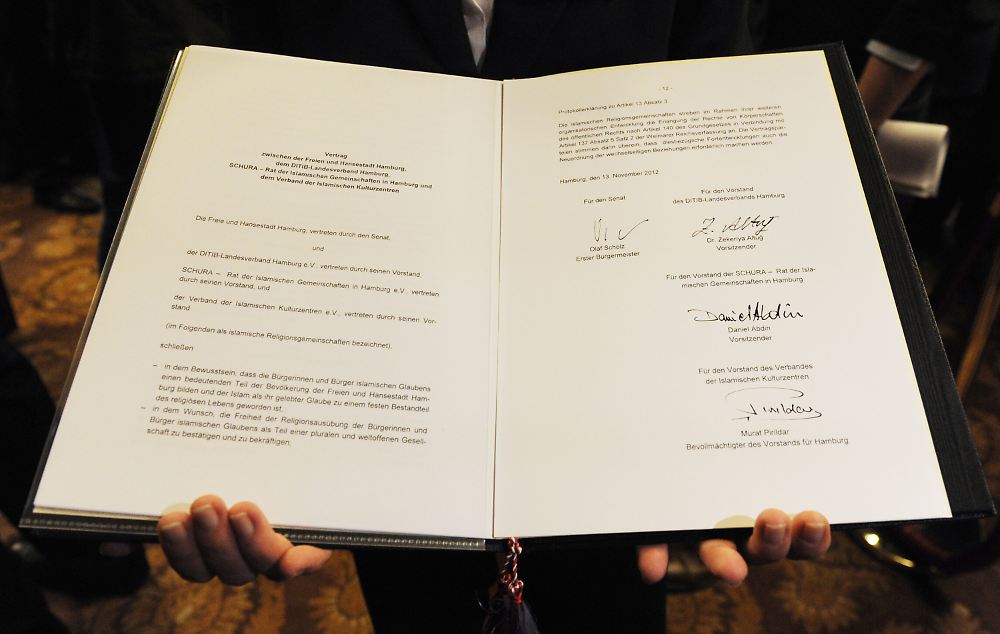
Hamburg, the second-largest city in Germany, has concluded a "historic treaty" with its Muslim communities that grants Muslims broad new rights and privileges but does little to encourage their integration into German society.

The November 13 agreement, signed by Hamburg's Socialist Mayor Olaf Scholz and the leaders of four Muslim umbrella groups, is being praised by the proponents of multiculturalism for putting the northern port city's estimated 200,000 Muslims on an equal footing with Christian residents.

Moreover, Muslim officials will also be able to determine who will (and who will not) be allowed to teach courses about Islam in city schools. In practice, this means that only Muslims will be allowed to teach Islam and that pupils will not be exposed to any critical perspectives about the religious, social and political ideology of Islam.

Under the wide-ranging accord, Muslims in Hamburg will also have the right to take three Islamic holidays as days off from work. Up until now, it has been up to individual employers to decide whether or not to grant Muslim staff religious days off on a case-by-case basis. In addition, Muslim students will be exempt from attending school on Muslim holidays.

The agreement also includes provisions for the construction of more mosques in Hamburg, the upkeep of cultural Islamic facilities, the authorization for Muslims to bury their dead without the use of coffins, as well as the counseling of patients and prison inmates by Muslim clerics.

Hamburg has also pledged to incorporate Muslim broadcast slots alongside Protestant and Catholic broadcasts on public and private radio and television, as well as broadcasting council seats for Muslims with the northern Germany's NDR public broadcaster and Germany's federal ZDF television channel.

Muslims for their part undertake to respect fundamental rights and support equality between the sexes, although the document provides no specifics on how these notions are defined or how they will be enforced.

Mayor Scholz, who is a former federal labor minister of the opposition Social Democrats (SPD), described the signing at the Hamburg city hall as a "milestone" for integration, adding: "With the signing of these agreements, we are strengthening the societal foundation of our city: we are all Hamburg."

Hamburg's agreements were made with the city's Alevi community (Alevis are a liberal sect within Islam based mostly in Turkey) and three Muslim umbrella organizations: the DITIB Turkish-Islamic Union (DITIB), the Council of Islamic Communities (Shura) and the Federation of Islamic Cultural Centers (VIKZ). Together these four groups are said to represent about 90% of the Muslims living in Hamburg.

Muslims for their part hope the Hamburg treaty will establish a precedent for the rest of Germany to follow. The spokesperson for the Alevi community in Germany, Aziz Alsandemir, says: "We hope that this accord will be viewed as a trigger by other provinces."

Bremen, the second-largest city in northern Germany, is close to finalizing its own treaty with local Muslim umbrella groups. According to the Socialist mayor of Bremen, Jens Böhrnsen, "Muslims form a significant part of the population of Bremen." The German states of Baden-Württemberg and Schleswig-Holstein, both of which are run by Socialist governments, are also looking at negotiating treaties with the Muslims in their regions.

At the national level, the SPD has said it would like to see Islam recognized as an official religion in Germany. In aninterview with the newspaper Neue Osnabrücker Zeitung, SPD politician Dieter Wiefelspütz said: "It would be an important signal to the four million Muslims in Germany, if the state recognizes Islam as a religious community." He added: "Islam needs a fair chance in Germany."


Sunday, December 09, 2012

3 Faiths, 1 God: Judaism, Christianity, Islam


Teaser:

This is an excerpt from the ground-breaking documentary, Three Faiths, One God: Judaism, Christianity, Islam which compares similarities and differences in religious beliefs and practices that Islam has with Christianity and Judaism. It also examines how people of goodwill in the Abrahamic faith communities are coming to terms with historical conflicts that impact their lives today, the crisis of the fundamentalist approach to religious pluralism and tearing down barriers to understanding & respect. 

www.threefaithsonegod.com

Sunday, November 04, 2012

How Far Is America From Electing A Muslim President?


By Daniel Tutt,


Closer Than You Might Think
As someone deeply engaged in combatting Islamophobia, one of the highlights of the 2008 Presidential election was when General Colin Powell denounced the myth that President Obama is Muslim on Meet the Press. General Powell, a senior statesman respected across partisan lines managed to clear a decade of post 9/11 Islamophobia in a single sentence: “So what if he was?”
So what if President Obama was Muslim?
Of course President Obama is not a Muslim, despite a sizable bloc of the American public still believing that he is. While he may not have realized it, Powell’s statement was more than just a statement in support of then Sen. Obama for president. It told every young American Muslim that they are a part of what it means to be an American. Powell’s statement said that no Americans faith should be a barrier to them holding the highest office in the land.
I’ve never been an advocate for identity politics, but America is a country that thrives off of its diversity, and as the browning of America increases, bringing minorities into positions of power may matter less and less. The election of the nation’s first African American President has not realized Martin Luther King Jr.’s “Beloved Community,” nor has it ushered in greater civil rights for African Americans. It certainly has not ended racism. But its symbolic value is important and it shows that the principle of equality enshrined in the American constitution still means something.
Like race, the religion of a presidential candidate matters. Despite the climate of increasing islamophobia in America, America very well could elect a Muslim for President sooner than many think. If we look at American religious history, we find that perceptions towards religious outsiders change rapidly and surprisingly. It happened in 1960 when the nation elected John F. Kennedy, the first Catholic President, less than 60 years prior anti-Catholic sentiment was so vociferous that many Catholics were murdered.
To gauge whether America might elect a Muslim to be President, we should look closely at the “Islam of America:” Mormonism. Ever since its founding, Mormonism, the first American-born religion, has been portrayed as foreign and often defined in opposition to the Protestant majority. Even today, 16% of Americans say that they would not vote for a Mormon presidential candidate due to their suspicion of the religion’s influence on the country.
In a recent policy brief for the Institute for Social Policy and Understanding entitled, “Beyond the Stereotype: The Shared Story of Muslims and Mormons in America,” I examine the shared history of Mormons and Muslims and present suggestions for how policymakers and leaders from both faiths can move past prejudice towards mutual understanding.
Throughout American history, Mormonism has been culturally and theologically conflated with Islam to paint Mormons as foreign and to drum up xenophobic attitudes against them since Joseph Smith founded Mormonism in 1833 including wholly unflattering comparisons in popular culture.
The similar patterns and frames used to denigrate Mormons and Muslims historically are still with us today. The recent conflagration over the anti-Muslim film “The Innocence of Muslims” highlights how extremist Evangelical groups direct their bigotry at both Muslims and Mormons. Sam Klein, the alleged co-producer, is a former Marine and extremist Christian who has helped train militiamen in California churches and led “protests outside abortion clinics, Mormon temples and mosques.” While the vast majority of Evangelicals do not openly participate in such activities, Mormons and Muslims often internalize these movements as verification of a generally negative and widespread reaction to their respective faiths.
How Far Away Are We from a Muslim President?
Muslims belong to the country’s least favorable religion, and 42 percent of Americans claim that they would not vote for a Muslim presidential candidate. 63 percent of Americans claim to have never met a Muslim, but despite rising levels of Islamophobia in America, majorities of Americans don’t express anxiety with Muslims building a mosque in their neighborhood, or with having a Muslim as their neighbor. According to the Public Religion Research Institute’s recent findings, few Americans report having much knowledge about who Muslims are and what they believe. Only 14 percent of Americans say they know a lot about the religious beliefs and practices of Muslims, and 57 percent say they know only a little.
According to the Pew Forum’s extensive studies of attitudes towards Mormons, Romney’s Mormon faith should not make a substantial difference in his chances at becoming president. Many analysts pointed out that Romney’s inability to court Evangelical Christian voters would present the gravest threat to his chances at getting elected based on his faith. However, with the presidential election less than a week away, Billy Graham a leading evangelical figure in the U.S., removed the word “cult”from his association’s description of Mormonism, although some conservative Christians saw the move as partisanship.
Despite rising levels of Islamophobia, majorities of Americans don’t express anxiety with Muslims building a mosque in their neighborhood, or with having a Muslim neighbor. In other words, most Americans are more and more able to separate their anxieties about the religion Islam from American Muslims civic and political rights. According to the Public Religion Research Institute’s recent findings, few Americans report having much knowledge about who Muslims are and what they believe. Only 14 percent of Americans say they know a lot about the religious beliefs and practices of Muslims, and 57 percent say they know only a little.
In the same study, a majority of Americans claimed that American Muslims are an important part of the religious experience in America, even though a majority does not know a Muslim personally. As Muslim Americans grow in population prejudice will transform as people come into contact with Muslims and form more personal relationships. If Mormonism is any example, the day will soon come when a Muslim will be able to run for president and America will have grown out of its petty prejudices and stereotypes.
Daniel Tutt is a Fellow at the Institute for Social Policy and Understanding and Outreach Director of Unity Productions Foundation.
This article is part of the “Election 2012 – American Muslims VOTE!” series, which is running on Altmuslim at Patheos, AltmuslimahIllume, and Aziz Poonawalla’s news and politics blog on Patheos. Click on this special topics page to view all articles in this series and add your comments. Tweet your thoughts on this article, on the series, and on the 2012 elections at #MuslimVOTE.

Thursday, November 01, 2012

Hanging With The Muslims


By Steven Scholl,


On Labor Day weekend, I spent four days hanging out with 15,000 Muslims at theIslamic Society of North America’s 49th annual convention in Washington, D.C. As one of the few non-Muslims in attendance, I was able to eavesdrop on hundreds of conversations swirling around me, take in several talks by prominent Muslims and attend author Karen Armstrong’s address to the big donors to ISNA. I wish all America could have listened in on these startling and revealing declarations of faith from the North American Muslim front. I am sure most Americans would have been shocked by the content of the discourse at ISNA.
Shocked, because what Muslims say to each other when they are hanging out together is so radically ordinary.
Let’s start with the theme of the convention: “One Nation Under God: Striving for the Common Good.” How radical is that? There was a strong emphasis in workshops and speeches on how American Muslims can integrate the commandments of the Quran to better serve the poor, the oppressed, those in need within the Muslim community, and in cooperation with interfaith groups to help all people regardless of faith.
Finding common ground to further the common good as faithful citizens was a recurring theme throughout the Labor Day weekend gathering.
The Sanctity Of All Creation
I dropped into a talk by best-selling author-scholar Seyyed Hossein Nasr on moral values from an Islamic perspective. Nasr made a passionate plea to his Muslim audience that they remember that the Quran speaks of the sanctity of all creation and not just the human world. Nasr spoke of how most contemporary thought — especially social and economic theories — places humans at the center of creation.
He contrasted this with the Quran’s creation-based theology, arguing that it is critical for Muslims to advocate for green solutions, especially while environmental degradation is being advanced in the name of human comfort and economic greed. He exhorted Muslims to be more active in protecting the earth in the spirit of Islamic values.
Controversial Swiss scholar Tariq Ramadan seemed to be everywhere during the convention. He spoke at least seven times on major stages and in smaller rooms on panels. Ramadan had been banned from entering the United States in 2004, when he had been offered a tenured position at the University of Notre Dame’s Joan B. Kroc Institute for International Peace Studies. Citing the U.S. Patriot Act, the U.S. Immigration and Customs Enforcement revoked his U.S. visa. His offense? Making a donation to two Muslim charities that had tenuous ties to Hamas. After a U.S. Federal Appeals Court sided with Ramadan, his ban was lifted by Secretary of State Hillary Clinton in 2010.
At ISNA he spoke on the themes of his newest book,Islam and the Arab Awakening, on the fragile rise of democratic institutions in the Arab world and the role Islam will play in this unfolding process. He also spoke passionately to young Muslims one night, urging that Muslim women continue to assert themselves as leaders within the American Muslim community.
One of my favorite moments came watching Ramadan sign books after one of his panel talks. The two young boys, no older than 13, asked the scholar to sign his weighty, Oxford University Press tome. I could not catch the details of the conversation, but Ramadan spent extra time with these young Muslims, listening to their stories and questions and not rushing to sign the book and move on to the next buyer. His care and concern and focus on these teenagers was heartfelt and a joy to see.
Embedded With The Muslims
But more than the headliners, I was most interested in the rank and file Muslims attending the convention. I had a booth where I was selling books for my publishing house, White Cloud Press. For four days I witnessed a steady parade of Muslims, from infants to octogenarians, many who stopped for a few moments to talk about books and religion or just to talk about their hopes and aspirations.
There were great conversations with twenty something Muslims about marriage and how ISNA is a great meeting place for a young Muslim to meet a prospective spouse. Like Jewish and Christian conferences and conventions, at ISNA opportunities are created for young, singles to find their future mate. Journalist Obaid Siddiqui told me that besides the banquet there is always a big open area where singles can mingle to “see and be seen” at the hotel next to the convention center.
As I was flying home thinking about my four days “embedded” with American Muslims, what kept coming back to me was the very distinct vibe given off by the majority of Muslims I met and observed. The vibe can best be summed up by the Arabic word adab, which translates a range of English terms: Good manners, etiquette, refinement and morals.
As I mixed with Muslims I was inevitably met with incredible kindness and concern for my well-being, and I watched how this adab was taking place all around me. I was not just getting special treatment for being the guest. If I might generalize, Muslims manifest a simple yet profound sense of decorum displayed in their conversations and interactions that is sincere and very moving. They care for the needs of others.
In a very tangible way, these Muslims practice the Golden Rule found in all faith traditions, to do unto others as you would have done to yourself.
The Beauty Of Adab
This is all the more impressive when considering the seemingly endless rants against, and outright violence directed at, American Muslims. American Muslims, and especially American Muslim women, are often stuck in an impossible lose-lose situation. Tea Party militants accuse all Muslim men of hating women and abusing Muslim women as a matter of faith. Then the Tea Bag Taliban folk turn around andaccuse prominent American Muslim women, women who have achieved positions of influence in American society (Huma Abedin, Samar Ali, and Linda Sarsour, for example) of being Muslim terrorists.
Attacks on American Muslims remains a troubling constant in our lives today. Firebombing and defacing of mosques are frequent and hate crimes against Muslims, and those mistaken for Muslims like the Sikhs, are surging.
In August there was a surge in violence toward Muslims with eight attacks taking place in 11 days, including the mass killing at the Wisconsin Sikh Gurdwara (temple), a firebomb attack on a Muslim home, an attempted bombing of a mosque during prayers in Lombard, Illinois, a burning of a mosque in Joplin, Missouri, and assorted attacks and vandalism in Rhode Island, Oklahoma, and California.
Just a week ago, another mosque was burned in what was deemed by police to be anact of arson at the Islamic Center of Greater Toledo in Toledo, Ohio.
Through all of this, the American Muslim community’s response has been to work with law enforcement and to redouble efforts to educate Americans about their faith. In doing so, they have shown us that adab is an effective nonviolent way to confront hatred and violence. Adab is more than just making nice and giving up your seat on the metro. If you are an American Muslim, it means standing firm and facing hatred with dignity and forbearance and always being ready to make peace.
One of the most profound examples of the practice of Islamic values and especially of adab is the reaction of American Muslim men, women, and children in Orange County, California, when confronted with an angry mob screaming their hate in the name of their Christian faith. The scene was this: Orange County Muslims were holding a fundraiser for homeless relief efforts, not just for Muslims, but for the general community. The video of what went down is sickening at one level and beautiful at another.
It is difficult to stomach the hate speech in the name of God and country. But the beautiful thing to watch is the Muslims response. Walking through the hatemongers, the Muslims never flinch, they do not stop in entering the hall in order to do their Islamic duty of helping out their non-Muslim neighbors, and they never strike back or even argue with the Tea Party belligerents. They walk with purpose and dignity through the verbal bile directed their way: Their faith strong and their adab in full display.
Steven Scholl is publisher of White Cloud Press and a writer on religion and culture. He did graduate studies in Islamic thought, lived for a year in Cairo, Egypt, and leads tours to the Middle East through his company Imagine Adventures.

American Muslims Can Help Improve America’s World Image


Ever since the 9/11 attacks, American Muslims have been subject to an intense campaign which has questioned their loyalty to the United States. Charges ranged from claiming that they have not been outspoken enough in their condemnation of terrorism to complicity, incitement, and even specious claims of active participation in anti-American activities. Several prominent Muslim organizations, large mosques, and some civil rights advocacy organizations, have argued that the charges were baseless and deliberately malign the true views of Islam and its adherents.
Times have changed, but serious challenges remain an impediment to a fuller and active international role by the Muslim community. These challenges include the trust deficit that so defines the relationship between law enforcement and the Muslims. Add to this the incendiary statements by Internet-based pundits (Pamela Geller and Steve Emerson) and even public officials (Cong. Peter King and Cong. Michel Bachmann) a series of laws (The Patriot Act) and the NYPD espionage activities. All these efforts aim to strip Muslim citizens of their basic rights, are all present hindrances.
Notwithstanding these obstacles, the community, motivated by both internal and external factors, appears to be on the verge of a yet-uncharted path to becoming America’s de facto ambassador to the Arab and Muslim world. The community has reached an identifiable confluence of factors that portend of a rising constituency confident of its achievements, of the American constitution and laws, and like, others before it, desirous of “marketing” the United States to the world.
America’s often problematic and exceedingly controversial relationship with its over 6 million Muslims is the subject of much debate, political pandering, and downright hateful acts. An entire industry of Islamophobes and self-styled experts have attained national prominence due to their advocacy of the impending and irreversible existential divide between the backward world of Islam and the enlightened West. Regardless, American Muslims have put aside these matters and engaged in a significant campaign here in the US and abroad, fulfilling a role usually reserved for skilled and seasoned diplomats versed in the art of diplomacy. In essence, American Muslims have taken the role of goodwill ambassadors. Their role was twofold: first, to situate the aftermath of the recent vile anti-Islam movie (the protests and the killing of American officials) in its proper context for both fellow Americans and people in Muslim countries.
Several New Jersey mosques I have contacted confirmed their weekly congregational sermons (on Fridays) focused on the proper response to the recent American-made 14-minute movie titled “Innocence of Muslims,” that portrayed the Prophet Muhammad, Islam’s founder, as a villainous, homosexual, and child-molesting buffoon.
In what was perhaps one of his most passionately delivered sermons since arriving in the US in 1996, Imam Mohammad Qatanani of the Paterson Islamic Center of Passaic County prodded his congregation not to rush to judgment and not to make blanket accusations against all Coptic Christians. Eloquent and well researched as is customary, Imam Qatanani implored the community to recognize that the incessant attacks on Islam have done little in the way of precluding more people from becoming Muslims or weakened the faith of Muslims around the world. “Islam and its revered prophet are much bigger than any cheaply made movie or specious book or expedient political stance.”
The Imam stated further that the evolving events should avail us of “an opportunity to educate our fellow Americans that Islam is not represented by the actions of a few extremists.” Similarly, ‘it is incumbent upon us to remind our brethren that America did support the desire of the Arab peoples to rid themselves of the dictatorships and oppressors.”
The Imam added further, “Muslims should be offended by the movie. But they should also consider the source. The offensive video is no more representative of America than it is of the extremists who co-opted the video as a means to incite violence in the Arab world.”
CAIR, the Council on American Islamic relations, in a pioneering fashion, released an Arabic language video plea urging the protesters to understand the true implications of their actions. (See video of similar appeal in other languages) Nihad Awad, national executive director, told viewers in the Middle East that ordinary Americans and the U.S. government should not be blamed for the religious hatred expressed in the film.
Speaking in fluent classical Arabic, Mr. Awad said: "Islamic traditions include a number of instances in which the Prophet Muhammad (PBUH) had the opportunity to retaliate against those who abused him, but refrained from doing so. "One tradition, or hadith, states: 'You do not do evil to those who do evil to you, but you deal with them with forgiveness and kindness.'
Perhaps the most symbolic of the community’s assertiveness to combat extremism came in the formal union of Muslim and Coptic Christians in a Jersey City mosque. Mutual respect of all faiths and categorical denouncements of bigoted acts were their message. Their message will reverberated all over the Middle East.

Via: "The Examiner"

Photo: "Understanding Islam"
Via: "Deviant Art"