


Showing posts with label Economic Sanctions. Show all posts
Showing posts with label Economic Sanctions. Show all posts
Wednesday, December 10, 2014
War By Other Means
John Pilger and David Munro examine the policy of First World banks agreeing loans with Third World countries, who are then unable to meet the crippling interest charges.


Sunday, November 16, 2014
Writing History: The Pen Is Dipped In Palestinian Blood
"The fundamental reason for the ill health of the population in Gaza is of course the siege and the bombing"
“Israeli impunity is one of the greatest moral challenges of our time”
Monday, January 20, 2014
Paying The Price: Killing The Children Of Iraq
A documentary film by John Pilger
Sanctions enforced by the UN on Iraq since the Gulf War have killed more people than the two atomic bombs dropped on Japan in 1945, including over half a million children - many of whom weren't even born when the Gulf War began.
Wednesday, September 25, 2013
Closed Zone
Gisha - Legal Center for Freedom of Movement calls on the State of Israel to fully open Gaza's crossings and to allow the real victims of the closure - 1.5 million human beings - the freedom of movement necessary to realize their dreams and aspirations.
For more information visit: http://www.closedzone.com
Tuesday, August 27, 2013
Iran: The Real Cost Of Sanctions
Courtesy Of Al-Jazeera
The United States has unveiled aggressive new sanctions targeting Iran's currency and car industry that are among the toughest yet. They are aimed at making Iranian money all but unusable outside the country.
The latest measures mark the first time Iran's currency, the rial, has been directly targeted by sanctions.
The sanctions apply to foreign financial institutions making what is described as significant transactions in the rial, and those holding significant amounts of the currency outside Iran. However, the meaning of 'significant' in this case, has not been made clear.
The sanctions also ban the sale of goods and services to Iran's car industry, the second largest employer after the energy sector.
Iran's currency has been in free fall for some time, losing two thirds of its value in the past two years.
The sharpest drop came at the end of September 2012. On September 24, it would have taken 24,600 rials to buy one US dollar. By October 2, the cost of a dollar had risen to 39,000 rials - a 59 percent drop in the value of the currency in just one week.
These latest sanctions are the ninth round of restrictions imposed by the US. Diplomatic ties were broken in 1980 following the storming of the US embassy in Tehran. Successive US measures have prohibited almost all trade with Iran.
The United Nations ratified four rounds of sanctions between 2006 and 2010, over Iran's uranium, enrichment programme.
The European Union has also imposed its own restrictions, most notably, bans on the import, purchase and transport of Iranian crude oil and natural gas in 2012.
The UN imposed a near-total financial and trade embargo against Iraq in 1990. But 13 years of sanctions resulted in malnutrition, disease and a lack of clean water and medical supplies.
So, what is the human cost of sanctions against Iran?
To discuss this, Inside Story with presenter Veronica Pedrosa is joined by guests: Bahman Farmanara, the owner of a family-run textile business in Tehran, Raymond Tanter, the founder of the Iran Policy Committee, and author of the book: Arab Rebels and Iranian dissidents; and Shashank Joshi, a research fellow of the Royal United Services Institute, who has also written the book: Permanent Crisis: Iran's Nuclear Trajectory.
Wednesday, May 01, 2013
Iranian Sanctions Intended To Foster Unrest

Nima Shirazi explains:
Director of National Intelligence James Clapper and Director of the Defense Intelligence Agency Army Lieutenant General Michael Flynn testified before the Senate Armed Services Committee today and reiterated the same assessmentregarding Iran as was delivered last month.
The exact same statements – verbatim – were included in Clapper’s unclassified report, including the assessment that, “Iran is developing nuclear capabilities to enhance its security, prestige, and regional influence and give it the ability to develop nuclear weapons, should a decision be made to do so. We do not know if Iran will eventually decide to build nuclear weapons.”
Of course, as Clapper notes, Iran’s ability to potentially manufacture the components is inherent to its advanced nuclear infrastructure and is not an indication of an active nuclear weapons program, which all U.S. intelligence agencies agree Iran does nothave.
As such, Clapper again reported to the Senate Committee, “Iran has the scientific, technical, and industrial capacity to eventually produce nuclear weapons. This makes the central issue its political will to do so.”
In his testimony, Clapper stated that, were the decision to weaponize its nuclear energy program to be made by Ayatollah Khamenei, Iran could theoretically reach a “breakout” point within “months, not years.” His report repeats the assessment, though, that “[d]espite this progress, we assess Iran could not divert safeguarded material and produce a weapon-worth of WGU before this activity is discovered.”
Again, undermining the bogus claims that Iran is an irrational and reckless actor, Clapper maintained the judgment that “Iran’s nuclear decisionmaking is guided by a cost-benefit approach,” balancing its own domestic interests with “the international political and security environment.” Iran also has a defensive – not aggressive – military posture, one based on “its strategy to deter – and if necessary retaliate against – forces in the region, including US forces” were an attack on Iran to occur.
During questioning from Senators following his prepared remarks, Clapper admitted – as a number of recent independent reports have shown – that the increasingly harshsanctions levied upon Iran have had no effect on the decision-making process of the Iranian leadership, yet has produced considerable damage to the Iranian economy and resulted in increased “inflation, unemployment, [and the] unavailability of commodities” for the Iranian people.
This, he said, is entirely the point. Responding to Maine Senator Angus King, who asked about the impact sanctions have on the Iranian government, Clapper explained that the intent of sanctions is to spark dissent and unrest in the Iranian population, effectively starting that Obama administration’s continued collective punishment of the Iranian people is a deliberate (and embarrassingly futile) tactic employed to foment regime change.
“What they do worry about though is sufficient restiveness in the street that would actually jeopardize the regime. I think they are concerned about that,” Clapper said of the Iranian leadership. It is no wonder, then, that Clapper refers in his own official report to the economic warfare waged against Iran as “regime threatening sanctions.”
Not mentioned in the session, of course, are the decades of repeated affirmations by senior Iranian officials that Iran rejects nuclear weapons on strategic, moral and religious grounds. Within the past six weeks, this position has been reiterated by Iran’s envoy to the IAEA Ali Asghar Soltanieh, President Ahmadinejad, and Ayatollah Khamenei himself.
Just two days ago, for instance, during a three-day diplomatic visit to Africa, Ahmadinejad declared, “The era of the atomic bomb is over. Atomic bombs are no longer useful and have no effect on political equations. Atomic bombs belong to the last century, and anyone who thinks he can rule the world by atomic bombs is a political fool,” according to a report by Iran’s state-run PressTV. He also pushed back the constant conflation in Western discourse of nuclear energy with nuclear weapons. “Nuclear energy is one thing and an atomic bomb is another. This useful energy must belong to all nations,” he added.
Furthermore, reports that Iran has continued converting its stockpiled 19.75% enriched uranium into fuel plates for its cancer-treating medical research reactor gained absolutely no traction within the Committee or Clapper’s comments. For Congress, Iran is a threat simply by virtue of having independent political considerations, inalienable national rights and refusing to accept American hegemony over its own security interests.
South Carolina Senator Lindsey Graham, who spends most of his time advocating for new, illegal military adventures in the Middle East, presented this wholly disingenuous and misleading question to Clapper: “Over the last six months, as we’ve been imposing sanctions and been negotiating with the P5+1 regime, [does Iran] have more or lessenriched uranium for a nuclear bomb?”
None of Iran’s enriched uranium is “for a nuclear bomb” insofar as it is all far fromweapons-grade and under the safeguard and seal of the IAEA. Iran’s enriched uranium is no more “for a nuclear bomb” than Graham’s fanciest set of steak knives are for throat-slitting.
“Can I just say it’s more?,” Graham proffered, revealing that he already knew the answer he wanted to hear, at which point Clapper chimed in. “Not highly-enriched,” he said, “but up to the 20% level.” Graham was undeterred from his propagandizing and grandstanding. “Well, they’re marching in the wrong direction,” he said. “We talk, they enrich.” AIPAC poetry at its finest.
Shortly before ending the session, in response to questions from Connecticut Senator Richard Blumenthal, Clapper stated that the relationship between the American and Israeli intelligence communities – especially on the Iranian nuclear program – has “never been closer or more pervasive,” citing unprecedented levels of “intimacy.”
While each state continues to maintain its own unique sources for intelligence gathering, Clapper said, “generally speaking,” the United States and Israel are “on the same page” when it comes to Iran.
Pressing the issue on behalf of his AIPAC backers, Blumenthal asked whether allinformation is shared between the two nuclear-armed nations, at which point Clapper declined to agree completely.
“Pretty much,” he replied.
Why was Clapper being so cagey? An Associated Press report from last July seems to provide an answer:
Despite inarguable ties between the U.S. and its closest ally in the Middle East and despite statements from U.S. politicians trumpeting the friendship, U.S. national security officials consider Israel to be, at times, a frustrating ally and a genuine counterintelligence threat.
In fact, the AP states, “The CIA considers Israel its No. 1 counterintelligence threat” in the Middle East, meaning that the agency “believes that U.S. national secrets are safer from other Middle Eastern governments than from Israel.” This is unsurprising, of course, as “Israel’s foreign intelligence service, the Mossad, and its FBI equivalent, the Shin Bet, both considered among the best in the world, have been suspected of recruiting U.S. officials and trying to steal American secrets.”
Did any of that make it into Clapper’s “Worldwide Threat Assessment” today? No, of course not. Israel was only mentioned as a victim and an ally. One might think an untrustworthy, nuclear-armed serial aggressor, constantly threatening to drag the United States into an unprovoked military conflict with inevitable devastating consequences, all with the allegiance and blessing of Congress, would rank rather high on potential security threats to the United States.
But James Clapper isn’t allowed to say that.
Sunday, March 24, 2013
The Coming Collapse Of Iran Sanctions

Flynt Leverett and Hillary Mann Leverett write in Al-Jazeera:
Western policymakers and commentators wrongly assume that sanctions will force Iranian concessions in nuclear talks that resume this week in Kazakhstan - or perhaps even undermine the Islamic Republic's basic stability in advance of the next Iranian presidential election in June.
Besides exaggerating sanctions' impact on Iranian attitudes and decision-making, this argument ignores potentially fatal flaws in the US-led sanctions regime itself - flaws highlighted by ongoing developments in Europe and Asia, and that are likely to prompt the erosion, if not outright collapse of America's sanctions policy.
Virtually since the 1979 Iranian revolution, US administrations have imposed unilateral sanctions against the Islamic Republic. These measures, though, have not significantly damaged Iran's economy and have certainly not changed Iranian policies Washington doesn't like.
Between 2006 and 2010, America got the UN Security Council to adopt six resolutions authorising multilateral sanctions against Iran - also with limited impact, because China and Russia refused to allow any resolution to pass that would have harmed their interests in Iran.
Beyond unilateral and multilateral measures against Iran's economy, the US has, since 1996, threatened to impose "secondary" sanctions against third-country entities doing business with the Islamic Republic. In recent years, Congress has dramatically expanded the range of activities subject to such sanctions, going beyond investments in Iranian oil and gas production to include simple purchases of Iranian crude and almost all financial transactions.
This year, Congress blacklisted transfers of precious metals to Iran, to make it harder for Tehran to repatriate export earnings or pay for imports in gold. Congress has also increased the sanctions that can be imposed on offending entities, including their cut-off from the US financial system.
Secondary sanctions are a legal and political house of cards. They almost certainly violate American commitments under the World Trade Organisation, which allows members to cut trade with states they deem national security threats but not to sanction other members over lawful business conducted in third countries. If challenged on the issue in the WTO's Dispute Resolution Mechanism, Washington would surely lose.
India aims to cash in on Iran sanctions
|
Consequently, US administrations have been reluctant to impose secondary sanctions on non-US entities transacting with Iran. In 1998, the Clinton administration waived sanctions against a consortium of European, Russian and Asian companies developing an Iranian gas field; over the next decade, Washington declined to make determinations whether other non-US companies' Iranian activities were sanctionable.
The Obama administration now issues blanket waivers for countries continuing to buy Iranian oil, even when it is questionable they are really reducing their purchases.
Still, legal and reputational risks posed by the threat of US secondary sanctions have reduced the willingness of companies and banks in many countries to transact with Iran, with negative consequences for its oil export volumes, the value of its currency and other dimensions of its economic life.
Last year, the European Union - which for years had condemned America's prospective "extraterritorial" application of national trade law and warned it would go to the WTO's Dispute Resolution Mechanism if Washington ever sanctioned European firms over Iran-related business - finally subordinated its Iran policy to American preferences, banning Iranian oil and imposing close to a comprehensive economic embargo against the Islamic Republic.
In recent weeks, however, Europe's General Court overturned European sanctions against two of Iran's biggest banks, ruling that the EU never substantiated its claims that the banks provided "financial services for entities procuring on behalf of Iran's nuclear and ballistic missile programmes".
The European Council has two months to respond - but removing sanctions against the banks would severely weaken Europe's sanctions regime. Other major players in Iran's economy, including the Central Bank of Iran and the National Iranian Oil Company, are now challenging their own sanctioned status.
On the other side of the world, America is on a collision course with China over sanctions. In recent years, Beijing has tried to accommodate US concerns about Iran. It has not developed trade and investment positions there as rapidly as it might have, and has shifted some Iran-related transactional flows into renminbito to help the Obama administration avoid sanctioning Chinese banks (similarly, India now pays for some Iranian oil imports in rupees).
Whether Beijing has really lowered its aggregate imports of Iranian oil is unclear - but it clearly reduces them when the administration is deciding about six-month sanctions waivers for countries buying Iranian crude.
The administration is taking its own steps to forestall a Sino-American conflict over sanctions. Besides issuing waivers for oil imports, the one Chinese bank Washington has barred from the US financial system for Iran-related transactions is a subsidiary of a Chinese energy company - a subsidiary with no business in the US.
However, as Congress enacts additional layers of secondary sanctions, President Obama's room to manoeuver is being progressively reduced. Therein lies the looming policy train wreck.
If, at congressional insistence, the administration later this year demands that China sharply cut Iranian oil imports and that Chinese banks stop virtually any Iran-related transactions, Beijing will say no. If Washington retreats, the deterrent effect of secondary sanctions will erode rapidly. Iran's oil exports are rising again, largely from Chinese demand.
"If Washington sanctions major Chinese banks and energy companies, Beijing will respond... by retaliating against US companies in China." |
Once it becomes evident Washington won't seriously impose secondary sanctions, growth in Iranian oil shipments to China and other non-Western economies (for example, India and South Korea) will accelerate. Likewise, non-Western powers are central to Iran's quest for alternatives to US-dominated mechanisms for conducting and settling international transactions - a project that will also gain momentum after Washington's bluff is called.
Conversely, if Washington sanctions major Chinese banks and energy companies, Beijing will respond - at least by taking America to the WTO's Dispute Resolution Mechanism (where China will win), perhaps by retaliating against US companies in China.
Chinese policymakers are increasingly concerned Washington is reneging on its part of the core bargain that grounded Sino-American rapprochement in the 1970s - to accept China's relative economic and political rise and not try to secure a hegemonic position in Asia.
Beijing is already less willing to work in the Security Council on a new (even watered-down) sanctions resolution and more willing to resist US initiatives that, in its view, challenge Chinese interests (witness China's vetoes of three US-backed resolutions on Syria).
In this context, Chinese leaders will not accept American high-handedness on Iran sanctions. At this point, Beijing has more ways to impose costs on America for violations of international economic law that impinge on Chinese interests than Washington has levers to coerce China's compliance.
As America's sanctions policy unravels, President Obama will have to decide whether to stay on a path of open-ended hostility toward Iran that ultimately leads to another US-initiated war in the Middle East, or develop a very different vision for America's Middle East strategy - a vision emphasising genuine diplomacy with Tehran, rooted in American acceptance of the Islamic Republic as a legitimate political order representing legitimate national interests and aimed at fundamentally realigning US-Iranian relations.
Sunday, February 17, 2013
The Age Of The Siege

NATO Strategies, Economic Sanctions and The "Responsibility To Protect"
By Felicity Arbuthnot
Courtesy Of "Global Research"
Disengage, avoid, and withhold support from whatever abuses, degrades and humiliates humanity.” (Alice Walker, b:1944.).
“[former Danish PM and Secretary General of NATO] Anders Fogh Rasmussen, Du har blod på dine hænder” ( “You have blood on your hands”), Danish protester, 2003.
The siege of Leningrad is still considered the most lethal siege in world history, a shocking “racially motivated starvation policy”, described as: “an integral part of Nazi policy in the Soviet Union during World War 11.”
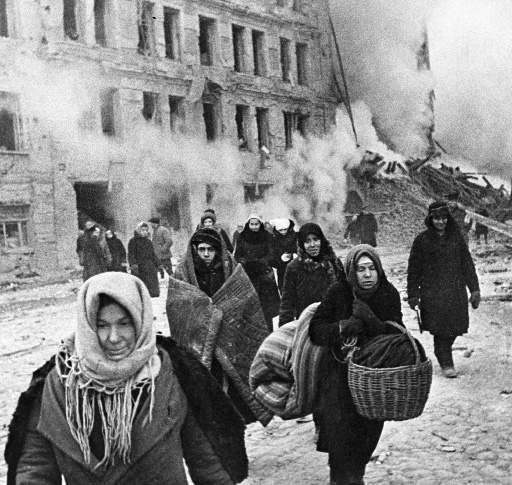 The 872 day siege began on 8th September 1941 and was finally broken on 27th January 1944. It is described as: “one of the longest and most destructive sieges in history and overwhelmingly the most costly in casualties.” Some historians cite it as a genocide. Due to record keeping complexities the exact number of deaths resultant from the blockade’s deprivations are uncertain, figures range from 632,000 to 1.5 million.
Sieges now extend to entire countries, they have become the torture before the destruction. And they are not counted in long days, but in long years. Iran thirty three years, Iraq thirteen-plus years. Ironically the disparity in the deaths in Iraq resultant from that siege, mirror near exactly what was considered a “genocide” in Leningrad.
Syria has been subject to EU “restrictions” since 2011, ever more strangulating, with near every kind of financial transaction made impossible by May 2011- when “restrictions” were also placed on President Assad himself, all senior government officials, senior security and armed forces Heads. The list of that denied is dizzying (i.) By February 2012, assets of individuals were frozen, as those of the Central Bank of Syria.
Cargo flights by Syrian carriers to the EU were also barred, as was trade in gold, precious metals and diamonds – anything which might translate in to hard cash, without which neither individuals or countries can purchase the most basic essentials.
By July 2012 Syrian Arab Airlines and even Syria’s Cotton Marketing Organisation had joined the EU’s victims.
America of course, had been way ahead of the game, with the Syria Accountability and Lebanese Sovereignty Act (ii) signed in to law on 12th December 2003, the year of Iraq’s comprehensive US-led destruction. Thus the mighty USA’s personal siege on under twenty one million people, is now entering its tenth year.
By last August, as with Iraq before it, the inability to trade meant that, as ever, the now Nobel Peace Prize winning EU and the policies of the Nobel Peace Prize winning US President, were targeting Syria’s most vulnerable.
Many pharmaceutical companies had closed, resulting in severe shortages of medication for chronic diseases and the casualties of the insurgency, according to the World Health Organisation (iii.) Prior to the US-UK-EU-NATO supported insurgency, Syria had produced ninety percent of its drugs and medication needs.
However : “ … production has been hit by the fighting, lack of raw materials, impact of sanctions and higher fuel costs.” Further, near all pharmaceutical plants were located in areas of heaviest fighting, Aleppo, Homs and Damascus provinces and have suffered “substantial damage.” The result is: “a critical shortage of medicines”, according to WHO spokesman Tarik Jasarevic.
“Drugs for tuberculosis, hepatitis, hypertension, diabetes and cancer are urgently needed, as well as haemodialysis for kidney diseases.”
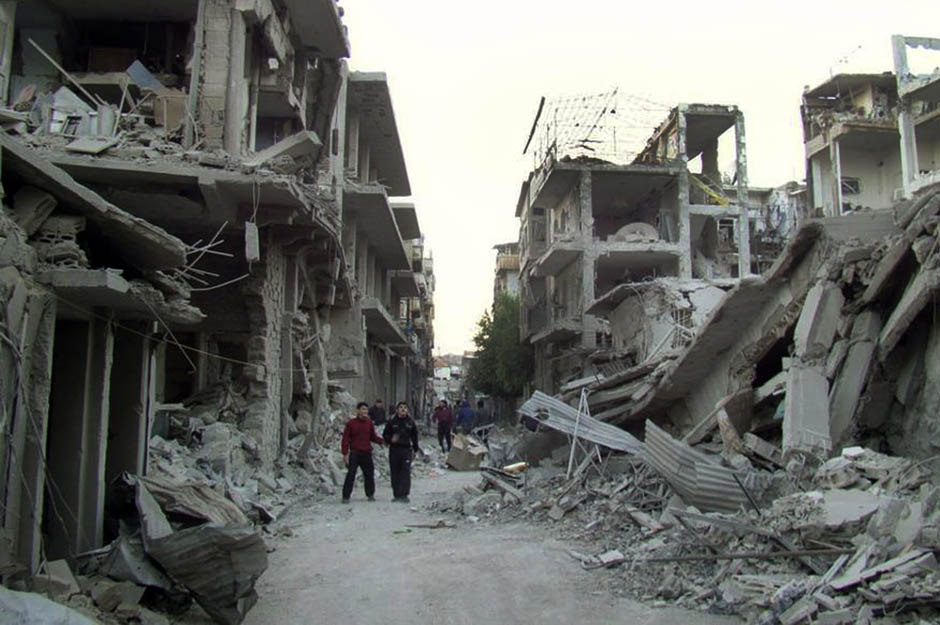 Health centres have closed due to violence, damage, or being taken over by the Western backed fighters. (image: Homs, 2012)
“The health facilities that have stopped functioning are located in the most affected areas where the urgent need for medical and surgical interventions is the most prominent,” Jasarevic said.
The Syrian Health Ministry reported that it “lost” – stolen or destroyed – two hundred ambulances in a few weeks through June and early August 2012.
Banks run out of cash and the 2012 wheat harvest is likely to have been wrecked because of the shortage of labour, according to U.N. agencies. In the Middle East bread is still truly the “staff of life.” The all mirrors Iraq, even down to the wheat harvest – in Iraq those bombing the country over thirteen years until the invasion, dropped flares on the harvested wheat and grains, reducing tentative bread security to ashes.
Syria struggles to meet it’s annual grain imports of around four million tons, because of a superb sleight of hand by the siege imposers. Essential foods are exempt from sanctions, but moneys are frozen, thus the wherewithal to trade. The country is ever potentially hours away from a bread crisis.
In 2011 Syria’s own harvest was hit by blight, water shortages and conflict. In December 2012 Iran sent consignments of flour to Syria, temporarily easing the bread crisis, but the siege under which Iran struggles is also of enormity – and shamefully under reported in the West.
As Iran shipped flour to Syria, Iran’s Health Ministry was approaching India for a life saving list of denied medications, for the most critical conditions in patients. Vital items denied included: “drugs to treat lung and breast cancers; brain tumours; heart ailments; infections after kidney, heart and pancreas transplants; meningitis in HIV patients; arthritis; bronchitis and respiratory distress in newborns; and epilepsy.” (iv)
And here again is that sleight of hand: “Although trade in medicine is exempt from international sanctions imposed by the UN Security Council and the unilateral sanctions announced by the US and EU, Western banks have been declining to handle transactions.” (Emphasis mine.)
Targeting the sick is the action of the criminally insane. For targeting the newborn surely no expression has been conceived, except by Madeleine Albright when referring to Iraq’s sanctions related, half million child deaths: “ … we think the price is worth it.” It was not a slip of the tongue, it was clearly to be the New World Order.
This partial list of medications unobtainable by Iran should be put on a wall of shame in Washington and all those Nobel winning EU capitol cities:
“Denied include chemotherapy; drugs used to prevent infections in kidney, heart and pancreas transplant patients and in AIDS treatment. Treatments for colon cancer; cell lung cancer; cancerous brain tumours; chemotherapy drugs for lung, ovarian and testicular cancer; treatment for non-Hodgkin’s lymphona.”
Also: “treatment for breast cancer therapy; a range of chemotherapy drugs; treatment for life threatening recurring heart conditions; specific meningitis treatments; drugs for respiratory distress in the new born; anti-convulsion treatments for epileptic seizures; wide spectrum treatment for heart ailments.”
Additionally:
“Nitroglycerine for angina and coronary artery disease; treatment for septicaemia and bacterial meningitis; medication to reduce risk of premature birth; treatments for acute bronchitis, pneumonia, bone infections, gynaecological infections and those of urinary tract.”
Nimidopine which reduces the risk of damage after bleeding inside the head, is also on the list. How fortunate Madam Clinton did not suffer her alleged brain-adjacent clot in Iran.
Last October Iran’s Head of The Foundation for Special Diseases, Fatemeh Hashemi, stated that six million patients were potentially at risk as a result of sanctioned medications (v.) A holocaust for-warned – and met by that murderous “international community” with near silence.
Mehrnaz Shahabi (vi) also encapsulates the captives in this Age of the Siege:
“Iran (made) ninety seven percent of its needed drugs domestically … The devalued currency means that raw materials imported for drug production are now a lot more expensive.“In many cases, the raw material cannot even be paid for because of the banking sanctions, particularly as the Society for Worldwide Interbank Financial Telecommunication (SWIFT) in compliance with the EU sanctions, has stopped its electronic communication services for Iranian financial institutions and transactions from Iran.”
Thus, as Syria, domestically produced drugs are near unavailable.
Additionally: “The most advanced life-saving drugs cannot be made in generic form.These include drugs for heart disease, lung problems, kidney disease and dialysis, multiple sclerosis, thalassaemia, haemophilia and many forms of cancer.”
Cancers in Iran have soared and a “cancer tsumani” is predicted by 2015. Since Iran borders and breathes the same air as Iraq, it would not be unreasonable to assume that as Iran is punished for its nuclear industry, America and Britain’s, in the form of the depleted uranium weapons used in Iraq, bears some responsibility for another health tragedy of enormity.
“All of the surgeries for thousands of haemophilic patients have been cancelled because a shortage of coagulant drugs. A 15-year-old child died at the end of October due to the absence of coagulant medication. The head of Iran’s Hemophilia Society has said, stating: ‘This is a blatant hostage-taking of the most vulnerable people by countries which claim they care about human rights. Even a few days of delay can have serious consequences like hemorrhage and disability.’ ”
As the New Year was celebrated across Europe and the “Land of the Free”, the Syrian Upper Mesopotamia Archbishop, Jaques Behnan Hindo, was writing an urgent appeal to the Presidency of the United Nations Food and Agriculture Organisation.
In a situation which he warned: “could soon become catastrophic”, he said supply routes were halted and: “every economic activity appears paralyzed (causing) depletion of vital goods, and soaring prices.
“The lack of fuel prevents heating homes and leads to the complete closure of all agricultural activities, just as the planting season begins.“The grain silos were looted and wheat was sold to Turkish traders who conveyed it in Turkey, under the gaze of the Turkish customs officers.”
It is impossible not to reflect that NATO ally Turkey is the equivalent of the bombing flame droppers on the Iraqi harvests.
In addition to the plundered, grain, the Archbishop denounced the gradual disappearance of other vital products including, as Iraq, baby milk.
Archbishop Hindo also sent an appeal to Iraq’s Prime Minister Nuri al-Maliki: “Please help us as quickly as possible, by sending 600 fuel tanks, 300 tanks of gasoline and some tons of flour.
“The first victims are the children. You experience in your body, in your soul – and in the children all the injustice”, caused by draconian, life threatening, illegal, collective punishment on a nation’s people, yet again starting with the unborn, the newborn, and the barely crawling.
At the end of WW11, Leningrad (now Saint Petersberg) was awarded the status of Hero City for collective unwavering courage, resistance and inventiveness under Nazi atrocities.
The world is surely in need of the status of Hero Country for those who exhibit the same courageous qualities against those nations who emulate the same atrocities.
Notes
Tuesday, February 12, 2013
US Officials Confess To Targeting Iran’s Civilian Population

By Franklin Lamb
Courtesy Of "Eurasia Review"
“It would be a defense lawyer’s worst nightmare wouldn’t it? I mean to have one's clients, in this case the Vice-President of the United States and the outgoing Secretary of state confess so publicly to serial international crimes against a civilian population?”The confessions and the crimes, were those admitted to by US Vice-President Joe Biden and outgoing Secretary of State Hillary Clinton this past week.
Both of the US officials, in discussing US relations with the Islamic Republic, openly admitted that the US-led sanctions against Iran (and Syria) are politically motivated and constitute a "soft-war" against the nearly 80 million people of Iran (23 million people in Syria) in order to achieve regime change.
Mrs. Clinton, was the first of the dynamic duo to be heard from. She acknowledged that the harsh US sanctions were intended to target and send the people of Iran a message. “So we hope that the Iranian people will make known their concerns… so my message to Iranians is do something about this.”
An Australian Broadcasting Company interviewer asked Clinton on January 31 of last year: “If you have issues with the government of Iran, why destroy the Iranian people with the current sanctions in place? It's very difficult to find certain medicines in Iran. Where is your sense of humanity?”
What the Clinton interrogator had in mind, she explained later, were the US-led sanctions reducing Iran’s GDP growth (-1.1% GDP) resulting in an inflation of 21.0% that is being felt mostly by the civilian population. As well as periodic food shortages in the supermarkets of such staples such as rice, there are price rises on everything.
For example, per page printing for students is up as much as 400% and the cost of aused car up 300%. In general, supermarket items have risen 100 to 300 percent or higher over the past twenty-four months and, devastating for many, certain lifesaving medicines are no longer available.
Clinton: “Well, first, let me say on the medicine and on food and other necessities, there are no sanctions.” This statement is utter nonsense and Mrs. Clinton knows it.
The targeting process by the US Treasury Department is well entrenched in Washington.
When dear reader is next in Washington, DC, perhaps on a tour bus riding down NW Pennsylvania Avenue following a visit to the US Capitol, consider getting off the bus at 15th and Pennsylvania at the US Department of the Treasury. Walk around the main building and you will see an Annex building. This building, as Clinton knows well, and like Biden, has visited more than once, houses the Office of Financial Assets Control (OFAC). The well-funded agency’s work includes precisely targeting “food and medicines and other necessities” in order to force the civilian population of Iran to achieve regime change.
For more than two hundred years, since the War of 1812, when OFAC was founded to sanction the British, the office has become expert at imposing sanctions and it has done so more than 2000 times. OFAC currently uses a large team of specialists and computers to think-up, design, test, and send to AIPAC and certain pro-Zionist officials and members of congress their work-product topped off by recommendations.
OFAC and its Treasury Department associates have had a hand in virtually every US sanction applied to Iran since President Jimmy Carter issued Executive Order 12170 in November 1979 freezing about $12 billion in Iranian assets, including bank deposits, gold and other properties.
From the State Sponsor of Terrorism Designation Act in 1979 to the Syria Accountability Act of 2004, more than a dozen Presidential Executive Orders including the 2011-2012 Executive orders which froze the US property of high-rankling Syrian and Iranian officials and more broadly E.O. 13582 which froze all governmental assets of the Syrian government and prohibited Americans from doing business with the Syrian government and banned all US import of Syrian petroleum products.
What OFAC does with its data base is science not art. It can calculate quite precisely the economic effect on the civilian population of a single action designating one company, bank, government entity or infrastructure system of a country. OFAC, on behalf of its government, electronically wages a cold war against its civilian targets.
This week OFAC and the Treasury Department blacklisted Iran’s state broadcasting authority, Islamic Republic of Iran Broadcasting, responsible for broadcast policy in Iran and overseas production at Iranian television and radio channels, potentially limiting viewing and listening opportunities for Iran’s civilian population. Its director, Ezzatollah Zarghami, was included in the action. Additionally sanctioned are Iran’s Internet-policing agencies and a major electronics producer.
David S. Cohen, the pro-Zionist Treasury undersecretary for terrorism and financial intelligence, who oversees the OFAC sanctions effort, reportedly following meetings with Israeli officials, said last week's actions were meant to “tighten the screws and intensify the economic pressure against the Iranian regime.”
In reality, the sanctions target the civilian population and the “Iranian regime” won’t be much affected. The same applies to Syria. Despite the public relations language that “food and medicine are exempted from the brutal US-led sanctions, as OFAC well knows, the reality is something else. They know well the chilling effects of the sanctions on international suppliers of medicines and food stuffs with respect to a targeted country.
The US Treasury department has thousands of gigabytes of data confirming that the boards of directors of international business do not, and will not allow their companies to risk millions of dollars in profits by technically violating any of the thousands of details in the sanctions -- many of which are subject to interpretation -- for the sake of doing business with Iran or Syria. This is why there are severe shortages of medicines and certain foodstuffs in these sanctioned countries and to state otherwise is Orwellian News-Speak.
OFAC does not operate in a vacuum. It works closely with other US agencies including the 16 intelligence agencies that together make up the UN Intelligence Community.
Together they have applied sanctions of great breadth and severity against the civilian populations of Syria and Iran. These sanctions have been bolstered on occasion by several direct and/or green-lighted Israeli assassinations and cyber-assaults, hoping to foment civil unrest to achieve regime change and other political goals.
A few days after Mrs. Clinton's somewhat inadvertent confession that the US government intentionally targets the civilian population of Iran, Vice President Joe Biden chimed in on the 4th of February that the US was ready to hold direct negotiations with Iran but added the caveat,
"We have also made clear that Iran's leaders need not sentence their people to economic deprivation,” acknowledging as did Hillary that the US sanctions are intended to target and harm the Iranian and Syrian people.
A senior Obama administration official described the latest step as “a significant turning of the screw,” meaning that the people of Iran face a “stark choice” between bowing to US demands and reviving their oil revenue, the country’s economic lifeblood or more and more sanctions will follow until they do.
This targeting of Iran’s and Syria’s civilian population by US-led sanctions is a massive violation of the principles, standards and rules of international law and their most fundamental underpinnings which is the protection of civilians.
Some Examples
The 1977 Additional Protocols to the 1949 Geneva Conventions prohibit any measure that has the effect of depriving a civilian population of objects indispensable to its survival.
Article 70 of Protocol I mandates relief operations to aid a civilian population that is “not adequately provided” with supplies and Article 18 of Protocol II requires relief operations for a civilian population that suffers “undue hardship owing to a lack of supplies essential for its survival, such as foodstuffs and medical supplies.”
Prohibition On Starvation As A Method Of Warfare
• Under international humanitarian law, civilians enjoy a right to humanitarian assistance during armed conflicts.
• Art. 23 of the Fourth Geneva Convention obligates states to facilitate the free passage and distribution of relief goods including medicines, foodstuffs, clothing and tonics intended for children under 15, expectant mothers, and maternity cases.
• Art. 70 of Additional Protocol I prohibits interfering with delivery of relief goods to all members of the civilian population.
• US-led sanctions are prohibited by the principle of proportionality found in Arts. 51 and 57 of Additional Protocol I.
• Under the terms of Art. 3 common to the 1949 Geneva Conventions, humanitarian and relief actions must be taken. Pursuant to Art. 18(2) of Additional Protocol II, relief societies must be allowed to offer their services to provide humanitarian relief.
• The US-led sanctions violate the Rule of Distinction between civilians and combatants
The Right To Life
The US-led sanctions violate the right to life incorporated in numerous international human rights instruments including Art. 6 of the International Covenant on Civil and Political Rights, 1966; Art. 2 of the European Convention for the Protection of Human Rights and Fundamental Freedoms, 1950; and Art. 4 of the African Charter of Human Rights, 1981.
The Rights Of The Child
One of the groups most vulnerable to US-led sanctions in Syria and Iran are children. The rights of children are laid down in the United Nations Convention on the Rights of the Child, 1989, which currently stands as the most widely ratified international agreement.
Most relevant in the context of the US-led sanctions are Arts. 6 and 24 of the Convention, according to which every child has the inherent right to life and the right to the highest attainable standard of health and access to medical services.
If "terrorism" means, as the United States government defines it as the targeting of civilians in order to induce political change from their government, what is it called when the American government itself applies intense economic suffering on a civilian population, causing malnutrition, illnesses, starvation and death in order to induce regime change?
The US-led sanctions against Iran and Syria are illegal, inhumane, ineffective, immoral and outrageous. They must be resisted every day by every person of good will, everywhere, until they are withdrawn.
Tuesday, February 05, 2013
Iran Unveils Copycat Arsenal
... the main hardware is grounded in experience and hardship. Driven by desperation and shaped by the isolation that comes with widening external sanctions, Tehran’s copycat arsenal could contain a few nasty surprises for the U.S. and its allies in the unlikely event that tensions over Iran’s nuclear program come to blows.
For one, low-tech weapons force the users to fight creatively. “There’s a chance they’ll catch us by surprise,” Air Force Lt. Col. Dan Ward, an engineer and acquisitions expert and prolific writer (.pdf), tells Danger Room in an e-mail.
Equally importantly, Iran’s tendency to produce slightly evolved versions of classic weapons means it doesn’t spend billions of dollars developing, say, a brand-new warplane and all its associated technologies from scratch. “One of the benefits of this ‘frugal innovation’ approach is that it allows a greater quantity of aircraft to be purchased (as opposed to the infamously small fleet of F-22s, for example),” Ward explains.
The Iranian air force maintains around 500 manned warplanes, making it one of the biggest in the region. But it’s not just planes benefiting from Tehran’s secondhand weapons-development strategy. The Toufan 2 attack helicopter, which first appeared in public during a military exercise this week, is an upgraded version of the American AH-1, a Vietnam War-era copter that Iran originally purchased from U.S. manufacturer Bell back in the 1970s, before the Islamic Revolution transformed Tehran from America’s close ally to one of its most bitter enemies.
Aviation blogger David Cenciotti notes what appear to be the Toufan 2′s improvements over the original American-made ‘copter. “The main difference from the version already in service is the electro-optical surveillance and tracking system that is believed to use FLIR (Forward-Looking Infrared) technology, visible electro-optical imagery, as well as laser designation and illumination to provide target identification, ranging and tracking capability.”
That approach — adding new electronics to an old, sometimes copied, vehicle — is characteristic of Iran’s arms industry. Among other hardware, Iranian technicians have also reverse-engineered and enhanced: the American F-5 jet fighter; American, British and Russian tanks; British patrol vessels; and Chinese and North Korean ballistic missiles.
The Iranian version of the F-5, known locally as the Saeqeh, made the news a few years ago when state media claimed the obviously non-stealthy jet could evade enemy radar. The government-controlled press has made equally risible boasts regarding the Iranian navy’s new Jamaran “destroyer,”which is in fact a copy of a copy of a decades-old British light frigate, albeit with relatively modern weapons based on U.S. designs. Tehran’s Zulfiqar tanks and Dehlaviyeh missiles are likewise knock-offs.
Iran’s homemade drones (there are lots of them) could combine broad design elements taken from U.S. UAVs that have crashed,with surprising frequency, in or near Iranian territory in recent years. Fitted with electronics built at home or sourced from Iran’s few remaining allies, new hybrid drones might look like knock-offs but boast unique abilities. Unexpected sensor combinations, for instance.
Iranian lawmaker Avaz Heidarpour said last month that his country had figured out how to build its own versions of a U.S. stealth spy drone that crashed on the Iran-Afghanistan border in December 2011. Tehran’s engineers possess the technical know-how to perfectly duplicate the radar-absorbing materials that are one key to American stealth warplanes.
But considering Iran’s decades of experience tearing down, copying, manufacturing and upgrading old designs of foreign origin, it’s not inconceivable that a rough approximation of the Sentinel could soon appear in the skies over Iran and its neighbors. If history is any guide, the Iranian done-clone could add customized systems to an airframe modeled on the lines of the crashed RQ-170.
Meanwhile, Iran is also enhancing old U.S.-built F-4D Phantom fighters. Originally acquired from the American plane-maker McDonnell Douglas in the early 1970s, the twin-engine jets quickly fell behind the latest F-15s, F-16s and other U.S. warplanes that entered service in subsequent decades. Blocked from buying new jets, Iran has begun upgrading around 10 of its remaining F-4Ds plus dozens of newer F-4Es with new radars, radios, cockpit displays and missiles sourced from China.
The F-4s aren’t terribly maneuverable and they’re anything but stealthy, but with new sensors and weapons they could still put up a fight. Germany, Turkey and Japan certainly think so: they, too, still use F-4s fitted with new gear. And Iran’s lack of cutting-edge equipment means its pilots must adapt, improvise and emphasize skill and tactics over technology.
“It’s been said the greatest swordsman in the world has nothing to fear from the second greatest swordsman,” Ward notes. “He should be worried about some idiot who’s never picked up a sword before and acts in a completely unpredictable manner. Iranians flying refurbished and upgraded F-4s will, out of necessity, fly them differently than a pilot in a more advanced fighter.”
“We’ll learn and adapt, of course,” Ward adds, “but that first hit could hurt more than we think.”
Via: "Wired"
Subscribe to:
Posts (Atom)

