Showing posts with label Military Technology. Show all posts

Wednesday, January 07, 2015

DOD Stymies Access To Report On Israel's Nukes


The U.S. Defense Department is so far refusing to produce a report that discusses nuclear technology issues in Israel, in response to a researcher's request for information.

     The report at issue is called "Critical Technology Issues in Israel and NATO Countries," written nearly three decades ago. It is not classified.


     Grant Smith, founder of the Washington-based Institute for Research: Middle Eastern Policy, Inc., filed a request for the report under the Freedom of Information Act three years ago. When the government failed to produce the document, he followed up with a pro se complaint in September.


      In a November answer, government lawyers argued simply that Smith had "failed to state a claim."


     U.S. District Judge Tanya Chutkan is presiding over the matter and has expressed concern about the pace at which this case is proceeding.


     "I'd like to know what is taking so long for a 386-page document," she said at a Nov. 

21st hearing in federal court in Washington. "The document was located some time ago."


     "It certainly wasn't our intention to circumvent the procedures in this case," said Special Asst. U.S. Attorney Laura Jennings. "Our thought was that it would, in fact, expedite the process."


     The report "Critical Technology Issues in Israel and NATO Countries" appears to involve super computers and nuclear capability. It was cited but not identified by title in The Jerusalem Post in a 1990 article, "Supercomputers Slow in Coming."

     Similarly, it was referred to in general terms in a 1995 issue of a publication called The Risk Report that discussed a dispute among U.S. federal agencies over whether to sell a powerful computer from Cray Research to a group of Israeli universities.


     "The United States approved the sale of powerful computers that could boost Israel's well-known but officially secret A-bomb and missile programs," said the Risk Report article. 
"A 1987 Pentagon-sponsored study found that Technion University, one of the schools in the network, was helping design Israel's nuclear re-entry vehicle. U.S. officials say Technion's physicists also worked in Israel's secret weapon complex at Dimona."
     The article also said Hebrew University and the Weizmann Institute, two other Israeli institutions which, as members of the Inter-University Computation Center, would have access to the Cray supercomputer, had been cited in the same Pentagon study.

     The push to get hold of the Pentagon report is set against the backdrop of the Nuclear Non-Proliferation Treaty.


     Israel has not signed the treaty.
     Iran, on the other hand, has signed the treaty.

     In his complaint, Smith noted that the Weizmann Institute, Technion, and Hebrew University raise large sums of tax-exempt donations through affiliates in the United States. 

The American Society for Technion-Israel Institute for Technology Inc., for example, reported raising more than $65 million in tax-exempt contributions in 2011.


     According to publicly available tax filings by non-profits, the American Committee for the Weizmann Institute of Science reported $59 million in tax-exempt contributions in 2012, and American Friends of Hebrew University raised nearly $48 million in that same year.


     Smith's complaint noted that those substantial sums are sent to Israel in addition to the $86 billion in direct foreign aid Israel has received from U.S. taxpayers since 1987 when the Pentagon report was written.


     "The Symington Amendment to the Foreign Assistance Act of 1961 prohibits most U.S. foreign aid to any country found trafficking in nuclear enrichment equipment or technology outside international safeguards," said Smith's complaint. "The Glenn Amendment of 1977 to the Foreign Assistance Act of 1961 calls for an end to U.S. foreign aid to countries that import nuclear reprocessing technology."

     On the same day as the Nov. 21st court hearing over the government's delay in producing the report, government lawyer Jennings filed a motion saying that "non-disclosure" agreements applied to the report. "We've become aware of these non-disclosure agreements that apply," she said at the hearing. "We'll now need to do a line by line review."


     Smith, representing himself, said: 


"So what we've seen most recently is that the government is now coming up with novel ways to try and delay this by talking about mandatory disclosure reviews. We don't think it's meaningful that their captive think tank may have signed NDAs. Perhaps they even have a sock puppet in the Pentagon that signs NDAs on their behalf. It would be the same from our perspective."

     Judge Chutkan answered, "I'm not willing to characterize the government responses as necessarily trying to be evasive or deceptive."


     During the Nov. 21st hearing, Judge Chutkan asked DOD counsel Mark Herrington how long ago the document had been located.


     "Quite a while ago," he answered.


     "But Mr. Herrington, this case was filed on September 23," the judge continued. "We are talking about one document that's 386 pages long. I've reviewed my share of documents in my career. It should not take that long to review that document and decide what needs to be redacted."


     Describing the Defense Department as "a gigantic bureaucratic machine," Herrington reiterated the government position that it was in fact trying to eliminate delays in producing the report. He said he thought the government could meet a deadline imposed by the judge for responding to Smith's complaint.


     "We were hoping to have had a decision two days ago," he explained. "Came close, didn't quite get there."


     "Didn't quite get where?" asked Chutkan.


     "Making a determination to release the document," replied Herrington, who proceeded to cite Thanksgiving week as an additional complication.


     "What we'd like the Court to do," Smith answered, "is to realize that the Department of Defense has failed to respond. If it's necessary that we file an additional motion requesting your personal in-camera review of the document in question, that's what we'd like to do."


     Chutkan concluded the hearing by granting a short extension of time to the government. "And I want to caution the government that I'm going to be looking with disfavor on further motions for extensions of time," she warned.


     In a late December filing, the government against asked for more time, calling their motion a request for a schedule "modification." 


     The motion also changed the government's explanation for the ongoing delay, saying the government was checking with Israel to see if its government had any objections to the report's release. There was no further mention of any non-disclosure agreement.

     In his response, Smith said: "Given the Defendant's overall bad faith approach to the Plaintiff's public interest FOIA, in camera review by this Court would now be the most efficient and fair way to determine their release status."


     A ruling on Smith's request for release of the report "Critical Technology Issues in Israel and NATO Countries" could come as soon as Friday.

By JANET MCMAHON

Tuesday, October 14, 2014

The US Navy's Ghost WarShip


Built by Juliet Marine Systems, a private company in Portsmouth, N.H., it’s designed to fight swarm attacks, water-born IEDs, and, aargghh, piracy. According to Business Insider, “Ghost is intended to have zero radar signature, and the vessel is supposedly difficult for the enemy to spot, let alone target. The ship is nonmagnetic and hard to detect via sonar, making it ideal for infiltration and surveillance of enemy areas.”

Thursday, October 09, 2014

US Navy Autonomous Swarm Boats


A fleet of U.S. Navy boats approached an enemy vessel like sharks circling their prey. 
Iin this case, part of an exercise conducted by the U.S. Office of Naval Research (ONR), the boats operated without any direct human control: they acted as a robot boat swarm.
The tests on Virginia’s James River this past summer represented the first large-scale military demonstration of a swarm of autonomous boats designed to overwhelm enemies. This capability points to a future where the U.S. Navy and other militaries may deploy underwater, surface, and flying robotic vehicles to defend themselves or attack a hostile force.
“What’s new about the James River test was having five USVs [unmanned surface vessels] operating together with no humans on board,” said Robert Brizzolara, an ONR program manager.

In the test, five robot boats practiced an escort mission that involved protecting a main ship against possible attackers. To command the boats, the Navy use a system called the Control Architecture for Robotic Agent Command and Sensing (CARACaS). The system not only steered the autonomous boats but also coordinated its actions with other vehicles—a larger group of manned and remotely-controlled vessels.

Thursday, November 14, 2013

The Navy Is Building A Stealth Battleship Strike Force


The Navy's newest warships are hard to detect on radar, heavily armed with super-accurate guns and missiles ... and gigantic. Six hundred feet long and displacing 15,000 tons of water, the DDG-1000 Zumwalt-class ships are designated as destroyers but are actually as big as some World War I battleships.

By David Axe

The lead ship in the class is slated to launch any day now -- a milestone briefly delayed by the recent government shutdown. The Navy is building three of the Zumwalts over the next five years and deploying them to the Pacific to counter China's fast-improving military.
That's assuming the $7-billion-apiece Zumwaltdon't simply capsize the first time a powerful wave strikes them from behind. The high-tech battleships feature a novel, downward-sloping "tumblehome" hull that's optimized for stealth not stability -- and lacks the wave-resisting qualities of traditional ships with upward-flaring hulls.
"On the DDG-1000, with the waves coming at you from behind, when a ship pitches down, it can lose transverse stability as the stern comes out of the water-and basically roll over," naval architect Ken Brower told Defense News.
Even if they don't sink in heavy seas, the Zumwalts are controversial vessels. Besides being by far the biggest and most expensive surface combatants in memory, the Zumwalts are actually inferior to older, smaller ships in certain key stats, in particular radar performance and missile capacity.
But what they lack in weapons and sensors, the new battleships make up for with other enhancements, including space for their own robotic air forces plus massive electrical output that, in the near future, could support powerful laser weapons.

Navy art
Warship Fantasy
The Zumwalts began as a 1990s naval fantasy. The sailing branch wanted to revamp its entire fleet of 100 frigates, destroyers and cruisers with a single basic design that could avoid radar detection, carry new sensors and weapons and be operated by a greatly reduced crew. The stealth design would be scaled upward or downward to replace 10,000-ton cruisers and destroyers and 4,000-ton frigates.
As with other military techno-fantasies of the ‘90s, the 21st-Century Surface Combatant initiative collapsed under the weight of its mounting cost and complexity. All that survives at present are a couple dozen small Littoral Combat Ships currently under construction plus the three Zumwalts. To keep its surface fleet numbers up, the Navy has decided to keep building the same Arleigh Burke-class destroyers it has been buying since the late 1980s.
So few in number, the Zumwalts will be niche, practically experimental vessels -- albeit with potentially powerful combat abilities. "What a tremendous ship!" Rear Adm. Thomas Rowden, the Navy's top shipbuilder, crowed to Defense Media Network. He described the Zumwalt class as "unique because it incorporates several innovative technologies into a multi-mission warship, including integrated power distribution, signature reduction, active and passive self-defense systems and enhanced survivability features."

Wheeling out DDG-1000's deckhouse. Huntington Ingalls Industries photo
Building The Battleships
In addition to the hard-to-detect tumblehome hull, the Zumwalts have smooth, angular superstructures that, in two of the three vessels, are made of composites instead of steel, further enhancing their stealth qualities. To save money, the Navy decided last week that the third and final Zumwalt will have a steel deckhouse made in Maine.
Huntington Ingalls Industries makes the 1,000-ton composite superstructure deckhouses in a special facility in Gulfport, Mississippi and ships them by barge to Bath Iron Works in Maine, where the ships are assembled and where they will be launched, one every couple of years starting later this year.
Rather than packing the vertical-launch missile cells into tight groupings fore and aft, as is typical, the Zumwalts carry their missile cells along the edge of the hull, effectively adding heft to their outside lines that can insulate them against enemy strikes.
But the unique layout decreases the overall missile arsenal from 96 large munitions in an Arleigh Burke to just 80 in a Zumwalt. Granted, the Sea Sparrow short-range self-defense missile comes in four-packs that fit inside a standard launch cell, so in theory a Zumwalt could carry 320 Sea Sparrows.
But in practice the vessels will carry a mix of munitions including larger, one-per-cell SM-2 long-range air-defense missiles. In a divisive move, the Navy has opted not to give the new battleships the radar enhancement for deploying all the SM-2's modes, in particular its ability to hit incoming ballistic missiles.
Cost is one reason. The other reason is that the Zumwalts are primarily bombardment ships meant for sneaking up on and smashing targets on land. And for that they will carry scores of Tomahawk cruise missiles plus other high-tech weapons.
Scale models of an Arleigh Burke and a Zumwalt by Modeled Horizons, showing their relative sizes. Modeled Horizons photo
Reaching Out
Each Zumwalt comes equipped with two 155-millimeter cannons made by BAE Systems and installed forward of the deckhouse in "holsters" that help them avoid radar detection. The guns are fed by automatic ammo systems that can deliver a 225-pound shell to each gun every six seconds until the 600-round magazine is depleted.
Boosted by rockets in their bottoms and steered by small fins, the shells can fly 62 miles to precisely hit GPS coordinates. But it's the possible future weapons that have the Navy really excited?-?and that's got everything to do with the battleships' electrical power generation.
"It has the power margin," Rowden said. "It's an electric drive-ship, and the power generation capability it has is huge." At cruising speed, the Zumwalts produce 58 megawatts of excess power for weapons, sensors and other gear.
That electricity could power a laser gun. In 2010 Boeing completed initial design work on the so-called "Free Electron Laser Weapon System," a weapons-grade light beam. "The Free Electron Laser will use a ship's electrical power to create, in effect, unlimited ammunition and provide the ultra-precise, speed-of-light capability required to defend U.S. naval forces against emerging threats, such as hyper-velocity cruise missiles," Boeing veep Gary Fitzmire said.
An officer in the Pentagon's Office of Net Assessment told War is Boring that the Zumwalts would be perfect test platforms for the laser.
Navy concept art
Pacific Showdown
Based in San Diego starting in 2014, the Zumwalts will reinforce the Navy's Pacific Fleet as it stands up to an increasingly aggressive and well-armed China. Rowden said the battleships could sail alone, in groups with other surface ships or alongside aircraft carriers.
In America's ongoing campaign against Islamic terrorists or, God forbid, in some future shooting war with China, the Zumwalts could send Navy SEALs ashore by small boat or by one of the two Seahawk helicopters each carries. With their 11,000-square foot flight decks, the vessels can also support up to three Fire Scout drone helicopters for recon missions.
The commandos and drones could spot the targets and the Zumwalts could hit them with missiles and guns?-?and then fire missiles and possibly lasers to defend themselves from counter-attack.
But if a big wave hits from behind -- watch out. Even a $7-billion stealth battleship has weaknesses. The Zumwalts' most dangerous enemy could be the sea itself.

Sunday, November 10, 2013

The Navy’s Newest Warship Is Powered By Linux

When the USS Zumwalt (DDG 1000) puts to sea later this year, it will be different from any other ship in the Navy's fleet in many ways. The $3.5 billon ship is designed for stealth, survivability, and firepower, and it's packed with advanced technology. And at the heart of its operations is a virtual data center powered by off-the-shelf server hardware, various flavors of Linux, and over 6 million lines of software code.
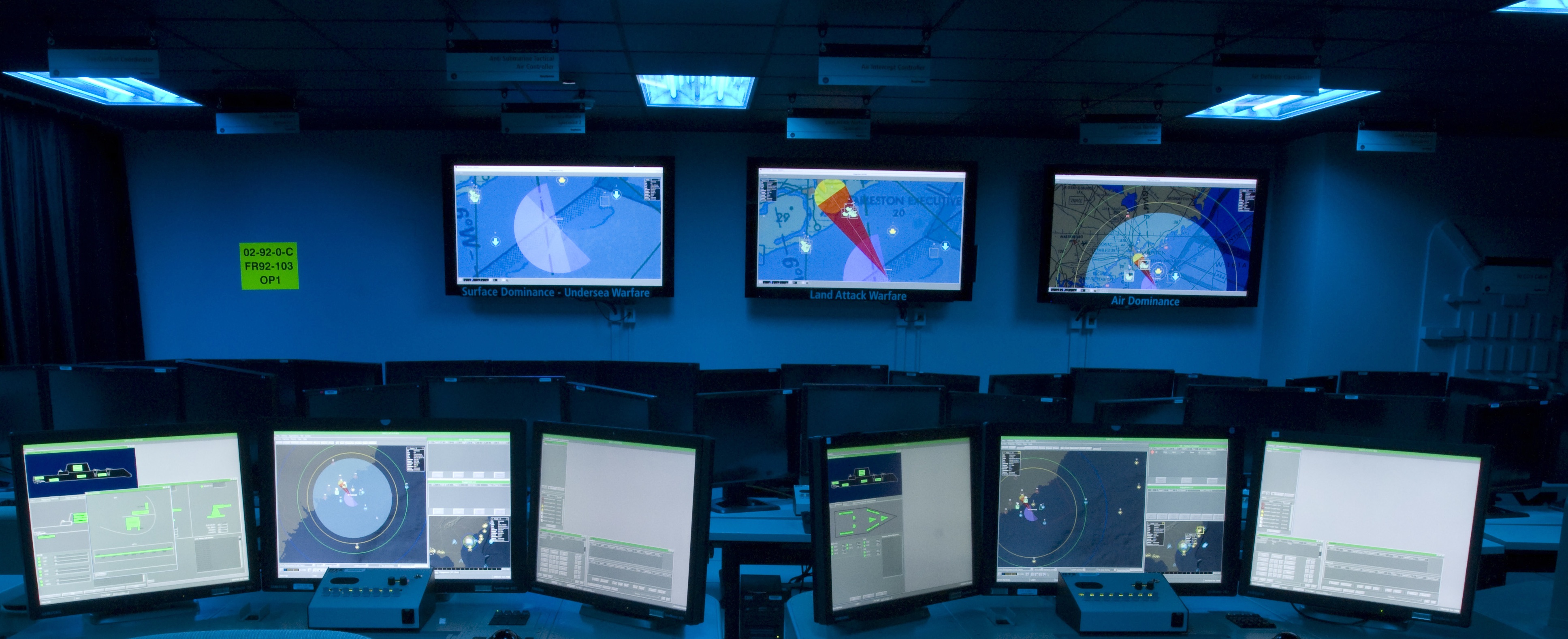
On October 10, I flew up to Rhode Island to visit Raytheon's Seapower Capability Center in Portsmouth, where engineers assembled and pre-tested the systems at the heart of the Zumwalt and are preparing to do the same for the next ship in line, the USS Michael Monsoor—already well into construction. There, Raytheon's DDG-1000 team gave me a tour of the centerpiece of the ship's systems—a mockup of the Zumwalt's operations center, where the ship's commanding officer and crew will control the ship's sensors, missile launchers, guns, and other systems.
Over 20 years ago, I learned how to be a ship watch stander a few miles from the Raytheon facility at the Navy's Surface Warfare Officer School. But the operations center of the Zumwalt will have more in common with the fictional starship USS Enterprise's bridge than it does with the combat information centers of the ships I went to sea on. Every console on the Zumwalt will be equipped with touch screens and software capable of taking on the needs of any operator on duty, and big screens on the forward bulkhead will display tactical plots of sea, air, and land.
Perhaps it's appropriate that the first commanding officer of the Zumwalt will be Captain James Kirk (yes, that's actually his name). But considering how heavily the ship leans on its computer networks, maybe they should look for a chief engineer named Vint Cerf.

Off The Shelf and On The Ship

Enlarge / Data center in a box: Electronic Modular Enclosures being configured at Raytheon's Portsmouth, Rhode Island, facility.
In the past, you couldn't just put off-the-shelf computer systems aboard a ship for mission critical tasks—when I was aboard the USS Iowa, we had to shut down non-tactical systems before the guns were fired because the shock and vibration would crash systems hard. So typically, individual computer systems are ruggedized. But that adds heavily to the cost of the systems and makes it more difficult to maintain them.
The design of the Zumwalt solves that problem by using off-the-shelf hardware—mostly IBM blade servers running Red Hat Linux—and putting it in a ruggedized server room. Those ruggedized server rooms are called Electronic Modular Enclosures (EMEs), sixteen self-contained, mini data centers built by Raytheon.
Measuring 35 feet long, 8 feet high, and 12 feet wide, the 16 EMEs have more than 235 equipment cabinets (racks) in total. The EMEs were all configured and pre-tested before being shipped to Bath, Maine, to be installed aboard the Zumwalt. The EME approach lowered overall cost of the hardware itself, and allows Raytheon to pre-integrate systems before they're installed. "It costs a lot to do the work in the shipyard," said Raytheon's DDG-1000 deputy program manager Tom Moore, "and we get limited time of access."
Each EME has its own shock and vibration damping, power protection, water cooling systems, and electromagnetic shielding to prevent interference from the ship's radar and other big radio frequency emitters.
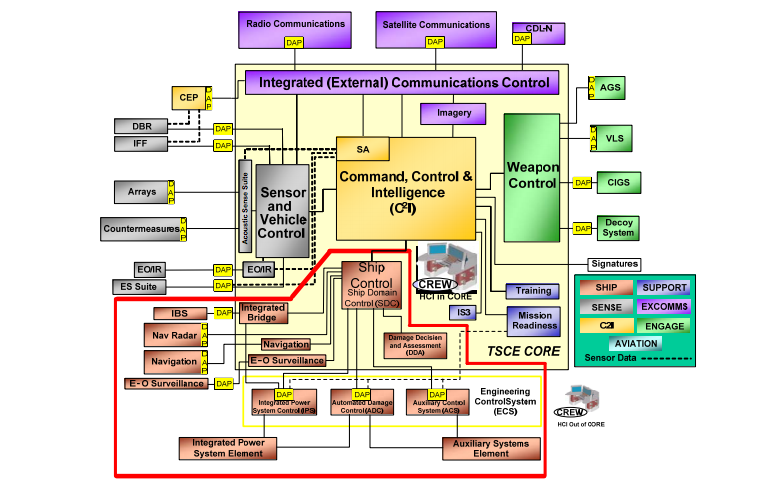
The EMEs tap into the Total Ship Computing Environment, the Zumwalt's shipboard Internet. Running multiple partitioned networks over a mix of fiber and copper, TSCE's redundantly switched network system connects all of the ship's systems—internal and external communications, weapons, engineering, sensors, etc.—over Internet protocols, including TCP and UDP. Almost all of the ship's internal communications are based on Voice Over IP (with the exception of a few old-school, sound-powered phones for emergency use).
Enlarge / A diagram of the Zumwalt's control systems and their connections to the Total Ship Computing Environment.
There's also some wireless networking capability aboard the Zumwalt, but Raytheon officials giving me the tour were not at liberty to discuss just what sort of wireless this is. Still, that capability is supposed to allow for roving crew members to connect to data from the network while performing maintenance and other tasks.
Systems that weren't built to be wired into an IP network—other "programs of record" within the ship, which are installed across multiple classes of Navy ships—are wired in using adaptors based on single-board computers and the Lynx OS real-time Linux operating system. Called Distributed Adaptation Processors, or DAPs, these systems connect things like the ship's engineering systems, fire suppression systems, missile launchers, and radio and satellite communications gear into the network so they can be controlled by networked clients.

It Looks Like You Want To Launch A Missile

Enlarge / The mock-up of the Zumwalt's operations center at Raytheon's Portsmouth facility, complete with haze-gray paint, has the exact dimensions of the space on the ship itself. The Zumwalt will include a second level to host the operations of units deployed with the ship.
Some of those networked clients were what I was looking at in the mocked-up Zumwalt operations center. The operations center isn't just where screens are watched and commands are shouted—the whole ship can be practically run from the space, from guns and missiles to engines. There's no "radio room" on the Zumwalt; all the communications are managed from the operations center. The ship's guns are fully automated and operated by an operations center watch stander instead of a gunner's mate in the mount. Theoretically, the ship could even be steered from the ops center—the ship is piloted by computer, not a helmsman. And all of these tasks are performed from the same type of console.
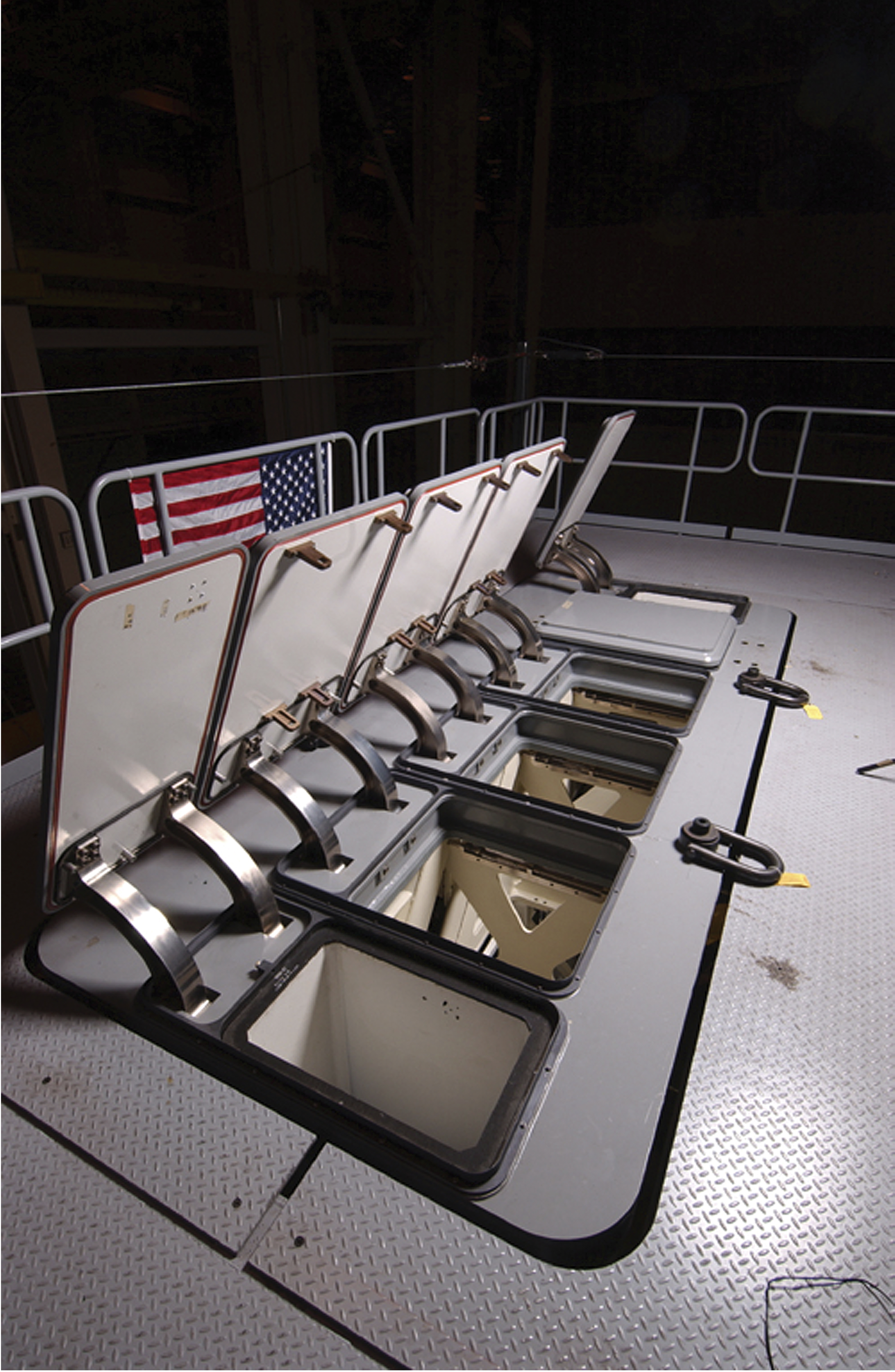
Enlarge / The Mark 57 vertical launch system, developed by Raytheon, can carry a mix of anti-ship, anti-aircraft, and land attack cruise missiles. It communicates with the operations center over the ship's network.
Called the Common Display System, or CDS (pronounced as "keds" by those who work with it), the three-screen workstations in the operations center are powered by a collection of quad-processor Intel motherboards in an armored case, which gives new meaning to the nautical phrase "toe buster." Even the commanding officer's and executive officer's chairs on the bridge have CDS workstations built-in.
Each CDS system can run multiple Linux virtual machines atop LynuxWorx's LynxSecure, a separation kernel tthat has been implemented in CDS as a hypervisor. This allows the workstation to connect to various networks partitioned by security level and purpose. "Every watch stander station runs out of the same box," Raytheon's DDG-1000 developer lead Robert Froncillo told me. "So they can sit at any CDS and bring up their station."
This may not seem like a big deal to most people. But on past ships, workstations tended to be purpose-built for a specific weapons system or sensor. That meant every system had a different configuration and interface, and you couldn't have a watch stander handle multiple tasks without having to switch seats. The CDS workstation uses common USB interfaces for its peripheral devices (such as trackballs and specialized button panels) and is equipped with touchscreens, as well, so that watch standers have a choice between "classic" and touch interfaces.
That doesn't mean there's necessarily a "Clippy" to help new operators master their systems. The Raytheon team has had sailors in to perform usability assessments from before code was even written, showing them screen shots of interfaces to get feedback from users. "We had a chief that said, 'We don't want any 'wizards,'" said Froncillo.
A digital illustration of how the Zumwalt's operations center will look, complete with its second-level suite for hosting operations for air detachments and other units deployed aboard.
Raytheon
Putting all of the pieces together is a collection of middleware running on those IBM blade servers. Many of the shipboard systems use a commercial publish/subscribe middleware platform to send updates to operator consoles. But for other systems that need to be more tightly coupled (like, for example, missile launch commands), the Navy has specified the use of the Common Object Request Broker Architecture (CORBA)—the military's favorite mission-critical middleware model. (The software for the Joint Tactical Radio System's software-defined radios was also developed using CORBA.)

The Next Release

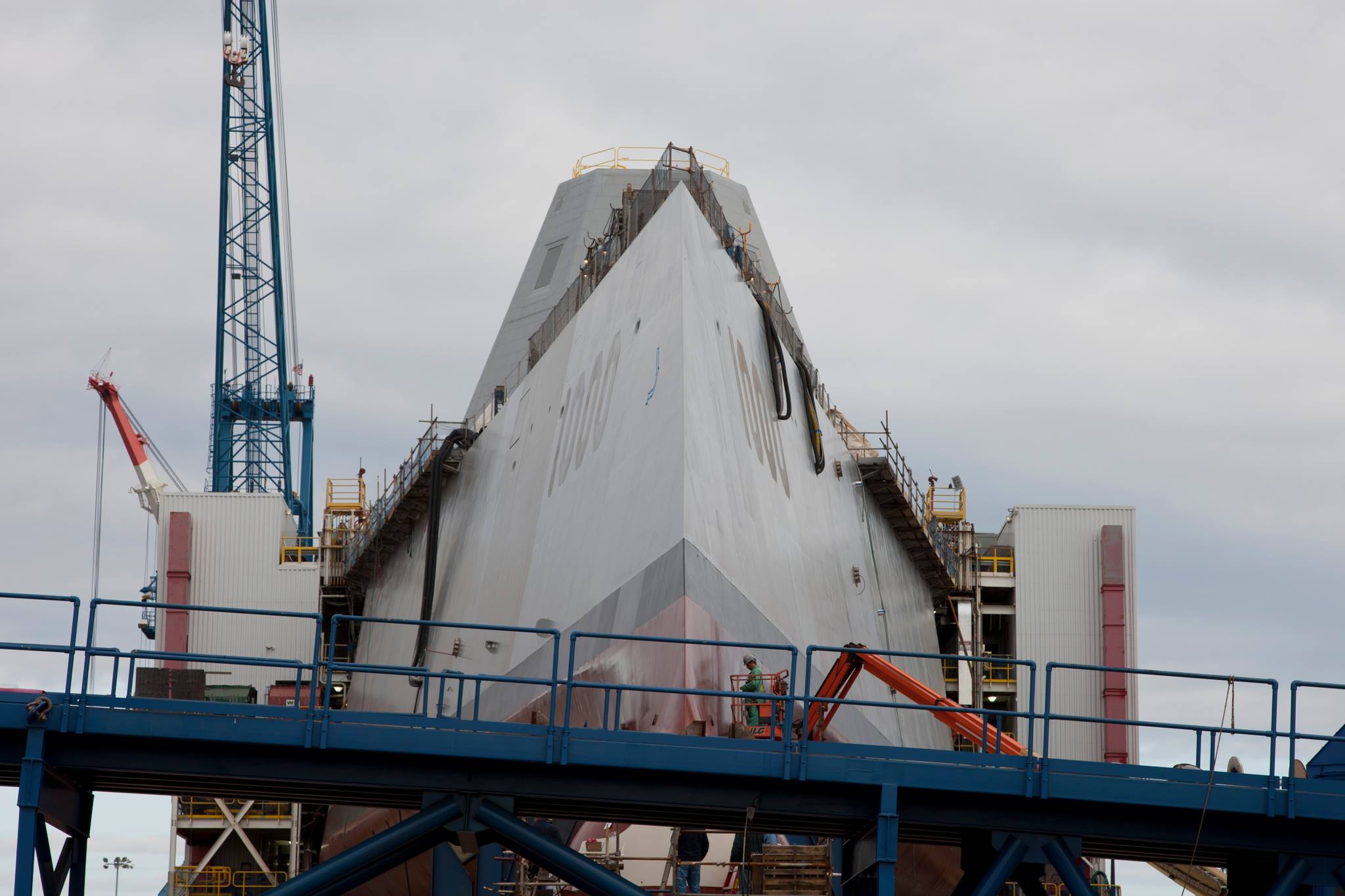
Enlarge / The Zumwalt bow-on at Bath Iron Works. DDG-1001, the USS Michael Monsoor, sits behind her, more than 60 percent complete.
The Zumwalt may not have sailed yet, but its software has already shipped six times. When Release 5 was completed, Raytheon brought in more sailors to test the system, tethering it to the company's Total Ship System Simulator to run through a number of combat scenarios. "We did antisubmarine warfare, air, and land attack missions," Froncillo said. The lessons learned were incorporated into release 6, and 7 will be installed on the ship before the ship's "shakedown" cruise. Another upgrade will be installed post-delivery, and continual improvements will be made as the software is deployed to the other two ships in the class.
But the life of the technology being deployed on the Zumwalt won't end there. CDS will be used as part of the Navy's Aegis Modernization Program to upgrade the systems of the fleet's guided missile cruisers and destroyers. "And there are a lot of things we're developing that will be reused," Moore said.
Considering how much has been spent over the past decade trying to get the Zumwalt built, and the other technologies that were developed in the process, one can hope that more than just the software gets some reuse.

Monday, September 23, 2013

Metal Storm

Posted by "Sayf Maslul"

Courtesy Of "The Discovery Channel and YouTube"


Metal Storm Limited is a Brisbane, Australia based research and development company that specializes in electronically initiated superposed load weapons technology and owns the proprietary rights to the electronic ballistics technology invented by J. Mike O'Dwyer. 

Metal Storm represents both the name of the company and the technology. The company maintains a subsidiary in Arlington, Virginia, U.S.A.

Metal Storm uses the concept of superposed load; multiple projectiles loaded nose to tail in a single gun barrel with propellant packed between them. 

The roman candle, a traditional firework design, employs the same basic concept, however, the propellant continues to burn in the roman candle's barrel, igniting the charge behind the subsequent projectile. 

The process is repeated by each charge in turn, ensuring that all projectiles in the barrel are discharged sequentially from the single ignition. 

Various methods of separately firing each propellant package behind stacked projectiles have been proposed which would allow a "single shot" capability more suitable to firearms.

The distinguishing features of this technology are the absence of ammunition feed and casing ejection systems (the only moving parts are the projectiles), and the electronic ignition of the propellant charges. The relatively simple external shape of the Metal Storm barrel allows for the clustering of Metal Storm barrels into a barrel array or 'pod', or for their attachment (as single units) 'bolted on' to existing weapons mounts, including infantry weapons.

The absence of a mechanical feed mechanism and the inherently compact lightweight nature of Metal Storm systems also makes them suitable for attachment to light robotic ground and aerial vehicles. The electronic ignition allows for the firing of the stacked ammunitions at 'electronic speed' without any delays caused by mechanical ammunition feed mechanisms.

The clustered barrel array has been further developed with the design and building of prototypes of electronic firing control systems, allowing selective firing from any barrel in a cluster, and within each barrel the ability to control the rate of fire. 

This allows for responses which range from the equivalent of a volley gun discharge (all projectiles 'at once') to using (selectively) individual munitions with increasingly serious (but non-lethal) effects and lethal munitions including high explosive and air burst shells (all from different barrels in the array).

To Continue Reading: https://en.wikipedia.org/wiki/Metal_Storm

Monday, August 26, 2013

DARPA's Terminator-Like Atlas Robot


Tim Hornyak:

DARPA unveiled this hulking, 6-foot robot developed by Boston Dynamics, creator of the infamous BigDog and other scary creatures. Surprisingly, the 330-pound terror is designed to help us meatsacks.
Atlas is a testbed humanoid for disaster response, but it looks like it knows its way around a phased plasma rifle in the 40-watt range. Fortunately, it comes from Massachusetts, not the future.
We've seen hints of Atlas with Boston Dynamics' Petman soldier robot, which can do pushups and run on a treadmill.


Whereas that humanoid was designed to test chemical protection clothing, Atlas is altogether different. It's designed to not only walk and carry things, but can travel through rough terrain outdoors and climb using its hands and feet.

"Articulated, sensate hands will enable Atlas to use tools designed for human use," Boston Dynamics says. 

"Atlas includes 28 hydraulically actuated degrees of freedom, two hands, arms, legs, feet, and a torso."

Its head includes stereo cameras and a laser range finder. It's tethered to an off-board, electric power supply -- at least that's one weakness.

The DARPA Robotics Challenge is designed to help evolve machines that can cope with disasters and hazardous environments like nuclear power plant accidents.

The seven teams currently in the challenge will get their own Atlas bot and then program it until December, when trials will be held at the Homestead Miami Speedway in Florida.

They will be presented with tasks such as driving a utility vehicle, walking over uneven terrain, clearing debris, breaking through a wall, closing a valve, and connecting a fire hose.

Meanwhile, check out Atlas' other weakness in the vid below -- it's got an unstoppable desire to groove. As the English playwright William Congreve observed, music has charms to soothe the savage robot.

Tuesday, March 05, 2013

The Pentagon’s Wall-of-Light Laser Shield

PASS Demonstrator.

The Plasma Acoustic Shield System (PASS) is a crackling, flashing wall of light hanging in the air up to 100 meters away. And while it’s the stuff of sci-fi, the laser-powered PASS already exists in prototype form, built by Stellar Photonics of Redmond, Wash., with funding from the Pentagon’s Joint Nonlethal Weapons Directorate (JNLWD). 

Initially intended to shield soldiers by creating a high-intensity distraction and provide a highly visible warning signal, PASS may develop into a weapon in its own right, producing a barrage of explosions with the power of flash–bang stun grenades. It may also evolve into a shield capable of absorbing laser and microwave blasts from directed energy weapons. 

The technology is based on short pulses from a high-power laser. If you focus a laser beam down to a point, the intensity can become so great that the molecules of air itself break down. As electrons separate from their atoms to produce ions, the gas becomes plasma, an effect seen at the core of a lightning bolt. This ionization produces a miniature explosion with a flash of light and a sharp pop. 

W. Alexander Long, vice president and co-founder of Stellar Photonics, says the company developed a technique called dynamic pulse detonation, designed to enhance this blast. The initial laser pulse produces a small cloud of plasma; another pulse strikes the plasma a fraction of a second later. The plasma cloud absorbs the laser energy and expands rapidly in a supersonic shock wave, creating a bigger bang than the first pulse’s. The laser can scan and rapid-fire a series of pulses to build up a wall of plasma bursts, in much the same way that an old cathode-ray television builds up a picture by scanning across the screen. 

The PASS demonstrator is mounted in a turret attached to a Hummer. It is a nonlethal option that might be used, for example, if a vehicle approaches a checkpoint without slowing down. If the driver ignores verbal and other warnings (such as a flash of ultrabright light) to slow down, soldiers could use PASS to produce a barrage of flash–bangs right in front of the car. Anyone who proceeded might be assumed to be hostile. In addition, the bright laser bursts are likely to interfere with attempts to aim a weapon, though PASS cannot inflict damage at its current power levels. 

"At the current state of the art, the Plasma Shield System can only be used for warnings," Long says. "More work is needed on the next generation of eye-safe, high-energy pulse lasers." 

The demonstration system produces 10 flash–bangs per second. Long says other currently available lasers could raise this rate to 40 per second, but they are not eye-safe. Stellar Photonics plans a next-generation system capable of 200 flash–bangs per second, and this rate will increase as more powerful solid-state lasers become available. Ensuring that the lasers cannot cause eye damage or blindness has been one of the major challenges. 

Higher scan rates would allow the plasma shield to take more advanced shapes—for example, to put a horizontal barrier across a road. Long says that once the scan rate reaches kilohertz, thousands of flash–bangs per second, it would be possible generate letters or graphics and literally paint in the air. 


Stellar Photonics has been working on the PASS since 2005 with partners Orca Photonic Systems and Laser Guidance. Previously, the Pentagon’s JNLWD funded the Pulsed Energy Projectile, a chemical laser that produced a flash–bang effect at the surface of the target. The intent was to provide a precise, long-range alternative to rubber bullets. But, as with the giant antimissile Airborne Laser, the chemical laser for PEP was very big, weighing about 500 pounds, and carried a limited supply of fuel for laser shots. After years of development, the PEP program disappeared around 2008. 

Another Navy program, Plasma Point Defense, begun in 2004, looked at generating a plasma shield as a way to deflect incoming missiles. This was not feasible with existing technology, and the military dropped the idea. 

PASS, modest as it looks now, has the potential to keep growing and succeed where Plasma Point Defense and the Pulsed Energy Projectile did not. Solid-state lasers mean that PASS is compact and rugged and can keep firing for as long as there is a power supply. The Navy is already exploring how they can get more bang out of laser technology with contracts to two new developers whose systems will rival the one built by Stellar Photonics. 

RadiaBeam Technologies of Santa Monica, Calif., specializes in components for particle accelerators. They are working on MILI-Flash, for Mid-Infrared Laser Induced Flashbang system. This also uses a double-pulse scheme, with an ultrashort ignition pulse to ionize the air, followed by longer pulse to heat and expand the plasma and create the desired flash–bang. Meanwhile Physical Optics Corporation of Torrance, Calif., is offering RESLIFE (Ranged Eye-Safe Laser-Induced Flashbang Enabling System). This uses two lasers operating at different wavelengths for the two pulses, a picosecond Erbium-doped laser for the initial pulse, and a nanosecond Thulium-doped laser for the followup. Both companies are on a nine-month development contract; the successful one will then produce a prototype with a range in excess of a hundred meters. 

It’s easy to see the immediate military applications of PASS technology for warning, signalling, and shielding. Networked together, a number of PASS systems would produce quite an impressive spectacle. The plasma wall is a barrier to both visible and infrared viewing. Because plasma can absorb microwaves and radar, PASS may also prove a viable technology for screening from radar, as well as blocking directed microwave pulses that can damage electronics. 

While the flash–bangs will always be less effective than kinetic weapons, they could serve as a nonlethal option for crowd control or for hitting small, fast-moving targets such as miniature drones at the speed of light and with laser accuracy. 

Similar technology may be used in the civilian world for 3D displays. Japanese company Burton Inc. has demonstrated a laboratory system that can sketch crude moving images of a stick man and a bouncing ball floating in the air. Something the size of PASS should enable stadium-scale plasma displays. 

However, according to the Department of Defense, it’s too early to say what applications the technology will find, or what the timeline is for possible deployment. "The technology is still in its infancy to appropriately respond to its applicability," said Kelley Hughes, spokesperson for the Joint Non-Lethal Weapons Directorate. 

Via: "Popular Mechanics"

DARPA's New 1.8 GigaPixel Surveillance Drone


DARPA and the US Army have taken the wraps off ARGUS-IS, a 1.8-gigapixel video surveillance platform that can resolve details as small as six inches from an altitude of 20,000 feet (6km). ARGUS is by far the highest-resolution surveillance platform in the world, and probably the highest-resolution camera in the world, period.
ARGUS, which would be attached to some kind of unmanned UAV (such as the Predator) and flown at an altitude of around 20,000 feet, can observe an area of 25 square kilometers (10sqmi) at any one time. If ARGUS was hovering over New York City, it could observe half of Manhattan. Two ARGUS-equipped drones, and the US could keep an eye on the entirety of Manhattan, 24/7.
It is the definition of “observe” in this case that will blow your mind, though. With an imaging unit that totals 1.8 billion pixels, ARGUS captures video (12 fps) that is detailed enough to pick out birds flying through the sky, or a lost toddler wandering around. These 1.8 gigapixels are provided via 368 smaller sensors, which DARPA/BAE says are just 5-megapixel smartphone camera sensors. These 368 sensors are focused on the ground via four image-stabilized telescopic lenses.
The end result, as you can see in the (awesome) video above, is a mosaic that can be arbitrarily zoomed. In the video, a BAE engineer zooms in from 17,500 feet to show a man standing in a parking lot doing some exercises. A white speck is a bird flying around. You can’t quite make out facial features or license plates (phew), but I wonder if that would be possible if ARGUS was used at a lower altitude (during a riot, say).
ARGUS’s insane resolution is only half of the story, though. It isn’t all that hard to strap a bunch of sensors together, after all. The hard bit, according to the Lawrence Livermore National Laboratory (LLNL), is the processing of all that image data. 1.8 billion pixels, at 12 fps, generates on the order of 600 gigabits per second. This equates to around 6 petabytes — or 6,000 terabytes — of video data per day. From what we can gather, some of the processing is done within ARGUS (or the drone that carries it), but most of the processing is done on the ground, in near-real-time, using a beefy supercomputer. We’re not entirely sure how such massive amounts of data are transmitted wirelessly, unless DARPA is waiting for its 100Gbps wireless tech to come to fruition.
The software, called Persistics after the concept of persistent ISR — intelligence, surveillance, and reconnaissance — is tasked with identifying objects on the ground, and then tracking them indefinitely. As you can see in the video, Persistics draws a colored box around humans, cars, and other objects of interest. These objects are then tracked by the software — and as you can imagine, tracking thousands of moving objects across a 10-square-mile zone is a fairly intensive task. The end user can view up to 65 tracking windows at one time.
ARGUS-IS, surveying Quantico, Virginia
ARGUS-IS, surveying Quantico, Virginia. Click to see a much larger version.
According to the video, which is from the PBS Nova TV show, the ARGUS system in its entirety produces one million terabytes per day — all of which is stored by the Army for future use. We’re a bit skeptical about PBS’s crazy figure (a million terabytes is an exabyte), but in theory most of that data is actually meta data — the coordinates and other identifying features of the thousands (millions?) of objects being tracked by ARGUS.
Boeing A160 Hummingbird helicopter, with ARGUS-IS attached belowThe original goal was to deploy ARGUS in Afghanistan, but that never came to pass. It isn’t entirely clear what ARGUS’s future is; it was meant to be mounted on Boeing’s high-altitude A160 Hummingbird helicopter (pictured right), but the chopper has since been scrapped. If ARGUS is to be deployed, it will most likely be strapped to the underbelly of a Predator droneWhere it will be used, however, with the war in Afghanistan apparently winding down, is another question entirely. Its efficacy in a military setting would be unsurpassed, but it’s easy to imagine how ARGUS could be used here at home in the US, too.
For the lore nerds out there: Argos was a 100-eyed giant from Greek mythology. His role was to act as Io’s guardian — a good, if typecast role, for someone with 100 eyes.