


Showing posts with label Stealth Weapons. Show all posts
Showing posts with label Stealth Weapons. Show all posts
Tuesday, October 14, 2014
The US Navy's Ghost WarShip
Built by Juliet Marine Systems, a private company in Portsmouth, N.H., it’s designed to fight swarm attacks, water-born IEDs, and, aargghh, piracy. According to Business Insider, “Ghost is intended to have zero radar signature, and the vessel is supposedly difficult for the enemy to spot, let alone target. The ship is nonmagnetic and hard to detect via sonar, making it ideal for infiltration and surveillance of enemy areas.”


Thursday, November 14, 2013
The Navy Is Building A Stealth Battleship Strike Force

The Navy's newest warships are hard to detect on radar, heavily armed with super-accurate guns and missiles ... and gigantic. Six hundred feet long and displacing 15,000 tons of water, the DDG-1000 Zumwalt-class ships are designated as destroyers but are actually as big as some World War I battleships.
By David Axe
The lead ship in the class is slated to launch any day now -- a milestone briefly delayed by the recent government shutdown. The Navy is building three of the Zumwalts over the next five years and deploying them to the Pacific to counter China's fast-improving military.
That's assuming the $7-billion-apiece Zumwalts don't simply capsize the first time a powerful wave strikes them from behind. The high-tech battleships feature a novel, downward-sloping "tumblehome" hull that's optimized for stealth not stability -- and lacks the wave-resisting qualities of traditional ships with upward-flaring hulls.
"On the DDG-1000, with the waves coming at you from behind, when a ship pitches down, it can lose transverse stability as the stern comes out of the water-and basically roll over," naval architect Ken Brower told Defense News.
Even if they don't sink in heavy seas, the Zumwalts are controversial vessels. Besides being by far the biggest and most expensive surface combatants in memory, the Zumwalts are actually inferior to older, smaller ships in certain key stats, in particular radar performance and missile capacity.
But what they lack in weapons and sensors, the new battleships make up for with other enhancements, including space for their own robotic air forces plus massive electrical output that, in the near future, could support powerful laser weapons.

Navy art
Warship Fantasy
The Zumwalts began as a 1990s naval fantasy. The sailing branch wanted to revamp its entire fleet of 100 frigates, destroyers and cruisers with a single basic design that could avoid radar detection, carry new sensors and weapons and be operated by a greatly reduced crew. The stealth design would be scaled upward or downward to replace 10,000-ton cruisers and destroyers and 4,000-ton frigates.
As with other military techno-fantasies of the ‘90s, the 21st-Century Surface Combatant initiative collapsed under the weight of its mounting cost and complexity. All that survives at present are a couple dozen small Littoral Combat Ships currently under construction plus the three Zumwalts. To keep its surface fleet numbers up, the Navy has decided to keep building the same Arleigh Burke-class destroyers it has been buying since the late 1980s.
So few in number, the Zumwalts will be niche, practically experimental vessels -- albeit with potentially powerful combat abilities. "What a tremendous ship!" Rear Adm. Thomas Rowden, the Navy's top shipbuilder, crowed to Defense Media Network. He described the Zumwalt class as "unique because it incorporates several innovative technologies into a multi-mission warship, including integrated power distribution, signature reduction, active and passive self-defense systems and enhanced survivability features."

Wheeling out DDG-1000's deckhouse. Huntington Ingalls Industries photo
Building The Battleships
In addition to the hard-to-detect tumblehome hull, the Zumwalts have smooth, angular superstructures that, in two of the three vessels, are made of composites instead of steel, further enhancing their stealth qualities. To save money, the Navy decided last week that the third and final Zumwalt will have a steel deckhouse made in Maine.
Huntington Ingalls Industries makes the 1,000-ton composite superstructure deckhouses in a special facility in Gulfport, Mississippi and ships them by barge to Bath Iron Works in Maine, where the ships are assembled and where they will be launched, one every couple of years starting later this year.
Rather than packing the vertical-launch missile cells into tight groupings fore and aft, as is typical, the Zumwalts carry their missile cells along the edge of the hull, effectively adding heft to their outside lines that can insulate them against enemy strikes.
But the unique layout decreases the overall missile arsenal from 96 large munitions in an Arleigh Burke to just 80 in a Zumwalt. Granted, the Sea Sparrow short-range self-defense missile comes in four-packs that fit inside a standard launch cell, so in theory a Zumwalt could carry 320 Sea Sparrows.
But in practice the vessels will carry a mix of munitions including larger, one-per-cell SM-2 long-range air-defense missiles. In a divisive move, the Navy has opted not to give the new battleships the radar enhancement for deploying all the SM-2's modes, in particular its ability to hit incoming ballistic missiles.
Cost is one reason. The other reason is that the Zumwalts are primarily bombardment ships meant for sneaking up on and smashing targets on land. And for that they will carry scores of Tomahawk cruise missiles plus other high-tech weapons.

Scale models of an Arleigh Burke and a Zumwalt by Modeled Horizons, showing their relative sizes. Modeled Horizons photo
Reaching Out
Each Zumwalt comes equipped with two 155-millimeter cannons made by BAE Systems and installed forward of the deckhouse in "holsters" that help them avoid radar detection. The guns are fed by automatic ammo systems that can deliver a 225-pound shell to each gun every six seconds until the 600-round magazine is depleted.
Boosted by rockets in their bottoms and steered by small fins, the shells can fly 62 miles to precisely hit GPS coordinates. But it's the possible future weapons that have the Navy really excited?-?and that's got everything to do with the battleships' electrical power generation.
"It has the power margin," Rowden said. "It's an electric drive-ship, and the power generation capability it has is huge." At cruising speed, the Zumwalts produce 58 megawatts of excess power for weapons, sensors and other gear.
That electricity could power a laser gun. In 2010 Boeing completed initial design work on the so-called "Free Electron Laser Weapon System," a weapons-grade light beam. "The Free Electron Laser will use a ship's electrical power to create, in effect, unlimited ammunition and provide the ultra-precise, speed-of-light capability required to defend U.S. naval forces against emerging threats, such as hyper-velocity cruise missiles," Boeing veep Gary Fitzmire said.
An officer in the Pentagon's Office of Net Assessment told War is Boring that the Zumwalts would be perfect test platforms for the laser.

Navy concept art
Pacific Showdown
Based in San Diego starting in 2014, the Zumwalts will reinforce the Navy's Pacific Fleet as it stands up to an increasingly aggressive and well-armed China. Rowden said the battleships could sail alone, in groups with other surface ships or alongside aircraft carriers.
In America's ongoing campaign against Islamic terrorists or, God forbid, in some future shooting war with China, the Zumwalts could send Navy SEALs ashore by small boat or by one of the two Seahawk helicopters each carries. With their 11,000-square foot flight decks, the vessels can also support up to three Fire Scout drone helicopters for recon missions.
The commandos and drones could spot the targets and the Zumwalts could hit them with missiles and guns?-?and then fire missiles and possibly lasers to defend themselves from counter-attack.
But if a big wave hits from behind -- watch out. Even a $7-billion stealth battleship has weaknesses. The Zumwalts' most dangerous enemy could be the sea itself.
Sunday, November 10, 2013
The Navy’s Newest Warship Is Powered By Linux
When the USS Zumwalt (DDG 1000) puts to sea later this year, it will be different from any other ship in the Navy's fleet in many ways. The $3.5 billon ship is designed for stealth, survivability, and firepower, and it's packed with advanced technology. And at the heart of its operations is a virtual data center powered by off-the-shelf server hardware, various flavors of Linux, and over 6 million lines of software code.
On October 10, I flew up to Rhode Island to visit Raytheon's Seapower Capability Center in Portsmouth, where engineers assembled and pre-tested the systems at the heart of the Zumwalt and are preparing to do the same for the next ship in line, the USS Michael Monsoor—already well into construction. There, Raytheon's DDG-1000 team gave me a tour of the centerpiece of the ship's systems—a mockup of the Zumwalt's operations center, where the ship's commanding officer and crew will control the ship's sensors, missile launchers, guns, and other systems.
Over 20 years ago, I learned how to be a ship watch stander a few miles from the Raytheon facility at the Navy's Surface Warfare Officer School. But the operations center of the Zumwalt will have more in common with the fictional starship USS Enterprise's bridge than it does with the combat information centers of the ships I went to sea on. Every console on the Zumwalt will be equipped with touch screens and software capable of taking on the needs of any operator on duty, and big screens on the forward bulkhead will display tactical plots of sea, air, and land.
Perhaps it's appropriate that the first commanding officer of the Zumwalt will be Captain James Kirk (yes, that's actually his name). But considering how heavily the ship leans on its computer networks, maybe they should look for a chief engineer named Vint Cerf.
Off The Shelf and On The Ship

Enlarge / Data center in a box: Electronic Modular Enclosures being configured at Raytheon's Portsmouth, Rhode Island, facility.
In the past, you couldn't just put off-the-shelf computer systems aboard a ship for mission critical tasks—when I was aboard the USS Iowa, we had to shut down non-tactical systems before the guns were fired because the shock and vibration would crash systems hard. So typically, individual computer systems are ruggedized. But that adds heavily to the cost of the systems and makes it more difficult to maintain them.
The design of the Zumwalt solves that problem by using off-the-shelf hardware—mostly IBM blade servers running Red Hat Linux—and putting it in a ruggedized server room. Those ruggedized server rooms are called Electronic Modular Enclosures (EMEs), sixteen self-contained, mini data centers built by Raytheon.
Measuring 35 feet long, 8 feet high, and 12 feet wide, the 16 EMEs have more than 235 equipment cabinets (racks) in total. The EMEs were all configured and pre-tested before being shipped to Bath, Maine, to be installed aboard the Zumwalt. The EME approach lowered overall cost of the hardware itself, and allows Raytheon to pre-integrate systems before they're installed. "It costs a lot to do the work in the shipyard," said Raytheon's DDG-1000 deputy program manager Tom Moore, "and we get limited time of access."
Each EME has its own shock and vibration damping, power protection, water cooling systems, and electromagnetic shielding to prevent interference from the ship's radar and other big radio frequency emitters.
The EMEs tap into the Total Ship Computing Environment, the Zumwalt's shipboard Internet. Running multiple partitioned networks over a mix of fiber and copper, TSCE's redundantly switched network system connects all of the ship's systems—internal and external communications, weapons, engineering, sensors, etc.—over Internet protocols, including TCP and UDP. Almost all of the ship's internal communications are based on Voice Over IP (with the exception of a few old-school, sound-powered phones for emergency use).
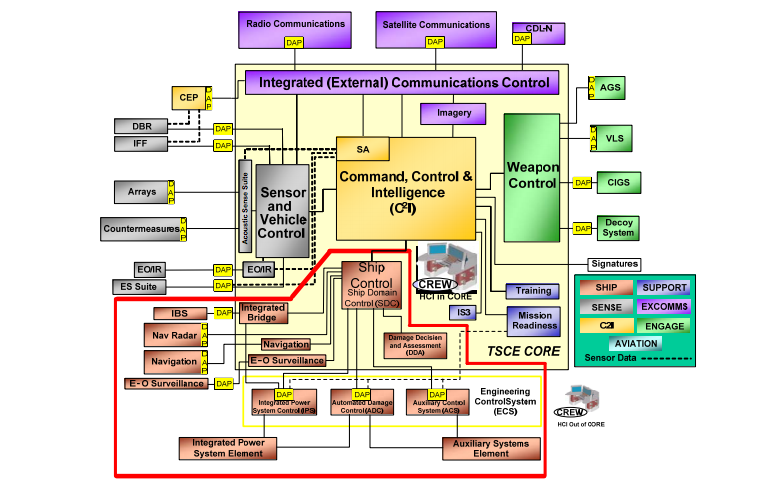
Enlarge / A diagram of the Zumwalt's control systems and their connections to the Total Ship Computing Environment.
There's also some wireless networking capability aboard the Zumwalt, but Raytheon officials giving me the tour were not at liberty to discuss just what sort of wireless this is. Still, that capability is supposed to allow for roving crew members to connect to data from the network while performing maintenance and other tasks.
Systems that weren't built to be wired into an IP network—other "programs of record" within the ship, which are installed across multiple classes of Navy ships—are wired in using adaptors based on single-board computers and the Lynx OS real-time Linux operating system. Called Distributed Adaptation Processors, or DAPs, these systems connect things like the ship's engineering systems, fire suppression systems, missile launchers, and radio and satellite communications gear into the network so they can be controlled by networked clients.
It Looks Like You Want To Launch A Missile
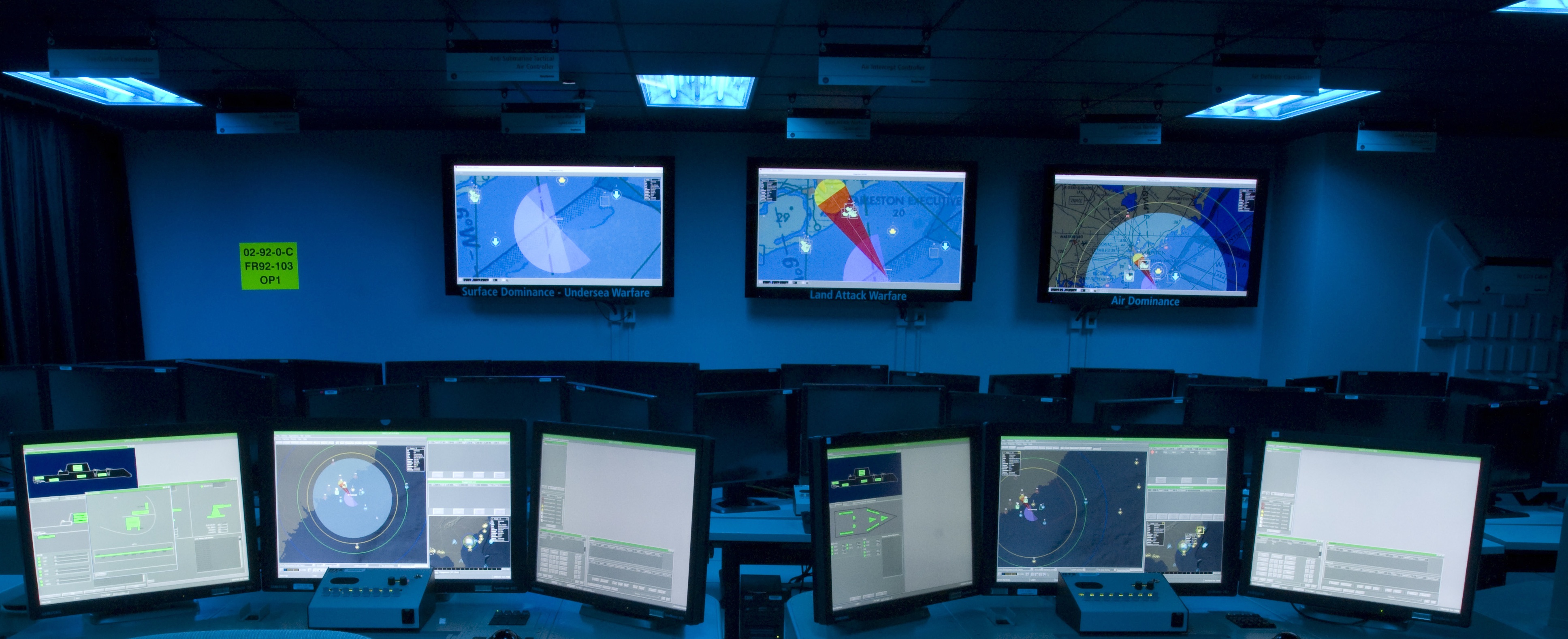
Enlarge / The mock-up of the Zumwalt's operations center at Raytheon's Portsmouth facility, complete with haze-gray paint, has the exact dimensions of the space on the ship itself. The Zumwalt will include a second level to host the operations of units deployed with the ship.
Some of those networked clients were what I was looking at in the mocked-up Zumwalt operations center. The operations center isn't just where screens are watched and commands are shouted—the whole ship can be practically run from the space, from guns and missiles to engines. There's no "radio room" on the Zumwalt; all the communications are managed from the operations center. The ship's guns are fully automated and operated by an operations center watch stander instead of a gunner's mate in the mount. Theoretically, the ship could even be steered from the ops center—the ship is piloted by computer, not a helmsman. And all of these tasks are performed from the same type of console.
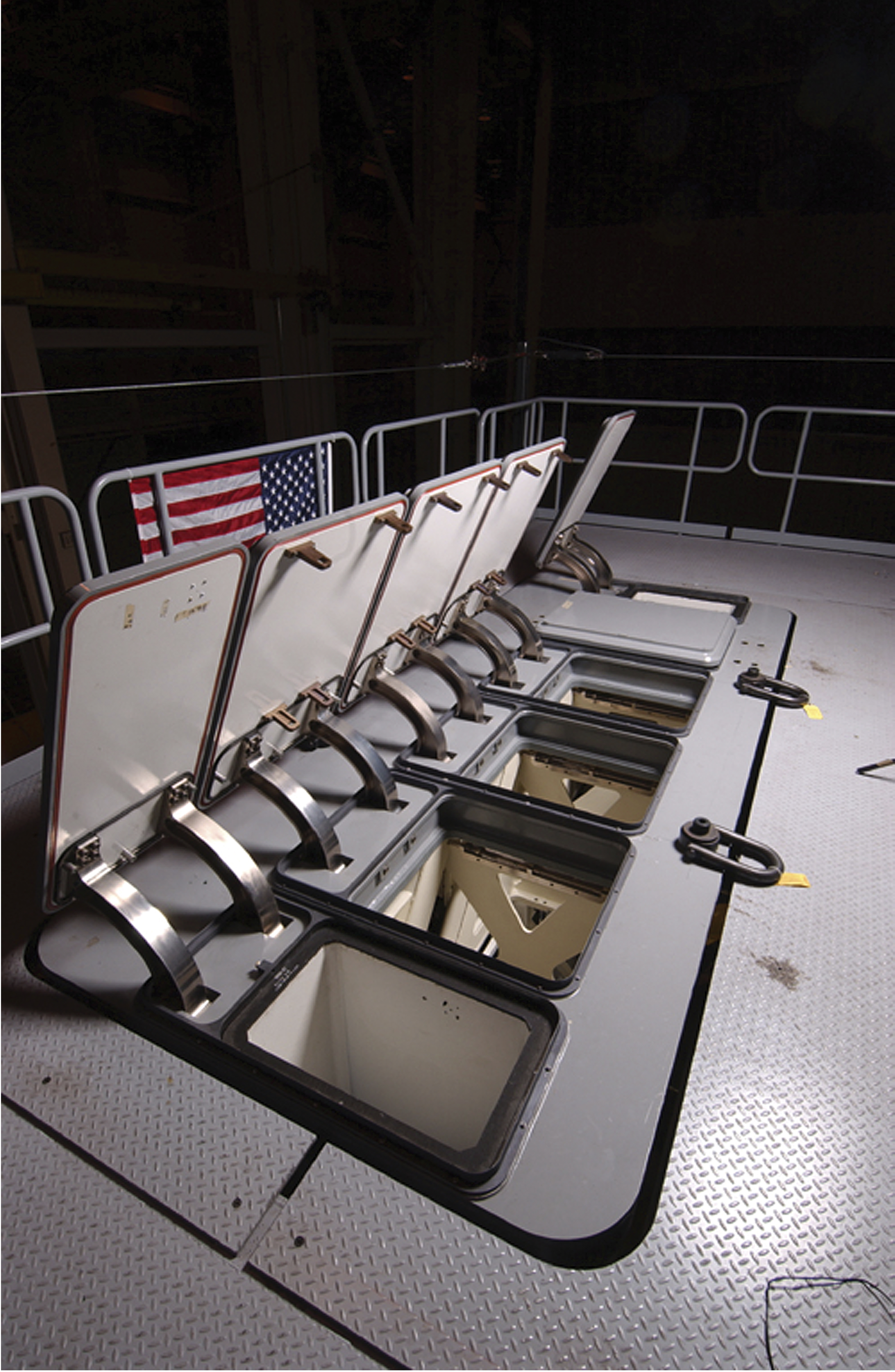
Enlarge / The Mark 57 vertical launch system, developed by Raytheon, can carry a mix of anti-ship, anti-aircraft, and land attack cruise missiles. It communicates with the operations center over the ship's network.
Each CDS system can run multiple Linux virtual machines atop LynuxWorx's LynxSecure, a separation kernel tthat has been implemented in CDS as a hypervisor. This allows the workstation to connect to various networks partitioned by security level and purpose. "Every watch stander station runs out of the same box," Raytheon's DDG-1000 developer lead Robert Froncillo told me. "So they can sit at any CDS and bring up their station."
This may not seem like a big deal to most people. But on past ships, workstations tended to be purpose-built for a specific weapons system or sensor. That meant every system had a different configuration and interface, and you couldn't have a watch stander handle multiple tasks without having to switch seats. The CDS workstation uses common USB interfaces for its peripheral devices (such as trackballs and specialized button panels) and is equipped with touchscreens, as well, so that watch standers have a choice between "classic" and touch interfaces.
That doesn't mean there's necessarily a "Clippy" to help new operators master their systems. The Raytheon team has had sailors in to perform usability assessments from before code was even written, showing them screen shots of interfaces to get feedback from users. "We had a chief that said, 'We don't want any 'wizards,'" said Froncillo.

A digital illustration of how the Zumwalt's operations center will look, complete with its second-level suite for hosting operations for air detachments and other units deployed aboard.
Raytheon
Putting all of the pieces together is a collection of middleware running on those IBM blade servers. Many of the shipboard systems use a commercial publish/subscribe middleware platform to send updates to operator consoles. But for other systems that need to be more tightly coupled (like, for example, missile launch commands), the Navy has specified the use of the Common Object Request Broker Architecture (CORBA)—the military's favorite mission-critical middleware model. (The software for the Joint Tactical Radio System's software-defined radios was also developed using CORBA.)
The Next Release

Enlarge / The Zumwalt bow-on at Bath Iron Works. DDG-1001, the USS Michael Monsoor, sits behind her, more than 60 percent complete.
The Zumwalt may not have sailed yet, but its software has already shipped six times. When Release 5 was completed, Raytheon brought in more sailors to test the system, tethering it to the company's Total Ship System Simulator to run through a number of combat scenarios. "We did antisubmarine warfare, air, and land attack missions," Froncillo said. The lessons learned were incorporated into release 6, and 7 will be installed on the ship before the ship's "shakedown" cruise. Another upgrade will be installed post-delivery, and continual improvements will be made as the software is deployed to the other two ships in the class.
But the life of the technology being deployed on the Zumwalt won't end there. CDS will be used as part of the Navy's Aegis Modernization Program to upgrade the systems of the fleet's guided missile cruisers and destroyers. "And there are a lot of things we're developing that will be reused," Moore said.
Considering how much has been spent over the past decade trying to get the Zumwalt built, and the other technologies that were developed in the process, one can hope that more than just the software gets some reuse.
Thursday, January 10, 2013
The Perfect Invisibility Cloak
A Canadian company called Hyperstealth is reporting that it has developed Quantum Stealth, a material that renders the target “completely invisible by bending light waves around the target.” If the mock-up photos are to be believed, Quantum Stealth basically works like Harry Potter’s invisibility cloak.
Since 2002, Hyperstealth has been in the business of designing camouflage patterns for military uniforms, vehicles, and installations. In 2010, at the International Camouflage Symposium, Hyperstealth’s CEO Guy Cramer demonstrated SmartCamo — a material that could reportedly adjust its camouflage markings to match its surroundings. We say “reportedly” because Cramer apparently published a video demonstration of SmartCamo, but then US military intervened and asked him to take it down. Presumably Quantum Stealth is a follow-up from SmartCamo.

Again, for security reasons, Cramer is saying very little about Quantum Stealth. All of the pictures that you see here, and on Hyperstealth’s site, are mock-ups, because “for security issues we can not show the actual technology.” Cramer says that both the US and Canadian military have seen Quantum Stealth in action, and that they’ve also confirmed that the material obscures the target from infrared (thermal) imaging. Below, you can see Cramer talking to CNN’s Pentagon correspondent about Quantum Stealth.
Now, we’ve written about invisibility cloaks in the past, but these have generally been very small, lab-based experiments that only work with very specific wavelengths of light. These invisibility cloaks generally work by bending light around an object using metamaterial waveguides — think of them as optical paths that negatively refract light, so that their detour around the object can’t be discerned. So far, we have only managed to develop metamaterials that bend specific wavelengths of light — so the object might be invisible to microwaves or infrared, but not both. Quantum Stealth reportedly works across the entire range of visible light, and infrared too. If this is really the case, Quantum Stealth completely redefines the state of the art.
In theory, Quantum Stealth works by bending light around the target, and Cramer certainly uses the right words to support his case — nanotechnology, metamaterials — but it’s still very hard to believe that a lone inventor in Canada has actually succeeded in creating an invisibility cloak. It’s not impossible, but it’s improbable. I want to say that there’s a clue in the name — that Quantum Stealth somehow uses some neat glitch in quantum mechanics to provide invisibility — but really, it’s probably just hyperbole, like the company’s name. If Quantum Stealth really exists, though, you’d assume that the US military would be quick to flaunt its new toy. After all, there’s nothing more terrifying than an invisible army.
Via: "Extreme Tech"
Thursday, December 13, 2012
B-2 Stealth Bomber's Successor

The youngest active stealth bomber in the U.S. turns 15 this year, and the other 19 B-2s in the Air Force fleet are nearly five years older. Meanwhile, the integrated defense systems they face have become much more sophisticated. Multi-static radar, which is now relatively common, is so sensitive that it can detect certain stealth craft. To stay ahead of such defense systems, the Air Force has budgeted $3.7 billion over the next five years to develop a successor to the B-2 that could be active by 2020. Actual designs of the new bomber are classified, but some secrets are already out.
Patents and bid proposals from Northrop Grumman, maker of the B-2, suggest that the new bomber will be narrower than the B-2 but maintain the familiar flying wing design, which reduces radar reflection by minimizing hard edges. Engineers are also testing new types of radar-absorbing coatings that could be customized to individual defense systems. And so a picture of the next generation of stealth bombers is beginning to emerge.
CUSTOM COATINGS
Most stealth coatings consist of a radar-absorbing material, typically a form of iron, suspended in paint. But they are heavy (which lowers fuel efficiency), need to be reapplied frequently, and don’t absorb all radar frequencies. Ceno Technologies, a particles-science company in Sanborn, New York, has developed a lighter, more durable coating that uses hollow ceramic spheres, called cenospheres. Because the spheres can be covered in carbon, silver or other metals that absorb slightly different wavelengths of radar, the coating can be customized to deceive specific radar systems.
SMOOTHER SHAPE
The B-2 has two semi-flush air-intake vents, the hard edges of which can reflect radar. In one design seen in a patent from Northrop Grumman, the new bomber has four small vents rather than two large ones. The smaller vents can be buried more deeply in the wing, reducing the possibility of radar returns.
SMARTER DECOYS
To confuse radar defense systems, the new bomber will probably carry something like the Miniature Air Launched Decoy made by Raytheon. The modified drones use radar reflectors to create bomber-like signatures that divert attention from the actual bomber. The decoys fly on a preprogrammed course for up to 575 miles and may carry radar jammers to further confuse air defenses.
RETRACTABLE WING
In one design from Northrop Grumman, engineers included a canard wing on the plane’s nose, which would provide extra lift during takeoff and flight, allowing a smaller bomber to carry a heavier weapons payload. Because its straight lines and hard angles would reflect radar, the canard wing will most likely be designed to fold flush with the bomber’s body as the craft comes within range of defense systems.
HEAVIER WEAPONS
The new bomber will most likely have a single weapons bay, as opposed to the twin bays on the B-2. It will still be able to carry conventional GPS-guided JDAM missiles, nuclear warheads and even the new 30,000-pound, bunker-busting Massive Ordnance Penetrator, but a single bay would reduce the cost of manufacturing—a major concern for designers on a relatively tight budget.
Via: "PopSci"
Monday, December 03, 2012
Autonomous Terminator Drones With AI

Contractors hoist the X-47B Unmanned Combat Air System (UCAS) demonstrator to the flight deck of the aircraft carrier USS Harry S. Truman at Naval Station Norfolk, Virginia, in this U.S. Navy handout photo dated November 26, 2012 . (Reuters/U.S. Navy/Seaman Christopher A. Morrison/Handout)

The X-47B Unmanned Combat Air System (UCAS) demonstrator is hoisted onto the flight deck of the aircraft carrier USS Harry S. Truman at Naval Station Norfolk, Virginia, in this U.S. Navy handout photo dated November 26, 2012. (Reuters/U.S. Navy/Mass Communication Specialist 3rd Class Lorenzo J. Burleson/Handout)

Contractors prepare to hoist the X-47B Unmanned Combat Air System (UCAS) demonstrator onto the flight deck of the aircraft carrier USS Harry S. Truman at Naval Station Norfolk, Virginia, in this U.S. Navy handout photo dated November 26, 2012. (Reuters/U.S. Navy/Mass Communication Specialist 3rd Class Lorenzo J. Burleson/Handout)
Via: "Russia Today"
Monday, September 03, 2012
The Drone Revolution’s Next Phase

Today's unmanned robotic planes only seem advanced. A decade after the CIA and the Air Force tucked a Hellfire missile under the wing of a Predator drone, much hasn't actually changed: pilots in air-conditioned boxes remotely control much of the armed drone fleet; the robo-planes are easy for an enemy to spot; the weapons they fire weigh about the same; as much as they love the skies, they take refuge on dry land; and they're built around traditional airframes like planes and helicopters. Yawn.
All this is starting to change. Drones are moving out to sea -- above it and below it. They're growing increasingly autonomous, no longer reliant on a pilot with a joystick staring at video feeds from their cameras. They're getting stealthier; the payloads they carry are changing; and they're going global. They're pushing humans out of the gondolas of blimps. And the laboratories of the drones of the future aren't only owned by American defense contractors, they're in Israel and China and elsewhere, too.
Of course, there are other advancements as well: new model drones fly longer and wield better cameras. But those are routine improvements, like your smartphone rolling out upgrades to its operating system. Here's a look at the more ambitious ways drones are getting re-imagined.
Northrop Grumman X-47B
The U.S. Navy is at the forefront of drone development. Its most ambitious project is to land a robotic plane on an aircraft carrier with minimal human involvement. It's among aviation's hardest maneuvers, one that no current drone on Planet Earth can execute. Next year, the Navy will program its X-47B -- a batwing-shaped robot -- to land on the deck of the U.S.S. George Washington off the coast of Maryland to see if it can be done. All with a click of a mouse.
If the X-47B can pull this off, it'll be a sea change (pardon the pun). The X-47B is a demonstration model, not the Navy's carrier-based drone of the future. By 2018, the Navy hopes, a successful X-47B will yield to the UCLASS program, for Unmanned Carrier Launched Airborne Surveillance and Strike System. The name is actually pretty descriptive: If it works as planned -- again, a big if -- the Navy will have robotic eyes in the sky way out into blue waters, capable of spying on suspicious maritime behavior and attacking targets they spot. The effort ranks as one of the most significant in the history of drones.
Already, the X47B can refuel in mid-air, giving it a long, long seaborne flight time. Oh, and it looks like an alien spaceship. No big deal.
AeroVironment's Switchblade
For all the upgrades drones are set to receive, U.S. military officials swear there's one unyielding constant: A human being, inside a chain of command, will always make the decision to use a drone's lethal force. The Switchblade doesn't exactly violate that rule. But it pushes drone warfare closer to the boundary.
Already heading to Afghanistan for commando usage, the tiny Switchblade folds up into a backpack; gets fired through a tube; and a soldier using a laptop sends it on a one-way mission onto a target. Count the innovations there: Most tiny drones are spies instead of killers; and the Switchblade doesn't fire a missile, it is the missile. But there's a third, and more profound, change. The drone can be pre-programmed to hit a set of coordinates, making it an "autonomous platform" that manufacturer AeroVironment likes to boast about. True, a human being still sets those coordinates. But the small Switchblade moves drone warfare a step closer to an era when the robots decide who lives and who dies.
Long-Endurance Multi-Intelligence Vehicle
Another example of how the drones of the future won't necessarily be airplanes or helicopters. The U.S. Army is working on a spy blimp the size of a football field. Pilot not necessarily included.
Much of the hype around Northrop Grumman's Long-Endurance Multi-Intelligence Vehicle, or LEMV, concerns the novelty of a giant blimp capable of hauling a heretofore unimaginable bank of cameras in its gondola. Less attention has gone to the mega-blimp's intended ability to flip into autonomous mode. Which makes sense, when considering the airship's other capabilities: If it works correctly, it should be able to stay aloft for weeks at a time. Does it really make sense to keep a human being in the lighter-than-air ship, complete with all the physiological frailties that would necessitate dropping the blimp down onto the ground? The Army is starting to consider those questions: Earlier this month, it brought the blimp over New Jersey for its first test flight; and next year it's supposed to deploy to Afghanistan.
Raytheon's Small Tactical Munition
Yes, it's true: The Small Tactical Munition is not a drone. But it still has important implications for drone warfare.
The weapon of choice for the U.S. drone arsenal is the Hellfire missile. The Hellfires, unleashed on countless terrorism suspects over the last decade, weigh about 100 pounds. That's a problem: It cuts against the trend of miniaturization that is all the rage in drone circles. Enter the Small Tactical Munition: a bomb weighing just 13 pounds designed to turn the Army's 12-pound Shadow spy drone into a killer. Raytheon has been developing the Small Tactical Munition for years, but now thinks the bomb could beready to field within months. Not much good for a drone that's supposed to, say, look like a hummingbird. But it's probably just the first in mini-weapons for drones.
Israel Aerospace Industries' Robo-Butterfly
It makes sense that Israel would be on the bleeding edge of drone technology. Not only are its spy apparatus and tech sectors among the world's elite, Israel has a long, long history with unmanned aircraft. The Israel Defense Forces' first drone unit formed in 1971, to aid with reconnaissance. Now it's joining the U.S. military in developing tiny, tiny drones that look like bugs -- with one huge difference.
In May, Israel Hayom reported on the Butterfly, a robot weighing a mere 20 grams and designed to look like the eponymous insect, except packed with listening devices and tiny video cameras. Not altogether dissimilar from the U.S. Air Force's "micro-aviary" of insect- and bird-like unmanned aircraft. But Israel Aerospace Industries' mini-drone adds something unexpected: a helmet that gives an operator Butterfly vision. "When you put this on you are actually inside the butterfly's cockpit," enthused the company's mini-robotics chief Dubi Binyamini. "You see what the butterfly sees. You can fly at any altitude and distance and see everything in real time." In the States, drone operators merely watch their robotic aircraft's video feed, with no attempt at anything approaching a sensory meld.
Dark Sword
If you had to guess what this Chinese drone's specialty is -- and you do, because China's government has cloaked it in secrecy -- it's probably stealth. The elongated, sharp angles of the Dark Sword are reminiscent of a stretched-out mashup of a Stealth Bomber and a Joint Strike Fighter. Designs for Dark Sword have been floating around for years, and Flight International has dubbed it an "amalgam of concepts" -- to include, potentially, being a rare unmanned dogfighter.
China isn't new to drones. It's got the the Soaring Dragon, a surveillance drone that looks eerily reminiscent of a U.S. Air Force Global Hawk. But a stealthy drone is a next step up for China's unmanned capabilities. The Dark Sword may not be the only Chinese stealth drone, either. Late in 2011, pictures of the so-called Wind Blade -- a stealthy, blended-wing design drone -- started surfacing on the internet.
Boeing's Phantom Ray
This Boeing stealth drone has survived a near-death experience. Like its rival the X-47B, it's a demonstrator craft; and like the X-47B, its batwing shape indicates that it's designed to evade radar. Unlike the X-47B, however, the U.S. military got cold feet: In 2006, it told Boeing that it wasn't interested in paying for the project anymore. Rather than junk Phantom Ray, Boeing opted to fund the project itself, and last April, the Phantom Ray took off on its maiden flight in St. Louis. And since the Navy hasn't picked a design for the UCLASS project that comes after the X-47B, it's possible that the Phantom Ray will eventually overtake its robotic adversary.
General Atomics' Sea Avenger
Take one part Predator and one part UCLASS and you've got the Sea Avenger. In short, the project is a next-gen Predator that can land on an aircraft carrier. Or so manufacturer General Atomics desires.
The Avenger is the third phase of the iconic armed Predator drone, following the Reaper. In 2010, the Air Force had reached the end of its intended purchases of Preds and moved toward buying Avengers. And for good reason: Avengers are way, way faster, capable of going beyond 400 knots, making it three times as fast as a Pred and 50 percent faster than a Reaper. The sleeker design also turns the drone stealthy.
So General Atomics tweaked its Avenger design to yield the Sea Avenger. (Hold your Sub-Marinerjokes.) The idea is to add the "flexibility" to accommodate "carrier suitable landing gear, tail hook, drag devices, and other provisions for carrier operations." Translated from the contractor-ese, that means General Atomics is hoping that when X-47B gives way to UCLASS, the Navy will go with the iconic brand in the killer-drone field.
BAE Systems' Taranis
Stealth drones aren't only for the Americans and the Chinese. BAE Systems is working on Europe's first stealth robo-killer, the Taranis. Only the drone hasn't had a smooth upward ascent.
Named for the Celtic thunder god, BAE first rolled out the Taranis in 2010, complete with a Hollywood-style presentation. Yet trial flights, originally scheduled for last year, have been pushed back repeatedly, and now the hope is to get the Taranis aloft in 2013. There isn't yet much to show for the £143 million -- around $220 million -- spent developing the prototype, aside from the occasional mistaken UFO sighting. But if European budgetary austerity doesn't ground the Taranis before it leaves the tarmac, the Taranis' ability to evade radar could help wean allied militaries off their dependency on American airpower.
Mikoyan Skat
Russia isn't so great with drones. Sure, it's buying spy robots from Israel, but its own fleet of homebrewed armed drones won't be ready for another 20 years. That leaves the Russian government with smaller drones -- the better to spy on street protests -- and not a whole lot besides. Except for the Skat.
Translating to "Manta Ray," the Skat is a stealthy drone that can carry up to two tons of weapons in its bays, and fly at nearly 500 miles per hour at a low altitude. Mockups and displays of the Skat have been on display for at least five years, but the drone remains in development. It might not take 20 years to field, but it highlights how far the once-mighty Russians have to go to capitalize on the drone revolution.
DRDO Rustom 1
Rising global power India doesn't intend to get left out of the drone revolution. After buying Israeli models for years, its Defense Research and Development Organization (DRDO) is starting to homebrew its own.Three different models of killer flying 'bots are in the works: the Rustom 1, the Rustom H and the Rustom 2. (The Rustom 1 had its maiden flight in 2009; the other two are still being developed.) These drones clearly don't have the capabilities of the American next-gens -- they're slower, not autonomous, and won't be stealthy. And they wear their influences on their sleeves: The most ambitious model, the Rustom H, seems like a knock-off of the iconic Predator. Still, the arrival of India's drone sector helps underscore how drone tech has cemented itself as a status symbol for rising powers.
Monday, June 18, 2012
Air Force Wants Hypersonic Missiles For Stealth Jets

An X-51 Waverider hypersonic missile attached to the wing of a B-52 bomber. The Air Force seeks to build a smaller variant for its stealth fighters. Photo: Boeing
By Robert Beckhusen
June 7, 2012 | 6:00 pm
Courtesy Of "Wired"
For decades, the military has tried — with little success — to build missiles capable of traveling at breakneck, hypersonic speeds. Missile tests, however, have been uneven, with repeated failures punctuated by the occasional stunning success. Now the Air Force is taking a bigger role by seeking to build another hypersonic missile, this time for its stealth fighter jets.
The Air Force’s desired “High Speed Strike Weapon” would travel at five times the speed of sound or faster, theoretically launching from a stealthy F-22 Raptor jet or a future F-35 Joint Strike Fighter, and traveling so fast and at such long distances as to render an enemy’s anti-aircraft systems defunct. The Air Force’s Research Laboratory Munitions Directorate is gathering possible design partners later this month at Elgin Air Force Base in Florida before any solicitation. According to an Air Force notice, whatever prototype gets built will ultimately need to strike “time-critical” targets — on the move, possibly — from “tactically relevant standoff distances.”
If it can be done, the weapon will “be representative of an air-breathing hypersonic missile system” that can tough it out in “the most stringent environments presented to us in the next decade,” said Steven Walker, the Air Force’s deputy assistant secretary for science, technology and engineering, in written testimony to the House Armed Services Committee in February.
That’s the hope, at least. The U.S. military has a mixed record with hypersonics. Last August, the Pentagon’s pizza-shaped Falcon Hypersonic Technology Vehicle 2 failed for a second (and likely final) time, crashing into the Pacific during a test flight. But the Army’s Advanced Hypersonic Weapon did much better during a test in November. Two years ago, the Air Force successfully flew its X-51 WaveRider scramjet missile at speeds of Mach 5 for 200 seconds after launching it off a B-52 bomber. A later test, though, ended with engine failure.
Unlike those weapons, though, the High Speed Strike Weapon isn’t a so-called “Global Strike” weapon. Those weapons are supposed to hit anywhere on Planet Earth at any time. The former Falcon missile, for instance, was designed to launch with a rocket into space, before screaming back down to Earth and obliterating its target. But those weapons are indistinguishable from a nuclear weapon when seen on radar — which could inadvertently trigger nuclear Armageddon once a surprised nuclear power like Russia sees one in the air.
A fighter-launched missile resembles any other smaller, non-nuclear missile. It’s just traveling super-fast. Armageddon averted.
There are other technical challenges in launching a scramjet missile from a fighter jet instead of a sub-orbital rocket or a B-52, though. It’ll still need to have air-breathing engines that compresses the air around the missile into a supersonic mixture of oxygen and fuel — absent a turbine. But it will also need to be small enough to be carried by a jet fighter while carrying the necessary advanced navigation controls, precision guidance tools and sophisticated sensors, plus the warhead. The service will also still have to find the right mixture of composite materials like titanium and tungsten (among others) to hold up under the enormous heat generated by Mach 5, Mach 6 and even faster flight.
The Air Force is requesting a whopping 150 percent increase in funding for the program, from $6.2 million now to $15.4 million in 2013 in one “thrust” of weapons development, according to subscription-required InsideDefense. That’s a lot of money for a missile that may not work.
Subscribe to:
Posts (Atom)

