


Showing posts with label Siege Warfare. Show all posts
Showing posts with label Siege Warfare. Show all posts
Sunday, November 16, 2014
Writing History: The Pen Is Dipped In Palestinian Blood
"The fundamental reason for the ill health of the population in Gaza is of course the siege and the bombing"
“Israeli impunity is one of the greatest moral challenges of our time”


Sunday, February 17, 2013
The Age Of The Siege

NATO Strategies, Economic Sanctions and The "Responsibility To Protect"
By Felicity Arbuthnot
Courtesy Of "Global Research"
Disengage, avoid, and withhold support from whatever abuses, degrades and humiliates humanity.” (Alice Walker, b:1944.).
“[former Danish PM and Secretary General of NATO] Anders Fogh Rasmussen, Du har blod på dine hænder” ( “You have blood on your hands”), Danish protester, 2003.
The siege of Leningrad is still considered the most lethal siege in world history, a shocking “racially motivated starvation policy”, described as: “an integral part of Nazi policy in the Soviet Union during World War 11.”
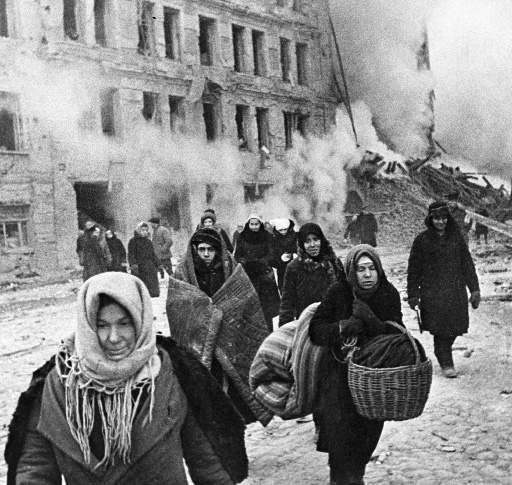 The 872 day siege began on 8th September 1941 and was finally broken on 27th January 1944. It is described as: “one of the longest and most destructive sieges in history and overwhelmingly the most costly in casualties.” Some historians cite it as a genocide. Due to record keeping complexities the exact number of deaths resultant from the blockade’s deprivations are uncertain, figures range from 632,000 to 1.5 million.
Sieges now extend to entire countries, they have become the torture before the destruction. And they are not counted in long days, but in long years. Iran thirty three years, Iraq thirteen-plus years. Ironically the disparity in the deaths in Iraq resultant from that siege, mirror near exactly what was considered a “genocide” in Leningrad.
Syria has been subject to EU “restrictions” since 2011, ever more strangulating, with near every kind of financial transaction made impossible by May 2011- when “restrictions” were also placed on President Assad himself, all senior government officials, senior security and armed forces Heads. The list of that denied is dizzying (i.) By February 2012, assets of individuals were frozen, as those of the Central Bank of Syria.
Cargo flights by Syrian carriers to the EU were also barred, as was trade in gold, precious metals and diamonds – anything which might translate in to hard cash, without which neither individuals or countries can purchase the most basic essentials.
By July 2012 Syrian Arab Airlines and even Syria’s Cotton Marketing Organisation had joined the EU’s victims.
America of course, had been way ahead of the game, with the Syria Accountability and Lebanese Sovereignty Act (ii) signed in to law on 12th December 2003, the year of Iraq’s comprehensive US-led destruction. Thus the mighty USA’s personal siege on under twenty one million people, is now entering its tenth year.
By last August, as with Iraq before it, the inability to trade meant that, as ever, the now Nobel Peace Prize winning EU and the policies of the Nobel Peace Prize winning US President, were targeting Syria’s most vulnerable.
Many pharmaceutical companies had closed, resulting in severe shortages of medication for chronic diseases and the casualties of the insurgency, according to the World Health Organisation (iii.) Prior to the US-UK-EU-NATO supported insurgency, Syria had produced ninety percent of its drugs and medication needs.
However : “ … production has been hit by the fighting, lack of raw materials, impact of sanctions and higher fuel costs.” Further, near all pharmaceutical plants were located in areas of heaviest fighting, Aleppo, Homs and Damascus provinces and have suffered “substantial damage.” The result is: “a critical shortage of medicines”, according to WHO spokesman Tarik Jasarevic.
“Drugs for tuberculosis, hepatitis, hypertension, diabetes and cancer are urgently needed, as well as haemodialysis for kidney diseases.”
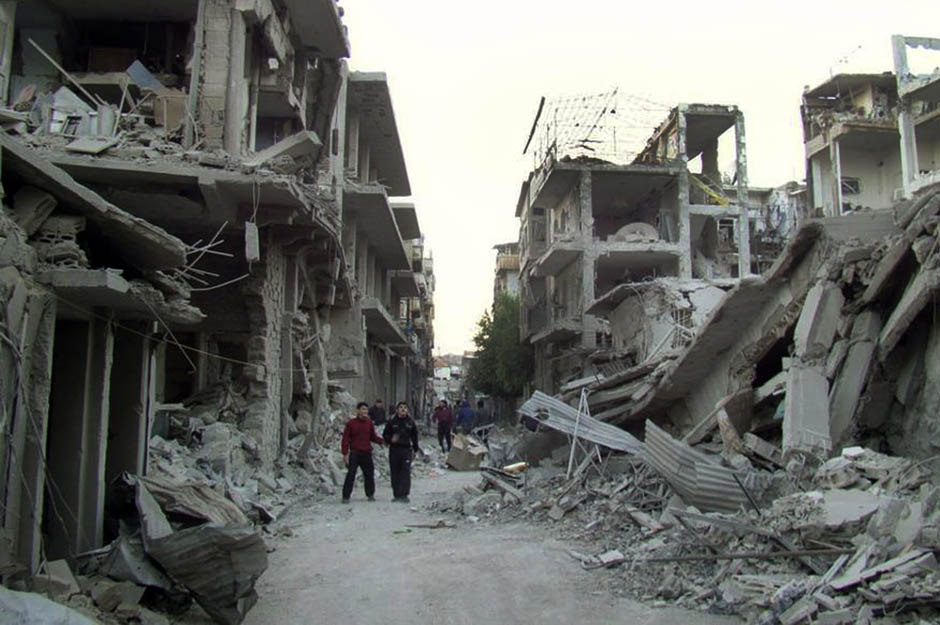 Health centres have closed due to violence, damage, or being taken over by the Western backed fighters. (image: Homs, 2012)
“The health facilities that have stopped functioning are located in the most affected areas where the urgent need for medical and surgical interventions is the most prominent,” Jasarevic said.
The Syrian Health Ministry reported that it “lost” – stolen or destroyed – two hundred ambulances in a few weeks through June and early August 2012.
Banks run out of cash and the 2012 wheat harvest is likely to have been wrecked because of the shortage of labour, according to U.N. agencies. In the Middle East bread is still truly the “staff of life.” The all mirrors Iraq, even down to the wheat harvest – in Iraq those bombing the country over thirteen years until the invasion, dropped flares on the harvested wheat and grains, reducing tentative bread security to ashes.
Syria struggles to meet it’s annual grain imports of around four million tons, because of a superb sleight of hand by the siege imposers. Essential foods are exempt from sanctions, but moneys are frozen, thus the wherewithal to trade. The country is ever potentially hours away from a bread crisis.
In 2011 Syria’s own harvest was hit by blight, water shortages and conflict. In December 2012 Iran sent consignments of flour to Syria, temporarily easing the bread crisis, but the siege under which Iran struggles is also of enormity – and shamefully under reported in the West.
As Iran shipped flour to Syria, Iran’s Health Ministry was approaching India for a life saving list of denied medications, for the most critical conditions in patients. Vital items denied included: “drugs to treat lung and breast cancers; brain tumours; heart ailments; infections after kidney, heart and pancreas transplants; meningitis in HIV patients; arthritis; bronchitis and respiratory distress in newborns; and epilepsy.” (iv)
And here again is that sleight of hand: “Although trade in medicine is exempt from international sanctions imposed by the UN Security Council and the unilateral sanctions announced by the US and EU, Western banks have been declining to handle transactions.” (Emphasis mine.)
Targeting the sick is the action of the criminally insane. For targeting the newborn surely no expression has been conceived, except by Madeleine Albright when referring to Iraq’s sanctions related, half million child deaths: “ … we think the price is worth it.” It was not a slip of the tongue, it was clearly to be the New World Order.
This partial list of medications unobtainable by Iran should be put on a wall of shame in Washington and all those Nobel winning EU capitol cities:
“Denied include chemotherapy; drugs used to prevent infections in kidney, heart and pancreas transplant patients and in AIDS treatment. Treatments for colon cancer; cell lung cancer; cancerous brain tumours; chemotherapy drugs for lung, ovarian and testicular cancer; treatment for non-Hodgkin’s lymphona.”
Also: “treatment for breast cancer therapy; a range of chemotherapy drugs; treatment for life threatening recurring heart conditions; specific meningitis treatments; drugs for respiratory distress in the new born; anti-convulsion treatments for epileptic seizures; wide spectrum treatment for heart ailments.”
Additionally:
“Nitroglycerine for angina and coronary artery disease; treatment for septicaemia and bacterial meningitis; medication to reduce risk of premature birth; treatments for acute bronchitis, pneumonia, bone infections, gynaecological infections and those of urinary tract.”
Nimidopine which reduces the risk of damage after bleeding inside the head, is also on the list. How fortunate Madam Clinton did not suffer her alleged brain-adjacent clot in Iran.
Last October Iran’s Head of The Foundation for Special Diseases, Fatemeh Hashemi, stated that six million patients were potentially at risk as a result of sanctioned medications (v.) A holocaust for-warned – and met by that murderous “international community” with near silence.
Mehrnaz Shahabi (vi) also encapsulates the captives in this Age of the Siege:
“Iran (made) ninety seven percent of its needed drugs domestically … The devalued currency means that raw materials imported for drug production are now a lot more expensive.“In many cases, the raw material cannot even be paid for because of the banking sanctions, particularly as the Society for Worldwide Interbank Financial Telecommunication (SWIFT) in compliance with the EU sanctions, has stopped its electronic communication services for Iranian financial institutions and transactions from Iran.”
Thus, as Syria, domestically produced drugs are near unavailable.
Additionally: “The most advanced life-saving drugs cannot be made in generic form.These include drugs for heart disease, lung problems, kidney disease and dialysis, multiple sclerosis, thalassaemia, haemophilia and many forms of cancer.”
Cancers in Iran have soared and a “cancer tsumani” is predicted by 2015. Since Iran borders and breathes the same air as Iraq, it would not be unreasonable to assume that as Iran is punished for its nuclear industry, America and Britain’s, in the form of the depleted uranium weapons used in Iraq, bears some responsibility for another health tragedy of enormity.
“All of the surgeries for thousands of haemophilic patients have been cancelled because a shortage of coagulant drugs. A 15-year-old child died at the end of October due to the absence of coagulant medication. The head of Iran’s Hemophilia Society has said, stating: ‘This is a blatant hostage-taking of the most vulnerable people by countries which claim they care about human rights. Even a few days of delay can have serious consequences like hemorrhage and disability.’ ”
As the New Year was celebrated across Europe and the “Land of the Free”, the Syrian Upper Mesopotamia Archbishop, Jaques Behnan Hindo, was writing an urgent appeal to the Presidency of the United Nations Food and Agriculture Organisation.
In a situation which he warned: “could soon become catastrophic”, he said supply routes were halted and: “every economic activity appears paralyzed (causing) depletion of vital goods, and soaring prices.
“The lack of fuel prevents heating homes and leads to the complete closure of all agricultural activities, just as the planting season begins.“The grain silos were looted and wheat was sold to Turkish traders who conveyed it in Turkey, under the gaze of the Turkish customs officers.”
It is impossible not to reflect that NATO ally Turkey is the equivalent of the bombing flame droppers on the Iraqi harvests.
In addition to the plundered, grain, the Archbishop denounced the gradual disappearance of other vital products including, as Iraq, baby milk.
Archbishop Hindo also sent an appeal to Iraq’s Prime Minister Nuri al-Maliki: “Please help us as quickly as possible, by sending 600 fuel tanks, 300 tanks of gasoline and some tons of flour.
“The first victims are the children. You experience in your body, in your soul – and in the children all the injustice”, caused by draconian, life threatening, illegal, collective punishment on a nation’s people, yet again starting with the unborn, the newborn, and the barely crawling.
At the end of WW11, Leningrad (now Saint Petersberg) was awarded the status of Hero City for collective unwavering courage, resistance and inventiveness under Nazi atrocities.
The world is surely in need of the status of Hero Country for those who exhibit the same courageous qualities against those nations who emulate the same atrocities.
Notes
Monday, October 31, 2011
Remembering Gaza

Some buildings that were destroyed in the 2008-2009 Israeli war on Gaza are still piles of rubble [GALLO/GETTY]
Looking Beyond Statistics, The Future Of The Children Of Gaza Is At Risk Of Being Wasted Due To Politics.
By David Miliband
Last Modified: 17 Oct 2011 07:00
Courtesy Of "Al-Jazeera"
Government is all about statistics, but life is about people. That disjunction explains a lot about the cynicism and disaffection with politics that characterises much of the world nowadays. And, while domestic problems may seem intractable, distance increases the confusion and fatigue induced by seemingly intractable international problems. As usual, the people who suffer are those who most need the world's attention.
This is notably true of the 1.5 million people crowded into the Gaza strip, locked between Israel, Egypt, and the Mediterranean Sea. The West has already isolated Gaza's Hamas-controlled government. This week, the US Congress will discuss cutting off aid to the West Bank-based Palestinian Authority. But this is a time for more international engagement with the Palestinian people, not less.
The statistics say that 80 per cent of Gaza's population is dependent on UN food aid. The youth unemployment rate is 65 per cent. The website of the United Nations Office for the Coordination of Humanitarian Affairs has a comprehensive database that shows how many trucks, containing different kinds of supplies, have been allowed in by the Israeli authorities.
The situation of the people - or rather the fight about their situation - is periodically in the news, most recently when violence broke the otherwise reasonably effective ceasefire in August. But Gaza has become the land that time - and the wider international community - forgot.
It is for this reason that I took up the offer from Save the Children to visit the Gaza Strip last week. I had not been able to visit while serving in government for security reasons. Now I wanted to get a sense of life, not statistics. The purpose of the visit was not to meet politicians or decision makers, but to get a glimpse, albeit brief, of how people there live.
And there is real life. Boys in Western football shirts - mainly Lionel Messi of Barcelona. Restaurants overlooking the Mediterranean. Schoolgirls in white headscarves wherever you look. Barbers, clothes shops, fruit stalls. And a good deal of traffic - with new cars smuggled in through tunnels beneath the "Philadelphi Route" that runs along the Egyptian border.
But real life is also traumatic and limited. We saw buildings - not just the former Hamas headquarters - still in rubble. Houses are riddled with bullet holes. There is no electricity for up to eight hours a day. Shortage of schools and teachers have pushed class sizes to 50 or 60 and the school day is restricted to a few hours to allow for two or even three shifts.
The consequences of war are encountered everywhere, nowhere more so than for those caught in the crossfire. We met the niece and son of a farmer caught in the "buffer zone" between the Israeli border and Gaza. She had lost an eye and a hand to Israeli shells in the war of 2008-2009.
 |
| Civilians have paid a high price in Gaza for the crimes of a few [GALLO/GETTY] |
Save the Children, obviously, is most concerned about the 53 per cent of Gaza population that is under 18. The statistics say 10 per cent of children are "stunted" - so undernourished before the age of two that they never grow to their full potential.
We saw what Save the Children is trying to do about it, at a nutrition centre serving mothers and children in Gaza City. The needs are basic: Promoting breastfeeding, food supplies for young children and medical attention for mothers. But not all those who need help are coming to get it, so Save the Children funds outreach workers to encourage families to use the services.
There is remarkable work being done to create opportunities, as well as to prevent catastrophe. The Qattan Center for the Child is a privately funded library - and drama, computer, and youth center - that would grace any British community. The director told me it is dedicated to the credo of "building people not buildings". The centre is a true oasis.
The situation surrounding such oases represents the ultimate failure of politics. After the war ended in January 2009, the international community was preoccupied with opening up Gaza. Nearly three years later, there is only stalemate - to match the wider stalemate in the search for a Palestinian state that can live alongside Israel.
The responsibility lies, first and foremost, with Israel. The UN's Gaza peace resolution (which Britain authored) calls on the Israeli government to open up the supply lines, but this has been heeded only in small part. That is why the tunnels do such a roaring trade, which Hamas taxes to fund its activities. The Israeli government would retort that the parallel call in the resolution for a halt to the flow of arms into Gaza also has not been heeded. That is true, too.
Yet the international pressure is muted. The focus has shifted. But Gaza's people and their needs remain in what British Prime Minister David Cameron last year called an "open prison". Surely, there is room across divides of party and nation to address these pressing humanitarian needs, which otherwise would only fuel future political trouble.
What makes the situation in Gaza even more infuriating is that the status quo is actually irrational. It is not in anyone's political interest. Israel doesn't become safer, nor do Hamas or Fatah become more popular.
One young mother at the nutrition centre told me that she was just completing her accountancy degree - but there was no work. Yusuf, aged nine, working on a computer at the Qattan Center, told me that he wanted to be a pilot.
These people are not a threat to peace in the Middle East. They are actually its hope. What they need is a chance to shape their own futures.
David Miliband was British Foreign Secretary from 2007 to 2010, and is currently a member of parliament for the Labour Party.
Wednesday, August 31, 2011
Donors Help Keep Palestinians In Cages

Development aid to the Palestinian Authority has only entrenched Israel’s occupation and colonization.
By CHARLOTTE SILVER,
THE ELECTRONIC INTIFADA,
AUG 17, 2011
Courtesy Of "The Institute For Middle East Understanding"
"Israel besieges us, puts us in cantons — in cages — and the international community is feeding us in these cages. It's anything but developmental and it's helping Israel's colonization, ethnic cleansing and dispossession,” Dr. Samia Botmeh said, as she sat in her office in the Center for Development Studies (CDS) at Birzeit University near Ramallah in the occupied West Bank.
Despite the massive amounts of development aid that have been poured into the West Bank, the productive capacity of the Palestinian economy — measured by examining the agricultural and manufacturing sectors — is half that of 1994, and accounts for no more than 12 percent of employment.
While the World Bank and Palestinian Authority boast an 8 percent growth in gross domestic product (GDP), realper capita income is still 8.4 percent lower than what it was in 1999, signifying that theGDP growth is not reflective of income growth for the average Palestinian.
Egypt provides an elucidative comparison. Two decades of serious neo-liberal reforms produced a GDP growth in Egypt that was similarly applauded by the International Monetary Fund (IMF): between 2006 and 2008, GDP grew 7 percent and there was a 4.6 percent spike in 2009 alone. However, as was made stunningly clear at the end of January, the country's GDP growth had not trickled down to the majority of the people: unemployment had actually increased and 40 percent of the population lived on less than two dollars per day.
With former IMF representative Salam Fayyad at the helm since 2007, the PA has adopted the strategy of neo-liberal “good governance” as its framework for the state-building project. As post-colonial states have done in the past, the PA has sought to create an environment conducive for efficient and free-flowing markets by privatizing public services, emphasizing private property rights and reducing corruption. This agenda — state-building through neo-liberal policies — is most patently set forth in a PA program titled “Ending the Occupation, Establishing a State.”
As Mustaq H. Khan, an economics professor at London’s School of Oriental and Afrian Studies, pointed out in a lecture in Ramallah last winter, the injection of development aid into Palestine has deceptively flattered the PA’s good governance program, leading onlookers and promoters such as the IMF and World Bank to attribute the boost in GDP to a successful market economy (“Post-Oslo State-Building Strategies and their Limitation,” 1 December 2010 [PDF]).
There is still a stark contrast between the perceived improvement in the Palestinian economy and the actual standard of living for the majority of Palestinians. Development aid — which comprises roughly 40 percent of Palestine's GDP — has been complicit in obscuring economic reality and in some cases truncating Palestine's struggle for national liberation.
In June 2011, Birzeit University held a conference at which activists and academics spoke with donors and a representative from the PA on the failures of development, as well as the troubling role development aid plays in Palestine's national movement.
“The framework of development is extremely unrealistic and problematic,” Dr. Samia Botmeh told The Electronic Intifada. The framework under scrutiny at Birzeit was the United Nations Development Programme's Conflict-Related Development Analysis (CDA), which seeks to maximize the impact of development aid in conflict zones.
Botmeh added that the current international framework for assessing development aid in the West Bank treats the Israeli-occupied region either as a conflict zone or a post-colonial zone. “This is completely unrealistic because we are not in a conflict, we are in a colonization process,” she said.
The conference took place after the university’s Center for Development Studies concluded a project commissioned by the UNDP that examined how development funds could be better allocated in the occupied West Bank and Gaza Strip amid Israel’s continued occupation.
Because the CDA framework attempts to implement “development” projects while avoiding any political position, the study found that it implicitly assumes both parties have a reason to compromise. This fundamentally flawed approach refuses to acknowledge — and therefore address — the stark power imbalance that allows Israel to remain intransigent.
Realizing that reallocating funds would not address the fundamental hindrances to achieving economic self-determination through development in Palestine, the center articulated what development should look like in the context of an active colonization process. “Development should be about more than helping people survive; it should be about ending colonization,” Botmeh explained.
The Center for Development Studies’ critique shows how development fails to achieve much of anything tangible for Palestinians, and — even more ominously — serves to fortify Israel’s occupation and further annexation of land.
Development Confined To “State-Building”
After the implementation of policies dictated by the Oslo Accords, signed by Israel and the Palestine Liberation Organization in the mid-1990s, international aid to Palestine took a turn toward development. Previously, aid to Palestine was earmarked for “humanitarian” purposes such as UN operations and charity. With the establishment of the Palestinian Authority as a transitional government, development aid was ostensibly intended to promote an independent economy that would facilitate a smooth transition to a Palestinian state.
After 18 years of an ostensible peace process — of which the agency of the Palestinian national liberation struggle has been confined to a “state-building” project by the PA and Israel — Palestinians’ standards of living have decreased, while inequality has increased.
Botmeh believes that the underlying assumption of this development aid is that it is being funnelled into a post-colonial state and that Israel has an intention to withdraw from the West Bank and Gaza Strip. These assumptions, blatantly oblivious to any political reality, have allowed development aid to reinforce Israel's colonization through the continued degradation of Palestine’s territorial contiguity and the ongoing depopulation of Area C — more than 60 percent of the West Bank, including East Jerusalem, that is under full Israeli military control.
Under the Oslo accords, the occupied West Bank and Gaza Strip were carved up into areas A, B and C, the last of which is administered and controlled by the Israeli government and its military. Israel has declared three-quarters of the land as “closed military zones” or nature reserves, and therefore “off-limits” to Palestinians. Approximately 40,000 Palestinians live in Area C.
The 1999 deadline for the termination of the West Bank's geographic stratification into Areas A, B and C has long passed. Far from assisting in the formation of a viable state, development aid has served to entrench the partitioning of the land.
Peter Lundberg, a representative of the Swedish International Development Cooperation Agency, confirms these faults in the current development paradigm in Palestine. Speaking from the perspective of an international donor, Lundberg excoriated the complicity of development aid in fragmenting Palestinians by only working in Area A due to Israeli restrictions in Area C.
“Donors and the PA have been too focused on state-building, which is important, but they are going to lose critical parts of the land,” Lundberg said. “Development should help Palestinians stay on their land; too many have left [their land in] Area C.”
Because implementing projects in Israeli-controlled Area C are logistically burdensome and in many cases impossible, donors are inclined to contribute to projects in Area A.
According to Lundberg's statistics, there has been an exodus of Palestinians from Area C mostly due to the impossible living conditions Israel has created and the predatory nature of surrounding settlements. Israel does not allow communities to be connected to sources of water or electricity and refuses nearly every request for a building permit, thus leading to the destruction of water-collecting devices, schools and homes. In contrast, settlements sitting next to these Palestinian villages are afforded free-running water, electricity, roads and expanding infrastructure.
In 1967 there were approximately 200,000 Palestinians living in the Jordan Valley, which is designated Area C, except for the Palestinian city of Jericho. Today, there are only 56,000, 40,000 of whom live in Jericho (in Area A), according to statistics from the international aid agency Save the Children.
The devastating picture that these statistics reveal is that donors have been complicit in aiding Israel's process of cantonizing the West Bank into the 18 percent that comprises Area A. By doing so they have helped to surrender the majority of the West Bank’s land and agriculture — which could form the basis of a genuine self-sustainable Palestinian economy and state — to Israel’s control.
Neo-Liberalism Undermining Palestinian Rights For Self-Determination
Raja Khalidi, a senior economist with the United Nations Conference on Trade and Development (UNCTAD), has written that the development enterprise — representing $1.5 billion a year — is taking place inside territories that have been tagged by the World Bank, European Union, IMF and United States as a site for expanding a neo-liberal project (see “Neoliberalism as Liberation: The Statehood Program and the Remaking of the Palestinian National Movement,” Journal of Palestine Studies, Vol 40, no. 2, Winter 2011).
In the PA's neo-liberal paradigm — as enshrined in the “Palestinian Reform and Development Plan” of 2008-10 and “Ending the Occupation, Establishing the State” — economic growth is promised as a consolation for occupation rather than a strategy to resist it.
Speaking at the conference, Khalidi remarked on the absurdity of such an agenda in the context of an occupation that ultimately determines Palestine's economy. “For the last three years, the PA has been routing out internal obstacles to state-building, while the PA has no structure to tackle external obstacles,” he said.
Moreover, without sovereignty, genuine economic growth is out of reach. Khalidi explained that the PA is not only unable to counteract Israel's aggressive policies of colonization but it also does not have the ability to exercise control over Palestine’s macro-economic policies — such as its own currency and control over interest or exchange rates.
Development aid has long been faulted for its inadvertent assistance in sustaining the occupation by reducing its humanitarian impact and thus making it more palatable. However, Omar Barghouti, a leading figure of the boycott, divestment and sanctions (BDS) movement, revealed the disingenuous nature of international development aid.
“Development exudes complicity in colonialism; it's intentional and it's complicit — ignorance is not an excuse,” he said at the conference.
Barghouti proffered several examples of countries throwing some money at the cause of development in Palestine while concurrently supporting projects or companies that actively undermine Palestinian sovereignty.
Veolia, a French transportation corporation that according to Barghouti is mostly owned by the state, is currently building Jerusalem's new light rail system. The Jerusalem light rail connects West Jerusalem to illegal settlement blocs in occupied East Jerusalem. Despite targeted pressure on Veolia to withdraw from the light rail project — part of a global BDS campaign that has cost the company up to $10 billion, according to Barghouti — the company and by extension France have held onto their contract with Israel.
Restoring Class Struggle To The National Liberation Struggle
Adam Hanieh, a lecturer in development studies at the School of Oriental and African Studies, situates development aid in the longer arc of Israel's colonization of the land through systematic fragmentation of the Palestinian people and nation. In his lecture at Birzeit, Hanieh restored the importance of class struggle to the goal of national liberation and exposed development aid as working against Palestinian unity undivided by wealth or class, against the occupation.
“Sixty-three years of colonization have seen the division, fragmentation and fracturing of the Palestinian people. Development must confront this fragmentation, not aid it,” Hanieh explained to the audience.
Illustrating how neo-liberalism has encouraged the notion that the solutions to problems are individual in nature rather than collective, Hanieh stressed that much of the “development” one sees arising in the West Bank benefits Israeli business. For example, consumption in Ramallah's flourishing restaurant and café culture is mostly funded by this development aid — and in turn sustains the importation of Israeli products. Poignantly, this new consumer class — enabled by development aid — creates one more isolated stratum of Palestinian society.
All this continues against the backdrop of the regional popular uprisings against, among other things, neo-liberal policies. These uprisings showcase an exemplary shaking off of dictators and the present world order and the inspiring potential of class struggle.
If development aid programmes set freedom — rather than the introduction of a neo-liberal state — as their principal objective for Palestinians, then they may begin to counter the 63-year process of confiscation and colonization. Otherwise, they will be offering that process a helping hand.
Charlotte Silver is a journalist based in the West Bank. She can be reached at charlottesilver A T gmail D O T com.
Monday, August 22, 2011
Guilty Until Proven Innocent

The Israeli military carried out air strikes in the Gaza Strip that killed six Palestinians following the shootout in Eilat [REUTERS]
As Israeli Airstikes Continue To Be Carried Out In Gaza, Most People There Feel Trapped and Abandoned By The World.
By Yasmeen El Khoudary
Last Modified: 22 Aug 2011 12:40
Courtesy Of "Al-Jazeera"
The mini war that Israel waged on Gaza following the turmoil in South Israel is just another perfect example of how Gaza is the Middle East's "Biggest Loser." Caught in a thorny network composed of selfish interests and different agendas, the 1.5 million people of Gaza are indeed the biggest losers when it comes to just about anything in the Middle East.
Our destiny does not lie within our hands. We do not have any control over even the smallest aspects of our lives. We do not enjoy the luxury of planning for tomorrow, let alone next week. We, the people of Gaza, valiantly try to go on with our daily lives as if things are in perfect order. But there are times when things are so bleak and so dark that everything we have been trying to build collapses in the blink of an eye.
On Thursday, and after a rough night full of Israeli air attacks on different locations in the Gaza Strip, we woke up to another hot Ramadan day which was interrupted by news about a shooting operation in Eilat, whereby five Israeli soldiers were killed and 36 others were injured. Immediately and without even waiting for the details of the operation to be announced, people started fretting about a likely Israeli attack on Gaza.
It was much like the instantaneous reactions of Muslims in Norway to the terrorist attacks that took Oslo by storm recently, which ignited fear in their hearts because of inevitable racist attacks that they were going to suffer had the attacker been a Muslim. More inevitable than the racist attacks was of course the media threat, which also instantaneously and without any evidence linked the terrorist attacks to Al Qaeda and to Muslim extremists. However, the murderer turned out to be a Norwegian, allowing Norwegian Muslims to heave a sigh of relief.
'We Are Never Safe'
The scenario in Gaza was not very different. The 'operation' killed five soldiers, but nobody knows who led the operation. At first, we read reports indicating that Egypt's involvement, only to find that Israel promptly denied Egypt's intervention before Egypt itself did. Immediately afterwards, we heard Ehud Barak's statements accusing 'Gaza' of the attacks and promising to "punish those who were responsible". How he came to that conclusion, what evidence he holds, or who in Gaza he thinks is responsible, we have no idea (and neither does he, I'm starting to believe). What we know for sure is that we are doomed, and that ahead of us lies what might be a live reminder of Cast Lead, regardless of the fact that not a piece of evidence connected the people of Gaza to the Eilat operation.
That is the only difference between the case with Norwegian Muslims and us. The former were safe after the truth was revealed, but we are never safe - with or without the truth. Between Israel, Hamas, the Palestinian Authority, Egypt, the USA, and whoever happens to be in the wrong place at the wrong time, we, the innocent people of Gaza, can be found struggling to catch our breath from under the feet of these selfish giants whenever something happens. Today is no exception- and as usual, there's no one that can be blamed cost-free but the people of Gaza. Even if Egypt was involved in this operation, it seemed that Israel was emphasizing 'Gaza's' sole responsibility for the operation because it felt like avenging and retaliating. I would not be surprised if the communication blackout that was imposed on Gaza ten days ago was the first of many to come, and that we might be experiencing one in case a military operation is indeed launched.
Amidst the wild rumors, leaks and speculations, the constant Israeli threats, the rising toll of people killed and injured by Israel, Friday prayers around the Strip calmed people down. In times like these, mosques play a very important role, by reading soothing prayers, make urgent announcements, etc. Last Friday, however, and as Israel was bombing Gaza, the Imam leading the prayers in the mosque next to our house was concerned with something else. He dedicated his sermon and his prayers to Somalia and asked people to donate to it. That humanity, that beating human conscience and respect for human life are the qualities that are inseparable from Palestinians, even if the world might think otherwise.
Whether what awaits us is another cruel Israeli attack where we would be both the aggressor and the victim, or whether it's going to be a deceiving live political soap opera where we sit back and watch, we do not know. We will wait for it to happen, because the selfish world decides our fate. It is because we, the people of Gaza, are guilty until proven innocent - if ever.
Yasmeen El Khoudary is a freelance writer based in Gaza, occupied Palestine. She graduated from the American University in Cairo with a BA in Political Science, and works now as a self-employed writer and researcher. She blogs at yelkhoudary.blogspot.com
Follow Yasmeen El Khoudary on Twitter:- @yelkhoudary
Tuesday, August 02, 2011
"The Punishment Of Gaza"
Written by Gideon Levy
07-25-2011
The book discussed in this edition of Epilogue is "The Punishment of Gaza" written by Gideon Levy.
Israel's 2009 invasion of Gaza was a vicious act of aggression that killed over a thousand Palestinians and devastated the infrastructure of an already impoverished enclave. Award- winning journalist, Gideon Levy's "The Punishment of Gaza" shows how the ground was prepared for the assault and documents its continuing effects.
07-25-2011
The book discussed in this edition of Epilogue is "The Punishment of Gaza" written by Gideon Levy.
Israel's 2009 invasion of Gaza was a vicious act of aggression that killed over a thousand Palestinians and devastated the infrastructure of an already impoverished enclave. Award- winning journalist, Gideon Levy's "The Punishment of Gaza" shows how the ground was prepared for the assault and documents its continuing effects.
Thursday, July 21, 2011
Remember Palestine!
We Are All Palestinians!
What is the significance of the increased determination of Israeli authorities to forbid foreign travelers from visiting the West Bank?
This week civilian members of an action nicknamed the flytilla tried to reach groups in Palestine to experience life there, all was stopped from doing so.
We Are All Palestinians!
What is the significance of the increased determination of Israeli authorities to forbid foreign travelers from visiting the West Bank?
This week civilian members of an action nicknamed the flytilla tried to reach groups in Palestine to experience life there, all was stopped from doing so.
Saturday, July 16, 2011
US Foreign Policy Invigorated At The Expense Of Gaza

Before the 34 pages could be thoroughly examined, both the US and Israel dismissed the findings. Now Clinton is suddenly urging all interested parties to work through the same institution that her department has repeatedly undermined.
By: Ramzy Baroud
July 8, 2011
Courtesy Of "Iviews"
US Secretary of State Hillary Clinton has made a series of stern and fiery statements recently, giving the impression that war is somehow upon us once again. Oddly, Clinton's sudden reappearance into the Middle East diplomacy scene was triggered by the brave attempts of peace activists to break the siege on Gaza.
In recent months, as Arab nations settled old scores with their insufferable dictators, US foreign policy started taking a backseat. Attempts at swaying Arab revolts teetered between bashful diplomatic efforts to sustain US interests - as was the case with Yemen - and military intervention, as in Libya, which is still being marketed to the US public as a humanitarian intervention, as opposed to the war it actually is.
The indecisiveness and double-standards on display are hardly new.
The US' stance during the Tunisian popular revolution ranged between complete lack of interest (when the protests began brewing in December 2010), to sudden enthusiasm for freedom and democracy (when the revolts led to the ousting of longtime President Zine El Abidine Ben Ali on January 14, 2011).
The same foreign policy pendulum repeatedly swung both ways during the Egyptian Revolution. The US political definitions of Hosni Mubarak shifted from that of a friendly leader to that of a loathsome dictator who had to go for the sake of Egyptian democracy.
It took Tunisians 28 days to overthrow their leader, and Egyptians 18 days to outset Mubarak. During these periods, US foreign policy in the two countries - and the Middle East as a whole - seemed impossible to delineate in any concrete statements. Hillary Clinton was an emblematic figure in this diplomatic discrepancy.
Now Clinton is back, speaking in a lucid language which leaves no room for misinterpretation. When it comes to the security and interests of Israel - as opposed to those of the entire Middle East region and all its nations - Clinton, like other top American officials, leaves no room for error. Israel will always come first.
Clinton's forceful language was triggered by the decision of humanitarian activists from over 20 countries to travel to Gaza in a symbolic gesture to challenge the Israeli blockade of one of the poorest regions on earth. The 500 peace activists on board ten boats will include musicians, writers, Nobel Laureates, Holocaust survivors, and members of parliament.
"We think that it's not helpful for there to be flotillas that try to provoke action by entering into Israeli waters and creating a situation in which the Israelis have the right to defend themselves," Clinton told reporters on June 23. Of course, the foreboding language offers another blank check to Israel, giving it permission to do as it pleases. If Israel repeated the same scenario it used to intercept and punish activists abroad the first flotilla on May 31, 2010 - killing nine activists in the Mavi Marmara - then it would constitute another act of 'self-defense', according to Clinton's avant-garde rationale.
Responding to Clinton's comments, Irish MEP Paul Murphy told the Irish Examiner on June 24: "It is not true that we will be entering Israeli waters. We will be sailing through Gaza waters." He added, "Ms Clinton's comments are disgraceful. She has essentially given the green light to Israeli Defence Forces to use violence against participants in the flotilla." Indeed, Israeli diplomats will be utilizing Clinton's advanced verbal and political support for the Israeli action in every platform available to them.
According to Clinton, the entire business with the flotillas is unnecessary. "We don't think it's useful or helpful or productive to the people of Gaza," she told reporters in Washington, adding that, "a far better approach is to support the work that's being done through the United Nations."
The United Nations had already declared the Gaza siege illegal. Various top UN officials have stated this fact repeatedly, and the international body had called on Israel to end the siege. Notable among the many statements was a 34-page report by UN human rights chief Navi Pillay. Published on August 14, 2009, the report "accused Israel of violating the rules of warfare with its blockade stopping people and goods from moving in or out of the Gaza Strip," according to the Associated Press. The Gaza blockade," Pillay stated, "amounts to collective punishment of civilians, which is prohibited under the Geneva Conventions on the conduct of warfare and occupation." Before the 34 pages could be thoroughly examined, both the US and Israel dismissed the findings. Now Clinton is suddenly urging all interested parties to work through the same institution that her department has repeatedly undermined.
In recent months, as Arab nations settled old scores with their insufferable dictators, US foreign policy started taking a backseat. Attempts at swaying Arab revolts teetered between bashful diplomatic efforts to sustain US interests - as was the case with Yemen - and military intervention, as in Libya, which is still being marketed to the US public as a humanitarian intervention, as opposed to the war it actually is.
The indecisiveness and double-standards on display are hardly new.
The US' stance during the Tunisian popular revolution ranged between complete lack of interest (when the protests began brewing in December 2010), to sudden enthusiasm for freedom and democracy (when the revolts led to the ousting of longtime President Zine El Abidine Ben Ali on January 14, 2011).
The same foreign policy pendulum repeatedly swung both ways during the Egyptian Revolution. The US political definitions of Hosni Mubarak shifted from that of a friendly leader to that of a loathsome dictator who had to go for the sake of Egyptian democracy.
It took Tunisians 28 days to overthrow their leader, and Egyptians 18 days to outset Mubarak. During these periods, US foreign policy in the two countries - and the Middle East as a whole - seemed impossible to delineate in any concrete statements. Hillary Clinton was an emblematic figure in this diplomatic discrepancy.
Now Clinton is back, speaking in a lucid language which leaves no room for misinterpretation. When it comes to the security and interests of Israel - as opposed to those of the entire Middle East region and all its nations - Clinton, like other top American officials, leaves no room for error. Israel will always come first.
Clinton's forceful language was triggered by the decision of humanitarian activists from over 20 countries to travel to Gaza in a symbolic gesture to challenge the Israeli blockade of one of the poorest regions on earth. The 500 peace activists on board ten boats will include musicians, writers, Nobel Laureates, Holocaust survivors, and members of parliament.
"We think that it's not helpful for there to be flotillas that try to provoke action by entering into Israeli waters and creating a situation in which the Israelis have the right to defend themselves," Clinton told reporters on June 23. Of course, the foreboding language offers another blank check to Israel, giving it permission to do as it pleases. If Israel repeated the same scenario it used to intercept and punish activists abroad the first flotilla on May 31, 2010 - killing nine activists in the Mavi Marmara - then it would constitute another act of 'self-defense', according to Clinton's avant-garde rationale.
Responding to Clinton's comments, Irish MEP Paul Murphy told the Irish Examiner on June 24: "It is not true that we will be entering Israeli waters. We will be sailing through Gaza waters." He added, "Ms Clinton's comments are disgraceful. She has essentially given the green light to Israeli Defence Forces to use violence against participants in the flotilla." Indeed, Israeli diplomats will be utilizing Clinton's advanced verbal and political support for the Israeli action in every platform available to them.
According to Clinton, the entire business with the flotillas is unnecessary. "We don't think it's useful or helpful or productive to the people of Gaza," she told reporters in Washington, adding that, "a far better approach is to support the work that's being done through the United Nations."
The United Nations had already declared the Gaza siege illegal. Various top UN officials have stated this fact repeatedly, and the international body had called on Israel to end the siege. Notable among the many statements was a 34-page report by UN human rights chief Navi Pillay. Published on August 14, 2009, the report "accused Israel of violating the rules of warfare with its blockade stopping people and goods from moving in or out of the Gaza Strip," according to the Associated Press. The Gaza blockade," Pillay stated, "amounts to collective punishment of civilians, which is prohibited under the Geneva Conventions on the conduct of warfare and occupation." Before the 34 pages could be thoroughly examined, both the US and Israel dismissed the findings. Now Clinton is suddenly urging all interested parties to work through the same institution that her department has repeatedly undermined.
Pillay's report was issued nearly two years ago. Since then, little has been done to remedy the situation and to bring to an end the protracted Palestinian tragedy in Gaza. In fact, UNRWA has recently put Gaza's unemployment at 45.2 percent, allegedly amongst the worst in the world. The UN report, released on June 14, claimed that unemployment in the first half of 2011 had increased by 3 percent. Monthly wages were also shown to have declined significantly. It seems the humanitarian crisis in Gaza is not only bad, it is progressively worsening.
This time, Clinton is speaking from a power position. As diplomatic pressure from Israel finally dissuaded Turkey from allowing the Humanitarian Relief Foundation (İHH) from joining the flotilla, it seems the Mavi Marmara won't be setting sail to Gaza anytime soon. As if to confirm that the IHH decision was motivated by political pressure, Clinton "spoke to her Turkish counterpart, Ahmet Davutoglu to express her happiness at the announcement" (according to Turkey's Hurriyet Daily News, June 21).
With political victory in mind, the State Department travel warning of June 22 read like a legal disclaimer issued by the Israeli foreign ministry. It warned US citizens to avoid any attempt to reach Gaza by sea. Those who participate in a flotilla risk arrest, prosecution, deportation and a possible 10-year travel ban by Israel.
In a region that is rife with opportunities for political stances - or at least a measureable shift in policy - the US State Department and its chief diplomat have offered nothing but inconsistency and contradiction. Now, thanks to a group of peaceful civil society activists, including many pacifists and elders, the State Department is getting its decisive voice back. And the voice is as atrocious and unprincipled as ever.
This time, Clinton is speaking from a power position. As diplomatic pressure from Israel finally dissuaded Turkey from allowing the Humanitarian Relief Foundation (İHH) from joining the flotilla, it seems the Mavi Marmara won't be setting sail to Gaza anytime soon. As if to confirm that the IHH decision was motivated by political pressure, Clinton "spoke to her Turkish counterpart, Ahmet Davutoglu to express her happiness at the announcement" (according to Turkey's Hurriyet Daily News, June 21).
With political victory in mind, the State Department travel warning of June 22 read like a legal disclaimer issued by the Israeli foreign ministry. It warned US citizens to avoid any attempt to reach Gaza by sea. Those who participate in a flotilla risk arrest, prosecution, deportation and a possible 10-year travel ban by Israel.
In a region that is rife with opportunities for political stances - or at least a measureable shift in policy - the US State Department and its chief diplomat have offered nothing but inconsistency and contradiction. Now, thanks to a group of peaceful civil society activists, including many pacifists and elders, the State Department is getting its decisive voice back. And the voice is as atrocious and unprincipled as ever.
*****
Ramzy Baroud (www.ramzybaroud.net) is an internationally-syndicated columnist and the editor of PalestineChronicle.com. His latest book is "My Father Was a Freedom Fighter: Gaza's Untold Story" (Pluto Press, London), now available on Amazon.com.Friday, July 15, 2011
Israeli Occupation Is The Longest Military Occupation Of Modern Times
Siege Of Gaza Has Become A Moral Blockade Of Israel
Israel Is Merely One Subject Out Of Several That The Political - Or The Apolitical - Complaining Is Busy With.
By Yitzhak Laor
Published 03:13 05.07.11
Latest update 03:13 05.07.11
Courtesy Of "Haaretz Newspaper"
Israel is indeed connected to the centers of power in the world. The predictions of a tsunami at present seem to be exaggerated, but nevertheless, before the victory ball, it is worth remembering - the Israeli occupation is the longest military occupation of modern times. The subjects of the occupation in its two forms - the West Bank and the Gaza Strip - live under a brutal regime that few other occupations allowed themselves, without any law - the blockade and the morbidity rate among children, the roadblocks and the arbitrariness of the soldiers, breaking in to people's homes (imagine your children being awakened at night by the shouting of armed men, breaking down doors and blinding them with flashlights; imagine living without any protection ), the prolonged occupation, a disaster for us and for the Palestinians - because Israel enjoys the support of the West.
The settlements have turned the occupation into something insolvable, at least in the next few decades, so that the occupation will not merely raise another generation of Israeli troopers, egged on by the rabbis of the rabble, but also a third and fourth generation of Palestinians without another kind of life.
The fact that the Gaza Strip has become an international symbol of cruelty is yet further proof of the stupidity of our leaders. Operation Cast Lead and the blockade of Gaza - both of them with broad national consensus - have turned Gaza into a symbol that no longer needs coordination on the part of the Palestinians. Israeli democracy appears as it actually is: In the name of the majority (six million Jews ) it is permitted to do to the minority (five million, in Israel and the territories ) almost anything.
The national minority in Israel has the right to vote but it does not have television of its own ; it has health insurance but also heavy unemployment and infant mortality rates that are much higher than among the Jews (8.3 compared with 3.7 for every 1000 births ). Tel Aviv, which sells itself to the world as a liberal city, is the only metropolis in the West that does not have a Muslim population. Its "coolness" is racist - the 20 percent minority does not appear at all in the life of the city. And it is advisable for propagandists not to point to Jaffa as proof of diversity - Jaffa with its yuppie immigration is a perfect example of apartheid carried out by "secular" and "liberal" Tel Aviv.
Official propaganda, too, will not help. The more pressure Israel brings to bear on centers in the West - countries and media giants - the more the wave against it grows, because the hatred of the occupation and of Israeli racism springs from the knowledge that what Israel does is funded by the West, gets assistance from the West, and from connections with the focuses of power - as a living memorial to colonialism. There is nothing better than the way in which the Greeks thwarted the Gaza aid flotilla's departure to reinforce this. It was not just Greece that thwarted it.
The coalitions that are being organized against Israel in the West include members of the left. There are also many others and not all of them are humanistic. They are not always Jew-lovers. These coalitions will continue to grow as long as the western political community presents itself as "helpless" in the face of Israeli obduracy. Of course it is not helpless, and when it has actual interests, it is capable of behaving in typically western barbaric fashion, as it is doing now in Libya and in Iraq.
The loathing of Israel fits in with the growing anti-establishment wrath, within the context of politics where there is no difference between the parties. The protests in Greece are an example of lack of faith of this kind, which does not spring from the Israeli occupation but from the powerlessness of the masses to influence what is taking place in their countries - economics and war.
Israel is merely one subject out of several that the political - or the apolitical - complaining is busy with. Very few people join flotillas, but many more participate in sending them and even more internalize their oppression. The complaining and mumbling is part of a burgeoning anti-establishment consensus. The record of what is always known as "the hypocritical politicians" has been joined by the hypocritical attitude toward Israeli cruelty.
It is not surprising therefore that the blockade of Gaza is getting tighter in the form of a moral blockade of Israel. Slowly but surely, in a world filled with injustice and war crimes and racism toward minorities and migrants, Israel has learned, during decades of stupidity, how to become the symbol of injustice and these crimes. We are no longer the embodiment of progress, as we were trumpeted as being for a long time, but the exact opposite. And this is truly just the beginning.
Israel Is Merely One Subject Out Of Several That The Political - Or The Apolitical - Complaining Is Busy With.
By Yitzhak Laor
Published 03:13 05.07.11
Latest update 03:13 05.07.11
Courtesy Of "Haaretz Newspaper"
Israel is indeed connected to the centers of power in the world. The predictions of a tsunami at present seem to be exaggerated, but nevertheless, before the victory ball, it is worth remembering - the Israeli occupation is the longest military occupation of modern times. The subjects of the occupation in its two forms - the West Bank and the Gaza Strip - live under a brutal regime that few other occupations allowed themselves, without any law - the blockade and the morbidity rate among children, the roadblocks and the arbitrariness of the soldiers, breaking in to people's homes (imagine your children being awakened at night by the shouting of armed men, breaking down doors and blinding them with flashlights; imagine living without any protection ), the prolonged occupation, a disaster for us and for the Palestinians - because Israel enjoys the support of the West.
The settlements have turned the occupation into something insolvable, at least in the next few decades, so that the occupation will not merely raise another generation of Israeli troopers, egged on by the rabbis of the rabble, but also a third and fourth generation of Palestinians without another kind of life.
The fact that the Gaza Strip has become an international symbol of cruelty is yet further proof of the stupidity of our leaders. Operation Cast Lead and the blockade of Gaza - both of them with broad national consensus - have turned Gaza into a symbol that no longer needs coordination on the part of the Palestinians. Israeli democracy appears as it actually is: In the name of the majority (six million Jews ) it is permitted to do to the minority (five million, in Israel and the territories ) almost anything.
The national minority in Israel has the right to vote but it does not have television of its own ; it has health insurance but also heavy unemployment and infant mortality rates that are much higher than among the Jews (8.3 compared with 3.7 for every 1000 births ). Tel Aviv, which sells itself to the world as a liberal city, is the only metropolis in the West that does not have a Muslim population. Its "coolness" is racist - the 20 percent minority does not appear at all in the life of the city. And it is advisable for propagandists not to point to Jaffa as proof of diversity - Jaffa with its yuppie immigration is a perfect example of apartheid carried out by "secular" and "liberal" Tel Aviv.
Official propaganda, too, will not help. The more pressure Israel brings to bear on centers in the West - countries and media giants - the more the wave against it grows, because the hatred of the occupation and of Israeli racism springs from the knowledge that what Israel does is funded by the West, gets assistance from the West, and from connections with the focuses of power - as a living memorial to colonialism. There is nothing better than the way in which the Greeks thwarted the Gaza aid flotilla's departure to reinforce this. It was not just Greece that thwarted it.
The coalitions that are being organized against Israel in the West include members of the left. There are also many others and not all of them are humanistic. They are not always Jew-lovers. These coalitions will continue to grow as long as the western political community presents itself as "helpless" in the face of Israeli obduracy. Of course it is not helpless, and when it has actual interests, it is capable of behaving in typically western barbaric fashion, as it is doing now in Libya and in Iraq.
The loathing of Israel fits in with the growing anti-establishment wrath, within the context of politics where there is no difference between the parties. The protests in Greece are an example of lack of faith of this kind, which does not spring from the Israeli occupation but from the powerlessness of the masses to influence what is taking place in their countries - economics and war.
Israel is merely one subject out of several that the political - or the apolitical - complaining is busy with. Very few people join flotillas, but many more participate in sending them and even more internalize their oppression. The complaining and mumbling is part of a burgeoning anti-establishment consensus. The record of what is always known as "the hypocritical politicians" has been joined by the hypocritical attitude toward Israeli cruelty.
It is not surprising therefore that the blockade of Gaza is getting tighter in the form of a moral blockade of Israel. Slowly but surely, in a world filled with injustice and war crimes and racism toward minorities and migrants, Israel has learned, during decades of stupidity, how to become the symbol of injustice and these crimes. We are no longer the embodiment of progress, as we were trumpeted as being for a long time, but the exact opposite. And this is truly just the beginning.
Israel's Stupidity In Dealing With The Flotilla
Outsourcing, Aggressive and Vocal Diplomacy and Ridiculous Lies Thwarted The Flotilla, But They Have Not Taken Gaza Off The International Agenda.
By Amira Hass
Published 03:16 07.07.11
Latest update 03:16 07.07.11
Courtesy Of "Haaretz Newspaper"
CRETE - Like an anti-Semitic caricature, Israel has extended its long tentacles around the globe in an effort to stop 10 decades-old ships from sailing to Gaza. Many Israelis interpreted this as a great victory.
The story could be read as follows: The Greek government wanted to save people whom it surely views as eccentrics and professional trouble-makers, even if naive, from a traumatic and perhaps even fatal experience. The Greek foreign minister rejected claims that Israeli pressure led his government to ban the flotilla's departure. He explained that Greece wanted to prevent a "humanitarian disaster" in the event of a clash between the Israel Defense Forces and the protesters.
Indeed, a Greek police officer - one of those who tried (in vain ) to discover from passengers on the Tahrir who was piloting their ship - did not beat around the bush. We wanted to save you from the Israeli army, he told one of them. The Jew of the blood libel, of whom one must be wary, has been replaced by an Israeli navy commando.
In anti-Semitic caricatures, the cunning Jew is doomed to lose and his control over the world is fated to come to an end. But Israel's government is revising the caricature and sketching a glorious victory. A war of attrition, in the form of mysterious breakdowns and unprecedented red tape by the Greek authorities, thwarted the flotilla's original plan to anchor off the Gaza coast. When Prime Minister Benjamin Netanyahu openly thanked the Greek government, he knew full well what he was thanking it for.
We must now await future media leaks to know what exactly Greece received in exchange, other than closer military ties. Perhaps money, to complete the caricature?
This is a convenient time to be using pressure tactics. Greece's socialist government is in a fragile situation, as the European Union and the International Monetary Fund are forcing the country to adopt an austerity plan that most of its people oppose. True, the fact that Greece has become a subcontractor of the Israeli army did not bring the masses into the streets, but there is no doubt about it: The sympathy of the Greek soldiers who arrested the Tahrir's passengers and of the bureaucrats who delayed them was with the flotilla and with Gaza, not with their government's orders. That's all we need: another country whose government gets along well with Israel in complete opposition to popular sentiment.
The flotilla's organizers added a term from the world of business and globalization to their description of Israel's domination of the Palestinians. Israel, they said, was outsourcing the industry of the blockade on Gaza. In exchange for reward, a foreign government - Greece - took on an active role and adopted a deliberate policy of keeping the Gaza Strip one huge prison.
Logic dictates that a government whose policy validates anti-Semitic stereotypes ought to worry Israelis and Jews worldwide. But the Israeli government is doing what its voters want and believe in. For there is one stereotype that has not been recycled here: that of the wise Jew.
Outsourcing, aggressive and vocal diplomacy and ridiculous lies thwarted the flotilla, but they have not taken Gaza off the international agenda. If Israel - which knew full well that there was not one gram of explosives aboard the ships - had let them sail to Gaza, the flotilla would not have preoccupied the international media as it did.
Blocking the flotilla did not discourage the organizers, who are graduates of the anti-apartheid and anti-white supremacy struggles. Rather, it provided ample proof of how white Israel is. As a result, blocking the flotilla only increased their motivation to keep placing the Palestinians' demand for freedom at the forefront of the international agenda.
By Amira Hass
Published 03:16 07.07.11
Latest update 03:16 07.07.11
Courtesy Of "Haaretz Newspaper"
CRETE - Like an anti-Semitic caricature, Israel has extended its long tentacles around the globe in an effort to stop 10 decades-old ships from sailing to Gaza. Many Israelis interpreted this as a great victory.
The story could be read as follows: The Greek government wanted to save people whom it surely views as eccentrics and professional trouble-makers, even if naive, from a traumatic and perhaps even fatal experience. The Greek foreign minister rejected claims that Israeli pressure led his government to ban the flotilla's departure. He explained that Greece wanted to prevent a "humanitarian disaster" in the event of a clash between the Israel Defense Forces and the protesters.
Indeed, a Greek police officer - one of those who tried (in vain ) to discover from passengers on the Tahrir who was piloting their ship - did not beat around the bush. We wanted to save you from the Israeli army, he told one of them. The Jew of the blood libel, of whom one must be wary, has been replaced by an Israeli navy commando.
In anti-Semitic caricatures, the cunning Jew is doomed to lose and his control over the world is fated to come to an end. But Israel's government is revising the caricature and sketching a glorious victory. A war of attrition, in the form of mysterious breakdowns and unprecedented red tape by the Greek authorities, thwarted the flotilla's original plan to anchor off the Gaza coast. When Prime Minister Benjamin Netanyahu openly thanked the Greek government, he knew full well what he was thanking it for.
We must now await future media leaks to know what exactly Greece received in exchange, other than closer military ties. Perhaps money, to complete the caricature?
This is a convenient time to be using pressure tactics. Greece's socialist government is in a fragile situation, as the European Union and the International Monetary Fund are forcing the country to adopt an austerity plan that most of its people oppose. True, the fact that Greece has become a subcontractor of the Israeli army did not bring the masses into the streets, but there is no doubt about it: The sympathy of the Greek soldiers who arrested the Tahrir's passengers and of the bureaucrats who delayed them was with the flotilla and with Gaza, not with their government's orders. That's all we need: another country whose government gets along well with Israel in complete opposition to popular sentiment.
The flotilla's organizers added a term from the world of business and globalization to their description of Israel's domination of the Palestinians. Israel, they said, was outsourcing the industry of the blockade on Gaza. In exchange for reward, a foreign government - Greece - took on an active role and adopted a deliberate policy of keeping the Gaza Strip one huge prison.
Logic dictates that a government whose policy validates anti-Semitic stereotypes ought to worry Israelis and Jews worldwide. But the Israeli government is doing what its voters want and believe in. For there is one stereotype that has not been recycled here: that of the wise Jew.
Outsourcing, aggressive and vocal diplomacy and ridiculous lies thwarted the flotilla, but they have not taken Gaza off the international agenda. If Israel - which knew full well that there was not one gram of explosives aboard the ships - had let them sail to Gaza, the flotilla would not have preoccupied the international media as it did.
Blocking the flotilla did not discourage the organizers, who are graduates of the anti-apartheid and anti-white supremacy struggles. Rather, it provided ample proof of how white Israel is. As a result, blocking the flotilla only increased their motivation to keep placing the Palestinians' demand for freedom at the forefront of the international agenda.
The Blockade Is The Problem
The Economic Pressure Of The Blockade Has Not Brought About Moderation In Hamas' Positions, and Stopping Protesters En Route To Gaza Will Not Change The Military Balance.
Haaretz Editorial
Published 02:21 04.07.11
Latest update 02:21 04.07.11
Courtesy Of "Haaretz Newspaper"
All signs indicate that the government of Israel has taken steps to receive the present Gaza flotilla in a manner much more systematic than last year's actions. Instead of relying entirely on the use of force, diplomatic measures were taken this time, and friendly states, first and foremost Greece, mobilized to help Israel and hampered the flotilla's departure. This diplomatic action proved that there are alternatives less violent than Israel's predilection for discharging armed soldiers to suppress civilian protests.
Yet the industriousness and creativity which Benjamin Netanyahu and his government have displayed merely underscore the folly that serves as the foundation of their policy. Israel removed its settlements and soldiers from the Gaza Strip six years ago, and withdrew to the Green Line in order to end its occupation of a strip of land densely populated by Palestinians. The move was taken so that they could conduct their own lives. Since then, it appears as though Israel became addicted to occupation and is unable to liberate itself, even after it declared a "pull-out." Hearing the cabinet's statement about how Israel will act "with determination" to stop the flotilla, as well as the defense minister's declaration yesterday about Israel's intention to "defend its borders," sufficed as evidence that the government still views the Gaza Strip as part of Israel, and insists on monitoring every entry and exit to and from Gaza.
The blockade, which was eased but not eliminated as a result of the fatal entanglement with the first flotilla, is unethical, and also mistaken on diplomatic grounds. Placing stiff restrictions on movement and commerce, in an embargo policy affecting one and a half million Palestinians, does not contribute anything. It only perpetuates the conflict and the hatred, and casts light on Israel as a cruel, occupying power.
The government justifies the blockade on Gaza by pointing to the hostility of Hamas, the organization which rules Gaza; Hamas, the government points out, refuses to recognize Israel and the Oslo Accords. In fact, the naval embargo is justifiable, in terms of the need to prevent the entry of heavy weaponry. Yet the economic pressure has not brought about moderation in Hamas' positions, and stopping protesters en route to Gaza will not change the military balance. Dealing with Hamas necessitates the use of diplomatic methods which might bring about change in the organization's approach; the military effort should concentrate on stopping the smuggling of arms.
Halting the second flotilla does not compensate for the total failure of Israel's policy toward Gaza.
Haaretz Editorial
Published 02:21 04.07.11
Latest update 02:21 04.07.11
Courtesy Of "Haaretz Newspaper"
All signs indicate that the government of Israel has taken steps to receive the present Gaza flotilla in a manner much more systematic than last year's actions. Instead of relying entirely on the use of force, diplomatic measures were taken this time, and friendly states, first and foremost Greece, mobilized to help Israel and hampered the flotilla's departure. This diplomatic action proved that there are alternatives less violent than Israel's predilection for discharging armed soldiers to suppress civilian protests.
Yet the industriousness and creativity which Benjamin Netanyahu and his government have displayed merely underscore the folly that serves as the foundation of their policy. Israel removed its settlements and soldiers from the Gaza Strip six years ago, and withdrew to the Green Line in order to end its occupation of a strip of land densely populated by Palestinians. The move was taken so that they could conduct their own lives. Since then, it appears as though Israel became addicted to occupation and is unable to liberate itself, even after it declared a "pull-out." Hearing the cabinet's statement about how Israel will act "with determination" to stop the flotilla, as well as the defense minister's declaration yesterday about Israel's intention to "defend its borders," sufficed as evidence that the government still views the Gaza Strip as part of Israel, and insists on monitoring every entry and exit to and from Gaza.
The blockade, which was eased but not eliminated as a result of the fatal entanglement with the first flotilla, is unethical, and also mistaken on diplomatic grounds. Placing stiff restrictions on movement and commerce, in an embargo policy affecting one and a half million Palestinians, does not contribute anything. It only perpetuates the conflict and the hatred, and casts light on Israel as a cruel, occupying power.
The government justifies the blockade on Gaza by pointing to the hostility of Hamas, the organization which rules Gaza; Hamas, the government points out, refuses to recognize Israel and the Oslo Accords. In fact, the naval embargo is justifiable, in terms of the need to prevent the entry of heavy weaponry. Yet the economic pressure has not brought about moderation in Hamas' positions, and stopping protesters en route to Gaza will not change the military balance. Dealing with Hamas necessitates the use of diplomatic methods which might bring about change in the organization's approach; the military effort should concentrate on stopping the smuggling of arms.
Halting the second flotilla does not compensate for the total failure of Israel's policy toward Gaza.
Friday, July 08, 2011
Outsourcing The Gaza Blockade
Is Greece Helping Israel Enforce The Siege By Banning The Freedom Flotilla 2 From Leaving Its Ports?
Last Modified: 04 Jul 2011 11:21
Courtesy Of "Al-Jazeera"
The Greek Coast Guard has arrested the captain of a boat headed for Gaza. The Audacity of Hope - the flagship vessel in a flotilla delivering aid to Gaza - was carrying 3,000 letters of support for Palestinians.
The ship set sail on Friday defying Greece's ban on all ships heading to Gaza leaving their ports. Greek authorities accuse it of setting sail without permission and endangering the lives of passengers.
So, is Israel outsourcing its blockade to Greece? And does the move signal a shift in relations between the two countries?
Inside Story, with presenter Sohail Rahman, discusses with guests: Huwaida Arraf, the chairperson of the Free Gaza Movement International Flotilla Committee; Akiva Eldar, the chief political correspondent for Haaretz newspaper; and Mustapha Barghouthi, the general-secretary of the Palestinian National Initiative.
Last Modified: 04 Jul 2011 11:21
Courtesy Of "Al-Jazeera"
The Greek Coast Guard has arrested the captain of a boat headed for Gaza. The Audacity of Hope - the flagship vessel in a flotilla delivering aid to Gaza - was carrying 3,000 letters of support for Palestinians.
The ship set sail on Friday defying Greece's ban on all ships heading to Gaza leaving their ports. Greek authorities accuse it of setting sail without permission and endangering the lives of passengers.
So, is Israel outsourcing its blockade to Greece? And does the move signal a shift in relations between the two countries?
Inside Story, with presenter Sohail Rahman, discusses with guests: Huwaida Arraf, the chairperson of the Free Gaza Movement International Flotilla Committee; Akiva Eldar, the chief political correspondent for Haaretz newspaper; and Mustapha Barghouthi, the general-secretary of the Palestinian National Initiative.
Thursday, April 28, 2011
The 'Grand Lions' Of Libya

Misurata's Tripoli Street was once a civilian neighbourhood but is now the front line of the battle
between rebels and Gaddafi loyalists [GALLO/GETTY]
Gaddafi's Troops May Be Better Armed, But Rebels In Misurata Say Their Morale Is Higher.
By Ruth Sherlock
Last Modified: 19 Apr 2011 12:39
Courtesy Of "Al-Jazeera"
Sniper bullets spat and pinged down the street as the rebel forces advanced. Backs to the walls, crouched behind concrete blocks they unleashed a barrage of return fire towards where the Gaddafi gunman hid.
The front line, the civilian neighbourhood along Misurata's Tripoli Street, has become the devastated playground of war. Fighters battle amid crumbling houses; their windows shattered, the walls blasted with holes from rocket propelled grenades.
Garage doors, gates and fences are pockmarked with bullet holes. A minaret lays crumbled on the rooftop of the local mosque. The streets are blasted with the thick black residue of mortar attacks.
This artery of central Misurata was once a buzzing high street. Now, a sofa hangs from the broken windows of a furniture store, clothes shops are burnt out casings, corner stores are wasted caves of contorted, melted shelves and ash.
This artery of central Misurata was once a buzzing high street. Now, a sofa hangs from the broken windows of a furniture store, clothes shops are burnt out casings, corner stores are wasted caves of contorted, melted shelves and ash.
The rooftops where women once hung their washing to dry are now the dens of snipers that support Gaddafi's ground troops. Chickens scratch at the streets where the rebels patrol in Toyota pick-ups with mounted machine guns.
Unlike their inexperienced counterparts in Benghazi - who are prone to easily prompted retreats, Misurata's rebels are hardened fighters. For more than six weeks they have fended off Gaddafi's advance on three fronts - the port is Misurata's only connection with the outside world.
Morale versus Munitions
Morale versus Munitions
As the thud of mortar rounds shook the adjacent street and the rattle of machine guns came from nearby, the rebel fighters advanced under sniper fire from the surrounding rooftops.
Commander Tahar Mohammed, a clothes trader in peacetime, now leads the 'Grand Lion' battalion. "We are running an operation to clear out the snipers from this part of Tripoli Street," he says, standing among the burning buildings that were the scene of that morning's battle.
Earlier the group had recaptured a section of Tripoli Street that was previously under the control of Gaddafi forces.
"We pushed them back 500 metres in four hours," Mohammed explains.
As the battalion nonchalantly lunched in the newly captured area, shells still falling around them, they spoke of that morning's operation.
The rebels had sprung a multi-pronged attack: Firing heavy machine guns and rocket propelled grenades they had cornered the snipers in one building.
"We asked the snipers to surrender: They didn't, so we shot them. We killed eight and captured one," says fighter Sahah Mohammed Khalil.
"We asked the snipers to surrender: They didn't, so we shot them. We killed eight and captured one," says fighter Sahah Mohammed Khalil.
Their intention is to clear the area, building by building, street by street. And they are enjoying laudable success.
They now control 60km of Tripoli Street. The areas closer into town have also been secured. The streets are punctuated with checkpoints and sand barricades - a form of defence against a possible attack.
Khalil's head is bandaged with a bloody patch where he took a piece of shrapnel. "The snipers have rocket propelled grenades, rifles and grenades. When one got scared, the sniper threw a hand grenade," he says.
Khalil's head is bandaged with a bloody patch where he took a piece of shrapnel. "The snipers have rocket propelled grenades, rifles and grenades. When one got scared, the sniper threw a hand grenade," he says.
The Gaddafi troops are better equipped they say. "This is one of their RPG's - family size," says Mohammed.
Gaddafi has better weapons, but our morale is higher, say the rebels. "Gaddafi has the bravery of a bird, his people don't want to fight," Mohammed adds.
In a Misurata medical clinic lays one of Gaddafi's fighters. The 19-year-old boy, who does not want his identity revealed, was a student of electrical engineering in Tripoli. When the fighting started and his lessons were cancelled he says he was forced to join Gaddafi's troops.
"We were kept locked in the camp and trained for two weeks and then they took us to the battalion," he explains.
"We were kept locked in the camp and trained for two weeks and then they took us to the battalion," he explains.
Told only that they would be fighting foreign mercenaries, they were brought to Misurata, he recounts. When they came under heavy fire from the rebels, their officer turned and ran. The boy followed and says his own brigade shot him.
"The instructions were that nobody should go back. I lay on the ground bleeding for one-and-a-half hours," he says.
Breaking into tears, he adds: "I haven't seen my family in more than a month."
"The instructions were that nobody should go back. I lay on the ground bleeding for one-and-a-half hours," he says.
Breaking into tears, he adds: "I haven't seen my family in more than a month."
Subscribe to:
Posts (Atom)

