
Showing posts with label Terrorism-Industrial Complex. Show all posts

Tuesday, March 26, 2013

Pentagon's Massive Expansion Of 'Cyber-Security' Unit


Cyber-Threats Are The New Pretext To Justify Expansion Of Power and Profit For The Public-Private National Security State

By Glenn Greenwald
Courtesy Of "The Guardian"


As the US government depicts the Defense Department as shrinking due to budgetary constraints, the Washington Post this morning announces "a major expansion of [the Pentagon's] cybersecurity force over the next several years, increasing its size more than fivefold." Specifically, saysthe New York Times this morning, "the expansion would increase the Defense Department's Cyber Command by more than 4,000 people, up from the current 900." The Post describes this expansion as "part of an effort to turn an organization that has focused largely on defensive measures into the equivalent of an Internet-era fighting force." This Cyber Command Unit operates under the command of Gen. Keith Alexander, who also happens to be the head of the National Security Agency, the highly secretive government network that spies on the communications of foreign nationals - and American citizens.
The Pentagon's rhetorical justification for this expansion is deeply misleading. Beyond that, these activities pose a wide array of serious threats to internet freedom, privacy, and international law that, as usual, will be conducted with full-scale secrecy and with little to no oversight and accountability. And, as always, there is a small army of private-sector corporations who will benefit most from this expansion.

Disguising Aggression As "Defense"

Let's begin with the way this so-called "cyber-security" expansion has been marketed. It is part of a sustained campaign which, quite typically, relies on blatant fear-mongering.
In March, 2010, the Washington Post published an amazing Op-Ed by Adm. Michael McConnell, Bush's former Director of National Intelligence and a past and current executive with Booz Allen, a firm representing numerous corporate contractors which profit enormously each time the government expands its "cyber-security" activities. McConnell's career over the last two decades - both at Booz, Allen and inside the government - has been devoted to accelerating the merger between the government and private sector in all intelligence, surveillance and national security matters (it was he who led the successful campaign to retroactively immunize the telecom giants for their participation in the illegal NSA domestic spying program). Privatizing government cyber-spying and cyber-warfare is his primary focus now.
McConnell's Op-Ed was as alarmist and hysterical as possible. Claiming that "the United States is fighting a cyber-war today, and we are losing", it warned that "chaos would result" from an enemy cyber-attack on US financial systems and that "our power grids, air and ground transportation, telecommunications, and water-filtration systems are in jeopardy as well." Based on these threats, McConnell advocated that "we" - meaning "the government and the private sector" - "need to develop an early-warning system to monitor cyberspace" and that "we need to reengineer the Internet to make attribution, geolocation, intelligence analysis and impact assessment - who did it, from where, why and what was the result - more manageable." As Wired's Ryan Singel wrote: "He's talking about changing the internet to make everything anyone does on the net traceable and geo-located so the National Security Agency can pinpoint users and their computers for retaliation."
The same week the Post published McConnell's extraordinary Op-Ed, the Obama White House issued its own fear-mongering decree on cyber-threats, depicting the US as a vulnerable victim to cyber-aggression. It began with this sentence: "President Obama has identified cybersecurity as one of the most serious economic and national security challenges we face as a nation, but one that we as a government or as a country are not adequately prepared to counter." It announced that "the Executive Branch was directed to work closely with all key players in US cybersecurity, including state and local governments and the private sector" and to "strengthen public/private partnerships", and specifically announced Obama's intent to "to implement the recommendations of the Cyberspace Policy Review built on the Comprehensive National Cybersecurity Initiative (CNCI) launched by President George W. Bush."
Since then, the fear-mongering rhetoric from government officials has relentlessly intensified, all devoted to scaring citizens into believing that the US is at serious risk of cataclysmic cyber-attacks from "aggressors". This all culminated when Defense Secretary Leon Panetta, last October,warned of what he called a "cyber-Pearl Harbor". This "would cause physical destruction and the loss of life, an attack that would paralyze and shock the nation and create a profound new sense of vulnerability." Identifying China, Iran, and terrorist groups, he outlined a parade of horribles scarier than anything since Condoleezza Rice's 2002 Iraqi "mushroom cloud":
"An aggressor nation or extremist group could use these kinds of cyber tools to gain control of critical switches. They could derail passenger trains, or even more dangerous, derail passenger trains loaded with lethal chemicals. They could contaminate the water supply in major cities, or shut down the power grid across large parts of the country."
As usual, though, reality is exactly the opposite. This massive new expenditure of money is not primarily devoted to defending against cyber-aggressors. The US itself is the world's leading cyber-aggressor. A major purpose of this expansion is to strengthen the US's ability to destroy other nations with cyber-attacks. Indeed, even the Post report notes that a major component of this new expansion is to "conduct offensive computer operations against foreign adversaries".
It is the US - not Iran, Russia or "terror" groups - which already is the first nation (in partnership with Israel) to aggressively deploy a highly sophisticated and extremely dangerous cyber-attack. Last June, the New York Times' David Sanger reported what most of the world had already suspected: "From his first months in office, President Obama secretly ordered increasingly sophisticated attacks on the computer systems that run Iran's main nuclear enrichment facilities, significantly expanding America's first sustained use of cyberweapons." In fact, Obama "decided to accelerate the attacks . . . even after an element of the program accidentally became public in the summer of 2010 because of a programming error that allowed it to escape Iran's Natanz plant and sent it around the world on the Internet." According to the Sanger's report, Obama himself understood the significance of the US decision to be the first to use serious and aggressive cyber-warfare:
"Mr. Obama, according to participants in the many Situation Room meetings on Olympic Games, was acutely aware that with every attack he was pushing the United States into new territory, much as his predecessors had with the first use of atomic weapons in the 1940s, of intercontinental missiles in the 1950s and of drones in the past decade. He repeatedly expressed concerns that any American acknowledgment that it was using cyberweapons - even under the most careful and limited circumstances - could enable other countries, terrorists or hackers to justify their own attacks."
The US isn't the vulnerable victim of cyber-attacks. It's the leading perpetrator of those attacks. As Columbia Professor and cyber expert Misha Glenny wrote in the NYT last June: Obama's cyber-attack on Iran "marked a significant and dangerous turning point in the gradual militarization of the Internet."
Indeed, exactly as Obama knew would happen, revelations that it was the US which became the first country to use cyber-warfare against a sovereign country - just as it was the first to use the atomic bomb and then drones - would make it impossible for it to claim with any credibility (except among its own media and foreign policy community) that it was in a defensive posture when it came to cyber-warfare. As Professor Glenny wrote: "by introducing such pernicious viruses as Stuxnet and Flame, America has severely undermined its moral and political credibility." That's why, as the Post reported yesterday, the DOJ is engaged in such a frantic and invasive effort to root out Sanger's source: because it reveals the obvious truth that the US is the leading aggressor in the world when it comes to cyber-weapons.
This significant expansion under the Orwellian rubric of "cyber-security" is thus a perfect microcosm of US military spending generally. It's all justified under by the claim that the US must defend itself from threats from Bad, Aggressive Actors, when the reality is the exact opposite: the new program is devoted to ensuring that the US remains the primary offensive threat to the rest of the world. It's the same way the US develops offensive biological weapons under the guise of developing defenses against such weapons (such as the 2001 anthrax that the US government itself says came from a US Army lab). It's how the US government generally convinces its citizens that it is a peaceful victim of aggression by others when the reality is that the US builds more weapons, sells more arms and bombs more countries than virtually the rest of the world combined.

Threats To Privacy and Internet Freedom

Beyond the aggressive threat to other nations posed by the Pentagon's "cyber-security" programs, there is the profound threat to privacy, internet freedom, and the ability to communicate freely for US citizens and foreign nationals alike. The US government has long viewed these "cyber-security" programs as a means of monitoring and controlling the internet and disseminating propaganda. The fact that this is all being done under the auspices of the NSA and the Pentagon means, by definition, that there will be no transparency and no meaningful oversight.
Back in 2003, the Rumsfeld Pentagon prepared a secret report entitled "Information Operations (IO) Roadmap", which laid the foundation for this new cyber-warfare expansion. The Pentagon's self-described objective was "transforming IO into a core military competency on par with air, ground, maritime and special operations". In other words, its key objective was to ensure military control over internet-based communications:

dod cyber
It further identified superiority in cyber-attack capabilities as a vital military goal in PSYOPs (Psychological Operations) and "information-centric fights":

dod cyber
And it set forth the urgency of dominating the "IO battlespace" not only during wartime but also in peacetime:
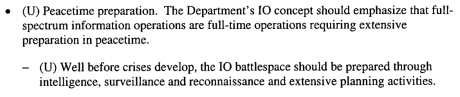
dod cyber
As a 2006 BBC report on this Pentagon document noted: "Perhaps the most startling aspect of the roadmap is its acknowledgement thatinformation put out as part of the military's psychological operations, or Psyops, is finding its way onto the computer and television screens of ordinary Americans." And while the report paid lip service to the need to create "boundaries" for these new IO military activities, "they don't seem to explain how." Regarding the report's plan to "provide maximum control of the entire electromagnetic spectrum", the BBC noted: "Consider that for a moment. The US military seeks the capability to knock out every telephone, every networked computer, every radar system on the planet."
Since then, there have been countless reports of the exploitation by the US national security state to destroy privacy and undermine internet freedom. In November, the LA Times described programs that "teach students how to spy in cyberspace, the latest frontier in espionage." They "also are taught to write computer viruses, hack digital networks, crack passwords, plant listening devices and mine data from broken cellphones and flash drives." The program, needless to say, "has funneled most of its graduates to the CIA and the Pentagon's National Security Agency, which conducts America's digital spying. Other graduates have taken positions with the FBI, NASA and the Department of Homeland Security."
In 2010, Lawrence E. Strickling, Assistant Secretary of Commerce for Communications and Information, gave a speech explicitly announcing that the US intends to abandon its policy of "leaving the Internet alone". Noting that this "has been the nation's Internet policy since the Internet was first commercialized in the mid-1990s", he decreed: "This was the right policy for the United States in the early stages of the Internet, and the right message to send to the rest of the world. But that was then and this is now."
The documented power of the US government to monitor and surveil internet communications is already unfathomably massive. Recall that the Washington Post's 2010 "Top Secret America" series noted that: "Every day, collection systems at the National Security Agency intercept and store 1.7 billion e-mails, phone calls and other types of communications." And the Obama administration has formally demandedthat it have access to any and all forms of internet communication.
It is hard to overstate the danger to privacy and internet freedom from a massive expansion of the National Security State's efforts to exploit and control the internet. As Wired's Singel wrote back in 2010:
"Make no mistake, the military industrial complex now has its eye on the internet. Generals want to train crack squads of hackers and have wet dreams of cyberwarfare. Never shy of extending its power, the military industrial complex wants to turn the internet into yet another venue for an arms race".
Wildly exaggerated cyber-threats are the pretext for this control, the "mushroom cloud" and the Tonkin Gulf fiction of cyber-warfare. As Singel aptly put it: "the only war going on is one for the soul of the internet." That's the vital context for understanding this massive expansion of Pentagon and NSA consolidated control over cyber programs.

Bonanza For Private Contractors

As always, it is not just political power but also private-sector profit driving this expansion. As military contracts for conventional war-fighting are modestly reduced, something needs to replace it, and these large-scale "cyber-security" contracts are more than adequate. Virtually every cyber-security program from the government is carried out in conjunction with its "private-sector partners", who receive large transfers of public funds for this work.
Two weeks ago, Business Week reported that "Lockheed Martin Corp., AT&T Inc., and CenturyLink Inc. are the first companies to sign up for a US program giving them classified information on cyber threats that they can package as security services for sale to other companies." This is part of a government effort "to create a market based on classified US information about cyber threats." In May, it was announced that "the Pentagon is expanding and making permanent a trial program that teams the government with Internet service providers to protect defense firms' computer networks against data theft by foreign adversaries" - all as "part of a larger effort to broaden the sharing of classified and unclassified cyberthreat data between the government and industry."
Indeed, there is a large organization of defense and intelligence contractors devoted to one goal: expanding the private-public merger for national security and intelligence functions. This organization - the Intelligence and National Security Alliance (INSA) - was formerly headed by Adm. McConnell, and describes itself as a "collaboration by leaders from throughout the US Intelligence Community" which "combines the experience of senior leaders from government, the private sector, and academia."
As I detailed back in 2010, one of its primary goals is to scare the nation about supposed cyber-threats in order to justify massive new expenditures for the private-sector intelligence industry on cyber-security measures and vastly expanded control over the internet. Indeed, in his 2010 Op-Ed, Adm. McConnell expressly acknowledged that the growing privatization of internet cyber-security programs "will muddy the waters between the traditional roles of the government and the private sector." At the very same time McConnell published this Op-Ed, the INSA website featured a report entitled "Addressing Cyber Security Through Public-Private Partnership." It featured a genuinely creepy graphic showing the inter-connectedness between government institutions (such as Congress and regulatory agencies), the Surveillance State, private intelligence corporations, and the Internet:

insa
Private-sector profit is now inextricably linked with the fear-mongering campaign over cyber-threats. At one INSA conference in 2009 - entitled "Cyber Deterrence Conference" - government officials and intelligence industry executives gathered together to stress that "government and private sector actors should emphasize collaboration and partnership through the creation of a model that assigns specific roles and responsibilities."
As intelligence contractor expert Tim Shorrock told Democracy Now when McConnell - then at Booz Allen - was first nominated to be DNI:
Well, the NSA, the National Security Agency, is really sort of the lead agency in terms of outsourcing . . . . Booz Allen is one of about, you know, ten large corporations that play a very major role in American intelligence. Every time you hear about intelligence watching North Korea or tapping al-Qaeda phones, something like that, you can bet that corporations like these are very heavily involved. And Booz Allen is one of the largest of these contractors. I estimate that about 50% of our $45 billion intelligence budget goes to private sector contractors like Booz Allen.
This public-private merger for intelligence and surveillance functions not only vests these industries with large-scale profits at public expense, but also the accompanying power that was traditionally reserved for government. And unlike government agencies, which are at least subjected in theory to some minimal regulatory oversight, these private-sector actors have virtually none, even as their surveillance and intelligence functions rapidly increase.
What Dwight Eisenhower called the military-industrial complex has been feeding itself on fear campaigns since it was born. A never-ending carousel of Menacing Enemies - Communists, Terrorists, Latin American Tyrants, Saddam's chemical weapons, Iranian mullahs - has sustained it, and Cyber-Threats are but the latest.
Like all of these wildly exaggerated cartoon menaces, there is some degree of threat posed by cyber-attacks. But, as Singel described, all of this can be managed with greater security systems for public and private computer networks - just as some modest security measures are sufficient to deal with the terrorist threat.
This new massive expansion has little to do with any actual cyber-threat - just as the invasion of Iraq and global assassination program have little to do with actual terrorist threats. It is instead all about strengthening the US's offensive cyber-war capabilities, consolidating control over the internet, and ensuring further transfers of massive public wealth to private industry continue unabated. In other words, it perfectly follows the template used by the public-private US National Security State over the last six decades to entrench and enrich itself based on pure pretext.

Sunday, December 02, 2012

Poorly Learned Lessons About Terrorism


By Paul R. Pillar ,
One of those principles is that terrorism is not something with a beginning and an end. It is instead a tactic that has persisted throughout history. And yet the notion of a beginning and an end persists in thinking in this country about terrorism. The counterterrorism machine has gotten cranked up to run in ways that would not be acceptable to most Americans if it were to run forever, and yet there is no evident point at which, once turned on, it should be turned off. It was inevitable that a backlash would set in.
Related to this point is the prevalent, and equally mistaken, notion that fighting terrorism involves wiping out or incapacitating some identifiable set of people: “the terrorists.” That is the idea behind the hit lists and target matrices. The Post's series depicts a U.S. counterterrorist effort that has become increasingly and narrowly focused on eliminating the people in the matrices rather than on what leads people to become terrorists and to get into the matrices in the first place. The United States, through its policies and actions, does a lot to affect which people, and how many people, become terrorists. Those actions include the drone strikes, with their collateral damage and power to enrage, that have become the preeminent means of elimination.
Another concept that is only slowly and belatedly being appreciated is that counterterrorism involves inherent trade-offs, between security and such things as civil liberties, personal privacy, and alternative use of public resources. The common absolutist attitude toward preventing terrorism, which was especially stark in the immediate aftermath of 9/11, has led most public discussion of the topic to be phrased in terms of what measures are necessary to do the job. But there is no “necessary” level. It is instead a matter of how much security to buy at what price. The answer to that can vary, and vary over time as the same population changes its attitudes. This is a lesson that is only being learned over time and as backlashes have set in.
Most of the important lessons about this subject still have not been assimilated by most of the American public. Over the next few years public support for counterterrorism probably will ebb and flow as it always has: sharply up after a terrorist incident, gradually down as the costs and downsides become more apparent with any incident-free passages of time. Such fluctuation will have little or no correlation with the pattern of actual terrorist threats or with a rational approach to countering the threats.

Saturday, September 01, 2012

The Sham “Terrorism Expert” Industry

Glenn Greenwald writes,

A Highly Ideological, Jingoistic Clique Masquerades As Objective Scholars, All To Justify US Militarism

Shortly prior to the start of the London Olympics, there was anoutburst of hysteria over the failure to provide sufficient security against Terrorism, but as Harvard Professor Stephen Walt noted yesterday in Foreign Policy, this was all driven, as usual, by severe exaggerations of the threat: “Well, surprise, surprise. Not only was there no terrorist attack, the Games themselves came off rather well.” Walt then urges this lesson be learned:

[W]e continue to over-react to the “terrorist threat.” Here I recommend you read John Mueller and Mark G. Stewart’s The Terrorism Delusion: America’s Overwrought Response to September 11, in the latest issue of International Security. Mueller and Stewart analyze 50 cases of supposed “Islamic terrorist plots” against the United States, and show how virtually all of the perpetrators were (in their words) “incompetent, ineffective, unintelligent, idiotic, ignorant, unorganized, misguided, muddled, amateurish, dopey, unrealistic, moronic, irrational and foolish.” They quote former Glenn Carle, former deputy national intelligence officer for transnational threats saying “we must see jihadists for the small, lethal, disjointed and miserable opponents that they are,” noting further that al Qaeda’s “capabilities are far inferior to its desires.”
In the next paragraph, Walt essentially makes clear why this lesson will not be learned: namely, because there are too many American interests vested in the perpetuation of this irrational fear:
Mueller and Stewart estimate that expenditures on domestic homeland security (i.e., not counting the wars in Iraq or Afghanistan) have increased by more than $1 trillion since 9/11, even though the annual risk of dying in a domestic terrorist attack is about 1 in 3.5 million. Using conservative assumptions and conventional risk-assessment methodology, they estimate that for these expenditures to be cost-effective “they would have had to deter, prevent, foil or protect against 333 very large attacks that would otherwise have been successful every year.” Finally, they worry that this exaggerated sense of danger has now been “internalized”: even when politicians and “terrorism experts” aren’t hyping the danger, the public still sees the threat as large and imminent.  As they conclude:
… Americans seems to have internalized their anxiety about terrorism, and politicians and policymakers have come to believe that they can defy it only at their own peril.  Concern about appearing to be soft on terrorism has replaced concern about seeming to be soft on communism, a phenomenon that lasted far longer than the dramatic that generated it … This extraordinarily exaggerated and essentially delusional response may prove to be perpetual.”
Which is another way of saying that you should be prepared to keep standing in those pleasant and efficient TSA lines for the rest of your life, and to keep paying for far-flung foreign interventions designed to “root out” those nasty jihadis.
Many of the benefits from keeping Terrorism fear levels high are obvious. Private corporations suck up massive amounts of Homeland Security cash as long as that fear persists, while government officials in the National Security and Surveillance State can claim unlimited powers, and operate with unlimited secrecy and no accountability. In sum, the private and public entities that shape government policy and drive political discourse profit far too much in numerous ways to allow rational considerations of the Terror threat.
* * * * *
But there’s a very similar and at least equally important (though far less discussed) constituency deeply vested in the perpetuation of this fear. It’s the sham industry Walt refers to, with appropriate scare quotes, as “terrorism experts,” who have built their careers on fear-mongering over Islamic Terrorism and can stay relevant only if that threat does.
These “terrorism experts” form an incredibly incestuous, mutually admiring little clique in and around Washington. They’re employed at think tanks, academic institutions, and media outlets. They can and do have mildly different political ideologies — some are more Republican, some are more Democratic — but, as usual for D.C. cliques, ostensible differences in political views are totally inconsequential when placed next to their common group identity and career interest: namely, sustaining the myth of the Grave Threat of Islamic Terror in order to justify their fear-based careers, the relevance of their circle, and their alleged “expertise.” Like all adolescent, insular cliques, they defend one another reflexively whenever a fellow member is attacked, closing ranks with astonishing speed and loyalty; they take substantive criticisms very personally as attacks on their “friends,” because a criticism of the genre and any member in good standing of this fiefdom is a threat to their collective interests.
On a more substantive level, any argument (such as Walt’s) that puts the Menace of Islamic Terror into its proper rational perspective — namely, that it pales in comparison to countless other threats (including Terrorism from non-Muslim individuals and states); that it is wildly exaggerated considering what is done in its name; and that it is sustained by ugly sentiments of Islamophobic bigotry — is one that must be harshly denounced. Such an argument not only threatens their relevance but also their central ideology: that Terror is an objective term that just happens almost always to mean Islamic Terror, but never American Terror.
Thus, Walt’s seemingly uncontroversial article was published for not even 24 hours when it was bitterly attacked for hours on Twitter this morning by Daveed Gartenstein-Ross, and it’s not hard to see why. Looking at Gartenstein-Ross’s reaction and what drives it sheds considerable light onto this sham “terrorism expert” industry.
Gartenstein-Ross’ entire lucrative career as a “terrorism expert” desperately depends on the perpetuation of the Islamic Terror threat. He markets himself as an expert in Islamic Terror by highlighting that he was born Jewish, converted to Islam while in college, and then Saw the Light and converted to Christianity. During his short stint as a Muslim, he worked at the al-Haramain charity foundation in Oregon — the same one that was found to have been illegally spied upon by the Bush NSA — but became an FBI informant against the group because — as he claimed in a book,”My Year Inside Radical Islam”, which he subsequently wrote to profit off of his conduct — he was horrified by “the group hatreds and anti-intellectualism of radical Islam.”
He is now listed as an “expert” at the neocon Foundation for the Defense of Democracies (the group’s list of “experts” is basically a Who’s Who of every unhinged neocon extremist in the country). Gartenstein-Ross is specifically employed by the Foundation as something called “Director of the Center for the Study of Terrorist Radicalization.” According to his own bio, he also “consults for clients who need to be at the forefront of understanding violent non-state actors and twenty-first century conflict” including for “major media companies, and strategic consultations for defense contractors” and “also regularly designs and leads training for the U.S. Department of Defense’s Leader Development and Education for Sustained Peace (LDESP) courses, the U.S. State Department’s Office of Anti-Terrorism Assistance, and domestic law enforcement.”
Unsurprisingly, Gartenstein-Ross — like so many “terrorism experts” in similar positions — is eager to depict Islamic Terror as a serious threat: he knows where his bread his buttered and does not want the personal cash train known as the War on Terror ever to arrive at a final destination. If you were him, would you?
In 2009, he wrote a study entitled “Homegrown Terrorists in the U.S. and U.K.” which, needless to say, was only about Muslims: an “examination of 117 ‘jihadist’ terrorists in the United States and the United Kingdom” which “concludes that religious beliefs” — namely, Islam –”play a role in radicalization.” In 2011, he wrote a book entitled Bin Laden’s Legacy: Why We’re Still Losing the War on Terror, which argues that “despite the death of Osama bin Laden, al Qaeda remains a significant threat.” He has hyped the ludicrous alleged Iranian Quds Forces plot against the Saudi Ambassador (explaining that ”Holder weighing in on the plot’s connection to Iran means the administration is deadly serious about it”), and recently touted Nigeria as the “next front in the war on terror.”
To be sure, Gartenstein-Ross is more nuanced and sophisticated than the standard neocon “terror expert” cartoon — his 2011 bin Laden book argues against wasteful counter-terrorism programs that are out of proportion to the actual threat, and he has, to his credit, publicly opposed some of the more crass Islamophobic attacks — but if the War on Islamic Terror disappears, so, too, does his lucrative career as a “terrorism expert.” In that regard, he’s a highly representative figure for this industry.
Walt’s clearly expressed and uncontroversial argument about the exaggerated Terror threat prompted hours of angry derision and personal mockery today from Gartenstein-Ross (who ironically often holds himself out as the Beacon of Civil Discourse). It began this way:
Gartenstein-Ross then demanded that Muslim Terror be taken more seriously than Walt suggests: “terrorists actually put 3 bombs on passenger planes since 2009.” He was then joined by fellow “natsec” clique members for hours of swarming group mockery aimed at Walt (that’s how they typically behave). Gartenstein-Ross continuedForeign Policy ”should rename Walt’s blog ‘An Ideologue in an Ideological Age.’ The idea he transcends ideological blinders is laughable.” Professor Walt, he then said, is “far less rigorous than his reputation suggests” and “the gap between perception & reality is rather astounding.” Then: “when an academic starts blogging it’s often easy to tell if that ‘authority’ is undeserved.”
All this public impugning of Walt’s reputation, scholarship and character over the crime of pointing out that the threat of Islamic Terror is wildly overstated by people who have an interest in perpetuating the threat. It’s as though Gartenstein-Ross and his friends were eager to jump up, wave their arms, and prove Walt’s argument by identifying themselves as precisely the fear-mongering culprits he was criticizing.
Exactly the same thing happened this week in response to Juan Cole’ssuperb post entitled “Top Ten differences between White Terrorists and Others,” pointing out all the revealing differences in how white perpetrators of violence are talked about versus non-white (especially Muslim) ones. Cole’s argument was every bit as threatening to the vested interests of the “terror expert” industry as Walt’s was, as it reveals the ugly truth that the hysteria over the Muslim Threat is motivated far more by Islamophobic bigotry and subservience to U.S. Government militarism than any rational policy assessments or high-minded scholarship.
This was too much to bear for J.M. Berger, a self-described “specialist on homegrown extremism” and author of “Jihad Joe: Americans Who Go to War in the Name of Islam,” which, in his words, “uncovers the secret history of American jihadists” — meaning Muslims, of course. “American Muslims have traveled abroad to fight in wars because of their religious beliefs,” says the book’s summary. (Symbolizing how relentlessly incestuous this clique is, Gartenstein-Ross randomly took a moment out of his attack on Walt today to pimp what he called Berger’s “valuable book”). Like Gartenstein-Ross, Berger avoids the more overt forms of anti-Muslim rhetoric, often stressing the need to distinguish between Good Muslims and the Terrorist kind, but he spends his time doing things like shrieking about the Towering Menace of Anwar al-Awlaki and generally hopping on whatever Muslim-Terrorism-is-a-Grave-Danger train that comes along.
Berger denounced Cole’s piece as “80 percent BS, 20 percent fair points” and said it was composed of “lazy generalizations.” Specifically, Berger complained that when a Muslim launches a violent attack, there are “whole stories dedicated to AQ being fringe and Islam being peaceful,” but when there’s a violent attack by a white shooter, “no one does stories about how white people are mostly peaceful and non-racist” (apparently, the true victims of unfair media coverage of Terror attacks are white people, not Muslims). He insisted, needless to say, that white perpetrators of violence are depicted as lone nuts while attacks by Muslims are depicted as part of a broader Terror threat only because it’s so true. It’s vital to Berger that Islamic Terror continue to be perceived as a vital, coordinated national security threat or else J.W. Berger and his “expertise” will cease to matter.
The key role played by this “terrorism expert” industry in sustaining highly damaging hysteria was highlighted in an excellent and still-relevant 2007 Washington Post Op-Ed by Zbigniew Brzezinski. In it, he described how the War on Terror has created an all-consuming Climate of Fear in the U.S. along with a systematic, multi-headed policy of discrimination against Muslim Americans based on these severely exaggerated threats, and described one of the key culprits this way:
Such fear-mongering, reinforced by security entrepreneurs, the mass media and the entertainment industry, generates its own momentum.The terror entrepreneurs, usually described as experts on terrorism, are necessarily engaged in competition to justify their existence. Hence their task is to convince the public that it faces new threats. That puts a premium on the presentation of credible scenarios of ever-more-horrifying acts of violence, sometimes even with blueprints for their implementation.
It’s very similar to what Les Gelb, in expressing his regret for supporting the attack on Iraq, described as “the disposition andincentives [in America's Foreign Policy Community] to support wars to retain political and professional credibility.” When I interviewed Gelb in 2010 regarding that quote, he told me that D.C. experts know that they can retain relevance in and access to key government circles only if they lend theoretical support to U.S. militarism rather than oppose it.
(Notably, people in these insular, government-subservient D.C. enclaves try to suppress and delegitimize any discussion of who funds them and what their careerist and cultural incentives are by denouncing any such discussion as illegitimate ad hominem; that’s all a way of demanding that they be accepted at face value as “experts” and that the financial and institutional pressures and groupthink precepts shaping their world and their views never be assessed).
Similarly to Brzezinski’s Op-Ed, Ken Silverstein recently wrote an excellent June, 2012 Harpers article examining the fraud known as Matthew Levitt, Ph.D., who heads the “Counterterrorism and Intelligence Program at the Washington Institute for Near East Policy,” where he tracks “global jihadist movements” (as usual, “terrorism experts” fixate on Muslims). Levitt has been repeatedly used by the U.S. Government as a “terrorism expert” witness in the prosecution of dozens of Muslims accused of Terrorism despite a history of discredited claims and extremely dubious grounds for claiming “expertise”. Silverstein writes:
That is a description that applies generally to the sham “terrorism expert” industry.
* * * * *
Not all of these “terror experts” are driven primarily by careerist relevance. Some are actually vapid enough to be True Believers, addicted to the excitement and sense of purpose that Terrorism provides. Fran Townsend — Bush’s former Homeland Security adviser, CNN’s “national security expert,” and a paid supporter of the Iranian Terror group MEK — provided a small but telling example this morning. She was apparently at New York’s LaGuardia Airport when a very exciting episode happened which she “reported” on Twitter as it unfolded. First was this:
Code words! Security breaches! How scary! And exciting! Moments later:
The mystery builds! Then:
Here, things start to palpably deflate. The depressing realization starts to set in that nothing of any significance has happened, that it’s all just some routine, banal event of no consequence. Then: the inevitable, deeply disappointing denouement:
In other words, nothing — all that breathless excitement over absolutely nothing: a perfect little microcosm of America’s Terrorism policies and its “terror expert” industry over the last decade.
* * * * *
But the most pernicious attribute of this “terror expert” industry, the aspect that requires much more attention, is its pretense to non-ideological, academic objectivity. In reality, these “terror experts”, almost uniformly, have a deeply ideological view — a jingoistic, highly provincial understanding — of what Terrorism is and is not. They generally fixate on Muslims to the exclusion of all other forms of Terror. In particular, the idea that the U.S. or its allies now commit Terrorism is taboo, unthinkable. Their views on what Terrorism is track the U.S. Government’s and, by design, justify U.S. government actions. They are not “experts” as much as they are ideologues, rank propagandists, and servants of America’s establishment power centers.
The reason the term “terrorism experts” deserves to be put in quotation marks is not as some ad hominem insult (something the mavens of the “terror expert” clique are incapable of understanding, as they demonstrated with their ludicrously personalized outrage when I applied this critique to one of their industry’s most cherished Patron Saints, Will McCants). Rather, it’s because — as I’ve written aboutmany times before — the very concept of Terrorism is inherently empty, illegitimate, meaningless. “Terrorism” itself is not an objective term or legitimate object of study, but was conceived of as a highly politicized instrument and has been used that way ever since.
The best scholarship on this issue, in my view, comes from Remi Brulin, who teaches at NYU and wrote his PhD dissertation at the Sorbonne in Paris on the discourse of Terrorism. When I interviewed him in 2010, he described the history of the term — it was pushed by Israel in the 1960s and early 1970s as a means of universalizing its conflicts (this isn’t our fight against our enemies over land; it’s the Entire World’s Fight against The Terrorists!). The term was then picked up by the neocons in the Reagan administration to justify their covert wars in Central America (in a test run for what they did after 9/11, they continuously exclaimed: we’re fighting against The Terrorists in Central America, even as they themselves armed and funded classic Terror groups in El Salvador and Nicaragua). From the start, the central challenge was how to define the term so as to include the violence used by the enemies of the U.S. and Israel, while excluding the violence the U.S., Israel and their allies used, both historically and presently. That still has not been figured out, which is why there is no fixed, accepted definition of the term, and certainly no consistent application.
Brulin details the well-known game-playing with the term: in the 1980s, Iraq was put on the U.S. list of Terror states when the U.S. disliked Saddam for being aligned with the Soviets; then Iraq was taken off when the U.S. wanted to arm Saddam to fight Iran; then they were put back on again when the U.S. wanted to attack Iraq. The same thing is happening now with the MEK: now that they’re a pro-U.S. and pro-Israel Terror group rather than a Saddam-allied one, they are magically no longer going to be deemed Terrorists.That is what Terrorism is: a term of propaganda, a means of justifying one’s own state violence — not some objective field of discipline in which one develops “expertise.”
This flaw in the concept of “terrorism expertise” is not a discrete indictment of specific “scholars,” but is a fundamental flaw plaguing the entire field. Even the most decorated and honored “terrorism experts” are little more than ideological propagandists, because that’s what the term necessarily entails. Today, Brulin wrote the following to me regarding U.S. Reagan-era policy in Central America — namely, supporting Terror groups (death squads) while denouncing Terrorism — and the specific “terrorism expert” often held up as the field’s most prestigious, Bruce Hoffman:
One obvious question comes to mind: how do “terrorism experts” deal with US policies in Salvador during the 1980s?
A comprehensive analysis of the two major “terrorism studies” journals, “Studies on Conflict and Terrorism” (simply titled “Terrorism” until 1992) and “Terrorism and Political Violence” shows that overall these journals have dealt with this issue by … being silent about it. More precisely, several authors in fact absolutely accept that the concept of “state terrorism”  is a valid one, and that acts by “death squads” clearly fall under that definition also. They simply never deal with this issue in the context of the real world policies of the United States and of the Reagan years in particular, a silence all the more surprising than Reagan was the first American President to develop a “discourse on terrorism”.
Reacting to Glenn Greenwald, Andrew Exum wrote: “Greenwald makes it seem as if states are never mentioned as terrorist actors, but there is a lot of literature on the use of coercive violence by states and state terrorism”.  This is true of course, but at least when it comes to the conflict of El Salvador studied here, and to US policies in that country, those who did write about this issue havenever been published in the major “terrorism studies journals.”
Exum then adds: “Bruce Hoffman published this book in 1999. I’m pretty sure those two guys are terrorism experts without the scare quotes.”
In “Inside Terrorism”, to his merit, Hoffman devotes a full chapter to the question of the “definition of terrorism.” What follows in the rest of his book is naturally dependent on what he decides to include and not include in his definition of “terrorism”. Here is, in full, how Hoffman deals with the issue of “death squads” (emphasis added):
“The use of so-called ‘death squads’ (often off-duty or plain-clothes security or police officers) in conjunction with blatant intimidation of political opponents, human rights and aid workers, student groups, labor organizers, journalists and others has been a prominent feature of the right-wing military dictatorships that took power in Argentina, Chile and Greece during the 1970s and even of elected governments in El Salvador, Guatemala, Colombia and Peru since the mid-1980s. But these state-sanctioned or explicitly ordered acts of internal political violence directed mostly against domestic populations — that is, rule by violence and intimidation by those already in power against their own citizenry — aregenerally termed ‘terror’ in order to distinguish that phenomenon from ‘terrorism’, which is understood to be violence committed by non-state entities. (Bruce Hoffman, Inside Terrorism, 27).
Sadly, Hoffman does not tell his readers who at the time “termed acts by death squads ‘terror’”, or who wishes to do so “in order to distinguish this phenomenon from ‘terrorism.’”
Not only is this argument rather less than convincing, but most crucially no one in Washington, at the time, ever used this argument, and this for obvious reasons. Indeed, as Hoffman himself notes, the “death squads”, “even in elected governments like El Salvador”, were “state-sanctioned”, precisely what the Reagan administration kept denying at the time. Furthermore, Hoffman’s argument makes no sense in the historical context: can one imagine the Reagan administration defending US aid to El Salvador as part of the “fight against terrorism” while stating that the ties between that State and the “death squad” posed no problem because they merely fell under the concept of “terror”?
Thus, the role of “terrorism experts” cannot simply be described as blindly accepting of the official “discourse on terrorism”, although this is already a strong critique. As the case of El Salvador demonstrates, what they have done is to invent arguments aimed at excluding from discussion specific issues, while hiding or being completely silent about the actual debates that took place on this topic at the very heart of Washington. In so doing, they have allowed a “terrorism discourse” to developed and become hegemonic despite the many internal inconsistencies that have been at its heart from the very beginning.
Finally, one will note that Hoffman, in Inside Terrorism, makes no mention of the Contras and their support by the Reagan administration. This is a difficult decision to explain, since aid to the Contras falls under the concept of “state sponsored terrorism”, the validity of which is accepted by all experts. Here, Hoffman uses the technique used by so many other “terrorism experts” in this case:he simply decides to not write about it, with no explanation given.
The entire field is one huge effort to legitimize U.S. state violence and delegitimize the violence by its enemies (along those lines: the court-martial of accused Fort Hood shooter Nidal Hasan began today, and I asked earlier today on Twitter whether this attack constituted Terrorism given that it targeted a military base and soldiers of anation at war. My mere asking of this question sparked all sorts of intense outrage from the predictable “natsec” D.C. mavens: Of course it’s Terrorism, as Hasan killed unarmed people including one civilian, exclaimed people who would never, ever dare apply the Terrorism label to the civilian-devastating U.S. attack on Iraq or the use of American drones and cluster bombs to kill innocent civilians by the dozens; that is the discourse of Terrorism: violence by Muslims against a U.S. military base during a time of war qualifies, but violence by the U.S. Government against thousands of innocent Muslim civilians never could).
Brulin is far from alone among scholars in recognizing the true purpose of this sham discipline. Harvard’s Lisa Stampnitzky, whom I interviewed several months ago, is also a leading scholar on the exploitation of Terrorism and the field that calls itself “terrorism experts.” In a superb journal article in Qualitative Sociology, she documents that “‘Terrorism’ has proved to be a highly problematic object of expertise”; in particular, “Terrorism studies fails to conform to the most common sociological notions of what a field of intellectual production ought to look like, and has been described by participants and observers alike as a failure.” She notes that the harshest condemnations have come from those who work in this academic discipline: “Terrorism researchers have characterized their field as stagnant, poorly conceptualized, lacking in rigor, and devoid of adequate theory, data, and methods.” That includes Bruce Hoffman himself, who, she notes, wrote:
Fifteen years ago, the study of terrorism was described by perhaps the world’s preeminent authority on modern warfare as a ’huge and ill-defined subject [that] has probably been responsible for more incompetent and unnecessary books than any other outside the field of sociology. It attracts phonies and amateurs…as a candle attracts moths’… [T]errorism research arguably has failed miserably.
Stampnitzky adds: “More than 15 years after this assessment, descriptions of the field are rife with similar claims.” Indeed, her forthcoming book from Cambridge University Press is entitled “Disciplining Terror: How Experts Invented Terrorism” and, in her words, it “explains how political violence became ‘terrorism,’ and how this transformation led to the current ‘war on terror’.” For that reason, she argues in her dissertation, “those who would address terrorism as a rational object, subject to scientific analysis and manipulation, produce a discourse which they are unable to control, as attempts at scientific discourse are continually hybridized by the moral discourse of the public sphere, in which terrorism is conceived as a problem of evil and pathology.” Indeed, she explains in her journal article, “One of the most oft-noted difficulties has been the inability of researchers to establish a suitable definition of the concept of ‘terrorism’ itself.”
In a recently published journal article in International Security, entitled “The Terrorism Delusion,” Professors John Mueller and Mark G. Stewart (cited by Walt) extensively document what a fraud the concept of “Terrorism” has become over the last decade. Specifically, ”the exaggerations of the threat presented by terrorism and then on the distortions of perspective these exaggerations have inspired— distortions that have in turn inspired a determined and expensive quest to ferret out, and even to create, the nearly nonexistent.
Richard Jackson is a Professor at the The National Centre for Peace and Conflict Studies in New Zealand. He has written volumes on the fraud of “terrorism expertise” and the propagandistic purpose of this field of discipline. He has documented that most self-proclaimed “terrorism experts” simply ignore the primary cause of the violence they claim to study: “most terrorism scholars, politicians and the media don’t seem to ‘know’ that terrorism is most often caused by military intervention overseas, and not religion, radicalization, insanity, ideology, poverty or such like” — even though “the Pentagon has known it for years.” In one article entitled “10 Things More Likely to Kill You Than Terrorism,” he notes that “The chances of you dying in a terrorist attack are in the range of 1 in 80,000, or about the same chance of being killed by a meteor,” and that bathtubs, vending machines, and lightning all pose a greater risk of death.
In a book critiquing the “terrorism expert” field, Jackson argued that “most of what is accepted as well-founded ’knowledge’ in terrorism studies is, in fact, highly debatable and unstable.“ He therefore scorns almost four decades of so-called Terrorism scholarship as ”based on a series of ‘virulent myths’, ’half-truths’ and contested claims” that are plainly “biased towards Western state priorities.” To Jackson, terrorism is “a social fact rather than a brute fact” and “does not exist outside of the definitions and practices which seek to enclose it, including those of the terrorism studies field.” In sum, it means whatever the wielder of the term wants it to mean: something that cannot be the subject of legitimate “expertise.”
* * * * *
There is no term more potent in our political discourse and legal landscape than “Terrorism.” It shuts down every rational thought process and political debate the minute it is uttered. It justifies torture (we have to get information from the Terrorists); due-process-free-assassinations even of our own citizens (Obama has to kill the Terrorists); and rampant secrecy (the Government can’t disclose what it’s doing or have courts rule on its legality because the Terrorists will learn of it), and it sends people to prison for decades (material supporters of Terrorism).
It is a telling paradox indeed that this central, all-justifying word is simultaneously the most meaningless and therefore the most manipulated. It is, as I have noted before, a word that simultaneously means nothing yet justifies everything. Indeed, that’s the point: it is such a useful concept precisely because it’s so malleable, because it means whatever those with power to shape discourse want it to mean. And no faction has helped this process along as much as the group of self-proclaimed “terrorism experts” that has attached itself to think tanks, academia, and media outlets. They enable pure political propaganda to masquerade as objective fact, shining brightly with the veneer of scholarly rigor. The industry itself is a fraud, as are those who profit from and within it.
Via: "Salon"