Showing posts with label Right Of Return. Show all posts

Tuesday, November 12, 2013

Mahmoud Abbas – Cornered, Bribed, Threatened


By Mark Bruzonsky

The “Palestinian Authority” headed by Mahmoud Abbas long ago became a collaborating regime.  And that’s the most positive adjective, far worse is said of him.   The famed American Palestinian scholar Edward Said did in fact say far worse years ago shortly after Abbas signed the Oslo agreement at the White House and took Arafat down the winding road that has so badly fractured and weakened the Palestinians ever since.

But at least in the end, despite unprecedented and repeated “enticements”,  Arafat steadfastly refused to sign away crucial Palestinian rights that have defined the conflict for nearly a hundred years.  Abbas however has now been maneuvered into a situation in which he just might, even though his credibility to do so is far far less than Arafat’s.

Abbas’s choices have greatly narrowed in recent years.   He knows that if he refuses to accommodate the Americans, Israelis, and Saudis — all of whom fund, protect, and control him — they may decide to replace him, and as they did with Arafat when they in the end isolated him, threatened him, and then stealth assassinated him.

Abbas hangs on not just to collect still more VIP priviledges and monies for family, friends, and the PA mini-regime of Ramallah, but because he fears he will be isolated, discredited, and/or terminated.   He and his family have already squireled away more than $100 million.  The matrix of inducements, threats, and bribes, that now whirl around Abbas and his cabal of cronies in Ramallah is greater than ever before.

Sunday, December 16, 2012

Challenging Israel’s Myths


Lawrence Davidson's reply to Fred Skolnik:

Soon after my Nov. 4 analysis, “In Defense of Richard Falk” was published by Media with a Conscience (MWC), the site editor forwarded to me an unusual chastising response. Unusual because it came from a relatively well-known scholar and writer by the name of Fred Skolnik.

It is not rare for Zionists to take me to task, and Skolnik is most certainly a Zionist. Yet it is rare that those who chastise are of Skolnik’s stature. And so, a reply is in order.

... as far as Skolnik is concerned I am part of “an army of Israel haters … churning out endless … venomous half truths” about the Land of Israel. Nonetheless, Skolnik has taken the time to write a three-page commentary to set me and my readers straight.

That being said, here is my analysis of elements of Mr. Skolnik’s case for Israel.

1. Skolnik: “There is no historic Palestine that has anything to do with the Arabs, nor is there an “indigenous’ or native Muslim population there.” Skolnick’s assertion is a very old fantasy or myth that has been developed over the years to allow radical Zionists and violent settlers to rationalize their historical absorption of Palestinian land.

Quoting from the Wikipedia entry for Palestinian People, an entry which reflects the latest research into this subject of who was where and when, including genetic analysis, we find that Palestinians are the “modern descendants of those who have lived in Palestine over the centuries and today are largely culturally and linguistically Arab. … Genetic analysis suggests that a majority of the Muslims of Palestine, inclusive of the Arab citizens of Israel, are descendants of Christians, Jews and other inhabitants of the southern Levant whose core reaches back to prehistoric times.”

Furthermore, “a study of high-resolution haplotypes [DNA sequences] demonstrated that a substantial portion of Y chromosomes of Israeli Jews (70%) and of Palestinian Muslim Arabs (82%) belong to the same chromosome pool.”

What all this means is that the ancestors of those Palestinians who are now culturally and linguistically Arab have been in Palestine for time immemorial. Over the ages, the population fragmented, acquired differing religious, linguistic and cultural traits. Indeed, those indigenous Palestinians, Jews and local Christians as well,are basically the same people gone in somewhat separate cultural ways.

Poor Mr. Skolnik. It is a shock that he is so ardently supporting the ethnic cleansing of his own cousins.

2. Skolnik: “Most of the Arabs with ‘roots’ in the Land of Israel migrated there from other parts of the Arab world in the 19th and early 20th centuries while the Jews have been continuously present in the Land of Israel for well over 3000 years.”

This is another myth that was most prominently put forth in a book by Joan Peters, published in 1984, andentitled From Time Immemorial. Her argument and evidence were meticulously taken apart and shown to be false by Norman Finkelstein in his Image and Reality of the Israel-Palestine Conflict(1995).

3. Skolnik: “The displacement of the Arabs in the Land of Israel during Israel’s war of Independence … was paralleled by the displacement of hundreds of thousands of Jews living in Arab lands at the time whose lives were made unbearable under vindictive Arab rule.” Subsequently, the Israelis “received their Jewish brethren with open arms” while the Arab countries that received Arab refugees “herded them into camps and treated them like animals.”

For an editor of a 22-volume encyclopedia Skolnik shows a deplorable tendency to slip into generalizing, stereotyping and lumping together multiple events with multiple outcomes. Here are some counterpoints:

–Actually, the exodus of Arab Jews from their countries of residence went on over an extended period of time and in some cases, such as Algeria, had nothing to do with the events in Palestine. In other cases where the Arab country found itself at war with Israel, as with Egypt, Jewish immigration was a direct result of the Zionist expulsion of Arabs. And in the case of Morocco, the government tried hard to assure the Jews safety and prosperity to counter Zionist propaganda urging them to leave.

–Sometimes the “displacement” was hastened, as in Iraq, by Zionist agents committing violent acts of sabotage against local Jewish communities.

–The reception the Arab Jews got in Israel wasn’t quite the “open arms” picture Skolnik paints. They were received by their European Jewish “brethren” with racial prejudice. Even today, Ashkenazi and Sephardic/Mizrachi relations in Israel are strained.

–As for the Arab refugees who were allegedly “treated like animals” by their fellow Arabs, this is an exaggeration. The situation differed country to country. For instance, treatment in Lebanon was bad; in Jordan it was good. In none of the refugee camps in Arab countries were conditions worse than those in the tent cities and “development towns” in the Negev Desert into which the Israelis herded 80 percent of the Arab Jewish refugees.

4. Mr. Skolnik has other points which time and space do not allow me to address. The interested reader can find them in his response to my essay on Dr. Falk. If you read and consider them please take the time to follow up with other sources of information, such as the works of the Israeli historians Ilan Pappe and Benny Morris as well as the journalistic pieces of Amira Hass and Gideon Levy (both of whom work for the Israeli newspaper Haaretz), and the reports of Israel’s human rights group B’Tselem. These are all Israeli sources, but they tell a very different story than does Skolnik.

From Skolnik To Gaza

As Mr. Skolnik so aptly demonstrates, we all live within our ownworld. These are usually constructed for us by our upbringing: our families, our peers, our schools, our friends and the level of attachment we develop to the community. This attachment is usually sustained and deepened by the reinforcing information environment that the community provides for us.

These environments at once transform us into “good” citizens and simultaneously narrow our views of the world so they conform to acceptable political and cultural paradigms.The process usually works quite well. Nevertheless, it is still true that in any community you get a continuum of acceptance and devotion ranging from the skeptic to the true believer. For the latter, the community can do no wrong and its behavior can always be rationalized. When it comes to Israel, Skolnik is a true believer.

In a country like Israel, one that has armed itself to the teeth yet feels perennially insecure, and where the true believers are in charge, the situation is made dangerous in the extreme. Over the years Israeli leaders, generally believing the same things that Fred Skolnik believes, have dispossessed and ethnically cleansed the Palestinians, pushing them into ever smaller areas of concentration.

Gaza is the worst example of these cases. It is a virtual “open air prison” of a million and half people squeezed into 139 square miles, the most densely populated place on earth. There, with the compliance of the United States and the European Union, the Israelis have proceeded to reduce most of the Gazans to abject poverty.

When, periodically, these people strike out at their tormenters, usually in ineffective ways, they are labeled terrorists and, again with Western blessing, attacked furiously and disproportionately by the Israelis. You can now witness the latest onslaught live on the web.

Under these circumstances Skolnik’s assertions that the Jews were in Palestine first and the Arabs only came later as interlopers is really besides the point. Let us say, just for the sake of argument, that he is correct, that the Jews, even in their European guise, are the real indigenous Palestinians, having come back to the homeland after an extended absence of a couple of thousand years.

Even granted this fiction, does any of that give today’s Israeli Jews the right to treat the Palestinians as they do? Does it justify the creation of an apartheid environment in the occupied West Bank? Does it give them the right to reduce a million and half Gazans to a calculated impoverishment and then provoke them until they respond, whereupon Israelis indulge themselves in self-righteous mass murder?

I don’t believe any of Skolnik’s pseudo-history. I also don’t give a damn who lived in or controlledPalestine 3,000 years ago. The ones who control it now are, by their actions, no better than barbarians. And the leaders in the West who back them have Palestinian blood on their hands.

When it comes to behaviors like ethnic cleansing and cultural genocide, the claim of self-defense is ludicrous.Nor can the fantasies of Fred Skolnik justify such on-going crimes.
Via: "Middle-East-Online"

Thursday, December 06, 2012

Normalize This


By Remi Kanazi,

Nor·mal·i·za·tion: a "colonization of the mind" whereby the oppressed subject comes to believe that the oppressor's reality is the only "normal" reality...and that the oppression is a fact of life that must be coped with. 

Those who engage in normalization either ignore this oppression, or accept it as the status quo that can be lived with. 

In an attempt to whitewash its violations of international law and human rights, Israel attempts to re-brand itself or present itself as "normal" -- even "enlightened" -- through an intricate array of relations and activities encompassing hi-tech, cultural, legal, LGBT and other realms.

Normalization applies to relationships that convey a misleading or deceptive image of normalcy, symmetry, or parity despite a patently abnormal and asymmetric relationship of colonial oppression and apartheid.

Nothing is normal about occupation
Nothing normal about apartheid ethic cleansing
Seige, blockade, settler-only roads
Bombing water wells, schools, mosques, and UN buildings
Nothing normal about putting a civilian population on a diet
Paying non-indigenous foreigners to settle land that has already been populated
Rewriting the nakba with each stolen childhood
Trying to desensitize the puncture wounds and quall marks
Put into the bodies of ? and Rachel Corry
No, I don't want to normalize with you
I don't want to hug, have coffee, talk it out, break bread, sit around the campfire, eat s'mores and gush about how we're all the same
I don't want to share stage, ? co-write a poem, ? submit to your anthology ?
Talk about how art, instead of justice, can forge a better path
I don't want to indulge your amnesia about a glorious past
Have a therapy session, I'm two sides with equal grievances
The only thing baron is a moral capacity
? semi-colonial state with an appropriative culture
I will not fight for your privilege, nor will I seek to normalize it
Your dialogue group, it's a breathing ground for injustice
Just look at the board members in the ZOA sponsorship
Zionism is a real demographic threat
Infecting the minds of millions with racism
They were hooded in the south
Pushing darker nations and ? young men ? blocks in Northern Ireland
In case you missed the hint, I don't want to pretend that all is okay
Or that bombs dropped on Gaza don't have the manufacture
The pilot doesn't have a nationality
Or ? Perez ? Lieberman
It's not just the occupation, stupid
It's the right of return
Equality for all Palestinians
It's a transformation from a racist, exclusivist, supremecist state
To a nation for all of its citizens
You deserve nothing... more than equality
Which means more than African refugees are provided in South Tel Aviv
You are the shining light on a settlement hill
Reminding the world that racism often comes in nice packaging
We don't give the Sudan 3.1 billion dollars a year in military aid
Don't have preferential trade agreements with North Korea
Don't call Iran a democracy
You're a proxy for empire
A 1950's authocracy and 21st century clothing
Yes! You're singled out
With aid, weapons, and UN vetos in your favor
Did I hurt your feelings?
Should we hug after the show?
Do these words hurt more than bombs dropped on Gaza
White ? eating the flesh of the children
I am not a bad guy, you're defending the bad system
Your words and actions have consequences
You're either with oppression, or you're against it
I didn't write history; it didn't choose to stand on the wrong side of it
Your system of oppression is coming to an end
And whether you recognize or not yet, it'll be liberated
For you, too.

Producer: Tami Woronoff 
Cinematographer: Mike McSweeney 
Editor: Matthew C. Levy
Sound: Steve Burgess 

Twitter: https://twitter.com/Remroum
Facebook: http://www.facebook.com/RemiPoet
Website: http://www.PoeticInjustice.net
Purchase Poetic Injustice:http://www.poeticinjustice.net/purchase.aspx#.UI3EKGnuVv1

PACBI (The Palestinian Campaign for the Academic and Cultural Boycott of Israel): http://www.pacbi.org/etemplate.php?id=1850

For more information on cultural and academic boycott in the US, please visit:http://www.usacbi.org/

Monday, December 03, 2012

Telling Truths About Israel/Palestine

False national narratives play key roles in controlling human behavior, especially when enforced by an aggressive propaganda system that demonizes factual counter-narratives. That has long been the case as Israel minimized its harsh treatment of Palestinians, but the truth has begun to break through.

By Lawrence Davidson,
Courtesy Of "Consortium News"


On Oct. 16, the Israeli organization Yazkern hosted dozens of veterans of Israel’s 1948 “War of Independence” for a look at what that struggle really entailed. The veterans testified to what can only be called a conscious effort at ethnic cleansing – the systematic destruction of entire Palestinian villages and numerous massacres.

The aim of Yazkern’s effort at truth-telling was to break through the  sanitized “mainstream nationalistic narrative” of 1948  and the accompanying denial of any legitimate Palestinian counter-narrative.
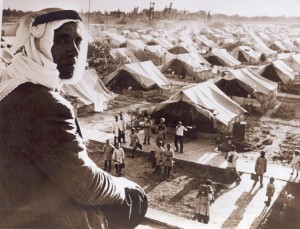
In 1948, some Palestinians, uprooted by Israel’s claims to their lands, relocated to the Jaramana Refugee Camp in Damascus, Syria
documentary film by Israeli-Russian journalist Lia Tarachansky, dealing with this same subject, the Palestinian “Nakba” or catastrophe, is nearing  completion. It too has the testimony of Israeli soldiers of the 1948 war.

These latest revelations lend credence to the claims of Israel’s “new historians,” such as Ilan Pappe, who have written books based on evidence gleamed from government archives showing that, even before the outbreak of hostilities leading to the creation of the State of Israel, the Zionist authorities planned to ethnically cleanse as much of Palestine as possible of non-Jews.

OK, you might say, the Israelis behaved savagely in 1948 – and only a small minority will admit it – but what about after “the War of Independence”? As it turns out, the ethnic cleansing never stopped. Conveniently, the longstanding denial that it ever started has helped to hide the fact that it’s ongoing.

Just this week, we received the news that Defense Minister Ehud Barak has given the order to demolish eight Palestinian villages with some 1,500 residents in the south Hebron hills. The excuse offered by Barak is that the land is needed for military training exercises.

According to the “new historians,” this is a standard Israeli government cover for ethnic cleansing. Sure, for a couple of years the Israeli army will use the land that held the demolished villages. Then, almost inevitably, the area becomes the site of a new Israeli Jewish settlement.

On Oct. 20, Al-Jazeera reported on Israeli documents showing that between 2008 and 2010 the Israeli army allowed food supplies into the Gaza Strip based on a daily calorie count that held the basic diet of a 1.5 million people to a point just short of malnutrition.

According to the Israeli human rights organization Gisha Legal Center for Freedom of Movement, “the official goal of the policy was to wage economic warfare which would paralyze Gaza’s economy and, according to the Defense Ministry, create pressure on the Hamas government.” Actually, this bit of savagery predates 2008.

Back in 2006, Dov Weissglass, then an adviser to Prime Minister Ariel Sharon, stated that “the idea is to put the Palestinians on a diet, but not to make them die of hunger.” Of course, precedents for this can be found in the treatment of European Jews in the 1930s and 1940s. One assumes that Mr. Weissglass was aware of this.

However, just as with the barbarism practiced in the “War of Independence,” in this case too there is a well-practiced capacity for national denial. According to Gideon Levy writing in Haaretz, “the country has plenty of ways … of burying skeletons deep in the closet so that Israelis shouldn’t be overly disturbed.”

The military authors of the document that turned Weissglass’s hideous “idea” into savage practice, operated in a country afflicted with blindness. Just so the present Israeli government does not worry about public unease over the fact that it is slowly but surely destroying the Gaza sewage system and rendering its water supply undrinkable.

Then there are the petty acts of cruelty that can be considered telltale signs of an underlying savagery. For instance, the fact that Israeli customs officials held back the the exam sheets for the October 2012 College Board tests bound for the West Bank graduating high school seniors.

AMIDEAST, the organization that serves as the testing agency for the Palestinian territories, had made sure the Israeli authorities had the tests in their hands weeks in advance. Nonetheless, in an apparent act of vindictiveness, the customs officials held on to them until AMIDEAST had to cancel the exam.

One observer has asked the question, “what has the SAT [tests] have to do with Israeli security?”  Well it might be that, in the mind of a cruel customs official, the more college-bound Palestinians from the Occupied Territories, the more articulate witnesses to Israeli oppression.

On the Gaza side of the equation, the U.S. was forced to cancel a small scholarship program for Gaza college students because the Israelis refused to let the students leave their open-air prison, even if only to go to a West Bank school.  (For anyone who might want to follow the grim procession of Israeli oppressive acts on a day-to-day basis, I recommend the web site Today In Palestine.)

Challenge and Denial

In the face of this behavior on the part of Israel, that country’s public support in the United States has finally begun to slip.

Most recently, 15 prominent church leaders, representing major Christian denominations, wrote an open letter to Congress calling for “an immediate investigation into possible violations by Israel of the U.S. Foreign Assistance Act and the U.S. Arms Export Control Act which respectively prohibit assistance to any country which engages in a consistent pattern of human rights violations. … We urge Congress to hold hearings to examine Israel’s compliance, and we request regular reporting on compliance and the withholding of military aid for non-compliance.”

So far, Congress has turned a deaf-ear to this request, but the Zionist reaction was loud and clear. Leading the way in this effort was the head of the misnamed Anti-Defamation League (ADL), Abraham Foxman. Charging the Christian leaders with a “blatant lack of sensitivity” (one might ask just how sensitive one is suppose to be to an oppressor?) Foxman decided to punish the offending clergy by refusing to engage in ongoing “interfaith dialogue.”

Having “big brains” is a two-edge sword for human beings. It means we can think all manner of creative thoughts and even exercise some self-control over our own inappropriate impulses if we care to try. However, it also means that we can be manipulated into thinking that we need not try – that we are the victims even as we are oppressing others and that any criticism of our actions is just another example of our victimization.

Israeli culture – and indeed the culture of Zionism generally – is one ongoing project of self-manipulation to achieve just such a state of mind. And, to a great extent, it has succeeded. A recent poll taken in Israel shows that “a majority of the [Israeli Jewish] public wants the state to discriminate against Palestinians … revealing a deeply rooted racism in Israeli society.”

The Zionists are not the only experts in denial. The United States, Israel’s chief ally, has always been good at this gambit as well. After the 9/11 attacks, any consideration of the possibility that United States foreign policy in the Middle East might have helped motivate the terrorism was anathema – and it still is over a decade later.

Instead of taking a hard look at our own behavior, we are simply expanding our capacity to kill outright anyone who would challenge our policies in a violent fashion. Our answer is targeted killings by drone or otherwise, a bit of savagery we copied from the Israelis.

Machiavelli, who can always be relied upon to see the darker side of things, once said, “Whoever wishes to foresee the future must consult the past; for human events resemble those of preceding times. This arises from the fact that they are produced by men who ever have been, and ever shall be, animated by the same passions, and thus they necessarily have the same results.”

But is it really inevitable?  

Wednesday, November 14, 2012

Door To A Two-State Solution Closed 45 Years Ago

By "Alan Hart"


UN Secretary-General Ban Ki-Moon told the General Assembly that “the door may be closing for good on a two-state solution to the Israel-Palestine conflict.” He added: “The continued growth of Israeli settlements in the occupied Palestinian territory seriously undermines efforts toward peace. We must break this dangerous impasse.”
The truth of history, which most if not all world leaders know but dare not state, is that the door Ban Ki-Moon sees closing, was actually slammed shut 45 years ago. The precise date of the closure was 22 November 1967. 
In the aftermath of the Six Days War of that year, the UN Security Council unanimously adopted, after much agonizing over five drafts, Resolution 242. At the time it was hailed as the key to a just and lasting peace in the Middle East. It could never have been that and here’s why.
Leaving aside the fact that 242 does not mention the Palestinians by name (it called only for a just settlement of “the refugee problem”), the key to understanding why the resolution was fatally flawed and bound to be a disaster for all who work seriously for justice and peace is in the fact that the 1967 war was a war of Israeli aggression, not as Israel asserted, and still asserts, a war of self-defense by way of a pre-emptive strike. (As I document in detail in Volume Three of the American edition of my book Zionism: The Real Enemy of the Jews, the Arabs did not strike first and never had any intention of initiating war with Israel, a fact that was known to Israel’s leaders. In my book I quote a number of them saying so).
Because it was a war of Israeli aggression, and given that 242′s preamble does pay lip-service to the “inadmissibility of the acquisition of territory by war“, there is no question about what the Security Council should have done. It should have demanded Israel’s unconditional withdrawal from the newly occupied Arab territories. That didn’t happen because President Johnson, guided by his Zionist advisers, refused to have Israel labelled as the aggressor.
There was, in, fact, a precedent for what ought to have happened. When Israel colluded with Britain and France in 1956 to invade Egypt in the hope of toppling Nasser, President Eisenhower insisted that Israel should withdraw from the Sinai without conditions. At the time the Zionist lobby and its stooges in Congress were seeking to tie Eisenhower’s hands and prevent him from reading the riot act to Israel. He responded by going over the heads of Congress with a prime time television address to his fellow Americans. Among the things he said was this:
Israel insists on firm guarantees as a condition to withdrawing its forces of invasion. If we agree that armed attack can properly achieve the purpose of the assailant, then I fear we will have turned back the clock of international order. We will have countenanced the use of force as a means of settling international differences and gaining national advantage… If the UN once admits that international disputes can be settled by using force, then we will have destroyed the very foundation of the organization and our best hope for establishing real world order.”
In November 1967, by not demanding that Israel withdraw without conditions, the Security Council, bullied by President Johnson on Zionism’s behalf, did what Eisenhower had warned against – it turned back the clock of international order and destroyed the hope the UN represented.
The question without an answer in 242 was – WHICH ISRAEL were the Arab states required to recognise and legitimize in order to comply with their obligations for peace as set down in the resolution?
  • The Israel of the 1949 Armistice Agreements, in other words Israel as it was on the eve of the 1967 war (and probably with mutually agreed border modifications here and there); or
  • a greater Israel in permanent occupation of all of Jerusalem, and chunks, if not all, of the West Bank and pieces of Egypt and Syria?
That question was without an answer in the final text of 242 for one very simple reason.Through the Johnson administration the Zionists succeeded in getting the definitive article “the” dropped from the text. As a consequence Israel’s armed forces were required to withdraw “from territories (not the territories) occupied in the recent conflict.”
If 242 had stated that Israel’s withdrawal from “the territories” was required, the meaning would have been that, in exchange for recognition and legitimacy, Israel was required to withdraw from all the territories it occupied in the 1967 war. But that was not on so far as the gut-Zionists were concerned. They wanted the freedom to be the ones, and the only ones, who would determine, on a take it or leave it basis backed by brute force, the extent of any Israeli withdrawals. Resolution 242 in its final form gave them that freedom. Effectively 242 put Zionism in the driving seat with a veto on any peace process.
The other thing the Security Council should have done was to insert into the text of 242 a statement to the effect that Israel should not seek to settle or colonise the Occupied Territories, and that if it did the Security Council would enforce international law and see to it that Israel was isolated and sanctioned by the whole international community.
Question: Why did the text of 242 not contain such a declaration?
Those responsible for framing the resolution were very much aware that Israel’s hawks were going to proceed with their colonial venture come what may, in determined defiance of international law and no matter what the organised international community said or wanted. Put another way, some if not all of those responsible for framing 242 were resigned to the fact that, because of the history of the Jews and the Nazi holocaust, Israel was not and never would or could be a normal state. As a consequence, there was no point in seeking to oblige it to behave like a normal state i.e. in accordance with international law and its obligations as a member of the UN. Like it or not, and whatever it might mean for the fate of mankind, the world was going to have to live with the fact that there were two sets of rules for the behaviour of nations – one for Israel and one for all other nations. Because of the way Israel was created, mainly by Zionist terrorism and ethnic cleansing and without legitimacy in international law, the UN system now had a double standard built into it, and because the political will to confront Zionism did not exist, there was nothing anybody could do to change that reality.
Some years ago a very, very senior UN official said to me, “Zionism has corrupted everything it touched, including this organisation in its infancy.” I knew, really knew, that he was reflecting the deeply held but private conviction of all the top international civil servants who were responsible for trying to make the world body work in accordance with the ideals and principles enshrined in its Charter. (As I said in my book when I quoted him, I will not name the man because he would not have made the comment to me if he had imagined that I would ever quote him by name, at least while he lived. He would not be embarrassed by public association with his truth: but he would not want, and would not deserve, all the hassle of being falsely labelled by Zionism’s character assassins as an anti-Semite).
Contentious though it is to say so in public, I think the corruption charge is supported by the facts. In 1947 the Zionists and their allies in the U.S. Congress subverted the General Assembly of the UN to get a rigged and bare minimum majority for the partition plan which was subsequently vitiated. In 1967 the Security Council was effectively subverted by the Johnson administration’s Zionist-driven refusal to hold Israel accountable to international law and its obligations as a member of the UN.
And thus it was, at least so far as the Arab and wider Muslim world (and me, too) are concerned, that the UN said goodbye to its integrity; and the door to a two-state solution of the Israel-Palestine conflict was closed, slammed shut. Forty five years ago.

Saturday, October 27, 2012

Palestinian Refugees: Time To Return NOW


10 million Palestinians. Almost 5 million of them are refugees. And half of those are still living in camps. It is in Lebanon that the Palestinian refugees live under the worst conditions. We visited the camps of Chatila, Borj Al Barajneh, Marelias, Nahr Al Bared, Badawi, Ain El Hilweh et Rachidiya.

Everywhere we find great poverty, a dense population, narrow lanes, a maze of electric wires all connected to each other, workshops for small manual jobs... but everywhere also the same steadfast will to return to their country, Palestine.

'Palestinian Refuges' is now converted to TV format and is available for any Public Access TV station in America (and the World) to download and broadcast.

To get Public Access TV Stations to broadcast - 'Palestinian Refuges' people can phone their local Public Access TV station and request the film be broadcast to their local community. The TV station can download the show from PEGMedia.org and then broadcast it.

Wednesday, August 15, 2012

Exploiting Jews From Arab Countries

Lara Friedman reports:


Last month saw an assault in Congress on Palestinian refugees—an effort to use legislation to re-define the Palestinian refugee issue out of existence.  This week the other shoe dropped, when a bipartisan group of members of Congress introduced a new bill embracing the cause of “Jewish refugees from Arab countries” in a way that Congress has never replicated on the Palestinian side (for more info, see this list of all bills/resolutions dealing with Palestinian and/or Jewish refugees since 1989). 

Perhaps not coincidentally, in what one Israeli paper described as a “sea change” in Israeli policy, the Israeli Foreign Ministry recently launched a diplomatic offensive focused on this very issue.  The Foreign Ministry makes clear that its focus is not only (ore even primarily) seeking justice for Jews from Arab countries.  The main goal is to impose new terms of reference on future peace negotiations—terms that place full responsibility on the Arab world both for Palestinian refugees of 1948 and for Jews who came to Israel from Arab countries in the wake of the creation of Israel. 

refugee-protest-openz
Arab Israeli protestors hold up banners and Palestinian flags as they march for the right of return for Palestinian refugees who fled their homes or were expelled during the 1948 war (Ahmad Gharabli / AFP / Getty Images)

Moreover, these terms propose that the grievances of Jews from Arab countries actually outweigh those of Palestinian refugees, based on their numbers and the value of the property they lost.  Indeed, back in 2008, then-Religious Affairs MinisterYitzhak Cohen stated that

The uprooted Jews' problem is equal to, if not greater than, the Palestinian refugees’ problem.

The implication of this argument is that in future peace negotiations, Jewish refugee claims can be used to cancel out or trump Palestinian refugee claims.  Finally, according to these new terms of reference, Arab countries must immediately absorb Palestinian refugees into their own populations.  This demand appears to reflect the belief that, just as Israel is the homeland of the Jews, any Arab country can be a homeland of any Arab, regardless of whether said Arab has any ties to the country in question. 

This cynical exploitation of Jews who came to Israel from Arab countries dishonors their history and tarnishes the legitimacy of their claims.  The respective suffering and losses of Palestinian refugees and Jews from Arab countries cannot be denied, but neither should one be pitted against the other for cynical political purposes.  The painful history of some Jews from Arab countries doesn’t negate the historic, moral and political responsibility—shared by Israel and the world—to address the plight and grievances of Palestinian refugees.  Trying to use it do so is antithetical to the achievement of peace and the two-state solution.  And make no mistake: Israeli-Palestinian peace is the only path to truly resolving the Palestinian refugee issue, and, by extension, to building relations between Israelis and the Arab world that will permit the resolution of claims of Jews who came to Israel from the Arab world.    

The fact that, in the years following the establishment of the state of Israel, many Jews came to Israel from Arab countries is indisputable.  Some emigrated voluntarily; others fled an atmosphere of growing discrimination, oppression, and threats. Unquestionably, many of these Jews have legitimate claims for property that was confiscated or left behind.  For various reasons, including the absence of bilateral relations between Israel and most of the relevant Arab countries,  as well as Israeli concerns about fueling Palestinian refugee claims, there has thus far been neither the mechanism nor the political will to address this issue.

But is the term “refugee”—and all that it implies emotionally and politically—an intellectually honest way to describe Jews from Arab countries living in Israel?  Around the time of Israel’s creation, it indeed appears to have described many of them, referring to someone who:

...[o]wing to well-founded fear of being persecuted for reasons of race, religion, nationality, membership of a particular social group or political opinion, is outside the country of his nationality and is unable or, owing to such fear, is unwilling to avail himself of the protection of that country…

However, the term “refugee” connotes more than this.  It brings to mind people forced by unmanageable circumstances to live, temporarily or sometimes permanently, as strangers in a foreign land, yearning in their hearts for their lost homes and homeland, hoping that they can someday return.  Is this an appropriate way to describe Jews who came to Israel from Arab countries?  Former director general of the Israeli Foreign Ministry, Alon Liel, doesn’t think so: 

It’s true that many Jews found themselves in Israel without having made plans to come—they escaped from Arab countries. But they were accepted and welcomed here. To define them as refugees is exaggerated.

Do supporters of this effort inside Congress, and its backers outside Congress (including those who support a Jewish right to every inch of biblical “Greater Israel”) believe that Jews who came to Israel from Arab countries see themselves as unwilling exiles in a foreign land, dreaming of the day they can return to their true homes in, say, Yemen, Egypt, or Tunisia? 

Clearly, this isn’t how Israeli governments—who actively encourage the immigration of Jews from around the world—have seen it.  As one advocate of the rights of Jews from Arab countries admitted,

No doubt successive [Israeli] governments saw Jews from the Muslim world as Zionist immigrants, not refugees.

Writing in Haaretz (highly recommended) in 2003, when the campaign around Jews from Arab lands was first picking up steam, Israeli professor Yehouda Shenhav, noted that:

As early as 1975, at the time of WOJAC's formation [an organization formed in the 1970s around this issue], Knesset speaker Yisrael Yeshayahu declared: “We are not refugees. [Some of us] came to this country before the state was born. We had messianic aspirations.”  Shlomo Hillel, a government minister and an active Zionist in Iraq, adamantly opposed the analogy: “I don't regard the departure of Jews from Arab lands as that of refugees. They came here because they wanted to, as Zionists.” In a Knesset hearing, Ran Cohen stated emphatically: “I have this to say: I am not a refugee.” He added: “I came at the behest of Zionism, due to the pull that this land exerts, and due to the idea of redemption. Nobody is going to define me as a refugee.”

Again, this is not to suggest that Jews from Arab countries don’t have legitimate claims for their losses—they do.  But Palestinian refugees aren’t responsible for what happened to them, any more than those Jews are responsible for what happened to Palestinians.  Both groups are victims of historical forces beyond their control.  As Professor Shenhav notes:

The unfounded, immoral analogy between Palestinian refugees and Mizrahi immigrants needlessly embroils members of these two groups in a dispute, degrades the dignity of many Mizrahi Jews, and harms prospects for genuine Jewish-Arab reconciliation.

Speaking at the United Nations last year, Prime Minister Netanyahu, delivered the following description of what Israel represents to Jews everywhere and throughout history:

…for those Jews who were exiled from our land, they never stopped dreaming of coming back: Jews in Spain, on the eve of their expulsion; Jews in the Ukraine, fleeing the pogroms; Jews fighting the Warsaw Ghetto, as the Nazis were circling around it. They never stopped praying, they never stopped yearning. They whispered: Next year in Jerusalem. Next year in the promised land.  As the prime minister of Israel, I speak for a hundred generations of Jews who were dispersed throughout the lands, who suffered every evil under the Sun, but who never gave up hope of restoring their national life in the one and only Jewish state…”

So which is it?  Is Israel the homeland of the Jews—the place where full citizenship is the birthright of any Jew born anywhere, or is it a generic country that magnanimously gave what has turned out to be permanent refuge to a group of foreigners (who happened to be Jewish) fleeing persecution in their native countries of the Arab world?            

It can’t be both. 

Thursday, June 07, 2012

AIPAC Trying To Erase Palestinian Refugees


Mark Kirk, R-Illinois


Critics of Senator Mark Kirk's drive to redefine who a Palestinian refugee is say the move is part of a strategy to take refugee rights for Palestinians off the negotiating table.

By Alex Kane
May 29, 2012
Courtesy Of "Alter Net"

Palestinians in the occupied territories, the diaspora and in refugee camps protested earlier this month on the 64th anniversary of the Nakba, commemorating the expulsion of 750,000 Palestinians by nascent Israeli forces in the late 1940s. Palestinians were sending a message to the world that the right to return to their homes would not be forgotten, and that millions of refugees are awaiting a solution.
One senator from Illinois, though, wants to write off those millions and change who is classified as a Palestinian refugee.Mark Kirk, a hawkish Republican whose political career has been boosted by right-wing Israel advocates, is leading a drive to fundamentally redefine who a Palestinian refugee is in the eyes of the United States.
Critics see the move as just one step in a larger strategy to take the issue of refugee rights for Palestinians off the negotiating table, and to cut funding from the United Nations Relief and Works Agency (UNRWA), the UN agency that assists Palestinians. One senior Senate aide who helped craft the amendment told theJewish Telegraphic Agency that “this will have major implications for future negotiations over final status issues with regard to refugees.”
In a statement, UNRWA spokesman Christopher Gunness said that “while UNRWA is following the debate in DC very closely, [the agency] does not comment in public about the internal workings of the legislatures of member states.”
Israel strongly opposes Palestinians’ right to return to their homes or their descendants’ homes, which they fled during the 1947-49 Arab-Israeli war and were never allowed to return to. Israel opposes the right to return because of their policy of maintaining a Jewish demographic majority. International law, though, strongly supports the rights of refugees to return to homes they were displaced from.
On Thursday May 24, a Senate committee passed an amendment by unanimous voice vote that would require the State Department to differentiate between Palestinian refugees who were displaced first-hand and those born after to families who were refugees.
The senator behind the amendment was Kirk, who is close to the American Israel Public Affairs Committee and has received over a million dollars from Israel oriented political action committees during his political career. Senator Patrick Leahy (D-VT) expressed concern at the bill and modified the amendment, but it still contains the State Department reporting requirement that Kirk was pushing.Kirk celebrated the passing of the amendment in a May 25 press release: "With U.S. taxpayers providing more than $4 billion to UNRWA since 1950, the watershed reporting requirement will help taxpayers better understand whether UNRWA truly remains a refugee assistance organization or has become a welfare agency for low-income residents of the Levant."
An earlier version of the bill pushed by Kirk would have made it US policy to classify as a refugee only those Palestinians personally displaced by Israeli forces. In practice, this would mean erasing the refugee status of almost all registered Palestinian refugees, cutting down the number to about 30,000.
"This amendment turns reality on its head," said Randa Farah, an associate professor of anthropology at the University of Western Ontario and an expert on Palestinian refugees and UNRWA. "The reality is that the number of Jewish settlers in Palestine turned it into a state of a Jewish majority, by displacing the indigenous Palestinian inhabitants."
It’s unclear how far the amendment will go in the legislative process. The State Department has come out strongly against Kirk’s idea to redefine Palestinian refugees. Their position, as Josh Rogin of Foreign Policy reports, is that “final status issues can and must only be resolved between Israelis and Palestinians in direct negotiations. The Department of State cannot support legislation which would force the United States to make a public judgment on the number and status of Palestinian refugees.” Rogin also reports that the State Department puts the number of Palestinian refugees at 5 million--the amount registered with UNRWA--and that US policy is in line with UNRWA’s practice of granting refugee status to descendants.
A diplomatic source with knowledge of the Kirk amendment outlined the key problems with it in an interview. The US has no interest in attacking UNRWA because in allied countries like Jordan, UNRWA is a stabilizing force. Jordan hosts some 2 million Palestinian refugees who are registered with UNRWA, which provides refugees with crucial services in education and health. If US funds to UNRWA were cut, for example, as Kirk tried to do when he was in the House of Representatives, Jordan could be destabilized.
Furthermore, Kirk’s amendment rests on the wrong assumption that Palestinian refugee status is uniquely passed on through generations. In fact, the United Nations High Commissioner for Refugees, a separate agency that oversees refugee situations outside of Palestine, also gives refugee status to generations of family members who remain displaced. For example, the son of a Cambodian refugee registered with the UNHCR as a result of being displaced is also considered a refugee by the UNHCR. The amendment also does not address the fact that the 1967 war created 500,000 Palestinian refugees, with an additional 175,000 Palestinians registering with UNRWA as a result.
Lara Friedman, an expert on Congressional policy on Israel/Palestine, criticized the bill in a recent post at the Daily Beast blog Open Zion. Kirk wants to “use U.S. law” to redefine “most Palestinian refugees out of existence” outside of a negotiations context. “Of course, it won’t work, even if this somehow makes it into law. Palestinians who consider themselves refugees don’t do so simply because UNRWA, or anyone else, gives them permission to do so,” wrote Friedman.
The big issue here, as Friedman notes, is that Kirk is pushing for a fundamental shift in US policy towards who is a Palestinian refugee. In turn, this shift could help scuttle Palestinian refugee rights in negotiations over resolving the Israel/Palestine conflict. If this amendment were to become US policy, it would boost Israel's attempts to take the right of return off the table.
Backers of the bill have been explicit about their aims. Jonathan Schanzer, vice president for research at the neoconservative think tank Foundation for the Defense of Democracies, wrote that the aim of the bill is to “tackle” the “thorny” issue of the right of return. “By tackling one of the toughest challenges of the Palestinian-Israeli conflict without the bedlam that typically accompanies bilateral negotiations, there would theoretically be one less sticking point when the stars align again for diplomacy,” wrote Schanzer. “Under the leadership of Knesset member Einat Wilf, this idea now has the backing of the prime minister's office, the Ministry of Defense, and the Ministry of Foreign Affairs.”
According to Americans for Peace Now, Schanzer is reportedly "deeply engaged in this latest anti-UNRWA initiative." The group also reports that AIPAC "was reportedly pleased with the amendment but has issued no public statement."
It’s all in line with the recent attacks on UNRWA by Likud Party member Danny Ayalon. Ayalon created a video in conjunction with the right-wing Israel lobby group Stand With Us which argued that UNRWA was prolonging the refugee conflict and the conflict with the Palestinians. But Farah, the expert on UNRWA and Palestinian refugees recently wrote, it is Israel’s “repressive apparatus” of control over Palestinians that perpetuates the conflict and “increases the dependence of refugees on UNRWA’s meager aid, while at the same time creating even more refugees and internally displaced persons.”
The right of return is not something Palestinians plan on giving up, as the recent Nakba Day protests show. But that won’t stop Kirk from trying to legislate their status as refugees out of existence. Kirk is holding water for the Israeli demand that Palestinian refugees should never be allowed to return to the homes they were forced out of over six decades ago.
"The real question is why aren’t Palestinian refugees allowed to return? The answer of course is because it threatens the odious and racist Zionist concept of a 'Jewish state,'" said Farah. "Generational distance or time does not annul rights to stolen land or confiscated property or return to a homeland from which a people have been forcibly denationalized and rendered de facto stateless." 
Alex Kane is AlterNet's New York-based World editor, and a staff reporter forMondoweiss