Showing posts with label Refugees. Show all posts

Monday, December 03, 2012

Telling Truths About Israel/Palestine

False national narratives play key roles in controlling human behavior, especially when enforced by an aggressive propaganda system that demonizes factual counter-narratives. That has long been the case as Israel minimized its harsh treatment of Palestinians, but the truth has begun to break through.

By Lawrence Davidson,
Courtesy Of "Consortium News"


On Oct. 16, the Israeli organization Yazkern hosted dozens of veterans of Israel’s 1948 “War of Independence” for a look at what that struggle really entailed. The veterans testified to what can only be called a conscious effort at ethnic cleansing – the systematic destruction of entire Palestinian villages and numerous massacres.

The aim of Yazkern’s effort at truth-telling was to break through the  sanitized “mainstream nationalistic narrative” of 1948  and the accompanying denial of any legitimate Palestinian counter-narrative.
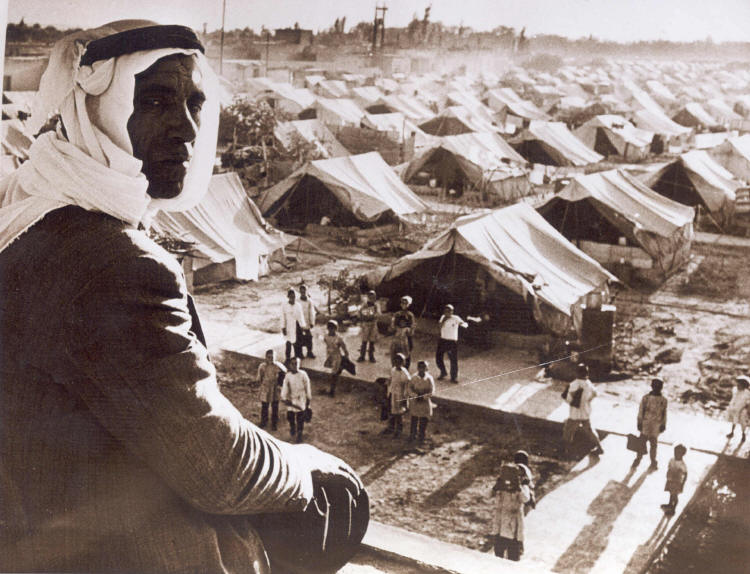
In 1948, some Palestinians, uprooted by Israel’s claims to their lands, relocated to the Jaramana Refugee Camp in Damascus, Syria
documentary film by Israeli-Russian journalist Lia Tarachansky, dealing with this same subject, the Palestinian “Nakba” or catastrophe, is nearing  completion. It too has the testimony of Israeli soldiers of the 1948 war.

These latest revelations lend credence to the claims of Israel’s “new historians,” such as Ilan Pappe, who have written books based on evidence gleamed from government archives showing that, even before the outbreak of hostilities leading to the creation of the State of Israel, the Zionist authorities planned to ethnically cleanse as much of Palestine as possible of non-Jews.

OK, you might say, the Israelis behaved savagely in 1948 – and only a small minority will admit it – but what about after “the War of Independence”? As it turns out, the ethnic cleansing never stopped. Conveniently, the longstanding denial that it ever started has helped to hide the fact that it’s ongoing.

Just this week, we received the news that Defense Minister Ehud Barak has given the order to demolish eight Palestinian villages with some 1,500 residents in the south Hebron hills. The excuse offered by Barak is that the land is needed for military training exercises.

According to the “new historians,” this is a standard Israeli government cover for ethnic cleansing. Sure, for a couple of years the Israeli army will use the land that held the demolished villages. Then, almost inevitably, the area becomes the site of a new Israeli Jewish settlement.

On Oct. 20, Al-Jazeera reported on Israeli documents showing that between 2008 and 2010 the Israeli army allowed food supplies into the Gaza Strip based on a daily calorie count that held the basic diet of a 1.5 million people to a point just short of malnutrition.

According to the Israeli human rights organization Gisha Legal Center for Freedom of Movement, “the official goal of the policy was to wage economic warfare which would paralyze Gaza’s economy and, according to the Defense Ministry, create pressure on the Hamas government.” Actually, this bit of savagery predates 2008.

Back in 2006, Dov Weissglass, then an adviser to Prime Minister Ariel Sharon, stated that “the idea is to put the Palestinians on a diet, but not to make them die of hunger.” Of course, precedents for this can be found in the treatment of European Jews in the 1930s and 1940s. One assumes that Mr. Weissglass was aware of this.

However, just as with the barbarism practiced in the “War of Independence,” in this case too there is a well-practiced capacity for national denial. According to Gideon Levy writing in Haaretz, “the country has plenty of ways … of burying skeletons deep in the closet so that Israelis shouldn’t be overly disturbed.”

The military authors of the document that turned Weissglass’s hideous “idea” into savage practice, operated in a country afflicted with blindness. Just so the present Israeli government does not worry about public unease over the fact that it is slowly but surely destroying the Gaza sewage system and rendering its water supply undrinkable.

Then there are the petty acts of cruelty that can be considered telltale signs of an underlying savagery. For instance, the fact that Israeli customs officials held back the the exam sheets for the October 2012 College Board tests bound for the West Bank graduating high school seniors.

AMIDEAST, the organization that serves as the testing agency for the Palestinian territories, had made sure the Israeli authorities had the tests in their hands weeks in advance. Nonetheless, in an apparent act of vindictiveness, the customs officials held on to them until AMIDEAST had to cancel the exam.

One observer has asked the question, “what has the SAT [tests] have to do with Israeli security?”  Well it might be that, in the mind of a cruel customs official, the more college-bound Palestinians from the Occupied Territories, the more articulate witnesses to Israeli oppression.

On the Gaza side of the equation, the U.S. was forced to cancel a small scholarship program for Gaza college students because the Israelis refused to let the students leave their open-air prison, even if only to go to a West Bank school.  (For anyone who might want to follow the grim procession of Israeli oppressive acts on a day-to-day basis, I recommend the web site Today In Palestine.)

Challenge and Denial

In the face of this behavior on the part of Israel, that country’s public support in the United States has finally begun to slip.

Most recently, 15 prominent church leaders, representing major Christian denominations, wrote an open letter to Congress calling for “an immediate investigation into possible violations by Israel of the U.S. Foreign Assistance Act and the U.S. Arms Export Control Act which respectively prohibit assistance to any country which engages in a consistent pattern of human rights violations. … We urge Congress to hold hearings to examine Israel’s compliance, and we request regular reporting on compliance and the withholding of military aid for non-compliance.”

So far, Congress has turned a deaf-ear to this request, but the Zionist reaction was loud and clear. Leading the way in this effort was the head of the misnamed Anti-Defamation League (ADL), Abraham Foxman. Charging the Christian leaders with a “blatant lack of sensitivity” (one might ask just how sensitive one is suppose to be to an oppressor?) Foxman decided to punish the offending clergy by refusing to engage in ongoing “interfaith dialogue.”

Having “big brains” is a two-edge sword for human beings. It means we can think all manner of creative thoughts and even exercise some self-control over our own inappropriate impulses if we care to try. However, it also means that we can be manipulated into thinking that we need not try – that we are the victims even as we are oppressing others and that any criticism of our actions is just another example of our victimization.

Israeli culture – and indeed the culture of Zionism generally – is one ongoing project of self-manipulation to achieve just such a state of mind. And, to a great extent, it has succeeded. A recent poll taken in Israel shows that “a majority of the [Israeli Jewish] public wants the state to discriminate against Palestinians … revealing a deeply rooted racism in Israeli society.”

The Zionists are not the only experts in denial. The United States, Israel’s chief ally, has always been good at this gambit as well. After the 9/11 attacks, any consideration of the possibility that United States foreign policy in the Middle East might have helped motivate the terrorism was anathema – and it still is over a decade later.

Instead of taking a hard look at our own behavior, we are simply expanding our capacity to kill outright anyone who would challenge our policies in a violent fashion. Our answer is targeted killings by drone or otherwise, a bit of savagery we copied from the Israelis.

Machiavelli, who can always be relied upon to see the darker side of things, once said, “Whoever wishes to foresee the future must consult the past; for human events resemble those of preceding times. This arises from the fact that they are produced by men who ever have been, and ever shall be, animated by the same passions, and thus they necessarily have the same results.”

But is it really inevitable?  

Saturday, October 27, 2012

Palestinian Refugees: Time To Return NOW


10 million Palestinians. Almost 5 million of them are refugees. And half of those are still living in camps. It is in Lebanon that the Palestinian refugees live under the worst conditions. We visited the camps of Chatila, Borj Al Barajneh, Marelias, Nahr Al Bared, Badawi, Ain El Hilweh et Rachidiya.

Everywhere we find great poverty, a dense population, narrow lanes, a maze of electric wires all connected to each other, workshops for small manual jobs... but everywhere also the same steadfast will to return to their country, Palestine.

'Palestinian Refuges' is now converted to TV format and is available for any Public Access TV station in America (and the World) to download and broadcast.

To get Public Access TV Stations to broadcast - 'Palestinian Refuges' people can phone their local Public Access TV station and request the film be broadcast to their local community. The TV station can download the show from PEGMedia.org and then broadcast it.

Wednesday, August 15, 2012

Exploiting Jews From Arab Countries

Lara Friedman reports:


Last month saw an assault in Congress on Palestinian refugees—an effort to use legislation to re-define the Palestinian refugee issue out of existence.  This week the other shoe dropped, when a bipartisan group of members of Congress introduced a new bill embracing the cause of “Jewish refugees from Arab countries” in a way that Congress has never replicated on the Palestinian side (for more info, see this list of all bills/resolutions dealing with Palestinian and/or Jewish refugees since 1989). 

Perhaps not coincidentally, in what one Israeli paper described as a “sea change” in Israeli policy, the Israeli Foreign Ministry recently launched a diplomatic offensive focused on this very issue.  The Foreign Ministry makes clear that its focus is not only (ore even primarily) seeking justice for Jews from Arab countries.  The main goal is to impose new terms of reference on future peace negotiations—terms that place full responsibility on the Arab world both for Palestinian refugees of 1948 and for Jews who came to Israel from Arab countries in the wake of the creation of Israel. 

refugee-protest-openz
Arab Israeli protestors hold up banners and Palestinian flags as they march for the right of return for Palestinian refugees who fled their homes or were expelled during the 1948 war (Ahmad Gharabli / AFP / Getty Images)

Moreover, these terms propose that the grievances of Jews from Arab countries actually outweigh those of Palestinian refugees, based on their numbers and the value of the property they lost.  Indeed, back in 2008, then-Religious Affairs MinisterYitzhak Cohen stated that

The uprooted Jews' problem is equal to, if not greater than, the Palestinian refugees’ problem.

The implication of this argument is that in future peace negotiations, Jewish refugee claims can be used to cancel out or trump Palestinian refugee claims.  Finally, according to these new terms of reference, Arab countries must immediately absorb Palestinian refugees into their own populations.  This demand appears to reflect the belief that, just as Israel is the homeland of the Jews, any Arab country can be a homeland of any Arab, regardless of whether said Arab has any ties to the country in question. 

This cynical exploitation of Jews who came to Israel from Arab countries dishonors their history and tarnishes the legitimacy of their claims.  The respective suffering and losses of Palestinian refugees and Jews from Arab countries cannot be denied, but neither should one be pitted against the other for cynical political purposes.  The painful history of some Jews from Arab countries doesn’t negate the historic, moral and political responsibility—shared by Israel and the world—to address the plight and grievances of Palestinian refugees.  Trying to use it do so is antithetical to the achievement of peace and the two-state solution.  And make no mistake: Israeli-Palestinian peace is the only path to truly resolving the Palestinian refugee issue, and, by extension, to building relations between Israelis and the Arab world that will permit the resolution of claims of Jews who came to Israel from the Arab world.    

The fact that, in the years following the establishment of the state of Israel, many Jews came to Israel from Arab countries is indisputable.  Some emigrated voluntarily; others fled an atmosphere of growing discrimination, oppression, and threats. Unquestionably, many of these Jews have legitimate claims for property that was confiscated or left behind.  For various reasons, including the absence of bilateral relations between Israel and most of the relevant Arab countries,  as well as Israeli concerns about fueling Palestinian refugee claims, there has thus far been neither the mechanism nor the political will to address this issue.

But is the term “refugee”—and all that it implies emotionally and politically—an intellectually honest way to describe Jews from Arab countries living in Israel?  Around the time of Israel’s creation, it indeed appears to have described many of them, referring to someone who:

...[o]wing to well-founded fear of being persecuted for reasons of race, religion, nationality, membership of a particular social group or political opinion, is outside the country of his nationality and is unable or, owing to such fear, is unwilling to avail himself of the protection of that country…

However, the term “refugee” connotes more than this.  It brings to mind people forced by unmanageable circumstances to live, temporarily or sometimes permanently, as strangers in a foreign land, yearning in their hearts for their lost homes and homeland, hoping that they can someday return.  Is this an appropriate way to describe Jews who came to Israel from Arab countries?  Former director general of the Israeli Foreign Ministry, Alon Liel, doesn’t think so: 

It’s true that many Jews found themselves in Israel without having made plans to come—they escaped from Arab countries. But they were accepted and welcomed here. To define them as refugees is exaggerated.

Do supporters of this effort inside Congress, and its backers outside Congress (including those who support a Jewish right to every inch of biblical “Greater Israel”) believe that Jews who came to Israel from Arab countries see themselves as unwilling exiles in a foreign land, dreaming of the day they can return to their true homes in, say, Yemen, Egypt, or Tunisia? 

Clearly, this isn’t how Israeli governments—who actively encourage the immigration of Jews from around the world—have seen it.  As one advocate of the rights of Jews from Arab countries admitted,

No doubt successive [Israeli] governments saw Jews from the Muslim world as Zionist immigrants, not refugees.

Writing in Haaretz (highly recommended) in 2003, when the campaign around Jews from Arab lands was first picking up steam, Israeli professor Yehouda Shenhav, noted that:

As early as 1975, at the time of WOJAC's formation [an organization formed in the 1970s around this issue], Knesset speaker Yisrael Yeshayahu declared: “We are not refugees. [Some of us] came to this country before the state was born. We had messianic aspirations.”  Shlomo Hillel, a government minister and an active Zionist in Iraq, adamantly opposed the analogy: “I don't regard the departure of Jews from Arab lands as that of refugees. They came here because they wanted to, as Zionists.” In a Knesset hearing, Ran Cohen stated emphatically: “I have this to say: I am not a refugee.” He added: “I came at the behest of Zionism, due to the pull that this land exerts, and due to the idea of redemption. Nobody is going to define me as a refugee.”

Again, this is not to suggest that Jews from Arab countries don’t have legitimate claims for their losses—they do.  But Palestinian refugees aren’t responsible for what happened to them, any more than those Jews are responsible for what happened to Palestinians.  Both groups are victims of historical forces beyond their control.  As Professor Shenhav notes:

The unfounded, immoral analogy between Palestinian refugees and Mizrahi immigrants needlessly embroils members of these two groups in a dispute, degrades the dignity of many Mizrahi Jews, and harms prospects for genuine Jewish-Arab reconciliation.

Speaking at the United Nations last year, Prime Minister Netanyahu, delivered the following description of what Israel represents to Jews everywhere and throughout history:

…for those Jews who were exiled from our land, they never stopped dreaming of coming back: Jews in Spain, on the eve of their expulsion; Jews in the Ukraine, fleeing the pogroms; Jews fighting the Warsaw Ghetto, as the Nazis were circling around it. They never stopped praying, they never stopped yearning. They whispered: Next year in Jerusalem. Next year in the promised land.  As the prime minister of Israel, I speak for a hundred generations of Jews who were dispersed throughout the lands, who suffered every evil under the Sun, but who never gave up hope of restoring their national life in the one and only Jewish state…”

So which is it?  Is Israel the homeland of the Jews—the place where full citizenship is the birthright of any Jew born anywhere, or is it a generic country that magnanimously gave what has turned out to be permanent refuge to a group of foreigners (who happened to be Jewish) fleeing persecution in their native countries of the Arab world?            

It can’t be both. 

Thursday, June 07, 2012

AIPAC Trying To Erase Palestinian Refugees


Mark Kirk, R-Illinois


Critics of Senator Mark Kirk's drive to redefine who a Palestinian refugee is say the move is part of a strategy to take refugee rights for Palestinians off the negotiating table.

By Alex Kane
May 29, 2012
Courtesy Of "Alter Net"

Palestinians in the occupied territories, the diaspora and in refugee camps protested earlier this month on the 64th anniversary of the Nakba, commemorating the expulsion of 750,000 Palestinians by nascent Israeli forces in the late 1940s. Palestinians were sending a message to the world that the right to return to their homes would not be forgotten, and that millions of refugees are awaiting a solution.
One senator from Illinois, though, wants to write off those millions and change who is classified as a Palestinian refugee.Mark Kirk, a hawkish Republican whose political career has been boosted by right-wing Israel advocates, is leading a drive to fundamentally redefine who a Palestinian refugee is in the eyes of the United States.
Critics see the move as just one step in a larger strategy to take the issue of refugee rights for Palestinians off the negotiating table, and to cut funding from the United Nations Relief and Works Agency (UNRWA), the UN agency that assists Palestinians. One senior Senate aide who helped craft the amendment told theJewish Telegraphic Agency that “this will have major implications for future negotiations over final status issues with regard to refugees.”
In a statement, UNRWA spokesman Christopher Gunness said that “while UNRWA is following the debate in DC very closely, [the agency] does not comment in public about the internal workings of the legislatures of member states.”
Israel strongly opposes Palestinians’ right to return to their homes or their descendants’ homes, which they fled during the 1947-49 Arab-Israeli war and were never allowed to return to. Israel opposes the right to return because of their policy of maintaining a Jewish demographic majority. International law, though, strongly supports the rights of refugees to return to homes they were displaced from.
On Thursday May 24, a Senate committee passed an amendment by unanimous voice vote that would require the State Department to differentiate between Palestinian refugees who were displaced first-hand and those born after to families who were refugees.
The senator behind the amendment was Kirk, who is close to the American Israel Public Affairs Committee and has received over a million dollars from Israel oriented political action committees during his political career. Senator Patrick Leahy (D-VT) expressed concern at the bill and modified the amendment, but it still contains the State Department reporting requirement that Kirk was pushing.Kirk celebrated the passing of the amendment in a May 25 press release: "With U.S. taxpayers providing more than $4 billion to UNRWA since 1950, the watershed reporting requirement will help taxpayers better understand whether UNRWA truly remains a refugee assistance organization or has become a welfare agency for low-income residents of the Levant."
An earlier version of the bill pushed by Kirk would have made it US policy to classify as a refugee only those Palestinians personally displaced by Israeli forces. In practice, this would mean erasing the refugee status of almost all registered Palestinian refugees, cutting down the number to about 30,000.
"This amendment turns reality on its head," said Randa Farah, an associate professor of anthropology at the University of Western Ontario and an expert on Palestinian refugees and UNRWA. "The reality is that the number of Jewish settlers in Palestine turned it into a state of a Jewish majority, by displacing the indigenous Palestinian inhabitants."
It’s unclear how far the amendment will go in the legislative process. The State Department has come out strongly against Kirk’s idea to redefine Palestinian refugees. Their position, as Josh Rogin of Foreign Policy reports, is that “final status issues can and must only be resolved between Israelis and Palestinians in direct negotiations. The Department of State cannot support legislation which would force the United States to make a public judgment on the number and status of Palestinian refugees.” Rogin also reports that the State Department puts the number of Palestinian refugees at 5 million--the amount registered with UNRWA--and that US policy is in line with UNRWA’s practice of granting refugee status to descendants.
A diplomatic source with knowledge of the Kirk amendment outlined the key problems with it in an interview. The US has no interest in attacking UNRWA because in allied countries like Jordan, UNRWA is a stabilizing force. Jordan hosts some 2 million Palestinian refugees who are registered with UNRWA, which provides refugees with crucial services in education and health. If US funds to UNRWA were cut, for example, as Kirk tried to do when he was in the House of Representatives, Jordan could be destabilized.
Furthermore, Kirk’s amendment rests on the wrong assumption that Palestinian refugee status is uniquely passed on through generations. In fact, the United Nations High Commissioner for Refugees, a separate agency that oversees refugee situations outside of Palestine, also gives refugee status to generations of family members who remain displaced. For example, the son of a Cambodian refugee registered with the UNHCR as a result of being displaced is also considered a refugee by the UNHCR. The amendment also does not address the fact that the 1967 war created 500,000 Palestinian refugees, with an additional 175,000 Palestinians registering with UNRWA as a result.
Lara Friedman, an expert on Congressional policy on Israel/Palestine, criticized the bill in a recent post at the Daily Beast blog Open Zion. Kirk wants to “use U.S. law” to redefine “most Palestinian refugees out of existence” outside of a negotiations context. “Of course, it won’t work, even if this somehow makes it into law. Palestinians who consider themselves refugees don’t do so simply because UNRWA, or anyone else, gives them permission to do so,” wrote Friedman.
The big issue here, as Friedman notes, is that Kirk is pushing for a fundamental shift in US policy towards who is a Palestinian refugee. In turn, this shift could help scuttle Palestinian refugee rights in negotiations over resolving the Israel/Palestine conflict. If this amendment were to become US policy, it would boost Israel's attempts to take the right of return off the table.
Backers of the bill have been explicit about their aims. Jonathan Schanzer, vice president for research at the neoconservative think tank Foundation for the Defense of Democracies, wrote that the aim of the bill is to “tackle” the “thorny” issue of the right of return. “By tackling one of the toughest challenges of the Palestinian-Israeli conflict without the bedlam that typically accompanies bilateral negotiations, there would theoretically be one less sticking point when the stars align again for diplomacy,” wrote Schanzer. “Under the leadership of Knesset member Einat Wilf, this idea now has the backing of the prime minister's office, the Ministry of Defense, and the Ministry of Foreign Affairs.”
According to Americans for Peace Now, Schanzer is reportedly "deeply engaged in this latest anti-UNRWA initiative." The group also reports that AIPAC "was reportedly pleased with the amendment but has issued no public statement."
It’s all in line with the recent attacks on UNRWA by Likud Party member Danny Ayalon. Ayalon created a video in conjunction with the right-wing Israel lobby group Stand With Us which argued that UNRWA was prolonging the refugee conflict and the conflict with the Palestinians. But Farah, the expert on UNRWA and Palestinian refugees recently wrote, it is Israel’s “repressive apparatus” of control over Palestinians that perpetuates the conflict and “increases the dependence of refugees on UNRWA’s meager aid, while at the same time creating even more refugees and internally displaced persons.”
The right of return is not something Palestinians plan on giving up, as the recent Nakba Day protests show. But that won’t stop Kirk from trying to legislate their status as refugees out of existence. Kirk is holding water for the Israeli demand that Palestinian refugees should never be allowed to return to the homes they were forced out of over six decades ago.
"The real question is why aren’t Palestinian refugees allowed to return? The answer of course is because it threatens the odious and racist Zionist concept of a 'Jewish state,'" said Farah. "Generational distance or time does not annul rights to stolen land or confiscated property or return to a homeland from which a people have been forcibly denationalized and rendered de facto stateless." 
Alex Kane is AlterNet's New York-based World editor, and a staff reporter forMondoweiss

Monday, March 21, 2011

A North African Refugee Crisis

Will Unrest In The Region See An Influx Of Refugees Into Europe?

By Frost Over The World
Last Modified: 19 Mar 2011 14:18
Courtesy Of "Al-JAzeera"


Lawrence Gonzi, the prime minister of Malta, and Jonathan Ellis, the director of policy at the Refugee Council in Britain, discuss the likely influx of refugees from North Africa to Europe.

Plus, Robin Lamb, the former UK ambassador to Bahrain and director-general of the Libyan British Business Council, talks about recent events in Bahrain.

And, finally, former athlete and Olympic medalist Carl Lewis looks ahead to the London 2012 Olympic Games.

Friday, December 25, 2009

The Rights of Palestinian Refugees

What Role for the UNRWA?

by Dina Jadallah
December 16, 2009
Courtesy Of Global Research

The United Nations Relief and Works Agency for Palestine Refugees’ (UNRWA) sixtieth anniversary has now come and gone. Is this a sign of success or of profound failure? And for whom? The answer will vary depending on perspective: UNRWA’s, the refugees, and the states in which it operates. Nevertheless, the continued existence of an agency that was originally intended as a temporary relief and works organization until the legal and political rights of displaced refugees are restored is testimony to the failure of the whole world to address and solve the tragedy of the so-far ongoing Palestinian refugee crisis.

Palestinian refugees, who number 7.2 million worldwide, remain the largest and longest suffering in the world. More than four million of them are registered with the United Nations for assistance. Overwhelmingly, they refuse to give up their inalienable right of return (as per UN Resolution 3236). Their numbers continue to expand due to natural demographic growth. That is compounded by Israeli policies, such as house demolitions, illegal settlements, forced exile, land expropriation, and the construction of the apartheid wall. All of these have added to the numbers. For instance, in 2008 alone, Israel stripped the residency of 4577 Jerusalemites – twenty times the average of the last forty years. (1)

Acting Commissioner General Karen Koning AbuZayd, speaking from the Arab League headquarters in Cairo on December 15, 2009, castigated and urged Arabs to increase their contributions to UNRWA from the current 1% of its operating budget to the historical average of 7.8%. The funding shortfall is all the more pressing because refugees, whose numbers are growing by 3.5% a year, comprise 40% of all Palestinians in the Occupied Territories and more than two-thirds of the Gaza population. (2) Given that the budget deficit is only $58 million and in view of the detrimental effect that this would have on the provision of services to the refugees, this is especially galling.

And yet, one may ask, does the international community not bear the primary responsibility for the creation and existence of the Palestinian predicament and refugee crisis? Originally, was not the Balfour Declaration that established the basis for a “Jewish Homeland” in Palestine a British, i.e. non-Arab, affair? Was the UN not itself responsible for the original suggestion to “partition” Palestine? Moreover, are all the successive vetoes that have prevented the implementation of many UN Resolutions supporting Palestinians’ rights not the result of international, i.e. primarily non-Arab, hegemonic pressures?

Caught between a rock and a hard place UNRWA finds itself in a predicament that is primarily political, despite its economic manifestations. Undeniably, there is American and Zionist pressure on Arab governments to distance themselves from the Palestinian cause so as to induce the downtrodden refugees to accept an externally formulated “settlement.” Other possibilities include the general criticism of inflated salaries and expenses at UNRWA, along with political partisanship in its hiring practices, a lack of transparency in its administrative operations, and reduction of services. (3) Or is it that Arab citizens in general do and want to help, but that their efforts to do so are hampered by Arab regime / state impediments -- for example, the as-yet-undelivered pre-fab housing sitting on the Egyptian border for those whose homes and shelters were destroyed by the Gaza assault last year?

According to Andrew Whitley, Director of the Representative Office of UNRWA for the United States and Canada, UNRWA faces deep challenges. Chief among which are dilapidated housing; the rebuilding of Nahr el-Barid camp in Lebanon, including the removal of the 11,000 pieces of unexploded ordinance left behind by Lebanese army shelling; general camp rehabilitation in the region as a whole; fixing declining educational standards as well as increases in the number of school dropouts; addressing financial problems; and managerial reform. (4) These challenges have profoundly deleterious effects on the welfare of the refugees.

From the perspective of Israel and its Zionist sympathizers, UNRWA’s “failings” are of a wholly different nature. It is ironic that their primary criticism of UNRWA is what they call, the perpetuation of the Palestinian refugee problem. The implications are that, one, Israel is not responsible for creating the refugee crisis, and two, the resolution of said crisis lies in the refugees’ resettlement in the host countries. The reason for the irony is the (mistaken, but intentional) reformulation of the legal rights of refugees of war. In fact, UNRWA was specifically created with Israeli Zionist intervention in order to prevent and disable the resettlement of Palestinian refugees on their patrimonial land from which they were expelled, terrorized into leaving, and dispossessed.

Usually, in the event of a refugee crisis resulting from war, the victims are handled by the UN High Commissioner for Refugees (UNHCR). In the Palestinians’ case, however, the creation of a separate organization, UNRWA, effectively precluded the application of some of the standards of protection that are normally accorded to refugees. Al-Awda argues that the UN refugee convention that created the UNHCR specifically excluded those falling under UNRWA – thus reducing the agency to providing humanitarian assistance without any specific protection mandate.

Specifically also and unlike the categorization schema for refugees that UNRWA uses, the UNHCR defines refugee by nationality. It is largely due to this reason, the stateless status of Palestinians under the British Mandate, that Israel, from the very start insisted on the creation of a separate entity to handle the humanitarian affairs of the dispossessed.

Article 1D of the Refugee Convention states that when protection or assistance for Palestinian refugees ceases before their situation is resolved in accordance with UN resolutions, then they shall be “entitled to the benefits of this Convention.” Based on this article, the UN Human Rights Council, al-Badil, and others have argued that the UNHCR should have begun to exercise its protection mandate for Palestinians. (5)

(In contrast, at a panel discussion marking the occasion of UNRWA’s sixtieth anniversary on 12/1/2009 at the Carnegie Endowment for International Peace in Washington, D.C., Andrew Whitley, Director of the Representative Office of UNRWA for the United States and Canada, asserted that UNRWA does have a protection mandate for Palestinian refugees given to it by the UN General Assembly which does fall under the UN refugee convention.)

The bottom line is the undeniable and persistent damage to the rights of Palestinian refugees. Mostly, it is due to a lack of international political will to redress the plight of the Palestinians. But partly also, it ensued from UNRWA’s habitually uncertain future, requiring regular renewal of authorization for its continued operations. In addition, precarious funding limited the agency’s level and scope of assistance. Financial troubles have resulted in the deterioration of educational, health, and other services. These problems are structural and difficult to counteract or overcome.

It could be argued that the creation and existence of UNRWA is both a product of and a factor in the fundamental disagreement over the principles and basic rights standards for the resolution of the Palestinian refugee crisis. As Milton Viorst pointed out at the aforementioned panel discussion on 12/1/2009, the “Works” part of the UNRWA name has been dropped and the principal activity of the organization has been reduced to purely humanitarian relief. This was due to financial limitations, underdeveloped skills, as well as lack of cooperation from Arab countries as well as Israel. Needless to say, no “Works” has hurt the economic development possibilities for the refugees and also prevented their integration into the host countries. Not that the refugees wanted to build new societies: they continue to insist on their aspirations to return.

From the start, there was some refugee suspicion of UNRWA activities, deriving mostly from the (perceived?) ambiguity of their potential resettlement in the host countries – a prospect that they overwhelmingly and strongly rejected. While UNRWA insisted that their initial works projects aimed at economic development and were not meant to prejudice the Palestinians’ rights of return and / or compensation, its continued reference to “host country absorptive capacity” evoked anxiety.

Furthermore, in the late 1940s and early 1950s, the US State Department was directing the UN Secretary General to explore opportunities for a capital investment program that would render UNRWA services unnecessary. These economic “incentives” are echoed today in Netanyahu’s speeches suggesting that economic aid and development will make Palestinians more moderate and amenable to imposed “settlements.”

“Settlement” is a term with dubious meanings and attributes, ranging from dictated and directed “negotiated” “agreements” to settler colonies on usurped and occupied land to settling Palestinian refugees anywhere but where they legally should be settled… For its part, UNRWA was involved in a very limited resettlement through the Placement Services Office in the early 50s –based on refugee choice. This was stopped shortly thereafter due to host government protest. (6) On the whole however, UNRWA has opposed resettlement efforts and does not force a “solution” on the refugees that is contrary to their wishes. The UNHCR 1995 report further adds that governments "must also be encouraged to create the conditions which will allow refugees to return to their homeland."

Another level of Israeli (and lately also American Congressional) line of indirect attack on Palestinian refugees (and thus UNRWA) is the claim that there is an equivalence between Palestinian refugees and Jewish refugees that from Arab countries. According to this assertion, the latter are entitled to compensation – the implication being that such a demand will cause Arab states to be less insistent that Israel pay compensation or be forced to re-admit and re-settle Palestinian refugees. On 11/11/2009, Israel was considering a law tying compensation to peace. (7)

This line of reasoning ignores the most fundamental facts. Namely, that unlike most Arab Jewish emigrants to Israel, Palestinian refugees had no choice in their dispossession and exile. They did not want to leave. In contrast, most Jewish “refugees” left at the behest of the state of Israel and other Zionist organizations urging them to do so. Moreover, their departure took place over many decades. Israel historically did not cite that as a reason for why it refuses to allow the Palestinians’ return. The idea of equivalence is only a recent phenomenon meant to counteract the growing sympathy that the Palestinians’ plight is generating.

In conclusion, what matters most is the welfare and the preservation of the political rights of the Palestinian refugees. As an agency that is primarily concerned with administering their humanitarian needs, UNRWA has a mixed record. And its ability to rectify its deficiencies is greatly constricted by the structural organization of the agency, as well as by the political configuration and the economic limitations in which it operates. All of these factors have contributed to the plight of the refugees. They have also impeded what rightly ought to be among the chief concerns of resolving any refugee crisis: namely, the post-conflict return and resettlement of the displaced population, including to their original homes if they so choose.

Dina Jadallah is an Arab-American of Palestinian and Egyptian descent, a political science graduate, an artist and a writer. She can be reached at d.jadallah@gmail.com.

Notes

(1) See http://www.haaretz.com/hasen/spages/1132170.html
(2) “Sharp Drop in Arab Donations to UNRWA,” Al-Jazeera, 12/15/2009,
http://www.aljazeera.net/NR/exeres/0F88F0DF-DEF5-4D8D-B2FD-52AAD3BB1B33.htm.
(3) See for instance, the letter issued by Witness -- Palestinian Association for Human Rights (Beirut, Lebanon) to UNRWA on 10/31/2009: www.pahrw.org/default.asp?contentid=271&MenuID=7.)
(4) Speech given at a Panel Discussion on the occasion of UNARWA’s Sixtieth Anniversary at the Carnegie Endowment for International Peace, Washington, D.C., 12/1/2009.
(5) See
http://www.al-awda.org/faq-refugees.html.
(6) See
http://prrn.mcgill.ca/prrn/papers/unrwa-role.html.
(7) See
http://www.google.com/hostednews/afp/article/ALeqM5ivzerKldTJsfaZVno2akJ0XDV3ew. For the text of US House of Representatives Resolution 185 (4/1/2008) in support of this position, see http://www.jewishvirtuallibrary.org/jsource/US-Israel/HRes185.html.


Global Research Articles by Dina Jadallah