This is a captivating extract from
Empire of Secrets, an account of British intelligence in the dwindling years of empire, written by
Calder Walton, and published last year which details the struggle between Zionist armed groups, principally the Irgun and the Stern Gang, and British intelligence in Palestine in the decade or so before the creation of the Israeli state in 1947. I came across it on the
Foreign Policy magazine website this morning and because of some intriguing Irish linkages, thought brokenelbow.com followers would enjoy reading it.
The story is calculated to infuriate and exasperate pro-Israel neoconservatives, especially those lurking in think tanks associated with Cameron’s Tory party in Britain, because of the history of co-operation between extreme Zionism and the IRA that Walton traces.
Not only were many of the Zionist military tactics in 1940’s Britain and Palestine drawn from pre-war IRA bombing campaigns in Britain but the Irgun was re-organized “on IRA lines”, according to Walton, by
Robert Briscoe, father of Fianna Fail TD and Mayor of Dublin
Ben Briscoe, who travelled secretly to Britain in the pre-war years to meet and advise Irgun representatives.
Briscoe Senior, himself a Fianna Fail TD for many years, had impeccable IRA credentials. He accompanied Eamonn de Valera to the USA on a lengthy fund-raising trip during the Anglo-Irish war and also was sent by Michael Collins to Germany in 1919 to procure arms for the IRA. A former Chief of Staff of the IRA’s boy scouts, na Fianna Eireann, Eamonn Martin was Briscoe’s best man at his wedding and he hated the British, describing himself in a memoir as a self-appointed professor holding “the chair of subversive activities against England”.
Another Irish Jew who strongly supported both Irish Republican and Zionist terrorism was Isaac Herzog, the former Chief Rabbi of Ireland who emigrated to Palestine in 1936 where he was appointed to the chief rabbinate, the most powerful clerical position in the Jewish world. MI5 kept him under close surveillance and asked the Irish police to keep tabs on Briscoe.
The idea that Zionist extremists could draw inspiration from and co-operate with a group like the IRA rather than the pro-British Unionists, and that both could happily regard Britain as their common foe, is clearly a mind-blowing thought for neocons.
This part of the story of Israel’s origin has been airbrushed almost out of existence for two very good reasons: bad enough that Israel’s more violent founders made common cause with people linked in the modern popular mind with likes of Col Gaddafi but the ending of the IRA’s war carries some uncomfortable implications for the neocons.
If the IRA’s conversion to peaceful ways is genuine (or even an admission of failure or inability to win) then so could the Palestinians’, and if that is the case then Israel’s refusal to come to final terms with the Palestinians becomes impossible to justify. Far better to depict the IRA as Arab-loving irreconcilables whose alleged conversion to peaceful ways is at best ingenuous, at worst legerdemain – just like the Palestinians – whose deceit and duplicity can only succeed if faced by government weakness and timidity. Hence Israel’s staunch refusal to be beguiled into a deal with Palestinians stands in sharp contrast to Britain’s abject post-colonial capitulation to the IRA’s peaceniks. The essential neocon gospel, which says that negotiations with terrorists must never happen, is undermined by the Zionist-IRA romance. (
A classic expression of this neocon attitude towards recent events in Ireland can be found here)
The truth of course is staggeringly simple: armed groups are deeply pragmatic at heart; not only will they always make alliances that benefit them most – and both the Zionist extremists and the IRA entertained alliances during their most violent days that embraced the full ideological spectrum – but they knew when it was time to hang up the guns, embrace respectability and take power, the Zionists because they won, the IRA because they never could. Neocons can just not afford to view such groups, even those from which they have sprung, as self-servingly rational in this way. To do so risks collapsing their world. So far better that such history be forgotten or rewritten.
Although Walton does not deal with this aspect of the relationship, the Zionist-IRA connection arguably worked both ways. Many people have wrongly assumed, myself included, that the IRA invented the car bomb in the early 1970’s; in fact it was the Irgun and the Stern gang which first used them in Palestine. The IRA was copying a tactic devised by Zionist groups.
Equally, the Irgun’s tactic of infiltrating bombing teams into Britain by ordering members to join the British services was copied by the IRA in the run up to the 1956-62 campaign when undercover IRA members helped stage significant arms raids on British Army installations. And the IRA’s bombing of the Grand Hotel in Brighton in 1984, which nearly killed British prime minister Margaret Thatcher, could almost have been a carbon copy of the Irgun’s bombing of the King David hotel in Jerusalem in 1946 which killed 91 people. The IRA aimed to wipe out the British cabinet; the Irgun’s target was Britain’s administrative headquarters in Palestine as well as the command post of MI5 and MI6.
And like Irgun’s leader
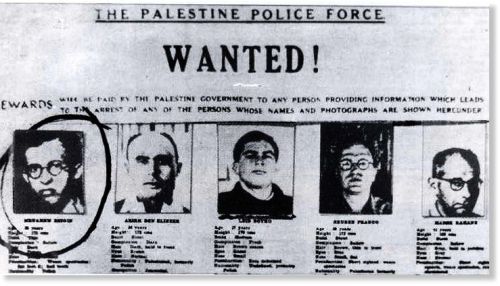
Menachim Begin and Stern gang’s
Yitzhak Shamir, IRA leaders from Michael Collins and Eamon de Valera to Gerry Adams and Martin McGuinness all eventually recanted their violent ways to embrace respectability and political power.
Anyway, here is Walton’s chapter on Zionism’s war with British Intelligence. Enjoy:
How Zionist Extremism Became British Spies Biggest Enemy
In World War II’s aftermath, MI5 turned to fight a new threat. It wasn’t the Soviets. It was bombers from Jerusalem. BY CALDER WALTON
The years after World War II were not kind to Britain’s intelligence services — especially MI5, its domestic counterintelligence and security agency. In the name of austerity, funding of the nation’s intelligence services was slashed, their emergency wartime powers removed, and their staff numbers drastically reduced. MI5’s ranks were reduced from 350 officers at its height in 1943, to just a hundred in 1946. Its administrative records reveal that it was forced to start buying cheaper ink and paper, and its officers were instructed to type reports on both sides of paper to save money. And there were some serious discussions within the government, as there had been after World War I, about shutting MI5 down altogether.
Unfortunately for MI5, in the post-war years it faced the worst possible combination of circumstances: reduced resources, but increased responsibilities. After the war Britain had more territories under its control than at any point in its history, and MI5 was responsible for security intelligence in all British territories.
But MI5’s most urgent threat lay not in its diminished resources, nor from its new Soviet enemy. Recently declassified intelligence records reveal that at the end of the war the main priority for MI5 was the threat of terrorism emanating from the Middle East, specifically from the two main Zionist terrorist groups operating in the Mandate of Palestine, which had been placed under British control in 1921. They were called the Irgun Zevai Leumi (“National Military Organization,” or the Irgun for short) and the Lehi (an acronym in Hebrew for “Freedom Fighters of Israel”), which the British also termed the “Stern Gang,” after its founding leader, Avraham Stern. The Irgun and the Stern Gang believed that British policies in Palestine in the post-war years — blocking the creation of an independent Jewish state — legitimized the use of violence against British targets. MI5’s involvement with counterterrorism, which preoccupies it down to the present day, arose in the immediate post-war years when it dealt with the Irgun and Stern Gang.
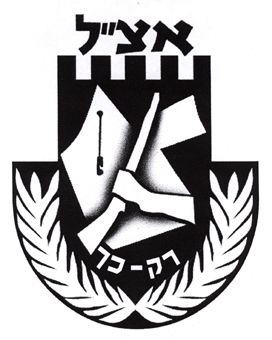
Irgun’s crest
MI5’s involvement in dealing with Zionist terrorism offers a striking new interpretation of the history of the early Cold War. For the entire duration of the Cold War, the overwhelming priority for the intelligence services of Britain and other Western powers would lie with counterespionage, but as we can now see, in the crucial transition period from World War to Cold War, MI5 was instead primarily concerned with counterterrorism.
As World War II came to a close, MI5 received a stream of intelligence reports warning that the Irgun and the Stern Gang were not just planning violence in the Mandate of Palestine, but were also plotting to launch attacks inside Britain. In April 1945 an urgent cable from MI5’s outfit in the Middle East, SIME, warned that Victory in Europe (VE-Day) would be a D-Day for Jewish terrorists in the Middle East. Then, in the spring and summer of 1946, coinciding with a sharp escalation of anti-British violence in Palestine, MI5 received apparently reliable reports from SIME that the Irgun and the Stern Gang were planning to send five terrorist “cells” to London, “to work on IRA lines.” To use their own words, the terrorists intended to “beat the dog in his own kennel.” The SIME reports were derived from the interrogation of captured Irgun and Stern Gang fighters, from local police agents in Palestine, and from liaisons with official Zionist political groups like the Jewish Agency. They stated that among the targets for assassination were Britain’s foreign secretary, Ernest Bevin, who was regarded as the main obstacle to the establishment of a Jewish state in the Middle East, and the prime minister himself. MI5’s new director-general, Sir Percy Sillitoe, was so alarmed that in August 1946 he personally briefed the prime minister on the situation, warning him that an assassination campaign in Britain had to be considered a real possibility, and that his own name was known to be on a Stern Gang hit list.
The Irgun and the Stern Gang’s wartime track record ensured that MI5 took these warnings seriously. In November 1944 the Stern Gang had assassinated the British minister for the Middle East, Lord Moyne, while he was returning to his rented villa after a luncheon engagement in Cairo. Moyne’s murder was followed by an escalation of violence in Palestine, with incidents against the British and Irgun and Stern Gang fighters being followed by bloody reprisals. In mid-June 1946, after the Irgun launched a wave of attacks, bombing five trains and 10 of the 11 bridges connecting Palestine to neighboring states, London’s restraint finally broke. British forces conducted mass arrests across Palestine (codenamed Operation Agatha), culminating on June 29 — a day known as “Black Sabbath” because it was a Saturday — with the detention of more than 2,700 Zionist leaders and minor officials, as well as officers of the official Jewish defense force (Haganah) and its crack commandos (Palmach). None of the important Irgun or Stern Gang leaders was caught in the dragnet, and its result was merely to goad them into even more violent counteractions. On July 22, the Irgun dealt a devastating blow, codenamed Operation Chick, to the heart of British rule in Palestine when it bombed the King David Hotel in Jerusalem, which housed the offices of British officialdom in the Mandate, as well as serving as the headquarters of the British Army in Palestine.
The bombing was planned by the leader of the Irgun, Menachem Begin, later to be the sixth prime minister of Israel and the joint winner of a Nobel Peace Prize. On the morning of July 22, six young Irgun members entered the hotel disguised as Arabs, carrying milk churns packed with 500 pounds of explosives. At 12:37 p.m. the bombs exploded, ripping the facade from the southwest corner of the building. This caused the collapse of several floors in the hotel, resulting in the deaths of 91 people. In terms of fatalities, the King David Hotel bombing was one of the worst terrorist atrocities inflicted on the British in the twentieth century. It was also a direct attack on British intelligence and counterterrorist efforts in Palestine: both MI5 and SIS — the Secret Intelligence Service, also known as MI6 — had stations in the hotel.
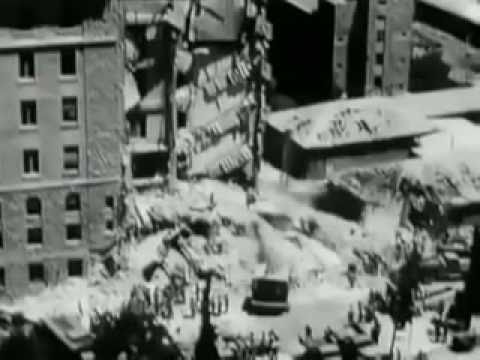
The King David Hotel after the Irgun bombing attack
In the wake of the bombing, the Irgun and the Stern Gang launched a series of operations outside Palestine, just as the reports coming into MI5 had warned. At the end of October 1946 an Irgun cell operating in Italy bombed the British Embassy in Rome, and followed this in late 1946 and early 1947 with a series of sabotage attacks on British military transportation routes in occupied Germany. In March 1947 an Irgun operative left a bomb at the Colonial Club, near St Martin’s Lane in the heart of London, which blew out the club’s windows and doors, injuring several servicemen. The following month a female Irgun agent left an enormous bomb, consisting of 24 sticks of explosives, at the Colonial Office in London. The bomb failed to detonate because its timer broke. The head of Metropolitan Police Special Branch, Leonard Burt, estimated that if it had gone off it would have caused fatalities on a comparable scale to the King David Hotel bombing — but this time in the heart of Whitehall. At about the same time, several prominent British politicians and public figures connected with Palestine received death threats from the Stern Gang at their homes and offices. Finally, in June 1947, the Stern Gang launched a letter-bomb campaign in Britain, consisting of 21 bombs in total, which targeted every prominent member of the cabinet. The two waves of bombs were posted from an underground cell in Italy. Some of those in the first wave reached their targets, but they did not result in any casualties. Sir Stafford Cripps was only saved by the quick thinking of his secretary, who became suspicious of a package whose contents seemed to fizz, and placed it in a bucket of water. The deputy leader of the Conservative Party, Sir Anthony Eden, carried a letter bomb around with him for a whole day in his briefcase, thinking it was a Whitehall circular that could wait till the evening to be read, and only realized what it was when he was warned by the police of the planned attack, on information provided by MI5.
The problem for MI5 in London, and local security forces in Palestine, was the extremely difficult nature of detecting and countering the Irgun and the Stern Gang. Both groups were organized vertically into cells, whose members were unknown to those in other cells, and whose extreme loyalty meant they were nearly impossible to penetrate. As one of MI5’s leading officers dealing with Zionist terrorism, Alex Kellar noted in one MI5 report, “these terrorists are hard nuts to crack, and it is by no means easy to get them to talk.” To complicate matters further, they also frequently made use of false identities and disguises. Female agents used hair dye or wigs to alter their appearance, while male agents were known to dress as women to elude security patrols.
Menachem Begin was known to travel under several aliases, and in the wake of the King David Hotel bombing he managed to elude the Palestine police and the bounty on his head by a series of clever disguises. In November 1946, the Palestine police produced alarming reports that he might be traveling incognito to Britain. Then, in early 1947, the alarm reached fever pitch when SIS sent a report to MI5 warning that Begin was thought to have undergone plastic surgery to alter his appearance, though as the report dryly concluded, “we have no description of the new face.” The story soon leaked to the press, with the News Chronicle running the headline “Palestine Hunting a New Face,” and sarcastically noting that although Begin might have changed his appearance, it was “likely that the flat feet and bad teeth have remained.” As it turned out, the reports of Begin’s plastic surgery were inaccurate: they were caused by confusion within the Palestine police (CID) when comparing photos of him. Begin had not actually left Palestine, but had grown a beard and disguised himself as a rabbi, evading the local police by concealing himself in a secret compartment in a friend’s house in Jerusalem. When he agreed to give a secret interview to the author Arthur Koestler, he did so in a darkened room: Koestler vainly attempted to counter this by drawing heavily on his cigarettes, hoping to generate enough of a glow to catch a glimpse of Begin’s appearance.

Begin as prime minister of Israel
The situation was made all the more alarming for MI5 by the fact that members of the Irgun and the Stern Gang were known to have served in British forces during the war. With bitter irony, some of them had been trained by Britain’s wartime sabotage agency, SOE, and its foreign intelligence services, SIS, while serving in the elite Palmach commando unit of the Jewish paramilitary organization, the Haganah. Just like the former members of a number of other guerrilla groups the British armed during the war, such as communist forces in Malaya, the Irgun and the Stern Gang used their training in explosives and other paramilitary warfare against their former masters. Reports landing on MI5’s desks throughout the summer of 1946 warned that Irgun and Stern Gang fighters were likely to be still serving within British military ranks, and were planning to use that as a cover to travel to Britain. MI5 was thus faced with the real possibility that terrorists could arrive in Britain wearing British military uniforms.
***
With these startling reports coming into its London headquarters, MI5 devised a range of measures to prevent the extension of Zionist terrorism from Palestine to Britain. These have left few traces within records previously in the public domain, but as we can now see from MI5’s own records, they were often extremely elaborate. The front line of its counterterrorist defense was what was termed “personnel security,” which involved making background checks and scrutinizing visa applications for entry into Britain. On MI5’s recommendation, all visa applications made by Jewish individuals from the Middle East were immediately telephoned through to MI5 for checking against its records before the applicants were permitted entry. MI5 also conducted a series of background vetting checks against its records on approximately 7,000 Jewish servicemen known to be in the British armed forces. This led to the identification of 40 individuals with suspected extremist sympathies, 25 of whom were discharged from the armed forces. MI5’s security measures also involved heightened inspections at ports and other points of entry to the United Kingdom, to each of which an MI5-compiled “Index of Terrorists” was distributed, while on its advice Scotland Yard ratcheted up its protection of many leading political and public figures, and increased the number of officers detailed to guard Buckingham Palace. In October 1947 a senior Palestine police CID officer, Maj. John O’Sullivan, traveled to London and provided MI5 with microfilm photographs of terrorist suspects that were added to the index. Some of these mug-shots are today held with unconcealed pride by former Irgun and Stern Gang members.
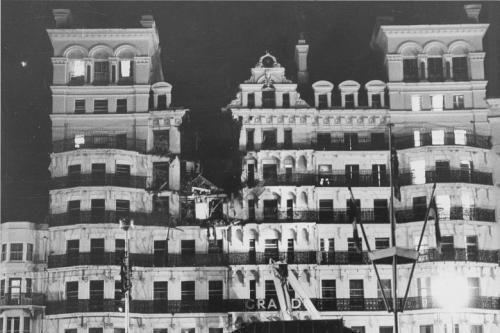
The Grand Hotel, Brighton in the aftermath of the 1984 bombing attack against Margaret Thatcher’s cabinet
At the same time as these “personnel security” measures, which were designed to frustrate the entry of terrorists or terrorist sympathizers into Britain, MI5 embarked on the intensive surveillance of extremist Zionist political groups and individuals who were already there. Its assumption in doing this was that Irgun or Stern Gang operatives who succeeded in gaining entry to Britain would at some point make contact with these organizations or individuals, and therefore scrutinizing their activities could provide crucial leads to tracking them down. MI5 also assumed that agents would make contact with elements of the diaspora Jewish community in Britain. These assumptions would prove correct.
To investigate Zionist groups and individuals in Britain, MI5 used the full repertoire of investigative techniques at its disposal. At the heart of its investigations were Home Office Warrants, which allowed for mail interception and telephone taps. In the post-war years MI5 imposed HOWs on all the main Zionist political bodies in Britain: the Jewish Agency for Palestine, the Jewish Legion, the Jewish-Arab Legion, the Zionist Federation of Jewish Labor and the United Zionist “Revisionist” Youth Organization. The last of these, in particular, caused a good deal of alarm within MI5. Some of its members addressed local Jewish clubs in North London with firebrand speeches against the British, fusing religion with politics. Another source of concern was the Jewish Struggle, a Zionist “Revisionist” publication based in London that frequently reprinted extremist Irgun propaganda from Palestine, typically denouncing the British as “Nazis” and advocating the use of violence. MI5’s fear was that the Jewish Struggle would act as a recruiting platform for future terrorists in Britain. In December 1946 Alex Kellar and MI5’s legal advisor, Bernard Hill, met the director of public prosecutions, and decided that, although there was insufficient evidence to prosecute, they would officially warn the editors of the Jewish Struggle that if they continued to publish Irgun material, their periodical would be shut down. The Jewish Struggle appears to have ceased publication soon after.
Another major source of MI5’s counterterrorist intelligence in the post-war years were moderate Jewish and Zionist groups, both in Palestine and Britain. It forged close links with the body officially responsible for representing Zionist wishes to the British government, the Jewish Agency. In fact, MI5’s policy toward the Jewish Agency was duplicitous: it cooperated with it, but at the same time kept it under close surveillance, running telephone and letter checks on its London headquarters even while it was liaising with its officers. The reason for this was that although MI5 trusted the agency’s security officials, it suspected that its broader staff and membership might contain Irgun and Stern Gang supporters. The willingness of the agency to provide the British with intelligence on the Irgun and the Stern Gang reveals the extent to which those groups’ activities were not supported by the majority of the Jewish population in Palestine — and this, it should be noted, has no parallel in contemporary Arab and Islamist terrorism. The bombing of the King David Hotel brought the coordinated Hebrew Resistance Movement, which had been forged between the Haganah, the Irgun and the Stern Gang, to an end. The Irgun’s bombing operation was not approved by the Haganah, and after July 1946 it therefore began providing the British with intelligence on the Irgun and the Stern Gang, and helped British security personnel to hunt them down.
In Palestine itself, MI5’s liaison officer stationed in Jerusalem in the post-war years, Henry Hunloke, a former Conservative MP, maintained close liaison with Jewish Agency officials, and acquired valuable intelligence from them, for example on suspected terrorists clandestinely entering or leaving Palestine. One of the agency officials from whom both MI5 and SIS (MI6) received counterterrorist intelligence was Reuven Zislani, who worked in the foreign intelligence department of the Jewish Agency. After 1948 Zislani changed his name to Reuven Shiloah and became the first head of Israel’s foreign intelligence service, the Mossad. In its efforts to establish contacts with Jewish Agency officials in Britain, MI5 used a series of go-betweens, or “cut-outs.” Although the declassified documentation is presently incomplete, it seems likely that the Jewish Agency representative who met MI5’s cut-out in London was Teddy Kollek, later a long-standing and celebrated mayor of Jerusalem, who during the war had become the deputy head of the Jewish Agency’s intelligence department. Kollek is known to have provided MI5 with counterterrorist intelligence in Palestine: for example, in August 1945 he revealed the location of a secret Irgun training camp near Binyamina, and told an MI5 officer that “it would be a great idea to raid the place.” The information he provided led to the arrest of 27 Irgun fighters, including the father of a later Israeli cabinet minister.
Some of the meetings held in March 1947 between the Jewish Agency official — probably Kollek — and MI5’s cut-out, known in the declassified records by his codename, Scorpion, took place in London’s finest restaurants. One was over a lavish meal of “oysters, duck and petit pots de creme au chocolat,” while another featured gin and “rich red roast beef .” The meetings did produce some intelligence on Irgun and Stern Gang fighters suspected of being about to leave Palestine, whose names MI5 placed on “watch lists” at British ports and airports. Despite the value of this information, one MI5 officer could not help noting that his mouth started to water when he read Scorpion’s reports. After all, this was a time when, in Austerity Britain, bread rationing was in place.
***
As the terrorist threat intensified, MI5 became increasingly worried about the support shown by foreign groups, and even foreign powers, to the Irgun and the Stern Gang. It did not take much detective work for MI5 to discover that the two groups were receiving technical support from the IRA. One Jewish IRA leader, Robert Briscoe, who was also a member of the Irish parliament, a “Revisionist” Zionist and a future mayor of Dublin, was known by MI5 to support the Irgun, and in his memoirs he recalled that he assisted them in every way he could. Briscoe, who in his own words “would do business with Hitler if it was in Ireland’s good,” made several trips to Britain before the war and met Irgun representatives there. He wrote in his memoirs that he elected himself “to a full Professorship with the Chair of Subversive Activities against England,” and helped the Irgun to organize themselves on “IRA lines.”
In order to enhance the intelligence cooperation on IRA-Irgun-Stern Gang links, in October 1947 MI5 dispatched an officer and a Palestine police officer, Maj. J. O’Sullivan, temporarily in London to brief MI5 on Zionist terrorism, to Dublin. They liaised with the Irish CID, which kept Briscoe under surveillance and passed its findings on to MI5. The former chief rabbi of Ireland, Isaac Herzog, was also an open supporter of both Irish Republican and Zionist terrorism. After his emigration to Palestine in 1936, Herzog rose to arguably the most important position in the Jewish religious world, the chief rabbinate of Palestine. MI5’s DSO in Palestine and the Palestine police both apparently kept a close watch on Rabbi Herzog’s activities. In a manner that encapsulates the tensions that existed between moderates and extremists in both Palestine and Ireland, one of Herzog’s sons, Chaim, disapproved of his father’s collusion with terrorism. In sharp contrast to his father, Chaim Herzog served in British military intelligence on D-Day, went on to help establish the Israeli intelligence community, and eventually became president of Israel.
The stance taken by the U.S. government over Palestine, and in particular the position of Jewish-Americans, sometimes made it difficult for MI5 to obtain cooperation from U.S. authorities on issues of Zionist terrorism. The unambiguous support shown by the U.S. administration toward Zionist aspirations was one of the main factors which led in February 1947 to the British government’s decision to hand the entire matter of Palestine over to the United Nations. More specifically, MI5 knew that some extremist Zionist groups operating in the United States, such as the “Bergson Group” and the “Hebrew Committee for the Liberation of Palestine,” were raising funds and logistical support for the Irgun and the Stern Gang, with explosives and ammunition sometimes being sent in food packages to Britain.
MI5 established a useful working relationship with American military (G-2) intelligence in occupied zones of Europe over clandestine Jewish migration to Palestine and Zionist terrorism, but in general the relationship between British and U.S. intelligence over Zionism was difficult. In March 1948 the high table of the British intelligence community, the Joint Intelligence Committee, noted its reports on Palestine would inevitably be controversial in Washington, and should only be given to the head of the CIA in person, and not left with him. It also advised that other British intelligence reports on Zionist matters should be censored before they were passed on to U.S. authorities. Meanwhile, Operation Gold, run by U.S. Navy intelligence, was intercepting cable traffic with Jewish gun-runners, but this was not shared with Britain, nor was it acted upon by Washington.
One of the few ways in which MI5 was able to receive cooperation from the FBI on Zionist matters was by stressing many prominent Zionists’ connections with communism and the Soviet Union. MI5 believed that several members of the Irgun and the Stern Gang had made their way to Palestine with the aid of Soviet intelligence. Menachem Begin and Nathan Friedman-Yellin, a leader of the Stern Gang, were both of Polish origin, and MI5 rightly suspected that the Soviets had helped them “escape” to Palestine during the war. Several Zionist leaders advocated cooperation with the Soviet Union, including the head of “security” for the Jewish Agency in Palestine, Moshe Sneh, who was aware of, if not actively involved, with planning the King David Hotel bombing. MI5’s suspicions have been confirmed by subsequent research, which shows that on several occasions the Stern Gang appealed to Moscow for aid.
This makes the involvement of the notorious Soviet spy Kim Philby in SIS’s investigations into Zionist terrorism all the more interesting. Philby — Moscow’s longtime agent in the British intelligence services — was, at the time, the head of Section IX in SIS, Soviet counterintelligence. The position afforded him a legitimate interest in the Middle East — an interest that he probably also inherited from his father, the noted Arabist, Harry St John Philby. During the war St John Philby had unsuccessfully attempted to broker a deal for the partition of Palestine, the so-called Philby Plan. Kim Philby’s manipulative agenda in SIS’s Zionist investigations is difficult to determine. On July 9, 1946 SIS circulated a report throughout Whitehall advising that the Irgun was planning to take “murderous action” against the British Legation in Beirut. Almost certainly this was an inaccurate warning of the King David Hotel bombing, which occurred two weeks later.
It was Philby who circulated the report. Philby had less motivation for sabotaging British investigations into Zionist terrorism, however, than he did in other fields. He undoubtedly would have secretly welcomed the terrorist campaign waged in the British Mandate of Palestine as undermining the British empire, but when he was working on Zionist affairs for SIS — and by extension for the KGB — immediately after the war, the Soviet Union’s policy toward Palestine had not yet crystallized. Moscow initially supported the creation of the state of Israel, hoping that it would be a thorn in the side of the “imperialist” West, and the Soviet Union was the first country in the world to recognize Israel when it was established in May 1948. However, Stalin miscalculated: Over the coming years, Israel built up a special relationship with the USA, not with the Soviet Union, and Stalin spent the final years before his death in 1953 consumed with anti-Semitic conspiracy theories. By this time Philby was no longer working on Zionist matters for SIS, and therefore not for the KGB either. In the absence of still- closed KGB archives, Philby’s precise role in Zionist matters must remain a matter for speculation. Nevertheless, Moscow certainly would have been interested to learn, through him, that London suspected Soviet involvement in Zionist terrorism.
***
Together with its counterterrorist operations in Britain, in the immediate post-war years Britain’s intelligence services were also assessing and countering Jewish “illegal” immigration to Palestine. In fact, MI5 and SIS helped to shape the British government’s overall response to this immigration. In 1939 a quota system was established which limited the number of Jewish immigrants to Palestine to 7,500 per year. Immigration above that number was termed “illegal” by the British government. Then as now, “illegal immigration” was a term fraught with controversy, and a fierce debate about it raged between Zionist politicians and the British government. MI5’s role in it was not to debate the moral and legal aspects of Jewish immigration into Palestine, but to produce dispassionate assessments for Whitehall about its security implications.
MI5’s overall assessment was that mass Jewish immigration to Palestine would almost certainly cause civil war between Jews and Arabs, as it had threatened to do during the “Arab Revolt” in the 1930s. The main policy devised by the British authorities to prevent “illegal” immigration was to intercept refugee ships. Detention centers were established in Cyprus to house intercepted refugees, who were then permitted to enter Palestine through the quota system. This was, however, another public relations disaster for the British government, whose critics accused it of establishing “Nazi-style concentration camps.” The British also deported some Irgun and Stern fighters to detention centers in Eritrea, which again attracted claims that they were no better than the Nazis. Such criticism sometimes came from surprising quarters, not least from the assistant secretary at the Colonial Office, Trafford Smith, who privately detailed his despair:
The plain truth to which we so firmly shut our eyes is that in this emergency Detention business we are taking a leaf out of the Nazi book, following the familiar error that the end justifies the means (especially when the means serve current expediency). We are out to suppress terrorism, and because we can find no better means we order measures which are intrinsically wrong, and which, since their consequence is evident to the whole world, let us in for a lot of justifiable and unanswerable criticism.
Rather than pursuing the ill-conceived and counterproductive measures of deporting and detaining Jewish refugees, MI5 advised the cabinet and the chiefs of staff to concentrate their efforts on preventing “illegal” immigration “at source.” With the assistance of SIS, MI5 identified a number of South American and Greek shipping companies that chartered vessels to Jewish refugees, and the Foreign Office was able to exert pressure on these governments to prevent companies registered in their countries from carrying out this practice. The operations appeared to have an impact. An MI5 report stated that by 1948 “only 1 out of some 30 ships carrying illegal immigrants reached their destination.”
While MI5 made assessments and was involved in defensive measures to counter unrestricted Jewish migration to Palestine, Britain’s other intelligence services attempted actively to subvert the flow of migrants. In February 1947 SIS carried out an operation, appropriately codenamed Embarrass, for “direction action.” A small team, mostly comprised of former SOE personnel, was recruited to attach limpet mines to refugee ships and disable them before they could set sail. In the summer of 1947 the team mined five ships in Italian ports — having first checked that no one was on board. Nevertheless, if Operation Embarrass had been made public, the fact that SIS agents were mining boats containing Holocaust survivors would have been disastrous for the British government.
Operation Embarrass did not stop there. When some of the mines were discovered, SIS blamed them first on a fictitious Arab opposition group, the “Defenders of Arab Palestine,” and then on the Soviet government. It obtained typewriters that were known to be used by dissident Arab groups and Soviet authorities, and used them to type letters implicating both groups, which it then carefully leaked around Whitehall. In a further twist, SIS made it appear that the British government was using the traffic of Jewish refugees to get its own agents out of Europe, hoping thereby to get the Soviets to block the flow of migrants to Palestine. SIS therefore attempted to deceive not only Jewish refugees, Arab opposition groups and the Soviet government, but the British government itself. This was truly the stuff of smoke and mirrors. Britain’s policy of limiting Jewish immigration to Palestine, both overt and covert, was beset with controversy and resentment. It was, however, symptomatic of a much deeper problem that undermined British rule in Palestine: Britain was faced with a range of contradictory demands regarding the future of the Mandate — from Jews, Arabs and world opinion at large.
In early 1946 an Anglo-American committee of inquiry was appointed to find a settlement in Palestine, but despite the best efforts of its members, who in April 1946 recommended that a compromise be found so that Jews should not dominate Arabs in Palestine, nor Arabs dominate Jews, the committee’s findings were not accepted by either party. By September 1947 the JIC in London was painting a gloomy picture for the British government of the future of the Mandate, concluding that any settlement would be unacceptable either to Jews or Arabs. Britain found itself in a situation that was rapidly becoming ungovernable. In 1947 100,000 troops — one-tenth of the military manpower of the entire British empire — were tied down in Palestine, a financial burden that London could not afford.
Adapted from EMPIRE OF SECRETS Copyright © 2013 Calder Walton. Published by The Overlook Press.
http://www.overlookpress.com. All rights reserved.
Source: The Broken Elbow


 The Irgun was not the only Jewish terrorist group but it was the most active in causing indiscriminate terror in pre-Israel Palestine. Up to the time of the Jaffa attack, its most spectacular feat had been the July 22, 1946, blowing up of the King David Hotel in Jerusalem, with the killing of 91 people – 41 Arabs, 28 Britons and 17 Jews.
 The other major Jewish terrorist group operating in Palestine in the 1940s was the Lohamei Herut Israel– “Fighters for the Freedom of Israel,” Lehi in the Hebrew acronym – also known as the Stern Gang after its fanatical founder Avraham Stern. Two of its more spectacular outrages included the assassination of British Colonial Secretary Lord Moyne in Cairo on November 6, 1944, and the assassination of Count Folke Bernadotte of Sweden in Jerusalem on September 17, 1948.
 Begin and the Revisionists were heartily hated by the mainline Zionists led by David Ben-Gurion. He routinely referred to Begin as a Nazi and compared him to Hitler. In a famous letter to The New York Times in 1948, Albert Einstein called the Irgun “a terrorist, rightwing, chauvinist organization” that stood for “ultranationalism, religious mysticism and racial superiority.”
 The ship was a war surplus US tank landing craft and had been donated to the Irgun by Hillel Kook’s Hebrew Committee for National Liberation, an American organization made up of Jewish-American supporters of the Irgun.
 The core of that conflict, one that continues to divide Israel and its American supporters as well, lies in the different philosophies of David Ben-Gurion and Vladimir Jabotinsky. Both were from Eastern Europe, born in the 1880s, and both sought an exclusivist Jewish state. But while Ben-Gurion was pragmatic and secular, Jabotinsky was impatient and messianic, a leader who glorified in the heroic trappings of fascism. Ben-Gurion was usually willing to take less now to get more later, and thus he was content to accept partition of Palestine as a necessary stepping stone toward a larger Jewish state. Jabotinsky, on the other hand, impatiently preached the right of Jews not only to all of Palestine but to “both sides of the Jordan,” meaning the combined area of Jordan and Palestine, or as he called it,Eretz Yisrael, the ancient land of Israel.
 Jabotinsky, by contrast, was flamboyant and a devoted admirer of Italy’s fascist leader Benito Mussolini. His disciple, Menachem Begin, described him as “a speaker, a writer, a philosopher, a statesman, a soldier, a linguist … But to those of us who were his pupils, he was not only their teacher, but also the bearer of their hope.” Begin’s biographer, Eric Silver, added: “There was a darker side to [Jabotinsky's] philosophy: blood, fire and steel, the supremacy of the leader, discipline and ceremony, the manipulation of the masses, racial exclusivity as the heart of the nation.
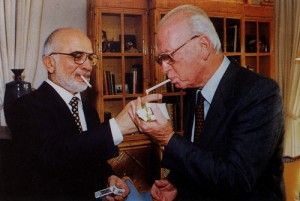 disagree on tactics, their ultimate aim of maintaining a Jewish state free of non-Jews was the same. Rabin explained his strategy shortly before his death during an interview with Rowland Evans and Robert Novak: