Showing posts with label Nazi's. Show all posts

Tuesday, December 02, 2014

Lehi Terror Wartime Contacts With Germany & Italy

File:SternGang-Doc-Nazi-Collaboration.jpg
German cover letter from 11 January 1941 attached to a description of an offer for an alliance with Nazi Germany attributed to Lehi.

In mid-1940, Stern became convinced that the Italians were interested in the establishment of a fascist Jewish state in Palestine.[4] He conducted negotiations, he thought, with the Italians via an intermediary Moshe Rotstein, and drew up a document that became known as the "Jerusalem Agreement". In exchange for Italy's recognition of, and aid in obtaining, Jewish sovereignty over Palestine, Stern promised that Zionism would come under the aegis of Italian fascism, with Haifa as its base, and the Old City of Jerusalem under Vatican control, except for the Jewish quarter. In Heller's words, Stern's proposal would "turn the 'Kingdom of Israel' into a satellite of the Axis powers."

However, the "intermediary" Rotstein was in fact an agent of the Irgun, conducting a sting operation under the direction of the Irgun intelligence leader in Haifa, Israel Pritzker, in cooperation with the British. Secret British documents about the affair were uncovered by historian Eldad Harouvi (now director of the Palmach Archives) and confirmed by former Irgun intelligence officer Yitzhak Berman.]When Rotstein's role later became clear, Lehi sentenced him to death and assigned Yaacov Eliav to kill him, but the assassination never took place. However, Pritzker was killed by Lehi in 1943.
Late in 1940, Lehi, having identified a common interest between the intentions of the new German order and Jewish national aspirations, proposed forming an alliance in World War II with Nazi Germany. It offered assistance in transferring the Jews of Europe to Palestine, in return for Germany's help in expelling Britain from Mandatory Palestine. Late in 1940, Lehi representative Naftali Lubenchik went to Beirut to meet German official Werner Otto von Hentig (who also was involved with the Haavara or Transfer Agreement, which had been transferring German Jews and their funds to Palestine since 1933). Lubenchik told von Hentig that Lehi had not yet revealed its full power and that they were capable of organizing a whole range of anti-British operations.

On the assumption that the destruction of Britain was the Germans' top objective, the organization offered cooperation in the following terms. Lehi would support sabotage and espionage operations in the Middle East and in eastern Europe anywhere where they had cells. Germany would recognize an independent Jewish state in Palestine/Eretz Israel, and all Jews leaving their homes in Europe, by their own will or because of government injunctions, could enter Palestine with no restriction of numbers.

Stern also proposed recruiting some 40,000 Jews from occupied Europe to invade Palestine with German support to oust the British. On 11 January 1941, Vice Admiral Ralf von der Marwitz, the German Naval attaché in Turkey, filed a report (the "Ankara document") conveying an offer by Lehi to "actively take part in the war on Germany's side" in return for German support for "the establishment of the historic Jewish state on a national and totalitarian basis, bound by a treaty with the German Reich."
According to Yellin-Mor,
Lubebtchik did not take along any written memorandum for the German representatives. Had there been a need for one, he would have formulated it on the spot, since he was familiar with the episode of the Italian "intermediary" and with the numerous drafts connected with it. Apparently one of von Hentig's secretaries noted down the essence of the proposal in his own words.
According to Joseph Heller,
The memorandum arising from their connversation is an entirely authentic document, on which the stamp of the 'IZL in Israel' is clearly embossed.

Von der Marwitz delivered the offer, classified as secret, to the German Ambassador in Turkey and on 21 January 1941 it was sent to Berlin. There was never any response.

A second attempt to contact the Nazis was made at the end of 1941, but it was even less successful. The emissary Yellin-Mor was arrested in Syria before he could carry out his mission.

This proposed alliance with Nazi Germany cost Lehi and Stern much support. The Stern Gang also had links with, and support from, the Vichy France Sûreté's Lebanese offices.
Source: Wikipedia

Sunday, April 13, 2014

Seven Decades Of Nazi Collaboration: America’s Dirty Little Ukraine Secret

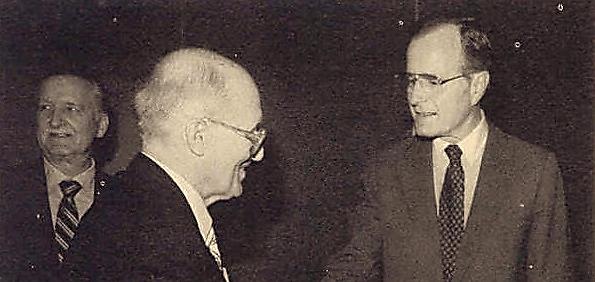
Yaroslav Stetsko, an OUN leader during World War II, meets George H.W. Bush.

An interview with Russ Bellant, author of “Old Nazis, the New Right, and the Republican Party.”

As the Ukrainian crisis has unfolded over the past few weeks, it’s hard for Americans not to see Vladimir Putin as the big villain. But the history of the region is a history of competing villains vying against one another; and one school of villains—the Nazis—have a long history of engagement with the US, mostly below the radar, but occasionally exposed, as they were by Russ Bellant in his book Old Nazis, The New Right And The Republican Party(South End Press, 1991). Bellant’s exposure of Nazi leaders from German allies in the 1988 Bush presidential campaign was the driving force in the announced resignation of nine individuals, two of them from the Ukraine, which is why he was the logical choice to turn to illuminate the scattered mentions of Nazi and fascist elements amongst the Ukrainian nationalists, which somehow never seems to warrant further comment or explanation. Of course most Ukranians aren’t Nazis or fascists—all the more reason to illuminate those who would hide their true natures in the shadows…or even behind the momentary glare of the spotlight.
Your book, Old Nazis, the New Right, and the Republican Party exposed the deep involvement in the Republican Party of Nazi elements from Central and Eastern Europe, including Ukrainian, dating back to World War II and even before. As the Ukrainian crisis unfolded in the last few weeks there have been scattered mentions of a fascist or neo-fascist element, but somehow that never seems to warrant further comment or explanation. I can’t think of anyone better to shed light on what’s not being said about that element. The danger of Russian belligerence is increasingly obvious, but this unexamined fascist element poses dangers of its own. What can you tell us about this element and those dangers?
The element has a long history, of a long record that speaks for itself, when that record is actually known and elaborated on. The key organization in the coup that took place here recently was the Organization of Ukrainian Nationalists [OUN], or a specific branch of it known as the Banderas [OUN-B]. They’re the group behind the Svoboda party, which got a number of key positions in the new interim regime. The OUN goes back to the 1920s, when they split off from other groups, and, especially in the 1930s began a campaign of assassinating and otherwise terrorizing people who didn’t agree with them.
As World War II approached, they made an alliance with the Nazi powers, they formed several military formations, so that when Germany invaded the Soviet Union in June 1941, they had several battalions that went into the main city at the time, where their base was, Lvov, or Lwow, it has a variety of spellings [also 'Lviv']. They went in, and there’s a documented history of them participating in the identification and rounding up Jews in that city, and assisting in executing several thousand citizens almost immediately. There were also involved in liquidating Polish group populations in other parts of Ukraine during the war.
Without getting deeply involved in that whole history, the Organization of Ukrainian Nationalists to this day defend their wartime role, they were backers of forming the 14th Waffen SS Division, which was the all-Ukrainian division that became an armed element on behalf of the Germans, and under overall German control. They helped encourage its formation, and after the war, right at the end of the war, it was called the First Ukrainian division and they still glorify that history of that SS division, and they have a veterans organization, that obviously doesn’t have too many of members left but they formed a veterans division of that.
If you look insignia being worn in Kiev in the street demonstrations and marches to the SS division insignia still being worn. In fact I was looking at photographs last night of it and there was a whole formation marching, not with 14th Division, but with the Second Division, it was a large division that did major battle around the Ukraine, and these marchers were wearing the insignia on the armbands of the Second Division.
So this is a very clear record, and the OUN, even in its postwar publications has called for ethno-genetically pure Ukrainian territory, which of course is simply calling for purging Jews, and Poles, and Russians from what they consider Ukrainian territory. Also, current leaders of Svoboda have made blatantly anti-Semitic remarks that call for getting rid of Muscovite Jews and so forth. They use this very coarse threatening language that anybody knowing the history of World War II would tremble at. If they were living here, it would seem like they would start worrying about it.
Obviously these people don’t hold monopoly power in Ukraine, but they stepped up and the United States has been behind the Svoboda party and these Ukrainian nationalists. In fact the US connections to them go back to World War II and the United States has had a long-standing tie to the OUN, through the intelligence agencies, initially military intelligence, and later the CIA.
Your book discusses a central figure in the OUN, Yaroslav Stetsko, who was politically active for decades here in America. What can you tell us about his history?
Yaroslav Stetsko was the number two leader of the OUN during World War II and thereafter. In 1959, Stefan Bandera, who was head of the OUN, was killed and that’s when Stetsko assumed the leadership. Stetsko in 1941 was the guy who actually marched into Lvov with the German army June 30, 1941 and the OUN issued a proclamation at that time under his name praising and calling for glory to the German leader Adolf Hitler and how they’re going to march arm in arm for the Ukraine and so forth. After the war, he was part of the key leadership that got picked up by the Americans.
There’s a number of accounts I’ve seen, at least three credible up reports, on how they were in the displaced person camp, the Allied forces set up displaced persons camp and picked up tens of thousands of these former allies of Hitler from countries all over the East, Hungary, Latvia, Lithuania – there weren’t Polish collaborators I think most people know the Germans heavily persecuted and murdered millions of Polish residents – but Bulgaria, Romania, Croatia, and so forth, Belorussia. They had them in these camps they built and organized them, where the Ukrainians were assassinating their Ukrainian nationalist rival so that they would be the undisputed leaders of Ukrainian nationalist movement, so they would get the sponsorship of the United States to continue their political operation, and they were successful in that regard. So when Bandera was out of the picture, Stetsko became the undisputed leader of Ukrainian nationalists.
The Organization of Ukrainian Nationalists in 1943 under German sponsorship organized a multinational force to fight on behalf of the retreating German army. After the battle of Stalingrad in ’43 the Germans felt a heightened need to get more allies, and so the Romanian Iron Guard, the Hungarian Arrow Cross, the Organization of Ukrainian Nationalists and others with military formations in place to assist came together and formed the united front called the Committee of Subjugated Nations and again worked on behalf of of the German military. In 1946, they renamed it the Anti-Bolshevik Bloc of Nations, ABN. Stetsko was the leader of that until he died in 1986.
I mention this in part because the OUN tries to say well during the war we fought the Germans and the communists. The fact of the matter is that they were the leadership of this whole multinational alliance on behalf of the German the last two years of the war and in the war thereafter. All the postwar leaders of the unrepentant Nazi allies were all under the leadership of Yaroslav Stetsko.
What happened when Stetsko, and others like him from other German allied forces came to the United States?
In the United States, when they came, his groups organized ‘captive nations’ committees, they became, supposedly, the representatives of people who are being oppressed in Eastern Europe, the Baltic countries, by the Soviet. But they were, in fact, being given an uncritical blank check to represent the voices of all these nations that were part of the Warsaw Pact when in fact they represented the most extreme elements of each of the national communities.
The Captive Nations Committee in Washington DC for instance was run by the person who headed the Ukrainian organization of nationalists, that was true in a number of places. In my hometown area near Detroit as well, they played a major role. In the early 50s, when they were resettled in the United States, there was at least 10,000 of them that were resettled, when you look at all the nationalities. They became politically active through the Republican national committee, because it was really the Eisenhower administration that made the policy decision in the early 1950s, and brought them in. They set up these campaign organizations, every four years they would mobilize for the Republican candidate, whoever it would be, and some of them like Richard Nixon, in 1960, actually had close direct ties to some of the leaders like the Romanian Iron Guard, and some of these other groups.
When Richard Nixon ran for president in 1968, he made a promise to these leaders that they would if he won the presidency he would make them the ethnic outreach arm of the Republican National Committee on a permanent basis, so they wouldn’t be a quadrennial presence, but a continuing presence in the Republican Party. And he made that promise through a guy named Laszlo Pasztor, who served five years in prison after World War II for crimes against humanity. He was prosecuted in 1946 by non-Communist government that actually had control of Hungary at the time. There was a period from ’45 to ’48 when the Hungarian Communist Party didn’t run Hungary. They were the ones who prosecuted him. He had served as a liaison between the Hungarian Nazi party and Berlin; he served in the Berlin embassy of the Hungarian Arrow Cross movement. This is the guy that got picked to organize all the ethnic groups, and the only people that got brought in were the Nazi collaborators.
They didn’t have a Russian affiliate because they hated all Russians of all political stripes. There were no African Americans or Jewish affiliates either. It was just composed of these elements, and for a while they had a German affiliate but some exposure of the Nazi character of the German affiliate caused it to be quietly removed, but other [Nazi] elements were retained.
Your book was researched and published in the 1980s. What was happening by that point in time, after these groups had been established for more than a decade?
I went to their meetings in the 1980s, and they put out material that really make clear who they were there 1984, one of their 1984 booklets praised the pro-Nazi Ustashi regime in Croatia, and these Ustashi killed an estimated 750,000 people and burned them alive in their own camp in Croatia. And here they are praising the founding of this regime, and acknowledging that it was associated with the Nazis, and it was signed by the chairman of the Republican National Committee. You couldn’t make this stuff up. It was just crazy.
I interviewed the Kossack guy, he showed me his pension from service in the SS in World War II, and how he was affiliated with free Nazi groups in the United States, and he was just very unrepentant. These are the umbrellas that were called ‘Captive Nations Committees’ by these people that Stetsko was over, and was part of, too. The Reagan White House brought him in, and promoted him as a major leader and did a big dinner—[UN Ambassador] Jeane Kirkpatrick was part of it, George Bush as Vice President, of course Reagan—and Stetsko was held up as a great leader., And proclamations were issued on his behalf.
When Bush was running for president in 1988, Bush Senior, he came to these basically one of the leading locations of the Ukrainian nationalists in North America, which is in just outside of Detroit, a suburb of Detroit to their cultural center, and one of their foremost leaders in the world is headquartered out of their, at the time, he got Bush to come there and they denounced the OSI and Bush just shook his head, he wouldn’t say anything about it.
The OSI was the Offices of Special Investigations, it was investigating the presence of Nazi war criminals in the United States, and deporting those that were found to have lied on their history when they applied to come into the United States after the war. They had deported a number of people from all over the United States. They had a lot of open investigations, and all these émigré Nazis were trying to bring all the political pressure they could to stop these investigations, including the Ukrainian nationalists ones.
So they denounced them, the OSI investigations, in front of Bush, Bush nodded his head, but he wouldn’t say anything because he didn’t want to sound like he was sympathetic to the Nazi war criminals, but at the same time he didn’t want to offend his hosts by disputing the issue with them. So, the issue of World War II was still being played out over four decades later, in the politics of the presidency, and unfortunately Bush and Reagan continued to be on the side that we tried to defeat in World War II.
What was the response when your book came out, with all this information? How was the information received, and what was the political reaction?
Prior to the book’s publication, Washington Jewish Week had done a story about some of the ethnic leaders of the Bush campaign and their history, like denying the Holocaust, or being involved with these émigré Nazi groups. They named a couple of them that weren’t part of the Heritage Groups Council, but they were part of the Bush campaign.
Then when I published the book, it brought out a lot more names, and the Philadelphia Inquirer and the Boston Globe did stories on them. It got to the point where when reporter from the Philadelphia Inquirer would call them about one of their ethnic leaders of the Bush campaign the standard response was he’s no longer part of the campaign, and they’d say that almost as soon as the name would get mentioned. So that they would call that person, and I’ll give the example of Florian Galdau, he was, he ran the Rumanian Iron Guard in New York City. He had wartime record. [Romanian Archbishop Valerian] Trifa himself was implicated in the mass killing of Jews in Bucharest in 1941, I believe. Galdau’s record is clear, because when Trifa was prosecuted he was one of the people targeted by the Office of Special Investigations, and he was forced into deportation in the 1980s, but in those records, they identify Florian Galdau is one of his operatives, so his history is known, except apparently to the Bush campaign.
So when he was identified by the Philadelphia Inquirer, they immediately said he wasn’t part of it, so the Philadelphia Inquirer called Florian Galdau, and he said, “No, I’m part of it. They never said anything to me. As far as I know I’m still part of the campaign.” And that was the pattern.
The Republican National Committee said after the election that they were going to put a blue ribbon committee together and do an investigation of the charges in my book. I was never contacted, nobody affiliated with the book project, the publisher wasn’t contacted none, none of the sources I worked with was contacted. And after about a year, with nobody raising any issues or questions about it they just folded it up and they said well we have not had the resources to investigate this matter.
I did publish an op-ed in the New York Times about two weeks after the election was over, and I think that was the last time anybody said anything publicly about it that got any kind of forum. I think they were allowed to just die and wither away, that is those leaders. The Republican idea was probably to bring in another generation of people who were born in the United States as these émigré’s died off, but they never did anything about this history that Richard Nixon had bequeathed them with. The Reagan White House had really made deep political commitments and alliances with them, they didn’t want to look like they turned their back on them; and Bush wanted them for his reelection campaign, so he wasn’t going to turn his back on them either.
If you want an anecdote, I know that 60 Minutes was working on a piece that Bradley’s team was working on, and Nancy Reagan herself called the executive producer and said that we would really like it if you would wouldn’t do this story, and they killed it. Because, basically, it’s not just about Nazis and the Republican national committee were Nazis in the White House, it inevitably raises the question of who are they how did they get here, who sponsored them and it goes back to the intelligence agencies at that point. And some people don’t like treading there, if it’s tied to an intelligence agency, they prefer to just stay away from the subject. So, some people at 60 Minutes were frustrated by it, but that’s what happened. I think that they were able to effectively kill the story when people tried to cover it. They were able to persuade news managers to not delve into it too much.
What’s happened since you wrote your book, and most of the World War II generation died off? What have the OUN and its allies been up to since then that we should be aware of?
Once the OUN got sponsored by the American security establishment intelligence agencies, they were embedded in a variety of ways in Europe as well, like Radio Free Europe which is headquartered in Munich. A lot of these groups, in the ABN were headquartered in Munich under the sponsorship of Radio Free Europe. From there they ran various kinds of operations where they were trying to do work inside the Warsaw Pact countries. When the Soviet Union collapsed in 1991, a number of them moved back into the Ukraine as well as the other respective countries, and began setting up operations there, and organizing political parties. They reconstituted the veterans group of the Waffen SS, they held marches in the 1990s in the Ukraine, and organized political parties, in alliance with the United States, and became part of what was called the Orange Revolution in 2004, when they won the election there.
The prime minister was closely allied with them. They worked with the new government to get veterans benefits for the Ukrainian SS division veterans, and they started establishing the statues and memorials and museums for Stepan Bandera, who was the leader of the OUN, and who I should say was despised by other Ukrainian nationalists because of their methods, because they were extreme and violent toward other rival Ukrainian nationalist groups as well. So Bandera wasn’t a universal hero, but this group was so influential, in part because of its US connections, that if you go online and you Google ‘Lviv’ and the word ‘Bandera’ you’ll see monuments and statues and large posters and banners of Bandera’s likeness and large monuments permanent erected monuments on behalf of Bandera so they made this guy like he’s the George Washington of the Ukraine.
That government was in power until 2010, when there was another election, and a new regime was elected with a lot of support from the East. Ukrainian nationalist groupings around the Orange Revolution were sharply divided against each other, and there was rampant corruption, and people voted them out. The United States was very aggressive in trying to keep the nationalists in power, but they lost the election. The United States was spending money through the National Endowment for Democracy, which was pumping money into various Ukrainian organizations, and they were doing the same thing in Russia and many other countries around the world as well. We’re talking about many millions of dollars a year to affect the politics of these countries.
When the occupations came in Independence Square in Kiev late last year, you can see Svoboda’s supporters and you can hear their leaders in the parliament making blatant anti-semitic remarks. The leader of the Svoboda party went to Germany to protest the prosecution of John Demjanjuk, who was the Ukrainian who was settled in the United States, who was implicated as a concentration camp guard in the killing of innocent people. The German courts found him guilty and Svoboda leadership went to Germany to complain about convicting this guy. The reason they said they didn’t want any Ukrainian tainted with it because they live a lie that no Ukrainian had anything to do with the German Nazi regime, when history betrays them, and their own affiliations betray them. But they don’t like that being out there publicly, so they always protest their innocence of any Ukrainian being charged with anything, regardless of what the evidence is.
Your book was an important revelation but was not alone. Your book notes that Jack Anderson reported on the pro-Nazi backgrounds of some of the ethnic advisors as far back as 1971, yet when your report came out almost two decades later, everyone responded with shock, surprise, and even denial. What lessons should we draw from this history of buried history? And how should it influence our thinking about the unfolding crisis in the Ukraine?
I don’t believe it’s ever too late to become familiarized and educated about the history of this phenomenon both the wartime history and our postwar collaboration with these folks. There were a number of exposés written about the émigré Nazis. There was a 1979 book called Wanted and it did a number of case stories of these people being brought in to the United States, including the Trifa story. Christopher Simpson did a book called Blowbackthat discussed the policy decisions, it’s an incredible book. He’s a professor at American University and he did years of research through the Freedom of Information Act and archives, and got the policy documents under which the decisions were made to bring these folks together, and not just into the United States but to deploy them around the world.
Like my book, it didn’t get the attention it deserved. The New York Times book reviewer was negative toward the book. There are people that really don’t want to touch this stuff. There’s a lot of people who don’t want it touched. I think it’s really important for people who believe in openness and transparency and democratic values, who don’t want to see hate groups come back to power in other parts of the world to know what happened.
There’s not very many Americans that really even know that the Waffen SS was a multinational force. That’s been kind of kept out of the received history. Otherwise people would know that there were Ukrainian Nazis, Hungarian Nazis, Latvian Nazis, and they were all involved in the mass murder of their fellow citizens, if they were Jewish, or even if they were co-nationalists that were on the other side of the issue of the war. They were just mass murderers, across Eastern Europe. And that history, those facts aren’t even well-known. A lot of people didn’t even know this phenomenon even existed.
I think all Americans have a responsibility to know what their government is doing in the foreign policy in Europe as well as elsewhere around the world, as well as Latin America as well as Africa. Since our policy was to uphold apartheid in South Africa why weren’t Americans challenging that more? They began challenging that in the 80s, but the apartheid regime was run by the Nazi party. They were allied with Germany in World War II, they were the Nationalist party and they took power in 1948 and the United States backed that for decades. We backed the death squads in Latin America, even though they massacred tens of thousands of people – 30,000 people in Chile alone. Americans aren’t being attentive to what their government is doing abroad, even though it’s been doing done with their tax dollars and in their name, and I think we just have a general responsibility.
I went to these meetings, I went to these conferences, I went over a period of years. I met with them directly, most of the people I wrote about, I met with them personally or in group meetings. People can’t afford to do that on their own, timewise, but there’s enough literature out there they can read and pursue it, they will get enough enough of a handle to get what the real picture is, to demand change. I’m not totally partisan in this, but I think the Republican Party was extreme on this, but the Democrats folded and didn’t challenge this when they knew it was going on.
There is an old Roman poet that once said truth does not say one thing and wisdom another. I’m a believer in that. Tell the truth and wisdom will follow.

Wednesday, October 02, 2013

They Thought They Were Free

An Excerpt From: "They Thought They Were Free: The Germans, 1933-45"

But Then It Was Too Late

By Milton Mayer
Courtesy Of: The University Of Chicago Press

"What no one seemed to notice," said a colleague of mine, a philologist, "was the ever widening gap, after 1933, between the government and the people. Just think how very wide this gap was to begin with, here in Germany. And it became always wider. You know, it doesn’t make people close to their government to be told that this is a people’s government, a true democracy, or to be enrolled in civilian defense, or even to vote. All this has little, really nothing, to do with knowing one is governing.

"What happened here was the gradual habituation of the people, little by little, to being governed by surprise; to receiving decisions deliberated in secret; to believing that the situation was so complicated that the government had to act on information which the people could not understand, or so dangerous that, even if the people could not understand it, it could not be released because of national security. And their sense of identification with Hitler, their trust in him, made it easier to widen this gap and reassured those who would otherwise have worried about it.

"This separation of government from people, this widening of the gap, took place so gradually and so insensibly, each step disguised (perhaps not even intentionally) as a temporary emergency measure or associated with true patriotic allegiance or with real social purposes. And all the crises and reforms (real reforms, too) so occupied the people that they did not see the slow motion underneath, of the whole process of government growing remoter and remoter.

"You will understand me when I say that my Middle High German was my life. It was all I cared about. I was a scholar, a specialist. Then, suddenly, I was plunged into all the new activity, as the university was drawn into the new situation; meetings, conferences, interviews, ceremonies, and, above all, papers to be filled out, reports, bibliographies, lists, questionnaires. And on top of that were the demands in the community, the things in which one had to, was ‘expected to’ participate that had not been there or had not been important before. It was all rigmarole, of course, but it consumed all one’s energies, coming on top of the work one really wanted to do. You can see how easy it was, then, not to think about fundamental things. One had no time."

"Those," I said, "are the words of my friend the baker. ‘One had no time to think. There was so much going on.’"

"Your friend the baker was right," said my colleague. "The dictatorship, and the whole process of its coming into being, was above all diverting. It provided an excuse not to think for people who did not want to think anyway. I do not speak of your ‘little men,’ your baker and so on; I speak of my colleagues and myself, learned men, mind you. Most of us did not want to think about fundamental things and never had. There was no need to. Nazism gave us some dreadful, fundamental things to think about—we were decent people—and kept us so busy with continuous changes and ‘crises’ and so fascinated, yes, fascinated, by the machinations of the ‘national enemies,’ without and within, that we had no time to think about these dreadful things that were growing, little by little, all around us. Unconsciously, I suppose, we were grateful. Who wants to think?

"To live in this process is absolutely not to be able to notice it—please try to believe me—unless one has a much greater degree of political awareness, acuity, than most of us had ever had occasion to develop. Each step was so small, so inconsequential, so well explained or, on occasion, ‘regretted,’ that, unless one were detached from the whole process from the beginning, unless one understood what the whole thing was in principle, what all these ‘little measures’ that no ‘patriotic German’ could resent must some day lead to, one no more saw it developing from day to day than a farmer in his field sees the corn growing. One day it is over his head.

"How is this to be avoided, among ordinary men, even highly educated ordinary men? Frankly, I do not know. I do not see, even now. Many, many times since it all happened I have pondered that pair of great maxims, Principiis obsta and Finem respice—‘Resist the beginnings’ and ‘Consider the end.’ But one must foresee the end in order to resist, or even see, the beginnings. One must foresee the end clearly and certainly and how is this to be done, by ordinary men or even by extraordinary men? Things might have. And everyone counts on that might.

"Your ‘little men,’ your Nazi friends, were not against National Socialism in principle. Men like me, who were, are the greater offenders, not because we knew better (that would be too much to say) but because we sensed better. Pastor Niemöller spoke for the thousands and thousands of men like me when he spoke (too modestly of himself) and said that, when the Nazis attacked the Communists, he was a little uneasy, but, after all, he was not a Communist, and so he did nothing; and then they attacked the Socialists, and he was a little uneasier, but, still, he was not a Socialist, and he did nothing; and then the schools, the press, the Jews, and so on, and he was always uneasier, but still he did nothing. And then they attacked the Church, and he was a Churchman, and he did something—but then it was too late."

"Yes," I said.

"You see," my colleague went on, "one doesn’t see exactly where or how to move. Believe me, this is true. Each act, each occasion, is worse than the last, but only a little worse. You wait for the next and the next. You wait for one great shocking occasion, thinking that others, when such a shock comes, will join with you in resisting somehow. You don’t want to act, or even talk, alone; you don’t want to ‘go out of your way to make trouble.’ Why not?—Well, you are not in the habit of doing it. And it is not just fear, fear of standing alone, that restrains you; it is also genuine uncertainty.

"Uncertainty is a very important factor, and, instead of decreasing as time goes on, it grows. Outside, in the streets, in the general community, ‘everyone’ is happy. One hears no protest, and certainly sees none. You know, in France or Italy there would be slogans against the government painted on walls and fences; in Germany, outside the great cities, perhaps, there is not even this. In the university community, in your own community, you speak privately to your colleagues, some of whom certainly feel as you do; but what do they say? They say, ‘It’s not so bad’ or ‘You’re seeing things’ or ‘You’re an alarmist.’

"And you are an alarmist. You are saying that this must lead to this, and you can’t prove it. These are the beginnings, yes; but how do you know for sure when you don’t know the end, and how do you know, or even surmise, the end? On the one hand, your enemies, the law, the regime, the Party, intimidate you. On the other, your colleagues pooh-pooh you as pessimistic or even neurotic. You are left with your close friends, who are, naturally, people who have always thought as you have.

"But your friends are fewer now. Some have drifted off somewhere or submerged themselves in their work. You no longer see as many as you did at meetings or gatherings. Informal groups become smaller; attendance drops off in little organizations, and the organizations themselves wither. Now, in small gatherings of your oldest friends, you feel that you are talking to yourselves, that you are isolated from the reality of things. This weakens your confidence still further and serves as a further deterrent to—to what? It is clearer all the time that, if you are going to do anything, you must make an occasion to do it, and then you are obviously a troublemaker. So you wait, and you wait.

"But the one great shocking occasion, when tens or hundreds or thousands will join with you, never comes. That’s the difficulty. If the last and worst act of the whole regime had come immediately after the first and smallest, thousands, yes, millions would have been sufficiently shocked—if, let us say, the gassing of the Jews in ’43 had come immediately after the ‘German Firm’ stickers on the windows of non-Jewish shops in ’33. But of course this isn’t the way it happens. In between come all the hundreds of little steps, some of them imperceptible, each of them preparing you not to be shocked by the next. Step C is not so much worse than Step B, and, if you did not make a stand at Step B, why should you at Step C? And so on to Step D.

"And one day, too late, your principles, if you were ever sensible of them, all rush in upon you. The burden of self-deception has grown too heavy, and some minor incident, in my case my little boy, hardly more than a baby, saying ‘Jewish swine,’ collapses it all at once, and you see that everything, everything, has changed and changed completely under your nose. The world you live in—your nation, your people—is not the world you were born in at all. The forms are all there, all untouched, all reassuring, the houses, the shops, the jobs, the mealtimes, the visits, the concerts, the cinema, the holidays. But the spirit, which you never noticed because you made the lifelong mistake of identifying it with the forms, is changed. Now you live in a world of hate and fear, and the people who hate and fear do not even know it themselves; when everyone is transformed, no one is transformed. Now you live in a system which rules without responsibility even to God. The system itself could not have intended this in the beginning, but in order to sustain itself it was compelled to go all the way.

"You have gone almost all the way yourself. Life is a continuing process, a flow, not a succession of acts and events at all. It has flowed to a new level, carrying you with it, without any effort on your part. On this new level you live, you have been living more comfortably every day, with new morals, new principles. You have accepted things you would not have accepted five years ago, a year ago, things that your father, even in Germany, could not have imagined.

"Suddenly it all comes down, all at once. You see what you are, what you have done, or, more accurately, what you haven’t done (for that was all that was required of most of us: that we do nothing). You remember those early meetings of your department in the university when, if one had stood, others would have stood, perhaps, but no one stood. A small matter, a matter of hiring this man or that, and you hired this one rather than that. You remember everything now, and your heart breaks. Too late. You are compromised beyond repair.

"What then? You must then shoot yourself. A few did. Or ‘adjust’ your principles. Many tried, and some, I suppose, succeeded; not I, however. Or learn to live the rest of your life with your shame. This last is the nearest there is, under the circumstances, to heroism: shame. Many Germans became this poor kind of hero, many more, I think, than the world knows or cares to know."

I said nothing. I thought of nothing to say.

"I can tell you," my colleague went on, "of a man in Leipzig, a judge. He was not a Nazi, except nominally, but he certainly wasn’t an anti-Nazi. He was just—a judge. In ’42 or ’43, early ’43, I think it was, a Jew was tried before him in a case involving, but only incidentally, relations with an ‘Aryan’ woman. This was ‘race injury,’ something the Party was especially anxious to punish. In the case at bar, however, the judge had the power to convict the man of a ‘nonracial’ offense and send him to an ordinary prison for a very long term, thus saving him from Party ‘processing’ which would have meant concentration camp or, more probably, deportation and death. But the man was innocent of the ‘nonracial’ charge, in the judge’s opinion, and so, as an honorable judge, he acquitted him. Of course, the Party seized the Jew as soon as he left the courtroom."

"And the judge?"

"Yes, the judge. He could not get the case off his conscience—a case, mind you, in which he had acquitted an innocent man. He thought that he should have convicted him and saved him from the Party, but how could he have convicted an innocent man? The thing preyed on him more and more, and he had to talk about it, first to his family, then to his friends, and then to acquaintances. (That’s how I heard about it.) After the ’44 Putsch they arrested him. After that, I don’t know."

I said nothing.

"Once the war began," my colleague continued, "resistance, protest, criticism, complaint, all carried with them a multiplied likelihood of the greatest punishment. Mere lack of enthusiasm, or failure to show it in public, was ‘defeatism.’ You assumed that there were lists of those who would be ‘dealt with’ later, after the victory. Goebbels was very clever here, too. He continually promised a ‘victory orgy’ to ‘take care of’ those who thought that their ‘treasonable attitude’ had escaped notice. And he meant it; that was not just propaganda. And that was enough to put an end to all uncertainty.

"Once the war began, the government could do anything ‘necessary’ to win it; so it was with the ‘final solution of the Jewish problem,’ which the Nazis always talked about but never dared undertake, not even the Nazis, until war and its ‘necessities’ gave them the knowledge that they could get away with it. The people abroad who thought that war against Hitler would help the Jews were wrong. And the people in Germany who, once the war had begun, still thought of complaining, protesting, resisting, were betting on Germany’s losing the war. It was a long bet. Not many made it."

Copyright notice: Excerpt from pages 166-73 of They Thought They Were Free: The Germans, 1933-45 by Milton Mayer, published by the University of Chicago Press. ©1955, 1966 by the University of Chicago. All rights reserved.

This text may be used and shared in accordance with the fair-use provisions of U.S. copyright law, and it may be archived and redistributed in electronic form, provided that this entire notice, including copyright information, is carried and provided that the University of Chicago Press is notified and no fee is charged for access. Archiving, redistribution, or republication of this text on other terms, in any medium, requires the consent of the University of Chicago Press. (Footnotes and other references included in the book may have been removed from this online version of the text.)

Milton MayerThey Thought They Were Free: The Germans, 1933-45 ©1955, 1966, 368 pagesPaper $19.00 ISBN: 0-226-51192-8

For information on purchasing the book—from bookstores or here online—please go to the webpage for They Thought They Were Free.

Tuesday, July 16, 2013

UK & US Hid Evidence Of Nazi War Atrocities


By David Keys


Nazi war criminals escaped prosecution because crucial evidence in Britain’s National Archives and in government archives in the United States was ignored for decades.


The thousands of pages of documentation describe atrocities carried out in both Eastern and Western Europe – but have only been examined by German government war crimes investigators over the past four years, after most of the suspects and witnesses had died. At no stage had British or US intelligence told the Germans of the existence of the material.

Much of the original material was gathered when British and US intelligence services bugged a small number of  prisoner of war camps near London and  Washington DC during World War Two. For years the documents were kept under wraps by the intelligence services because the prisoner-of-war camp bugging program would have been regarded as illegal under international law – and, more importantly, because, during most of the Cold War, the US and Britain did not want to alert the Soviets to the fact that they had developed this intelligence gathering technique.

“All the relevant material was of course known to the British and American intelligence services during and after the war – and was in the public domain after its declassification in the US in the 1970s and the UK in 1996. However, prior to 2009, no use was ever made of the material to track down war criminals. If the direct evidence and the indirect leads contained in the material, had been used earlier by official war crime investigators, there is no doubt that a number of   war criminals would have been arrested and brought to trial,” said  London School of Economics historian, Professor Sönke Neitzel, co-author of  Soldaten: On Fighting, Killing and Dying – a recently published book on the World War Two allied prisoner-of-war camp bugging operation.

“It is regrettable that the intelligence services in the UK and the US did not make use of  the documentation and did not pass it on to the German war crime investigation authorities in the latter part of the 20th century, before many of the suspects had died,” he said.

A Channel 4 documentary – Spying on Hitler’s Army – on the secret bugging operation will be broadcast on Sunday evening.

In total some 3000 hours of clandestine recordings were made of German  prisoners- of-war in UK and US PoW camps. Of those 3000 hours, up to 200 hours referred to war crimes. The US material was declassified in the 1970s, while the UK material was declassified in 1996. Professor Neitzel started his research into the material in 2001.

His first academic article was then published in 2004. In 2009 German government investigators heard that Professor Neitzel was carrying out academic research on the British and American documents and requested the material from him, which he then supplied. However, by that time, most of the suspects had died.

“In the rare cases which offered some prospects of success, our investigations ended up revealing that the relevant persons had died,” said a spokesman for the Official German State Justice Administration responsible for investigating Nazi war crimes.

Because of the illegal nature of the bugging and the wish to keep it secret from the Soviets, the material was not used in the Nuremberg war crime trials.

Commenting on what appears to have been a proposal by the British Army’s department responsible for war crimes prosecutions (the Judge Advocate General’s Branch), MI19 (the Intelligence Service section responsible for the bugging operation) insisted that the existence of the transcripts could not be revealed in any way. This precluded their use in any war crime trials – and almost certainly greatly limited their use even in investigations.

A formerly top secret, and up till now unpublished, letter written by an MI19 lieutenant colonel on 16 November 1945, found by Professor Neitzel, in the National Archives at Kew, states that the organisation considers “as of the highest importance the avoidance of anything which could draw attention to or make public the methods employed” to obtain the information.

The letter went on to say this was partly because “these methods” (ie. the bugging of German prisoners) “would presumably again feature largely in any future war” – ie against the Soviets. 

What’s more, the letter pointed out that, at the time, those methods were “still being employed” inside prisoner-of-war camps by allied intelligence services outside the UK.

The letter added that MI19 wanted to “avoid at any cost” anything that might disclose “the names of [German] PoWs who have been actively working for us”.

The MI19 lieutenant colonel also made clear the advanced nature of the British bugging techniques and equipment.

The Germans “have in fact used similar methods themselves, which, however, they have never brought to that point of perfection reached by us,” says the formerly top secret 1945 letter.

Professor Neitzel also believes that British war crimes prosecution authorities were not particularly interested in pursuing relatively junior war criminals even if their crimes were extensive and horrific.

“The British were only really interested in prosecuting top generals, politicians, government officials and doctors,” he said. 

Of the  10,000 prisoners who were secretly bugged, more than 300 were recorded as stating that they had participated in activities which were obviously war crimes or had witnessed such activities.

That information in turn provided evidence that may have helped identify hundreds of  other German soldiers who had committed war crimes, but had not been taken prisoner. 

“Churchill definitely knew about MI19’s bugging operation – but it’s not known whether the immediate post-war discussion about preventing their use in war crimes trials reached his level,” said Professor Neitzel.

The transcripts reveal information about  many types of war crime, including  the mass-murder of  Jews, the killing of PoW’s, the slaughter of  civilians in anti-partisan operations and the rape of women in Nazi occupied territories in both Eastern and Western Europe. They provide evidence of war crimes which occurred in Russia, Lithuania, Latvia, Poland, Serbia, Belgium, France, Italy and Greece.

The suspects referred to in the bugging documentation – virtually all of whom have now died – include members of the Waffen SS  and of the Wehrmacht – mostly from the lower ranks but including some more senior officers.

If the transcripts had been used for war crimes investigations at a much earlier stage, it’s likely that Lieutenant-General Heinrich Kittel (who died in 1969) may have faced prosecution as an alleged accessory because the documentation reveals that, when he was a colonel, he had witnessed serious war crimes – but apparently did nothing to stop them. General Dietrich von Choltitz, who died in 1966, might also have faced prosecution for his alleged role in the Holocaust, as revealed in the transcripts.

Other potential suspects died in the later 20th century and early 21st – including a Waffen SS non-commissioned officer called Fritz Swoboda who died in 2007 – just two years before the German investigators had access to the bugging operation transcripts.

Thursday, February 14, 2013

The Churchill You Didn't Know


Thousands voted him the greatest Briton - but did they know about his views on Gandhi, gassing and Jews...

Research by Amy Iggulden
Courtesy Of "The Guardian"

I will not pretend that, if I had to choose between communism and nazism, I would choose communism.
Speaking in the House of Commons, autumn 1937
I do not understand the squeamishness about the use of gas. I am strongly in favour of using poisonous gas against uncivilised tribes.
Writing as president of the Air Council, 1919
It is alarming and nauseating to see Mr Gandhi, a seditious Middle Temple lawyer, now posing as a fakir of a type well known in the east, striding half naked up the steps of the viceregal palace, while he is still organising and conducting a campaign of civil disobedience, to parlay on equal terms with the representative of the Emperor-King.
Commenting on Gandhi's meeting with the Viceroy of India, 1931
(India is) a godless land of snobs and bores.
In a letter to his mother, 1896
I do not admit... that a great wrong has been done to the Red Indians of America, or the black people of Australia... by the fact that a stronger race, a higher grade race... has come in and taken its place.
Churchill to Palestine Royal Commission, 1937
(We must rally against) a poisoned Russia, an infected Russia of armed hordes not only smiting with bayonet and cannon, but accompanied and preceded by swarms of typhus-bearing vermin.
Quoted in the Boston Review, April/May 2001
"The choice was clearly open: crush them with vain and unstinted force, or try to give them what they want. These were the only alternatives and most people were unprepared for either. Here indeed was the Irish spectre - horrid and inexorcisable.
Writing in The World Crisis and the Aftermath, 1923-31
The unnatural and increasingly rapid growth of the feeble-minded and insane classes, coupled as it is with a steady restriction among all the thrifty, energetic and superior stocks, constitutes a national and race danger which it is impossible to exaggerate... I feel that the source from which the stream of madness is fed should be cut off and sealed up before another year has passed.
Churchill to Asquith, 1910
One may dislike Hitler's system and yet admire his patriotic achievement. If our country were defeated, I hope we should find a champion as admirable to restore our courage and lead us back to our place among the nations."
From his Great Contemporaries, 1937
You are callous people who want to wreck Europe - you do not care about the future of Europe, you have only your own miserable interests in mind.
Addressing the London Polish government at a British Embassy meeting, October 1944
So far as Britain and Russia were concerned, how would it do for you to have 90% of Romania, for us to have 90% of the say in Greece, and go 50/50 about Yugoslavia?
Addressing Stalin in Moscow, October 1944
This movement among the Jews is not new. From the days of Spartacus-Weishaupt to those of Karl Marx, and down to Trotsky (Russia), Bela Kun (Hungary), Rosa Luxembourg (Germany), and Emma Goldman (United States)... this worldwide conspiracy for the overthrow of civilisation and for the reconstitution of society on the basis of arrested development, of envious malevolence, and impossible equality, has been steadily growing. It has been the mainspring of every subversive movement during the 19th century; and now at last this band of extraordinary personalities from the underworld of the great cities of Europe and America have gripped the Russian people by the hair of their heads and have become practically the undisputed masters of that enormous empire."
Writing on 'Zionism versus Bolshevism' in the Illustrated Sunday Herald, February 1920

Wednesday, June 06, 2012

Were Nazi Soldiers Heroes?


By Jacob G. Hornberger
Wednesday, May 30, 2012
Courtesy Of "The Future Of Freedom Foundation"


Have you ever noticed that Nazi soldiers, especially those who died in World War II, are never celebrated as heroes? Why is that? Didn’t they answer the call of their government in time of war? Didn’t they serve their country by loyally obeying the dictates of their government? Weren’t they patriots for their willingness to fight and die for their country?

I’m not talking about soldiers who committed war crimes or who participated in the Holocaust. I’m talking about ordinary German soldiers, many of whom were civilians before the war started, who fought Allied forces in North Africa, at the Battle of the Bulge, on the Eastern front, and elsewhere.

Why aren’t those Nazi soldiers treated as heroes? Didn’t some of them fight as courageously and heroically as British, Soviet, or American soldiers? Why are they not honored as heroes as much as Allied soldiers are?

Indeed, why aren’t German citizens during World War II honored for having come to the support of their government during a time of war? Didn’t the German people do what citizens are supposed to do? Sure, Germany ended up losing the war but no one can say that the average German citizen didn’t do everything he could to win the war.

Yesterday, the Washington Times went on the attack against MSNBC host Chris Hayes for questioning the automatic invocation of the term ‘heroes’ to describe American soldiers who have died in America’s many wars. The Times wrote:
The word “heroes” has been used to describe America’s fallen for more than 200 years. It’s not “rhetorically proximate” to justifications for war but a traditional mark of gratitude and respect for the sacrifice made by the person who was killed and the family members left behind. It’s a way of recognizing that regardless of how a person died, he did so in service to the country. It’s not a glorification of war but a solemn acknowledgment of sacrifice.
What’s not clear from the Times’ position, however, is whether the principles it enunciates apply only American soldiers or to soldiers in every country. Applying the standard set forth by the Times, would it be appropriate for Germans to use the word “heroes” to describe Germany’s fallen in the many wars in which Germany has been involved, including World War II? Could it be said that describing Nazi soldiers killed in World War II as “heroes” would not serve to justify World War II but instead serve simply as a mark of gratitude and respect for the sacrifice made by the German soldier who was killed and the family members left behind? Could it be said that this would just be a way to recognize that regardless of how the Nazi soldier died, he did so in service to his country? Could it be said that describing the Nazi soldier as a hero would not be a glorification of war but rather a solemn acknowledgement of sacrifice?

In other words, would the Times apply its principles regarding war, soldiers, heroism, and patriotism only to the United States or universally?

Or do they apply only to the winners? Do they apply, for example, to the Soviet Union, one of the winners of World War II, which was governed by a brutal communist regime during the war and for decades afterward, a regime that oppressed Jews and others and kept Eastern Europe under its iron boot for decades after the end of the war. Were communist soldiers opposing Nazi soldiers heroes for serving their government during time of war? Were they heroes for their willingness to die to ensure that their country remained under communist rule rather than Nazi rule?

Indeed, how would the Times apply its principles to the Vietnam War, a war that the United States lost? 

Surely, it would say that American soldiers who served in Vietnam or who died there were heroes, except perhaps for the ones who committed war crimes. Would it say the same about North Vietnamese communist soldiers or about the Viet Cong?

It seems to me that the reason that Nazi soldiers have never been honored as heroes is because the world has long held Germany to a different standard than the one that the Washington Times applies to the United States. Both German soldiers and the German citizenry should have made a critical examination of what their government was doing and realized that their government was in the wrong. On reaching that determination, it was the duty of the individual soldier to refuse to participate in the military, and it was the duty of the citizen to oppose his government, even in time of war.

Obviously, the Nazi government didn’t take that position. Its position was that it is the solemn duty of the citizen to come to the support of his government in time of crisis or war. The Hitler regime viewed the citizen who joined the Nazi armed forces as a hero for his willingness to fight and die for his country. The German people who supported the troops and the rest of the government were looked upon as patriots.

Isn’t that the same standard adhered to by many Americans with respect to America’s wars, soldiers, and citizenry?

There were some German citizens who said no. Among them were Hans and Sophie Scholl and the members of a secret organization called the White Rose. Their position on patriotism was entirely different from the official one. They felt that it was the duty of a citizen to make a critical examination of his government’s policies. That’s what the White Rose members did, and they concluded that the Nazi government was in the wrong. Thus, the White Rose group not only opposed their government in the middle of World War II, they also exhorted the German citizenry, including German soldiers, to rise up and overthrow the Hitler regime.

Not surprisingly, the German authorities considered the White Rose members to be bad people and unpatriotic Germans, which is why they executed them. Personally,I happen to believe that they were among the most courageous and heroic people in history.

In 1951, during the Korean War, Leonard E. Read, the founder of The Foundation for Economic Education, wrote one of the most thought-provoking essays ever written, entitled. “Conscience on the Battlefield.” In that essay, Read stated that from a moral standpoint, no soldier can ever escape the consequences of his individual actions during war simply by later telling God that he was following orders or loyally serving his government during time of war. It was incumbent on each soldier, Read stated, to make a personal determination as to whether the killing he was ordered to do was morally justified and could be reconciled with the soldier’s individual conscience.

In my opinion, Read and the White Rose people had it right. The genuine patriot stands and fights for his government when it is right and he refuses to support it and even opposes it when it is in the wrong. That’s the type of courage and heroism that enlightens a country, not the blind type of “my government, right or wrong” type of patriotism and heroism that afflicted Nazi Germany and that continues to afflict people in many other countries today.

Jacob Hornberger is founder and president of the Future of Freedom Foundation.