Showing posts with label Sculptures. Show all posts

Wednesday, April 03, 2013

Imagine The Fruits Of Genetic Manipulation


Transgenic Sculptures 


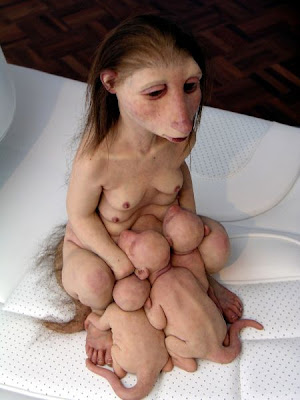
Patricia Piccinini’s silicone sculptures imagine a not-so-distant future where humans have mastered genetic manipulation and can create animals to serve their every emotional, social, and ecological need. Her transgenic creations serve as companions for children, protectors for endangered species, and even surrogate mothers. The results are often at the same time tender and repulsive.
Piccinini, who has lived in Australia since childhood, works with a critical eye toward genetic manipulation. Her series “Nature’s Little Helpers,” which includes “The Bodyguard,” “Getaway,” “The Surrogate,” and “Big Mother,” envisions creatures that have been created to protect and rehabilitate the Australian ecosystem:

The sculptures present a series of creatures that I have designed to ‘assist’ a series of the endangered Australian animals. In the photographs, we follow more closely one of these creatures, ‘The Bodyguard (for the Golden Helmeted Honeyeater)’. It is very seductive to think that we could find a simple technological solution to complex ecological problems such as extinction. It is far more exciting to talk about genetic engineering than to designate a large area of habitat/real estate as national park so that dozens or even hundreds of native species might be given a better chance of survival. We have a long history of scientifically introducing new stuff into our environment in order to make it better, however it has rarely worked. Yet our relatively recent understanding of genetics seems to have left us ready to add yet more stuff in an unprecedented way. Why do we think we have it all figured out now?
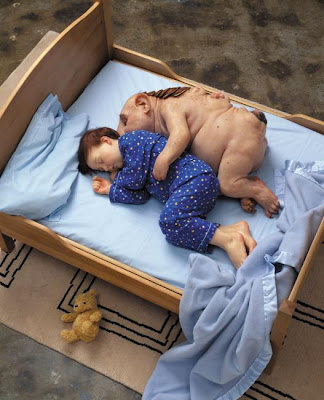
But the inclusion of children in many of her sculptures, who treat these unnatural creations with little more than curiosity, wonder, and affection but a different spin on the story, suggesting that the next generation would neither view these animals with revulsion nor focus merely on their usefulness. And another series, “Nest and The Stags,” lends overtly animalistic qualities to motor vehicles.
Via: "io9"

Saturday, March 30, 2013

Die Slowly


He who becomes the slave of habit,
Who follows the same routes every day,
Who never changes pace,
Who does not risk and change the color of his clothes,
Who does not speak and does not experience,
Dies slowly.

He or she who shuns passion,
Who prefers black on white,
Dotting ones "it’s" rather than a bundle of emotions,
The kind that make your eyes glimmer,
That turn a yawn into a smile,
That make the heart pound in the face of mistakes and feelings,
Dies slowly.

He or she who does not turn things topsy-turvy,
Who is unhappy at work,
Who does not risk certainty for uncertainty,
To thus follow a dream,
Those who do not forego sound advice at least once in their lives, 
Die slowly.

He who does not travel, who does not read,
Who does not listen to music,
Who does not find grace in himself,
She who does not find grace in herself,
Dies slowly.

He who slowly destroys his own self-esteem,
Who does not allow himself to be helped,
Who spends days on end complaining about his own bad luck,
About the rain that never stops,
Dies slowly.

He or she who abandon a project before starting it,
Who fail to ask questions on subjects he doesn't know,
He or she who don't reply when they are asked something they do know,
Die slowly.

Let's try and avoid death in small doses,
Reminding oneself that:
Being alive requires an effort far greater than the simple fact of breathing.

Only a burning patience will lead
To the attainment of a splendid happiness.

(Poem by Pablo Neruda)

Wednesday, August 08, 2012

Love On Through


There is a bliss beyond all that the minstrel has told,
When two, that are linked in one heavenly tie.

With heart never changing, and brow never cold
Love on through all ills, and love on till they die!

One hour of a passion so sacred is worth
Whole ages of heartless and wandering bliss;
And O, if there be an elysium on earth,
Its is this, it is this.


(T. Moore- Lalla Rookh, Light Of The Harem) 

Swept Away

Sculpture by Carlo Bronti
(1951)