


Showing posts with label Anatomy and Physiology. Show all posts
Showing posts with label Anatomy and Physiology. Show all posts
Tuesday, December 16, 2014
Glass Brain FlyThrough
This is an anatomically-realistic 3D brain visualization depicting real-time source-localized activity (power and "effective" connectivity) from EEG (electroencephalographic) signals. Each color represents source power and connectivity in a different frequency band (theta, alpha, beta, gamma) and the golden lines are white matter anatomical fiber tracts. Estimated information transfer between brain regions is visualized as pulses of light flowing along the fiber tracts connecting the regions.
The modeling pipeline includes MRI (Magnetic Resonance Imaging) brain scanning to generate a high-resolution 3D model of an individual's brain, skull, and scalp tissue, DTI (Diffusion Tensor Imaging) for reconstructing white matter tracts, and BCILAB (http://sccn.ucsd.edu/wiki/BCILAB) / SIFT (http://sccn.ucsd.edu/wiki/SIFT) to remove artifacts and statistically reconstruct the locations and dynamics (amplitude and multivariate Granger-causal (http://www.scholarpedia.org/article/G...) interactions) of multiple sources of activity inside the brain from signals measured at electrodes on the scalp (in this demo, a 64-channel "wet" mobile system by Cognionics/BrainVision (http://www.cognionics.com)).
The final visualization is done in Unity and allows the user to fly around and through the brain with a gamepad while seeing real-time live brain activity from someone wearing an EEG cap.
Team:
- Gazzaley Lab / Neuroscape lab, UCSF: Adam Gazzaley, Roger Anguera, Rajat Jain, David Ziegler, John Fesenko, Morgan Hough
- Swartz Center for Computational Neuroscience, UCSD: Tim Mullen & Christian Kothe


Wednesday, July 10, 2013
The Scientific Power Of Thought
The power of the mind and it's ability to affect physical change may shock you! Find out how simply imagining can make it so.
Written and created by Mitchell Moffit
(twitter @mitchellmoffit)
and,
Gregory Brown
(twitter @whalewatchmeplz).
TWITTER: http://www.twitter.com/AsapSCIENCE
FACEBOOK: http://www.facebook.com/AsapSCIENCE
Mitchell Moffit
http://www.mitchellmoffit.com
http://www.twitter.com/mitchellmoffit
http://www.facebook.com/mitchellmoffit
Gregory Brown
http://www.gregorybrownart.tumblr.com
http://www.twitter.com/whalewatchmeplz
Further Reading --
1) The Brain That Changes Itself - Norman Doidge, M.D.
Music Experiment:
2) http://jn.physiology.org/content/74/3...
3) http://ti.me/WifVpK
Muscle Experiement:
4) http://jn.physiology.org/content/67/5...
Brain Plasticity:
5) http://bit.ly/S8CHlM
This Is How Your Brain Works
Ever wonder how your brain processes information? These brain tricks and illusions help to demonstrate the two main systems of Fast and Slow Thinking in your brain.
Written and created by Mitchell Moffit
(twitter @mitchellmoffit)
and,
Gregory Brown
(twitter @whalewatchmeplz).
TWITTER: http://www.twitter.com/AsapSCIENCE
FACEBOOK: http://www.facebook.com/AsapSCIENCE
Mitchell Moffit
http://www.mitchellmoffit.com
http://www.twitter.com/mitchellmoffit
http://www.facebook.com/mitchellmoffit
Gregory Brown
http://www.gregorybrownart.tumblr.com
http://www.twitter.com/whalewatchmeplz
Further Reading --
1) Thinking Fast and Slow - Daniel Khaneman
2) http://www.ncbi.nlm.nih.gov/pubmed/11...
3) http://bit.ly/UGmTGY
Sunday, April 14, 2013
Exhaled Breath Is Unique Fingerprint

Jason Palmer reports:
Compounds Present In Exhaled Breath Can Act As A "Fingerprint" For Individuals
These "metabolites" represent the waste products of the body's chemistry - but their uniqueness had never been shown.
A study in PLOS ONE suggests they could be as useful to medical diagnosis as those found in urine or blood.
Because a breath test is non-invasive and the results are instantaneous, it could prove even more convenient for example in anaesthesia or doping tests.
"I don't understand why breath hasn't been a widely used [means of] medical science diagnosis," said the study's lead author Renato Zenobi of the Swiss Federal Institute of Technology (ETH) in Zurich.
"In traditional Chinese medicine, they feel your pulse, look at your tongue and smell your breath," he told BBC News. "There are trained dogs whocan sniff cancer with a fairly good hit-rate - but the dog doesn't tell you what the compounds are."
Prior work has shown that the precise type of bacteria responsible for lung infections or even the presence of stomach cancer could be discerned in the breath.
What remained to be seen was whether the breath's metabolic contents varied enough between people - and varied little enough within an individual - to be diagnostic - to act as a real and repeatable "breathprint".
"You need to show there is a core individual signal that is stable over time," Prof Zenobi said. "If it changes a lot during the course of the day or after you've had a coffee or smoked a cigarette, you can just forget about it."
It is the non-invasive and immediate nature of the test that makes it most promising.
It could for example help determine an appropriate dosage in anaesthesia, where an effective but safe dose is dependent on a patient's tolerance and metabolic rate - a small dose could be given to test how it is metabolised. A quick, at-the-starting-line test could be administered to check for doping in sport.
As the tests continue and the stability and uniqueness of each individual's breathprint is further verified, it could become a staple of the long-predicted "personalised medicine", tailored to each person's chemistry.
Wednesday, April 03, 2013
Imagine The Fruits Of Genetic Manipulation

Transgenic Sculptures
Patricia Piccinini’s silicone sculptures imagine a not-so-distant future where humans have mastered genetic manipulation and can create animals to serve their every emotional, social, and ecological need. Her transgenic creations serve as companions for children, protectors for endangered species, and even surrogate mothers. The results are often at the same time tender and repulsive.

Piccinini, who has lived in Australia since childhood, works with a critical eye toward genetic manipulation. Her series “Nature’s Little Helpers,” which includes “The Bodyguard,” “Getaway,” “The Surrogate,” and “Big Mother,” envisions creatures that have been created to protect and rehabilitate the Australian ecosystem:

The sculptures present a series of creatures that I have designed to ‘assist’ a series of the endangered Australian animals. In the photographs, we follow more closely one of these creatures, ‘The Bodyguard (for the Golden Helmeted Honeyeater)’. It is very seductive to think that we could find a simple technological solution to complex ecological problems such as extinction. It is far more exciting to talk about genetic engineering than to designate a large area of habitat/real estate as national park so that dozens or even hundreds of native species might be given a better chance of survival. We have a long history of scientifically introducing new stuff into our environment in order to make it better, however it has rarely worked. Yet our relatively recent understanding of genetics seems to have left us ready to add yet more stuff in an unprecedented way. Why do we think we have it all figured out now?

But the inclusion of children in many of her sculptures, who treat these unnatural creations with little more than curiosity, wonder, and affection but a different spin on the story, suggesting that the next generation would neither view these animals with revulsion nor focus merely on their usefulness. And another series, “Nest and The Stags,” lends overtly animalistic qualities to motor vehicles.
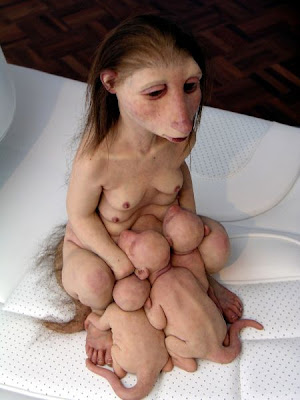
Via: "io9"
Check out: "Patricia Piccinini"
Thursday, March 14, 2013
Lover's Hearts Beat At The Same Rate Everyday

This graph shows something quite wonderful. It shows that in a couple, the heart rates of a man and woman are in sync. Yes, when you're involved in a romantic relationship, your heart beats as fast as your partner's.
This couple was one of the 32 heterosexual couples in a study conducted by physiologies at UC Davis in the US that aimed to see if people in romantic relationships co-regulated their physiologies with their partners. By co-regulated, read change; by physiologies, read heart rates.
In one of the experiments, the couples sat facing each other but just far enough that they would not be able to touch. The researchers asked them to simply stare at one another for three minutes straight in as calm a manner as possible (ahem) while they monitored the couple's heart rates.
The graph above does not actually show the heart rates of the man and woman changing with time. Instead it shows a complex measure of heart rate which takes into consideration the observed changes in heart rate due to the individual self-regulating, that is trying to control himself or herself by keeping calm for instance, as well as the changes associated with the individual as he or she unconsciously mimics the partner, known as co-regulation. Since the extent of both self-regulation and co-regulation is different in man and woman, this measure allows for comparison between the two. In the above graph, the measure is actually shown by a blue line.
But the blue line is so closely matched by a red line that you barely see it. What does the red line indicate? It indicates the changes one would expect to see if the couple's heart rates are the same. Therefore the more closely the blue and red lines match, the closer an individual's heart rate is to the partner's. It is no surprise then that when the researchers compared the measure of heart rates between people not involved in a romantic relationship, the blue and red lines did not match.
The researchers also found that it was the women who tended to adjust their heart rates to their partners. Why this actually happens on a psychological level however is still a mystery. The researchers speculate that women have a strong link to their partners may have something to do with them having more empathy.
And inspired from this study, here's a great line: "I love you so much that my heartbeats as fast as yours whenever I see you."
In one of the experiments, the couples sat facing each other but just far enough that they would not be able to touch. The researchers asked them to simply stare at one another for three minutes straight in as calm a manner as possible (ahem) while they monitored the couple's heart rates.
The graph above does not actually show the heart rates of the man and woman changing with time. Instead it shows a complex measure of heart rate which takes into consideration the observed changes in heart rate due to the individual self-regulating, that is trying to control himself or herself by keeping calm for instance, as well as the changes associated with the individual as he or she unconsciously mimics the partner, known as co-regulation. Since the extent of both self-regulation and co-regulation is different in man and woman, this measure allows for comparison between the two. In the above graph, the measure is actually shown by a blue line.
But the blue line is so closely matched by a red line that you barely see it. What does the red line indicate? It indicates the changes one would expect to see if the couple's heart rates are the same. Therefore the more closely the blue and red lines match, the closer an individual's heart rate is to the partner's. It is no surprise then that when the researchers compared the measure of heart rates between people not involved in a romantic relationship, the blue and red lines did not match.
The researchers also found that it was the women who tended to adjust their heart rates to their partners. Why this actually happens on a psychological level however is still a mystery. The researchers speculate that women have a strong link to their partners may have something to do with them having more empathy.
And inspired from this study, here's a great line: "I love you so much that my heart
Via: "Nature"
Thursday, February 28, 2013
'Quadruple Helix' DNA Discovered In Human Cells

Image via: Gizmodo.com
In 1953, Cambridge researchers Watson and Crick published a paper describing the interweaving 'double helix' DNA structure - the chemical code for all life. Now, in the year of that scientific landmark's 60th Anniversary, Cambridge researchers have published a paper proving that four-stranded 'quadruple helix' DNA structures - known as G-quadruplexes - also exist within the human genome. They form in regions of DNA that are rich in the building block guanine, usually abbreviated to 'G'.
The findings mark the culmination of over 10 years investigation by scientists to show these complex structures in vivo - in living human cells - working from the hypothetical, through computational modelling to synthetic lab experiments and finally the identification in human cancer cells using fluorescent biomarkers.
The research, published today in Nature Chemistry and funded by Cancer Research UK, goes on to show clear links between concentrations of four-stranded quadruplexes and the process of DNA replication, which is pivotal to cell division and production.
By targeting quadruplexes with synthetic molecules that trap and contain these DNA structures - preventing cells from replicating their DNA and consequently blocking cell division - scientists believe it may be possible to halt the runaway cell proliferation at the root of cancer.
"The research indicates that quadruplexes are more likely to occur in genes of cells that are rapidly dividing, such as cancer cells. For us, it strongly supports a new paradigm to be investigated - using these four-stranded structures as targets for personalised treatments in the future."
Physical studies over the last couple of decades had shown that quadruplex DNA can form in vitro - in the 'test tube', but the structure was considered to be a curiosity rather than a feature found in nature. The researchers now know for the first time that they actually form in the DNA of human cells.
"This research further highlights the potential for exploiting these unusual DNA structures to beat cancer – the next part of this pipeline is to figure out how to target them in tumour cells," said Dr Julie Sharp, senior science information manager at Cancer Research UK.
"We have found that by trapping the quadruplex DNA with synthetic molecules we can sequester and stabilise them, providing important insights into how we might grind cell division to a halt," said Balasubramanian.
The study showed that if an inhibitor is used to block DNA replication, quadruplex levels go down - proving the idea that DNA is dynamic, with structures constantly being formed and unformed.
The researchers also previously found that an overactive gene with higher levels of Quadruplex DNA is more vulnerable to external interference.
"The possibility that particular cancer cells harbouring genes with these motifs can now be targeted, and appear to be more vulnerable to interference than normal cells, is a thrilling prospect.
Via: "Phys"
Monday, February 25, 2013
The Scientific Power Of Thought
Written and created by Mitchell Moffit (twitter @mitchellmoffit) and Gregory Brown (twitter @whalewatchmeplz).
The power of the mind and it's ability to affect physical change may shock you! Find out how simply imagining can make it so.
Get Your FREE Audio Book - http://bit.ly/10gMVnV
Further Reading:
1) The Brain That Changes Itself - Norman Doidge, M.D.
Music Experiment:
2) http://jn.physiology.org/content/74/3/1037.short
3) http://ti.me/WifVpK
Muscle Experiement:
4) http://jn.physiology.org/content/67/5/1114.short
Brain Plasticity:
5) http://bit.ly/S8CHlM
Sunday, February 24, 2013
Wednesday, February 20, 2013
How The Human Brain Adapts To Injury

This image shows four sources of evidence of takeover by a right-hemisphere area following the disablement of its left hemisphere counterpart. Credit: Carnegie Mellon University
For the first time, scientists at Carnegie Mellon University's Center for Cognitive Brain Imaging (CCBI) have used a new combination of neural imaging methods to discover exactly how the human brain adapts to injury. The research, published in Cerebral Cortex, shows that when one brain area loses functionality, a "back-up" team of secondary brain areas immediately activates, replacing not only the unavailable area but also its confederates.
"The human brain has a remarkable ability to adapt to various types of trauma, such as traumatic brain injury and stroke, making it possible for people to continue functioning after key brain areas have been damaged," said Marcel Just, the D. O. Hebb Professor of Psychology at CMU and CCBI director. "It is now clear how the brain can naturally rebound from injuries and gives us indications of how individuals can train their brains to be prepared for easier recovery. The secret is to develop alternative thinking styles, the way a switch-hitter develops alternative batting styles. Then, if a muscle in one arm is injured, they can use the batting style that relies more on the uninjured arm."
For the study, Just, Robert Mason, senior research psychologist at CMU, and Chantel Prat, assistant professor of psychology at the University of Washington, used functional magnetic resonance imaging (fMRI) to study precisely how the brains of 16 healthy adults adapted to the temporary incapacitation of the Wernicke area, the brain's key region involved in language comprehension. They applied Transcranial Magnetic Stimulation (TMS) in the middle of the fMRI scan to temporarily disable the Wernicke area in the participants' brains. The participants, while in the MRI scanner, were performing a sentence comprehension task before, during and after the TMS was applied. Normally, the Wernickearea is a major player in sentence comprehension.
The research team used the fMRI scans to measure how the brain activity changed immediately following stimulation to the Wernicke area. The results showed that as the brain function in the Wernicke area decreased following the application of TMS, a "back-up" team of secondary brain areas immediately became activated and coordinated, allowing the individual's thought process to continue with no decrease in comprehension performance.
The brain's back-up team consisted of three types of brain regions: (1) contralateral areas—areas that are in the mirror-image location of the brain; (2) areas that are right next to the impaired area; and (3) a frontal executive area.
"The first two types of back-up areas have similar brain capabilities as the impaired Wernicke area, although they are less efficient at the capability," Just said. "The third area plays a strategic role as in responding to the initial impairment and recruiting back-up areas with similar capabilities."
Additionally, the research showed that impairing the Wernicke area also negatively affected the cortical partners with which the Wernicke area had been working. "Thinking is a network function," Just explained. "When a key node of a network is impaired, the network that is closely collaborating with the impaired node is also impaired. People do their thinking with groups of brain areas, not with single brain areas."
Mason, the study's lead author, noted that following the TMS, the impaired area and its partners gradually returned to their previous levels of coordinated activity, while the back-up team of brain areas was still in place. "This means, that for some period of time, there were two cortical teams operating simultaneously, explaining why performance is sometimes improved by TMS," he said.
This research builds on Just's previous research on brain resilience after stroke and brain training to remediate dyslexia. The studies are motivated by a computational theory, called 4CAPS, that provides an account of how autonomous brain systems dynamically self-organize themselves in response to changing circumstances, which the researchers believe to be the basis of fluid intelligence.
Just, who uses brain imaging to understand how brain processes underpin various types of human thought, has helped to establish Carnegie Mellon as a world leader in brain sciences. The university recently launched a Brain, Mind and Learning initiative to build from its research excellence in psychology, computer science and computation to continue to solve real-world problems.
Via: "Medical Xpress"
Friday, February 15, 2013
Scientists Catch Virus In The Act Of Infecting A Cell
Researchers from The University of Texas at Austin and The University of Texas Health Science Center at Houston (UT Health) Medical School announced that they have caught a virus (called T7) in the act of infecting a cell. Researchers observed the changes in the structure of a virus as it infects an E. coli bacterium. The research paper was published in Science Epxress.
The researchers found that the T7 virus has six tail fibers folded back against its capsid. The virus can extend these fibers to "walk" across its host cell surface to find a site to infect. The researchers say the virus behaves "a bit like a planetary rover."
Ian Molineux, professor of biology at The University of Texas at Austin, said in a release that the idea that phages "walk" over the cell surface was previously proposed, but their paper provides the first experimental evidence. This is also the first time scientists have made images showing how the virus's tail extends into the host, which allows it to infect a cell with its DNA.
Molineux says, "Although many of these details are specific to T7, the overall process completely changes our understanding of how a virus infects a cell."
Via: "Science - Space - Robots"
Sunday, February 10, 2013
First Antibiotic-Resistant Gonorrhea Cases Detected In North America

Gonorrhea infects close to 700,000 Americans each year.
Completely Incurable Gonorrhea May Be At Hand
JASON KOEBLER reports,
The fears of major health organizations have come true: Gonorrhea that is immune to the last remaining effective oral antibiotic has been detected in at least nine North American patients, meaning the era of "incurable" gonorrhea could be close.
In a study released Tuesday in the Journal of the American Medical Association, a group of scientists led by Vanessa Allen of Public Health Ontario, found that 6.7 percent of patients with gonorrhea at a Toronto clinic still had the disease after a round of cephalosporins, the last effective oral antibiotic used to treat the disease. Of 133 patients who returned for a "test of cure" visit, nine remained gonorrhea-positive. This is the first time cephalosporin-resistant gonorrhea has been found in humans in North America.
Last year, both the World Health Organization and the Centers for Disease Control warned that untreatable gonorrhea—the world's second most common sexually transmitted infection—could soon be a reality as the bacteria showed increasing resistance to cephalosporins in lab tests.
"These are the clinical cases we've been waiting for," Allen says. "This is the translation of the lab information into what the clinical consequence is."
Previously, there had been a couple individual case reports of untreatable gonorrhea cases in the United Kingdom, Austria, France, Norway, and Japan. In an accompanying editorial, Robert Kirkcaldy of the CDC writes that gonorrhea is quickly becoming a more threatening disease.
"Cephalosporin treatment failures have now been documented in North America," he writes. "Although this milestone was expected, its arrival is deeply troubling."
Gonorrhea is estimated to infect close to 700,000 Americans each year. Symptoms include painful urination, abdominal pain, genital discharge, itching, and infertility in women. Women who have both HIV and gonorrhea are more likely to pass HIV to their offspring than women with just HIV.
Less than a year ago, Gail Bolan, director of the CDC's sexually transmitted disease prevention program, wrote that the "threat of untreatable gonorrhea is emerging rapidly." At the time, just 1.7 percent of gonorrhea isolated in the lab were considered resistant to cephalosporins. Allen says her study shows just how fast antibiotic resistance is evolving in the organisms.
"Our results aren't generalizable to the overall concentration because they all came from one clinic," she says. "But basically, the problem appears worse than we originally thought."
Although each of the nine patients in Canada were cured with the injectable antibiotic known as ceftriaxone, Allen warns that there's been "a parallel increase" in resistance to that antibiotic.
"I think without a doubt this will become a bigger problem," Allen says. "The next threat is when, not if, the same thing happens with ceftriaxone. And then what?"
According to Kirkcaldy, "clinicians now face the emergence of cephalosporin-resistant [gonorrhea] without well-studied, effective backup treatment options."
Via: "US News"
Thursday, January 31, 2013
Babies Learn Language From Mothers While In Womb

Image via: Canada.com
Babies only hours old are able to differentiate between sounds from their native language and a foreign language, scientists have discovered. The study indicates that babies begin absorbing language while still in the womb, earlier than previously thought.
Sensory and brain mechanisms for hearing are developed at 30 weeks of gestational age, and the new study shows that unborn babies are listening to their mothers talk during the last 10 weeks of pregnancy and at birth can demonstrate what they've heard.
"The mother has first dibs on influencing the child's brain," said Patricia Kuhl, co-author and co-director of the Institute for Learning & Brain Sciences at the University of Washington. "The vowel sounds in her speech are the loudest units and the fetus locks onto them."
Previously, researchers had shown that newborns are born ready to learn and begin to discriminate between language sounds within the first months of life, but there was no evidence that language learning had occurred in utero.
"This is the first study that shows fetuses learn prenatally about the particular speech sounds of a mother's language," said Christine Moon, lead author and a professor of psychology at Pacific Lutheran University in Tacoma, Wash. "This study moves the measurable result of experience with speech sounds from six months of age to before birth."
The results will be published in an upcoming issue of the Journal Acta Paediatrica.
Forty infants, about 30 hours old and an even mix of girls and boys, were studied in Tacoma and Stockholm, Sweden. While still in the nursery, the babies listened to vowel sounds in their native tongue and in foreign languages.
Their interest in the sounds was captured by how long they sucked on a pacifier that was wired into a computer measuring the babies' reaction to the sounds. Longer or shorter sucking for unfamiliar or familiar sounds is evidence for learning, because it indicates that infants can differentiate between the sounds heard in utero.
In both countries, the babies at birth sucked longer for the foreign language than they did for their native tongue.
The researchers say that infants are the best learners, and discovering how they soak up information could give insights on lifelong learning. "We want to know what magic they put to work in early childhood that adults cannot," Kuhl said. "We can't waste that early curiosity.
Via: "Medical Xpress"
Tuesday, January 22, 2013
DARPA's Tracking Gene Changes Technology

Check out Darpa’s latest bright idea: to fund “multidisciplinary research proposals in the area of genomic and proteomic technologies that can continuously and persistently record specific natural or human promulgated environmental, physical and genomic events within the genetic or epigenetic systems of microorganisms.”
Sounds to me like Darpa wants to create a digital spy technology that is encoded into the genes of a living bug. It will apparently record and report on any modifications being made to the bug itself – kind of like the Track Changes option in your Word document.
Why would Darpa care about changes in this particular bug, you ask? Because it might be patented. Patented genes and microbes are precious bio-commodities in the research world. Essentially, Darpa wants to invent a tech tool to protect their intellectual property – in this case, mutant bacteria and viruses – from other scientists. The program is called Chronicle of Lineage Indicative of Origins, or “CLIO.”
There’s been a prolonged rumpus over the question of genetic patents. Basically, if you have a gene patent, it means you’ve managed to isolate a new gene from a microbe and it’s yours to profit from. So now, no one else can make, use, sell or study that gene, without your permission.
But it’s hard to keep track of who is violating the patent laws by playing with genes that don’t belong to them. How to catch the culprits? Darpa’s solution: build an electronic scribe into the bug’s genes. It will track any manipulation of the microbial genome and be able to spot misuse in a moment.
The mere idea is vaguely comprehensible, at best. Think about turning it into a reality and it stumps you. There are barely any prototypes or precedents for this kind of technology. Not only does Darpa want to create recording “tags,” they also want these tags to remain immutable and somehow resist microbe evolution. The way they plan to do this is “possibly a complex mathematical approach.”
They also want the technology to provide secure access to a select few hands — a sort of encrypted password system for genes. Darpa prides itself on far-out research. But password-protected genes? That’s beyond the bleeding edge.
Via: "Wired"
Monday, January 21, 2013
100 Diagrams That Changed The World
A visual history of human sensemaking, from cave paintings to the world wide web.
 Since the dawn of recorded history, we’ve been using visual depictions to map the Earth, order the heavens, make sense of time, dissect the human body, organize the natural world,perform music, and even concretize abstract concepts like consciousness and love. 100 Diagrams That Changed the World (UK; public library) by investigative journalist and documentarian Scott Christianson chronicles the history of our evolving understanding of the world through humanity’s most groundbreaking sketches, illustrations, and drawings, ranging from cave paintings to The Rosetta Stone to Moses Harris’s color wheel to Tim Berners-Lee’s flowchart for a “mesh” information management system, the original blueprint for the world wide web.
But most noteworthy of all is the way in which these diagrams bespeak an essential part of culture — the awareness that everything builds on what came before, that creativity is combinatorial, and that the most radical innovations harness the cross-pollination of disciplines. Christianson writes in the introduction:
It appears that no great diagram is solely authored by its creator. Most of those described here were the culmination of centuries of accumulated knowledge. Most arose from collaboration (and oftentimes in competition) with others. Each was a product and a reflection of its unique cultural, historical and political environment. Each represented specific preoccupations, interests, and stake holders.[…]The great diagrams depicted in the book form the basis for many fields — art, astronomy, cartography, chemistry, mathematics, engineering, history, communications, particle physics, and space travel among others. More often than not, however, their creators — mostly known, but many lost to time — were polymaths who are creating new technologies or breakthroughs by drawing from a potent combination of disciplines. By applying trigonometric methods to the heavens, or by harnessing the movement of the sun and the planets to keep time, they were forging powerful new tools; their diagrams were imbued with synergy.

Rosetta Stone (196 BC)
Discovered in 1799, this granite block containing a decree written in three languages allowed Egyptologists to interpret hieroglyphics for the first time -- a language that had been out of use since the fourth century AD.

The Ptolemaic System (Claudus Ptolemy, c. AD 140-150)
This 1568 illuminated illustration of the Ptolemaic geocentric system, 'Figura dos Corpos Celestes' (Four Heavenly Bodies), is by the Portuguese cosmographer and cartographer Bartolomeu Velbo.

Ptolemy's World Map (Claudius Ptolemy, c. AD 150)
In this 15th-century example of the Ptolemaic world map, the Indian Ocean is enclosed and there is no sea route around the Cape. The 'inhabited' (Old) World is massively inflated.

Lunar Eclipse (Abu Rayhan al-Biruni, 1019)
An illustration showing the different phases of the moon from al-Biruni's manuscript copy of his Kitab al-Tafhim (Book of Instruction on the Principles of the Art of Astrology)
Christianson offers a definition:
diagramFrom the latin diagramma (figure) from Greek, a figure worked out b lines, plan, from diagraphein, from graphein to write.First known use of the word: 1619.
- A plan, a sketch, drawing, outline, not necessarily representational, designed to demonstrate or explain something or clarify the relationship existing between the parts of the whole.
- In mathematics, a graphic representation of an algebraic or geometric relationship. A chart or graph.
- A drawing or plan that outlines and explains the parts, operation, etc. of something: a diagram of an engine.

Vitruvian Man (Leonardo da Vinci, c. 1487
This sketch, and the notes that go with it, show how da Vinci understood the proportions of the human body. The head measured from the forehead to the chin was exactly one tenth of the total height, and the outstretched arms were always as wide as the body was tall.

Human Body (Andreas Vesalius, 1543)
Vesalius's revolutionary anatomical treatise, De Humani Corporis Fabrica, shows the dissected body in unusually animated poses. These detailed diagrams are perhaps the most famous illustrations in all of medical history.

Heliocentric Universe (Nicolaus Copernicus, 1543)
Copernicus's revolutionary view of the universe was crystallized in this simple yet disconcerting line drawing. His heliocentric model -- which placed the Sun and not the Earth and the center of the universe -- contradicted 14th-century beliefs.

The Four Books of Architecture
Palladio's country villas, urban palazzos, and churches combined modern features with classical Roman principles. His designs were hailed as 'the quintessence of High Renaissance calm and harmony.'

Flush Toilet (John Harington, 1596)
The text accompanying Harington's diagram identified A as the 'Cesterne,' D as the 'seate boord,' H as the 'stoole pot,' and L as the 'sluce.' If used correctly, 'your worst privie may be as sweet as your best chamber.'

Moon Drawings (Galileo Galilei, 1610)
Aided by his telescope, Galileo's drawings of the moon were a revelation. Until these illustrations were published, the moon was thought to be perfectly smooth and round. Galileo's sketches revealed it to be mountainous and pitted with craters.

Color Wheel (Moses Harris, 1766)
Moses Harris's chart was the first full-color circle. The 18 colors of his wheel were derived from what he then called the three 'primitive' colors: red, yellow and blue. At the center of the wheel, Harris showed that black is formed by the superimposition of these colors.

A New Chart of History (Joseph Priestley, 1769)
The regularized distribution of dates on Priestley's chart and its horizontal composition help to emphasize the continuous flow of time. This innovative, colorful timeline allowed students to survey the fates of 78 kingdoms in one chart.

Line Graph (William Playfair, 1786)
William Playfair was the first person to display demographic and economic data in graph form. His clearly drawn, color-coded line graphs show time on the horizontal axis and economic data or quantities on the vertical axis.

Emoticons (Puck Magazine, 1881)
Emoticons made a discreet entrance, arriving in print for the first time in this March 30, 1881 issue of Puck. The small item in the middle of this page gives four examples of 'typographical art' -- joy, melancholy, indifference, and astonishment.

Treasure Island Map (Robert Louis Stevenson, 1883)
While there is no evidence of real pirates ever leaving a 'treasure map' showing where they had buried their stolen goods, with 'X' marking the spot, Stevenson's fictional device has continued to excite generations of children to this day.

Cubism and Abstract Art (Alfred Barr, 1936)
Barr's striking diagram highlighted the role that cubism had played in the development of modernism. Like the exhibition and book that accompanied it, Barr's diagram was a watershed in the history of 20th-century modernism.

Intel 4004 CPU (Ted Hoff, Stanley Mazor, Masatoshi Shima, Federico Faggin, Philip Tai, and Wayne Pickette, 1971)
Wayne Pickette suggested that Intel could use a 'computer on a board' for one of their projects with the Japanese company Busicom. Pickette drew this diagram with Philip Tai for the 4004 demonstration board.
Complement 100 Diagrams That Changed the World
Via: "Brain Pickings"
Subscribe to:
Posts (Atom)

