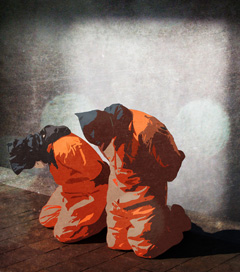
Showing posts with label Our Torturers. Show all posts

Tuesday, May 01, 2012

American Muslim Alleges FBI Had A Hand In His Torture


EXCLUSIVE: Yonas Fikre Believes The US Government Played A Role In His Hellish Three-Month Detention In The United Arab Emirates. (Updated with Video)

By Nick Baumann
Tue Apr. 17, 2012 12:01 AM PDT
Courtesy Of "Mother Jones"


UPDATE: Fikre's lawyers have written a letter to the Justice Department about his allegations and released a video of him talking about his ordeal.
Last June, while Yonas Fikre was visiting the United Arab Emirates, the Muslim American from Portland, Oregon was suddenly arrested and detained by Emirati security forces. For the next three months, Fikre claims, he was repeatedly interrogated and tortured. Fikre says he was beaten on the soles of his feet, kicked and punched, and held in stress positions while interrogators demanded he "cooperate" and barked questions that were eerily similar to those posed to him not long before by FBI agents and other American officials who had requested a meeting with him.
Fikre had been visiting family in Khartoum, Sudan, when, in April 2010, the officials got in touch with him. He agreed to meet with them, but ultimately balked at cooperating with FBI questioning without a lawyer present and he rebuffed a request to become an informant. Pressing him to cooperate, the agents told him he was on the no-fly list and could not return home unless he aided the bureau, Fikre says. The following week he received an email from one of the US officials; it arrived from a State Department address: "Thanks for meeting with us last week in Sudan. While we hope to get your side of the issues we keep hearing about, the choice is yours to make. The time to help yourself is now."
"When Yonas [first] asked whether the FBI was behind his detention, he was beaten for asking the question," says his lawyer. "Toward the end, the interrogator indicated that indeed the FBI had been involved."
Fikre made his way to the UAE the following year, where, he and his lawyer allege, he was detained at the request of the US government. They say his treatment is part of a pattern of "proxy" detentions of US Muslims orchestrated by the the US government. Now, Fikre's Portland-based lawyer, Thomas Nelson, plans to file suit against the Obama administration for its alleged complicity in Fikre's torture. 
"There was explicit cooperation; we certainly will allege that in the complaint," says Nelson, a well known terrorism defense attorney. "When Yonas [first] asked whether the FBI was behind his detention, he was beaten for asking the question. Toward the end, the interrogator indicated that indeed the FBI had been involved. Yonas understood this as indicating that the FBI continued to [want] him to work for/with them." Nelson, the American Civil Liberties Union, and the Council on American Islamic Relations are assembling a high-powered legal team to handle Fikre's case in the United States.
Fikre's story echoes those of Naji Hamdan, Amir Meshal, Sharif Mobley, Gulet Mohamed, and Yusuf and Yahya Wehelie. All are American Muslim men who, while traveling abroad, claim they were detained, interrogated, and (in some cases) abused by local security forces; the men claim they were arrested at the behest of federal law enforcement authorities, alleging the US government used this process to circumvent their legal rights as American citizens.
As Mother Jones reported in its September/October 2011 issue, the FBI has acknowledgedthat it tips off local security forces on the names of Americans traveling overseas that the bureau suspects of involvement in terrorism, and that these individuals are sometimes detained and questioned. The FBI also admits that its agents sometimes "interview or witness an interview" of Americans detained by foreign governments in terrorism cases. And as several FBI officials told me on condition of anonymity, the bureau has for years used its elite cadre of international agents (known as legal attachés, or legats) to coordinate the overseas detention and interrogation by foreign security services of American terrorism suspects. Sometimes, that entails cooperating with local security forces that are accustomed to abusing prisoners. (FBI officials have told Mother Jones that foreign security forces are asked to refrain from abusing American detainees.)
It's difficult to confirm US involvement in the detentions of Fikre or other alleged proxy detainees—indeed, plausible deniability is part of the appeal of the program. But what's clear is that Fikre was on the FBI's radar well before his detention in the UAE. (The FBI declined to comment on his case, as did the State Department.) Fikre, whose only previous brush with the legal system came when he sued a restaurant for having ham in its clam chowder, may have drawn the FBI's interest because of his association with Portland's Masjed-as-Saber mosque, where he was a youth basketball coach. 
The mosque has been a focus of FBI scrutiny ever since the October 2002 case of the "Portland Seven," in which seven Muslims from the Portland area were charged with trying to go to Afghanistan to fight with the Taliban in the wake of 9/11. (Six are now in jail; the seventh was killed in Pakistan.) Masjed-as-Saber was in the news again in 2010 when Mohamed Osman Mohamud, a 19-year-old Somali American who sometimes worshipped there, was charged with trying to detonate a fake car bomb provided by an undercover FBI agent.
More recently, three other men who attended Fikre's mosque—Mustafa Elogbi, Michael Migliore, and Jamal Tarhuni—have found themselves on the no-fly list after traveling abroad. (The government's use of the no-fly list to prevent American terrorist suspects from returning home after traveling overseas is currently the subject of a major ACLU lawsuit.)
Fikre's case "really does make a mockery of the FBI's use of watchlisting as a means of protecting the US," says Gadeir Abbas, a staff attorney with the Council on American-Islamic Relations. "It's not a means of protecting America—it's a tool the FBI uses to put people in vulnerable positions."
It "really does make a mockery of the FBI's use of watchlisting as a means of protecting the US."
Fikre, who is currently living in Sweden and believes that it would be unsafe for him to return to the United States, has given a series of videotaped interviews detailing his ordeal. His presence in Sweden beyond the three-month window allowed for tourist visas suggests that he has applied for permanent status there, and local media have so far refrained from reporting on the story for fear of affecting his case to stay in the country.
In the interviews, Fikre describes a series of events that are similar to the 2008 case of Naji Hamdan, a Lebanese American auto-parts dealer from Los Angeles who was then living in the UAE. Like Hamdan, Fikre claims he was detained in the UAE, tortured (including with stress positions and beatings on the soles of his feet, so as to not show marks), and asked about his activities in the United States. Like Hamdan, Fikre believed a western interrogator was present in the room at some points during his detention, because when he could peek out under his blindfold ("after being kicked/punched and falling over," Nelson says) he occasionally saw western slacks and shoes. "In those occasions there was a fair amount of whispering," Nelson added.
The similarities between the two cases were so striking that Michael Kaufman and Laboni Hoq, lawyers who are representing Hamdan in his separate case against the government, initially thought that Fikre had simply parroted Hamdan's story. But once they heard more, they decided "the backstory of why the government was interested in him was reasonable and something that didn't sound fabricated," Kaufman said. "It seemed like a long way to go for a lie," Hoq added.
A key difference between Hamdan's and Fikre's stories is that Hamdan eventually confessed—under torture, he now emphasizes—to being a member of several terrorist groups, including Al Qaeda. He ultimately spent 11 months in UAE custody before being deported to Lebanon, where he now runs a children's clothing store. Despite an extensive FBI investigation, he was never charged in the United States.
Fikre, his lawyer says, "never confessed to anything"—"thankfully."  
"The FBI does this stuff because they can get away with it," Nelson says. "But the bureau has totally destroyed any relationship it had with the Muslim community in Portland."
UPDATE, Wednesday, 1:00 p.m. EST: Fikre's lawyers have released a video of him talking about his ordeal (they've also written a letter to the Justice Department). You can watch the video here:

Monday, April 16, 2012

Uranium Double Standard: The U.S., Kazakhstan and Iran

Article image

“Iran Hasn’t Always Been Deemed A ‘Nuclear Threat’ By U.S. Policymakers.”

By Allen Ruff and Steve Horn
Published: Thursday 12 April 2012
Courtesy Of "Nation Of Change"


Iran’s alleged "nuclear threat" has taken center stage among diplomats, military men, and politicians in Washington, Tel Aviv, and the West at-large.

Despite the fact that investigative journalistsSeymour Hersh, Gareth Porter and others have meticulously documented the fact that Iran, in fact, poses no nuclear threat at all, the Obama Administration and the U.S. Congress have laid down multiple rounds of harsh sanctionsas a means to "deter" Iran from reaching its "nuclear capacity."
The most recent round featured a call to boycott Iran’s oil industry by President Obama.
While rhetorical attention remains focused on Iran’s "threat", there is an "elephant in the room": Kazakhstan’s booming uranium mining and expanding nuclear industry -- a massive effort involving U.S. multinational corporations and an authoritarian regime increasingly tied to Washington.
Double standards have long reigned supreme in U.S. foreign policy. Few examples illustrate that better than the contrast between Washington’s stance toward the nuclear ambitions of Iran and Kazakhstan.
The Seoul, Korea Dog and Pony Show
The alleged Iranian "threat" was a central concern at the Nuclear Security Summit, which occurred in Seoul, South Korea between March 26-27.
Notables attending the conference included the likes of U.S. President Barack Obama, Israeli Deputy Prime Minister, Dan Meridor; Canadian Prime Minister Stephen Harper, Russian outgoing President Dmitry Medvedev, Chinese President Hu Jintao, South Korean President Lee Myung-bak, and British Prime Minister Nick Clegg, to name several.
Noticeably absent were representatives from Iran, though the country received the brunt of criticism from many of the attendees at what amounted to a dog and pony show in Seoul.
Speaking at the Summit, Obama stated, "There is time to solve this diplomatically, but time is short. Iran's leaders must understand that there is no escaping the choice before it. Iran must act with the seriousness and sense of urgency that this moment demands. Iran must meet its obligations."
One notable uranium-developing powerhouse in no way viewed as a "threat" by the 53 world leaders assembled at Seoul was Kazakhstan, the resource-rich former Soviet republic strategically located at the center of the Asian heartland.
A country four times the size of the state of Texas, the Central Asia giant now serves as a key thoroughfare for what the Pentagon and U.S. geo-strategic planners refer to as the Northern Distribution Network (NDN), the main route equipping US/NATO forces in Afghanistan.
Kazakhstan’s self-proclaimed "president for life" -- Nursultan Nazarbayev – played a highly visible role at Seoul and joined Obama in a bilateral meeting, as well as a photo op.
As the Summit started, the New York Times published a public relations piece by Nazarbayev, fittingly titled, "What Iran Can Learn From Kazakhstan." Noting his country’s post-Soviet efforts at nuclear weapons disarmament, the Kazakh leader informed his readers that his country "…chose building peaceful alliances and prosperity over fear and suspicion…"
The cynicism in Nazarbayev’s rhetoric could not have been missed by those familiar with a country where no true opposition parties, critical media or free trade unions are allowed, where protections under the law are virtually absent; and bribery and corruption rule.
Just days prior to the appearance of Nazarabyev’s Times piece,Amnesty International examined events in the aftermath of theDecember 2011 massacre of striking oil workers in Zhanaozen. Appearing a 100 days after that dark day, the report found the government’s investigation into the events "inadequate." Amnesty noted, "There have been numerous reports of widespread torture and other ill-treatment of those detained by security forces in the aftermath of the violence and investigations into these allegations do not to date appear to be thorough and impartial."
Kazakh Nukes
Well-known for its massive quantity of Caspian Sea oil and naturalgas resources, Kazakhstan is also a growing nuclear power, possessing roughly 15-percent of the world’s known uranium supply and producing roughly one-third of the current global supply,according to the World Nuclear Association. Bypassing Australia and Canada last year, it currently is the world’s largest producer of the nuclear fuel source.
Kazakhstan’s nuclear industry extends from the mining, processing and export of uranium to the construction of nuclear reactors. Closely tied to both Canadian and U.S. mega energy corporations, it seemingly poses no concern for Washington. Unlike Iran, no one seems to be calling for sanctions or regime change despite the repressive nature of Nazarbayev’s regime. Business is business and U.S. strategic interest trumps all.
A bit of recent nuclear industry business history is in order.
In October 2006, the Japanese multinational corporation Toshiba -- of television- and computer-manufacturing fame -- purchased a 77-percent majority share in Westinghouse Electric for a mere $5.4 billion. The other two companies involved in the buyout were Japan’s IHI Corporation, as well as the U.S. multinational Shaw Group.
Less than a year later, in July 2007, Kazakhstan’s state owned company KazAtomProm paid $486.3 million for a 10-percent of Toshiba’s stake in the jointly owned corporation, meaning it now owns 7.7-percent of Westinghouse.
"The deal," explained nuclear industry analyst and consultant, Dan Yurman, "would give Toshiba access to Kazakhstan's uranium at a time when increased demand has tripled prices of the nuclear fuel ingredient in the past year. It would give Kazatomprom access to Toshiba's uranium processing technology and its sales channels."
The transaction infuriated close observers of the global nuclear industry, who cited human rights concerns and the dictatorial,kleptocratic nature of the Nazarbayev regime that "won" yet another rigged January 2012 election held amidst the ongoing repression following the state crackdown at Zhanaozen.
 
Clinton and Nazarbayev: East Meets Westinghouse
The nature of wheelings and dealings under Nazarbayev was fully displayed in an earlier nuclear deal that preceded, but was directly connected to the Westinghouse purchase - a 2005 transaction between the Kazakh state-owned KazAtomProm and a Canadian energy entrepreneur, facilitated by none other than the former U.S. President Bill Clinton.
In 2005, Clinton, then (and still) head of the newly-formed Clinton Foundation, helped Canadian business mogul Frank Giustra make the nuclear deal of a lifetime.
According to the New York Times, Clinton facilitated a trip in September that year for the two of them to visit Nazarbayev in Almaty, Kazakhstan. Two days later Giustra "signed preliminary agreements giving it the right to buy interests in three uranium projects controlled by Kazakhstan’s state-owned uranium agency, Kazatomprom."
The deal needed Nazarbayev’s go-ahead to assure final approval. With Clinton at his side, Giustra received it. As the Times piece described it, "The monster deal stunned the mining industry, turning an unknown shell company (UrAsia Energy Ltd.) into one of the world’s largest uranium producers in a transaction ultimately worth tens of millions of dollars to Mr. Giustra."
Giustra obtained a stake in the mines for $450 million, "the largest initial public offering in the history of Canada’s Venture Exchange." In appreciation for his role as internediary, Giustra made a "philanthropic gift" to the former President’s Foundation totaling $131.1 milliion.
It gets better. "In February 2007, a company called Uranium One agreed to pay $3.1 billion to acquire (the shell company) UrAsia. Mr. Giustra, a director and major shareholder in UrAsia, would be paid $7.05 per share for a company that just two years earlier was trading at 10 cents per share," the New York Times storyexplained. That same month, the then president of KazAtomProm,Moukhtar Dzhakishev, paid a special visit to Clinton’s Chappaqua, NY abode.
The reason for the visit? The Times provides the answer: "Mr. Dzhakishev said he wanted to discuss Kazakhstan’s intention — not publicly known at the time — to buy a 10 percent stake in Westinghouse, a United States supplier of nuclear technology."
Roughly two years after the deal was cut, Dzhakishev was sent packing to a high security penitentiary for 14 years, accused by Nazarbayev’s investigators, Bloomberg reported, of "embezzling state shares in uranium deposits, including one co-owned by Canada’s Uranium One." (Uranium One, of course, was the company that purchased Giustra’s UrAsia Energy Ltd.)
The arrest was made by the KNB, the Kazakhstani successor to the Soviet-era KGB. Many believe -- including leaders from the opposition Azat Party -- that the arrest was politically motivated.
Everyone walked away a winner in this one, other than Dzhakishev.
In exchange for his patronage, Nazarbayev received Clinton’s praisefor "opening up the social and political life" of Kazakhstan. The ex-president and former leader of the "free world" proceeded to endorse the dictator in his bid to become the chair of theOrganization for Security and Co-operation in Europe (OSCE), the body mandated to monitor arms control, human rights, freedom of the press, and fair elections across the Global North.
Eleven months prior to the 2005 deal, then U.S. Sen. Hillary Clinton (D-NY) co-signed a letter to the U.S. State Department she now heads sounding "alarm bells" regarding Nazarbayev’s earlier bid to head the OSCE. The letter found Kazakhstan’s bid unacceptable and cited "serious corruption," cancelled elections and government control of the media.
The only honest way to describe the situation: insider wheeling and dealing of epic proportions for Clinton, Giustra, and the Nazarbayev clique, with Dzhakishev ending up on the rotten end of this deal.
The Fukushima Connection
No story about the nuclear industry would be complete without a mention of the spring 2011 Fukushima Daiichi nuclear disaster. This tale, too, would be incomplete without pointing to the connections between U.S. geopolitical maneuvering, the Iranian "nuclear" threat, the "benevolent" Kazakhstani nuclear industry, and what is now a wasteland in Fukushima.
In the days after Japan’s nuclear disaster, investigative journalist Greg Palast connected some of the dots by revealing that, "One of the reactors dancing with death at Fukushima Station 1 was built by Toshiba. Toshiba was also an architect of the emergency diesel system."
Such back-up power generators were part the "seismic qualification" (SQ) test requirements that all nuclear power plants must pass. Yet, meeting SQ qualifications is expensive, so, as Palastexplained, "The most inexpensive way to meet your SQ is to lie." Stone and Webster, the nuclear unit of The Shaw Group, did just that for Fukushima Daiichi.
Shaw, as mentioned, owns a 20-percent stake in Westinghouse, KazAtomProm owns a 7.7-percent stake in it, while Toshiba owns a 69.3-percent stake.
Kazakhstan continues to experience its own nuclear tragedy in the area around Semipalatinsk, (Semey), formerly the center of Soviet-era nuclear weapons tests. A still unknown, but massive number of inhabitants of this northeastern Kazakh city continue to suffer and die from leukemia, other cancers, and horrific birth defects caused by high levels of radiation.
"Already, the thyroid cancer rate in the east and north of Kazakhstan is twice as high as in the rest of the country, and other cancers such as breast, have higher rates," explained The Ecologistin an August 2011 article.
This, then, raises the question: Who or what poses the nuclear threat? Nuclear energy, nuclear armament, and uranium enrichment in of themselves, or solely Iran’s "nuclear ambitions"?
History Repeating Itself?: Iran’s Once Benevolent Nuclear Industry
Iran hasn’t always been deemed a "nuclear threat" by U.S. policymakers.
Long before U.S. geopolitical planning elites deemed Iran’s nuclear program a "threat," its development was encouraged, in the 1970s during the closing years of Shah Reza Pahlavi’s dictatorship. None other than former U.S. Vice President Dick Cheney, former Secretary of Defense Donald Rumsfeld, and former Deputy Secretary of Defense Paul Wolfowitz, all three at the time holding held high-level national security positions under President Gerald Ford, promoted the effort.
The scenario was best unpacked in an article appearing in the The Washington Post in March 2005. Dafna Linzer wrote of the deal:
"Ford's team endorsed Iranian plans to build a massive nuclear energy industry, but also worked hard to complete a multibillion-dollar deal that would have given Tehran control of large quantities of plutonium and enriched uranium -- the two pathways to a nuclear bomb. Either can be shaped into the core of a nuclear warhead, and obtaining one or the other is generally considered the most significant obstacle to would-be weapons builders.
Iran, a U.S. ally then, had deep pockets and close ties to Washington. U.S. companies, including Westinghouse and General Electric, scrambled to do business there.
(Snip)
"After balking initially, President Gerald R. Ford signed a directive in 1976 offering Tehran the chance to buy and operate a U.S.-built reprocessing facility for extracting plutonium from nuclear reactor fuel."
(Snip)
"The U.S.-Iran deal was shelved when the shah was toppled in the 1979 revolution that led to the taking of American hostages and severing of diplomatic relations."
Linzer went on to explain that U.S. companies, led by Westinghouse, stood to gain $6.4 billion from the sale of six to eight nuclear reactors and parts.
It all connects. Westinghouse today is co-owned by Toshiba, The Shaw Group, and Kazakhstan’s uranium giant, KazAtomProm. Basically the same corporate interests eyeing Iran’s nuclear development under the US-backed Shah’s currently have their hands in Kazakhstan’s nuclear industry today.
Hypocrisy and The Looming Attack On Iran
With rapidity, the build-up for an attack on Iran progresses.
In response to a U.S. threat to sanction Iran’s oil industry, in late-December 2011 the Iranian government threatened to shut downthe Strait of Hormuz, the strategic "choke point" for oil passing passing from the Persian Gulf.
Soon after, U.S. Joint Chiefs of Staff Chairman Gen. Martin Dempsey told CBS’ Face the Nation that, "[Iran] has invested in capabilities that could, in fact, for a period of time block the Strait of Hormuz. We’ve invested in capabilities to ensure that if that happens, we can defeat that."
Three weeks on, the U.S. Navy announced the deployment of a floating Forward Operating Base "mothership" south of Iran, aboard the USS Ponce.
"Navy documents indicate that it could be headed to the Persian Gulf, where Iran has threatened to block the Strait of Hormuz, a crucial shipping route for much of the world’s oil supply," explained The Washington Post. The ship will manned with active-duty Navy SEAL commandos.
In the midst of the Hormuz snafu, investigative reporter Mark Perry published a groundbreaking exposé, revealing that agents from Israel’s foreign intelligence service, Mossad, had been posing as U.S. spies in Pakistan to recruit members of the terrorist organization Jundallah to fight a covert war against Iran, presumably with the blessing of the U.S. government. Jundallah is a State Department designated terrorist organization.
Perry also broke a story on March 28, uncovering the fact that Israel -- again, almost certainly with U.S. blessing -- procured an air base in Azerbaijan, Iran’s northern neighbor located to the southwest of Kazakhstan, across the Caspian sea. He referred to this as "Israel’s Secret Staging Ground."
This development is a logical one, given that Azerbaijan has already been the home site of a secretive U.S. Central Operations Command (CENTCOM)/Blackwater Worldwide (now known as Academi and, previously, as Xe Services) forward operating base as part of the broader Caspian Guard Initiative for years. Jeremy Scahill explained the Initiative in his book "Blackwater: The Rise of the World’s Most Powerful Mercenary Army." He wrote,
"Beginning in July 2004, Blackwater forces were contracted to work in the heart of the oil- and gas-rich Caspian Sea region, where they would quietly train a force modeled after the Navy SEALs and establish a base just north of the Iranian border," Scahill wrote"
"Blackwater would be tasked with establishing and training an elite ... force modeled after the U.S. Navy SEALs that would ultimately protect the interests of the United States and its allies in a hostile region ... [serving] a dual purpose: protecting the West's new profitable oil and gas exploitation in a region historically dominated by Russia and Iran, and possibly laying the groundwork for an important forward operating base in an attack against Iran," he continued.
More recently, The New Yorker magazine’s Seymour Hersh, writing on "Our Men in Iran?," revealed that the U.S. Joint Special Operations Command (JSOC) has been training another U.S. designated terrorist organization, the Mujahideen-e Khalq (MEK), since 2005. The training has occurred at the Department of Energy’s Nevada-based National Nuclear Security Administrationheadquarters.
Hersh and others have suggested that the MEK and others, including Mossad have been responsible for the spate of assassinations of Iranian nuclear scientists over the past several years. They also portend a dark future, if these series of events proceed in their logical and rather predictable order.
The alleged Iranian "nuclear threat" has become a pretext for regime change in Tehran, a desired goal of U.S. strategic planners and allies in Tel Aviv ever since the overthrow of the U.S.-backed Shah Mohammad Reza Pahlavi in 1979.
The real concern since then for the U.S. has been control over the flow of increasingly valuable strategic sources of energy -- oil, gas, and uranium -- that propel corporate state interests in the region. Kazakhstan’s Nazarbayev will remain a strategic ally regardless of the brutality of his regime, as long as he keeps in line.
As Franklin Delano Roosevelt once said in regard to Nicaragua’s U.S.-backed dictator Anastasio Somoza García, "Somoza may be a son of a bitch, but he's our son of a bitch."
The same, it appears, could be said about Kazakhstan’s Nazarbayev as the U.S. moves toward desired regime change in Iran.

Author pic
ABOUT ALLEN RUFF
Historian and activist Allen Ruff received his Ph.D. in U.S. History from the University of Wisconsin-Madison. He's written on the history of the American Left, local history and has published one novel. Schooled by decades of activist experience, his primary work now centers on opposition to U.S. interventions in the Middle East and elsewhere. He currently hosts a public affairs radio program and is part of the staff collective at Rainbow Bookstore Cooperative in Madison, WI.
ABOUT STEVE HORN
Steve Horn is a researcher and writer at DeSmogBlog. He is also a freelance investigative journalist. Follow him on Twitter at @Steve_Horn1022.


Sunday, April 01, 2012

The U.S. Has Been Enabling Torture For Decades

The United States Has Been Enabling Torture for Decades
(Image: Troy Page; Adapted: mike.benedetti, Caleb Kimbrough)

By Mark Karlin 
Thursday, 15 March 2012 04:27 
Courtesy Of "Truth Out"


Marjorie Cohn – a law professor and past president of the National Lawyer's Guild – has assembled a compelling interdisciplinary anthology on the "normalization" of torture as an extension of American foreign policy. This is not a new occurrence limited to the so-called "war on terror," but extends back decades.

The United States Exports Torture

Mark Karlin: The infamous School of the Americas (SOA) (now euphemistically renamed the "Western Hemisphere Institute for Security Cooperation") has long been accused of teaching human rights violations, including torture. The Defense Department vigorously denies this accusation.

In Chapter 2, Bill Quigley - who writes for Truthout, as well as yourself - outs the truth. Hasn't the School of the Americas, and its predecessor, which was located in the Panama Canal Zone, been outsourcing torture and human rights violations for decades?

Marjorie Cohn:  During the 1970s and 1980s, dictators and military leaders in Chile, Bolivia, Colombia, Guatemala, El Salvador, Honduras and Paraguay used skills they learned at the US Army's School of the Americas to torture and execute dissidents. SOA graduates assassinated bishops, priests, labor leaders, women, children and community workers, and massacred entire communities. Although the school was cosmetically renamed in 2001 to the "Western Hemisphere Institute for Security Cooperation" (WHINSEC) at Ft. Benning, Georgia, the US government continues to resist accountability for those complicit in the egregious human rights violations perpetrated by the school's students. There is a growing protest movement against the SOA/WHINSEC. Since the assassination of Archbishop Oscar Romero in El Salvador in 1980, protesters have increasingly engaged in lobbying and civil disobedience, including regular teach-ins, demonstrations and prayer vigils. Up to 20,000 demonstrators descend on Ft. Benning each year. They want the US government to admit what it has done at the school, allow an independent investigation and accept responsibility for the consequences. They are demanding that the torture school be closed.

MK: The torture and murders that occurred during the "dirty wars" in South America and the military dictatorship/right-wing militias' suppression of opposition in Central America was something out of the Spanish Inquisition. The US was on the side of the military governments, and yet, they were committing torture and massacres even against US citizens, including nuns. Terry Lynn Karl describes this in Chapter 2, with El Salvador as a case study. How come it took the war on terror to ignite a national discussion on torture and US foreign policy?

MC: During the dirty wars in Latin America, most of the torture was perpetuated by foreign governments (albeit with the backing of the United States). But when the grotesque photographs of torture and abuse at Abu Ghraib were published, Americans were confronted with torture being committed by their own government. As additional photographs and reports of torture emerged, and memoranda written by former President George W. Bush's legal mercenaries were made public, it became impossible to ignore the cruelty being perpetrated by the US government.

MK: We tend to think of torture as physical, but you have a chapter on psychological torture. What forms does that take, in the United States and abroad?

MC: As historian Alfred McCoy explains in his chapter, the CIA has refined the "art"of torture by developing techniques to manipulate human consciousness. Since drug research had been unsuccessful, the CIA explored sensory deprivation and stress positions to be used offensively by CIA interrogators and defensively to train US troops to resist enemy interrogators. In 1963, the CIA created the KUBARK Counterintelligence Interrogation manual (KUBARK), which codified secret research on mind control. McCoy observes how they used heat and cold, light and dark, noise and silence, feast and famine, and sensory overload and deprivation to pursue their sordid ends.

MK: What is the role that professionals play - doctors, psychologists, lawyers, etc. - in the normalization of torture as a tool of the state?

MC: Psychologists were an essential component of the Bush torture regime. They helped develop, supervise, implement and disseminate abusive interrogation techniques, modeled on the US military's Survival, Evasion, Resistance and Escape (SERE) program. Bush administration officials "engineered"SERE techniques to design counter-resistance methods in order to break detainees. The American Psychological Association (APA), which is the nation's largest professional mental health organization, "essential cover"for the psychologists' assistance to the torture regime. Notably, a group of activist psychologists opposed the APA's complicity. The movement achieved several major successes, which forced a change in APA policies. 
Psychologist Stephen Soldz documents that movement in his chapter.

Lawyers in the Bush administration's Justice Department rewrote the law to justify torture and abuse. In a memo signed by Jay Bybee, John Yoo narrowed the definition of torture so the victim must experience intense pain or suffering equivalent to pain associated with serious physical injury so severe that death, organ failure or permanent damage resulting in loss of significant body functions will likely result; Yoo's definition contravenes the definition in the UN Convention Against Torture (CAT), a treaty the US has ratified which is thus part of the US law under the Constitution's supremacy clause. Yoo said self-defense or necessity could be used as a defense to war crimes prosecutions for torture, notwithstanding CAT's absolute prohibition against torture in all circumstances, even in wartime. This memo, and another Yoo wrote with Jay Bybee in August 2002, provided the basis for the administration's torture of prisoners.

MK: Obviously, in the post-9/11 period, the US got into torture in a big way. Many people have forgotten the photos from Abu Ghraib that showed prisoners who had been tortured to death, or of prisoners being tortured. Waterboarding became the focal point of media attention, not torture in general. Why do you think the visually documented torture by the US military in Iraq (leading to murder in some cases) has become sort of a near-forgotten footnote?

MC: The corporate media have short-term memories. Unless there is a breaking development in the torture saga, it is absent from the national conversation. Torture should be an ongoing story because the Bush officials and lawyers who choreographed the torture program should be facing trial in our courts. But Obama continues to resist accountability for his predecessors. His attorney general, Eric Holder, announced on June 30 that his office will investigate only two instances of detainee mistreatment. He said the department,  "has determined that an expanded criminal investigation of the remaining matters is not warranted." Holder has granted impunity to those who authorized, provided legal cover and carried out the "remaining matters."

Both of the incidents that Holder has agreed to investigate involved egregious treatment, and both resulted in death. These two deaths should be investigated and those responsible punished in accordance with the law.But the investigation must have a much broader scope. More than 100 detainees have died in US custody, many from torture. And untold numbers were subjected to torture and cruel treatment in violation of US and international law. 

MK: Chapter 13 focuses on the criminal accountability of the Bush administration for torture, but there have been no significant charges ever brought, except for low-level military personnel. Are high-level American officials above the law when it comes to torture?

MC: No. Under the well-established doctrine of command responsibility, commanders are liable for torture (considered a war crime under the Geneva Conventions and the US torture statute) if they knew or should have known their subordinates would commit torture and they did nothing to stop or prevent it. Bush officials Dick Cheney, Condoleezza Rice, George Tenet, John Ashcroft, Alberto Gonzales, Colin Powell and Bush himself, as well as their lawyers, including Yoo and Bybee, engaged in a common plan to authorize torture in violation of CAT and the Geneva Conventions. They knew that interrogators would take action based on that authorization. These officials and lawyers should be investigated and prosecuted for war crimes under US law. There is precedent for holding lawyers criminally liable for giving legally erroneous advice that resulted in great physical or mental harm or death. In US v. Altstoetter, Nazi lawyers were convicted of war crimes and crimes against humanity for advising Adolf Hitler on how to "legally" disappear political suspects to special detention camps.

MK: As far as Guantánamo, isn't the whole prison complex there an ongoing state of torture?

MC: Guantánamo has become a powerful symbol of human rights violations - so much so that Amnesty International described it as "the gulag of our times." Prisoners released from Guantanamo have detailed assaults, prolonged shackling in uncomfortable positions, sexual abuse and threats with dogs. Mustafa Ait Idr, an Algerian citizen who was living in Bosnia when he was sent to Guantanamo, charged that US military guards jumped on his head, resulting in a stroke that paralyzed his face. They also broke several of his fingers and nearly drowned him in a toilet. Mohammed Sagheer, a Pakistani cleric, claimed the wardens at Guantanamo used drugs "that made us senseless." French citizen Mourad Benchellali, released from Guantanamo in July 2004, said, "I cannot describe in just a few lines the suffering and the torture; but the worst aspect of being at the camp was the despair, the feeling that whatever you say, it will never make a difference." Benchellali added, "There is unlimited cruelty in a system that seems to be unable to free the innocent and unable to punish the guilty." Many of the prisoners at Guantanamo refused food to protest being held incommunicado for years with no hope of release. They concluded that death could not be worse than the living hell they were enduring. Attorney Julia Tarver's client Abdul Rahman told her "of his determination to die and said that, 'now, after four years in captivity, life and death are the same,'" Tarver wrote in a sworn declaration filed in federal district court.

MK: Isn't it odd that so many of the same people who promote the concept of American exceptionalism - and the US being a nation of higher moral values than the rest of the world - also condone torture?

MC: It's not surprising that those who think American lives are worth more than others would objectify groups of people - Arabs, Muslims - to rationalize cruel treatment. This is not a new phenomenon. The people in most of the countries the United States has attacked, or whose repressive governments the US has supported, are non-white.

MK: Under the Obama administration, it has become the policy of the White House that US citizens who are thought - not tried, but "thought" - to be aiding terrorism can be assassinated. This came true - and we may not know of other incidents - when the US military killed US citizen Anwar al-Awlaki in a drone missile attack in Yemen. If the US government can now kill US citizens without a trial, what is to prevent us from being tortured?

MC: Holder is trying to justify the assassination of US citizens without trial under Congress' Authorization for Use of Military Force after 9/11. But the Geneva Conventions and the International Covenant on Civil and Political Rights, both treaties the United States has ratified, forbid extrajudicial executions. They also forbid torture and cruel treatment. But that didn't stop the Bush administration from torturing and abusing detainees. The first indication that Bush officials would employ torture in their war on terror occurred in December 2001, after US citizen John Walker Lindh was captured in Afghanistan. Lindh's American interrogators stripped and gagged him, strapped him to a board and displayed him to the press. He was writhing in pain from a bullet, which US officials would leave in his body for weeks in order to "preserve the chain of custody of the evidence" against him. A Navy admiral told the intelligence officer who interrogated Lindh that, "the secretary of defense's counsel has authorized him to 'take the gloves off' and ask whatever he wanted." Although Lindh was initially charged with terrorism crimes that exposed him to three life terms plus 90 years, then-Attorney General John Ashcroft permitted him to plead guilty to lesser offenses that garnered him 20 years. The condition: that Lindh declare he suffered "no deliberate mistreatment" while in custody.

MK: Of course, no discussion of torture is complete without bringing up the CIA. Frankly, I can't imagine that the CIA does not engage in torture around the world. How would we ever know if it was?

MC: Since 9/11, CIA involvement in extraordinary renditions, sometimes called "outsourcing torture," has increased dramatically. Terrorism suspects in Europe, Asia, Africa and the Middle East have been rendered to foreign countries such as Egypt, Syria, Morocco and Jordan, all notorious for torture. The Council of Europe has identified 14 European states which have apparently cooperated with the United States in extraordinary renditions. There are secret CIA prisons, so-called "black sites," in many countries, including Romania and Poland, in which prisoners have been tortured after having been rendered there. In her chapter, journalist Jane Mayer discusses Ibn Sheikh al Libi, who was tortured in CIA custody. Al Libi provided a link between Saddam Hussein and al-Qaeda, which Powell cited in his speech before the UN Security Council as he tried to secure a resolution authorizing the invasion of Iraq. The CIA knew Al Libi's information was false; indeed, he later recanted and died under mysterious circumstances.