Showing posts with label Militarization Of Police. Show all posts

Monday, January 27, 2014

Cops War On People Deadlier Than Iraq


Over 5,000 people have been killed in the US by police than US soldiers have fallen during the Iraq war over the last 10 years. 

The figure seems to reflect the increased militarization of police and, shockingly, means that you are 29 times more likely to be killed by a police officer than by a terrorist. 
This Buzzsaw news clip is with: Tyrel Ventura and Tabetha Wallace.

Watch the full episode here:
https://www.youtube.com/watch?v=F6rnm...

Friday, June 28, 2013

Obama Expands Militarization Of Police


Courtesy Of The Real News

Among items transfered to local law enforcement agencies have been assault rifles and grenade launchers, even Blackhawk helicopters and .50 caliber machine guns ; In fiscal year 2011 alone, the Pentagon transferred almost $500 million worth of materials to domestic law enforcement -- near double the previous year's total

Friday, March 29, 2013

1.6 Billion Rounds Of Ammo For Homeland Security?


Ralph Benko sheds light on the following topic,


The Denver Post, on February 15th, ran an Associated Press article entitled Homeland Security aims to buy 1.6b rounds of ammo, so far to little notice.  It confirmed that the Department of Homeland Security has issued an open purchase order for 1.6 billion rounds of ammunition.  As reported elsewhere, some of this purchase order is for hollow-point rounds, forbidden by international law for use in war, along with a frightening amount specialized for snipers. Also reported elsewhere, at the height of the Iraq War the Army was expending less than 6 million rounds a month.  Therefore 1.6 billion rounds would be enough to sustain a hot war for 20+ years.  In America.
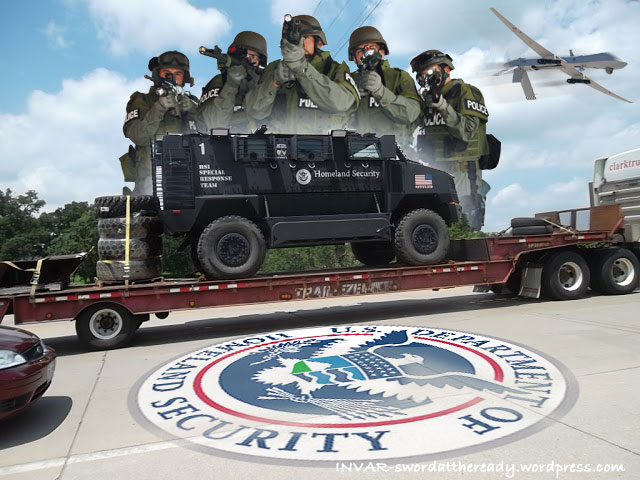
Add to this perplexing outré purchase of ammo, DHS now is showing off its acquisition of heavily armored personnel carriers, repatriated from the Iraqi and Afghani theaters of operation.  As observed by “paramilblogger” Ken Jorgustin last September:
[T]he Department of Homeland Security is apparently taking delivery (apparently through the  Marine Corps Systems Command, Quantico VA, via the manufacturer – Navistar Defense LLC) of an undetermined number of the recently retrofitted 2,717 ‘Mine Resistant Protected’ MaxxPro MRAP vehicles for service on the streets of theUnited States.”
These MRAP’s ARE BEING SEEN ON U.S. STREETS all across America by verified observers with photos, videos, and descriptions.”
Regardless of the exact number of MRAP’s being delivered to DHS (and evidently some to POLICE via DHS, as has been observed), why would they need such over-the-top vehicles on U.S. streets to withstand IEDs, mine blasts, and 50 caliber hits to bullet-proof glass? In a war zone… yes, definitely. Let’s protect our men and women. On the streets of America… ?”
“They all have gun ports… Gun Ports? In the theater of war, yes. On the streets of America…?
Seriously, why would DHS need such a vehicle on our streets?”
Why indeed?  It is utterly inconceivable that Department of Homeland Security Secretary Janet Napolitano is planning a coup d’etat against President Obama, and the Congress, to install herself as Supreme Ruler of the United States of America.  There, however, are real signs that the Department bureaucrats are running amok.  About 20 years ago this columnist worked, for two years, in the U.S. Department of Energy’s general counsel’s office in its procurement and finance division.  And is wise to the ways.   The answer to “why would DHS need such a vehicle?” almost certainly is this:  it’s a cool toy and these (reportedly) million dollar toys are being recycled, without much of a impact on the DHS budget.  So…why not?
Why, indeed, should the federal government not be deploying armored personnel carriers and stockpiling enough ammo for a 20-year war in the homeland?  Because it’s wrong in every way.  President Obama has an opportunity, now, to live up to some of his rhetoric by helping the federal government set a noble example in a matter very close to his heart (and that of his Progressive base), one not inimical to the Bill of Rights: gun control.  The federal government can (for a nice change)begin practicing what it preaches by controlling itself.
Remember the Sequester?  The president is claiming its budget cuts will inconvenience travelers by squeezing essential services provided by the (opulently armed and stylishly uniformed) DHS.  Quality ammunition is not cheap.  (Of course, news reports that DHS is about to spend $50 million on new uniforms suggests a certain cavalier attitude toward government frugality.)
Spending money this way is beyond absurd well into perverse.  According to the AP story a DHS spokesperson justifies this acquisition to “help the government get a low price for a big purchase.” Peggy Dixon, spokeswoman for the Federal Law Enforcement Training Center:  “The training center and others like it run by the Homeland Security Department use as many as 15 million rounds every year, mostly on shooting ranges and in training exercises.”
At 15 million rounds (which, in itself, is pretty extraordinary and sounds more like fun target-shooting-at-taxpayer-expense than a sensible training exercise) … that’s a stockpile that would last DHS over a century.  To claim that it’s to “get a low price” for a ridiculously wasteful amount is an argument that could only fool a career civil servant.
Meanwhile, Senator Diane Feinstein, with the support of President Obama, is attempting to ban 100 capacity magazine clips.  Doing a little apples-to-oranges comparison, here, 1.6 billion rounds is … 16 million times more objectionable.
Mr. Obama has a long history of disdain toward gun ownership.  According to Prof. John Lott, in Debacle, a book he co-authored with iconic conservative strategist Grover Norquist,

“When I was first introduced to Obama (when both worked at the University of Chicago LawSchool, where Lott was famous for his analysis of firearms possession), he said, ‘Oh, you’re the gun guy.’
I responded: ‘Yes, I guess so.’
’I don’t believe that people should own guns,’ Obama replied.
I then replied that it might be fun to have lunch and talk about that statement some time.
He simply grimaced and turned away. …
Unlike other liberal academics who usually enjoyed discussing opposing ideas, Obama showed disdain.”
Mr. Obama?  Where’s the disdain now?  Cancelling, or at minimum, drastically scaling back — by 90% or even 99%, the DHS order for ammo, and its receipt and deployment of armored personnel carriers, would be a “fourfer.”
  • The federal government would set an example of restraint in the matter of weaponry.
  • It would reduce the deficit without squeezing essential services.
  • It would do both in a way that was palatable to liberals and conservatives, slightly depolarizing America.
  • It would somewhat defuse, by the government making itself less armed-to-the-teeth, the anxiety of those who mistrust the benevolence of the federales.
If Obama doesn’t show any leadership on this matter it’s an opportunity for Rep. Darrell Issa, chairman of the House Oversight and Government Reform Committee, and Rep. Michael McCaul, chairman of the House Committee on Homeland Security, to summon Secretary Napolitano over for a little national conversation. Madame Secretary?  Buying 1.6 billion rounds of ammo and deploying armored personnel carriers runs contrary, in every way, to what “homeland security” really means.  Discuss.

Wednesday, January 23, 2013

American Law Enforcement Has Always Been Paramilitary


"American law enforcement is and has always been paramilitary. We've simply seen an escalation, and a very large one, since 9/11 and leading into the Occupy movement as well …. They are a civilian police force but they operate according to a paramilitary organisational arrangement. It's a very heavily command-and-control oriented institution."
- Norm Stamper, a former Seattle police chief

An investigation by the Center for Investigative Reporting found that some police departments have been transformed into "army-like forces" because of the equipment they use.

... the most visible use of that equipment has come as they dispersed largely peaceful protests like those seen at the height of the Occupy Wall Street movement.

In July this year, in the Californian city of Anaheim, police officers looked like they were prepared for war as they surrounded unarmed protesters demonstrating against police brutality.


"What we've been seeing in the last 10 years is even more disturbing .... The level of force that governments, politicians and law enforcement officials are choosing to use is not really based on a realistic assessment of the threat but increasingly based on what sort of political message that they want to send."

Radley Balko, a senior writer at the Huffington Post

Tuesday, May 22, 2012

Americans Love A Good Killer

The Military / Police Symbiosis

By JOHN GRANT
WEEKEND EDITION MAY 11-13, 2012
Courtesy Of "CounterPunch"


The essential American soul is hard, isolate, stoic and a killer.
- D.H. Lawrence
The realist in murder writes of a world in which gangsters can rule nations … where a judge with a cellar full of bootleg liquor can send a man to jail for having a pint in his pocket … where no man can walk down a dark street in safety because law and order are things we talk about but refrain from practicing.
- Raymond Chandler
American pop culture is certainly not unique in having a love affair with killers. Since the first cave man cracked his neighbor’s head open to control a water hole, eliminating others has been top on the list of problem-solving techniques.
Life today has evolved to the point the club has been improved and a young man can sit in an air- conditioned room sipping a Diet Pepsi as he whacks somebody 12,000 miles away. Or else an elite team of tricked-up killers with sophisticated air support can be dropped in at night to do the job.
That’s the state of the art 2012 when it comes to homicide.
Our military is now establishing secret bases all over the world from which to launch these types of homicide assaults specifically focused on leaders of movements we don’t like. It’s now going on big time in Yemen, the very poor country on the southern edge of the Arabian peninsula, which is dominated by the super-rich Saudi royal clan, an oily collaboration with which US leaders have had a half-century relationship.
As Jeremy Scahill’s excellent reporting from Yemen makes clear, our drone attacks and support for Yemeni government troops are aggravating poor Yemenis like crazy, driving them into the arms of al Qaeda elements. And, as we should all know by now, once the magic word “al Qaeda” is mentioned all reason and compassion goes out the window and homicide becomes the acceptable problem-solving recourse.
This new US military doctrine based on sophisticated intelligence and secret homicide raids virtually anywhere is growing at a time our military is linking more and more with local, domestic police agencies. This phenomenon has the potential for serious civil liberties abuse. National borders are fading and life is becoming more and more globalized; burgeoning communications technologies ironically make us less socially cohesive. Add economic, religious and political polarization to the mix and the symbiosis between the military and local police becomes quite scary.
The ultimate dark question lurking in all this is: Are death squads within the domestic borders of the United States a possibility? Some will surely see such a question as hysterical — in both senses of the word. But for those who feel it can’t happen here, there’s the lesson of that mythic frog who doesn’t hop out of the pot because the temperature of the water is raised very slowly. For those on the right, there’s also the metaphor of Munich, which says if you appease the initial signs of oppressive force and don’t act against it, you’re certain to be screwed later.
Creeping Militarism Arriving On a Street Near You
Several recent stories suggest how very deep militarism has seeped into the post-9/11, Drug War- obsessed American culture. The Bush Administration’s decision to invade two countries and engage in counter-insurgency wars for ten years is front and center as part of the problem. War has consequences. In the case of Vietnam, it divided the nation.
The first story is about how returning soldiers from Iraq and Afghanistan are employing counter-insurgency tactics on the street in places like Springfield, Massachusetts. The enemy is drug gangs, the domestic suppliers of controlled substances illegally imported from places like South America. “Gang members and drug dealers operate very similarly to insurgents,” Massachusetts State Trooper Michael Cutone told the Times; he was a Green Beret in Iraq.
second story is summed up in its headline: “U.S. Drug War Inside Honduras Waged Iraq-Style.” To interdict drug shipments from South America headed for the US, the US military has constructed three forward operating bases (or FOBs) in Honduras, one a former CIA airfield from the controversial Contra War days. This kind of military intervention inside Honduras would have been unlikely without the June 2009 military coup that overthrew elected President Manuel Zelaya. The Obama administration, as some may recall, did nothing to prevent or oppose this coup, which there’s little doubt was undertaken with the knowledge of elements in the US government.
Admiral Joseph Kernan, deputy commander of Southern Command, told the Times there are “insidious” parallels between drug traffickers and terror networks. “They operate without regard to borders,” he said. And, of course, so does the military of the United States of America. According to the Times, Admiral Kernan “spent years in Navy SEAL combat units,” the elite unit in the forefront of the new quick-and-lethal special operations doctrine.
The third story recounts the warm reception fired General Stanley McChrystal is getting at Yale, where he has been hired to lecture on leadership. McChrystal, of course, is a proven master at two things: public relations (he was the one-star briefing officer during the Iraq Invasion) and the management of special operations units. He’s arguably the key person in the successful use of killer teams in Anbar Province — known colloquially as “the Salvadoran option” — which developed into the US military’s current special operations doctrine relying on assassin teams and drones to weaken and destabilize enemy leadership. The bin Laden hit was a highly publicized example of this; most examples are top secret.
General McChrystal is famous for a stark and ascetic lifestyle. When reduced to its crude fundamentals, General McChrystal’s leadership expertise amounts to controlling information from the US public and organizing killers. In the 1960s, a man like McChrystal would have faced protests on a college campus. Today, he’s a rock star.
Beyond real, flesh-and-blood people like General McChrystal, Americans’ fascination with killers is clear from just a cursory survey of popular culture. Everywhere, in films, in popular books on the grocery store shelves and in video games, there’s an obsession with hit men, serial killers, sexual psychopaths and government agents with a license to kill; popular killers range from those in an underground, criminal world to those wearing badges and working under the lethal rights granted by national sovereign.
There’s Lawrence Block’s lovable hit man Keller who knocks people off between trips to stamp-collector shops, the swimming pool and other mundane tasks his middle-class readers can identify with. There’s Dexter, the lovable serial killer who offs only scum of the earth we’re glad to see eliminated. And there’s Jake Grafton, Steven Koonts’ CIA agent in The Assassin, who hunts down al Qaeda demons — as do a hundred others in the same genre within a genre.
Then there’s Keith Hayward in Peter Straub’s macabre gem of a novella A Special Place: The Heart of a Dark Matter. Hayward is actually a very unpleasant character. He starts out as a 12-year-old killing local cats. His Uncle Till, who likes to kill women with a knife, recognizes his nephew’s talents and trains him in the discipline of killing so he can safely fulfill his true potential. As I was reading Straub’s dark little fairy tale I couldn’t help but wonder if Keith Hayward had the discipline to enter the realm of sovereign killing and to become a special ops killer for America. Again, some may see this as a cheap shot at our national heroes of the moment; I’m not sure.
At this juncture, I should say I’m not a pacifist and, to be perfectly candid, when the luxury of personal security is lifted I think I’d agree some people may need killing. (I apologize to all my pacifist friends.) But this only shifts the argument from the act of killing to the question who is one killing and why. In the case of the US government, when it comes to the combined War On Terror and the Drug War, there’s a clear, on-going history of intervention, invasion and occupation that provokes people to oppose us with violence, which means killing them is only exacerbating the problem and making more enemies to kill later. The process of violence is a vicious cycle with no end, as Martin Luther King so eloquently pointed out before he was assassinated.
When the Englishman D.H. Lawrence describes the American soul as “hard, isolate, stoic and a killer,” he doesn’t include as a trait a devotion to history. No. History is something too many Americans like to avoid at all costs — unless like “remember the Alamo!” it can be used to mobilize an army for purposes of homicidal revenge. History that digs in and explains the American soul is like a ball and chain. Better to remain ignorant, or as Susan Sontag put it after 9/11: “By all means let’s mourn together, but let’s not be stupid together.” Sadly, the American leaders at the time and the American mob all chose to be stupid.
Add to this volatile cultural stew the polarization of fundamentalist religion and the promotional power of the National Rifle Association and pretty soon you’re back to the wild west where everybody feels they have the need, and the right, to solve their problems lethally. It’s your right to stand your ground with a .40 caliber Glock.
Military/Police Symbiosis
The anxiety I feel today is exactly what Raymond Chandler alluded to in the epigram at the top, about “a world in which gangsters can rule nations.” The militarization of the police inside the US is a perfect example of this.
The Posse Comitatus Act of 1878 makes it illegal to use Army units within the domestic United States. (The Air Force was added to the act in 1956.) The militarization of police forces, on the other hand, has no such brake.
It’s interesting to look at the issue as a hemisphere problem. In Latin America, the overlap between military and police forces has been notoriously problematic, with many instances of human rights abuses. US military trainers are now being deployed to places like Honduras to train the police and the military; and one of the things they preach is the separation of military and police functions. It’s ironic that those very separations are breaking down here in North America. We’re becoming more like Latin America as they become more like us.
“The Salvador option” was the informal name given to General McChrystal’s Special Operations “death squads” in Anbar Province in Iraq. In El Salvador such units were referred to as “paramilitary.” My dictionary defines “para-“ as “distinct from, but analogous to.”
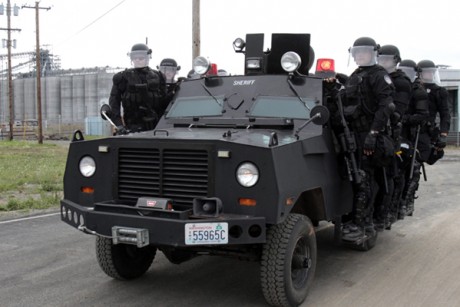
Recently, York County, Pennsylvania, purchased a $296,000 up-armored Lenco Bearcat for its SWAT Team; the funds came from money and belongings seized from drug dealers. This kind of self-aggrandizing spoils system is notorious in police forces across the nation. The more property confiscated, the more sophisticated military equipment and weapons a department can buy. The problem is, if you buy a tank you naturally want to use it. The more military equipment and training you get, the more you will become a paramilitary unit — “distinct from, but analogous to” a military unit.
There’s also a vast network of associations and training enterprises that reinforce the militarization of local police forces. An article in the Spring issue of the National Tactical Officers Association’s magazine The Tactical Edge specifically addresses the military/police relationship. It’s a review of a book called Field Command by Charles “Sid” Heal.
“The book is a first of its kind,” reviewer John Gnagey writes. “The concepts and principles are taken from tactical texts and military field manuals but are presented in scenarios that commonly confront law enforcement officers.” The book is divided into sections: At the Scene, Understanding and Developing Strategy, Command Staff, Planning and Decision Making and Multi-Dimensional Battlespace.
In the early fifties, I recall my mom literally telling me police officers were my friend. Those days are gone — if they were ever anything more than perception. It’s now an entrenched war of gangs on the streets of America, with the police being the most powerful gang. And police thinkers are using terms like “counter-insurgency” and “battlespace” to talk about policing the streets of America.
Like any civilian caught in the middle of a dangerous warzone, it’s becoming less a matter of right and wrong, and more a matter of prudently choosing sides to cover your ass.
JOHN GRANT is a founding member of ThisCantBeHappening!, the new independent Project Censored Award-winning online alternative newspaper. 

Thursday, April 05, 2012

Security For The One-Percent


Police As Commodity 

By WILLEM de LINT 
MARCH 28, 2012 
Courtesy Of "CounterPunch"


Over the past several years, but now with more intensity, domestic security measures are being mooted, planned, and carried out with a purposefulness that appears to take as a given that what is good for the 1% is good for the rest of us. Moreover, they appear to be developed with the eager cooperation of domestic policing and security actors and agents. What of this presumption? Do the mandates and interests of policing and security actors and agencies match up with those of a minute proportion (1%) of the polity?
In 1829 a new model of policing arose after industrialisation, urbanisation and when the arrival of a new merchant class required a recalibration from feudal to capital class relations. People were forced into close and sometimes unsanitary and “uncivil” contact. Tumult had been in the air. There were revolutionary class fractures. There were spectacular public order affrays. There were riots about food, taxes, sectarian discrimination.
Still, the view that it was desirable or possible to put things in order with raw military power or surveillance and disruption (following the French model) was untenable in a country that had come to value the rule of law. In ushering the new police through parliament, Sir Robert Peel said famously of the New Metropolitan London Police that “the police are the public and the public are the police.”
Is revolution is in the air again? The rumblings of revolt networked to the OWS are not connected directly to war, food shortages or taxes. They are tied to matters of distributive justice and the question of who may speak and whose voice may be heard in the halls of the major institutions of liberal democracy.
Judging by the anticipatory response, it would seem that steps are being taken in anticipation of a major conflagration in the homeland.
Which brings us back to the question of how policing and domestic security has been – and ought to be – understood as an institution of liberal governance. The Department of Homeland Security is both instance and measure of the feared eventuality of domestic insecurity. Relaxation on domestic spying by the NSA and CIA, and on COINTELPRO-like activities by the NYPD (in its extra-territorial spying activities, “mosque crawls”), and in the fusion site popping up throughout the country, suggest surveillance or national security state configurations eerily consistent with the French gendarmes so adamantly refused as a model for the modern police.
The grounding of these fusions in post-911 homegrown terrorism is also a basis that has allowed the deliberate erosion of rights and freedoms one target at a time. But doesn’t the argument that existential security and quotidian safety give the state and the individual inseparable interests require a referendum (of the 99%)?
What is on offer looks like a false flag behind which the true object is almost invisible. That object is the very possibility that the 99% will indeed perceive their interests in stark contradistinction to those of the 1%; that they will demand not only redistribution, but a new distributive measure or paradigm. It is this eventuality of a unified revolt of the masses that is being planned against. Its leaders or spokespersons listed. Its means of association countered.
And it is in this effort that we also return to the role of domestic policing and security. It has been the fatuous presumption of the 1% that police and security actors and agencies are in their pocket, paid for and paid off. Mayor Bloomberg is rightly portrayed as believing that the NYPD is a private army of himself and Wall Street. The presumption of those currently broker power in America (and the world) is “l’etat c’est moi”, that whatever the need, there can be no doubt as to the loyalties of men and women in blue – that is to say, black.
Is this how it will go? In all revolutionary moments – including the one the 1% appears to be planning on – there is a question as to where military, policing and security forces will place their bets. Most recently in the Arab Spring we saw this in the shifting allegiances of the Egyptian military. So what of policing and security actors who work for the people? Do they not, after all, subscribe to the belief that the distinction between the 99% and 1% is real and meaningful?
More fundamentally, will public police allow themselves to continue to be “played” by the military-finance-security complex of the 1%, despite how grossly such a fealty separates them from their true craft and those whose hard work in fact pays their salaries and provides them with a remnant of legitimacy. Is there discussion around the boardroom table of the largest public policing and security providers regarding the interests of those constituents that are in fact paying the piper? If not, it had better get up.
It might not be too bold to assert that another paradigm shift in social and economic relations is unfolding. As before, this will push status quo assumptions to the brink. No, I do not refer to the convenient distraction of a “terrorist threat.” On the contrary, the proper object concerns the assumptions upon which a trajectory of a future may still be possible. The economic ideology that has pushed us to the brink is the true threat to our security. A paradigm which depends both upon gross inequality and diminishing renewable resources is untenable. And we depend uponour police and security services to be of service as we cross a great chasm of unrest and seek a different grounding for a collective future.
True, the OWS movement has not stipulated those new grounds. A new bull awaits. The bell has not rung out. In the meantime, we know thatmovement, widespread and revolutionary social movement, is necessary and practical; this for a chance of a more firm security.
Willem de Lint is a Professor in Criminal Justice at Flinders Law School, Flinders University of South Australia.

Wednesday, February 29, 2012

The Creeping Militarization Of American Society

By Christopher J. Coyne & Abigail R. Hall 
Published: 1:41 PM 02/20/2012 
Updated: 1:45 PM 02/20/2012 
Courtesy of "The Daily Caller"


Earlier this month, Congress passed House Resolution 658, the “Federal Aviation Administration Air Transportation Modernization and Safety Improvement Act,” which President Obama is expected to sign. One of the over 1,000 sections of H.R. 658 authorizes domestic use of aerial spy drones by the U.S. government.
This is but the latest case of the increased militarization of U.S. police forces. Other examples abound. Under Program 1033, the U.S. military provided police with over $500 million in military equipment in 2011, more than double the amount allocated by the government a year before. Small town police forces have been equipped with SWAT gear and automatic weapons. State and local law enforcement are receiving training akin to that expected in the armed forces.
Such activities fuel an ongoing debate regarding their implication for civil liberties. But H.R. 658 and these other examples also draw attention to a broader point. They lead us to wonder about government constraints, particularly during and after times of crisis.
The Founding Fathers understood the “paradox of power” — the need to simultaneously empower government and constrain its ability to use that power to violate the rights of citizens. They addressed this paradox by creating checks and balances that would, in principle, constrain the activities of government. One of the most important checks, noted the Founders, were vigilant citizens who monitored the activities of their government.
But sometimes, citizens are not so careful to check their government. There are instances which work to loosen the restraints on government. One of the greatest threats is the onset of crises. A crisis event induces citizens to call for government to do something and do it quickly. The demand to act swiftly results in an aggressive government response absent public debate and scrutiny. This leads to increases in both the scale and scope of government activities, many of which persist well after the crisis has ended.
This logic helps to explain the increased militarization of U.S. domestic police forces, which began with the onset of the War on Drugs in the 1980s. This militarization accelerated in the wake of September 11th, as federal dollars flowed through the Department of Homeland Security to local police forces in the name of fighting terrorism. Under this broad umbrella, domestic police have justified the acquisition of military technologies and equipment, ranging from assault rifles and armored cars to tactical training, and soon drones.
There is reason to expect such expansions in the reach of government power to continue. As the threat of terrorism remains a focal point of elected officials, government is able to justify a myriad of expenditures and policies that may reduce the rights of its citizens, like the new stipulations in H.R. 658.
American citizens have reason to be concerned about their civil liberties. It is immensely important, however, that citizens recognize the broader process through which the government expands its powers. Only then may these powers be checked. American citizens would be wise to heed the words of Patrick Henry: “The Constitution is not an instrument for the government to restrain the people, it is an instrument for the people to restrain the government.”
Christopher J. Coyne is the F.A. Harper Professor of Economics at George Mason University. Abigail R. Hall is a Mercatus Graduate Fellow, Department of Economics at George Mason University.

Friday, December 30, 2011

A Civil Liberties Review For 2011


By John W. Whitehead 
Article posted Dec 29 2011, 1:46 AM 
Courtesy Of "Information Liberation"

It’s been a year of populist uprisings, economic downturns, political assassinations, and one scandal after another. Gold prices soared, while the dollar plummeted. The Arab Spring triggered worldwide protests, including the Occupy Wall Street protests here in America. Nature unleashed her forces with a massive earthquake and tsunami in Japan, flooding in Thailand and Pakistan, a severe drought in East Africa, and a famine in Somalia. With an unemployment rate hovering around 9.5%, more than 4 million Americans passed the one-year mark for being out of a job. After a death toll that included more than 4,500 American troops and at least 60,000 Iraqis, the U.S. military officially ended its war in Iraq. At the conclusion of their respective media circus trials, Casey Anthony went free while Conrad Murray went to jail. And Will and Kate tied the knot, while Demi and Ashton broke ties. All in all, it’s been a mixed bag of a year, but on the civil liberties front, things were particularly grim.

Welcome to the new total security state. The U.S. government now has at its disposal a technological arsenal so sophisticated and invasive as to render any constitutional protections null and void. And these technologies are being used by the government to invade the privacy of the American people. Several years ago, government officials acknowledged that the nefarious intelligence gathering entity known as the National Security Agency (NSA) had exceeded its legal authority by eavesdropping on Americans' private email messages and phone calls. However, these reports barely scratch the surface of what we are coming to recognize as a "security/industrial complex"—a marriage of government, military and corporate interests aimed at keeping Americans under constant surveillance. The increasingly complex security needs of our massive federal government, especially in the areas of defense, surveillance and data management, have been met within the corporate sector, which has shown itself to be a powerful ally that both depends on and feeds the growth of governmental bureaucracy.

GPS tracking and secret spying on Americans. Technology, having outstripped our ability as humans to control it, has become our Frankenstein's monster. Delighted with technology's conveniences, its ability to make our lives easier by performing an endless array of tasks faster and more efficiently, we have given it free rein in our lives, with little thought to the legal or moral ramifications of allowing surveillance technology, especially, to uncover nearly every intimate detail of our lives. Consider how enthusiastically we welcomed Global Positioning System (GPS) devices, which use orbiting satellites to produce accurate and continuous records of their position and of any person or object carrying the devices, into our lives. We’ve installed this satellite-based technology in everything from our phones to our cars to our pets. Yet by ensuring that we never get lost, never lose our loved ones and never lose our wireless signals, we have also made it possible for the government to never lose sight of us, as well. Indeed, as a case before the U.S. Supreme Court makes clear, the government is taking full advantage of this technology to keep tabs on American citizens, and in the process, is not only violating the Fourth Amendment's prohibition against unreasonable searches and seizures but is putting an end, once and for all, to any expectation of privacy in public places. Senator Ron Wyden and Rep. Jason Chaffetz have introduced a bill that would require police to obtain a warrant and prove probable cause before tracking someone via GPS. Senators Franken and Blumenthal have also sponsored legislation to “require companies to get a user’s consent before sharing cell phone location information.”


Internet surveillance. In late July 2011, the House Judiciary Committee passed the cleverly titled “Protecting Children from Internet Pornographers Act of 2011,” which laid the groundwork for all internet traffic to be easily monitored by government officials. Most recently, the Stop Online Piracy Act (SOPA), making its way through the House of Representatives, and its sister legislation in the Senate, the Protect IP Act (PIPA), have shown the government’s intent to control all internet traffic. The bills, which are supposedly intended to combat copyright violations on the internet, are written so broadly so as to not only eliminate internet piracy but replace the innovative and democratic aspects of the internet with a tangled bureaucratic mess regulated by the government and corporations.

Intrusive pat-downs, virtual strip searches and screening stations. Under the direction of the Transportation Security Administration (TSA), American travelers have been subjected to all manner of searches ranging from whole-body scanners and enhanced patdowns at airports to bag searches in train stations. Visible Intermodal Prevention and Response (VIPR) task forces, comprised of federal air marshals, surface transportation security inspectors, transportation security officers, behavior detection officers and explosive detection canine teams laid the groundwork for the government’s effort to secure so-called “soft” targets such as malls, stadiums, bridges, etc. Some security experts predict that checkpoints and screening stations will eventually be established at all soft targets, such as department stores, restaurants, and schools. Given the virtually limitless number of potential soft targets vulnerable to terrorist attack, subjection to intrusive pat-downs and full-body imaging will become an integral component of everyday life in the United States.

More powers for the FBI. As detailed in the FBI’s operations manual, rules were relaxed in order to permit the agency’s 14,000 agents to search law enforcement and private databases, go through household trash, and deploy surveillance teams, with even fewer checks against abuse. FBI agents were also given the go-ahead to investigate individuals using highly intrusive monitoring techniques, including infiltrating suspect organizations with confidential informants and photographing and tailing suspect individuals, without having any factual basis for suspecting them of wrongdoing. These new powers extend the agency’s reach into the lives of average Americans and effectively transform the citizenry into a nation of suspects, reversing the burden of proof so that we are now all guilty until proven innocent. Thus, no longer do agents need evidence of possible criminal or terrorist activity in order to launch an investigation. Now, they can “proactively” look into people and groups, searching databases without making a record about it, conducting lie detector tests and searching people’s trash.

Patriot Act redux. Congress pushed through a four-year extension of three controversial provisions in the USA Patriot Act that authorize the government to use aggressive surveillance tactics in the so-called war against terror. Since being enacted in 2001, the Patriot Act has driven a stake through the heart of the Bill of Rights, violating at least six of the ten original amendments—the First, Fourth, Fifth, Sixth, Seventh and Eighth Amendments—and possibly the Thirteenth and Fourteenth Amendments, as well. The Patriot Act has also redefined terrorism so broadly that many non-terrorist political activities such as protest marches, demonstrations and civil disobedience are considered potential terrorist acts, thereby rendering anyone desiring to engage in protected First Amendment expressive activities as suspects of the surveillance state.

Drones over America. Attached as an amendment to the "Federal Aviation Administration (FAA) Air Transportation Modernization and Safety Act" (S.223), the legislation allowing drones—pilotless, remote-controlled aircraft that have been used extensively in Iraq, Afghanistan and Pakistan—to fly in general American airspace cleared Congress, thanks to support from military contractors and a lack of opposition from those who should know better, including an American populace preoccupied with rising gas prices, a dismal economy and endless wars abroad. However, police agencies across the nation are already beginning to use spy drones, and some officials are considering outfitting them with “nonlethal” weapons. Just recently, police in North Dakota working with U.S. Customs and Border Patrol arrested a family of farmers using information acquired by a spy drone. The FBI and DEA also use spy drones in their domestic police work.

Increased arrests for recording encounters with police. Thanks to ubiquitous cell phone technology, more Americans are recording police encounters. Consequently, police have begun arresting those who attempt to record them, citing wiretap laws as justification for the arrests. While many of those wrongly arrested for recording police activity were acquitted, the courts have not been consistent in affirming the First Amendment right of citizens to record police activity.

Terrorism Liaison Officers. In another attempt to control and intimidate the population, the government has introduced Terrorism Liaison Officers (TLOs) into our midst. TLOs are firefighters, police officers, and even corporate employees who have received training to spy on and report back to government entities on the day-to-day activities of their fellow citizens. These individuals are authorized to report “suspicious activity” which can include such innocuous activities as taking pictures with no apparent aesthetic value, making measurements and drawings, taking notes, conversing in code, espousing radical beliefs, and buying items in bulk. With the Director of National Intelligence now pushing for a nationwide program, you may soon see these government-corporate agents in a town near you.

Fusion centers. TLOs report back to so-called “fusion centers”—data collecting agencies spread throughout the country, aided by the National Security Agency—which constantly monitor our communications, everything from our internet activity and web searches to text messages, phone calls and emails. This data is then fed to government agencies, which are now interconnected—the CIA to the FBI, the FBI to local police—a relationship which will make a transition to martial law that much easier. As of 2009, the government admitted to having at least 72 fusion centers. A map released by the ACLU indicates that every state except Idaho has a fusion center in operation or formation.

Merger of the government and the police, and the establishment of a standing army. At all levels (federal, local and state), through the use of fusion centers, information sharing with the national intelligence agencies, and monetary grants for weapons and training, the government and the police have joined forces. In the process, the police have become a “standing” or permanent army, one composed of full-time professional soldiers who do not disband. In appearance, weapons and attitude, local law enforcement agencies are increasingly being transformed into civilian branches of the military. Indeed, the average citizen is helpless in the face of police equipped with an array of weapons, including tasers, etc. The increasing militarization of the police, the use of sophisticated weaponry against Americans, and the government’s increasing tendency to employ military personnel domestically have us teetering on the edge of a police state. 

Court rulings affirming the right of police to invade our homes without warrants. In Barnes v. State, the Indiana Supreme Court broadly ruled that citizens don’t have the right to resist police officers who enter their homes illegally, which is the law in most states. Yet consider how many individuals have been killed simply for instinctively reaching for any kind of weapon, loaded or not, during the initial trauma of a SWAT team raid. In Kentucky v. King, the U.S. Supreme Court gave police carte blanche authority to break into homes or apartments without a warrant. Specifically, the court ruled that if a SWAT team arrives at the wrong address but for whatever reason suspects the citizen inside the home may possess drugs, these armed warriors can break down the door and invade your home—all without possessing a warrant.

Bringing the war home. America became the new battleground in the war on terror. A perfect example of this is the National Defense Authorization Act of 2012, which was passed by the Senate with a vote of 93–7. Contained within this massive defense bill are several provisions which, taken collectively, re-orient our legal landscape in such a way as to ensure that martial law, rather than the rule of law—our U.S. Constitution, becomes the map by which we navigate life in the United States. In short, this defense bill not only decimates the due process of law and habeas corpus for anyone perceived to be an enemy of the United States, but it radically expands the definition of who may be considered the legitimate target of military action.

What does 2012 hold for us? Only time will tell. But as Jane Addams, the first U.S. woman to receive the Nobel Peace Prize advised, “America’s future will be determined by the home and the school. The child becomes largely what he is taught; hence we must watch what we teach, and how we live.” If we want to avert certain disaster in the form of authoritarianism, then we’d do well to start teaching the principles of freedom to our young people right away and hope the lesson sticks.
__
Constitutional attorney and author John W. Whitehead [send him mail] is founder and president of The Rutherford Institute. He is the author of The Change Manifesto (Sourcebooks).

Tuesday, December 27, 2011

How The Feds Fueled The Militarization Of Police

Police in riot gear move to another location at the port facilities in Longview, Wash., Wednesday, Sept. 21, 2011.
Police in riot gear move to a location at the port facilities in Longview, Wash., Wednesday, Sept. 21, 2011.  (Credit: AP/Don Ryan)


Billions In Post-9/11 Taxpayer Dollars Have Paid For Combat-Style Gear On Display In The Occupy Crackdowns 

BY JUSTIN ELLIOTT 
SATURDAY, DEC 24, 2011 9:00 AM EASTERN STANDARD TIME 
Courtesy Of "Salon Magazine"


The militarization of America’s metropolitan police forces was on full display in recent months as police from Los Angeles to New York cracked down on Occupy protests, decked out in full SWAT gear and occasionally using strange pieces of military hardware.
Less well known is that police forces in small towns and far-flung cities have also been stocking up on heavy equipment in the years since Sept. 11, 2001.
In spite of strained city and state budgets in local years, the trend has continued thanks to generous federal grants. According to a new story by the Center for Investigative Reporting, $34 billion in federal grant money has financed the past decade’s shopping spree.
To learn more about the trend, I spoke with G.W. Schultz, who co-authored the story with Andrew Becker. (Also worth a look is the slide show accompanying the story.)
You start your piece with Fargo, N.D., where the police have a “$256,643 armored truck, complete with a rotating turret,” kevlar helmets and assault rifles in their squad cars. What did they say when you asked why they need this kind of heavy equipment?
Their view is that they need to be as prepared as a city like New York. We’ve been studying the grant programs for a while. You see this in city after city. Everyone has got an explanation for why they need more and not less grant money. I grew up in Tulsa; there’s still a lot of sensitivity around the Oklahoma City bombing. So the attitude is, “Look, we could have a similar attack and we need to be ready for it.” Now I live in Austin. The attitude here is, we could have an incident like the one in which a guy smashed his plane into the IRS building a few years ago, or the one in which a guy started shooting people from a tower at the Uniersity of Texas a few decades ago. Every city has an answer like that. The approach to security spending is based on speculation about what could happen, however remote. That attitude enables you to buy everything without limit because you can never attain 100 percent security.
What Is The Federal Grant Program That Is Handing Out All This Money?
What we learned over time is that it’s not just one grant program, it’s grant programs. There is a dizzying array of grants that local communities are eligible for from the Department of Homeland Security and sometimes the Justice Department. A few grants existed prior to 9/11. After DHS was created, Congress kept creating new programs to meet perceived needs around security. For example, “We need a bulletproof vehicle to send in our SWAT unit if a Mumbai-style attack occurs.” That led to a spree of spending on bulletproof vehicles. Each round of purchases is fueled by a what-if scenario.
You Write In Your Piece That There’s A Lot Of Information Still Lacking About This Spending. What Don’t We Know? 
We’ve been working on this Homeland Security research for a few years. The feds have never had a listing of everything the local police and other local government agencies bought with the grant money. You literally can’t go to Washington and find a listing of how the $34 billion was spent; you have to go state by state. We set out to do that; after a period of many months, we still only have records from 41 states, and they are wildly inconsistent. We wanted to build a nationwide database of how the money was spent, but there turned out to be just no way to do it because of the lack of information. But we spent so much time with grant records, we were able to identify trends; we knew many communities were buying SWAT-style trucks, combat-style protective gear, and so on.
Has Most Of This Equipment — Assault Rifles and Armored Vehicles and So On —Just Not Been Used? 
It’s hard to tell. We can say from available audits that a lot of the equipment purchased with grant funds is not used. As the years pass by, you see more people in government concede that particularly during the early years after 9/11, a lot of the stuff that was bought was never used, and a lot of money was wasted. I was recently at a small public safety summit in Austin and the chief of police here rhetorically asked the audience, “All the protective attire that you bought after 9/11 for a chemical attack, have you used any of that?” And the room kind of giggled a little bit. In the end there’s still an attitude in law enforcement and the government that it could be used and we need to be prepared.
Who Is Making Money Off Of All This?
Well, defense contractors are not manufacturing F-35s or big ships for local cops. But these companies and Wall Street in general think in terms of diversity. They want small profit margins and large profit margins. Companies like Northrop Grumman have sold a lot of bomb-dismantling robots to local police. Some traditional defense contractors like Raytheon have also gotten into the intelligence side, selling things like information-sharing tools and radio equipment. I went to a conference a few weeks ago where Raytheon had a big presence, offering expensive communications equipment for dispatchers and so on.
It’s important to point out you can’t buy guns with Homeland Security grants — but it’s about the only thing you can’t buy. That’s a restriction the feds decided to place early on. But if a local police department can take care of some of the capabilities they believe they need to have with grants, that leaves money to buy things like AR-15s. In the 10 years since 9/11, they’ve done both — both combat-style SWAT attire and assault rifles. That’s partly why you see images now of SWAT police looking very much like combat troops in Baghdad or Kabul.
Are there any dissenting voices within the police community about all this militarization? 
There are even folks in the SWAT community — some of the older folks who have observed the evolution of SWAT — who are concerned about this. They’re concerned about whether or not the training is going to meet all the equipment that’s being bought. Part of the reason for that is the training is not as sexy as the equipment. The image and romance of battling bad guys with lots of tough-looking equipment and guns maybe isn’t as exciting as investing in training. There’s also concern among some police about deploying tactical units too often — for low-risk warrant executions and things like that. But, the counter-voice in law enforcement is, “Look, this enhances safety for officers.” They look back at a couple of really bad shootings and say, “We’re never going to let that happen again. We’re going to get whatever equipment or training we need.” But that comes at a cost.
Does it make police look more intimidating to be wielding AR-15s with all kinds of devices attached to them? Especially in a country that’s been working for years to implement community policing strategies. In a place like Los Angeles, there were years of work done to soften the image of law enforcement and improve the department’s relationship with minority communities. Is that threatened by the wider adoption of combat stye equipment and training?
Justin Elliott
Justin Elliott is a Salon reporter. Reach him by email at jelliott@salon.com and follow him on Twitter @ElliottJustinMore Justin Elliott