Showing posts with label Hubris. Show all posts

Sunday, June 10, 2012

America's Perpetual War


Written by Jack Kenny
Monday, 28 May 2012 10:35
Courtesy Of "The New American"


When former Speaker of the House and 2012 presidential candidate Newt Gingrich spoke of the Palestinians as an "invented people," many were offended on behalf of the Palestinians. But former Massachusetts Governor and GOP presidential frontrunner Mitt Romney was offended on behalf of Israeli Prime Minister Benjamin Netanyahu.
"Before I made a statement of that nature," Romney admonished Gingrich in a debate, "I'd get on the phone to my friend Bibi Netanyahu and say: 'Would it help if I say this? What would you like me to do?'"
That was vintage Mitt Romney. Expect to hear more of it as we enter the summer season, the national conventions and the fall campaign. When he was a candidate for the 2008 presidential nomination, Romney was asked if the President could launch military action against Iran without congressional authorization. The lawyers, Romney replied, will sort out those questions. (Ron Paul responded as though he had been launched from anti-ballistics missile, as he pointedly shot down the notion that lawyers, in the White House or elsewhere, could explain away the constitutional requirement that Congress declare war.) Romney has repeatedly said he wants the generals "on the ground" in Afghanistan to decide when we should bring our troops home form that desolate land that has little to offer besides endless warfare. And he apparently is prepared to submit our foreign policy and, indeed, our domestic political debate, to the imprimatur of the Prime Minister of Israel.
Consider: The U.S. Secretary of Defense, the director of our Central Intelligence Agency, and 16 different intelligence services of the United States have said at various times from 2007 to the present that there is no evidence that Iran has decided to build a nuclear bomb. Yet it is ostensibly because of the possibility that what Iran maintains is its civilian nuclear program might be converted to a strategic military capability that the United States has imposed what David Axelrod, senior political advisor to President Obama, has called the "most withering" economic sanctions ever imposed on any nation. And Romney and many leading Republicans claim those sanctions are not tough enough. Romney has called for truly "crippling" sanctions, backed by serious and credible threat of military force.
"You're a tough guy?" asked Fox News commentator Bill O'Reilly. You're going to stare them down and say 'Look, I'm gonna use them'?" Romney sat passively, showing no emotion as O'Reilly warned. "If you bomb Iran that starts World War III. You know that. They're going to try to block Hormuz. Oil will double. The unintended consequences to the United States all across the Muslim world will be horrible." Yes, Romney no doubt knows all that. But does he care?
That anyone should need to ask if the presumptive nominee of a major political party cares if he starts World War III should be startling enough. The possibility that he would be willing to do that out of a desire to help "my friend, Bibi Netanyahu" is even more shocking.  
For Netanyahu has said repeatedly that he regards a nuclear-armed Iran as an "existential threat" to Israel. This despite the fact that Israel has an estimated 200 to 300 nuclear bombs of its own. If the Israelis have their own ability to deter the Iranians or retaliate in devastating fashion if Iran does attack, why do they need the economic and military power of the United States not merely to back them up, but to wage a preventive war for them?
And why have we repeatedly put American soldiers in harm's way throughout the world when the United States was not attacked or even threatened?
Americans have grown accustomed to the role of champion of other people's freedom and well-being. We have long been proud of the fact that the graves of American soldiers circle the globe. We have liberated countless people and we celebrate our willingness to put the lives of young Americans on the line for the oppressed of the world. But is it not now time to take a step back from the precipice of war and ask ourselves if we are really prepared to back up the check to which President Kennedy affixed our name and seal, to be paid to the order of "To Whom It May Concern"? America, the young President pledged in his Inaugural Address, would "pay any price, bear any burden, meet any hardship, support any friend, oppose any foe, in order to assure the survival and the success of liberty. This much we pledge — and more."
"And more?" Good Lord, there's more? Oh, yes. There is nation building around the globe. There is the duty of killing Afghanistan's opium business, building schools, making sure their daughters receive the same education as their sons. I recall that when my state still lacked a Job Corps program, one of our local builders complained that Iraq would have a Job Corps program before New Hampshire would. As a comedian remarked way back in the Fifties, "Satire doesn't stand a chance against reality anymore." Lyndon Johnson was determined to prove him right. Remember the promise of a Great Society on the Mekong Delta of South Vietnam?
Most people with even a minimal knowledge of history know that the last time the United States issued a formal declaration of war was in World War II, and not without cause. Try as he might to drag Americans into war to redeem the pledges made by the Machiavellians at Ten Downing Street, America did not go to war until Japan attacked an American military base on American territory in Hawaii. And we did not declare war against Germany until the Germans, bound by a treaty commitment to Japan, declared war on the United States.
When North Korean divisions invaded South Korea in June of 1950, President Harry Truman, in the absence of any previously announced defense commitment to South Korea, sent American troops into the battle without so much as a "by your leave" to the Congress of the United States. "We are not at war," he insisted at a press conference a few days later.
When a reporter asked if our involvement might be called a "police action under the United Nations," Truman, mistaking an anchor for a lifeline, grasped it and said, "Yes, that is exactly what it amounts to." Over the next three years Americans would come to bitterly resent that "police action" and the President who arbitrarily and unilaterally committed American lives to it. In all likelihood, that decision and the circumlocution describing it cost Mr. Truman another term in the White House.
Today President Obama has America committed to Afghanistan well beyond the 2014 deadline for withdrawing combat forces. There is a ten-year commitment beyond that and beyond that...? Well, who knows?
In the summer of 1972, the United States was in the middle of its eighth year of combat operations in an undeclared war in Viet Nam, a war that began under suspicious circumstances concerning a naval attack that may or may not have occurred in the Gulf of Tonkin. Senator George McGovern of South Dakota accepted the presidential nomination of the Democratic Party at its national convention in Miami that summer with a speech few Americans heard, let alone heeded. Because of time-consuming procedural battles, McGovern's speech was delivered at what one wag called "prime time in Guam. Yet its message was clear: "Come home, America!" was its oft-repeated theme. McGovern lost in a landslide to President Richard M. Nixon, who was fond of secret diplomacy in China and secret bombing in Laos and Cambodia. America did not come home.
We still have not. This Memorial Day, before we further decorate the earth with more graves of more young Americans, let us pause to consider who really "supports the troops." Is it those who are eager to send young Americans to die in other people's quarrels or even for other nations' imperial ambitions, all under the endlessly "entangling alliances" of the United Nations and NATO? Let patriots stand, rather, with John Quincy Adams in his July 4th toast of 1821, noting with pride that America once again, in keeping with her heritage of peace and freedom, "goes not abroad in search of monsters to destroy. She is the well-wisher to the freedom and independence of all. She is the champion and vindicator only of her own."

The Bloody Consequences Of Military Hubris

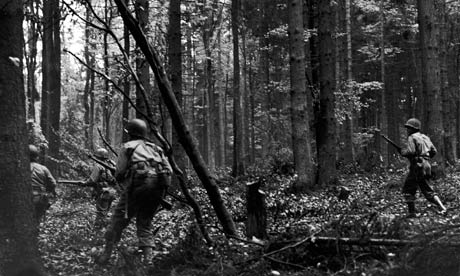
US troops march through Hurtgen Forest, Germany, 1944
American infantrymen in the Hürtgen Forest, Germany, 2 November 1944: 24,000 died there in three months. Photograph: Time Life Pictures/Getty


What Folly That The US Prefers To Celebrate Its Victories, Like D-Day, Rather Than Learn From Its Disasters, Like Hürtgen

By Clancy Sigal
Saturday 2 June 2012 10.00 EDT
Courtesy Of "The Guardian"


After the real Normandy invasion, American commanders, high on victories, were anxious to attack Hitler's Siegfried Line, a series of defensive positions along the German border that were concrete bunkers protected by antitank obstacles and mines, and by motivated, battle-hardened Wehrmacht troops. The idiot's plan was to frontally advance through a 70-mile-square dark Hürtgen forest, near Aachen, during the worst winter on record.
The forest trees had been planted so deliberately close together that visibility was almost zero – except for previously zeroed-in mortars andMaschinengewehr. The stupidest private soldier could have told the US brass that flanking the thickly wooded hills – going around it – would be more productive tactically and less destructive of the 24,000 Americans who died trying to take this piece of militarily valueless real estate.
I know about this disaster because I joined one of its lead elements, the Fourth Infantry Division, after they returned from Europe, decimated and shellshocked, and I had a chance to talk to survivors. At one point, the Fourth's 22nd Regiment suffered 80% casualties; some of its companies took nearly 200% dead and wounded – that is every soldier had to be replaced twice over, usually by gormless trainees like me. Hardly a squad leader, sergeant or young lieutenant survived. (See the late Paul Fussell's The Boys' Crusade: American Infantry in Northwestern Europe.)
The three-month battle of the Hürtgen Forest, the longest battle in US military history – marked by mud, snow, misery, desertions, unheard-of GI casualties and top brass incompetence – is a historical stepchild swept aside for more glorious encounters like D-Day and the Battle of the Bulge.
From September to November 1944, in the dark, mysterious, Grimm-like "haunted wood", summer-uniformed, under-armed, ill-supplied GIs, mostly unsupported by artillery and weathered-in air, without maps and unable to see one another in the jungle-like, mine-planted forest, were shredded by murderous tree-bursts for which they'd not been trained and flung blindly into repeated attacks by uncoordinated "command and control" officers issuing dumb orders from the rear. Understandably, if they lived, they preferred not to talk about it to civilians. Official military histories, which infantryman-scholar Fussell called "a masterpiece of omission, evasion and cheerful euphemism", simply erased Hürtgen altogether.
Top officers responsible for the fiasco – Ike Eisenhower, Omar Bradley, Courtney Hodges and Lawton Collins, among them – went on to honored retirement. Bradley, who became a "wise man" adviser to President Lyndon Johnson, strongly recommended against withdrawing from theVietnam war. They never learn.
It depends on whether you're looking at it from inside a shell-blasted foxhole, like the wounded veteran Fussell, or from an elegantly-drawn map in a warm chateau miles away from the freezing front, which you find reasons not to visit and see for yourself.
Ernest Hemingway, a civilian journalist and an invalided veteran from the Great War, wanted to see what the hell was going on. So he armed himself with a submachine gun (against the Geneva Convention) and invited himself to the Hürtgen battle with the Fourth Division's 22nd Infantry Regiment. He took one look at this killing field, mud up to the axles, and GI foxholes useless under vertical shell explosions, and knew instantly what the generals refused to admit, that it was the first world war's Passchendaele disaster all over again: brass sacrificing khaki for their greater glory.
An exception to the rule of generals covering their asses was James Gavin, commander of the 82nd Airborne, who always jumped into combat with his men and carried the enlisted man's weapon, the M-1 Garand. He broke ranks to admit:
"For us, the Hürtgen was one of the most costly, most unproductive, and most ill-advised battles that our army has ever fought."
If only "Jumpin' Jim" Gavin, who understood the costs of combat, was still around to counsel Barack Obama about the lessons of Hürtgen and perhaps gently guide our commander-in-chief away from his current love affair with high-tech, kill-at-a-distance drone warfare – so bloodless, so intellectual, so glory-seeking … and so self-defeating. Obama, who, his aides tell us, has a "death list" printed on baseball cards listing which foreign enemies (and/or family) to obliterate with his thunderbolts, would have been at home at the battle of Hürtgen, behind the lines in some distant war room, poring over a map and brooding, brooding.

Thursday, May 31, 2012

The Imperial Mind

American Rage At Pakistan Over The punishment Of A CIA-Cooperating Pakistani Doctor Is Quite Revealing

BY GLENN GREENWALD
SATURDAY, MAY 26, 2012 07:53 AM EDT
Courtesy Of "Salon Magazine"


Americans of all types — Democrats and Republicans, even some Good Progressives — are just livid that a Pakistani tribal court (reportedly in consultation with Pakistani officials) has imposed a 33-year prison sentence on Shakil Afridi, the Pakistani physician who secretly worked with the CIA to find Osama bin Laden on Pakistani soil. Their fury tracks the standard American media narrative: by punishing Dr. Afridi for the “crime” of helping the U.S. find bin Laden, Pakistan has revealed that it sympathizes with Al Qaeda and is hostile to the U.S. (NPR headline: “33 Years In Prison For Pakistani Doctor Who Aided Hunt For Bin Laden”; NYT headline: “Prison Term for Helping C.I.A. Find Bin Laden”). Except that’s a woefully incomplete narrative: incomplete to the point of being quite misleading.

What Dr. Afridi actually did was concoct a pretextual vaccination program, whereby Pakistani children would be injected with a single Hepatitis B vaccine, with the hope of gaining access to the Abbottabad house where the CIA believed bin Laden was located. The plan was that, under the ruse of vaccinating the children in that province, he would obtain DNA samples that could confirm the presence in the suspected house of the bin Laden family. But the vaccine program he was administering was fake: as Wired‘s public health reporter Maryn McKenna detailed, “since only one of three doses was delivered, the vaccination was effectively useless.” An on-the-ground Guardian investigation documented that ”while the vaccine doses themselves were genuine, the medical professionals involved were not following procedures. In an area called Nawa Sher, they did not return a month after the first dose to provide the required second batch. Instead, according to local officials and residents, the team moved on.”
That means that numerous Pakistani children who thought they were being vaccinated against Hepatitis B were in fact left exposed to the virus. Worse, international health workers have long faced serious problems in many parts of the world — including remote Muslim areas — in convincing people that the vaccines they want to give to their children are genuine rather than Western plots to harm them. These suspicions have prevented the eradication of polio and the containment of other preventable diseases in many areas, including in parts of Pakistan. This faux CIA vaccination program will, for obvious and entirely foreseeable reasons, significantly exacerbate that problem.
As McKenna wrote this week, this fake CIA vaccination program was “a cynical attempt to hijack the credibility that public health workers have built up over decades with local populations” and thus “endangered the status of the fraught polio-eradication campaign, which over the past decade has been challenged in majority-Muslim areas in Africa and South Asia over beliefs that polio vaccination is actually a covert campaign to harm Muslim children.” She further notes that while this suspicion “seems fantastic” to oh-so-sophisticated Western ears — what kind of primitive people would harbor suspicions about Western vaccine programs? – there are actually “perfectly good reasons to distrust vaccination campaigns” from the West (in 1996, for instance, 11 children died in Nigeria when Pfizer, ostensibly to combat a meningitis outbreak, conducted drug trials — experiments — on Nigerian children that did not comport with binding safety standards in the U.S.).
When this fake CIA vaccination program was revealed last year, Doctors Without Borders harshly denounced the CIA and Dr. Afridi for their “grave manipulation of the medical act” that will cause “vulnerable communities – anywhere – needing access to essential health services [to] understandably question the true motivation of medical workers and humanitarian aid.” The group’s President pointed out the obvious: “The potential consequence is that even basic healthcare, including vaccination, does not reach those who need it most.” That is now clearly happening, as the CIA program “is casting its shadow over campaigns to vaccinate Pakistanis against polio.” Gulrez Khan, a Peshawar-based anti-polio worker, recently said that tribesman in the area now consider public health workers to be CIA agents and are more reluctant than ever to accept vaccines and other treatments for their children.
For the moment, leave to the side the question of whether knowingly administering ineffective vaccines to Pakistani children is a justified ruse to find bin Laden (just by the way, it didn’t work, as none of the health workers actually were able to access the bin Laden house, though CIA officials claim the program did help obtain other useful information). In light of all the righteous American outrage over this prison sentence, let’s consider what the U.S. Government would do if the situation were reversed: namely, if an American citizen secretly cooperated with a foreign intelligence service to conduct clandestine operations on U.S. soil, all without the knowledge or consent of the U.S. Government, and let’s further consider what would happen if the American citizen’s role in those operations involved administering a fake vaccine program to unwitting American children. Might any serious punishment ensue? Does anyone view that as anything more than an obvious rhetorical question?
There are numerous examples that make the point. As’ad AbuKhalilposes this one: “Imagine if China were to hire an American physician who would innocently inject unsuspecting Americans with a chemical to obtain information for China.  I am sure that his prison term would be even longer.” Or what if an American doctor of Iranian descent had done this on behalf of the Quds Force, in order to find a member of the designated Iranian Terror group MeK who was living in the United States (one who, say, has been working with Israel to help assassinate Iranian nuclear scientists and wound their wives, or one who was trained by the U.S.), after which Iranian agents invaded his American home, pumped bullets in his skull and shot a few others (his wife and a child) and then dumped his corpse into the Atlantic Ocean? Or take the case of Orlando Bosch, the CIA-backed anti-Cuban Terrorist long harbored by the U.S.; suppose a Cuban-American doctor sympathetic to Castro had injected American children as part of a fake vaccination program in order to help Cuba find and kill Bosch on U.S. soil; he’d be lucky to get 33 years in prison.
In fact, the U.S. Government tries to impose the harshest possible sentences on Americans who do far less than Dr. Afridi did in Pakistan. The Obama administration charged former NSA official Thomas Drake with espionage and tried to imprison him fordecades merely because he exposed serious waste, corruption and illegality in surveillance programs — without the slightest indication of any harm to national security. Right now, they’re charging Bradley Manning with “aiding the enemy” — Al Qaeda — and attempting to impose life imprisonment on the 23-year-old Army Private, merely because he leaked information to the world showing serious war crimes and other government deceit (something The New York Times does frequently) which nobody suggests was done in collaboration with or even with any intent to help Al Qaeda or any other foreign entity. Given all that, just imagine how harshly they’d try to punish an American who secretly collaborated with a foreign intelligence service — who created a fake vaccine program for American kids — to enable secret military action on U.S. soil without their knowledge.
But of course none of these comparisons is equivalent. It’s all different when it’s done to America rather than by America. That’s the great prize for being the world’s imperial power: the rules you impose on others don’t bind you at all. I’m quite certain that none of the people voicing such intense rage over Pakistan’s punishment of Dr. Afridi would voice anything similar if the situation were reversed in any of the ways I’ve just outlined. Can you even imagine any of them saying something like: yes, this American doctor injected American kids with ruse vaccines in order to help the intelligence service of Iran/Pakistan/China/Cuba conduct clandestine operations on U.S. soil without the knowledge of the U.S. Government, but I think that’s justified and he shouldn’t be punished.
If you read or watch any accounts of life in the Roman empire, what you will frequently witness is someone being severely punished for an act against a Roman citizen. That was the most severe crime and the one most harshly punished: one could do any manner of bad things to non-citizens, but not so much as raise a hand to a Roman citizen.
Watch how often that formulation is used in our political discourse: he tried to kill Americans, people will emphasize when justifying all sorts of U.S. government actions. In other words, there are ordinary, pedestrian crimes (like this one, from today: “An American drone fired two missiles at a bakery in northwest Pakistan Saturday and killed four suspected militants, officials said, as the U.S. pushed on with its drone campaign despite Pakistani demands to stop. This was the third such strike in the country in less than a week”). But then there is the supreme crime: he tried to kill Americans! It’d be one thing if this outrage were honestly expressed as self-interest (we give massive aid to Pakistan so they should do our bidding), but instead, it is, as usual, couched in moral terms.
That is the imperial mind at work. Its premises are often embraced implicitly rather than knowingly: American lives are inherently more valuable; foreign lives are expendable in pursuit of American interests; the U.S. has the inalienable right to take action in other countries that nobody is allowed to take in the U.S. (just imagine: “An Iranian drone fired two missiles at a bakery in the northwest U.S. Saturday and killed four suspected militants, Iranian officials said, as Iran pushed on with its drone campaign despite American demands to stop. This was the third such strike in the country in less than a week” or “Thirty five women and children were killed by a Yemeni cruise missile armed with cluster bombs which struck an alleged Marine training camp in Texas”).
These self-venerating imperial prerogatives are the premises driving the vast bulk of American foreign policy and military discourse. It is certainly what’s driving the spectacle of so many people pretending that the punishment of Dr. Afridi is some sort of aberrational act which the U.S. and other Decent, Civilized Countries would never do.
* * * * *
Two related points:
(1) NPR emphasizes what appear to be the genuine due process deficiencies in the punishment imposed on Dr. Afridi, though he certainly is receiving more due process than those informally and secretly accused of Treason by the U.S. Government and given the Anwar Awlaki treatment, or accused of Terrorism and targeted with a U.S. drone or locked for a decade or so in a cage without charges of any kind.
(2) Zaid Jilani, formerly of Think Progress, asks a really good question about the Hollywood Election Year film depicting the bin Laden raid being produced by Sony Pictures with the help of the Obama administration: “Will the movie feature Pakistani kids tricked into getting fake vaccines? Probably not.” If the film does mention this, I’d bet it will be to marvel at and celebrate the James-Bond-like ingenuity of the CIA.

Tuesday, May 08, 2012

How US Hubris Baited Afghan Trap

Exclusive: Despite what Official Washington thinks it knows, the real error on Afghan policy after the Soviets left in 1989 was not the abrupt cutoff of U.S. aid but nearly the opposite, continued CIA support for the Islamist mujahedeen and rejection of peace overtures from Moscow, writes Robert Parry.

By Robert Parry
May 3, 2012
Courtesy Of "Consortium News"


President Barack Obama’s decision to extend the U.S.-Afghan strategic relationship through 2024 was driven, in part, by one of Official Washington’s most cherished myths – that the United States abruptly abandoned Afghanistan in 1989 and must not make that mistake again.

This myth is repeated by policymakers and pundits alike. On Tuesday, for instance, MSNBC’s Chris Matthews asked if his guests had seen the movie, “Charlie Wilson’s War.” He apparently viewed the Tom Hanks film as a documentary when it was really a fictional account, both on the innocence of the Afghan mujahedeen and the callowness of Congress in supposedly pulling the plug once the Soviet Army withdrew.
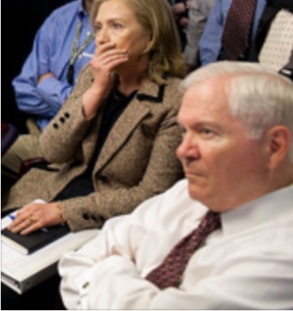
Then-Defense Secretary Robert Gates in Situation Room on May 1, 2011, monitoring the raid that killed Osama bin Laden. (From White House photo by Pete Souza)

But Matthews is far from alone in believing this mythology. The New York Times’ lead editorial on Wednesday criticized Obama for not explaining how he would prevent Afghanistan from imploding after the scheduled U.S. troop withdrawal in 2014, though the Times added that the plan’s “longer-term commitment [of aid] sends an important message to Afghans that Washington will not abandon them as it did after the Soviets were driven out.”

The abandonment myth also has been cited by senior Obama administration officials, including the current AmbassadorRyan Crocker and former Defense Secretary Robert Gates, as a way to explain the rise of the Taliban in the mid-1990s and al-Qaeda’s use of Afghanistan for plotting the 9/11 attacks on the United States in 2001.

In late 2009, Defense Secretary Gates reprised the phony conventional wisdom, telling reporters: “We will not repeat the mistakes of 1989, when we abandoned the country only to see it descend into civil war and into Taliban hands.”

Yet, Gates knew the real history since he was deputy national security adviser in 1989 when the key decisions were made to continue covert U.S. aid, not cut it off. Still, the fictional version from the movie, “Charlie Wilson’s War,” apparently proved too tempting as an excuse for an open-ended occupation of Afghanistan.

In the movie, Tom Hanks played the late Rep. Charlie Wilson, D-Texas, who was a key figure in financing the mujahedeen war against the Soviets in the 1980s. In one scene – after the Soviet withdrawal on Feb. 15, 1989 – Hanks begs a congressional committee for additional money but gets turned down.

The truth, however, is that the end game in Afghanistan surrounding the Soviet departure was messed up not because the United States cut the mujahedeen off but because Washington pressed for a clear-cut victory, rebuffing peaceful options.

And we know that Gates knows this reality because he recounted it in his 1996 memoir, From the Shadows.

The Real History

Here’s what that history actually shows: In 1988, Soviet President Mikhail Gorbachev promised to remove Soviet troops from Afghanistan and sought a negotiated settlement. He hoped for a unity government that would include elements of Najibullah’s Soviet-backed regime in Kabul and the CIA-backed Islamic fundamentalist rebels.

Gates, who was then deputy CIA director, opposed Gorbachev’s plan, disbelieving that the Soviets would really depart and insisting that – if they did – the CIA’s mujahedeen could quickly defeat Najibullah’s army.

Inside the Reagan administration, Gates’s judgment was opposed by State Department analysts who foresaw a drawn-out struggle. Deputy Secretary of State John Whitehead and the department’s intelligence chief Morton Abramowitz warned that Najibullah’s army might hold on longer than the CIA expected.

But Gates prevailed in the policy debates, pushing the CIA’s faith in its mujahedeen clients and expecting a rapid Najibullah collapse if the Soviets left. In the memoir, Gates recalled briefing Secretary of State George Shultz and his senior aides on the CIA’s predictions prior to Shultz flying to Moscow in February 1988.

“I told them that most [CIA] analysts did not believe Najibullah’s government could last without active Soviet military support,” wrote Gates.

After the Soviets did withdraw in February 1989 – proving Gates wrong on that point – some U.S. officials felt Washington’s geostrategic aims had been achieved and a move toward peace was in order. There also was mounting concern about the Afghan mujahedeen, especially their tendencies toward brutality, heroin trafficking and fundamentalist religious policies.

However, the new administration of George H.W. Bush – with Gates moving from the CIA to the White House as deputy national security adviser – rebuffed Gorbachev and chose to continue U.S. covert support for the mujahedeen, aid which was being funneled primarily through Pakistan’s Inter-Services Intelligence agency, the ISI.

Back in Afghanistan, Najibullah’s regime defied the CIA’s expectation of a rapid collapse, using Soviet weapons and advisers to beat back a mujahedeen offensive in 1990. As Najibullah hung on, the war, the violence and the disorder continued.

Gates finally recognized that his CIA analysis had been wrong. In his memoir, he wrote: “As it turned out, Whitehead and Abramowitz were right” in their warning that Najibullah’s regime might not fall quickly. Gates’s memoir also acknowledged that the U.S. government did not abandon Afghanistan immediately after the Soviet departure.

“Najibullah would remain in power for another three years [after the Soviet pull-out], as the United States and the USSR continued to aid their respective sides,” Gates wrote. Indeed, Moscow’s and Washington’s supplies continued to flow until several months after the Soviet Union collapsed in summer 1991, according to Gates.

“On Dec. 11, 1991, both Moscow and Washington cut off all assistance, and Najibullah’s government fell four months later,” Gates wrote. “He had outlasted both Gorbachev and the Soviet Union itself.” In other words, Gates confirmed that covert U.S. military support to the Afghan rebels continued for almost three years after the Soviet Army left Afghanistan.

Criles’s Account

And other U.S. assistance may have continued even longer, according to George Criles’s 2003 book, Charlie Wilson’s War, upon which the movie was loosely based. In the book, Crile described how Wilson kept the funding spigot open for the Afghan rebels not only after the Soviet departure in 1989 but even after the Soviet Union disintegrated in 1991.

In the later years of the conflict, there was also much wider knowledge about the brutality and corruption of the mujahedeen, Crile noted, though few in Washington dared speak about the dark side of these supposed “freedom-fighters.”

Crile wrote: “Throughout the war, Wilson had always told his colleagues that Afghanistan was the one morally unambiguous cause that the United States had supported since World War II – and never once had any member of Congress stood up to protest or question the vast expenditures.

“But with the departure of the Soviets, the war was anything but morally unambiguous. By 1990, the Afghan freedom fighters had suddenly and frighteningly gone back to form, reemerging as nothing more than feuding warlords obsessed with settling generations-old scores.

“The difference was that they were now armed with hundreds of millions of dollars’ worth of weapons and explosives of every conceivable type. The justification for the huge CIA operation had been to halt Soviet aggression, not to take sides in a tribal war – certainly not to transform the killing capacity of those warriors.”

Crile reported that at the end of that year, Wilson traveled to Moscow and listened to appeals for a settlement of the long-running conflict from Andre Koserov, a future Russian foreign minister. Koserov told Wilson that Moscow and Washington had a common interest in preventing the emergence of radical Islamic control of Afghanistan.

Upon returning to Washington, however, Wilson’s openness to Moscow’s overtures brought a stern rebuke from his hard-line friends in the CIA who wanted to see an clear-cut victory of the CIA-backed mujahedeen over the Soviet clients in Kabul.

“It was sad to see how quickly Wilson’s effort at statesmanship collapsed,” Crile reported. “He found that it wasn’t easy to stop what he had started.”

So, Wilson flipped back to the side of his old allies in the CIA and the Saudi royal family, which was matching the CIA’s huge contributions dollar for dollar.

“In the second year after the Soviet withdrawal, Wilson delivered another $250 million for the CIA to keep its Afghan program intact,” Crile wrote. “With Saudi matching funds, the mujahedeen would receive another half billion dollars to wage war. The expectation was that they would join forces for a final push to throw out the Soviet-backed Najibullah regime, restore order, and begin the process of rebuilding.”

Afghan Slaughters

However, Najibullah’s forces continued to hold out and the mujahedeen broke down into internal bickering. They also showed their level of respect for human rights by slaughtering enemy prisoners.

Eventually, the mujahedeen did capture the strategic city of Khost, but turned it into a ghost town as civilians fled or faced the mujahedeen’s fundamentalist fury. Western aid workers found themselves “following the liberators in a desperate attempt to persuade them not to murder and pillage,” Crile wrote.

U.S. Ambassador to Pakistan Robert Oakley began to wonder who were the worse bad guys, the Soviet-backed communists or the U.S.-supported mujahedeen.

“It was the leaders of the Afghan puppet government who were saying all the right things, even paying lip service to democratic change,” Crile reported. “The mujahideen, on the other hand, were committing unspeakable atrocities and couldn’t even put aside their bickering and murderous thoughts long enough to capture Kabul.”

In 1991, as the Soviet Union careened toward its final crackup, George H.W. Bush’s administration had so many doubts about the nature of its erstwhile Afghan allies that it made no new request for money, and the Senate Intelligence Committee approved nothing for Afghanistan, Crile wrote.

“But no one could just turn off Charlie Wilson’s war like that,” Crile noted. “For Charlie Wilson, there was something fundamentally wrong with his war ending then and there. He didn’t like the idea of the United States going out with a whimper.”

Wilson made an impassioned appeal to the House Intelligence Committee and carried the day. The committee first considered a $100 million annual appropriation, but Wilson got them to boost it to $200 million, which – with the Saudi matching funds – totaled $400 million, Crile reported.

“And so, as the mujahideen were poised for their thirteenth year of war, instead of being cut off, it turned out to be a banner year,” Crile wrote. “They found themselves with not only a $400 million budget but also with a cornucopia of new weaponry sources that opened up when the United States decided to send the Iraqi weapons captured during the Gulf War to the mujahideen.”

But even then the Afghan rebels needed an external event to prevail on the battlefield, the stunning disintegration of the Soviet Union in the latter half of 1991. Only then did Moscow cut off its aid to Najibullah. His government finally fell in 1992. But its collapse didn’t stop the war – or the mujahedeen infighting.

The capital of Kabul came under the control of a relatively moderate rebel force led by Ahmad Shah Massoud, an Islamist but not a fanatic. However, Massoud, a Tajik, was not favored by Pakistan’s ISI, which backed more extreme Pashtun elements of the mujahedeen.

Rival Afghan warlords battled with each other for another four years destroying much of Kabul. Finally, a disgusted Washington began to turn away. Crile reported that the Cross Border Humanitarian Aid Program, which was the only sustained U.S. program aimed at rebuilding Afghanistan, was cut off at the end of 1993, almost five years after the Soviets left.

Rise Of The Taliban

While chaos continued to reign across Afghanistan, the ISI readied its own army of Islamic extremists drawn from Pashtun refugee camps inside Pakistan. This group, known as the Taliban, entered Afghanistan with the promise of restoring order.

The Taliban seized the capital of Kabul in September 1996, driving Massoud into a northward retreat. The ousted communist leader Najibullah, who had stayed in Kabul, sought shelter in the United Nations compound, but was captured. The Taliban tortured, castrated and killed him, his mutilated body hung from a light pole.

The triumphant Taliban imposed harsh Islamic law on Afghanistan. Their rule was especially cruel to women who had made gains toward equal rights under the communists, but were forced by the Taliban to live under highly restrictive rules, to cover themselves when in public, and to forgo schooling.

The Taliban also granted refuge to Saudi exile Osama bin Laden, who had fought with the Afghan mujahedeen against the Soviets in the 1980s. Bin Laden then used Afghanistan as the base of operations for his terrorist organization, al-Qaeda, setting the stage for the next Afghan War in 2001.

So, the real history is quite different and much more complex than the Hollywood version that Official Washington has embraced as its short-hand understanding of what happened after the Soviet Army withdrew in 1989.

One lesson that could come from the actual history is the futility of trying to impose a Western or military solution on Afghanistan and the value of negotiations even when dealing with unsavory foes.

If Gates had indeed been the “wise man” that he is now purported to be, he would have urged Presidents Ronald Reagan and George H.W. Bush to work with Soviet President Gorbachev on a compromise that might have involved a power-sharing arrangement, rather than to insist on total victory for the CIA-backed mujahedeen.

One also might conclude that it was not the mythical “abandonment” of Afghanistan in February 1989 that wrought the devastation of the past two decades, but rather the triumphalism of Gates and other war hawks who insisted on rubbing Moscow’s nose in its Afghan defeat rather than cooperating on a negotiated settlement.

That hubris set the stage for the 9/11 attacks, the subsequent Afghan War, America’s disastrous detour into Iraq and what now looks to be an even costlier commitment to Afghanistan, making the remote country a money pit that could drain the U.S. Treasury for another dozen years.

At minimum, Official Washington might want to get the history straight.

[To read more of Robert Parry’s writings, you can now order his last two books, Secrecy & Privilege andNeck Deep, at the discount price of only $16 for both. For details on the special offer, click here.]  

Robert Parry broke many of the Iran-Contra stories in the 1980s for the Associated Press and Newsweek. 
His latest book, Neck Deep: The Disastrous Presidency of George W. Bush, was written with two of his sons, Sam and Nat, and can be ordered at neckdeepbook.com. His two previous books, Secrecy & Privilege: The Rise of the Bush Dynasty from Watergate to Iraq and Lost History: Contras, Cocaine, the Press & ‘Project Truth’ are also available there.