


Submitted By "Sayf Maslul"
By "Press TV"
Courtesy Of "YouTube"
Showing posts with label Freedom Flotilla. Show all posts
Showing posts with label Freedom Flotilla. Show all posts
Sunday, December 18, 2011


Friday, November 25, 2011
Meet Jihan Hafiz and Reed Lindsay
Submitted By "Sayf Maslul"
Source "The Real News"
Courtesy Of "YouTube"
A special show with Cairo Correspondents Jihan Hafiz and Reed Lindsay speaking about covering the Egyptian Revolution and Jihan's recent detention while covering the Gaza flotilla
Sunday, October 02, 2011
‘Tears Of Gaza’
‘Tears of Gaza’ by Vibeke Lokkeberg is a documentary film that should be watched by every American, to see how Israel spends our taxes. Every European should watch it, to see the true face of Israel. It should be viewed by every Arab, to renew our resolve not to allow a racist nation to wipe Palestine and her children from the map and from history.
By Susan Abulhawa
‘Tears of Gaza’ by Vibeke Lokkeberg is a documentary film that should be watched by every American, to see how Israel spends our taxes. Every European should watch it, to see the true face of Israel. It should be viewed by every Arab, to renew our resolve not to allow a racist nation to wipe Palestine and her children from the map and from history.
I had read the stories from Gaza after Israel’s so called “operation cast lead”. I had read the reports. I thought I had cried enough then not to cry again. But this film went to my heart, stirred everything up, made the tears fall and fall and here I am now, with a hollow, spooned out hole in my gut because bombs were dropped on sleeping children, helicopters rained the death and disfigurement of white phosphorous on terrified civilians huddling at a UN school for shelter… and no one is doing anything about it.Tears of Gaza lays bare the lies, the cover ups and Richard Goldstone’s moral flip flopping. It takes you into the heart of Gaza’s tormented landscape to show the truth behind craven and mendacious headlines with words that describe Israel’s slaughter as an “incursion” or “self defense”. This film shows us these truths through the luminous spirits of children. It is not to be missed!
I first heard of “Tears of Gaza”, or “Gaza Traer” as the original Norwegian title is called, when Bernard Henri-Levi launched an attack against Lokkeberg and me in major newspapers throughout Europe. She and I were in touch after that and I was finally just able to get hold of the film to watch it. It is a monumentally important work. It is beautiful and painful and honest and devastating.
Vibeke Lokkeberg gives us the names, faces, and stories of three ordinary Gaza children with extraordinary spirits. We first fall in love with Yehya, a 12-year-old boy who wants to become a doctor so he can heal people who are shot by Israelis. We see him on a small motorboat, lost in the magic of childhood as he is taught to steer the boat. His beautiful eyes and brilliant smile during these moments make his tears all the harder to bear when he talks about his beloved father. The losses that follow in his life are incomprehensible and overwhelming merely to hear about.
Until you meet Amira, 14 years old, and walk through her world.
Amira is beautiful. It’s the kind of beauty that holds an ineffable pain not often seen in the young. Her life, too, is marred by death and destruction and disfigurement of her body by ammunition. She tells us that she wants to become a lawyer so she can take the Israelis to court for the crimes they’ve committed. Then, recalling her father and brothers, she admits wishing she had just “gone with them”.
Like Amira, Rasmia is far beyond her 11 years. Arabic speakers might detect things about her that non-Arabic speakers will not. This is largely because of the translation; and this is my only criticism of the film. When Rasmia goes into what seems like a waking trance, her mother tells us in Arabic that she is “imagining”. The translation says “memorizing”, which doesn’t make sense and it distracts from an important subtlety. Her mother explains that she sometimes just “imagines” things from the attacks. I suspect that most psychologists witnessing those scenes and hearing her mother’s explanation would agree that she was experiencing flashbacks and exhibiting clear signs of post-traumatic stress disorder.
Another example where the wrong translation obscures important nuances is when Yehya is telling us about losing his father. He is, in fact, speaking in the third person: “when someone loses their father, it’s like they’ve lost the whole world” etc. But his words are translated as if in the first person: “when my father died, it’s like I lost the whole world.” The distinction might not seem important, until you realize that he cannot get the words out without breaking down when he speaks in the first person. It’s a faint distinction, but one that makes your heart break even more.
And we should all allow our hearts be broken over Gaza. It’s the least we can do. To hear these three children and ask others to hear them is the very least we can do. Vibeke Lokkeberg has given us a monumentally important record of what happened in December 2009 to January 2010; so no one can ever say “I didn’t know”.
Lest we forget, lest our tears dry or outrage subside, and lest our hearts heal before Palestine is free, I hope this film will be shown throughout the world, across university campuses, communities, organizations and living rooms. Take this not just as a review, but a call to action.
- Susan Abulhawa is the author of Mornings in Jenin (Bloomsbury 2010) and the founder of Playgrounds for Palestine.
By Susan Abulhawa
‘Tears of Gaza’ by Vibeke Lokkeberg is a documentary film that should be watched by every American, to see how Israel spends our taxes. Every European should watch it, to see the true face of Israel. It should be viewed by every Arab, to renew our resolve not to allow a racist nation to wipe Palestine and her children from the map and from history.
I had read the stories from Gaza after Israel’s so called “operation cast lead”. I had read the reports. I thought I had cried enough then not to cry again. But this film went to my heart, stirred everything up, made the tears fall and fall and here I am now, with a hollow, spooned out hole in my gut because bombs were dropped on sleeping children, helicopters rained the death and disfigurement of white phosphorous on terrified civilians huddling at a UN school for shelter… and no one is doing anything about it.Tears of Gaza lays bare the lies, the cover ups and Richard Goldstone’s moral flip flopping. It takes you into the heart of Gaza’s tormented landscape to show the truth behind craven and mendacious headlines with words that describe Israel’s slaughter as an “incursion” or “self defense”. This film shows us these truths through the luminous spirits of children. It is not to be missed!
I first heard of “Tears of Gaza”, or “Gaza Traer” as the original Norwegian title is called, when Bernard Henri-Levi launched an attack against Lokkeberg and me in major newspapers throughout Europe. She and I were in touch after that and I was finally just able to get hold of the film to watch it. It is a monumentally important work. It is beautiful and painful and honest and devastating.
Vibeke Lokkeberg gives us the names, faces, and stories of three ordinary Gaza children with extraordinary spirits. We first fall in love with Yehya, a 12-year-old boy who wants to become a doctor so he can heal people who are shot by Israelis. We see him on a small motorboat, lost in the magic of childhood as he is taught to steer the boat. His beautiful eyes and brilliant smile during these moments make his tears all the harder to bear when he talks about his beloved father. The losses that follow in his life are incomprehensible and overwhelming merely to hear about.
Until you meet Amira, 14 years old, and walk through her world.
Amira is beautiful. It’s the kind of beauty that holds an ineffable pain not often seen in the young. Her life, too, is marred by death and destruction and disfigurement of her body by ammunition. She tells us that she wants to become a lawyer so she can take the Israelis to court for the crimes they’ve committed. Then, recalling her father and brothers, she admits wishing she had just “gone with them”.
Like Amira, Rasmia is far beyond her 11 years. Arabic speakers might detect things about her that non-Arabic speakers will not. This is largely because of the translation; and this is my only criticism of the film. When Rasmia goes into what seems like a waking trance, her mother tells us in Arabic that she is “imagining”. The translation says “memorizing”, which doesn’t make sense and it distracts from an important subtlety. Her mother explains that she sometimes just “imagines” things from the attacks. I suspect that most psychologists witnessing those scenes and hearing her mother’s explanation would agree that she was experiencing flashbacks and exhibiting clear signs of post-traumatic stress disorder.
Another example where the wrong translation obscures important nuances is when Yehya is telling us about losing his father. He is, in fact, speaking in the third person: “when someone loses their father, it’s like they’ve lost the whole world” etc. But his words are translated as if in the first person: “when my father died, it’s like I lost the whole world.” The distinction might not seem important, until you realize that he cannot get the words out without breaking down when he speaks in the first person. It’s a faint distinction, but one that makes your heart break even more.
And we should all allow our hearts be broken over Gaza. It’s the least we can do. To hear these three children and ask others to hear them is the very least we can do. Vibeke Lokkeberg has given us a monumentally important record of what happened in December 2009 to January 2010; so no one can ever say “I didn’t know”.
Lest we forget, lest our tears dry or outrage subside, and lest our hearts heal before Palestine is free, I hope this film will be shown throughout the world, across university campuses, communities, organizations and living rooms. Take this not just as a review, but a call to action.
- Susan Abulhawa is the author of Mornings in Jenin (Bloomsbury 2010) and the founder of Playgrounds for Palestine.
Wednesday, September 28, 2011
What Would Ataturk Do?
Turkish Foreign Policy
By Leon T. Hadar
Posted: 9/16/11 09:02 PM ET
Courtesy Of "The Huffington Post"
By Leon T. Hadar
Posted: 9/16/11 09:02 PM ET
Courtesy Of "The Huffington Post"
Even before the crisis in the relationship between Israel and Turkey over the raid on the Gaza "Peace Flotilla" had erupted last December, right-wing Israelis and American neoconservatives were promoting a new Grand Narrative: Turkey was joining forces with Iran and Syria in an anti-American and anti-Israeli Islamofascist Axis of Evil, seeking to destroy the Jewish State as part of a long-term strategy of re-establishing the Ottoman Empire and a Global Caliphate. Turkey was becoming the New Iran.
Indeed, according to a report in Haaretz, Israeli Prime Minister Benjamin Netanyahu told his cabinet last January that Turkey was "consistently gravitating eastward to Syria and Iran rather than westward over the last two years" and that "the trend certainly has to worry Israel."
Moreover, Netanyahu provided his "full backing" for the diplomatic campaign that his foreign minister Avigdor Lieberman was conducting against the Turkish Prime Minister Reccep Tayip Erdogan -- Lieberman compared Erdogan to Venezuela's president Hugo Chavez -- which included the summoning of the Turkish ambassador to Israel for a meeting in which he was seated in a low sofa, and facing him, in higher chairs, were Israeli officials delivering a reprimand.
And following the Israeli raid on the flotilla, Israeli politicians, pundits and commentators reflecting the Likud-necon narrative were suggesting that under the leadership of the Islamist Justice and Development Party (AKP) Turkey was setting aside the secular and pro-Western orientation of Mustafa Kemal Ataturk, the founder of modern Turkey, and was being transformed into a radical Islamist state that was pursuing a Neo-Ottomanist strategy aimed establishing close ties with the Arab World and de-legitimizing the Jewish State.
The policy implication of such an account was that the U.S. and Israel had no choice but to regard Turkey -- like Iran -- as an assertive strategic and ideological power that was posing a direct threat to Western interests and the survival of Israel.
So it was a bit surprising that the recent decision by Ankara to downgrade its diplomatic relations with Israel has not triggered the same kind of Turkey-bashing by the usual suspects in Jerusalem and Washington. While rejecting Turkish demand that Israel apologize for the killing of nine people aboard the Mavi Marmara, Netanyahu insisted that Israel "regrets the loss of human life" and expressed his hope "that the way will be found to overcome the differences with Turkey." Israel "never wanted its relations with Turkey to deteriorate, nor does it want them to deteriorate right now," Netanyahu stressed.
"Turkey is not Israel's enemy and Israel is not Turkey's enemy," former Prime Minister Olmert said in a speech last week. "Turkey has previously functioned as a bridge to important and sensitive contacts of the highest importance to our interests, and it can continue to be so in the future," he said, reflecting a more realistic, if not accommodative approach towards Turkey that is shared by many Israelis.
Even a right-winger like Netanyahu recognizes that in the aftermath of the collapse of the friendly regime of Hosni Mubarak in Egypt -- and against the backdrop of the regional political instability being ignited by the Arab Spring -- Israeli leaders do not have the luxury of turning Turkey into a full-fledged enemy.
Moreover, it was difficult to accuse Turkey of allying itself with Iran and Syria in the same week that Ankara was giving the diplomatic cold shoulder to both Tehran and Damascus. It announced that it would install a radar system designed by the United States as part of a NATO shield against a possible missile attack by Iran on Europe and it joined the United States and the European Union (EU) in condemning the Syrian government's violent repression of demonstrators.
Indeed, the earlier notion that the Netanyahu-Lieberman duo were advancing -- and that was echoed by their allies in Washington -- that Erdogan and the AKP were pursuing a foreign policy based on an Islamist agenda reflected a common fallacy, that ideological principles -- as opposed to considerations of national interest -- are the main driving force behind the foreign policy of Turkey, or, for that matter, of other governments ruled by political movements committed to secular or religious doctrines.
Historians who have studied Soviet foreign policy have noted that many of the major decisions on war and peace that were made by Soviet leaders -- such as signing the pact with Nazi Germany and later joining the West in fighting Hitler -- were based less on abstract communist doctrines and more on traditional core geo-strategic of imperial Russia. In a way, Peter the Great would have probably approved of many of the critical foreign policy choices made by Stalin.
There are of course cases in which ideology does end up being elevated above the pursuit of national interests, For example, the self-destructive policies that were followed by Nazi Germany. Hence, German's Chancellor Bismarck would have not approved of the most important decisions made by Adolph Hitler before and during World War II.
From this perspective, it is very likely that Ataturk would have approved much of the foreign policy agenda being pursued by Erdogan. Or to put it in more concrete terms, most of the decisions made by Erdogan -- remaining in NATO while improving strategic ties with Turkey's neighbors; continuing to campaign for EU membership while strengthening Turkey's economic position in the Middle East; the "trust-but-verify" approach towards Iran's nuclear military policies; conditioning the maintenance of the partnership with Israel on its treatment of the Palestinians -- fit very much with the kind of Realpolitik foreign policy embraced by Ataturk and his secular political successors.
Indeed, there was nothing very "Islamist" in the decision made by Turkey not to support the American invasion of Iraq in 2003 and its refusal to allow U.S. forces to cross Turkish territory on their way to Iraq, regarded as a turning point in the relationship between Washington and Ankara. The ousting of Iraq's Saddam Hussein and the Americans attempts to "remake" the Middle East were seen as running contrary to Turkish national interests by religious and secular Turks alike, concerned -- and rightly so -- that U.S. policy would destabilize the Middle East.
And the collapse of the U.S. hegemonic project in the Middle East and the rise of Iran as the new regional power, and French and German opposition to Turkish membership in the EU have created incentives for Turkey to fill the strategic vacuum by strengthening its political and economic ties with Saudi Arabia, Syria, Iraq and other Arab governments as well as with Iran. This Turkish strategy would have been embraced even under the leadership of the staunchest secular leadership.
Nor was the general direction of the Turkish policy towards Israel a demonstration of a new "anti-Israeli" approach. Erdogan's diplomatic effort to serve as a mediator between Syria and Israel made a lot of strategic sense, especially at a time when Washington's power in the region was eroding in the aftermath of the Iraq War, and offered long-term benefits to all those involved in the process, including the Israelis.
At the same time, the 2008 Israeli military operation in Gaza, which led to the collapse of the Israeli-Syrian talks under Turkish auspices, ran contrary to the interests of Turkey which was trying to co-opt the Islamist movement of Hamas and persuade it to moderate its positions. The television images of Palestinian civilian casualties in Gaza helped ignite anti-Israeli sentiments in what is after all a functioning democracy. In a way, the democratically elected governments in Ankara -- unlike the military governments that preceded them -- do have to respond to pressure from an electorate that sympathizes with the Palestinian cause. After all, the neoconservatives in Washington should be celebrating the victory of democracy in Turkey. Not!
In any case, the view that there is a direct relationship between the Islamist ideology of the current Turkish government and the deterioration in the relationship with the Jewish State derive from a myth about a "special relationship" between Ankara and Jerusalem. But Turkey has never regarded Israel as an ally -- but as just another important regional player with which it shares some mutual interests. The need to contain the pressure from Arab nationalists led by Egypt's Gamal Abdel Nasser and backed by the Soviet Union helped strengthen Israeli-Turkish cooperation during the Cold War. But even then, the relationship suffered a setback when Turkey downgraded its relationship with Israeli after forming the Baghdad Pact with Iraq in 1955 and pledged to come to the support of Jordan if attacked by Israel.
If anything, the recent diplomatic crisis between Ankara and Jerusalem resembles similar dips in the relationship between the two countries that had taken place when secular and/or military regimes ruled Turkey. Growing Arab-Israeli tensions and waves of rapprochement in the relationship between Turkey and the Arab states had major impact on Ankara's ties with the Jewish State under Ataturk's heirs.
In 1947 Turkey voted against the United Nations partition plan and the creation of Israel; but in 1949, after Egypt and Jordan signed armistice agreements with Israel, Turkey became the first Muslim state to recognize Israel. Diplomatic missions were opened in December 1950 at the legation level in Ankara and Tel Aviv, although from 1956, following the attack by Israel against Egypt, the legation in Tel Aviv was reduced to the lowest diplomatic level of charge d'affaires. That changed only in December 1991, six weeks after the start of the Arab-Israeli peace conference in Madrid, the Turks decided to upgrade the diplomatic representation of Israel -- and the PLO -- to the ambassadorial level.
Earlier on during the First Intifada, Turkey had signaled its support for the Palestinian cause by becoming the fourth country -- and the only government then maintaining diplomatic relationship with Israel --to recognize Palestine as an independent state. Turkey also joined most of the Arab and Muslim governments in denouncing Israel in response to its invasion of Lebanon in 1982 and the Israeli policies in the Palestinian territories.
Hence, Turkey's long-term interests have always been based on the understanding that geographical proximity, economic interests and civilizational considerations require that it normalize the relationship with its neighbors. This explains why it is unlikely that any government in Ankara would now establish a full-fledged alliance with a Jewish state as long as Israel remained at war with the Arab world. Israelis may not like that. But Ataturk would have approved.
Tuesday, September 27, 2011
Taking On Turkey: Israel's 'Dangerous' Game
Instead of acknowledging the country's rising significance and accommodating to the rules of the 'new Middle East' political game, Israel resorted to intimidation and insults.
By: Ramzy Baroud
September 20, 2011
Courtesy Of "Iviews"
The UN Palmer Report, which largely exonerated Israel for murdering nine unarmed Turkish civilians in international waters on May 31, 2010, seemed in some ways like the last straw. Prior to its publication, the camel's back had already mostly broken, and a collapse in Turkish-Israeli ties was looming.
Turkey's sin was seeking an apology for the killing of its citizens - on their way to deliver essential, life-saving supplies to malnourished and besieged Palestinians in Gaza - at the hand of Israeli army commandos.
If the civilians had been Israelis, and the commandos part of a Turkish force, all hell would have broken loose. Israel and the US would have declared Turkey a pariah state. Turkey, however, merely demanded an apology, and it was affronted further for doing so.
Of course, this is not the first time that Israel deliberately provoked and tested Turkish patience. Israel has attempted to infiltrate Turkey's own political spaces by supporting its regional opponents and arming various rebel groups with the aim of destabilizing Turkey.
Instead of acknowledging the country's rising significance and accommodating to the rules of the 'new Middle East' political game, Israel resorted to intimidation and insults. It repeatedly placed Turkey - a thriving democracy and a proud regional power of 80 million - in a very sensitive standing.
However, the anti-Turkish attitude in Israel was not an outcome of the Mavi Marmara incident last year. "The height of humiliation" is how an Israeli newspaper described a scene in which Israel's Deputy Foreign Minister Danny Ayalon summoned Turkish ambassador, Ahmet Oguz, last January to humiliate him before Israeli media. Oguz was reprimanded over a fictional Turkish TV show that was critical of Israel. To ensure that the point has been successfully made, Ayalon "urged journalists to make clear that the ambassador was seated on a low sofa, while the Israeli officials were in much higher chairs," according to the BBC (January 13, 2010). Ayalon noted that "there is only one flag here" - the Israeli flag - and "we are not smiling".
How did Turkey respond? A statement issued by the foreign ministry 'invited' their counterparts in "Israeli foreign ministry to respect the rules of diplomatic courtesy." Hardly outrageous. The gist of the Turkish message that followed the murder of the Turkish humanitarian activists a few months later was not much different. It basically asked for an apology.
Turkey was shunned for the seemingly unreasonable demand. An unnamed senior Israeli official explained the Israeli logic to Ynet news on September 2, following Turkey's decision to downgrade ties with Israel. "Turkey is an important country in the Middle East, but an apology is a very strategic precedent for Israel in this region," he said. That is true, Israel's diplomacy is predicated on unfair trade, violent storming of humanitarian boats, subservient activities, espionage and much more. Indeed, an apology for the murder of Turkish's civilians would be a precedent.
Even after the recent publishing of Palmer Report - a contradictory and obvious attempt at exonerating the Israeli army while implicating Turkish humanitarian activists - Turkey acted responsibly. But it also acted with the poise and dignity that is expected of a democratic country expressing the wishes of the vast majority of its people. It downgraded military, trade and other ties with Israel. Why should Turkey share military intelligence with a country that murders Turks, humiliates its diplomats and refuses to apologize?
Still, from Israel's point of view, Turkey has crossed all the limits of acceptable behavior. "Turkish warships will escort any Turkish aid vessels to Palestinians in the Gaza Strip," said Turkish Prime Minister, Recep Tayyip Erdogan, in an interview with Al Jazeera (as quoted in the Guardian, September 8). At the same time, Turkish diplomacy continued to offer a window of opportunity to detain further escalation. "Our embassy in Israel is open, and the Israeli embassy in Ankara is open. The relations would return to the old days if Israel apologizes and accepts to pay compensation," said Huseyin Celik, Deputy Chairman of the ruling Justice and Development party (according to the Guardian, September 8.)
By: Ramzy Baroud
September 20, 2011
Courtesy Of "Iviews"
The UN Palmer Report, which largely exonerated Israel for murdering nine unarmed Turkish civilians in international waters on May 31, 2010, seemed in some ways like the last straw. Prior to its publication, the camel's back had already mostly broken, and a collapse in Turkish-Israeli ties was looming.
Turkey's sin was seeking an apology for the killing of its citizens - on their way to deliver essential, life-saving supplies to malnourished and besieged Palestinians in Gaza - at the hand of Israeli army commandos.
If the civilians had been Israelis, and the commandos part of a Turkish force, all hell would have broken loose. Israel and the US would have declared Turkey a pariah state. Turkey, however, merely demanded an apology, and it was affronted further for doing so.
Of course, this is not the first time that Israel deliberately provoked and tested Turkish patience. Israel has attempted to infiltrate Turkey's own political spaces by supporting its regional opponents and arming various rebel groups with the aim of destabilizing Turkey.
Instead of acknowledging the country's rising significance and accommodating to the rules of the 'new Middle East' political game, Israel resorted to intimidation and insults. It repeatedly placed Turkey - a thriving democracy and a proud regional power of 80 million - in a very sensitive standing.
However, the anti-Turkish attitude in Israel was not an outcome of the Mavi Marmara incident last year. "The height of humiliation" is how an Israeli newspaper described a scene in which Israel's Deputy Foreign Minister Danny Ayalon summoned Turkish ambassador, Ahmet Oguz, last January to humiliate him before Israeli media. Oguz was reprimanded over a fictional Turkish TV show that was critical of Israel. To ensure that the point has been successfully made, Ayalon "urged journalists to make clear that the ambassador was seated on a low sofa, while the Israeli officials were in much higher chairs," according to the BBC (January 13, 2010). Ayalon noted that "there is only one flag here" - the Israeli flag - and "we are not smiling".
How did Turkey respond? A statement issued by the foreign ministry 'invited' their counterparts in "Israeli foreign ministry to respect the rules of diplomatic courtesy." Hardly outrageous. The gist of the Turkish message that followed the murder of the Turkish humanitarian activists a few months later was not much different. It basically asked for an apology.
Turkey was shunned for the seemingly unreasonable demand. An unnamed senior Israeli official explained the Israeli logic to Ynet news on September 2, following Turkey's decision to downgrade ties with Israel. "Turkey is an important country in the Middle East, but an apology is a very strategic precedent for Israel in this region," he said. That is true, Israel's diplomacy is predicated on unfair trade, violent storming of humanitarian boats, subservient activities, espionage and much more. Indeed, an apology for the murder of Turkish's civilians would be a precedent.
Even after the recent publishing of Palmer Report - a contradictory and obvious attempt at exonerating the Israeli army while implicating Turkish humanitarian activists - Turkey acted responsibly. But it also acted with the poise and dignity that is expected of a democratic country expressing the wishes of the vast majority of its people. It downgraded military, trade and other ties with Israel. Why should Turkey share military intelligence with a country that murders Turks, humiliates its diplomats and refuses to apologize?
Still, from Israel's point of view, Turkey has crossed all the limits of acceptable behavior. "Turkish warships will escort any Turkish aid vessels to Palestinians in the Gaza Strip," said Turkish Prime Minister, Recep Tayyip Erdogan, in an interview with Al Jazeera (as quoted in the Guardian, September 8). At the same time, Turkish diplomacy continued to offer a window of opportunity to detain further escalation. "Our embassy in Israel is open, and the Israeli embassy in Ankara is open. The relations would return to the old days if Israel apologizes and accepts to pay compensation," said Huseyin Celik, Deputy Chairman of the ruling Justice and Development party (according to the Guardian, September 8.)
Since an apology is a 'precedent', Israel responded in the only way it knows how. An accusatory campaign was launched against Turkey with outlandish insinuations and direct threats.
"This is part of the Islamization spreading there, and we must recognize it," said the senior official to Ynet. The leading Israeli news source also published a column by one Ron Ben-Yishai, calling the Turkish Prime Minister a "short-tempered thug." In 'Turkey no great power,' Yishai accused the country of failing on most fronts. "Turkey under Erdogan's leadership is neither a reliable ally nor a credible rival," he charged.
These views are hardly marginal, and were matched by specific threats by Israeli Foreign Minister Avigdor Lieberman. "We'll exact a price from Erdogan that will prove to him that messing with Israel doesn't pay off," Lieberman reportedly said. More specifically, he "urge(d) all Israeli military veterans to refrain from traveling to Turkey and facilitate cooperation with the Armenians -- Turkey's historic rivals." He said he also plans to meet with the Turkish rebel group PKK to "cooperate with them and boost them in every possible area," according to UPI, September 9.
Per this logic, demanding an apology for murder equals a thuggish act, while stirring regional instability and admitting to supporting armed militias is an acceptable diplomatic maneuver.
Turkey had no other option but to escalate before an obstinate 'ally.' And considering the latter's existing isolation in the region - and the growing anti-Israeli sentiment in Egypt and elsewhere - it is likely that Israel, not Turkey, will lose out in this political tussle.
Even the US, Israel's 'unconditional' ally, seems to recognize the dangerous game being played by Israel and its rightwing government of Benjamin Netanyahu. Recently revealed comments made by then US Secretary of Defense Robert Gates indicate that Americans are simply fed up with supporting Israel's 'dangerous' policies, while 'receive(ing) nothing in return' (Bloomberg, September 5).
It is these very dangerous policies that guide Israel's brewing conflict with Turkey amid complete lack of political wisdom in Tel Aviv. But if extreme militancy was not enough to intimidate or weaken the resolve of a tiny and besieged place like Gaza, why should it work against a great and rising power like Turkey?
Rational thinking in Netanyahu's government might also be an acceptable precedent.
"This is part of the Islamization spreading there, and we must recognize it," said the senior official to Ynet. The leading Israeli news source also published a column by one Ron Ben-Yishai, calling the Turkish Prime Minister a "short-tempered thug." In 'Turkey no great power,' Yishai accused the country of failing on most fronts. "Turkey under Erdogan's leadership is neither a reliable ally nor a credible rival," he charged.
These views are hardly marginal, and were matched by specific threats by Israeli Foreign Minister Avigdor Lieberman. "We'll exact a price from Erdogan that will prove to him that messing with Israel doesn't pay off," Lieberman reportedly said. More specifically, he "urge(d) all Israeli military veterans to refrain from traveling to Turkey and facilitate cooperation with the Armenians -- Turkey's historic rivals." He said he also plans to meet with the Turkish rebel group PKK to "cooperate with them and boost them in every possible area," according to UPI, September 9.
Per this logic, demanding an apology for murder equals a thuggish act, while stirring regional instability and admitting to supporting armed militias is an acceptable diplomatic maneuver.
Turkey had no other option but to escalate before an obstinate 'ally.' And considering the latter's existing isolation in the region - and the growing anti-Israeli sentiment in Egypt and elsewhere - it is likely that Israel, not Turkey, will lose out in this political tussle.
Even the US, Israel's 'unconditional' ally, seems to recognize the dangerous game being played by Israel and its rightwing government of Benjamin Netanyahu. Recently revealed comments made by then US Secretary of Defense Robert Gates indicate that Americans are simply fed up with supporting Israel's 'dangerous' policies, while 'receive(ing) nothing in return' (Bloomberg, September 5).
It is these very dangerous policies that guide Israel's brewing conflict with Turkey amid complete lack of political wisdom in Tel Aviv. But if extreme militancy was not enough to intimidate or weaken the resolve of a tiny and besieged place like Gaza, why should it work against a great and rising power like Turkey?
Rational thinking in Netanyahu's government might also be an acceptable precedent.
*****
Ramzy Baroud (www.ramzybaroud.net) is an internationally-syndicated columnist and the editor of PalestineChronicle.com. His latest book is "My Father Was a Freedom Fighter: Gaza's Untold Story" (Pluto Press, London), now available on Amazon.com.
Sunday, September 25, 2011
Netanyahu's Grotesque Foreign Policy
Ari Shavit Of "Haaretz Newspaper" [Published 02:58 22.09.11], stated the following:
"we have never been as pitiful as we are today. The grotesque foreign policy of Netanyahu and Foreign Minister Avigdor Lieberman has turned Israel into a pathetic and helpless polity.
The reason for this is simple. In war, the best defense is offense. In diplomacy, the best offense is giving. Only if you give something do you get something, acquire allies and increase your strength.
But the Israel of Netanyahu-Lieberman is a tightfisted country that is incapable of giving. That is why it doesn't receive anything, doesn't acquire allies and is becoming dangerously weakened.
It is losing one asset after another and one position after another, and is becoming totally isolated.
Netanyahu and Lieberman...did not initiate anything and did not offer anything and did not concede anything...."
"we have never been as pitiful as we are today. The grotesque foreign policy of Netanyahu and Foreign Minister Avigdor Lieberman has turned Israel into a pathetic and helpless polity.
The reason for this is simple. In war, the best defense is offense. In diplomacy, the best offense is giving. Only if you give something do you get something, acquire allies and increase your strength.
But the Israel of Netanyahu-Lieberman is a tightfisted country that is incapable of giving. That is why it doesn't receive anything, doesn't acquire allies and is becoming dangerously weakened.
It is losing one asset after another and one position after another, and is becoming totally isolated.
Netanyahu and Lieberman...did not initiate anything and did not offer anything and did not concede anything...."
Netanyahu and Crew Running Israel Aground
By Doron Rosenblum
Published 04:15 16.09.11
Latest update 04:15 16.09.11
Courtesy Of "Haaretz Newspaper"
This week, we learned that the commander of an Israel Navy vessel was jailed for seven days for a navigational error that caused the boat to stray some 700 meters into a neighboring country's territorial waters. His punishment would presumably have been more severe had the vessel run aground - and not inadvertently, but on purpose.
But that is precisely what is happening in another sphere, about which Israel's judicial system is considerably more forgiving: the diplomatic sphere. There, at least for now, the commander and his crew of eight are exempt from punishment, even though they caused an entire country to run aground, consciously and deliberately.
Assiduously, stubbornly and systematically, if not with nihilistic arrogance, this entire crew navigated the country into a situation of forced paralysis, diplomatic isolation and international vulnerability that has already drawn attention, and even deep concern, from leaders and media outlets worldwide. What Deputy Foreign Minister Danny Ayalon did not do out of stupidity was done with defiant brutality by his master, Foreign Minister Avigdor Lieberman. And what Lieberman did not do was done by Prime Minister Benjamin Netanyahu, who appointed him on purpose to serve as a loose cannon.
If any tiny fragments of hope were left and any life rafts were still floating on the water, Netanyahu made sure to personally sink them with his own words - by his personal clashes with the American president, by his hollow speeches, by his forecasts of disaster and terror that would "merely prove" there was no point in doing anything, and above all, by revealing his deep belief that "the conflict is unsolvable."
Groucho Marx boasted in one of his films that he worked his way up from nothing to a state of extreme poverty. Netanyahu's achievement is much more impressive, since he began with countless political options and diplomatic leads, yet in a mere two years, has reached extreme diplomatic poverty: with no hope, no friends in the region, no partners for dialogue, no real allies, even bereft of military options (some will take comfort in that, at least ).
He and his crew of eight devoted this entire time to riding roughshod over every diplomatic finesse, to scattering threats, to provoking crises, to searching for anti-Semitism and to finding various bizarre excuses for continuing the annexationist status quo. Only when they were absolutely forced to did they pay lip service to "two states" and "willingness to negotiate" - but with a lack of conviction that was worse than an direct refusal. For in so doing, Netanyahu did not merely irreversibly lose sympathy; he lost a much more important card: trust.
For many years, the right and the settlers demonized the Oslo process, and indeed, any diplomatic process that entailed withdrawing from the territories. They called its initiators "the Oslo criminals" and even demanded that they be "brought to trial."
For the past three years, an extreme right-wing government has had the chance - and almost total political freedom - to implement the alternative policy of "peace and security" by which they swore. But as the months went by, it became clear that Netanyahu and his government had nothing positive to offer, only the drastic application of an anti-Oslo policy - that is to say, undermining and uprooting any trace of goodwill and hope that had ever sprouted in the United States-Israel-Palestine triangle.
.
.
.
Only the relative and very transient quiet on the security front - whose time is also running out, as the government itself admits - has deferred the question of the responsibility borne by the anti-Oslo crew, who steered Israel into an unprecedentedly dangerous strait from which there is no exit. These leaders, unlike the leaders of the Oslo process, do not even have the defense of having acted in good faith.
Friday, September 23, 2011
Just Because They Once Were Victims
Courtesy Of "The Telegraph"
This is not an anti-semetic poem, or anti - Israeli poem.
There is an Irish boat "The Rachel Corrie" heading to Israel this Saturday, we will wait to see will they again do a commando raid...
This is a protest poem, in protest at the violation of human rights in attacking ships laden with aid and medical supplies bound for Gaza.
Israel has the right to exist... fact.
So does Palestine... fact.
Israel cannot starve out the Palestinians.
A colauge of mine from the Irish Trade Union Palestinian Solidarity is on one of the ships that was boarded yesterday, and we think is not among the wounded and dead. Those who acted in this manner are nothing better than the Iranian regime that shot Neda Soltani.
The regime that runs Israel today shows by its inhuman blockade of Gaza that they are the equivalent of the Kapos that helped the Germans keep order in the concentration camps in WWII.
They have nothing in common with those innocents who perished, in whose name the state was founded.
Just because they once were victims, does not give them the right to be the agressor today.
This is not an anti-semetic poem, or anti - Israeli poem.
There is an Irish boat "The Rachel Corrie" heading to Israel this Saturday, we will wait to see will they again do a commando raid...
This is a protest poem, in protest at the violation of human rights in attacking ships laden with aid and medical supplies bound for Gaza.
Israel has the right to exist... fact.
So does Palestine... fact.
Israel cannot starve out the Palestinians.
A colauge of mine from the Irish Trade Union Palestinian Solidarity is on one of the ships that was boarded yesterday, and we think is not among the wounded and dead. Those who acted in this manner are nothing better than the Iranian regime that shot Neda Soltani.
The regime that runs Israel today shows by its inhuman blockade of Gaza that they are the equivalent of the Kapos that helped the Germans keep order in the concentration camps in WWII.
They have nothing in common with those innocents who perished, in whose name the state was founded.
Just because they once were victims, does not give them the right to be the agressor today.
=============== THE POEM ===============
It does not give them the right
To crush the natives of this land
And use their US given might
To attack a peaceful convoy
Of internationally certified aid
To rattle sabres to the world
And make a people afraid.
It does not give them the right
To crush the natives of this land
And use their US given might
To attack a peaceful convoy
Of internationally certified aid
To rattle sabres to the world
And make a people afraid.
Do they not remember where they were from
Do they not read that often times before
They angered God with such behavior
And that they anger Him once more?
They were once the victims
That everybody does know
It does not give them the right to be agressors
What happened 70 years ago…
Do they not read that often times before
They angered God with such behavior
And that they anger Him once more?
They were once the victims
That everybody does know
It does not give them the right to be agressors
What happened 70 years ago…
Thursday, September 22, 2011
Israeli Pyromaniacs Setting The Mideast On Fire
Autumn 2011 Is Teeming With Disasters and Our Fate Has Been Entrusted To A Handful Of Cynical Politicians, Headed By Benjamin Netanyahu
By Gideon Levy
Published 02:48 08.09.11
Latest update 02:48 08.09.11
Courtesy Of "Haaretz Newspaper"
It's as if summer 2011 never happened, as if there had never been a protest here: Israel is being led with dreadful blindness by a handful of irresponsible politicians, dangerous pyromaniacs without equal, yet the public remains apathetic. The government is pregnant with danger, conducting a scandalous policy, yet there is no protest.
With all the (enormous ) respect due the social protest, it should already have roused a political protest as well. With all the (enormous ) respect due to social issues - the cost of living is indeed a vital issue - but what about life itself, which is now being threatened in our names, yet about which no one utters a peep?
After summer comes autumn; that's the norm. And autumn 2011 is teeming with disasters: Turkey, America, September at the United Nations - and our fate has been entrusted to a handful of cynical politicians, headed by Benjamin Netanyahu, who think that national honor means losing our last ally in the region; that national honor means causing Israelis to fear traveling to their favorite country; that national honor means Israelis undergoing humiliating security checks in Istanbul, and perhaps also soldiers standing trial overseas; that national honor means losing a strategic ally, an important Muslim nation, virtually the only one that accepted us in the region where we have chosen to live.
To Netanyahu and his ministers, national honor also means hearing crude (and justified ) remarks about our prime minister from the former defense secretary of our absolutely last remaining ally. So who - tell me, who - has more honor? The one who demands a deserved apology and refuses to back down, or the one who is leading his country to the brink of destruction?
The day after nine activists were killed aboard the Mavi Marmara, Israel should have offered a heartfelt apology. Excessive use of lethal weaponry and the close-range killing of civilians from a friendly country is something that cries out for an apology. It's not hard to imagine what would have happened had nine Israeli activists working on behalf of Turkish Jewry been killed by Turkey's army in this fashion.
But Avigdor Lieberman, our thuggish foreign minister, gave the signal, and Benjamin Netanyahu, our easily led prime minister, gave himself over to the "no apology" madness. This, it's worth recalling, came after the incident of the low chair and the incident at Davos. It's also worth recalling that this was aimed at a strong, flourishing, regional power, at the very moment when it was moving away from Syria and Iran - a country with a population 10 times the size of Israel's and a standing army three times the size of Israel's. But who's counting?
And what will Egypt do now that Turkey has almost entirely severed relations with Israel? What new depths will this lead us into?
Israelis looked at all this as if it were a natural disaster. This summer, they learned that the cost of living is not a decree from heaven, as they had always been taught to believe, but they have yet to learn that foreign policy is also not an act of God which can neither be combated nor altered.
Instead, they have been given the usual tranquilizers and mind-altering drugs, the opium of the Israeli masses, the magic charm against every evil: The world is "anti-Semitic"; the world "is against us"; it makes no difference what we do. They don't even ask themselves: Is all this worth it? It's enough for a ratings-hungry television anchor to call the Turkish prime minister "the boor from Ankara," or for a transportation minister with his eye on the primaries to say that Turkey is the one that should apologize, or for an inflamed pundit to write about the "same old anti-Semitism," all so that we will accept the storm that has hit us this autumn as part of the normal progression of the seasons, so that we will once again feel oh so righteous.
"Our town is burning, brothers, burning," wrote the Yiddish poet and songwriter Mordechai Gebirtig (translation from Songs of the Ghettos ). "Our whole town burns! And you stand looking on with folded arms and shake your heads. You stand looking on with folded arms, while the fire spreads!"
But the fire in our city is to a large extent the work of our own hands. There are also pyromaniacs in Turkey, but ours are immeasurably more dangerous to us. They will set our most vital national interests on fire for the sake of showing voters a puffed-out chest; they will sell out Israel for the sake of adopting the grotesque pose they falsely deem standing tall in front of the members of their parties' central committees.
And the public? If this is indeed a natural disaster and the whole world is really against us, what is there for it do other than unite in another display of self-sacrifice and nationalism, its favorite pastimes? And where is the protest when we need it once more?
By Gideon Levy
Published 02:48 08.09.11
Latest update 02:48 08.09.11
Courtesy Of "Haaretz Newspaper"
It's as if summer 2011 never happened, as if there had never been a protest here: Israel is being led with dreadful blindness by a handful of irresponsible politicians, dangerous pyromaniacs without equal, yet the public remains apathetic. The government is pregnant with danger, conducting a scandalous policy, yet there is no protest.
With all the (enormous ) respect due the social protest, it should already have roused a political protest as well. With all the (enormous ) respect due to social issues - the cost of living is indeed a vital issue - but what about life itself, which is now being threatened in our names, yet about which no one utters a peep?
After summer comes autumn; that's the norm. And autumn 2011 is teeming with disasters: Turkey, America, September at the United Nations - and our fate has been entrusted to a handful of cynical politicians, headed by Benjamin Netanyahu, who think that national honor means losing our last ally in the region; that national honor means causing Israelis to fear traveling to their favorite country; that national honor means Israelis undergoing humiliating security checks in Istanbul, and perhaps also soldiers standing trial overseas; that national honor means losing a strategic ally, an important Muslim nation, virtually the only one that accepted us in the region where we have chosen to live.
To Netanyahu and his ministers, national honor also means hearing crude (and justified ) remarks about our prime minister from the former defense secretary of our absolutely last remaining ally. So who - tell me, who - has more honor? The one who demands a deserved apology and refuses to back down, or the one who is leading his country to the brink of destruction?
The day after nine activists were killed aboard the Mavi Marmara, Israel should have offered a heartfelt apology. Excessive use of lethal weaponry and the close-range killing of civilians from a friendly country is something that cries out for an apology. It's not hard to imagine what would have happened had nine Israeli activists working on behalf of Turkish Jewry been killed by Turkey's army in this fashion.
But Avigdor Lieberman, our thuggish foreign minister, gave the signal, and Benjamin Netanyahu, our easily led prime minister, gave himself over to the "no apology" madness. This, it's worth recalling, came after the incident of the low chair and the incident at Davos. It's also worth recalling that this was aimed at a strong, flourishing, regional power, at the very moment when it was moving away from Syria and Iran - a country with a population 10 times the size of Israel's and a standing army three times the size of Israel's. But who's counting?
And what will Egypt do now that Turkey has almost entirely severed relations with Israel? What new depths will this lead us into?
Israelis looked at all this as if it were a natural disaster. This summer, they learned that the cost of living is not a decree from heaven, as they had always been taught to believe, but they have yet to learn that foreign policy is also not an act of God which can neither be combated nor altered.
Instead, they have been given the usual tranquilizers and mind-altering drugs, the opium of the Israeli masses, the magic charm against every evil: The world is "anti-Semitic"; the world "is against us"; it makes no difference what we do. They don't even ask themselves: Is all this worth it? It's enough for a ratings-hungry television anchor to call the Turkish prime minister "the boor from Ankara," or for a transportation minister with his eye on the primaries to say that Turkey is the one that should apologize, or for an inflamed pundit to write about the "same old anti-Semitism," all so that we will accept the storm that has hit us this autumn as part of the normal progression of the seasons, so that we will once again feel oh so righteous.
"Our town is burning, brothers, burning," wrote the Yiddish poet and songwriter Mordechai Gebirtig (translation from Songs of the Ghettos ). "Our whole town burns! And you stand looking on with folded arms and shake your heads. You stand looking on with folded arms, while the fire spreads!"
But the fire in our city is to a large extent the work of our own hands. There are also pyromaniacs in Turkey, but ours are immeasurably more dangerous to us. They will set our most vital national interests on fire for the sake of showing voters a puffed-out chest; they will sell out Israel for the sake of adopting the grotesque pose they falsely deem standing tall in front of the members of their parties' central committees.
And the public? If this is indeed a natural disaster and the whole world is really against us, what is there for it do other than unite in another display of self-sacrifice and nationalism, its favorite pastimes? And where is the protest when we need it once more?
Friday, September 16, 2011
The Disaster Known As Netanyahu

Turkey has expelled Israel's ambassador as relations continue to deteriorate [Reuters]
Rather Than Apologising For Israel's Killing Of Nine Turkish Activists, The Prime Minister Dug In His Heels.
By MJ Rosenberg
Last Modified: 02 Sep 2011 17:54
Courtesy Of "Al-Jazeera"
Well-handled, Prime Minister Binyamin Netanyahu. Rather than apologise to the Turkish government for the deaths of nine of its nationals on the Mavi Marmara, you dug in and now your ambassador to Ankara has been expelled. At this rate, the once critical Israeli-Turkish relationship will soon be finished, leaving Israel with no friends in the region except shaky Jordan.
The peace treaty with Egypt is holding, but just barely and Egypt can hardly be considered a friend anymore. Its people despise Israel and identify it with former President Mubarak, the one Egyptian relationship Israel bothered cultivating. Israel's de facto friendship with Syria will end when President Bashar al-Assad goes. He is no Zionist, but he has been a force for stability on Syria's border with Israel, and Lebanon's, too.
Once he's gone, the north will almost surely heat up, especially now that Hezbollah plays a dominant role in the Lebanese government. As for the Palestinians, Netanyahu says that if they dare to take their case to the United Nations later this month, he may declare the Oslo agreement null and void. In other words, the Palestinians will be deemed enemies of Israel. Again.
In short, Binyamin Netanyahu is very close to bringing Israel back to where it was before the Oslo agreement of 1993. There is even the strong possibility that he will take it back to where it was before the Camp David peace treaty with Egypt — with the added disaster that the relationship with Turkey (established in 1948) will also be gone.
In a normal country, a record of disastrous failures like those would lead to Netanyahu's departure from office. But not in Israel. Despite all the damage he has done to the country's security and to its economy (note the massive protests against Netanyahu's Tea Party economics), he remains in office because the right supports him and Israel is governed by an entirely right-wing coalition.
The worst part is that nearly all of Israel's problems with its neighbors could be resolved by ending the occupation. Even the economy would benefit if the Israeli government was not wasting so much money on the settlers and their exorbitant demands.
New Realities
Israel's propaganda machine would have it otherwise. It insists that the Palestinians, and the Arabs and Muslims throughout the world who support them, don't really care about the occupation. Their goal, we are constantly told, is to destroy Israel itself. As proof, they insist that "the Palestinians have never recognised Israel's right to statehood."
This is the kind of thing that used to be called the "big lie." The Palestinians have repeatedly recognised Israel's right to statehood and security within the 1967 borders.
For those who have forgotten, that is what President Clinton, Prime Minister Rabin and PLO Chairman Yasir Arafat agreed to on the White House lawn that day in 1993. Israel recognised Palestinian rights and the Palestinians recognised Israel. In the years since, neither side has threatened to revoke that recognition until last month when Netanyahu began saying that Oslo could be revoked if the Palestinians go to the United Nations.
But why?
The Palestinian turn to the United Nations offers the solution to virtually all of Israel's problems. President Mahmoud Abbas says that once Palestine is recognised by the international body, he will resume negotiations with Israel over all the issues that divide the two sides. The only difference will be that negotiations will be between two states, not one powerful state and one supplicant hoping a few crumbs fall off the table.
Netanyahu is terrified of a UN vote. He and his emissaries are going around the world demanding that the statehood resolution be voted down. And the combined forces of Netanyahu and the lobby here have cajoled the Obama administration to join Netanyahu in demanding a "no" vote.
It is clear that Netanyahu wants to preserve the status quo, even if it means that Israel reverts to a position where every one of its neighbors is an actual or potential enemy, even if it means that its strategic relationship with Turkey is over, even if it means that it has no one in the region to help prevent war with Iran.
Wrong Priorities
It sounds crazy, but only because it is. Netanyahu's highest priority is to maintain the occupation. The settlers and the religious fanatics are his people; the Israelis of Tel Aviv and Haifa are not. It's not that Israel's security does not matter to Netanyahu. It does. But for him, Ariel and the crazed settlers of Hebron matter every bit as much as the state itself. To him, there is no difference. (On that score, Netanyahu is much like Palestinian extremists who view all of Israel as occupied territory. Netanyahu makes no distinctions either.)
Netanyahu is bringing Israel to the brink and no one is doing anything about it. Both the president and Congress go along with Netanyahu because the lobby tells them that the only way to support Israel (and, in turn, be supported by its "friends") is to approve of everything done by the Israeli prime minister. That is why the Palestinians have to go to the UN. They cannot expect anything from the United States or even the Europeans (who are being pressured heavily on Netanyahu's behalf by the US).
The UN vote is expected to occur on September 20. It is too much to hope that America will do what it knows is the right thing and vote "yes" or be an honest broker and abstain. The best we can hope for is that the United States and Israel are part of a very small minority voting "no." That kind of vote will strengthen the Palestinians and perhaps frighten Netanyahu into negotiating in good faith.
But even if not, the UN will have stated that the Palestinians are people, too; people with rights, including the right to full sovereignty in the West Bank, Gaza, and East Jerusalem. At that point, the writing will be on the wall. The occupation is ending, hopefully before Netanyahu does too much more damage ... to Israel.
A version of this article was previously published on Foreign Policy Matters.
Friday, September 09, 2011
Islam Is Unbeatable and Indestructible
Israel Better Think Twice
By Gilad Atzmon
September 07, 2011
Courtesy Of "Information Clearing House"
As the rift between Israel and Turkey deepens, the Israeli media is preparing its crowd for another possible exciting bloody conflict.
Israel’s leading news outlet Ynet, published yesterday a detailed comparison between Israel’s and Turkey’s military capacity - it outlines the size of the air force, navy, ground forces in the respective countries. “Turkey”, it says, “posses much bigger navy but our air force is larger.’
I guess that this is what one would expect from Israel, a morbid collective driven by war enthusiasm and some bizarre craving for bloody conflict.
We have to remember, that at least on the face of it, this new emerging rift between Israel and Turkey, is not about land, oil or assets. It is all about apology. Relations between the two old allies have soured further in recent days after the publication of the UN investigation into Israel's murderous assault on a Turkish Mavi Marmara in high seas. In the attack nine peace activists were murdered; some of them were clearly executed in cold blood. Turkey demands Israel’s. apology. For some reason Israel failed to react. The meaning of it is simple. Israel prefers the prospect of a violent development instead of confronting its sin.
I will make myself as simple, short and clear just to make sure that the Israelis and their allies around the world understand how futile their agenda is.
Islam Is Unbeatable and Indestructible. The Israelis should remember their latest military blunders. In 2006 its army was humiliated by the Hezbula, a small Lebanese paramilitary organisation. In just a few weeks the heroic Hezbollah managed to bring Israel to its knees. In 2008-9 Israeli Army mounted a massive attack on Gaza, the initial objective was to dismantle the democratically elected Hamas. Israel murdered more than 1400 Palestinians but it achieved none of its military objectives. Hamas and Hezbollah won these battles without air force, navy or tanks. In fact resilience was enough to defeat the IDF.
But Israel is not alone, The English speaking Empire is also heavily beaten in Iraq and Afghanistan. Similarily, Iraqi insurgency and Taliban do not posses tanks, F 16s or submarines. In the age of Islamic resistance, tables of contents with numbers of tanks, vessels, and airplanes are obsolete. It is the spirit and the will rather than the tank that wins the battle. This spirit better be called The Islam Spring, and it is unbeatable indeed.
The message for Israelis is plainly clear. Israel and its supporting lobbies had better learn how to contain their inherent violent tendencies. Israel cannot win this battle. The sooner the Israelis encompass this obvious fact, the better it is for Israel and for world peace.
Gilad Atzmon is a musician-composer. He is particularly well-known his political analysis which is widely published. His website Gilad.co.uk
NOTE: I took the liberty to include (below) the "Y-Net" report comparing Turkish-Israeli Military Might. Courtesy Of "Google Translation" [Translate.Google.com].
The rift in the relationship deepens every day, and two former allies seem more remote than ever. Israeli-Turkish relations reached a new low, after Turkish Prime Minister Recep Tayyip Erdogan , announced yesterday (Tuesday) on the absolute separation of the military trade and trade with Israel Government ."Turkish warships will orbit more frequently in the eastern Mediterranean," said Turkish Prime Minister.
Rupture With Turkey - Recent Articles:
U.S. concerned about tension between Israel and Turkey"Turkey freezes trade? Year and a half there is no such"
Where Turkey: "They like us, we apologize"
Erdogan's remarks were made just a day after a senior government in Ankara said that "the Middle East would not be a place where Israeli Navy demonstrates his bullying against civilian vessels'. Against the escalating crisis between the former allies houses, ynet compare the balance of power between the Turkish army and the IDF and examined: Who has a larger army?
Data: Library of Congress and the CIA (from siteGlobalfirepower.com )
With the fall of the Ottoman Empire and the establishment of the modern republic under the leadership of Kemal Ata - Turk, replace the armed forces of Turkey the Ottoman army. Since, traditionally, the Turkish military is a significant political institution and was considered as the defender of the secular Republic of Ata - Turk.
By law, the army was supposed to protect the Turkish Constitution and the unity of the state, and therefore it plays a political role - a role that had eroded as Erdogan cemented his position as undisputed ruler of the Muslim state.
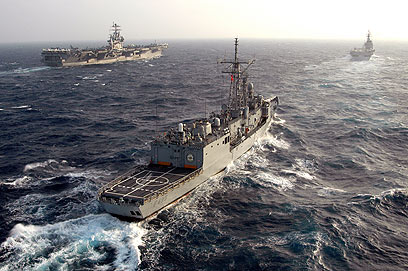
Turkish warship maneuvers with the aircraft carrier USS "Harry Truman"
Turkish army recruitment age, the world's sixth largest, is 19 and length of service depends on the role carried out by every soldier. So how big and strong Turkish army and is it worth the Israeli army forces, or even better than he could? Turkish army is the second largest force in NATO after the United States Army and currently serving in active duty over 612 thousand soldiers. And he and Erdogan's army would need additional forces in order, are available to 429 thousand reservists. On the other hand, Israel has about 187 thousand soldiers recruits, and about 565 thousand army reservists.

Air superiority over Israel? Turkish fighter jet F-16 Fighting Falcon
Against Israel, the Turkish Air Force has "only" 1940 aircraft, including F-16 aircraft and Phantoms, and the number of its helicopters was about 874. And as the IDF, is Turkey going to take her service the stealth aircraft F-35 model for 2015.
Aerial bombardments killed at the border with Iraq, according to the Turkish claims, more than 160 "Kurdish terrorists". Turkish operation against the PKK began in response to attacks carried out by the Kurds against Turkish security forces, killing soldiers and police. On air strikes against Kurdish targets, react the PKK: "Nobody was hurt and all of our men damaged buildings were deserted for a long time."
Between industry supplied military equipment to Turkey include Israeli tanks and armored vehicles and unmanned aircraft.Turkish military analysts said yesterday that Turkey's decision to freeze military agreements with Israel, following the Palmer report on the flotilla will hurt the military struggle against Kurdish rebels.
According to security experts, Turkey's struggle against Kurdish resistance (PKK) would be hurt because it makes extensive use made in Israel by military means.
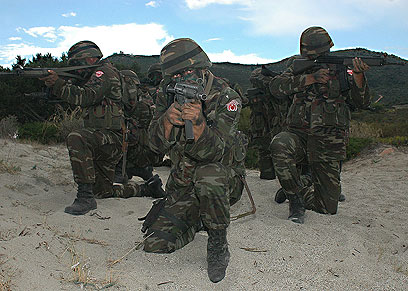
Over 612 thousand troops in regular service. Turkish soldiers
Last night the U.S. State Department announced that the rift between two of its major allies in the Middle East worries in Washington
about the current state of relations between two countries," the State Department announced. "We work with both countries in order to defuse the crisis and prevent future conflicts," added State Department spokeswoman, Victoria Nuland."We are concerned
Last Thursday, AReport of the Commission PalmerInternational, which said that although Israel has supposedly excessive power against the passengers of the flotilla, the closure of its Gaza laws, and recommended that Turkey settle for repentance to Israel and receiving compensation. Erdogan demanded However apology , Netanyahu refused - and in response to Ambassador Israel was expelled from Ankara and deterioration of the relationship through a new phase, culminating in the meantime is the announcement of the cessation of trade.
By Gilad Atzmon
September 07, 2011
Courtesy Of "Information Clearing House"
As the rift between Israel and Turkey deepens, the Israeli media is preparing its crowd for another possible exciting bloody conflict.
Israel’s leading news outlet Ynet, published yesterday a detailed comparison between Israel’s and Turkey’s military capacity - it outlines the size of the air force, navy, ground forces in the respective countries. “Turkey”, it says, “posses much bigger navy but our air force is larger.’
I guess that this is what one would expect from Israel, a morbid collective driven by war enthusiasm and some bizarre craving for bloody conflict.
We have to remember, that at least on the face of it, this new emerging rift between Israel and Turkey, is not about land, oil or assets. It is all about apology. Relations between the two old allies have soured further in recent days after the publication of the UN investigation into Israel's murderous assault on a Turkish Mavi Marmara in high seas. In the attack nine peace activists were murdered; some of them were clearly executed in cold blood. Turkey demands Israel’s. apology. For some reason Israel failed to react. The meaning of it is simple. Israel prefers the prospect of a violent development instead of confronting its sin.
I will make myself as simple, short and clear just to make sure that the Israelis and their allies around the world understand how futile their agenda is.
Islam Is Unbeatable and Indestructible. The Israelis should remember their latest military blunders. In 2006 its army was humiliated by the Hezbula, a small Lebanese paramilitary organisation. In just a few weeks the heroic Hezbollah managed to bring Israel to its knees. In 2008-9 Israeli Army mounted a massive attack on Gaza, the initial objective was to dismantle the democratically elected Hamas. Israel murdered more than 1400 Palestinians but it achieved none of its military objectives. Hamas and Hezbollah won these battles without air force, navy or tanks. In fact resilience was enough to defeat the IDF.
But Israel is not alone, The English speaking Empire is also heavily beaten in Iraq and Afghanistan. Similarily, Iraqi insurgency and Taliban do not posses tanks, F 16s or submarines. In the age of Islamic resistance, tables of contents with numbers of tanks, vessels, and airplanes are obsolete. It is the spirit and the will rather than the tank that wins the battle. This spirit better be called The Islam Spring, and it is unbeatable indeed.
The message for Israelis is plainly clear. Israel and its supporting lobbies had better learn how to contain their inherent violent tendencies. Israel cannot win this battle. The sooner the Israelis encompass this obvious fact, the better it is for Israel and for world peace.
Gilad Atzmon is a musician-composer. He is particularly well-known his political analysis which is widely published. His website Gilad.co.uk
NOTE: I took the liberty to include (below) the "Y-Net" report comparing Turkish-Israeli Military Might. Courtesy Of "Google Translation" [Translate.Google.com].
Turkish Army Against The IDF. Whi Is Greater?
Turkey is much more submarines to Israel a little more combat aircraft. Against the Ankara government makes statements, ynet checked the balance of power between the armies. Two - Battle of the Eastern Mediterranean
|
The rift in the relationship deepens every day, and two former allies seem more remote than ever. Israeli-Turkish relations reached a new low, after Turkish Prime Minister Recep Tayyip Erdogan , announced yesterday (Tuesday) on the absolute separation of the military trade and trade with Israel Government ."Turkish warships will orbit more frequently in the eastern Mediterranean," said Turkish Prime Minister.
Rupture With Turkey - Recent Articles:
U.S. concerned about tension between Israel and Turkey"Turkey freezes trade? Year and a half there is no such"
Where Turkey: "They like us, we apologize"
Erdogan's remarks were made just a day after a senior government in Ankara said that "the Middle East would not be a place where Israeli Navy demonstrates his bullying against civilian vessels'. Against the escalating crisis between the former allies houses, ynet compare the balance of power between the Turkish army and the IDF and examined: Who has a larger army?
| No power? Turkish army against army |  |
| Turkey | Israel | |
| Population | 78,785,548 | 7473052 |
| Regular army forces | 612 900 | 187 000 |
| Reserve forces | 565 000 | 429 000 |
| Tanks | 4246 | 3230 |
Data: Library of Congress and the CIA (from siteGlobalfirepower.com )
With the fall of the Ottoman Empire and the establishment of the modern republic under the leadership of Kemal Ata - Turk, replace the armed forces of Turkey the Ottoman army. Since, traditionally, the Turkish military is a significant political institution and was considered as the defender of the secular Republic of Ata - Turk.
By law, the army was supposed to protect the Turkish Constitution and the unity of the state, and therefore it plays a political role - a role that had eroded as Erdogan cemented his position as undisputed ruler of the Muslim state.
Turkish warship maneuvers with the aircraft carrier USS "Harry Truman"
Turkish army recruitment age, the world's sixth largest, is 19 and length of service depends on the role carried out by every soldier. So how big and strong Turkish army and is it worth the Israeli army forces, or even better than he could? Turkish army is the second largest force in NATO after the United States Army and currently serving in active duty over 612 thousand soldiers. And he and Erdogan's army would need additional forces in order, are available to 429 thousand reservists. On the other hand, Israel has about 187 thousand soldiers recruits, and about 565 thousand army reservists.
Turkey Against "Israeli Bullying At Sea"
Following her outspokenness regarding Ankara's recent "Israeli bullying" in the Mediterranean and increasing presence in the Turkish waters of the region, it is interesting to examine the balance of power between the two armies the marine sector. And in this case, indicate the number of Turkish forces on the Israelis. To the Turkish Navy has a total 265 vessels in Slhil naval forces has 64. While Sltorkim has 16 submarines, the Israelis have 3 only.| Troubled Waters: The Turkish Navy with Israel | |
| Turkey | Israel | |
| Total fleet ships | 265 | 64 |
| Minesweepers | 21 | 0 |
| Submarines | 16 | 3 |
Army Wins The Number Of Planes
Compared with the maritime arena, the sky, the Israeli military has a small quantitative advantage. Available to the IAF are 1964 aircraft, including fighter jets F-16 and F-15. Number of helicopters available to the Israeli army is 689. By the way, Israel's air superiority should receive serious reinforcement for the year 2017 when the IDF will receive from the United States the future combat aircraft F-35.Air superiority over Israel? Turkish fighter jet F-16 Fighting Falcon
Against Israel, the Turkish Air Force has "only" 1940 aircraft, including F-16 aircraft and Phantoms, and the number of its helicopters was about 874. And as the IDF, is Turkey going to take her service the stealth aircraft F-35 model for 2015.
Turkish Train On The Kurds?
Israel could learn about the power of the Turkish army, as well as its quality, the Turkish Air Force bombing raids in recent weeks of the goals of the underground Kurdish (PKK) on the border with Iraq.Aerial bombardments killed at the border with Iraq, according to the Turkish claims, more than 160 "Kurdish terrorists". Turkish operation against the PKK began in response to attacks carried out by the Kurds against Turkish security forces, killing soldiers and police. On air strikes against Kurdish targets, react the PKK: "Nobody was hurt and all of our men damaged buildings were deserted for a long time."
| Catch air: Turkish air force against Israel | |
| Turkey | Israel | |
| Total aircraft | 1940 (Including F-16 and Phantoms) | 1964 (Including F-16 and F-15) |
| Helicopters | 874 | 689 |
Between Suppliers Of Arms To The Turks - In Israel
Than the United States, other countries that supply arms and military technology to the Turkish army are Germany, Britain, Italy, South Korea, France, Spain, China, Russia - and in Israel.Between industry supplied military equipment to Turkey include Israeli tanks and armored vehicles and unmanned aircraft.Turkish military analysts said yesterday that Turkey's decision to freeze military agreements with Israel, following the Palmer report on the flotilla will hurt the military struggle against Kurdish rebels.
According to security experts, Turkey's struggle against Kurdish resistance (PKK) would be hurt because it makes extensive use made in Israel by military means.
Over 612 thousand troops in regular service. Turkish soldiers
Last night the U.S. State Department announced that the rift between two of its major allies in the Middle East worries in Washington
about the current state of relations between two countries," the State Department announced. "We work with both countries in order to defuse the crisis and prevent future conflicts," added State Department spokeswoman, Victoria Nuland."We are concerned
Last Thursday, AReport of the Commission PalmerInternational, which said that although Israel has supposedly excessive power against the passengers of the flotilla, the closure of its Gaza laws, and recommended that Turkey settle for repentance to Israel and receiving compensation. Erdogan demanded However apology , Netanyahu refused - and in response to Ambassador Israel was expelled from Ankara and deterioration of the relationship through a new phase, culminating in the meantime is the announcement of the cessation of trade.
Sunday, August 07, 2011
The Spinning Of Polls and Demonization Of Palestinians

By Paul R. Pillar
July 23, 2011
Courtesy Of "The National Interest"
Several days ago a poll of Palestinians in the West Bank and Gaza, conducted by the Stanley Greenberg organization on behalf of the Israel Project, generated a spurt of commentary about the hateful attitudes and nefarious intentions that the Palestinians supposedly have toward Israel. Benny Morris wrote a piece in these spaces, under the ominous title of “Eliminating Israel,” the main message of which was that most Palestinian Arabs aren't really interested in living in peace side-by-side with Israel but instead see any two-state agreement as only a stepping stone toward somehow doing away with Israel altogether and claiming all of mandatory Palestine for themselves. Morris argued that outsiders such as the U.S./U.N./E.U./Russia quartet should take this into account when considering “Netanyahu's fears regarding Palestinian leadership's real aims” in pressing for statehood in the West Bank and Gaza. Othercommentaries also supportive of the Netanyahu government followed similar themes.
The first question one is entitled to ask about such commentary is: even if this accurately described Palestinian intentions, how could any Palestinian with at least half a brain see any way to accomplish such an objective? Even more to the point, how would establishment of a Palestinian state in the West Bank and Gaza, which would be many times weaker than the State of Israel, bring Palestinians any closer to such an objective? If anything, creating a separate Palestinian state would appear to have the opposite effect. Everyone is familiar with the demographic trends showing that Arabs living in all the lands between the Mediterranean and the Jordan River will come to outnumber Jews. But if most of those Arabs became citizens of a separate state for Palestinian Arabs, Israel—which would have for the first time a fully recognized international border—would be secure in the prospect of retaining its Jewish majority and character as a Jewish state. All of this means that the notion of current Palestinian leaders having a “real aim” of eliminating Israel is preposterous.
Nonetheless, polling data that might appear to indicate the opposite warrants further scrutiny. Unfortunately, amid the burst of commentary about the supposedly nefarious aims of Palestinians I was unable, despite much searching, to find the poll itself. Finally later in the week the Israel Project, to its credit, provided a link to the poll. The overall picture it presents is one of a Palestinian population mostly concerned with trying to get on with their daily lives and understandably pessimistic about the prospects for any political breakthroughs that would affect them. Eighty-one percent of respondents, in what is probably an accurate perception, believe that Prime Minister Netanyahu “isn't really serious about wanting peace and supporting a two-state solution.” Remarkably, despite such pessimism, a negotiated peace agreement with Israel is still the strong Palestinian preference. Two-thirds of the respondents agreed with the statement that “it is possible to find peace with Israel” as opposed to a statement that “there is no hope of peace with Israel.” Two-thirds also agreed that it is “time for diplomatic engagement with Israel” rather than with a statement that it is time for “violent resistance” against Israel. In possibly the most remarkable indication of faith in bilateral negotiations despite the well-founded reasons for pessimism, a majority said they would still want the Palestinian Authority to go to the negotiating table even if it was on the basis of conditions laid down by Netanyahu that rule out any plan that divides Jerusalem or that involves settlement of any Palestinian refugees within Israel.
The pro-Netanyahu commentaries cherry-pick from the poll some results suggesting hostile attitudes toward Jews. Morris begins his piece with part of a quotation from a hadith (a saying of the Prophet Mohammed, which serves as a kind of explanatory supplement to the Koran) which is also quoted in the Hamas charter and that makes reference to killing Jews. This hadith is poetic scripture, with flowery language that also talks about such things as Gharkad trees and people hiding behind stones. As Morris correctly notes, the hadith is “well-known” and “accepted by Muslims as canonical and weighty.” Ninety-eight percent of the respondents in the poll were Sunni Muslims. Is it any surprise that when asked whether they agree with this bit of scripture associated with their faith, a majority (73 percent) would say yes? One could probably elicit similar responses to nasty-sounding bits of scripture associated with other faiths. Some passages of the Old Testament imply a pretty hostile attitude toward certain other peoples, and many adherents to the religions for which it is holy scripture would express agreement because it is holy scripture, without this implying anything about attitudes toward political problems of the present day. One could similarly extract from the New Testament some ostensibly hostile attitudes of Christians toward Jews. (If what Morris or any other commentator is saying is not just that Palestinian Arabs exhibit peculiar hostility but instead that any Muslim—a believer in the texts of Islam—is ipso facto dangerous and untrustworthy, then he should say that explicitly and his argument can be perceived and judged as such.)
Prune away the Gharkad trees and other poetry that elicits expressions of religious faith, and there was plenty else in the poll that more directly and effectively measures Palestinian attitudes toward present-day Israel. Another quotation from the Hamas charter that was not scripture and about which the poll asked was: “Peace initiatives, the so-called peaceful solutions, and the international conferences to resolve the Palestinian problem, are all contrary to the beliefs of the Islamic Resistance Movement. There is no solution to the Palestinian problem except by Jihad.” A plurality of respondents disagreed with that statement. There were numerous other questions about Hamas, which fared rather poorly in the poll, in the abstract as well as in comparison with Fatah or the Palestinian Authority.
Probably some of the responses to questions involving enmity toward Jews reflected the same kind of hateful prejudice that is present in many other countries as anti-Semitism. It is unlikely that most of the responses were that. Ninety-five percent of respondents in the Greenberg poll agreed with the statement that “all religions ought to be equally accepted and welcome in society.” The poll results make it clear that the respondents made little distinction between “Jews” and “Israelis,” and Israelis were thought of mostly as occupiers and those standing in the way of Palestinian self-determination. To the extent that resentments over that situation get expressed in agreement with negative statements about a religious or ethnic group, that cannot be excused but, given the bitterness surrounding the underlying conflict, neither should it be surprising.
One can find sentiments expressed in similar terms on the other side of this conflict. In a poll in 2006, for example, Jewish Israelis were asked, “How do you feel when you hear Arabic being spoken around you on the streets of Israel?” Thirty percent said they felt “hatred.” (This is another example of a poll question being subject to multiple interpretations. Does this mean hatred from Arab toward Jew, or the other way around? My guess is that some respondents interpreted it one way, some the other way, and for still others it didn't matter because they felt hatred in both directions.) In the same poll, 50 percent said they would refuse to work at a job in which the direct supervisor was an Arab. Such sentiments, expressed in purely ethnic terms, also cannot be excused but again are not surprising.
As for one-state versus two-state resolutions of the conflict, Leila Farsakh has an informativearticle on the subject in a recent issue of the Middle East Journal. She notes that the idea of Jews and Arabs living together in a single state in Palestine is an old one, proposed back in the 1920s and 1930s. But most Palestinians and Zionists alike rejected the idea as a compromise of the national aspirations of each. The concept of a one-state solution has more recently been the subject of renewed talk by scholars and activists, for the obvious reason that two decades of work on a two-state solution has come up empty. But all the old practical and political difficulties, which Farsakh reviews in detail, are still present, along with the obvious fact that Jewish national aspirations have been realized in the form of a strong and well-established state. As a result, Palestinians “at the official and grassroots levels,” notes Farsakh, doubt the feasibility of a one-state option, because of not only strong Israeli opposition but “more so out of fear of Israel's economic and political domination over the Palestinians within a single state.”
So what accounts for results in the Greenberg poll that, according to the commentators, suggest otherwise? It is an artifact of how portions of the poll were constructed, especially in forcing people to choose between two different statements that, even if logical alternatives, are not alternatives in terms of the sentiment and emotion that drive their responses. For example, respondents were asked to choose between the statements “Israel has a permanent right to exist as a homeland for the Jewish people” and “Over time Palestinians must work to get back all the land for a Palestinian state.” “All” the land? Does this mean the occupied territories seized by Israel in the 1967 war, which is the territorial issue that has been debated for many years and has been the subject of nearly every conversation about Palestinians getting land back, or does it mean something more than that? With or without that ambiguity, think about how the average Palestinian, facing the clipboard-wielding interviewer, will react when asked to identify with one or the other of two sentences, one of which speaks of someone else's national aspirations and the other of which speaks about his own people's national aspirations. Naturally most Palestinians will choose the latter, the one that talks about getting land back for a state of their own. This is a simple expression of sentiment and priorities, not some scheme about making a two-state solution a device for wiping out Israel. It is hard to think of a more tendentious way to construct a survey question to generate fodder for commentators trying to argue that Palestinians don't accept Israel's right to exist.
Inconsistencies in responses to other questions in the Greenberg poll, even without reference to any other survey data or other evidence, vividly demonstrate how much the design of the questions shaped the results. For example, respondents had more than one opportunity to say whether they accepted a two-state solution. When asked a straight up-or-down question on their view about such a solution, there was almost twice as much support as when the question was made part of a two-statements comparison similar to the one just mentioned.
The seemingly endless Israeli-Palestinian conflict has generated all too much bitterness, animosity, and emotion-driven misperception on both sides. It is not helpful for supporters of one side to fancifully accuse the other side of grand, destructive plans that do not exist. In this case, the accusation serves only as one more excuse for the ruling coalition in Israel (some members of which are quite open about their intentions) to retain the West Bank—could we say “all the land”?—indefinitely and to keep Palestinian Arabs from ever having their own state.
Image by Hanini
Subscribe to:
Posts (Atom)
