Saturday, December 13, 2014

A Slave's Freedom


Loghman of Sarrakhs cried: "Dear God, behold
Your faithful servant, poor, bewildered, old--
An old slave is permitted to go free;
I've spent my life in patient loyalty,
I'm bent with grief, my black hair's turned to snow;
Grant manumission, Lord, and let me go."


A voice replied: "When you have gained release
from mind and thought, your slavery will cease;
You will be free when these two disappear."


By Farid ud-Din Attar

English version by Afkham Darbandi and Dick Davis
Original Language Persian/Farsi

Touch Me With Your Heart


Artist: Eileen Flores

Palestine Is Still The Issue


'Palestine Is Still The Issue' tells how almost a million Palestinians had been forced off their land in 1948, and again in 1967. 

John Pilger asks why the Palestinians, whose right of return was affirmed by the United Nations more than half a century ago, are still caught in a terrible limbo - refugees in their own land, controlled by Israel in the longest military occupation in modern times.

"If we are to speak of the great injustice here, nothing has changed. What has changed is that the Palestinians have fought back. Stateless and humiliated for so long, they have risen up against Israel's huge military regime, although they themselves have no army, no tanks, no American planes and gunships or missiles. Some have committed desperate acts of terror, like suicide bombing. But, for Palestinians, the overriding, routine terror, day after day, has been the ruthless control of almost every aspect of their lives, as if they live in an open prison. This film is about the Palestinians and a group of courageous Israelis united in the oldest human struggle, to be free."
Pilger distills the history of Palestine during the twentieth century into an easily comprehensible struggle for land - the loss of seventy-eight per cent of that belonging to Palestinians when the state of Israel was founded in 1948 and their claim to only the remaining twenty-two per cent, which had for thirty-five years been occupied by Israel.

In a series of extraordinary interviews with both Israelis and Palestinians, he speaks to the families of suicide bombers and their victims. He witnesses the humiliation of Palestinians at myriad checkpoints with a permit system not dissimilar to apartheid South Africa's infamous pass laws. 

One Palestinian woman tells of how she was stopped from passing through a checkpoint when she went into labour and had to return home to give birth with her mother-in-law using a razor to cut the umbilical cord. The baby later died. 

He goes into the refugee camps and meets children who, he says, "no longer dream like other children, or if they do, it is about death." 

He is shown round the Palestinian Ministry of Culture in Ramallah after a recent Israeli attack where he discovers faeces smeared on walls and floors and a room of children's paintings vandalised.

Archive footage shows pledges by successive American presidents in support of Israel. Pilger describes the Israeli administration as "America's deputy sheriff" in the oil-rich Middle East, receiving billions of dollars and the latest weapons: F16 aircraft, bombs, missiles and Apache helicopters. 

He reveals that Britain also fuels the conflict even though it condemns Israel for its illegal occupation. 


"During the first fourteen months of the Palestinian uprising, the Blair government approved 230 export licences for weapons and military equipment to Israel... Tony Blair has said, and I quote him, "We are doing everything we can to bring peace and stability to the Middle East.'" As a result, Israel is now the fourth-largest military power in the world.
Pilger concludes: 


"The truth is that Israelis will never have peace until they recognise that Palestinians have the same right to the same peace and the same independence that they enjoy. 
Recently, that great voice of freedom, Archbishop Desmond Tutu, asked this: "Have the Jewish people of Israel forgotten their collective punishment, their home demolitions, their humiliations so soon?" 
Israel's own dissenting voices have not forgotten and those who speak out in this film honour the best traditions of Jewish humanity... The occupation of Palestine should end now. Then, the solution is clear: two countries, Israel and Palestine, neither dominating nor menacing the other. Is that impossible or is history to witness the consequences of yet another silence?'"

Friday, December 12, 2014

X-Men: Days Of Future Past


Starring: Hugh Jackman, James McAvoy, Michael Fassbender, Jennifer Lawrence, Halle Berry, Anna Paquin, Ellen Page, Peter Dinklage, Ian McKellen, Patrick Stewart

Never Let You Go


Artist: Sweet Sensation

Why I’m Now A Friend Of Palestine Rather Than Israel

PENNANT Hills Golf Club in Sydney is an unusual place for an epiphany on the changes in Israel. Still, it was there I met a Christian volunteer who went to the occupied territories to escort Palestinian children to school, to protect them from verbal and physical ­violence by Israeli settlers.
Violence against Arab kids? Christian volunteers to protect them? From Jewish settlers?
None of this was around in 1977 when I rented a room in Sydney Trades Hall and called on Bob Hawke, ACTU president, to help me launch Labor Friends of Israel.
In 1977 the Israeli occupation was 10 years old. There were 25,000 settlers. It was easy to believe the Israelis were holding the West Bank only as a bargaining chip. Arabs were terrorists.
Now the occupation has lasted 47 years. There are 500,000 settlers. Up to 60 per cent of the Israeli cabinet is on record as opposing a two-state solution. Palestinians have been part of a peace process for 25 years.
Israel has gone from secular to religious. The ultra-Orthodox and religious Zionists hold 30 of the 120 seats in the Knesset. It has gone from cosmopolitan to chauvinist, with some ministers ­espousing a brand of radical ­nationalism like that of France’s Le Pen or Austria’s Jorg Haider.
“The symbol of Israel used to be the kibbutz,” says a friend in the British Labour Party. “It’s now the settlement.” They have doubled in the past 54 months alone. 
The ­Atlantic reported the Obama ­administration is deeply offended at how the Israelis use settlements to wreck any peace deal. Settlers won’t move. The Israeli government won’t force them. So an ­indefinite occupation morphs into the extremists’ goal of a Greater Israel.
With one catch. It will have two classes of citizen.
“A term used about another country on another continent”, Ehud Barak told me when I as foreign minister discussed this very dilemma. The word is apartheid, of course, used by another former prime minister, Ehud Olmert, and the only word that can be applied if, within one nation, there is one set of laws for one race and an inferior set for the other — the other being the majority.
Barack Obama says that if settlement expansion keeps growing he can’t manage the fallout for Israel. That fallout has begun, with 
Sweden joining 138 nations that have already recognised Palestine and Britain’s House of Commons endorsing recognition. In the British debate, Richard Ottaway, a Conservative and long-term supporter of Israel, ­declared, “If they are losing ­people like me, they will be losing a lot of people.”
He and others in centrist politics have been sickened by religious fanatics standing on seized Palestinian land declaring that God gave them Judea and Samaria, and the Arabs are inferior anyway. 
Sickened by the routine violence of the settlers, serious enough to warrant front-page treatment in that voice of the US foreign policy establishment,Foreign Affairs: settlers smashing the windows of Palestinian flats to drive families out, uprooting the date and olive trees on Palestinian farms, spraying graffiti on ­churches and mosques.
In 1977 the Palestine Liberation Organisation was blowing up planes. Now for 25 years Palestinians have been committed to a neg­otiated solution, most recently to a demilitarised state with the presence of a US-led NATO force on the West Bank and East ­Jerusalem.
In 1977 when we launched Labor Friends of Israel we knew, to our disgrace, none of their narrative. Now Israeli historians — this is a measure of Israel’s openness — have gone to the archives of their army to tell the full story of how massacres were used during the foundation of Israel in 1948 to drive out 700,000 Palestinians. The credibility of historian Benny Morris is confirmed when he declares he agreed with the policy and thinks David Ben-Gurion should have gone further until there were no Palestinians left.
Where do Palestinians stand now? Gideon Levy wrote in the Israeli newspaper Haaretz that 
it leaves them living with mass arrests (760 in a recent sweep, 260 of them children) expulsions, demolitions. A former head of Shin Bet (Israel’s ASIO) said in the 2012 documentary The Gatekeepers that his paratrooper son invaded Nablus two or three times. He asked, “Did this bring us victory? I don’t think so.”
This week 100 ex-generals, senior police and a former head of Mossad issued a letter urging Israeli Prime Minister Benjamin Netanyahu to negotiate with “moderate Arab states and with the Palestinians (in the West Bank and Gaza Strip as one)”. They know a two-state solution will not be perfect but preferable.
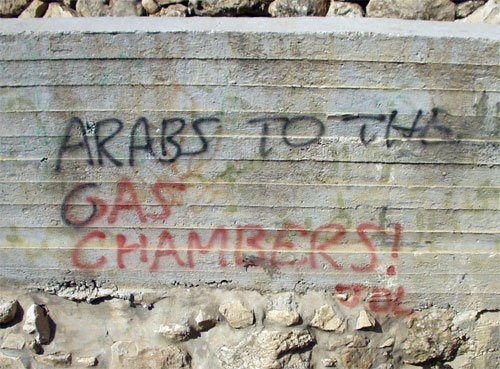
[Arab+sand+niggers.jpg]
Permanent occupation means Israelis get cast as Afrikaners and the world will recognise Palestine and isolate Israel.
The alternative would be unthinkable: to accept colonial rule with one religious and racial group enjoying the vote, the majority denied it.
From the writers of The West Wing came this. Discussing Gaza and the West Bank, a White House adviser says to another, “Revolutionaries will outlast and out-die occupiers every time.” No other colonial rule has survived, let alone with rich settlers on fortified hilltops with Los Angeles lawns, the wretched huddled in the gullies, their 12-year-old kids subject to military arrest and ­detention.
We have politely pitched the case for Palestinian statehood as creating security for Israel. But in view of the settlements and settler violence, I now pitch the case in terms of the rights of the Palestinian people, recognised in international law and every draft peace statement supported by the world for a quarter of a century.
Palestinians must commit to non-violent resistance, not a third intifada. They must build international support. They must engage with the righteous Jews who condemn the takeover of Zionism by the fanatics.
Forty years ago I signed up to be president of Labor Friends of Israel; I still count myself a friend of the liberals in that country but it serves the cause of a just peace better by me this week becoming patron of Labor Friends of Palestine.
Bob Carr is a former NSW premier and foreign minister. This is part of an address he gave to the Australian Friends of Palestine Association in Adelaide last night.

Thursday, December 11, 2014

Cat Scratch Fever


Artist: MotorHead

An Open Letter For The People In Gaza

We are doctors and scientists, who spend our lives developing means to care and protect health and lives. We are also informed people; we teach the ethics of our professions, together with the knowledge and practice of it. We all have worked in and known the situation of Gaza for years.
On the basis of our ethics and practice, we are denouncing what we witness in the aggression of Gaza by Israel.
We ask our colleagues, old and young professionals, to denounce this Israeli aggression. We challenge the perversity of a propaganda that justifies the creation of an emergency to masquerade a massacre, a so-called “defensive aggression”. In reality it is a ruthless assault of unlimited duration, extent, and intensity. We wish to report the facts as we see them and their implications on the lives of the people.
We are appalled by the military onslaught on civilians in Gaza under the guise of punishing terrorists. This is the third large scale military assault on Gaza since 2008. Each time the death toll is borne mainly by innocent people in Gaza, especially women and children under the unacceptable pretext of Israel eradicating political parties and resistance to the occupation and siege they impose.
This action also terrifies those who are not directly hit, and wounds the soul, mind, and resilience of the young generation. Our condemnation and disgust are further compounded by the denial and prohibition for Gaza to receive external help and supplies to alleviate the dire circumstances.
The blockade on Gaza has tightened further since last year and this has worsened the toll on Gaza's population. In Gaza, people suffer from hunger, thirst, pollution, shortage of medicines, electricity, and any means to get an income, not only by being bombed and shelled. Power crisis, gasoline shortage, water and food scarcity, sewage outflow and ever decreasing resources are disasters caused directly and indirectly by the siege.1
People in Gaza are resisting this aggression because they want a better and normal life and, even while crying in sorrow, pain, and terror, they reject a temporary truce that does not provide a real chance for a better future. A voice under the attacks in Gaza is that of Um Al Ramlawi who speaks for all in Gaza: “They are killing us all anyway—either a slow death by the siege, or a fast one by military attacks. We have nothing left to lose—we must fight for our rights, or die trying.”2
Gaza has been blockaded by sea and land since 2006. Any individual of Gaza, including fishermen venturing beyond 3 nautical miles of the coast of Gaza, face being shot by the Israeli Navy. No one from Gaza can leave from the only two checkpoints, Erez or Rafah, without special permission from the Israelis and the Egyptians, which is hard to come by for many, if not impossible. People in Gaza are unable to go abroad to study, work, visit families, or do business. Wounded and sick people cannot leave easily to get specialised treatment outside Gaza. Entries of food and medicines into Gaza have been restricted and many essential items for survival are prohibited.3 Before the present assault, medical stock items in Gaza were already at an all time low because of the blockade.3 They have run out now. Likewise, Gaza is unable to export its produce. Agriculture has been severely impaired by the imposition of a buffer zone, and agricultural products cannot be exported due to the blockade. 80% of Gaza's population is dependent on food rations from the UN.
Much of Gaza's buildings and infrastructure had been destroyed during Operation Cast Lead, 2008—09, and building materials have been blockaded so that schools, homes, and institutions cannot be properly rebuilt. Factories destroyed by bombardment have rarely been rebuilt adding unemployment to destitution.
Despite the difficult conditions, the people of Gaza and their political leaders have recently moved to resolve their conflicts “without arms and harm” through the process of reconciliation between factions, their leadership renouncing titles and positions, so that a unity government can be formed abolishing the divisive factional politics operating since 2007. This reconciliation, although accepted by many in the international community, was rejected by Israel. The present Israeli attacks stop this chance of political unity between Gaza and the West Bank and single out a part of the Palestinian society by destroying the lives of people of Gaza. Under the pretext of eliminating terrorism, Israel is trying to destroy the growing Palestinian unity. Among other lies, it is stated that civilians in Gaza are hostages of Hamas whereas the truth is that the Gaza Strip is sealed by the Israelis and Egyptians.
Gaza has been bombed continuously for the past 14 days followed now by invasion on land by tanks and thousands of Israeli troops. More than 60 000 civilians from Northern Gaza were ordered to leave their homes. These internally displaced people have nowhere to go since Central and Southern Gaza are also subjected to heavy artillery bombardment. The whole of Gaza is under attack. The only shelters in Gaza are the schools of the UN Relief and Works Agency for Palestine Refugees in the Near East (UNRWA), uncertain shelters already targeted during Cast Lead, killing many.
According to Gaza Ministry of Health and UN Office for the Coordination of Humanitarian Affairs (OCHA),1 as of July 21, 149 of the 558 killed in Gaza and 1100 of the 3504 wounded are children. Those buried under the rubble are not counted yet. As we write, the BBC reports of the bombing of another hospital, hitting the intensive care unit and operating theatres, with deaths of patients and staff. There are now fears for the main hospital Al Shifa. Moreover, most people are psychologically traumatised in Gaza. Anyone older than 6 years has already lived through their third military assault by Israel.
The massacre in Gaza spares no one, and includes the disabled and sick in hospitals, children playing on the beach or on the roof top, with a large majority of non-combatants. Hospitals, clinics, ambulances, mosques, schools, and press buildings have all been attacked, with thousands of private homes bombed, clearly directing fire to target whole families killing them within their homes, depriving families of their homes by chasing them out a few minutes before destruction. An entire area was destroyed on July 20, leaving thousands of displaced people homeless, beside wounding hundreds and killing at least 70—this is way beyond the purpose of finding tunnels. None of these are military objectives. These attacks aim to terrorise, wound the soul and the body of the people, and make their life impossible in the future, as well as also demolishing their homes and prohibiting the means to rebuild.
Weaponry known to cause long-term damages on health of the whole population are used; particularly non fragmentation weaponry and hard-head bombs.45 We witnessed targeted weaponry used indiscriminately and on children and we constantly see that so-called intelligent weapons fail to be precise, unless they are deliberately used to destroy innocent lives.
We denounce the myth propagated by Israel that the aggression is done caring about saving civilian lives and children's wellbeing.
Israel's behaviour has insulted our humanity, intelligence, and dignity as well as our professional ethics and efforts. Even those of us who want to go and help are unable to reach Gaza due to the blockade.
This “defensive aggression” of unlimited duration, extent, and intensity must be stopped.
Additionally, should the use of gas be further confirmed, this is unequivocally a war crime for which, before anything else, high sanctions will have to be taken immediately on Israel with cessation of any trade and collaborative agreements with Europe.
As we write, other massacres and threats to the medical personnel in emergency services and denial of entry for international humanitarian convoys are reported.6 We as scientists and doctors cannot keep silent while this crime against humanity continues. We urge readers not to be silent too. Gaza trapped under siege, is being killed by one of the world's largest and most sophisticated modern military machines. The land is poisoned by weapon debris, with consequences for future generations. If those of us capable of speaking up fail to do so and take a stand against this war crime, we are also complicit in the destruction of the lives and homes of 1·8 million people in Gaza.
We register with dismay that only 5% of our Israeli academic colleagues signed an appeal to their government to stop the military operation against Gaza. We are tempted to conclude that with the exception of this 5%, the rest of the Israeli academics are complicit in the massacre and destruction of Gaza. We also see the complicity of our countries in Europe and North America in this massacre and the impotence once again of the international institutions and organisations to stop this massacre.
Paola Manduca aEmail AddressIain Chalmers bDerek Summerfield cMads Gilbert dSwee Ang eon behalf of 24 signatories
Source: The Lancet

Wednesday, December 10, 2014

Bringin' On The Heartbreak


Artist: Def Leppard

War By Other Means


John Pilger and David Munro examine the policy of First World banks agreeing loans with Third World countries, who are then unable to meet the crippling interest charges.