Showing posts with label Quantum Mechanics. Show all posts

Sunday, January 13, 2013

Quantum Imaging Heralds Unjammable Aircraft Detection


Physicists Have Exploited The Quantum Properties Of Photons To Create The First Imaging System That Is Unjammable

Jamming radar signals is an increasingly sophisticated affair. There are various techniques such as drowning the radar frequency with noise or dropping chaff to create a false reflection. But the most advanced radar systems can get around these ruses.

So a more sophisticated idea is to intercept the radar signal and modify it in a way that gives false information about the target before sending it back. That’s much harder to outsmart.

But today, Mehul Malik and pals at the University of Rochester in New York state demonstrate a way to do it.

These guys base their technique on the quantum properties of photons and in particular on the fact that any attempt to measure a photon always destroys its quantum properties.

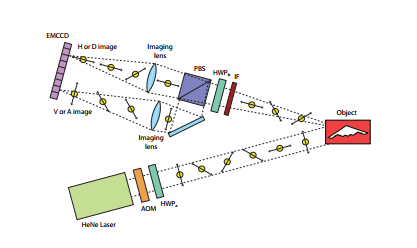
So their idea is to use polarised photons to detect and image objects. Reflected photons can of course be used to build up an image of the object. But an adversary could intercept these photons and resend them in a way that disguises the object’s shape or makes it look as if it is elsewhere.

However, such a process would always change the quantum properties of the photons such as their polarisation. And so it should always be possible to detect such interference. “In order to jam our imaging system, the object must disturb the delicate quantum state of the imaging photons, thus introducing statistical errors that reveal its activity,” say Malik and co.

That’s more or less exactly how quantum key distribution for cryptography works. The idea here is that any eavesdropper would change the quantum properties of the key and so reveal his or her presence. The only difference in the quantum imaging scenario is that the “message” is sent and received by the same person.

Malik and co have tested their idea by bouncing photons off an aeroplane-shaped target and measuring the polarisation error rate in the return signal. Without any eavesdropping the system easily imaged the aeroplane.

But when an adversary intercepted the photons and modified them to send back an image of a bird, the interference was easy to spot, say Malik and co.

That’s an impressive demonstration of the first imaging system that is unjammable thanks to quantum mechanics.

That’s not to say the technique is perfect. It suffers from the same limitations that plague early quantum cryptographic systems, which are theoretically secure but crackable in practice.

For example, instead of sending single photons, the quantum imaging system sends photon pulses which contain several photons. One or more of these can easily be siphoned away and analysed by an adversary without anybody else being any the wiser.

However, there are an increasingly wide range of fixes for these problems for quantum key distribution that could help make this quantum imaging system more secure.

Perhaps best of all, this kind of system could easily be put to work now. The techniques are well known and widely used in optics labs all over the world. So there’s no reason, this security cannot be added relatively quickly and cheaply to existing imaging systems.

Via: "Tehcnology Review"

Friday, January 11, 2013

Quantum Networks


The quantum Internet is a term that has been bandied about a lot recently. And, for the moment it is utter nonsense. The Internet connects computers, so the quantum Internet pre-supposes the existence of useful quantum computers. The Internet also involves arbitrary on-the-fly routing through many intermediate stations, while current quantum communications protocols rely on point-to-point connections. I can't think of anything less Internet-like than that.
The nice thing about buzzwords, though, is that some people take them seriously while also recognizing the problems inherent to the idea. That leads to some fantastic research. A group of Japanese and British researchers have come up with a communications protocol that overcomes many of the fundamental problems associated with transferring quantum information over long distances. We still don't have a quantum computer, but when we do, these guys know how to connect them up.

Quantum Static On Your Phone Line

The issue boils down to the very nature of the quantum state. Usually, when we consider a quantum bit (qubits) of information, we are talking about a single photon. In any optical fiber, there is a certain probability the photon will be absorbed, which increases exponentially with distance. Generally, this limits point-to-point quantum data transfer to distances under 100km.
To expand that range, you need to entangle qubits at distant locations. The idea is that you send photon pairs over short distances and entangle them with neighboring photon pairs. That entangles the two most distance photons with each other. This can be repeated, transferring entanglement over large distances.
The process of entangling two photons is, however, not always successful. So, in a chain of photon pair sources, you might manage half the links on the first attempt. These should be stored in a memory, while the other half tries again. After several repetitions, the end-points are entangled with each other. Unfortunately, this requires a long-lasting quantum memory that can store a lot of different photons. This way, the right photon can be used once the entire entangled chain is established. Such a memory doesn't exist yet.

Spreading Your Bets On Photon Survival

This would all be so much easier if the quantum state was stored across multiple photons. This is what a team of Japanese and British researchers have been considering. Drawing on early results from optical quantum computing schemes, they realized the error correcting mechanisms proposed for those systems could be used to extend the distance over which a quantum state could be transported.
Their scheme relies on the fact that no one really wants to send a single qubit, instead we want to send lots. These individual qubits can then be blocked together to make one larger quantum state that is the superposition of the individual quantum states. In addition, we add more qubits whose values are determined by the results of mathematical operations on the data qubits. When we do this, a tiny bit of each qubit's state is held by several of the photons within the block, creating lots of redundancy.
Now, it turns out that on the receiving end, one can retrieve the entire quantum state of the data block provided a couple of conditions are met. At least one logical qubit within the block must make it through without loss. And, for each logical qubit, one physical qubit (a photon) survives.
So, if you have a block of a thousand photons—encoding 10 logical qubits in 10 photons with the remaining 990 photons being redundant—we require that one of those 10 photons makes it through cleanly. We also require the remaining photons that make it through contain information about the state of all the remaining qubits. If that occurs, you can retrieve the other 10 from the built-in redundancy.
The downside is, of course, that it takes many more physical qubits to encode a single logical qubit, so you might think that the data rate will be rather low. Not so fast, say the researchers. Information can be encoded on many different quantum states of the qubit, so one qubit could be stored in a superposition of polarization states, while another could be stored in phase, and another in spatial mode profiles, etc. (The nature of these states are unimportant save that we can play with one and not change the other.)
Those of you paying attention will be questioning this assumption though. Imagine in our previous example that we store three logical qubit states in a single photon. Well, if that photon is absorbed, we have lost three different qubits. Now, our encoding scheme relies on one logical qubit making it through in its entirety. Naively, we might think that this would reduce the chances of this occurring by a factor of three, which would be disastrous.
Luckily, the researchers are not as naive as me, and they have an answer. The encoding system works by blocking data and encoding it together into a single giant quantum state. The trick is to make sure the different quantum states of the same photon are used to encode qubits from different blocks of data. This way, the loss of a photon still results in losing three qubits, but they are from different blocks, making them the equivalent of losing three independent photons.

But Wait, It's A Router Too

The big advantage, though, is this scheme also allows something that looks like quantum routing. The basic process is that the photonic qubits are generated from matter qubits at one end and stored into matter qubits at a node. The storage process involves the emission of photons that can be used to determine the channel losses and appropriately decode the actual quantum data from the block. But, unlike point-to-point schemes, the decoding process doesn't involve measuring the quantum state, it only involves picking the right bits and performing operations on them. This is important, because a measurement would destroy the quantum state. Since the quantum state is preserved, it can be re-encoded in a new block and sent on to a new node.
One can then imagine blocks are chunked into super-blocks with the first block containing routing information, and the remaining blocks being data. The first block could be entirely classical and contain routing information, or it could be stored in qubits, which are read at a node (destroying the quantum nature of the state), and then re-encoded in new qubits. Either way would work.

Where Do I Order My Quantum Router?

All through reading this paper, I had my doubts. But it really is a solid bit of work. It is also, I think, going to be regarded as a key paper should quantum networks become ubiquitous and significant. Implementation, though, is going to be challenging. This is because the number of qubits per photon and the number of photons per qubit scale very fast. For instance, if we limit ourselves to losses of 50 percent—that is, the link destroys 50 percent of the photons sent to the receiver—and only store a single logical qubit per photon, then we require over 7000 photons (physical qubits) to transmit 10 logical qubits.
If we go the more complicated route and store multiple qubits per photon, then things get better: only 75 photons are required to transmit 15 photons. But, that assumes that 15 qubits are encoded on each photon, so, we actually need to send a minimum of 15 blocks of data, adding up to 1125 photons for 225 logical qubits.
Why do I care about these numbers? Well, that means we require 1125 matter qubits that can be set to the right value and retained until they are transferred to a photon. Furthermore, we require that each photon acquires 15 different qubits. To do that successfully 98 percent of the time, it will involve an encoding operation that works 99.8 percent of the time. At the moment, these operations have probabilities that are much lower, effectively limiting experiments to a couple of logical qubits per photon.
Nevertheless, these experimental difficulties are well-known and understood. Over time, the situation will improve and in a few years (less than 10), we will see encoding schemes similar to this that can encode more qubits per photon. The quantum Internet may yet lie ready, awaiting the arrival of a quantum computer.


Wednesday, December 12, 2012

Taking A Step Towards Quantum Computing


Researchers from Purdue University and the University of New South Wales (UNSW) have created a working transistor that consists of a single atom on silicon crystal.

Their findings, published in the journal Nature Nanotechnology, details the tiny electronic device, which may yet prove to be the future of quantum computing.

Until now, single-atom transistors have been realized only by chance, where researchers either have had to search through many devices or tune multi-atom devices to isolate one that works.

“But this device is perfect,” says Professor Michelle Simmons, group leader and director of the ARC Centre for Quantum Computation and Communication Technology at UNSW. “This is the first time anyone has shown control of a single atom in a substrate with this level of precise accuracy.”

It is predicted that transistors will reach the single-atom level by about 2020 to keep pace with Moore’s Law, which describes an ongoing trend in computer hardware that sees the number of chip components double every 18 months.

This major advance has developed the technology to make this possible well ahead of schedule and gives valuable insights to manufacturers into how devices will behave once they reach the atomic limit, says Professor Simmons.

UNSW has a brief video on the transistor:


Via: "The Tech Herald"

Tuesday, October 23, 2012

The International Quantum Teleportation Space Race


By Adam Mann,

There is an international quantum teleportation space race heating up. Around the world, countries are investing time and millions of dollars into the technology, which uses satellites to beam bits of quantum information down from the sky and and could profoundly change worldwide communication.

This is not a maybe-sort-of-one-day quantum technology. Quantum teleportation has been proven experimentally many times over and researchers are now eyeing the heavens as their next big leap forward. Most of what remains are the nuts and bolts engineering challenges (and some more money) before it becomes a thing of the present.
Though it may be disappointing to hear, quantum teleportation is not about instantly sending a person or object between two places – this is no “Beam me up, Scotty,” or “Bampf!” Instead, the technique involves the perhaps even freakier task of separating a subatomic particle from its quantum state.
“Once you disembody the state of one of particle, you can then recreate the particle in remote copy,” said physicist and computer scientist Charles Bennett of IBM, who co-authored the first paper on quantum teleportation in 1993.
Though the team’s paper was purely theoretical at the time, scientists since then have done many experiments teleporting particles over longer and longer distances. In the past year, a team from Chinaand another in Austria set new records for quantum teleportation, using a laser to beam photons through the open air over 60 and 89 miles, respectively. This is many times farther than the previous record of 10 miles, set in 2010 by the same Chinese team. With scientists extending quantum teleportation to such distances, many are already considering the next step: zapping particles and information from an orbiting satellite to a relay station on Earth.
If developed, quantum teleportation satellites could allow spies to pass large amounts of information back and forth or create unhackable codes. Should we ever build quantum computers – which would be smaller and exponentially more powerful than modern computers, able to model complex phenomenon, rapidly crunch numbers, and render modern encryption keys useless – they would need quantum teleporters in order to be networked together in a quantum version of the internet.
China plans to launch a satellite with a quantum teleportation experiment payload in 2016 and the European, Japanese, and Canadian space agencies are hoping to fund their own quantum teleportation satellite projects in the coming years. Conspicuously, the U.S. is far behind the pack because of a bureaucratic reshuffling that left quantum communication research experiments without government support in 2008. Whoever loses this new competition could fail to capitalize on the promise of quantum communication altogether.

How It works

The trick to teleportation comes from a quirk of quantum mechanics that allows you to create two particles that are completely in tune with one another, which are known as an entangled pair.
Let’s say you have two entangled photons and you are measuring their polarization, or the direction in which they are oscillating. If one photon has a vertical polarization, you know the other one is going to be exactly the same. The trouble is that quantum mechanics works on probability – before you measure a particle’s polarization it is equally likely to be horizontal or vertical. According to the standard interpretation of quantum mechanics, particles exist in some strange simultaneous vertical/horizontal state until you make a measurement. With an entangled pair, you can just measure one particle, and no matter how far away the other one is from the first, it will instantly gain whatever property you measured.
“It’s like two people play dice and they always get the same result; it’s always random but they always get the same result,” said physicist Rupert Ursin of the Austrian Academy of Sciences in Vienna, who works with one team that set the recent distance record.
Of course, even with such dice, there’s no way to compose a signal or transfer information. You could give your friend one die and tell him to stand in another room, agreeing beforehand on a binary system where rolling an even number means 0 and an odd number means 1. But because the outcome of each roll is random, all your friend would end up doing is sending you a haphazard string of zeroes and ones.
To send a controllable signal, you need quantum teleportation. This requires three subatomic particles, say photons. Two of the photons are entangled with one another, and the third contains the bit of information you want to send. For a simple example of how this works, let’s say you place one photon from the entangled pair in L.A. and the other in New York.
In L.A., a scientist measures one of the entangled photons and the third particle at the same time. She doesn’t find out their exact properties but just their relative ones – if they are the same or opposite one another – and the particles get destroyed during this measurement. Let’s say she discovers that the particles are opposites and relays this information to her New York colleague. He then measures his entangled photon and knows that the opposite of that measurement is the bit of information he was meant to receive.
Another way to explain it involves a CIA-interrogation analogy that Charles Bennett, co-author of the first quantum teleportation study, likes to use. Imagine that a woman named Alice who lives in Seattle has uncovered information that the CIA desperately needs to thwart an attack. The CIA wants to interrogate her and they need to be able to do it at their headquarters in Washington D.C. Trouble is, Alice doesn’t want to come to D.C. and nothing will persuade her to do so. But the CIA happens to have a pair of magical twin agents named Romulus and Remus who always answer yes or no questions exactly the same way.
So the CIA sends agent Remus to Seattle, not to interrogate Alice, but just to learn if she gets along with Remus. The two meet and get to know each other. Alice discovers that she hates Remus. Every question that she would have answered yes to in life, he answers no. So now all Remus has to do is tell his boss back at headquarters that his and Alice’s answers are opposite. Now the CIA can simply question Romulus to get the information they need.
But just as Romulus and Remus started out together in D.C., quantum teleportation scientists usually don’t have entangled particle pairs just sitting around in two different locations. During an experiment, researchers will often generate an entangled pair in one place. They measure the state of one of the entangled particles and compare that to a third particle containing the bit of data to be sent. They then use a laser beam to send the information about the particles’ relative states, along with the second entangled particle, to another location.
Because subatomic particles are sensitive and small, they’re liable to get lost, meaning that experimenters have to be careful about their protocols. The first quantum teleportation experiments involved sending particles across small spaces, on the order of inches. Eventually, researchers figured out how to shoot a particle several feet, and then hundreds of feet.
“Now we want to show that this kind of communication might be useful on a global scale,” said physicistAnton Zeilinger of the University of Vienna, who led the Austrian quantum-distance team. “The method of choice is to use quantum communication via satellite,” he added, since photons can’t travel very far in glass fiber without getting absorbed.

The Race To Space

Being able to do this quantum satellite teleportation would provide many new advantages, in particular the ability to create cryptographic keys for sensitive information that would be stored in subatomic particles. If anyone were to measure the particle, they would change its properties so spy agencies would always know if they’ve been hacked. Someday in the future, James Bond and MI6 could be passing secret codes back and forth on a teleported light beam through space.
With this in mind, “there are now a couple of research groups considering how to build a quantum payload suitable for a satellite,” said physicist Thomas Jennewein of the University of Waterloo in Ontario, Canada. “There’s basically a race going on to get into space first with a quantum satellite.”
Though Japanese researchers are planning a small quantum experiment on a laser-communication satellite named Socrates that will launch in 2014, the only group with a scheduled satellite devoted to quantum communication is from China.
The Chinese satellite would show the feasibility of several technologies, including quantum key distribution, entanglement distribution, and quantum teleportation, said physicist Yu-Ao Chen of the University of Science and Technology of China in Shanghai, who worked with the Chinese team led by Jian-Wei Pan that set the recent distance record. The main obstacle is how to shrink down the large equipment used in their previous record-breaking teleportation experiment, he said.
The Chinese space agency has put $554 million toward funding five scientific satellites over the coming years, one of which will be used for quantum communication. This is a new direction for China, which has in the past launched more than 100 satellites, but until now only one for dedicated scientific experiments. While the exact figure for the quantum communication project is unknown, it could be on the order of $50 to 100 million, estimated Zeilinger. This stands in contrast to Europe and Canada, which have invested an order of magnitude less for their projects.
This has put China in an enviable position. Other teams are lining up for the chance to collaborate and use their satellite for quantum teleportation experiments. “We already have a deal with Austria to use it when it passes over Vienna,” said Chen. “Germany, Canada, Italy, and many other groups also want to be involved in this project.”
Absent from this tussle is the U.S., whose quantum communication programs have floundered in recent years. Much of this can be traced back to a programmatic reorganization that occurred when the newly created Intelligence Advanced Research Projects Activity (IARPA) – aka DARPA for spies – took over quantum computing research funding from the National Security Agency and National Institute of Standards and Technology in 2008. IARPA said that it would no longer be providing money to the various quantum communications projects because it didn’t want to fund other agencies’ research.
“One of the first things that happened was the quantum communication research program was put into a good deal of chaos, and largely ended,” said physicist Richard Hughes of Los Alamos National Laboratory in New Mexico. Many quantum communication researchers were upset, prompting them towrite an open letter to John Holdren, director of the White House Office of Science and Technology policy.
While in 2012 U.S. government agencies have shown renewed interest in such research, “there’s been a four-year gap and the world doesn’t stand still,” said Hughes. “It’s interesting how strong China has become in the last four or five years in the international science scene — they’ve really come along fast.”
In order to gain the high ground, all interested countries are racing forward with their technology development. In addition to shrinking the machines used for quantum teleportation to get them aboard satellites, engineers will have to make them usable during all hours. Currently, quantum teleportation experiments only happen at night, because during the day the sun’s light washes out whatever signal researchers are trying to send.
“The greatest challenge in making long-range quantum communication and quantum computing is getting good storage of quantum information,” said Bennett. Since photons are readily absorbed in most materials, it’s difficult to keep them around for much longer than a fraction of a second.
In the meantime, everyone is making sure they stay abreast of the latest developments going on around the world.
“We’re not anxious but definitely keeping our eyes open and talking to the various groups,” said Jennewein. “We have the sense that we have to keep moving if we want to be part of the early game.”
Ursin said that if his Austrian team had the funding, they could develop new experiments in about four or five years. Still, there is a ways to go before people are using quantum teleportation and communication routinely, said Hughes. The technology may feasibly be ready in as little as a decade, but not all new developments are immediately adopted. Cellphones were technically available 40 years ago, but only as unwieldy and relatively powerless devices – it was only in recent times that they became ubiquitous. But others in the field are ready for the next breakthrough.
“For us it’s not a question if these technologies will be used, it’s a matter of when, how, and where will we really use them in everyday life,” said Jennewien.
Images: 1) Schematic of quantum teleportation beaming particles from a satellite to two ground stations. 2) and 3) The Austrian team’s laser beam teleports photons between the Canary Islands of Tenerife and La Palma. IQOQI Wien

Thursday, August 23, 2012

Light-Driven Plasmonic Nanoswitch For New Computers


The ability to stream videos online with the quality of high-end home theater systems, and to run computer programs a thousand times faster, are some of the future advances being made possible by a Penn State research team led by Tony Jun Huang, the James Henderson assistant professor of engineering science and mechanics.

Huang's Biofunctionalized NanoElectroMechanicalSystems (BioNEMS) group has developed a working plasmonic switch, the first step in building optical computers with frequencies 100,000 times greater than the ones of current microprocessors.

Huang explained, "Computer chips have circuits. Today's electronic circuits are good and small, but they're slow and have low capacity, relatively speaking. To make the big jump, we need to develop photonic circuits.

Photonic circuits use light to carry information, similar to the technology behind fiber optic cables, and have higher speeds and higher capacities. But the problem with photonic circuits is that they're too big."

The answer, Huang said, is to create something that combines the speed and capacity of photonic circuits with the small size of electronic circuits — a plasmonic circuit.

''Plasmonic circuits are a hybrid of electronics and photonics,'' he stated.

''They can transmit electrons and light at the same time.''

Huang's BioNEMS group has been focusing on the first step towards a plasmonic circuit puzzle: the plasmonic switch.

''In electronic circuits, transistors amplify and switch electric current to realize two different states: ones and zeros,'' he said. ''It's the same for plasmonic circuits where plasmonic transistors and switches are required.''

The plasmonic switches designed so far haven't been very efficient, the engineer stated. ''Few people have made plasmonic switches. They have used chemicals or electricity to do the switching. Using chemicals is very slow and would produce waste because you have two chemicals that have to react. It's just not practical.

"Using electricity is better, but we want to make our whole system modulated by light. So using electricity to drive it is not as compatible as a light-driven device as we're proposing.''

Huang's team, which includes postdoctoral researcher Vincent Hsiao and graduate students Yuebing Zheng and Bala Krishna Juluri, has done just that, creating a light-driven plasmonic switch. Molecules in the group's plasmonic switch change shape, causing the device's liquid crystals to align or de-align, in essence changing from a one to a zero.

The work has already caused a stir in the scientific community. It has been featured as the cover image of the Sep. 17, 2008, issue of the journal Advanced Materials. It also was recently highlighted in the journal Nature Photonics.

''There's still a long way to go,'' cautioned Huang. He characterizes the team's work as more fundamental research instead of applied work. ''There are a lot of questions we have not been able to answer at this moment.''

The BioNEMS team will continue its work in plasmonic switches, including investigating different nanomaterials that might work better.

Huang thinks that it may be at least five years before a true working plasmonic circuit might be created.

''Practically, we have to be able to integrate these plasmonic switches with other components, such as plasmonic waveguides, before we can demonstrate a plansmonic circuit.''

Via: "Penn State University"

Thursday, August 09, 2012

Using BEC To Slow Down Light


By use of a Bose--Einstein Condensate, Danish physicist Lene Vestergaard Hau (Harvard University) succeeded in slowing a beam of light to about 17 metres per second, and, in 2001, was able to momentarily stop a beam.

About a decade ago, Hau started playing with BECs — for a physicist, that means shooting lasers at them. She found that lasers of the right wavelengths could tune the optical properties of a BEC, giving Hau an almost supernatural command over any other light shined into it. 

Her first trick was slowing a pulse of light to a crawl — 15 mph as it traveled through the BEC. Since then, Hau has completely frozen a pulse and then released it. And recently she shot a pulse into one BEC and stopped it — turning the BEC into a hologram, a sort of matter version of the pulse. Then she transferred that matter waveform into an entirely different BEC nearby — which emitted the original light pulse. That's just freaky. 


Hey, Einstein may have set that initial speed limit of light, but he only theorized about BECs. "It's not breaking relativity," Hau says. "But I'm sure he would have been rather surprised."