Showing posts with label Physics. Show all posts

Friday, March 15, 2013

15, 000 Volts Through Wood


By Melanie Hoff


HIgh voltage wood erosion.
Soundtrack: Aire De Zamba by Agustín Barrios Mangoré
To learn when wood pieces will be available to buy, send me a message with your email or follow me on twitter.

Sunday, January 13, 2013

Quantum Imaging Heralds Unjammable Aircraft Detection


Physicists Have Exploited The Quantum Properties Of Photons To Create The First Imaging System That Is Unjammable

Jamming radar signals is an increasingly sophisticated affair. There are various techniques such as drowning the radar frequency with noise or dropping chaff to create a false reflection. But the most advanced radar systems can get around these ruses.

So a more sophisticated idea is to intercept the radar signal and modify it in a way that gives false information about the target before sending it back. That’s much harder to outsmart.

But today, Mehul Malik and pals at the University of Rochester in New York state demonstrate a way to do it.

These guys base their technique on the quantum properties of photons and in particular on the fact that any attempt to measure a photon always destroys its quantum properties.

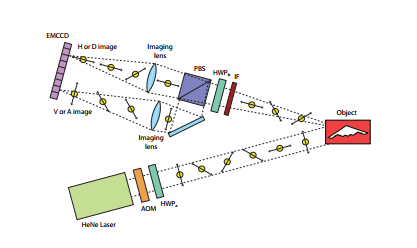
So their idea is to use polarised photons to detect and image objects. Reflected photons can of course be used to build up an image of the object. But an adversary could intercept these photons and resend them in a way that disguises the object’s shape or makes it look as if it is elsewhere.

However, such a process would always change the quantum properties of the photons such as their polarisation. And so it should always be possible to detect such interference. “In order to jam our imaging system, the object must disturb the delicate quantum state of the imaging photons, thus introducing statistical errors that reveal its activity,” say Malik and co.

That’s more or less exactly how quantum key distribution for cryptography works. The idea here is that any eavesdropper would change the quantum properties of the key and so reveal his or her presence. The only difference in the quantum imaging scenario is that the “message” is sent and received by the same person.

Malik and co have tested their idea by bouncing photons off an aeroplane-shaped target and measuring the polarisation error rate in the return signal. Without any eavesdropping the system easily imaged the aeroplane.

But when an adversary intercepted the photons and modified them to send back an image of a bird, the interference was easy to spot, say Malik and co.

That’s an impressive demonstration of the first imaging system that is unjammable thanks to quantum mechanics.

That’s not to say the technique is perfect. It suffers from the same limitations that plague early quantum cryptographic systems, which are theoretically secure but crackable in practice.

For example, instead of sending single photons, the quantum imaging system sends photon pulses which contain several photons. One or more of these can easily be siphoned away and analysed by an adversary without anybody else being any the wiser.

However, there are an increasingly wide range of fixes for these problems for quantum key distribution that could help make this quantum imaging system more secure.

Perhaps best of all, this kind of system could easily be put to work now. The techniques are well known and widely used in optics labs all over the world. So there’s no reason, this security cannot be added relatively quickly and cheaply to existing imaging systems.

Via: "Tehcnology Review"

Saturday, December 22, 2012

Cosmic Journeys : The Largest Black Holes In The Universe


A supermassive black hole is the largest type of black hole in a galaxy, on the order of hundreds of thousands to billions of solar masses. Most--and possibly all--galaxies, including the Milky Wa y(see Sagittarius A), are believed to contain Supermassive black holes at their centers.

Supermassive black holes have properties which distinguish them from lower-mass classifications. First, the average density of a supermassive black hole (defined as the mass of the black hole divided by the volume within its Schwarzschild radius) can be less than the density of water in the case of some supermassive black holes.

Donald Lynden-Bell and Martin Rees hypothetized in 1971 that the center of the Milky Way galaxy would contain a supermassive black hole. Sagittarius A was discovered and named on February 13 and 15, 1974, by astronomers Bruce Balick and Robert Brown using the baseline interferometer of the National Radio Astronomy Observatory. They discovered a radio source that emits synchrotronic radiation, also it was found to be dense and immobile because of its gravitation. Therefore, the first discovered supermassive black hole existed in the center of the Milky Way.

Supermassive Black Holes Outside The Milky Way

It is now widely accepted that the center of nearly every galaxy contains a supermassive black hole.

It is believed that black holes and their host galaxies coevolved between 300-800 million years after the Big Bang, passing through a quasar phase.

The nearby Andromeda Galaxy, 2.5 million light-years away, contains a (1.1–2.3) × 108 (110-230 million) solar mass central black hole, significantly larger than the Milky Way's.

The largest supermassive black hole in the Milky Way's neighborhood appears to be that of M87, weighing in at (6.4 ± 0.5) × 109 (~6.4 billion) solar masses at a distance of 53.5 million light years.

On 5 December 2011 astronomers discovered the largest super massive black hole yet found to be that of NGC 4889, weighing in at 21 billion solar masses at a distance of 336 million light-years away in the Coma constellation.

Some galaxies, such as Galaxy 0402+379, appear to have two supermassive black holes at their centers, forming a binary system.

Binary supermassive black holes are believed to be a common consequence of galactic mergers. The binary pair in OJ 287, 3.5 billion light years away, contains the previous most massive black hole known (until the December 2011 discovery, with a mass estimated at 18 billion solar masses.

A supermassive black hole was recently discovered in the dwarf galaxy Henize 2-10, which has no bulge. The precise implications for this discovery on black hole formation are unknown, but may indicate that black holes formed before bulges.

On March 28, 2011, a supermassive black hole (SMBH) was for the first time seen tearing a mid-size star apart. That is, according to astronomers, the only likely explanation of the observations that day of sudden X-ray radiation and the follow-up broad-band observations.

The source was previously an inactive galactic nucleus, and from study of the outburst the galactic nucleus is estimated to be a SMBH with mass of the order of a million solar masses. This rare event is assumed to be a relativistic outflow (material being emitted in a jet at a significant fraction of the speed of light) from a star tidally disrupted by the SMBH. A significant fraction of a solar mass of material is expected to have accreted onto the SMBH. Subsequent long-term observation will allow this assumption to be confirmed if the emission from the jet decays at the expected rate for mass accretion onto a SMBH.

Info via: "Wikipedia"