Showing posts with label Mosques. Show all posts

Sunday, November 09, 2014

Conversing With The Lord


The Sultan Hassan Mosque is a compact and stylish mosque.It is one of the masterpieces of Mamluk architecture.
The building was commissioned by Sultan Hassan bin Al-Nasir Muhammad bin Qalawun in 1356 AD as a mosque and religious school for all four juristic branches of Sunni Islam.
Construction started in 1356 AD and ended 7 years later in 1363 AD
By Saira Bhatti
Taken on: July 1, 2011


Friday, October 03, 2014

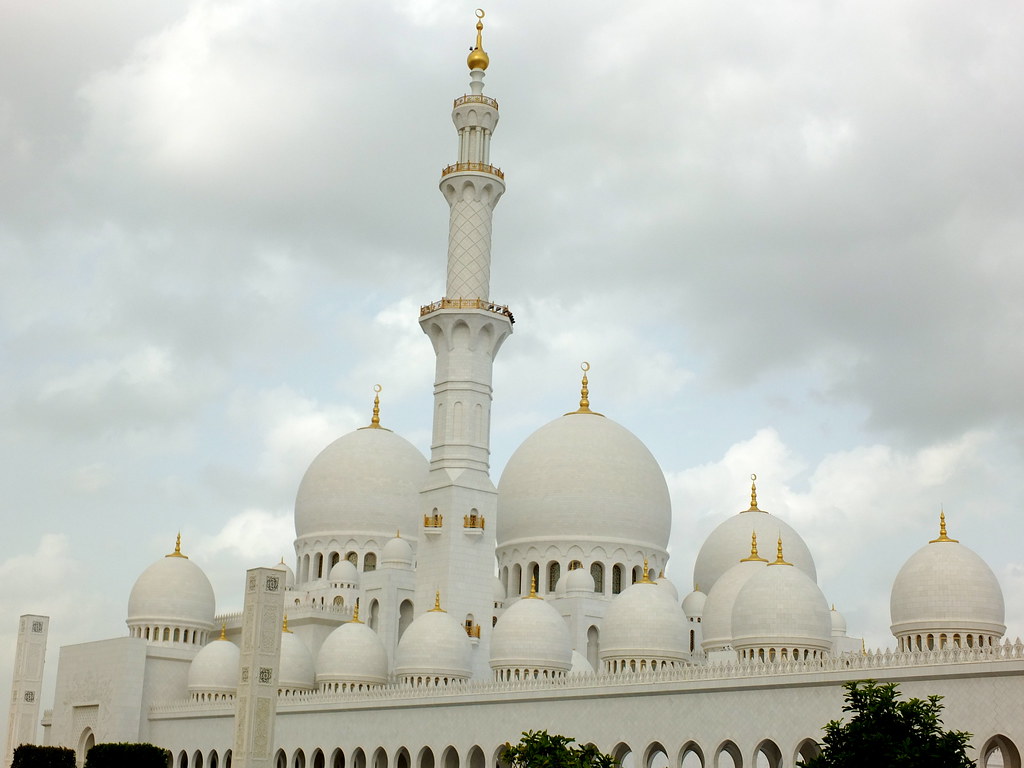
Minaret


By Dan
Taken on: March 31, 2011
Location: Sheikh Zayed Grand Mosque (جامع الشيخ زايد الكبير), Abu Dhabi (أبو ظبي)
Note: The above title is mine. 

Friday, June 20, 2014

Sheikh Zayed Mosque Light Show


In celebration of UAE National Day 2011

Projection and design by Obscura Digital

44 projectors with a combined brightness of 840,000 lumens, were used to cover a surface 600ft wide x 351ft high

Music by Random Rab

Tuesday, October 15, 2013

Medina


With giant umbrella’s that open to protect the visitors from the scorching sun.

By Ali Asghari
Masjid Al-Nabawi
(The Prophet’s Mosque
Location: Medina, Saudi Arabia


Tuesday, August 21, 2012

Arson, Vandalism At Mosques Not Uncommon


Three suspicious fires within four years at the mosque west of Joplin are part of a national trend.

The American Civil Liberties Union and the Council on American-Islamic Relations have tracked dozens of fires, firebombings and incidents of vandalism at mosques around the country in recent years.

Among the attacks on mosques in the past two years have been these, according to the council:

• In July, a South Carolina mosque was vandalized when someone threw a large outdoor concrete ashtray through a window.

• In June, the Michigan chapter of the Council on American-Islamic Relations called on the FBI to investigate a possible bias motive for a fire and hate graffiti targeting a building associated with a Dearborn mosque.

• In April, someone threw a rock through a rear window of the Bab E Mustafa Community Center in the Riverview area of Baltimore County, Md.

• In January, the Council on American-Islamic Relations called on the FBI and local law enforcement to investigate vandalism targeting a mosque under construction in Virginia. Vandals smashed glass in windows and doors of the Chantilly mosque, causing an estimated $60,000 in damage.

• A mosque in Queens, N.Y., was firebombed in January with worshippers inside. There were no injuries.

• An Oct. 31, 2011, arson fire at a mosque in Wichita, Kan., caused an estimated $120,000 in damage.

• An arson attack on a Houston, Texas, mosque was reported in May 2011.

• In April 2011, someone burned three copies of the Quran, the Muslim holy book, and left a threatening letter near the entrance of the Islamic Center of Springfield, Mo., mosque. The anonymous letter claimed that Muslims would “stain the earth” and that Islam wouldn’t survive.

• A fire at a Kansas City mosque in February 2011 was termed “suspicious.”

• Construction equipment was set afire at the site of a mosque being built in Murfreesboro, Tenn., in August 2010.

Via: "The Joplin Globe"

Sunday, November 13, 2011

Pig Parts Dumped At Swiss Mosque Site

In a 2009 referendum, voters prohibited the construction of new minarets in Switzerland.
In a 2009 referendum, voters prohibited the construction of new minarets in Switzerland


By Brian Walker, 
CNN Updated 6:46 PM EST, Sat November 12, 2011 
Courtesy Of "CNN"


(CNN) -- Muslims in Switzerland are responding with shock and outrage after a pig carcass and severed swine heads were discovered buried at the site of a proposed mosque.
Police in the town of Grenchen uncovered the pigs Friday after they received an anonymous message claiming that someone had buried the body parts and spilled 120 liters of blood from the animals in an effort to desecrate the ground to halt the construction of the mosque.
Pork and pork byproducts are haram, or forbidden, in Islam.
The unsigned flier, written in German, says "This operation was done (conducted) to protest against the growing expansion of Islam in Switzerland," and says that a similar desecration in Spain earlier halted another mosque construction project.
Thomas Suber, chief of the Solothurn Canton police, told CNN by phone that there were no suspects currently, but that a full investigation is under way.
"We can't say yet it is a hate crime in those words, but it could have been done to stop the mosque," said Suber.
Suber said that whoever is responsible may be brought up on environmental pollution charges.
The police chief says that veterinary health officials have been called in to find if pig's blood has in fact been spilled, and that charges may be filed over illegal dumping of animal parts in addition to other potential criminal charges.
But for Muslims in Switzerland, it's just the latest sign that they are being victimized by some in the far right.
Abdel Azziz Qaasim Illi, spokesman for Switzerland's Central Islamic Council said the deed "crossed a line" that had already been pushed against Muslims since a popular referendum in 2009 banned the construction of new minarets.
"Since the ban on minarets there's been an increase in Islamophobia and Islamophobic events, so it was not really surprising" said Illi. "But it is an escalation in Switzerland because this is a peaceful country where Christians and Muslims have all been living together... and we are a bit afraid this may increase."
There are an estimated 500,000 Muslims in Switzerland, out of a population of more than 7 million says Illi, who admitted that the population is rising but that most Swiss Muslims were immigrants from Albania and elsewhere in the Balkans, where there is a tradition of moderate Islam.
The property had been purchased by the local Muslim community several years ago from a Swiss far right political activist. The man claimed that he had not been informed that it would be used for a mosque and had fought the sale in court, before ultimately losing his civil case recently allowing construction to go forward.
"We can just wait for the next rain or snowfall to cleanse the ground, so we do not fear from this side anything," said Illi.
"But on the other hand it's an emotional thing, it means that there are actually people in this society who deny the right of Muslims when it comes to a mosque in Switzerland and this is something that hurts us."

Wednesday, February 23, 2011

Beyond The Beards and Burqas


Muslim men in London prepare Iftar, the meal which breaks the Ramadan fast. Such images stand in contrast to the way Islam is often portrayed as the religion of "extremists" in mainstream British media [GALLO/GETTY]


As The Iraq Inquiry and The 7/7 Inquest Draw To A Close, Attitudes To Islam In Britain Are Under Scrutiny.

By Stefan Simanowitz
Last Modified: 17 Feb 2011 09:33 GMT
Courtesy Of "Al Jazeera"

The most striking scene in Nick Broomfield's powerful 2007 film Battle for Haditha is not one of violence but love.

A wife calls to her husband from an upstairs window. He comes up to the bedroom. She removes her hijab. Her hair tumbles over her bare shoulders. They shower and then make love. The scene is not especially erotic or intense.

What makes it memorable is the rarity of seeing Muslims depicted in a normal way, doing normal things, like normal people. Muslims of the Western popular imagination are too often angry men waving guns or distraught women wailing beside gravesides. They are terrorists and suicide bombers. They are patriarchal husbands, violent fathers or repressed women forced to cover their faces and murdered in the name of honour.

Over the next few months, two inquiries that go to the heart of Britain's relationship with Islam, both at home and abroad, will publish reports. Although neither the Iraq inquiry, which drew to an end this month, nor the ongoing inquest into the 7/7 bombings, will explore this complex relationship in any concrete way, it is nevertheless this relationship that provides the essential context through which we may come closer to an understanding of these events and of wider societal trends.

Blair's Plea

Towards the end of his testimony at the Iraq inquiry in January, Tony Blair, Britain's former prime minister, veered away from a question put to him by a member of the panel to make an impassioned plea.

"The West has got to get out of this wretched posture of apology for believing we are responsible for what ... these extremists are doing. We are not," he said.

"The fact is that they are doing it because they disagree fundamentally with our way of life and they will carry on doing it unless they are met by the requisite determination and, if necessary, force."

This insight into Blair's worldview shows not only that he harbours no regrets about the Iraq war and believes there is much killing still to be done, but also provides a clear thumbnail exposition of his rationale.

Rather than acknowledging the unsettling existence of a multitude of radicalised groups living in our midst and scattered across the globe, Blair prefers to view the West as facing a single enemy. Indeed, using the words "extremists", "Islamists" and "al-Qaeda" interchangeably, the Middle East peace envoy stopped just short of calling for war on Iran.

They're All Out To Get 'Us'

The former prime minister does not differentiate between extremists - and believes any attempt to try to comprehend the reasons for their murderous rage is futile.

Instead, he takes the much more comforting view that they are "at war with civilisation". We are being targeted, so the reasoning goes, because we are too civilised.

This simplistic view, so often repeated, has gained currency in the British popular imagination. Indeed, for most Britons, July 7, 2005, will be remembered as the day that al-Qaeda terrorists attacked London.

But five-and-a-half years on, no link has been established between the 7/7 bombers and al-Qaeda. While it is possible that two of the bombers, Shehzad Tanweer and Mohammad Sidique Khan, may have visited training camps in Pakistan and met with al-Qaeda operatives, there is no firm evidence of this.

Last year a report from the Centre for Social Cohesion analysing Islamist terrorist offences in Britain over the past decade found that only 14.5 per cent of terrorism offenders had links with al-Qaeda. And yet, despite this, a belief persists that most Islamic jihadist attacks, including the 7/7 bombings, are somehow masterminded by al Qaeda.

Al-Qaeda 'Doesn't Exist'

According to Alain Bauer, professor of criminology and terrorism specialist, al-Qaeda as it is commonly depicted, does not exist. "It is not like a James Bond movie where they are villains based in a volcano," he tells me. "Rather, al-Qaeda is more like a mutual organisation or a franchise."

Bauer believes the "invention" of al-Qaeda results from a very human desire to put a name and a face to an otherwise unknowable enemy. But "knowing thine enemy" should extend beyond knowing his name and what he looks like. It should also involve a genuine attempt to understand why it is he wants to destroy you.

Despite having given a name to our enemy, Western populations do not feel more secure. Al-Qaeda remains an unknown and unquantifiable force.

The resultant pervasive sense of fear has allowed us to accept the incursion of the surveillance state, the loss of many hard won freedoms and a foreign policy which now regards as justified pre-emptive attacks on states - in breach of international law. Indeed, a key failing of the Iraq inquiry has been its failure to ask not just about the existence of weapons of mass destruction (WMD) but about the evidence of intent to use them and evidence of imminent attack.

While the taking of innocent life can never be justified or excused, understanding the causes of Islamic extremism is clearly essential if we are to stop its rise. It may be comforting to believe that we in the West are being targeted because we are 'too civilised", but the reality is much more complex. In times of austerity, it is common for people to find convenient scapegoats on whom to vent their frustration and angry. Minority or immigrant populations have traditionally fulfilled this role and if we are not careful, the coincidence of rising unemployment, declining social welfare provision and growing anti-Islamic sentiment create a "perfect storm".

The lessons we must take from the 2003 invasion of Iraq and from the 7/7 bombings must go beyond those of operational effectiveness and good governance. While we should not be apologetic, we should also not be blinkered. We need to challenge lazy simplifications and stereotypes. We must look behind the beards and the burqas and recognise our common humanity.

Stefan Simanowitz is a writer, journalist and human rights campaigner. He campaigned against the 2003 invasion of Iraq and attended the Chilcot Inquiry.

Sunday, January 23, 2011

Islamophobia 'Acceptable' In UK


There are around 2.9 million Muslims living in Britain, about five per cent of the population [GALLO/GETTY] 


British Politician Says Prejudice Against Muslims Is Now Socially Acceptable and That Country Is Becoming Less Tolerant.

Last Modified: 20 Jan 2011 14:27 GMT
Courtesy Of "Al-Jazeera"

Prejudice against Muslims has "passed the dinner-table test" and become socially acceptable in Britain, the chairwoman of the country's ruling Conservative party has said.

Sayeeda Warsi, the first British Muslim woman to join the country's cabinet, said in a speech at the University of Leicester on Thursday that Britain is becoming a less tolerant place for believers.

Warsi said that dividing Muslims into "moderate" and "extremist" fuels intolerance as does "the patronising, superficial way faith is discussed in certain quarters, including the media".

The Pakistan-born minister has previously criticised parts of British society for demonizing Muslims in response to the threat from small numbers of extremists.

'Challenge For Britain'

In her latest speech she said that attacks committed by a small number of Muslims should not be used to condemn the entire community.

But she also urgeed Muslim communities to be clearer about their rejection of radical acts.

Britain has around 2.9 million Muslims, around five per cent of the population, according to an estimate in 2010 by the Pew Forum on Religion and Public Life.

Anas Altikriti, the director of the Cordoba Foundation, which works toward bridging the gap between the Muslim and Western world, told Al Jazeera that Warsi should be congratulated for her remarks.

"What it achieves is basically to place this particular issue and this challenge for British society and Britain as a whole firmly on the table of debate," he said.

"I think there is a greater recognition that this is something that has to be addressed in a collective manner."

But he added that comments on their own "don't really do much. What we need ... is a set of policies".

Warsi's comments come after David Cameron, the prime minister, said in his New Year message that Britain still faced a serious threat of attack plots.

"We must ask ourselves as a country how we are allowing the radicalisation and poisoning of the minds of some young British Muslims who then contemplate and sometimes carry out acts of sickening barbarity," he said.

His official spokesperson said on Thursday that Warsi was "expressing her view" and that the prime minister "agrees that this is an important debate".

US Pastor Banned

Meanwhile, Britain has banned Terry Jones, the US pastor who sparked global outrage by threatening to burn the Quran, from entering the country.

Jones was invited to speak at an event next month, by an anti-immigrant group called "England Is Ours".

But the UK's interior ministry said his presence is "not conducive to the public good".

Wednesday, January 05, 2011

Whatever Happened To The "Ground Zero Mosque"?

A Manufactured Story Disappeared Just As Suddenly As It Burst Onto The Media Scene In 2010

By Justin Elliott
FRIDAY, DEC 31, 2010 11:01 ET
Courtesy Of "The Salon Media Group"

Sunday, December 05, 2010

Is There An Antidote For Anti-Muslim Rhetoric?

Ignorance is our real enemy in this struggle against the forces of hatred and division, and the more ignorance there is, the stronger the hand of those who seek to marginalize the American Muslim community.

By Hesham Hassaballa
December 1st, 2010
Courtesy Of "IslamiCity"

The summer of 2010 has seen tremendous anti-Muslim rhetoric, fervor, and disinformation. By twisting the truth about Islam and Muslims, a relatively small number of anti-Muslim ideologues have managed to take over the discourse and create a truly hostile environment for American Muslims. This is being borne out in the numerous mosque fights that have sprung up across the country, with the grandest example being the non-controversy that became the controversial "Ground Zero Mosque," or as comedian Jon Stewart likes to call it, the "Community Center of Death.

The root cause of all this hostility is ignorance and misinformation. Americans are still woefully misinformed about Islam. According to a recent Pew Research Poll, 65% of Americans know either "some" or "not very much" about Islam. One in four Americans know "nothing at all." This void in knowledge is fertile ground into which Islamophobes can plant their seeds of misinformation. Yet, I cannot blame my fellow non-Muslim Americans for this lack of knowledge about Islam. Many Americans know very little about even their own faiths.

The Pew Forum on Religion and Public Life released the US Religious Knowledge Surveydetailing Americans' knowledge about religion. And it does not look pretty. According to the survey, more than four-in-ten Catholics in the United States (45%) do not know that their church teaches that the bread and wine used in Communion do not merely symbolize but actually become the body and blood of Christ. About half of Protestants (53%) cannot correctly identify Martin Luther as the person whose writings and actions inspired the Protestant Reformation, which made their religion a separate branch of Christianity. Roughly four-in-ten Jews (43%) do not recognize that Maimonides, one of the most venerated rabbis in history, was Jewish.

This puts Americans' lack of knowledge about Islam in perspective. Nevertheless, ignorance is our real enemy in this struggle against the forces of hatred and division, and the more ignorance there is, the stronger the hand of those who seek to marginalize the American Muslim community. What can Muslims do about this? "Work harder," is the inevitable answer. "Work harder at educating the American public about Islam."

Yet, even that is becoming more and more difficult to do. People are being told not to trust what Muslims say because they are all practicing "taqiyya." The recent declaration of Faisal Shahzad that when he took an oath of allegiance to the United States, he "did not mean it" does not help to dispel this falsehood. Moreover, there are moves to change American textbooks, which have been deemed by some to be too "pro-Muslim." So, what are we to do?


More engagement, on both a personal and national level, needs to be undertaken. American Muslims all live somewhere, and that "somewhere" has neighbors. American Muslims need to know their neighbors on an intimate, personal level. Exchange gifts, go to block parties, coach softball teams, become Neighborhood Watch block captains - that is the best way to teach about Islam, by showing what "real live Islam" looks like. Yes, public service announcements highlighting the role of Muslim 9/11 first responders do help in a big way. Yes, more credible, honest Muslim spokespeople in the mainstream media help. But, local engagement is the key.

In addition, Muslims must enter into the field of the arts in droves: writing books, producing television shows, and making films. Muslims have already made great strides: the wonderful work of Unity Productions Foundation, Azhar Usman, Wajahat Ali, and G. Willow Wilson are excellent examples. I am also trying to contribute to this effort with my forthcoming book, Noble Brother, which is the story of the Prophet Muhammad told entirely in poetry. Each one of us has a talent, and we should try to use that talent to contribute to the American Muslim story.

Moreover, Muslims should start promoting themselves a little more on a local level. I was speaking to a Muslim producer of a local Chicago TV network news affiliate, and she told me that a great way to increase the number of positive stories about Muslims in the media is to self-promote. More of us should be the "local experts" on Islam and the American Muslim story and share this expertise with their local news media.

We should all have Press Kits ready for distribution. If we are doing something positive, such as running a marathon for a good cause or donating to a free clinic, we should send out a press release. Foment good relationships with local print and broadcast reporters. This is already being done all across the country, but we need more of it. We all know that American Muslims contribute positively to the country's well being every single day; more of our neighbors should know about it as well.

This is not an easy task, not in the least. But, it is essential. It is not necessary that every non-Muslim American become experts at Islam; many are not even expert in their own faiths. But what is necessary is that we are all familiar enough with each other - our likes, our dislikes, our hopes, our dreams - that when we see images of pedophile priests or "Islamic" suicide bombers, we say to ourselves, "I know that is not the reality, because my neighbor is not like that. And I believe my neighbor more than I believe what's on the TV." And we will all the better for it.

Source: AltMuslimauthor - Hesham A. Hassaballa is a Chicago physician and writer. He is the co-author of "The Beliefnet Guide to Islam," published by Doubleday in 2006. His blog is called God, Faith, and a Pen.

Friday, November 19, 2010

The Politics Behind Misunderstanding Islam

By John Feffer
November 10, 2010
Courtesy Of "IslamiCity's iViews"

The Muslims were bloodthirsty and treacherous. They conducted a sneak attack against the French army and slaughtered every single soldier, 20,000 in all. More than 1,000 years ago, in the mountain passes of Spain, the Muslim horde cut down the finest soldiers in Charlemagne's command, including his brave nephew Roland. Then, according to the famous poem that immortalized the tragedy, Charlemagne exacted his revenge by routing the entire Muslim army.

The Song of Roland, an eleventh century rendering in verse of an eighth century battle, is a staple of Western Civilization classes at colleges around the country. A "masterpiece of epic drama," in the words of its renowned translator Dorothy Sayers, it provides a handy preface for students before they delve into readings on the Crusades that began in 1095. More ominously, the poem has schooled generations of Judeo-Christians to view Muslims as perfidious enemies who once threatened the very foundations of Western civilization.

The problem, however, is that the whole epic is built on a curious falsehood. The army that fell upon Roland and his Frankish soldiers was not Muslim at all. In the real battle of 778, the slayers of the Franks were Christian Basques furious at Charlemagne for pillaging their city of Pamplona. Not epic at all, the battle emerged from a parochial dispute in the complex wars of medieval Spain. Only later, as kings and popes and knights prepared to do battle in the First Crusade, did an anonymous bard repurpose the text to serve the needs of an emerging cross-against-crescent holy war.

Similarly, we think of the Crusades as the archetypal "clash of civilizations" between the followers of Jesus and the followers of Mohammed. In the popular version of those Crusades, the Muslim adversary has, in fact, replaced a remarkable range of peoples the Crusaders dealt with as enemies, including Jews killed in pogroms on the way to the Holy Land, rival Catholics slaughtered in the Balkans and in Constantinople, and Christian heretics hunted down in southern France.

Much later, during the Cold War, mythmakers in Washington performed a similar act, substituting a monolithic crew labeled "godless communists" for a disparate group of anti-imperial nationalists in an attempt to transform conflicts in remote locations like Vietnam, Guatemala, and Iran into epic struggles between the forces of the Free World and the forces of evil. In recent years, the Bush administration did it all over again by portraying Arab nationalists as fiendish Islamic fundamentalists when we invaded Iraq and prepared to topple the regime in Syria.

Similar mythmaking continues today. The recent surge of Islamophobia in the United States has drawn strength from several extraordinary substitutions. A clearly Christian president hasbecome Muslim in the minds of a significant number of Americans. The thoughtful Islamic scholar Tariq Ramadan has become a closet fundamentalist in the writings of Paul Berman and others. And an Islamic center in lower Manhattan, organized by proponents of interfaith dialogue, has become an extremist "mosque at Ground Zero" in the TV appearances, political speeches, and Internet sputterings of a determined clique of right-wing activists.

This transformation of Islam into a violent caricature of itself -- as if Ann Coulter had suddenly morphed into the face of Christianity -- comes at a somewhat strange juncture in the United States. Anti-Islamic rhetoric and hate crimes, which spiked immediately after September 11, 2001, had been on the wane. No major terrorist attack had taken place in the U.S. or Europe since the London bombings in 2005. The current American president had reached out to the Muslim world and retired the controversial acronym GWOT, or "Global War on Terror."

All the elements seemed in place, in other words, for us to turn the page on an ugly chapter in our history. Yet it's as if we remain fixed in the eleventh century in a perpetual battle of "us" against "them." Like the undead rising from their coffins, our previous "crusades" never go away.  Indeed, we still seem to be fighting the three great wars of the millennium, even though two of these conflicts have long been over and the third has been rhetorically reduced to "overseas contingency operations." The Crusades, which finally petered out in the seventeenth century, continue to shape our global imagination today. The Cold War ended in 1991, but key elements of the anti-communism credo have been awkwardly grafted onto the new Islamist adversary. And the Global War on Terror, which President Obama quietly renamed shortly after taking office, has in fact metastasized into the wars that his administration continues to prosecute in Afghanistan, Pakistan, Iraq, Yemen, and elsewhere.

Those in Europe and the United States who cheer on these wars claim that they are issuing a wake-up call about the continued threat of al-Qaeda, the Taliban, and other militants who claim the banner of Islam. However, what really keeps Islamophobes up at night is not the marginal and backwards-looking Islamic fundamentalists but rather the growing economic, political, and global influence of modern, mainstream Islam. Examples of Islam successfully grappling with modernity abound, from Turkey's new foreign policy and Indonesia's economic muscle to the Islamic political parties participating in elections in Lebanon, Morocco, and Jordan. Instead of providing reassurance, however, these trends only incite Islamophobes to intensify their battles to "save" Western civilization.

As long as our unfinished wars still burn in the collective consciousness -- and still rage in Kabul, Baghdad, Sana'a, and the Tribal Areas of Pakistan -- Islamophobia will make its impact felt in our media, politics, and daily life. Only if we decisively end the millennial Crusades, the half-century Cold War, and the decade-long War on Terror (under whatever name) will we overcome the dangerous divide that has consumed so many lives, wasted so much wealth, and distorted our very understanding of our Western selves.

The Crusades Continue

With their irrational fear of spiders, arachnophobes are scared of both harmless daddy longlegs and poisonous brown recluse spiders. In extreme cases, an arachnophobe can break out in a sweat while merely looking at photos of spiders. It is, of course, reasonable to steer clear of black widows. What makes a legitimate fear into an irrational phobia, however, is the tendency to lump all of any group, spiders or humans, into one lethal category and then to exaggerate how threatening they are. Spider bites, after all, are responsible for at most a handful of deaths a year in the United States.


Islamophobia is, similarly, an irrational fear of Islam. Yes, certain Muslim fundamentalists have been responsible for terrorist attacks, certain fantasists about a "global caliphate" continue to plot attacks on perceived enemies, and certain groups like Afghanistan's Taliban and Somalia's al-Shabaab practice medieval versions of the religion. But Islamophobes confuse these small parts with the whole and then see terrorist jihad under every Islamic pillow. They break out in a sweat at the mere picture of an imam.

Irrational fears are often rooted in our dimly remembered childhoods. Our irrational fear of Islam similarly seems to stem from events that happened in the early days of Christendom. Three myths inherited from the era of the Crusades constitute the core of Islamophobia today: Muslims are inherently violent, Muslims want to take over the world, and Muslims can't be trusted.

The myth of Islam as a "religion of the sword" was a staple of Crusader literature and art. In fact, the atrocities committed by Muslim leaders and armies -- and there were some -- rarely rivaled the slaughters of the Crusaders, who retook Jerusalem in 1099 in a veritable bloodbath.

"The heaps of the dead presented an immediate problem for the conquerors," writesChristopher Tyerman in God's War. "Many of the surviving Muslim population were forced to clear the streets and carry the bodies outside the walls to be burnt in great pyres, whereat they themselves were massacred." Jerusalem's Jews suffered a similar fate when the Crusaders burned many of them alive in their main synagogue. Four hundred years earlier, by contrast, Caliph 'Umar put no one to the sword when he took over Jerusalem, signing a pact with the Christian patriarch Sophronius that pledged "no compulsion in religion."

This myth of the inherently violent Muslim endures. Islam "teaches violence," televangelist Pat Robertson proclaimed in 2005. "The Koran teaches violence and most Muslims, including so-called moderate Muslims, openly believe in violence," was the way Major General Jerry Curry (U.S. Army, ret.), who served in the Carter, Reagan, and Bush Sr. administrations, put it.

The Crusaders justified their violence by arguing that Muslims were bent on taking over the world. In its early days, the expanding Islamic empire did indeed imagine an ever-growing Dar-al-Islam (House of Islam). By the time of the Crusades, however, this initial burst of enthusiasm for holy war had long been spent. Moreover, the Christian West harbored its own set of desires when it came to extending the Pope's authority to every corner of the globe. Even that early believer in soft power, Francis of Assisi, sat down with Sultan al-Kamil during the Fifth Crusade with the aim of eliminating Islam through conversion.

Today, Islamophobes portray the building of Cordoba House in lower Manhattan as just another gambit in this millennial power grab: "This is Islamic domination and expansionism,"writes right-wing blogger Pamela Geller, who made the "Ground Zero Mosque" into a media obsession. "Islam is a religion with a very political agenda," warns ex-Muslim Ali Sina. "The ultimate goal of Islam is to rule the world."


These two myths -- of inherent violence and global ambitions -- led to the firm conviction that Muslims were by nature untrustworthy. Robert of Ketton, a twelfth century translator of the Koran, was typical in badmouthing the prophet Mohammad this way: "Like the liar you are, you everywhere contradict yourself." The suspicion of untrustworthiness fell as well on any Christian who took up the possibility of coexistence with Islam. Pope Gregory, for instance, believed that the thirteenth century Crusader Frederick II was the Anti-Christ himself because he developed close relationships with Muslims.

For Islamophobes today, Muslims abroad are similarly terrorists-in-waiting. As for Muslims at home, "American Muslims must face their either/or," writes the novelist Edward Cline, "to repudiate Islam or remain a quiet, sanctioning fifth column." Even American Muslims in high places, like Congressman Keith Ellison (D-MN), are not above suspicionIn a 2006 CNN interview, Glenn Beck said, "I have been nervous about this interview with you, because what I feel like saying is, 'Sir, prove to me that you are not working with our enemies.'"

These three myths of Islamophobia flourish in our era, just as they did almost a millennium ago, because of a cunning conflation of a certain type of Islamic fundamentalism with Islam itself. Bill O'Reilly was neatly channeling this Crusader mindset when he asserted recently that "the Muslim threat to the world is not isolated. It's huge!"  When Deputy Undersecretary of Defense for Intelligence William Boykin, in an infamous 2003 sermon, thundered "What I'm here to do today is to recruit you to be warriors of God's kingdom," he was issuing the Crusader call to arms.

But O'Reilly and Boykin, who represent the violence, duplicity, and expansionist mind-set of today's Western crusaders, were also invoking a more recent tradition, closer in time and far more familiar.


The Totalitarian Myth

In 1951, the CIA and the emerging anti-communist elite, including soon-to-be-president Dwight Eisenhower, created the Crusade for Freedom as a key component of a growing psychological warfare campaign against the Soviet Union and the satellite countries it controlled in Eastern Europe. The language of this "crusade" was intentionally religious. It reached out to "peoples deeply rooted in the heritage of western civilization," living under the "crushing weight of a godless dictatorship." In its call for the liberation of the communist world, it echoed the nearly thousand-year-old crusader rhetoric of "recovering" Jerusalem and other outposts of Christianity.

In the theology of the Cold War, the Soviet Union replaced the Islamic world as the untrustworthy infidel. However unconsciously, the old crusader myths about Islam translated remarkably easily into governing assumptions about the communist enemy: the Soviets and their allies were bent on taking over the world, could not be trusted with their rhetoric of peaceful coexistence, imperiled Western civilization, and fought with unique savagery as well as a willingness to martyr themselves for the greater ideological good.


Ironically, Western governments were so obsessed with fighting this new scourge that, in the Cold War years, on the theory that my enemy's enemy is my friend, they nurtured radical Islam as a weapon. As journalist Robert Dreyfuss ably details in his book The Devil's Game, the U.S. funding of the mujahideen in Afghanistan was only one part of the anti-communist crusade in the Islamic world. To undermine Arab nationalists and leftists who might align themselves with the Soviet Union, the United States (and Israel) worked with Iranian mullahs, helped create Hamas, and facilitated the spread of the Muslim Brotherhood.

Though the Cold War ended with the sudden disappearance of the Soviet Union in 1991, that era's mind-set -- and so many of the Cold Warriors sporting it -- never went with it. The prevailing mythology was simply transferred back to the Islamic world.  In anti-communist theology, for example, the worst curse word was "totalitarianism," said to describe the essence of the all-encompassing Soviet state and system.

According to the gloss that early neoconservative Jeanne Kirkpatrick provided in her bookDictatorships and Double Standards, the West had every reason to support right-wing authoritarian dictatorships because they would steadfastly oppose left-wing totalitarian dictatorships, which, unlike the autocracies we allied with, were supposedly incapable of internal reform.

According to the new "Islamo-fascism" school -- and its acolytes like Norman Podhoretz, David Horowitz, Bill O'Reilly, Pamela Geller -- the fundamentalists are simply the "new totalitarians," as hidebound, fanatical, and incapable of change as communists. For a more sophisticated treatment of the Islamo-fascist argument, check out Paul Berman, a rightward-leaning liberal intellectual who has tried to demonstrate that "moderate Muslims" are fundamentalists in reformist clothing.

These Cold Warriors all treat the Islamic world as an undifferentiated mass -- in spirit, a modern Soviet Union -- where Arab governments and radical Islamists work hand in glove. They simply fail to grasp that the Syrian, Egyptian, and Saudi Arabian governments have launched their own attacks on radical Islam. The sharp divides between the Iranian regime and the Taliban, between the Jordanian government and the Palestinians, between Shi'ites and Sunni in Iraq, and even among Kurds all disappear in the totalitarian blender, just as anti-communists generally failed to distinguish between the Communist hardliner Leonid Brezhnev and the Communist reformer Mikhail Gorbachev.

At the root of terrorism, according to Berman, are "immense failures of political courage and imagination within the Muslim world," rather than the violent fantasies of a group of religious outliers or the Crusader-ish military operations of the West. In other words, something flawed at the very core of Islam itself is responsible for the violence done in its name -- a line of argument remarkably similar to one Cold Warriors made about communism.

All of this, of course, represents a mirror image of al-Qaeda's arguments about the inherent perversities of the infidel West. As during the Cold War, hardliners reinforce one another.

The persistence of Crusader myths and their transposition into a Cold War framework help explain why the West is saddled with so many misconceptions about Islam. They don't, however, explain the recent spike in Islamophobia in the U.S. after several years of relative tolerance. To understand this, we must turn to the third unfinished war: the Global War on Terror or GWOT, launched by George W. Bush.

Fanning The Flames

President Obama was careful to groom his Christian image during his campaign. He was repeatedly seen praying in churches, and he studiously avoided mosques. He did everything possible to efface the traces of Muslim identity in his past.

His opponents, of course, did just the opposite. They emphasized his middle name, Hussein,challenged his birth records, and asserted that he was too close to the Palestinian cause.  They also tried to turn liberal constituencies -- particularly Jewish-American ones -- against the presumptive president. Like Frederick II for an earlier generation of Christian
fundamentalists, since entering the Oval Office Obama has become the Anti-Christ of the Islamophobes.

Once in power, he broke with Bush administration policies toward the Islamic world on a few points. He did indeed push ahead with his plan to remove combat troops from Iraq (with some important exceptions). He has attempted to pressure Prime Minister Benjamin Netanyahu's government to stop expanding settlements in occupied Palestinian lands and to negotiate in good faith (though he has done so without resorting to the kind of pressure that might be meaningful, like a cutback of or even cessation of U.S. arms exports to Israel). In a highly publicized speech in Cairo in June 2009, he also reached out rhetorically to the Islamic world at a time when he was also eliminating the name "Global War on Terror" from the government's vocabulary.

For Muslims worldwide, however, GWOT itself continues. The United States has orchestrated a surge in Afghanistan. The CIA's drone war in the Pakistani borderlands has escalated rapidly. U.S. Special Forces now operate in 75 countries, at least 15 more than during the Bush years. Meanwhile, Guantanamo remains open, the United States still practices extraordinary rendition, and assassination remains an active part of Washington's toolbox.


The civilians killed in these overseas contingency operations are predominantly Muslim. The people seized and interrogated are mostly Muslim. The buildings destroyed are largely Muslim-owned. As a result, the rhetoric of "crusaders and imperialists" used by al-Qaeda falls on receptive ears. Despite his Cairo speech, the favorability rating of the United States in the Muslim world, already grim enough, has slid even further since Obama took office -- in Egypt, from 41% in 2009 to 31% percent now; in Turkey, from 33% to 23%; and in Pakistan, from 13% to 8%.

The U.S. wars, occupations, raids, and repeated air strikes have produced much of this disaffection and, as political scientist Robert Pape hasconsistently argued, most of the suicide bombings and other attacks against Western troops and targets as well. This is revenge, not religion, talking -- just as it was for Americans after September 11, 2001. As commentator M. Junaid Levesque-Alam astutely pointed out, "When three planes hurtled into national icons, did anger and hatred rise in American hearts only after consultation of Biblical verses?"

And yet those dismal polling figures do not actually reflect a rejection of Western values (despite Islamophobe assurances that they mean exactly that). "Numerous polls that we have conducted," writes pollster Stephen Kull, "as well as others by the World Values Survey and Arab Barometer, show strong support in the Muslim world for democracy, for human rights, and for an international order based on international law and a strong United Nations."

In other words, nine years after September 11th a second spike in Islamophobia and in home-grown terrorist attacks like that of the would-be Times Square bomber has been born of two intersecting pressures: American critics of Obama's foreign policy believe that he has backed away from the major civilizational struggle of our time, even as many in the Muslim world see Obama-era foreign policy as a continuation, even an escalation, of Bush-era policies of war and occupation.

Here is the irony: alongside the indisputable rise of fundamentalism over the last two decades, only some of it oriented towards violence, the Islamic world has undergone a shift which deep-sixes the clichŽ that Islam has held countries back from political and economic development. "Since the early 1990s, 23 Muslim countries have developed more democratic institutions, with fairly run elections, energized and competitive political parties, greater civil liberties, or better legal protections for journalists," writes Philip Howard in The Digital Origins of Dictatorship and Democracy. Turkey has emerged as a vibrant democracy and a major foreign policy player. Indonesia, the world's most populous Muslim country, is now the largest economy in Southeast Asia and the eighteenth largest economy in the world.

Are Islamophobes missing this story of mainstream Islam's accommodation with democracy and economic growth? Or is it this story (not Islamo-fascism starring al-Qaeda) that is their real concern?

The recent preoccupations of Islamophobes are telling in this regard. Pamela Geller, after all, was typical in the way she went after not a radical mosque, but an Islamic center about two blocks from Ground Zero proposed by a proponent of interfaith dialogue. As journalist Stephen Salisbury writes, "The mosque controversy is not really about a mosque at all; it's about the presence of Muslims in America, and the free-floating anxiety and fear that now dominate the nation's psyche." For her latest venture, Geller is pushing a boycott of Campbell's Soup because it accepts halal certification -- the Islamic version of kosher certification by a rabbi -- from the Islamic Society of North America, a group which, by the way, has gone out of its way to denounce religious extremism.

Paul Berman, meanwhile, has devoted his latest book, The Flight of the Intellectuals, to deconstructing the arguments not of Osama bin-Laden or his ilk, but of Tariq Ramadan, the foremost mainstream Islamic theologian. Ramadan is a man firmly committed to breaking down the old distinctions between "us" and "them." Critical of the West for colonialism, racism, and other ills, he also challenges the injustices of the Islamic world. He is far from a fundamentalist.

And what country, by the way, has exercised European Islamophobes more than any other? Pakistan? Saudi Arabia? Taliban Afghanistan?  No, the answer is: Turkey. "The Turks are conquering Germany in the same way the Kosovars conquered Kosovo: by using higher birth-rates," argues Germany's Islamophobe du jour, Thilo Sarrazin, a member of Germany's Social Democratic Party. The far right has even united around a Europe-wide referendum to keep Turkey out of the European Union.

Despite his many defects, George W. Bush at least knew enough to distinguish Islam from Islamism. By targeting a perfectly normal Islamic center, a perfectly normal Islamic scholar, and a perfectly normal Islamic country -- all firmly in the mainstream of that religion -- the Islamophobes have actually declared war on normalcy, not extremism.

The victories of the tea party movement and the increased power of Republican militants in Congress, not to mention the renaissance of the far right in Europe, suggest that we will be living with this Islamophobia and the three unfinished wars of the West against the Rest for some time. The Crusades lasted hundreds of years. Let's hope that Crusade 2.0, and the dark age that we find ourselves in, has a far shorter lifespan.
*****
John Feffer is the co-director of Foreign Policy in Focus at the Institute for Policy Studies, writes its regular World Beat column, and will be publishing a book on Islamophobia with City Lights Press in 2011. This piece first appeared on TomDispatch.