Showing posts with label Nuclear Energy. Show all posts

Monday, October 01, 2012

The Worlds Nuclear Club

While 14 Nations Host Nuclear Weapons, 30 Countries Generate Atomic Energy, and Another 18 Are Building Future Reactors.


“Why is the news hook not the states already with nuclear weapons?” asks Jonathan Granoff, president of the Global Security Institute, which advocates for the elimination of nuclear weapons.

“Why just about the state that might get nuclear weapons? We should focus on countries that have huge arsenals and get rid of them.”

“The main issue is that 189 countries have agreed to pursue a nuclear-free zone in the Middle East,” says Granoff. “Israel doesn’t want it negotiated until it gets security assurances from its neighbours. But the lack of security is in the threat posed by its [own] unsafeguarded nuclear facilities.”

“Iran is a symptom of the failure to have a universal ban on nuclear weapons,” Granoff told Al Jazeera, suggesting that the international community is not approaching the problem correctly by emphasising Iran’s alleged nuclear aspirations.

“Imagine if the Biological Weapons Convention said that no country can have polio or smallpox as weapons, but we’re going to entrust nine countries with the plague! That’s incoherent and unsustainable because we all understand that the plague is not a legitimate weapon due to its indiscriminate and horrific effects.”

Granoff adds that “a mere one per cent of the world’s nuclear arsenal could end civilisation”.

“It’s not raining, so close the umbrella,” says Granoff. “The Cold War is over. Let’s get over it.”
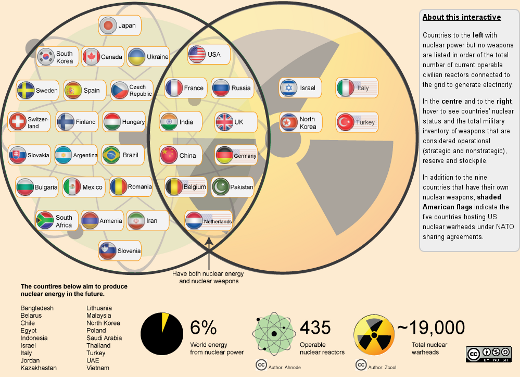

Strategic Warheads

Germany, like Japan, is covered by America's Cold War nuclear umbrella. While Japan is said to be able to produce weapons if it needed to, Germany, along with fellow NATO nations Belgium, Netherlands, Italy and Turkey, stores US warheads on its soil.

Although American strategic warheads are stationed within their borders and local troops know how to handle them, these countries cannot actually make sovereign decisions about use or deployment.

The British have in the past considered giving up their nuclear deterrent. Sceptics say the UK does not actually need its warheads for any defensive reasons.

“They cost an arm and a leg to maintain, and who believes the UK is a superpower at this point?” asks Barth.

Former Cold War enemies Russia and the US have by far the largest number of weapons and are the primary targets of denuclearisation drives. But the most prominent current debate dwells on nascent Iranian capabilities.

Iran has argued its developments are exclusively for civilian purposes and will allow the country to export a larger share of its petroleum resources.


Saturday, July 07, 2012

US May Be Heading For A Nuclear Catastrophe

People and Power
Last Modified: 01 Mar 2012 11:22
Courtesy Of "Al-Jazeera"


In March 2011, a devastating earthquake and tsunami in Japan caused a meltdown at the Fukushima nuclear power plant.

As tens of thousands of people were evacuated from nearby towns and villages, the world waited anxiously to see whether the radioactive fallout would spread across the country, or even be carried overseas.

Unsurprisingly, in the wake of this incident, the nuclear operations of other countries have come under considerable scrutiny.

One such country is the US where more than 100 similar reactors - some of them in earthquake zones or close to major cities - are now reaching the end of their working lives.

Their owners want to keep them running, but others - from environmentalists to mainstream politicians - are deeply concerned.

In this investigation for People & Power, Joe Rubin and Serene Fang of the Center for Investigative Reporting examine whether important safety considerations are being taken into account as the US Nuclear Regulatory Commission (NRC) considers extending the licences of these plants.

The agency has recently come under fire for glossing over the potential dangers of ageing reactors, for becoming too cosy with the industry and for political infighting among the agency's senior executives, which critics in the US Senate and elsewhere say seriously hampers its ability to ensure safety.

The investigation focuses on the Pacific Gas & Electric nuclear facility at Diablo Canyon and two others, Vermont Yankee and Indian Point in New York.

These three sites represent the dangers posed to nuclear power plant safety by earthquakes, terrorism, mechanical breakdown and flooding.

Rubin and Fang discover that the NRC's oversight track record is far from perfect, and that unless urgent action is taken the US could be heading for a nuclear catastrophe of its own.

Wednesday, June 20, 2012

Iran To Build Nuclear-Powered Submarine

Two of Iran
Two of Iran's domestically-built Ghadir submarines (file photo)


Courtesy Of "Press TV"


Iran's deputy Navy commander says the Islamic Republic has taken the initial steps for manufacturing the country’s first nuclear-powered submarine.


In a Tuesday interview with Fars news agency, Rear Admiral Abbas Zamini pointed to the Iranian Navy’s plan to build super-heavy nuclear-fueled submarines, saying, “Since we possess peaceful nuclear technology, therefore we can also put on our agenda the construction of propulsion systems for nuclear submarines.”

Zamini expressed optimism that Iran's Navy will use the nuclear-powered generation of submarines in the near future, adding, “Definitely, every country has the right to use peaceful nuclear technology in the propulsion system of its vessels.”

Iran has repeatedly emphasized that as a signatory to the nuclear Non-Proliferation Treaty and a member of the International Atomic Energy Agency, it is entitled to develop and acquire nuclear technology for peaceful purposes.

The Iranian commander noted that the construction of a 18,750-ton nuclear submarine takes 12 million man/hours and one million pieces of equipment.

Zamini reaffirmed the Iranian Navy’s determination to boost its presence in international waters and pointed out that the nuclear-propulsion systems will further assist Iran to achieve that aim.

In the recent years, Iran has made great achievements in the defense sector and gained self-sufficiency in producing essential military hardware and defense systems.

Iran has repeatedly assured other nations, especially its neighbors, that its military might poses no threat to other countries, insisting that its defense doctrine is based on deterrence.

Meanwhile, Iran's Navy has been multiplying its naval presence in the international waters since last year, deploying vessels to the Indian Ocean and dispatching two ships via the Suez Canal to the Mediterranean for the first time in February 2011. 

Sunday, September 04, 2011

Nuclear Safety: A Dangerous Veil Of Secrecy


Anti-nuclear rallies marking the attack on Hiroshima don't distinguish between nuclear energy and weapons [Reuters]


Who Can The Public Trust On Nuclear Safety - The Anti-Nuclear Camp, The Nuclear Lobby Or Academics Funded By The Latter?

By D. Parvaz
Last Modified: 11 Aug 2011 13:09
Courtesy Of "Al-Jazeera"


There are battles being fought on two fronts in the five months since a massive earthquake and tsunami damaged the Daiichi nuclear power plant in Fukushima, Japan.


On one front, there is the fight to repair the plant, operated by the Tokyo Electric Power Company (TEPCO) and to contain the extent of contamination caused by the damage. On the other is the public’s fight to extract information from the Japanese government, TEPCO and nuclear experts worldwide.


The latter battle has yielded serious official humiliation, resulting high-profile resignations, scandals, and promises of reform in Japan’s energy industry whereas the latter has so far resulted in a storm of anger and mistrust.


Even most academic nuclear experts, seen by many as the middle ground between the anti-nuclear activists and nuclear lobby itself, were reluctant to say what was happening: That in Fukushima, a community of farms, schools and fishing ports, was experiencing a full-tilt meltdown, and that, as Al Jazeera reported in June, that the accident had most likely caused more radioactive contamination than Chernobyl.
Read more of our coverage of Japan's disasters


As recently as early August, those seeking information on the real extent of the damage at the Daiichi plant and on the extent of radioactive contamination have mostly beenreassured by the nuclear community that there’s no needto worry.


This is worrying because while both anti-nuclear activists and the nuclear lobby both have openly stated biases, academics and researchers are seen as the middle ground - a place to get accurate, unbiased information.
David Biello, the energy and climate editor at Scientific American Online, said that trying to get clear information on a scenario such as the Daiichi disaster is tough.


“There's a lot of secrecy that can surround nuclear power because some of the same processes can be involved in generating electricity that can also be involved in developing a weapon, so there's a kind of a veil of secrecy that gets dropped over this stuff, that can also obscure the truth” said Biello.


"So, for example in Fukushima, it was pretty apparent that a total meltdown had occurred just based on what they were experiencing there ... but nobody in a position of authority was willing to say that."


A High-Stakes Game


There’s no denying that there’s a lot of money - and power - riding on the nuclear industry.


The money trail can be tough to follow - Westinghouse, Duke Energy and the Nuclear Energy Institute (a "policy organisation" for the nuclear industry with 350 companies, including TEPCO, on its roster) did not respond to requests for information on funding research and chairs at universities.


But most of the funding for nuclear research does not come directly from the nuclear lobby, said M.V. Ramana, a researcher at Princeton University specialising in the nuclear industry and climate change. Most research is funded by governments, who get donations - from the lobby (via candidates, political parties or otherwise).


The Center for Responsive Politics - a non-partisan, non-profit elections watchdog group – noted that even as many lobbying groups slowed their spending the first quarter of the year, the Nuclear industry "appears to be ratcheting up its lobbying" increasing its multi-million dollar spending.


"In the United States, a lot of the money doesn’t come directly from the nuclear industry, but actually comes from the Department of Energy (DOE). And the DOE has a very close relationship with the industry, and they sort of try to advance the industry’s interest," said Ramana. Indeed, nuclear engineering falls under the "Major Areas of Research" with the DOE, which also has nuclear weapons under its rubric.


The DOE's 2012 fiscal year budge request to the US Congress for nuclear energy programmes was $755m.


"So those people who get funding from that….it’s not like they (researchers) want to lie, but there’s a certain amount of, shall we say, ideological commitment to nuclear power, as well as a certain amount of self-censorship."  It comes down to worrying how their next application for funding might be viewed, he said.


Kathleen Sullivan, an anti-nuclear specialist and disarmament education consultant with the United Nations Office of Disarmament Affairs, said it's not surprising that research critical of the nuclear energy and weapons isn't coming out of universities and departments that participate in nuclear research and development.
Naoto Kan, Japan's prime minister, vowed to challenge the "myth of safety" of nuclear power [Reuters]


"It (the influence) of the nuclear lobby could vary from institution to institution," said Sullivan. "If you look at the history of nuclear weapons manufacturing in the United States, you can see that a lot of research was influenced perverted, construed in a certain direction."


Sullivan points to the DOE-managed Lawrence Berkeley National Laboratory at the University of California in Berkley (where some of the research for the first atomic bomb was done) as an example of how intertwined academia and government-funded nuclear science are.


The situation really isn’t much different in the field of nuclear energy, said Sullivan.


"It's all part and parcel to itself."


Of course this isn’t unique to the nuclear industry – all energy lobbies fund research one way or another. But the consequences of self-censorship when it comes to the potential downsides of nuclear energy are far more dire, than, say, for wind power.


"For nuclear physics to proceed, the only people interested in funding it are pro-nuclear folks, whether that be industry or government," said Biello. "So if you're involved in that area you've already got a bias in favour of that technology … if you study hammers, suddenly hammers seem to be the solution to everything."


And should they find results unfavourable to the industry, Ramana said they would "dress it up in various ways by saying 'Oh, there’s a very slim chance of this, and here are some safety measure we recommend,' and then the industry will say, 'Yeah,yeah, we’re incorporating all of that.'"


Ramana, for the record, said that while he's against nuclear weapons, he doesn't have a moral position on nuclear power except to say that as a cost-benefit issue, the costs outweigh the benefits, and that "in that sense, expanding nuclear power isn't a good idea." 


But generally speaking, he said that nuclear researchers have a stake in reassuring the pubic that nothing bad is happening.


"'How is this going to affect the future of nuclear power?'That’s the first thought that came into their heads," said Ramana, adding, "They basically want to ensure that people will keep constructing nuclear power plants."


For instance, a May report by MIT’s Center For Advanced Nuclear Energy Systems (where TEPCO funds a chair) points out that while the Daiichi disaster has resulted in "calls for cancellation of nuclear construction projects and reassessments of plant license extensions" which might "lead to a global slow-down of the nuclear enterprise," that  "the lessons to be drawn from the Fukushima accident are different."


Among the report's closing thoughts are concerns that "Decision-making in the  immediate aftermath of a major crisis is often influenced by emotion," and whether"an accident like Fukushima, which is so far beyond design basis, really warrant a major overhaul of current nuclear safety regulations and practises?"


"If so," wonder the authors, "When is safe safe enough? Where do we draw the line?"


The Japanese public, it seems, would like some answers to those very questions, albeit from a different perspective.

Kazuo Hizumi, a Tokyo-based human rights lawyer, is among those pushing for openness. He is also an editor at News for the People in Japan, a news site advocating for transparency from the government and from TEPCO.


With contradicting information and lack of clear coverage on safety and contamination issues, many have taken to measuring radiation levels with their own Geiger counters.


"They do not know how to do it," he said of some of the community groups and individuals who have taken to measure contamination levels in the air, soil and food.


"But mothers are worried about their children so much and Japanese government has to consider their worries."


report released in July by Human Rights Now highlights the need for immediately accessible information on health and safety in areas where people have been affected by the disaster, including Fukushima, especially on the issues of contaminated food and evacuation plans.


A 'Nuclear Priesthood'


Biello describes the nuclear industry is a relatively small, exclusive club.


"The interplay between academia and also the military and industry is very tight. It's a small community...they have their little club and they can go about their business without anyone looking over their shoulder. "


This might explain how, as the Associated Press reported in June, that the U.S. Nuclear Regulatory Commission was "working closely with the nuclear power industry to keep the nationalise ageing reactors operating within standards or simply failing to enforce them."


However, with this exclusivity comes a culture of secrecy – "a nuclear priesthood," said Biello, which makes it very difficult to parse out a straightforward answer in the very technical and highly politicised field. 


"You have the proponents, who believe that it is the technological salvation for our problems, whether that's energy, poverty, climate change or whatever else. And then you have opponents who think that it's literally the worst thing that ever happened and should be immediately shut back up in a box and buried somewhere," said Biello, who includes "professors of nuclear engineering and Greenpeace activists" as passionate opponents on the nuclear subject.


In fact, one is hard pressed to find a media report quoting a nuclear scientist at any major university sounding the alarms on the risks of contamination in Fukushima.


Doing so has largely been the work of anti-nuclear activists (who have an admitted bias against the technology) andindependent scientists employed by think tanks, few of whom responded to requests for interviews.


Even anthropologists who study the behaviour of those working in the nuclear power industry, refused to comment on the culture of secrecy that surrounds it.


The situation is much the same in Japan, said Hizumi, with "only a few who give people true information." 


So, one's best bet, said Biello, is to try and "triangulate the truth" - to take "a dose" from anti-nuclear activists, another from pro-nuclear lobbyists and throw that in with a little bit of engineering and that'll get you closer to the truth.


"Take what everybody is saying with a grain of salt."


Nobody Likes Bad News


Since World War II, the process of secrecy – the readiness to invoke "national security" - has been a pillar of the nuclear establishment…that establishment, acting on the false assumption that "secrets" can be hidden from the curious and knowledgeable, has successfully insisted that there are answers which cannot be given and even questions which cannot be asked.


The net effect is to stifle debate about the fundamental of nuclear policy. Concerned citizens dare not ask certain questions, and many begin to feel that these matters which only a few initiated experts are entitled to discuss


If the above sounds like a post-Fukushima statement, it is not. It was written by Howard Morland for the November 1979 issue of The Progressive magazine focusing on the hydrogen bomb as well as the risks of nuclear energy.


The US government - citing national security concerns - took the magazine to court in order to prevent the issue from being published, but ultimately relented during the appeals process when it became clear that the information The Progressive wanted to publish was already public knowledge and that pursuing the ban might put the court in the position of deeming the Atomic Energy Act as counter to First Amendment rights (freedom of speech) and therefore unconstitutional in its use of prior restraint to censor the press.


"Exciting Nuclear Land" is part of the Japanese school curriculum
But, of course, that's in the US, although a similar mechanism is at work in Japan, where a recently created task force aims to "cleanse" the media of reportage that casts an unfavourable light on the nuclear industry (they refer to this information as "inaccurate" or a result of "mischief."


The government has even gone so far as to accept bids from companies that specialise in scouring the internet to monitor for online reports, Tweets and blogs that are critical of its handling of the Daiichi disaster, which has presented a unique challenge to the lobby there.


Hizumi said that the move to police online content on the disaster has upset the Japanese pubic and that the president of the Japan Federation of Bar Associations has openly criticised the policy.


"The public fully trusted the Japanese Government," said Hizumi. But the absence of "true information" has massively diminished that trust, as, he said, has the public's faith that TEPCO would be open about the potential dangers of a nuclear accident.


But Japan's government has a history of slow response to TEPCO's cover-ups. In 1989, that Kei Sugaoka, a nuclear energy at General Electric who inspected and repaired plants in Japan and elsewhere, said he spotted cracks in steam dryers and a "misplacement" or 180 degrees in one dryer unit. He noticed that the position of the dryer was later omitted from the inspection record's data sheet.

Sugaoka told a Japanese networkthat TEPCO had instructed him to "erase" the flaws, but he ultimately wrote a whistleblowing letter to METI, which resulted in the temporary 17 TEPCO reactors, including ones at the plant in Fukushima.


"I guess, just, you know, they're not being open to the public. They should be more open to the public," said Sugaoka.


"Everything is always kept a secret." 


But the Japanese nuclear lobby has been quite active in shaping how people see nuclear energy. The country's Ministry of Education, together with the Natural Resources Ministry (of of two agencies under Japan's Ministry of Economy, Trade and Industry - METI - overseeing nuclear policies) even provides schools with a nuclear energy information curriculum.


These worksheets - or education supplements - are used to inform children about the benefits of nuclear energy over fossil fuels.


Fukushima = Chernobyl?


Depending on who you believe, either Fukushima is another Chernobyl – in terms of the severity of the accident and risks of contamination – or it’s nothing like the 1986 disaster.


There’s reason to believe that at least in one respect, Fukushima can’t and won’t be another Chernobyl, at least due to the fact that the former has occurred in the age of the Internet whereas the latter took place in the considerably quaint 80s, when a car phone the size of a brick was considered the height of communications technology to most.


"It (a successful cover up) is definitely a danger in terms of Fukushima, and we'll see what happens. All you have to do is look at the first couple of weeks after Chernobyl to see the kind of cover up," said Biello.


"I mean the Soviet Union didn't even admit that anything was happening for a while, even though everybody was noticing these radiation spikes and all these other problems. The Soviet Union was not admitting that they were experiencing this catastrophic nuclear failure... in Japan, there's a consistent desire, or kind of a habit, of downplaying these accidents, when they happen. It's not as bad as it may seem, we haven't had a full meltdown."


Fast forward to 2011, when video clips of each puff of smoke out of the Daiichi plant make it around the world in seconds, news updates are available around the clock, activists post radiation readings on maps in multiple languages and Google Translate picks up the slack in translating every last Tweet on the subject coming out of Japan.


In short, it will be a heck of a lot harder to keep a lid on things than it was 25 years ago.

Tuesday, April 05, 2011

Egypt's Nuclear Debate

<p>An aerial view shows the quake-damaged Fukushima nuclear power plant in the Japanese town of Futaba, Fukushima prefecture, March 12, 2011. Japan scrambled to prevent nuclear accidents at two atomic plants where reactor cooling systems failed after a massive earthquake, as it evacuated tens of thousands of residents. Tokyo Electric Power, which runs the plants, said it had released some radioactive vapour into the atmosphere at one plant to relieve building reactor pressure, but said the move posed no health risks. </p>
Photographed by AFP

By Louise Sarant
Wed, 30/03/2011 - 01:27
Courtesy Of "Al-Masry Al-Youm"


In light of the environmental and human tragedy unraveling in Japan, countries equipped with nuclear power are trembling. The idea of nuclear energy, traditionally presented as emission-free and environmentally-friendly overall, has become discredited. Nuclear engineers, such as Jacques Noos from France, admit that their work is in jeopardy. “All [our] convictions as nuclear engineers have been shaken,” said Noos during an interview to the European Energy Review.
The accident in Fukushima has impacted Egypt’s nuclear program -- Egypt recently suspended its program for an indefinite period of time. Egypt decided in 2007 to re-launch its nuclear program after having frozen it for two decades, and the International Atomic Energy Agency (IAEA) backed the decision in 2010. Although construction had yet to begin at Egypt’s nuclear plant, which was slated to be located in the town of al-Dabaa on the North Coast, the process of becoming nuclear had accelerated significantly over the past three years.
Currently the program is stalled, but behind closed doors a fierce debate is underway to determine whether the program should be cancelled entirely or revived at some point later on. While the Egyptian Nuclear Power Plants Authority denies the possibility cancelling the nuclear program in its entirety, a lobby of young environmentalists is determined to expose the dangers and unimportance of nuclear power for a country like Egypt.
Ibrahim Aly al-Osery, a consultant in nuclear affairs and energy with the Nuclear Power Plants Authority, explains his frustration over this stalled program. “We should not wait before reviving our nuclear program, because it is the only way for Egypt to be energy independent,” he says. “We have already waited so long!” he laments, recalling the history of Egypt’s nuclear program, itself a history of postponements.
The program began in the 1960’s in collaboration with the USSR, and was frozen in 1986 by former President Hosni Mubarak in the aftermath of the Chernobyl disaster. Pressure to cancel the program also emanated from prominent businessmen who sought to develop the coastal region for tourism. The choice of al-Dabaa (120 km West of Alexandria) for locating the plant represented a clear impediment to their plans. Until 2007, the nuclear program continued to lay dormant.
“Egypt has limited resources in oil and natural gas, and in 20 to 30 years it will run out and we will be obliged to import our electricity if we don’t start producing our own energy through nuclear plants,” al-Osery explains. “The demand for electricity in Egypt increases by 10 percent annually due to our rapidly-growing population, and renewable energies like solar, wind, hydro and biomass cannot possibly cover this demand,” he says.
In 2010, Egypt produced 25,000 Mega Watts (MW) of electricity, 500 MW of which was produced using renewable energy. “By 2027, Egypt will need a capacity of 50,000 MW to function properly, and only nuclear plants can deliver such an amount of electricity,” he adds.
According to al-Osery, the nuclear power stations Egypt planned to build would be extremely safe because al-Dabaa would receive the latest and most modern nuclear reactors. “First, our station would use pressurized light-water reactors that are much safer than the boiling water reactor of Fukushima, and second, the North coast area is not subject to risk of earthquakes or tsunamis as seen in Japan,” he says, adding that the nuclear power plant is designed to withstand a nine meter high wave as an extra precaution.
Lama al-Hatow is a young environmental engineer and a member of a recently founded environmentalist lobby group, disagrees with al-Osery.
“Many people think that if we want to move away from fossil fuels, there is no option other than nuclear. This is absolutely untrue,” she says, adding that “several studies undertaken by the National Renewable Energy Authority (NREA) have shown that a combination of solar and wind could power the country and meet future energy needs.”
Al-Hatow witnessed the nuclear disaster in Japan first hand, and she spent a couple of days in and out of nuclear fallout shelters before she was evacuated from Tokyo to Osaka where she took a flight back to Cairo. “I am extremely worried about the Egyptian nuclear program, because when you realize that Japan -- one of the most modern countries in the world -- has been unable to contain this nuclear disaster within the perimeter of Fukushima, what could Egypt do?”
According to al-Hatow, even if the Egypt’s nuclear plant never experienced an environmental disaster, properly maintaining the facility would be a source of worry in itself. “The kind of maintenance needed to operate such a facility is enormous, and judging from the maintenance of our train system and our waste-water treatment facilities, I’m not too confident about our ability to supervise the maintenance of such an enormous and dangerous facility,” she argues.
Her experience in Japan made her realize how important it is to speak out against nuclear energy, and that is what she intends to do with the help of other young environmentalists within the lobby group. “Through this lobby group, that we want to turn into a political party, we want to impact and influence policy makers on environmental challenges,” she says, adding that the group is composed of 50 to 60 young environmentalists with various specialties. “Our goal is not to win seats in the parliament; what we aim at is putting the environment on the agendas of possible candidates for the next elections,” she stresses.
Ensuring that Egypt’s nuclear program remains inoperative is the lobby group’s first priority, and they are currently brainstorming on how to launch a campaign against the program’s revival. “We have to work a lot harder to try and convince people that the nuclear option is not a proper energy supplier for Egypt. We have not decided if we are going to launch a mass media campaign, a Facebook group, distribute flyers or protest in Tahrir… we will see,” she concluded.

Sunday, February 22, 2009

Iran Not Producing Weapon-Grade Uranium: IAEA

By Atul Aneja
Courtesy of The Hindu Online

DUBAI: Iran has not converted the low-grade uranium that it has produced into weapon-grade uranium, inspectors belonging to the International Atomic Energy Agency have said.

The Austrian Press Agency quoted an IAEA expert as saying that the uranium substances that Iran has produced at its Natanz enrichment facility have been carefully recorded and remote cameras have been installed to supervise part of the stockpile.
“If the Iranians intend to transport these uranium substances to a secret location for further processing, agency’s inspectors will find out,” he said.

The expert added that “so far, Iran has carried out good cooperation with us in relevant verifications”.
IAEA head Mohamed ElBaradei has said that Iran has slowed down its uranium enrichment programme. He made this observation while submitting a report to the U.N. Security Council on Thursday. Iran has reportedly added only 164 centrifuges (which are used for enrichment) since December last, a comparatively slower rate than in the past.

The IAEA report said that Iran had so far produced around 1,000 kg. of low-enriched uranium.

Iran has denied accusations by the United States and its allies that it has been engaged in a clandestine nuclear weapons programme.

Iran has continued with its uranium enrichment activities which it stresses only have a peaceful orientation.

The report notes that Iran has not stopped uranium enrichment activity despite imposition of sanctions by U.N. Security Council.

The Security Council has demanded that Iran must suspend all uranium enrichment as a first step to allow negotiations to commence.

Thursday, February 19, 2009

Iran Sets Up Command To Guard Nuclear Sites

Sat, 14 Feb 2009 19:30:06 GMT
Courtesy Of Press TV
Iran's surface-to-air Rapier SAM missile
Iran is working to home in on its military anti-aircraft command, amid threats of an Israeli air strike on the country's nuclear sites.

Air Force Chief Brigadier General Ahmad Miqani said Saturday that the Iranian military has been ordered by the country's Commander-in-Chief Ayatollah Seyyed Ali Khamenei to set up a new Anti-Aircraft Command.

The command will deal with anti-aircraft warfare, or air defense which entails engaging hostile military aircraft in defense of ground objectives, and is also used to prevent unauthorized aircraft from entering the country's airspace.

The move will bring all anti-aircraft systems belonging to the military and the Islamic Revolution Guard Corps (IRGC) including radar equipment, surveillance and intelligence gathering devices, long-, mid- and short-range missiles and defense systems under the newly-established command.

The Iranian commander added that the move "aims to enhance and expand combat capabilities of the country's air defense unit."

"To counter the enemy's advanced military equipment, we [Iran] should be equipped with state-of-the-art air defense technology," explained Brig. Gen. Miqani, adding that Iran is working its way to assembling the required anti-aircraft artillery.

The new structural arrangements in the Iranian military comes as the newly-appointed head of US intelligence predicted that Israel and Iran would engage in a major military confrontation before the end of the year.

In a report to the Senate Intelligence Committee on the potential threats as foreseen by the 16 intelligence agencies in the United States, Dennis Blair said Tel Aviv would eventually declare war on Tehran as a last-ditch effort to curb Iran's enrichment capabilities.

The prediction by the US intelligence official came in line with remarks in a Friday interview by former Israeli UN ambassador Dan Gillerman revealing that Israel is preparing a military offensive against Iran.

"Israel has both the responsibility to defend itself and the capacity to defend itself, and I am sure that when the time comes and all other options have been exhausted, Israel will act in the only way it must to protect its people," said Gillerman.

Iran's Defense Ministry announced earlier on Wednesday that it had built a long-range anti-aircraft system capable of simultaneously striking multiple enemy targets.

"This long-range anti-aircraft system can identify and track multiple targets and is capable of simultaneously destroying them from a long distance," Brigadier General Mohammad-Najjar said at the Islamic Revolution's military achievements exhibition.

The newly-built Iranian missile, which calls to mind the controversial Russian S-300 surface-to-air missile defense system, is believed to have been built in order to shield Iran's nuclear facilities from an Israeli go-it-alone air strike.

CS/HGH

Sunday, January 25, 2009

Time For Behavior Adjustment: OURS

By Daniel Pourkesali
December 6, 2008
Courtesy Of OpEd News

I was encouraged by the title of Trita Parsi's latest commentary 'Why diplomacy and sanctions don't mix' only to be disappointed by the narrative which unfortunately gives credence to the prevailing attitude in the United States that we alone hold the moral high ground to arbitrarily subject any country we choose to punitive sanctions for our own self interest.

Over two-thirds of all sanctions since 1945 have been initiated by the U.S., three-quarters of which have involved unilateral action without significant participation by any other country. They are often discussed and portrayed as a form of diplomacy and an alternative to war even though they're no less an act of aggression with very heavy human costs.

Instead of categorically accepting the 'carrot and stick' scheme as an appropriate foreign policy tool and engaging in the 'politically correct' argument over which should come first, we should expose the futility of this barbaric practice as an appallingly ineffective instrument in modifying the conduct of the governments it targets and reveal the horrible human suffering it creates. Over five hundred thousand children under the age of five perished as a direct result of U.S. and UNSC imposed sanctions on the so-called "dual use" materials and equipments related to nutrition, health and education in the 12 years prior to the 2003 invasion of Iraq.

Any self-respecting person of Iranian heritage should be outraged by the fact that similar sanctions are now under consideration and several have already been imposed on Iran through coercion for engaging in a legitimate activity under the Non-Proliferation Treaty (NPT) let alone advise the incoming president to use them as some kind of leverage that can be done away with "in return for significant behavioral changes".

Article 4 of the NPT states that "Nothing in this Treaty shall be interpreted as affecting the inalienable right of all Parties to the Treaty to develop, research, production and use of nuclear energy for peaceful purpose" and there are no mentions of 'bad behavior' in the United Nations Charter as grounds for subjecting a country to disciplinary action. Article 39 of the UN Charter provides that the Security Council can take punitive action against a member state only if it finds that a 'threat to the peace, breach of the peace, or act of aggression' exists, otherwise imposition of such sanctions are against internationally accepted laws.

Forcing Iran to give up its right under the NPT while granting a pass to nuclear powered states to continue violating the terms of Articles 1, 3, 4 and 6, is an abuse of power by the United Nations and in clear violation of its own Charter.

To succeed with his pro-diplomacy agenda, president-elect Barack Obama must give up all attempts at gaining any leverage over Iran through sanctions because no "combination of incentives and disincentives" or any meaningful negotiation to resolve differences can even begin until all illegal sanctions already imposed are removed and Iran's nuclear dossier is returned to the International Atomic Energy Agency (IAEA).

Many of us who voted for Obama saw him as someone who could finally restore America's tarnished global image, but real change can only come in form of altering that old supercilious Washington mindset and prevent it from transitioning to the new administration.

Campaign Iran

Daniel M Pourkesali is an Engineer with an Aerospace company in Northern Virginia specializing in development and manufacturing of flight dynamics, engineering and control systems. He is also a columnist and board member of the Campaign Against Sanctions and Military Intervention in Iran (CASMII), National Iranian American Council (NIAC), Persian Gulf Organization, and Iranians for International Cooperation.

A Peek Into Iran's Nuclear Pandora's Box

By Sreeram Chaulia
December 17, 2008
Courtesy Of Asia Times Online

The contention of a senior Russian diplomat, Vladimir Voronkov, that Iran is presently incapable of developing nuclear weapons and the means to deliver them has reopened an international Pandora's box.

The comments by Voronkov, head of the Russian Foreign Ministry's Department of European Cooperation, cast doubts on, if not contradict, Israel's assessment that Iran is rapidly gaining nuclear-weapons capability in the guise of "peaceful" electricity generation.

Russia's word has a notable significance on the matter because it enjoys unparalleled access to Iran's nuclear facilities. Russian engineers working for a Russian company are building Iran's Bushehr nuclear reactor and are in daily touch with Iranian ground realities. Voronkov buttressed his claim by adding, "This information is confirmed by all the services responsible for the collection and analysis of information."

If Moscow's combined intelligence agencies are in agreement that Iran does not have nuclear-weapons capability, it calls for serious rethinking about whether the "crisis" built up over Tehran going nuclear was nothing but a bogey to roll back its rise as the impresario of a Shi'ite resurgence in the Middle East.

Long before the George W Bush administration began trumpeting the Iranian nuclear threat theory to the level of an international headache, Israel was gravely worried that a nuclear-armed Tehran could neutralize Tel Aviv's regional lead in unconventional weaponry. As an undeclared nuclear weapons power since the 1960s, Israel has been watching its volatile neighborhood like a jealous hawk for any signs of other states acquiring the ultimate deterrent.

In 1981, former Israeli prime minister Menachem Begin ordered Operation Opera, a surreptitious air strike to bomb and damage Iraq's Osirak reactor before it could be loaded with nuclear fuel and possibly used for weapons production. At that time, Iraqi president Saddam Hussein pleaded the exact line that Iran's political leadership is purveying today - that Osirak was part and parcel of Baghdad's legal and "entirely peaceful" civilian nuclear program.

In September 2007, Israel did a redux of Osirak by aerially bombarding Syria's partially built nuclear reactor near the Turkish border which was allegedly a joint venture with the government of North Korea. Planning for this strike happened in early 2007, when the head of Israeli intelligence, Meir Dagan, presented Prime Minister Ehud Olmert with "evidence" that Syria was seeking to buy a nuclear weapon from North Korea to give Tel Aviv a "devastating surprise".

Compared to the Osirak incident, Israel's Syria attack is shrouded in greater mist and speculation. One theory is that the Syrian reactor was only partially constructed and that it was years away from churning out anything threatening to Israel. The New York Times cited an American official that the action was a warning from Israel to Iran rather than a pre-emptive strike to decapitate Syria's barely existent plutonium infrastructure. The fact that Syria and Iran are close allies holding out against Israeli and American designs in the Middle East makes this interpretation plausible.

Israel started sounding alarm bells about Iran's nuclear program in 1991, but these fell on deaf years in Washington for a long time. From the mid-1990s, Israeli strategists were issuing dire predictions that Iran is just "a few years away" from acquiring a nuclear weapon. While the Bill Clinton administration did not buy this threat perception, Israel found empathy in the succeeding George W Bush White House and Pentagon. With many of the neo-conservatives hailing from Jewish backgrounds, or attached to the special US-Israel relationship, it became relatively easy for the US to push Iranian nuclear weapons to the top of the stockpile of pressing global issues.

Before the US military campaign in Iraq got bogged down in fierce anti-colonial resistance and sectarian violence, it was common to hear neo-cons in the US and Israel reach shrill pitch about the impending disaster of Iran going nuclear. Sensing a window of opportunity to fulfill their dream of forcible "regime change" in Tehran, the neo-cons used Iranian nukes as the casus belli. The US intelligence community was cowed by its political bosses to concur that Iran posed a serious world threat.

But as the war in Iraq dragged on and drained American troop morale and public enthusiasm, internal rifts cropped up within the US over plunging into a second war before the first was won. The 2005 National Intelligence Estimate, a comprehensive report based on consensus among various American spy agencies, projected that Iran is "about a decade away from manufacturing the key ingredient for a nuclear weapon". This revised figure was double the previous conjecture of a five-year distance between Tehran and the atom bomb. It poured cold water on war-mongering rhetoric by downplaying the urgency of the "Iranian nuke crisis", which had been highlighted by Israel as a ticking time bomb that must be defused by all means.

Adding another twist to the empirical debate about whether or not Iran has nuclear weapons is the International Atomic Energy Agency (IAEA), the United Nations' nuclear watchdog organization. In June 2008, IAEA director general Mohamed ElBaradei cast a new stone into already rippled waters by opining, "It would need at least six months to one year to reach the point where we would wake up one morning to an Iran with a nuclear weapon." In November this year, a routine IAEA update based on inspections recorded that Iran had already produced enough low-enriched uranium to build a single atomic bomb.

Israel and the neo-cons, whose influence in US policymaking has gradually declined, jumped at this neutral view and again sharpened their knives. Talk that Bush would bow out of power by waging war on Iran mounted in step with the IAEA's revelations. The seesaw drama about Iran's possession or lack of nuclear weapons was always integrally linked to Israeli and US war-making intentions.

Unfortunately for ElBaradei, who is on record that he will resign if Iran is physically attacked, his public candor about Tehran's imprecise and opaque disclosures has played into the hands of those itching for a military solution.

The latest Russian pronouncements are antidotes to the Israeli scare tactics. But like all previous assessments, Moscow's words can also be questioned for their veracity. Among the permanent members of the UN Security Council, Russia is strategically the closest to Iran and a staunch opponent of using force on Tehran. With rumors abounding that Israel could "do Osirak 3" on Iran at any moment, the Russian release could be timed to protect a friend.

Russian and US representatives are also meeting in Moscow to sort out a spat over Washington's proposed stationing of anti-missile defense systems in Poland and the Czech Republic. Voronkov specifically mentioned Iranian delivery systems (read missiles) in his announcement, a likely message for Washington which is portraying the Iranian missile threat as the raison d'etre for militarizing eastern Europe
.

However, it bears reminder that even Russia and China acquiesced in three rounds of UN economic sanctions against Iran for refusing to suspend its nuclear activities. As Tehran plays hide-and-seek with the IAEA and European Union interlocutors, the "Iranian nukes" cover story is set to dominate international headlines. US president-elect Barack Obama's remark that a nuclear Iran is "unacceptable" keeps the door open for speculation about the technical status quo of Tehran's weapons program.

The military decapitation option might not be taken off the table by Israel, despite Obama's inauguration next month in Washington. With the smog around Iranian nukes showing little sign of clearing, a dangerous informational confusion persists in which war could still break out.

Sreeram Chaulia is a researcher on international affairs at Syracuse University's Maxwell School of Citizenship and Public Affairs in New York.

(Copyright 2008 Asia Times Online (Holdings) Ltd.)