Showing posts with label Nonviolence. Show all posts

Wednesday, February 29, 2012

How Violence Protects The State

'Violence Is The Modus Operandi Of The State. To Build A Free Society, We Will Have To Use Different Means.' 

By Stephanie Van Hook 
Published on Friday, February 17, 2012 
Courtesy Of "Common Dreams"


On April 4, 1967, exactly one year before Martin Luther King Jr. was murdered, he spoke passionately in a sermon at Riverside Church in New York about the war in Vietnam. In this gripping speech about the hypocrisy of bringing democracy through napalm and the audacity of fostering a brotherhood through war and killing, he made a daring confession: “I could never again raise my voice against the violence of the oppressed in the ghettos without having first spoken clearly to the greatest purveyor of violence in the world today —my own government.”
The most significant social movement in the US in the coming months will be the Occupy movement, as it returns in some numbers to the street. As the Occupy movement grows more polarized between strategies in light of its upcoming spring activities, it might do well to reflect on the logic of Dr. King’s brave statement. Contrary to what Peter Gelderloos and others have claimed, it is violence and the stasis of a dysfunctional system of oppression that protects the state, not nonviolence. How does violence protect the state? Do a few general internet searches on the Occupy movement in images to see how that movement is visually narrated (not to mention how it feels to see the portrayed reduction of a promising national movement into a series of police confrontations).
“I could never again raise my voice against the violence of the oppressed in the ghettos without having first spoken clearly to the greatest purveyor of violence in the world today —my own government.”
- Martin Luther King Jr.
Examining these images with some detachment, we might wonder how this civil war with police began. This examination might also give us some clues about the general population’s confusion about “what Occupy wants,” and the US citizenry’s preference for political candidates who do not create violence on the streets—even if those elected officials ultimately maintain systems of greater violence within our society and between it and other nations. If the choice is between unruly demonstrations and elections, Occupy risks becoming a reason to turn to politics as usual.
Paradoxically, while the public will be fascinated by police/Occupy confrontations, and while the media will mock activists’ lack of moral character and strength for accepting violence as an effective strategy, it will only make the way safer and clearer for greater state violence to be perpetrated in the name of national security. Who knows, we may be pulled into a new war with Iran in the coming year —what better way to stifle a movement: delegitimize it (through violence), and then unite us against a common enemy!
Violence in opposition to the State relieves the State and the citizenry of any guilt for a brutal response to all protesters—and it refocuses from the nominal issue to the issue of violence by protesters. Thus any violence by protesters serves the state well (just ask anyone employed by the government who has hired an agent provocateur). It is a weapon of mass distraction. Stop worrying about the uptick in home foreclosures, the dead being shipped back from Afghanistan, and the new increases in the Pentagon’s proposed budget—look at the violent window-breakers from Occupy who threaten us all!
Just a few weeks ago, I was in dialogue with an official from the Pentagon’s weapons acquisitions team. In his final assessment (the conversation was about the present year’s National Defense Authorization Act and our Metta Center advocacy of alternatives to killing), our organization’s proposal of a nonviolent policy—a new U.S. policy of deep reconciliation to combat terrorism— “creates guilt, which is not good.” In other words, by repressing guilt, we can continue killing people.
Keep in mind that soldiers are committing suicide in higher numbers than ever before, and therefore we should pay attention to what this guilt is telling us. This mindset of denial echoed by the Pentagon official, integral to waging war, is rooted in a belief about ourselves as separate from one another—in other words, that we should be able to kill one another without remorse, which is the supreme superstition of a violent system. On the level of the Occupy movement, we might formulate it as a principle: activists cannot harm the actors of the State without harming our movement. The more we fight against the police, the more we allowing ourselves to be seen as accepting violent tactics, the stronger we make the system we want to change, the deeper that system digs in its heels. The more we entertain the use of violence, or even create occasions where it can break out, the more violence is justified. Why? Because as Max Weber’s definition of the State suggests, it "upholds the claim to the monopoly of the legitimate use of physical force in the enforcement of its order." Violence is the modus operandi of the State. To build a free society, we will have to use different means.
Nonviolence is not just protest, it is not simply occupying space and it is not just about adversarial confrontations; it’s about our humanity. Erica Chenoweth and Maria Stephanbrilliantly document the power of civil resistance when it uses nonviolence as its means to replace leaders. We should read their work and others, but we should not be afraid of going deeper either; more than changing a certain regime at this time, we need to transform a culture.
In short, in order to delegitimize a violent system, we have to delegitimize violence. This change requires us to adopt a principle about human beings and human dignity: we will not use violence against others because we want to create a vibrant culture, a merciful culture, a generous culture because we as human beings have the potential to nurture these qualities within ourselves and each other. We will not degrade human dignity because it is not worthy of ourselves as people; let this be the motivation for our long-term struggle. The power of the violent State system would stand much less chance against a movement committed to this nonviolent, compassionate spirit of unity.

Tuesday, August 16, 2011

The Changing Face Of Kashmiri Dissent

In A Region Known For Its Violence, Some Kashmiris Are Adopting Art and Music To Protest What They See As Unjust Treatment Of Their Homeland.


Courtesy Of "Al-Jazeera"

The site of violent conflict since 1989, Indian Kashmir is seeing a period of relative calm. Peaceful demonstration seems to have replaced armed conflict, despite the continued presence of Indian troops in the region. Protests have become more democratic and artistic expression has become more prevalent.
Since 1949, India and Pakistan have fought over Kashmir thrice. Between those conflicts began an armed resistance to Indian rule that sparked a counter-insurgency program from the Indian military. Between 1999 and 2003, suicide bombings against Indian military targets were carried out by various Kashmiri insurgency groups. In the last few years, however, this sort of violence in Kashmir has largely disappeared.

Not to say that dissent has disappeared in Indian Kashmir, however. On the contrary, it's still being expressed, and frequently - just through more peaceful means. Kashmiris take to the streets in mass rallies, often raising their hands in protest of Indian rule. Sometimes demonstrations result in clashes with security forces however, as some Kashmiris have begun to use the act of throwing stones at security forces as a symbolic form of protest.

The stone-throwing draws a parallel with the Palestinan conflict – a parallel cartoonist Malik Sajad is more than happy to highlight in his work as well. One of his cartoons features a Kashmiri stag facing down an Indian armoured holding a rock in an image reminiscent of the scenes from the Palestinian Territories. Sajad explains that the stag, a symbol of Kashmir, reminds the viewer that Kashmir's wildlife is affected by Indian rule just as its people are. As a part of the growing artistic expression of dissent, Sajad's cartoons and graphic novels visually narrate the collective experience of his community. In one cartoon, a tree labelled "Kashmiri Community" is shown being picked apart by woodpeckers, an image that Sajad says represents the self-destruction of the Kashmiri community.

Born and raised in Srinagar, Kashmir, Rapper MC Kash brings the protest movement to music. With a goal to bring attention to the situation in Kashmir, MC Kash raps in English to attract a wider international audience. His 2010 song, "I Protest (Remembrance)", was adopted as a protest anthem and garnered attention outside of Kashmir. Some of the song's lyrics included "these killings ain't random it's an organised genocide" and "when freedom of sppech is subjected to strangulation, flames of revolution engulfs the population." Despite his graphic, politically-charged lyrics, MC Kash insists he's not anti-Indian, only trying to raise awareness of what his community faces at home.

Read more of Al Jazeera's special coverage: Kashmir - The Forgotten Conflict

These are some of the social media elements featured in this segment of The Stream.
  • An infographic from Al Jazeera English's Kashmir: The Forgotten Conflict page that features statistics about the ongoing conflict.  
  • Below, Kashmiri participate in a rally in support of separatist leader Syed Ali Shah Geelani in Srinagar.
  • Kashmiris raise their hands at a rally against Indian rule in Srinagar in the summer of 2010. Protesters demanding an end to Indian rule held massive rallies in 2008 and 2010, leading to confrontations with the Indian army.
  • Indian forces take cover after protesters throw rocks at them during a demonstration in Srinagar.
  • In this political cartoon by Malik Sajad, Indian Prime Minister Manmahon Singh is depicted as both school teacher and articulator of the narrative of Kashmiri history. The children depicted are international - note the blond hair - suggesting that the author believes the Indian narrative extends beyond domestic borders.
  • According to Sajad, this cartoon illustrates the self-destruction of the Kashmiri community as a result of the conflict. The woodpeckers represent self-interested Kashmiris using unrest as a pretext to further their own gains.
  • Sajad's artistic representation of growing up in Kashmir with the presence of the Indian military.
  • Below is a rock-wielding Hangul (the Kashmiri Stag)  facing an Indian armoured vehicle. 
  • cover[1]
  • Released in September of 2010, MC Kash's song "I Protest (Remembrance)" was quickly adopted as a protest anthem.
  • I PROTEST by MC Kash [HD 720p] [Original]
    Kashmir Intifada Exlusive I PROTEST(RAP) BY MC KASH GFX and video by MT'n'MA Support the ongoing Quit Jammu & Kashmir Movement & ask Indian Occupational forces to go back home.Support valor of people on streets of Kashmir.
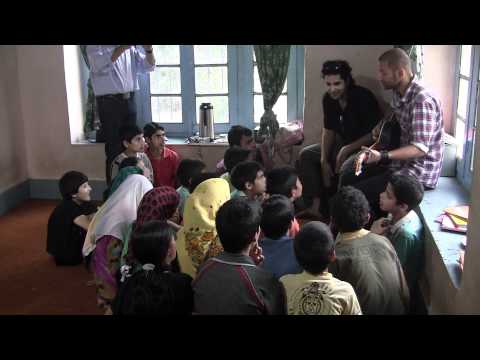
  • Zerobridge is a New York based indie band. The band's members include brothers Mubashir and Mohsin Mohi-ud-Din whose parents emigrated from Kashmir.  The name Zerobridge comes from a bridge across the Jhelum river in Srinagar, Indian Kashmir's summer capital.  Watch as the brothers perform their song "How Long" with the children of the CHINAR orphanage in Kashmir. 
  • Zerobridge 1st Live Show in Kashmir w. One Young Kashmir Pt.1
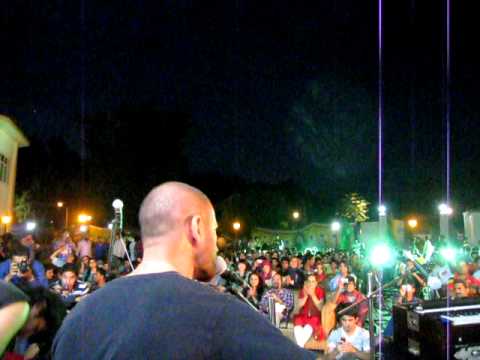
    Just played our 1st zerobridge show in Kashmir. We are still in shock. A dream of so many years actually happened for us. With the backdrop of Kashmir's mountains, we played to 100s and 100s of Kashmiris both young and old; both boys and girls.
  • Watch Zerobridge's first live concert in Kashmir.
  • Zerobridge Live @ CHINAR orphanage: Kashmir
    Zerobridge perform their song 'How Long' with the brilliant children of the CHINAR orphanage. Follow the music and film initiative with CHINAR @ www.dangerville.wordpress.com Support CHINAR : www.chinar.org Zerobridge: on facebook and music on itune www.myspace.com/zerobridge
  • Thumbnail image: Kashmiri protestors chant slogans on February 05, 2010 on the outskirts of Srinagar. (Photo by Daniel Berehulak/Getty Images)

Thursday, June 23, 2011

Non-Violent Revolution Works Best

By Gwynne Dyer
SPECIAL TO QMI AGENCY
Last Updated: June 16, 2011 9:41am
Courtesy Of "The London Free Press"


The "Prague Spring" of 1968 was a gallant attempt at a non-violent democratic revolution, but it was crushed by Soviet tanks. Eighteen years later, in the Philippines, the first "people-power" revolution succeeded, and since 1986 non-violent revolutions have driven a great many dictators from power. The most recent was in Egypt, in February --but there never was a guarantee that these revolutions would turn out well.
The revolution in the Philippines succeeded because by the late '80s, everything was happening in real time on global television. Oppressive regimes that had never had much compunction about killing people who challenged them didn't feel confident about doing it before a global audience. They no longer felt free to use massive force unless the protesters gave them an excuse by resorting to violence themselves.
The Marcos regime that was overthrown in the Philippines in 1986 was a mere kleptocracy with little ideology beyond a vague "anticommunism."
When the infection spread to China in 1989, the outcome was different, because a disciplined Communist dictatorship was willing to kill large numbers of its own people in front of the television cameras. It understood that if it failed that test, it would not survive.
Less ruthless Communist dictatorships in Europe, longer in power and ideologically exhausted, did fail the test.
The non-violent revolutions that began in East Germany in November 1989, and ended Communist rule in the old Soviet Union itself by late 1991, could have been stopped if the local Communist regimes had been willing to follow the Chinese example.
None of them had the stomach for killing on that scale.
Around the same time, there was a peaceful transition to majority rule in South Africa, but then there's a long gap. An attempted non-violent revolution in Iran in 2009 was mercilessly crushed, and some people worried that repressive regimes might have finally figured out how to counter non-violent revolution. And then along came the "Arab spring."
The technique is still alive after all, and it worked in Tunisia and in Egypt.
On the other hand, it has been stamped out in Bahrain, whose fate resembles that of Prague in 1968. And while the revolt in Yemen has probably displaced the old regime, it has been very violent, and the new regime may be no more democratic than the old.
Same goes for Syria, and of course for Libya. There are no one-size-fits-all techniques for revolution or for anything else.
But the desire for democracy, equality and fairness survives everywhere, and the least bad technique for trying to achieve those things is still non-violence.
Even if sometimes the revolution succeeds but the aftermath doesn't.
The original "people power" revolution in the Philippines was followed by two decades of political turbulence. Yugoslavia splintered into half a dozen warring fragments. Russia, though it escaped mass violence, is not exactly a model democracy.
On the other hand, South Korea, Indonesia and South Africa are now all democracies. So are Poland, Romania and Taiwan.
The aftermath may not be what most people hoped for in Egypt, and it probably won't be in the case of Syria.
But non-violent revolution works often enough, and its results are positive often enough, that it is still the most hopeful political development of the past quarter-century.
Gwynne Dyer is a London-based independent journalist whose articles are published in 45 countries

Saturday, May 21, 2011

Israel Fears Palestinian Nonviolence

By Rami G. Khouri
May 18, 2011 02:41 AM
(Last updated: May 18, 2011 02:41 AM)
Courtesy Of "The Daily Star"


The simultaneous marches Sunday by thousands of Palestinian refugees who approached, and in places breached, the Israeli borders, causing Israeli troops to open fire and kill over a dozen refugees, have been treated by Israel as an existential threat – which is exactly what this is.

The fact that the grandchildren of the original Palestinian refugees made this symbolic gesture on the anniversary of the dismemberment of Palestine and the creation of Israel in 1948 should worry the Israelis deeply, because it speaks volumes about the state of the Palestinian-Israeli conflict today.

The symbolism of what happened Sunday is terrifying for Israelis, in fact far more terrifying than any military threat that Israel has ever faced, because it reflects three cardinal realities that mean only trouble for Israel. The first is that the element of time is working against the Zionist strategy of creating a powerful Israeli state that can either intimidate the Palestinians into forgetting about their right to return to their homes in Israel, or simply generating hopelessness among the refugees that ultimately makes them give up their quest for repatriation or restitution. Time since 1948 has only turned the original 750,000 Palestinian refugees into 4.5 million refugees today whose attachment to their land, home and rights is stronger than ever.

In this respect, Israelis who take a moment to reflect on the meaning of what happened Sunday should see in the acts of the Palestinians a compressed historical image of the Jews’ own epic determination to return to their ancestral homeland in Palestine, after thousands of years of exile. The combination of historical memory, nationalist identity, and political activism is stronger than any military means that can be used to regain one’s national rights – as the Israelis should know from their own experiences and their own national struggle.

The second reality is that Palestinians are exploring new means of resisting Israel and its denial of Palestinian refugee rights, including nonviolent resistance through peaceful marches to the borders of Israel. The specter of refugees walking to the borders of Israel from four different points – in Lebanon, Syria, the West Bank and Gaza – is a nightmare for Israel for what it portends for the future. If the Palestinians organize such nonviolent marches and other protests skillfully – which is more than likely – they will create situations that the Israelis will not be able to control. I would expect, for example, coordinated nonviolent protests that see all Palestinians mobilize simultaneously against Israel in the very near future.

Here is what I would look for in the months ahead. Palestinian refugees will continue to march peacefully to the borders of Israel from all directions; Palestinians living under Israeli occupation or siege in the West Bank, Gaza and Arab East Jerusalem would undertake their own nonviolent protests; Palestinians who are Israeli citizens would march peacefully in solidarity inside Israel; and, Palestinians around the world would march peacefully to Israeli embassies and consulates. All of them would carry Palestinian flags and chant nationalist songs. Israelis everywhere in the world would be besieged by hundreds of thousands of peaceful Palestinian protesters who collectively make the point that they have not forgotten or forfeited their rights for a redress of grievance and an end to their refugee status. Most of the world would almost certainly support such peaceful protests, forcing Israel to respond to the legitimate rights of the Palestinians through means other than shooting and killing them.

The third point that should worry Israelis is that the Palestinians themselves have started the process of reuniting their political leadership in the form of the Fatah-Hamas reconciliation and the reconstitution and revitalization of the institutions of the Palestine Liberation Organization. This will create a unified Palestinian national leadership that represents all Palestinians in the world, and that is likely to commit to nonviolent protests as the most effective means of continuing the struggle against Israel and Zionism – until a fair political resolution to the conflict is achieved, based on the existing Arab Peace Initiative of 2002 that remains on the table.

This development could be bolstered by the political transformations now taking place across the Arab world, where more democratic, representative and legitimate Arab governments are certain to reflect their public opinions that would want to show solidarity with and support for the Palestinian struggle, especially a nonviolent struggle.

We may be on the verge of a historic shift in Palestinian tactics in fighting the Israeli threat, whereby coordinated nonviolent resistance will both neutralize the military might that Israel now enjoys and force Israelis to consider a more realistic and credible political response that would allow for a negotiated end to the conflict that satisfies both sides’ national aspirations and legal rights.

The Israelis are worried, and they should be – because they just saw in the Palestinians’ fortitude a mirror image of the same Jewish determination to struggle over generations, and ultimately to achieve their national rights in their ancestral homeland.

Rami G. Khouri is published twice weekly by THE DAILY STAR.

Friday, May 20, 2011

Here Comes Your Non-Violent Resistance


May 17th 2011, 2:09 by M.S.
Courtesy Of "The Economist"


FOR many years now, we've heard American commentators bemoan the violence of the Palestinian national movement. If only Palestinians had learned the lessons of Gandhi and Martin Luther King, we hear, they'd have had their state long ago. Surely no Israeli government would have violently suppressed a non-violent Palestinian movement of national liberation seeking only the universally recognised right of self-determination.
Palestinian commentators and organisers, including Fadi Elsalameen and Moustafa Barghouthi, have spent the last couple of years pointing out that these complaints resolutely ignore the actual and growing Palestinian non-violent resistance movement. For that matter, they elide the fact that the first intifada, which broke out in 1987, was initially as close to non-violent as could be reasonably expected. For the most part, it consisted of general strikes and protest marches. In addition, there was a fair amount of kids throwing rocks, as well as the continuing threat of low-level terrorism, mainly from organisations based abroad; the Israelis conflated the autochthonous protest movement with the terrorism and responded brutally, and the intifada quickly lost its non-violent character. That's not that different from what has happened over the past couple of months in Libya; it shows that it's very hard to keep a non-violent movement non-violent when the government you're demonstrating against subjects you to gunfire for a sustained period of time.
In any case, if you're among those who have made the argument that Israelis would give Palestinians a state if only the Palestinians would learn to employ Ghandhian tactics of non-violent protest, it appears your moment of truth has arrived. As my colleague writes, what happened on Nakba Day was Israel's "nightmare scenario: masses of Palestinians marching, unarmed, towards the borders of the Jewish state, demanding the redress of their decades-old national grievance." Peter Beinart writes that this represents "Israel's Palestinian Arab Spring": the tactics of mass non-violent protest that brought down the governments of Tunisia and Egypt, and are threatening to bring down those of Libya, Yemen and Syria, are now being used in the Palestinian cause.
So now we have an opportunity to see how Americans will react. We've asked the Palestinians to lay down their arms. We've told them their lack of a state is their own fault; if only they would embrace non-violence, a reasonable and unprejudiced world would see the merit of their claims. Over the weekend, tens of thousands of them did just that, and it seems likely to continue. If crowds of tens of thousands of non-violent Palestinian protestors continue to march, and if Israel continues to shoot at them, what will we do? Will we make good on our rhetoric, and press Israel to give them their state? Or will it turn out that our paeans to non-violence were just cynical tactics in an amoral international power contest staged by militaristic Israeli and American right-wing groups whose elective affinities lead them to shape a common narrative of the alien Arab/Muslim threat? Will we even bother to acknowledge that the Palestinians are protesting non-violently? Or will we soldier on with the same empty decades-old rhetoric, now drained of any truth or meaning, because it protects established relationships of power? What will it take to make Americans recognise that the real Martin Luther King-style non-violent Palestinian protestors have arrived, and that Israeli soldiers are shooting them with real bullets?
(Photo credit: AFP)

Monday, May 02, 2011

Demonising Palestinian Nonviolence


Weekly nonviolent protests, such as those held in Nabi Saleh or Bil'in, rarely evoke interest from the international community, yet its increasing momentum is giving Israel cause for worry [EPA]


As The Nonviolence Movement In Palestine Continues To Be Threatened, Knowledge Of Its Existence Remains Minimal At Best.

By Mark Perry
Last Modified: 28 Apr 2011 18:32
Courtesy Of "Al-Jazeera"


On March 24, the Israeli government arrested Bassem Tamimi, a 44-year-old resident of the small Palestinian village of Nabi Saleh, which is just west of Ramallah.

Tamimi was arrested for leading a group of his neighbours in protest marches on a settlement that had "expropriated" the village's spring – the symbolic centre of Nabi Saleh's life.

Tamimi was brought before the Ofer military court and charged with "incitement, organising unpermitted marches, disobeying the duty to report to questioning" and "obstruction of justice" – for giving young Palestinians advice on how to act under Israeli police interrogation.

He was remanded to an Israeli military prison to await a hearing and a trial.

The detention of Tamimi is not a formality: under Israeli military decree 101 he is being charged with attempting "verbally or otherwise, to influence public opinion in the Area in a way that may disturb the public peace or public order."

As in Syria, this is an "emergency decree" disguised as protecting public security. It carries a sentence of 10 years.

A Strategic Choice

The arrest of Tamimi marked only the most recent escalation in Israel's campaign to suffocate the Nabi Saleh movement: in the two months prior to his arrest, Israeli officials detained more than 18 Nabi Saleh youths; over the last two years, nearly 15 per cent of Nabi Saleh's population has spent time in Israeli jails; half of those arrested have been under the age of 18 and the youngest of them was 11.

But what is extraordinary about the Nabi Saleh campaign is its effectiveness. The protesters are trained in non-violent tactics.

"Our strategic choice of a popular struggle – as a means to fight the occupation taking over our lands, lives, and future – is a declaration that we do not harm human lives," Tamimi has said. "The very essence of our activity opposes killing." 

Tamimi's arrest has not stopped the movement. On the morning of April 8, about 80 villagers marched from Nabi Saleh's main street towards the settlement.

As they crossed into some nearby fields, they were attacked by Israeli soldiers with teargas, rubber bullets, and stun grenades.

The villagers fled, but then reorganised themselves, defiantly linking arms in front of the soldiers. Again, the Israeli army responded harshly and, by that evening, had arrested six villagers.

But these are small incidents in a continuing battle. The protests go on day after day, week after week – and have over the course of the last four years.

Nabi Saleh does not stand alone.

The non-violent protests actually began eight years ago in small communities near Israel's security wall, then took root in the villages of Mas'ha and Budrus; the protests have now spread to towns and villages across the West Bank, encompassing mass rural movements from Hebron in the south to Nablus in the north.

"Dangerous"

The protests have involved dozens to hundreds, and on rare occasions, thousands of villagers.

But pride of place for this widespread non-violent resistance movement belongs to Bil'in, a village that (like Nabi Saleh) has seen much of its land taken over by a settlement.

The leader of the Bil'in protests is Abdallah Abu Rahmah, the head of Bil'in's Popular Committee Against the Wall. 

Like Tamimi, Abu Rahmah has trained his young activists in the principles of non-violence, sparking movable protests that the Israeli army has found impossible to suppress. 

Abu Rahmah, a high school teacher at the Latin Patriarch School in Ramallah, began organising Bil'in's protests in 2004, even as the violence of the Second Intifada was beginning to wane.

Every Friday after prayers, Abu Rahmah would lead a group of Bil'in residents on a protest march towards a local settlement – and every Friday his march would be intercepted by the Israeli army.

In one demonstration, an Israeli sniper used a .22 calibre rifle to disburse the protesters, killing a Palestinian boy.
Twenty-one unarmed demonstrators, among them five children, have been killed in non-violent West Bank demonstrations since the beginnings of the movement.

In the village of Nil'in in 2008, American activist Tristan Anderson was paralysed after an Israeli soldier fired a high velocity tear gas canister at his head from a distance of 15 meters.

In December of 2009, Israeli soldiers raided Abu Rahmah's home, arrested him for incitement, and sentenced him to 12 months in prison.

At the end of his sentence, the Israeli military asked his sentence to be extended for another four months, describing Abu Rahmah as "dangerous". The court agreed.

Abu Rahmah has become a symbol of the protests. While in prison, he smuggled letters to his supporters, including one – written this last February – that has become a kind of "Letter from Birmingham Jail" of the movement.

He wrote:

Ofer is an Israeli military base inside the Occupied Territories that serves as a prison and military court. The prison is a collection of tents enclosed by razor wire and an electrical fence, each unit containing four tents, 22 prisoners per tent. Now, in winter, wind and rain comes through the cracks in the tent and we don't have sufficient blankets, clothes, and other basic necessities. Food is a critical issue here in Ofer, there's not enough. We survive by buying ingredients from the prison canteen that we prepare for our tent. We have one small hot plate, and this is also our only source of warmth.

One month after penning this letter, Abu Rahmah was released, but it's only a matter of time before he's arrested again – and shut inside one of the half-dozen Israeli military prisons and administrative facilities that dot the West Bank.

Israeli tactics, the mass arrests, and the use of live fire have been condemned by a long list of human rights organisations. But not by the United States.

Demonising Nonviolence

Just how much do the Bil'in-Nabi Saleh protests worry Israel?

One widely circulated article from the popular Israeli political daily Yediot Ahronot described Naji Tamimi, who helped his cousin Bassem organise the Nabi Saleh movement, as "a pied piper" who "fans the flames of violence" (despite the fact that not one Israeli has died as a result of the protests).

The article went further: "Even though it hasn't been proven, it seems that sources connected to the Palestinian Authority are directing the activities and that the funds paid out to the youths is coming from donations from organisations registered abroad."

Not proven – because it's not true.

In fact, while Fatah and Hamas officials monitor the protests (PA officials have come to Nabi Saleh – before scuttling back to their offices in Ramallah), they have been careful not to interfere in them.

They view the protests as a credible and powerful movement that is better left alone. Hamas leaders agree.

"We wish them well. We hope they succeed. We support them. We are staying away," a senior Hamas official says.

A group of international activists have been helping the Nabi Saleh protests.

Jonathan Pollak, a 29-year-old native of Tel Aviv, has found himself at the centre of the protests – and has written about them extensively.

"I grew up in a progressive home," he says, "but I don't think that anyone in my family could be described as a radical. I came to Nabi Saleh and realised I had to help. What's happening here is just wrong."

Joseph Dana, a New York native and journalist, works alongside Pollak. He came to Israel to find his Jewish identity. "I haven't found it," he says. "What I found instead was an army that arrests children."

Silencing Nonviolence

Pollak, Dana, and other international activists are working to bring attention to the Nabi Saleh movement and have escorted diplomats from Europe through the village.

A few low-level American diplomats from Jerusalem have come to Nabi Saleh, but no senior American officials have visited.

"The international community has been asking for years where the Palestinian nonviolent movement is," Joseph Dana says from his home in Jerusalem. "Well, here it is. And the Americans are nowhere to be found."

Pollak and Dana are being modest. While the events at Nabi Saleh and Bil'in have been largely ignored in the United States, they have sparked a simmering conflict between Palestinian villagers and Israeli settlers.

The Israeli army has taken the side of the settlers, arresting hundreds of young Palestinians (many of them minors) and using (in one case) the testimony of a 14-year-old boy to condemn the movement's leadership.

"They kept him up all night, shouting at him," Dana says. "He was frightened, alone. Finally, he did what they wanted. If you can imagine, Israeli soldiers subjecting a child to mental torture."

While the world's attention has been diverted by the events in Tahrir Square, Israeli officials have struck back against what may well be the greatest threat to their settlement project – condemning non-violent protesters as "terrorists" and standing aside while settlers have taken more and more land from unarmed and defenceless people.

Israel has poured increased funds into countering the protests, deployed more and more soldiers to stop them, and escalated the arrest of its leaders – breaking down the doors of their homes in pre-dawn raids designed to frighten and intimidate them.

Nothing has worked.

The Quest For Civil Rights

Unfunded and unnoticed, Bassem Tamimi, his cousin Naji, Abdallah Abu Rahmah, and a handful of others have organised and trained battalions of young men and women in the art of non-violent resistance.

Bassem Tamimi's arrest has not stopped the protests. They are growing, and spreading. The movement is now in the hands of Bassem's wife, Nariman, who vows to fight on.

She has already spent time in an Israeli jail, but remains undeterred.

"There is no knowing what the future holds," she says from her home in Nabi Saleh, "but our path is clear and so is our goal. We know well that it is possible to achieve it, and we will continue to fight for it. To a great extent, the question of our victory is also one that should be directed to the American people and their government – are you on the side of justice and victory, or on the side of continued oppression?"

The Arab Spring has seen revolutions come to Tunisia, Egypt, Libya, Yemen, Bahrain, and Syria. In each revolution, US president Barack Obama has praised the crowds seeking democracy and freedom.

Again and again he has talked of the need to fight extremist violence. He has paid homage to the young men and women who have brought freedom to Egypt and Tunisia.

He has supported those defending themselves in the streets of Benghazi, Sanaa, and Damascus. His talisman has been non-violence, his pole star the American civil rights movement.

In Cairo, in June of 2009, Obama linked the Palestinian quest for freedom to the American civil rights movement.

"Palestinians must abandon violence," he said. "Resistance through violence and killing is wrong and it does not succeed."

He was right. So why is it that now – when finally, Montgomery has come to Nabi Saleh – he chooses to remain silent?

Mark Perry is a military and political analyst and author of eight books, including Partners In Command, George Marshall and Dwight Eisenhower in War and Peace, and most recently Talking To Terrorists.