Showing posts with label Non-Lethal Weapons. Show all posts

Thursday, November 24, 2011

Just How Dangerous Are 'Non-Lethal' Weapons?


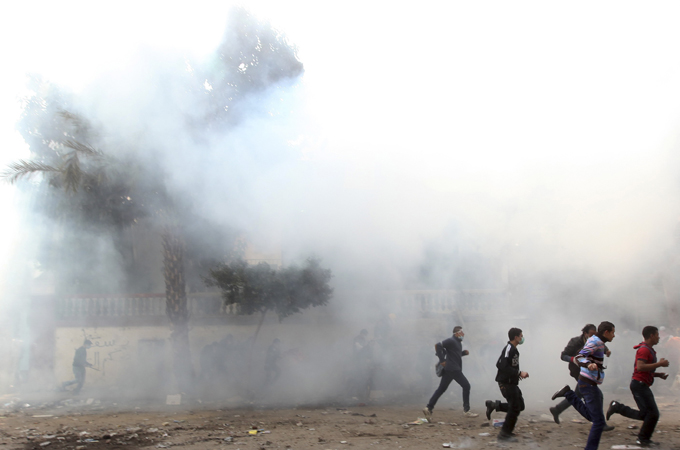
Egypt protesters say the recent tear gas used is different and 'stronger' from that fired at them  in January [Reuters]


Fears That Tear Gas and Rubber Bullets, Widely Used In Crackdown Against Protesters, Could Be Cause Of Deaths In Egypt. 

By Mujib Mashal 
Last Modified: 23 Nov 2011 16:10 
Courtesy Of "Al-Jazeera"


From Egypt, to Athens, to Oakland, police have employed "non-lethal weapons" to break down recent protests and disperse protesters.

As crowds have swelled to express discontent, variations of tear gas, rubber bullets, water cannons, and stun grenades have been fired back at them.

The US defence department describes non-lethal weapons as "primarily employed to immediately incapacitate targeted personnel or materiel, while minimising fatalities, permanent injury to personnel ... in the target area or environment.
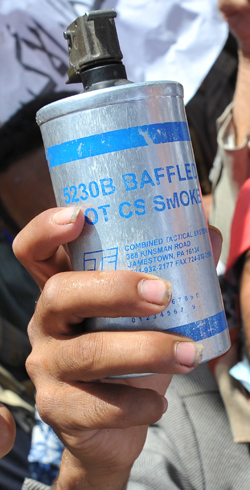
Yemeni  protesters display a Combined Systems tear gas canister [EPA]
"Non-lethal weapons are intended to have reversible effects on personnel and material."

Despite this, activists have reported grave injuries as a result of tear gas canisters fired at protesters from close range.

Moreover, the non-lethality of the gas is also in doubt, as serious questions are being raised about the causes of recent deaths during this week's protests in Cairo's Tahrir square.

Al Jazeera’s Mike Hanna, reporting from the Egyptian capital, said: 

"There have been repeated rounds of tear gas fired here. It is a particularly virulent form, stinging the face to an immense extent.

"Many of those who have been killed are said to have died of asphyxiation.

"Medical workers say the conditions of those brought in is serious, many with symptoms they have not seen before from tear gas inhalation."

Speaking to Al Jazeera, Khalid Hamdi, staffing a make-shift clinic in Tahrir square, said: “We've seen many faintings and we'd never seen that before.

"About 70 per cent of the injuries are fainting. People are coming in with asthma, convulsions sometimes - this wasn't often before."

Amnesty international has also expressed concern about the use of tear gas in the square.

"We have received reports from medical sources saying that some of those who died did so as as a result of suffocation after inhaling tear gas," Said Haddadi, a spokesman for the rights group, told Al Jazeera.

'Pain and Discomfort'

US government agencies, the departments of state and commmerce in particular, regulate the export of tear gas and other non-lethal weapons by granting export licenses allowing US manufacturers to sell tear gas to foreign buyers.

Two US companies have been identified as major exporters of the devices: Combined Systems Inc and NonLethal Technologies Inc, both based in Pennsylvania.

Peter Felstead, editor of Jane’s Defence Weekly, said countries buying weapons from the UK, at least, are closely vetted and their contracts constantly reviewed.

“If something happens in Saudi Arabia, or Bahrain for example, withdrawing contracts in response to those kind of events would present something of a dilemma. The US and UK strategic alliances with Saudi Arabia in particular are very strong. If there is unrest in Saudi,  the question is will the support be withdrawn?"

He said buyers are expected to obtain training packages along with their purchase to make sure the weapons are employed properly. A lack of proper training could be the cause of any fatalities that might result.

"There are times when employing crowd control is absolutely necessary. But if the non-lethal weapons are not employed properly, they could make things worse.

"For example, if you end up forcing a crowd away from security forces to stampede through a narrow gap, you could kill people in the process."

What exactly is being fired at protesters in Tahrir is unclear.

Two forms of tear gas are most commonly used: Chlorobenzylidene malononitrile (also referred to as CS) and Chloroacetophenone (often known as CN).

Both gases are irritants that affect the eyes, nose, mouth and lungs, and cause tearing, sneezing and coughing.
"The primary effect is shortness of breath, pain, and discomfort," reads the catalogue of Combined Systems Inc.

Dr Ziad Kazzi, from Grady Health System and assistant director of Georgia Poison Center, said large doses of the gas could be fatal to healthy individuals as well.

“Those with already existing conditions, such as asthma or lung disease, are at higher risk. However, if large doses are inhaled, particularly in enclosed space, it could damage lungs and lead to death, even for healthy people. But it depends on the dosage.”

“Dose determines the poison,” he said, adding that several factors such as concentration, potency of the gas, the amount that is being delivered, the environment that it is being released in, and the personal characteristics of the people receiving it all play a part.

He said small doses have not been proven to have lasting effects.

'A Cloud Of Irritant Agent'

Tear gas canisters come in various shapes and forms, for indoor and outdoor purposes.

Smoke grenades - both launched by hand as well as munitions launchers - "deliver a cloud of irritant agent with a discharge time of approximately 25 seconds," NonLethal Technologies Inc's catalogue says.

Smoke projectiles, the second method that tear gas can be used at protesters, are "designed to provide effective outdoor crowd dispersal while maintaining a safe stand-off distance of up to 80 yards," according to the catalogue.

The canisters weigh between 175 and 500 grammes, and are made of aluminum or stern steel. Much of the injuries are caused by the fact that these canisters are fired onto crowded areas.

"Danger: Do not fire directly at person[s]. Severe injury or death may result," is reportedly written on the canisters.

Rubber bullets have also been fired at protesters, causing severe injuries.

The bullets come in aluminum cartridges, with a total weight of about 185 grammes. In one of the models in the NonLethal Technologies catalogue, each cartridge contains "three rubber batons that are skip fired towards the subjects".

"Eyewitnesses and lawyers have told us that some were injured as a result of rubber bullets," Amnesty's Haddadi said about the use of rubber bullets in the protests in Cairo.

“People can be killed by rubber bullets, there is no doubt about that. It has happened in northern Ireland. If you fire from close range, or someone is hit in the head," Felstead said.

"It would be quite difficult to specifically target people lethally. But it could easily happen when firing into a crowd."

With over 36 killed in Egypt since November 19, and medical sources citing "suffocation after inhaling tear gas" as the cause of many of the deaths, the non-lethality of the weapons employed - as well as how they were imported - has come under serious question.

Khalid Abdala, an Egyptian actor and activist, told Al Jazeera from Tahrir that he held international governments "complicit in everything that is happening here".

"International governments have replenished the stocks of bullets that have been shot at people right now, and the tear gas that is clinging to my lungs," he said.

Saturday, September 26, 2009

"Non-Lethal Weapons": An Instrument of Social Control


By Tom Burghardt
Source:
Antifascist Calling...
September 22, 2009

Courtesy Of
Global Research

Although so-called non-lethal weapons (NLWs) have been around for decades and range from CS gas to pepper spray and from the low-tech water cannon to the Taser, their use by military and police agencies world-wide are designed to ensure compliance from hostile "natives."

And with ever-more devilish torture tools being dreamed up by the likes of the Defense Advanced Research Projects Agency (DARPA) and the Joint Non-Lethal Weapons Program (JNLWP), it's a safe bet that migration from the military to civilian law enforcement agencies will continue at its current break-neck pace.

In this context, San Diego's East County Magazine and progressive Liberty One Radio reported, ironically enough on September 11, that the San Diego Sheriff's Department stationed a Long-Range Acoustic Device (LRAD) during recent town hall forums.

Manufactured by American Technology Corporation (ATC), the firm's LRAD 500-x is a dual-purpose device: a powerful hailer and a non-lethal weapon capable of producing ear-shattering sounds highly-damaging to their human targets.

ATC's technology has been deployed in Iraq as an "anti-insurgent weapon" and off the coast of Somalia to fight off desperate "pirates," that is, former Somali fishermen whose livelihood has been destroyed by over-fishing by foreign factory fleets and toxic dumping, including nuclear waste, by Western polluters.

No matter, time to break out the sonic blasters!

Developed for the U.S. Navy in the wake of the 2000 attack on the U.S.S. Cole, cruise ship Captain Michael Groves "successfully repelled pirates off the Somali coast using non-lethal weapons including an LRAD. Groves has since filed suit against Carnival Cruise Line, claiming he suffered permanent hearing loss as a result," East County Magazine reports.

The BBC noted in 2005 that the "shrill sound of an LRAD at its loudest sounds something like a domestic smoke alarm, ATC says, but at 150 decibels, it is the aural equivalent to standing 30m away from a roaring jet engine and can cause major hearing damage if misused."

According to ATC's web site, "LRAD resolves uncertain situations and potentially saves lives on both sides of the device by combining powerful voice commands and deterrent tones with focused acoustic output to clearly transmit highly intelligible instructions and warnings well beyond 500 meters."

While the defense establishment and their civilian counterparts dismiss concerns that acoustic weapons pose a danger to their targets, the Bradford Non-Lethal Weapons Research Project noted in 2006:

Juergen Altmann, who is conducting an independent scientific assessment of acoustic weapons, has warned that there is risk of hearing damage to people exposed to the beam at ranges of up to 100m. ... An added difficulty with ensuring no permanent damage is that some people are more susceptible to noise-induced hearing loss than others and hearing damage can occur at levels below the threshold for ear pain. A report from the US Army's 361st Psychological Operations Company gives an idea of the powerful effects of the LRAD: 'During distance tests at 100 meters, the sound was painful to listeners, even with hands held over the ears and ear plugs in'." (Neil Davison, Nick Lewer, Bradford Non-Lethal Weapons Research Project, Research Report No. 8, March 2006, pp. 33-34)

Far from being employed as a means to "reduce casualties," its actual use lends itself to the opposite effect. In Iraq, for example the U.S. Army's 361st Psychological Operations Company noted that "The LRAD has proven useful for clearing streets and rooftops during cordon and search, for disseminating command information, and for drawing out enemy snipers who are subsequently destroyed by our own snipers."

In a civilian setting, one can easily envisage groups of "rioters" being sonically blasted prior to street clearing operations by heavily-armed SWAT teams. Kevin Keenan, the executive director of the American Civil Liberties Union told East County Magazine:

"It's very concerning. It is fine for the Sheriff's Department to have new less-than-lethal weapons, but for their interactions with individuals these still-dangerous weapons need to be used only as substitutes for firearms. They can't be used as just another tool on the tool belt. As we've seen with tasers and pepper spray, these types of weapons are being used to subdue people even though they pose the risk of serious physical harm."

He added, "Even more concerning is having these weapons for public order policing. I can imagine no situation, or am not aware of any situation that's ever happened in San Diego County or is likely to happen that would justify using these weapons for public order policing to control a crowd. The main effect of having those weapons at public events is to chill people and chill free speech and free association." (Miriam Raftery, "Sonic Weapons Used in Iraq Positioned at Congressional Town Hall Meetings in San Diego County," East County Magazine, September 11, 2009)

I would add however, the purpose of these weapons is precisely to "chill free speech and free association," thus ensuring compliance to the whims of our capitalist masters.

Research into more "effective" low-cost acoustic NLWs are gathering steam. Wired reported September 1 that a "Tennessee lab primarily responsible for building components for nuclear weapons is branching off into the nonlethal weapons business."

Called the Banshee II, the weapon emits a piercing 144-decibel sound that is designed to be more than just annoying. "It also has a frequency-switching system that pumps your ear drums, so it sounds like there's a drum beating there," the inventor tells Knoxnews.com. "You physically feel it in your ear drum." (Sharon Weinberger, "Nuke Lab Builds 'Beating Drum' Sonic Blaster, Wired, September 1, 2009)

While such devices never caught on with the military its inventor, so-called nuke "gadget guru" Fariborz Bzorgi who works at the Y-12 nuclear plant in Tennessee "hopes the Banshee II could have broader applications for law enforcement."

No doubt they will. As Neil Davison, the author of the recently published "Non-Lethal" Weapons points out, military and police moves towards "effects-based" NLWs are consistent with requirements "for weapons with greater range, more precise delivery, and rheostatic effects from 'non-lethal' to 'lethal'."

Davison cites the LRAD and other acoustic devices as "the only new technologies that have emerged" in the last several years and pointedly notes that "all these weapons have emerged from the private sector."

That they have should hardly come as a surprise.

After all as Homeland Security Weekly reported in 2007, "homeland security spending is a massive and highly lucrative new market." With an expected growth rate between "eight and ten percent annually over the next five years" the publication claims that "the addressable U.S. market over the next five years will be in the range of approximately $140 billion, a 21 percent increase over our five-year estimate made in 2004."

As the Center for Investigative Reporting revealed, heimat grifting and massive waste go hand in hand:

• Cities and agencies bought things with grant money that would not make California a safer place. One county tried to use anti-terrorism funds for a lawnmower but it was blocked at the last minute. Another county succeeded in buying a big-screen television.

• Dozens of cities and agencies failed to keep adequate records on how they spent the money. In some cases, the poor record keeping resulted in thousands of dollars worth of overpayments to local agencies. In other cases, agencies were unable to find where they stored their own equipment.

• Communities repeatedly bought large and small-ticket items without seeking competitive bids. Federal procurement rules designed to protect the taxpayer weren't used on millions of dollars in new communications systems, night-vision goggles and bomb-disposal robots. (G.W. Schulz, "Homeland Security Marked by Waste, Lack of Oversight," Center for Investigative Reporting, September 11, 2009)

While schools go unfunded, infrastructure collapses and affordable health care for all is an unattainable pipe dream, police and intelligence agencies are having a field day--at our expense. Call it part of the "counterterrorism stimulus" package that our corporate security masters are hell-bent on shoving down our throats.

However you slice it, there's a lot of boodle to be had by enterprising defense and security grifters. Alongside current multibillion dollar outlays for "biodefense" and counterterrorism initiatives by a multitude of state and federal agencies, the development of ever more dubious "non-lethal" weapons, implements for compliance and control during the capitalist meltdown, will enjoy a steady growth curve long into the future.

Tom Burghardt is a researcher and activist based in the San Francisco Bay Area. In addition to publishing in Covert Action Quarterly and Global Research, an independent research and media group of writers, scholars, journalists and activists based in Montreal, his articles can be read on Dissident Voice, The Intelligence Daily, Pacific Free Press and the whistleblowing website Wikileaks. He is the editor of Police State America: U.S. Military "Civil Disturbance" Planning, distributed by AK Press.


Tom Burghardt is a frequent contributor to Global Research.

Global Research Articles by Tom Burghardt

Tuesday, September 08, 2009

Curbing Social Dissent


"Non-Lethal" Weapons to be Used in "Homeland Security"?

By Tom Burghardt
Source: Antifascist Calling
September 5, 2009

Courtesy Of
Global Research

When the U.S. military planned to deploy Raytheon's Active Denial System (ADS) in Iraq, it set off a political firestorm. How couldn't it?

Known for its "goodbye effect," the so-called "pain ray" is a "non-lethal" directed energy weapon that repels "rioters" and other disreputable citizens by heating the outer surface of the skin to 130 degrees F. in short, directed bursts. With a range of some 550 yards, the microwave beam can penetrate clothing and its effects have been described by test subjects as nothing less than "excruciating."

The prospect that American "liberators" would soon be zapping "unruly mobs," that is, Iraqi citizens objecting to the destruction of their country and the looting of their resource-rich nation by Western (corporate) invaders proved to be a public relations nightmare for the Pentagon.

The Defense Science Board concluded that an ADS deployment was "not politically tenable," because of a "possible association with torture" if the system were used at detention centers to ensure "compliance" from recalcitrant prisoners.

Last year I reported (see: '"Non-Lethal' Weapons: Where Science and Technology Service Repression," July 8, 2008), that the Pentagon's Joint Non-Lethal Weapons Directorate (JNLWD) claimed that ADS "is helping to fill the gap between the 'shout' and 'shoot' alternatives faced by our troops." But standing up ADS in the Iraqi "theatre" was not to be.

However, as readers of Antifascist Calling are well-aware, being an imperialist empire means never to have to say you're sorry. Time for Plan B!

Coming Soon to the Homeland

According to a blurb on Raytheon's web site, the commercial version of ADS known as Silent Guardian "is a revolutionary less-than-lethal directed energy application that employs millimeter wave technology to repel individuals or crowds without causing injury."

Touted as providing a "zone of protection that saves lives, protects assets and minimizes collateral damage" the system is marketed as the ideal tool to "establish intent and de-escalate aggression." Commercial and military application envisaged for the system "include law enforcement, checkpoint security, facility protection, force protection and peacekeeping missions." Some "peace," eh?!

Capitalizing on the profit-rich "homeland security" market, Wired reported that Raytheon has announced an "impending direct commercial sale" of a miniature version of ADS to law enforcement agencies.

This is Active Denial in a box, a 10,000-pound containerized system that can be mounted on a ship, a truck, or a fixed installation. It's got an effective range of about 250 meters. The beam has a power of around 30 kilowatts. (David Hambling, "'Pain Ray' First Commercial Sale Looms," Wired, August 5, 2009)

While Hambling may believe it "paradoxical" that "the controversial 'pain beam' may be more acceptable in the civilian market than in the military," I'd beg to differ.

Given the empire's utter contempt for its citizens (witness the despicable "debate" by various grifting congressional factions over what is ludicrously described as health care "reform"--a cynical display of bellying up to the corporatist bar if ever there were one!), why would any sane person not believe that heimat securocrats wouldn't zap union malcontents during a strike, environmental activists protesting outside a polluting company's headquarters or an unruly crowd of pensioners demanding their looted savings back from any number of dodgy banks grown fat on TARP funds?

"Tough luck, suckers! Have a 'taste' of Silent Guardian!"

No. 5 on Washington Technology's 2009 "Top 100 List," of Prime Federal Contractors, Raytheon carries a lot of clout with Congress and the Pentagon. With some $5,942,575,316 in revenue from its defense portfolio, the Waltham, Mass. firm's major customers include the Departments of Defense and Homeland Security.

Not that being a behemoth isn't without its pitfalls. According to the Project on Government Oversight's Federal Contractor Misconduct Database, Raytheon clocks in at No. 5 as a company with a history of "misconduct such as contract fraud and environmental, ethics, and labor violations."

With some some 17 instances of what POGO characterizes as serious breeches ranging from overcharges, contractor kickbacks, False Claims Act Violations, to violations of SEC Rules, groundwater contamination and racial discrimination, Raytheon has been tagged for some $475.8 million in what the government watchdog group calls it's "total misconduct dollar amount."

Not that any of this matters in Washington. According to the Center for Responsive Politic's OpenSecrets.org database, Raytheon's Political Action Committee bestowed some $2.4 million in campaign contributions on the best politicians money can buy, with some 55% of the total going to grifting Democrats. A perusal of the recipients of Raytheon largess during the last election cycle provides insight into how the well-greased wheels really spin.

"Liberal" or "conservative," "dove" or "hawk" it doesn't matter, just keep those contracts flowing! And when it comes to "homeland security" no expense will be spared!

According to Wired, while the firm believes that Silent Guardian "might have all sorts of applications in law enforcement, prisons and protecting installations," the firm told the publication that although the system "has attracted widespread interest ... it would be premature for us to discuss any sales until contracts are signed."

Although Raytheon isn't saying what the price tag for Silent Guardian will cost cash-strapped municipalities staggering under the hammer blows of the current capitalist economic meltdown, most analysts believe the system will cost several million dollars to purchase and maintain.

Not everyone is thrilled however, by the prospect of local SWAT teams zapping citizens with a microwave weapon. Neil Davison, a researcher at the University of Bradford's Non-Lethal Weapons Research Project in the UK, told Wired "as the costs and size drop, expect police forces to become more and more interested. This is where function creep will become a problem. With current controversies over the misuse of the Taser, the spread of new military weapons technologies to the civilian realm does not seem like a very sensible way to go."

But "go" it must and most assuredly will.

As I reported in June (see: "Look! Up in the Sky! It's a Bird... It's a Plane... It's a Raytheon Spy Blimp!"), the spread of military technology into the homeland security market isn't limited to non-lethal weapons.

The deployment of Raytheon's Rapid Aerostat Initial Deployment spy blimp known as RAID, is kitted-out with "electro-optic infrared, radar, flash and acoustic detectors."

Perfect for spying on antiwar demonstrators from a safe perch in the clouds, the firm's use of blimps "carrying high-tech sensors to detect threats" will "enable appropriate countermeasures" from law enforcement, according to a company press release. Some 300 RAID airships have already been deployed in Iraq and Afghanistan.

More "Venom" from Our Capitalist Masters

Should Raytheon's "pain beam" not do the trick, Combined Systems Inc. (CSI), a subsidiary of The Carlyle Group, may have just the right product for enterprising homeland security bureaucrats and their corporate partners.

The firm, acquired by Carlyle in 2005, is described in a blurb on Carlyle's web site as a manufacturer of "branded less-lethal munitions, anti-riot products and other related products that serve the military and law enforcement markets in the United States and abroad."

Wired reported in late August that "the Marine Corps has issued an urgent request for a powerful non-lethal weapon that can fire volleys of 40mm grenades. And in parallel, the service is launching a push for a more futuristic version of the same weapon."

One might also add, such a monstrous "non-lethal" system will inevitably have homeland security applications after a bit of tweaking is done to create a scaleable version useful to those who "protect and serve."

Dubbed the Venom Non-Lethal Tube Munition System (NL/TMS) by CSI, according to the firm Venom "is a modular launching system accepting three cassettes, each loaded with ten cartridges (V-30) or the scaled-down, lightweight and portable version accepting one cassette (V-10). Both versions can be integrated into a variety of fire control systems. Each cartridge is assigned an IP address allowing individual cartridge or desired sequence firing from a fire control panel, communicating via cable or wireless device."

Unsurprisingly, an assigned IP address can mean only one thing: that Venom is RFID-chipped for inventory control and, as part of the "internet of things" described by researchers Katherine Albrecht and Liz McIntyre in their essential book Spychips every commodity--from breakfast cereal to weapons--have their own web page. Convenient, isn't it! According to Wired,

Venom is essentially a modern version of the old multi-barreled cannon used to fight off boarders in naval actions, but in non-lethal form. It's designed for firing at crowds, and many of the munition options contain sub-projectiles to enhance the "shotgun" effect. These include a load of 24 .60 cal hard rubber stingballs, 160 smaller stingballs, foam batons, and "multi flash bang" projectiles. Venom can also fire CS gas projectiles, but these are strictly off-limits for military operations (unless you happen to work for Blackwater). It can also be used for smoke and marker rounds. (David Hambling, "Marines Seek Crowd-Blasting 'Venom' Launcher," Wired, August 24, 2009)

Which just goes to show as I've pointed out many times, "what happens in Vegas" certainly doesn't stay there! This bitter truth is all the more compelling when you consider the tens of billions of dollars at stake as the military market literally bleeds over into the homeland security bazaar; a marketing guru's wet dream that possesses unlimited horizons.

But let's understand one inescapable fact about life in the United States, a veritable open air asylum fronting as a democratic republic: we're so much disposable chaff to be tossed aside by our masters, marginalized when the need arises or violently repressed when all other means have failed.

Tom Burghardt is a researcher and activist based in the San Francisco Bay Area. In addition to publishing in Covert Action Quarterly and Global Research, an independent research and media group of writers, scholars, journalists and activists based in Montreal, his articles can be read on Dissident Voice, The Intelligence Daily, Pacific Free Press and the whistleblowing website Wikileaks. He is the editor of Police State America: U.S. Military "Civil Disturbance" Planning, distributed by AK Press.


Tom Burghardt is a frequent contributor to Global Research.

Global Research Articles by Tom Burghardt