


Submitted by "Sayf Maslul"
Dear Citizens of the world,
We live in the most troubled times! Ravaged by debt, enslaved by greed, and trapped by media lies! Our lives have become such a burden, that we forgo the very basic instincts of our being - to care for our fellow brothers and sisters, We must dare to speak out in support of the Palestinian people who resist and endorse the horrific existence brought upon them through our blood thirsty imperial crusade.
The people of Palestine wake up in fear everyday knowing it may be their last; they walk the streets with military tanks aiming at them, they have to go through military checkpoints every day just to get to school or work, they are denied their basic human rights, they are shot at from point blank range for peacefully protesting, innocent Palestinian children are used as human shields by the Zionist IDF soldiers.
We at Anonymous and TeaMp0isoN would like you to take a few minutes out from your busy lives and just imagine the following existence for you, your family or those you hold dear:
Imagine you wake up with no hope every day, imagine your very existence, the future of your children, even the future of your nation was decided by the bullets of an occupying force! Imagine your children growing up accepting death as an inevitable consequence of being who they are! Imagine accepting the indignity of being searched, denied the freedom of movement in your own country; imagine having to queue up at a check point with a terminally or fatally wounded child only to be told that a non medic has decided that you cannot pass, imagine having to take your child back home to watch them die knowing that there is nothing you can do! Imagine watching an illegal settler forcing you and your family from your home, imagine the authorities aiding them, imagine your children watching their children playing in the back yard - with their toys, imagine you having to live outside in a tent watching them redevelop your home! Imagine what you would say to your child when he/she asks why!
Imagine seeing F16's terrorise your children, imagine being unable to sleep, traumatised, scared, crying - imagine this happening every day! Imagine bombs tearing the limbs of your children, imagine seeing 1, 2, 3, 4 or more of your children laid out on the floor looking at you, fear stuck on their face, lifeless, not breathing, some seeming at peace, others ravaged by shrapnel, eyes missing, hands burnt, intestines slowly sliding out of an open wound, head missing, bits of their skull missing, imagine seeing your child in hospital screaming, crying, suffering, looking at you with pleading eyes, begging eyes to help take the pain away, imagine knowing there is nothing you can do because illegal weaponry like white phosphorus was cooking their insides.
just imagine what you would do!
Would you worry about your bills? Would you worry about your car, your TV, your trainers, your holiday? Would you buy the products that financed this suffering, Would you support the men and women who did this, Would you call them a defence force and the victims the terrorists? WOULD YOU?
that is EXACTLY what you are doing when you drink Coca Cola, eat a Big Mac or buy pampers for your baby and do you know about the other everyday Israeli products you purchase from which the profits gained are used to fund the suffering of the palestinian people. Do you realize the taxes that you pay feed the forces that traumatize the people of Palestine, Of course not you're more worried about not having free health care.
The people of Palestine have been robbed of their land and their freedom, the Racist Zionist state is killing innocent Palestinians using illegal chemical weapons, the governments of the world have ignored the war crimes committed by Israel, will you ignore these illegal methods and war crimes too?
Israel has been committing genocide, infanticide, and every day homicide since 1948 and the world and her citizens have been aiding and abetting and financing this! We are all complicit in the murder of the innocent! It's time to make a stand!
Anonymous, TeaMp0isoN and many other hacktivists from around the world have united, we may not be able to stop the Zionist regime, but the least we can do is raise awareness and educate people by defacing zionist websites, Operation Free Palestine is about educating the blind and terrorising the terrorist, the tables have turned, the time has come
Existence is resistance,
We are Legion.
We do not forgive.
We do not forget,
Expect us.
Showing posts with label Independent Palestinian State. Show all posts
Showing posts with label Independent Palestinian State. Show all posts
Friday, December 30, 2011


Wednesday, December 21, 2011
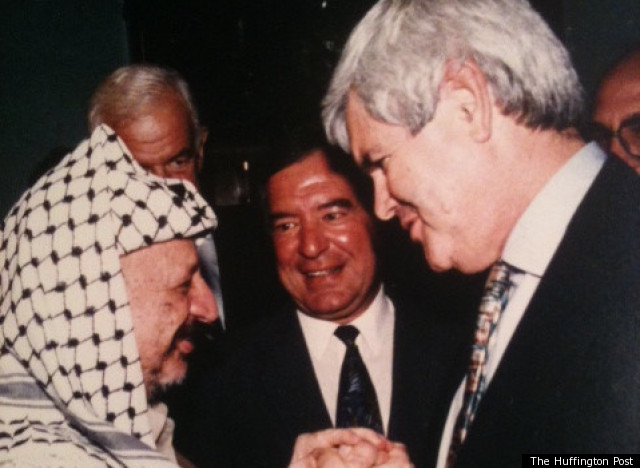
Newt Gingrich's Literal Embrace Of Yasser Arafat
By Sam Stein
First
Posted: 12/13/11 01:53 PM ET
Updated: 12/13/11 11:00 PM ET
Courtesy Of "The Huffington Post"
Posted: 12/13/11 01:53 PM ET
Updated: 12/13/11 11:00 PM ET
Courtesy Of "The Huffington Post"
WASHINGTON -- Newt Gingrich's questioning of the "authenticity" of the Palestinian people and even whether they should be classified as a group has sparked a sharp debate within the Republican Party.
"Remember, there was no Palestine as a state – (it was) part of the Ottoman Empire," Gingrich told the Jewish Channel last week. "I think we have an invented Palestinian people who are in fact Arabs and historically part of the Arab community and they had the chance to go many places."
Several of his fellow candidates for the GOP presidential nomination called his commentsunnecessarily provocative and ultimately unhelpful to the ongoing Israeli-Palestinian peace process. In foreign policy circles there has been no shortage of debate about the accuracy of the remarks and the former House Speaker's consistency on the matter.
On Monday, a political operative who has been working on Palestine-Israel policy for the past 20 years sent The Huffington Post a picture of Gingrich, then the House minority whip, grasping the hand of longtime Palestinian leader Yasser Arafat immediately following the September 1993 Oslo peace accords.
The embrace, the source said, came after Arafat met with 20 to 25 House leaders over coffee. Jotting notes down in a yellow pad, Gingrich used the meeting to pitch Arafat on how best to actually construct a Palestinian state. "He said, 'Look, here is what I think you need -- an economic plan – and here is how it will work,'" the operative recalled. "It was a very positive contribution at the time and as they stood up, there were pictures."
In the background of the picture is Rep. Nick Rahall (D-W.Va.), a long-serving Arab-American congressman, whose office confirmed that the meeting did take place.
At the time the picture was taken, relations between Palestinian political authorities and Israeli officials -- and those same authorities and U.S. officials -- were at a starkly different place than they are today. Arafat had attained an elevated status for having pledged to move away from his terrorist past. The Oslo Accords, which set up a process meant to end in a final agreement between the Palestinian Liberation Organization and the Israeli government, were being hailed as a historic breakthrough. U.S. politicians of all stripes were upbeat.
"I think if the elected head of the Israeli government and the leader of the PLO can find a way to get together and if they are joined by, as it seems possible, Jordan and maybe even some concessions by Syria, I think it would be pretty ridiculous for us to then back off and not at least try to help them make it happen," Gingrich told CNN ten days before that photo was taken. "I don't think we should pressure Israel. But if Israel decides -- the Israeli government decides it's going to try to do something, I don't think we ought to be in the position to block it."
But the situation was fragile. By March 1994, Gingrich and others were urging President Clinton to veto a UN resolution that referred to Jerusalem as occupied territory. Even earlier, leadership in the House and Senate had adopted resolutions declaring the city the undivided capital of Israel. Months later, the Clinton administration was proclaiming that it was "embarrassed" by a GOP-led bid to move the US embassy from Tel Aviv to Jerusalem. Doing so, they countered, would hurt the peace process.
With Israeli Prime Minister Yitzhak Rabin's assassination, the peace process only became more fraught. In April 1997, Gingrich was accusing Arafat of manipulating U.S. media organizations into "serving as [his[ witting or unwitting ally." Addressing the conservative, pro-Israel lobby AIPAC, he concluded that Arafat was "Israel's so-called partner in the peace process ... More than three years after Oslo, he still has not fulfilled his promise to amend the PLO charter and remove its call for the destruction of Israel."
By 1998, Gingrich was accusing Secretary of State Madeleine Albright of behaving as "an agent for the Palestinians" in renewed peace negotiations. U.S. diplomats complained that the Speaker was causing serious headaches even as he met, once more, with Arafat.
Asked to elaborate on his position on the Oslo Accords, Gingrich's presidential campaign provided some of the above quotes, underscoring a consistency in his approach to Israeli-Palestinian affairs -- primarily, that he has been inherently skeptical of Arafat and supportive of Israel.
"I think it is delusional to call it a peace process," he told the Jewish Channel last week. "We have an armed truce with a Palestinian authority that is relatively weak and on its flank is a Hamas authority which may become relatively weak because it can't deliver anything. Both of which represent an enormous desire to destroy Israel."
Still, as the September 1993 photo shows, there was a point in time where Gingrich did (literally) embrace Palestinian leadership and, at the very least, offered advice about creating a state for the same group of people he now refers to as inauthentic.
Sunday, October 23, 2011
Israeli-Style Peace and Justice
By Stephen Lendman
October 11th, 2011
Courtesy Of "The People's Voice"
Israel is a repressive rogue state. Netanyahu bombs Gaza and attacks fishermen while talking peace.
On October 10, without provocation, Israeli jets bombed northern Gaza. An explosion rocked Rafah city. So far, no cause is known but Israel most likely is responsible.
Israeli bulldozers demolished a Palestinian home near Bethlehem after military forces invaded Jab'a village. Palestinians were prevented from entering or leaving.
On October 6, Israeli forces demolished homes, barns and barracks belonging to Palestinian shepherds in Wadi Al-Maleh and Al-Hamma north of the Jordan Valley.
At the same time, IDF troops stormed Beit Kahlil northwest of Hebron. Another Palestinian home was destroyed. Olive trees were uprooted and other property bulldozed. Soldiers fired tear gas at residents trying to stop them.
On October 8, Israeli gunboats opened fire on Gazan fishermen, causing extensive damage. No casualties were reported. At-Tawfeeq Society of Fishermen head Mahmoud Al Aassy said Israel terrorizes Gazans to deter them from fishing to earn a living and feed their families.
Similar incidents occurred earlier in October and many previous times, causing damage and casualties. In addition, dozens of fishermen have been kidnapped. Their boats and equipment were destroyed. As a result, Palestinians risk life and limb to fish.
Since the second Intifada began in September 2000, the Al Mezan Center for Human Rights said Israel attacked Palestinian fishermen 229 times, killing six and injuring 22. In addition, 29 fishermen were kidnapped and 67 boats confiscated without cause.
Israel contemptuously flouts the most fundamental international laws and norms, operating lawlessly with impunity. But Netanyahu wants peace.
Correction - he wants unconditional surrender to Israeli demands like in decades of previous one-sided negotiations. Palestinians only were awarded the right to enforce their own occupation.
Nonetheless, Ma'an News said Quartet members want Israelis and Palestinians to resume talks within days, no matter their futility.
So far, PA officials refuse unless Israel halts settlement construction on stolen Palestinian land. Netanyahu flatly refuses.
On Sunday, a PA statement said:
"The Quartet must tell Israel that it cannot pretend to accept its initiative while flagrantly breaching its terms."
Abbas spokesman Nabil Abu Rdainah said if Israel "recognizes the 1967 borders and freezes settlements, we are ready to go immediately" to talks. Israel wants them resumed with no preconditions so terrorizing Palestinians can continue with impunity.
Netanyahu's Extremist Government
Elected in February 2009, Netanyahu's coalition government is Israel's worst ever. Notably, Foreign Minister and Deputy Prime Minister Avigdor Lieberman is a notorious racist ultranationalist.
On Israeli Radio in November 2006, he called for assassinating "militant" Palestinian leaders (meaning from Hamas and other resistance groups), saying:
"They have to disappear, go to Paradise, all of them and there can't be any compromise."
He also deplores peace, repudiates previous agreements, calls Israeli Arabs a fifth column threat to Israel's security, and wants them forcibly deported.
In 1998, he called for bombing Egypt's Aswan Dam to cause flooding in retaliation for Mubarak's support for Arafat.
In 2001, as National Infrastructure Minister, he proposed dividing the West Bank into four isolated cantons, denying Palestinians free movement outside their own.
In 2002, Yedioth Ahronoth quoted him saying in a cabinet meeting that Palestinians should be told that "(a)t 8AM, we'll bomb all the commercial centers. At noon, we'll bomb their gas stations. At two, we'll bomb their banks."
In 2003, Haaretz said he called for drowning Palestinian prisoners in the Dead Sea, offering to provide buses to take them there.
In 2004, he proposed annexing Israeli West Bank settlements. He also demanded Israeli Arabs pledge loyalty to Israel as a democratic Jewish state or be deported.
In 2006, he called for killing Arab Knesset members who met members of the Hamas-led Palestinian Authority (PA).
Israel's current government is its worst ever. Netanyahu is its most extremist prime minister, exceeding the worst of Ariel Sharon and past right wing rogues. Lieberman is an embarrassment, an incendiary racist. Majority Knesset members go along.
Likud Party Platform
Its "Peace & Security" chapter outlines extremist views stating:
"A unilateral Palestinian declaration of the establishment of a Palestinian state will constitute a fundamental and substantive violation of the agreements with the State of Israel and the scuttling of the Oslo and Wye accords. The government will adopt immediate stringent measures in the event of such a declaration."
Moreover, the "Government of Israel flatly rejects the establishment of a Palestinian Arab state west of the Jordan....The Jordan River will be the permanent eastern border of the State of Israel."
In other words, no Palestinian state will be allowed in Gaza, the West Bank and East Jerusalem (22% of historic Palestine within 1967 borders).
Fact check
Palestine is a state. In 1988, over 100 countries recognized its Declaration of Independence. Today, an overwhelming majority of UN member states do so. Only Israel, Washington and a handful of rogue partners refuse.
Jewish West Bank/Jerusalem settlements represent "a clear expression of the unassailable right of the Jewish people" to steal Palestinian land with impunity.
Likud believes Israel is entitled to all Palestinian territory it wishes. It calls ending the Israeli/Palestinian conflict dependent on its leaders accepting all Israeli demands.
"Jerusalem is the eternal, united capital of the State of Israel and only of Israel. The government will flatly reject Palestinian proposals to divide Jerusalem....The government firmly rejects attempts of various sources in the world....to question Jerusalem's status as Israel's capital."
Fact check
On November 29, 1947, the UN General Assembly passed Resolution 181, the Palestine Partition Plan. It granted 56% of historic Palestine to Jews (with one-third of the population), 42% to Palestinians, with Jerusalem designated an international city (a corpus separatum - separate body) under a UN Trusteeship Council.
The area includes all Jerusalem, Bethlehem, Beit Sahour, and Christian holy sites.
Internationally recognized, including by Washington, Resolution 181 remains binding today.
Moreover, it called for establishing an Independent Arab state by October 1, 1948, asking:
"all Governments and peoples to refrain from taking any action which might hamper or delay the carrying out of these recommendations." It also called for the Security Council to take all "necessary measures as provided for in the plan for its implementation."
Israel's 1948 "War of Independence" intervened, stealing 78% of historic Palestine. In June 1967, it took the rest, including Jerusalem as Israel's sole capital.
It also occupied Syria's Golan. Syria wants it back. Israel flatly refuses. Likud's platform says Israel has sole "sovereignty over the area. The government will continue to strengthen Jewish settlement(s) on the Golan."
For over 30 years, Palestinians sought peace. Israel demands unconditional surrender. Negotiating in good faith was never its long suit.
As a result, Palestinians never had a legitimate partner. Netanyahu and Lieberman abhor peace. So does Washington, assuring the futility of new talks like previous ones.
A Final Comment
In July and August, Israelis staged mass nationwide social justice protests, similar to ones ongoing in hundreds of US and European cities.
Major grievances include:
extreme wealth disparity;
unaffordable housing, creating an intolerable burden for growing numbers being priced out of a place to live;
high food and energy prices;
low wages and eroding social benefits;
onerous taxes on working households;
lack of free education and better healthcare benefits;
weak labor rights;
a disproportionate amount of construction funding for settlement development, leaving too little to build affordable housing in Israel.
Israel spends double the amount per settlement resident compared to others Israelis. In fact, since the 1990s, it's been official government policy to encourage population shifts to West Bank and East Jerusalem locations, depriving most Israelis in the process. In addition, Israel spends over $700 million annually on occupation, besides an inordinate amount on defense at the expense of social needs.
the "high cost of raising children," the common ignored complaint voiced by most Israelis.
Largely dismissive, Netanyahu last August appointed former government official Manuel Trajtenberg to head a 14-member "panel for socioeconomic change." At the time, he said proposed solutions must be "economically sound."
In other words, business as usual was mandated. Trajtenberg's establishment panel included senior government officials, assuring neoliberal continuity with little change.
On September 26, Trajtenberg issued his report. Social protest leaders called it a "blatant insult," vowing renewed mass nationwide demonstrations. On October 9, Israel's cabinet accepted it.
On October 10, Haaretz headlined, "Israel protest leaders vow to escalate fight, after cabinet approves Trajtenberg report," saying:
They promised "renewed demonstrations" against Trajtenberg's cosmetic changes, leaving vital issues poorly or unaddressed.
National Student Union chairman Itzik Shumuli said "it didn't do enough to increase the housing supply (especially public housing) or reduce the cost of living and combat the widespread use of temporary employees...."
Others want more spending but didn't get it. Instead, small amounts of money in Israel's existing budget were shifted from defense to social issues, but not enough to matter.
According to protest leader Daphni Leef:
"This committee received a limited charter, a pathetic charter, and it fulfilled (it) completely. We asked for a root canal and instead got our teeth cleaned. The summer of 2011 may be over, but our protest continues....We will not be mocked any longer or taken for granted."
For decades, neoliberal harshness harmed Israelis like Americans and Europeans. Millions demand real change, raging against policies they reject.
Fed up, they've occupied hundreds of cities. So did Israelis last summer. Betrayed, they'll be out again, knowing it's them against hardline Netanyahu extremists determined to maintain status quo pain.
Confrontations may follow. Follow-up articles will discuss global progress or lack of it.
Stay tuned and get involved because everyone not super-rich is affected.
Stephen Lendman lives in Chicago and can be reached at lendmanstephen@sbcglobal.net.
Also visit his blog site at sjlendman.blogspot.com and listen to cutting-edge discussions with distinguished guests on the Progressive Radio News Hour on the Progressive Radio Network Thursdays at 10AM US Central time and Saturdays and Sundays at noon. All programs are archived for easy listening.
Saturday, October 22, 2011
The “Generous” Offer
Krauthammer's Fable
By EVE SPANGLER
OCTOBER 11, 2011
Courtesy Of "CounterPunch"
Given recent Palestinian initiatives at the U.N., it was only a matter of time until the usual Israeli apologetics appeared. Charles Krauthammer’s recent Washington Post op. ed. perfectly exemplifies the product. He repeats, yet again, the story of the “generous offers” of statehood made by Israelis and rebuffed by Palestinians.
His arguments are specious on many levels. He is wrong about important things – none of the proposed scenarios require the dismantling of the major settlement blocks. He is deceptive and incomplete about others: yes, land swaps have been proposed, but usually these involve giving Palestinians desert in return for their aquifers; yes, a Palestinian East Jerusalem was, briefly, put on the table, but only as the ring of settlements severing it from the West Bank nears completion.
Krauthammer remains silent on the most significant problem of the allegedly generous offers: they are based solely on Israeli desires instead of international law. For example, he has nothing to say about the likely loss of citizenship by Palestinian citizens of Israel in the event of land swaps. He continues to mime faux bewilderment – why are Palestinians so recalcitrant in refusing further diminution of their homeland?
On the other side, the Palestinians also have a story about a “generous offer,” although they do not get prime space in the Washington Post for their narrative. If the Israelis really want to live in peace, why have they rejected the Saudi (later Arab) Peace Initiative out of hand?
Ever since 2002, first Saudi Arabia and then all 22 Arab states have offered Israel full normalization of relations, provided that they comply with the basic two state deal: the 1967 borders, a Palestinian capital in East Jerusalem, the right of return for refugees – provisions consistent with multiple UN Resolutions.
The credibility of the Arab Peace Initiative is bolstered by the donor-backed training of Palestinian security forces and by the fact that Hamas has announced its willingness to abide by the will of the majority in a peace referendum.
The Palestinian story of the “generous (Arab) offer” thus does far less violence to truth than the Israeli one. Nevertheless, it fails to recognize the suspicion directed at the Arab Peace Initiative – was it not constructed primarily as a public relations effort in the wake of 9/11? If it was meant seriously why did no one come to the Knesset as Anwar Sadat did, to talk directly to Israelis about the offer? Was the right of return for refugees meant to be a poison pill? And how would the electorate for a peace referendum be defined – would refugees have a voice in determining their own fate?
Neither version of the “generous offer” entirely convinces: the Israeli one because it so obviously flies in the face of growing settlements and growing settler violence; the Palestinian one because, given Islamophobia, Arab narratives are simply dismissed rather than tested.
But perhaps there is also another force at work – a dim and tentative perception that neither side currently acknowledges forthrightly. Perhaps we all sense that since the two state solution has been an ever-receding chimera for 44 years, neither side really wants it.
Zionists have never been circumspect about their desire to “judaize” the land. After all, with Palestinians in place, Israel cannot have all it desires: to be a Jewish state, to be a democracy, and to control all the land. It can have any two of those three objectives together, but all three at once are impossible to reconcile.
Palestinians have never found it just that their historic homeland should be subdivided to rectify the murderous European hatred of Jews. Update the numbers a bit, and Lord Balfour’s revelatory statement is as good today as it was in 1917: “Zionism, be it right or wrong, good or bad, is … of far profounder import than the desires and prejudices of the 700,000 Arabs who now inhabit that ancient land. ” Why should Palestinians acquiesce to that?
Serious thinkers have already turned their attention to the challenges implicit in the death of the two state solution – for example, Salman Abu Sitta’s ground-breaking work showing how many Palestinian refugees come from Israel’s least settled areas and could return there with much less disruption than is generally supposed. What kind of legal formulas might safeguard the cultural and ethnic heritage of Christians, Muslims and Jews in a single state? Are there examples of successful bi-national states? How might a bi-national state in Israel/Palestine become more like Canada or Belgium and less like Lebanon?
In trying to develop useful mental models of a one state solution, it is crucial to remember this: National identity is socially constructed. It develops at the confluence of starting assumptions and present circumstances. It changes over time. And, paradoxically, each new iteration of evolving national identity claims for itself the mantle of being ancient, immutable, and non-negotiable. We do not need to accept this sleight of hand.
Israelis and Palestinians each have romantic myths about their ancient identities. Both also are faced with changing circumstances: for Palestinians, the critical erosion of their territory and the abandonment of their refugees; for Israelis, their growing isolation, the decline of the Holocaust generation, the western hunger for oil, the Arab spring. From this confluence, the unthinkable needs to be thought about.
Let me be clear. I am not suggesting that building new, heavily contested national projects is simply a matter of mental gymnastics, without material determinants. At the same time, however, we must begin from what is true: that national identities are socially constructed and therefore mutable. The identities of the past need not constrain the future. Now that is a generous offer.
Eve Spangler is an Associate Professor of Sociology at Boston College and a founding member of American Jews for a Just Peace.
By EVE SPANGLER
OCTOBER 11, 2011
Courtesy Of "CounterPunch"
Given recent Palestinian initiatives at the U.N., it was only a matter of time until the usual Israeli apologetics appeared. Charles Krauthammer’s recent Washington Post op. ed. perfectly exemplifies the product. He repeats, yet again, the story of the “generous offers” of statehood made by Israelis and rebuffed by Palestinians.
His arguments are specious on many levels. He is wrong about important things – none of the proposed scenarios require the dismantling of the major settlement blocks. He is deceptive and incomplete about others: yes, land swaps have been proposed, but usually these involve giving Palestinians desert in return for their aquifers; yes, a Palestinian East Jerusalem was, briefly, put on the table, but only as the ring of settlements severing it from the West Bank nears completion.
Krauthammer remains silent on the most significant problem of the allegedly generous offers: they are based solely on Israeli desires instead of international law. For example, he has nothing to say about the likely loss of citizenship by Palestinian citizens of Israel in the event of land swaps. He continues to mime faux bewilderment – why are Palestinians so recalcitrant in refusing further diminution of their homeland?
On the other side, the Palestinians also have a story about a “generous offer,” although they do not get prime space in the Washington Post for their narrative. If the Israelis really want to live in peace, why have they rejected the Saudi (later Arab) Peace Initiative out of hand?
Ever since 2002, first Saudi Arabia and then all 22 Arab states have offered Israel full normalization of relations, provided that they comply with the basic two state deal: the 1967 borders, a Palestinian capital in East Jerusalem, the right of return for refugees – provisions consistent with multiple UN Resolutions.
The credibility of the Arab Peace Initiative is bolstered by the donor-backed training of Palestinian security forces and by the fact that Hamas has announced its willingness to abide by the will of the majority in a peace referendum.
The Palestinian story of the “generous (Arab) offer” thus does far less violence to truth than the Israeli one. Nevertheless, it fails to recognize the suspicion directed at the Arab Peace Initiative – was it not constructed primarily as a public relations effort in the wake of 9/11? If it was meant seriously why did no one come to the Knesset as Anwar Sadat did, to talk directly to Israelis about the offer? Was the right of return for refugees meant to be a poison pill? And how would the electorate for a peace referendum be defined – would refugees have a voice in determining their own fate?
Neither version of the “generous offer” entirely convinces: the Israeli one because it so obviously flies in the face of growing settlements and growing settler violence; the Palestinian one because, given Islamophobia, Arab narratives are simply dismissed rather than tested.
But perhaps there is also another force at work – a dim and tentative perception that neither side currently acknowledges forthrightly. Perhaps we all sense that since the two state solution has been an ever-receding chimera for 44 years, neither side really wants it.
Zionists have never been circumspect about their desire to “judaize” the land. After all, with Palestinians in place, Israel cannot have all it desires: to be a Jewish state, to be a democracy, and to control all the land. It can have any two of those three objectives together, but all three at once are impossible to reconcile.
Palestinians have never found it just that their historic homeland should be subdivided to rectify the murderous European hatred of Jews. Update the numbers a bit, and Lord Balfour’s revelatory statement is as good today as it was in 1917: “Zionism, be it right or wrong, good or bad, is … of far profounder import than the desires and prejudices of the 700,000 Arabs who now inhabit that ancient land. ” Why should Palestinians acquiesce to that?
Serious thinkers have already turned their attention to the challenges implicit in the death of the two state solution – for example, Salman Abu Sitta’s ground-breaking work showing how many Palestinian refugees come from Israel’s least settled areas and could return there with much less disruption than is generally supposed. What kind of legal formulas might safeguard the cultural and ethnic heritage of Christians, Muslims and Jews in a single state? Are there examples of successful bi-national states? How might a bi-national state in Israel/Palestine become more like Canada or Belgium and less like Lebanon?
In trying to develop useful mental models of a one state solution, it is crucial to remember this: National identity is socially constructed. It develops at the confluence of starting assumptions and present circumstances. It changes over time. And, paradoxically, each new iteration of evolving national identity claims for itself the mantle of being ancient, immutable, and non-negotiable. We do not need to accept this sleight of hand.
Israelis and Palestinians each have romantic myths about their ancient identities. Both also are faced with changing circumstances: for Palestinians, the critical erosion of their territory and the abandonment of their refugees; for Israelis, their growing isolation, the decline of the Holocaust generation, the western hunger for oil, the Arab spring. From this confluence, the unthinkable needs to be thought about.
Let me be clear. I am not suggesting that building new, heavily contested national projects is simply a matter of mental gymnastics, without material determinants. At the same time, however, we must begin from what is true: that national identities are socially constructed and therefore mutable. The identities of the past need not constrain the future. Now that is a generous offer.
Eve Spangler is an Associate Professor of Sociology at Boston College and a founding member of American Jews for a Just Peace.
Sunday, October 16, 2011
Abbas Bid For Bantustan Exposes Israeli Hypocrisy
"In addition to leaving Obama and Netanyahu defrocked as hypocrites, the bid has unmasked a number of people and institutions. Seeing Tony Blair and Hilary Clinton squirming and ducking for cover from the heat unleashed by Abbas’ “jihad” is quite enjoyable. The Quartet, made up of an old boy’s club from Russia, America, the UN and the European Union, is now clearly understood to be firmly in the Israeli camp."
By Iqbal Jassat
(Saturday, October 8, 2011)
Courtesy Of "Media Monitors Network"
By Iqbal Jassat
(Saturday, October 8, 2011)
Courtesy Of "Media Monitors Network"
Why do you say that there is “some merit” in Abbas’ bid while you vehemently oppose and discredit it?
It’s a question many people, including journalists have challenged me with in the last few days as a global audience readied itself to watch the drama unfolding at the United Nations centered on the Palestinian Authority seeking approval for an independent state.
In attempting to unpack what clearly appears to be a contradiction in terms, the reality is that while battle lines are being drawn in an arena that for more than six decades can arguably be held responsible for turning its back on the plight of Palestine; the same venue will place the spotlight on Israeli intransigence!
The “merit” therefore in the bid attempt is that a confirmed collaborator plunges headlong into an abyss of disaster. But along with him too are the leaders of America and Israel!
Thus, while it is clear from the repeated threats of veto by the U.S. that Mahmoud Abbas was not likely to succeed in gaining unanimous approval in the Security Council, his “insubordination” risked exposing Obama’s double standards and blatant hypocrisy beyond repair.
Analysts, including some who had previously held that Obama would still surprise the world by “fixing” the conflict, are now convinced that America would rather stand accused as an unfair mediator than to be challenging Israel. However to make the choice between these immoral positions in full glare of the world’s media is not comfortable for any U.S. president, let alone Obama!
Abbas in the course of his bid effort caused enormous embarrassment and humiliation to a man who sought very hard to cast himself as different from his predecessors, particularly the extreme neo-con administration headed by George W Bush.
Obama’s speech at the UN was so far-removed from his Cairo PR stunt resulting in harsh rebukes and scorn from erstwhile allies in the columns of many American newspapers.
In similar fashion, the apartheid regime’s leader Bibi Netanyahu was so severely wounded by the bid attempt, which he resorted to some of the worst forms of Islamophobia, racism and unmitigated hate!
Hurling insults at Islam and Muslims through slander and derogatory terms such as “crocodiles” and positioning “militant Islam” as the world’s enemy No 1, was a shameful display of conceit brought upon by the fact that the “master” was provoked by the “slave’s” insistence to unmask him!
In addition to leaving Obama and Netanyahu defrocked as hypocrites, the bid has unmasked a number of people and institutions. Seeing Tony Blair and Hilary Clinton squirming and ducking for cover from the heat unleashed by Abbas’ “jihad” is quite enjoyable. The Quartet, made up of an old boy’s club from Russia, America, the UN and the European Union, is now clearly understood to be firmly in the Israeli camp.
On the other hand and perhaps on a more serious note, the bid exercise and its entire project associated with gaining UN backing for an independent state is fraught with huge risks for Palestinians as a whole.
Any so-called “Palestinian state” compromises and weakens the ability of refugees to return to their original homes. Indeed, such a state – prototype of South Africa’s disgraced Bantustans – would be entirely dependent and economically controlled by the Occupying regime.
In the ensuing debates that go on to enrich people’s understanding of different opinions, what has become crystal clear is that Palestinians will not surrender their rights.
Nor are they willing to go on living without civil rights under a repressive occupier for another six decades.
The message is clear: if a faithful and obedient client authority was able to expose Israel in all its nakedness, there cannot be any hope for the settler-state to sustain its illegal status!
In similar fashion, the apartheid regime’s leader Bibi Netanyahu was so severely wounded by the bid attempt, which he resorted to some of the worst forms of Islamophobia, racism and unmitigated hate!
Hurling insults at Islam and Muslims through slander and derogatory terms such as “crocodiles” and positioning “militant Islam” as the world’s enemy No 1, was a shameful display of conceit brought upon by the fact that the “master” was provoked by the “slave’s” insistence to unmask him!
In addition to leaving Obama and Netanyahu defrocked as hypocrites, the bid has unmasked a number of people and institutions. Seeing Tony Blair and Hilary Clinton squirming and ducking for cover from the heat unleashed by Abbas’ “jihad” is quite enjoyable. The Quartet, made up of an old boy’s club from Russia, America, the UN and the European Union, is now clearly understood to be firmly in the Israeli camp.
On the other hand and perhaps on a more serious note, the bid exercise and its entire project associated with gaining UN backing for an independent state is fraught with huge risks for Palestinians as a whole.
Any so-called “Palestinian state” compromises and weakens the ability of refugees to return to their original homes. Indeed, such a state – prototype of South Africa’s disgraced Bantustans – would be entirely dependent and economically controlled by the Occupying regime.
In the ensuing debates that go on to enrich people’s understanding of different opinions, what has become crystal clear is that Palestinians will not surrender their rights.
Nor are they willing to go on living without civil rights under a repressive occupier for another six decades.
The message is clear: if a faithful and obedient client authority was able to expose Israel in all its nakedness, there cannot be any hope for the settler-state to sustain its illegal status!
Saturday, October 15, 2011
Why Palestine Already Is A State

Palestine Is Already A Sovereign State & Is Seeking Membership Of The UN, Not Statehood
By Joe Lauria
Wednesday, 28. September 2011
Courtesy Of "Boiling Frog Post"
A combination of mistakes—whether through ignorance or design—and significant omissions of fact have left the American public misinformed about why the Palestinians went to the United Nations last week and what they are trying to achieve.
 The biggest error repeated across the media in hundreds of headlines and stories is that the Palestinians are seeking statehood at the U.N. In fact, Palestine is already legally a sovereign state and is seeking membership of the United Nations, not statehood. The United Nations does not grant or recognize statehood. Only states can recognize other states bilaterally. The U.N. can only confer membership or non-member, observer state status to already existing states. The U.N. Charter is clear. Article 4 says that only existing states may apply for U.N. membership.
Last Friday Secretary-General Ban Ki-moon accepted an application for U.N. membership from PLO Chairman and Palestinian Authority President Mahmoud Abbas. Ban sent the application to the Security Council, which began deliberating on it on Monday (Sept. 26).
The very act of the Secretary General accepting the membership application is an acknowledgement from the U.N. that Palestine is already a state, since only states can apply.
 The Montevideo Convention of 1933 lays out the requirements for statehood: a population living on a defined territory with a government that can enter into relations with other governments. The Palestinians have all three. Though its borders with Israel are not set, other countries with border disputes have been admitted as U.N. members, such as Pakistan and India. Trygve Lie, the first U.N. Secretary-General, also wrote a 1950 memo that states do not need universal recognition to apply.
Palestine declared its independence on November 15, 1988, a fact found nowhere in the American mainstream reporting of the past week. A Palestinian walked out of the Al Asqa Mosque that day in Al Quds/Jerusalem and read the declaration aloud, much as someone read the American Declaration of Independence to a crowd in the courtyard of the Philadelphia State House on July 4, 1776.
Almost immediately one hundred nations recognized an independent Palestinian state. Since then 30 more nations have recognized Palestine, some having opened Palestinian embassies in their capitals. This crucial fact too was not reported in the U.S. media. For Palestinians and those countries that recognize them, Israeli troops are occupying a sovereign nation.
It was the same as when Morocco and then France and other nations recognized an independent United States years before the war against Britain was won. For Americans and those nations recognizing America , British troops became an occupation force, not an army defending British territory.
The problem for the Americans then and for the Palestinians now is that the occupying nation and the world’s biggest power are not among the 130 who’ve recognized them.
If there were a United Nations in 1777 the Americans could have applied for membership. And if Britain had a veto on the Security Council then as it does now, it would have blocked that membership.
Today neither the occupying power, Israel, nor the world’s biggest power, the U.S., recognizes Palestinian statehood. Thus the U.S. has vowed to veto the Palestinians’ membership resolution in the Security Council.
The U.S. had furiously lobbied to prevent the Palestinians from coming to the U.N. at all, including Congress threatening to cut off all aid. Having failed, Washington is now trying to delay a vote as long as possible while lobbying the several non-permanent members of the Security Council to abstain, or vote against.
 But the Palestinians knew from the start the U.N. process would take weeks and have so far not backtracked on their plan one inch.
Membership in the U.N. requires a recommendation from the 15-member Security Council, secured with nine votes in favor and no vetoes. If the recommendation passes, the 193-seat General Assembly must approve with a two-thirds majority. Eight votes in favor or less would kill the Security Council membership resolution, sparing the U.S. from a veto that would cost them dearly on the Arab street.
Brazil, Russia, India, China, South Africa and Lebanon are among the Security Council members who have formally recognized Palestine and are firm about voting in favor. The U.S. isn’t bothering with them. But Nigeria, Bosnia-Herzegovina, Colombia and Gabon have also recognized Palestine and are under extreme American, and in the case of Gabon, French pressure to at least abstain.
Falling short of eight votes would be an embarrassment for the Palestinians, but the Security Council route is only the first step. After a sure defeat in the Security Council, two options in the General Assembly remain.
 President Abbas told reporters on his plane back home from New York that the Palestinians are willing to wait two weeks for the Security Council to act before going to the next step for membership. That step is to try to circumvent either a U.S. veto or less than nine votes in the Security Council in the General Assembly, employing a Cold War-era resolution known as Uniting for Peace.
It was introduced by the U.S. in 1950 to get around repeated Soviet vetoes on the Korean War. Francis Boyle, a legal adviser to Abbas, told me he has advised the Palestinian president to take this step. But the Palestinians would have to convince two-thirds of voting Assembly members that Palestinian membership would be a response to a “threat to peace, breach of the peace or an act of aggression” from Israel.
The U.S. and Israel would fight to keep this off the General Assembly agenda. But Boyle, who cautioned that he does not speak for the Palestinians, told me he thinks the Palestinians have the votes to overcome this.
Nevertheless, there seems to be a split in the PLO leadership on whether to use Uniting for Peace. Hanan Ashrawi, a PLO executive committee member, says it is still a viable option. But the Palestinians’ U.N. observer, Riyad Mansour, believes any membership bid must legally go through the Security Council first and there’s no getting around it. Abbas’ position on this is not clear. It will be interesting to see if the Palestinians try to use Uniting for Peace and what happens if they do.
If they decide against it or fail, their third option is to try to become a non-member, observer state, which needs only a simple majority of 97 votes in the General Assembly which the Palestinians clearly have.Becoming an observer state would be more than symbolic. It could reshape the balance of power between Israel and the Palestinians. As an observer state, Palestine could participate in Assembly debates, but could not vote, sponsor resolutions or field candidates for Assembly committees. But more importantly, it would allow Palestine to accede to treaties and join specialized U.N. agencies, such as the International Civil Aviation Organization (ICAO), the Law of the Sea Treaty, the Nuclear Non-Proliferation Treaty (NPT) and the International Criminal Court (ICC), officials said.
Switzerland joined the ICAO in 1947 when it was still an observer state before becoming a U.N. member in 2002. Denis Changnon, an ICAO spokesman in Montreal, told me the treaty gives members full sovereign rights over air space, a contentious issue with Israel, which currently controls the airspace above the West Bank and Gaza. The Palestinians could bring claims of violation of its air space to the International Court of Justice.
If Palestine joins the Law of the Sea Treaty it would gain control of its national waters off Gaza, a highly contentious move as those waters are currently under an Israeli naval blockade. Boyle said he has advised Abbas to accede to treaties, including the Law of the Sea. If they do, the Palestinians could challenge the Israeli blockade at the ICJ as well as claim a gas field off Gaza, currently claimed by Israel.
Even more troubling for Israel and the U.S. would be Palestine joining the International Criminal Court. Ambassador Christian Wenaweser, president of ICC Assembly of State Parties, said in an interview a Palestine observer state could join the ICC and ask the court to investigate any alleged war crimes and other charges against Israel committed on Palestinian territory after July 2002, including Israel’s 2008-2009 Operation Cast Lead war against Gaza that killed 1,400 Palestinian civilians.
Ashrawi says Israeli settlements in Palestine can be challenged as war crimes in the court as a violation of the Fourth Geneva Convention.
The Palestinians know they must still negotiate borders, refugees, settlements, the occupation and Jerusalem. Abbas said pushing for U.N. membership did not mean he no longer wants to negotiate. Rather gaining membership or observer state status would give the Palestinians more leverage in those talks, he said.
In an effort to upstage and derail the Palestinians’ membership drive, just minutes after Abbas and Israeli Prime Minister Benjamin Netanyahu had finished addressing the General Assembly last Friday the so-called Quartet—the U.S., U.K., Russia and the U.N.—announced its vision of a one-year plan for a comprehensive settlement.
The Quartet dropped its repeated call for a settlement freeze and called for no preconditions for talks. The Palestinians, who are demanding a freeze before negotiations based on the pre-occupation 1967 borders, rejected the Quartet’s plan. Israel then announced 1,100 new settlements in occupied East Jerusalem.
The Quartet has failed again. Westerners cannot solve this problem. Maybe it’s time to make it the Quintet by adding the Arab League—to give voice to the Palestinians. How to get the U.S. media to become interested in more accurately reporting the Palestinian’s side of the story is another matter.
Wednesday, October 12, 2011
Remember Obama's Deplorable Tactics At The UN

The 66th UN General Assembly Session Will Remember Obama's Deplorable Tactics
Abbas said, "It is a moment of truth; and my people are waiting to hear the answer of the world. Will it allow Israel to continue its occupation, the only occupation in the world? Will it allow Israel to remain a State above the law and accountability?" ...
By: Dr. Habib Siddiqui
October 3, 2011
Courtesy Of "IslamiCity"
Last month the Palestinian President Mahmoud Abbas, Israeli Prime Minister Benyamin Netanyahu, and the U.S. President Obama all spoke at the U.N. While for the first time in years, Abbas behaved and spoke like a leader, taking proactive measures instead of waiting for someone else to call the shots, it is hard to decide whose speech was worse: Netanyahu's or Obama's. Obama's read like an appeal to Jewish voters to finance and reelect him in the next election and Netanyahu's read like a pep rally to the Likud Central Committee.
In the post-Arafat era, President Abbas has more often than not behaved like a yes-man for the U.S., as if too unsure or too uncomfortable about speaking out against the mindless zero-sum activities that seem to be the only things that either the U.S. or the Israeli government cared about. But on Friday, September 23, he found his lost voice and assumed the title the Palestinian people have long waited for. He transformed himself to becoming their leader, their hero, in relaying their voice. It was long overdue.
In the 66th session of the General Assembly, President Abbas said, "It is a moment of truth; and my people are waiting to hear the answer of the world. Will it allow Israel to continue its occupation, the only occupation in the world? Will it allow Israel to remain a State above the law and accountability?" "There are either those that believe that we are not wanted in the Middle East or (those that believe) that there is a missing State that needs to be established immediately."
He thanked the states that had supported the Palestinian struggle and had recognized the State of Palestine, and those that had upgraded Palestine's representation in their capitals. He also thanked the U.N. Secretary-General for stating that the Palestinian State should have been created years ago; such support made the Palestinians feel that they were being listened to and that their tragedy was not being ignored. It also reinforced their hope for justice.
President Abbas then informed the Assembly that he had submitted to the Secretary-General an application for admission of Palestine, on the basis of the 4 June 1967 borders, with Al-Quds Al-Sharif (Jerusalem) as its capital, as a full United Nations member. "I call upon Mr. Secretary-General to expedite transmittal of our request to the Security Council, and I call upon the distinguished members of the Security Council to vote in favor of our full membership. I also appeal to the states that have not yet recognized the State of Palestine to do so," he said. The world's support for that was a "victory for truth, freedom, justice, law and international legitimacy" and was the greatest contribution to peacemaking in the Holy Land. In closing, he said: "I have come here today with a message from a courageous and proud people: Palestine is being reborn." He implored everyone to stand with it.
In his speech, President Obama said that "America's commitment to Israel's security is unshakeable." He also made it crystal clear that Washington will veto any Palestinian application to the U.N. Security Council for statehood. Not once did he refer to illegal Jewish "settlements" on Palestinian lands, nor did he even use the word "occupied" - or any derivative of that word in his long speech. Nor was there a word about the plight of the still besieged population of Gaza, or about the "1967 borders" as being the basis for any eventual two-state solution. Obama is truly becoming a joke of our time!
Honestly speaking, Obama does not surprise me any more. Since becoming the President of the USA, he has largely forgotten what got him elected and put him into the White House. It was to usher in a 'change' for the better from the dark days of GW Bush. To those who voted for Obama, Bush was a villain, an utterly evil man with a crusading zeal, who had deliberately lied and took the country into two unnecessary wars, thereby bankrupting it. Obama was supposed to be the 'good' guy restoring America's honor and dignity. But Bush, whether one either loathes or loves him, was no hypocrite; at least people knew what to expect of him. But the same cannot be said of Obama. The latter has become the greatest disappointment of our time.
As I write, the Obama administration has assassinated Anwar al-Awlaki and Samir Khan -- two of its own citizens, thus behaving like any of the hated authoritarian regimes of our time. By acting as the accuser, prosecutor, judge, jury and (finally now the) executioner - all at the same time - his administration has violated the Fifth Amendment, which forbids the U.S. federal government from depriving any person -- not just American citizens -- of life without due process of law. Commenting on the assassination, Rep. Ron Paul (R-Texas), who is running for the GOP presidential nomination, said, "Al-Awlaki was born here, he is an American citizen. He was never tried or charged for any crimes. No one knows if he killed anybody. We know he might have been associated with the underwear bomber. But if the American people accept this blindly and casually that we now have an accepted practice of the president assassinating people who he thinks are bad guys, I think it's sad." Paul noted the different treatment afforded the Oklahoma bomber. "What would people have said about Timothy McVeigh? We didn't assassinate him, and they were pretty certain he had done it. They went and put him through the courts, and then they executed him. To start assassinating American citizens without charges, we should think very seriously about this."
As is clear from his murderous activities overseas, Obama is not a man of peace! The Nobel Committee should do us all a favor by admitting its mistake and recall its Peace prize which they bestowed to this undeserving person.
In his Cairo speech two years ago, President Obama displayed some awareness of the Palestinian distress; but that was before he was enslaved by the U.S. pro-Israel lobby. Commenting on Obama's speech at the UN, Hanan Ashrawi, a veteran Palestinian stateswoman, told Israel's Haaretz newspaper, "Listening to him, you would think it was the Palestinians who occupy Israel," noting what even The New York Times suggested seemed to be the "hypocritical" nature of Obama's enthusiasm for Arab democracy movements. "He presented a double standard when he disassociated the Arabs' fight for their freedom in the region from the Palestinian freedom fighters, who deal with the occupation for 63 years," she said. "What we heard is precisely why we are going to the U.N.," she added.
By siding so brazenly with Netanyahu and against the Palestinian bid for statehood, Obama has put the final nail in the coffin of America's status as a superpower, thus, forfeiting Washington's 20-year exclusivity as broker of the clearly broken "peace process" between the two parties.
As Uri Avnery has recently observed, "Obama treated the two sides as if they were equal in strength - Israelis and Palestinians, Palestinians and Israelis. But of the two, it is the Israelis - only they - who suffer and have suffered. Persecution. Exile. Holocaust. An Israeli child threatened by rockets. Surrounded by the hatred of Arab children. So sad. No occupation. No settlements. No June 1967 borders. No Naqba. No Palestinian children killed or frightened."
This in spite of the fact that 6,430 Palestinians including 1,463 Palestinian children were killed by the Israelis since September 29, 2000! In the same period, more than 45,000 Palestinians have been injured, 5,554 Palestinians imprisoned and 24,813 Palestinian homes have been destroyed by the Israelis. The tolls on the Israeli side are one prisoner held (by Hamas) and no home destroyed. In the same period, Israel has built 236 Jewish-only settlements and outposts illegally on confiscated land. Obviously, none of these facts mattered to Obama.
The Arab Spring may have been America's last chance to recover its tarnished standing in the Middle East. Obama stayed with Mubarak until it was too late; 'crying Iranian wolves', he sided with the murderous regime in Bahrain; he came to the aid of the rebels in Libya against Gaddafi but chose to ignore the plight of the Syrian people against their murderous tyrant Bashar al-Asad. Now he has blown it, perhaps forever. As Uri Avnery has put it, "No self-respecting Arab will forgive him for plunging his knife into the back of the helpless Palestinians. All the credit the U.S. has tried to gain in the last months in the Arab and the wider Muslim world has been blown away with one puff."
And what a difference a year can make! Last year, Obama in his speech to the United Nations was full of promise and determination to advance Palestinian statehood through negotiations with Israel. He said in the UN General Assembly: "Those of us who are friends of Israel must understand that true security for the Jewish state requires an independent Palestine - one that allows the Palestinian people to live with dignity and opportunity... And we can come back here, next year, as we have for the last sixty, and make long speeches about it. We can read familiar lists of grievancesÉ.Or, we can say that this time will be different - that this time we will not let terror, or turbulence, or posturing, or petty politics stand in the way. This time, we will think not of ourselves, but of the young girl in Gaza who wants to have no ceiling on her dreams, or the young boy in Sderot who wants to sleep without the nightmare of rocket fire. This time, we should draw upon the teachings of tolerance that lie at the heart of three great religions that see Jerusalem's soil as sacred. This time we should reach for what's best within ourselves. If we do, when we come back here next year, we can have an agreement that will lead to a new member of the United Nations - an independent, sovereign state of Palestine, living in peace with Israel."
Ironically, in his speech last year, Obama reminded us about one of the first actions of the UN General Assembly, which was to adopt a Universal Declaration of Human Rights in 1948. "That Declaration begins by stating that, "recognition of the inherent dignity and of the equal and inalienable rights of all members of the human family is the foundation of freedom, justice, and peace in the world," Obama said.
By promising to deny that very right to the Palestinian people, what message is Obama conveying to the world now? Can one conceive of freedom, justice and peace for the world without beginning with freedom, justice, and peace in the lives of individual human beings? By standing up against universal values, Obama has unmasked the immoral character of his administration. He foolishly thinks that such immoral stands -- and there are plenty to cite -- would get him reelected in 2012. Why would the pro-Israelis vote for him when they would have the likes of Rick Perry and other Christian fundamentalist nuts within the opposition to vote for? What Obama needed was a moral leadership to salvage his pathetic record, and not the deplorable hypocrisy or the pro-Israeli appeasements with which he has come to be associated with. His flip-flop actions have erased the support within the non-partisan center that he needs to get reelected.
Whether or not President Obama wields the butcher's knife with his own hand, no one is under any delusion that his speech at the UN has killed the peace process. With such a support from Washington, it was no surprise that last Tuesday Israel announced 1,100 new housing units in east Jerusalem outside Israel's pre-1967 boundaries.
Israel is a pariah state, a fact once again demonstrated through the thunderous ovation that Abbas enjoyed (compared to Netanyahu) during his historic speech at the UN General Assembly. Its goal has been to expand its borders by swallowing up the West Bank and to make life so miserable for the Palestinian people that they will have no option but to leave. Lack of mobility restricts Palestinian livelihood. And the diversion of water into the Israeli settlements robs them of a basic necessity of their life. These are crimes against humanity. But in this age of information, she has been using endless zero-sum 'peace talks' as covers to complete her illegal annexation policy.
President Obama should reflect upon the fact that if the U.S. government vetoes Palestine's bid for recognition by the U.N., it would be against America's own declaration of independence which says that if people are denied equal rights and representative government, they have the right to resist their oppressors. It is a terrible hypocrisy of the Obama administration when it denies the rights to the Palestinian people that it cherishes at home and preaches abroad.
One can only pity Obama who lost the moral compass of what is right and what is wrong!
The Arab Spring may have been America's last chance to recover its tarnished standing in the Middle East. Obama stayed with Mubarak until it was too late; 'crying Iranian wolves', he sided with the murderous regime in Bahrain; he came to the aid of the rebels in Libya against Gaddafi but chose to ignore the plight of the Syrian people against their murderous tyrant Bashar al-Asad. Now he has blown it, perhaps forever. As Uri Avnery has put it, "No self-respecting Arab will forgive him for plunging his knife into the back of the helpless Palestinians. All the credit the U.S. has tried to gain in the last months in the Arab and the wider Muslim world has been blown away with one puff."
And what a difference a year can make! Last year, Obama in his speech to the United Nations was full of promise and determination to advance Palestinian statehood through negotiations with Israel. He said in the UN General Assembly: "Those of us who are friends of Israel must understand that true security for the Jewish state requires an independent Palestine - one that allows the Palestinian people to live with dignity and opportunity... And we can come back here, next year, as we have for the last sixty, and make long speeches about it. We can read familiar lists of grievancesÉ.Or, we can say that this time will be different - that this time we will not let terror, or turbulence, or posturing, or petty politics stand in the way. This time, we will think not of ourselves, but of the young girl in Gaza who wants to have no ceiling on her dreams, or the young boy in Sderot who wants to sleep without the nightmare of rocket fire. This time, we should draw upon the teachings of tolerance that lie at the heart of three great religions that see Jerusalem's soil as sacred. This time we should reach for what's best within ourselves. If we do, when we come back here next year, we can have an agreement that will lead to a new member of the United Nations - an independent, sovereign state of Palestine, living in peace with Israel."
Ironically, in his speech last year, Obama reminded us about one of the first actions of the UN General Assembly, which was to adopt a Universal Declaration of Human Rights in 1948. "That Declaration begins by stating that, "recognition of the inherent dignity and of the equal and inalienable rights of all members of the human family is the foundation of freedom, justice, and peace in the world," Obama said.
By promising to deny that very right to the Palestinian people, what message is Obama conveying to the world now? Can one conceive of freedom, justice and peace for the world without beginning with freedom, justice, and peace in the lives of individual human beings? By standing up against universal values, Obama has unmasked the immoral character of his administration. He foolishly thinks that such immoral stands -- and there are plenty to cite -- would get him reelected in 2012. Why would the pro-Israelis vote for him when they would have the likes of Rick Perry and other Christian fundamentalist nuts within the opposition to vote for? What Obama needed was a moral leadership to salvage his pathetic record, and not the deplorable hypocrisy or the pro-Israeli appeasements with which he has come to be associated with. His flip-flop actions have erased the support within the non-partisan center that he needs to get reelected.
Whether or not President Obama wields the butcher's knife with his own hand, no one is under any delusion that his speech at the UN has killed the peace process. With such a support from Washington, it was no surprise that last Tuesday Israel announced 1,100 new housing units in east Jerusalem outside Israel's pre-1967 boundaries.
Israel is a pariah state, a fact once again demonstrated through the thunderous ovation that Abbas enjoyed (compared to Netanyahu) during his historic speech at the UN General Assembly. Its goal has been to expand its borders by swallowing up the West Bank and to make life so miserable for the Palestinian people that they will have no option but to leave. Lack of mobility restricts Palestinian livelihood. And the diversion of water into the Israeli settlements robs them of a basic necessity of their life. These are crimes against humanity. But in this age of information, she has been using endless zero-sum 'peace talks' as covers to complete her illegal annexation policy.
President Obama should reflect upon the fact that if the U.S. government vetoes Palestine's bid for recognition by the U.N., it would be against America's own declaration of independence which says that if people are denied equal rights and representative government, they have the right to resist their oppressors. It is a terrible hypocrisy of the Obama administration when it denies the rights to the Palestinian people that it cherishes at home and preaches abroad.
One can only pity Obama who lost the moral compass of what is right and what is wrong!
*****
Monday, October 10, 2011
Palestine & UN: History Of A Double Standard

The United Nations General Assembly has adopted 690 different resolutions between 1947-1990 on matters dealing with Palestine [EPA]
The Struggle For Palestinian Nationhood Is Entering Yet Another New Phase In Its Decades Long History.
By Marwan Bishara
Last Modified: 21 Sep 2011 12:16
Courtesy Of "Al-Jazeera"
Failure to resolve the Palestinian-Israeli conflict and Israel's 40-year occupation, in the words of UN former Secretary General Kofi Annan, would “continue to hurt the reputation of the United Nations and raise questions about its impartiality”.
No cause has consumed as much UN paper work as the plight of the displaced and occupied Palestinians. But hundreds of its resolutions on Palestine have not been respected let alone applied for over half a century.
Nowhere has the UN ideals and mechanisms been more mired in power politics than in Palestine. The efforts to neutralise UN intervention have been championed mainly by the United States. This week’s efforts by the Obama administration working on behalf of Israel took advocacy into a whole new level.
Washington has vetoed more than 40 UN Security Council resolutions critical of its policies some of which were drafted by its European allies. A quick look at today’s Middle East makes it clear that such obstructions worked for the interest of neither party, nor for peace and security in the region.
Cold-War rivalries have also contributed to UN paralysis in the Israeli Palestinian-Arab conflict, which explains why more than half of the 690 resolutions adopted by the General Assembly from 1947-1990 have been ignored.
But what justifies sidelining the UN ever since, while keeping it at an arm’s length from a two decades of Peace Process?
The Short Answer Is A Double Standard.
All major post-Cold War conflicts have seen direct UN involvement including, Bosnia, Kosovo, Somalia, Kuwait, Iraq, Afghanistan, Iran, Syria and of late, Lebanon, South Sudan. Not the Palestine problem. It was deferred to the US sponsored diplomatic process even though Washington’s close relations with Israel rendered it anything but an impartial broker.
Not only was Palestinian Israeli conflict snatched out of the world body, most relevant US resolutions critical of Israel were ignored by the US sponsors.
Only after the peace process failed to yield a solution a decade later, did the Bush administration allow the United Nations to join, and even then, only as a junior partner in a newly formed International Quartet that includes the European Union and Russia, all of whom are members of the UN!
Meanwhile, Israel has disregarded tens of resolutions, “censuring”, “calling”, “urging”, “recommending”, or “condemning” its attacks, settlement, deportations, occupation, etc.
Likewise, all pleas and demands for humanitarian and political interventions fell on deaf ears. The only time the UN was allowed to act, was in 1997 when it sent few international unarmed observers to the occupied city of Hebron. Alas, they weren’t mandated to speak publicly about the ongoing violations.
For the past four decades, Israel has violated all relevant UNSC council resolutions such as the resolution 465 of 1980 that strongly deplored all measures taken by Israel to change the physical character, demographic composition, institutional structure of status of the Palestinian and other Arab territories occupied since 1967, including Jerusalem.
It also rejected Resolution 476, which reaffirmed the necessity to end the Israeli occupation of Arab territories ongoing since the 1967 war. The only UN Security Council Resolution that was accepted by the US and Israel as the basis of the diplomatic process, i.e. 242 of 1967, was also systematically violated. Israel has been expanding its settlement activity when the resolution notes the "inadmissibility of the acquisition of territory by force".
Paradoxically, Israel was created by a UN recommendation for Partitioning Palestine in 1947, and was accepted as a new UN member on the basis of its commitment to respect its resolution, and specifically UNGA 194 regarding the return of the Palestinian refugees.
Now that all other venues have been tried and failed, including 18 years of bilateral negotiations, the UN Security Council must carry its responsibilities by demanding that Israel carry its obligations under UN charter and by recognising the Palestinian right for self-determination in a state of their own. Period.
No cause has consumed as much UN paper work as the plight of the displaced and occupied Palestinians. But hundreds of its resolutions on Palestine have not been respected let alone applied for over half a century.
Nowhere has the UN ideals and mechanisms been more mired in power politics than in Palestine. The efforts to neutralise UN intervention have been championed mainly by the United States. This week’s efforts by the Obama administration working on behalf of Israel took advocacy into a whole new level.
Washington has vetoed more than 40 UN Security Council resolutions critical of its policies some of which were drafted by its European allies. A quick look at today’s Middle East makes it clear that such obstructions worked for the interest of neither party, nor for peace and security in the region.
Cold-War rivalries have also contributed to UN paralysis in the Israeli Palestinian-Arab conflict, which explains why more than half of the 690 resolutions adopted by the General Assembly from 1947-1990 have been ignored.
But what justifies sidelining the UN ever since, while keeping it at an arm’s length from a two decades of Peace Process?
The Short Answer Is A Double Standard.
All major post-Cold War conflicts have seen direct UN involvement including, Bosnia, Kosovo, Somalia, Kuwait, Iraq, Afghanistan, Iran, Syria and of late, Lebanon, South Sudan. Not the Palestine problem. It was deferred to the US sponsored diplomatic process even though Washington’s close relations with Israel rendered it anything but an impartial broker.
Not only was Palestinian Israeli conflict snatched out of the world body, most relevant US resolutions critical of Israel were ignored by the US sponsors.
Only after the peace process failed to yield a solution a decade later, did the Bush administration allow the United Nations to join, and even then, only as a junior partner in a newly formed International Quartet that includes the European Union and Russia, all of whom are members of the UN!
Meanwhile, Israel has disregarded tens of resolutions, “censuring”, “calling”, “urging”, “recommending”, or “condemning” its attacks, settlement, deportations, occupation, etc.
Likewise, all pleas and demands for humanitarian and political interventions fell on deaf ears. The only time the UN was allowed to act, was in 1997 when it sent few international unarmed observers to the occupied city of Hebron. Alas, they weren’t mandated to speak publicly about the ongoing violations.
For the past four decades, Israel has violated all relevant UNSC council resolutions such as the resolution 465 of 1980 that strongly deplored all measures taken by Israel to change the physical character, demographic composition, institutional structure of status of the Palestinian and other Arab territories occupied since 1967, including Jerusalem.
It also rejected Resolution 476, which reaffirmed the necessity to end the Israeli occupation of Arab territories ongoing since the 1967 war. The only UN Security Council Resolution that was accepted by the US and Israel as the basis of the diplomatic process, i.e. 242 of 1967, was also systematically violated. Israel has been expanding its settlement activity when the resolution notes the "inadmissibility of the acquisition of territory by force".
Paradoxically, Israel was created by a UN recommendation for Partitioning Palestine in 1947, and was accepted as a new UN member on the basis of its commitment to respect its resolution, and specifically UNGA 194 regarding the return of the Palestinian refugees.
Now that all other venues have been tried and failed, including 18 years of bilateral negotiations, the UN Security Council must carry its responsibilities by demanding that Israel carry its obligations under UN charter and by recognising the Palestinian right for self-determination in a state of their own. Period.
He was previously a professor of International Relations at the American University of Paris. An author who writes extensively on global politics, he is widely regarded as a leading authority on the Middle East and international affairs.
Opposition To Palestinians State Threatens US-Egyptian Ties

Palestinians gather in Cairo to watch a broadcast of Palestinian President Mahmoud Abbas' bid for statehood in front of the U.N. General Assembly on Sept. 23, 2011
Khalil Hamra / AP
By Vivienne Walt
Cairo Monday, Sept. 26, 2011
Courtesy Of "Time Magazine"
A U.N. vote on Palestinian statehood may be weeks or even months away, but the verdict of Egypt's public is already in — and it could mean trouble for Cairo's relations with Washington, its longtime key ally and major financial backer.
Even before the popular movement that overthrew President Hosni Mubarak turned its attention to the Israeli-Palestinian conflict next door, its authors believed they had taught the Palestinians an important lesson: that when negotiations and discreet lobbying fails to bring about change, it's time to take matters into your own hands.
Many Egyptians have been surprised that Israel's Prime Minister Benjamin Netanyahu has failed to seize the opportunity of the Arab Spring to negotiate the creation of a Palestinian state while the region's attentions are consumed by other issues. If Israel's occupation of Palestinian territories is not ended soon, they warn, Israel could face far tougher responses from newly confident Arabs — even among those who quietly admire Israel's democratic values.
"Netanyahu is missing a golden chance to work with Palestinians and get this problem off our chest," says Naguib Sawiris, a wealthy tycoon who ran the Orascom telecommunications giant until May and recently founded the secular, liberal Free Egyptians political party. "He had an advantage in the past in that he had the only democratic state in the region," he says. "Tomorrow he will be facing three, four, five democratic states. And they will deal with [Israelis] differently." A more representative political system in Egypt and Tunisia could see resurgence of Islamist parties. Sawiris, a Coptic Christian with global business interests says Israel is the one country with which he can't do business, for a simple reason: "I would lose all my business in the Middle East."
And President Barack Obama's moves to block the Palestinian statehood bid at the U.N. could raise a similar risk for U.S. companies operating in the Arab world. Obama's interventions on Israel's behalf are creating a wave of hostility against the U.S. on the Arab street, stirring up feelings that have been on the back burner through much of the Arab Spring, and reversing some of the goodwill earned by U.S. statements and interventions in support of Arab freedom.
For months visitors landing at Cairo International Airport have been greeted by a billboard quoting Obama saying that Americans should raise their children "to be like young Egyptians." But a backlash against the U.S. is inevitable after Washington was perceived to be siding with Israel against the Palestinians, warns Hisham Fahmy, CEO of the American Chamber of Commerce in Egypt. "What form it is going to take is anybody's guess, but you know that it is going to happen."
One immediate form of protest likely to be adopted by the Egyptian public is a consumer boycott of U.S. products. Ziad Aly, CEO and founder of Alzwad, a mobile-application company in Cairo, remembered how Egyptians shunned American products during the Palestinian intifadeh in the early 2000s, foregoing items like Coca-Cola, which is a staple for many Cairenes in normal times.
"Whenever America takes a big stand toward what happens in Israel, immediately you get this kind of reaction," Aly said Friday, speaking by phone from an expo for start-up companies in Alexandria sponsored by the U.S. Agency for International Development. Ten years after the intifadeh, Cairo is now full of brand-name American products, from Guess jeans to Starbucks cappuccinos. Several Egyptians told TIME they would now avoid buying those items, particularly if there was a local alternative readily at hand. Starbucks, for example, has faced stiff competition from Egypt's local Cilantro coffee shops since the U.S. chain opened in Cairo two years, in part, says one local business owner, because of anti-Israeli feeling.
But there is more at stake for both Egyptians and Americans than Coke and Starbucks. Anti-American feeling over the Palestinian issue may well have an impact on the choices made by Egyptian voters in parliamentary elections later this year, and in presidential elections expected early in 2012 — to the benefit of those politicians and parties more willing to stand up to Israel and distance themselves from Washington, like those aligned with the Muslim Brotherhood. Despite Mubarak's close alliance with Washington, the revolution was almost entirely devoid of anti-American slogans. "We were really happy all through the revolution that there was never an anti-U.S. or anti-Western feeling," said Aly, adding that when he traveled to Silicon Valley earlier this month, top executives at Google, Twitter and venture-capital firms all wanted to meet him, eager to discuss the Egyptian revolution with a true-life activist. He believed that enthusiasm was possible partly because the revolution seemed so separated from the fraught issues of Israeli-Palestinian relations.
But the Middle East conflict is back in focus on Egypt's streets, where the mood is less celebratory and more confrontational over the pace and form of the political transition. In May demonstrators hung an effigy in the square with a Star of David on its chest to mark the anniversary of Israel's 1948 war of independence, and the military fought running battles with protesters who tried to swarm the Israeli embassy in downtown Cairo. On Sept. 11, tens of thousands of protesters stormed the embassy, prompting the evacuation of the Israeli ambassador and his staff. Three protesters were killed in the clashes with military and the police, and days later, Egypt's ruling Supreme Council of the Armed Forces reintroduced Mubarak's hated emergency laws.
Despite the darker mood toward the U.S. and Israel, no significant player in Egyptian politics — not even the Muslim Brotherhood — is ready to abandon the U.S.-brokered 1979 Camp David peace agreement between Israel and Egypt. Even if Israel manages to block the emergence of a Palestinian state, few Egyptians have any appetite for another conflict with Israel. "The cost of not honoring the Camp David agreement is so high that nobody would risk that," Fahmy says. "We cannot afford a conflict."
Subscribe to:
Posts (Atom)
