Showing posts with label Exceptionalism. Show all posts

Sunday, July 08, 2012

'American Exceptionalism': A Short History


How Did A Phrase Initially Used Dismissively By Joseph Stalin Become Shorthand For Who Loves America More?

BY URI FRIEDMAN
JULY/AUGUST 2012
Courtesy Of "Foreign Policy"

On the campaign trail, Mitt Romney contrasts his vision of American greatness with what he claims is Barack Obama's proclivity for apologizing for it. The "president doesn't have the same feelings about American exceptionalism that we do," Romney has charged. All countries have their own brand of chest-thumping nationalism, but almost none is as patently universal -- even messianic -- as this belief in America's special character and role in the world. While the mission may be centuries old, the phrase only recently entered the political lexicon, after it was first uttered by none other than Joseph Stalin. Today the term is experiencing a resurgence in an age of anxiety about American decline.


1630
As the Massachusetts Bay Company sets sail from England to the New World, Puritan lawyer John Winthropurges his fellow passengers on theArabella to "be as a city upon a hill," alluding to a phrase from Jesus'sSermon on the Mount. The colonists must make New England a model for future settlements, he notes, as the "eyes of all people are upon us."
1776
In "Common Sense," revolutionary pamphleteer Thomas Paine describes America as a beacon of liberty for the world. "Freedom hath been hunted round the globe," he explains. "Asia, and Africa, have long expelled her. Europe regards her like a stranger, and England hath given her warning to depart. O! receive the fugitive, and prepare in time an asylum for mankind."
1840
Reflecting on his travels in the United States in his seminal work, Democracy in America, French intellectual Alexis de Tocqueville writes that the "position of the Americans" is "quite exceptional, and it may be believed that no democratic people will ever be placed in a similar one."
1898
"There is but a single specialty with us, only one thing that can be called by the wide name 'American.' That is the national devotion to ice-water.… I suppose we do stand alone in having a drink that nobody likes but ourselves." --Mark Twain
1914
U.S. President Woodrow Wilson infuses Paine's notion of the United States as a bastion of freedom with missionary zeal, arguing that what makes America unique is its duty to spread liberty abroad. "I want you to take these great engines of force out onto the seas like adventurers enlisted for the elevation of the spirit of the human race," Wilson tells U.S. Naval Academy graduates. "For that is the only distinction that America has."
1929-1930
Coining a new term, Soviet leader Joseph Stalin condemnsthe "heresy of American exceptionalism" while expelling American communist leader Jay Lovestone and his followers from the Communist International for arguing that U.S. capitalism constitutes an exception to Marxism's universal laws. Within a year, the Communist Party USA has adopted Stalin's disparaging term. "The storm of the economic crisis in the United States blew down the house of cards of American exceptionalism," the party declaresgloating about the Great Depression.
1941
Echoing Wilson, magazine publisher Henry Luce urges the United States to enter World War II and exchange isolationism for an "American century" in which it acts as the "powerhouse" of those ideals that are "especially American."
1950s
A group of American historians -- including Daniel BoorstinLouis HartzRichard Hofstadter, and David Potter -- argues that the United States forged a "consensus" of liberal values over time that enabled it to sidestep movements such as fascism and socialism. But they question whether this unique national character can be reproduced elsewhere. As Boorstin writes, "nothing could be more un-American than to urge other countries to imitate America."
1961
President John F. Kennedy suggests that America's distinctiveness stems from its determination to exemplify and defend freedom all over the world. He invokes Winthrop's "city upon a hill" anddeclares: "More than any other people on Earth, we bear burdens and accept risks unprecedented in their size and their duration, not for ourselves alone but for all who wish to be free."
1975
In a National Affairs essay, "The End of American Exceptionalism," sociologist Daniel Bell gives voice to growing skepticism in academia about the concept in the wake of the Vietnam War and the Watergate scandal. "Today," he writes, "the belief in American exceptionalism has vanished with the end of empire, the weakening of power, the loss of faith in the nation's future."
1980
Ronald Reagan counters President Jimmy Carter's rhetoric about a national "crisis of confidence" with paeans to American greatness during the presidential campaign. "I've always believed that this blessed land was set apart in a special way," Reagan later explains.
1989
The final days of the Cold War raise the prospect that the American model could become the norm, not the exception. "What we may be witnessing is not just the end of the Cold War" but the "end of history as such, that is … the universalization of Western liberal democracy as the final form of human government," political scientist Francis Fukuyama famously proclaims.
In my mind it was a tall, proud city built on rocks stronger than oceans, wind-swept, God-blessed, and teeming with people of all kinds living in  harmony and peace." --Ronald Reagan
1996
In a speech justifying NATO's intervention in Bosnia, President Bill Clinton declares that "America remains the indispensable nation" and that "there are times when America, and only America, can make a difference between war and peace, between freedom and repression."
2000
American exceptionalism becomes a partisan talking point as future George W. Bush speechwriter Marc Thiessan, in a Weekly Standard article, contends that there are two competing visions of internationalism in the 21st century: the "'global multilateralism' of the Clinton-Gore Democrats" vs. the "'American exceptionalism' of the Reagan-Bush Republicans."
2004
"Like generations before us, we have a calling from beyond the stars to stand for freedom. This is the everlasting dream of America." --George W. Bush
2007-2008
Amid skepticism about America's global leadership, fueled by a disastrous war in Iraq and the global financial crisis, Democrat Barack Obama runs against Bush's muscular "Freedom Agenda" in the election to succeed him. "I believe in American exceptionalism," Obama says, but not one based on "our military prowess or our economic dominance." Democratic pollster Mark Penn advises Hillary Clinton to target Obama's "lack of American roots" in the primary by "explicitly own[ing] 'American'" in her campaign.
2009
As critical scholarship -- such as Godfrey Hodgson's The Myth of American Exceptionalism -- proliferates, Obama becomes the first sitting U.S. president to use the phrase "American exceptionalism" publicly. "I suspect that the Brits believe in British exceptionalism and the Greeks believe in Greek exceptionalism" -- a line later much quoted by Republicans eager to prove his disdain for American uniqueness.
2010
80 percent of Americans believe the United States "has a unique character that makes it the greatest country in the world." But only 58 percent think Obama agrees. --USA Today/Gallup poll
2011-2012
With the presidential race heating up, the phrase gets reduced to a shorthand for "who loves America more." After making the "case for American greatness" in his 2010 book No Apology, GOP candidate Mitt Romney claims Obama believes "America's just another nation with a flag." The president, for his part, invokes Bill Clinton's "indispensable nation" in his State of the Unionaddress and later declares, in response to Republican critics, "My entire career has been a testimony to American exceptionalism." If Stalin only knew what he started.

Friday, February 03, 2012

Aggression Born Of American 'Exceptionalism'

By HIROAKI SATO 
Monday, Jan. 30, 2012 
Courtesy Of "The Japan Times"

NEW YORK — I thought American exceptionalism was debunked and dying. I was wrong.


Most recently, American exceptionalism jumped to the political fore at the start of this century. It did so with a swagger, ironically, because of the 9/11 attacks. In his speech that night, President George W. Bush put forward the United States as "the brightest beacon for freedom and opportunity in the world."
That assertion was a bit odd in the circumstances, but no matter. He condemned those who carried out the attacks as "evil" and told the world that America, being goodness incarnate, would bring those responsible to justice, making no distinction between the terrorists who committed these acts and those who harbored the terrorists.
As Bush pushed his intent to attack Iraq, which had nothing to do with those "evil" acts, some advised that the U.S. assume the role that Britain played from the 19th to the early 20th century. The U.S. is powerful and enlightened enough, the argument went, to relegate those benighted, ne'er-do-well Middle Eastern countries back into colonial status and rule them as lord and master.
Even a plan was cooked up to send schoolteachers to Iraq after its "liberation." The story appeared in The Education Week — a periodical that constantly reports on the problems American education faces.
Behind all that lay the age-old belief that America is a country like no other. That high self-regard faltered as the Iraq War, like the war against Afghanistan that had started earlier, did. Then came the bursting of the financial bubble. The argument that American exceptionalism is a "myth" came to the fore.
Three years ago Godfrey Hodgson published the book "The Myth of American Exceptionalism" (Yale Univ. Press). The most cogent case against "the myth" I've read of late is Stephen M. Walt's article with the same title (Foreign Policy, November 2011). In it the Harvard professor dissects it from five angles to show it is fantasy based on ignorance and self-aggrandizement.
First, Walt points to the notion that "there is something exceptional about American exceptionalism." There simply isn't. Powers of any international standing at one time or another entertained similar ideas to justify their "missions."
Walt doesn't cite Japan among his examples, but Japan once projected itself as "the leading race" among the Asian nations. That self-appointed role included what may be called belligerent eschatology. Japan's exceptional mission required the country, some prominent men argued, to fight the U.S. even if that meant Japan's annihilation.
Walt's second point of rebuttal is the belief that the U.S. "behaves better than other nations." He cites expansionism and the accompanying slaughters. He doesn't mention it, but it was none other than Fortune magazine that plainly stated, in 1935, that the U.S. was second only to Great Britain in the total size of territories it had seized by then.
As for killings, it was in a website of President George W. Bush's secretive administration that I was surprised to see the simple statement: The population of American Indians had been reduced to just 5 percent of its original size by the early 20th century. "Ethnic cleansing" nonpareil.
In "The Elusive American Century" (Harper's, February 2012), Boston University professor Andrew Bacevich reminds us that it was Henry Luce, the creator of the publishing empire that included Fortune, that came up with the term "the American century." He did so in early 1941. What a "century" it has been so far, in large-scale, willful slaughters!
Walt's third point of refutation: "America's success is due to its special genius." Not really, he points out: America's success in becoming the envy of the world has to do not with its "uniquely American virtues" so much as with sheer luck that the new nation came with a vast land "lavishly endowed with natural resources and traversed by navigable rivers."
Walt's two other points for rebuttal — that the U.S. is "responsible for most of the good of the world" and that "God is on our side" — may be skipped, except for Otto von Bismarck's quip (which he quotes) that "God has a special providence for fools, drunks, and the United States."
God, as a matter of fact, is what Republican presidential candidate Mitt Romney, in calling for a new American Century, invoked last fall when he spelled out his foreign policy were he to become president, as Bacevich ruefully noted in "America: With God on our side" (L.A. Times, Oct. 16, 2011).
"God did not create this country to be a nation of followers," Romney told the Citadel cadets. "America must lead the world." Without the "clarity of American purpose and resolve, the world becomes a far more dangerous place," he declaimed.
You expect something like that from a presidential candidate. But then, from a different quarter, came a full-throated case for American exceptionalism. In "Terror on Trial" (Wall Street Journal, Jan. 7-8, 2012), British writer William Shawcross said the opposite of what you might first expect from the title of his article.
What first caught my eye was the discordant assemblage of photos that topped Shawcross' article: shots of Guantanamo detainees in the infamous scarlet prison garb huddling in a wire-fenced gravelly garden, with masks and gloves; the Nuremberg trial; Khalid Sheik Mohammed (apparently after torture?); three Pakistani women holding up a sign saying "Burning Pakistan / Bush Gifted / Obama Granted"; the drone MQ-9 Reaper; and Bush and Obama together.
And what did Shawcross say? His concluding paragraph sums it up: "Since the beginning of the 20th century, America's commitment and sacrifices have been essential to the world's ability to resist the forces of nihilistic aggression. That was certainly true in the war against fascism, and it is still true today."
So, the photos were to buttress that argument. The Guantanamo prison, torture and the use of drones to murder people with impunity are all right to fight today's terrorism. Shawcross cites Nuremberg not just because his father, Hartley, was Britain's chief prosecutor at the trial, but because Supreme Court Justice Robert Jackson was the chief U.S. prosecutor.
Shawcross neglects to mention that Jackson enunciated lofty ideals and principles that his country has trampled on. It doesn't seem to have occurred to Shawcross that willful misconduct of the U.S. in subsequent decades provoked "the forces of nihilistic aggression." American exceptionalism of this brand comes with blowback, as the CIA uses the term.
Hiroaki Sato is a translator and essayist in New York.

Friday, July 29, 2011

American (Real) Exceptionalism


By Ghali Hassan*
Wednesday, Jul 20, 2011
Courtesy Of "Axis Of Logic"


A majority of Americans believe America is an “exceptional” nation and “a shining beacon of democracy and hope to a dark world”.  But, reliable and unbiased evidence shows that real America is an unequal society, oppressive, undemocratic and a violent imperialist power.


Inequality and Poverty


A report released on 20 October 2008 by the Organisation for Economic Co-operation and Development (OECD) revealed that the U.S. has “the highest inequality level and poverty rate across the OECD, Mexico and Turkey excepted. Since 2000, income inequality has increased rapidly, continuing a long-term trend that goes back to the 1970s”. All Western Europe’s OECD states, along with Japan, South Korea, Canada and Australia have recorded better figures than the U.S., as did central and eastern European states, including Poland and Hungary. [1].
The OECD Report shows that,
“Rich households in America have been leaving both middle and poorer income groups behind. This has happened in many countries, but nowhere has this trend been so stark as in the United States. The average income of the richest 10 percent is US$93,000 in purchasing power parities, the highest level in the OECD. However, the poorest 10% of the US citizens have an income of US$5,800 per year—about 20% lower than the average for OECD countries”.
Over the past 30 years, the richest 1% of U.S. population, the ruling class, has tripled its share of the income pie, mainly through tax cuts and financial deregulation. If their income had increased only at the pace of American productivity (80%), they would be taking about a trillion dollar less out of U.S. economy. According to a study by Jon Bakija, Adam Cole and Bradley Heim, the U.S. is truly exceptional in that it is on its way to becoming the most unequal society on the planet, if not already the most an equal society. [2].


In 2009, there are 43.6 million Americans living in poverty, one in every seven Americans. The U.S. Census Bureau reported in September 2010 that, there were 8.8 million families living in poverty in 2009, including one child in every five. According to a study by the U.S. Agriculture Department (USDA), some 14.7 percent of American households had serious feeding problems. For over a third of the affected households, the situation is particularly bleak. This means, 6.8 million or about 5.7 percent of all U.S. households, is in serious food insecurity, according to the study. At least one member of each household was forced to eat less or to switch their eating habits. Around one million children were affected. [3].


A report by UNICEF Innocenti Research Centre in Italy revealed that, although the U.S. is still considered (by economists) as the wealthiest country in the world, it has the highest incidences of child poverty among industrialised nations. The Report shows that, factors such as, poor education, structural racism against minorities and women, limited job opportunities and declining health status contribute greatly to child poverty and hunger among the marginalised and forgotten Americans. [4].


Healthcare


The U.S. is exceptional among industrialised and many non-industrialised nations not only in having by far the most expensive healthcare system but healthcare in the U.S. is the least accessible. The U.S. is one of the few countries in the world that does not provide universal health care for children and pregnant women. There are more than 60 million uninsured Americans. The U.S. has 59 million people medically uninsured; 132 million without dental insurance; 60 million without paid sick leave. Furthermore, infant mortality, low birth weight, and child deaths under five are ranked among the highest in the U.S. as compared to Western nations and Japan. Among OECD countries, only Mexico, Turkey and the Slovak Republic have high infant mortality than the U.S. Life expectancy in the U.S. has fallen behind compared to other nations. A recent report by the University of Washington found that life expectancy, particularly for women, has fallen in 860 counties across the U.S. [5].


Violence and Militarism


No other nation perpetuates violence in the same way as the U.S. does. It has a complete monopoly on violence. The U.S. is rightly condemned by a majority of the world’s populations as the greatest threat to world peace and human survival. At home, the U.S. is the world leading nation of organised violence. “The culture of organised violence is one of the most powerful forces shaping American society, extending deeply into every aspect of American life”, writes Henry Giroux, a professor of Cultural Studies at McMaster University in Ontario, Canada.


In militarism, the U.S. is exceptional. According to the International Institute for Strategic Studies, the U.S. spends more than the next 45 highest spending countries in the world combined or 48 percent of the world's total military spending. [6]. About 50 percent of U.S. discretionary spending goes for the Pentagon. A massive transfer of wealth into the hands of a few while the American people lack sufficient jobs, healthcare, education, housing, retirement security.


As an imperialist militarised power in pursuit of world hegemony, the U.S. is a serial violator of international law, and international human rights law. Since the end of World War Two, the U.S. government (the Zionist ruling class) has embarked on a foreign policy characterised by wars of aggression and illegal military invasions and occupation of defenceless nations. Millions of innocent civilians have been killed and many more millions have been wounded by U.S. forces. From Vietnam to Iraq, Yugoslavia to Afghanistan and Pakistan and Yugoslavia, the destruction caused by U.S. aggression was truly barbaric. Furthermore, to enforce its murderous occupation of defenceless nations, the local populations are subjected to brutal treatment, including night raids and deprivation of liberty. Human rights abuses including, kidnapping, imprisonment, sexual violence, torture and executions were parts of U.S. military occupation.


Human Rights


The U.S. government is addicted to bragging about human rights violations in other countries, knowing full well that the U.S. is a bastion of human rights violations. Outside the U.S., the U.S. record on human rights is criminal. The 1990-2033 U.S.-Britain engineered and enforced genocidal sanctions against Iraq that killed at least 2 million innocent Iraqis, including 600,000 infant under the age of 5 is a case in point of U.S. violations of human right in other nations. The sanctions were the prelude to the 2003 war of aggression that ruined an advanced nation.


In the U.S., the U.S. justice system is one of the most corrupt and callous in the world. It is a brutal system that openly denies justice to the poor and venerable, including, African Americans, people from minorities and Muslims. In its annual report on human rights, the New York-based Human Rights Watch condemns the U.S. on its treatment of Americans of racial and ethnic minorities. For example, African American males are incarcerated at a rate more than six times that of white non-Hispanic males and 2.6 times that of Hispanic males. In 2009, 1 in 10 African American males aged 25-29 was in prison or jail compared to 1 in 64 white males and 1 in 25 Hispanic males. That is more than two-thirds of prisoner incarcerated are African and Hispanic Americans.  While African Americans constitute only about 13 percent of the U.S. population, they constitute 33.6 percent of drug arrests, 44 percent of state convictions on drug felonies, and 37 percent of people sent to state prison on drug charges. The Report shows that African Americans and white Americans engage in drug offenses at equivalent rates. Furthermore, the U.S. imprisons three times more women than any other nation in the world. There were 123 female prisoners per 100,000 women of the U.S. female population, compared to 1,348 male prisoners per 100,000 men.


According to National Council on Crime and Delinquency (NCCD), the U.S. incarcerates the largest number of people in the world at a rate four times the world average. More than 2.3 million people are incarcerated, or 25% of the world’s prison population, the majority are African and Hispanic Americans. Most prisoners are locked in a network of super-maximum security prisons, known as the Prison-industrial Complex or Gulags, where prisoners are subjected to brutal torture and human rights abuses. As of this writing, prisoners in California prisons have been on hunger strike for three weeks to protest against torture and inhumane treatments. [7]. Furthermore, since 2001, the U.S. has extended its Gulags of torture and human rights abuse centres as far as Guantanamo Bay in Cuba, Abu Ghraib in Iraq and Bagram in Afghanistan.


Democracy


While the U.S. claims to be a democracy and pretend to promote democracy around the world, the U.S. is not a democracy, but a plutocracy. The U.S. is ruled by a wealthy ruling class for the sole benefit of the minority rich Americans.  The American people are manipulated and completely excluded from political influence and decisions. The people are reduced to helpless spectators. They have been indoctrinated “not to get involved in politics” and to mind their own business. 


Elections are used to con the people. Indeed, the U.S. has one of the lowest voter participation rates. Former U.S. president George W. Bush was an illegitimate president for two terms having arrived at the White House through well-known rigged elections. The so-called, two-party system is a fraud. It is a one-party with two branches system that serves corporate interest. It doesn’t matter who occupy the White House, the country is controlled by wealthy corporations and individuals.


Furthermore, the so-called “promotion of democracy” around the world by the U.S. government and its agencies is nothing more and nothing less than the promotion of ruling elites subservient to U.S. diktats, mostly brutal dictators serving U.S. interests. In short, the U.S. promotes murderous dictators and has a shameful disdain for democracy. The U.S. role in subverting and undermining democracy around the world is outright criminal.


Freedom


In personal freedom, as David Morris, an author and the co-founder of the Institute for Local Self-Reliance writes; “To American exceptionalists, freedom means being able to do what you want unencumbered by obligations to your fellow citizens. It is a definition of freedom the rest of the world finds bewildering.  Can it be, they ask, that the quintessential expression of American freedom is low or no taxes and the right to carry a loaded gun into a bar?” People who question or doubt the official story of 9/11 are demonised and depicted as anti-American “conspirators”. The event was used as an opportunity for the U.S. government to crackdown on dissent, including students’ protest and academic freedom. Furthermore, in press freedom, the U.S. ranked 20th by Reporters without Borders and 24th by Freedom House. So, the U.S. is not exceptional as Americans claim.


In conclusion, “Among industrialized nations, the United States is at or near the worst ranking in employment, democracy, wellbeing, food security, life expectancy, education, and percentage of the population in prison, but right at the top in military spending whether measured per capita or as a percentage of GDP or in absolute terms”, writes American author, David Swanson.


So the U.S is not an “exceptional” nation. American “Exceptionalism” is false propaganda used to promote ugly nationalism and rally Americans behind America’s imperialist wars and incite Americans against each other. If the U.S. indeed aspires to be “exceptional” nation, it will have to reinvent itself. A complete collapse of the current U.S. system will benefit not only the American people, but the survival of the planet and humanity.


Footnotes:

[1] OECD. (2008). Growing Unequal? Income Distribution and Poverty in OECD Countries. Country Note: USA(See Link here).

[2] Jon Bakija, J. Cole, A., & Heim, B. (2010, November). Jobs and Income Growth of Top Earners and the Causes of Changing Income Inequality: Evidence from U.S. Tax Return Data. Department of Economics Working Papers 2010-24. Williamstown, MA: Department of Economics, Williams College. (See Link here).

[3] Nord, M., Coleman-Jensen, A., Andrews, M., & Carlson, S. (2009, November). Household Food Security in the United States, 2009. ERR-108, USDA, Econ. Res. Serv. (See Link here).

[4] UNICEF (2007). Child poverty in perspective: An overview of child well-being in rich countriesInnocenti Report Card 7. UNICEF Innocenti Research Centre, Florence, Italy.  (See Link here).

[5] Kulkarni, S. C., Levin-Rector, A., Ezzati, M., & Murray, C. (2011).Falling behind: life expectancy in US counties from 2000 to 2007 in an international context. Population Health Metrics9:16. (See Link here).


[6] Hellman, C., & Sharp T. (2009). The FY 2009 Pentagon Spending Request - Global Military Spending. Washington DC: Center for Arms Control and Non-Proliferation. (See Link here).


[7] Hartney, C. (2009). US Rates of Incarceration: A global Perspective.National Council on Crime and Delinquency (See Link here); Sabol, W.J., West, H. C., & Cooper, M. (2010). Prisoners 2008U.S. Department of Justice, Bureau of Justice Statistics Bulletin. (See Link here).


*Ghali Hassan is an independent political analyst living in Australia.


© Copyright 2011 by AxisofLogic.com

This material is available for republication as long as reprints include verbatim copy of the article in its entirety, respecting its integrity. Reprints must cite the author and Axis of Logic as the original source including a "live link" to the article. Thank you!

Monday, May 16, 2011

America's Exceptionalist Justice

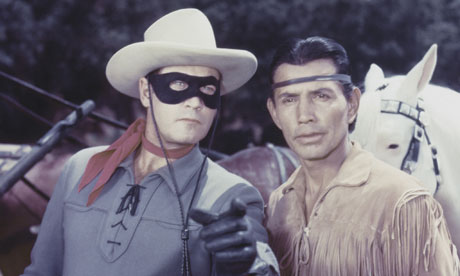
The Lone Ranger
The Lone Ranger and Tonto, in the long-running TV series. Photograph: Silver Screen Collection/Getty Images


Wild West Vigilantism May Work While The Hero Can Outshoot The Villain and His Friends, But Real Justice Outflanks Escalation

By Tom Wright
Thursday 5 May 2011 19.00 BST
Courtesy Of "The Guardian"


Consider the following scenario. A group of Irish republican terrorists carries out a bombing raid in London. People are killed and wounded. The group escapes, first to Ireland, then to the US, where they disappear into the sympathetic hinterland of a country where IRA leaders have in the past been welcomed at the White House. Britain cannot extradite them, because of the gross imbalance of the relevant treaty. So far, this seems plausible enough.
But now imagine that the British government, seeing the murderers escape justice, sends an aircraft carrier (always supposing we've still got any) to the Nova Scotia coast. From there, unannounced, two helicopters fly in under the radar to the Boston suburb where the terrorists are holed up. They carry out a daring raid, killing the (unarmed) leaders and making their escape. Westminster celebrates; Washington is furious.
What's the difference between this and the recent events in Pakistan? Answer: American exceptionalism. America is subject to different rules to the rest of the world. By what right? Who says?
Consider another fictive scenario. Gangsters are preying on a small mid-western town. The sheriff and his deputies are spineless; law and order have failed. So the hero puts on a mask, acts "extra-legally", performs the necessary redemptive violence and returns to ordinary life, earning the undying gratitude of the local townsfolk, sheriff included. This is the plot of a thousand movies, comic-book strips, and TV shows: Captain America, The Lone Ranger, and (upgraded to hi-tech) Superman. The masked hero saves the world.
Films and comics with this plot-line have been named as favourites by many presidents, as Robert Jewett and John Shelton Lawrence pointed out in The Myth of the American Superhero and Captain America and the Crusade Against Evil. The main reason President Obama has been cheered to the echo across the US, even by his bitter opponents, is not simply the fully comprehensible sense of closure a decade after the horrible, wicked actions of September 11 2001. Underneath that, he has just enacted one of America's most powerful myths.
Perhaps the myth was necessary in the days of the wild west, of isolated frontier towns and roaming gangs. But it legitimises a form of vigilantism, of taking the law into one's own hands, which provides "justice" only of the crudest sort. In the present case, the "hero" fired a lot of stray bullets in Iraq and Afghanistan before he got it right. What's more, such actions invite retaliation. They only "work" because the hero can shoot better than the villain; but the villain's friends may decide on vengeance. Proper justice is designed precisely to outflank such escalation.
Of course, proper justice is hard to come by internationally. America regularly casts the UN (and the international criminal court) as the hapless sheriff, and so continues to play the world's undercover policeman. The UK has gone along for the ride. What will we do when new superpowers arise and try the same trick on us? And what has any of this to do with something most Americans also believe, that the God of ultimate justice and truth was fully and finally revealed in the crucified Jesus of Nazareth, who taught people to love their enemies, and warned that those who take the sword will perish by the sword?

Monday, January 03, 2011

America's Dangerous Self-Deceptions


By Lawrence Davidson
December 27, 2010
Courtesy Of "Consortium News"


Editor’s Note: In 1984, as the U.S. national elite was embracing “American exceptionalism” as a core philosophy, Ronald Reagan’s UN Ambassador Jeane Kirkpatrick branded those who still dared disagree with U.S. foreign policy as disloyal citizens who would “blame America first,” a clever turn of phrase widely applauded by Washington’s courtier press.

Yet, the consequences of that assault on meaningful self-criticism are now painfully apparent, as the United States stumbles around the world increasingly viewed as a destructive behemoth blind to its own shortcomings and deceptions, as Lawrence Davidson notes in this guest essay:

Benjamin Disraeli once labeled Britain’s government "an organized hypocrisy." That was in circa 1845. Things have not changed much and by now hypocrisy might well be seen as a common sin of democratic government.

This is because in democracies straight-forward honesty about behavior that runs counter to the idealized national image is usually bad politics.

Among today’s democracies none proves this point more than the United States. The United States, like Great Britain in the 19th century, simultaneously acts like an imperial power and cultivates a national image as the world’s prime purveyor of good government, stability and progress.

However, history has taught us that a nation cannot be both of these things at once. So the folks in Washington have created for themselves an environment wherein principle and consistency are impossible. Take, for instance, the following:

1. A stolen election in the Ivory Coast has resulted in active disapproval on the part of the U.S. government. After all, this is not good government. 

President Obama slapped sanctions on the fellows who stole the vote and urged the United Nations to send more troops (some 9,000 are already in the country) to set things right.

On the other hand, the November parliamentary elections in Egypt(presently a U.S. ally) were an outright farce. The opposition was banned, jailed and otherwise intimidated. Not at all good government. And Washington’s response? Nada (nothing).

If you claim to be the prime purveyor of democracy in the world, are you not supposed to be consistent?

2. Then there is the yet unproven Iranian nuclear weapons program. According to studies done by U.S. intelligence, this program is a myth. Nonetheless, Israeli paranoia has stirred up U.S. congressional passions.

Iran is now proclaimed a destabilizing rogue nation. The United States has proceeded to apply one package of sanctions after another on Teheran.

There are actually men and women among our elected officials (obviously more swayed by the whisperings of Zionist lobbyists than by U.S. intelligence reports) who are quite willing to go to war over this unsubstantiated threat. Considering the cost and horror of such action, I think that they, regardless of age or sex, should be in the front combat lines of any conflict resulting from their misplaced enthusiasm.

Not to be undone in this effort, European Union countries also seek to put pressure on Iran to stop something that, according to U.S. intelligence agencies, is not happening.

On the other hand there is Israel (America’s "strategic" ally), the source of much of this mania. That country is in violation of international law in ways that Tehran could never match.

Its expansionist policies are the main destabilizing force in the entire Middle East. It is religiously devoted to the ethnic cleansing of an entire people while claiming that it is civilized and "Western."

And, Israel has 200 or more nuclear warheads, the missile systems to deliver them, and a leadership whose reckless disregard for world peace makes Ahmadinejad look like a model of sanity.

If the United States seeks stability in the Middle East so that region may be a reliable source of oil, should it not be concerned with Israel as well as Iran? So, what does Washington have to say about the loaded warheads in Israel? Nada. And the EU, well, they plan to admit Israel into the European Organization for Nuclear Research.

3. Latin America has always been an arena wherein the U.S. preaches good government and development. But on the ground, hypocrisy rules.

Cuba, Venezuela, Guatemala, Nicaragua and El Salvador are or were hounded by one American administration after another because their leftist governments were, by definition, bad governments. 

Simultaneously, the same administrations backed the murderers and torturers who once passed for political leaders in places like Argentina and Chile.

Washington also backed the Contras and called these violators of human rights, "freedom fighters." It has gotten to the point where the number of people living south of the Rio Grande who now trust the U.S. government is dwindling fast.

And some of those who still do so also cheer the South and Central American death squads funded by various American corporations and trained by the U.S. military’s infamous School of the Americas in Georgia. What does Washington have to say about this skewed situation? Nada.

These are just a few examples of the contradictions that beset the idealized U.S. national image.

As the skepticism that can be found in Latin America, and now the Middle East too suggests, belief in this America really stops at the its borders. Beyond that point the ideal image is increasingly seen as masking a form of aggressive narcissism.

Yet inside the borders, most are still true believers. Our national self-image dominates to the point that we can apply Andre Gide’s adage, "the true hypocrite is the one who ceases to perceive his deception, the one who lies with sincerity." I think many of our politicians fall into this category.

Why Is It So?

Why are things this way? Well, as mentioned above, believing in a national image that is unhinged from reality has something to do with it.

American politicians know that identifying yourself with the idealized U.S. (democracy, stability and progress, etc.) is a winning political formula. But how do you bury the contradictions?

You either hide your hypocrisy behind a thick cloud of secrecy (a la the WikiLeaks affair) or you obscure your double standards with mass propaganda. Washington uses both strategies.

If you pursue these strategies long enough and consistently enough you build yourself a "thought collective" – groupthink on a national level. Within the thought collective self-deception and rationalization become high arts and soon both the leaders and the followers no longer notice the underlying hypocrisy.

It also helps that most of the public is indifferent toward the world beyond their local sphere. Indifference results in ignorance and the void left by ignorance is readily filled with manipulative misinformation.
Nor do the indifferent care about government secrecy on subjects that appear to have no relevance to their daily lives.

To make all this a bit clearer, think about your own experience. When you act in the world things usually work out if the ideas and beliefs in your head match well with the reality outside you. However, when those ideas and beliefs do not match up with outside reality, things almost never go well.

Indeed, at such times you can walk right off a cliff. America’s idealized national image, along with all the spin coming from its powerful political and media elites, constitute a good part of the notions floating around the collective "U.S. head."

Over the last 50 years or more those notions have become ever more detached from reality. Vietnam, Iraq, the September 11th attacks were all symptoms of this growing fact.

Much of the rest of the world can see this, but rather than face the grim truth, most Americans are determined to maintain their collective self-image through stubborn self-deception and hypocrisy. And, there is no telling how much longer this can go on?

Lawrence Davidson is a history professor at West Chester University in Pennsylvania. He is the author of Foreign Policy Inc.: Privatizing America's National Interest; America's Palestine: Popular and Offical Perceptions from Balfour to Israeli Statehood; and Islamic Fundamentalism.