Showing posts with label Soviet Union. Show all posts

Monday, October 20, 2014

The Congressman Who Spied For Russia


Born in Vilnius, Lithuania, in 1885, Dickstein immigrated with his religious Jewish parents to the Lower East Side as a small child.

Samuel Dickstein, a Democrat from New York City who served in the House of Representatives from the early 1920s to the mid-1940s.

Dickstein didn’t achieve a degree of prominence in Congress until the Democrats took control of the House following the 1930 midterms and Tammany chieftains insisted that he be named to lead the Committee on Immigration and Naturalization. From this perch, he began his career as a scourge of the disloyal.

Stalin had a spy in Congress, an exasperating character who once “blazed up very much, claiming that if we didn’t give him money he would break with us,” according to his Soviet contact. To this day, Sam Dickstein is the only known U.S. representative to have served as a covert agent for a foreign power. His codename was Crook.

Friday, October 17, 2014

Citizen X


Andrei Romanovich Chikatilo (Russian: Андрей Романович Чикатило,Ukrainian: Андрій Романович Чикатило; 16 October 1936 – 14 February 1994) was a Soviet serial killer, nicknamed the Butcher of Rostov, the Red Ripper, and the Rostov Ripper, who committed the sexual assault, murder and mutilation of a minimum of 52 women and children between 1978 and 1990 in the Russian SFSR, the Ukrainian SSR and the Uzbek SSR. Chikatilo confessed to a total of 56 murders and was tried for 53 of these killings in April 1992. He was convicted and sentenced to death for 52 of these murders in October 1992 and subsequently executed in February 1994.
Chikatilo was known by such titles as the Rostov Ripper and the Butcher of Rostov because the majority of his murders were committed in the Rostov Oblast of the Russian SFSR.
BackGround Info via: Wikipedia

Starring: Stephen Rea, Donald Sutherland, Max von Sydow

Friday, September 26, 2014

Countdown To Looking Glass


Docudrama uses fictional reports of a crisis in the Middle East, which leads to a nuclear confrontation between the US and the USSR. "Looking Glass" is the code word for the Strategic Air Command's control plane which is to be used in the case of nuclear war.

Mention the similarities between the story and today's Geo-political situation.

Starring: Scott Glenn, Michael Murphy, Helen Shaver, Patrick Watson. 

Operation Looking Glass

s the code name for an airborne command center operated by the United States. It provides command and control of U.S. nuclear forces in the event that ground-based command centers are destroyed or otherwise rendered inoperable. In such an event, the general officer serving as the Airborne Emergency Action Officer (AEAO) on Looking Glass assumes by devolution the authority of the National Command Authorities and can command execution of nuclear attacks. The AEAO is supported by a battle staff of approximately 20 people, with another dozen responsible for the operation of the aircraft systems.

The Looking Glass was initiated by the U.S. Air Force's Strategic Air Command in 1961 and operated by the 34th Air Refueling SquadronOffutt AFBNebraska. In August 1966 the mission transferred to the 38th Strategic Reconnaissance Squadron, the 2d Airborne Command and Control Squadron in April 1970, to the 7th Airborne Command and Control Squadron in July 1994, and to the U.S. Navy in October 1998.

The Strategic Air Command began the Looking Glass mission on February 3, 1961, using EC-135C[1] From the Airborne Command Post (ABNCP) conception aircraft based at its headquarters at Offutt AFBNebraska backed up by aircraft flying with the Second Air Force / 913th Air Refueling Squadron at Barksdale AFB Louisiana, Eighth Air Force / 99th Air Refueling Squadron at Westover AFB, Massachusetts, and Fifteenth Air Force / 22d Air Refueling SquadronMarch AFB, California.

EC-135 Looking Glass aircraft were airborne 24 hours a day for over 29 years,[2] until July 24, 1990, when "The Glass" ceased continuous airborne alert, but remained on ground or airborne alert 24 hours a day. The one break in the schedule occurred March 4, 1980, when a 1st Airborne Command and Control Squadron E-4 operated a combined Nightwatch / Looking Glass mission, Scheduled for an eight-hour mission, it ended up flying a double (16 hours) due to bad weather at both Offutt and Ellsworth.

The airborne command post is referred to as Looking Glass because its mission "mirrors" ground-based command, control, and communications located at the USSTRATCOM Global Operations Center (GOC) at Offutt Air Force Base. It has also been called the "Doomsday Plane," since its role would only be necessary in the event that the ground nuclear command centers at Offutt, the National Military Command Center, and Site R were destroyed. The Looking Glass is equipped with the Airborne Launch Control System, capable of transmitting launch commands to U.S. ground-based ICBMs in the event that the ground launch control centers are rendered inoperable.

At DEFCON 2 or higher, the Looking Glass pilot and co-pilot were both required to wear an eye patch, retrieved from theirEmergency War Order (EWO) kit. In the event of a surprise blinding flash from a nuclear detonation, the eye patch would prevent blindness in the covered eye, thus enabling them to see in at least one eye and continue flying. Later, the eye patch was replaced by goggles that would instantaneously turn opaque when exposed to a nuclear flash, then rapidly clear for normal vision.

The Looking Glass is also designed to help ensure continuity and reconstitution of the US government in the event of anuclear attack on North America. Although the two types of aircraft are distinct, the Doomsday Plane nickname is also frequently associated with the E-4 "Nightwatch" Advanced Airborne Command Post mission and aircraft.

The Looking Glass was the anchor in what was known as the World Wide Airborne Command Post (WWABNCP) network. This network of specially equipped EC-135 aircraft would launch from ground alert status and establish air-to-air wireless network connections in the event of a U.S. national emergency. Members of the WWABNCP network included:

  • (1) Operation "Silk Purse" for the Commander in Chief, U.S. European Command (USCINCEUR), based at RAF Mildenhall in the United Kingdom;
  • (2) Operation "Scope Light" for the Commander in Chief, U.S. Atlantic Forces (CINCLANT), based at Langley AFB, VA;
  • (3) Operation "Blue Eagle" for the Commander in Chief, U.S. Pacific Command (USCINCPAC), based at Hickam AFB, HI; and
  • (4) Operation "Nightwatch" which supported the President of the United States and were based at Andrews AFB, Maryland. In the early 1970s the E-4B aircraft replaced the EC-135s on this mission.

The Eastern Auxiliary (EAST Aux) and Western Auxiliary (West Aux) Command Posts were also part of the WWABNCP ("wah-bin-cop") network and were capable of assuming responsibility for Looking Glass as the anchor. The West Aux 906th Air Refueling Squadron was based at Minot AFBNorth Dakota and moved to the 4th Airborne Command & Control Squadron at Ellsworth AFBSouth Dakota in April 1970 and the East Aux mission 301st Air Refueling Squadron was based at Lockbourne AFBOhio and moved to the 3rd Airborne Command & Control Squadron at Grissom AFBIndiana in April 1970. After 1975 East Aux would be assumed from the Looking Glass backup ground alert aircraft launched from Offutt AFB.

Wednesday, January 29, 2014

ALMOST EVERYTHING IN “DR. STRANGELOVE” WAS TRUE

dr-strangelove-still-580.jpg

POSTED BY ERIC SCHLOSSER

This month marks the fiftieth anniversary of Stanley Kubrick’s black comedy about nuclear weapons, “Dr. Strangelove or: How I Learned to Stop Worrying and Love the Bomb.” Released on January 29, 1964, the film caused a good deal of controversy. Its plot suggested that a mentally deranged American general could order a nuclear attack on the Soviet Union, without consulting the President. One reviewer described the film as “dangerous … an evil thing about an evil thing.” Another compared it to Soviet propaganda. Although “Strangelove” was clearly a farce, with the comedian Peter Sellers playing three roles, it was criticized for being implausible. An expert at the Institute for Strategic Studies called the events in the film “impossible on a dozen counts.” A former Deputy Secretary of Defense dismissed the idea that someone could authorize the use of a nuclear weapon without the President’s approval: “Nothing, in fact, could be further from the truth.” (See a compendium of clips from the film.) When “Fail-Safe”—a Hollywood thriller with a similar plot, directed by Sidney Lumet—opened, later that year, it was criticized in much the same way. “The incidents in ‘Fail-Safe’ are deliberate lies!” General Curtis LeMay, the Air Force chief of staff, said. “Nothing like that could happen.”
 The first casualty of every war is the truth—and the Cold War was no exception to that dictum. Half a century after Kubrick’s mad general, Jack D. Ripper, launched a nuclear strike on the Soviets to defend the purity of “our precious bodily fluids” from Communist subversion, we now know that American officers did indeed have the ability to start a Third World War on their own. And despite the introduction of rigorous safeguards in the years since then, the risk of an accidental or unauthorized nuclear detonation hasn’t been completely eliminated.
The command and control of nuclear weapons has long been plagued by an “always/never” dilemma. The administrative and technological systems that are necessary to insure that nuclear weapons are always available for use in wartime may be quite different from those necessary to guarantee that such weapons can never be used, without proper authorization, in peacetime. During the nineteen-fifties and sixties, the “always” in American war planning was given far greater precedence than the “never.” Through two terms in office, beginning in 1953, President Dwight D. Eisenhower struggled with this dilemma. He wanted to retain Presidential control of nuclear weapons while defending America and its allies from attack. But, in a crisis, those two goals might prove contradictory, raising all sorts of difficult questions. What if Soviet bombers were en route to the United States but the President somehow couldn’t be reached? What if Soviet tanks were rolling into West Germany but a communications breakdown prevented NATOofficers from contacting the White House? What if the President were killed during a surprise attack on Washington, D.C., along with the rest of the nation’s civilian leadership? Who would order a nuclear retaliation then?
With great reluctance, Eisenhower agreed to let American officers use their nuclear weapons, in an emergency, if there were no time or no means to contact the President. Air Force pilots were allowed to fire their nuclear anti-aircraft rockets to shoot down Soviet bombers heading toward the United States. And about half a dozen high-level American commanders were allowed to use far more powerful nuclear weapons, without contacting the White House first, when their forces were under attack and “the urgency of time and circumstances clearly does not permit a specific decision by the President, or other person empowered to act in his stead.” Eisenhower worried that providing that sort of authorization in advance could make it possible for someone to do “something foolish down the chain of command” and start an all-out nuclear war. But the alternative—allowing an attack on the United States to go unanswered or NATO forces to be overrun—seemed a lot worse. Aware that his decision might create public unease about who really controlled America’s nuclear arsenal, Eisenhower insisted that his delegation of Presidential authority be kept secret. At a meeting with the Joint Chiefs of Staff, he confessed to being “very fearful of having written papers on this matter.”
President John F. Kennedy was surprised to learn, just a few weeks after taking office, about this secret delegation of power. “A subordinate commander faced with a substantial military action,” Kennedy was told in a top-secret memo, “could start the thermonuclear holocaust on his own initiative if he could not reach you.” Kennedy and his national-security advisers were shocked not only by the wide latitude given to American officers but also by the loose custody of the roughly three thousand American nuclear weapons stored in Europe. Few of the weapons had locks on them. Anyone who got hold of them could detonate them. And there was little to prevent NATO officers from Turkey, Holland, Italy, Great Britain, and Germany from using them without the approval of the United States.
In December, 1960, fifteen members of Congress serving on the Joint Committee on Atomic Energy had toured NATO bases to investigate how American nuclear weapons were being deployed. They found that the weapons—some of them about a hundred times more powerful than the bomb that destroyed Hiroshima—were routinely guarded, transported, and handled by foreign military personnel. American control of the weapons was practically nonexistent. Harold Agnew, a Los Alamos physicist who accompanied the group, was especially concerned to see German pilots sitting in German planes that were decorated with Iron Crosses—and carrying American atomic bombs. Agnew, in his own words, “nearly wet his pants” when he realized that a lone American sentry with a rifle was all that prevented someone from taking off in one of those planes and bombing the Soviet Union.
* * *
The Kennedy Administration soon decided to put locking devices inside NATO’s nuclear weapons. The coded electromechanical switches, known as “permissive action links” (PALs), would be placed on the arming lines. The weapons would be inoperable without the proper code—and that code would be shared with NATO allies only when the White House was prepared to fight the Soviets. The American military didn’t like the idea of these coded switches, fearing that mechanical devices installed to improve weapon safety would diminish weapon reliability. A top-secret State Department memo summarized the view of the Joint Chiefs of Staff in 1961: “all is well with the atomic stockpile program and there is no need for any changes.”
After a crash program to develop the new control technology, during the mid-nineteen-sixties, permissive action links were finally placed inside most of the nuclear weapons deployed byNATO forces. But Kennedy’s directive applied only to the NATO arsenal. For years, the Air Force and the Navy blocked attempts to add coded switches to the weapons solely in their custody. During a national emergency, they argued, the consequences of not receiving the proper code from the White House might be disastrous. And locked weapons might play into the hands of Communist saboteurs. “The very existence of the lock capability,” a top Air Force general claimed, “would create a fail-disable potential for knowledgeable agents to ‘dud’ the entire Minuteman [missile] force.” The Joint Chiefs thought that strict military discipline was the best safeguard against an unauthorized nuclear strike. A two-man rule was instituted to make it more difficult for someone to use a nuclear weapon without permission. And a new screening program, the Human Reliability Program, was created to stop people with emotional, psychological, and substance-abuse problems from gaining access to nuclear weapons.
Despite public assurances that everything was fully under control, in the winter of 1964, while “Dr. Strangelove” was playing in theatres and being condemned as Soviet propaganda, there was nothing to prevent an American bomber crew or missile launch crew from using their weapons against the Soviets. Kubrick had researched the subject for years, consulted experts, and worked closely with a former R.A.F. pilot, Peter George, on the screenplay of the film. George’s novel about the risk of accidental nuclear war, “Red Alert,” was the source for most of “Strangelove” ’s plot. Unbeknownst to both Kubrick and George, a top official at the Department of Defense had already sent a copy of “Red Alert” to every member of the Pentagon’s Scientific Advisory Committee for Ballistic Missiles. At the Pentagon, the book was taken seriously as a cautionary tale about what might go wrong. Even Secretary of Defense Robert S. McNamara privately worried that an accident, a mistake, or a rogue American officer could start a nuclear war.
Coded switches to prevent the unauthorized use of nuclear weapons were finally added to the control systems of American missiles and bombers in the early nineteen-seventies. The Air Force was not pleased, and considered the new security measures to be an insult, a lack of confidence in its personnel. Although the Air Force now denies this claim, according to more than one source I contacted, the code necessary to launch a missile was set to be the same at every Minuteman site: 00000000.
* * *
The early permissive action links were rudimentary. Placed in NATO weapons during the nineteen-sixties and known as Category A PALs, the switches relied on a split four-digit code, with ten thousand possible combinations. If the United States went to war, two people would be necessary to unlock a nuclear weapon, each of them provided with half the code. Category APALs were useful mainly to delay unauthorized use, to buy time after a weapon had been taken or to thwart an individual psychotic hoping to cause a large explosion. A skilled technician could open a stolen weapon and unlock it within a few hours. Today’s Category D PALs, installed in the Air Force’s hydrogen bombs, are more sophisticated. They require a six-digit code, with a million possible combinations, and have a limited-try feature that disables a weapon when the wrong code is repeatedly entered.
The Air Force’s land-based Minuteman III missiles and the Navy’s submarine-based Trident II missiles now require an eight-digit code—which is no longer 00000000—in order to be launched. The Minuteman crews receive the code via underground cables or an aboveground radio antenna. Sending the launch code to submarines deep underwater presents a greater challenge. Trident submarines contain two safes. One holds the keys necessary to launch a missile; the other holds the combination to the safe with the keys; and the combination to the safe holding the combination must be transmitted to the sub by very-low-frequency or extremely-low-frequency radio. In a pinch, if Washington, D.C., has been destroyed and the launch code doesn’t arrive, the sub’s crew can open the safes with a blowtorch.
The security measures now used to control America’s nuclear weapons are a vast improvement over those of 1964. But, like all human endeavors, they are inherently flawed. The Department of Defense’s Personnel Reliability Program is supposed to keep people with serious emotional or psychological issues away from nuclear weapons—and yet two of the nation’s top nuclear commanders were recently removed from their posts. Neither appears to be the sort of calm, stable person you want with a finger on the button. In fact, their misbehavior seems straight out of “Strangelove.”
Vice Admiral Tim Giardina, the second-highest-ranking officer at the U.S. Strategic Command—the organization responsible for all of America’s nuclear forces—-was investigated last summer for allegedly using counterfeit gambling chips at the Horseshoe Casino in Council Bluffs, Iowa. According to the Iowa Division of Criminal Investigation, “a significant monetary amount” of counterfeit chips was involved. Giardina was relieved of his command on October 3, 2013. A few days later, Major General Michael Carey, the Air Force commander in charge of America’s intercontinental ballistic missiles, was fired for conduct “unbecoming an officer and a gentleman.”According to a report by the Inspector General of the Air Force, Carey had consumed too much alcohol during an official trip to Russia, behaved rudely toward Russian officers, spent time with “suspect” young foreign women in Moscow, loudly discussed sensitive information in a public hotel lounge there, and drunkenly pleaded to get onstage and sing with a Beatles cover band at La Cantina, a Mexican restaurant near Red Square. Despite his requests, the band wouldn’t let Carey onstage to sing or to play the guitar.
While drinking beer in the executive lounge at Moscow’s Marriott Aurora during that visit, General Carey made an admission with serious public-policy implications. He off-handedly told a delegation of U.S. national-security officials that his missile-launch officers have the “worst morale in the Air Force.” Recent events suggest that may be true. In the spring of 2013, nineteen launch officers at Minot Air Force base in North Dakota were decertified for violating safety rules and poor discipline. In August, 2013, the entire missile wing at Malmstrom Air Force base in Montana failed its safety inspection. Last week, the Air Force revealed that thirty-four launch officers at Malmstrom had been decertified for cheating on proficiency exams—and that at least three launch officers are being investigated for illegal drug use. The findings of a report by the RAND Corporation, leaked to the A.P., were equally disturbing. The study found that the rates of spousal abuse and court martials among Air Force personnel with nuclear responsibilities are much higher than those among people with other jobs in the Air Force. “We don’t care if things go properly,” a launch officer told RAND. “We just don’t want to get in trouble.”
The most unlikely and absurd plot element in “Strangelove” is the existence of a Soviet “Doomsday Machine.” The device would trigger itself, automatically, if the Soviet Union were attacked with nuclear weapons. It was meant to be the ultimate deterrent, a threat to destroy the world in order to prevent an American nuclear strike. But the failure of the Soviets to tell the United States about the contraption defeats its purpose and, at the end of the film, inadvertently causes a nuclear Armageddon. “The whole point of the Doomsday Machine is lost,” Dr. Strangelove, the President’s science adviser, explains to the Soviet Ambassador, “if you keep it a secret!”
A decade after the release of “Strangelove,” the Soviet Union began work on the Perimeter system—-a network of sensors and computers that could allow junior military officials to launch missiles without oversight from the Soviet leadership. Perhaps nobody at the Kremlin had seen the film. Completed in 1985, the system was known as the Dead Hand. Once it was activated, Perimeter would order the launch of long-range missiles at the United States if it detected nuclear detonations on Soviet soil and Soviet leaders couldn’t be reached. Like the Doomsday Machine in “Strangelove,” Perimeter was kept secret from the United States; its existence was not revealed until years after the Cold War ended.
In retrospect, Kubrick’s black comedy provided a far more accurate description of the dangers inherent in nuclear command-and-control systems than the ones that the American people got from the White House, the Pentagon, and the mainstream media.
“This is absolute madness, Ambassador,” President Merkin Muffley says in the film, after being told about the Soviets’ automated retaliatory system. “Why should you build such a thing?” Fifty years later, that question remains unanswered, and “Strangelove” seems all the more brilliant, bleak, and terrifyingly on the mark.

Tuesday, November 05, 2013

America's Holy Warrior


  • When Osama Bin Laden Was The Good Guy, Because He Fought America's Enemies.
  • When "Mujahideen" and "Jihad" Were Kosher, Because They Were Used Against America's Enemies.
  • When It Was Fine To Fight In Other Countries, As Long As It Was Against America's Enemies
  • When Today's "Terrorists" Were YesterYear Known As "Guerrilla's".

Anti-Soviet warrior puts his army on the road to peace: The Saudi businessman who recruited mujahedin now uses them for large-scale building projects in Sudan. 

OSAMA Bin Laden sat in his gold- fringed robe, guarded by the loyal Arab Mujahedeen who fought alongside him in Afghanistan. Bearded, taciturn figures - unarmed, but never more than a few yards from the man who recruited them, trained them and then dispatched them to destroy the Soviet army - they watched unsmiling as the Sudanese villagers of Almatig lined up to thank the Saudi businessman who is about to complete the highway linking their homes to Khartoum for the first time in history.

Mr Bin Laden looks every inch the mountain warrior of mujahedin legend. Chadored children danced in front of him, preachers acknowledged his wisdom. 'We have been waiting for this road through all the revolutions in Sudan,' a sheikh said. 'We waited until we had given up on everybody - and then Osama Bin Laden came along.'

And 'this job' is certainly an ambitious one: a brand-new highway stretching all the way from Khartoum to Port Sudan, a distance of 1,200km (745 miles) on the old road, now shortened to 800 km by the new Bin Laden route that will turn the coastal run from the capital into a mere day's journey. Mr Bin Laden has brought the very construction equipment that he used only five years ago to build the guerrilla trails of Afghanistan.

He is a shy man. Maintaining a home in Khartoum and only a small apartment in his home city of Jeddah, he is married - with four wives - but wary of the press. His interview with the Independent was the first he has ever given to a Western journalist, and he initially refused to talk about Afghanistan, sitting silently on a chair at the back of a makeshift tent, brushing his teeth in the Arab fashion with a stick of miswak wood. 

But talk he eventually did about a war which he helped to win for the Afghan Mujahedeen: 

'What I lived in two years there, I could not have lived in a hundred years elsewhere,' he said.
When the history of the Afghan resistance movement is written, Mr Bin Laden's own contribution to the mujahedin - and the indirect result of his training and assistance - may turn out to be a turning- point... he tries to minimise his role.
'When the invasion of Afghanistan started, I was enraged and went there at once - I arrived within days, before the end of 1979,' he said. 'Yes, I fought there, but my fellow Muslims did much more than I. Many of them died and I am still alive.'
Within months, however, Mr Bin Laden was sending Arab fighters - Egyptians, Algerians, Lebanese, Kuwaitis, Turks and Tunisians - into Afghanistan; 'not hundreds but thousands,' he said. He supported them with weapons and his own construction equipment. Along with his Iraqi engineer, Mohamed Saad - who is now building the Port Sudan road - Mr Bin Laden blasted massive tunnels into the Zazi mountains of Bakhtiar province for guerrilla hospitals and arms dumps, then cut a mujahedin trail across the country to within 15 miles of Kabul.
'No, I was never afraid of death. As Muslims, we believe that when we die, we go to heaven. Before a battle, God sends us seqina, tranquillity.
'Once I was only 30 metres from the Russians and they were trying to capture me. I was under bombardment but I was so peaceful in my heart that I fell asleep. This experience has been written about in our earliest books. I saw a 120mm mortar shell land in front of me, but it did not blow up. Four more bombs were dropped from a Russian plane on our headquarters but they did not explode. We beat the Soviet Union. The Russians fled.'
But what of the Arab Mujahedeen whom he took to Afghanistan - members of a guerrilla army who were also encouraged and armed by the United States - and who were forgotten when that war was over
'Personally neither I nor my brothers saw evidence of American help. When my mujahedin were victorious and the Russians were driven out, differences started (between the guerrilla movements) so I returned to road construction in Taif and Abha. I brought back the equipment I had used to build tunnels and roads for the mujahedin in Afghanistan. Yes, I helped some of my comrades to come here to Sudan after the war.'
How many? Osama Bin Laden shakes his head. 'I don't want to say. But they are here now with me, they are working right here, building this road to Port Sudan.' I told him that Bosnian Muslim fighters in the Bosnian town of Travnik had mentioned his name to me. 'I feel the same about Bosnia,' he said. 'But the situation there does not provide the same opportunities as Afghanistan.
A small number of Mujahedeen have gone to fight in Bosnia-Herzegovina but the Croats won't allow the Mujahedeen in through Croatia as the Pakistanis did with Afghanistan.'
Thus did Mr Bin Laden reflect upon jihad while his former fellow combatants looked on. Was it not a little bit anti-climactic for them, I asked, to fight the Russians and end up road-building in Sudan? 'They like this work and so do I. This is a great plan which we are achieving for the people here, it helps the Muslims and improves their lives.'
His Bin Laden company - not to be confused with the larger construction business run by his cousins - is paid in Sudanese currency which is then used to purchase sesame and other products for export; profits are clearly not Mr Bin Laden's top priority.

Thursday, May 30, 2013

How A 1980s Nuclear War Scare Became A Full-Blown Crisis


During 10 days in November 1983, the United States and the Soviet Union nearly started a nuclear war. Newly declassified documents from the CIA, NSA, KGB, and senior officials in both countries reveal just how close we came to mutually assured destruction — over a military exercise.
That exercise, Able Archer 83, simulated the transition by NATO from a conventional war to a nuclear war, culminating in the simulated release of warheads against the Soviet Union. NATO changed its readiness condition during Able Archer to DEFCON 1, the highest level. The Soviets interpreted the simulation as a ruse to conceal a first strike and readied their nukes. At this period in history, and especially during the exercise, a single false alarm or miscalculation could have brought Armageddon.
According to a diplomatic memo obtained through a Freedom of Information Act request by National Security Archives researcher Nate Jones, Soviet General Secretary Yuri Adroprov warned U.S. ambassador Averell Harriman six months before the crisis that both countries “may be moving toward a red line” in which a miscalculation could spark a nuclear war. Harriman later wrote that he believed Andropov was concerned “over the state of U.S.-Soviet relations and his desire to see them at least ‘normalized,’ if not improved.”
The early 1980s was a “crisis period, a pre-wartime period,” said Gen. Varfolomei Korobushin, the former deputy chief of staff of the Soviet nuclear Strategic Rocket Forces, according to an interview conducted by the Pentagon in the early 1990s and obtained by Jones. The Kremlin’s Central Committee slept in shifts. There were fears the deployment of Pershing II ballistic missiles to Europe (also in November 1983) could tip the balance. If a conventional war erupted, Soviet planners worried their troops would come close to capturing the nuclear-tipped missiles, prompting the United States to fire them.
The Soviet Union, according to an unclassified article written for the CIA’s classified Studies in Intelligence journal and provided to Jones, notes that Soviet fears of a preemptive American nuclear attack “while exaggerated, were scarcely insane.” This stemmed from the Soviet experience during World War II, when the Third Reich launched Operation Barbarossa, the largest invasion in human history. Soviet officials worried history might be repeated by NATO.
Oleg Gordievsky, a CIA and MI6 source during the Cold War, was previously known to have warned the West about these fears,  but the CIA article identifies a second source of this information: a Czech intelligence officer with ties to the KGB who “noted that his counterparts were obsessed with the historical parallel between 1941 and 1983. He believed this feeling was almost visceral, not intellectual, and deeply affected Soviet thinking.”
(The complete list of unclassified documents are collected at the Archives’ website, with two more sets of documents to follow.) The NSA had 81 more documents, but did not release them. However, it did “review, approve for release, stamp, and send a printout of a Wikipedia article,” he noted.
Still, we do have more evidence of serious Soviet preparations. Documents obtained by Jones detail a massive KGB intelligence-gathering mission called Operation RYaN. (The name is a Russian acronym for “nuclear missile attack.”) According to the CIA article, RYaN was “for real” and accelerated in the early 1980s during the scare. The goal was to find out if and when the United States and NATO would attack. According to KGB instructions sent to agents in London, Soviet spies were to monitor bomb shelters, blood banks, military bases and key financial and religious leaders for signs of war preparations. “Many of the assigned observations would have been very poor indicators of a nuclear attack,” Jones warns.
But in another sense, the scrambling for any scrap of intelligence — whether good or bad — reflected a feverish belief among some quarters that war was just around the corner. “[T]he Reagan administration marked the height of the Cold War,” notes one declassified history published by the National Security Agency. “The president referred to the Soviet Union as the Evil Empire, and was determined to spend it into the ground. The Politburo reciprocated, and the rhetoric on both sides, especially during the first Reagan administration, drove the hysteria. Some called it the Second Cold War. The period 1982-1984 marked the most dangerous Soviet-American confrontation since the Cuban Missile Crisis.”
Source: Wired

Tuesday, October 16, 2012

U.S. Was Prepared To Nuke Cuba


Image of JFK and Nikita Khrushchev

Pentagon Estimated 18,500 U.S. Casualties in Cuba Invasion 1962, But If Nukes Launched, "Heavy Losses" Expected

Gen. Taylor Proposed Major Retaliation if Cubans "Foolhardy" Enough to Try to Repel U.S. Invasion with Nuclear Weapons

But Taylor Warned There Would Be "No Experience Factor Upon Which to Base an Estimate of Casualties"

Pentagon Accountants Estimated Missile Crisis Cost $165 Million Dollars, Over $1.4 Billion in Current Dollars

... The chairman of the Joint Chiefs of staff said his forces were prepared to use nuclear weapons in an American invasion of the island if the Cubans used nuclear arms to resist.

The top secret memo from the chairman, General Maxwell D. Taylor, dated Nov. 2, 1962, underscored the continuing danger of a nuclear conflict between the superpowers even after the Soviet Union removed nuclear missiles from the island on Nov. 1.


“We must accept the possibility that the enemy may use nuclear weapons to repel invasion,” General Taylor wrote. “However, if the Cuban leaders took this foolhardy step, we could respond at once in overwhelming nuclear force against military targets.”
The National Security Archive, a research organization at George Washington University, found the three-page memo in government archives and planned to post it on its Web site on Monday night.
General Taylor also told the president that military planners were expecting up to 18,500 American troops killed and wounded in the first 10 days after an invasion. But he cautioned that the estimate applied only to a non-nuclear conflict.
“If atomic weapons were used, there is no experience factor upon which to base an estimate of casualties,” General Taylor wrote. “Certainly, we might expect to lose very heavily at the outset if caught by surprise, but our retaliation would be rapid and devastating and thus would bring to a sudden close the period of heavy losses.”
“The American generals were eager for an invasion, and even the possible presence of tactical nuclear weapons in Cuba didn’t give them a sense of caution,” Mr. Blanton said. Kennedy, by contrast, was distrustful of the military brass and very cautious, he said.
Michael Dobbs, an historian and author of “One Minute to Midnight,” a 2009 account of the crisis, said some American military leaders still favored invading Cuba at the time the memo was written, but Kennedy probably had ruled out that possibility. “By November 2, things would have had to go very, very wrong for the U.S. to launch an invasion,” he said.
Though the crisis has been studied intensively and is the subject of many books, new evidence and new interpretations continue to emerge. The conventional notion of a tough President Kennedy whose unyielding stance caused the Soviet leader Nikita S. Khrushchev to “blink” has given way to a more nuanced portrait of a Kennedy who prevented war through careful negotiation and secret concessions, including his agreement to remove American nuclear missiles from Turkey.

Tuesday, May 08, 2012

How US Hubris Baited Afghan Trap

Exclusive: Despite what Official Washington thinks it knows, the real error on Afghan policy after the Soviets left in 1989 was not the abrupt cutoff of U.S. aid but nearly the opposite, continued CIA support for the Islamist mujahedeen and rejection of peace overtures from Moscow, writes Robert Parry.

By Robert Parry
May 3, 2012
Courtesy Of "Consortium News"


President Barack Obama’s decision to extend the U.S.-Afghan strategic relationship through 2024 was driven, in part, by one of Official Washington’s most cherished myths – that the United States abruptly abandoned Afghanistan in 1989 and must not make that mistake again.

This myth is repeated by policymakers and pundits alike. On Tuesday, for instance, MSNBC’s Chris Matthews asked if his guests had seen the movie, “Charlie Wilson’s War.” He apparently viewed the Tom Hanks film as a documentary when it was really a fictional account, both on the innocence of the Afghan mujahedeen and the callowness of Congress in supposedly pulling the plug once the Soviet Army withdrew.
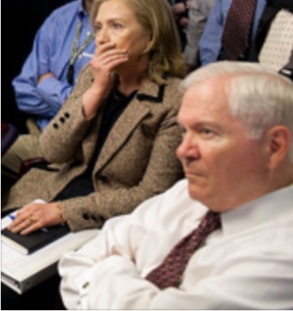
Then-Defense Secretary Robert Gates in Situation Room on May 1, 2011, monitoring the raid that killed Osama bin Laden. (From White House photo by Pete Souza)

But Matthews is far from alone in believing this mythology. The New York Times’ lead editorial on Wednesday criticized Obama for not explaining how he would prevent Afghanistan from imploding after the scheduled U.S. troop withdrawal in 2014, though the Times added that the plan’s “longer-term commitment [of aid] sends an important message to Afghans that Washington will not abandon them as it did after the Soviets were driven out.”

The abandonment myth also has been cited by senior Obama administration officials, including the current AmbassadorRyan Crocker and former Defense Secretary Robert Gates, as a way to explain the rise of the Taliban in the mid-1990s and al-Qaeda’s use of Afghanistan for plotting the 9/11 attacks on the United States in 2001.

In late 2009, Defense Secretary Gates reprised the phony conventional wisdom, telling reporters: “We will not repeat the mistakes of 1989, when we abandoned the country only to see it descend into civil war and into Taliban hands.”

Yet, Gates knew the real history since he was deputy national security adviser in 1989 when the key decisions were made to continue covert U.S. aid, not cut it off. Still, the fictional version from the movie, “Charlie Wilson’s War,” apparently proved too tempting as an excuse for an open-ended occupation of Afghanistan.

In the movie, Tom Hanks played the late Rep. Charlie Wilson, D-Texas, who was a key figure in financing the mujahedeen war against the Soviets in the 1980s. In one scene – after the Soviet withdrawal on Feb. 15, 1989 – Hanks begs a congressional committee for additional money but gets turned down.

The truth, however, is that the end game in Afghanistan surrounding the Soviet departure was messed up not because the United States cut the mujahedeen off but because Washington pressed for a clear-cut victory, rebuffing peaceful options.

And we know that Gates knows this reality because he recounted it in his 1996 memoir, From the Shadows.

The Real History

Here’s what that history actually shows: In 1988, Soviet President Mikhail Gorbachev promised to remove Soviet troops from Afghanistan and sought a negotiated settlement. He hoped for a unity government that would include elements of Najibullah’s Soviet-backed regime in Kabul and the CIA-backed Islamic fundamentalist rebels.

Gates, who was then deputy CIA director, opposed Gorbachev’s plan, disbelieving that the Soviets would really depart and insisting that – if they did – the CIA’s mujahedeen could quickly defeat Najibullah’s army.

Inside the Reagan administration, Gates’s judgment was opposed by State Department analysts who foresaw a drawn-out struggle. Deputy Secretary of State John Whitehead and the department’s intelligence chief Morton Abramowitz warned that Najibullah’s army might hold on longer than the CIA expected.

But Gates prevailed in the policy debates, pushing the CIA’s faith in its mujahedeen clients and expecting a rapid Najibullah collapse if the Soviets left. In the memoir, Gates recalled briefing Secretary of State George Shultz and his senior aides on the CIA’s predictions prior to Shultz flying to Moscow in February 1988.

“I told them that most [CIA] analysts did not believe Najibullah’s government could last without active Soviet military support,” wrote Gates.

After the Soviets did withdraw in February 1989 – proving Gates wrong on that point – some U.S. officials felt Washington’s geostrategic aims had been achieved and a move toward peace was in order. There also was mounting concern about the Afghan mujahedeen, especially their tendencies toward brutality, heroin trafficking and fundamentalist religious policies.

However, the new administration of George H.W. Bush – with Gates moving from the CIA to the White House as deputy national security adviser – rebuffed Gorbachev and chose to continue U.S. covert support for the mujahedeen, aid which was being funneled primarily through Pakistan’s Inter-Services Intelligence agency, the ISI.

Back in Afghanistan, Najibullah’s regime defied the CIA’s expectation of a rapid collapse, using Soviet weapons and advisers to beat back a mujahedeen offensive in 1990. As Najibullah hung on, the war, the violence and the disorder continued.

Gates finally recognized that his CIA analysis had been wrong. In his memoir, he wrote: “As it turned out, Whitehead and Abramowitz were right” in their warning that Najibullah’s regime might not fall quickly. Gates’s memoir also acknowledged that the U.S. government did not abandon Afghanistan immediately after the Soviet departure.

“Najibullah would remain in power for another three years [after the Soviet pull-out], as the United States and the USSR continued to aid their respective sides,” Gates wrote. Indeed, Moscow’s and Washington’s supplies continued to flow until several months after the Soviet Union collapsed in summer 1991, according to Gates.

“On Dec. 11, 1991, both Moscow and Washington cut off all assistance, and Najibullah’s government fell four months later,” Gates wrote. “He had outlasted both Gorbachev and the Soviet Union itself.” In other words, Gates confirmed that covert U.S. military support to the Afghan rebels continued for almost three years after the Soviet Army left Afghanistan.

Criles’s Account

And other U.S. assistance may have continued even longer, according to George Criles’s 2003 book, Charlie Wilson’s War, upon which the movie was loosely based. In the book, Crile described how Wilson kept the funding spigot open for the Afghan rebels not only after the Soviet departure in 1989 but even after the Soviet Union disintegrated in 1991.

In the later years of the conflict, there was also much wider knowledge about the brutality and corruption of the mujahedeen, Crile noted, though few in Washington dared speak about the dark side of these supposed “freedom-fighters.”

Crile wrote: “Throughout the war, Wilson had always told his colleagues that Afghanistan was the one morally unambiguous cause that the United States had supported since World War II – and never once had any member of Congress stood up to protest or question the vast expenditures.

“But with the departure of the Soviets, the war was anything but morally unambiguous. By 1990, the Afghan freedom fighters had suddenly and frighteningly gone back to form, reemerging as nothing more than feuding warlords obsessed with settling generations-old scores.

“The difference was that they were now armed with hundreds of millions of dollars’ worth of weapons and explosives of every conceivable type. The justification for the huge CIA operation had been to halt Soviet aggression, not to take sides in a tribal war – certainly not to transform the killing capacity of those warriors.”

Crile reported that at the end of that year, Wilson traveled to Moscow and listened to appeals for a settlement of the long-running conflict from Andre Koserov, a future Russian foreign minister. Koserov told Wilson that Moscow and Washington had a common interest in preventing the emergence of radical Islamic control of Afghanistan.

Upon returning to Washington, however, Wilson’s openness to Moscow’s overtures brought a stern rebuke from his hard-line friends in the CIA who wanted to see an clear-cut victory of the CIA-backed mujahedeen over the Soviet clients in Kabul.

“It was sad to see how quickly Wilson’s effort at statesmanship collapsed,” Crile reported. “He found that it wasn’t easy to stop what he had started.”

So, Wilson flipped back to the side of his old allies in the CIA and the Saudi royal family, which was matching the CIA’s huge contributions dollar for dollar.

“In the second year after the Soviet withdrawal, Wilson delivered another $250 million for the CIA to keep its Afghan program intact,” Crile wrote. “With Saudi matching funds, the mujahedeen would receive another half billion dollars to wage war. The expectation was that they would join forces for a final push to throw out the Soviet-backed Najibullah regime, restore order, and begin the process of rebuilding.”

Afghan Slaughters

However, Najibullah’s forces continued to hold out and the mujahedeen broke down into internal bickering. They also showed their level of respect for human rights by slaughtering enemy prisoners.

Eventually, the mujahedeen did capture the strategic city of Khost, but turned it into a ghost town as civilians fled or faced the mujahedeen’s fundamentalist fury. Western aid workers found themselves “following the liberators in a desperate attempt to persuade them not to murder and pillage,” Crile wrote.

U.S. Ambassador to Pakistan Robert Oakley began to wonder who were the worse bad guys, the Soviet-backed communists or the U.S.-supported mujahedeen.

“It was the leaders of the Afghan puppet government who were saying all the right things, even paying lip service to democratic change,” Crile reported. “The mujahideen, on the other hand, were committing unspeakable atrocities and couldn’t even put aside their bickering and murderous thoughts long enough to capture Kabul.”

In 1991, as the Soviet Union careened toward its final crackup, George H.W. Bush’s administration had so many doubts about the nature of its erstwhile Afghan allies that it made no new request for money, and the Senate Intelligence Committee approved nothing for Afghanistan, Crile wrote.

“But no one could just turn off Charlie Wilson’s war like that,” Crile noted. “For Charlie Wilson, there was something fundamentally wrong with his war ending then and there. He didn’t like the idea of the United States going out with a whimper.”

Wilson made an impassioned appeal to the House Intelligence Committee and carried the day. The committee first considered a $100 million annual appropriation, but Wilson got them to boost it to $200 million, which – with the Saudi matching funds – totaled $400 million, Crile reported.

“And so, as the mujahideen were poised for their thirteenth year of war, instead of being cut off, it turned out to be a banner year,” Crile wrote. “They found themselves with not only a $400 million budget but also with a cornucopia of new weaponry sources that opened up when the United States decided to send the Iraqi weapons captured during the Gulf War to the mujahideen.”

But even then the Afghan rebels needed an external event to prevail on the battlefield, the stunning disintegration of the Soviet Union in the latter half of 1991. Only then did Moscow cut off its aid to Najibullah. His government finally fell in 1992. But its collapse didn’t stop the war – or the mujahedeen infighting.

The capital of Kabul came under the control of a relatively moderate rebel force led by Ahmad Shah Massoud, an Islamist but not a fanatic. However, Massoud, a Tajik, was not favored by Pakistan’s ISI, which backed more extreme Pashtun elements of the mujahedeen.

Rival Afghan warlords battled with each other for another four years destroying much of Kabul. Finally, a disgusted Washington began to turn away. Crile reported that the Cross Border Humanitarian Aid Program, which was the only sustained U.S. program aimed at rebuilding Afghanistan, was cut off at the end of 1993, almost five years after the Soviets left.

Rise Of The Taliban

While chaos continued to reign across Afghanistan, the ISI readied its own army of Islamic extremists drawn from Pashtun refugee camps inside Pakistan. This group, known as the Taliban, entered Afghanistan with the promise of restoring order.

The Taliban seized the capital of Kabul in September 1996, driving Massoud into a northward retreat. The ousted communist leader Najibullah, who had stayed in Kabul, sought shelter in the United Nations compound, but was captured. The Taliban tortured, castrated and killed him, his mutilated body hung from a light pole.

The triumphant Taliban imposed harsh Islamic law on Afghanistan. Their rule was especially cruel to women who had made gains toward equal rights under the communists, but were forced by the Taliban to live under highly restrictive rules, to cover themselves when in public, and to forgo schooling.

The Taliban also granted refuge to Saudi exile Osama bin Laden, who had fought with the Afghan mujahedeen against the Soviets in the 1980s. Bin Laden then used Afghanistan as the base of operations for his terrorist organization, al-Qaeda, setting the stage for the next Afghan War in 2001.

So, the real history is quite different and much more complex than the Hollywood version that Official Washington has embraced as its short-hand understanding of what happened after the Soviet Army withdrew in 1989.

One lesson that could come from the actual history is the futility of trying to impose a Western or military solution on Afghanistan and the value of negotiations even when dealing with unsavory foes.

If Gates had indeed been the “wise man” that he is now purported to be, he would have urged Presidents Ronald Reagan and George H.W. Bush to work with Soviet President Gorbachev on a compromise that might have involved a power-sharing arrangement, rather than to insist on total victory for the CIA-backed mujahedeen.

One also might conclude that it was not the mythical “abandonment” of Afghanistan in February 1989 that wrought the devastation of the past two decades, but rather the triumphalism of Gates and other war hawks who insisted on rubbing Moscow’s nose in its Afghan defeat rather than cooperating on a negotiated settlement.

That hubris set the stage for the 9/11 attacks, the subsequent Afghan War, America’s disastrous detour into Iraq and what now looks to be an even costlier commitment to Afghanistan, making the remote country a money pit that could drain the U.S. Treasury for another dozen years.

At minimum, Official Washington might want to get the history straight.

[To read more of Robert Parry’s writings, you can now order his last two books, Secrecy & Privilege andNeck Deep, at the discount price of only $16 for both. For details on the special offer, click here.]  

Robert Parry broke many of the Iran-Contra stories in the 1980s for the Associated Press and Newsweek. 
His latest book, Neck Deep: The Disastrous Presidency of George W. Bush, was written with two of his sons, Sam and Nat, and can be ordered at neckdeepbook.com. His two previous books, Secrecy & Privilege: The Rise of the Bush Dynasty from Watergate to Iraq and Lost History: Contras, Cocaine, the Press & ‘Project Truth’ are also available there.