


Showing posts with label Mass Manipulation. Show all posts
Showing posts with label Mass Manipulation. Show all posts
Wednesday, January 21, 2015
How Do They Manipulate Us?
By Lucien Cerise
• Summary:
1. What is Social Engineering ?
2. Human brain’s manipulation & computers’ system: formatting human brain.
3. From Management to Social Engineering: optimizing the control of the society.
4. Structuralism, French Theory, The Gender Theory & the Deconstruction of the Human dehumanization: Formatting the Human.
5. Dehumanization part two: future of the Human.
6. Frauds on the vote for the Taubira’s law in France ? Gay mariage law in France.


Wednesday, December 31, 2014
How The Elite Stay In Power
In this video we break down in simple terms the only way "those in power" can stay in power. It's not as complex at it may seem. They need us more than we need them.
“The race issue based on skin colour is a deeply emotional one among many, that has caused unimaginable separation and was used very craftily to position large groups of people against each other. This is a wake-up call to all those who believe they are free because of race or class or wealth. We have all been denied freedom and dignity, trapped in a life of servitude to the banking families and their economic stranglehold on our planet - no matter what colour our skin may be.”― Michael Tellinger, UBUNTU Contributionism - A Blueprint For Human Prosperity
Music: Xtrngr - Dreams
Speech, Voice and Video Editing: Elina St-Onge
Free eBook: http://bit.ly/howtochangetheworldbook
Courtesy Of: We Are Change
Sunday, December 28, 2014
The Psychology Of Authority
What percentage of people would obey if they were ordered to commit murder? The answer might surprise you.
How is it that one man in a uniform can order another man to kill a person that they have never met and has never done them any harm and can have that order followed over and over and over again….?
Monday, December 22, 2014
Asking Muslims To Condemn Terrorism Must Stop

There's a certain ritual that each and every one of the world's billion-plus Muslims, especially those living in Western countries, is expected to go through immediately following any incident of violence involving a Muslim perpetrator. It's a ritual that is continuing now with the Sydney hostage crisis, in which a deranged self-styled sheikh named Man Haron Monis took several people hostage in a downtown café.
Here is what Muslims and Muslim organizations are expected to say: "As a Muslim, I condemn this attack and terrorism in any form."
This expectation we place on Muslims, to be absolutely clear, is Islamophobic and bigoted. The denunciation is a form of apology: an apology for Islam and for Muslims.
The implication is that every Muslim is under suspicion of being sympathetic to terrorism unless he or she explicitly says otherwise. The implication is also that any crime committed by a Muslim is the responsibility of all Muslims simply by virtue of their shared religion.
This sort of thinking — blaming an entire group for the actions of a few individuals, assuming the worst about a person just because of their identity — is the very definition of bigotry.
It is time for that ritual to end: non-Muslims in all countries, and today especially those in Australia, should finally take on the correct assumption that Muslims hate terrorism just as much as they do, and cease expecting Muslims to prove their innocence just because of their faith.
Bigoted assumptions are the only plausible reason for this ritual to exist, which means that maintaining the ritual is maintaining bigotry. Otherwise, we wouldn't expect Muslims to condemn Haron Monis — who is clearly a crazy person who has no affiliations with formal religious groups — any more than we would expect Christians to condemn Timothy McVeigh. Similarly, if someone blames all Jews for the act of, say, extremist Israeli settlers in the West Bank, we immediately and correctly reject that position as prejudiced. We understand that such an accusation is hateful and wrong — but not when it is applied to Muslims.
This is, quite literally, a different set of standards that we apply only to Muslims. Hend Amry, who is Libyan-American, brilliantly satirized this expectation with this tweet, highlighting the arbitrary expectations about what Muslims are and are not expected to condemn:
Hend @LibyaLibertyAs a Muslim, I condemn acts of sexual assault following time spent as a self-proclaimed spiritual healer specializing in black magic.10:50 AM - 15 Dec 2014
This ritual began shortly after September 2001. American Muslims, as well as Muslims in other Western countries, feared that they could be victims to a public backlash against people of their religion. While the short-term need to guard against a backlash was real, that moment has passed, and the ritual's persistence is perpetuating Islamophobia rather than reducing it, by constantly reminding us of our assumption that Muslims are guilty until proven innocent.
The media has played a significant role in maintaining this ritual and thus the prejudiced ideas behind it. Yes, that includes openly Islamophobic cable news hosts like those in the US. But it also includes even well-intentioned media outlets and reporters who broadcast Muslims' and Muslim organizations' condemnation of acts of extremist violence, like the hostage crisis in Sydney.
There is no question that this coverage is explicitly and earnestly designed to combat Islamophobia and promote equal treatment of Muslims. No question. All the same, this coverage ends up cementing the ritual condemnation as a necessary act, and thus cementing as well the racist implications of that ritual.
By treating it as news every time, the media is reminding its readers and viewers that Muslims are held to a different standard; it is implicitly if unintentionally reiterating the idea that they are guilty until proven innocent, that maybe there is something to the idea of collective Muslim responsibility for lone criminals who happen to share their religion.
Instead, we should treat the assumptions that compel this ritual — that Muslims bear collective responsibility, that they are presumed terrorist-sympathizers until proven otherwise — as flatly bigoted ideas with no place in our society. There is no legitimate reason for Muslim groups to need to condemn Haron Monis, nor is there any legitimate reason to treat those condemnations as news. So we should stop.
We should treat people like Haron Monis as what he is: a deranged lunatic. And we should treat Muslims as what they are: normal people who of course reject terrorism, rather than as a lesser form of humanity that is expected to reject violence every time it happens.
By Max Fisher
Sunday, July 27, 2014
The Bernaysian Manipulation Of The Human Psyche

Photo: Shutterstock (c) Johan Swanepoel, Featured Image: Shutterstock (c) Sciencepics
Edward Bernays was the master of influencing and shaping public opinion who developed upon the ideas of earlier social psychologists and the work of his uncle, Sigmund Freud, in order to create techniques to manipulate the subconscious desires of the masses. Throughout his 103 year life-span, the “father of public relations” was at the pinnacle of his field advising US Presidents Coolidge, Eisenhower, Hoover and Wilson, as well as inventor Thomas Edison, US industrialist Henry Ford and First Lady Eleanor Roosevelt. He also reportedly refused invitations by Hitler and Franco to work on fascist propaganda campaigns in Europe. At the end of World War 1 Bernays served as a propagandist for America before going on to work with various government departments and corporations throughout his lifetime, including: the US Department of State, CBS, Procter and Gamble, and the American Tobacco Company, as well as designing the propaganda campaign for the United Fruit Company which led to the CIA coup against the Guatemalan President Jacobo Árbenz in 1954.
Bernays combined the work of people such as the French social psychologist Gustave Le Bon to create techniques which appeal to the subconscious emotions of the public, as opposed to engaging the public in rational and intellectual debate. Le Bon studied the mental characteristics and the behaviour of the crowd, believing that when part of a mass, individuals are subordinate to the crowd mind and that a human behaves in a more emotive, irrational manner. Bernays observed that if a propagandist could understand the “motives of the group mind”, they would possess the ability to “control and regiment the masses”:
“The systematic study of mass psychology revealed to students the potentialities of invisible government of society by the manipulation of the motives which actuate man in the group. Trotter and Le Bon, who approached the subject in a scientific manner, and Graham Wallas, Walter Lippmann, and others who continued with searching studies of the group mind, established that the group has mental characteristics distinct from those of the individual, and is motivated by impulses and emotions which cannot be explained on the basis of what we know of individual psychology. So the question naturally arose: If we understand the mechanism and the motives of the group mind, is it not possible to control and regiment the masses according to our will without their knowing of it?” (Bernays, 1928, p.71)
Bernays continues to reveal the growing ability of the propagandist to understand and successfully alter “public opinion” way back in the 1920’s, long before television sets were in every household and the sophisticated modern media techniques of today:
“The recent practice of propaganda has proved that it is possible, at least up to a certain point and within certain limits. Mass psychology is as yet far from being an exact science and the mysteries of human motivation are by no means all revealed. But at least theory and practice have combined with sufficient success to permit us to know that in certain cases we can effect some change in public opinion with a fair degree of accuracy by operating a certain mechanism, just as the motorist can regulate the speed of a car by manipulating the flow of gasoline.” (Bernays, 1928, p.71 & p.72)
The basic premise of Bernays thesis is that humans are “rarely aware” of the true motivations ad desires powering their actions, and if certain individuals could uncover the real desires of the mass mind, the public could be influenced and manipulated without their knowledge of it:
“Men are rarely aware of the real reasons which motivate their actions…….It is chiefly the psychologists of the school of Freud who have pointed out that many of man’s thoughts and actions are compensatory substitutes for desires which has been obliged to suppress. A thing may be desired not for its intrinsic worth or usefulness, but because he has unconsciously come to see it as a symbol of something else, the desire for which he is ashamed to admit to himself…. This general principle, that men are very largely actuated by motives which they conceal from themselves, is as true of mass as of individual psychology. It is evident that the successful propagandist must understand the true motives and not be content to accept the reasons which men give for what they do…..Human desires are the steam which makes the social machine work. Only by understanding them can the propagandist control that loose-jointed mechanism which is modern society” (Bernays, 1928, p. 74, p.75 & p.76)
The study of mass psychology and herd behaviour were important areas which had to be understood to intelligently manipulate the public:
“The whole basis of successful propaganda is to have an objective and then to endeavour to arrive at it through an exact knowledge of the public and modifying circumstances to manipulate and sway that public (Bernays, 1928, p.126). But clearly it is the intelligent minorities which need to make use propaganda continuously and systematically……Small groups of persons can, and do, make the rest of us think what they please about a given subject. (Bernays, 1928, p.57)”
In ancient times, leaders of a tribe, group or society processed tremendous power over the rest of the people especially if they are skilled in the art of persuasion. Political leaders in modern times have the ability to shape and mould the psychology of their followers in a truly profound manner, especially if they have the ability to use propaganda effectively:
“The voice of the people expresses the mind of the people, and that mind is made up for it by the group leaders in whom it believes and by those persons who understand the manipulation of public opinion. Fortunately, the sincere and gifted politician is able, by the instrument of propaganda, to mould and form the will of the people” (Bernays, 1928, p. 109)
Bernays reveals the power propagandists have to manipulate and control the “public mind” through understanding the techniques of managing the public:
“The conscious and intelligent manipulation of the organised habits and opinions of the masses is an important element in democratic society. Those who manipulate this unseen mechanism of society constitute an invisible government which is the true ruling power of our country. We are governed, our minds moulded, our tastes formed, our ideas suggested, largely by men we have never heard of…………..Whatever attitude one chooses toward this condition, it remains a fact that in almost every act of our daily lives, whether in the sphere of politics or business, in our social conduct or our ethical thinking, we are dominated by a relatively small number of persons – a trifling fraction of our hundred and twenty million – who understand the mental processes and social patterns of the masses. It is they who pull the wires which control the public mind, who harness old social forces and contrive new ways to bind and guide the world.” (Bernays, 1928, p.37 & p.38)
Sources:
Edward Bernays – ‘Propaganda’ 1928
Via: The Analyst Report
Thursday, April 17, 2014
The “Conspiracy Theory” Label
Powerful Tool of Media Disinformation and Political Discourse

 Image: CNN’s Anderson Cooper (Wiki Commons)
On March 18, 2014 Cass Sunstein released his latest collection of essays,Conspiracy Theories and Other Dangerous Ideas.[1] Like his other works geared toward a mainstream readership, the prominent Harvard law professor, former Obama administration regulatory czar, and NSA advisor [2] points to numerous alleged dangers posed by even “rational people” who are susceptible to adopting “crippled epistemologies.” What Sunstein fails to explain throughout his most recent medley of gentle authoritarianism is how the “conspiracy theory” term has received vigorous promotion from the editorial practices of certain major corporate news media.
“Conspiracy theory” is not merely a flippant or off-handed water cooler term, but rather a powerful tool of political discourse. “Deployed as a pejorative putdown,” political scientist Lance deHaven-Smith observes,
the label is a verbal defense mechanism used by political elites to suppress mass suspicions that inevitably arise when shocking political crimes benefit top leaders or play into their agendas, especially when those same officials are in control of agencies responsible for preventing events in question or for investigating them after they have occurred.[3]
Along these lines, “conspiracy theory” and its common variants, “assassination buff,” “crackpot,” “wacko,” and so on, were essentially interpolated into news reports and commentary in the late 1960s by CIA media assets as the agency maneuvered to bolster the Warren Commission’s “lone assassin” explanation of John F. Kennedy’s assassination.
When confronted in 2012, Sunstein does not “remember very well” co-authoring a 2008 paper, “Conspiracy Theories,” the namesake of his most recent book.
Only in the past forty years or so has the label become an especially salient discursive technique for channeling political dialogue and inquiry. From the late 1800s through the first half of the 1900s the phrase can seldom be found in news discourse. A search of the Historical New York Timesdatabase finds that “conspiracy theory” is used 30 times between 1870 and 1960, often in accounts of criminal court proceedings. Yet from 1960 to 1969 alone there are 46 instances of the term’s usage in Times articles. Since 1970, it is invoked in over 1,700 pieces, with a peak between 2000 and 2009 (728).[4]
Today the pejorative not only acts as a disciplinary measure–journalists and scholars alike fear such a trenchant smear–but also as a technique to shape information and analysis. It serves as a more-than-subtle way of saying, “Look here, not there,” thereby guiding readers and viewers to place their reasoning faculties in abeyance and adopt what are often uncritical and even misleading modes of substantiation and conclusion. While this phenomenon is clearly demonstrable in print news media, it is also widespread in US-based cable and broadcast news.
A LexisNexis search of news program transcripts for the dates March 1, 2011 to March 1, 2014 reveals 2,469 usages of the “conspiracy theory/theories” term. Probing the surveyed time span reveals CNN (586 transcripts) and MSNBC (382) as the foremost purveyors of the phrase, with Fox News (182) a distant third. The US government’s transcript service, US Federal News, comes in at fourth, suggesting persistent strategic usage of the label at federal government press conferences and similar functions to drive home official positions and dispel challenges to them. Programming on National Public Radio ranks fifth, with 115 instances.
The following is a breakdown of the cable or broadcast outlet/program referencing “conspiracy theory” or “conspiracy theories” in transcript text within the aforementioned three-year span.
CNN Transcripts - 586
Global Broadcast Database (local broadcast transcripts) - 416
MSNBC - 382
Fox News - 182
US Federal News - 144
National Public Radio - 116
Australian Broadcasting Corporation - 71
NBC News - 67
Congressional Quarterly Transcripts - 57
ABC News - 55
CTV TV (Canada) - 55
CBS News – 54
CNN International - 48
Imus Simulcast - 39
Financial Market Regulatory Wire - 31
PBS News Hour - 21
Bloomberg: Surveillance Show - 17
Congressional Quarterly Testimony - 16
The Charlie Rose Show - 15
Follow the Money - 14
Euro News - 13
Lou Dobbs Tonight – 12
Cavuto – 8
Global Broadcast Database (local broadcast transcripts) - 416
MSNBC - 382
Fox News - 182
US Federal News - 144
National Public Radio - 116
Australian Broadcasting Corporation - 71
NBC News - 67
Congressional Quarterly Transcripts - 57
ABC News - 55
CTV TV (Canada) - 55
CBS News – 54
CNN International - 48
Imus Simulcast - 39
Financial Market Regulatory Wire - 31
PBS News Hour - 21
Bloomberg: Surveillance Show - 17
Congressional Quarterly Testimony - 16
The Charlie Rose Show - 15
Follow the Money - 14
Euro News - 13
Lou Dobbs Tonight – 12
Cavuto – 8
To be more conclusive, the specific contexts in which the term is mobilized might be more fully examined and delineated. An argument may also be waged that this metric is not exactly proper given the dissimilar breadth of content produced by each outlet. After all, a 24-hour cable news channel such as CNN simply has far more “news hole” to fill than a daily one-hour broadcast likePBS News Hour or Charlie Rose.
Image: MSNBC’s Rachel Maddow (Wiki Commons)
Yet even here the variances are telling. For example, when comparing domestic CNN transcripts to those of the channel’s counterpart, CNN International, the former uses the term over twelve times as frequently. Such findings suggest the execution of a clear-cut editorial policy to fulfill certain propaganda-related ends–indeed, not unlike the Central Intelligence Agency’s usage of the term to combat alternative interpretations of President Kennedy’s assassination.
Along these lines, further examination of the data sample distinguishes how even news personalities’ bylines are correlated with frequent employment of the “conspiracy theory” label. Searching within the same data set, transcripts with CNN Anderson Cooper’s byline possess the highest incidence of the expression (81), with MSNBC’s Rachel Maddow and Al Sharpton tied for second place (77), and Piers Morgan (38) ranking third. CNN’s Erin Burnett and MSNBC’s Chris Hayes tie for fourth. Ostensibly conservative Fox News personalities Bill O’Reilly and Sean Hannity use the expression less frequently.
Anderson Cooper (CNN) - 81
Rachel Maddow (MSNBC) - 77
Al Sharpton (MSNBC) - 77
Piers Morgan (CNN) - 38
Erin Burnett (CNN) - 31
Chris Hayes (MSNBC) - 31
Sean Hannity (Fox News) - 29
Bill O’Reilly (Fox News) – 19
Rachel Maddow (MSNBC) - 77
Al Sharpton (MSNBC) - 77
Piers Morgan (CNN) - 38
Erin Burnett (CNN) - 31
Chris Hayes (MSNBC) - 31
Sean Hannity (Fox News) - 29
Bill O’Reilly (Fox News) – 19
Image: CNN’s Anderson Cooper (Wiki Commons)
With the exception of ABC (Australia) and CTV (Canada), all of the outlets are US-based, suggesting how the American population, well known for its limited historical comprehension and political sophistication, is expressly targeted with repeated usage of the “conspiracy theory” phrase. A population relying on sensation, caricature, and hearsay to understand national and world affairs has already forsaken its freedom. It is perhaps ironic that CNN and MSNBC in particular cater to audiences that see themselves as open-minded and “liberal”–indeed, the opposite of cunning technocrats such as Sunstein. At the same time, if these two networks’ continually depressed ratings are any indication, the public is becoming more and more skeptical of how it is being patronized.[5]
A most profound political act any individual can undertake may involve adopting a basic regimen of intellectual self-defense that would include an increased awareness of the “conspiracy theory” label itself and a resolve to assess the term’s utilization vis-á-vis the context in which it is employed, in an effort to better determine what it seeks to obscure, legitimate, and redirect attention to.
Notes
[1] Cass Sunstein, Conspiracy Theories and Other Dangerous Ideas, New York: Simon and Schuster, 2014.
[2] “America’s Joseph Goebbels to Serve on NSA Oversight Panel,” Liberty Blitzkrieg, August 25, 2013.
[3] Lance deHaven-Smith, Conspiracy Theory in America, Austin: University of Texas Press, 2013, 9.
[4] See also deHaven-Smith, 126-131.
[5] “Key Indicators in Media & News,” Pew Research Journalism Project, March 26, 2014.
(James F. Tracy)
Friday, February 07, 2014
Truth & Lies In The War On Terror
John Pilger breaks the silence and investigates American foreign policy in the world
By John Pilger
Thursday, August 22, 2013
Egypt's Media Openly Embrace Political Bias

Political Reports Stemming From Egypt Are Displaying A clear Lack Of Objectivity.
"A Media War" is how Sarah Hartmann - head of the EU-Middle East Forum, a program run by the German Council on Foreign Relations - describes the current press situation in Egypt.
Since the ousting of President Mohammed Morsi by the Egyptian army in early July, Egypt's mass media have been siding with the military and opposing the Muslim Brotherhood.
Journalists who report positively on pro-Morsi demonstrations are being put under pressure. Several arrests have taken place.
A History Of Biased Reporting
According to Berlin-based political scientist Hamadi El-Aouni, there is a tradition in Egypt of the government influencing media reports. "Following the revolution in 1954, the Egyptian state under President Gamal Abdel Nasser decided that the media should play a strategic role," he told DW.
The Doha Centre for Media Freedom provides several examples of this. According to its observations, during last year's presidential election many Egyptian newspapers reported on voters in foreign countries.
They drew a lot of attention to small groups of Egyptian expatriates who were opposed to Morsi. At the same time, large groups of pro-Morsi Egyptians abroad were mostly ignored, creating a skewed picture of the situation for Egyptians at home.
They drew a lot of attention to small groups of Egyptian expatriates who were opposed to Morsi. At the same time, large groups of pro-Morsi Egyptians abroad were mostly ignored, creating a skewed picture of the situation for Egyptians at home.
In addition to this, certain formulations and images were deliberately chosen to cover up some facts. All this resulted in misleading and manipulated reporting.
According to El-Aouni, this form of journalism is still going strong. "Reporting in Egypt means serving as a mouthpiece of the politicians, state and government," he said.
No Voice For Morsi Supporters
The millions that support Morsi are currently not being given a say in Egyptian media. There is also little mention of the number of casualties resulting from the clearing of the pro-Morsi protest camp by the security forces.International Arabic-language broadcasters are providing a counterweight - among them Al Arabiya, Al Jazeera, Deutsche Welle and BBC Arabic. Of these, Qatar-based Al Jazeera has the biggest viewer base in Egypt.
Tuesday, January 08, 2013
The Jewish Suicide Bomber That You Never Heard Of

Martin Iqbal writes,
In 1983 American police foiled a significant terror attack that most Americans to this day are utterly oblivious to. On October 18, 1983, a suicide bomber strapped with explosives was caught in the spectators’ gallery of the US House of Representatives, attempting to blow up the US Capitol.(1) The reason most Americans know nothing of this plot, is that the terrorist was a Jewish Israeli named ‘Israel Rabinowits’. The astounding ignorance of Americans is owing to the supreme control that Zionist Jews wield over the American press. Michael Collins Piper reports(1) that this event was mentioned
just once in The Washington Post – the so-called newspaper of record in the American capital – and only once, in passing, in The New York Times.
A search of the New York Times online archive mirrors Piper’s findings, and it reveals the staggeringly trivial and obfuscatory nature of the NYT’s reportage. The November 2, 1983 article(2)titled “BOMB CARRIER IN U.S. HOME PROMPTS TIGHTENED SECURITY” is significant for a number of reasons.
First and foremost it must be acknowledged that the article appeared not on the first page (as would be expected for a suicide bomb attempt on the US Capitol), but on the paper’s Late City Final Edition, Section A, Page 22, Column 1. After searching the archive from 1981 to the present day, I can say confidently that there is no other mention of this event, even on the day of or following the attempted attack.
This is consistent with Michael Collins Piper’s findings with respect to the Washington Post:(1)
And for the record, even though it was certainly qualified as “big” news, even The Washington Post buried the story in its local news section – across from the obituaries.
The title of the NYT article is purposefully misleading and deceptive. The terrorist suicide bomber is described as a ‘bomb carrier‘, (no mention of ethnicity or religion) and the U.S. House is referred to as ‘home‘ in what on the face of it seems to be a mistake, but what is likely intentional. This euphemistic description of the event (buried on page 22) is clearly meant to make the article less of a ‘grabber’ so that readers pass over the information. One can only imagine what the (front page) headline would have been if the Jewish terrorist had been Muslim: Islamist Suicide Bomb Attempt Prompts Tightened Security at U.S. House.
Reading further into the article we see that the name of the suicide bomber is eventually revealed in the fifth paragraph, and the fact that he is Jewish is completely omitted from the entire text. Conversely, reportage on terror attacks perpetrated (allegedly or otherwise) by Muslims consistently pivots on and emphasises the perpetrator’s ethnicity and religion (information which is always conveyed in the headline).
Despite publishing not a word on the terrorist’s potential motives, the NYT also actually tries to humanise the terrorist in indirectly suggesting that Rabinowits had moralistic ambitions. The article reveals that Rabinowits’s lawyer told a court that his client “wanted to address Congress about world hunger“.
The very fact that most Americans know nothing of this event is a telling indictment of the Zionist controlled nature of the ‘free’ media in the United States. This important event has been barely covered, and where it has been covered, it has been documented in a deceptive, misleading, and trivial manner. What is even more sickening and telling is how this Zionist media outlet in particular actually attempted to humanise the terrorist – no doubt purely because he was a member of the tribe.
Update: 24 February 2012
Hat tip to Irradiee for suggesting newspaperarchive.com, a search of which has uncovered the fact that Israel Rabinowits was not locked up by the American authorities for his attempted terror attack. Instead – just like his modern day Mossad cohorts who took part in the 9/11 attacks – he was sent back to Israel.
A January 9, 1986 issue of the Titusville Herald(3) reveals that approximately two years after the attempted terrorist attack, Israel Rabinowits was sent back to Israel where he is “apparently” in prison:
Meanwhile, a House official said Wednesday that a man carrying a homemade bomb who was arrested in the House gallery after threatening to blow up the Capitol more than two years ago was deported to Israel, where he is apparently in prison.Jack Russ, the House sergeant at arms, said Israel Rubinowits was ordered never to return to the United States after the October 18, 1983 episode.
What is interesting about this passage, buried on page 9 of the paper, is that it appears within an article that is placed on the front page of the newspaper. The title of this article is “US Says Khadafy Trains Terrorists“. Laughably, the newspaper attempts to contextualise this Jewish Israeli’s attempted terror attack within alleged terrorism committed by Muammar Gaddafi – revolutionary and longtime enemy of the terrorist states of Israel and the United States of America.
Notes
1) ‘The Confessions of an anti-Semite’ by Michael Collins Piper, Chapter 18
2) ‘BOMB CARRIER IN U.S. HOME PROMPTS TIGHTENED SECURITY’ – New York Times, November 2, 1983
2) ‘BOMB CARRIER IN U.S. HOME PROMPTS TIGHTENED SECURITY’ – New York Times, November 2, 1983
Editor’s note: Only an abstract of the archived New York Times article can be viewed online (here), however I have gained access to the full version which is published here [rtf].
3) Titusville Herald, January 9, 1986, page 9, article titled: ‘US Says Khadafy Trains Terrorists’
Below is the New York Times coverage of the terrorist operation:
AP (The New York Times); National Desk
November 2, 1983, Wednesday
Late City Final Edition, Section A, Page 22, Column 1, 478 words
The Capitol police re-adjusted metal detectors and installed sensitive bomb-detecting equipment last month after a tourist entered the House gallery with a homemade bomb under his shirt. Jack Russ, the sergeant-at-arms of the House, said today that the urgent steps following the Oct. 18 scare were the beginning of a tighter security system. In an interview, Mr. Russ said the bomb taken into the building ''was not a dud.'' It failed to explode because the man ''had not placed his wiring properly,'' he said.
Friday, January 04, 2013
How NATO Shapes and Manipulates Public Opinion
Courtesy Of "Global Research"


When NATO forces intervened in Libya last year to help oust Muammar Qaddafi, military planners were aware that one of the greatest battles of the conflict would not be military, but ideological: justifying the legitimacy of their actions to both Libyans and the wider international audience.
NATO’s “strategic communications” framework for the operation informed officials that “Managing the information domain will be critical to NATO’s efforts being understood – and ultimately supported – by the audiences.”
In order to ensure this support, NATO must “use of the full range of information and communication capabilities” to help unify their message and “manage and shape perceptions, to counter potential misinformation and to build public support.”
For international audiences, this meant conveying NATO’s commitment, legitimacy and resolve and being prepared to counter criticisms of its military policies.
If asked about civilian casualties, the framework recommends NATO spokespeople provide “Clear messaging on NATO doing its utmost to carefully target only air related military objectives and avoid civilian casualties.”
If asked about NATO’s credibility in the Arab world, the framework recommends emphasizing the operation’s “legal basis and recognition by the International Community, including Arab League and the Gulf Cooperation Council” while maintaining that “NATO is acting legally and in support of the Libyan people.”
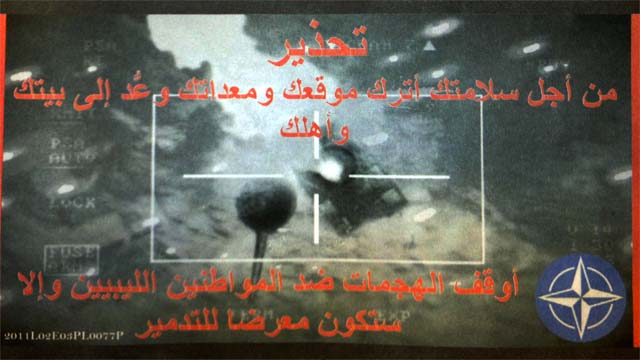
An example of a psychological operations leaflet dropped over Libya by NATO forces during Operation Unified Protector.
For audiences within Libya, strategic communications involved the production of media to influence Qaddafi loyalists to leave their weapons and cease killing civilians.
Leaflets found in Tripoli around August 2011 advised Libyan forces that “many officers and soldiers have chosen to stand against Gaddafi’s orders and refrain from fighting against innocent civilians.”
One side of the leaflet, which bore NATO’s logo, encouraged soldiers to “join these men for a prosperous, peaceful future for Libya” while the opposite side displayed a photo of a Predator drone alongside a tank with a crosshair over it. Amateur radio enthusiasts in Europe and the U.S. were able to listen to NATO broadcasts encouraging Libyan forces to abandon their vehicles and cease fighting. “NATO does not want to kill you,” says a voice inone of the broadcasts, “but if you continue to operate, move, maintain or remain with military equipment of any sort, you will be targeted for destruction.”
Understanding StratCom
A collection of documents recently obtained and published by Public Intelligence provides a complete guide to NATO’s training process for “strategic communications” activities, including public diplomacy, public affairs, information operations and psychological operations. The documents, compiled for participants in a NATO training summit, describe the doctrine behind strategic communications and provide practical examples of their use in a number of recent conflicts from Libya to Afghanistan. These activities are designed to contribute “positively and directly in achieving the successful implementation of NATO operations, missions, and activities” as well as “influence the perceptions, attitudes and behaviour of target audiences . . . with the goal of achieving political or military objectives”. NATO’sStrategic Communications Policy explains the aim of these operations:
Today’s information environment, characterized by a 24/7 news cycle, the rise of social networking sites, and the interconnectedness of audiences in and beyond NATO nations territory, directly affects how NATO actions are perceived by key audiences. That perception is always relevant to, and can have a direct effect on the success of NATO operations and policies. NATO must use various channels, including the traditional media, internet-based media and public engagement, to build awareness, understanding, and support for its decisions and operations.
NATO’s Military Concept for Strategic Communications states that “the vision is to put Strategic Communications at the heart of all levels of military policy, planning and execution” as it is “not an adjunct activity, but should be inherent in the planning and conduct of all military operations and activities.”
Strategic communications at the political level encompasses both public diplomacy and public affairs, functions designed to communicate facts and information to the public while maintaining credibility. According to NATO’s Allied Command Operations Directive on Public Affairs, “Public support for NATO’s missions and tasks follows from public understanding of how the Alliance makes a difference to international peace and security.” If viewed from an effects-based perspective, the directive states that “enhancing support for the Alliance by maintaining credibility is the effect for the [public affairs] function.” NATO’s Public Diplomacy Strategy for 2010-2011 states the primary goal of communication efforts should be conveying “the values and principles that NATO stands for, first and foremost the principle of Allied solidarity, will feature prominently in NATO’s communication and outreach efforts, in particular towards the young generation.”
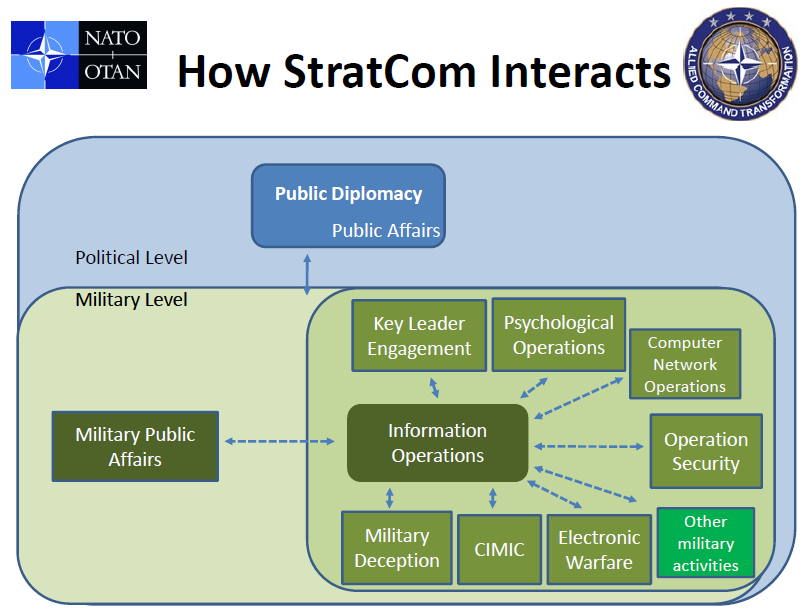
A diagram depicting the relationships between various components of NATO’s strategic communications efforts.
At the military level, strategic communications encompasses everything from psychological operations to electronic warfare. Deception operations, computer network operations and even engagement with local leaders all fall under the category of information operations, one of the broadest areas of strategic communications.
NATO’s Bilateral Strategic Command Information Operations Reference Book describes information operations as being increasingly important in modern operations due to the “the complex challenges of the global security environment” which “require consideration and integration of the information factor throughout all processes – analysis, planning, execution and assessment.” Due to the importance of the overall information environment in determining the outcome of a conflict, it is necessary that “all decision-makers at all times appropriately understand the (possible) effects of their actions in the information environment; it is not just about deliberate activity using information through means of communication, it is the combination of words and deeds that delivers the ultimate effect.”
NATO’s documentation on strategic communications acknowledges the increasingly important role that information and perception play in determining the effects of military action. “The employment of any element of power projection, particularly the military element, has always had a psychological dimension,” according to NATO’s 2003 Psychological Operations Policy. This psychological impact is nothing new, but has increasingly broad implications due to the prevalence of modern technology and social media:
PSYOPS have been used throughout history to influence attitudes and behaviours of people, leaders and key communicators. The dense and ubiquitous nature of today’s global information environment, coupled with NATO’s involvement in non-Article 5 Crisis Response Operations, have dramatically increased the demand and importance of effective PSYOPS. In today’s Information Age, NATO can expect to operate for an extended period of time in an area where sophisticated, indigenous media compete for influence over the perceptions of local audiences. The organisation, state, or entity more able to effectively influence the understanding of a crisis or conflict, especially managing the perceptions of particular target audiences, will likely be the most successful. PSYOPS are conducted to convey selected information and indicators to governments, organisations, groups and individuals, with the aim of influencing their emotions, attitudes, motives, perceptions, reasoning and ultimately their behaviour and decisions.
To achieve the desired outcome, strategic communications are integrated directly into NATO’s comprehensive planning process, defining goals and strategies for the various influence activities to be conducted in support of an operation. Strategic communications frameworks for the operation are developed by a working group at NATO headquarters ensuring all aspects of communication, from the diplomatic level to the military information operations on the ground, are coordinated within a unified narrative. After reviewing “NATO strategic and military strategic objectives and effects” NATO’sComprehensive Planning Directive instructs military planners to “assess the impact of military actions on the information environment” and “develop narratives, themes and master messages for different audiences.”
Based on their understanding of the different perspectives and biases of the different audiences, StratCom should develop an over-arching, resonating narrative, upon which themes and master messages can be based. StratCom must then refine the themes and master messages depending on the strategic conditions, taking into account target audience receptiveness, susceptibility and vulnerability to different historical, social, cultural, and religious references.
The directive also recommends that planners “identify and establish required mechanisms to address issues of strategic and/or political importance” such as civilian casualties to protect against the “rapid loss of NATO’s credibility in the theatre and perhaps even within the wider international community.” This may require the involvement of “other international actors, opinion formers and elites” who can be “integrated into this approach through a coordinated engagement strategy at all levels within the wider local, regional and international public to promote support for NATO actions.”
Framing Conflicts
Examining NATO’s strategic communications frameworks for several recent conflicts provides concrete examples of the organization’s efforts to construct and maintain narratives favorable to their military and political objectives.
The frameworks, which are signed by NATO’s Secretary General and sent to diplomatic representatives of allied countries involved in the conflict, detail a core message and various supportive themes designed to promote the narrative advanced by NATO.
For example, the 2011strategic communications framework for Afghanistan emphasizes the themes of resolve and momentum to “maintain Afghan and international support for the continuation of the mission.” The strategic communications framework for NATO’s intervention in Libya emphasizes legitimacy, that NATO is “operating under a clear international legal mandate, in coordination with the Contact Group on Libya, and with broad regional support”, while managing expectations and emphasizing the humanitarian assistance being provided.
Spokespeople play a central role in implementing the strategic communications framework by reinforcing the narratives decided on by NATO officials and countering misinformation. A training presentation for instructing NATO spokespeople in Afghanistan describes how to “control your media environment” by advancing “commercial” messages that support the strategic communications objectives for the conflict.
The presentation lists cosmetic issues for spokespeople, like posture and controlling hand gestures, and even provides bridging phrases such as “First let me say . . .” or “The key issue here is . . .” to bring interviewers back to the spokesperson’s commercial messages.
The presentation also teaches spokespeople how to deflect difficult questions on topics like civilian casualties. If asked about NATO “being responsible for high numbers of civilian casualties”, the presentation recommends countering with a statement about NATO’s effort to minimize civilian casualties “through a variety of measures which calls upon our forces to exercise courageous restraint during operations.”
NATO has even worked to develop a framework for assessing the efficacy of activities to influence populations. Over a three year period from 2007-2010, NATO convened multiple research groups with members from the U.S., U.K., Belgium, Netherlands, Sweden, Canada and Germany to formalize a program for measuring the effectiveness of strategic communications activities designed to influence targeted audiences.
The groups authored a report in 2011 called “How to Improve Your Aim: Measuring the Effectiveness of Activities that Influence Attitudes and Behaviors” that assessed NATO’s procedures for determining the success or failure of influence activities in achieving their desired effect. All military operations, including communications functions, are geared towards realizing a particular effect that can be “material, attitudinal or behavioral.”
The report seeks to develop a methodology for monitoring media, conducting surveys and determining the effectiveness of influence operations by tracking specific and quantifiable “impact indicators”. These indicators help determine whether the intended effect is occurring and provide feedback for future operations planning.
Studying and implementing strategic communications has now become an essential component of NATO’s military operations as both a means of influencing populations in theater and abroad. As the development of doctrine for manipulating perceptions continues to become more sophisticated, the ability of the public to discern reality and make decisions becomes increasingly difficult. The information environment, according to NATO’s Allied Joint Doctrine on Information Operations, is “where humans and automated systems observe, orientate, decide and act upon information, and is therefore the principal environment of decision-making.” When governments and militaries make it their fundamental purpose to not simply deceive or manipulate the enemy, but to build and “maintain support” from the very populations that provide them with their funding and mandate, it becomes increasingly difficult for civilian leaders and the public at large to determine the actual reality of a conflict, effectively nullifying their democratic involvement in the prosecution of wars to which they must ultimately pledge their money, their reputations and even their lives.
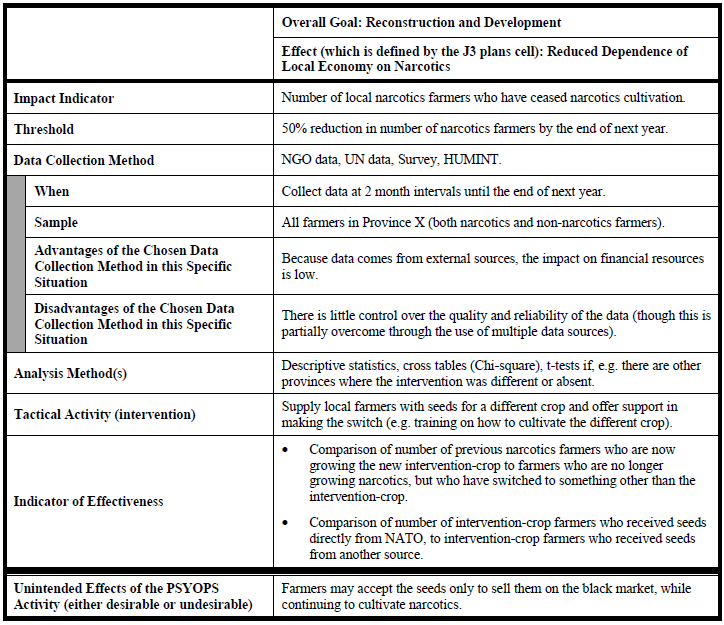
An example of an “effects matrix” used in planning and assessing psychological operations and other influence activities. The table is presented in a restricted 2011 NATO research report “How to Improve Your Aim: Measuring the Effectiveness of Activities that Influence Attitudes and Behaviors”.
Subscribe to:
Posts (Atom)

