Showing posts with label Faith-Based Wars. Show all posts

Friday, May 18, 2012

NATO: The New Holy Alliance


The Chicago Conclave and History's Little Ironies

By Justin Raimondo,
May 09, 2012
Courtesy Of "Anti-War"


They’re cowering in Chicago, where the NATO summit is scheduled to open on May 20: the security arrangements go well beyond paranoia. They’re telling office workersin buildings adjacent to the site to “dress down,” lest they become identified with the proceedings. A huge “security zone” is being imposed on McCormick Place, where the conclave will take place, and subway riders who must pass under the site will be subjected to pat-downs and other security measures. The airspace above the venue will be restricted, and any planes that pass through it will be promptly shot down.
I have no doubt the original McCormick – Col. Robert Rutherford McCormick, publisher of the Chicago Tribune from the 1920s to the mid-fifties – is rolling in his grave as the NATO-ites prepare to convene in the place named for him. The Coloneldenounced NATO, on the occasion of its formation, as the instrument of a destructive internationalism, one that would forever entangle us in the feuds and intrigues of a dangerous world: for his pains, he was attacked in The New Republic and even in The Nation (!) for “taking the Soviet line.” As McCormick, along with such notables as Joe Kennedy and Herbert Hoover, warned against the folly of “collective security” embodied by NATO, the editors of The New Republic envisioned a Red Dawn-like future in which the Commie Colossus would sweep across Europe and leap the Atlantic “until the Stalinist caucus in the Tribune Tower would bring out in triumph the first communist edition of the Chicago Tribune.”
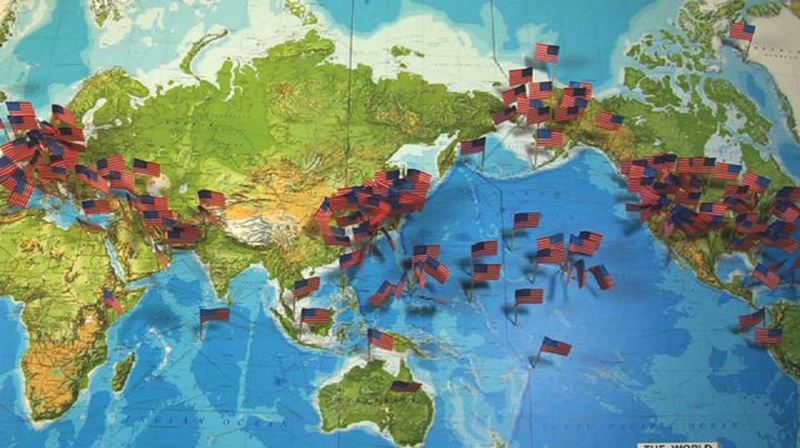
Now that the Colossus has been downed and the original rationale for NATO no longer exists, the same hysterics are the occasion for any suggestion that America’sinternational footprint – considerably enlarged by its participation in NATO – be scaled back, Not to worry: new rationales are readily available, and the prosecution of our eternal “war on terrorism” has breathed new life into NATO’s moribund body.
Like all government bureaucracies, NATO is relentlessly devoted to its own self-perpetuation: far from dismantling itself after the end of the alleged “Soviet threat,” the NATO-crats extended their reach, moving into the Caucasus, where Georgia’swould-be dictator Mikheil Saakashvili is hoping to join the ranks of the alliance. The US has put the NATO “brand” on its occupation of Afghanistan, with the new “multilateralist” emphasis of the Obama administration being given a fresh gloss in Chicago.
As a conduit of “defense” funds piped directly into the coffers of the military-industrial complex, NATO is a reliable source of income for our crony capitalists. Aside from that, however, it provides a political and ideological framework on which to hang our interventionist pretensions. Which brings us back to Colonel McCormick….
When proposals for an “international army” arose in the postwar era, McCormick’sTribune presciently compared the idea to the Holy Alliance, a gaggle of European monarchs who plotted to defend the “Christian” principle of monarchical absolutism in the post-Napoleonic world:
Almost immediately the defensive arrangement became aggressive. The people of Spain found their government oppressive and sought to do something about it. Their efforts were put down. The people of Piedmont and of Naples were the victims of appalling misgovernment: in 1821 they had to be repressed by the Austrians under Gen. Frimont.
And so it went. The South American nations had won their independence from Spain during the long European struggle. Now that the war was over, the king of Spain, with the repressive ideas of the Holy Alliance as his guide, was resolved to force his former colonies back into submission. He might have sent his fleet and his armies across the Atlantic if President Monroe had not put forward the doctrine that bears his name.”
Under President Monroe, America was a bulwark against the Holy Alliance of its day, the focus of Europe’s fearful monarchs as the peasants began to rise. Today, America stands at the head of a new Holy Alliance, as our modern-day Metternichs convene in Chicago amid rumors of a peasant protest that have the authorities terrified. The entire affair is to be walled off, with troops in the streets and snipers on rooftops: the city will be in lockdown for days.
Chicago has often been a battleground in the wars our government has waged on its own citizens. The year 1968 saw a pitched battle in the shadow of the Democratic national convention, as antiwar protestors fought police in the streets: the picture of Hubert Humphrey standing shoulder-to-shoulder with Boss Daley – against the backdrop of cops flattening peaceful protestors – forever discredited the cold war liberal wing of that party.
Naturally, one hopes the protest will be peaceful, but the authorities are making this difficult if not impossible by imposing draconian bans on almost all forms of protest – public gatherings are all but outlawed for the duration, unless they take place in designated “protest pens.” Hardly anyone finds it shocking that the constitutional right to assembly and to free speech has been summarily abolished by Boss Rahm Emanuel. After all, the Constitution is merely a national document, which must yieldto the supranational priorities of the NATO confab.
NATO should have died with the end of the cold war. Instead it grew into the octopus-like creature it is today, its suckered tentacles attaching themselves to every conflict that arises, internationalizing ancient tribal feuds and elevating minor border skirmishes to the level of international crises.
America pays the bills, and provides the military backbone, while the Europeans are in it for their cut of the action, whilst assiduously avoiding getting their own soldiers killed. In return, Washington gets to dress up its wars in “multilateralist” drag, and conduct foreign policy without congressional oversight. One notes the recent agreement with Afghan “President” Hamid Karzai, signed by the President on his recent trip to Kabul, will be a major topic of discussion at the Chicago conclave: does anyone but me find it odd that the administration is taking a treaty to NATO for approval before deigning to submit it for the consideration of the US Senate?
I suspect the Colonel would have found it odd, too, but he’s been dead since 1955, the year the Warsaw Pact was founded and the cold war began in earnest. His warnings against a promiscuous internationalism, derided as “isolationism” by both the “progressive” left and the “New Right” of William F. Buckley, Jr., passed into history, where they are unlikely to be recovered by today’s anti-NATO protesters. Yet one likes to think McCormick’s ghost will be looking down at them from the height of the Tribune Tower, and saying: “Didn’t I tell you so?”

Monday, May 14, 2012

The US Military's 'Anti-Islam Classes'

How Widespread Is The Use Of Anti-Islamic Material In The US Military?

Inside Story Americas
Last Modified: 12 May 2012 13:14
Courtesy Of "Al-Jazeera"


Al Jazeera has obtained exclusive material of a course taught on a US military base implying that Hamas has influenced the US government at the highest levels.

"There is a cottage industry of these Muslim bashers who are training law enforcement personnel, military personnel... and you are breeding a generation of leaders in our society who have this suspicion of Islam and hostility towards American Muslims and Muslims in general. The intention of these trainers is to demonise Islam and to marginalise American Muslims."
- Ibrahim Hooper, CAIR's national communications director
The course is called "Understanding the Threat to America." And in it are hundreds of slides that claim to link the Muslim Civil Liberties Advocacy Organisation (CAIR) and other American Muslim groups to the Palestinian group Hamas.

It was taught to senior military officers at a base in the state of Virginia.

The US military is conducting a review of all material taught to its officers after the website Wired.com exposed another course teaching anti-Islam material.

One of the slides presented by Army Lieutenant Colonel Matthew Dooley says the model he is presenting presumes that the Geneva Conventions are "no longer relevant," when fighting Muslims.

It goes on to say that historical precendents of Dresden, Tokyo, Hiroshima and Nagasaki are applicable to "Mecca and Medina's destruction."

Dooley's 31-page presentation entitled "So What Can We Do?" A Counter - Jihad Op Design Model, comes to some startling conclusions: "Given the factual basis of what "Islamists" say they seek to impose on the world, the United States has come to accept that radical "true Islam" is both a political and military enemy to free people throughout the world.... It is therefore time for the United States to make our true intentions clear. This barbaric ideology will no longer be tolerated. Islam must change or we will facilitate its self destruction."
"The Geneva Conventions has always been our bedrock document for the military, so for a military instructor to stand up in a professional military education course and say we are going to put it aside and go to total war is just astounding."
- Morris Davis, a retired Air Force Colonel

Dooley has since been suspended but still holds his position at the college where this material was taught.

Both the courses obtained by Al Jazeera and Wired.com were voluntary courses and it is not clear if similar material has been taught in other military colleges.

So how widespread is the use of anti-Islamic material in the US military? And is the government doing enough to put an end to its use?

To discuss this, Inside Story Americas, with presenter Anand Naidoo, is joined by Ibrahim Hooper, CAIR's national communications director; Morris Davis, a retired Air Force Colonel who served as chief prosecutor at Guantanamo Bay between 2005 and 2007; and Al Jazeera's Josh Rushing.

"In all of our learning institutions we want students to get a wide array of views and perspectives - we want the instruction to challenge them and challenge their thinking; that's all healthy. But it needs to be blanced and certainly needs to be in keeping with our core values as an institution. The material that was presented to us as a matter of concern by this young officer student certainly is not in keeping with our values - and more importantly, not even in keeping with the strategy as we see it in the 'War on Terror'."
John Kirby, US Department of Defense spokesman

Sunday, May 13, 2012

Second Anti-Islam Military Curriculum Surfaces

By Miguel Llanos,
Courtesy Of "MSNBC"


As the Pentagon reviews all military classes following the disclosure of one that advocated "total war" against Muslims, the news website Al-Jazeera reported Saturday that it had received materials from a similar course and that both were put together by the same group, a nonprofit that offers classes and workshops to military and government officials.

Al-Jazeera said it received course slides from an unnamed military officer who said "this bigoted conspiracy cabal is both disgusting and so deeply un-American."

The slides leave the impression that Hamas extremists have infiltrated the U.S. government, media and education via U.S. Islamic groups like the Council on American-Islamic Relations, Al-Jazeera said.
The documents indicated the two courses were prepared by the consulting firm Strategic Engagement Group, Inc., Al-Jazeera said. The website for Strategic Engagement does include statements similar to those in the materials cited by Al-Jazeera, msnbc.com found.
The firm's website states its president, E.J. Kimball, was formerly a foreign policy counsel to Rep. Sue Myrick, R-N.C., and created the bipartisan Congressional Anti-Terrorism Caucus.
Myrick earlier wrote to Pentagon chief Leon Panetta voicing her concern that "the political nature of these (class) reviews might inadvertently weaken" military training, Al-Jazeera noted.
Stephen Coughlin, VP of strategic communication initiatives, is described as "the leading expert in the United States on Islamic Doctrine" and a U.S. Army Reserve major with military intelligence expertise.
The group says it formed in 2010 "for the purpose of exposing and defeating efforts to subvert theUnited States Constitution and subjugate the American People."
Strategic Engagement did not immediately respond to msnbc.com's request for comment on the Al-Jazeera report.
The slides indicate the course was approved by two retired three- star generals and former CIA Director James Woolsey, Al-Jazeera added.


Friday, May 11, 2012

Use ‘Hiroshima’ Tactics For ‘Total War’ on Islam

dooley_presentation_slide1

U.S. Military Taught Officers Islam Is An Enemy That Must Be Annihilated

By Noah Shachtman and Spencer Ackerman
May 10, 2012 | 4:00 am
Courtesy Of "Wired Magazine"


The U.S. military taught its future leaders that a “total war” against the world’s 1.4 billion Muslims would be necessary to protect America from Islamic terrorists, according to documents obtained by Danger Room. Among the options considered for that conflict: using the lessons of “Hiroshima” to wipe out whole cities at once, targeting the “civilian population wherever necessary.”
The course, first reported by Danger Room last month and held at the Defense Department’s Joint Forces Staff College, has since been canceled by the Pentagon brass. It’s only now, however, that the details of the class have come to light. Danger Room received hundreds of pages of course material and reference documents from a source familiar with the contents of the class.
The chairman of the Joint Chiefs of Staff recently ordered the entire U.S. military to scour its training material to make sure it doesn’t contain similarly hateful material, a process that is still ongoing. But the officer who delivered the lectures, Army Lt. Col. Matthew A. Dooley, still maintains his position at the Norfolk, Virginia college, pending an investigation. The commanders, lieutenant colonels, captains and colonels who sat in Dooley’s classroom, listening to the inflammatory material week after week, have now moved into higher-level assignments throughout the U.S. military.
For the better part of the last decade, a small cabal of self-anointed counterterrorism experts has been working its way through the U.S. military, intelligence and law enforcement communities, trying to convince whoever it could that America’s real terrorist enemy wasn’t al-Qaida — but the Islamic faith itself. In his course, Dooley brought in these anti-Muslim demagogues as guest lecturers. And he took their argument to its final, ugly conclusion.
dooley_moderate2
“We have now come to understand that there is no such thing as ‘moderate Islam,’” Dooley noted in a July 2011 presentation (.pdf), which concluded with a suggested manifesto to America’s enemies. “It is therefore time for the United States to make our true intentions clear. This barbaric ideology will no longer be tolerated. Islam must change or we will facilitate its self-destruction.”
Dooley could not be reached for comment. Joint Forces Staff College spokesman Steven Williams declined to discuss Dooley’s presentation or his status at the school. But when asked if Dooley was responsible for the course material, he responded, “I don’t know if I would classify him [Dooley] as responsible. That would be the commandant” of the school, Maj. Gen. Joseph Ward.
That makes the two-star general culpable for rather shocking material. In the same presentation, Dooley lays out a possible four-phase war plan to carry out a forced transformation of the Islam religion. Phase three includes possible outcomes like “Islam reduced to a cult status” and “Saudi Arabia threatened with starvation.” (It’s an especially ironic suggestion, in light of today’s news that Saudi intelligence broke upthe most recent al-Qaida bombing plot.)
International laws protecting civilians in wartime are “no longer relevant,” Dooley continues. And that opens the possibility of applying “the historical precedents of Dresden, Tokyo, Hiroshima, Nagasaki” to Islam’s holiest cities, and bringing about “Mecca and Medina['s] destruction.”
slide3


Dooley’s ideological allies have repeatedly stated that “mainstream” Muslims are dangerous, because they’re “violent” by nature. Yet only a few of al-Qaida’s most twisted fanatics were ever caught musing about wiping out entire cities.
“Some of these actions offered for consideration here will not be seen as ‘political correct’ in the eyes of many,” Dooley adds. “Ultimately, we can do very little in the West to decide this matter, short of waging total war.”
Dooley, who has worked at the Joint Forces Staff College since August 2010, began his eight-week class with a straightforward, two-part history of Islam. It was delivered by David Fatua, a former West Point history professor. “Unfortunately, if we left it at that, you wouldn’t have the proper balance of points of view, nor would you have an accurate view of how Islam defines itself,” Dooley told his students. Over the next few weeks, he invited in a trio of guest lecturers famous for their incendiary views of Islam.
our_response4
Shireen Burki declared during the 2008 election that “Obama is bin Laden’s dream candidate.” In her Joint Forces Staff College lecture, she told students that “Islam is an Imperialist/Conquering Religion.” (.pdf)
Stephen Coughlin claimed in his 2007 master’s thesis that then-president George W. Bush’s declaration of friendship with the vast majority of the world’s Muslims had “a chilling effect on those tasked to define the enemy’s doctrine.” (.pdf)  Coughlin was subsequently let go from his consulting position to the military’s Joint Staff, but he continued to lecture at the Naval War College and at the FBI’s Washington Field Office. In his talk to Dooley’s class (.pdf), Coughlin suggested that al-Qaida helped drive the overthrow of Egyptian strongman Hosni Mubarak and Libyan dictator Muammar Gadhafi. It was part of a scheme by Islamists to conquer the world, he added. And Coughlin mocked those who didn’t see this plot as clearly as he did, accusing them of “complexification.”
Coughlin titled his talk: “Imposing Islamic Law – or – These Aren’t the Droids Your Looking For!”
understanding5
Former FBI employee John Guandolo told the conspiratorial World Net Daily website last year that Obama was only the latest president to fall under the influence of Islamic extremists. “The level of penetration in the last three administrations is deep,” Guandolo alleged. In his reference material for the Joint Forces Staff College class, Guandolo not only spoke of today’s Muslims as enemies of the West. He even justified the Crusades, writing that they “were initiated after hundreds of years of Muslim incursion into Western lands.”
Guandolo’s paper, titled “Usual Responses from the Enemy When Presented With the Truth” (.pdf), was one of hundreds of presentations, documents, videos and web links electronically distributed to the Joint Forces Staff College students. Included in that trove: a paper alleging that “it is a permanent command in Islam for Muslims to hate and despise Jews and Christians” (.pdf). So was a video lecture from Serge Trifkovic, a former professor who appeared as a defense witness in several trials of Bosnian Serb leaders convicted of war crimes, including the genocide of Muslims. A web link, titled “Watch Before This Is Pulled,” supposedly shows President Obama — the commander-in-chief of the senior officers attending the course — admitting that he’s a Muslim.
coughlin_driods6
Dooley added the caveats that his views are “not the Official Policy of the United States Government” and are intended “to generate dynamic discussion and thought.” But he taught his fellow military officers that Obama’s alleged admission could well make the commander in chief some sort of traitor. “By conservative estimates,” 10 percent of the world’s Muslims, “a staggering 140 million people … hate everything you stand for and will never coexist with you, unless you submit” to Islam. He added, “Your oath as a professional soldier forces you to pick a side here.” It is unclear if Dooley’s “total war” on Muslims also applied to his “Muslim” commander in chief.
After the Pentagon brass learned of Dooley’s presentation, the country’s top military officer, Joint Chiefs of Staff Chairman Gen. Martin Dempsey, issued an order to every military chief and senior commander to get rid of any similar anti-Islam instructional material. Dempsey issued the order because the White House had already instructed the entire security apparatus of the federal government — military and civilian — to revamp its counterterrorism training after learning of FBI material that demonized Islam.
coughlin_dog7
By then, Dooley had already presented his apocalyptic vision for a global religious war. Flynn has ordered a senior officer, Army Maj. Gen. Frederick Rudesheim, to investigate how precisely Dooley managed to get away with that extended presentation in an official Defense Department-sanctioned course. The results of that review are due May 24.
Ironically, Dooley and his guest lecturers paint a dire picture of the forward march of Islamic extremism right as its foremost practitioner feared its implosion. Documents recently declassified by the U.S. government revealed Osama bin Laden fretting about al-Qaida’s brutal methods and damaged brandalienating the vast majority of Muslims from choosing to wage holy war. Little could he have known that U.S. military officers were thinking of ways to ignite one.
slide8


Thursday, April 12, 2012

The Doctrine Of Intervention


Indigenous populations in Brazil were completely bypassed by the construction of the Belo Monte dam [REUTERS]


Today's Political Ethics Are Surprisingly Similar To The Doctrine Of Discovery Set By The Vatican Back In 1452.

By Manuela Picq
Last Modified: 04 Apr 2012 12:45
Courtesy Of "Al-Jazeera"


New York, NY - One does not think of archaic papal bulls when witnessing democratic states like Brazil or the United States building dams on Amazon rivers or drilling for oil in the Arctic Ocean. Yet today's political ethics are surprisingly similar to the doctrine of discovery set by the Vatican back in 1452.

Fifteenth-century papal bulls that declared war against all non-Christian peoples also encouraged the conquest and exploitation of enemy territories throughout the world. European explorers like Columbus took possession of newly "discovered" non-Christian lands with the express authorisation of the Catholic Church.

This internationally recognised doctrine allowed claims to be made on "empty" invaded lands outlasted European absolute monarchies and has become enshrined in secular nation-states. In the US, for instance, Chief Justice John Marshall used the right of discovery in 1823 to invalidate native claims over their land and to assert the authority of the US government over land titles.

The World Council of Churches (WCC) recently disowned the doctrine of discovery, perhaps in light of its centrality at the 11th session of the UN Permanent Forum on Indigenous Issues this coming May in New York. Better late than never.


Inside Story Americas - The real cost of Brazil's dam
Yet from the Amazon to Iraq, policies still attempt to save the barbarians from themselves, export the truth of democracy or teach natives how to best preserve their own habitat. The problem is that the doctrine justifying the conquest and exploitation of certain states survived colonial times to evolve into a broader - and more resilient - self-arrogated right of intervention.

Rejecting The Doctrine Of Discovery

In February, the WCC issued a statement denouncing the doctrine used to colonise the Americas and enslave native populations as a violation of human rights. 

Affirming the rights of indigenous peoples to live in and retain their traditional lands as well as enrich their ancestral cultures, the WCC now urges governments to dismantle the legal structures and policies based on the doctrine of discovery and dominance so as to enable indigenous peoples to identify their own aspirations and pursue their own concerns.

The WCC specifically identifies the role of the Catholic Church in establishing a doctrine that justified the conquest and acquisition of indigenous territories, repelling documents such as Dum Diversas (1452) that called for the enslavement of non-Christian peoples, the seizure of their possessions and the occupation of their lands.

At last, churches have formally spurned any moral or legal right to seize indigenous land or dominate indigenous peoples. Identifying its historical significance, they framed the doctrine of discovery as the legal precedent that permitted continuous appropriation and resulted in the current extent of indigenous exploitation. 

The WCC statement is relevant because it explicitly recognises that the concepts that emerged five centuries ago forged a paradigm of domination that is still deployed against indigenous peoples today.

Whose Right To Intervene?

The doctrine of discovery remains a contemporary political challenge because it paved the way for the principle of intervention. Peoples and territories that were not Christian were treated as empty, un-modern spaces, up for grabs and improvement.

Since the Americas were conceptualised as terra nullis to justify colonisation, conquest became embedded in a discourse of civilising universalism, in which those claiming to hold the truth self-righteously bestow upon themselves the right to intervene against the barbarians.

Immanuel Wallerstein traces this rhetoric of power all the way back to the 16th century Valladolid Debate between Bartolome de Las Casas and Juan Gines de Sepulveda on the status of natives. Sepulveda derived the right of European monarchies to dominion from the inherent barbarity of the Amerindians. He defended intervention to protect natives from themselves, from their own harmful practices.

De Las Casas, in contrast, maintained that evil occurred everywhere and was not unique to Amerindians, denying justification for their subjugation, which could cause far more harm than good. The debate, which was left unresolved, continues in modified form today, for instance in controversies about Iraq, where the violence of war was trivialised by supporters of a military intervention destined to bring democracy.

The doctrine of intervention has a long, enduring history, one in which universalism is prone to colonialising tactics and modernisation all too frequently overlaps with westernisation. The "barbarians" may be Amerindians in 1551 or Muslims in 2001.

From Valladolid to Iraq, the same discourse seeks to justify appropriation in the name of universal truths. The doctrine of discovery faded only to give way to a doctrine of intervention, determining who intervenes, for what cause and with what legitimacy. The justificatory rationale changes - from Christianity to development and human rights - leaving the right to intervene unaltered.


Australians push for Aborigine recognition
The discourse that rationalised the colonisation of the Americas in the sake of Christianity is the same that justifies protecting human rights in Iraq or privatising water supplies for the sake of development.

Indigenous Tutelage

Intervention remains particularly strong when it comes to indigenous peoples and territories. Large-scale mining continues to engender human abuse and resource appropriation by multinational corporations across the Andes and Central America, perpetuating the pillage Spanish colonisers started centuries ago in Potosi. In the Amazon, governments and corporations alike take possession of "empty" lands to drill for oil in the name of development and national interest.

Latin American governments rhetorically insist on a foreign policy of non-intervention, yet are quick to intervene on indigenous territories to modernise the state. From the TIPNIS highway in Bolivia to the Belo Monte dam in Brazil, governments continue to bypass indigenous consultation and autonomies for the sake of national development.

The priorities of indigenous peoples are silenced in Chile, while their agency is dismissed in Ecuador, where massive indigenous mobilisations are dismissed as being manipulated by international interests. In Brazil, the government's self-congratulatory tone for bringing a woman to direct the National Foundation of the Indian (FUNAI) seems to ignore its failure to appoint an indigenous person.

The idea that natives are un-modern, almost part of nature, and therefore unable to manage their own land continues to lead to "well-intentioned" intervention as well. When indigenous territories in the Arctic or the Amazon are not conceptualised as empty spaces to be exploited for national development, it is the turn of conservationists to intervene in the name of nature.

When parks such as Yellowstone were founded, conservationists like John Muir promoted the idea that the land had not been previously trodden upon, pushing out people who actively lived and fed on those lands to "protect" nature. Today, it is the turn of powerful conservationists groups in the global north to intervene by buying big chunks of land and pushing populations out.

The UN system itself may perpetuate forms of tutelage. On February 21, the Indigenous Forum at the World Intellectual Property Organisation unanimously decided to withdraw from discussions on the draft treaty relating to genetic resources in response to consistent efforts to undermine indigenous inclusion within the process. 

How equitable can a treaty be that ostensibly holds indigenous interests as central but actually operates without significant indigenous decision-making? This unprecedented move calls into question the entire UN practice of incorporating indigenous voices in its deliberating process.

Dominant cultures continue to intervene in the autonomy of indigenous peoples. This continuum is proof that the doctrine of intervention did not die with formal processes of decolonisation, adapting to new zeitgeists like a chameleon.

The practice of conquest, more diverse than often assumed, needs to be reconceived as a global political challenge that concerns us all rather than as a mere cultural concern discussed in indigenous forums. It is the international system that is at stake. Universalism cannot be exported, much less imposed. It is a collective practice.

Manuela Picq has just completed a position as a visiting professor and research fellow at Amherst College. She is currently writing a book on indigenous peoples' rights in the Amazon.

Thursday, March 22, 2012

Unjust Wars, Then and Now

By George F. Smith 
Monday, March 12, 2012 
Courtesy Of "The Ludwig von Mises Institute"


According to the Federation of American Scientists, nine countries account for the approximately 20,500 nuclear weapons known to exist, with the United States having 8,500 of these. Iran has none. Between 150–200 B61 nuclear bombs, the primary thermonuclear weapon in the United States, are deployed in Europe at six bases in five countries, one of which is Turkey, a border state of Iran.
By contrast, Iran has no known military bases in Canada or Mexico, nor has it imposed sanctions against the United States, as the United States and other countries have done to Iran. Yet, Iran is considered a threat to peace and stability because the International Atomic Energy Agencyissued a report last November saying it very definitely might or might not be building a nuclear device.
If the United States ends up at war with Iran, there arises the question of what it will cost and how to pay for it. Using recent history as a guide, the total financial cost of the Iraq invasion, including veterans' support, is expected to reach $4 trillion. Yet in 2002, Bush economic advisor Lawrence Lindsey was fired for saying the Iraq war could cost as much as $200 billion, which was 3–4 times the Department of Defense estimate. Even if someone knew how much an Iran war would cost, no one would believe him. But it's clear we do have an idea of how we would pay for it: more debt.
On Friday, August 5, 2011, S&P downgraded US debt from AAA to AA+, citing a failure of government to stabilize its "medium-term debt dynamics." The previous Tuesday, Congress had voted to raise the debt ceiling by $2 trillion. S&P's downgrade, as Gary North viewed it, was their way of saying, "Yes, the loud noise you heard on Tuesday really was what it sounded like." It was a crack in the ice, a signal for smart skaters to head for shore.
Those pushing for more war and more debt are not smart skaters. How did we go from our core political principle of "live and let live" to the hegemonic "live the way we say, or we'll bomb you back to the stone age!"? How did we reach the point where smart economists tell us the size of the government debt is irrelevant as long as we keep the tax slaves rowing faster and faster? Actually, it began right from the start.

Funding a "Just War" Unjustly

Unlike the various US invasions in the Middle East and Asia of the past several decades, there is strong conviction among many Americans about the legitimacy of the country's founding war. A legitimate war, or what Murray Rothbard called a just war, "exists when a people tries to ward off the threat of coercive domination by another people, or to overthrow an already-existing domination." Like all wars, a just war is laced with dangers beyond the inferno of the battles, especially if war funding relies to a significant degree on the printing press. The American Revolution is a case in point.
On June 22, 1775, the colonial delegates who were assembled in Philadelphia, under the inspiration of Gouverneur Morris,[1] decided to print $2 million in "bills of credit" called Continentals. The plan was to begin redeeming them in 1779, not with hard coin, but by levying taxes in the Continentals themselves, which would then be retired. So appealing was the idea of printing money that by 1779 a total of $227 million had been issued. The bills were everywhere, and everywhere despised. In a letter to John Jay, president of the Continental Congress, George Washington complained that "a wagon load of money will scarcely purchase a wagon load of provisions." By December 1779 the Continental had fallen to 42:1 against specie, and by spring of 1781 the currency was virtually worthless.
Individual states were also printing money to finance the war, and the British too adopted the printing press as a war strategy, printing Continentals and using Tories known as "shovers" to shove the imitations into circulation and thus accelerate the currency's depreciation.
Inflationists in Congress viewed depreciation as a clever way to impose the necessary taxes to pay for the war, though Gouverneur Morris thought it was too bad Washington's soldiers would suffer the most from this tactic. As the value of the currency rapidly approached zero, the Continental army turned to direct theft ("impressment") to acquire their provisions when merchants balked at trading goods for something worthless.
The Continental was allowed to die without redeeming it, but in 1779 Congress began emitting "loan certificates" that were also used as money. A big chunk of this money hung around after the war as a peacetime public debt. Robert Morris, the leader of the nationalist faction, pushed for its redemption at par in specie as a means of stuffing the pockets of associates who had purchased the certificates at highly depreciated prices.
Redemption was also a way of rallying support for taxing power in Congress. Under the Articles of Confederation and perpetual Union, which was ratified on March 1, 1781, the United States of America was considered a "league of friendship" rather than a central government, with each state retaining "its sovereignty, freedom, and independence." Although the articles recognized the obligation of Congress to pay all debts incurred before ratification, they did not give Congress authority to coerce such payments from the states.
To the nationalists, the lack of taxing power and other alleged deficiencies made the Confederation government "the laughing stock of the Atlantic world," as historian Leonard L. Richards notes in his masterpiece, Shays's Rebellion: The American Revolution's Final Battle.[2] Throughout the 1780s, they tried fruitlessly to get enough of them together to replace the Articles of Confederation. In modern parlance, what they needed was a "new Pearl Harbor," a major crisis that could be propagandized for political ends. In 1786, Shays's Rebellion provided the break they needed.

Shays's Regulators

As the official story is told, indigent farmers in western Massachusetts were unable to pay their taxes, so the courts were sending them to jail and seizing their farms. To avoid the penalties for defaulting on their debts, the story continues, Daniel Shays and a few other "wretched officers" from the Revolution led backcountry rabble to shut down the courts.
Massachusetts Governor James Bowdoin called out the militia to put a stop to the uprising. When most of the militiamen sided with the rebels, he turned to wealthy Bostonians to fund a temporary army. Led by General Benjamin Lincoln, the army prevented the insurgents from seizing the federal arsenal at Springfield in late January 1787, then crushed the rebellion permanently a week later in a surprise attack at Petersham. Although the top rebel leaders fled to other states, most of the others eventually returned to their farms. Bowdoin agreed to pardon the rebels if they signed an oath of allegiance to the state, which the vast majority did.
As Richards argues compellingly, the standard story of Shays's Rebellion as an uprising of debtor farmers doesn't wash. Richards had discovered by accident that the Massachusetts archives had microfilmed the signatures of the 4,000 men who signed the state's oath of allegiance. Since many of the insurgents also included their occupations and hometowns, he was able to gather more information about them with the help of town archivists and historians. For example,
  • At the time of the rebellion Daniel Shays owed money to at least ten men. Of those ten, three were rebel leaders. For every rebel who went to court as a debtor, another went as a creditor.
  • Colrain, the most rebellious town, had 12 families involved in debt suits during 1785 and 1786. Yet only four of these families provided men to the town's total of 156 rebels. Their leader, James White, who led the assault against the Springfield arsenal, was convicted of high treason. He was also one of Colrain's creditors.
  • In 1786 creditors in Connecticut took over 20 percent of the state's taxpayers to court. Yet there was no comparable revolt in Connecticut.
It wasn't debt that triggered the rebellion, Richards concludes; it was the new state government and its attempt to enrich the few at the expense of the backcountry.
Like other states, Massachusetts had issued notes to help fund the Revolutionary War. Immediately upon issue, they depreciated to about 1/4 par, and later declined to about 1/40 of their face value. Many soldiers were paid in these notes, then later unloaded them to speculators at high discounts. Speculators bought roughly 80 percent of the notes, of which half were owned by just 35 men. Every one of these 35 had served in the state house during the 1780s or had a close relative who did.
The legislature voted to consolidate its war notes at face value and praised the speculators as "worthy patriots" who had come to the state's aid in its time of need. But these men did not buy the notes directly from the government; they bought them for a song from farmers and soldiers, who were now being taxed to redeem them at full value. The speculators, most of whom had stayed home during the war, were seeking to benefit at the expense of veterans.
Poll and property taxes were to account for 90 percent of all taxes. The poll tax placed a fine on every male 16 years or older. Thus, a regressive tax ensured a wealth transfer from farm families with grown sons to the pockets of Boston speculators.
Nationalist versions of the insurgency spread throughout the states and upset many elites, including George Washington, who was enjoying a peaceful retirement at Mount Vernon. According to Washington's trusted friend and former artillery commander General Henry Knox, who was planning to build a four-story summer home on one of his Maine properties, the insurgents wanted to seize the property of the rich and redistribute it to the poor and desperate. David Humphreys, one of Washington's former aides living in New Haven, told him the uprising was due to a "licentious spirit among the people," whom he characterized as "levelers" determined "to annihilate all debts public & private."
The "rebels," for their part, saw themselves from the very beginning as Regulators whose purpose was "the suppressing of tyrannical government in the Massachusetts State." The Shays Regulators drew on the success story of Vermont in the 1770s in which Bennington farmers, in a dispute with New York land speculators, had stopped courts from sitting and terrorized surveyors sent on behalf of the speculators.
On March 19, 1787, Knox wrote Washington hinting that he would be given the president's chair at the Philadelphia convention in May. Knox stressed that Washington would not be presiding over some middling conference of tinkerers amending a defective document but instead would be leading a prestigious body of men as they created a more "energetic and judicious system."
Nationalists at the Constitutional Convention that spring wanted a stronger central government — an elective monarchy, in Alexander Hamilton's view. Though they didn't get the results they pushed for, the nationalists and their intellectual heirs of today have shown that their lust for a more "energetic" government will not be thwarted by words on paper.

Hamilton's Funding Proposals

As Rothbard notes, there were two ways to fund the debt: One way that was compatible with the decentralized nature of the union under the Articles of Confederation was to apportion the congressional debt among the states and let them raise taxes to pay their share. The other way was crucial to "the cherished principles of national aggrandizement": give Congress the power to tax so it can do the funding.[3] Article I, section 8, clause 1 secured this power.
In January 1790, the 34-year-old Hamilton, as Treasury secretary, presented his plan to Congress for retiring the Revolutionary War debt.Download PDF The $54 million federal debt would be funded at par and the federal government would assume responsibility for the states' $25 million war debts. The plan called for converting federal debt into bonds that would mature after an assigned period of time, paying 4 percent interest on long-term bonds and 6 percent interest on those of shorter duration. The new government would pay the principal on the debt from a sinking fund established through the post office. Revenue for the fund would come from an import tariff and an excise tax on what Hamilton labeled "pernicious luxuries" that included whiskey. His plan was not to pay off the debt, but to recycle it. When bonds came due he would have new bonds issued to replace them. As long as interest payments on the debt could be paid, the government's credit was assured.
Among those opposing his plan was Hamilton's former Federalist Papers ally, James Madison, who argued that repaying the debt at par to current bearers was stiffing war veterans and farmers for the benefit of wealthy "stockjobbers." He favored a plan of discrimination, wherein the government would pay the original bearers the face value of the certificates and the current bearers the highest market value plus interest.
Aside from the near impossibility of finding the original bearers, Hamilton opposed discrimination on the grounds that it amounted to a "breach of contract" if the government did not pay to the bearer on demand the full value of their certificates. How else would the government "justify and preserve their confidence"? The buyer of a depreciated security, Hamilton argued,
is not even chargeable with having taken an undue advantage. He paid what the commodity was worth in the market, and took the risks of reimbursement upon himself. He of course gave a fair equivalent, and ought to reap the benefit of his hazard; a hazard which was far from inconsiderable, and which, perhaps, turned on little less than a revolution in government.Download PDF
In funding wealthy speculators in this manner, Hamilton was well aware this would concentrate investment capital in relatively few hands and would encourage them to make further investments in the federal government. This was a critical part of his agenda: to strengthen the union at the expense of the individual states.
Senator William Maclay, one of Hamilton's most vocal critics, brought the public into the debate with a scathing article he wrote for a Philadelphia newspaper in February 1790.Download PDF Assumption, he argued, was a means of reducing state governments to insignificance and of establishing a "pompous Court," by which he meant an arrogant and powerful central government. "The people will be meddling with serious matters unless you amuse them with trifles," he said caustically. A pompous Court in partnership with a pliant press would keep the people amused as it goes about its task of having the citizenry subsidize New York's moneyed class. The Treasury will grow in influence, and thus
shall the capital of the United States [New York] in a few years equal London or Paris in population, extent, expense and dissipation, while for the aggrandizement of one spot, and one set of men, the national debt shall tower aloft to hundreds of millions.
As the debate raged throughout the spring and early summer, Hamilton, sensing defeat, turned to Secretary of State Thomas Jefferson for help. Jefferson invited Madison and Hamilton over for supper and together they cut a deal. In exchange for the needed votes, Hamilton would agree to relocate the nation's capital from New York to Philadelphia for 10 years, then finally to a place on the Potomac, where it would be next door to Virginia, more accessible to the South generally, and removed from Hamilton's power base. The arrangement was consummated when the Residence Actnarrowly passed both houses in early July, and the funding bill became law on August 4 by a slim margin.
Still, the issue did not die. On December 16, a date immortalized by the Boston Tea Party in 1773, Virginia's General Assembly issued a formal protest.Download PDF Unlike many heavily indebted northern states, Virginia had already imposed taxes to redeem a large part of its debt and had expected the balance to be extinguished in the near future. Hamilton's plan of assumption would benefit the more profligate states while imposing heavy taxes on Virginians for which the Assembly had no way of providing relief. Furthermore, since no clause of the Constitution gave Congress the authority to assume the debts of the states, and given that obedience to the law of the land was held as a "hallowed maxim," Virginia could not "acquiesce in a measure" that was clearly unconstitutional. As the perpetuation of debt in England has threatened everything that relates to English liberty, the Assembly noted, the same can be expected in the United States if assumption is not repealed.
It wasn't.
The eight Massachusetts men in the House had been badly split on many issues regarding the new government, but on assumption they were united, because the debt would be funded by means other than direct taxes. According to Governor John Hancock, the consolidated debt of Massachusetts was $5,276,955, of which $5,055,451 ended up in Hamilton's program. Institutions claimed $347,097 of this amount, while the remaining part belonged to 1,480 individual citizens. Included in this group were speculators living in or near Boston who would be awarded almost 80 percent of the monetary total.[4]
State leaders in Massachusetts had tried to pay off the state's war debts by 1790, and for this they had imposed an onerous tax scheme borne mostly by farmers in the west. Hamilton's plan removed this burden. Since many of them were subsistence farmers, rarely buying anything from the outside world, the new taxes amounted to almost no tax at all. The federal debt thus had little effect on their everyday lives. The taxes that drove them to shut down the courts in 1786 were gone.

Conclusion

Hamilton's funding proposals were step one in a fiscal policy that later included a rudimentary central bank and a proposal to protect favored American industries from foreign competition. By hijacking the legal system, Hamilton did indeed manufacture a "revolution in government," one that overturned the revolution of 1776. Though ostensibly constrained by the new constitution, he reinterpreted key clauses in such a way that the government could do almost anything, as long as it was declared to be in "the public interest."
Somehow, ordinary Americans found themselves to be the public whose interests required subordination to the decrees of the government.
The Whiskey Rebellion of 1794, in which Hamilton joined President Washington and 13,000 conscripts and officers from the creditor aristocracy of the eastern seaboard to crush penny-ante tax protestors in western Pennsylvania, dramatized this point.
So did the War to Prevent Southern Independence and every war or crisis since. So did theSixteenth Amendment, the Seventeenth Amendment, the Federal Reserve Act,Download PDF the Current Tax Payment Act of 1943 (withholding), the Patriot Act, the National Defense Authorization Act — I leave it to the reader to fill in the rest.
Today, with Hamilton's "implied powers" interpretation of the Constitution deeply ingrained in public rhetoric, a major political figure like Nancy Pelosi can respond contemptuously to a question about ObamaCare's constitutionality without fearing congressional censure.
As the US national debt continues its ascent to the heavens with the blessings of leading economists, the massive tower of IOUs sways to and fro at the mercy of political currents. Will Asians continue to buy the debt? Will the Fed be pressured to monetize more of it? Will the Fed say, "Enough!" and let interest rates soar? Will the government, with its dedication to endless war and cheap money, take over the task of obliterating the dollar so it can fulfill the grandiose dreams of the political class?
Or will people finally say, "Enough!" and remove the government from monetary affairs altogether?
Fortunately, the ideas of Austrian masters such as Mises and Rothbard are permeating American politics, and not just in the presidential race. No longer can the Federal Reserve print without detection and foundational analysis, as witnessed by the success of such books as Meltdown andThe Politically Incorrect Guide to the Great Depression and the New Deal, as well as the countless blogosphere commentaries and speeches bringing light to the Fed's perfidy.
In 1971, after severing the dollar's last tie to gold, President Nixon announced, appropriately, "I am now a Keynesian in economics." With the ice cracking under Keynesians and their promise of a free lunch, there could soon be a leader who can rightly proclaim that Austrian economics has saved the day.
Notes
[1] Conceived in Liberty, Volume IV, Murray Rothbard, Mises Institute, Auburn, AL, 1999, p. 379
[2] Shays's Rebellion: The American Revolution's Final Battle, Leonard L. Richards, University of Pennsylvania Press, 2003, p. 25
[3] Conceived in Liberty, pp. 394–395
[4] Shays's, p. 157

George F. Smith is the author of The Flight of the Barbarous Relic, a novel about a renegade Fed chairman, Eyes of Fire: Thomas Paine and the American Revolution, a script about Paine's impact on the early stages of the Revolution, and The Jolly Roger Dollar: An Introduction to Monetary Piracy. Visit his website. Send him mail. See George F. Smith's article archives.