Showing posts with label Buddhist Terrorism. Show all posts

Monday, February 09, 2015

Terrorism and The Other Religions

Contrary to what is alleged by bigots like Bill Maher, Muslims are not more violent than people of other religions. Murder rates in most of the Muslim world are very low compared to the United States.
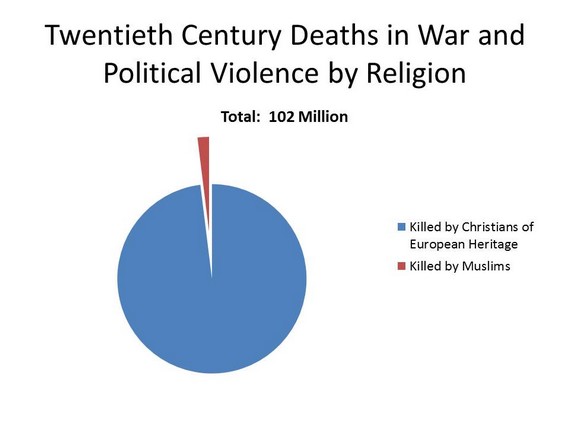
As for political violence, people of Christian heritage in the twentieth century polished off tens of millions of people in the two world wars and colonial repression. This massive carnage did not occur because European Christians are worse than or different from other human beings, but because they were the first to industrialize war and pursue a national model. Sometimes it is argued that they did not act in the name of religion but of nationalism. But, really, how naive. Religion and nationalism are closely intertwined. The British monarch is the head of the Church of England, and that still meant something in the first half of the twentieth century, at least. The Swedish church is a national church. Spain? Was it really unconnected to Catholicism? Did the Church and Francisco Franco’s feelings toward it play no role in the Civil War? And what’s sauce for the goose: much Muslim violence is driven by forms of modern nationalism, too.
I don’t figure that Muslims killed more than a 2 million people or so in political violence in the entire twentieth century, and that mainly in the Iran-Iraq War 1980-1988 and the Soviet and post-Soviet wars in Afghanistan, for which Europeans bear some blame.
Compare that to the Christian European tally of, oh, lets say 100 million (16 million in WW I, 60 million in WW II– though some of those were attributable to Buddhists in Asia– and millions more in colonial wars.)
relviolence
Belgium– yes, the Belgium of strawberry beer and quaint Gravensteen castle– conquered the Congo and is estimated to have killed off half of its inhabitants over time, some 8 million people at least.
Or, between 1916-1930 Tsarist Russian and then Soviet forces — facing the revolt of Central Asians trying to throw off Christian (and then Marxist), European rule — Russian forces killed an estimated 1.5 million people. Two boys brought up in or born in one of those territories (Kyrgyzstan) just killed 4 people and wounded others critically. That is horrible, but no one, whether in Russia or in Europe or in North America has the slightest idea that Central Asians were mass-murdered during WW I and before and after, and looted of much of their wealth. Russia when it brutally conquered and ruled the Caucasus and Central Asia was an Eastern Orthodox, Christian empire (and seems to be reemerging as one!).
Then, between half a million and a million Algerians died in that country’s war of independence from France, 1954-1962, at a time when the population was only 11 million!
I could go on and on. Everywhere you dig in European colonialism in Afro-Asia, there are bodies. Lots of bodies.
Now that I think of it, maybe 100 million people killed by people of European Christian heritage in the twentieth century is an underestimate.
As for religious terrorism, that too is universal. Admittedly, some groups deploy terrorism as a tactic more at some times than others. Zionists in British Mandate Palestine were active terrorists in the 1940s, from a British point of view, and in the period 1965-1980, the FBI considered the Jewish Defense League among the most active US terrorist groups. (Members at one point plotted to assassinate Rep. Dareell Issa (R-CA) because of his Lebanese heritage.) Now that Jewish nationalsts are largely getting their way, terrorism has declined among them. But it would likely reemerge if they stopped getting their way. In fact, one of the arguments Israeli politicians give for allowing Israeli squatters to keep the Palestinian land in the West Bank that they have usurped is that attempting to move them back out would produce violence. I.e., the settlers not only actually terrorize the Palestinians, but they form a terrorism threat for Israel proper (as the late prime minister Yitzhak Rabin discovered).
Even more recently, it is difficult for me to see much of a difference between Tamerlan Tsarnaev and Baruch Goldstein, perpetrator of the Hebron massacre.
Or there was the cold-blooded bombing of the Ajmer shrine in India by Bhavesh Patel and a gang of Hindu nationalists. Chillingly, they were disturbed when a second bomb they had set did not go off, so that they did not wreak as much havoc as they would have liked. Ajmer is an ecumenical Sufi shrine also visited by Hindus, and these bigots wanted to stop such open-minded sharing of spiritual spaces because they hate Muslims.
Buddhists have committed a lot of terrorism and other violence as well. Many in the Zen orders in Japan supported militarism in the first half of the twentieth century, for which their leaders later apologized. And, you had Inoue Shiro’s assassination campaign in 1930s Japan. Nowadays militant Buddhist monks in Burma/ Myanmar are urging on an ethnic cleansing campaign against the Rohingya.
As for Christianity, the Lord’s Resistance Army in Uganda initiated hostilitiesthat displaced two million people. Although it is an African cult, it is Christian in origin and the result of Western Christian missionaries preaching in Africa. If Saudi Wahhabi preachers can be in part blamed for the Taliban, why do Christian missionaries skate when we consider the blowback from their pupils?
Terrorism is a tactic of extremists within each religion, and within secular religions of Marxism or nationalism. No religion, including Islam, preaches indiscriminate violence against innocents.
It takes a peculiar sort of blindness to see Christians of European heritage as “nice” and Muslims and inherently violent, given the twentieth century death toll I mentioned above. Human beings are human beings and the species is too young and too interconnected to have differentiated much from group to group. People resort to violence out of ambition or grievance, and the more powerful they are, the more violence they seem to commit. The good news is that the number of wars is declining over time, and World War II, the biggest charnel house in history, hasn’t been repeated.

Friday, November 07, 2014

Myanmar Plans To Eradicate Rohingya Identity


Authorities sealed off villages in Myanmar's only Muslim-majority region and in some cases beat and arrested people who refused to register with immigration officials, in what may be the most aggressive effort yet to force Rohingya to indicate they are illegal migrants from neighboring Bangladesh.

Immigration officials, border guards and members of the illegal-alien task force in the northern tip of Rakhine state — home to 90 percent of the country's 1.3 million Rohingya — this year, in addition to questions about marriages, deaths and births, people were classified by ethnicity.

Residents said those who refused to take part suffered the consequences.

"We are trapped," Khin Maung Win said last week. He said authorities started setting up police checkpoints outside his village, Kyee Kan Pyin, in mid-September, preventing people from leaving even to shop for food in local markets, work in surrounding paddies or take children to school.

"If we don't have letters and paperwork showing we took part — that we are Bengali — we can't leave," he said.

Chris Lewa of the Arakan Project, which has been advocating on behalf of the Rohingya for more than a decade, said residents reported incidents of violence and abuse in at least 30 village tracts from June to late September. 

Most worrying to many, the government has largely stood by as Buddhist extremists have targeted Rohingya, sometimes with machetes and bamboo clubs, saying they pose a threat to the country's culture and traditions.
Denied citizenship by national law, members of the religious minority are effectively stateless. They feel they are being systematically erased.

Almost all Rohingya were excluded from a U.N.-funded nationwide census earlier this year, the first in three decades, because they did not want to register as Bengalis. And Thein Sein is considering a "Rakhine Action Plan" that would make people who identify themselves as Rohingya not only ineligible for citizenship but candidates for detainment and possible deportation.

Most Rohingya have lived under apartheid-like conditions in northern Rakhine for decades, with limited access to adequate health care, education and jobs, as well as restrictions on travel and the right to practice their faith.

In 2012, Buddhist extremists killed up to 280 people and displaced tens of thousands of others. About 140,000 people of those forced from their homes continue to languish in crowded displacement camps further south, outside Sittwe, the Rakhine state capital.

Many villages were placed under lockdown, with police checkpoints set up to make sure only those who have cooperated could leave, more than a dozen residents confirmed in telephone interviews with The Associated Press.

In other villages, the names of influential residents were posted on community boards with verbal warnings that they face up to two years in jail if they fail to convince others to take part in the registration process, Lewa said. Other Rohingya say officials forced them to sign the papers at gunpoint, or threatened that they would end up in camps like those outside Sittwe if they didn't comply, she said. In some cases residents say authorities have shown up after midnight and broken down doors to catch residents by surprise and pressure them to hand over family lists.

Villagers also have been kicked and beaten with clubs and arrested for refusing to take part, according to Lewa and residents interviewed by the AP.

Rohingya said they didn't want to register family members because they worry the information might be used to deny them citizenship.

As international pressure mounts to end abuses against Rohingya, the government has agreed to provide citizenship to anyone who qualifies. But many Rohingya say they cannot meet the requirements, which include submitting documents proving that their families have been in Myanmar for at least three generations. And under the plan Thein Sein is considering, even that would not be enough for people who insist on calling themselves Rohingya rather than Bengali.

Friday, June 13, 2014

When Buddhists Go To War


On October 1, Muslims in the coastal village of Thabyuchaing in the northwest of Burma fled into the surrounding forests as their homes were torched and left to burn by a sword-wielding Buddhist mob. Not everyone was lucky enough to escape: five Muslims, including a 94-year-old woman, were killed in the attack. 

The incident was an all too familiar reminder of the ethno-religious tensions and sectarian violence that continue to plague Burma’s nascent democracy. While Nobel Peace Prize winner and Burmese MP Aung Sung Suu Kyi has become the face of a liberalized Burma in the West, her domestic dominance is being increasingly challenged by Ashin Wirathu, a monk Time magazine described as the “face of Buddhist terror. ” Wirathu and his followers have been at the forefront of a campaign of ethnic and religious violence that has threatened to derail the country’s already fragile democratic transition.
Burma’s progress is vulnerable due to the lingering legacy of decades of military rule. The country’s first foray into democracy began in 1948, when it gained independence, bringing an end to over a century of British imperial rule. However, in 1962 a military led coup succeeded in overthrowing the civilian government, beginning a period of socialist military rule that ended in 1988. That year there was another coup establishing the State Peace and Development Council (or the military junta, as it is more commonly known) as the ruling body of Burma. The Buddhist establishment remained a bastion of Burmese national identity and security throughout this turbulent half-century. During this time, religious leaders were only occasionally critical of these successive regimes. It wasn’t until the last decade that religious leaders within various communities began to take a significant role in the country’s political development.
The 2007 Saffron Revolution demonstrated the capacity for change that these Burmese Buddhists wield. In what began as a student led protest against rising costs of living, monks across Burma began a campaign of civil resistance that brought the government to a standstill. Throughout the summer and early fall, monks marched through the cities and sat en masse in public squares and historic sites in defiance of the junta. In September, monks across the country suspended spiritual services to the military, a powerful symbolic move for a devoutly Buddhist country. When the government responded with force and brought the short-lived revolution to a bloody end, the crackdown was met with both domestic and international outcry as well as an outpouring of support — particularly for the monks who had dared to stand up to the military regime.
Burma’s history of ethnic and religious struggle extends beyond Buddhist political protest. Even before the 1962 coup, the central government had been in a near perpetual state of conflict with a variety of secessionist groups, perhaps most notably the Kachin people of northern Burma, who have been sporadically fighting a war of independence from the country since 1948. Within the last decade in particular, these conflicts have taken on a decidedly more internal character. The state of Rakhine, an epicenter of ethno-religious violence on the Bangladeshi border, has a history of Mujahedeen-inspired Muslim separatist movements. Recently, however, the violence has been predominantly Buddhist-on-Muslim. Oppression of the Rohingya, an ethnically Bangladeshi Muslim group who primarily reside in the state of Rakhine, has reached largely unprecedented levels, as Buddhist extremists have started burning Muslim holdings to the ground and forcing the Rohingya from their land.
The conflict between the Buddhist majority and Muslim minority in Burma appears to be ethnic cleansing in the making. Muslims make up only 4 percent of Burma’s population of approximately 55 million people. However, they are heavily concentrated in the country’s western half — comprising 40.75 percent of the total population of Rakhine  and 96 percent of the population along the border with Bangladesh. As of June this year, an estimated 200 Muslims have been killed and 150,000 have been displaced. Even more worrisome is the fact that Buddhist extremism in Burma is widespread. Other extremist Buddhist movements, such as the GAM in Aceh and the Buddhist radicals in Sri Lanka are relatively minor. In Burma, however, this manifestation of radical prejudice is just the latest chapter in a history of abuses.
Muslims have long been perceived as culturally and socially separate from the rest of Burma. While the country has never been culturally or ethnically homogeneous, the Rohingya have attracted an unusually fierce vitriol due to their practice of Islam, leading to historical and systematic discrimination. The laws in place restrict the number of children they are permitted to two per couple. Even more disheartening, many Burmese see the current anti-Muslim violence as an inevitable and justified backlash against Bengali land-grabbers.  Prominent members of the Buddhist institution, especially Ashin Wirathu, have only encouraged this attitude.
Always traveling in a motorcade with 60 of his closest followers, Wirathu — the self described “Burmese bin Laden”  — is at the heart of the growing tide of anti-Islamic rhetoric. While his self-assigned title may seem something of a paradox given his mission to drive Muslims out of Burma, the charismatic 45-year-old has proven himself as masterful and adept as his namesake at inciting religious hatred. A fierce polemicist who described coexistence with Muslims as “sleep[ing] next to a mad dog,” he describes the threat posed by Muslim communities in apocalyptic terms. “They will overwhelm [Burma] and take over our country,” said Wirathu, adding that they will “make it into an evil Islamic nation.” And like bin Laden, he has a keen eye for his media presence. DVDs of his speeches are sold on street corners. An enthusiastic user of YouTube, his followers post his fiery, anti-“Islamification” sermons, which Atlantic columnist Alex Bookbinder has noted “would not be out of place at Nuremberg.”
Born in the small town of Kyaukse in central Burma, Wirathu is no stranger to controversy. In 2001, he became involved with the 969 movement, a Buddhist nationalist organization. Two years later, he was found guilty by the military junta government for giving critical speeches that allegedly incited religious conflict. In 2010, he was released from prison as part of a conciliatory gesture by the military junta, and ever since, Wirathu has come to be seen as the 969 movement’s spiritual protector and leader.
The 969 movement purports to be a non-violent organization that stands for the protection of Buddhist values and national identity in Burma. But their actions reveal that their mission is in fact a narrowly defined racial and religious jingoism. The movement has its origins in a book written in the late 1990s by U Kyaw Lwin, a religious official in the military junta. Throughout Southeast Asia, the number 786 has special significance for many Muslims as a numerical representation of the phrase “In the Name of Allah, the Compassionate and Merciful.” In his numerological treatise, Lwin makes the argument that Muslims are in fact conspiring to take over Burma in the 21st century — premised on the absurdly conspiratorial fact that 7 plus 8 plus 6 equals 21. The number 969 has a similar significance. It was chosen as a cosmological defense because of its allusions to the “three jewels” of Buddhism: Buddha’s nine attributes, the six principles of his teachings, and the nine attributes of monastic order. Emblems of the 969 Movement are increasingly popular throughout Burma, with supporters proudly displaying the iconography in their homes, businesses and on their vehicles. Some stores juxtapose their emblems with signs proudly claiming that they do not stock Muslim goods.
As is often the case in states with uncertain futures, minority groups are scapegoats for the nation’s economic woes. Comparisons of modern day Burma to Nazi Germany are not entirely unwarranted. Wirathu has pointed to the affluence of a few Muslims as proof that the Burmese economy is at the whim of Islam, conveniently overlooking the legacy of crony capitalism that has enriched the military administration, none of whom are Muslim.The Burmese population at large, however, has seized upon these claims, and there is swelling support for Wirathu’s call to boycott Muslim businesses. His goal is to cut off the ability of Muslims to engage in commerce. By depriving them of their means of subsistence, Wirathu and other members of the 969 movement ultimately seek to drive Muslims from the country.
As is common among ethno-nationalist movements, Wirathu’s proclaimed goal is simply to protect the purity and integrity of the Burmese state. In a February speech he warned that if Muslims are allowed to become too wealthy their “money will eventually be used against you to destroy your race and religion.”  At the same rally, Wirathu also invoked the need to protect the innocence of Burmese women who would be “coerced or even forced to convert to Islam.”  It hardly needs restating that  the protection of women is compelling rhetoric that has been used by movements from the KKK to the National Socialist party. Its efficacy in Burma, unfortunately, has been readily apparent.
This insular notion of purity is common among many Asian states due to their shared religion. Buddhism has played an influential role in many countries throughout the region, and it has particularly helped unify Burma, a country cut off from much of the world by geography and political circumstance. Despite the fairly diverse ethnic makeup of Burma, Buddhism has proven to be the country’s most significant integrating factor. Its near-complete dominance and perceived cultural integrity explain in large part the hostility displayed toward Muslims who are branded perennial outsiders. The significance of monasticism to Burmese society cannot be overstated. There are over 500,000 monks in Burma  and an additional 75,000 nuns, meaning that roughly one percent of the population is part of the Buddhist institution. Furthermore, since monastic education in Burma is free, many of the poorest families will opt to send their children to study in monasteries. Buddhist religious education is commonplace amongst all strata of society, as almost all Burmese children receive a supplementary Buddhist education akin to Sunday school. This overwhelming preponderance of not merely Buddhist observance, but also Buddhist veneration, helps to explain the religion’s central role in Burmese identity and the enormous impact that it has on average citizens.
In June 2012, Burma experienced a paroxysm of ethnic riots in Rakhine, and it’s not hard to link the corrosive influence of Buddhist institutions to the widespread violence.  While the proximate cause of the 2012 June riots was the rape and murder of a Rakhine woman by a group of Rohingya Muslim men, the ensuing attacks and counterattacks by Rakhine and Rohingya communities were the inevitable product of pent-up frustration in an unequal system. Buddhist mobs in Rakhine, whipped into a frenzy by extremists like Wirathu, began indiscriminately attacking Rohingya men in a search for the perpetrators. The Rohingya responded with violence fueled by years of discrimination and neglect of their own.
In October of the same year, riots broke out again, but the cause was unclear. By the end of 2012, an estimated 168 people had been killed in the riots with a further 150,000, mostly Rohingya, displaced. While camps have been set up to aid in the resettlement process, they present only a stopgap solution, a temporary bandage for the scars of ethnic conflict. To many observers, the question is, “Why now?”
Burma stands at a precarious moment in its history. For the first time in over 50 years, democracy seems like a real possibility. However, internal and external forces have proven a stumbling block for suffrage. The discovery of vast natural resources in Burma, ranging from precious stones to fossil fuels, has elevated the democratic movement to one of global concern. Foreign actors have not undervalued Burma’s resource wealth. While the United States has approached Burma with a soft touch, China has taken a far more aggressive track, particularly in regards to securing resource extraction contracts.
Burma’s newfound riches will only stoke the flames. Militant ethno-nationalism often has arisen as a symptom of sudden resource wealth in emerging states around the world. Developing states with plentiful natural resources are often heavily exploited by foreign powers. Coupled with the possibility of enormous wealth, foreign exploitation might only produce an even more aggressive nationalism that endangers Burma’s ethnic and religious minorities.
Mongolia today is one of the fastest growing economies in the world, in large part due to its massive copper and coal reserves; it’s also home to a fledgling neo-Nazi movement. As paradoxical as a Mongolian neo-Nazi movement may sound, it is no more contradictory than militant Buddhists. The Tsagaan Khass, or White Swastika, as the group is known, has tried in recent years to rebrand itself as an environmental movement looking to protect Mongolia’s resource sovereignty, and ensure that the nation’s blood is “pure.” The group’s leaders are concerned that if Mongolian society starts “mixing with the Chinese, they will swallow us up.”  The situation in Mongolia bears more than a passing resemblance to that in Burma. While the White Swastika does not have the same widespread appeal as the 969 movement, they are both indicative of how these ethno-nationalist movements develop in response to perceived threats by historical rivals, particularly during periods of uncertain economic growth. While both Mongolia and Burma have vast resource wealth, they lack domestic extractive capabilities, forcing them to rely on foreign investment. This loss of resource sovereignty produces anger and resentment, particularly in economically marginalized groups who are susceptible to the scapegoats proffered by the likes of Ashin Wirathu and the White Swastika.
While transitional instability and resource nationalism may have played a role in Wirathu’s growing support, his success is still contingent on deeply held racial and religious prejudice. The Christian minority in Burma has not been the target of hate crimes, despite being the religion of the Kachin, who have waged a decades-long war of independence. The persecution of Muslims, then, can be seen as the cumulative product of systemic and ingrained bigotry, which has been violently catalyzed by economic and political instability. In other words, there’s a reason that Buddhist attacks have focused on one ethnic minority, rather than all vulnerable groups.
Last July, a bomb exploded a few yards away from Ashin Wirathu as he delivered another sermon on the Muslim threat. Unharmed and undaunted, Wirathu has continued to deliver sermons around the country. In the last year, the 969 movement has gone from fringe extremists to a national movement with growing support. There are even fears that the current administration has intentionally allowed Wirathu’s campaign of violence to proceed unabated in order to justify continued draconian national security measures. As he capitalizes on the underlying racial and religious prejudices that have swirled to the surface of Burmese society, over 150,000 Muslims find themselves without a home. While moderate monks and more liberal citizens have begun to push back against this metastasizing violence, recent events have shown that political circumstances can lead even Buddhists astray from the path to enlightenment, and into the foreboding brambles of racial violence.

Monday, June 02, 2014

Anti-Muslim Monk Wirathu Inciting Hatred


"Whatever (the Muslims) do they do it with their 'national' Muslim interests in mind. They have designs against our country, our faith and our society. They now have monopoly over the construction sector in Rangoon. They have come to dominate Aung San Suu Kyi's National League for Democracy. Even she is only riding the niggers' cars. All these national dissidents such as Aung San Suu Kyi and Min Ko Naing dare not speak a word about the Rakhine Crisis (during which our brethen Rakhine are suffering at the hands of the Bangali). Our national political emblem has been replaced by the Islam's symbol of beards! They are the worst violators of human rights and religious freedom. So, you Buddhist lay public must do everything with the (anti-Muslim) nationalist ethos. Only do business and socially interact with those who embrace 969 ethos of economic boycott and societal exclusion and ostracism against the (Muslim) enemy". 

Saturday, May 31, 2014

Non-Muslims Perpetrated 94% Of All Terror Attacks On US Soil


The Threat To The U.S. From "Muslim Terrorists" Has Been Greatly Exaggerated

An FBI report shows that only a small percentage of terrorist attacks carried out on U.S. soil between 1980 and 2005 were perpetrated by Muslims.
Princeton University’s Loon Watch compiled the following chart from the FBI’s data (as explained below, this chart is over-simplified … and somewhat inaccurate):
Terrorist Attacks on U.S. Soil by Group, From 1980 to 2005, According to FBI Database

According to this data, there were more Jewish acts of terrorism within the United States than Islamic (7% vs 6%).  These radical Jews committed acts of terrorism in the name of their religion.  These were not terrorists who happened to be Jews; rather, they were extremist Jews who committed acts of terrorism based on their religious passions, just like Al-Qaeda and company.
(The chart is misleading in several ways. For example, it labels “Extreme Left Wing Groups” and “Communists”, but not “Extreme Right Wing Groups” or “Fascists”. It should have either discarded allpartisan labels, or included labels for both ends of the spectrum.  In addition, “Latinos” is misleading, as Loonwatch is actually referring to Puerto Rican separatist groups, Cuban exile groups and the like.  However, as shown below, many of the basic concepts are correct.)
U.S. News and World Report noted in February of this year:
Of the more than 300 American deaths from political violence and mass shootings since 9/11, only 33 have come at the hands of Muslim-Americans, according to the Triangle Center on Terrorism and Homeland Security. The Muslim-American suspects or perpetrators in these or other attempted attacks fit no demographic profile—only 51 of more than 200 are of Arabic ethnicity. In 2012, all but one of the nine Muslim-American terrorism plots uncovered were halted in early stages. That one, an attempted bombing of a Social Security office in Arizona, caused no casualties.
Wired reported the same month:
Since 9/11, [Charles Kurzman, Professor of Sociology at University of North Carolina at Chapel Hill, writing for the Triangle Center on Terrorism and National Security] and his team tallies, 33 Americans have died as a result of terrorism launched by their Muslim neighbors. During that period, 180,000 Americans were murdered for reasons unrelated to terrorism. In just the past year, the mass shootings that have captivated America’s attention killed 66 Americans, “twice as many fatalities as from Muslim-American terrorism in all 11 years since 9/11,” notes Kurzman’s team.
Law enforcement, including “informants and undercover agents,” were involved in “almost all of the Muslim-American terrorism plots uncovered in 2012,” the Triangle team finds. That’s in keeping with the FBI’s recent practice of using undercover or double agents to encourage would-be terrorists to act on their violent desires and arresting them when they do — a practice critics say comes perilously close to entrapment. A difference in 2012 observed by Triangle: with the exception of the Arizona attack, all the alleged plots involving U.S. Muslims were “discovered and disrupted at an early stage,” while in the past three years, law enforcement often observed the incubating terror initiatives “after weapons or explosives had already been gathered.”
The sample of Muslim Americans turning to terror is “vanishingly small,” Kurzman tells Danger Room. Measuring the U.S. Muslim population is a famously inexact science, since census data don’t track religion, but rather “country of origin,” which researchers attempt to use as a proxy. There are somewhere between 1.7 million and seven million American Muslims, by most estimates, and Kurzman says he operates off a model that presumes the lower end, a bit over 2 million. That’s less a rate of involvement in terrorism of less than 10 per million, down from a 2003 high of 40 per million, as detailed in the chart above.
Yet the scrutiny by law enforcement and homeland security on American Muslims has not similarly abated. The FBI tracks “geomaps” of areas where Muslims live and work, regardless of their involvement in any crime. The Patriot Act and other post-9/11 restrictions on government surveillance remain in place. The Department of Homeland Security just celebrated its 10th anniversary. In 2011, President Obama ordered the entire federal national-security apparatus to get rid of counterterrorism training material that instructed agents to focus on Islam itself, rather than specific terrorist groups.
Kurzman doesn’t deny that law enforcement plays a role in disrupting and deterring homegrown U.S. Muslim terrorism. His research holds it out as a possible explanation for the decline. But he remains surprised by the disconnect between the scale of the terrorism problem and the scale — and expense — of the government’s response.
“Until public opinion starts to recognize the scale of the problem has been lower than we feared, my sense is that public officials are not going to change their policies,” Kurzman says. “Counterterrorism policies have involved surveillance — not just of Muslim-Americans, but of all Americans, and the fear of terrorism has justified intrusions on American privacy and civil liberties all over the internet and other aspects of our lives. I think the implications here are not just for how we treat a religious minority in the U.S., but also how we treat the rights & liberties of everyone.”
Kurzman told the Young Turks in February that Islamic terrorism “doesn’t even count for 1 percent” of the 180,000 murders in the US since 9/11.
While the Boston marathon bombings were horrific, a top terrorism expert says that the Boston attack was more like Columbine than 9/11, and that the bombers are “murderers not terrorists”.  Theoverwhelming majority of mass shootings were by non-Muslims.  (This is true in Europe, as well as in the U.S.)
However you classify them – murder or terrorism – the Boston bombings occurred after all of the statistical analysis set forth above. Moreover, different groups have different agendas about how to classify the perpetrators  (For example, liberal Mother Jones and conservative Breitbart disagree on how many of the perpetrators of terror attacks can  properly be classified as right wing extremists.)
we reviewed all of the terrorist attacks on U.S. soil as documented by the National Consortium for the Study of Terrorism and Responses to Terrorism (START). (2012). Global Terrorism Database, as retrieved from http://www.start.umd.edu/gtd.
The START Global Terrorism Database spans from 1970 through 2012 (and will be updated from year-to-year), and – as of this writing – includes 104,000 terrorist incidents.  As such, it is the most comprehensive open-source database open to the public.
We counted up the number of terrorist attacks carried out by Muslims.  We excluded attacks by groups which are obviously not Muslims, such as the Ku Klux Klan, Medellin Drug Cartel, Irish Republican Army, Anti-Castro Group, Mormon extremists, Vietnamese Organization to Exterminate Communists and Restore the Nation, Jewish Defense League, May 19 Communist Order, Chicano Liberation Front, Jewish Armed Resistance, American Indian Movement, Gay Liberation Front, Aryan Nation, Jewish Action Movement, National Front for the Liberation of Cuba, or Fourth Reich Skinheads.
We counted attacks by Al Qaeda, the Taliban, Black American Moslems, or anyone who even remotelysounded Muslim … for example anyone from Palestine, Lebanon or any other Arab or Muslim country, or any name including anything sounding remotely Arabic or Indonesian (like “Al” anything or “Jamaat” anything).
If we weren’t sure what the person’s affiliation was, we looked up the name of the group to determine whether it could in any way be connected to Muslims.
Based on our review of the approximately 2,400 terrorist attacks on U.S. soil contained within the START database, we determined that approximately 60 were carried out by Muslims.
In other words, approximately 2.5% of all terrorist attacks on U.S. soil between 1970 and 2012 were carried out by Muslims.*  This is a tiny proportion of all attacks.
We determined that approximately 118 of the terror attacks – or 4.9% – were carried out by Jewish groups such as Jewish Armed Resistance, the Jewish Defense League, Jewish Action Movement, United Jewish Underground and Thunder of Zion. This is almost twice the percentage of Islamic attacks within the United States.  In addition, there were approximately 168 attacks – or 7% – by anti-abortion activists, who tend to be Christian. Fuerzas Armadas de Liberacion Nacional  – a Puerto Rican paramilitary organization -  carried out more than 120 bomb attacks on U.S. targets between 1974 and 1983, and there were some 41 attacks by Cuban exiles, and a number of attacks by other Latin American groups.
Another study undertaken by the National Consortium for the Study of Terrorism and Responses to Terrorism – called ”Profiles of Perpetrators of Terrorism in the United States” – found:
Between 1970 and 2011, 32 percent of the perpetrator groups were motivated by ethnonationalist/separatist agendas, 28 percent were motivated by single issues, such as animal rights or opposition to war, and seven percent were motivated by religious beliefs. In addition, 11 percent of the perpetrator groups were classified as extreme right-wing, and 22 percent were categorized as extreme left-wing.
Preliminary findings from PPT-US data between 1970 and 2011 also illustrate a distinct shift in the dominant ideologies of these terrorist groups over time, with the proportion of emerging ethnonationalist/separatist terrorist groups declining and the proportion of religious terrorist groups increasing. However, while terrorist groups with religious ideologies represent 40 percent of all emergent groups from 2000-2011 (two out of five), they only account for seven percent of groups over time.
Similarly, a third study by the National Consortium for the Study of Terrorism and Responses to Terrorism Religion found that religion alone is not a key factor in determining which terrorists want to use weapons of mass destruction:
The available empirical data show that there is not a significant relationship between terrorist organizations’ pursuit of CBRN (chemical, biological, radiological or nuclear) weapons and the mere possession of a religious ideology, according to a new quantitative study by START researchers Victor Asal, Gary Ackerman and Karl Rethemeyer.
Therefore, Muslims are not more likely than other groups to want to use WMDs.
* The Boston marathon bombing was not included in this analysis, as START has not yet updated its database to include 2013 terrorist attacks.  3 people died in the Boston attack.  While tragic, we are confident that non-Musliims killed more than 3 during this same period.
We are not experts in terrorism analysis.  We would therefore defer to people like Kurzman on the exact number.  However, every quantitative analysis of terrorism in the U.S. we have read shows that the percent of terror attacks carried out by Muslims is far less than 10%.
Postscript: State-sponsored terrorism is beyond the scope of this discussion, and was not included in our statistical analysis.  Specifically, the following arguments are beyond the scope of this discussion, as we are focusing solely on non-state terrorism:
  • Arguments by  University of Michigan Professor Juan Cole that deaths from 20th century wars could be labeled Christian terrorism


Sunday, December 01, 2013

The Hidden Genocide Of Rohingya Muslims


Time For Soft Talk With Myanmar Is Over

An OIC (Organization of Islamic Countries) delegation, which included foreign ministers and senior officials from its member states Indonesia, Malaysia, Turkey, Saudi Arabia, Egypt, Djibouti, and Bangladesh recently visited Myanmar. It was led by the OIC Secretary General Ekmeleddin Ihsanoglu. The OIC delegation pressed for unhindered access of humanitarian aid to all affected people and communities, including Rakhine (Arakan) State, without any discrimination. They also stressed the need for clarifying misconceptions and misunderstandings on both sides and for building mutual trust and interfaith community harmony.

As has become the norm in this mostly Buddhist country that has come to signify the den of intolerance and hatred of our time, the OIC delegation was, however, met by angry demonstrators, esp. in the Rakhine state, which has seen more than its share of ethnic cleansing of the Muslim minorities. Some 3,000 protesters, led by Buddhist monks, staged their demonstrations in Rakhine's capital Sittwe (formerly called Akyab) as they toured camps housing mostly displaced Rohingya refugees as well as some ethnic Rakhines and met local officials. The delegation's visit to Myanmar's commercial capital Yangon on Friday also saw nearly 1,000 people, carrying "No OIC" placards.
The protests of this kind - organized by the members of the central government and local administration, Buddhist politicians and monks - are nothing new. These are a show of defiance against everything noble and humane. These dark, hideous and savage forces of Theravada Buddhism want to hide their monumental crimes against humanity and want to starve to death the remnants of the Muslim minority who mostly now live in abject poverty as Internally Displaced Persons (IDP) in squalid camps.
Last year, the Buddhist government similarly did not allow the fact finding missions from international agencies, including the OIC, to tour the ethnically cleansed territories. It also did not allow opening up an OIC office in the Rakhine state. In the midst of government-sponsored protest demonstrations, the OIC had to pack up and leave, which only emboldened the savage regime and its supporters within the apartheid state to repeat their crimes against the Rohingya - who, according to the UN, are the most persecuted people on earth - and other Muslim minorities.

So the plight of the Rohingya and other Muslim minorities continues unabated inside apartheid Myanmar. In ethnic cleansing drives in this country, the victims are usually the Rohingyas and yet they end up in the prisons (and not the Buddhist marauders) overwhelmingly. A peaceful demonstration may cost them their lives in this Mogher Mulluk. The same security forces which did nothing to stop lynching of Muslim victims have no moral qualms in killing them unprovoked for staging a peaceful demonstration. 
As has been noted by the Associated Press on November 24, 600 Rohingya Muslim men were recently thrown in jail in this remote corner of Myanmar during a ruthless security crackdown that followed sectarian violence, and among one in 10 who didn't make it out alive.

An eyewitness described that when she visited the jail, the cells were crammed with men, hands chained behind their backs, several stripped naked. Many showed signs of torture. Her husband, Mohammad Yasim, was doubled over, vomiting blood, his hip bone shattered. "We were all crying so loudly the walls of the prison could have collapsed," the 40-year-old widow said. "They killed him soon after that," she said of her husband. Her account was corroborated by her father, her 10-year-old son and a neighbor. "Other prisoners told us soldiers took his corpse and threw it in the forest." "We didn't even have a chance to see his body," she said.

In early November, three Rohingyas were killed. One Rohingya man was murdered by Rakhine villagers when collecting firewood in the forest. Another two were killed and four wounded after riot police opened fire during clashes. In Pauktaw Township the situation remained tense with many of the remaining Rohingya villagers being forced into an IDP camp allegedly for their own security by army and police. Many are afraid because the camp, funded by an international aid group, is very close to a village with only Buddhist Rakhines.

Buddhist security forces have been allowed to operate with impunity. As a result of such brutality, unfathomed discrimination by state authorities and their obvious collusion with the Rakhine (Magh) extremists towards never-ending pogroms life has only gotten worse for Rohingya. They see no way out but to board rickety boats for Bangladesh, or make the perilous journey to Malaysia. Many have already drowned trying when their boats capsized.

In spite of Myanmar's Government's zealous efforts to hide its complicity and crimes against humanity, truth has been leaking out. Consider, for instance, the testimony of Mr. Thomas H. Andrews, President and CEO of United to End Genocide on September 19, 2013 in front of the U.S. House of Representatives Committee on Foreign Affairs, Subcommittee on Asia and the Pacific. In that, he provided his first-hand account of visits made in Burma. He travelled to Rakhine State in the west where he visited eight IDP camps and spoke with dozens of desperate IDPs. He also travelled to the central and northern area of Mandalay and the city of Meiktila where he visited neighborhoods and met with many people and families who continue to live in fear and desperation. He also came across Muslims in Rangoon whose fear and intimidation was on the rise in Myanmar.

During his trip, Mr. Andrews was blocked by security forces at roadside checkpoints from visiting IDP camps. The reason was clear. They did not want him to hear what had happened to the Muslim community inside Myanmar. Nevertheless, the signs of destruction were everywhere and he was able to see burnt out buildings and destroyed Mosques, meet with those who had to literally run for their lives after watching their homes and everything that they had worked for destroyed. They were living in abject poverty in makeshift camps wanting desperately to return and rebuild their village but also utterly terrified by the Buddhist mobs, Myanmar security forces and police even more.

Throughout his travels, Mr. Andrews heard stories of systematic discrimination, isolation and blanket oppression where every aspect of life of members of the Muslim minority was controlled. 


People described living in constant fear of violence within their communities and intimidation by authorities. The right to move from one village - or even one street - to another, the right to earn a living, to get married, to have more than two children and even the right to live with one's own family was often dependent on the permission of authorities and most often only after the payment of bribes. 
He found that hate speech - a precursor of genocide - was prevalent in Burma. Fueling it was a systematic, well organized and well funded campaign of hatred and bigotry known as "969". It followed a well established pattern: 

1) Campaign organizers arrive in a village, distributing DVDs, pamphlets and stickers that warn Buddhists that their religion and their country were in peril as Muslims seek to eliminate both and establish a Muslim caliphate; 
2) Villages are invited to a special community event to hear a message from venerable Buddhist monks about how they can protect their families, nation and religion; 
3) Radical nationalist monks arrive at the designated time and deliver fiery hate-filled speeches warning that Muslims are plotting to destroy Buddhism and take control of the nation. Villages are encouraged to support the movement by signing petitions, and displaying "969" stickers on their homes and businesses. They are encouraged to only patronize those who displayed the stickers and boycott any Muslim owned or operated business. 
As I have documented earlier, the hateful rhetoric of these radical Rakhine monks and the "969" campaign is ominously reminiscent of the hateful propaganda directed at the Tutsi population and their sympathizers in the lead up and during the Rwandan genocide, let alone the Nazi-led Holocaust more than half a century earlier. 

Demanding the expulsion of all Rohingya from Burma, these monks urge the local population to sever all relations with not only the Rohingya, but also with what are described as their "sympathizers". Labeled as national traitors, those Buddhists who associate with Rohingya Muslims also face intimidation and the threat of violence. 
Gregory Stenton, President of Genocide Watch, documented eight stages of genocide - Classification, Symbolization, Dehumanization, Organization, Polarization, Preparation, Extermination and Denial. Human rights watchers have long concluded that the Rohingyas are facing genocide in Myanmar, and this crime must be stopped. 
Last week (Tuesday, November 19) the U.N. General Assembly's human rights committee passed a resolution urging Myanmar to give the stateless Rohingya minority equal access to citizenship and to crack down on Buddhist violence against them and other Muslims. 

In its response, an official of the Myanmar government said that it will not allow itself to be pressured by a U.N. resolution. Presidential spokesman Ye Htut insisted in a posting on his Facebook page that the government does not recognize that there is a group called Rohingya, referring to them instead as Bengalis.

As I have noted above, such defiance by the rogue Myanmar regime is not new and unless checked vehemently it will continue to defy the world community. 

The elimination of Muslims there has become a national project enjoying widespread support from Nobel disgrace Suu Kyi to president Thein Sein. 
Thus, the UN has to go beyond passing soft resolutions that don't bite the rogue regime

A reading of history shows that genocide succeeds when state sovereignty blocks international responsibility to protect its persecuted group. It continues due to lack of authoritative international institutions to predict it and call it as such. It happens due to lack of ready rapid response forces to stop it and lack of political will to peacefully prevent it and to forcefully intervene to stop it.
Since founding of the UN, at least 45 genocides and politicides have taken place in our world resulting in deaths of some 70 million people. It is a shameful record that needs to be improved. 
The time for soft talk with Myanmar is over. It is high time for the UN Security Council to authorize armed intervention in Myanmar by a UN force under Chapter Seven of the UN Charter. 

The Mandate must include protection of Rohingya civilians and humanitarian workers and a No Fly Zone over the Rakhine state. The Rules of Engagement must be robust and include aggressive prevention of killing. The major military powers (e.g., the USA, Russia and the UK) must provide leadership, logistics, airlift, communications, and financing. 

If Myanmar will not permit entry, its UN membership should be suspended. Myanmar's leaders should be tried in an international criminal court for committing and aiding crimes against humanity. Nothing short of these will be able to stop these savage criminals. Sooner the better!

*****
Dr Habib Siddiqui has authored 10 books. His latest book - Devotional Stories - is now available from A.S. Noordeen, Kuala Lumpur, Malaysia.

Friday, November 15, 2013

TSA Doesn't Think Terrorists Are Plotting To Attack


Jonathan Corbett, a long-time vocal critic of TSA body scanners, has been engaged in a lawsuit against the government concerning the constitutionality of those scanners. In the course of the case, the TSA gave him classified documents, which he was ordered not to reveal. In using some of that information to make his case, he needed to file two copies of his brief: a public one with classified stuff redacted, and the full brief under seal, for the government and the courts to look at. Just one problem: someone over at Infowars noticed that apparently a clerk at the 11th Circuit appeals court forgot to file the document under seal, allowing them to find out what was under the redactions... Included in there is the following, apparently quoted from the TSA's own statements:
“As of mid-2011, terrorist threat groups present in the Homeland are not known to be actively plotting against civil aviation targets or airports; instead, their focus is on fundraising, recruiting, and propagandizing.”
Elsewhere, the TSA appears to admit that "due to hardened cockpit doors and the willingness of passengers to challenge hijackers," it's unlikely that there's much value in terrorists trying to hijack a plane these days (amusingly, that statement is a clear echo of Bruce Schneier's statement criticizing the TSA's security theater -- suggesting that the TSA flat out knows that airport security is nothing more than such theatrics).

Elsewhere, in the redacted portions, the TSA is quoted as admitting that "there have been no attempted domestic hijackings of any kind in the 12 years since 9/11." 

As Corbett notes in his filing, the entire basis for the nude scanners is that they were somehow necessary to stop terrorists with explosives from getting on planes. Yet, as he makes clear, the TSA knows that there's been little threat of any such attack for quite some time. He also details how the machines are not very good at tracking down explosives, and pretty much everything that has been caught with these machines (such as guns) could be easily found via traditional metal detectors. Further, as noted above, other protections that have nothing to do with the nude scanners are the main reason (which the TSA admits) that terrorists have moved on from targeting airplanes.

Amazingly, it appears that the government forced Corbett to redact the revelation that the TSA's own threat assessments have shown "literally zero evidence that anyone is plotting to blow up an airline leaving from a domestic airport." Corbett argues that this shows why the searches are not reasonable under the 4th Amendment. Corbett also points out that about the only thing the machines seem useful at catching are illegal drugs -- but, as he notes, that's "irrelevant to aviation security." Sure, the government may like the fact that it catches illegal drugs with these machines, but the TSA can't argue it needs the machines for "terrorism" when it knows that's not true, and then tries to keep them just because it finds some narcotics...

While it still seems unlikely that Corbett's lawsuit will actually succeed, he's right that these revelations mean that, at the very least, Congress should be investigating why the TSA insisted that it needed these machines to find terrorists that it now admits aren't actually plotting to attack airplanes.

Wednesday, October 02, 2013

Terrorism Defined


The Terrorism Industry
By STEPHEN LENDMAN


Probably no word better defines or underscores the Bush presidency than "terrorism" even though his administration wasn't the first to exploit this highly charged term. We use to explain what "they do to us" to justify what we "do to them," or plan to, always deceitfully couched in terms of humanitarian intervention, promoting democracy, or bringing other people the benefits of western civilization Gandhi thought would be a good idea when asked once what he thought about it.

Ronald Reagan exploited it in the 1980s to declare "war on international terrorism" referring to it as the "scourge of terrorism" and "the plague of the modern age." It was clear he had in mind launching his planned Contra proxy war of terrorism against the democratically elected Sandinista government in Nicaragua and FMLN opposition resistance to the US-backed El Salvador fascist regime the same way George Bush did it waging his wars of aggression post-9/11.

It's a simple scheme to pull off, and governments keep using it because it always works. Scare the public enough, and they'll go along with almost anything thinking it's to protect their safety when, in fact, waging wars of aggression and state-sponsored violence have the opposite effect. The current Bush wars united practically the entire world against us including an active resistance increasingly targeting anything American.

George Orwell knew about the power of language before the age of television and the internet enhanced it exponentially. He explained how easy "doublethink" and "newspeak" can convince us "war is peace, freedom is slavery, and ignorance is strength." He also wrote "All war propaganda, all the screaming and lies and hatred, comes invariably from (chicken hawk) people who are not fighting (and) Big Brother is watching...." us to be sure we get the message and obey it.

In 1946, Orwell wrote about "Politics and the English Language" saying "In our time, political speech and writing are largely the defence of the indefensible" to hide what its user has in mind. So "defenseless villages are bombarded from the air (and) this is called 'pacification'." And the president declares a "war on terrorism" that's, in fact, a "war of terrorism" against designated targets, always defenseless against it, because with adversaries able to put up a good fight, bullies, like the US, opt for diplomacy or other political and economic means, short of open conflict.

The term "terrorism" has a long history, and reference to a "war on terrorism" goes back a 100 years or more. Noted historian Howard Zinn observed how the phrase is a contradiction in terms as "How can you make war on terrorism, if war is terrorism (and if) you respond to terrorism with (more) terrorism....you multiply (the amount of) terrorism in the world." 

Zinn explains that "Governments are terrorists on an enormously large scale," and when they wage war the damage caused infinitely exceeds anything individuals or groups can inflict. 

It's also clear that individual or group "terrorist" acts are crimes, not declarations or acts of war. So a proper response to the 9/11 perpetrators was a police one, not an excuse for the Pentagon to attack other nations having nothing to do with it.

George Bush's "war on terrorism" began on that fateful September day when his administration didn't miss a beat stoking the flames of fear with a nation in shock ready to believe almost anything - true, false or in between. And he did it thanks to the hyped enormity of the 9/11 event manipulated for maximum political effect for the long-planned aggressive imperial adventurism his hard line administration had in mind only needing "a catastrophic and catalyzing (enough) event - like a new Pearl Harbor" to lauch. With plans drawn and ready, the president and key administration officials terrified the public with visions of terrorism branded and rebranded as needed from the war on it, to the global war on it (GLOT), to the long war on it, to a new name coming soon to re-ignite a flagging public interest in and growing disillusionment over two foreign wars gone sour and lost.

Many writers, past and present, have written on terrorism with their definitions and analyses of it. The views of four noted political and social critics are reviewed below, but first an official definition to frame what follows.

How The US Code Defines Terrorism
Under the US Code, "international terrorism" includes activities involving:
(A) "violent acts or acts dangerous to human life that are a violation of the criminal laws of the United States or of any State, or that would be a criminal violation if committed within the jurisdiction of the United States or of any State;"

(B) are intended to -

(i) "intimidate or coerce a civilian population;

(ii) influence the policy of a government by intimidation or coercion; or

(iii) affect the conduct of a government by mass destruction, assassination, or kidnapping; and

(C) occur primarily outside the territorial jurisdiction of the United States...."
The US Army Operational Concept for Terrorism (TRADOC Pamphlet No. 525-37, 1984) shortens the above definition to be"the calculated use of violence or threat of violence to attain goals that are political, religious, or ideological in nature....through intimidation, coercion, or instilling fear."

Eqbal Ahmad On Terrorism

Before his untimely death, Indian activist and scholar Eqbal Ahmad spoke on the subject of terrorism in one of his last public talks at the University of Colorado in October, 1998. Seven Stories Press then published his presentation in one of its Open Media Series short books titled "Terrorism, Theirs and Ours." The talk when delivered was prophetic in light of the September 11 event making his comments especially relevant.

He began quoting a 1984 Reagan Secretary of State George Shultz speech calling terrorism "modern barbarism, a form of political violence, a threat to Western civilization, a menace to Western moral values" and more, all the while never defining it because that would "involve a commitment to analysis, comprehension and adherence to some norms of consistency" not consistent with how this country exploits it for political purposes. It would also expose Washington's long record of supporting the worst kinds of terrorist regimes worldwide in Indonesia, Iran under the Shah, Central America, the South American fascist generals, Marcos in the Philippines, Pol Pot and Saddam at their worst, the current Saudi and Egyptian regimes, Israel in the Occupied Palestinian Territories (OPT), and for the people of Greece, who paid an enormous price, the Greek colonels the US brought to power in the late 1960s for which people there now with long memories still haven't forgiven us.

Ahmad continued saying "What (then) is terrorism? Our first job is to define the damn thing, name it, give it a description of some kind, other than (the) "moral equivalent of (our) founding fathers (or) a moral outrage to Western civilization." He cited Webster's Collegiate Dictionary as a source saying "Terrorism is an intense, overpowering fear....the use of terrorizing methods of governing or resisting a government." It's simple, to the point, fair, and Ahmad calls it a definition of "great virtue. It focuses on the use of coercive violence....that is used illegally, extra-constitutionally, to coerce" saying this is true because it's what terrorism is whether committed by governments, groups, or individuals. This definition omits what Ahmad feels doesn't apply - motivation, whether or not the cause is just or not because "motives differ (yet) make no difference."
Ahmad Identifies The Following Types Of Terrorism:
* State terrorism committed by nations against anyone - other states, groups or individuals, including state-sponsored assassination targets;

* Religious terrorism like Christians and Muslims slaughtering each other during Papal crusades; many instances of Catholics killing Protestants and the reverse like in Northern Ireland; Christians and Jews butchering each other; Sunnis killing Shiites and the reverse; and any other kind of terror violence inspired or justified by religion carrying out God's will as in the Old Testament preaching it as an ethical code for a higher purpose;

* Crime (organized or otherwise) terrorism as "all kinds of crime commit terror."

* Pathology terrorism by those who are sick, may "want the attention of the world (and decide to do it by) kill(ing) a president" or anyone else.

* Political terrorism by a private group Ahmad calls "oppositional terror" explaining further that at times these five types "converge on each other starting out in one form, then converging into one or more others.

Nation states, like the US, focus only on one kind of terrorism - political terrorism that's "the least important in terms of cost to human lives and human property (with the highest cost type being) state terrorism." The current wars of aggression in Iraq, Afghanistan and Palestine underscore what Ahmad means. Never mentioned, though, is that political or retail terrorism is a natural response by oppressed or desperate groups when they're victims of far more grievous acts of state terrorism. Also unmentioned is how to prevent terrorist acts Noam Chomsky explains saying the way to get "them" to stop attacking "us" is stop attacking "them."

Ahmad responded to a question in the book version of his speech with more thoughts on the subject. Asked to define terrorism the way he did in an article he wrote a year earlier titled "Comprehending Terror," he called it "the illegal use of violence for the purposes of influencing somebody's behavior, inflicting punishment, or taking revenge (adding) it has been practiced on a larger scale, globally, both by governments and by private groups." When committed against a state, never asked is what produces it.
Further, official and even academic definitions of state terrorism exclude what Ahmad calls "illegal violence:" torture, burning of villages, destruction of entire peoples, (and) genocide." These definitions are biased against individuals and groups favoring governments committing terrorist acts. Our saying it's for self-defense, protecting the "national security," or "promoting democracy" is subterfuge baloney disguising our passion for state-sponsored violence practiced like it our national pastime.
Ahmad also observed that modern-day "third-world....fascist governments (in countries like) Indonesia (under Suharto), Zaire (now the Democratic Republic of Congo - DRC), Iran (under the Shah), South Korea (under its generals), and elsewhere - were fully supported by one or the other of the superpowers," and for all the aforementioned ones and most others that was the US.

Further, Ahmad notes "religious zealotry has been a major source of terror" but nearly always associated in the West with Islamic groups. In fact, it's a global problem with "Jewish terrorists....terrorizing an entire people in the Middle East (the Palestinians, supported by) Israel which is supported by the government of the United States." Crimes against humanity in the name of religion are also carried out by radical Christians, Hindus, Buddhists and others, not just extremist Muslims that are the only ones reported in the West.
In August, 1998 in the Dawn English-language Pakistani newspaper, Ahmad wrote about the power of the US in a unipolar world saying: "Who will define the parameters of terrorism, or decide where terrorists lurk? Why, none other than the United States, which can from the rooftops of the world set out its claim to be sheriff, judge and hangman, all at one and the same time." 
So while publicly supporting justice, the US spurns international law to be the sole decider acting by the rules of what we say goes, and the law is what we say it is. Further, before the age of George Bush, Ahmad sounded a note of hope saying nothing is"historically permanent (and) I don't think American power is permanent. It itself is very temporary, and therefore its excesses have to be, by definition, impermanent."
In addition, he added, "America is a troubled country" for many reasons. It's "economic capabilities do not harmonize with its military (ones and) its ruling class' will to dominate is not quite shared by" what its people want.

For now, however, the struggle will continue because the US "sowed in the Middle East (after the Gulf war but before George Bush became president) and South Asia (signaling Pakistan and Afghanistan) very poisonous seeds. Some have ripened and others are ripening. An examination of why they were sown, what has grown, and how they should be reaped is needed (but isn't being done). 

Missiles won't solve the problem" as is plain as day in mid-2007, with the Bush administration hanging on for dear life in the face of two calamitous wars the president can't acknowledge are hopeless and already lost.

Edward S. Herman On Terrorism

Herman wrote a lot on terrorism including his important 1982 book as relevant today as it was then, "The Real Terror Network."It's comprised of US-sponsored authoritarian states following what Herman calls a free market "development model" for corporate gain gotten through a reign of terror unleashed on any homegrown resistance against it and a corrupted dominant media championing it with language Orwell would love.

Back then, justification given was the need to protect the "free world" from the evils of communism and a supposedly worldwide threat it posed. It was classic "Red Scare" baloney, but it worked to traumatize the public enough to think the Russians would come unless we headed them off, never mind, in fact, the Russians had good reason to fear we'd come because "bombing them back to the stone age" was seriously considered, might have happened, and once almost did.

Herman reviews examples of "lesser and mythical terror networks" before discussing the real ones. First though, he defines the language beginning with how Orwell characterized political speech already explained above. He then gives a dictionary definition of terrorism as "a mode of governing, or of opposing government, by intimidation" but notes right off a problem for "western propaganda." 

Defining terrorism this way includes repressive regimes we support, so it's necessary finding "word adaptations (redefining them to) exclude (our) state terrorism (and only) capture the petty (retail) terror of small dissident groups or individuals" or the trumped up "evil empire" kind manufactured out of whole cloth but made to seem real and threatening.

Herman then explains how the CIA finessed terrorism by referring to "Patterns of International Terrorism" defining it as follows: "Terrorism conducted with the support of a foreign government or organization and/or directed against foreign nationals, institutions, or governments." 

By this definition, internal death squads killing thousands are excluded because they're not "international" unless a foreign government supports them. That's easy to hide, though, when we're the government and as easy to reveal or fake when it serves our purpose saying it was communist-inspired in the 1980s or "Islamofascist al Qaeda"-conducted or supported now. Saying it makes it so even when it isn't because the power of the message can make us believe Santa Claus is the grinch who stole Christmas.
Herman also explains how harsh terms like totalitarianism and authoritarianism only apply to adversary regimes while those as bad or worse allied to us are more benignly referred to with terms like "moderate autocrats" or some other corrupted manipulation of language able to make the most beastly tyrants look like enlightened tolerant leaders.
In fact, these brutes and their governments comprise the "real terror network," and what they did and still do, with considerable US help, contributed to the rise of the "National Security State" (NSS) post-WW II and the growth of terrorism worldwide supporting it. In a word, it rules by "intimidation and violence or the threat of violence." Does the name Augusto Pinochet ring a bell? What about the repressive Shah of Iran even a harsh theocratic state brought relief from?

Herman explained "the economics of the NSS" that's just as relevant today as then with some updating of events in the age of George Bush. He notes NSS leaders imposed a free market "development model" creating a "favorable investment climate (including) subsidies and tax concessions to business (while excluding) any largess to the non-propertied classes...." It means human welfare be damned, social benefits and democracy are incompatible with the needs of business, unions aren't allowed, a large "reserve army" of workers can easily replace present ones, and those complaining get their heads knocked off with terror tactics being the weapon of choice, and woe to those on the receiving end.

The Godfather in Washington makes it work with considerable help from the corrupted dominant media selling "free market" misery like it's paradise. Their message praises the dogma, turning a blind eye to the ill effects on real people and the terror needed to keep them in line when they resist characterized as protecting "national security" and "promoting democracy," as already explained. All the while, the US is portrayed as a benevolent innocent bystander, when, if fact, behind the scenes, we pull the strings and tinpot third-world despots dance to them. But don't expect to learn that from the pages of the New York Times always in the lead supporting the worst US-directed policies characterized only as the best and most enlightened.

At the end of his account, Herman offers solutions worlds apart from the way the Bush administration rules. They include opposing "martial law governments" and demanding the US end funding, arming and training repressive regimes. Also condemned are "harsh prison sentences, internments and killings," especially against labor leaders. Finally, he cites "the right to self-determination" for all countries free from foreign interference, that usually means Washington, that must be held to account and compelled to "stop bullying and manipulating....tiny states" and end the notion they must be client ones, or else.

Referring to the Reagan administration in the 1980s, Herman says what applies even more under George Bush. If allowed to get away with it, Washington "will continue to escalate the violence (anywhere in the world it chooses) to preserve military mafia/oligarch control" meaning we're boss, and what we say goes. Leaders not getting the message will be taught the hard way, meaning state-sponsored terrorism portrayed as benign intervention.
Herman revisited terrorism with co-author Gerry O'Sullivan in 1989 in their book "The Terrorism Industry: The Experts and Institutions That Shape Our View of Terror." The authors focus on what kinds of victims are important ("worthy" ones) while others (the "unworthy") go unmentioned or are characterized as victimizers with the corrupted media playing their usual role trumpeting whatever policies serve the interests of power. The authors state "....the West's experts and media have engaged in a process of 'role reversal' in....handling....terrorism... focus(ing) on selected, relatively small-scale terrorists and rebels including....genuine national liberation movements" victimized by state-sponsored terror. Whenever they strike back in self-defense they're portrayed as victimizers. Examples, then and now, are legion, and the authors draw on them over that earlier period the book covers.

They also explain the main reason individuals and groups attack us is payback for our attacking or oppressing them far more grievously. As already noted, the very nature of wholesale state-directed terror is infinitely more harmful than the retail kind with the order of magnitude being something like comparing massive corporate fraud cheating shareholders and employees to a day's take by a local neighborhood pickpocket.

"The Terrorism Industry" shows the West needs enemies. Before 1991, the "evil empire" Soviet Union was the lead villain with others in supporting roles like Libya's Gaddafi, the PLO under Arafat (before the Oslo Accords co-opted him), the Sandinistas under Ortega laughably threatening Texas we were told, and other designees portrayed as arch enemies of freedom because they won't sell out their sovereignty to rules made in Washington. Spewing this baloney takes lots of chutzpah and manufactured demonizing generously served up by "state-sponsored propaganda campaigns" dutifully trumpeted by the dominant media stenographers for power. Their message is powerful enough to convince people western states and nuclear-powered Israel can't match ragtag marauding "terrorist" bands coming to neighborhoods near us unless we flatten countries they may be coming from. People believe it, and it's why state-sponsored terrorism can be portrayed as self-defense even though it's pure scare tactic baloney.

The authors stress the western politicization process decides who qualifies as targeted, and "The basic rule has been: if connected with leftists, violence may be called terrorist," but when it comes from rightist groups it's always self-defense. 

Again, it's classic Orwell who'd be smiling saying I told you so if he were still here. He also understood terrorism serves a "larger service." Overall, it's to get the public terrified enough to go along with any agenda governments have in mind like wars of aggression, huge increases in military spending at the expense of social services getting less, and the loss of civil liberties by repressive policies engineered on the phony pretext of increasing our safety, in fact, being harmed.

The authors also note different forms of "manufactured terrorism" such as inflating or inventing a menace out of whole cloth. It's also used in the private sector to weaken or destroy "union leaders, activists, and political enemies, sometimes in collusion with agents of the state."

The authors call all of the above "The Terrorism Industry of institutes and experts who formulate and channel analysis and information on terrorism in accordance with Western demands" often in cahoots with "Western governments, intelligence agencies, and corporate/conservative foundations and funders."

It's a "closed system" designed to "reinforce state propaganda" to program the public mind to go along with any agenda the institutions of power have in mind, never beneficial to our own. Yet, their message is so potent they're able to convince us it is. It's an astonishing achievement going on every day able to make us believe almost anything, and the best way to beat it is don't listen.
Noam Chomsky On Terrorism

In his book "Perilous Power: The Middle East and US Foreign Policy," co-authored with Gilbert Achcar, Chomsky defines terrorism saying he's been writing about it since 1981 around the time Ronald Reagan first declared war on "international terrorism" to justify all he had in mind mentioned above. Chomsky explained "You don't declare a war on terrorism unless you're planning yourself to undertake massive international terrorism," and calling it self-defense is pure baloney.

Chomsky revisits the subject in many of his books, and in at least two earlier ones addressed terrorism or international terrorism as those volumes' core issue discussed further below. In "Perilous Power," it's the first issue discussed right out of the gate, and he starts off defining it. He does it using the official US Code definition given above calling it a commonsense one. But there's a problem in that by this definition the US qualifies as a terrorist state, and the Reagan administration in the 1980s practiced it, so it had to change it to avoid an obvious conflict.

Other problems arose as well when the UN passed resolutions on terrorism, the first major one being in December, 1987 condemning terrorism as a crime in the harshest terms. It passed in the General Assembly overwhelmingly but not unanimously, 153 - 2, with the two opposed being the US and Israel so although the US vote wasn't a veto it served as one twice over. When Washington disapproves, it's an actual veto in the Security Council or a de facto one in the General Assembly meaning it's blocked either way, and it's erased from history as well. Case closed.

Disguising what Martin Luther King called "the greatest purveyor of violence in the world today," referring to this country, a new definition had to be found excluding the terror we carry out against "them," including only what they do to "us." It's not easy, but, in practical terms, this is the definition we use - what you do to "us," while what we do to you is "benign humanitarian intervention." Repeated enough in the mainstream, the message sinks in even though it's baloney.

Chomsky then explains what other honest observers understand in a post-NAFTA world US planners knew would devastate ordinary people on the receiving end of so-called free trade policies designed to throttle them for corporate gain. He cites National Intelligence Council projections that globalization "will be rocky, marked by chronic financial volatility and a widening economic divide....Regions, countries, and groups feeling left behind will face deepening economic stagnation, political instability, and cultural alienation. They will foster political, ethnic, ideological, and religious extremism, along with the violence that often accompanies it."

Pentagon projections agree with plans set to savagely suppress expected retaliatory responses. How to stop the cycle of violence? End all types of exploitation including so-called one-way "free trade," adopting instead a fair trade model like Venezuelan President Hugo Chavez's government follows that's equitable to all trading partners and their people. The antidote to bad policy, brutal repression, wars and the terrorism they generate is equity and justice for all. However, the US won't adopt the one solution sure to work because it hurts profits that come ahead of people needs.

Chomsky wrote about terrorism at length much earlier as well in his 1988 book "The Culture of Terrorism." In it he cites "the Fifth Freedom" meaning "the freedom to rob, to exploit and to dominate society, to undertake any course of action to insure that existing privilege is protected and advanced." This "freedom" is incompatible with the other four Franklin Roosevelt once announced - freedom of speech, worship, want and fear all harmed by this interloper. To get the home population to go along with policies designed to hurt them, "the state must spin an elaborate web of illusion and deceit (to keep people) inert and limited in the capacity to develop independent modes of thought and perception." It's called "manufacturing consent" to keep the rabble in line, using hard line tactics when needed.
"The Cultural of Terrorism" covers the Reagan years in the 1980s and its agenda of state terror in the post-Vietnam climate of public resistance to direct intervention that didn't hamper Kennedy, Johnson and Nixon. So unable to send in the Marines, Reagan resorted to state terror proxy wars with key battlegrounds being Central America and Afghanistan. The book focuses on the former, the scandals erupting from it, and damage control manipulation so this country can continue pursuing policies dedicated to rule by force whenever persuasion alone won't work.
A "new urgency" emerged in June, 1986 when the World Court condemned the US for attacking Nicaragua using the Contras in a proxy war of aggression against a democratically elected government unwilling to operate by rules made in Washington. In a post-Vietnam climate opposed to this sort of thing, policies then were made to work by making state terror look like humanitarian intervention with local proxies on the ground doing our killing for us and deceiving the public to go along by scaring it to death.

So with lots of dominant media help, Reagan pursued his terror wars in Central America with devastating results people at home heard little about if they read the New York Times or watched the evening news suppressing the toll Chomsky reveals as have others:

-- over 50,000 slaughtered in El Salvador,

-- over 100,000 corpses in Guatemala just in the 1980s and over 200,000 including those killed earlier and since,

-- a mere 11,000 in Nicaragua that got off relatively easy because the people had an army to fight back while in El Salvador and Guatemala the army was the enemy.

The tally shows Ronald Reagan gets credit for over 160,000 Central American deaths alone, but not ordinary ones. They came "Pol Pot-style....with extensive torture, rape, mutilation, disappearance," and political assassinations against members of the clergy including El Salvador's Archbishop Oscar Romero gunned down by an assassin while celebrating mass inside San Salvador's Hospital de la Divina Frovidencia.

His "voice for the voiceless" concern for the poor and oppressed and courageous opposition to death squad mass-killing couldn't be tolerated in a part of the world ruled by wealthy elites getting plenty of support from some of the same names in Washington now ravaging Iraq and Afghanistan.

Chomsky cites the Reagan Doctrine's commitment to opposing leftist resistance movements throughout the 1980s, conducting state-sponsored terror to "construct an international terrorist network of impressive sophistication, without parallel in history....and used it" clandestinely fighting communism.

With lots of help from Congress and the dominant media, the administration contained the damage that erupted in late 1986 from what was known as the Iran-Contra scandal over illegally selling arms to Iran to fund the Contras. Just like the farcical Watergate investigations, the worst crimes and abuses got swept under the rug, and in the end no one in the 1980s even paid a price for the lesser ones. So a huge scandal greater than Watergate, that should have toppled a president, ended up being little more than a tempest in a teapot after the dust settled. It makes it easy understanding how George Bush gets away with mass-murder, torture and much more almost making Reagan's years seem tame by comparison.

Chomsky continued discussing our "culture of terrorism" with the Pentagon practically boasting over its Central American successes directing terrorist proxy force attacks against "soft targets" including health centers, medical workers and schools, farms and more, all considered legitimate military targets despite international law banning these actions.

Latin America is always crucial to US policy makers referring to it dismissively as "America's backyard" giving us more right to rule here than practically any place else. It's because of the region's strategic importance historian Greg Grandin recognizes calling it the "Empire's Workshop" that's the title of his 2006 book subtitled "Latin America, the United States, and the Rise of the New Imperialism." In it, he shows how the region serves as a laboratory honing our techniques for imperial rule that worked in the 1980s but now face growing rebellion providing added incentive to people in the Middle East inspiring them to do by force what leaders like Hugo Chavez do constitutionally with great public support.

But Washington's international terror network never quits or sleeps operating freely worldwide and touching down anywhere policy makers feel they need to play global enforcer seeing to it outliers remember who's boss, and no one forgets the rules of imperial management. Things went as planned for Reagan until the 1986 scandals necessitated a heavy dose of damage control. They've now become industrial strength trying to bail George Bush out his quagmire conflagrations making Reagan's troubles seem like minor brush fires. It worked for Reagan by following "overriding principles (keeping) crucial issues....off the agenda" applicable for George Bush, including:

-- "the (ugly) historical and documentary record reveal(ing)" US policy guidelines;

-- "the international setting within which policy develops;"

-- application of similar policies in other nations in Latin America or elsewhere;

-- "the normal conditions of life (in Latin America or elsewhere long dominated by) US influence and control (and) what these teach us about the goals and character of US government policy over many years;

-- similar matters (anywhere helping explain) the origins and nature of the problems that must be addressed."
It was true in the 1980s and now so these issues "are not fit topics for reporting, commentary and debate" beyond what policy makers disagree on and are willing to discuss openly.

The book concludes considering the "perils of diplomacy" with Washington resorting to state terror enforcing its will through violence when other means don't work. But the US public has to be convinced through guile and stealth it's all being done for our own good. It never is, of course, but most people never catch on till it's too late to matter. They should read more Chomsky, Herman, Ahmad, and Michel Chossudovsky discussed below, but too few do so leaders like Reagan and Bush get away with mass-murder and much more.

Chomsky wrote another book on terrorism titled "Pirates and Emperors, Old and New: International Terrorism in the Real World." It was first published in 1986 with new material added in more recent editions up to 2001. The book begins with a memorable story St. Augustine tells about a pirate Alexander the Great captured asking him "how he dares molest the sea." Pirates aren't known to be timid, and this one responds saying "How dare you molest the whole world? ....I do it with a little ship only (and) am called a thief (while you do) it with a great navy (and) are called an Emperor." It's a wonderful way to capture the relationship between minor rogue states or resistance movements matched off against the lord and master of the universe with unchallengeable military power unleashing it freely to stay dominant.

The newest edition of "Pirates and Emperors, Old and New"explores what constitutes terrorism while mainly discussing how Washington waged it in the Middle East in the 1980s, also then in Central America, and more recently post-9/11. As he often does, Chomsky also shows how dominant media manipulation shapes public perceptions to justify our actions called defensible against states we target as enemies when they resist - meaning their wish to remain free and independent makes them a threat to western civilization.

Washington never tolerates outlier regimes placing their sovereignty above ours or internal resistance movements hitting back for what we do to them. Those doing it are called terrorists and are targeted for removal by economic, political and/or military state terror. In the case of Nicaragua, the weapon of choice was a Contra proxy force, in El Salvador, the CIA-backed fascist government did the job, and in both cases tactics used involved mass murder and incarceration, torture, and a whole further menu of repressive and economic barbarism designed to crush resistance paving the way for unchallengeable US dominance.

The centerpiece of US Middle East policy has been its full and unconditional support for Israel's quest for regional dominance by weakening or removing regimes considered hostile and its near-six decade offensive to repress and ethnically cleanse indigenous Palestinians from all land Israelis want for a greater Israel. Toward that end, Israel gets unheard of amounts of aid including billions annually in grants and loans, billions more as needed, multi-billions in debt waved, billions more in military aid, and state-of-the-art weapons and technology amounting in total to more than all other countries in the world combined for a nation of six million people with lots of important friends in Washington, on Wall Street, and in all other centers of power that count.

It all goes down smoothly at home by portraying justifiable resistance to Israeli abuse as terrorism with the dominant media playing their usual role calling US and Israeli-targeted victims the victimizers to justify the harshest state terror crackdowns against them. For Palestinians, it's meant nearly six decades of repression and 40 years of occupation by a foreign power able to reign state terror on defenseless people helpless against it. For Iraq, it meant removing a leader posing no threat to Israel or his neighbors but portrayed as a monster who did with Iranian leaders and Hugo Chavez now topping the regime change queue in that order or maybe in quick succession or tandem.

It's all about power and perception with corrupted language, as Orwell explained, able to make reality seem the way those controlling it wish. It lets power and ideology triumph over people freely using state terror as a means of social control. Chomsky quoted Churchill's notion that "the rich and powerful have every right to....enjoy what they have gained, often by violence and terror; the rest can be ignored as long as they suffer in silence, but if they interfere with....those who rule the world by right, the 'terrors of the earth' will be visited upon them with righteous wrath, unless power is constrained from within." One day, the meek may inherit the earth and Churchill's words no longer will apply, but not as long as the US rules it and media manipulation clouds reality enough to make harsh state terror look like humanitarian intervention or self-defense by helpless victims look like they're the victimizers.
Michel Chossudovsky On "The War On Terrorism"
No one has been more prominent or outspoken since the 9/11 attacks in the US than scholar/author/activist and Global Research web site editor Michel Chossudovsky. He began writing that evening publishing an article the next day titled "Who Is Osama Bin Laden," perhaps being the first Bush administration critic to courageously challenge the official account of what took place that day. He then updated his earlier account September 10, 2006 in an article titled "The Truth behind 9/11: Who is Osama Bin Ladin." Chossudovsky is a thorough, relentless researcher making an extraordinary effort to get at the truth no matter how ugly or disturbing.

Here's a summary of what he wrote that was included in his 2005 book titled "America's War on Terrorism (In the Wake of 9/11)" he calls a complete fabrication "based on the illusion that one man, Osama bin Laden (from a cave in Afghanistan and hospital bed in Pakistan), outwitted the $40 billion-a-year American intelligence apparatus." He called it instead what it is, in fact - a pretext for permanent "New World Order" wars of conquest serving the interests of Wall Street, the US military-industrial complex, and all other corporate interests profiting hugely from a massive scheme harming the public interest in the near-term and potentially all humanity unless it's stopped in time.

On the morning of 9/11, the Bush administration didn't miss a beat telling the world Al Qaeda attacked the World Trade Center (WTC) and Pentagon meaning Osama bin Laden was the main culprit - case closed without even the benefit of a forensic and intelligence analysis piecing together all potential helpful information. There was no need to because, as Chossudovsky explained, "That same (9/11) evening at 9:30 pm, a 'War Cabinet' was formed integrated by a select number of top intelligence and military advisors. At 11:00PM, at the end of that historic (White House) meeting, the 'War on Terrorism' was officially launched," and the rest is history.
Chossudovsky continued "The decision was announced (straightaway) to wage war against the Taliban and Al Qaeda in retribution for the 9/11 attacks" with news headlines the next day asserting, with certainty, "state sponsorship" responsibility for the attacks connected to them. The dominant media, in lockstep, called for military retaliation against Afghanistan even though no evidence proved the Taliban government responsible, because, in fact, it was not and we knew it.

Four weeks later on October 7, a long-planned war of illegal aggression began, Afghanistan was bombed and then invaded by US forces working in partnership with their new allies - the United Islamic Front for the Salvation of Afghanistan or so-called Northern Alliance "warlords." Their earlier repressive rule was so extreme, it gave rise to the Taliban in the first place and has now made them resurgent.

Chossudovsky further explained that the public doesn't "realize that a large scale theater war is never planned and executed in a matter of weeks." This one, like all others, was months in the making needing only what CentCom Commander General Tommy Franks called a "terrorist, massive, casualty-producing event" to arouse enough public anger for the Bush administration to launch it after declaring their "war on terrorism." Chossudovsky, through thorough and exhausting research, exposed it as a fraud.

He's been on top of the story ever since uncovering the "myth of an 'outside enemy' and the threat of 'Islamic terrorists' (that became) the cornerstone (and core justification) of the Bush administration's military doctrine." It allowed Washington to wage permanent aggressive wars beginning with Afghanistan and Iraq, to ignore international law, and to "repeal civil liberties and constitutional government" through repression laws like the Patriot and Military Commissions Acts. A key objective throughout has, and continues to be, Washington's quest to control the world's energy supplies, primarily oil, starting in the Middle East where two-thirds of known reserves are located.

Toward that end, the Bush administration created a fictitious "outside enemy" threat without which no "war on terrorism" could exist, and no foreign wars could be waged. Chossudovsky exposed the linchpin of the whole scheme. He uncovered evidence that Al Queda "was a creation of the CIA going back to the Soviet-Afghan war" era, and that in the 1990s Washington "consciously supported Osama bin Laden, while at the same time placing him on the FBI's 'most wanted list' as the World's foremost terrorist." He explained that the CIA (since the 1980s and earlier) actively supports international terrorism covertly, and that on September 10, 2001 "Enemy Number One" bin Laden was in a Rawalpindi, Pakistan military hospital confirmed on CBS News by Dan Rather. He easily could have been arrested but wasn't because we had a "better purpose" in mind for "America's best known fugitive (to) give a (public) face to the 'war on terrorism' " that meant keeping bin Laden free to do it. If he didn't exist, we'd have had to invent him, but that could have been arranged as well.

The Bush administration's national security doctrine needs enemies, the way all empires on the march do. Today "Enemy Number One" rests on the fiction of bin Laden-led Islamic terrorists threatening the survival of western civilization. In fact, however, Washington uses Islamic organizations like Islamic jihad as a "key instrument of US military-intelligence operations in the Balkans and the former Soviet Union" while, at the same time, blaming them for the 9/11 attacks calling them "a threat to America."

September 11, 2001 was, indeed, a threat to America, but one coming from within from real enemies. They want to undermine democracy and our freedoms, not preserve them, in pursuit of their own imperial interests for world domination by force through endless foreign wars and establishment of a locked down national "Homeland Security (police) State." They're well along toward it, and if they succeed, America, as we envision it, no longer will exist. Only by exposing the truth and resisting what's planned and already happening will there be any hope once again to make this nation a "land of the free and home of the brave" with "a new birth of freedom" run by a "government of the people, by the people, for the people" the way at least one former president thought it should be.