Showing posts with label America's Occupy Movement. Show all posts

Tuesday, February 26, 2013

The Return Of COINTELPRO


By TOM MCNAMARA
Courtesy Of "CounterPunch"


“Democracies die behind closed doors” – Judge Damon J. Keith
For 15 years (1956-1971) the Federal Bureau of Investigation (FBI) ran a broad and highly coordinated domestic intelligence / counterintelligence program known as COINTELPRO (COunter INTELligence PROgrams). What was originally deemed as a justifiable effort to protect the US during the Cold War from Soviet and Communist threats and infiltration, soon devolved into a program for suppressing domestic dissent and spying on American citizens. Approximately 20,000 people were investigated by the FBI based only on their political views and beliefs. Most were never suspected of having committed any crime.
The reasoning behind the program, as detailed in a 1976 Senate report, was that the FBI had “the duty to do whatever is necessary to combat perceived threats to the existing social and political order.” The fact that the “perceived threats” were usually American citizens engaging in constitutionally protected behaviour was apparently overlooked. The stated goal of COINTELPRO was to “expose, disrupt, misdirect, discredit, or otherwise neutralize” any individual or group deemed to be subversive or a threat to the established power structure.
The FBI’s techniques were often extreme, with the agency being complicit in the murder and assassination of political dissidents, or having people sent away to prison for life. Some of the more “moderate” actions that were used were blackmail, spreading false rumors, intimidation and harassment. It has been argued that the US is unique in that it is the only Western industrialized democracy to have engaged in such a wide spread and well organized domestic surveillance program. It finally came to an end in 1971 when it was threatened with public exposure.
Or did it?
In a stunning revelation from the Partnership for Civil Justice Fund (PCJF), it appears that COINTELPRO is alive and well. Through a Freedom of Information Act (FOIA) request, PCJF was able to obtain documents showing how the FBI was treating the Occupy Wall Street (OWS) movement, from its inception, as a potential criminal and domestic terrorist threat. This despite the FBI’s own acknowledgement that the OWS organizers themselves planned on engaging in peaceful and popular protest and did not “condone the use of violence.”
The documents, while heavily redacted, give a clear picture of how the FBI was using its offices and agents across the country as early as August 2011 to engage in a massive surveillance scheme against OWS. This was almost a month before any actual protests took place or encampments were set up (the most famous being the one in New York City’s Zuccotti Park).
The FBI’s documents show a government agency at its most paranoid. It considered all planned protests, and the individuals involved, as potential threats. Most disturbing of all, there is talk (p. 61) of the government being ready to “engage in sniper attacks against protesters in Houston, Texas, if deemed necessary” and perhaps needing to formulate a plan “to kill the leadership [of the protest groups] via suppressed sniper rifles.”
Furthermore, the documents reveal a close and intricate partnership between the federal government on one side and banks and private businesses on the other.
On August 19, 2011, the FBI met with representatives of the New York Stock Exchange in order to discuss OWS protests that wouldn’t happen for another four weeks. In September of that year, even before OWS got into full swing, the FBI was notifying local businesses that they might be affected by protests. It is not clear if, while on Wall Street, the FBI investigated the criminal and irresponsible behavior engaged in by some of the largest banks on the planet, behavior which led directly to the financial crisis of 2008.
We are also introduced to a creature named the “Domestic Security Alliance Council” which, according to the federal government, is “a strategic partnership between the FBI, the Department of Homeland Security and the private sector.” A DSAC report tells us that any information shared between US intelligence agencies and their corporate partners should not be released to “the media, the general public or other personnel.”
In a curious coincidence, nine days after the PCJF’s embarrassing release of FBI documents, the New York Post ran a story about how a 27 year old woman and her “Harvard grad and Occupy Wall Street” boyfriend, Aaron Greene, were arrested by officers from the New York City Police Department (NYPD) after an alleged cache of weapons and bomb making explosives were found in their Greenwich Village apartment.
And what exactly led the police to this apartment? Was it credible actionable intelligence gathered from the FBI’s massive domestic surveillance program? Did some agent acquire this information by bravely infiltrating the potential domestic terrorist group known as OWS? Hardly. The NYPD was simply executing a routine search warrant related to a credit card-theft case.
But in a story about the exact same event that appeared in the New York Times, it was reported that “police said they did not believe that Mr. Greene was active in any political movements” and that no “evidence of a planned terrorist attack” had been found . Furthermore, police hadn’t “made a connection to any known plot or any connection to any known terrorists.” No mention was made of the suspect’s alleged ties to the OWS movement, an item that had been prominently reported in the New York Post’s version of events.
Oddly, a more recent New York Post story stated that Mr. Greene was now a “Nazi-loving Harvard grad” and a reported “Adolf Hitler-wannabe.” No mention was made of his suspected ties to OWS. This author made several attempts to contact the New York Post, and the writers of the 2 articles, in an effort to find out how they knew that Mr. Greene was an OWS member and activist. Attempts were also made to try to find out if the New York Post still believed that Mr. Greene was an active OWS member, or if they now simply thought that he was just an “Adolf Hitler-wannabe.”
As of the writing of this article, no response has been received from the New York Post.
The FBI’s stated mission regarding America’s security is to “develop a comprehensive understanding of the threats and penetrate national and transnational networks that have a desire and capability to harm us.”
The American people would be far better served by their government if, instead of wasting millions of dollars and thousands of man-hours harassing peaceful protesters, it spent a fraction of that time and money investigating, and bringing to justice, the people responsible for the engineered destruction of the American economy, and by extension, American society.
You know. The real terrorists.
Tom McNamara is an Assistant Professor at the ESC Rennes School of Business, France, and a Visiting Lecturer at the French National Military Academy at Saint-Cyr, Coëtquidan, France.
Sources
“COINTELPRO: The FBI’s Covert Action Programs Against American Citizens” Supplementary Detailed Staff Reports on Intelligence Activities and the Rights of Americans, Book III, Final report of the Select Committee to Study Governmental Operations with respect to Intelligence Activities, United States Senate, April 23, 1976. Accessed at:
“COINTELPRO: The Untold American Story”, by Paul Wolf with contributions from Robert Boyle, Bob Brown, Tom Burghardt, Noam Chomsky, Ward Churchill, Kathleen Cleaver, Bruce Ellison, Cynthia McKinney, Nkechi Taifa, Laura Whitehorn, Nicholas Wilson, and Howard Zinn. Presented to U.N. High Commissioner for Human Rights Mary Robinson at the World Conference Against Racism in Durban, South Africa by the members of the Congressional Black Caucus attending the conference: Donna Christianson, John Conyers, Eddie Bernice Johnson, Barbara Lee, Sheila Jackson Lee, Cynthia McKinney, and Diane Watson, September 1, 2001. Accessed at:
“FBI Documents Reveal Secret Nationwide Occupy Monitoring” The Partnership for Civil Justice Fund (PCJF), December 22, 2012. Accessed at:
http://www.justiceonline.org/commentary/fbi-files-ows.html
“Greenwich Village couple busted with cache of weapons, bombmaking explosives: sources” by Jamie Schram, Antonio Antenucci and Matt McNulty, December 31, 2012, The New York Post.   Accessed at:
“Manhattan Couple Stored Bomb-Making Items, Police Say” by Wendy Ruderman, December 31, 2012, The New York Times. Accessed at:
“More About FBI Spying” The American Civil Liberties Union (ACLU), June 25, 2010. Accessed at:
“NYC couple arrested after explosive substance find” December 31, 2012, CBS/AP. Accessed at:
“Revealed: how the FBI coordinated the crackdown on Occupy” by Naomi Wolf, December 29, 2012, The Guardian. Accessed at:
“The Federal Bureau of Investigation – Mission” The Federal Bureau of Investigation. Accessed at:
“Village ‘bomber’ planned to blow up Washington Sq. Arch with high-grade explosives: cops” by Jamie Schram and Jessica Simeone, January 10, 2013, The New York Post. Accessed at:

Wednesday, January 16, 2013

Secret Nationwide Occupy Monitoring


Courtesy Of "Justice Online"


FBI documents just obtained by the Partnership for Civil Justice Fund (PCJF) pursuant to the PCJF’s Freedom of Information Act demands reveal that from its inception, the FBI treated the Occupy movement as a potential criminal and terrorist threat even though the agency acknowledges in documents that organizers explicitly called for peaceful protest and did “not condone the use of violence” at occupy protests.
The PCJF has obtained heavily redacted documents showing that FBI offices and agents around the country were in high gear conducting surveillance against the movement even as early as August 2011, a month prior to the establishment of the OWS encampment in Zuccotti Park and other Occupy actions around the country. 
“This production, which we believe is just the tip of the iceberg, is a window into the nationwide scope of the FBI’s surveillance, monitoring, and reporting on peaceful protestors organizing with the Occupy movement,” stated Mara Verheyden-Hilliard, Executive Director of the Partnership for Civil Justice Fund (PCJF).  “These documents show that the FBI and the Department of Homeland Security are treating protests against the corporate and banking structure of America as potential criminal and terrorist activity.  These documents also show these federal agencies functioning as a de facto intelligence arm of Wall Street and Corporate America.”
“The documents are heavily redacted, and it is clear from the production that the FBI is withholding far more material. We are filing an appeal challenging this response and demanding full disclosure to the public of the records of this operation,” stated Heather Benno, staff attorney with the PCJF.
  • As early as August 19, 2011, the FBI in New York was meeting with the New York Stock Exchange to discuss the Occupy Wall Street protests that wouldn’t start for another month. By September, prior to the start of the OWS, the FBI was notifying businesses that they might be the focus of an OWS protest.
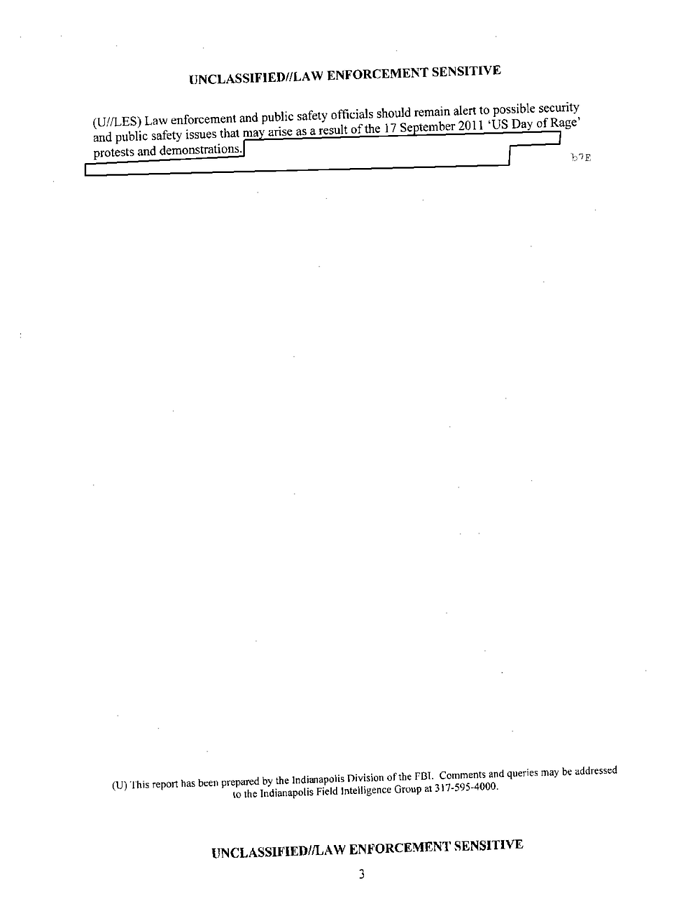
  • The FBI’s Indianapolis division released a “Potential Criminal Activity Alert” on September 15, 2011, even though they acknowledged that no specific protest date had been scheduled in Indiana. The documents show that the Indianapolis division of the FBI was coordinating with “All Indiana State and Local Law Enforcement Agencies,” as well as the “Indiana Intelligence Fusion Center,” the FBI “Directorate of Intelligence” and other national FBI coordinating mechanisms.
  • Documents show the spying abuses of the FBI’s “Campus Liaison Program” in which the FBI in Albany and the Syracuse Joint Terrorism Task Force disseminated information to “sixteen (16) different campus police officials,” and then “six (6) additional campus police officials.”  Campus officials were in contact with the FBI for information on OWS.  A representative of the State University of New York at Oswego contacted the FBI for information on the OWS protests and reported to the FBI on the SUNY-Oswego Occupy encampment made up of students and professors.
  • Documents released show coordination between the FBI, Department of Homeland Security and corporate America. They include a report by the Domestic Security Alliance Council (DSAC), described by the federal government as “a strategic partnership between the FBI, the Department of Homeland Security and the private sector,” discussing the OWS protests at the West Coast ports to “raise awareness concerning this type of criminal activity.” The DSAC report shows the nature of secret collaboration between American intelligence agencies and their corporate clients - the document contains a “handling notice” that the information is “meant for use primarily within the corporate security community. Such messages shall not be released in either written or oral form to the media, the general public or other personnel…” (The DSAC document was also obtained by the Northern California ACLU which has sought local FBI surveillance files.)
  • Naval Criminal Investigative Services (NCIS) reported to the DSAC on the relationship between OWS and organized labor for the port actions. The NCIS  describes itself as “an elite worldwide federal law enforcement organization” whose “mission is to investigate and defeat criminal, terrorist, and foreign intelligence threats to the United States Navy and Marine Corps ashore, afloat and in cyberspace.” The NCIS also assists with the transport of Guantanamo prisoners.
  • DSAC issued several tips to its corporate clients on “civil unrest” which it defines as ranging from “small, organized rallies to large-scale demonstrations and rioting.” It advised to dress conservatively, avoid political discussions and “avoid all large gatherings related to civil issues. Even seemingly peaceful rallies can spur violent activity or be met with resistance by security forces. Bystanders may be arrested or harmed by security forces using water cannons, tear gas or other measures to control crowds.”
  • The FBI in Anchorage reported from a Joint Terrorism Task Force meeting of November 3, 2011, about Occupy activities in Anchorage.
  • A port Facility Security Officer in Anchorage coordinated with the FBI to attend the meeting of protestors and gain intelligence on the planning of the port actions. He was advised to request the presence of an Anchorage Police Department official to also attend the event. The FBI Special Agent told the undercover private operative that he would notify the Joint Terrorism Task Force and that he would provide a point of contact at the Anchorage Police Department.
  • The Jacksonville, Florida FBI prepared a Domestic Terrorism briefing on the “spread of the Occupy Wall Street Movement” in October 2011. The intelligence meeting discussed Occupy venues identifying “Daytona, Gainesville and Ocala Resident Agency territories as portions …where some of the highest unemployment rates in Florida continue to exist.”
  • The Tampa, Florida FBI “Domestic Terrorism” liaison participated with the Tampa Police Department’s monthly intelligence meeting in which Occupy Lakeland, Occupy Polk County and Occupy St. Petersburg were discussed. They reported on an individual “leading the Occupy Tampa” and plans for travel to Gainesville for a protest planning meeting, as well as on Veterans for Peace plans to protest at MacDill Air Force Base.
  • The Federal Reserve in Richmond appears to have had personnel surveilling OWS planning. They were in contact with the FBI in Richmond to “pass on information regarding the movement known as occupy Wall Street.” There were repeated communications “to pass on updates of the events and decisions made during the small rallies and the following information received from the Capital Police Intelligence Unit through JTTF (Joint Terrorism Task Force).”
  • The Virginia FBI was collecting intelligence on the OWS movement for dissemination to the Virginia Fusion Center and other Intelligence divisions.
  • The Milwaukee division of the FBI was coordinating with the Ashwaubenon Public Safety division in Green Bay Wisconsin regarding Occupy.
  • The Memphis FBI’s Joint Terrorism Task Force met to discuss “domestic terrorism” threats, including, “Aryan Nations, Occupy Wall Street, and Anonymous.”
  • The Birmingham, AL division of the FBI sent communications to HAZMAT teams regarding the Occupy Wall Street movement.
  • The Jackson, Mississippi division of the FBI attended a meeting of the Bank Security Group in Biloxi, MS with multiple private banks and the Biloxi Police Department, in which they discussed an announced protest for “National Bad Bank Sit-In-Day” on December 7, 2011.
  • The Denver, CO FBI and its Bank Fraud Working Group met and were briefed on Occupy Wall Street in November 2011. Members of the Working Group include private financial institutions and local area law enforcement.
  • Jackson, MS Joint Terrorism Task Force issued a “Counterterrorism Preparedness” alert. This heavily redacted document includes the description, “To document…the Occupy Wall Street Movement.”
You can read the FBI - OWS documents below where we have uploaded them in searchable format for public viewing.
The PCJF filed Freedom of Information Act demands with multiple federal law enforcement agencies in the fall of 2011 as the Occupy crackdown began. The FBI initially attempted to limit its search to only one limited record keeping index. Recognizing this as a common tactic used by the FBI to conduct an inadequate search, the PCJF pressed forward demanding searches be performed of the FBI headquarters as well as FBI field offices nationwide.  
The PCJF will continue to push for public disclosure of the government’s spy files and will release documents as they are obtained.
DOCUMENT
PAGES
TEXT
Zoom
p. 1
p. 2
p. 3

Wednesday, November 14, 2012

My Crown Is Called: Deceit


I twist the truth,
I rule the world,
My crown is called deceit
I am the emperor of lies,
You grovel at my feet
I rob you and I slaughter you,
Your downfall is my gain
And still you play the sycophant
And revel in my pain
And all my promises are lies,
All my love is hate
I am the politician,
And I decide your fate

Song: Orgasmatron
Band: MotorHead
Art by: Khannea SunTzu

Friday, August 17, 2012

Suppressing Protest


Human Rights Violations In The U.S. Response To Occupy Wall Street

A group of legal experts have published a report detailing "abusive and unlawful protest regulation and policing practices" by New York police in response to Occupy Wall Street protests.

The report, Suppressing Protest: Human Rights Violations in the U.S. Response to Occupy Wall Street, examines treatment of protestors and journalists by local, state, and federal authorities from September 2011 through July 2012.

The eight-month investigation – carried out by law clinics at NYU, Fordham, Harvard and Stanford – documents instances in which authorities acted in ways that "suppress and chill protest rights" and violate international obligations to respect free assembly and expression.

These include excessive or unnecessary use of force, massive and continuous over-policing, obstruction of press freedoms and legal monitoring, constant surveillance, accountability and transparency failures, unjustified restrictions on peaceful assembly and arbitrary rule enforcement.

The first appendix of the 132-page report lists 130 incidents of excessive or unnecessary physical force by police in New York City.

A few examples (with video links):

September 24, 2011: A protester was being surrounded and held by three officers... One of the officers then pushed him to the ground... officers then proceeded to handcuff and arrest the protester.

October 5: An officer took at least three two-handed overarm swings at protesters. Some of the protesters are holding cameras, and at least one protester had his hands in the air as if signaling the officer to stop.

November 17: An officer threw another protester to the ground who was standing between police and their target... The video then shows another officer appearing to strike the apprehended protester several times with downward jabbing motions of his baton.

January 1, 2012:  An officer lifted a metal barricade with both hands, causing it to move up in the direction of a protester’s face. The video appears to show that the protester was struck in the face by the top bar of the barricade.

March 17: An officer [at 4:11] grabbed a protester out of the arms of another officer... Approximately six other officers then surrounded the protester, grabbed at his head and arms, ripped the mask off his face and pushed him to the ground.

The authors call for the city to establish an inspector general to oversee the police department, a review of the city’s response to the protests and the creation of new guidelines for policing them, and the prosecution of officers found to have broken laws.

If the NYPD fails to respond to these suggestions, the group said, it will ask the Department of Justice to investigate their complaints.

Further detailed studies from the Protest and Assembly Rights Project will be published in the coming months about police response in Boston, Charlotte, Oakland, and San Francisco.

Via: "Business Insider"

The Report: "About The Protest and Assembly Rights Project"

Wednesday, August 08, 2012

US Policing: Institutionalising Brutality


Extreme police tactics are not a new phenomenon in the US. But in the age of social media, police violence, such as the shooting of unarmed people and the use of pepper spray and taser guns, are being documented for the world to see.


Occupy protesters throughout the country felt the full force of police tactics - many were subject to violent arrest.
Perhaps the most controversial example was at the University of California, Davis (UC Davis) where peaceful protesters were pepper sprayed last November.

It is more than 20 years since a recording of police violence sparked riots in Los Angeles. The beating of Rodney King was caught on video and the footage shocked the world.

But two decades later how much has changed?

On Saturday, police in the Californian city of Anaheim shot and killed Manuel Diaz, an unarmed man who they said was running from them, hitting him in the leg and the back of the head.

Police said he and another young man shot dead the following day were both gang members. But local residents say the Latino men were victims of racial profiling and an overly aggressive police force.

The community reacted furiously and on Tuesday night, when protesters attempted to attend a city council meeting, they were barred from entering city hall by police who said the meeting room was full. 

The protesters reacted by throwing rocks and bottles at the police and setting fire to bins. Hundreds of police in riot gear responded by firing non-lethal rounds at the crowd. At least six people were injured and police made two dozen arrests.

The clashes between protesters and police have now gone on for several days and nights. In one incident, police fired rubber bullets at near point blank range and police dogs attacked protesters. Mobile phone footage of the incident went viral, attracting nationwide attention.

Anaheim's mayor says federal officials have agreed to investigate the shootings. But the city, where there have been six fatal police shootings this year, is now being compared to a powder keg.

So is policing in the US becoming increasingly militarised?


"I've lived in this community my whole life and it's sad when you have to be scared for your kids to go outside."
Louisa Sanchez, a protester 


Saturday, May 26, 2012

“We Are Preparing For Massive Civil War”


Says DHS Informant

Courtesy Of "Beacon Equity"


In a riveting interview on TruNews Radio, Wednesday, private investigator Doug Hagmann said high-level, reliable sources told him the U.S. Department of Homeland Security (DHS) is preparing for “massive civil war” in America.
“Folks, we’re getting ready for one massive economic collapse,” Hagmann told TruNewshost Rick Wiles.
“We have problems . . . The federal government is preparing for civil uprising,” he added, “so every time you hear about troop movements, every time you hear about movements of military equipment, the militarization of the police, the buying of the ammunition, all of this is . . . they (DHS) are preparing for a massive uprising.”
Hagmann goes on to say that his sources tell him the concerns of the DHS stem from a collapse of the U.S. dollar and the hyperinflation a collapse in the value of the world’s primary reserve currency implies to a nation of 311 million Americans, who, for the significant portion of the population, is armed.
Uprisings in Greece is, indeed, a problem, but an uprising of armed Americans becomes a matter of serious national security, a point addressed in a recent report by the Pentagon and highlighted as a vulnerability and threat to the U.S. during war-game exercises at the Department of Defense last year, according to one of the DoD’s war-game participants, Jim Rickards, author of Currency Wars: The Making of the Next Global Crisis.
Through his sources, Hagmann confirmed Rickards’ ongoing thesis of a fear of a U.S. dollar collapse at the hands of the Chinese (U.S. treasury bond holders of approximately $1 trillion) and, possibly, the Russians (threatening to launch a gold-backed ruble as an attractive alternative to the U.S. dollar) in retaliation for aggressive U.S. foreign policy initiatives against China’s and Russia’s strategic allies Iran and Syria.
“The one source that we have I’ve known since 1979,” Hagmann continued.  “He started out as a patrol officer and currently he is now working for a federal agency under the umbrella of the Department of Homeland Security; he’s in a position to know what policies are being initiated, what policies are being planned at this point, and he’s telling us right now—look, what you’re seeing is just the tip of the iceberg.  We are preparing, we, meaning the government, we are preparing for a massive civil war in this country.”
“There’s no hyperbole here,” he added, echoing Trends Research Institute’s Founder Gerald Celente’s forecast of last year.  Celente expects a collapse of the U.S. dollar and riots in America some time this year.
Since Celente’s ‘Civil War’ prediction of last year, executive orders NDAA and National Defense Resources Preparedness were signed into law by President Obama, which are both politically damaging actions taken by a sitting president.
And most recently, requests made by the DHS for the procurement of 450 million rounds of hollow-point ammunition only fuels speculation of an upcoming tragic event expected on American soil.
These major events, as shocking to the American people as they are, have taken place during an election year.
Escalating preparatory activities by the executive branch and DHS throughout the last decade—from the Patriot Act, to countless executive orders drafted to suspend (or strip) American civil liberties  “are just the beginning” of the nightmare to come, Hagmann said.
He added, “It’s going to get so much worse toward the election, and I’m not even sure we’re going to have an election in this country.  It’s going to be that bad, and this, as well, is coming from my sources.  But one source in particular said, ‘look, you don’t understand how bad it is.’  This stuff is real; these people, the Department of Homeland Security (DHS), they are ready to fight the American people.”
TruNews Wiles asked Hagmann: who does the DHS expect to fight, in particular?  Another North versus South, the Yankees against the Confederates?  Hagmann stated the situation is far worse than a struggle between any two factions within the U.S.; it’s an anticipated nationwide emergency event centered on the nation’s currency.
“What they [DHS] are expecting, and again, this is according to my sources, what they’re expecting is the un-sustainability of the American dollar,” Hagmann said.  “And we know for a fact that we can no longer service our debt.  There’s going to be a period of hyperinflation . . . the dollar will be worthless . . . The economic collapse will be so severe, people won’t be ready for this.”

Wednesday, May 23, 2012

Do We Have The Makings Of A Real Revolution?

Unless the spirit of the last year continues to grow and becomes a major force in the social and political world, the chances for a decent future are not very high.

By Noam Chomsky
May 8, 2012
Courtesy Of "Alter Net"


The Occupy movement has been an extremely exciting development. Unprecedented, in fact. There’s never been anything like it that I can think of.  If the bonds and associations it has established can be sustained through a long, dark period ahead -- because victory won’t come quickly -- it could prove a significant moment in American history.
The fact that the Occupy movement is unprecedented is quite appropriate. After all, it’s an unprecedented era and has been so since the 1970s, which marked a major turning point in American history. For centuries, since the country began, it had been a developing society, and not always in very pretty ways. That’s another story, but the general progress was toward wealth, industrialization, development, and hope. There was a pretty constant expectation that it was going to go on like this. That was true even in very dark times.
I’m just old enough to remember the Great Depression. After the first few years, by the mid-1930s -- although the situation was objectively much harsher than it is today -- nevertheless, the spirit was quite different. There was a sense that “we’re gonna get out of it,” even among unemployed people, including a lot of my relatives, a sense that “it will get better.”
There was militant labor union organizing going on, especially from the CIO (Congress of Industrial Organizations). It was getting to the point of sit-down strikes, which are frightening to the business world -- you could see it in the business press at the time -- because a sit-down strike is just a step before taking over the factory and running it yourself. The idea of worker takeovers is something which is, incidentally, very much on the agenda today, and we should keep it in mind. Also New Deal legislation was beginning to come in as a result of popular pressure. Despite the hard times, there was a sense that, somehow, “we’re gonna get out of it.”
It’s quite different now. For many people in the United States, there’s a pervasive sense of hopelessness, sometimes despair. I think it’s quite new in American history. And it has an objective basis.
On the Working Class
In the 1930s, unemployed working people could anticipate that their jobs would come back. If you’re a worker in manufacturing today -- the current level of unemployment there is approximately like the Depression -- and current tendencies persist, those jobs aren’t going to come back.
The change took place in the 1970s. There are a lot of reasons for it. One of the underlying factors, discussed mainly by economic historian Robert Brenner, was the falling rate of profit in manufacturing. There were other factors. It led to major changes in the economy -- a reversal of several hundred years of progress towards industrialization and development that turned into a process of de-industrialization and de-development. Of course, manufacturing production continued overseas very profitably, but it’s no good for the work force.
Along with that came a significant shift of the economy from productive enterprise -- producing things people need or could use -- to financial manipulation. The financialization of the economy really took off at that time.
On Banks
Before the 1970s, banks were banks. They did what banks were supposed to do in a state capitalist economy: they took unused funds from your bank account, for example, and transferred them to some potentially useful purpose like helping a family buy a home or send a kid to college. That changed dramatically in the 1970s. Until then, there had been no financial crises since the Great Depression. The 1950s and 1960s had been a period of enormous growth, the highest in American history, maybe in economic history.
And it was egalitarian.  The lowest quintile did about as well as the highest quintile. Lots of people moved into reasonable lifestyles -- what’s called the “middle class” here, the “working class” in other countries -- but it was real.  And the 1960s accelerated it. The activism of those years, after a pretty dismal decade, really civilized the country in lots of ways that are permanent.
When the 1970s came along, there were sudden and sharp changes: de-industrialization, the off-shoring of production, and the shift to financial institutions, which grew enormously. I should say that, in the 1950s and 1960s, there was also the development of what several decades later became the high-tech economy: computers, the Internet, the IT Revolution developed substantially in the state sector.
The developments that took place during the 1970s set off a vicious cycle. It led to the concentration of wealth increasingly in the hands of the financial sector. This doesn’t benefit the economy -- it probably harms it and society -- but it did lead to a tremendous concentration of wealth.
On Politics and Money
Concentration of wealth yields concentration of political power. And concentration of political power gives rise to legislation that increases and accelerates the cycle. The legislation, essentially bipartisan, drives new fiscal policies and tax changes, as well as the rules of corporate governance and deregulation. Alongside this began a sharp rise in the costs of elections, which drove the political parties even deeper into the pockets of the corporate sector.
The parties dissolved in many ways. It used to be that if a person in Congress hoped for a position such as a committee chair, he or she got it mainly through seniority and service. Within a couple of years, they started having to put money into the party coffers in order to get ahead, a topic studied mainly by Tom Ferguson. That just drove the whole system even deeper into the pockets of the corporate sector (increasingly the financial sector).
This cycle resulted in a tremendous concentration of wealth, mainly in the top tenth of one percent of the population. Meanwhile, it opened a period of stagnation or even decline for the majority of the population. People got by, but by artificial means such as longer working hours, high rates of borrowing and debt, and reliance on asset inflation like the recent housing bubble. Pretty soon those working hours were much higher in the United States than in other industrial countries like Japan and various places in Europe. So there was a period of stagnation and decline for the majority alongside a period of sharp concentration of wealth. The political system began to dissolve.
There has always been a gap between public policy and public will, but it just grew astronomically. You can see it right now, in fact.  Take a look at the big topic in Washington that everyone concentrates on: the deficit. For the public, correctly, the deficit is not regarded as much of an issue. And it isn’t really much of an issue. The issue is joblessness. There’s a deficit commission but no joblessness commission. As far as the deficit is concerned, the public has opinions. Take a look at the polls. The public overwhelmingly supports higher taxes on the wealthy, which have declined sharply in this period of stagnation and decline, and the preservation of limited social benefits.
The outcome of the deficit commission is probably going to be the opposite. The Occupy movements could provide a mass base for trying to avert what amounts to a dagger pointed at the heart of the country.
Plutonomy and the Precariat
For the general population, the 99% in the imagery of the Occupy movement, it’s been pretty harsh -- and it could get worse. This could be a period of irreversible decline. For the 1% and even less -- the .1% -- it’s just fine. They are richer than ever, more powerful than ever, controlling the political system, disregarding the public. And if it can continue, as far as they’re concerned, sure, why not?
Take, for example, Citigroup. For decades, Citigroup has been one of the most corrupt of the major investment banking corporations, repeatedly bailed out by the taxpayer, starting in the early Reagan years and now once again. I won’t run through the corruption, but it’s pretty astonishing.
In 2005, Citigroup came out with a brochure for investors called “Plutonomy: Buying Luxury, Explaining Global Imbalances.” It urged investors to put money into a “plutonomy index.” The brochure says, “The World is dividing into two blocs -- the Plutonomy and the rest.”
Plutonomy refers to the rich, those who buy luxury goods and so on, and that’s where the action is. They claimed that their plutonomy index was way outperforming the stock market. As for the rest, we set them adrift. We don’t really care about them. We don’t really need them. They have to be around to provide a powerful state, which will protect us and bail us out when we get into trouble, but other than that they essentially have no function. These days they’re sometimes called the “precariat” -- people who live a precarious existence at the periphery of society. Only it’s not the periphery anymore. It’s becoming a very substantial part of society in the United States and indeed elsewhere. And this is considered a good thing.
So, for example, Fed Chairman Alan Greenspan, at the time when he was still “Saint Alan” -- hailed by the economics profession as one of the greatest economists of all time (this was before the crash for which he was substantially responsible) -- was testifying to Congress in the Clinton years, and he explained the wonders of the great economy that he was supervising. He said a lot of its success was based substantially on what he called “growing worker insecurity.” If working people are insecure, if they’re part of the precariat, living precarious existences, they’re not going to make demands, they’re not going to try to get better wages, they won’t get improved benefits. We can kick ’em out, if we don’t need ’em. And that’s what’s called a “healthy” economy, technically speaking. And he was highly praised for this, greatly admired.
So the world is now indeed splitting into a plutonomy and a precariat -- in the imagery of the Occupy movement, the 1% and the 99%. Not literal numbers, but the right picture. Now, the plutonomy is where the action is and it could continue like this.
If it does, the historic reversal that began in the 1970s could become irreversible. That’s where we’re heading. And the Occupy movement is the first real, major, popular reaction that could avert this. But it’s going to be necessary to face the fact that it’s a long, hard struggle. You don’t win victories tomorrow. You have to form the structures that will be sustained, that will go on through hard times and can win major victories. And there are a lot of things that can be done.
Toward Worker Takeover
I mentioned before that, in the 1930s, one of the most effective actions was the sit-down strike. And the reason is simple: that’s just a step before the takeover of an industry.
Through the 1970s, as the decline was setting in, there were some important events that took place.  In 1977, U.S. Steel decided to close one of its major facilities in Youngstown, Ohio. Instead of just walking away, the workforce and the community decided to get together and buy it from the company, hand it over to the work force, and turn it into a worker-run, worker-managed facility. They didn’t win. But with enough popular support, they could have won.  It’s a topic that Gar Alperovitz and Staughton Lynd, the lawyer for the workers and community, have discussed in detail.
It was a partial victory because, even though they lost, it set off other efforts. And now, throughout Ohio, and in other places, there’s a scattering of hundreds, maybe thousands, of sometimes not-so-small worker/community-owned industries that could become worker-managed. And that’s the basis for a real revolution. That’s how it takes place.
In one of the suburbs of Boston, about a year ago, something similar happened. A multinational decided to close down a profitable, functioning facility carrying out some high-tech manufacturing. Evidently, it just wasn’t profitable enough for them. The workforce and the union offered to buy it, take it over, and run it themselves. The multinational decided to close it down instead, probably for reasons of class-consciousness. I don’t think they want things like this to happen. If there had been enough popular support, if there had been something like the Occupy movement that could have gotten involved, they might have succeeded.
And there are other things going on like that. In fact, some of them are major. Not long ago, President Barack Obama took over the auto industry, which was basically owned by the public. And there were a number of things that could have been done. One was what was done: reconstitute it so that it could be handed back to the ownership, or very similar ownership, and continue on its traditional path.
The other possibility was to hand it over to the workforce -- which owned it anyway -- turn it into a worker-owned, worker-managed major industrial system that’s a big part of the economy, and have it produce things that people need. And there’s a lot that we need.
We all know or should know that the United States is extremely backward globally in high-speed transportation, and it’s very serious. It not only affects people’s lives, but the economy.  In that regard, here’s a personal story. I happened to be giving talks in France a couple of months ago and had to take a train from Avignon in southern France to Charles De Gaulle Airport in Paris, the same distance as from Washington, DC, to Boston. It took two hours.  I don’t know if you’ve ever taken the train from Washington to Boston, but it’s operating at about the same speed it was 60 years ago when my wife and I first took it. It’s a scandal.
It could be done here as it’s been done in Europe. They had the capacity to do it, the skilled work force. It would have taken a little popular support, but it could have made a major change in the economy.
Just to make it more surreal, while this option was being avoided, the Obama administration was sending its transportation secretary to Spain to get contracts for developing high-speed rail for the United States, which could have been done right in the rust belt, which is being closed down. There are no economic reasons why this can’t happen. These are class reasons, and reflect the lack of popular political mobilization. Things like this continue.
Climate Change and Nuclear Weapons
I’ve kept to domestic issues, but there are two dangerous developments in the international arena, which are a kind of shadow that hangs over everything we’ve discussed. There are, for the first time in human history, real threats to the decent survival of the species.
One has been hanging around since 1945. It’s kind of a miracle that we’ve escaped it. That’s the threat of nuclear war and nuclear weapons. Though it isn’t being much discussed, that threat is, in fact, being escalated by the policies of this administration and its allies. And something has to be done about that or we’re in real trouble.
The other, of course, is environmental catastrophe. Practically every country in the world is taking at least halting steps towards trying to do something about it. The United States is also taking steps, mainly to accelerate the threat.  It is the only major country that is not only not doing something constructive to protect the environment, it’s not even climbing on the train. In some ways, it’s pulling it backwards.
And this is connected to a huge propaganda system, proudly and openly declared by the business world, to try to convince people that climate change is just a liberal hoax. “Why pay attention to these scientists?”
We’re really regressing back to the dark ages. It’s not a joke.  And if that’s happening in the most powerful, richest country in history, then this catastrophe isn’t going to be averted -- and in a generation or two, everything else we’re talking about won’t matter. Something has to be done about it very soon in a dedicated, sustained way.
It’s not going to be easy to proceed. There are going to be barriers, difficulties, hardships, failures.  It’s inevitable. But unless the spirit of the last year, here and elsewhere in the country and around the globe, continues to grow and becomes a major force in the social and political world, the chances for a decent future are not very high.
Noam Chomsky is Institute Professor Emeritus in the MIT Department of Linguistics and Philosophy.  A TomDispatch regular, he is the author of numerous best-selling political works, most recently, Hopes and Prospects,Making the Future, and Occupy, published by Zuccotti Park Press, from which this speech, given last October, is excerpted and adapted. His web site is www.chomsky.info.
Copyright 2012 Noam Chomsky

Saturday, May 19, 2012

Has America Become An Oligarchy?

Photo Gallery: The Winner-Take-All Society
The Occupy Wall Street movement is just one example of the sudden outbreak of tension between America's super-rich and the "other 99 percent." Experts now say the US has entered a second Gilded Age, but one in which hedge fund managers have replaced oil barons -- and are killing the American dream.

The Second Gilded Age

By Thomas Schulz
10/28/2011
Courtesy Of "Der Spiegel Online"


At first, the outraged members of the Occupy Wall Street movement in New York were mainly met with ridicule. They didn't seem to stand a chance and were judged incapable of going up against their adversaries, Wall Street's bankers and financial managers, either intellectually or in terms of economic knowledge.

"We are the 99 percent," is the continuing chant of the protestors, who are now in their seventh week of marching through the streets of Manhattan. And, surprisingly, they have hit upon the crux of America's problems with precisely this sentence. Indeed, they have given shape to a development in the country that has been growing more acute for decades, one that numerous academics and experts have tried to analyze elsewhere in lengthy books and essays. It's a development so profound and revolutionary that it has shaken the world's most powerful nation to its core.


Inequality in America is greater than it has been in almost a century. Those fortunate enough to belong to the 1 percent, made up of the super-rich, stand on one side of the divide; the remaining 99 percent on the other. Even for a country that has always accepted opposite extremes as part of its identity, the chasm has simply grown too vast.

Those who succeed in the US are congratulated rather than berated. Resenting other people's wealth is viewed as supporting class struggle, which is something very frowned upon.

Still, statistics indicate that the growing disparity is genuinely overwhelming. In fact, the 400 wealthiest Americans now own more than the "lower" 150 million Americans put together.

Nearly two-thirds of net private assets are concentrated in the hands of 5 percent of Americans. In comparison, the upper 5 percent of Germany hold less than half of net assets. In 2009 alone, at the same time as the US was being convulsed by mass layoffs, the number of millionaires in the country skyrocketed.

Indeed, if you look at the reports it compiles on every country in the world, even the CIA has concluded that wealth disparity is greater in the US than in Tunisia or Egypt.

A New 'Gilded Age'

In a book published in 2010, American political scientists Jacob Hacker and Paul Pierson discuss how this "hyperconcentration of economic gains at the top" also existed in the United States in the early 20th century, when industrial magnates -- such as John D. Rockefeller, Andrew Carnegie and J. P. Morgan -- dominated the upper stratum of society and held the country firmly in their grip for years.
Writer Mark Twain coined the phrase "the Gilded Age" to describe that period of rapid growth, a time when the dazzling exterior of American life actually concealed mass unemployment, poverty and a society ripped in two.

Economists and political scientists believe the US has entered a new Gilded Age, a period of systematic inequality dominated by a new class of super-rich. The only difference is that, this time around, the super-rich are hedge fund managers and financial magnates instead of oil and rail barons.

A Threat To The World Economy


The academics fear this change could have serious consequences for the country's economic future. As they see it, this extreme inequality threatens to dramatically slow growth in the world's largest economy. This is part of a development, they argue, that has been under way for years but remained largely hidden in the years of cheap credit, rising real estate prices and excessive consumption -- when it seemed everyone was on the way up. And the problems only came to light with the arrival of the financial crisis.


Through the 1970s, income for Americans across all social classes rose nearly in lockstep, by an annual average of roughly 3 percent. Starting in the 1980s, however, this trend underwent a fundamental transformation. Granted, the economy continued to grow -- but almost exclusively to the benefit of the country's top earners. The major economic expansion under President Ronald Reagan benefited only a few, and the problem only grew worse under George W. Bush.

At least since the beginning of the millennium, it has no longer been a simple matter of two societal extremes drifting further apart. Instead, the development is also accelerating. In the years of economic growth between 2002 and 2007, 65 percent of the income gains went to the top 1 percent of taxpayers. Likewise, although the productivity of the US economy has increased considerably since the beginning of the millennium, most Americans haven't benefited from it, with average annual incomes falling by more than 10 percent, to $49,909 (€35,184).

The Winner-Take-All Economy

Even for a country that loves extremes, this is a new and unprecedented development. Indeed, as Hacker and Pierson see it, the United States has developed into a "winner-take-all economy."

The political scientists analyzed statistics and studies concerning income development and other economic data from the last decades. They conclude that: "A generation ago, the United States was a recognizable, if somewhat more unequal, member of the cluster of affluent democracies known as mixed economies, where fast growth was widely shared. No more. Since around 1980, we have drifted away from that mixed-economy cluster, and traveled a considerable distance toward another: the capitalist oligarchies, like Brazil, Mexico, and Russia, with their much greater concentration of economic bounty."

This 1 percent of American society now controls more than half of the country's stocks and securities. And while the middle class is once again grappling with a lost decade that failed to bring increases in income, the high earners in the financial industry have raked in sometimes breathtaking sums. For example, the average income for securities traders has steadily climbed to $360,000 a year.

Still, that's nothing compared to the trend in executives' salaries. In 1980, American CEOs earned 42 times more than the average employee. Today, that figure has skyrocketed to more than 300 times. Last year, 25 of the country's highest-paid CEOs earned more than their companies paid in taxes.

By way of comparison, top executives at the 30 blue-chip companies making up Germany's DAX stock market index rarely earn over 100 times the salaries of their low-level employees, and that figure is often around 30 or 40 times.


'The Result Of Policy Choices'

Hacker and Pierson are far from the only economists and political scientists to recognize a fundamental societal distortion. Larry Bartels, one of America's leading political scientists, also believes America has entered a new Gilded Age. Bartels' 2008 book on the subject, "Unequal Democracy: The Political Economy of the New Gilded Age," has drawn a great deal of attention and even been quoted by President Barack Obama.

"The really dramatic economic gains over the past 30 years have been concentrated among the extremely rich," Bartels writes, "largely bypassing even the vast majority of ordinary rich people in the top 5 percent of income distribution." He doesn't see this fundamental shift in the distribution of wealth as having resulted from market forces or drastic events, such as the financial crisis. Instead, he believes they are "the result of policy choices."

As Bartels explains, much as the economic giants of the Gilded Age developed such enormous influence that they could dictate basic political conditions, today's Wall Street bosses and CEOs have successfully arranged extensive deregulation for their industries. Indeed, he argues that this is the only thing that can explain how hedge fund managers suddenly started making billions of dollars a year. Former Citigroup CEO Sanford Weill, for example, kept a framed pen in his office as a symbol of his influence. It was the pen President Bill Clinton -- at Weill's instigation -- used in 1999 to sign into law legislation repealing the provisions in the Glass-Steagall Act of 1933 that separated the transactions of investment and commercial banks.

At the same time, Bartels writes, the wealthy receive enormous tax breaks worth hundreds of billions of dollars. In the 1970s, capital gains tax was 40 percent, and the highest income tax bracket paid a rate of 70 percent. Under George W. Bush, these rates dropped to 15 percent and 35 percent, respectively. For example, it emerged a few weeks ago that legendary investor Warren Buffett earned $63 million last year but was only required to pay 17 percent in taxes.

Did Inequality Cause The Crisis?

In a medium-term, the consequences of this societal divide threaten the productivity of the entire economy. Granted, American economists in particular have long espoused the view that inequality is simply a necessary side effect of above-average growth. But that position is now being called into question.

In fact, recent research indicates that the economies of countries experiencing periods of pronounced inequality often show considerably less growth and more instability. On the other hand, it also finds that economies grow faster when income is more evenly distributed.

In a study published in September, the International Monetary Fund (IMF) also concluded that: "The recent global economic crisis, with its roots in US financial markets, may have resulted, in part at least, from the increase in inequality" in the country.


An Evolutionary View Of Economics

Cornell Univesity economist Robert Frank analyzes this development in his recently published book "The Darwin Economy." In it, he concludes that financial realities are best described not by Adam Smith's economic models but, rather, by Charles Darwin's thoughts on competition.

Frank writes that, with its often extreme deregulation, today's financial and economic system makes it impossible for individuals' self-serving behavior to ultimately contribute to the prosperity of society as a whole, as Smith had envisioned it. Instead, it leads to an economy in which only the fittest survive -- and the general public is left behind.

The question is: How long can the US withstand this internal tension?

Differences between rich and poor are tolerated as long as the rags-to-riches story of the dishwasher-turned-millionaire remains theoretically possible. But studies show that increasing inequality and political control concentrated in the hands of the wealthy elite have drastically reduced economic mobility and that the US has long since fallen far behind Europe on this issue. Indeed, only 4 percent of less-well-off Americans ever successfully make the leap into the upper-middle class.

"The major difference between this Gilded Age and the last one is the relative absence of protest," historian Gary Gerstle told the online magazine Salon in October. "In the first Gilded Age, the streets were flooded with protest movements."

Manhattan hasn't yet quite reached that point.


Translated from the German by Ella Ornstein