


Showing posts with label US Navy. Show all posts
Showing posts with label US Navy. Show all posts
Tuesday, October 14, 2014
The US Navy's Ghost WarShip
Built by Juliet Marine Systems, a private company in Portsmouth, N.H., it’s designed to fight swarm attacks, water-born IEDs, and, aargghh, piracy. According to Business Insider, “Ghost is intended to have zero radar signature, and the vessel is supposedly difficult for the enemy to spot, let alone target. The ship is nonmagnetic and hard to detect via sonar, making it ideal for infiltration and surveillance of enemy areas.”


Thursday, October 09, 2014
US Navy Autonomous Swarm Boats
A fleet of U.S. Navy boats approached an enemy vessel like sharks circling their prey.
Iin this case, part of an exercise conducted by the U.S. Office of Naval Research (ONR), the boats operated without any direct human control: they acted as a robot boat swarm.
The tests on Virginia’s James River this past summer represented the first large-scale military demonstration of a swarm of autonomous boats designed to overwhelm enemies. This capability points to a future where the U.S. Navy and other militaries may deploy underwater, surface, and flying robotic vehicles to defend themselves or attack a hostile force.
“What’s new about the James River test was having five USVs [unmanned surface vessels] operating together with no humans on board,” said Robert Brizzolara, an ONR program manager.
In the test, five robot boats practiced an escort mission that involved protecting a main ship against possible attackers. To command the boats, the Navy use a system called the Control Architecture for Robotic Agent Command and Sensing (CARACaS). The system not only steered the autonomous boats but also coordinated its actions with other vehicles—a larger group of manned and remotely-controlled vessels.
Thursday, November 14, 2013
The Navy Is Building A Stealth Battleship Strike Force

The Navy's newest warships are hard to detect on radar, heavily armed with super-accurate guns and missiles ... and gigantic. Six hundred feet long and displacing 15,000 tons of water, the DDG-1000 Zumwalt-class ships are designated as destroyers but are actually as big as some World War I battleships.
By David Axe
The lead ship in the class is slated to launch any day now -- a milestone briefly delayed by the recent government shutdown. The Navy is building three of the Zumwalts over the next five years and deploying them to the Pacific to counter China's fast-improving military.
That's assuming the $7-billion-apiece Zumwalts don't simply capsize the first time a powerful wave strikes them from behind. The high-tech battleships feature a novel, downward-sloping "tumblehome" hull that's optimized for stealth not stability -- and lacks the wave-resisting qualities of traditional ships with upward-flaring hulls.
"On the DDG-1000, with the waves coming at you from behind, when a ship pitches down, it can lose transverse stability as the stern comes out of the water-and basically roll over," naval architect Ken Brower told Defense News.
Even if they don't sink in heavy seas, the Zumwalts are controversial vessels. Besides being by far the biggest and most expensive surface combatants in memory, the Zumwalts are actually inferior to older, smaller ships in certain key stats, in particular radar performance and missile capacity.
But what they lack in weapons and sensors, the new battleships make up for with other enhancements, including space for their own robotic air forces plus massive electrical output that, in the near future, could support powerful laser weapons.

Navy art
Warship Fantasy
The Zumwalts began as a 1990s naval fantasy. The sailing branch wanted to revamp its entire fleet of 100 frigates, destroyers and cruisers with a single basic design that could avoid radar detection, carry new sensors and weapons and be operated by a greatly reduced crew. The stealth design would be scaled upward or downward to replace 10,000-ton cruisers and destroyers and 4,000-ton frigates.
As with other military techno-fantasies of the ‘90s, the 21st-Century Surface Combatant initiative collapsed under the weight of its mounting cost and complexity. All that survives at present are a couple dozen small Littoral Combat Ships currently under construction plus the three Zumwalts. To keep its surface fleet numbers up, the Navy has decided to keep building the same Arleigh Burke-class destroyers it has been buying since the late 1980s.
So few in number, the Zumwalts will be niche, practically experimental vessels -- albeit with potentially powerful combat abilities. "What a tremendous ship!" Rear Adm. Thomas Rowden, the Navy's top shipbuilder, crowed to Defense Media Network. He described the Zumwalt class as "unique because it incorporates several innovative technologies into a multi-mission warship, including integrated power distribution, signature reduction, active and passive self-defense systems and enhanced survivability features."

Wheeling out DDG-1000's deckhouse. Huntington Ingalls Industries photo
Building The Battleships
In addition to the hard-to-detect tumblehome hull, the Zumwalts have smooth, angular superstructures that, in two of the three vessels, are made of composites instead of steel, further enhancing their stealth qualities. To save money, the Navy decided last week that the third and final Zumwalt will have a steel deckhouse made in Maine.
Huntington Ingalls Industries makes the 1,000-ton composite superstructure deckhouses in a special facility in Gulfport, Mississippi and ships them by barge to Bath Iron Works in Maine, where the ships are assembled and where they will be launched, one every couple of years starting later this year.
Rather than packing the vertical-launch missile cells into tight groupings fore and aft, as is typical, the Zumwalts carry their missile cells along the edge of the hull, effectively adding heft to their outside lines that can insulate them against enemy strikes.
But the unique layout decreases the overall missile arsenal from 96 large munitions in an Arleigh Burke to just 80 in a Zumwalt. Granted, the Sea Sparrow short-range self-defense missile comes in four-packs that fit inside a standard launch cell, so in theory a Zumwalt could carry 320 Sea Sparrows.
But in practice the vessels will carry a mix of munitions including larger, one-per-cell SM-2 long-range air-defense missiles. In a divisive move, the Navy has opted not to give the new battleships the radar enhancement for deploying all the SM-2's modes, in particular its ability to hit incoming ballistic missiles.
Cost is one reason. The other reason is that the Zumwalts are primarily bombardment ships meant for sneaking up on and smashing targets on land. And for that they will carry scores of Tomahawk cruise missiles plus other high-tech weapons.

Scale models of an Arleigh Burke and a Zumwalt by Modeled Horizons, showing their relative sizes. Modeled Horizons photo
Reaching Out
Each Zumwalt comes equipped with two 155-millimeter cannons made by BAE Systems and installed forward of the deckhouse in "holsters" that help them avoid radar detection. The guns are fed by automatic ammo systems that can deliver a 225-pound shell to each gun every six seconds until the 600-round magazine is depleted.
Boosted by rockets in their bottoms and steered by small fins, the shells can fly 62 miles to precisely hit GPS coordinates. But it's the possible future weapons that have the Navy really excited?-?and that's got everything to do with the battleships' electrical power generation.
"It has the power margin," Rowden said. "It's an electric drive-ship, and the power generation capability it has is huge." At cruising speed, the Zumwalts produce 58 megawatts of excess power for weapons, sensors and other gear.
That electricity could power a laser gun. In 2010 Boeing completed initial design work on the so-called "Free Electron Laser Weapon System," a weapons-grade light beam. "The Free Electron Laser will use a ship's electrical power to create, in effect, unlimited ammunition and provide the ultra-precise, speed-of-light capability required to defend U.S. naval forces against emerging threats, such as hyper-velocity cruise missiles," Boeing veep Gary Fitzmire said.
An officer in the Pentagon's Office of Net Assessment told War is Boring that the Zumwalts would be perfect test platforms for the laser.

Navy concept art
Pacific Showdown
Based in San Diego starting in 2014, the Zumwalts will reinforce the Navy's Pacific Fleet as it stands up to an increasingly aggressive and well-armed China. Rowden said the battleships could sail alone, in groups with other surface ships or alongside aircraft carriers.
In America's ongoing campaign against Islamic terrorists or, God forbid, in some future shooting war with China, the Zumwalts could send Navy SEALs ashore by small boat or by one of the two Seahawk helicopters each carries. With their 11,000-square foot flight decks, the vessels can also support up to three Fire Scout drone helicopters for recon missions.
The commandos and drones could spot the targets and the Zumwalts could hit them with missiles and guns?-?and then fire missiles and possibly lasers to defend themselves from counter-attack.
But if a big wave hits from behind -- watch out. Even a $7-billion stealth battleship has weaknesses. The Zumwalts' most dangerous enemy could be the sea itself.
Sunday, November 10, 2013
The Navy’s Newest Warship Is Powered By Linux
When the USS Zumwalt (DDG 1000) puts to sea later this year, it will be different from any other ship in the Navy's fleet in many ways. The $3.5 billon ship is designed for stealth, survivability, and firepower, and it's packed with advanced technology. And at the heart of its operations is a virtual data center powered by off-the-shelf server hardware, various flavors of Linux, and over 6 million lines of software code.
On October 10, I flew up to Rhode Island to visit Raytheon's Seapower Capability Center in Portsmouth, where engineers assembled and pre-tested the systems at the heart of the Zumwalt and are preparing to do the same for the next ship in line, the USS Michael Monsoor—already well into construction. There, Raytheon's DDG-1000 team gave me a tour of the centerpiece of the ship's systems—a mockup of the Zumwalt's operations center, where the ship's commanding officer and crew will control the ship's sensors, missile launchers, guns, and other systems.
Over 20 years ago, I learned how to be a ship watch stander a few miles from the Raytheon facility at the Navy's Surface Warfare Officer School. But the operations center of the Zumwalt will have more in common with the fictional starship USS Enterprise's bridge than it does with the combat information centers of the ships I went to sea on. Every console on the Zumwalt will be equipped with touch screens and software capable of taking on the needs of any operator on duty, and big screens on the forward bulkhead will display tactical plots of sea, air, and land.
Perhaps it's appropriate that the first commanding officer of the Zumwalt will be Captain James Kirk (yes, that's actually his name). But considering how heavily the ship leans on its computer networks, maybe they should look for a chief engineer named Vint Cerf.
Off The Shelf and On The Ship

Enlarge / Data center in a box: Electronic Modular Enclosures being configured at Raytheon's Portsmouth, Rhode Island, facility.
In the past, you couldn't just put off-the-shelf computer systems aboard a ship for mission critical tasks—when I was aboard the USS Iowa, we had to shut down non-tactical systems before the guns were fired because the shock and vibration would crash systems hard. So typically, individual computer systems are ruggedized. But that adds heavily to the cost of the systems and makes it more difficult to maintain them.
The design of the Zumwalt solves that problem by using off-the-shelf hardware—mostly IBM blade servers running Red Hat Linux—and putting it in a ruggedized server room. Those ruggedized server rooms are called Electronic Modular Enclosures (EMEs), sixteen self-contained, mini data centers built by Raytheon.
Measuring 35 feet long, 8 feet high, and 12 feet wide, the 16 EMEs have more than 235 equipment cabinets (racks) in total. The EMEs were all configured and pre-tested before being shipped to Bath, Maine, to be installed aboard the Zumwalt. The EME approach lowered overall cost of the hardware itself, and allows Raytheon to pre-integrate systems before they're installed. "It costs a lot to do the work in the shipyard," said Raytheon's DDG-1000 deputy program manager Tom Moore, "and we get limited time of access."
Each EME has its own shock and vibration damping, power protection, water cooling systems, and electromagnetic shielding to prevent interference from the ship's radar and other big radio frequency emitters.
The EMEs tap into the Total Ship Computing Environment, the Zumwalt's shipboard Internet. Running multiple partitioned networks over a mix of fiber and copper, TSCE's redundantly switched network system connects all of the ship's systems—internal and external communications, weapons, engineering, sensors, etc.—over Internet protocols, including TCP and UDP. Almost all of the ship's internal communications are based on Voice Over IP (with the exception of a few old-school, sound-powered phones for emergency use).
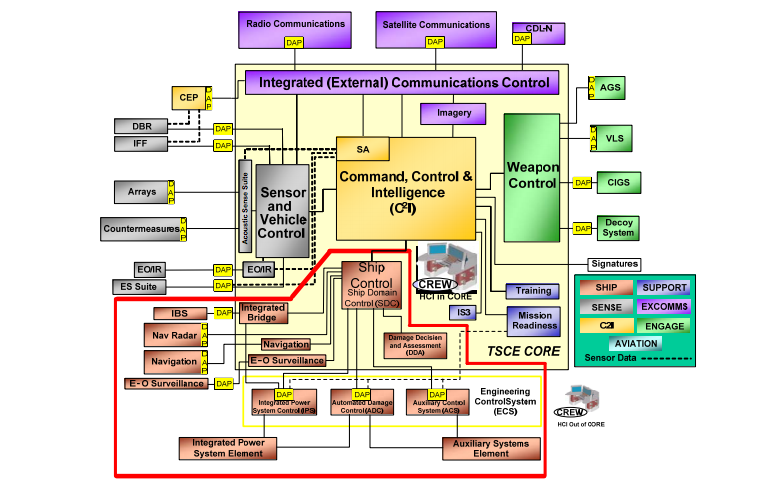
Enlarge / A diagram of the Zumwalt's control systems and their connections to the Total Ship Computing Environment.
There's also some wireless networking capability aboard the Zumwalt, but Raytheon officials giving me the tour were not at liberty to discuss just what sort of wireless this is. Still, that capability is supposed to allow for roving crew members to connect to data from the network while performing maintenance and other tasks.
Systems that weren't built to be wired into an IP network—other "programs of record" within the ship, which are installed across multiple classes of Navy ships—are wired in using adaptors based on single-board computers and the Lynx OS real-time Linux operating system. Called Distributed Adaptation Processors, or DAPs, these systems connect things like the ship's engineering systems, fire suppression systems, missile launchers, and radio and satellite communications gear into the network so they can be controlled by networked clients.
It Looks Like You Want To Launch A Missile
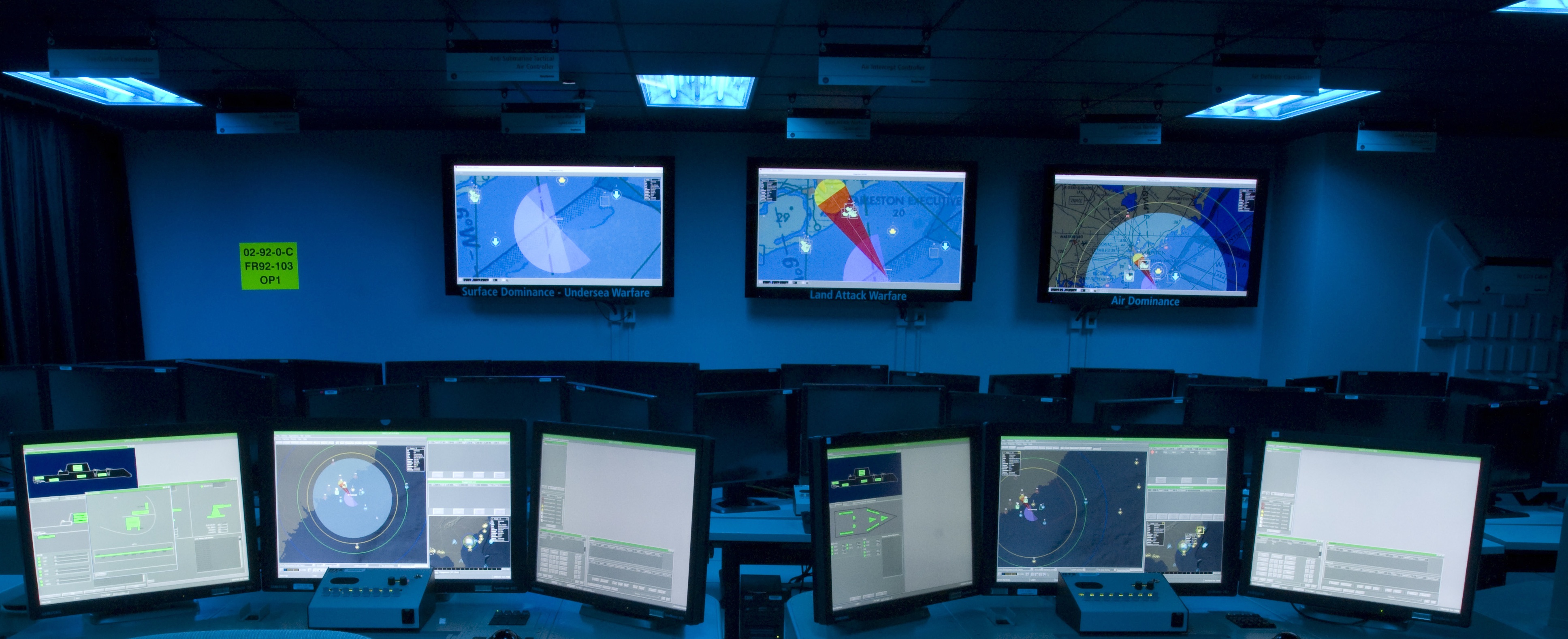
Enlarge / The mock-up of the Zumwalt's operations center at Raytheon's Portsmouth facility, complete with haze-gray paint, has the exact dimensions of the space on the ship itself. The Zumwalt will include a second level to host the operations of units deployed with the ship.
Some of those networked clients were what I was looking at in the mocked-up Zumwalt operations center. The operations center isn't just where screens are watched and commands are shouted—the whole ship can be practically run from the space, from guns and missiles to engines. There's no "radio room" on the Zumwalt; all the communications are managed from the operations center. The ship's guns are fully automated and operated by an operations center watch stander instead of a gunner's mate in the mount. Theoretically, the ship could even be steered from the ops center—the ship is piloted by computer, not a helmsman. And all of these tasks are performed from the same type of console.
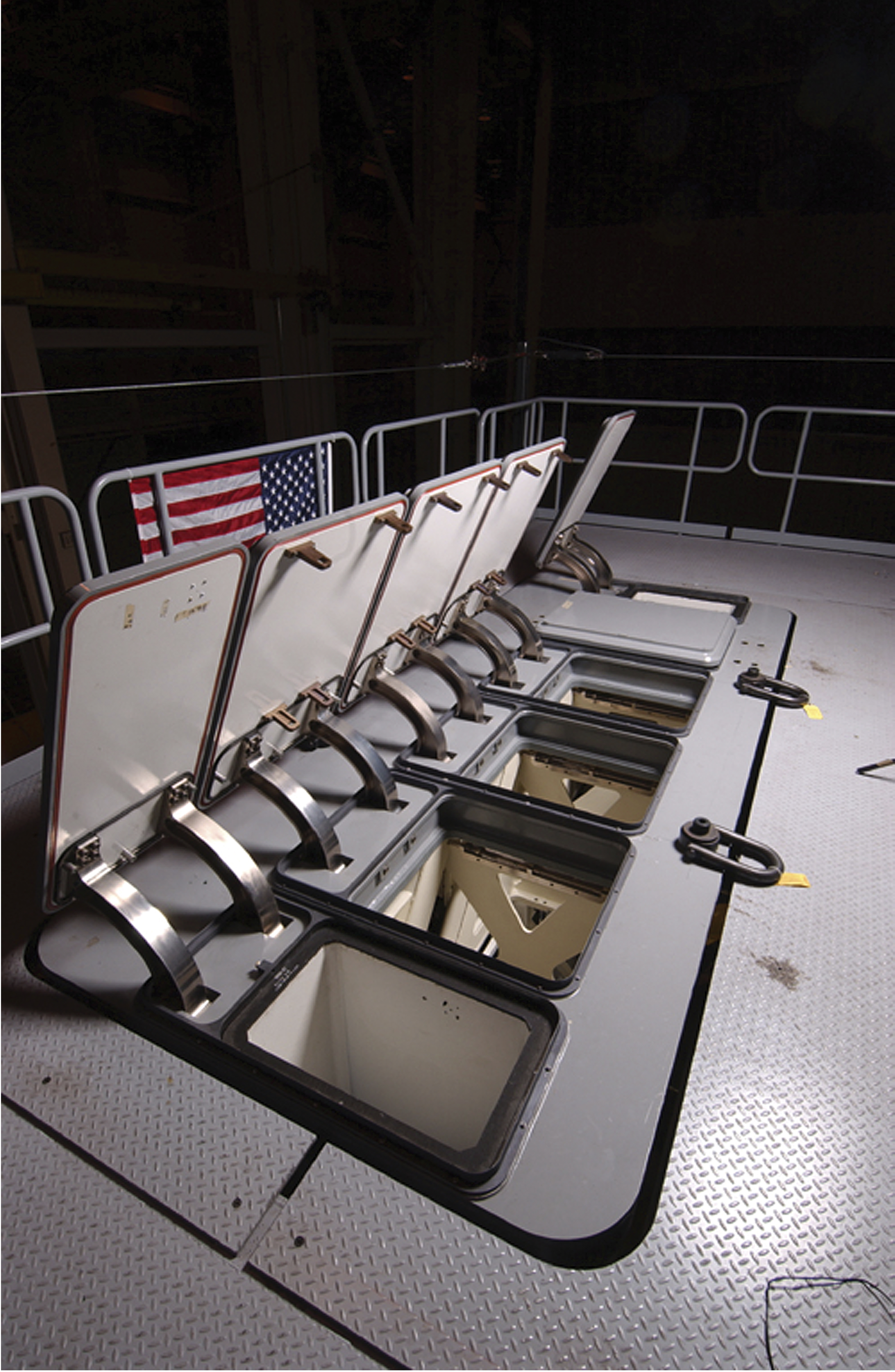
Enlarge / The Mark 57 vertical launch system, developed by Raytheon, can carry a mix of anti-ship, anti-aircraft, and land attack cruise missiles. It communicates with the operations center over the ship's network.
Each CDS system can run multiple Linux virtual machines atop LynuxWorx's LynxSecure, a separation kernel tthat has been implemented in CDS as a hypervisor. This allows the workstation to connect to various networks partitioned by security level and purpose. "Every watch stander station runs out of the same box," Raytheon's DDG-1000 developer lead Robert Froncillo told me. "So they can sit at any CDS and bring up their station."
This may not seem like a big deal to most people. But on past ships, workstations tended to be purpose-built for a specific weapons system or sensor. That meant every system had a different configuration and interface, and you couldn't have a watch stander handle multiple tasks without having to switch seats. The CDS workstation uses common USB interfaces for its peripheral devices (such as trackballs and specialized button panels) and is equipped with touchscreens, as well, so that watch standers have a choice between "classic" and touch interfaces.
That doesn't mean there's necessarily a "Clippy" to help new operators master their systems. The Raytheon team has had sailors in to perform usability assessments from before code was even written, showing them screen shots of interfaces to get feedback from users. "We had a chief that said, 'We don't want any 'wizards,'" said Froncillo.
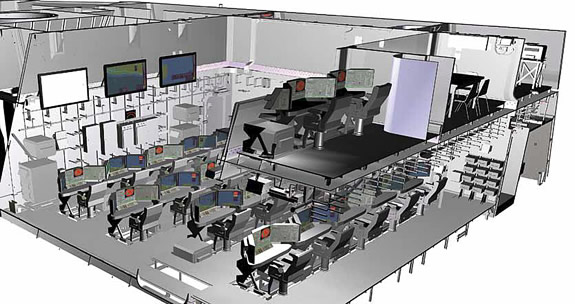
A digital illustration of how the Zumwalt's operations center will look, complete with its second-level suite for hosting operations for air detachments and other units deployed aboard.
Raytheon
Putting all of the pieces together is a collection of middleware running on those IBM blade servers. Many of the shipboard systems use a commercial publish/subscribe middleware platform to send updates to operator consoles. But for other systems that need to be more tightly coupled (like, for example, missile launch commands), the Navy has specified the use of the Common Object Request Broker Architecture (CORBA)—the military's favorite mission-critical middleware model. (The software for the Joint Tactical Radio System's software-defined radios was also developed using CORBA.)
The Next Release
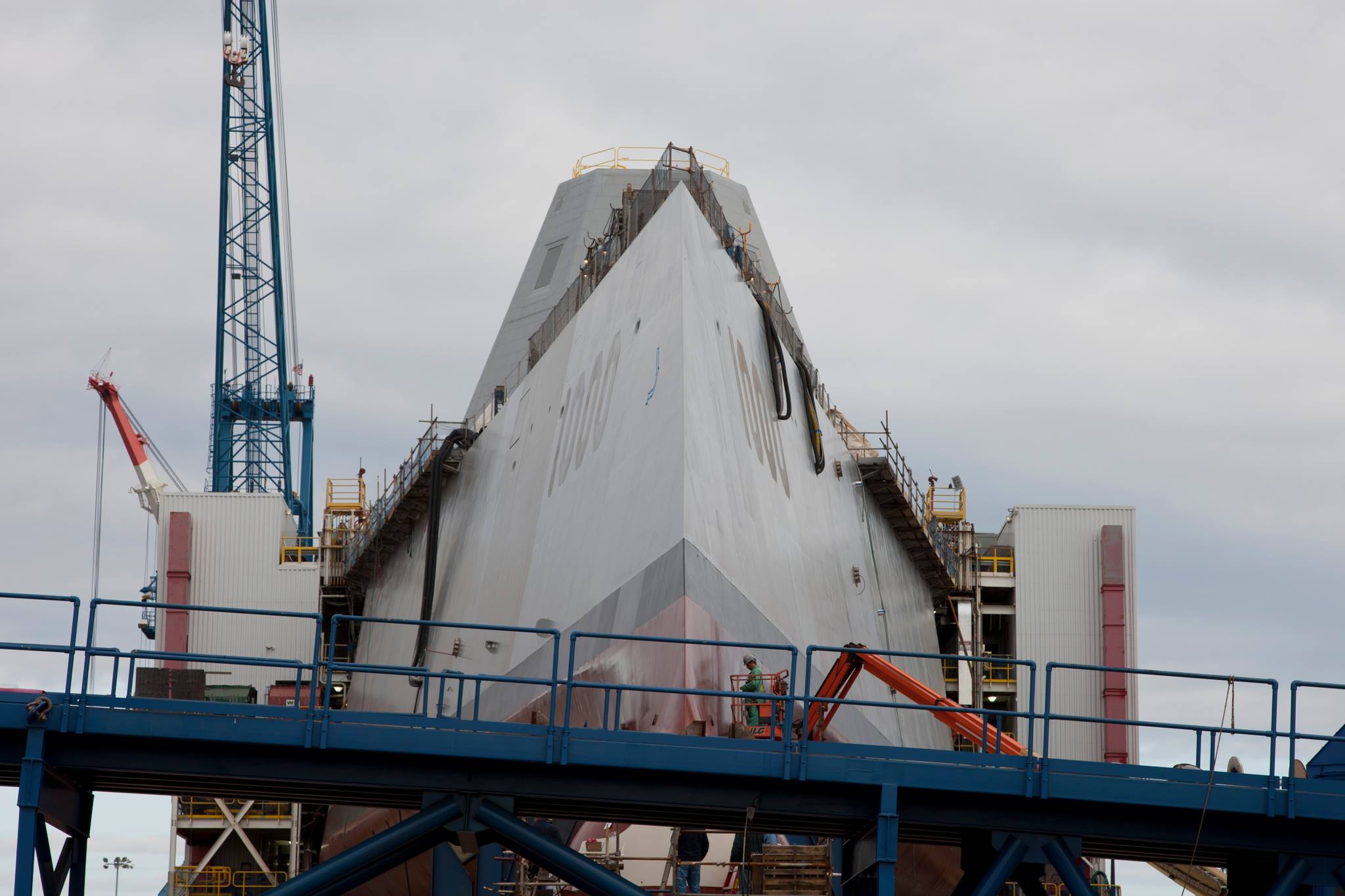
Enlarge / The Zumwalt bow-on at Bath Iron Works. DDG-1001, the USS Michael Monsoor, sits behind her, more than 60 percent complete.
The Zumwalt may not have sailed yet, but its software has already shipped six times. When Release 5 was completed, Raytheon brought in more sailors to test the system, tethering it to the company's Total Ship System Simulator to run through a number of combat scenarios. "We did antisubmarine warfare, air, and land attack missions," Froncillo said. The lessons learned were incorporated into release 6, and 7 will be installed on the ship before the ship's "shakedown" cruise. Another upgrade will be installed post-delivery, and continual improvements will be made as the software is deployed to the other two ships in the class.
But the life of the technology being deployed on the Zumwalt won't end there. CDS will be used as part of the Navy's Aegis Modernization Program to upgrade the systems of the fleet's guided missile cruisers and destroyers. "And there are a lot of things we're developing that will be reused," Moore said.
Considering how much has been spent over the past decade trying to get the Zumwalt built, and the other technologies that were developed in the process, one can hope that more than just the software gets some reuse.
Saturday, February 23, 2013
Navy Wants Drones Stashed On The Seafloor

Image via: DefenceTalk.com
The U.S. Navy wants to pack aerial drones and other intelligence-gathering technology into special containers built to withstand deep ocean pressures and distribute them around the world’s seas. The containers will rise to the surface when called into service from a remote location.
These “upward falling payloads” are seen as readying the Navy to address conflicts in corners of the world where it is too expensive or complex to establish a forward operating area, the Defense Advanced Research Projects Agency (DARPA) explained in a call for proposals.
The containers would be stealthily deployed well ahead of time and designed to stay put on the seafloor for years. The Pentagon said the capsules would be free of actual weapons, limiting the risk of losing any single package. Given the vastness and depth of the ocean, they would not be retrieved once deployed.
“Depending on the specific payload, the systems would provide a range of non-lethal but useful capabilities such as situational awareness, disruption, deception, networking, rescue, or any other mission that benefits from being pre-distributed and hidden,” DARPA explained in a press release.
One example provided is a capsule packed with an aerial drone that launches to the sea surface in the capsule and then takes off to provide situational awareness, networking or decoy functions.
To make this a reality, DARPA is reaching out to the technical research community for expertise in deep ocean engineering. Challenges include reliable remote communication with capsules on the seafloor and determining what type of sensors and tools to package.
“Almost half of the world’s oceans are more than four kilometers deep,” DARPA noted. “This provides considerable opportunity for cheap stealth.”
Via: "NBC"
Secret Nuclear Redesign Will Keep U.S. Subs Running Silently For 50 Years

The Ohio-class U.S.S. Louisiana. Photo: Navy
The U.S. Navy is betting the future of its submarine force on a secret and revolutionary nuclear drive system that aspires to be more efficient and quieter than anything under the water today.
The heart of the planned ballistic missile Ohio Replacement (OR) program will be built around a drive that will not need to be refueled for the 50-year life of the boats and cuts out potentially noisy direct mechanical connection to the drive train. In other words, the Navy’s next-gen subs could be almost silent, and keep running for a half-century straight.
The Navy’s ballistic missile fleet, or boomers, rely on stealth to hide from rival boats, ships and sub-hunting aircraft. The quieter the boat, the harder it is to find. (And these boats are big: the current Ohio boomer is more than a football field and half long displacing 19,000 tons.)
Now the Navy is developing an innovation that attempts to give OR boomers the quietest nuclear engine yet by “going to [an] electric drive,” Sean Stackley, the Navy’s chief weapons buyer, said in aJanuary interview with the U.S. Naval Institute.
Current boomers have a direct mechanical connection to the props that drive the boat. Energy from steam turbines driven by the nuclear power plant go through a series of mechanical gears that translate the high RPM output of the turbines into into lower torque energy needed to propel the ship. All of those mechanical connections can generate noise, the bane of the submariner.
Moving forward, the Navy wants to use the power from the reactor to create an elaborate electrical grid inside of the submarine. The reactor power would feed the grid and in turn the electric motors that would drive the boats. Eliminating the mechanical connection would mean less noise under water. The set up would also free up power previously devoted to driving the ship. Currently anywhere from 75 to 80 percent of the power from a nuclear submarine is devoted to driving the ship through the water. Extra power could be routed to other systems like sonars and potentially unmanned underwater vehicles.
This will be the second try for the Navy to use electric drive subs. The service experimented with the technology in the 1960s and 1970s but found the boats equipped with the drives to be underpowered and maintenance heavy.
Unlike other programs, the Navy hasn’t gone out of its way to tout the electric drive technology it plans to use for the OR boomers. A 2010 Analysis of Alternatives for the OR program, then known as the SSBN(X), was closely held by the service. Gene Taylor, the chairman of the Seapower subcommittee of the House Armed Services Committee at the time, demanded publicly that Congress get a chance to evaluate the proposal. He lost his 2010 election and the Navy kept specifics mostly quiet.
Among the details they have discussed, in addition to the electric drive, is the development of a new nuclear power plant for the OR boats.
“There is investment in the front end in the reactor plant to arrive at a core that will last the life of the boat,” Stackley said.
Now, the Navy’s nuclear fleet requires a mid-life refueling and overhaul that can keep a ship or submarine out of commission for almost three years with a cost in the billions.
“By eliminating that midlife refueling, you effectively get greater operational availability out of the boat,” Stackley said.
The standard ratio for ballistic missile submarines on patrol to subs in port is about four to one. Currently the navy fields 14 Ohio-class boomers packing 24 Trident II D5 intercontinental ballistic missiles. (The first four Ohios were converted to carry missiles with conventional warheads).
“There are still going to be midlife upgrades but the refueling portion is effectively eliminated which allows us to reduce from today’s 14 Ohios to reduce down to 12 Ohio Replacements,” Stackley said.
The original Ohio-class builder General Dynamics Electric Boat hasn’t built a boomer in more than 20 years and the durability of the drive and the boats to last until 2080 is a tall order.
Added to the pressure is a Pentagon imposed cost cap that reduce the cost of the boat from about $7 to 8 billion down to $4.9 billion. But the Navy will have little margin for error if they want to keep the price tag that low.
The Navy has already delayed work two years as part of its 2013 budget. Currently the first OR boat is scheduled to begin construction in 2021 for a decade-long construction and development process. The super-silent boat is scheduled to make its first patrol in 2031. After that, you may never hear from it again.
Via: "Wired"
Monday, December 03, 2012
Autonomous Terminator Drones With AI

Contractors hoist the X-47B Unmanned Combat Air System (UCAS) demonstrator to the flight deck of the aircraft carrier USS Harry S. Truman at Naval Station Norfolk, Virginia, in this U.S. Navy handout photo dated November 26, 2012 . (Reuters/U.S. Navy/Seaman Christopher A. Morrison/Handout)

The X-47B Unmanned Combat Air System (UCAS) demonstrator is hoisted onto the flight deck of the aircraft carrier USS Harry S. Truman at Naval Station Norfolk, Virginia, in this U.S. Navy handout photo dated November 26, 2012. (Reuters/U.S. Navy/Mass Communication Specialist 3rd Class Lorenzo J. Burleson/Handout)

Contractors prepare to hoist the X-47B Unmanned Combat Air System (UCAS) demonstrator onto the flight deck of the aircraft carrier USS Harry S. Truman at Naval Station Norfolk, Virginia, in this U.S. Navy handout photo dated November 26, 2012. (Reuters/U.S. Navy/Mass Communication Specialist 3rd Class Lorenzo J. Burleson/Handout)
Via: "Russia Today"
Wednesday, October 03, 2012
US Navy's PlaceRaider Malware Turns Your SmartPhone Into A Spy

Malware Produces 3D Models Of Your Phone's Surroundings
By Shaun Waterman,
Researchers from the U.S. Naval Surface Warfare Center have developed malicious software that can remotely seize control of the camera on an infected smartphone and employ it to spy on the phone’s user.
The malware, dubbed “PlaceRaider,” “allows remote hackers to reconstruct rich, three-dimensional models of the smartphone owner’s personal indoor spaces through completely opportunistic use of the camera,” the researchers said in a study published last week.
The program uses images from the camera and positional information from the smartphone’s gyroscopic and other sensors to map spaces the phone’s user spends a lot of time in, such as a home or office.
“Remote burglars” could use these three-dimensional models to “study the environment carefully and steal virtual objects [visible to the camera] … such as as financial documents [or] information on computer monitors,” the researchers reported.
Because users often do not realize that a smartphone is basically a small computer, and because there are few security products available, smartphones are considered highly vulnerable to hackers.
Commercial software, for instance, can turn smartphones into microphones and tracking devices.
But PlaceRaider is the first known example of malware developed to exploit the high-definition cameras that are now ubiquitous on smartphones.
The study was a collaboration between the Navy center team and researchers from the School of Informatics and Computing at Indiana University.
Via: "The Washington Times"
Sunday, June 03, 2012
The U.S. Navy's New Stealth Sub
New Stealth Sub Is Fully Networked, But Cut Off From The Outside World
By Spencer Ackerman
May 31, 2012 | 6:30 am
Courtesy Of "Wired"
UNDERWAY ON THE U.S.S. MISSISSIPPI — Practically every system aboard the Navy’s newest fast attack submarine is state of the art. Unlike earlier subs, the U.S.S. Mississippi’s control room, a hive of classified software and hardware, places sonar technicians and weapons specialists barely five feet apart. The periscope is mostly virtual: fiber optics allow the control room to see the surface world, rather than a physical tube running down from the bridge. But for all the advancements aboard the Mississippi, there’s one persistent challenge — staying connected to the outside world.
By Spencer Ackerman
May 31, 2012 | 6:30 am
Courtesy Of "Wired"
UNDERWAY ON THE U.S.S. MISSISSIPPI — Practically every system aboard the Navy’s newest fast attack submarine is state of the art. Unlike earlier subs, the U.S.S. Mississippi’s control room, a hive of classified software and hardware, places sonar technicians and weapons specialists barely five feet apart. The periscope is mostly virtual: fiber optics allow the control room to see the surface world, rather than a physical tube running down from the bridge. But for all the advancements aboard the Mississippi, there’s one persistent challenge — staying connected to the outside world.
Bandwidth on subs is practically a throwback to the era of Magic cards, Discmans, and the best Fresh Prince of Bel-Air episodes. To send and receive messages, the U.S. submarine fleet needs to rise to a depth shallow enough to raise periscopes and antennas; aboard the Mississippi, periscope depth is 60 feet. While there are exceptions to that rule, it sets up a basic tradeoff. To remain undetected and ready to complete their missions, submarine commanders have to be prepared for long periods of silence.
“There are some missions or taskings where you don’t go to periscope depth frequently and put antennas out of the water,” says Cmdr. Aaron Thieme, the deputy commander of Submarine Squadron 4, which includes the Mississippi. “There are some missions or taskings where you spend all your time at periscope depth with your antennas out of the water. There are some that require us not to transmit at all.”
The subs receive their internet access from bandwidth provided by satellites, same as the Navy’s surface ships. But unlike aircraft carriers, destroyers and frigates, submarines can’t augment their connectivity with 4G networks. And once the subs go below periscope depth, they’re effectively cut off from the outside world.
All this makes bandwidth on the subs an even scarcer resource than it is aboard the surface fleet. On the Mississippi, red Ethernet cables dangle from the ceilings of the officer’s wardroom. Only when the sub rises to periscope depth do officers plug the cables into their laptops, allowing them to access the Navy’s classified networks. That doesn’t happen often. The Mississippi has the capability to stay submerged — and silent — for up to 90 days.
For all the Navy’s formidable technological advancements, many of which are visible aboard theMississippi, connectivity lags behind. The Navy has yet to overcome some basic physical limitations. The deeper the sub dives, the harder it is for it to access a satellite. Thieme confirms that there is a depth beyond which the submarine fleet is totally disconnected, but understandably declines to disclose what that depth is. And like surface ships, the further the fleet disperses on or under the open water, the harder it is to keep the subs in contact.
And there’s an additional communications challenge for subs. Allowing sailors to e-mail their families risks compromising the stealth that’s central to the subs’ missions.
“Any time you transmit energy, whether it be electromagnetic or acoustic, fundamentally, it could be detected,” Thieme explains. “At some point, there could be a technology developed that can identify that energy source. Just as we go to great efforts to minimize the acoustic energy we put into the water, we go to efforts to minimize the counter-detectability of the electromagnetic energy that we transmit when we communicate.”
But don’t let that conjure up visions of rogue sub commanders, à la The Hunt for Red October. The chain of command informs the submarine how frequently and even when it needs to reach periscope depth to check in or receive orders. And the command has technical mechanisms — which the crew of the Mississippi will not discuss — for augmenting the bandwidth available to submarines in an emergency. More regularly, a text-only e-mail program called SailorMail allows sub crews to send and receive e-mails over an unclassified network — provided those e-mails are free of attachments, and sailors don’t mind waiting for transmissions at speeds slower than dial-up. For morale, the sub can stream news programs and sports when it’s at periscope depth.
Still, the Navy’s lack of consistent bandwidth for submarines could complicate some its broader plans. Itsnew super-concept for working seamlessly with the Air Force might founder if fighter jets can’t talk to Navy subs.
But underway on the Mississippi, officers are convinced bandwidth deserts are a manageable problem — and one that feeds into the culture of submarine warfare.
“It’s in our DNA to be able to go out and do a mission by ourselves without somebody looking over our shoulder,” says Thieme. “If the capability gets developed so that, regardless of whatever speed or depth we are we can maintain a communications tether or connectivity path, I [still] don’t see submariners becoming less autonomous.”
Exclusive Pictures: Inside The Navy’s Newest Spy Sub


UNDERWAY ON THE U.S.S. MISSISSIPPI — The Navy’s newest fast-attack submarine is speeding down the Florida coast, on its way to its commissioning ceremony in its namesake state, at 15 knots. And it’s getting outraced by dolphins.
Hours before the U.S.S. Mississippi dives several hundred feet beneath the Atlantic, its sail juts proudly into the warm, whipping southern air. Submariners allow me to see the highest point on the sub for myself — provided I can keep my balance up three steep levels’ worth of ladder and hoist myself out onto a platform the size of a fancy refrigerator. A harness hooked to an iron bolt on the sail keeps me from falling to my death. There’s no land in sight, just blue water turned white around the sub’s wake, a tall BPS-16 military radar spinning in front of us, and a family of dolphins jumping out of the surf in front of the 377-foot boat.
Apparently it’s typical. Where subs travel in the southern Atlantic, dolphins tend to tag along, eager to say hi to their large, silent playmate. “Dolphins like to sing,” notes Petty Officer Joshua Bardelon, a 32-year old from Pascagoula, the site of the Mississippi’s destination, who supervises the boat’s sonar systems.
Those systems are part of why Navy Secretary Ray Mabus is eager to take possession of his newest Virginia-class submarine when it formally joins the fleet on June 2. As much time as it spends listening to dolphin symphonies, the Mississippi is everything from a weapon to destroy other ships to an electronic-attack system to a stealthy transport for Navy commandos.
The multiple sonar arrays allow the submarine to detect other ships before it’s detected itself. Underway, the boat is dead silent except for the hum of the air conditioning, an indication of the classified tools that mask the Mississippi’s acoustic and electronic signatures to maintain its exceptional stealth. Then comes the boat’s electronic warfare capabilities — which its crew will discuss only vaguely.
“If I’m at periscope depth and I stick my periscope out of the water, people who are looking for me will be using a radar system to find me,” says the sub’s commander, Capt. John McGrath, a 20-year submarine veteran. “But I will know that that radar is in the area and I will use that to my advantage.”
Some of its other weapons are more traditional. The torpedo room, down in the deepest level of the boat, hosts 16 intimidating metal tubes, each wider than bicycle wheels, the bays for its 28-foot torpedoes and Tomahawk missiles. The room looks like a machinist’s workshop, except for the exercise bikes and the racks where the torpedomen sleep beside their weapons — the primary means for the Mississippi to complete its future missions: hunting and destroying enemy ships and subs.
“There are two types of ships in the Navy,” explains Chief Nathan Holmes. “We have submarines, and we have targets.”
Even though the Mississippi isn’t on a combat mission — which is why the Navy allows me to tag along on a boat overflowing with classified systems — McGrath is eager to demonstrate that his boat is a predator, not prey. After I climb down from the sail, he orders the boat’s pilot to dive to 155 feet, a way-station depth that’s far enough underwater to avoid sea traffic but shallow enough so he can get surface rapidly should something go wrong. When nothing does, McGrath orders the pilots to continue on to a depth of 400 feet. The faster the captain wants to go, the deeper he dives.
The dive is surprisingly imperceptible. Even though we’ve just dropped 400 feet in a minute, I barely lean forward. If I had been drinking anything, it wouldn’t have spilled.
That’s the case during my entire four-day stint on the boat. With the exception of a 20-minute exercise in dipping the Mississippi up and down — a queasy affair nicknamed “Angles and Dangles” — I’ve had rockier trips aboard surface ships. The fast-attack submarine is downright placid, even at 20 knots.
The steadiness will be an asset for one of the Mississippi’s other missions: aiding Navy SEALs. There’s a special bay, called a lockout trunk, that allows a tinier sub to dock and deposit a small number of SEALs onboard. Once they’re aboard, the Mississippi will become a Navy special warfare platform — as are many subs that don’t carry nuclear missiles — performing reconnaissance missions and getting SEALs stealthily in and out of where they need to go. The Virginia class’ smaller size allows the sub to “be more maneuverable in a littoral,” says Master Chief Bill Stoiber, the chief of the boat, or senior enlisted man aboard, making it particularly useful for SEAL insertion missions. After the summer, the Mississippi will head for southern Florida to test its special-warfare skills.
As much as the Mississippi is the newest in new for Navy subs, not everything aboard is super-advanced. Satellite connectivity is limited. Submariners like to stay autonomous when they’re below the waves, but that means that information aboard the sub largely stays on the sub, and outside information doesn’t always reach the boat quickly. The Mississippi rises to periscope depth — that is, shallower than 60 feet below, so its periscope can stick its neck out of the water — in order to fire off e-mails or receive communications through classified and unclassified-but-secured networks. Even so, submariners roll their eyes at how slow their connection speeds are. (Think dial-up. In the late ’90s.)
When the sub needs it, it can request extra satellite bandwidth from the Navy — often to send off a video or larger data file. But that “spot beam” is only for special occasions, and it’s a one-off event. Persistent, available undersea bandwidth is a challenge the Navy hasn’t yet figured out how to solve.
Then there are the traditional joys of life aboard a submarine. The Mississippi is home to 138 men, who have to get very comfortable with each other, since there’s nowhere to go for privacy. The halls are barely wide enough for two people hugging the walls to traverse. Submariners are billeted up to 47 per room, stacked up in threes on narrow racks. A typical deployment entails six months of living in these cramped conditions, and the Mississippi is capable of staying underwater for 90 days at a stretch.
Still, the ship makes a virtue out of solitude. The food is unexpectedly excellent. It’s difficult to store bread underneath the sea without it molding or going stale — and there’s no place to buy more — so the kitchen bakes it fresh every day. It’s tempting to forego a lunchtime hot dog just to eat a delicious empty roll an hour old.
The most striking demonstration of the crew’s tightness comes in the control room. Unlike older subs, the Virginia class doesn’t hive away its sonar stations. The dark room, illuminated by dozens of screens displaying torrents of highly classified data, joins up the pilots, navigators, weapons experts and sonar technicians. Five sonar techs stare at screens filled with green representations of the sounds of the ocean while they listen through headphones. Should they hear an enemy ship they’re hunting, they can holler at the fire control station on the other side of the control room that it’s time to attack.
For now, one of those techs passes me his cans. When I put them on, all I hear is a high-pitched squeak that sounds a little like a squeal of glee. Dolphins.
Photos: Mark Riffee/Wired.com
Subscribe to:
Posts (Atom)
