Showing posts with label Supercomputers. Show all posts

Sunday, July 21, 2013

China's 50+ Petaflop SuperComputer


By Nicole Hemsoth


Yesterday, we took the plunge and reported on the pervasive rumor that a MIC-based Chinese system had been validated by Top 500 brass in person—proving dramatic LINPACK performance against the Titan and the rest of the leaders of the supercomputing pack.
There is currently a team from the Top500 in China and they have reported that they’ve examined the system and that indeed, its performance parallels the early reports.
This morning we’ve been able to confirm a number of details about the system, which for the sake of brevity, we’ll present here in rather short form. Before doing so, thanks to all of you who scurried around to send us emails late last night with confirmation, further details, and insight about the new top super.
The reported performance (we have four highly credible sources confirming) is between 53-55 peak and between 27-29 LINPACK sustained performance. This is actually better than we were led to believe yesterday when it felt a little wrong to make the "50 petaflop" claim, despite our best sources telling us it was so.
The odd thing is that this is the famed Tianhe-2 system—yes, the one that wasn’t even supposed to be completed until 2015. Further, the system’s grand unveiling was going to unleash 100 petaflops onto the world. While we’re still working on understanding the odd timing on this, the fact remains that there’s nothing on the horizon that is going to be able to touch it unless there are some major surprises, which sources emphatically say there will not be.
Inspur, whose pride and joy petaflopper sits eagerly at the Guangzhou Supercomputer Centre, noted today (no edits, which will become painfully obvious):
“This will be the second time that China win the first chair of of Top500 after 3 years of Tianhe-1A. This based the continuous improvement of Chinese HPC industry, that Chinese ‘hard power’ is one of the largest in the world like HPC R&D and construction, etc. Meanwhile, the Chinese ‘soft power’ include HPC application and talents catches up on the advanced level in the world.”
They conclude their hard/soft power statement with the claim that, “The worldwide HPC distribution maybe is changing.”
And for those who are saying this is a “stunt system” we should note that we’re trying to drill down on just what applications this big maw will be crunching. We are also trying to get a handle on how many MICs they’re wrangling—the reports (too early for now) are simply staggering—this will make one hell of a programming article when we’re on hand at ISC.
This is a MIC-only system from what we understand—no GPU acceleration thrown in for added fire, which was what gave the Tianhe-1A its chart-topping power.
What a stellar year for Intel…we’re also lining up some commentary from their end, although there’s little chance they’ll speak on record about the specs until the list is formally announced.

Saturday, March 02, 2013

Introducing The $99 Linux Supercomputer


There was a time in computing when performance increases could be had by designing a more complex processor or turning up the clock speed. Those days are largely behind us and the most common solution at present is to add more cores to a symmetric multiprocessing (SMP) system, but this has practical scaling limits and there are downsides to a one-size-fits-all processor architecture.
The world's most powerful computers make use of parallel computing, using configurations such as Linux-based Beowulf clusters to distribute workloads across many thousands of processor cores. Closer to the other end of the scale, with desktop and mobile devices, compute intensive graphics processing is handled by high performance GPUs that are finely tuned for the task at hand.
Parallel computing and heterogeneous systems — with mixed types of computational units — are able to break through SMP scaling limits and achieve increased performance with reduced power consumption. However, they also come with their own challenges, and making parallel computing easy to use has been described as “a problem as hard as any that computer science has faced.”
With these challenges in mind the Parallella project has set out to help close the knowledge gap by developing an affordable, high performance and truly open parallel computing platform.

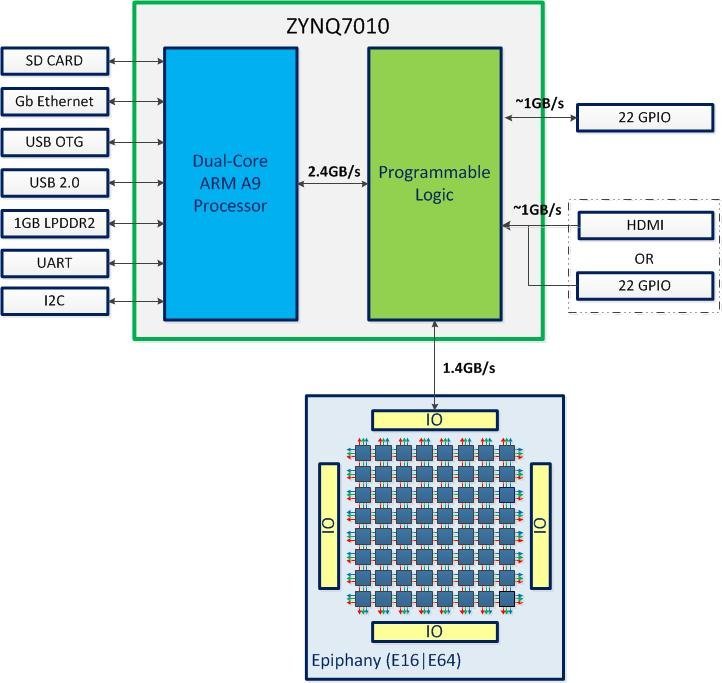
DiagramThe Parallella Computer

In October 2012 a Kickstarter campaign was successful in raising $898,921 to develop and produce  an initial run of the Parallella computer, a system equipped with a dual-core ARM A9 processor and either a 16 or 64-core Adapteva Epiphany floating-point accelerator. The project had just short of 5,000 backers and pledges of $99 or more being rewarded with at least one board with a 16-core device.
The Parallella computer was inspired in no small part by Raspberry Pi and will be credit card-sized with 1GB RAM available to the host and using MicroSD storage, providing Gigabit Ethernet, USB 2.0 and HDMI ports, and plenty of general purpose I/O (GPIO) for expansion via daughter cards.
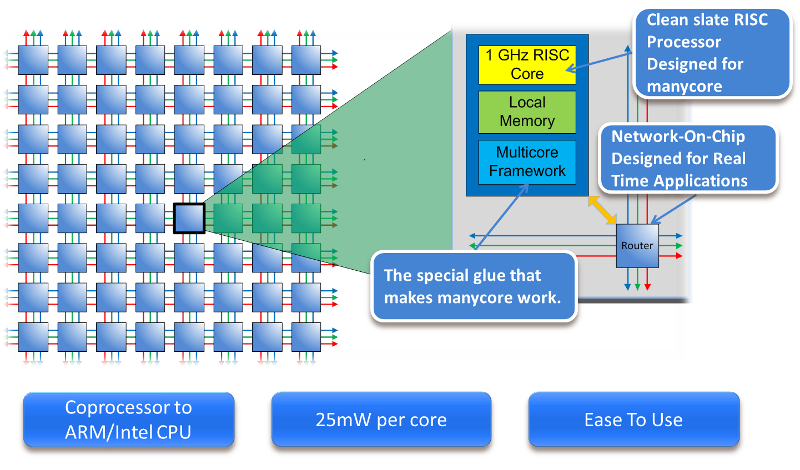
The Epiphany chip provides RISC floating-point cores each with 32KB of local memory,that are connected together by an on-chip mesh network, which allows one core to transparently access the memory of every other core. In contrast to GPUs, Epiphany is MIMD - meaning Epiphanythat cores are able to operate independently and the architecture is easier to program for a wider range of applications.
In addition to a dual-core ARM processor, the Xilinx Zynq system-on-chip that is being used provides programmable logic, which is where the interface to the Epiphany chip will be implemented. The Parallella computer is an open source hardware design and the schematics and PCB layout will be published along with the HDL source code for the Epiphany interface.
The hardware will ship with Ubuntu pre-loaded. Driver sources will also be provided and there has already been interest expressed in developing support for other distributions. 

Developing Software

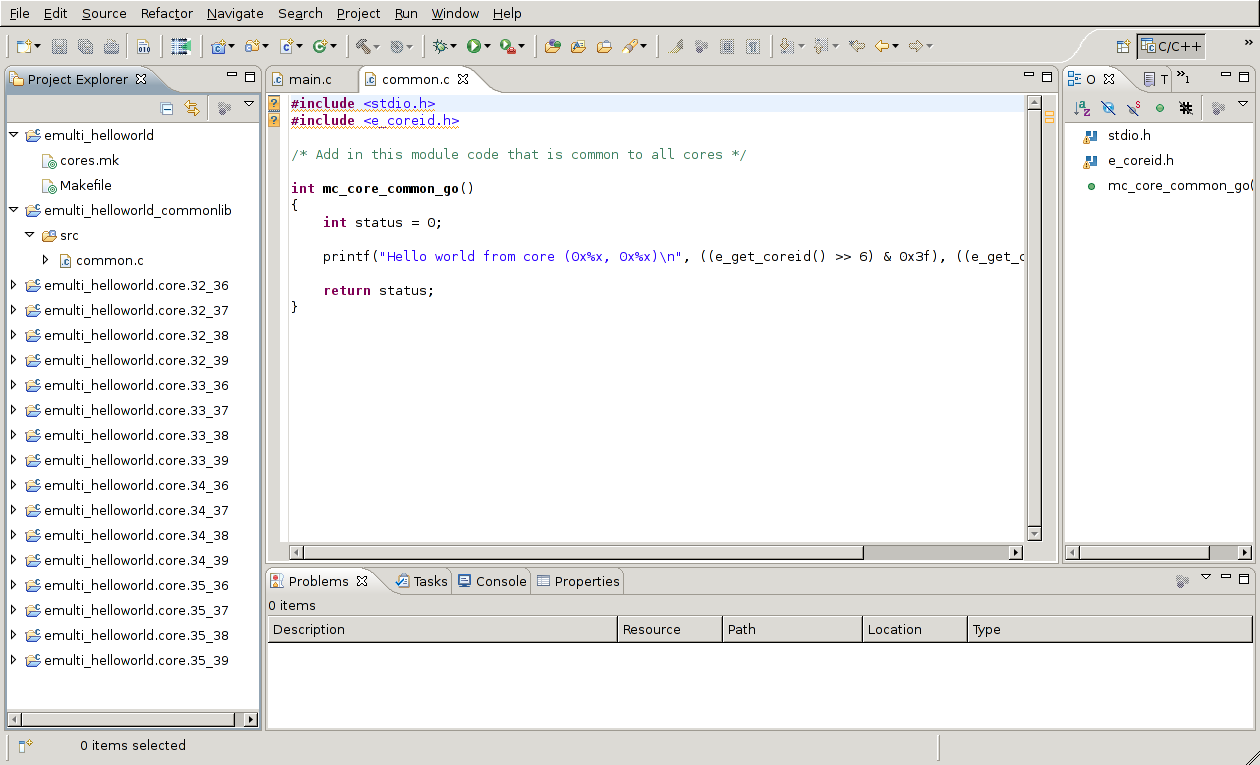
EclipseThe Eclipse multicore IDE
Development is supported by the Epiphany SDK, which is based on GCC 4.7, GDB, the Eclipse IDE and newlib C library. This was developed by our Adapteva partner, Embecosm, who also managed the introduction of the Epiphany architecture into the GCC mainline.
Brown Deer Technology have developed a fully open sourceOpenCL implementation and this can be used to simplify the creation of applications which use both ARM and Epiphany cores.
The project is now looking to members of the community to lead on developing support for additional languages and frameworks with leads recently announced for Erlang and Python.

Potential Applications

The uses to which backers have said that they will put their Parallella computers to use include sound processing, video encoding, 3D scanning, computer visioning, neural networks, physical simulation and, importantly, learning parallel programming!
Software-defined radio is an application that frequently comes up and Parallella is particularly well suited to this since the programmable logic it provides is situated between the ARM host, Epiphany accelerator and GPIO, allowing for digital radio hardware to be more easily integrated.
The 16-core Epiphany chip delivers 26 GFLOPS of performance and with the entire Parallella computer consuming only 5 watts, making it possible to prototype compute-intensive applications with mobile device power budgets or equally to construct energy-efficient HPC clusters.

ClusterProject status

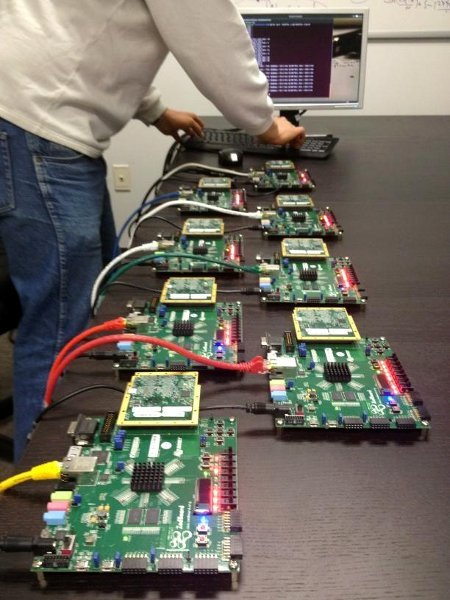
Testing a Beowulf cluster assembled from Parallella prototypes
The first prototypes went out to backers at the end of December 2012 with additional boards going out in January. These are based on an off-the-shelf Zedboard development system plus an Epiphany daughter card. Thes are virtually identical to the final design.
The Adepteva team is now working to meet a challenging timescale as a beta version of the credit card-seized board is due in February with release 1.0 due to go out to thousands of backers in May.
The tool chain sources are on GitHub and SDK packages have been provided to specific backers, and these will be made publicly available when the final hardware ships.
Python lead, Mark Dewing, has had some initial success with compiling the Python-on-a-Chip interpreter for Epiphany, testing this via the functional simulator provided by the SDK. Meanwhile Erlang Solutions has been working out how to approach Erlang support and will be sharing their initial thoughts on this in the coming weeks.

Next steps

The focus now is on completing the design and getting hardware out to backers, as well as establishing relationships between the Parallella community and those developing the languages, frameworks and applications that are vital to achieving the goal of democratizing access to parallel computing.
Via: "Linux"

Thursday, February 21, 2013

The 4 Hardest Computing Problems On Earth

America's most powerful supercomputer runs calculations so quickly it makes your laptop look like an abacus. The machine, called Titan, is located at the Oak Ridge National Laboratory in Tennessee. It is also the fastest supercomputer the world. It can process more than 17 petaflops of data per second -- that's roughly 20,000 trillion simultaneous calculations. Though Titan has the strength of 500,000 laptops, computer scientists are hungry for more. Already, they are dreaming of a machine that could manage an exaflop of data, which would require about 50 times more processing power than Titan. So-called exascale computing could let researchers answer some of the toughest scientific problems. Here's a closer look.

Virtual climate

Virtual Climate:

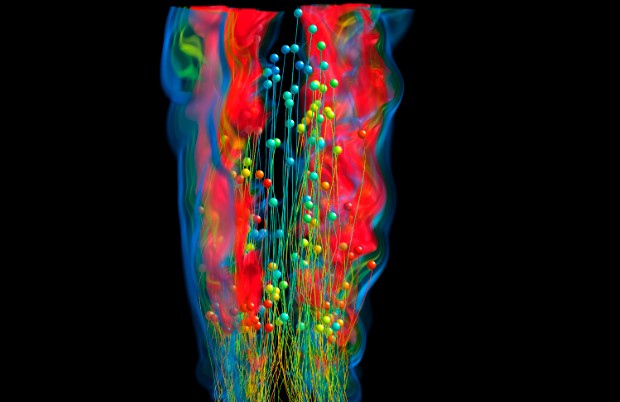
Building better climate models is becoming more important, as scientists work to predict the potential effects of a warming planet. Supercomputers are already integral to our understanding of atmospheric changes. "Whenever you see forecasters on TV, that weather movie took hours and hours to render on a supercomputer," says Sumit Gupta, a general manager at Nvidia's accelerated computing unit. (Nvidia's chips help power Titan.) But the best supercomputers today fall short of researchers' goals. If you think of the globe as an image, the best supercomputers can only render pixels the size of 14 square kilometers. An exascale computer could bring that down to one square kilometer. The effect? Scientists could see the impact of minutely detailed climate factors such as individual cloud formations and ocean eddies.

Digital cells

Digital Cells:

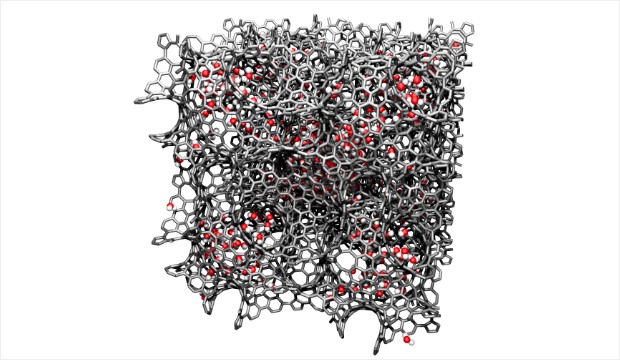
Much of the future of pharmaceuticals is in algorithms, not petri dishes. Researchers will develop drugs based on programs that predict how chemicals will interact with the body. Titan, for example, will advance these digital drug tests, says Jack Wells, the director of science at the Oak Ridge Leadership Computing Facility. It will let researchers solve equations that apply a technique called molecular dynamics. In this approach to solving problems in biology, chemistry, and materials sciences, scientists model the movement of individual atoms or molecules, factoring in the various forces exerted on them. Unfortunately, even with today's most powerful computers, scientists can only apply molecular dynamics to small clusters of atoms. A human cell, on the other hand, is composed of billions of atoms that all interact, and it is too complex for current computers to model. The hope is that future supercomputers could handle whole cells.

Future fuel

Future Fuel:

The equations behind burning fuel are extremely difficult to understand on the micro-scale. Scientists studying combustion must rely on guesswork. With Titan, scientists can model the chemical reactions for combustion of relatively simple fuels like alcohol and butanol. But because gasoline and biodiesels are complex fuels -- the molecules inside are longer and thus trickier to model -- more and more powerful supercomputers will be required to parse them.

Inside supernovae

Inside Supernova:

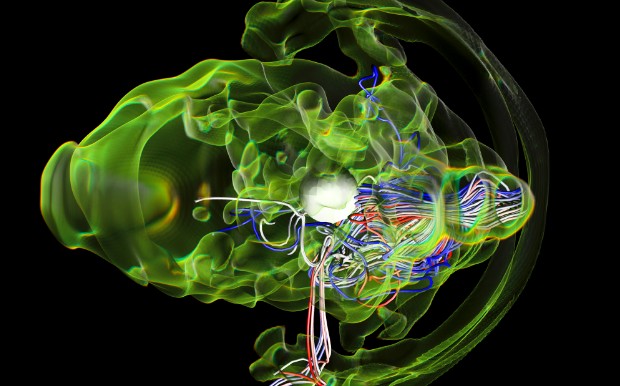
More powerful supercomputers could shine a light on some of the most foreign phenomena in the universe. For example, scientists in the future may be able to model the awesome forces that interact when a star explodes. Those events, called supernovae, often spew enough energy and light to outshine an entire galaxy. Supernovae involve not just astrophysics, but chemical and nuclear reactions. Running programs that includes all the sciences at play would require an exaflop of data. With that much power, the next generation of supercomputers could bring the mysteries of deep space closer to home.

Via: "CNN"