Showing posts with label Srebrenica. Show all posts

Friday, July 13, 2012

Women Who Refuse To Die

We Follow Four Survivors Of The 1995 Srebrenica Massacre As They Look To The Future Despite The Pain Of Their Past.


"When they took away my children in 1995, they also killed me - in the most brutal manner. This is not life .... I had my family and in just one day I'm left without them, without knowing why. And every morning I ask myself why, but there is no answer. My children were only guilty of having the names they had and their names were different from their killers. It was not only my children killed on July 11, 1995; thousands of other innocent children were murdered in the bloody genocide in Srebrenica .... I no longer have anything to lose; the criminals killed all I had, except for my pride."

Hatidza Mehmedovic

In July 1995, an estimated 8,000 Muslim men and boys - sons, husbands and brothers - were dragged away never to be seen again.

The Srebrenica massacre marks a particularly inhumane and brutal act within the tragedy and bloodshed of the 1992 to 1995 Bosnian War.

Tuesday, December 13, 2011

Unravelling Bosnia’s Past and Present


The Journey 

Submitted By "Sayf Maslul" 

Posted by: Wasim Mir
Date:  November 23, 2011
Courtesy Of "The Platform"


Before travelling to Bosnia I had expectations of a remote and possibly hostile region, fed by misinformed stereotypes from people in England. I was not only proved wrong, but moved to tears on occasions with memories that will last a lifetime.

I travelled with a group of 12 volunteers with a charity called MADE In Europe to Sarajevo and Eastern Bosnia. Together, we helped to set up strawberry farms for families who had been victims of the genocide in 1995, and were returning to their land.  These farms would provide them with a sustainable income.

Attending the annual memorial at Potocari, Srebrenica, the scene where over 8000 Bosnians were massacred in 1995, was an overwhelming experience; even the toughest of hearts would be moved. As a volunteer, I had heard horrendous war-time stories from my host family, but it was only upon attending such an emotional event that I realised the true scale of the genocide.

Bosnia was split into two entities after the war, The Federation, with a large Bosniak population, and Republika Srpska, with a large Serb population, both operating under separate governments. Republika Srpska was the scene of heinous war crimes, where Bosniaks were persecuted and ethnically cleansed from their land. In recent times, some of the displaced families have returned to their homes. Muslim villages are dotted around the beautiful rugged valleys, whilst the larger towns, including Zvornik and Srebrenica, are now almost entirely Serb. Walking around in a headscarf in Zvornik can be seen as provocative act, and sometimes an invitation for abuse. It is with some surprise then, that I learned that the largest mosque in Eastern Bosnia is located in the centre of Zvornik.

The reason for this, I believe, lies in the events that took place two decades ago. My experience volunteering in Bosnia revealed to me that severe cracks remain in the tense and complex structure of a nation rife with identity politics. Bosniaks and Serbs make an open visual display of their grief and their religious identity – churches and mosques are built to be seen as much as used. A culture of memorialisation is apparent especially in the East of the country; both sides appear to be competing as to the losses suffered in the war.

The two groups do intermingle, although not as actively as they probably could. Bosniaks and Serbs speak the same language and have to integrate in schools and workplaces. The majority of Bosniaks I spoke to were quick to dismiss any hatred for Serbs. Their qualms were with the military generals and nationalists who repeatedly call for Muslims to leave a land they have cultivated and graced for centuries. The breadwinner of the host family I lived with works and studies with many Serbs, yet he was keen to stress one point – ‘we will never forget what happened’. He had lost many family members in the war; I was not one to question his attitude.

My lasting memories from the trip will be the jaw-dropping beauty of the mosques, and sounds of Arabic echoing in remote villages. To see blonde-haired men, women and children, greet me with “Assalamaleyk” and an ear-to-ear smile touched me on every occasion. They were testament to the true universal attitude of Islam and of a kind human nature. So welcoming were the people that they allowed me to recite the call to prayer on a hilltop mosque, a personal highlight that I owe to the locals. It was interesting to see how Serb Orthodox churches were dotted around in villages, and most of them were newly built. Bosniaks make it clear every time they passed by that they do not approve of building on previous mosque land, but appreciate that the Serbs have a right to practice their religion freely.

It is a great shame to say that such a fascinating group of people have a cloud of injustice and doubt hanging over their heads, a cloud that will undoubtedly remain for the foreseeable future. The tense undertone still exists – whether it is Serbs at petrol stations serving Bosniaks, or Bosniaks getting searched by Serb policemen. However, the glimmer of hope I saw was of a people who saw past conflict and beyond prejudices. The most touching words were from a former military commander, who reiterated how he merely wished to live peacefully with his Serb brothers and sisters, in a united Bosnia.

On the surface, Bosnia appears to be as healthy as any other European nation and the only physical signs of war are evident in mass graves or bullet-laden buildings. However, deep under the thin cover of peace is a psychological tension between Bosniaks and Serbs. Coming back to the UK, I realised the privilege I have here to practise my religion freely, and to mix with people from countless other backgrounds. If those in Bosnia, with the terrible memories they have, can make an effort to co-exist, then surely we can do the same here in the UK.

MADE in Europe is a UK-based charity which aims to mobilise young Muslims to take action on global poverty through campaigning and volunteering.  For more information and to apply for next year’s Bosnia: The Journey programme, please visit www.madeineurope.org.uk/madethejourney.  

Saturday, June 11, 2011

Where Was The Media Hunt For Ratko Mladic?

We Ask If The Notorious General Was Able To Go Undetected For So Long Because Journalists Failed To Do Their Job.

Last Modified: 04 Jun 2011 10:54
Courtesy Of "Al-Jazeera"


On Listening Post this week: Ratko Mladic finally arrested. Where was the media hunt? Plus, the former IMF chief, sexual assault allegations and France's privacy laws.

Last week, a 16-year long manhunt ended with the arrest of alleged war criminal Ratko Mladic, bringing the former Yugoslavia back into the headlines. Accused by the International Criminal Tribunal of crimes against humanity, Mladic was one of the world's most wanted men.

While critics question both the Serbian government's efforts to catch him and the timing of his arrest, we ask: Where was the media on this story? How did the notorious general manage to elude its spotlight for so long? And how has the Bosnian media been treating the story? Because when the person widely blamed for instigating the bloodiest conflict in Europe since the Second World War is hiding undetected in your backyard, someone is not doing their job.

In Newsbytes this week: A Pakistani journalist is found dead after a report that suggested ties between al-Qaeda and the Pakistani armed forces; journalists get caught between Georgian police and anti-government protestors; there is a reported plan underway in Tehran to disconnect Iranian cyberspace from the world wide web; former Egyptian president Hosni Mubarak is fined $34mn for cutting the country's mobile phone and internet services during the protests earlier this year; and France 24's correspondent in Bahrain gives a harrowing account of her ordeal in prison.

When news broke that Dominique Strauss-Kahn had been accused of rape, images of the handcuffed former IMF director flooded the international airwaves and column inches. But as the breathless reporting of the "future president of France's" incarceration died down, the debate - especially in France - turned to the blurred lines between public interest and a person's right to privacy.

DSK's fondness for the opposite sex was no big secret in France. But France's privacy laws and Parisian journalists' self-imposed code of conduct over these issues kept DSK's open secret out of the media. Listening Post's Adnan Ahmed looks at the legal tightrope French journalists must walk and whether it let loose "Le Grand Seducteur".

Our internet video of the week looks at three dubstep performers and their almost inhuman dance moves, in a genre which emerged from South London in the late 1990s. Three quarters of a million hits on Youtube prove: This is the kind of thing you DO want to try at home. We hope you enjoy the show.

Monday, June 06, 2011

Remembering War Crimes and Media Obligations


Serbian state media only apologised for their role as propagandists in the days after the capture of alleged war criminal Ratko Mladic [GALLO/GETTY]


Serbian State TV Has Apologised For Its Role As A Propagandist In The War 16 Years Ago.

By Danny Schechter
Last Modified: 31 May 2011 11:43
Courtesy Of "Al-Jazeera"


In the TV business, we speak of booking a big name for a highly rated TV appearance as "a get". It took years to "get" Osama bin Laden although, in his case, his views were not wanted; he made more news - and generated more popular satisfaction - as a target of a possibly illegal liquidation.

He won't be giving any more interviews, that's for sure.

The world waited sixteen years for the Bosnian Serb General Ratko Mladic to be taken into custody.

It seems clear that the Serbian authorities knew where he was but didn't want to upset the volatile and violent nationalists still in their midst who backed the wars he led. Indeed, some even excused the massacres he reportedly carried out against the country's Muslims and all citizens who believed in multi-ethnic states.

Mladic will now face war crimes charges in The Hague.

In the week of his arrest, Serbian state television finally apologised for its role in inciting the barbaric war through misinformation, deception and propaganda thinly disguised as news.

AP reported:

Radio Television of Serbia, or RTS, said in a statement posted on its website yesterday that the station's programme was "almost constantly and heavily abused'' by Milosevic's regime with the aim of discrediting his political and ethnic opponents and spreading official propaganda.

Liberal politician Marko Karadzic described the apology as a "positive step'' but said the television's managing board did not distance itself clearly enough from the past.

"RTS's programme was an organised campaign of support to the policies of extinction and violence which we cannot view as insult or slander,'' aid Karadzic.

It's time for Croatian TV to make a similar statement: this statement clearly defines the often complicit relationship between war and media showing how TV networks promote wars in the guise of covering them.
Too many media organisations took their cues from state propagandists.

Many TV news executives in the US later issued more tempered apologies for their one-sided coverage of the Iraq war.

As someone who spent years reporting on, and writing about, wars and the carnage in the Balkans, it is emotionally satisfying to see a military mobster of Mladic's status finally in custody, even if his expected conviction will not bring back the tens of thousands hurt, maimed, or killed in the slaughters he allegedly directed.

I was honoured to be one of those thanked by people who spent years of their lives trying to arouse public opinion and government action.

I was mentioned in an email exchange that Bruce Rosen initiated which also praised journalists and activists who tried as hard as we could to publicise and condemn the crimes the world was witnessing while they were underway.

I feel comfortable quoting from these letters because they show how many of us felt then - and now.

Stephen Walker wrote:

Thanks, Bruce - David, Roy, Danny, and many others helped shine the light on the horrors."

For those of you who don't see the FT, there is an interesting op-ed that reminds us of the complicity of Western governments and the UN during the genocide. I would have added to it the over three years of US complicity, which grassroots and congressional pressure, along with the collapse of the UN "safe areas" charade at Srebrenica, helped bring to an end.

He praised activists and journalists alike, writing:

We all owe a huge debt to courageous journalists, like David Rohde, who risked their lives to bring us the stories of the victims, their families, and the perpetrators of the genocide.  But one of the important stories, largely untold, of the Bosnia Genocide is the impact grassroots activists, like yourself and many of the other recipients of your email, had during and after the genocide.

"Average" Americans sacrificed their time, energy, and money to raise awareness, lobby their government, solicit and deliver humanitarian aid, counsel rape victims, and do many other things that helped stop the genocide, enable the healing, and hold people in power responsible for bringing justice to the victims and their families. You, Glenn, and your fellow citizen activists have never received the attention or thanks you deserve, but you should take great pride in what you did over the years that led to yesterday's belated but welcome news.

There was this response from prize-winning journalist Roy Gutman, then with Newsday, now posted in Baghdad for McClatchey, who pursued the story with a rare tenacity:

As one of the journalists who worked on the story - David Rieff, John Burns, Ed Vulliamy, Christiane Amanpour, David Rohde, the late Kurt Schork Emma Dailey, Jeremy Bowen, Samantha Power, Roger Cohen, Stacy Sullivan being among the others - I'd like to say something to Steve, John and others who were at State and quit, or stayed and kept fighting, or set up NGO's to bring this before the public and keep it there.

Yesterday was a great day for mankind, and it wouldn't have happened without you. Your encouragement certainly helped keep us going in our profession, and I'm sure it helped create the impetus that eventually forced the administration to act.

I hope you'll understand if I use the platform of this email exchange to draw your attention to a truly disturbing situation, this time in US-allied Bahrain. Here is a story we ran yesterday, the latest of about ten. There are echoes of BH, just not the death toll, and one echo is the complete lack of reaction in DC. It is an alarming situation, and it is deteriorating.

Salute to all, Roy Gutman, Baghdad Bureau Chief, McClatchy Newspapers.

I wrote to Roy congratulating him for his role. He had cooperated with our company Globalvision on one of the many programs we did on the crisis.

He responded this way:

Danny, great to hear from you. Listen: Get thee to Bahrain. You're needed there. We all are. It's a disaster zone, desperately in need of real journalists. It was the first stop on my new assignment, covering the Mideast from a base in Baghdad. A very interesting time to be around these parts. As ever, Roy...

Eileen Weiss, adds:

I, too, was thrilled to hear the news of Mladic's arrest. However, I am deeply sad - many of us have been working tirelessly on behalf of Darfur and others in Sudan. Despite all the initial press attention, the situation on the ground has grown worse and worse, with houses in Abyei currently burning due to the actions of ICC war criminal Al-Bashir. Many words, failed diplomacy and reluctance to act have shown me that our leaders have basically learned nothing from the Bosnian situation.

I hope it's not another 15 years before justice is seen in Sudan.

And so, the fight against injustice globally, and for truth goes on.

The former Bosnian Ambassador to the UN, Mo Sacirby, who was later victimised for his outspoken role, gets the last word here:

Thanks for making the point, especially regarding great contributions made by so many... It is amazing how much has been forgotten, or more accurately redesigned to fit the history written by those who were acquiescent or complicit.

It is a time for congratulation, but also opportunity to counter efforts that continue, like indefinite tides to erase the footprints of what actually happened.

News Dissector Danny Schechter edits Mediachannel.org. He is the author of When News Lies: Media Complicity and the Iraq War. Comments to dissector@mediachannel.org

Sunday, June 05, 2011

The Crimes Of Ratko Mladic


Ratko Mladic, who was deported to The Hague on May 31, 2011, will be staying in the high-security prison Scheveningen, where he will await a trial that will determine his future [EPA]


Difficult Questions Are Raised By The Charges Against Mladic - Genocide Or Ethnic Cleansing? And Why Does It Matter?

By Ian Buruma
Last Modified: 01 Jun 2011 09:04
Courtesy Of "Al-Jazeera"

Ratko Mladic is an easy man to hate.

In his prime, he not only talked and behaved like a thug, but he also looked like one - the kind of bull-necked, pale-eyed, snarling psychopath who would gladly pull out your fingernails just for fun. Apart from many other cruelties, the Butcher of Bosnia was responsible, in the summer of 1995, for the killing of around 8,000 unarmed Bosnian Muslim men and boys in the woods around Srebrenica.

So it will give most of us a feeling of warm satisfaction that he has finally been arrested in the Serbian village of Lazarevo. Serbia has gained respect by arresting Mladic, which should speed up its membership in the European Union. The former victims of Mladic's Bosnian Serb forces will feel that some justice is being done at last.

Yet the forthcoming trial of Ratko Mladic raises certain uncomfortable questions.

Why, in the first place, can't he be put on trial in Belgrade, instead of The Hague? And is it really wise to charge him with genocide, as well as crimes against humanity and war crimes?

Both questions reveal how much we still live in the shadow of the Nuremberg Tribunal, where the Nazi leaders were tried by an international judicial panel. It was believed, perhaps correctly, that the Germans would be incapable of trying their own former leaders.

And the Nazi crimes had been so horrendous in scale and intent that new laws - "crimes against humanity" - had to be created to try those who had been formally responsible for them. States, too, should be held accountable for their deeds - hence, in 1948, the Convention on the Prevention and Punishment of the Crime of Genocide.

The Holocaust was not the main issue at stake in the Nuremberg Trials. Nevertheless, the allies thought that the Nazi project of exterminating an entire people called for an entirely new legal approach, to ensure that such an atrocity would never happen again.

The problem with genocide, as a legal concept, is that it is vague. It refers to "acts committed with intent to destroy, in whole or in part, a national, ethnical, racial, or religious group."

The emphasis is on "intent", not on the numbers of people whose lives are destroyed. Mao Zedong murdered up to 40 million Chinese, but did he intend to destroy them as a group? Surely not. We know that Hitler did intend to destroy every last Jewish man, woman, and child. Even though mass killings are not rare in history, Hitler's extermination plan was, if not unique, certainly highly unusual.

However, the laudable effort to prevent such a thing from recurring has had unfortunate consequences. For, in our zeal to learn lessons from history, we often learn the wrong ones, or distort history towards dubious ends.

In a way, the killings at Srebrenica also were affected by the memories of World War II. The United Nations' Dutch battalion promised to protect the Muslims there, even though it was in no position to do so. It was a promise that partly reflected the feeling of guilt that still haunts the Dutch for looking the other way as the Germans rounded up and deported two-thirds of their country's Jewish population to death camps.

This time, it would be different. This time, they would act. Alas, outnumbered and outgunned by Mladic's forces, the Dutch surrendered Srebrenica to its fate.

Genocide vs Civil War

Because of the trauma of Hitler's intention to murder all of the Jews, genocide has become the one compelling reason for military action, including armed invasion of other countries. But what constitutes genocide?

Bernard Kouchner, the founder of Doctors Without Borders, wanted the world to intervene in Nigeria in 1970, because he saw the killing of Ibos by Nigerian troops as a genocidal echo of Auschwitz. Others saw a brutal civil war, and cautioned that intervention would make things worse.

For some, we are forever living in 1938, or rather, 1942, when the Nazis approved what Hitler called "the final solution of the Jewish question".

President George W Bush and his cheerleaders, invoking the Munich Agreement at every opportunity, regarded the terrorist attacks of September 11, 2001, as a call to arms. Saddam Hussein was Hitler, so we had to send in the troops.

We should stop Sudan's Omar al Bashir's genocide in Darfur. We must stop Muammar Gaddafi from committing mass murder in Benghazi. And so on.

Sometimes intervention might save lives. But wars often beget more wars, or longer ones. Military action can cause more violence, and more civilian deaths. This is especially true of intervention in civil wars, where the sides cannot easily be divided into victims and aggressors, good and evil.

Of course, the world becomes much simpler if we choose to see it in black and white. And the Mladic trial will, no doubt, encourage this perception.

He will be tried for genocide, because the UN's tribunal for ex-Yugoslavia and the International Court of Justice decided that the Bosnian Serbs were genocidal. Since his subordinate, Radislav Krstic, was already sentenced for his complicity in the genocide at Srebrenica, Mladic will presumably be convicted.

We need not feel sorry for Mladic. There is no doubt that he is guilty of serious war crimes. And a trial, however unsatisfactory, is in most cases still to be preferred to an assassination.

But trying him for genocide, even though it will be hard to prove that he ever intended to exterminate Bosnian Muslims as a group, just because they were Muslims, will further muddy the term's already vague definition.

Mladic was engaged in ethnic cleansing, which, though reprehensible, is not the same as genocide. Loose definitions will encourage more military interventions, thus more wars.

By invoking Hitler's ghost too often, we trivialise the enormity of what he actually did.


Ian Buruma is professor of Democracy and Human Rights at Bard College, and the author of Taming the Gods: Religion and Democracy on Three Continents.

A version of this article was previously published on the Project Syndicate.

Saturday, June 04, 2011

Surviving Bosnia's Killing Fields

By AIDA CERKEZ, Associated Press
Fri Jun 3, 8:32 am ET
Courtesy Of "Yahoo News"

SREBRENICA, Bosnia-Herzegovina – The hardest part was the ants. They crawled over his arms and legs, over his face and into his mouth, hour by hour as he pretended to be dead in a pile of corpses slowly turning stiff.
Mevludin Oric lay for nine hours in one of the Srebrenica killing fields where Bosnian Serb commander Ratko Mladic's troops executed 8,000 Muslim men and boys in July 1995. He escaped in the dead of night, after the soldiers had satisfied themselves that everyone in the sea of bodies was dead.
On Thursday, Oric returned for the first time to the execution ground — a pretty V-shaped meadow surrounded by a forest — with Associated Press journalists to share his feelings about the capture of the man who orchestrated Europe's worst carnage since World War II.
He brought his eldest daughter, 17-year-old Merima. He wanted her to know what happened here — he wants everyone to know, vowing to testify against Mladic at the U.N. war crimes tribunal in the Hague, Netherlands.
"I can't wait to look into the eyes of that animal," said the lanky 42-year-old, his eyes lighting up after a morning spent on the verge of tears.
Serbia extradited Mladic to the Netherlands on Tuesday to face genocide charges; he was arrested last week in a village north of Belgrade after 16 years on the run.
Oric, a Bosnian Muslim soldier captured by Serbs as he fled through the woods, is one of four men known to have survived the Srebrenica massacre. All endured the unspeakable ordeal of playing dead while Serb troops patrolled the blood-soaked field, finishing off anybody who showed signs of life with a pistol shot to the head.
Ants bit Oric as they prowled his body, but he didn't dare move. Nearby, an old man begged for his life: "Children, we didn't do anything. Don't do this to us." He, too, was shot.
On top of Oric was his dead cousin Hars. In the execution line, Hars took Oric's hand and whispered: "They'll kill us all." When the gunfire erupted, Oric threw himself to the ground, as Hars fell over him, groaning in agony.
At one point, Oric saw a Serb soldier walk in his direction. The soldier paused to shoot a man in the head, then continued walking toward Oric. It's my turn, he thought.
"I closed my eyes," Oric said, looking at Merima, "and I thought about you and your mother. And for a few seconds before the expected shot, I wondered what it is like in heaven, or in hell."
The shot never came. But it would be hours more before Oric would be free.
As he toured the meadow Thursday, Oric deciphered its grim geography: "This is where I lay... This is where the pit was..."
"This here is soaked with blood," he said. "I should have been here. But destiny..." His voice trailed off.
"I would like to cry," said the construction worker, who lives with his mother and three daughters in central Bosnia. "But there's something in my throat that doesn't allow me to cry."
Close to midnight, the shooting stopped and the Serbs left. Oric's arms and legs were numb, but he managed to shake off his cousin's body and stand up. Moonlight shone over the field of bodies; he saw a shadow approach.
"It was the shadow of a man like a ghost" he said. "First I thought it was a soldier left to stand guard."
But it was Hurem Suljic, a Bosnian Muslim bricklayer with a bum leg who had also survived. Suljic got closer and asked, "Are you wounded?" Oric said no.
Looking around, they saw others still alive but destined to die from rifle wounds. One man had a gash in his side exposing his kidney. "Can you give me a jacket?" he pleaded, "I'm cold." Oric took a jacket from a dead man and gave it to him.
Oric saw another man crawling on his arms, dragging behind his bullet-riddled legs. "Run, brother," the man said. "Don't mind me. I won't make it."
Oric and Suljic stepped over corpses and headed into the forest. The journey was hard because of Suljic's bad leg. At times, Oric said, he had to carry the older man on his back. Four days later, they crossed a mine field at the front line and were met by Bosnian soldiers.
Before the trip back to Srebrenica, Oric took Merima to the school gymnasium where he and hundreds of other Bosnian Muslim captives had been held by Serb forces before the massacre.
Oric said Mladic was there too on that day, inspecting the prisoners minutes before they were loaded onto trucks and driven to the execution ground. Suljic has given similar testimony.
In the school gym, the Muslim men were told they would be part of a prisoner swap. But the men had doubts because they heard gunfire all around.
As Oric and his daughter toured the grounds, people in surrounding houses in the Serb-dominated area called out.
"Let Mladic go!" they yelled.
Sunday, May 29, 2011

Srebrenica: Worst European Atrocity Since WWII

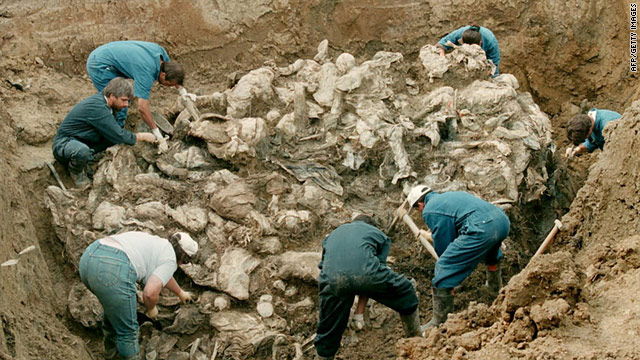
A photo dated July 24, 1996, shows International war crimes tribunal investigators examine a mass grave in Srebrenica.


STORY HIGHLIGHTS
  • At least 8,000 Muslim men, boys slain when Serbs overran U.N. safe haven
  • Mladic, then Bosnian Serb commander, is accused of direct involvement in the violence
  • Judge: Srebrenica "truly scenes from hell written on the darkest pages"

By CNN's Graham Jones
July 22, 2008
Courtesy Of "CNN"


It is now remembered as the worst atrocity in Europe since World War II.
In a five-day orgy of slaughter at Srebrenica in July 1995, up to 8,000 Muslims were systematically exterminated in what was described at the U.N. war crimes tribunal as "the triumph of evil."
Radovan Karadzic, then the Bosnian Serb political leader, who was arrested on a Belgrade bus Friday after more than 10 years on the run, is accused of ordering the violence at Srebrenica and the deadly siege of Sarajevo.
In 1995 Srebrenica's was designated a U.N. "safe area."
A judge at The Hague tribunal was later to describe what happened there as "truly scenes from hell written on the darkest pages of human history."
Thousands of Bosnian Muslims had sought refuge in the spa town of Srebrenicia in 1995 as the Bosnian Serb army marched towards them.
They were protected by just 100 lightly equipped Dutch peacekeepers -- who proved no match for the advancing, heavily-armed Serb army.
Denied reinforcements, the Dutch were forced to stand aside while Serb troops intent on "ethnic cleansing" did their worst -- the peacekeepers even witnessing the summary execution of civilians.
In the days before the onslaught, 30,000 Muslims fleeing the advancing Serb army were crammed into the town. Within days there was not one Muslim left.
A great number fled -- only for many of them to be wiped out in Serb ambushes -- but the men who stayed fared the worst.
Thousands of men and boys as young as 10 were rounded up and murdered. Those who tried to hide in their homes were, according to evidence at the trial of Serb General Radislav Krstic at The Hague in March 2000, "hunted down like dogs and slaughtered."
Serbian TV footage shows woman and children being separated from the men and put on buses.
In a sickening show of "reassurance" Bosnian Serb commander-in-chief General Ratko Mladic -- now on the war crimes tribunal's most wanted list -- told the women everyone would be taken out by bus out and safely reunited.
When the cameras were turned off the real face of the Serb army emerged as the slaughter began.
More than 60 truckloads of refugees were taken from Srebrenica to execution sites where they were bound, blindfolded, and shot with automatic rifles.
Some of the executions were carried out at night under arc lights. Industrial bulldozers then pushed the bodies into mass graves.
Some were buried alive, a French policeman who collected evidence from Bosnian Muslims, Jean-Rene Ruez, told The Hague tribunal in 1996.

Wednesday, July 21, 2010

Srebrenica: Tragedy That Time Cannot Heal

Written by Muzaffer Vatansever
Monday, 12 July 2010.
Courtesy Of "The Turkish Weekly"

Srebrenica, which was located on the eastern part of Bosnia-Herzegovina according to borders drawn by Dayton Peace Accord, witnessed the most dramatic tragedy of the recent history. In the last days of the Bosnian War, Srebrenica, where eight thousand people were massacred, went down in the history as the biggest mass destruction after the World War II. International society, which had been relatively hesitant since the beginning of the war, cannot force the war criminals to pay the bill of the Srebrenica genocide as they could not prevent. On 26th of 2007, International Court of Justice accepted Srebrenica massacres as genocide. However the Court decided that Serbia cannot be blamed for responsibility (1).

Today 11th of July 2010; fifteen years ago General of the Serbian Army Ratko Mladiç entered Srebrenica, one of the six so called “safe zones” demilitarized by UN. He said on 11st of June in 1995 “we are in Srebrenitsa. We are on the eve of an important day. We want to gift this city Serbian Nation. After the rebellion, it is time to take revenge from Turks.” These sentences were registered in archives of recent history. After that, the following five days more than eight thousand Bosnian men have been massacred. There are several mass graves near Srebrenitsa. Victims of massacre whose identities were ascertained after the openings of 13 mass graves were buried on 11th of June each year by commemoration. Today, in the fifteenth year of massacres, 775 people are buried to grave.

1992-1995 Bosnian War and the International Society

Ideological bases of Bosnian War, which took place between 1992 and 1995, go back to memorandum which criticized Socialist Federal Republic of Yugoslavia (hereafter, SFRY) was released in 1986 by the Serbian Academy of Sciences and Arts. In this memorandum it was stated that Serbia, one of the six Republics of Yugoslavia were exploited and SFRY advocated restructuring. Moving from this point, Slobodan Milosevic initially canceled the autonomous statute of Kosovo in 1989 and significantly altered the 1974 Constitution. Dismantlement process of Yugoslavia which started with Milosevic Administration reached the peak point after independence of Croatia and Slovenia. These two Republics were followed by Macedonia and Bosnia-Herzegovina. However, there is an immediate response to independence of Bosnia by Serbs in Bosnia and Armed Forces of Yugoslavia which would throw Bosnia to a bloody war, lasting three and half years. Initially, war broke out in peripheries and clashes between Serbs and Croats were the first attempts of gaining soils in Bosnia. This war in which a Muslim Bosnian character in the novel of Ivo Andric, the Nobel Laureate in Literature in 1961, said that “death is our life, graves are our country” witnessed the inhumane behaviors and led to demise of more than 150.000 Muslim Bosnians. Numerous people were displaced and forced to migrate.

Interventions of the International Community to Bosnian War restricted to the soft measures which did not include the violence as embargo on arms, humanitarian aids, and establishment of safe zones. On the other hand, there were new plans for the future of Bosnia Herzegovina as Vance-Oven Plan and Oven-Stoltenberg Plan which were mentioned by name of its leaders. However none of them were able to prevent brutality. Here upon, UN Security Council adopted “safe areas” formula which was used in Gulf War for Kurds. In pursuant the decision of the Security Council, UN declared Srebrenica, Zepa, Tuzla, Saraybosna, Goradze and Bilhac as safe areas. Population of Srebrenica increased to more than 40000 which had been around 26000 before the resolution of UN Security Council with regard to establishment of safe areas. However Dutch soldiers who were responsible to protect “Srebrenica safe area” failed. They just stayed as out-watcher to the massacre in the region which started with the siege of the city by the Serbs on 6th of July 1995. Worse than that, in 2006, Dutch Government gave medal to these soldiers due to “difficult conditions of Srebrenica.”

Srebrenitsa: July 1995

This unbelievable tragedy started with siege of Srebrenitsa where thousands of Bosnians took refuge, on the 6th of July, 1995. In sum 34000 soldiers were expected to be in these six safe areas. However there were just 7600 UN soldiers in total and 600 soldiers in Srebrenitsa (2). When the Serbian Army’s attack began, Bosnians wanted their weapons which they gave to UN Protection Force (UNPROFOR) beforehand. However, UNPROFOR rejected their demands. Serbs invading the city on 9th of July and captured thirty Dutch Soldiers in observation towers as hostages. Serbs used hostages as bargaining items and demanded the extradition of Bosnians. Despite the fact that NATO intervention came to agenda, it could not be started due to veto of the members, at first Holland. On the eleventh of June Serbs General Ratko Mladic came to city and reached an agreement with Dutch General. Onset of 12th of July all women and children were dispatched to other Muslim regions while Bosnian men, between 12 and 77 years old, were imprisoned as “war criminals”. Those who tried to escape were killed by Serbs. Massacres firstly started on 13th of June in storage near to Kravica. It is bitter that Dutch Soldiers gave 5000 Muslim Bosnians to Serbs in return for 14 Dutch hostages. First information about genocide, which had lasted for five days, were heard after some Bosnians who were able to escape and reached the Muslim villages. This brutality, which ended up with the massacres of more than 8000 Muslim Bosnians, was embedded in memories of Bosnians with deep pains; on the other side, it will ever exist in Serbian history as an embarrassing event.

Overview

Turkish Prime Minister Recep T. Erdogan, Serbian President Boris Tadic and leaders of countries in region attended to commemoration which is organized each year on 11th of July. This synergy is very important in terms transformation of the Srebrenica to a common suffering. Only if Srebrenica can be turned to a common suffering, the permanent basis of cooperation could be established. Therefore, basis of stability can be established. Change in the perceptions of Balkans which were the symbol of ethnic and religious conflicts in the past can only be enabled by the implementation of regional cooperation mechanisms. Turkey believes that permanent peace can only be achieved by regional rapprochement. Therefore, internalization of Srebrenica by the regional countries can be regarded as a significant opportunity in terms of construction of the common future in the region.

On the other hand, it is very desperate that European Leaders did not attend the commemoration. Why did not a representative of UN who was one of the main actors in Srebrenica come up front side? What does the medal given by Holland Defense Ministry to Dutch soldiers, who just watched the massacres, mean? And finally, the EU … The EU regards itself as the forerunner of human rights and universal values. If it is, from this point of view, it can be said that it firstly should face with Srebrenica.

Muzaffer Vatansever
USAK Center for EU Studies
muzaffer.vatansever@gmail.com

1- For the full text of the Court decision, see: http://www.icj-cij.org/docket/files/ 91/13685.pdf (for the summary of the decision, please see: http://www.icj-cij.org/docket/files/91/13687.pdf).

2- Merve İrem Yapıcı, “Bosna-Hersek’te Gerçekleştirilen Müdahalenin Uluslararası Hukuktaki Yeri”, Journal of International Law and Politics, Volume:2, No: 8, pp.5-6.
Monday, 12 July 2010