Showing posts with label Robocopters. Show all posts

Friday, March 30, 2012

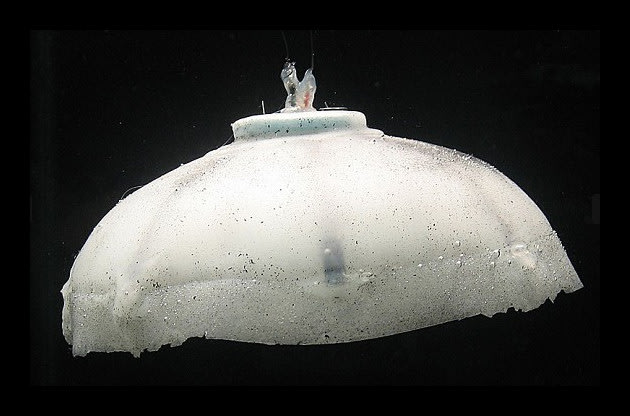
RoboJelly: The US Navy's Robot JellyFish


'Robojelly' prototype (SMS) 

By Dylan Stableford
Thu, Mar 22, 2012 
Courtesy Of "Yahoo News"


Researchers at Virginia Tech, the Univ. of Texas at Dallas and several other schools are working together to develop robotic jellyfish powered by sea water.
The "Robojelly" mimic the movement of jellyfish, using a combination of oxygen and hydrogen gases to contract its "muscles," or "nano-platinum catalyst-coated multi-wall carbon nanotube sheets, wrapped on the surface of nickel—titanium shape memory alloy," according to an abstract published in the April issue of Smart Materials and Structures.
"To our knowledge, this is the first successful powering of an underwater robot using external hydrogen as a fuel source," Yonas Tadesse, one of the projects lead researchers, told the BBC.
Like jellyfish, the robot "uses its circular muscles in the inside of its umbrella-like bell to move," Ankita Mehta wrote in the International Business Times. "When the muscles contract, the bell closes in and throws out water to push itself foreword. When they relax, the bell regains its original shape."
The U.S. Navy's Office of Naval Research is funding the development of the vehicle, and scientists hope the Robojelly could eventually be used for underwater rescue operations.
Alex Villanueva, a researcher at Virginia Tech, said the unmanned underwater will be used for "surveillance purposes," but their findings could have a "broad range of applications for both military and civilian uses."

Friday, March 02, 2012

Robotic MicroMouse

Posted by guest blogger "Sayf Maslul"

Thursday, December 15, 2011

GroundBot: A Spherical All-Terrain Surveillance Robot

BY EDW LYNCH 
ON NOVEMBER 22, 2011 
Courtesy Of "Laughing Squid"


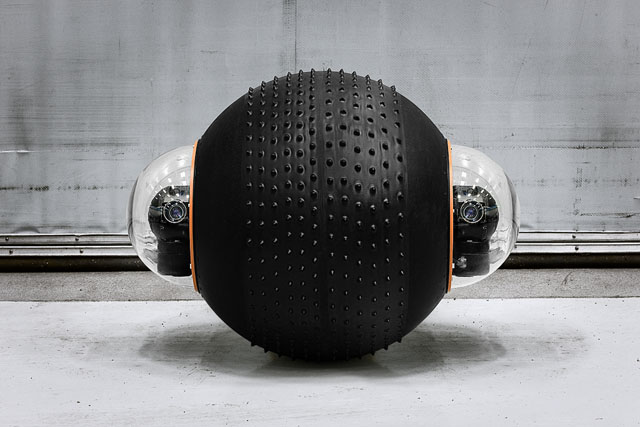
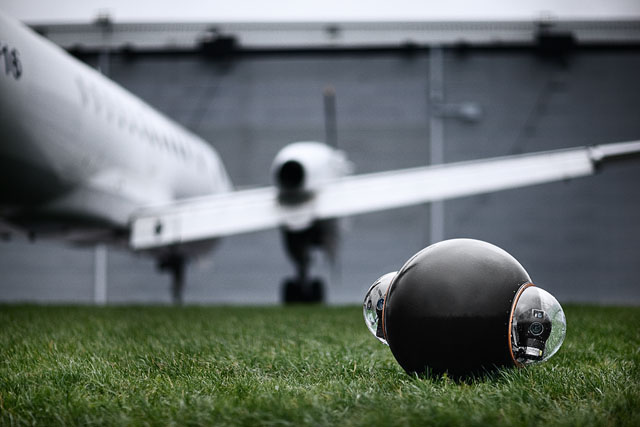
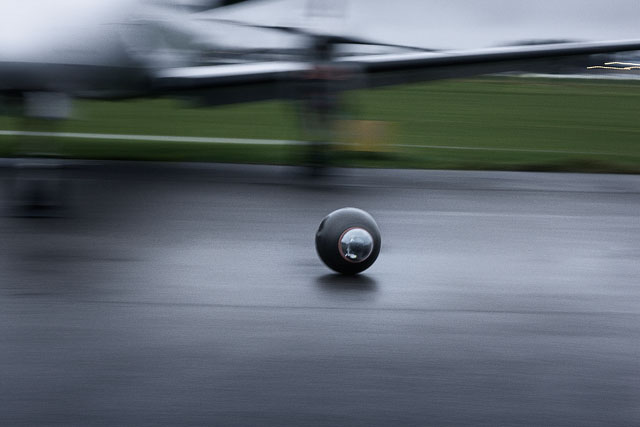
GroundBot by Rotundus

GroundBot by Rotundus

GroundBot by Rotundus

GroundBot by Rotundus


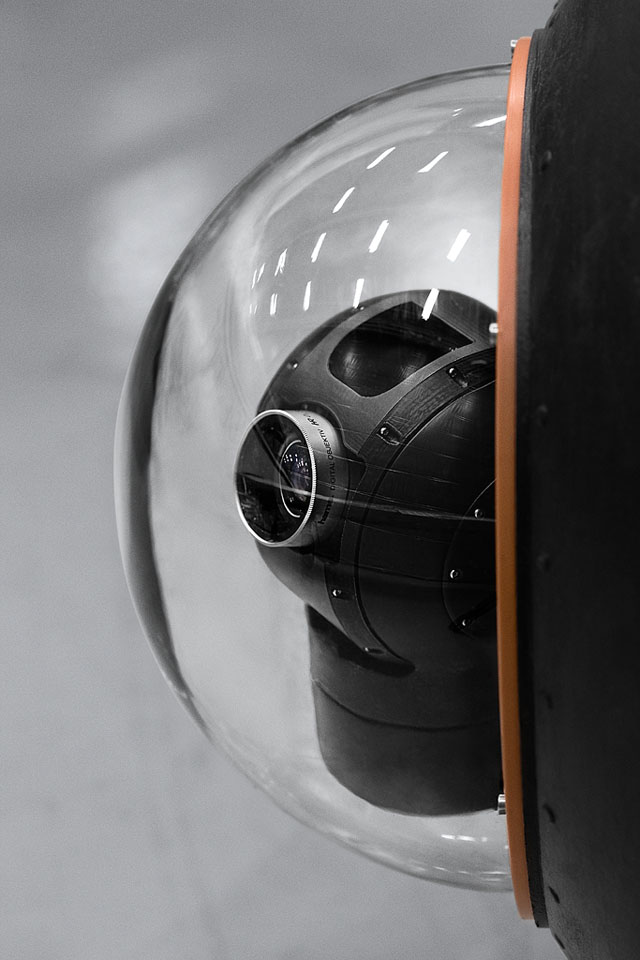
GroundBot by Swedish robotics firm Rotundus is an all-terrain, amphibious surveillance robot in the shape of a bug-eyed sphere (video). Roughly the size of a car tire, the robot moves silently at up to six mph. GroundBot houses two cameras which provide a stereoscopic view to its remote operator. Rotundus notes that the current version “cannot house robot arms or weapons.” Maybe in the next release.
The spherical design is simplicity itself. With its large circumference, GroundBot takes all kinds of terrain in its stride. And yet its appearance is friendly and unthreatening.
Inside, all cameras and sensors are sealed off from the outside world. This means that they are protected from bangs and knocks. In addition, the outside world is protected from potential electrical sparks when GroundBot is investigating gas leaks.

Monday, September 05, 2011

Tiny Pocketbots Prepped For Combat

By Noah Shachtman
August 19, 2011 | 7:00 am
Courtesy Of "Wired Magazine"


When the U.S. military first got serious about ground robots, it bought up a bunch of 42-pound machines called PackBots. The name implied that infantrymen would just throw the robots in their rucksacks. In reality, the things were too heavy for already-overloaded troops to carry around on the regular. The PackBot’s main competitor, the Talon, was even more of a burden. It weighed a whopping 125 pounds.
Now, there’s a new wave of reconnaissance bots being prepared for combat. And they are radically smaller than the previous generation; the tiniest of them weighs less than a pound-and-a-half. Which means they’ll not only fit inside a backpack, they might even squeeze inside a jacket or a pair of pants. Call them pocketbots.
Both the U.S. Army and Marine Corps are expected shortly to issue “urgent” battlefield requests for 3,500 to 5,000 of the micro machines. The idea that these new models can be tossed into a building or over a wall, allowing an infantryman to get a sense of what’s inside a room before he kicks down the door.
Three different bot-makers showed off their pocketbot models at the Association for Unmanned Vehicle Systems International conference in Washington this week. If they work as advertised, they could be the next big leap forward for military robotics.
Ground robots were originally issued to a specialized few, like explosive ordnance disposal technicians. That eventually grew to an unmanned force that’s now 2,000 strong in Afghanistan. These machines are so small, the military could potentially expand the robotic army even further.
“We can provide this capability to every soldier on the battlefield,” says retired Navy Captain Robert L. Moses. He’s an executive with iRobot, maker of the original PackBot — and a new, nine-inch “throwable” machine.
The First Look (that’s a video of it, above) appears to be almost identical to the PackBot. Like the bigger machine, it’s got flippers that allow it to spring up stairs (I saw it climb steps as big as the ‘bot). It’s got four color cameras, peeking out in every direction, and it can form a mesh network with its fellow machines. But the First Look has one not-entirely-insignificant difference from the Packbot: it’s five pounds, not 42.
Smaller still is the Throwbot, which was being demonstrated just across the aisle at the AUVSI conference. Shaped like a dumbbell and weighing just over a pound, the seven-inch machine scuttled across a pan of gravel and sand. Then a representative from Throwbot-maker Recon Robotics picked it up, and chucked it over a mock adobe wall. A handheld controller showed black-and-white footage from the machine’s single video camera. The feed won’t travel far — the Throwbot’s range is just 300 feet outdoors, and 100 feet inside. But it’s enough to provide a sneak peek of a room from the one next door. 1,000 of the machines have been sold to law enforcement and military units.
Machines like this have been in service for years — but not always with the best results. The robots aren’t the best at getting around obstacles, and a single, low-rez camera doesn’t provide ideal views. The Israeli Defense Forces, an early user or chuckable bots, has complained that using one early in an assault can sacrifice the element of surprise. “What could be more obvious than a several-pound robot crashing through a window to land at your feet?” our own David Axe asked a few months back. During a raid on a suspected drug house in Arizona, the local police waited until after the first round of fighting to throw a robot into the place.


At the other end of the conference call is the biggest of the pocketbots. In fact, at 15 inches long and 17 pounds fully loaded, it’s probably a stretch to say that the Dragon Runner 10 is pocketable at all. Then again, none of the other micro machines come with an optional arm and a claw.
Qinetiq, which makes the Dragon Runner 10, has spent years catering its heavier line of robots to bomb squads around the world. Military explosives-handlers tend to prefer the sturdier, stronger machines. The company has taken the same approach in its mini-me line. Along with the (relatively) big bot, there’s a rugged, eight-inch controller, plus another six pounds or so worth of batteries.
The Dragon Runner will go further than its competitors: 600 feet outside. The arm lets it do more than just scout out a dangerous area; it can detonate improvised bombs once it gets there. The Dragon Runner can carry two to three pounds — more than enough plastic explosives to blow a jury-rigged weapon into scraps. But it can’t climb stairs with the arm attached, which limits its utility.
This king-sized pocketbot could become an oxymoron as the military’s unmanned force continues to grow. Or this new wave of tiny robots might be big enough for something as large as a 17-pounder.
Photo: Noah Shachtman

Thursday, December 02, 2010

Recruiting Robots For Combat

By JOHN MARKOFF
Published: November 27, 2010
Courtesy Of "The New York Times"


FORT BENNING, Ga. — War would be a lot safer, the Army says, if only more of it were fought by robots.

Smarter Than You Think

Government Issue
Articles in this series are examining the recent advances in artificial intelligence and robotics and their potential impact on society.
David Walter Banks for The New York Times
REMOTELY CONTROLLED Some armed robots are operated with video-game-style consoles, helping to keep humans away from danger.
And while smart machines are already very much a part of modern warfare, the Army and its contractors are eager to add more. New robots — none of them particularly human-looking — are being designed to handle a broader range of tasks, from picking off snipers to serving as indefatigable night sentries.
In a mock city here used by Army Rangers for urban combat training, a 15-inch robot with a video camera scuttles around a bomb factory on a spying mission. Overhead an almost silent drone aircraft with a four-foot wingspan transmits images of the buildings below. Onto the scene rolls a sinister-looking vehicle on tank treads, about the size of a riding lawn mower, equipped with a machine gun and a grenade launcher.
Three backpack-clad technicians, standing out of the line of fire, operate the three robots with wireless video-game-style controllers. One swivels the video camera on the armed robot until it spots a sniper on a rooftop. The machine gun pirouettes, points and fires in two rapid bursts. Had the bullets been real, the target would have been destroyed.
The machines, viewed at a “Robotics Rodeo” last month at the Army’s training school here, not only protect soldiers, but also are never distracted, using an unblinking digital eye, or “persistent stare,” that automatically detects even the smallest motion. Nor do they ever panic under fire.
“One of the great arguments for armed robots is they can fire second,” said Joseph W. Dyer, a former vice admiral and the chief operating officer ofiRobot, which makes robots that clear explosives as well as the Roomba robot vacuum cleaner. When a robot looks around a battlefield, he said, the remote technician who is seeing through its eyes can take time to assess a scene without firing in haste at an innocent person.
Yet the idea that robots on wheels or legs, with sensors and guns, might someday replace or supplement human soldiers is still a source of extreme controversy. Because robots can stage attacks with little immediate risk to the people who operate them, opponents say that robot warriors lower the barriers to warfare, potentially making nations more trigger-happy and leading to a new technological arms race.
“Wars will be started very easily and with minimal costs” as automation increases, predicted Wendell Wallach, a scholar at the Yale Interdisciplinary Center for Bioethics and chairman of its technology and ethics study group.
Civilians will be at greater risk, people in Mr. Wallach’s camp argue, because of the challenges in distinguishing between fighters and innocent bystanders. That job is maddeningly difficult for human beings on the ground. It only becomes more difficult when a device is remotely operated.
This problem has already arisen with Predator aircraft, which find their targets with the aid of soldiers on the ground but are operated from the United States. Because civilians in Iraq and Afghanistan have died as a result of collateral damage or mistaken identities, Predators have generated international opposition and prompted accusations of war crimes.
But robot combatants are supported by a range of military strategists, officers and weapons designers — and even some human rights advocates.
“A lot of people fear artificial intelligence,” said John Arquilla, executive director of the Information Operations Center at the Naval Postgraduate School. “I will stand my artificial intelligence against your human any day of the week and tell you that my A.I. will pay more attention to the rules of engagement and create fewer ethical lapses than a human force.”
Dr. Arquilla argues that weapons systems controlled by software will not act out of anger and malice and, in certain cases, can already make better decisions on the battlefield than humans.
His faith in machines is already being tested.
“Some of us think that the right organizational structure for the future is one that skillfully blends humans and intelligent machines,” Dr. Arquilla said. “We think that that’s the key to the mastery of 21st-century military affairs.”
Automation has proved vital in the wars America is fighting. In the air in Iraq and Afghanistan, unmanned aircraft with names like Predator, Reaper, Raven and Global Hawk have kept countless soldiers from flying sorties. Moreover, the military now routinely uses more than 6,000 tele-operated robots to search vehicles at checkpoints as well as to disarm one of the enemies’ most effective weapons: the I.E.D., or improvised explosive device.
Yet the shift to automated warfare may offer only a fleeting strategic advantage to the United States. Fifty-six nations are now developing robotic weapons, said Ron Arkin, aGeorgia Institute of Technology roboticist and a government-financed researcher who has argued that it is possible to design “ethical” robots that conform to the laws of war and the military rules of escalation.
But the ethical issues are far from simple. Last month in Germany, an international group including artificial intelligence researchers, arms control specialists, human rights advocates and government officials called for agreements to limit the development and use of tele-operated and autonomous weapons.


The group, known as the International Committee for Robot Arms Control, said warfare was accelerated by automated systems, undermining the capacity of human beings to make responsible decisions. For example, a gun that was designed to function without humans could shoot an attacker more quickly and without a soldier’s consideration of subtle factors on the battlefield.
“The short-term benefits being derived from roboticizing aspects of warfare are likely to be far outweighed by the long-term consequences,” said Mr. Wallach, the Yale scholar, suggesting that wars would occur more readily and that a technological arms race would develop.
As the debate continues, so do the Army’s automation efforts. In 2001 Congress gave the Pentagon the goal of making one-third of the ground combat vehicles remotely operated by 2015. That seems unlikely, but there have been significant steps in that direction.
For example, a wagonlike Lockheed Martin device that can carry more than 1,000 pounds of gear and automatically follow a platoon at up to 17 miles per hour is scheduled to be tested in Afghanistan early next year.
For rougher terrain away from roads, engineers at Boston Dynamics are designing a walking robot to carry gear. Scheduled to be completed in 2012, it will carry 400 pounds as far as 20 miles, automatically following a soldier.
The four-legged modules have an extraordinary sense of balance, can climb steep grades and even move on icy surfaces. The robot’s “head” has an array of sensors that give it the odd appearance of a cross between a bug and a dog. Indeed, an earlier experimental version of the robot was known as Big Dog.
This month the Army and the Australian military held a contest for teams designing mobile micro-robots — some no larger than model cars — that, operating in swarms, can map a potentially hostile area, accurately detecting a variety of threats.
Separately, a computer scientist at the Naval Postgraduate School has proposed that theDefense Advanced Research Projects Agency finance a robotic submarine system that would intelligently control teams of dolphins to detect underwater mines and protect ships in harbors.
“If we run into a conflict with Iran, the likelihood of them trying to do something in the Strait of Hormuz is quite high,” said Raymond Buettner, deputy director of theInformation Operations Center at the Naval Postgraduate School. “One land mine blowing up one ship and choking the world’s oil supply pays for the entire Navy marine mammal program and its robotics program for a long time.”
Such programs represent a resurgence in the development of autonomous systems in the wake of costly failures and the cancellation of the Army’s most ambitious such program in 2009. That program was once estimated to cost more than $300 billion and expected to provide the Army with an array of manned and unmanned vehicles linked by a futuristic information network.
Now, the shift toward developing smaller, lighter and less expensive systems is unmistakable. Supporters say it is a consequence of the effort to cause fewer civilian casualties. The Predator aircraft, for example, is being equipped with smaller, lighter weapons than the traditional 100-pound Hellfire missile, with a smaller killing radius.
At the same time, military technologists assert that tele-operated, semi-autonomous and autonomous robots are the best way to protect the lives of American troops.
Army Special Forces units have bought six lawn-mower-size robots — the type showcased in the Robotics Rodeo — for classified missions, and the National Guard has asked for dozens more to serve as sentries on bases in Iraq and Afghanistan. These units are known as the Modular Advanced Armed Robotic System, or Maars, and they are made by a company called QinetiQ North America.
The Maars robots first attracted the military’s interest as a defensive system during an Army Ranger exercise here in 2008. Used as a nighttime sentry against infiltrators equipped with thermal imaging vision systems, the battery-powered Maars unit remained invisible — it did not have the heat signature of a human being — and could “shoot” intruders with a laser tag gun without being detected itself, said Bob Quinn, a vice president at QinetiQ.
Maars is the descendant of an earlier experimental system built by QinetiQ. Three armed prototypes were sent to Iraq and created a brief controversy after they pointed a weapon inappropriately because of a software bug.
However, QinetiQ executives said the real shortcoming of the system was that it was rejected by Army legal officers because it did not follow military rules of engagement — for example, using voice warnings and then tear gas before firing guns. As a consequence, Maars has been equipped with a loudspeaker as well as a launcher so it can issue warnings and fire tear gas grenades before firing its machine gun.
Remotely controlled systems like the Predator aircraft and Maars move a step closer to concerns about the automation of warfare. What happens, ask skeptics, when humans are taken out of decision making on firing weapons? Despite the insistence of military officers that a human’s finger will always remain on the trigger, the speed of combat is quickly becoming too fast for human decision makers.
“If the decisions are being made by a human being who has eyes on the target, whether he is sitting in a tank or miles away, the main safeguard is still there,” said Tom Malinowski, Washington director for Human Rights Watch, which tracks war crimes. “What happens when you automate the decision? Proponents are saying that their systems are win-win, but that doesn’t reassure me.”
NOTE: The video below was not part of the above article, but was independently inserted by me.

Russia's New Killer Robots

Friday, July 16, 2010

Full-Sized Robo-Copter Flies With No Human Help

By Olivia Koski
July 14, 2010 | 8:12 am


In mid-June, a single-turbine helicopter took off from a test field in Mesa, Arizona, avoided obstacles during flight, scoped out a landing site and landed safely. It’s the kind of flight choppers have made tens of thousands of times before. Except this time, the helicopter did it entirely on its own — with no humans involved. It was the first fully autonomous flight of a full-sized chopper, ever.

The trial, overseen by Army-funded research team from Carnegie Mellon and the Piasecki Aircraft Corporation, has sent robo-choppers into the sky before (see the video, after the jump). And this Boeing-modified MD530F helicopter, known as the Unmanned Little Bird has been making flights since 2004. But this was its first test without a pre-programmed flight path.

Unmanned smart choppers could help the military better handle dangerous territory and low-visibility conditions to evacuate wounded soldiers or bring supplies to the front lines. In areas with bad or nonexistent roads (like Afghanistan), helicopters are sometimes the only mode of transport. Finding a place to safely land in a dust storm, on rugged terrain, or with bullets flying at you presents a major challenge for pilots. Artificially intelligent helicopters could help pilots stake out good landing spots, or perhaps even allow them to stay safely behind at base.

While on-the-fly autonomous navigation is a first for a full-sized helicopter, the technology developed by Sanjiv Singh and his team from Carnegie Mellon is not so different from what they used to outfit a Chevy Tahoe to win Darpa’s 2007 Urban Challenge. “It’s not as if we started from scratch,” says Singh. “A lot of the technology was there already.”

To make the helicopter self-flying, the team installed a scanning LIDAR that uses lasers to collect range information from its surroundings. The laser data is processed by a computer that relays commands to the helicopter controllers.

The data also creates a 3-D map that enables the helicopter to “see” the ground or obstacles in the air — and then adjust its trajectory accordingly. The algorithms helped the helicopter miss a tall tower during one of the tests. In another trial, the team deceptively instructed the helicopter to land on top of a car, but the chopper was not fooled, resolving instead to land on flat ground nearby.

With its ability to avoid obstacles while it’s in flight, the system has more in common with autonomous SUVs that maneuver through rough terrain than high-flying remote-controlled flying drones like the Global Hawk. Like many military umanned aerial vehicles, the Global Hawk is fixed-wing, and avoids obstacles by simply flying where there aren’t any – at 65,000 feet.

“There aren’t a lot of autonomous helicopters,” Singh observes. The army recently scrapped its order of Northrop Grumman’s remote-controlled MQ-8 Fire Scout in favor of the fixed-wing RQ-7 Shadow.
With the cancellation of Future Combat Systems — the military’s plan to roboticize the military by 2020 — it’s tough to say what the future of autonomous helos looks like. But a defining moment in robo-choppers appears to have been reached last month in Mesa.

Photo: Sanjiv Singh

See Also:

Wednesday, October 21, 2009

America's Future Robotic Army?

Lt. Gen. Lynch Growing Tired of Waiting for His Droid Army

By Jason Ditz,
October 14, 2009
Courtesy Of Anti-War News

“There’s a resistance saying that armed ground robots are not ready for the battlefield. I’m not of that camp,”
– Lt. Gen. Rick Lynch

Perhaps underscoring the old adage that “to a man with a hammer, everything looks like a nail,” Lieutenant General Rick Lynch, who holds a masters degree in robotics, is pretty sure all his problems in Iraq could be solved with a massive army of battle droids.

Lt. Gen. Lynch is now claiming that 80 percent of the soldiers who died under his command could have been saved if only he had enough killbots.

There’s got to be a sense of urgency here,” Lynch noted, “I am so tired of going to demonstrations.”

Lynch is also hoping to deploy heavily armed robots to places where he suspects IEDs might be planted to “kill those bastards before they plant the IEDs.” It has to be noted, however, that US forces killed several farmers in Afghanistan this summer because they couldn’t tell the difference between IEDs and cucumbers, and question if the robots are any more observant.

Friday, July 24, 2009

Drones Revolutionized The Face Of Warfare


Story Highlights
  • Expert: Robots have biggest impact in 5,000 years on how man fights war
  • UAVs credited with killing more than half al Qaeda's top 20 leaders
  • U.S. military commanders are now trying to keep pace with battlefield demand
  • U.S. government admits that civilians, as well as targets, are dying in some strikes
  • From Nic Robertson
    CNN Senior International Correspondent

    July 24, 2009 -- Updated 0258 GMT (1058 HKT)

    Courtesy Of
    CNN International

    (CNN) -- Barely an hour's drive from the casinos of Las Vegas, a group of unassuming buildings have become as important as the trenches were to WWI. The big difference? Today's warriors are fighting without getting in harm's way, using drones to attack targets in Afghanistan and Pakistan.

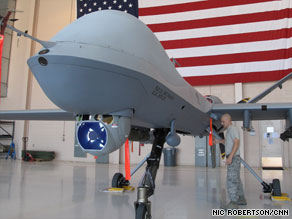
    Remote-controlled drones, such as the Predator, are proving increasingly popular with the U.S. military.

    Remote-controlled drones, such as the Predator, are proving increasingly popular with the U.S. military.

    Click to view previous image
    1 of 3
    Click to view next image

    U.S. Air Force fighter pilot Major Morgan Andrews is one such combatant. He kisses his wife goodbye, drives to Creech, a tiny desert air force base in Nevada, and within minutes could be killing insurgents on the other side of the world.

    Andrews fights not from the seat of the F16 he joined the air force to fly but from a darkened ground control station. He pilots a remote-controlled Predator, a UAV (unmanned aerial vehicle) which can spy on and attack positions and personnel without risk to its controller, shooting deadly Hellfire missiles at enemy fighters in support of fellow soldiers.

    "You're talking to them on the radios as if we were in a normal airplane flying overhead," says Andrews. "You see the imagery, you know what's going on, you see what you're looking at. It's very easy when something like that is happening to project yourself there and feel a part of the battle. Like I said, your heart starts racing a little bit." Is remote-controlled warfare a good or a bad idea? Tell us what you think.

    Meanwhile, intelligence analysts get to see images in real time and can identify personnel on the ground.

    There are now more than 7,000 UAVs ranging from the workhorse, the Predator, and its beefier, deadlier kin the Reaper, to army drones like the tiny hand-launched Raven and the larger Shadow.

    The drones are dramatically tilting the war in favor of the United States. Predators, for example, played a key role in killing al Qaeda in Iraq leader Abu Musab al Zarqawi in 2006. UAVs are credited with killing more than half al Qaeda's top 20 leaders.

    World's Untold Stories: Warfare by Remote
    For this month's World's Untold Stories Nic Robertson takes us inside the revolutionary world of robotic warfare and UAVs, better known as drones.
    Thurs July 23: 0430 ET, 1300 ET/Sat July 25: 0430 ET,

    Now U.S. Secretary of Defense Robert Gates wants more UAVs. Already he has said that the next generation of fighter planes -- the F-35 that took decades to develop at a cost of more than half-a-billion dollars each -- will be the last manned fighter aircraft.

    Lt. Gen. David Deptula, USAF, explains that the next phase will enable a single drone to provide as many as 60 simultaneous live video feeds directly to combat troops. Some new drones will be as small as flies, others walk -- all appear destined to work with decreasing human input.

    "The future of how you use these un-manned systems or remotely piloted systems is really unlimited," says Deptula, based at the Pentagon and racing to keep pace with battlefield needs as well as Gates's demands. "We need to open our minds and think more about capability and impact we are going to achieve as opposed to how we've done business in the past." Video Watch how UAVs are changing the face of warfare »

    At Creech, frontline requests surged when weapons were first put on the Predator. In Iraq and Afghanistan drones have become so indispensable that missions are cancelled if they are not available

    Robotic warfare expert Peter Singer, who advised President Barack Obama's campaign team and has authored "Wired for War," says that remote warfare is changing mankind's monopoly on how conflict is fought for the first time in 5,000 years. All that limits its advance is its application, not the technology.

    "The barriers of war in our society are already lowering," he says. "This tech may allow them to lower to the ground. And we might already be seeing this in the strikes being carried out on Pakistan."

    He points out that raw numbers over the last year show the same number of strikes as the opening of the Kosovo war. "But we didn't debate about it in Congress, we don't talk about it daily in our media."

    Pakistani officials say drones are killing al Qaeda leaders who thought they were beyond U.S. reach. But even the U.S. government admits civilians are dying in those attacks too.

    Singer fears the use of drones is misunderstood as cowardice, undermining the effectiveness of attacks and ultimately losing the war UAVs are fighting.

    He explains that last year one of the most popular songs in the Pakistani charts talked about America fighting without honor, adding that the U.S. is "getting better and better at targeting leaders but perhaps creating a context that gets more recruits."

    The spokesman for Taliban leader Mullah Omar recently told me that it is not afraid of drones, that it doesn't fear death. Deptula disagrees and quotes recently declassified comments between two Taliban leaders: "Tanks and armor are not a big deal, the planes are the killers."

    He says that of more than 600 Hellfires fired by Predators, over 95 percent hit their targets. Those that failed did so generally through mechanical fault, loss of guidance or a target moving at the last instant, Deptula says.

    Singer cites other instances when a computer fault has turned robotic warfare into a mass casualty event. "Last year in South Africa an anti-aircraft had a 'software glitch' during a training exercise," he says. "It was supposed to fire upwards into the sky, instead it lowered and it fired in a circle and killed nine soldiers, all because of a software glitch."

    For the U.S. military the gains more obviously outweigh the glitches. Hundreds, possibly thousands, of service men and women have had limbs and lives saved by bomb-detecting bots. Conservative estimates say that fighting from home and putting robots in to war has saved hundreds of millions of dollars.

    At Creech the demand for Predator pilots is so intense that it is mobilizing Air National Guard and reservists. It has also introduced an experimental training program for air force cadets from the videogame generation.

    Colonel Chris Chambliss, based at Creech, explains: "If you look at younger people right now, they multitask much better than I do. They can do a lot of things with a lot of different information, gather all that in. That's certainly a skill set we need."

    Cadet Greg Groves, who is in the Reserve Officers' Training Corps, has never flown a plane before -- but is well aware of his responsibilities.

    He says: "It's pretty clear that it's not a video game, and it is real life and that what I do directly affects someone else halfway around the world. So I don't think that's going to be a big problem for me."

    Groves' father and grandfather were both in the military: when he leaves for Creech he'll be the first in his family to go to war without fear of dying.

    Some commanders, such as Colonel Baxter Swift, based at USAF Balad in Iraq, says the future has only just begun.

    He says: "It's almost like what the hot air balloon was back in the Civil War for us. 'Hey, I can rise above and look around and see what the forces are doing on the battlefield.' So now we are just in the pioneering stage."

    Yet if U.S. forces can have UAVs, so can other nations. An estimated 40 or more countries also are developing drones, with an Iranian UAV already shot down over Iraq a few months ago. Even Hezbollah -- a political movement, not a state --- has used them against Israel. Video Watch how the demand for UAVs has increased »

    For his part, Singer draws another historical parallel, comparing the U.S. and the UAV to the British invention of the tank in the early 20th century.

    "There is no such thing as a permanent first maneuver advantage," Singer says.

    "The British came out of WWI with the most tanks, they invented the tank and yet they didn't figure out the best way to use it in the wars they would be fighting. It was the Germans that figured that out and it was the Germans that would be fighting and would win with the tank when WWII starts."

    All About U.S. Air Force ActivitiesThe TalibanAl QaedaPakistanIraqAfghanistan

    Tuesday, June 16, 2009

    The Coming Robot Wars

    Wired For War

    By P W Singer
    Reviewed by David Isenberg
    June 13, 2009
    Courtesy Of Asia Times OnLine

    If you want to understand why Peter Singer's latest book, Wired for War: The Robotics Revolution and Conflict in the 21st Century, is a tour de force, just consider some headlines from the past month.

    "Study Urges Using Neuroscience to Improve Soldiers' Performance"

    "Pentagon Joins CIA's [United States Central Intelligence Agency] Drone War on Pakistan"

    "Mullen: Drones Future Stalwart of US Force"

    "America's New Air Force"

    "Engineers at the Mojave Desert base are developing a miniature missile that can be launched from a robotic plane against terrorist targets."

    "In future, machines could decide when to fire weapons"

    The most fascinating thing about them is not that they are appearing only months after the book's release, though that will undoubtedly help boost sales. It is that every one of those headlines reflects an aspect of the issue, each of which has its own chapter in the book. They serve as testimonials to the prodigious amount of research and serious reflection on the issue that Singer has done.

    It bears mentioning that Singer, a senior fellow at the Washington, DC Brookings Institute must be making many other scholars gnash their teeth in envy. He is either the luckiest academic on the face of the planet or has an unparalleled sense of coming military trends. If he could discern economic futures as well as he does with military ones he would be giving advice to Warren Buffett and George Soros.

    His 2003 book, Corporate Warriors, examining the realm of private military and security contractors, came out less than six months after the US invasion of Iraq. That book became the gold standard for academic writing and media reporting on the issue. It was also the work which inspired the writing of countless other dissertations and theses on the subject. Although the subject had been covered by others, including myself, before then, his book made firms like Blackwater and Halliburton household words. To this day one can't read a paper on the subject without seeing a discussion of Singer's "typology" of the different types of private military contractors.

    That book's popularity was all the more impressive, considering it was his former PhD dissertation. A type of writing normally known for giving one bleary eyes and splitting headaches.

    After that he wrote a well received book on child soldiers.

    Fortunately, Singer has improved even more as a writer. Stylistically he has lightened up. His copious research is lightened by numerous pop culture references, much of it understandably drawn from science fiction, which is quite understandable, considering his subject is robots. That means references to the like of H G Wells and Jules Verne to Star Trek, Terminator movies, and, of course, Isaac Asimov. And almost all of them are highly informative and amusing. How many people knew that Wells predicted the advent of the atomic bomb?

    Despite the effort to appeal to a broader audience this is not a casual book. It is a very serious book about the future of one of humanities oldest activities, war. And while war and conflict has long been a staple of science fiction the problem, as Singer notes, is that science fiction is turning into science reality. He notes the famous quote by the late English physicist and science fiction author Arthur C Clarke, who wrote the novel 2001: A Space Odyssey, and gave us HAL, the malevolent supercomputer (think the artificial intelligence SkyNet from the Terminator movies) that: "Any sufficiently advanced technology is indistinguishable from magic."

    While robots are not magic, the technologies that are on the battlefields today, not to mention those on the drawing boards, are at the limits of human imagination. And perhaps beyond the limits of contemporary ethical and moral limits on the use of force and rules of war.

    Singer has very methodically and dispassionately looked at the past and present and has peered, on the basis of future weapons contracts, peered into the future. What has he seen? The answer is, though he does not put it this way himself is, to quote the tag line from one sci-fi movie classic (The Fly, 1986) is that we should "Be afraid ... Be very afraid."

    Right at the outset, in his author's note, Singer makes some critical points as to why this subject is important. Given that many people might think this is just another book about "gee whiz" technologies on the battlefield they are worth noting.

    First, "We embrace war but don't like to look to its future, including now one of the most fundamental changes ever in war."

    Second, "While we accept change in other realms, we resist trying to research and understand change in the study of war. For example, the very real fear about what the environment will look like as far away as 2050 has driven individuals, governments and companies alike to begin (belatedly) changing their practices. Yet we seem willing to stay oblivious to the changes that will come well before then for war, even though, just like the changes in global climate, we can already see the outlines of the transformation under way."

    Some of what Singer writes about has been known for years, at least for those who follow military technology issues. These include PackBots, used for explosive ordnance disposal (EOD), made by iRobot, the same firm that produced Roombas, the robotic vacuum cleaner. PackBots can also be equipped with a shotgun. So much for Isaac Asimov's Three Laws of Robotics, the first of which says robots shall do no harm.

    Another firm, Foster-Miller, produced the Talon, a ground robot which comes in EOD, reconnaissance, and hazardous material versions. Its true lethal weapon claim to fame, however, is its SWORDS (Special Weapons Observation Reconnaissance Detection System) version. This is the military version of a Transformer toy; able to carry almost any weapon less than 300 pounds, from automatic rifles and machine guns to grenade launchers and anti-tank rocket launchers.

    But is not just quantitative firepower that is remarkable; it is the accuracy and immunity to battlefield chaos. Not being affected by emotional stresses, every weapon it carries is capable of pinpoint precision, turning it into the equivalent of a sniper's rifle.

    The arming of a system likes SWORDS vastly increases the range of combat military duties it can do, from street patrols and sniping to urban warfare. Considering it can drive through snow or even underwater to a depth of 100 meters feet that means it could show up in the most unexpected places.

    But lethal weapons are not the only kind that robots are being equipped with. There is also ongoing work to equip robots with incapacitating chemical, acoustic, and directed energy weapons (think Star Trek phasers), and lasers.

    Ground robots can come in all shapes and sizes. The MARCBOT (Multi-Function Agile Remote Controlled Robot) is essentially a toy car with a video camera. But it has been used to carry anti-personnel mines to kill insurgents in Iraq.

    As of last year there were 22 different ground robot systems, over 12,000 in all, operating in Iraq. But robots aren't just for the army. They operate on the air and sea also.

    Most people today are familiar with the Predator, a UAV (Unmanned Aerial Vehicle) or drone, which can fly for a day and reach an attitude of 26,000 feet. Their cost of US$4.5 million each is miniscule compared to average cost of today's fighter or bomber aircraft. More importantly, they can stand stresses that human pilots cannot. Thus, the trend is that pilots will be used less and less.

    After the September 11, 2001 attacks Predators were armed, both by the CIA and the US military with Hellfire missiles, and have carried out thousands of missions, and at least hundreds of armed attacks.

    Aside from the predator there is its bigger brother, Global Hawk, which can stay in the hour for up to 35 hours and reach an altitude of 65,000 feet.

    Systems like these are actually piloted by human controllers working back in the United States. One hour they might be at work firing a missile from a Predator and the next back home eating dinner with the family. That has interesting, to say the least, implications for military professionalism and the warrior ethic.

    There are many other smaller aerial systems, used for reconnaissance, such as the Raven, Shadow and Wasp. Last year, according to Singer, there 5,331 drones in the US military inventory, almost double the number of manned planes.

    Drones are also being used domestically for homeland security and for policing the border with Mexico.

    At sea there is REMUS (Remote Environmental Monitoring Unit) used for clearing mines from waterways.

    In short, increasingly the US military will rely on robots. Even former president George W Bush acknowledged that. "Now it is clear the military does not have enough unmanned vehicles. We're entering an era in which unmanned vehicles of all kinds will take on greater importance - in space, on land, in the air, and at sea." To borrow from the world of fashion, military robots are the new black.

    All that just comes from the introductory overview. That is followed by chapters on the history of robots from ancient times to the end of the 20th century, fundamentals of robotics, and exponential change in technological trends.

    In chapter five, things become even more intriguing, and ominous, as Singer looks at the robots of the future, now on the drawing board. SWORDS is scheduled to be replaced by MAARS (Modular Advanced Armed Robotic System). Aside from more powerful weapons, a green laser "dazzler" and tear gas it will have a loudspeaker to warn insurgents that "resistance is futile".

    And, straight out of Paul Verhoeven's Starship Troopers, is the REV (Robotic Extraction Vehicle) which will be able to perform complex surgeries on wounded soldiers. Ironically, many of these systems are supposed to come together in the US Army's Future Combat Systems program, parts of which were recently cancelled after Secretary of Defense Robert Gates suggested cutting the program's ground vehicle and giant cannon components. He argued that they would not be as useful in the military's fights against insurgencies in such places as Iraq and Afghanistan.

    At sea there are both unmanned surface and underwater vehicles. Already there is the Spartan Scout, a 30 foot robotic speedboat, packing a .50-caliber machine gun. Some of the underwater
    vehicles mimic marine life, like the Robo-lobster, which detects and destroys mines close to shore.

    But it is in the air that the military robot future is advancing the quickest. Already, the Reaper, a successor to the Predator, that is four times bigger and nine times more powerful, is deployed to Iraq and Afghanistan. Other drones are being developed for electronic warfare, submarine hunting, and even air-to-air combat.

    DARPA (Defense Advanced Projects Research Agency) plans to field a VULTURE (Very-high-altitude, Ultra-endurance, Loitering Theater Unmanned Reconnaissance Element) drone, which it hopes will be able to stay aloft for five years at a time. People may recall that when the original Stark Trek series aired back in the 1960s the USS Enterprise was on a five-year mission.

    Lockheed Martin is pitching a robotic High Altitude Airship 25 times larger than the Goodyear blimp. Such an airship could be parked in the air for years and serve as spy satellite or even airstrip for other planes and drones (like the carrier in Sky Captain And The World of Tomorrow).

    There are also miniature drones that can eavesdrop into windows or climb up walls and pipes. Someday such systems may reach the nano scale, working at the molecular level, resulting in tiny missiles or nanobots destroying a target from the inside out.

    Singer writes that the air force sees at least 45% of its future large bomber fleet being able to operate without humans abroad.

    And for fighter jocks, like the ones Tom Cruise played in Top Gun, the news is grim. Already there UCAVs (Unmanned Combat Aerial Vehicles), such as Boeing's X-45 or Northrup Grumman's X-47, which can land on an aircraft carrier. The X-45 was, in fact, so threatening to the US Air Force's newest manned fighter planes, F-222 and F-35, that the X-45 was canceled, although some believe it still lives on in the classified "black" budget.

    Robot systems are also being envisioned for use in space. The X-41 Common Aero Vehicle is a cross between an intercontinental ballistic missile and the space shuttle. It would give the United States the ability to crush someone anywhere in the world on 30 minutes notice.

    And, as Singer points out, given the increasing number of private companies who are developing space travel capabilities the day may come when they have the ability to conduct military operations on their own. At that point the current private security contractors will have to change their acronym to private space contractors.

    All of this is fascinating, as Spock would say, but it poses profound implications for human control over war. Policymakers always like to toss off sound bites about humans being "in the loop" but there is no reason to think that is always true at present and far more reason to think it will be far less so in the future. In fact we started removing men from the loop in World War 2 with the Norden bombsight and the gap has been growing steadily since. As Singer notes, it is lip service, not reality.

    Already we have systems like the Aegis Defense system aboard US Navy warships which can operate in an autonomous mode, not needing human authorization to fire. And the sheer amount of sensor data that robotic systems generate will certainly be beyond the ability of human operators to assimilate, no matter how enhanced they are with neural implants or other technology.

    Not to mention that the imperatives of warfare are going to make robot autonomy inevitable, if only because once a robot is fired at it is going to need to be able to fire back, without waiting for human approval.

    By the way, that Terminator-like humanoid robot on the battlefield future is not far off. Scientists predict 2020 while soldiers predict 2025.

    All of this raises interesting questions. Will robots be vulnerable in the future? Can their communications links and operating systems be hacked? And, if so, what then?

    Or looking at Iraq and Afghanistan are robot systems really going to be effective in fighting insurgencies, where cultural awareness is as important as destructive power.

    And, as the United States increasingly relies on robots what happens when other states and non-state actors acquire their own? Already UAVs are widely traded around the world. And, in Iraq, insurgents have captured US robots and used them back against US soldiers.

    In an e-mail Singer wrote this is:
    Very much a growing field. The Predator and new Reaper variant for instance is being bought by pretty much half of North Atlantic Treaty Organization [nations]. Turkey just put in to buy to use against Kurds for instance.
    So what happens when other countries which are even more advanced in electronics and robotics, like Japan, start investing in military robotics?

    As Singer notes the US is not the only player in this. And, as an early adopter, the US may well be surpassed by other countries which piggyback off US developments.

    Because so much of robotic development is based on open source information their increased use may well hasten the global redistribution of power; not exactly the result that those hoping the use of military robots will allow continued US military hegemony.

    And how does the US military field enough scientifically and technologically adept personnel, when it has trouble attracting sufficient high school graduates, which was the case until the recent recession eased its recruiting problems.

    These are just a few of the questions Singer explores and it takes you barely past the halfway point.

    It is worth remembering that in the history of military technologies those who have wanted to develop something simply because they can have always won over those who questioned whether it should be developed.

    Singer makes it quite clear that the same is occurring with military robotics. If one walks into a lab where such systems are being developed one is going to be greeted with a shrug or a yawn. Right now, such systems are being developed in large part because doing so is "freaking cool".

    Currently there is already a dangerous divide between the American public and its military. What happens when the fighting is increasingly done by robots operated by "cubicle warriors"? Will policymakers find it even easier to go to war?

    Putting all other questions aside, Singer believes that Murphy's Law "Anything that can go wrong, will - at the worst possible moment" also applies to robots.

    Given the stakes, that alone is sufficient reason to be having a global debate about the subject. The fact that we are not is itself frightening.

    But for anyone interesting in having the debate Singer's book is a must-read.

    Wired for War: The Robotics Revolution and Conflict in the 21st Century by P W Singer, Penguin Press, 2009. ISBN-10: 1594201986. Price US$29.95, 512 pages.

    David Isenberg is a researcher at the International Peace Research Institute, Oslo. He is an adjunct scholar with the Cato Institute, a research fellow at the Independent Institute, a US Navy veteran, and the author of a new book, Shadow Force: Private Security Contractors in Iraq. The views expressed are his own. His e-mail is sento@earthlink.net.

    (Copyright 2009 Asia Times Online (Holdings) Ltd. All rights reserved.)