Showing posts with label Race Wars. Show all posts

Saturday, September 01, 2012

How The US Military Recruited Neo-Nazis, Gangs, and Criminals


Irregular Army: How Tthe US Military Recruited Neo-Nazis, Gangs, and Criminals to Fight the War on Terror


The tendency in mainstream Western journalism to downplay unfavourable trends occurring in the context of US military operations abroad: “The big scandals like Abu Ghraib, or the "Kill Team" in Afghanistan, eventually make their way into the media where they can be dismissed as bad apples and exceptions, and the general oppression of the occupations can be ignored”. 

A similar sort of argument can perhaps be made with regard to incidents such as the August 7 Sikh temple massacre in Wisconsin, perpetrated by Wade Michael Page, a decorated former Army psychological operations specialist and a neo-Nazi. Although any Pentagon-sanctioned explanation of the event would undoubtedly rest on the bad apple assumption, it has occurred to media outlets such as the Christian Science Monitor to question whether the intersection of military training and racist extremism in Page's case is not in fact indicative of a larger pattern. 

Noting that civil rights organisations like the Southern Poverty Law Centre "have warned that hate groups encourage their members to join [the military] for training and experience that they can later use to perpetrate crimes in the United States", CSM’s Anna Mulrine writes: 
"The Army's Criminal Investigation Division conducts a threat assessment of extremist and gang activity among Army personnel. 'Every year, they come back with "minimal activity", which is inaccurate,' Scott Barfield, a former gang investigator for the Department of Defence, told the Southern Poverty Law Centre in its 2006 report 'A Few Bad Men'. 'It's not epidemic, but there's plenty of evidence we're talking numbers well into the thousands, just in the Army'."
Irregular Army  

 US war veterans suffer amid mental care delays
Wade Michael Page's military service terminated prior to the inauguration of America's 21st century wars, when - as journalist Matt Kennard documents in his forthcoming bookIrregular Army: How the US Military Recruited Neo-Nazis, Gangs, and Criminals to Fight the War on Terror - insufficient enlistment levels led to an abandonment of certain recruiting standards and an increased influx of unsavory elements into the nation’s armed forces. 

According to a 2005 report sponsored by the US Department of Defence itself, "the military has a 'don't ask, don't tell' policy pertaining to extremism". However, Kennard's investigations suggest that even blatant "telling" often fails to incur meaningful repercussions. For starters, he reports telephoning five different Army recruitment centres, posing as an aspiring soldier curious as to whether his tattoo of Nazi SS lightning bolts will impede his soldiering aspirations. The upshot: "Despite being outlined in Army regulations as a tattoo to look out for, none of the recruiters reacted negatively and, when pressed directly about the tattoo, not one of them said it would be an outright problem".  

Even more revealing are Kennard's interactions with Forrest Fogarty, an Iraq war veteran and "white supremacist of the serious Hitler-worshipping type", whom Kennard meets in Tampa and accompanies on an excursion to the zoo with Fogarty's two children. 

Prior to departing for his tour in Iraq, Fogarty signed up with the Hammerskin Nation, "described by the Anti-Defamation League as the 'the most violent and best-organised neo-Nazi skinhead group in the United States'". Although his girlfriend attempted to thwart his deployment by submitting - to his military superiors - photographs of Fogarty at neo-Nazi rallies and performances of his Nazi rock band, he quickly persevered in front of the military committee assigned to scrutinise the circumstances: "I just denied it and said my girlfriend was a spiteful bitch, which is true".  

Domestic Wars

Leaders of the white supremacist movement view enlistment as a means of preparation for a domestic race war. Aside from general combat training, job perks include access to a laboratory of Iraqis and others susceptible to dehumanising brutalisation as well as opportunities to mail AK-47s and related items to the US. 

As Kennard demonstrates, the race war is not the only domestic conflict to which decaying military recruitment standards are contributing. According to a 2007 FBI report, "members of nearly every major street gang have been identified on both domestic and international military installations". The report's authors warn: "Both current and former gang-affiliated soldiers transfer their acquired military training and knowledge back to the community and employ them against law enforcement officers, who are typically not trained to engage gangster with military expertise."  

 US veterans face increased suicide risk
Kennard meanwhile cites statistics obtained by the Michael D Palm Centre via the Freedom of Information Act, revealing the proliferation in military ranks of felons and similarly qualified individuals. The Palm Centre, an official research unit of University of California at Santa Barbara, summarised its findings as follows: 
"The data indicate that from 2003 through 2006, the military allowed 4,230 convicted felons to enlist under the 'moral waivers' programme...  In addition, 43,977 individuals convicted of serious misdemeanors such as assault were permitted to enlist under the moral waivers programme during that period, as were 58,561 illegal drug abusers. In the Army, allowable offenses include making terrorist threats, murder, and kidnapping." 
According to Kennard, two of the morally waived terrorist threats involved domestic bomb attacks. 
As for mental health waivers, the Army's foremost mental health expert Col Elspeth Ritchie justified the funnelling into combat of troops diagnosed with post-traumatic stress syndrome on the grounds that "recruiting has been a challenge. And so we have to weigh the needs of the Army, the needs of the mission, with the soldiers’ personal needs". 

What To Look Forward To 

Irregular Army opens with a fifth-century quote on the decline of the Roman Empire from military observer Flavius Vegetius Renatus: "An Army raised without proper regard to the choice of its recruits was never yet made good by length of time; and we are now convinced by fatal experience that this is the source of all our misfortunes." 

Although US imperial decline is certainly nothing to mourn, the military establishment should perhaps consider the fallout of decisions to deploy and redeploy neo-Nazis, gang members, criminals and the mentally ill with the ostensible goal of sustaining empire. 

In addition to a likely increase in incidents such as the Sikh temple massacre, not to mention skyrocketing cases of suicide resulting from military service, an escalating militarisation of the US police force in order to deal with military-trained thugs with destructive domestic agendas clearly would not bode well for the civilian population.


Kennard notes that city officials in Salinas, California have already explored a military approach to the gang problem, partnering "with combat veterans and lecturers at the Naval Postgraduate School to devise a counterinsurgency operation likened by the veterans to those fought against insurgents on the streets of Mogadishu or Fallujah". Given that counterinsurgency is often synonymous with collective punishment, non-insurgents in such situations may fail to grasp the benefits.

As for other groups on the receiving end of police metamorphosis, the New York Times mused in December 2011: "[L]ately images from Occupy protests streamed on the internet - often in real time - show just how readily police officers can adopt military-style tactics and equipment, and come off more like soldiers as they face down citizens."

The absorption of tactics intended for use against foreign enemies into the repertoires of not only racist extremists and gang members but also law enforcement personnel dealing with citizens exercising their civil rights will make for irregular times indeed.

Tuesday, August 21, 2012

Unintended Causation


Is There A Causal Link Between Racially-Motivated Violence By Individuals and U.S. Foreign Policy?

Glenn Greenwald writes:

The alleged shooter of the Sikh temple in Wisconsin, Wade Michael Page, served in the U.S. Army from 1992 to 1998, first at a base in Texas and then at Fort Bragg in North Carolina. An article in The Guardian today examines Page’s time in the military and includes this passage:

Page did well enough after joining in 1992 to be assigned to a psychological operations unit at Fort Bragg, North Carolina. The unit is regarded in the US military as exclusive.
But at the time Fort Bragg was also a recruiting centre for white hate groups including the National Alliance, once regarded as one of the most effective such groups and also among the most extreme because it openly glorified Adolf Hitler. The Military Law Review at the time reported that National Alliance flags were openly hung in barracks and, out of uniform, soldiers sported neo-Nazi symbols and played records about killing blacks and Jews.
White supremacists have a natural attraction to the army,” the Military Law Review said. “They often see themselves as warriors, superbly fit and well-trained in survivalist techniques and weapons and poised for the ultimate conflict with various races.”
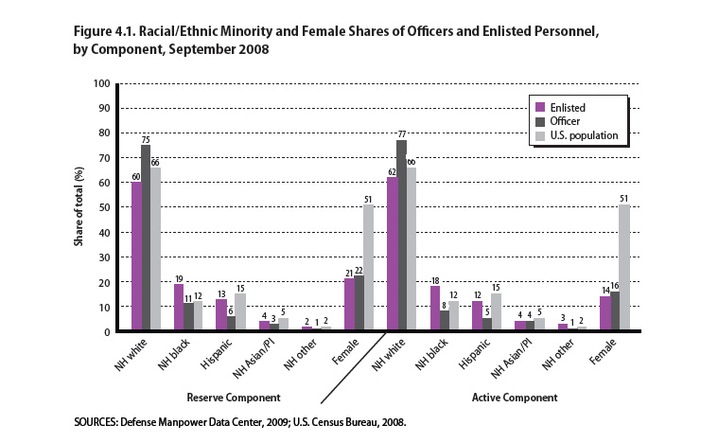
Is that perception on the part of white supremacists irrational: that joining the U.S. military is an optimal way to engage in, or train for, “conflict with various races”? It’s very hard to make the case that it is. There is ample evidence both of white supremacists’ encouraging adherents to join the U.S. military as well as those groups targeting service members for recruitment. It goes without saying that the vast, vast majority of members of the U.S. military are not members of white supremacist groups (indeed, only 62% of enlisted service members are non-Hispanic whites, though minorities are seriously underrepresented in the officer class). If anything, the attempt to Christianize the U.S. military is a greater problem than avowed members of racist groups joining the military (though those problems are arguably related). But whatever else is true, even the U.S. military’s own publication has recognized that “white supremacists have a natural attraction to the army.”
For all the endless chatter — and endless rights erosions — over the threat of Terrorism from Muslims, the reality is that there have been more Terror attacks on U.S. soil in the past decade committed by white, “right-wing extremists” than by Muslims. Philosophy Professor Falguni Sheth today provocatively argues that this spate of racially-motivated violence is directly connected to the decade-plus-long War on Terror that the U.S. has perpetrated.
Sheth begins by pointing to a mosque in Joplin, Missouri that yesterday was burned to the ground – the third fire on its property and “the second fire to hit the Islamic center in little more than a month” — and argues that our perceptions of violence are overwhelmingly dependent on the identity of the perpetrator (“those white guys are loners; those young white/Asian men are troubled and deranged loners. Those brown men are terrorists. Those black men are hoodlums and gangmembers”); Conor Friedersdorf makes a similar claim quite persuasively. But the bulk of Sheth’s argument is devoted to the claim that the underlying precepts of America’s foreign policy engender — if not tacitly justify — this sort of violence. I’m not adopting her argument in full, but it’s difficult to deny the causal connection she highlights:
Other truths must also be confronted. In large part, the shooters and arsonists who are behind many, if not most of these events in America, are white men.  In large part, these men have either come of age in the shadow of September 11. They have watched the media, heard Department of Homeland Security officials, and followed as mostly white male (and some female) politicians have given the anxious go ahead to wage an enormous war against Muslims abroad (Iraq, Afghanistan, Pakistan) or at home (in the form of the War on Terror).  Several of them have served in a military that follows the orders of two U.S. Presidential administrations by training their men to shoot, invade, drop rockets from helicopters, and drones controlled remotely from Syracuse, NY and other air force bases in the United States.
These white men have learned their lessons well, whether in the military or from hours of media news: the frustrations of a scared (white) America can be dealt with waging a war using guns, bombs, chemicals, and drones.  They have learned that it is ok to kill those who you believe to be behind threats to your comfort. They have internalized the message that those you fear can be addressed without words, without dialogue, but with violence, with power, with coercion. They have learned that some religions are automatically evil and that those who adhere to those religions must be destroyed.  And these white men reflect an ideology of violence that has permeated America in the name of the War on Terror. Sadly, that ideology, perpetuated by our white men and women in power, carried out by American soldiers, and endorsed by a lapdog media, isn’t fading away. It’s becoming bigger, stronger, and more murderous.
These men are not mad or crazy.  They are the well-trained students of American foreign and domestic policies. They have learned well the United States’ message: that violence and mayhem are the answer.  We need to change the scripts, and confront the fallout of a decade of the War on Terror—and other excuses for state-led violence quickly, before the chickens come home to roost.
The reason I’m hesitant fully to endorse this argument is that there are usually a diverse array of complex motives (psychological, emotional, ideological, religious) that drive individuals to engage in violence of this sort, and an equally diverse list of complex causes (legislative, political, cultural) as to why our society fosters and enables it. For that reason, I’m generally averse to seizing on a horrific episode, particularly in the immediate aftermath, and using it to try to isolate a single cause or confirm long-held beliefs.
That said, there’s no denying the strangeness of our collective reactions — intense outrage, laced with professed bafflement — to incidents like the Sikh shooting, or the mosque burning. It just is true that the U.S. is a country that has spent the last decade using massive amounts of violence in multiple Muslim countries: continuously bombing, invading, attacking, droning, and killing. In that part of the world, the U.S. government regularly kills innocent menwomen andchildren (almost always non-whites), and has bombed mosques,attacked funerals and mourners, and targeted media outlets for violence and killed their journalists.
There are some significant, obvious differences between state-sanctioned violence in the name of war and the rogue, indiscriminate killing by individuals, and it’s best not to ignore those differences in order to try to equate these acts. But Sheth’s primary point — that it’s difficult and perhaps even inconsistent to so righteously condemn things like the Sikh shooting or mosque burning while cheering for endless violence by the U.S. government against other nations filled with innocent people of races and religions different than one’s own– is not one that is easily dismissed. If the Military Law Review is willing to examine the attraction the U.S. military holds for white supremacists, the rest of us should be willing to do so as well.
And whatever else is true, it’s impossible to evade the fact thatEndless War will inevitably degrade the citizenry of the country that engages in it. A country which venerates its military above all other institutions, which demands that its soldiers be spoken of only with religious-like worship, and which continuously indoctrinates its population to believe that endless violence against numerous countries is necessary and just — all by instilling intense fear of the minorities who are the target of that endless violence — will be a country filled with citizens convinced of the virtues and nobility of aggression.
Via: "Salon"