Showing posts with label NeuroScience. Show all posts

Tuesday, April 02, 2013

The Pentagon's Mind Experiments

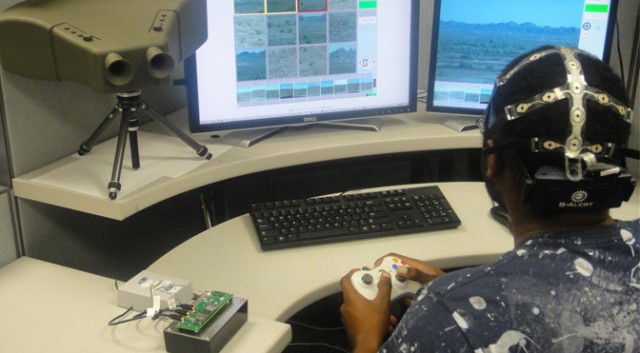
darpa-ct2ws-threat-detection-eeg-640x353
Cognitive Technology Threat Warning System (credit: DARPA)

By Ray Kurzweil


Duke University experiments in connecting the brains of two rats through implanted electrodes and the planned Brain Activity Map project reflect a growing Pentagon interest in neuroscience for applications that range from such far-off ideas as teleoperation of military devices (think mind-controlled drones), to more near-term and less controversial technology, like prosthetics controlled by the human brain, BBC Future reports.
The Pentagon’s expanding work in neuroscience in recent years has focused on medical applications, like research to understand traumatic brain injury and on concepts intended to help the military fight wars more effectively, such as studying ways to keep soldiers’ brains alert even after days without sleep.
But under the rubric of “Augmented Cognition,” DARPA has also pursued a number of military technologies, like goggles that would monitor a soldier’s brain signals to pick up potential threats before the conscious mind is aware of them.
While some of the applications might be a generation away, or may never arrive, like mind-controlled drones, others, like the brain-monitoring goggles, are already in testing (though probably not ready for use in the field).  That’s raising questions from ethicists, who are pushing for the government to begin now to think about “neuro ethics.”
In a 2012 article published last year in the journal Plos Biology, Jonathan Moreno, a professor of medical ethics, and Michael Tennison, a professor of neurology, argued that many neuroscientists don’t think about the contribution of their work to warfare, or consider the ethical implication of such work.
The question they raise is what choice future soldiers might have in such cognitively enhanced warfare. “If a warfighter is allowed no autonomous freedom to accept or decline an enhancement intervention, and the intervention in question is as invasive as remote brain control,” they write, “then the ethical implications are immense.”
Sharon Weinberger spoke in more detail about the Pentagon’s growing interest in neuroscience in her talk A Manhattan Project of the Mind at SXSW.

Monday, February 25, 2013

The Scientific Power Of Thought


Written and created by Mitchell Moffit (twitter @mitchellmoffit) and Gregory Brown (twitter @whalewatchmeplz).

The power of the mind and it's ability to affect physical change may shock you! Find out how simply imagining can make it so. 

Get Your FREE Audio Book - http://bit.ly/10gMVnV

Further Reading:

1) The Brain That Changes Itself - Norman Doidge, M.D.

Music Experiment:

2) http://jn.physiology.org/content/74/3/1037.short
3) http://ti.me/WifVpK

Muscle Experiement:

4) http://jn.physiology.org/content/67/5/1114.short

Brain Plasticity:

5) http://bit.ly/S8CHlM

Thursday, December 13, 2012

Mind Controlled Android Robot


An Electrode Cap and Computer Program Can Translate Brain Signals Into Commands For A Humanoid Robot.


Researchers in Japan are using a brain-machine interface to control the actions of a humanoid robot. The goal is to allow people “to feel embodied in the body of a humanoid robot,” in the words of one researcher.
Roboticists at the CRNS-AIST Joint Robotics Laboratory, a collaboration between the French National Center for Scientific Research and the Japanese Institute of Advanced Industrial Science and Technology, are trying to interpret brain waves into actions that can be understood by a robot. In the video below, a volunteer wears an electrode cap and watches a screen with flashing dots, which is used to teach his brain to associate flickering objects with actions. By focusing his attention, he can induce actions, which are translated from his brain activity into robotic motion.
A signal processing unit on a computer translates his brain activity and classifies it into a series of tasks. Then the team can instruct the robot on which task to perform. It could help paraplegics who can’t perform certain tasks on their own. Or it could be used for crazyfuture tourism, says Abderrahmane Kheddar, director of the JRL: “A paraplegic patient in Rome would be able to pilot a humanoid robot for sightseeing in Japan.”
Via: "PopSci"

Friday, November 02, 2012

Paralyzed Woman Uses Thought-Controlled Robotic Arm


The BrainGate implantable microelectrode array


Cathy Hutchinson has been unable to move her own arms or legs for 15 years. But using the most advanced brain-machine interface ever developed, she can steer a robotic arm towards a bottle, pick it up, and drink her morning coffee. The interface includes a sensor implanted in Cathy’s brain, which ‘reads’ her thoughts, and a decoder, which turns her thoughts into instructions for the robotic arm. In this video, watch Cathy control the arm and hear from the team behind the pioneering study.
The trial was a collaborative effort of the Department of Veterans Affairs, Brown University, Massachusetts General Hospital, Harvard Medical School, and the German Aerospace Center (DLR). It had two participants – the woman and a 66 year-old man, identified only as S3 and T2, respectively. Both of them had lost the use of their limbs years ago, due to brainstem strokes. They manipulated two different robotic arms, designed by the DLR Institute of Robotics and Mechatronics, and DEKA Research and Development Corp.
The business end of BrainGate, however, is a silicon microelectrode array that was implanted in each subject’s motor cortex (a part of the brain that’s associated with voluntary movement). That array is described as being about the size of a baby Aspirin, and contains 96 separate electrodes. An output cable leads from that array, to an external port on top of the user’s head.


Sunday, October 07, 2012

Paralyzed Woman Uses Thought-Controlled Robotic Arm

A paralyzed woman has used the experimental BrainGate neural interface system to get herse...


Cathy Hutchinson has been unable to move her own arms or legs for 15 years. But using the most advanced brain-machine interface ever developed, she can steer a robotic arm towards a bottle, pick it up, and drink her morning coffee. The interface includes a sensor implanted in Cathy's brain, which 'reads' her thoughts, and a decoder, which turns her thoughts into instructions for the robotic arm. In this video, watch Cathy control the arm and hear from the team behind the pioneering study.


The trial was a collaborative effort of the Department of Veterans Affairs, Brown University, Massachusetts General Hospital, Harvard Medical School, and the German Aerospace Center (DLR). It had two participants – the woman and a 66 year-old man, identified only as S3 and T2, respectively. Both of them had lost the use of their limbs years ago, due to brainstem strokes. They manipulated two different robotic arms, designed by the DLR Institute of Robotics and Mechatronics, and DEKA Research and Development Corp.
The BrainGate implantable microelectrode array
The business end of BrainGate, however, is a silicon microelectrode array that was implanted in each subject’s motor cortex (a part of the brain that’s associated with voluntary movement). That array is described as being about the size of a baby Aspirin, and contains 96 separate electrodes. An output cable leads from that array, to an external port on top of the user’s head.
Via: "GizMag"

Tuesday, June 26, 2012

The Mind Reader


Posted by "CavalierZee"

Adrian Owen has found a way to use brain scans to communicate with people previously written off as unreachable. Now, he is fighting to take his methods to the clinic.

What Is The Definition Of “Consciousness”? 

Adrian Owen still gets animated when he talks about patient 23. The patient was only 24 years old when his life was devastated by a car accident. Alive but unresponsive, he had been languishing in what neurologists refer to as a vegetative state for five years, when Owen, a neuro-scientist then at the University of Cambridge, UK, and his colleagues at the University of Liège in Belgium, put him into a functional magnetic resonance imaging (fMRI) machine and started asking him questions.

Incredibly, he provided answers.

A change in blood flow to certain parts of the man's injured brain convinced Owen that patient 23 was conscious and able to communicate. It was the first time that anyone had exchanged information with someone in a vegetative state.

Patients in these states have emerged from a coma and seem awake. Some parts of their brains function, and they may be able to grind their teeth, grimace or make random eye movements. They also have sleep–wake cycles. But they show no awareness of their surroundings, and doctors have assumed that the parts of the brain needed for cognition, perception, memory and intention are fundamentally damaged. They are usually written off as lost.

Owen's discovery1, reported in 2010, caused a media furore. Medical ethicist Joseph Fins and neurologist Nicholas Schiff, both at Weill Cornell Medical College in New York, called it a “potential game changer for clinical practice”2. The University of Western Ontario in London, Canada, soon lured Owen away from Cambridge with Can$20 million (US$19.5 million) in funding to make the techniques more reliable, cheaper, more accurate and more portable — all of which Owen considers essential if he is to help some of the hundreds of thousands of people worldwide in vegetative states. “It's hard to open up a channel of communication with a patient and then not be able to follow up immediately with a tool for them and their families to be able to do this routinely,” he says.

Owen takes a practical approach to applying the technology, hoping that it will identify patients who might respond to rehabilitation, direct the dosing of analgesics and even explore some patients' feelings and desires. “Eventually we will be able to provide something that will be beneficial to patients and their families,” he says.

Still, he shies away from asking patients the toughest question of all — whether they wish life support to be ended — saying that it is too early to think about such applications. “The consequences of asking are very complicated, and we need to be absolutely sure that we know what to do with the answers before we go down this road,” he warns.

Lost and Found

Owen traces the roots of his experiments to the late 1990s, when he was asked to write a review of clinical applications for technologies such as fMRI. He says that he had a “weird crisis of confidence”. Neuroimaging had confirmed a lot of what was known from brain mapping studies, he says, but it was not doing anything new. “We would just tweak a psych test and see what happens,” says Owen. As for real clinical applications: “I realized there weren't any. We all realized that.”

Owen wanted to find one. He and his colleagues got their chance in 1997, with a 26-year-old patient named Kate Bainbridge. A viral infection had put her in a coma — a condition that generally persists for two to four weeks, after which patients die, recover fully or, in rare cases, slip into a vegetative or a minimally conscious state — a more recently defined category characterized by intermittent hints of conscious activity.

Months after her infection cleared, Bainbridge was diagnosed as being in a vegetative state. Owen had been using positron-emission tomography in healthy people to show that a part of the brain called the fusiform face area (FFA) is activated when people see a familiar face. When the team showed Bainbridge familiar faces and scanned her brain, “it lit up like a Christmas tree, especially the FFA”, says Owen. “That was the beginning of everything.” Bainbridge was found to have significant brain function and responded well to rehabilitation3. In 2010, still in a wheelchair but otherwise active, she wrote to thank Owen for the brain scan. “It scares me to think of what might have happened to me if I had not had mine,” she wrote. “It was like magic, it found me.”

Owen moved from visual to auditory tests — “up the cognition ladder, from basic sound perception, to speech perception and then to speech comprehension”. For example, he presented people in a vegetative state with phrases containing words that sound the same but have two meanings, such as “The dates and pears are in the bowl”. The ambiguity forces the brain to work harder and shows up in characteristic fMRI patterns in healthy people — if, that is, they are comprehending the words. One of Owen's patients, a 30-year-old man who had been incapacitated by a stroke, showed the same pattern4. But not everyone was convinced that these signs pointed to comprehension. “Every time I would go to a neurologist or anaesthesiologist and say, 'he's perceiving speech', they'd ask 'but is he conscious?'.” Owen realized that he needed a different experiment to persuade the sceptics.

Anyone For Tennis?

It was June 2006. Wimbledon was on, and in a headline-stealing study, Owen took fMRI scans of a 23-year-old woman in a vegetative state while he asked her to imagine playing tennis and walking through the rooms of her house. When healthy, conscious adults imagine playing tennis, they consistently show activation in a region of the motor cortex called the supplementary motor area, and when they think about navigating through a house, they generate activity in the parahippocampal gyrus, right in the centre of the brain. The woman, who had been unresponsive for five months after a traffic accident, had strikingly similar brain activation patterns to healthy volunteers who were imagining these activities, proving, in Owen's mind, that she was conscious. The result, published in a one-page article in Science5, evoked wonder and disbelief. “I got two types of e-mail. People either said 'this is great' or 'how could you possibly say this woman is conscious?',” Owen says.

Other researchers contended that the response was not a sign of consciousness, but something involuntary, like a knee-jerk reflex. Daniel Greenberg, a psychologist at the University of California, Los Angeles, suggested in a letter to Science that “the brain activity was unconsciously triggered by the last word of the instructions, which always referred to the item to be imagined”6.

But Owen went on to bolster his case. Working with neurologist and neuroscientist Steven Laureys from the University of Liège, Owen showed that of 54 patients in a vegetative or minimally conscious state, five responded in the same way as the first woman1. Four of them were in a vegetative state. After refining their methods, the researchers asked patient 23 to use that capability to answer yes-or-no questions: imagine playing tennis for yes, navigating the house for no. They then asked about things that the technicians scoring the brain scans couldn't possibly know.

Is your father's name Thomas? No. Is your father's name Alexander? Yes. Do you have any brothers? Yes. Do you have any sisters? No. The experiment is no easy feat for the patient. Owen's protocol demands patients maintain focus for 30 seconds then rest for 30 seconds, with lots of repetition.

In front of a computer screen showing the fMRI data, Owen traces a blue line indicating activity in the supplementary motor area — a 'yes' — as it rises during the 'answer' period. It dives during the rest periods. A red line — indicating activity in the parahippocampal gyrus — represents the 'no'. The lines are sharp and clear, and Owen, who has a taste for puns, calls the implication “a no-brainer”. “You don't need to be a functional-imaging expert to appreciate what this person is telling you,” he says. The patient answered five of six questions correctly1. There was no discernible signal for the sixth.

Russell Poldrack, a neuroimaging expert at the University of Texas at Austin, calls Owen's methods ingenious. “When I want to give someone examples in which fMRI has told us something we really didn't know before, I use these,” he says.

But Parashkev Nachev, a clinical neuroscientist at Imperial College London, criticizes the work for “assuming that consciousness is a binary phenomenon”. Many patients, such as those having certain types of epileptic seizures, exhibit limited responsiveness without being conscious. Nachev says that more data are needed to indicate where in the continuum of cognitive abilities people in vegetative states fall.

Owen agrees that consciousness is not an “on-or-off thing”. He sees it as an “emergent property” of many “modules” of the brain working together. Enough of these modules are at work in his exercise, he says, for responsive patients to qualify as being conscious. A person needs long-term memory to know what tennis is, short-term memory to remember the question or command and intention to give an answer. Ultimately, Owen is not concerned with pinpointing a threshold of consciousness or with providing a comprehensive definition for it. He takes a “know it if you see it” approach. Responding to commands and questions — communication — is an undeniably conscious activity, in his view. “In the end if they say they have no reason to believe the patient is conscious, I say 'fine, but I have no reason to believe you are either',” he says.

To The Clinic

Currently, there are tens of thousands of people in a vegetative state in the United States alone. Owen reckons that up to 20% of them are capable of communicating; they just don't have a way to do so. “What we're seeing here is a population of totally locked-in patients,” Owen says.

Owen now wants to put his technique into the hands of clinicians and family members. So far, the technology has done little. The first woman in the tennis study died last year, and patient 23, for logistic and financial reasons, was assessed only once. Even if a person in a vegetative state is 'found', there is no guarantee that he or she will later be able to return a normal life. Owen nevertheless insists that “clarifying” a patient's state of consciousness helps families to deal with the tragedy. “They want to know what the diagnosis really is so that they can move on and deal with that. Doubt and uncertainty are always bad things.”

Two years ago, Owen was awarded a 7-year Can$10-million Canada Excellence Research Chair and another $10 million from the University of Western Ontario. He is pressing forward with the help of three new faculty members and a troop of postdocs and graduate students.

An early goal of the programme was to repeat the fMRI findings using an electroencephalogram (EEG)7. An EEG lacks fMRI's precision, and it cannot look as deeply into the brain, so the regions active in the tennis study were “off the menu”, says Owen. But other tasks — imagining wiggling a finger or toe — produce signals that, through repetition, become clear. An EEG is also cheap, relatively portable and fast (with milliseconds of lag compared with 8 seconds for fMRI), meaning that the research team can ask up to 200 questions in 30 minutes. “From a single trial you're not going to say, 'that person is saying yes', but if they get 175 of 190 right when tested, it's pretty clear.”

Now, using an EEG, Owen is planning to study 25 people in a vegetative state every year. He will have the help of a new 'EEGeep', a jeep equipped with experimental equipment that will allow the researchers to travel around to test patients who cannot be transported to Western Ontario.

One goal is to identify other brain systems, such as smell or taste, that might be intact and usable for communication. Imagining sucking a lemon, for example, can produce a pH-level change in the mouth and a recognizable brain signal8. Owen has shown that registering jokes provokes a characteristic response in healthy people9 and plans to try it on patients in a vegetative state. He hopes that he can use these tests to find some level of responsiveness in patients who cannot produce the tennis and navigation patterns of activity because of their level of brain damage.

The studies will also explore whether these patients have the capacity for greater intellectual depth. Owen thinks that some people in a vegetative state will eventually be able to express hopes and desires, perhaps like French magazine editor Jean-Dominique Bauby, who dictated his memoirs by repeatedly winking one eye. “I don't see a reason why they could not have a similar richness of thought, although undoubtedly some will not,” Owen says.

His techniques could also radically change treatment. Owen is already asking patients whether they feel pain. The answers will be useful in dosing pain killers, and similar tests could even be used in intensive-care units to guide rehabilitation resources, says Loretta Norton, a graduate student who is undertaking a study for this purpose. But she recognizes that this will be controversial.

Decision Time

Owen's methods raise more difficult dilemmas. One is whether they should influence a family's or clinician's decision to end a life. If a patient answers questions and demonstrates some form of consciousness, he or she moves from the 'possibly allowed to die' category to the 'not generally allowed to die' category, says Owens. Nachev says that claiming consciousness for these patients puts families in an awkward position. Some will be given hope and solace that their relative is still 'in there somewhere'. Others will be burdened by the prospect of keeping them alive on the basis of what might be ambiguous signs of communication.

Even more ethically fraught is whether the question should be put to the patients themselves. Fins and Schiff question whether patients would ever be able to show that they can understand the complexities of that question in the way that is normally demanded of, for example, patients giving informed consent.

Owen hopes one day to ask patients that most difficult of questions, but says that new ethical and legal frameworks will be needed. And it will be many years, he says, “before one could be sure that the patient retained the necessary cognitive and emotional capacity to make such a complex decision”. So far, he has stayed away from the issue. “It might be a little reassuring if the answer was 'no' but you can't presuppose that.” A 'yes' would be upsetting, confusing and controversial.

For now, Owen is hoping to use the technology to find other responders like Kate Bainbridge — who Owen now describes as a “motivational force”. “Otherwise,” he says, “what's the point?”

Nature 486, 178–180 (14 June 2012)

Courtesy Of "Nature" 

Monday, February 22, 2010

Neuroscience and National Security


The Complex Relationship Between Science and The Military
The military commonly enlists science in its efforts. But when science is humanity, the relationship gets a little stickier
By Emily Badger
Source: Miller-McCune
February 15, 2010
Courtesy Of
Global Research

Neuroscience and national security go together somewhat uneasily. Stick the two in a single sentence, and University of Pennsylvania historian Jonathan Moreno starts getting e-mails from all kinds of people who are sure they’ve been brainwashed by the CIA. (It might not help his inbox that he wrote a book called Mind Wars: Brain Research and National Defense.)

“It’s hard to talk about these issues in part because we have kind of a paranoid popular-culture background,” Moreno said. Maybe you’ve seen The Manchurian Candidate, or, more recently, The Men Who Stare at Goats.

Neuroscience and national security, though, sit at the forefront of the complex relationship between science and the military, bedfellows that have produced not just compelling fiction, but also real dilemmas for the researchers who bridge them.

The American Association for the Advancement of Science hosted a conference today of its year-oldScience and Human Rights Coalition, a group whose joint concerns are embodied most starkly in the application of science to war.

“The human rights frame is almost completely missing from this discussion,” said Len Rubenstein, the former executive director of Physicians for Human Rights and now a visiting scholar at Johns Hopkins. He spoke at the conference’s opening session. “The question of research for military purposes and scientific activity for military purposes is usually viewed either through the frame of professional ethics or scientific integrity. If human rights is introduced at all, it comes through the question of human subjects research with the Nuremberg Code.”

Scientists ought to consider, he argues, the broader question of human rights in work that ranges from weapons development to anthropology. As the science and potential military applications have grown more sophisticated, it follows that the ethics are now more complex, too.

Researchers, for instance, are already mulling whether beta-blockers could be used to reduce feelings of guilt in soldiers who do the unpleasant work of interrogation. Conversely, scientists wonder ifoxytocin could induce trust in the interrogated. And what if neuro-imaging could help indicate what combatants are thinking? Or if brain monitoring could track how soldiers handle stress in training?

“We’re moving clearly more and more in the direction of being able to manage neural activity, manage behavior, attitudes and perception at a distance,” Moreno said.

Rubenstein, in response, pointed to the little-recognized Article 22 of the Universal Declaration of Human Rights. It entitles a person to social security indispensable for both dignity and “the free development of his personality.”

“When we have weapons that are deliberately designed to change people’s personalities, to manipulate people’s personalities, we have a problem,” Rubenstein said. “Not only an ethical problem, not only a national security problem, we have a human rights problem.”

It’s not that human rights are opposed to national security, Rubenstein argues; this is why the Geneva Conventions attempt to regulate conduct in war, not oppose war all together. From there, the distinctions are important. Weapons incapable of discriminating between combatants and civilians — like land mines or cluster bombs — violate human rights, he said, suggesting scientists who contribute to developing them must bear this in mind.

The most public example of murky scientific involvement in warfare has come from the Pentagon’sHuman Terrain System, a controversial program to embed anthropologists with soldiers in Afghanistan and Iraq. The Department of Defense billed the program, which was unveiled in 2007, as a path toward greater cultural understanding and, ultimately, less violence.

But the American Anthropological Association roundly denounced the program. The participating anthropologists typically wear military uniforms and sometimes carry firearms. The military has insisted the program isn’t designed to gather intelligence for combat, but the AAA questioned how the one can ever be separated from the other in the context of war.

The Human Terrain System, the AAA concluded, violates many of the association’s main ethical tenets, including the obligation to do no harm and to obtain “informed consent” from subjects — something it may be impossible to give when facing a scientist in uniform.

In the new worlds of asymmetrical warfare, counterterrorism and neuroscience, however, all of the ethical guidelines may not yet be written.


Global Research Articles by Emily Badger