Showing posts with label Cognitive Technology Threat Warning System (CT2WS). Show all posts

Tuesday, April 02, 2013

The Pentagon's Mind Experiments

darpa-ct2ws-threat-detection-eeg-640x353
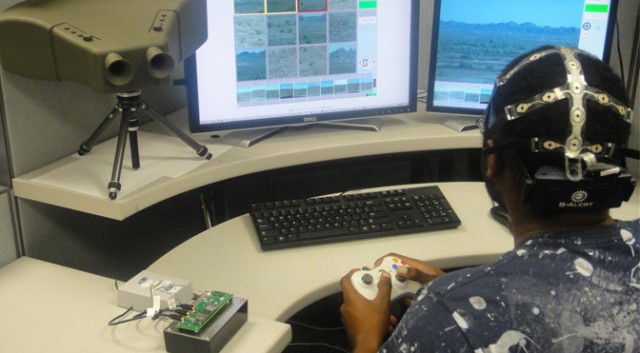
Cognitive Technology Threat Warning System (credit: DARPA)

By Ray Kurzweil


Duke University experiments in connecting the brains of two rats through implanted electrodes and the planned Brain Activity Map project reflect a growing Pentagon interest in neuroscience for applications that range from such far-off ideas as teleoperation of military devices (think mind-controlled drones), to more near-term and less controversial technology, like prosthetics controlled by the human brain, BBC Future reports.
The Pentagon’s expanding work in neuroscience in recent years has focused on medical applications, like research to understand traumatic brain injury and on concepts intended to help the military fight wars more effectively, such as studying ways to keep soldiers’ brains alert even after days without sleep.
But under the rubric of “Augmented Cognition,” DARPA has also pursued a number of military technologies, like goggles that would monitor a soldier’s brain signals to pick up potential threats before the conscious mind is aware of them.
While some of the applications might be a generation away, or may never arrive, like mind-controlled drones, others, like the brain-monitoring goggles, are already in testing (though probably not ready for use in the field).  That’s raising questions from ethicists, who are pushing for the government to begin now to think about “neuro ethics.”
In a 2012 article published last year in the journal Plos Biology, Jonathan Moreno, a professor of medical ethics, and Michael Tennison, a professor of neurology, argued that many neuroscientists don’t think about the contribution of their work to warfare, or consider the ethical implication of such work.
The question they raise is what choice future soldiers might have in such cognitively enhanced warfare. “If a warfighter is allowed no autonomous freedom to accept or decline an enhancement intervention, and the intervention in question is as invasive as remote brain control,” they write, “then the ethical implications are immense.”
Sharon Weinberger spoke in more detail about the Pentagon’s growing interest in neuroscience in her talk A Manhattan Project of the Mind at SXSW.

Friday, October 12, 2012

"Luke Skywalker" Binoculars Use Brain Waves To Spot Threats


By Katie Drummond,

Five years after the Pentagon first conceived of them, the binoculars of the future have arrived: Scopes that not only allow soldiers to scan wide-ranging areas and lengthy distances, but that tap into their brains to vastly improve threat-detection.


Called the Cognitive Technology Threat Warning System (CT2WS), the initiative was first launched in 2007 by — not surprisingly — DARPA. Today, the agency announced the results of field tests using the futuristic system, which was nicknamed “Luke Skywalker” early on in the program. According to DARPA, the binoculars yielded a 91 percent success rate in detecting threats. By comparison, soldiers using conventional binoculars or camera systems currently miss around 47 percent of potential dangers.
The system is comprised of a high-powered video camera, mounted to a tripod, that boasts a 120-degree field of vision. That camera works in tandem with an electroencephalogram (EEG) cap, worn on a soldier’s head, that actually monitors brain signals in real-time and then transmits them to a computer system. That system is programmed with “cognitive visual processing algorithms” that can crunch the deluge of brainwave data, and “cue” noteworthy images for an operator to look over.
Using the system, a soldier scanning a given region would be “shown approximately ten images per second, on average.” Instead of having to process potential threats oneself, the soldier (and an operator reviewing key images) would instead rely on subtle brain signals — picked up by the EEG cap — to hone in on hazards. The EEG data, according to DARPA, can enhance accuracy and hasten the rate at which threats are detected, by spotting theminside the brain before a soldier has even processed the situation.
“CT2WS built on the concept that humans are inherently adept at detecting the unusual,” reads a statement from DARPA. “Even though a person may not be consciously aware of movement or of unexpected appearance, the brain detects it and triggers the P-300 brainwave, a brain signal that is thought to be involved in stimulus evaluation or categorization.”
In other words, CT2WS harnesses that capacity for detection, without relying on conscious input from the wearer. And, at least according to these field tests, it seems to work extremely well when combined with human input. When tested without someone wearing an EEG cap, the system produced 810 false alarms every hour. Add a soldier decked out in EEG sensors to the mix, and that figure dropped to five false positives.
I’ve reached out to DARPA for more particulars on the prototype, which was developed by a team that includes HRL Laboratories and the University of California, San Diego. But based on reporting from Sharon Weinberger at Wired in 2007, the agency also wanted the binoculars to have a range from 1,000 to 10,000 meters, and be able to spy moving vehicles at a range of up to 6 miles.